OECD Competition Assessment Reviews: Logistics Sector in Singapore, conducted within the framework of the ASEAN Competition Action Plan, assesses the impact of regulation on competition in the sector. The assessment process benefited greatly from the support of the Competition and Consumer Commission of Singapore (CCCS).
Executive summary
Main economic characteristics of the logistics sector in Singapore
Key findings and recommendations by sub-sector
Introduction to the ASEAN competition assessment project
An OECD team has conducted assessments of competition laws and regulations in ten ASEAN Member States (AMS), as well as a general study of the ASEAN region. He has worked in close cooperation with the ASEAN Secretariat (ASEC), the ASEAN Expert Group on Competition (AEGC), as well as with the responsible authorities within each AMS, in particular, the competition authorities.
Benefits of competition
The Association of Southeast Asian Nations (ASEAN) selected the logistics sector as one of its 12 priority sectors in its ASEAN Framework Agreement for the Integration of Priority Sectors, signed in 2004. As part of the ASEAN Competitiveness Action Plan, the ASEAN Secretariat asked the OECD to: 1) carry out an independent competition assessment of legislation in the logistics sector; and 2) prepare a regional report assessing the impact on competition of state-owned enterprises (SOEs) and state-linked monopolies in selected markets in ASEAN. The analysis was funded by the ASEAN Economic Reform Program under the UK Foreign, Commonwealth &.
1 Introduction
Introduction to Singapore
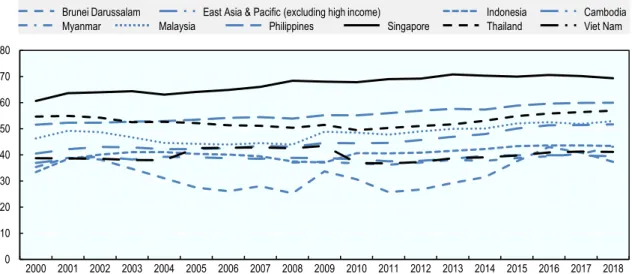
In the period 2006-2018, the share of services to the total GDP has been constantly increasing, as seen in Figure 1.3 below. In the ASEAN region, the best performer after Singapore is Malaysia, followed by Thailand (27) and Brunei Darussalam (55).

Introduction to the logistics sector
Inland waterway transport moves goods on non-maritime waters, such as rivers or canals. Maritime pilots tend to be navigational experts with high skill levels (often former captains) and specialized knowledge of the particular navigational conditions of a port, such as tide, wind direction and sea depth.
Logistics sector key figures
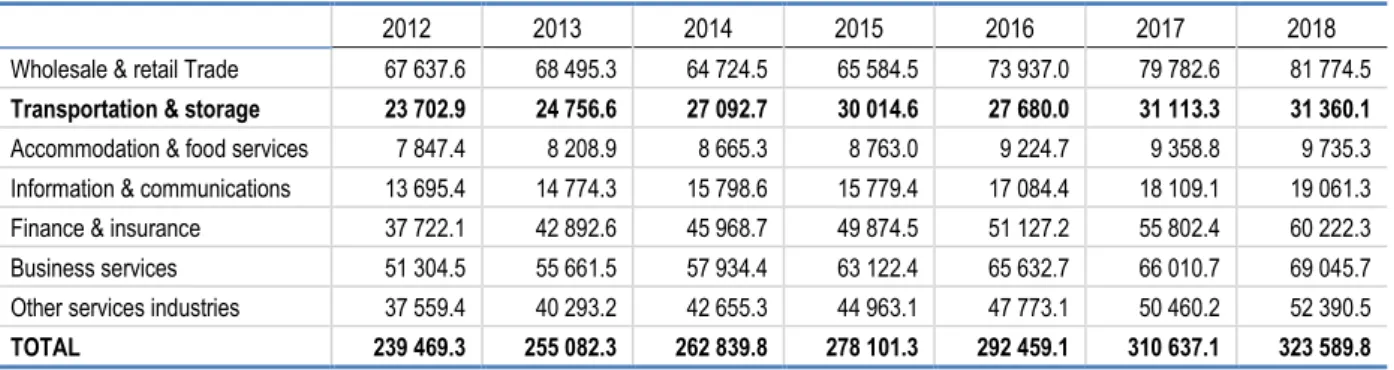
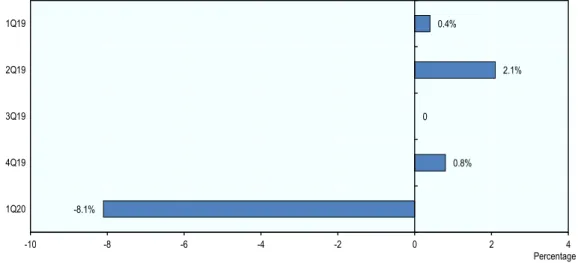
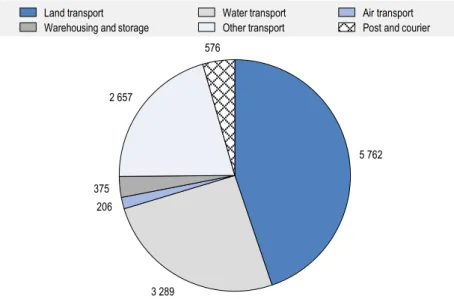
The logistics sector is a crucial sector for the development of any economy, connecting companies with both national and international opportunities. Freight transport is a sector of vital importance to Singapore's economy, especially as the country is a small open economy with limited space and natural resources and so heavily dependent on international trade.
2 Economic and institutional overview of the logistics sector in Singapore
Key stakeholders
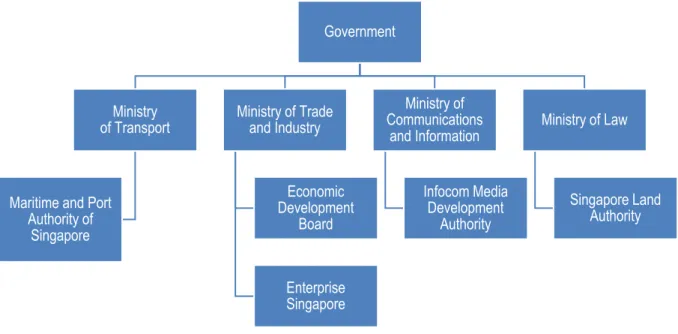
Within the government, the Ministry of Transport (MOT) is responsible for strengthening the country's connectivity and developing transport services to promote Singapore's economic competitiveness. The Maritime and Port Authority of Singapore (MPA) was established in 1996 to assume the roles of port authority, port regulator and planner, promoter and developer of Maritime Singapore, and to represent Singapore's maritime and port interests in international fora. In the past, it has attracted leading third-party logistics providers such as Exel and DB Schenker and helped locally based companies develop their capabilities.
In addition, he was responsible for several long-term plans such as the five-year productivity roadmap launched in 2012 together with SPRING Singapore (now part of Enterprise Singapore) to increase the long-term productivity of Singapore's logistics and. JTC Corporation (JTC), the country's leading planning promotion and industrial landscape development agency, currently manages industrial estates and business parks in Singapore.
Road freight transport
3 Overview of the legislation in the logistics sector in Singapore
Maritime freight transport
To ensure competence and safety, pilots must hold a valid certificate issued under Article 68 of the Maritime and Port Authority of Singapore Act. BEO exempts parties to a liner shipping agreement that does not exceed a total market share of 50%58 from Section 34 of the Competition Act if the following conditions are met. Some of the factors claimed to be unique to the liner industry (high and uneven capacity investment, fluctuating demand, structural requirements for overcapacity and below-average marginal costs when supply exceeds demand) are in fact shared with other industries that provide regular scheduled services, such as . such as rail and air transport (OECD, 2015, p. 13[49]).
Withdrawing the block exemption would mean that carriers that collaborate would have to carry out a self-assessment of how their collaboration fits into generic competition law. In that context, the Commission could consider issuing temporary guidelines for the application of the horizontal guidelines to liner shipping, similar to the temporary guidelines introduced following the repeal of the block exemption for liner conferences.

Warehouses
Such guidelines could focus on the need for alliances to ensure the transfer of a fair share of the benefits from their activities to consumers and downstream supply chain operators in accordance with the requirements of Article 101(1). 3, of the Treaty on the Functioning of the European Union. The Singapore Land Authority (SLA) controls the majority of land in Singapore and is also responsible for keeping the land registry. After the expiration of the agreed duration under the lease, the government may consider extending leases of industrial land "if there is significant investment on the land or property and the use is in line with current economic priorities".64.
Private individuals can apply to the SLA to renew their lease for up to 30 years with the payment of a land premium: a payment for the right to use land that takes into account changes in the value of the land. When a lease expires, the government considers whether to grant an extension, depending on whether the continued use of the land is consistent with its long-term planning and whether the lease extension will be accompanied by intensification and optimization of the land use.
Small-package delivery services
All service providers except SingPost prohibit the use of master keys for two-way design mailboxes. The situation is different in buildings with so-called three-way design letters that give access to the single letters. Outsource last-mile deliveries of small items that fit in the letterbox to SingPost.
IMDA has long said that limited access to mailboxes is justified for security reasons. For mail delivery, having Aperture Masterdoor Keys would be equivalent to having access to mailboxes with open openings.
Horizontal and others
Furthermore, Singapore authorities are supporting the development of innovation in the logistics sector through a number of policy initiatives. Such innovation will most likely help reduce transportation costs and bring efficiency to the logistics industry. In the highly fragmented road freight market in Southeast Asia, the platform connects companies in need of transportation services with pre-qualified ground freight carriers.
The provisions for the employment of foreigners in the logistics industry are intended to support the national labor market and ensure that Singaporeans acquire the necessary skills to take up jobs in the transport and warehousing sector. They have led to an increase in the country's doing business score, allowing Malaysia to rank 12th among 190 economies in 2020.

International agreements
Singapore signed the ASEAN Framework Agreement on Multimodal Transport (AFAMT) in 2005, but has yet to ratify it.90 The OECD understands that the necessary domestic ratification formalities and the deposit of the ratification instrument with the ASEAN Secretary General will be completed in the course of 2021 will take place. The AFAMT will regulate the liability, documents and operations of multimodal transportation companies in ASEAN countries and will facilitate their operations. Based on the draft currently under discussion, Singapore's Multimodal Transport Bill 2020 will cover four key areas, namely:
The objective of the ASEAN Framework Agreement on Multimodal Transport is to facilitate the "expansion of international trade among ASEAN members" and to "encourage the development of smooth, economical and efficient multimodal transport services that meet the requirements of international trade". Ratify the AFAMT and introduce specific provisions or a new law to implement the ASEAN Framework Agreement on Multimodal Transport into national law.
OECD (2019), Background note by the Secretariat: Competition for-the-market, https://www.oecd.org/daf/competition/competition-for-the-market.htm. OECD (2019), Roundtable on Hub-and-Spoke Arrangements – Background Note, https://www.oecd.org/daf/competition/hub-and-spoke-arrangements.htm. OECD (2014), Factsheet on how competition policy affects macroeconomic outcomes, https://www.oecd.org/competition/factsheet-macroeconomics-competition.htm.
OESO (2011), OECD Policy Roundtable - Competition in Ports and Port Services, http://www.oecd.org/regreform/sectors/48837794.pdf. 1, https://www.oecd.org/economy/policy-incentives-for-private-innovation-and-maximising-the-returns.pdf.
Notes
14 See www.singstat.gov.sg/find-data/search-by-theme/economy/national-accounts/latest-data;. 42 See www.imda.gov.sg/programme-listing/smes-go-digital/industry-digital-plans/logistics-idp. See also www.mti.gov.sg/- /media/MTI/ITM/Trade-Connectivity/Sea-Transport/Sea-Transport-ITM---Infographic.pdf.
66 Info-communications Development Authority of Singapore (2008), "IDA's Explanatory Memorandum on the Postal Services Regulations", https://www.imda.gov.sg/-. 82 Ministrstvo za delovno silo, SkillsFuture, https://www.mom.gov.sg/employment-practices/skills-training-and- development/skillsfuture.
Annex A. Methodology
- Mapping the sectors
- Screening of the legislation and selection of provisions for further analysis
- Limits the number or range of suppliers
- Limits the ability of suppliers to compete
- Reduces the incentive of suppliers to compete This may be the case if the piece of legislation
- Limits the choices and information available to customers This may be the case if the piece of legislation
- In-depth assessment of the harm to competition
- Formulation of recommendations
The OECD has also prepared (and refined it at later stages) a comprehensive economic overview of the logistics sector, covering industry trends and key indicators such as output, employment and prices, including comparisons with other ASEAN and OECD member countries where relevant. The analysis carried out during this stage aimed to provide background information to better understand the mechanisms of the sector, provide an overall assessment of competition, as well as clarify the important players and authorities. At the same time, the team researched the policy objectives of the selected provisions to better understand the regulation.
An additional aim in identifying the objectives was to prepare alternatives to the existing regulations in phase 4, taking into account the objective of the specific provisions where necessary. The objective of policy makers was explored in the recitals of legislation, where applicable, or through discussions with the relevant public authorities.