
This article is the seventh part of a work intended to describe and illustrate the Foratninifera of the Atlantic Ocean, especially those species which occur in the waters adjacent to the coast of the United States, including the entire Gulf of Mexico and the Caribbean, this is the area in which most of the work of the United States dredging vessels has been done.
THE FOKAMINIFEEA OF THE ATLANTIC OCEAN
NONIONIDAE, CAMERINIDAE, PENEROPLIDAE, AND ALVEOLINELLIDAE
INTRODUCTION
NONIONIDAE
2 BULLETIN 104, UNITED STATES NATIONAL MUSEUM
ATLANTIC OCEAN 3
4 BULLETIN 104, UNITED STATES NATIONAL MUSEUM
Both Nautilus scapJia and N.jaba of Fichtel and Moll appear to represent the same species, and d'Orbigny's Nonionina communis from the Vienna Basin is apparently the same from material examination. Test planispiral, bilaterally symmetrical, fully convoluted or very slightly developed, outline angular, umbilicus depressed, often with a few very small beads; chambers numerous, usually about 12 in the last formed spiral, broad and low, uniform in shape throughout; In fact, the umbilical region of the figure given by Fornasini from the "planches in^dites" is slightly beaded.
Test plani coil, fully convoluted, compressed, circumference rounded, composed of about 10 chambers in the last coil formed;
8 BULLETIN 104, UNITED STATES NATIONAL MUSEUM
9 region which is filled; wall smooth, distinctly but finely perforate;
Test plan is spiral, bilaterally symmetrical, usually convoluted, in peripheral view, sides nearly parallel, outline rounded; chambers numerous, usually 10 to 12 in the last formed coil in adults, chambers rapidly increasing in length, especially in the last few chambers; I recorded it from Montego Bay, on the north coast of Jamaica, from numerous stations around the Tortugas, and from the port of San Juan, Puerto Rico. It occurred fossilly in the late Tertiary from the Yumuri River Gorge, Matanzas, Cuba, and from Bluff 3, Cercado de Mao, Santo Domingo.
Test planispiral, bilaterally symmetrical, highly compressed; periphery rounded, umbilicus sunken and open; numerous chambers, 12 or more in the last formed coil, of fairly uniform shape and size;.

14 BULLETIN 104, UNITED STATES NATIONAL MUSEUM
FORAMINIFERA OF THE ATLANTIC OCEAN 15 The subtrochoid forms belonging to this genus are close to Nonion, and the microspherical form may be very close to it in many species. Africa (Egger); Scandinavian Coast (Goes); Dogs Bay, very rare (Wright); the southern coast of Norway from Brevik Fiord to Bukn. This is a very pretty little species, and is abundant in the diggings sent out by the late Joseph Wright some years ago.
These two genera, Crihrospira and Bradyina, are distinct in many ways and may not belong in this family.
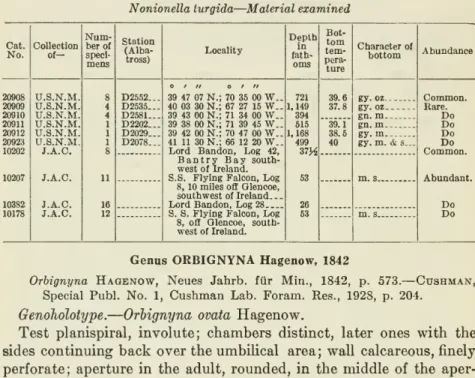
18 BULLETIN 104, UNITED STATES NATIONAL MUSEUM
This form was recorded by Kiaer and Awerinzew from the Arctic of Siberia, Greenland and off the coast of Norway. The form suggested by Heron-Allen and Earland from western Scotland as "Polystomella decipiens Costa" is this species. Although this species has been recorded by authors from the Atlantic Ocean, the specimens I have seen are not the same as this species as developed in the Mediterranean type locality.
As far as I have seen, nothing like this occurs in material from the western side of the Atlantic.
23 umbilical regions each with a large rounded boss, in peripheral view-
Black differs from the typical mainly in the character of the wall, which in the black is pearl-colored and coarsely perforated, giving a very characteristic appearance to the test. Test of small size for the genus, strongly compressed, periphery broadly rounded, margin slightly lobulate, sides nearly parallel in peripheral view, umbilical areas slightly depressed; chambers averaging 10 to 12 in number in the last formed coil, but varying, much. There is considerable variation in the specimens of this species, in the shape, which is somewhat longer than broad and soft.
Test of relatively large size for the genus, compressed, margin broadly rounded, margin only slightly lobulate, umbilical region slightly indented, smooth; chambers relatively few, 10 to 12 in last formed whorl, very slightly inflated; sutures distinct, slightly indented, marked by a double row of rounded pores, no.
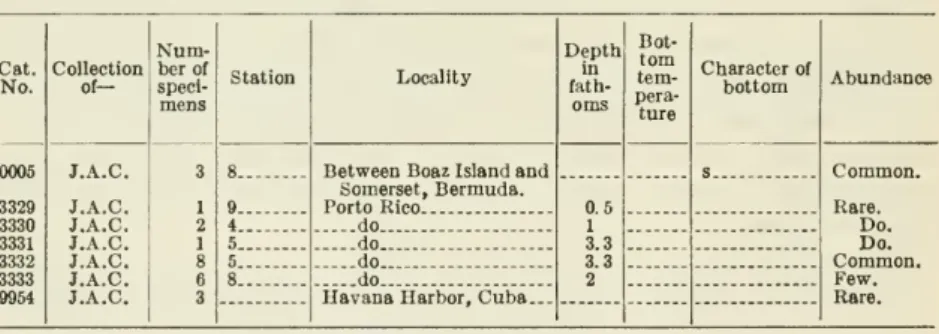
28 BULLETIN 104, UNITED STATES NATIONAL MUSEUM
Test of very large size for the genus, strongly compressed, periphery rounded, slightly lobulated, umbilical regions slightly depressed and the coils not completely enveloped, exposing some of the early coils in the central region; rooms numerous, as many as 25 in the last-. Test similar to ElpMdium in general structure, but trochoid, planoconvex, ventral side flattened, dorsal side convex.
30 BULLETIN 104, UNITED STATES NATIONAL MUSEUM
CAMERINIDAE
Archaediscinae Test not broken up into chambers
Camerininae Test with numerous chambers
FORAMINIFERA OF THE ATLANTIC OCEAN 31 wall calcareous, perforated; aperture narrow, at the base of the apertural plane. Test lenticular, planisplral, bilaterally symmetrical, involute; wall perforated, calcareous, with a secondary skeleton and complicated canal system; diaphragm simply at the base of the diaphragm face,. Tests similar to Camerina, but most flattened, the chamber usually not completely enclosed so that the earlier coUs are not covered, or with the wall very thin so that the earlier coUs are visible from the outside.
32 BULLETIN 104, UNITED STATES NATIONAL MUSEUM
33 HETEROSTEGINA ANTILLARUM d'Orbignjr
34 BULLETIN 104, UNITED STATES NATIONAL MUSEUM
PENEROPLIDAE
Spirolininae
Brady accepted this group in the Challenger Report, and many later authors followed suit. In 1915, Heron-Allen and Earland, in their paper on the recent foraminifera of the Kerimba Archipelago, examined the early descriptions and figures by using five different specific. For stages of development in microspheric and megalospheric forms, the reader is referred to Part 6 of Bulletin 71 of the United States National Museum, where pages 85 and 86 show this develop-.
Test typically tightly coiled throughout, compressed, biumbilicate, coils usually not completely involute, the earlier coils appearing at the umbilical region, periphery rounded to subacute; chambers numerous, very variable in number, distinct, not inflated, low and wide; sutures are distinct, raised, spiral sutures and some sutures often raised, other sutures ; wall ornamented with fine striae parallel to periphery; aperture consisting of several pores along the midline of the aperture surface. I have recorded it from Jamaica, Porto Rico, and the Tortugas, and it occurs at Habana.
OCEAN
Test very compressed, the early part coiled planispirally, but often partly developed, the later part very campanulate and spreading, reaching back on both sides towards the earlier chambers, but not tirely embracing; chambers distinct, very slightly inflated, wide and low; sutures distinct, depressed, occasionally somewhat. This species is abundant in the Mediterranean and in the Indo-Pacific, but does not, so far as I have seen, reach the West Indian region, where it is replaced by the following species. In the eastern Atlantic, what appear to be typical specimens are recorded from the coast of Great Britain, and very likely the species, like other Mediterranean areas, extends into the warmer parts of the eastern Atlantic.
Test small, very strongly compressed, early part planispirally coiled, usually partly volute, later part widened, forming a flared test; chambers distinct, long and low; attachment very distinct, depressed; wall finely pitted but not striated; openings in the central line of the apertural face. It occurs at numerous stations along the Tortugas and the Florida Keys, at Bermuda and Jamaica. Peneroplis planatus, as far as I have seen, does not occur in the western Atlantic and is apparently replaced by this species.
Test very compressed, in the young closely coiled and enveloped, the chambers later becoming elongated, finally spreading out and embracing the earlier portion of the test, which in the adult forms completely annular chambers; closely distinct, depressed; wall completely smooth; opening in the adult formed by pores around the median line of the periphery. I have collected many typical specimens at this same place, at the Tortugas, off Jamaica, and at Bermuda. It also occurs in the Bahamas and probably has a very wide general West Indian distribution.
However, Peneroplis does not have its chambers divided into chambers, a character easily produced by wetting the test.
42 BULLETIN 104, UNITED STATES NATIONAL MUSEUM
ATLANTIC OCEAN 43 Length of western Atlantic specimens not over 0.50 mm
Often abundant in the Mediterranean and Indo-Pacific, this species is very rare in the western tropical Atlantic. This is apparently a widespread form occurring in small numbers in the general region of Western India. So little is known about this genus that it is difficult to place specimens separately.
Chapman's figures appear to differ in shape and surface features from Brady's and those found in the Tortugas and Puerto Rico. Specimens from the West Indian region are of the same type, but consist only of rectangular series, which appear broken.
46 BULLETIN 104, UNITED STATES NATIONAL MUSEUM
The original specimens of Fichtel and Moll are recorded from the Mediterranean and the Arabian Sea. Its occurrence in the Mediterranean is much doubted, and it may be that the authors had West Indian material from some source. The Red Sea, which I could see in the Brady collection, has certain characters which seem to distinguish it from West Indian specimens.
In the western Atlantic there may be two living species in addition to what is often referred to as Orhiculina compressa d'Orbiguy, which is. These species must all be studied in detailed section and the relationships of the microspheric and megalospheric forms determined.
48 BULLETIN 104, UNITED STATES NATIONAL MUSEUM
Orbitolitinae
Test in early stages planispiral, at least in microspherical form, later annular, in the simplest forms the chamber is only partially divided, entirely so in more complex forms; openings on the peripheral face. Test in early stages planispiral, at least in microspherical form later annular; chambers in one plane, not completely divided into chambers; openings numerous. Dough discoid, planispiral in early stages at least microspherical in shape, later annular, completely divided into chambers;
Under this genus are included those species which have a single layer of annular chambers divided into chambers in the adult, often referred to "Orhiculina" and "Orbitolites." Test thin, very compressed, circular in outline in the adult, entire test consisting of a single layer of chambers, each with a single layer of chambers throughout, early chambers in a spiral, later. Test very compressed, circular in outline, the early chambers^^ in microspherical form twisted planispirally, soon widening and becoming annular, inside a gallospheric post-commencement of the annulus. proloculum rounded or oval; chambers in two layers in the adult, and each divided into many chambers, the chambers of each newly added series alternating with those of the preceding series; the wall is imperforate except in the proloculum and the subsequent chamber, which are finely porous; openings in the periphery of a double chamber series, like the chambers.
The species, if those from the West Indian region and those from the Indo-Pacific and the Mediterranean are the same, have a wide distribution. In the West Indies it occurs in large numbers, attached to the leaves of the short eel-grass, Posidonia, which grows in great abundance in shallow water. I have examined the species Amphisorus Tiemprichii in the Ehrenberg Collection in Berlin and it appears that Carpenter's species is a.
FORAMINIFERA OF THE ATLANTIC OCEAN 53 annular chambers not connected with each other, but with those of the adjacent preceding and succeeding annular chambers; wall imperforate except in the earliest chambers, which are perforated.
ALVEOLINELLIDAE
54 BULLETIN 104, UNITED STATES NATIONAL MUSEUM
I collected it on the north coast of Jamaica, at a few stations in the Tortugas region, and at.

PLATES
S. NATIONAL
INDEX