The Museum of History and Technology:
Paper 69
JAMES MILLHOLLAND AND EARLY RAILROAD ENGINEERING
John H White
Smithsonian Press Washington, D.C.
1967
215-884—6S-
:^^^t^^^^^<^
Figure 1.—James
Millholland
(1812-1875), pioneer railroad master mechanic. As this signature shows, he spelled hisname
variously. (From World's Railways, p. 45.)James Millholland
And
Early Railroad Engineering
From
the apprentice 07t the"Tom ThtimF^
to themaster machinist
of thePhiladelphia and Reading
Kailroad, the career ofJames Millholland spanned
nearlya
halfcentury in the earlydevelopment
of theAmerican
railroad.One
of the greatme
chatties of the 19 th century, he isremembered
not onlyfor his highly original innovations, themost
outstanding of ivhich ivas the conversion of thewood
burner to the anthracite burner, but alsofor his locomotives, ivhich were plain, practicalmachines,
highly distinctivefrom
the ornate locomotives of the period.The Author: John H. White
is associate curator of trans- portation in theSmithsonian
Institution sMuseum
of Historyand
Technology.JAMES Millholland
isremembered
todayas one of the foremostrailwaymaster mechanics ofthe 19th century.He was
fortunate in also having been esteemedinhislifetime forhavingperfectednumerous
railwaymechanisms
and,most particularly, for hiswork on
anthracite-coal-burning locomotives.He was
bornon
October6, 1812,inBaltimore,Maryland, and
therereceived a private education.' Gifted with'Railroad Gazette (August28, 1875),vol.7,p.362. (Obitu- arynotice.)
an
aptitude for mathematicsand
influenced by his father,who
manufactured ship fittings,young
Mill- holland inclined naturally toward mechanics as alife work. In 1829, at age 17, he
was
apprenticed toGeorge
\V.Johnson, a Baltimore machinist, there gaininghis firstexperienceinworkingon alocomotive engine, Peter Cooper's famousTom
Thumb.Cooper, in an effort to persuade the
new
Baltimoreand Ohio
Railroad to adopt steam power,had
started to build this lightsteam locomotive ui 1829.He had worked
out the general arrangementand
assembled aPAPER
69:JAMES MILLHOLLAND AND EARLY RAILROAD ENGINEERING
Figure2.
—
Tracing of Millholland's sketch of the George ]\'.Johnson, built in 1831 for the Baltimore and Ohio Railroad.
r^ft^sct itbCo
boiler
and
cylinder, but, busy with other affairs inNew
York, he askedGeorge Johnson
to complete the machine.Thus young
Millhollandhad
adirecthand
in the building of the
Tom Thumb —
completed in1830
— and
shared in a pioneer effort to introducemechanical transport inAmerica. Considering Mill- holland's later involvement with anthracite coal, it
was somewhat
prophetic that theTom Thumb was
de- signed toburn
this fuel.Millholland next assisted his employer in building a second locomotive,
named
the George ]\\ Johnson in honor ofits designer. Itwas
completed in 1831and won
SI000 as second prize in a contest sponsored by the Baltimoreand Ohio
Railroad.The
Johnsonem-
ployed a curious assemblage of design features, in- cluding walking beams, geared transmission,and
a divided firebox, but themachine was
not a successand was
retired after brief service.The
onlyauthentic illustration of the Johnson is alittle sketch
made
by Millholland in 1873 (fig. 2).The
several illustrationswhich
were subsequentK published are based on this sketch.-
Millholland left his native city for
New York
in1832
and
entered theemployment
of the Allaire Works, a firmfamous
for marine engines.With
the exception of a briefsojourn in Mobile,
Alabama, where
heworked on
a sawmill during 1836, hestayed with Allaire until 1837. In his 25th year, like most otheryoung
mechanics, he was obscureand unknown,
but,unlike most.Millholland was aboutto
embark
on a distinguished career.His great opportunity
came
in 1838when
he returned to railroadwork
in Baltimoreand was
appointed mastermechanic
of the Baltimoreand Susquehanna
Railroad.The
prestige of hisnew
position possibly
was more
apparent than real, for the Baltimoreand Susquehanna was
a threadbarelittle
company whose
serpentine roadwound
a dis- tance of58 miles between Baltimore,Maryland, and
York, Pennsylvania. Ithad
80 bridges, toomany
curves,
and
too few locomotives or cars.The
novice mastermechanic
soonwas
put to the test ofkeepingin working order the road's 10 engines,
which
could not have beenmore
poorly adapted to the needs of the compan)-.Three
were Britishmade. The
restwere built
on
patterns similar to the British engines by the Locksand
Canalsmachine
shop of Lowell, Massachusetts. All of the engines proved too light forsteep gradesand
too rigid to negotiate the road's sharp curves. Fortunately, thecompany had
a fairly well-equipped repair terminal in Baltimore, adjacent to the presentMt. Royal
Station,known
as the Bolton shops. Millholland therebegan
remodel- ing the road'sniotivepower
asfastasfundspermitted.One
of the most extensive locomotive remodelings Millholland executed for the Baltimoreand
Sus-quehanna was
the reconstruction of the Herald,^the first engine
on
the line. Itwas
a Sampson-class-Reconstructions of the Johnson appeared in Railway Age (July7, 1893),vol. 18,p. 531,andinJ.G. Pangborn, WorliTs Railways (NewYork: WinchcllPrinting Co., 1894), p. 52.
'The facts presented on the Herald are from the Baltimore and Susquehanna Railroad's annual report for 1854, and in Railroad Advocate (May 26, 1855), vol.2,p.2.
BULLETIN 252: CONTRIBUTIONS FROM THE MUSEUM OF HISTORY AND TECHNOLOGY
1!
,^,,,oHV. ^ s. so,,,
^tl
V
Jr
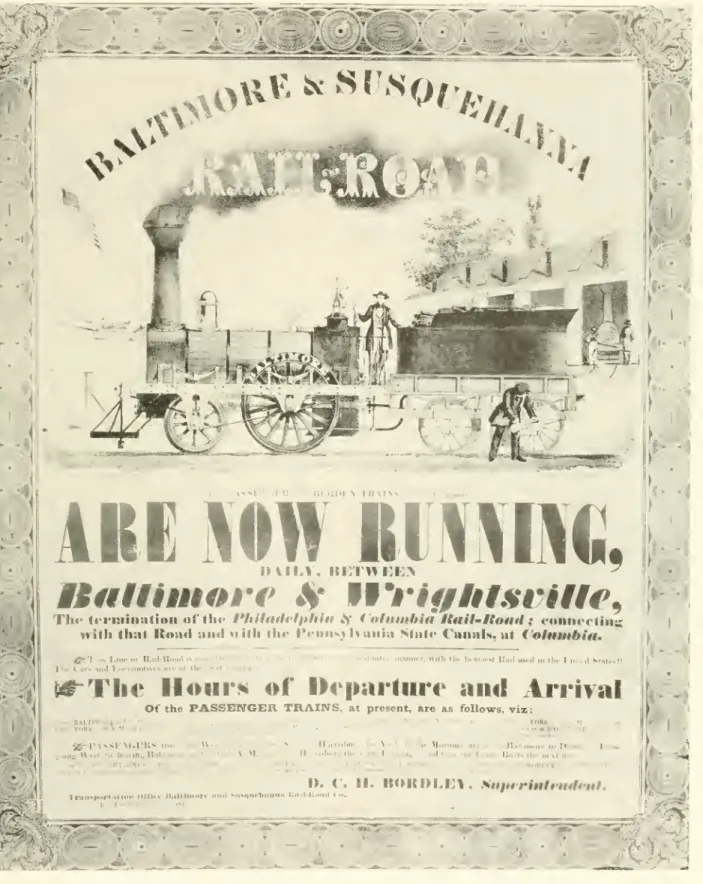
|i„ i>vssi:\(;i;!; :,..>i i!ii;i)i:> mvi\--.,i iin-i.
-4^^
'^i
kU MOW RIIIII«,
Hatthum'e ^V 99'riff/itsi'ifre,
rh«' tiTiiiiiiation
of Uh-
I'hilmlt'lithiti ift'ohimhia Itail-Koail
: <-oniii-<'iins vvitli tlial K»>iii himIwith
the i*«Miii>>,vivaiiia SttiU' CaiiHis,allohitnbia.
C- '. l.icK'r.rU.iil.H<«<ilUroi.-lni.l.il111 1 .1. r.l LlKLIIHUiviSIITC l.fill. I"xl.|T.I.I
If ;iii<IHiiji^tiiiiijii)iiinnnpr.withllichrnvi<-Ktllni)hhi'i)miiIkI
i^Tlie Hours of llepartiire and Arrival
Of
thePASSENGER TRAINS,
at present, are as follows,viz: :.wYORK•"*^.,M".v<i1' ^!•4i-I>\^S1M,I!KS I'. .1.1, 11,l>
1. •
J^.
I>.
i. H. BOUI>Li:i> StiiHHnletulfnl.
1r,...-|..,iiiti«iiofU»«-ItiiliiiM.trriiiitl^.isaiu-tiiinunKii.t.lt.tii.lt«..
Figure 3.
—
TheBaltimore(1837)builtbyLocksand Canals andreconstructedbyAlillholland in later years with a leading truck and cast-iron crank axle. (FromThomas
NorrcU.)i-
I-
PAPER
69:JAMES AEILLHOLLAND AND EARLY RAILROAD ENGINEERING
0-4-0, astandard design of its English maker,Robert Stephenson
&
Cb.The
enginehad
proved entirely unsatisfactoryfortheBaltimoreand
Susquehanna,and had
been rebuilt inOctober
1832—
-onlya fewmonths
after its delivery
—
as a4-2-0
wheel arrangement.By
1846, however, itwas
found too small for further serviceand
accordinglywas
taken into thecompany
shops for major remodeling. Millholland fashioned a powerful 13-ton 0-6-0, nearly twice the weight of the original Herald,
from which
only the boilerwas
used.
Other
major features of this remodeling were a gear drive forpower and
low speed,and
a lateral- motionarrangement
for each driving a.xle to permit navigation of sharp cur\'es.The
engine was in-tended for the
movement
of trains through city streets between the railroad's various Baltimore terminals.The
Heraldwas
still in ser\'ice in 1857, butwas
sold for scraptwo
years later.Millholland's gifts as
mechanic and
innovator firstreceived notice in a report by the American Railroad Journal for
November
6, 1845,on
the use ofcast iron formaking
crank axles. Inside-connected engines,which
were then popular, were fitted with wrought- iron crank axles.Although
\vrought ironwas
the strongest material available, itwas
not only costlv, but its variable qualityand
fibrous charactermade
itunreliable for use in crank axles. These broke frequently, creating a costly hazard
and
serious accidents.Millholland's insistence
upon
cast-iron crank axlesseemed
preposterous because the metalwas
brittleand
unable to withstand great impact stresses.He
eschewed oidinary cast iron, however,
and
insistedon
the best cold-blastMaryland
iron—
the kind used for cannonsand
car wheels— which had
a tensile strength ofabout 30,000pounds
per square inch.In its report, the American Railroad Journal noted that Millholland'scast-iron crank axle
had
been used successfully sinceJune
15, 1845.The
engine in question, unidentified except that itwas
built in Lowell,was
unquestionably one of the light Locksand
Canals locomotivesmentioned
above. Itwas
described as having a leading truck, a single pair of driving wheels,and
a pair of trailing wheels,making
it a 4—2-2.
The
crank axleweighed
1150pounds
before turning,which compared
favorably to a similarunmachined
wrought-iron axle weighing 1164 pounds. Ithad
been cast byJ.Watchman
ofBalti-more
at a cost of S69, whereas the wrought-iron axle cost S291 before machining.Not
onlywas
the cast- iron crankcheaper, butitwas
equallyas strongas thewrought-iron one.
The
American Railroad Journalcon- tinued its report:A
few evenings since, the engine with the cast iron crankaxle,was, together withits tender, thrownentirely off the track, by a large hog getting under the \\heels behind the cow-catcher—
nodamage
having been donetoany partof theengine, itwas thusshownthat the cast axle can bear without injury the sudden and violent strain towhich it was subjected by thisaccident,aswell as the wrought iron crankaxle. There is thereforegood reasonfor believing that thisimprovement,whichwillso materially reduce the cost of replacing a broken crank axle,
may
withperfectsafetybe introducedintogeneraluse.The
Baltimoreand Susquehanna
subsequentlyfittedits otherinside-connected engines withcast-iron crank axles.
No
evidence exists that other roads followed suit, but the Baltimore road seenied well pleased with Millholland's innovation. In a letter toRobert
Stephensonand
Co., datedMarch
8, 1850,Robert
S. Hollins, secretary of the Baltimoreand Susquehanna,
stated:"Our
preference is the Cranked Axle Locomotive, but repeated breaking ofthe axle;Every Locomotive
having broken one or more,we
were induced to trycast iron,and
afteran
experience of 5years,we
have adoptedthem
entirely, never yet having broken a Cast Iron Crank Axle''' ^ This state- ment,made two
years after Millhollandhad
left the Baltimoreand Susquehanna,
testifies that the cast- ironcrankaxlewas
a successon
itsown
meritand
not merely because itwas
a "pet" ofthe presidingmaster mechanic. According to Millholland's eldest son,James
A. Millholland, one of these crank axleswas
sentto his fatheryears later,presumably
inthe 1860's, after the enginehad
been scrapped.^ This trophy laid arouitd the Philadelphiaand Reading
shops forsome
years, only to bejunked
during a clean up.In addition to rebuilding existing machines
and
developing thecast-iron crankaxle, Millholland builttwo new
locomotives at the Bolton shops.The
firstof these identical machines, the General Taylor,
was
completed inOctober
1846; the other, theWm.
H.It'alsnn, in
March
1847.^ Intended forfreight service, thesemachines werelargeforthetimes,each weighing*Engineer(May 29, 1914), vol. 117,p. 601.
5Letters dated
May
11 and 18, 1888, fromJames A. Mill- holland toJ. E. VVatkins, acuratorat the Smithsonian Institu- tion.^American Railroail Journal (December 19, 1846), vol. 19, p. 811,states that the ]i'alson "waslately built." The March 1847 dateisgiven in the Baltimoreand Susquehanna's annual reportfor 1849.
BULLETIN 252: CONTRIBUTIONS FROM THE MUSEUM OF HISTORY AND TECHNOLOGY
26},; tons.
They had
18- x 18-inch cylinders, 48-inch- diameter driving wheels,and
were inside-connected, fitted with massive cast-iron crank axles each ofwhich measured
about 8,^ inchesindiameter (fig.4).A
separate cutoffwas
employed, both valves being driven bya single eccentric. Boththe Taylorand
the Watsonappearto have beenwood
burners, since theyhad
small, deep fireboxes.Millholland's energies were not confined to loco- motive work, for he also contributed
improvements
to car
and
bridge design. His advocacy of railway- car springsmade
ofwood
paralleled his cast-iron cranks as a bold substitution of a cheaper,unconven- tionalmaterialforheavy
service. Millhollandsecured apatent (No. 3,276) forwooden
springson September
23, 1843,
and
theiruseby
the Baltimoreand
Susque-hanna was
reported the following vear:The
freight cars ingeneral useonthisroadare superior, inmany
respects, toanywe
haveseen,that is, they carry agreateramount
offreight inproportion totheweight of the car, than on most roads.They
have six wheels, thebodyismade
lightbutstrong, restingonwoodsprings, consisting oftwo pieceseach 2 inches by6, and 13 feet long, ofwhiteash plank. Other companieswill do well to examine them and either adopt, or improve upon them."Tlie Baltimore
and Susquehanna
annual reportfor 1843 notes the construction of 29 six-wheel freight cars '-on the plan in\ented byJames
Millholland."Such
cars cost $450,weighed 8500 pounds,and had
a capacity of12,000to 14,000 pounds.The same
reportmentioned
the construction of a "similar" car for passenger service, apparentlymeaning
one with sixwheels
and on wooden
springs.The
1844 annual report shows the construction of 37more
six-wheel cars, 24 ofwhich
were built in thecompany
shops, the remainderby
pri\ate contractor.By
1850 the road reported 159 six-wheel freight cars of various styles. Six-wheel cars were in themselves unusual.The
onlyother United Statesrailroadknown
to havethem was
the Baltimoreand
Ohio,which had
o\er 200 six-wheel iron coal hoppers. Six-wheel tenders, however, werecommon
in the 1840sand
1850s,and
six-wheelcarswere used extensivelyby
foreign roads.In addition,
wood
springs were used lateron
thou- sands of four-wheel coal "jimmies" of the Reading,Lehigh
Valley, Central ofNew
Jersey,and
other roads.Some
of these continued in regular service through the 1890's. Millholland received J1000 for the use ofhiswood
springand
other patents while hewas
in theservice of theReading.*'American Railroad Journal (October 1844),vol. 17, p. 292.
'The Minutesof the Board of Managers, preservedby the Reading Company, Philadelphia, Pennsyhania. Cited here- afterasMinuteBooks.
PAPER
69:J.\MES MILLHOLLAND AND EARLY RAILRO.AD ENGINEERING
,\-s
J22j "
^^^l^
ijiii ( f>/s/gi
nTUf/uf
1 ),Z'/7//i;f'
^^nJUit
CortM/tn^
for A.eJomiet/
^<:'iLJc/e.A^i^i^^^^fM'
Figure 6.
The
plate-girder bridge completed in 1847byMillholland
for the Baltimore and Susquehanna Railroad. (FromEngineeringNews,October20, 1888.)track bridge
was
fabricatedfrom
Jj-inch boiler iron.It
was
6 feet deepby
54feet long, weighing 14 tons.Built at the Bolton shops in the winter of 1846
and
placed in service 19 miles north ofBaltimorein April 1847, itwas
the first such bridge inAmerica — and
probablythe first ofits kind inthe world. In 1864it
was
rebuilt for a double trackand
continued in use for another 18 years '' (seeAppendix
I).In 1848 Millholland
was
in the prime of life, a recognizedmechanic and
respected engineerwhose
reputationhad outgrown
his position with the strug-" EngineeringNews (October 20, 1888),vol. 20, p. 305,con- tainsa drawing and reproduces a letter (May 1, 1849) from Millhollandto
Herman
Haupt describingthebridge. See also C.W.
CoNDiT, American Building Art: the I9lh Century (New York:O.xford UniversityPress, I960), pp. 106-107and 301.gling Baltimore
and
Susquehanna. Accordingly,when
inAugust
1848 the Philadelphiaand Reading
Railroadofferedhim
theposition ofmastermachinist, hereadily accepted.'-The
Philadelphiaand Reading was
one of the best engineered railroads in the 19th-centtu-yUnited
States. In contrast to most
American
roads, it \vas very well constructed, with generous curves, light grades,and heavy T
rails. Its capitalized costcame
to SI80,000 per mile,
more
thansixtimes thatofmost otherAmerican
railroads.Running
from Phila-'2Millholland gives the date of his employment with the Readingin a letter (November9, 1860) to C.T. Parryof the Baldwin Locomotive \Vorks. This letter is preserved by the HistoricalSociety ofPennsylvania.
PAPER
69:JAMES MILLHOLLAND AND EARLY R.MLROAD ENGINEERING
iOCOAJ[]"/';
\
4 V"-i%^;
^
•:'jj'j5-r;syL
c.
S
n
-^^V/-T-
Figure 7.-
— The
Philadelphia, builtin 1844 by Norris Brothersfor the Philadel]jhiaand Reading Railroad.Shown
as rebuilt 1848-1849bv MillhoUand. (From AmericanLocomotives. 1849, by E. Reuter.)delphia tothe coal fields near Pottsville, the line
was
built as
an
anthracite carrier. In 1835, tliree years beforeitbegan
tooperate, the board ofmanagers had
decided itwas
"of the utmost importance that the locomotive enginesto beconstructed for thiscompany
be built with a view to the exclusive use ofanthracite as fuel . . . ."'^ This planwas
frustratedwhen
experience
showed
that anthracitewas
all but im- possible toburn
in locomotives,and
the linehad
to resort towood.Millholland's major
problem was
not simply to build a coal-burning locomotive—
diflicultenough
initself
—
but one that \\ould burn anthracite. This"MinuteBooks,April 13, 1835.
dense, slow-burning fuel
—
sometmies called "stonecoal"
— was
singularly inappropriate for use in thenarrow and
deepwood-burning
fireboxes of the early 19th century. Anthraciteburned
bestwhen
spread thin over a large area.Wood, on
the other hand, being highly combustible,was
stacked thickand deep
for best results in firing.
Because the Reading's primary traffic
was
anthra- cite,MillhoUand
\sas expected to develop a practical planfor usingthis fuel in thecompany's
locomotives.He
laboredten yearswiththeproblem,and
inthe end, despitemany
failures, he achieved aremarkably
successful design. Boiler
and
fireboximprovement
was
Millholland's chiefoccupation,and
he pioneered in this field.Most American
motive-power oflicials of the period were content withwood
burners, con-10 BULLETIN
252:CONTRIBUTIONS FROM THE MUSEUM OF HISTORY
.ANDTECHNOLOGY
i
Figure 8.
The
Delaware as built in 1846 by Ross VVinans foi" the Philadelphia and Reading Railroad.It was not a successful anthracite burner and was rebuilt in 1850 by MillhoUand with a central-com- bustion-chamberboiler. (FromAmericanLocomotives, 1849, byE. Renter.)
centrating their energies
on
the other basicproblem
of perfecting flexible running gears for theuneven and
cheaply built tracks that characterizedmost rail- roads in the United States.Millholland's initial attempt to produce an anthra- cite burner
was on
a Norris six-wheel connected engine, the Philadelphia}^ Built in 1844, thiswood
burnerhad
exploded shortly after being placed in serviceand
alreadyhad
been rebuilt once in thecompany's
shops before Millholland's remodeling of 1848 or 1849.He made
an effort to increase the grate area, but themachine was
a dismalfailureas a coal burner.The
rebuilt Philadelphia, however, is"Angus
Sinclair Development of theLocomotive Engine (New York: Sinclair Publishing Co., 1907), p. 288. Sinclair mis- takenly states that the Philadelphia wasa new locomotive andthe first engine to be constructed by MillhoUand for the
Reading.
noteworthy for its double-poppet throttle valve.
(A valveofthis typeis
shown
at n in fig. 11.) This isoneoftheearliestrecorded usesofthepoppetthrottle,
which
after 1870became
the standard throttle valve for allAmerican
locomotives.MillhoUand was
probably the first inAmerica
tomake
large-scale use ofthis style ofthrottle.Not
long after the Philadelphia's rebuilding, Mill-hoUand
attempted to modify the Warrior, an 0-8-0 flexible-beam freight engine built by Baldwin in 1846, for anthracite.The
fireboxwas
extended behind the rear driving wheelsand widened
toabout 66 inches.'^ Thiswas
anenormous
increase in grate''Rauchmakesthisstatement inhis articleon MillhoUandin Railway andLocomotive Engineering (June 1903),vol. 16, p. 276.
The Philadelphia and Reading annual report for 1858, how- ever,liststhe D'amoras rebuiltin 1858.
PAPER
69:JAMES MILLHOLLAND AND EARLY RAILROAD ENGINEERING
11Figure 9.
—
Millhollanu's patented central-combustion-chamber boiler with dead-plate fire grate.
Note the similarity of this design to the general arrangement, excepting the patented fcattires. of the Delawareboiler. (From U.S. NationalArchives.)
area, sincethe firebox in regular
wood
burners of the periodwas
rarelymore
than 34 inches wide.En-
couragedby
the Warriors performance, Millholland turned hishand
to rebuildingmore
of the Reading's old engines.Two
years before Millholland joined the Reading, several coal-burning, eight-wheel engineshad
been purchasedfrom
RossWinans, who had
developed a successful coal burnersome
years earlier. ^Vinans' engines were built toburn
soft coal, a fuel farmore
readily combustible than anthracite.
These
engines did not succeedon
the Reading, however, although Millholland recognized that their builderwas
correct inprovidinga largegratearea.He
rebuilt oneofthe machines, the Delaware, inDecember
1850,and two
sister enginessoon thereafter.
Some months
later the ScientificAmerican,comment-
ing
on
the rebuilt engines, said that theywere
so successful that theReading planned
to rebuild all of theirpower on
Millholland'snew
plan.'^ But the statementwas
premature, for the plan was, in fact,very defective.
Whatever
successwas
obtained with these engines should be credited to themethod
of firingand
not to the firebox plan. Millhollandhad
instructed the fireman toput only 7 inches of coalon
the grates in place of the 18 inches previously u.sed.(In the end,
most
locomotive authorities agreed that skillful firingwas more
important to successful coal burning than were themany complex
boilerand
^^ScientificAmerican (October 18, 1851), vol. 6, p. 35.
12 BULLETIN
252:CONTRIBUTIONS FROM THE MUSEUM OF HISTORY AND TECHNOLOGY
firebox designs advocated by various inventors
and
engineers, Millhollandamong
them.)The
ScientificAmerican
went on
to state thatcast-iron plates 9 incheswide on
eachsideand
16 inches wideat therear were placedon
the gratesinan
effort to protectthe firebox sheetsfrom
thedirect action of thefire,and
thus only the center portion of the grateswas
open. Thisarrangement may
have preserved the firebox, but ithampered combustion by
restricting the free passage ofair tothe underside ofthe fire.A
secondand more
importantmodificationwas
the placementof thecombustionchamber
nearthe center oftheboiler waist.The
central combustionchamber was
connected to the fireboxby
anumber
of large (3- or 4-inch-diameter) tubes; the gases were carried to thesmoke box by
regular small (2-inch-diameter) tubes. Ideally, all of the combustible gases notburned
in the fireboxwould burn
in the centralchamber
beforepassingtothesmoke
box. Inpractice,however, the temperature of the gases, already too coldforcombustion,
was
furtherreducedinthe centralchamber, where
theyweremixed
withmore
cold air.Millholland
was
overlyconcerned, asweremany
other engineers, with the quantity of air required forgood
combustion.On
February 17, 1852, Millholland secured a patent (No. 8,742) for the combinationofdead-plate gratesand
central combustion chamber.'"The
"The central combustion chamber had been patented in Englandsixyearsearlier. SeeJohn Dewrance, British Patent, October 1846. The central-combustion-chambcr boiler was revived in 1884 by A. J. Stevens, master mechanic of the Central Pacific Railroad. .Seemingly unaware that this was an old idea, he reported in the January 1885 Xalional Car Builder (page 2) on the successful tests of a locomotive boiler identical in plan to Millholland's. The incident aptly il-
lustrates the
many
instances of inventors independently du- plicating the work of others in attemptingto solve identical problems.Figure 10.
The
.anthracite-burning e.xpress locomotive Illinois, built in 1852 by Millholland at the Reading Shops.The
engine was not a success, but, after remodeling, continued in service until 1869.(Smithsonian photo 26807-G.)
PAPER
69:JAMES MILLHOLLAND AND EARLY
R.A.ILRO.\DENGINEERING
13T)
,,«s Miua»u.ffl«-s mimajE m.utmn
i„,„,,,„,,^^,^
R.R.R.
WORKS,
READING.PA.^.,.l/^BBC7
Figure 12.
—
The
Jiiniala. a P.-^vvnee-class freight locomotive builtin 1855 at the Reading .Shops. Note the misspellingo[Juniata inthiscontemporary lithograph. (From theReading Company.)The
tableindicates thata large quantityofwood
^vasburned
with the coal, testifying to the inability of MillhoUand's boiler tomake
steam.The combina-
tion ofwood and
coalwas
not unusual, having been used as early as the 1830'sby
the Philadelphiaand Columbia
Railroad.The
failure of MillhoUand's boilerwas
notedby
the American Railroad Journal,June
3, 1854,which
explained that because of in- sufficient steam the cylinders of the Illinoishad
been reduced in diameterby
2 inches."" After the Illinoisand
the Michigan, no other engineswere
builton
this design.Not many months
after the Illinoisentered service,MillhoUand
brought out anothernew
locomotivenamed
the Wyomissing; itwas
the first ofthePawnee
class
and an
odd-looking machine.''A
six-wheel, connected engine intended for freight service, its-"TheAmerican Railroad Journaldoesnotspecificallynamethe
Illinoisbutmentionsanexpresslocomotivebuiltby MillhoUand.
Thearticleerroneouslygivesthe original cylinderdiameteras 15ratherthan 17 inches.
-' Althoughthe H'yomissingwasthefirstPawnee-classlocomo-
tive, the class was named for the Pawnee, the second of the design.
boiler
was
builton
the 1852 patent,and
like the Illinois itwas
a poor steamer. Unfortunately,no
pertinent information or drawings exist for the IVjomissing.Two
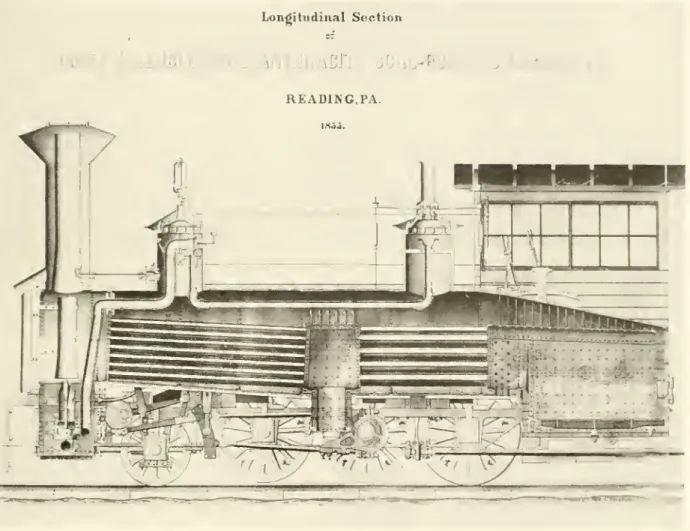
well-detailed lithographs were is-sued in 1855, however, of a sister machine, the Juniata (figs. 12
and
13).One
%iew shows thecom-
plete machine, the other a longitudinal sectionofthe locomotive. Again, the lithographs are thought to be attempts to
promote
MillhoUand's boiler patent.The
backward-sloping outerwrapper
ofthe fireboxisthe
most
remarkable featureshown
in the illustra- tions. This distinctiveform
of firebox (adopted at about thesame
timeby
\Vinans)became
the favored design for all subsequent locomoti\es built by Mill- hoUand.The
elimination ofcrown
barsand
the substitution ofstay bolts to support thecrown
(ortop inside sheet) of the fireboxwas
a progressive step.Unfortunately, the designer continued to use the abortive central combustion
chamber. The
boiler's efficiencywas
aidedby
a feedwater heater, a steam jet(meant
toimprove
draftwhen
the enginewas
stationary),
and
a variable exhaust. MillhoUand's use ofthese devices— none
original withhim —
reveals his awareness of the innovations of other skilled mechanics.16 BULLETIN 252: CONTRIBUTIONS FROM THE MUSEUM OF HISTORY AND TECHNOLOGY
Longitudinal Section
cz
READINCPA.
Figure 13.
— A
longitudinal section of the Juniata from the companion to the lithograph shown in the preceding illustration. (FromtheReadingCompany.)Locomoti\esofthe
Pawnee
classweremore
success- ful than the Illinois,and
theReading
built about 15 o\er the next several years.The
Pennsylvania Rail- roadand
the Delaware,Lackawanna and
Western Railroad, both desirous offindinggood
coal burners,had
a smallnumber
ofengines patterned after Mill- holland'sPawnee
design. It might beadded
that thePawnees
werenot trueMogul
or2-6-0locomotives as is occasionallyassumed.The
leading wheels were attachedto themain
frame in thesame manner
asthe driversand
could not swi\el. Since the leading wheels were behind the cylinders, the Pawnees, likemost coupled locomotives without trucks, were front-
end
heavy.In
January
1854while Millhollandwas
in themidstofdeveloping a workable anthracite-burning locomo-
tive, a great fire destroyed the
Reading
workshops.It
was
imperative torebuild the shops quicklysothat operations might be maintained,and
Millholland never satisfied with half measures—
immediately set towork on an
elaborateand
imaginative scheme.The
fireoccurredon
aSunday
night; bythefollowingTuesday morning
Millholland's draftsmanhad com-
pleted the preliminary drawings for a single-story, brick building measuring 482}; by 229 feet."" Its fireproofroofwas made
ofcorrugated sheet iron withan
iron-truss frame supported by cast-iron columns.--Railroad Advocate (February 10, 1855). vol. 1, p. 2.
PAPER
69:JAMES MILLHOLLAND AND E.ARLY RAILROAD ENGINEERING 17
Figure 14.
—
The
Tecumseh was completed inNovember
1853 at the Reading Shops. This Pawnee-class engineisillustrated bya contemporary- watercolor rendering. (Photocourtesyof theAtwaterKentMuseum.)Halfofthis
immense
structurewas
completed within a year after the fire. Itwas
fitted with a transfer tableand
stalls for 40 locomotives.A
foundry, 120by
30 feet,and
a blacksmith shop, 163 by 30 feet,adjoined the
main
building.The
car-repair, steam-hammer, and
brass shops wereon
a separate plot not directly adjacent to the locomotive facilities.These
shops were said to "surpass in extentand
in con- venience of arrangement,any
similar works in the United States if not in the world."^^A
detaileddiagram
of the"grand
plan"was
publishedby
the RailroadAdvocate,January
24, 1857.While
not all of Millholland's elaboratescheme was
adopted, its es- sential elements were retained.By
1896, however, theseshops were considered obsolete,and
plans wereunderway
to raise the roof of themain
building to permit installation of a heavy-duty, overhead travel- ing crane.^* It is uncertain if this remodeling pro- ject w^as undertaken, sincenew
repair shopswere
"
Ibid.''*Locomotive Engineering (.\pril 1896), vol. 9, pp. 307-309, describes and illustrates the old Reading shops.
constructed in 1902
on
anothersite in Reading.Not
until Millhollandhad
recognized the failure of hiscentral-combustion-chamber boiler did theRead-
ing achieve its goal of operating as a coal-burning road. Apparently Millhollanddropped
the patented boilerin 1855 or 1856, for the Reading's fleet of coal burnersgrew
rapidly thereafter. In 1852 only 24of the Reading's 103 locomotives were coal burners;by
1857 the proportionhad
increased to 100coal burnersin a total of 142 locomotives.
A
large part of this conversionmust
becredited to the generous purchase ofWinans' Camels. Yetthese ponderous,eight-wheel engines—
-developed primarily for soft-coalburning—
- were modified by Millholland because they never were entirely successful for anthracite.Even
so, the increasingnumber
ofcompany-built locomotivesindi- cates that Millhollandwas
perfecting a dependable hard-coal burner.Another
indication that itsown
shopswere at lastsupplyinga successfulproduct
came
in 1855
when
theReading
stopped buyingfrom
Winans.The
finaland
most positive proofthat the patented boilerwas
atlastabandoned
is the smallengraving of a Millholland locomotive boiler published inDouglas
18BULLETIN
252:CONTRIBUTIONS FROM THE MUSEUM OF HISTORY AND TECHNOLOGY
AIRMOLES WHICHCftN
"jBECLOSEDOROPENED.
HALF END ELtVATION
AND TRANSVERSE
SECTIONOF FIREBOX Figure 15. This drawing of 1856-1857 indicates that MillhoUandhad at last abandoned
his impractical central-combustion-chamber boiler. Note the wide firebo.x shown in the endelevation. (FromGalton's Report ontheRailwaysofthe UnitedStates, 1857).
Galton's Report on the Railways oj the United States}^
Galton gathered his information in the fall of 1856 for the British Parliament. It is
assumed
that he acquiredthe boilerdrawing
atthesame
timeand
thatit
was
MillhoUand's latestdesign. Thiswould
estab- lish the demise of the patent boiler at least as early as the fall of 1856, possibly in 1855.The
engraving shows MillhoUand's design for an anthracite-burning fireboxand
boiler.The
general plan is similar to that of the Pawnees, but the centralchamber
is not sho\sTi.The
design is plainand
straightforward,showing
a simple combustionchamber
at the fireboxend
of the boiler.An
end-elevation view shows the grate to be 66inches in width (fig. 15).About
1858MillhoUand
introduced water grates, thus solving a chronicproblem
long associated with anthracite burners.^^Ordinary
cast-iron grate barsburned
out quickly because of anthracite's intense heatand
lack of insulating ash, although it was the practice to use coal of poor quality, one thatwould
produce a largeamount
of ash to insulate the cast- iron grates from the direct heat of the fire.The
water gratewas
a series ofstaggered iron tubes con- nectingthe frontand
rear waterspaces of thefirebox.Circulation ofwater through the tubes preventedthe
grate's burning out. Although the idea
was
not original with MillhoUand, he introduced it in the United Statesand
perfected its use.One
advantage of the water grate, aside from its longer life,was
thatit permitted the use ofbetter grades ofanthracite.
By
1859 MillhoUand,forallpractical purposes,had
converted the Philadelphiaand Reading
to coal burning; only fourwood
buiTiers remained on the property.The Reading
thusbecame
the first major railroad inAmerica
to convertfrom wood
to coal,and
it did so despite the attendant difficulties in devising amethod
tobum
anthracite—
-a far greater challenge than if the native fuelwas
bituminous.Few
other largeroadsconverteduntilthe early 1870's.The Reading
might have converted even fasterhad
itnotbeen for MillhoUand'sstubborn attachmenttohis
patentedboiler. Butin all fairness, it
must
be agreed that his empirical rather than scientificmethods
solved the Reading's fuel problems years beforeany
othermajorrailroad achievedsimilar results.MillhoUand
paused tosummarize
hiswork
in this field in a specialmemorandum
published in the Philadelphiaand Reading
annual report of 1859 (seeAppendix
II). Previouslyhis effortshad
beenalluded to sparsely in the road's printed reports,""and
the^*London: Eyre
&
Spottiswoode, 1857.2'
An
exactdatefor MillhoUand'sfirstuse of thewatergrate cannot be determined. Engineer (February 8, 1861), vol. 11, p. 92, states that he used it for two or three years before he patented it .•\pril 16, 1861 (No. 32,076).-'Direct reference to MillhoUandintheMinuteBooksisalso sparse; the management dealt directly with MillhoUand's superior, G. A. NicoUs, Superintendent of the Reading, and nearlyallmechanicaldiscussionsmentiononlyNicoUs.
PAPER
69:JAMES MILLHOLLAND AND EARLY RAILRC-VD ENGINEERING 19
Figure 17. This clean-line passenger locomotive, the Htawatha, was built bv Millholland in 1859.
Itwas the firstofavei'ysuccessful class ofpassenger locomotivesand wasnotretired until 1883. (Smith- sonian photo40630.)
master machinist rarely
was
invited tomake any
direct
comment.
Obviously, themanagement
rec- ognized the importance of Millholland's achie\ementand now wanted him
to report directly to the stock- holders.In hisreport, Millholland brieflyreviews theroad's experience with the
Winans
enginesand
his progres- siveenlargement ofthe grate area from 17.68 squarefeet in 1847 to 24.5 square feet in 1854.
Under-
standably, hemakes
nomention
of the 1852 boiler patent or its dismal record.He
doescomment
at lengthon
the watergrateand
the substitution ofiron forcopperin fireboxes, inwhich
hiswork was
of eciualiinportance.
Copper had
been favored for the innerwrapper
of the firebox because it did not blisterand
breakdown
as readily as tlie fibrous wrought-iron plate, but itwas
expensive, soft,and
weak. Mill- holland reported that the renewalofa copper firebox cost S454compared
to SI99 for iron, the diflference lyingintheprice ofmaterials.The
coppersheetshad
to be
made
very thick, about%
ofan
inch, because they wereweak and became
e\enweaker when
heated.
The
lastand
most important objection to copperwas
thatitwas
a soft materialand was
rapidlyworn away by
the abrasive action of the fly ash (un-burned
particles of coal) as exhaustdrew
thesmoke
P.\PER 69:
JAMES MILLHOLLAND AND EARLY R.MLROAD ENGINEERING 21
c H .<i
Figure 19.
The
Fmvn, A light passenger lgcomotiv'E builtby Millhollandin 1860. (Chaney neg. 14479.)through the firebox at great speed. Iron fireboxes lasted for 59,866 miles
on
the average; copper fire- boxes,from
25,373 to 39,254 miles,depending on
their construction.
Despite the success of his water grate
and
firebox, a reporton
the performance ofReading
engines for1857
was
not altogether flattering to Millholland.-*' Annual mileage 12,023/ locomotive Costof repairsper mile 11.6^/ locomotive Costof coalper mile 13.4ff/ locomotiveMost American
locomotives a\'eraged about 20,000 miles per yearand
cost about 10 cents per mile for repairs. Fuel costwas
a less definite matter since itvariedwidely fromrailroad torailroad.
A good
gen- eral figure for the period, howe\er, is 20 cents per mile for wood.On some
roadswhere wood was
scarce or efficiency low, fuel costs were as high as 31 cents per mile. But, infact, no true comparison can bemade,
for no cost figures exist forwood-burning
locomotives doing thesame
heavy service as that performed by coal engineson
the Reading. Al-though
mileage figures forwood
engines are plentiful for the 1850s (some ran 30 miles to a cord), littleinformation is a\ailable
on
train weights. In short, Millholland's 19 miles per tonmust
be temperedby
theknowledge
that 700-ton trains were hauled, whilethe 25-30-mile-per-cord
wood
burners probably-had
hauled trains ofnomore
than 200 tons.-^In theory, Millholland should have
shown
bettereconomy
than he actually achieved. Coal cost theReading
S2.55 per ton; wood, $4.33 per cord.'"These fuels were even
more
disproportionate than indicatedbycost, since 1 tonof antliraciteisthermally equivalent to 1}> cords ofwood.Hence
$2.55 worth of coal, if efficiently burned, shoulddo
thework
of$6.50
worth
of wood. Millholland fell far short of thisideal, but hedid producea workable coal burner that performed withenough economy
to drivewood
burners offthe Reading.In the 1859reportMillhollandconfinedhisremarks to firebox
and
boiler improvement,yethe mightwell havementioned
hiswork on
locomotive rimning gear. In 1857 hehad
builtwhat
is generally be- lieved to be the first locomotive with a firebox above the frame.'' Thiswas
achievedby
aspecialdesigninwhich
the top rail of the frame, rather than being straight,was
set at aboutan
8° angle to the front pedestal, asshown
in thedrawing
of the Hiawatha(fig. 18).
The
inclined arrangement permitted the fireboxto pass over the top ofthe frameand
yet keep-' Z. CoLBURN and ,\. L. Hollev, Permanent Way and Coal Burning Locomotives(NewYork: Holley
&
Colburn,1858), p.118.» Ibid.
3" Ibid.
"The Vera Cruz is said to be the first locomotive witli its fireboxabovetheframe. There issomequestion, however,as towhetheritwasanoldenginerebuiltintheReadingshopsor a newmachineconstructed there.
PAPER
69:JAMES MILLHOLLAND AND EARLY RAILROAD ENGINEERING 23
Tt
24 BULLETIN
25 2:CONTRIBUTIONS FROM THE MUSEUM OF HISTORY AND TECHNOLOGY
Figure 21.
—
This 1864 firebox patent shows Mill- hoUand's plan for a betvveen-the-frames mountingof his water-grate firebox in order to achieve a lowercenter ofgravity than his usual boiler-frame arrangement permitted. (From U.S. Patent Office.)
the entire boiler assembly low. It also provided a firebo.x
some
10 inches wider than the conventional between-the-framestyle. This Millholland framewas
popular well into the 20th century.Sometime
in the early 1860s Millholland revixed the old-fashioned rivetedframe so popular \\ith New-England
locomotive builders in the 1840sand
1850s.The
frame's toprail wasmade
fromtwo
wrought-iron bars about 1Y^ inches thick by 6 inches deep.The
pedestals were bolted or riveted between the top-rail bars,
making
a simple,heavy
frame.No bottom
railpreferred cast-iron driving-wheel tires. These were cheaper than
wrought
iron,and
were extensivelyemployed by
the Baltimoreand Ohio Company and by
theReading
for wheels under 50 inches indiame-ter.
They
alsohad
been usedon
the Baltimoreand Susquehanna
in 1840 during MillhoUand's superin- tendence,where
hewas
credited with introducing cast-iron tires for large-diameter wheels in 1845.^^While
showing noinclinationtoabandon
thecast-iron tire, Millholland in 1851 or 1852 (about the time Kj-upp producedhis firststeel tires) producedsome
of the world's first steel tires. These weremade
at theReading
shopsand
werefittedto thelocomotiveUnited Stales.A
few other sets weremade and
gave good service, but foreconomy
he preferred the cast-iron tire. Unfortunately, nocontemporary
accountofthis early use of steel tires can be found,and we must depend on
the recollectionsofE. J. Ranch.''Another unusualdesi2:n favored by Millholland
was
one forsolid-end connectingrods.The
vast majority of 19th-century locomotives were equipped with straps bolted to the rodsand
provided with keys for alignment.The
strap-end rodwas
liable towork
looseor
become
misaligned byineptadjustmentofthe keys.The
solid-end rod, ha\-ing no straps, bolts, or keys,was
not subject to these defects. It should be noted that MillhoUand's preference forsolid-end rodswas
shared by several other mechanics, notably Ross Winans.\Vith the questionofapractical coal-burning boiler answered
by
1858, Millholland turned his attention to the design ofnew
locomotives.The
first of these ne\v designswas an
eight-wheel passenger locomotivenamed
Hiawatha. Itwas an
elegant machine, remarkablymodern
inappearance.The
water grate, poppet throttle,and
slope-back firebox were familiar Millholland features, but several novel devices were added.The round
iron cabwas
the most obvious departure from standardAmerican
practice. Itshould be
remembered
that theReading had
been a pioneer user of iron cabs (about 1845), but never beforehad
suchan
elaborateand
decorative iron cab'-'.liiifru-aii Railroad Journal (November 6, 1845), vol. lii,
p. 71+.
"Locomotive Engirnrring(June 1896),vol. 9, p. 500.
P.\PER 69:
JAMES MILLHOLLAND AND EARLY RAILRO.XD ENGINEERING
310-SS4
—
6£ 325
-i
IT)
CO
2 a o o
'^
B -a -3
«
^
g s H p
g
I
2 J2
< T3 -a c
O
Co u
_o
a
26 BULLETIN
252:CONTRIBUTIONS FROM THE MUSEUM OF HISTORY AND TECHNOLOGY
Figure 23.— Jin Anzona,A Gijs\.i'\i-t i \ss freight locomotive built in 1863 at the Reading .Shuij>. -Xuic the feedwater injector fitted to the firebox behind the rear driving wheel and the solid-end connecting rods. (Chaney neg. 5382.)
Figure 24.
One
of sever.al Mogul-type locomotives built in 1865 by Danforth, Cooke& Company
for theNew
York andErieRailway, fittedwith a Millhollandboiler. (Engineering,May
II, 1866.)PAPER
69:JAMES MILLHOLLAND AND EARLY RAILROAD ENGINEERING 27
Figure 25.
—
The
Robert Cranebl'ili in lob4lor the Readingand Ciolumbia Railroad by theLancaster Loco- motive Works. This engine was based on the designof Millholland's Hiawatha class. (Photo courtesy ofllie LancasterCountyHistoricalSociety.)
been seen
on
the road.The
Hiawathawas
also notable for its superheater, a nest of pipes placed in the smokebox.While
the Hiawathadrawing
is the earliestknown
illustration of Millholland's super- heater, he is credited with usingit"some
time" prior to 186L'*A
few other roads were e.xperimenting with the superheater at this time, but itwas
not" .\. L. HoLLEV, AmericanandEwopean RailwayPractice {New York: \'an Nostrand, 1861),p. 143.
adopted uni\crsallyfor locomotivesuntil about 1910.
In contrast to the Illinois, Millholland's first anthra- cite-burning passenger engine, the
Hmwalha was
a great successand
served as themodel
for 44 other locomotives ofthesame
design.The
adoption ofMillholland'sdesign byotherroads provided sure evidence that his anthracite-burning firebox, patented (41,316) January 19, 1864,was
a success. In 1860 the Central Railroad ofNew
Jersey purchased threenew
locomoti\'es with Millholland28 BULLETIN 252: CONTRIBUTIONS FROM THE MUSEUM OF HISTORY .AND TECHNOLOGY
Figure 26.
The
East Pennsylvania Railroad acquired the EaUnn in about 1860 from the Rogers Locomotive Works. It clearly has a Millholland boiler and other features of his design.The
scene isKutztown. Pennsvlvania. in 1870. (From theReadingCompany.)
Figure 27.
— A
Gunbo.\t-cl.ass freight locu.mutive built fru.m Millholland's designs for the Pennsyl- vania Railroadin 1866 bv the Lancaster LocomotiveW^orks.PAPER
69:J.\MES MILLHOLL.\ND AND E.\RLV RAILROAD EXGINEERIXG 29
O 4J
2r o
Figure 29.
The
Pennsylvania was the largest steam locomotive in theworld when
constructed by Millholland in 1863; this 50-ton locomotive was in service until 1885.One
pair ofdriving wheels was removed in 1870.firebo.xes.
These
werepronounced
superior toany
other coal btirners testedon
that roadand
were said to have saved 7 cents a mile over the road'swood
burners.'^
The
Erie purchased a largenumber
ofMogul
freight locomotivesbetween
1862and
1865, all ofwhich
were built with Millholland firebo.xes.The New
Jersey Railroadand
TransportationCom- pany
also acquired three engines similarly equipped.The
LancasterLocomotive Works
in 1865 advertised that itwould
build locomotives with the ". . . cele- brated coal burning boiler ofMr. James
Millhol- land." "^ Probably themost
impressive testament to Millhollandwas
the trial of his fireboxby
the Parisand
Orleans Railway.'" Millholland sent his chief assistant Levi B. Paxson to France to supervise the reconstruction oftheFrench
engines.Incidental to the use of the boiler by other
com-
panieswas
MillhoUand's injector for supplying water to boilers.The
injectorhad
been invented by Henri Giffard ofFranceand was
introduced in this countryabout I860.'' While most master mechanics agreed that feedwater
pumps
were troublesome, early in- jectors were expensiveand
unreliable. Millholland sought toremedy
these complaints with a simplified design. In his patent specification (No. 35,575) ofJune
10, 1862, the inventor claimed hisinjectorcould bemade
at)iaihthecostofan
equalGiffardinjector.MillhoUand's son
James
carried theargument
even further bystating that an injectormade
by hisfather for S4was
equal to a SI80 Giffard injector.''The
actual cost
and
success of MillhoUand's injector remains a question, but theReading was
one of thefirstrailroads to use injectorson itslocomotives.
The
device did not gain universal acceptance in loco- motives, however, for another 20 years.
In
March
1863 Millholland completed a large 10- wheel freight locomotive called the Nevada. Thismachine
was the first of the Reading's famousGun-
boat class, ofwhich
134 were constructed.The
design wasso sound that it wasstill being used
many
'5AmericanRailway Review (February28, 1861),vol. 4, p. 118.
''American Railroad Journal(August 12, 1865),vol. 18, p. 774.
"Engineer (February8, 1861),vol. 11,p. 92.
3'For a surveyhistory of theinjector,seeFrankA. Tavlor, ACatalog oftheMechanicalCollectionsoftheDivision of Engineering (U.S. National Mu.seumBulletin 173, 1939),pp. 125-133.
3»Letterfrom James A. MillhollandtoJ. E. VVatkins o


![Figure 7.- — The Philadelphia, built in 1844 by Norris Brothers for the Philadel]jhia and Reading Railroad.](https://thumb-ap.123doks.com/thumbv2/123dok/11716449.0/10.795.55.771.60.598/figure-philadelphia-built-norris-brothers-philadel-reading-railroad.webp)