16
Business Marketing
Communications: Managing the Personal Selling Function
Business marketing communications consist of advertising, sales promotion, and personal selling. As explored in Chapter 15, advertising and related sales promotion tools supplement and reinforce personal selling. Personal selling is the most impor- tant demand-stimulating force in the business marketer’s promotional mix. Through the sales force, the marketer links the i rm’s total product and service offering to the needs of business customers. After reading this chapter, you will understand:
1. The role of personal selling in relationship marketing strategy.
2. the skills and characteristics of high-performing account managers.
3. the nature of the sales management function.
4. selected managerial tools that can be applied to major sales force decision areas.
407
John Chambers, president and CEO at Cisco, says that “the customer is the strategy.”1 He began his career in the 1970s as an IBM salesperson. Today, he still spends 40 percent of his time working directly with customers, and he believes that the key to Cisco’s success comes through continuous customer feedback. In fact, every night, 365 days a year, he receives voice-mail updates on 10 to 15 top-tier customer ac- counts. By developing leading-edge technology and staying close to the customer, Cisco continues on its astonishing growth path.
In the marketing operations of the typical i rm, selling has been a dominant com- ponent and a major determinant of overall company success, highlighting the impor- tance of a strong structural linkage between marketing and sales.2 U.S. businesses, alone, spend $800 billion annually on personal selling, roughly three times the amount spent on advertising.3 Personal selling is dominant in business markets because, com- pared with consumer markets, the number of potential customers is relatively small and the dollar purchases are large. The importance of personal selling in the market- ing mix depends on such factors as the nature and composition of the market, the product line, and the company’s objectives and i nancial capabilities. Business market- ers have many potential links to the market. Some rely on manufacturers’ representa- tives and distributors; others rely exclusively on a direct sales force. Each i rm must determine the relative importance of the promotional mix components—advertising versus sales promotion versus personal selling.
Across all industries, the cost of an industrial sales call is much more than $200.4 Computer firms report much higher costs; chemical producers have much lower ones. Of course, these i gures vary, depending on a host of company, product, and market conditions. They do indicate, however, that signii cant resources are invested in personal selling in the business market. In fact, Erin Anderson and Bob Trinkle persuasively argue that few i rms have a clear understanding of the real costs of i eld sales.5 To maximize effectiveness and efi ciency, the personal selling function must be carefully managed and integrated into the i rm’s marketing mix. To enhance pro- ductivity and respond to intense competition, sales strategists are using a host of new approaches and technologies.
Regardless of how a i rm implements its sales strategy, the salesperson is the initial link to the marketplace and specii c customers. The task of the salesperson is both complex and challenging. To meet all their customers’ expectations, salespeople must have broad knowledge that extends beyond their own products. They must be able to talk intelligently about competitors’ products and about trends in the customer’s industry. They must know not only their customer’s business but also the business of their customer’s customers. This chapter i rst considers the lead role of the salesper- son in executing relationship marketing strategies and serving key customer accounts.
Attention then turns to the characteristics of high-performing account managers and the central features of the sales management process.
1Michele Marchetti, “America’s Best Sales Forces: Sales to CEO,” Sales & Marketing Management 151 (July 1999): p. 63.
2Christian Homburg, Ore Jensen, and Harley Krohmer, “Coni gurations of Marketing and Sales: A Taxonomy,” Journal of Marketing 72 (March 2008): pp. 133–154; see also James Cross, Steven W. Hartley, and William Rudelius, “Sales Force Activities and Marketing Strategies in Industrial Firms: Relationships and Implications,” Journal of Personal Selling & Sales Management 21 (Summer 2001): pp. 199–206.
3Deborah Kreuze, “How Effective is Personal Selling,” Insights from MSI (Spring 2008): p. 3.
4“The Cost of Doing Business,” Sales & Marketing Management 151 (September 1999): p. 56.
5Erin Anderson and Bob Trinkle, Outsourcing the Sales Function: The Real Costs of Field Sales (Mason, OH: Thomson Higher Education, 2005).
Relationship Marketing Strategy
6Assuming a central role in implementing the customer relationship marketing (RM) strategy for the business-to-business i rm (see Chapter 4) is the salesperson. Firm-to- i rm relationships in the business market involve multiple interactions among indi- viduals, forming a network of relationships. To ensure that customers are as satisi ed as possible, business marketers must effectively manage the complex web of inl uences that intersect in buyer-seller relationships.7
Figure 16.1 provides a model of interi rm relationship marketing. Relationship marketing activities represent dedicated relationship marketing programs, devel- oped and implemented to build strong relational bonds. These activities inl uence three important drivers of relationship marketing effectiveness—relationship quality, breadth, and composition—each capturing a different dimension of the relationship and exerting a positive inl uence on the seller’s performance activity.
Drivers of Relationship Marketing Effectiveness
Some customer relationships are characterized by extensive interactions and close bonds among members of the buying and selling organizations. By contrast, other relationships might be confined to a few relational ties that the salesperson has developed with members of the purchasing staff. Drawing on insights from social network theory, the following drivers of relational marketing effectiveness have been identii ed.
Relationship Quality Relationship quality represents a high-caliber relational bond with an exchange partner that captures a number of interaction characteristics such as commitment and trust. “Commitment represents a desire to maintain a valued relation- ship and, thus, an exchange partner’s relationship motivation toward a partner. Trust involves the evaluation of a partner’s reliability and integrity, which generates coni - dence in the partner’s future actions that support cooperation.”8 Partners involved in high-quality, committed relationships are willing to disclose proprietary information, which enables sellers to identify the customer’s unmet needs, cross-sell additional prod- ucts more effectively, and price products properly, thereby enhancing proi tability.
Relationship Breadth A key objective of the business marketer is to develop a keen understanding of a customer’s needs in order to develop a value proposition that squarely addresses those needs. Relationship breadth represents the number of interpersonal ties that a i rm has with an exchange partner. A seller that has forged more interpersonal ties with a customer can gain better access to information, identify proi t-enhancing opportunities, and become more efi cient in building and maintain- ing the relationship. Research indicates that multiple interi rm ties are particularly vital when serving customer organizations that have high employee turnover.9
6Unless otherwise noted, this section is based on Robert W. Palmatier, Relationship Marketing (Cambridge, MA:
Marketing Science Institute, 2008).
7Christian Homburg and Ruth M. Stock, “The Link between Salespeople’s Job Satisfaction and Customer Satisfaction in a Business-to-Business Context: A Dyadic Analysis,” Journal of the Academy of Marketing Science 32 (Spring 2004):
pp. 144–158.
8Robert W. Palmatier, “Interi rm Relational Drivers of Customer Value,” Journal of Marketing 72 (July 2008): p. 77.
9Ibid., p. 86.
Relationship Composition Relationship composition centers on the decision- making capability of relational contacts at the customer firm; a contact portfolio that includes high-level decision makers increases a seller’s ability to effect change in customer organizations. For example, greater authority in the contact portfolio allows a salesperson to access information, adapt offerings, and reach inl uential decision makers. A competitor who has access only to contacts with less authority faces dif- i cult odds in winning the account. Research suggests that building relationships with key decision makers generates the highest returns among customer organizations that are the most difi cult to access.10
Relationship Strength A clear portrait of a buyer-seller relationship will consider both relationship quality and relationship breadth. (See Figure 16.1.) Therefore, relationship strength rel ects the ability of a relationship to withstand stress and/or conl ict, such that multiple, high-quality relational bonds result in strong, resilient relationships. A service failure, like equipment failure or poor delivery service, creates conl ict in a buyer-seller relationship. A customer relationship characterized by many cursory contacts (greater breadth, low quality) will afford little protection to the seller during this period of stress. However, based on coni dence (trust), multiple, high- quality relationship ties (greater breadth, high quality) will support the seller during the service recovery process.
Relationship Effi cacy Representing the interaction between relationship quality and relationship composition, relationship efficacy captures the ability of an interi rm relationship to achieve desired objectives. High-quality relationships with
10Ibid., pp. 85–86.
FIGURE 16.1 A MODELOF INTERFIRM RELATIONSHIP MARKETING
Relationship breadth
Drivers of Relational Marketing Effectiveness
Relationship strength (quality x breadth)
Relationship eficacy (quality x composition) Relationship
quality Seller
relationship marketing activities
Seller Performance outcomes
Relationship composition
SOURCE: Robert W. Palmatier, Relationship Marketing (Cambridge, MA: Marketing Science Institute, 2008), p. 26. Copyright
© Marketing Science Institute. All rights reserved. Reproduced by permission.
members of the customer organization, coupled with a well-structured and diverse contact portfolio, gives sellers the means to execute responsive strategy. Robert W.
Palmatier observes:
A portfolio might encompass high-quality, broad relationships but it suffers if those contacts are restricted to one functional area with little decision-making (low composition) because the seller lacks access to divergent (nonredundant) information and cannot promote customer change.11
Relationship Marketing (RM) Programs
To strengthen relational ties with customers, three types of relationship marketing programs are employed.
Social RM programs use social engagements (for example, meals, sporting events) or frequent, customized communication to personalize the relationship and highlight the customer’s special status. The relational bonds that result from this specialized treatment are difi cult for rivals to duplicate and may prompt customers to reciprocate in the form of repeat sales and positive recommenda- tions of the seller to others.
Structural RM programs are designed to increase productivity and/or efi ciency for customers through targeted investments that customers would not likely make themselves. For example, the seller might provide an electronic order-processing interface of customized packaging for the customer. By offer- ing unique benei ts and, in the case of electronic ordering, a structural bond, these programs create competitive advantages and discourage customers from switching to competitors.
Financial RM programs provide economic benei ts, such as special discounts, free shipping, or extended payment terms, to increase customer loyalty. Because competitors can readily match the economic incentives, the advantages tend to be unsustainable.
Financial Impact of RM Programs12
Do RM programs pay off ? A recent study measured the incremental proi ts generated by RM programs to isolate the return on investment (ROI).
Social In evaluating the short-term i nancial returns of the different RM strat- egies, the study found that social RM investments have a direct and significant (approximately 180 percent) impact on proi t—far greater than the impact of struc- tural or i nancial RM programs. For the customer, social programs create a feel- ing of interpersonal debt, stimulating a pressing need to reciprocate and thereby generating immediate returns. Yet, Robert Palmatier observes: “Social programs may cause customers to think highly of the salesperson rather than the selling i rm, which increases the risk that the selling i rm loses the customer if the salesperson
•
•
•
11Palmatier, Relationship Marketing, p. 25.
12 This section is based on Robert W. Palmatier, Srinath Gopalakrishna, and Mark B. Houston, “Returns on Business-to- Business Relationship Marketing Investments: Strategies for Leveraging Proi ts,” Marketing Science 25 (September–
October 2006): pp. 477–493.
leaves. Therefore, the selling i rm should keep other avenues open for direct com- munication with customers.”13
Structural The i nancial impact of structural RM programs (for example, providing a value-enhancing linkage) depends on the frequency of interaction a i rm has with customers. While break-even returns are achieved for customers with average interac- tion frequency, the return on structural RM investment is approximately 120 percent for those customers who receive frequent contact from the seller. As a result, the business marketing strategist should target those customers for whom structural solu- tions offer the most value. Moreover, while merely breaking even in the short term, structural linkages like electronic order processing should increase long-term proi ts because customers are inclined to take advantage of the value provided.
Financial Since economic incentives often attract “deal-prone” customers and are easy for rivals to match, i nancial RM programs generally fail to generate posi- tive economic returns. Of course, such programs (for example, special discounts) may represent a necessary response to a competitive threat that is needed to protect existing customer relationships. By contrast, social and structural RM programs are offensive weapons that provide greater i nancial returns and a more durable competi- tive advantage.
Targeting RM Programs14
Some customers are more receptive to relationship marketing initiatives than others.
As purchasing managers emphasize cost-reducing and productivity-enhancing objec- tives, they carefully scrutinize the time and effort that can be invested in particu- lar supplier relationships. Relationship orientation (RO) represents the customer’s desire to engage in strong relationships with a current or potential supplier. “Cus- tomers tend to be more . . . open to relationship building when they face some risk, uncertainty, or dependence in the exchange process or are very motivated about the product or service category. In these situations, customers i nd the expertise, added l exibility, and risk-reduction benei ts of a relationship valuable and likely welcome the seller’s relationship efforts.”15
Allocating RM Resources Research demonstrates that the returns on RM invest- ments improve if business marketers are able to target customers on the basis of their RO rather than size. For example, salespeople report higher returns for their RM efforts directed toward buyers with the highest self-reported RO than for those with the lowest RO. Importantly, the study reveals a separate strategy that can be used effectively for customers who demonstrate a low RO. These customers would shift 21 percent of their business to another supplier of similar products if the transac- tion were completely automated (that is, if no salesperson was involved). This sug- gests that the business marketer could drastically lower costs and better serve some customers by accurately detecting those with a low RO and offering them the option of using an electronic ordering interface. By properly aligning RM resources to the
13Palmatier, Relationship Marketing, p. 64.
14 This section is based on Robert W. Palmatier, Lisa K. Scheer, Kenneth R. Evans, and Todd J. Arnold, “Achieving Relationship Marketing Effectiveness in Business-to-Business Exchanges,” Journal of the Academy of Marketing Science 36 (June 2008): pp. 174–190.
15Palmatier, Relationship Marketing, p. 90.
needs of customers, the salesperson can direct attention to those customers who are most receptive to relationship-building efforts.
Managing the Sales Force
Effective management of the business-to-business sales force is fundamental to the i rm’s success. Sales management refers to planning, organizing, directing, and controlling personal selling efforts.16 Sales force decisions are tempered by overall marketing objectives and must be integrated with the other elements of the marketing mix. Forecasts of the expected sales response guide the i rm in determining the total selling effort required (sales force size) and in organizing and allocating the sales force (perhaps to sales territories). Techniques for estimating market potential and fore- casting sales (discussed in Part III, “Assessing Market Opportunities”) are particularly valuable in sales planning. Sales management also involves the ongoing activities of se- lecting, training, deploying, supervising, and motivating sales personnel. Finally, sales operations must be monitored to identify problem areas and to assess the efi ciency, effectiveness, and proi tability of personal selling units.
This section considers strategic components of sales force management: (1) meth- ods for organizing the sales force, (2) key account management, and (3) the distinctive characteristics of high-performing account managers.
Organizing the Personal Selling Effort
How should the sales force be organized? The appropriate form depends on such factors as the nature and length of the product line, the role of intermediaries in the marketing program, the diversity of the market segments served, the nature of buying behavior in each market segment, and the structure of competitive selling.
The manufacturer’s size and i nancial strength often dictate, to an important degree, the feasibility of particular organizational forms. The business marketer can orga- nize the sales force by geography, product, or market. Large industrial enterprises that market diverse product lines may use all three.
Geographical Organization The most common form of sales organization in business marketing is geographical. Each salesperson sells all the i rm’s products in a dei ned geographical area. By reducing travel distance and time between customers, this method usually minimizes costs. Likewise, sales personnel know exactly which customers and prospects fall within their area of responsibility.
The major disadvantage of the geographical sales organization is that each sales- person must be able to perform every selling task for all of the i rm’s products and for all customers in the territory. If the products have diverse applications, this can be dif- i cult. A second disadvantage is that the salesperson has substantial leeway in choosing which products and customers to emphasize. Sales personnel may emphasize products and end-use applications they know best. Of course, this problem can be remedied through training and capable i rst-line supervision. Because the salesperson is crucial in implementing the i rm’s segmentation strategy, careful coordination and control are required to align personal selling effort with marketing objectives.
16A comprehensive treatment of all aspects of sales management is beyond the scope of this volume. For more extensive discussion, see Mark W. Johnston and Greg W. Marshall, Sales Force Management (New York: McGraw-Hill/
Irwin, 2008).
Product Organization In a product-oriented sales organization, salespersons specialize in relatively narrow components of the total product line. This is especially appropriate when the product line is large, diverse, or technically complex and when a salesperson needs a high degree of application knowledge to meet customer needs.
Furthermore, various products often elicit various patterns of buying behavior. The salesperson concentrating on a particular product becomes more adept at identifying and communicating with members of buying centers.
A prime benei t of this approach is that the sales force can develop a level of prod- uct knowledge that enhances the value of the i rm’s total offering to customers. The product-oriented sales organization may also help identify new market segments.
One drawback is the cost of developing and deploying a specialized sales force.
A product must have the potential to generate a level of sales and proi t that justii es individual selling attention. Thus, a “critical mass” of demand is required to offset the costs. In turn, several salespersons may be required to meet the diverse product requirements of a single customer. To reduce selling costs and improve productivity, some i rms have launched programs to convert product specialists into general-line specialists who know all the i rm’s products and account strategies. Often, as custom- ers learn to use technology, they outgrow the need for product specialists and prefer working with a single salesperson for all products.
Market-Centered Organization The business marketer may prefer to organize personal selling effort by customer type. Owens-Corning recently switched from a geographical sales structure to one organized by customer type. Similarly, Hewlett- Packard successfully used this structure to strengthen its market position in retail- ing, financial services, and oil and gas exploration.17 Sales executives at Fortune 500 companies that use sales teams believe they are better able to secure customers and improve business results by adopting a more customer-focused sales structure.18
By learning the specii c requirements of a particular industry or customer type, the salesperson is better prepared to identify and respond to buying inl uentials. Also, key market segments become more accessible, thus providing the opportunity for differentiated personal selling strategies. The market segments must, of course, be sufi ciently large to warrant specialized treatment.
Key Account Management19
Many business marketing i rms i nd that a small proportion of customers (for example, 20 percent) often account for a major share (for example, 80 percent) of its business.
These customers possess enormous purchasing power by virtue of their size, and they are searching for ways to leverage their suppliers’ capabilities to enhance the value they deliver to their own customers (see Chapter 2). In turn, many of these large buying i rms have centralized procurement and expect suppliers to provide coordinated and uniform service support to organizational units that are geographically dispersed on a national or global scale. In exchange for a long-term volume commitment, these cus- tomers expect the business marketing i rm to provide additional value-added services
17 Thayer C. Taylor, “Hewlett-Packard,” Sales and Marketing Management 145 (January 1993): p. 59.
18 Vincent Alonzo, “Selling Changes,” Incentive 170 (September 1996): p. 46.
19 This section is based on Joseph P. Cannon and Narakesari Narayandas, “Relationship Marketing and Key Account Management,” in Jagdish N. Sheth and Atul Parvatiyar, eds., Handbook of Relationship Marketing (Thousand Oaks, CA:
Sage Publications, 2000), pp. 407–429.
(for example, new-product-development assistance) and support (for example, just-in- time delivery) that may not be available to other customers.
Unique Value Propositions Customer prioritization represents the degree to which i rms prioritize customers by developing different value propositions for its top-tier versus bottom-tier customers. A recent study reveals that customer prioriti- zation leads to higher average customer proi tability and a higher return on sales by (1) positively affecting relationships with top-tier customers without affecting rela- tionships with bottom-tier customers and (2) reducing marketing and sales costs.20 Key Accounts versus Regular Accounts Given the importance of these large cus- tomers, i rms are rethinking how they manage their most important customers and how they organize internal operations to meet these customers’ complex needs. To that end, many i rms—Hewlett-Packard, Xerox, 3M, IBM, and Dow Chemical, for example—are establishing key account managers and creating customer teams com- posed of individuals from sales, marketing, i nance, logistics, and other functional groups. Key account managers are typically responsible for several important custom- ers and report to a senior executive. For some customers, the key account manager may work directly in the customer’s facilities. For example, an IBM key account team occupies ofi ces at Boeing and works solely on that account.
A key account represents a customer who
1. purchases a signii cant volume as a percentage of a seller’s total sales;
2. involves several organizational members in the purchasing process;
3. buys for an organization with geographically dispersed units;
4. expects a carefully coordinated response and specialized services such as logistical support, inventory management, price discounts, and customized applications.21
Rather than calling them “key accounts,” some companies describe such customers as strategic accounts or national accounts.
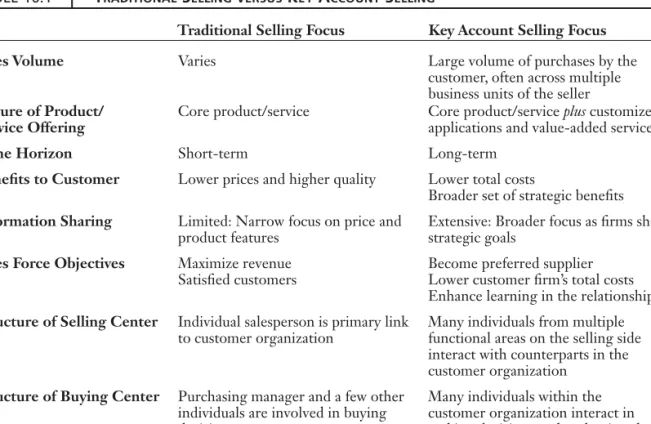
A Different Type of Relationship Table 16.1 compares and contrasts the tradi- tional selling paradigm with the key account selling paradigm. Key account custom- ers purchase in very large volume, and the focus of exchange extends beyond a core product as the seller augments the offering through value-added services and support.
For example, acting on behalf of Cisco, FedEx coordinates the delivery of Cisco com- ponents from geographically dispersed facilities to ensure a seamless installation in a customer’s organization. Whereas traditional sales management objectives typically emphasize maximizing revenue, key account relationships involve multiple goals. To illustrate, i rms may enter into a closer, long-term relationship to lower costs to both partnering i rms by reducing the seller’s marketing and logistics costs and reducing the buyer’s acquisition and production costs.
Coordinated Action To effectively deliver more value to an important customer, the interpersonal connections between the buying and selling firms must extend
20Christian Homburg, Mathias Droll, and Dirk Totzek, “Customer Prioritization: Does It Pay Off and How Should It Be Implemented?” Journal of Marketing 72 (September 2008): pp. 110–128.
21Frank V. Cespedes, Concurrent Marketing: Integrating Products, Sales, and Service (Boston: Harvard Business School Press, 1995), p. 187.
beyond the salesperson–purchasing manager relationship. A key account relation- ship involves frequent interactions between a team of functional experts from both organizations. The key account manager assumes a lead role in coordinating selling center activities and facilitating these cross-i rm communications among functional experts. Nurturing these interpersonal connections creates an atmosphere in which these specialized personnel can cooperatively identify new solutions that lower costs or advance performance. When uncertainty is high or important product adaptations are required, the interorganizational team should feature the active participation of key personnel from the customer organization who join with members of the selling organization to create the desired solution.22
Selecting Key Accounts23 If the business marketing firm can have close and important relationships with a rather small set of customers, each requiring a large investment, the choice of the key accounts is critical. Because key accounts possess buying power, demand special services, and are generally more costly to serve, the
22Ruth Maria Stock, “Interorganizational Teams as Boundary Spanners Between Supplier and Customer Companies,”
Journal of the Academy of Marketing Science 34 (October 2006): pp. 588–599.
23This section is based on Cespedes, Concurrent Marketing, pp. 193–198; see also George S. Yip and Audrey J. M. Bink,
“Managing Global Accounts,” Harvard Business Review 84 (September 2007): pp. 103–111.
Sales Volume Varies Large volume of purchases by the customer, often across multiple business units of the seller Nature of Product/
Service Offering
Core product/service Core product/service plus customized applications and value-added services Time Horizon Short-term Long-term
Benefi ts to Customer Lower prices and higher quality Lower total costs
Broader set of strategic benei ts Information Sharing Limited: Narrow focus on price and
product features
Extensive: Broader focus as i rms share strategic goals
Sales Force Objectives Maximize revenue Satisi ed customers
Become preferred supplier Lower customer i rm’s total costs Enhance learning in the relationship Structure of Selling Center Individual salesperson is primary link
to customer organization
Many individuals from multiple functional areas on the selling side interact with counterparts in the customer organization
Structure of Buying Center Purchasing manager and a few other individuals are involved in buying decision
Many individuals within the customer organization interact in making decisions and evaluating the relationship
SOURCE: Adapted with modifications from Joseph P. Cannon and Narakesari Narayandas, “Relationship Marketing and Key Account Management,” in Handbook of Relationship Marketing, Jagdish N. Sheth and Atul Parvatiyar, eds. (Thousand Oaks, CA: Sage Publications, 2000), p. 409; and Frank V. Cespedes, Concurrent Marketing: Integrating Products, Sales, and Service (Boston: Harvard Business School Press, 1995), pp. 186–202.
TABLE 16.1 TRADITIONAL SELLINGVERSUS KEY ACCOUNT SELLING
Traditional Selling Focus Key Account Selling Focus
account selection process must examine the sales and proi t potential as well as the long-term resource commitments the relationship demands.
Frank V. Cespedes recommends a three-phase approach in selecting key accounts To be chosen, a potential customer must meet the screening requirements of all three phases.
Phase 1: Centers on (a) the proi t potential of a customer, measured in terms of incremental sales potential, and (b) the degree to which a customer values the i rm’s support services and is willing to pay a premium price for them.
(For example, if the product is critical to a customer’s operations, support services are more valuable.)
Phase 2: Identii es customer accounts from Phase 1 that have unique support requirements that provide proi table organizational learning opportunities.
(For example, the goal here is to invest in support capabilities that are valued by multiple accounts.)
Phase 3: Considers the degree to which the transactions with the potential customer complement the economics of the seller’s business. (For example, some customers purchase higher-margin products than others or provide a better match to the i rm’s manufacturing capabilities.)
Says Cespedes, “When there are clear criteria for determining the proi t potential, learning benei ts, and cost drivers associated with customers, the i rm knows when (and when not) to incur the substantial commitments required for effective key- account relationships.”24
National Account Success
Research suggests that successful national account units enjoy senior management support; have well-dei ned objectives, assignments, and implementation procedures; and are staffed by experienced individuals who have a solid grasp of their entire company’s resources and capabilities and how to use them to create customer solutions.25 Do key account management programs enhance proi tability? Yes. A recent comprehensive study of U.S. and German i rms demonstrates the clear performance advantages that i rms with active key account management programs enjoy over peers without them. In turn, the research also indicates that successful programs provide the key account manager with ready access to resources and support across functional areas.26 Successful national account programs also adopt a strong relationship marketing perspective and consistently demonstrate their ability to meet the customer’s immediate and future needs.
To this point, we have examined the central role of personal selling in business marketing strategy and alternative ways to align the sales force to customer segments.
Attention now turns to key milestones in managing an engagement with a particular customer.
24 Ibid., p. 197.
25John P. Workman Jr., Christian Homburg, and Ove Jensen, “Intraorganizational Determinants of Key Account Management Effectiveness,” Journal of the Academy of Marketing Science 31 (Winter 2003): pp. 3–21; see also Homburg, Droll, and Totzek, “Customer Prioritization.”
26Christian Homburg, John P. Workman Jr., and Ove Jensen, “A Coni gurational Perspective of Key Account Manage- ment,” Journal of Marketing 66 (April 2002): pp. 38–60; see also Roberta J. Schultz and Kenneth R. Evans, “Strategic Collaborative Communication by Key Account Representatives,” Journal of Personal Selling & Sales Management 22 (Winter 2002): pp. 23–32.
Isolating the Account Management Process
27To explore the work that account managers perform, our focus is on complex sales situations in business markets, which are characterized by large dollar values, pro- tracted sales cycles, customized solutions, and the involvement of many organizational members on both the buying and selling sides. Frequently, in these sales situations an account manager is assigned to a particular set of customers and then assembles an ad hoc team as customer requirements or opportunities dictate. For example, large information technology i rms, such as IBM, reserve key account teams for a carefully chosen set of customers but rely on an assigned account manager to cover the major- ity of large-enterprise customers.
Assuming a central role in a particular engagement is the account manager who diagnoses what the customer needs, identifies the appropriate set of internal ex- perts, recruits them onto the ad hoc team, and then orchestrates the selling center’s activities to deliver a solution that matches customer needs. Let’s examine how high- performing account managers undertake these activities and highlight how they differ from their peers. Recent studies that explored the characteristics of high-performing account managers at two Fortune 500 i rms provide some valuable insights.
27This section draws on Michael D. Hutt and Beth A. Walker, “A Network Perspective of Account Manager Performance,” Journal of Business & Industrial Marketing 21 (7, 2006): pp. 466–473.
Competitive cognition refers to the framework a manager uses to organize and retain knowledge about competitors and to direct information acquisition and usage.1 Research suggests that competitive cognition influences individual performance. For example, in an intriguing study in the sports literature, research demonstrates that elite athletes (for example, members of the U.S. Olympic wrestling team) use extensive competitive plans that involve customized strategies and tactics to beat individual competitors, whereas poorer performers do not develop customized plans but rely, instead, on a more generic approach to competition.2
Building on this line of inquiry, a study explored the role of competitive cognition in the competi- tive crafting that salespeople do.3 Competitive crafting involves salespeople’s use of information and knowledge about competitors to create a business proposition for the customer. Examples
of crafting include speeding up the selling cycle to counter a slow rival or broadening the scope of the product and service offered to outmaneuver a niche rival. The results of the study indicate that each additional act of crafting increases the likelihood of the salesperson winning the customer’s business by i vefold!
1Beth A. Walker, Dimitri Kapelianis, and Michael D. Hutt,
“Competitive Cognition,” MIT Sloan Management Review 46 (Summer 2005): pp. 10–12.
2Daniel Gould, Robert C. Eklund, and Susan A. Jackson, “1988 U.S. Olympic Wrestling Excellence: I. Mental Preparation, PreCompetitive Cognition, and Affect,” The Sports Psychologist 6 (December 1992): pp. 358–382.
3Dimitri Kapelianis, Beth A. Walker, Michael D. Hutt, and Ajith Kumar, “Those Winning Ways: The Role of Competitive Crafting in Complex Sales,” Working paper (Tempe, AZ:
Arizona State University, 2008).
B2B T OP P ERFORMERS
Using Customized Strategies to Outmaneuver Rivals
FIGURE 16.2 THE CYCLEOF ACCOUNT MANAGEMENT SUCCESS
Prioritize Relationship
Building as
Key Role Develop
Strong Internal
Links Internal
Reputation Enhanced
Successful Engagement
Outcome
Forge Multiple Connections in Client
Organization
Initiate Involvement
with Client
Early Involvement in Client Engagement
Knowledge of Competitive
Strategies Knowledge of
Profitability Drivers
Partner with Client to Shape New Business
Proposal Align Internal
Resources to Client Needs Manage Client
Relationships at Multiple
Levels
Account Management Success
For complex sales situations, account manager performance is contingent on secur- ing access to the right people and the right information to solve novel problems for the customer. Figure 16.2 highlights the key milestones in a customer engagement and emphasizes the crucial role of relationship-building activities in the i rm and in the client organization. High performers excel at relationship building. Capitalizing on these relationship connections, the account manager is better equipped to design a business proposal that aligns the i rm’s capabilities to customer goals. Moreover, observe that successful outcomes enhance the account manager’s internal reputation, providing social capital the manager can invest in future customer engagements.
Building Internal Relationships High-performing account managers form more cross-functional and cross-unit ties within the organization than their colleagues.
A diverse social network provides a manager with access to unique skills and knowl- edge. Account managers with ties to a number of distinct knowledge pools in the organization can draw on a large array of skills, knowledge, and resources—thereby enhancing their customer responsiveness. Research suggests that top-perform- ing salespeople are able to “navigate their own organization to discover personnel, resources, or capabilities that may benei t them in specii c sales situations. . . .”28 Forging Relationships Within the Customer Organization Being centrally in- volved in a customer organization’s buying system improves an account manager’s ability to understand the customer’s requirements and business goals. Compared with their peers, high performers possess more cross-functional ties and a larger network of contacts within the customer organization. Because complex sales situations involve a buying center that includes participants from multiple levels of the organizational hierarchy and diverse units, an account manager’s communication network must go beyond the focal purchasing unit.
Managing the Customer Engagement Process By developing a network of relationships both within the i rm and within the customer organization, an account manager is ideally equipped to manage the customer engagement process. Through these connections account managers receive vital information about emerging customer opportunities, customer requirements and solutions, and competitive chal- lenges (see Figure 16.2). Compared with low performers, high-performing account managers are more proactive in initiating involvement with the customer and tend to be involved in client engagements earlier in the purchasing process than their peers.
Capitalizing on this early involvement, high performers are also more inclined to take an active role in shaping the client’s request for proposals (RFP).
Aligning and Crafting A successful client engagement hinges on both customer knowledge and competitive intelligence. High performers know more about client goals and the drivers of client proi tability than low performers. When creating a customer solution, a salesperson must “act as a broker and assemble an ad-hoc team of experts, coordinating the efforts of people who may not have met one another before.”29 Drawing on this knowledge allows them to align the capabilities of the i rm to the goals of the customer. High-performing account managers develop sound competitive intelligence and use this knowledge to outmaneuver their rivals in a par- ticular client engagement.
Enhanced Internal Reputation By building a strong network of relationships within both the firm and the customer organization, high-performing account managers—compared with their peers—are better able to diagnose customer require- ments, mobilize internal experts, and choreograph the activities that are required to outmaneuver rivals and create the desired customer solution. Successful outcomes enhance the reputation of an account manager in the organization, thereby strength- ening internal working relationships and assuring ready access to the right people and right information for future engagements.
28Christopher R. Plouffe and Donald W. Barclay, “Salesperson Navigation: The Intraorganizational Dimension of the Sales Role,” Industrial Marketing Management 36 (May 2007): p. 529.
29Tuba Ustuner and David Godes, “Better Sales Networks,” Harvard Business Review 84 (July–August 2006): p. 108.
Sales Administration
Successful sales force administration involves recruiting and selecting salespersons, then training, motivating, supervising, evaluating, and controlling them. The indus- trial i rm should foster an organizational climate that encourages the development of a successful sales force.
Recruitment and Selection of Salespersons
The recruiting process presents numerous trade-offs for the business marketer.
Should the company seek experienced salespersons, or should it hire and train in- experienced individuals? The answer depends on the specii c situation; it varies with the size of the i rm, the nature of the selling task, the i rm’s training capability, and its market experience. Smaller i rms often reduce training costs by hiring experienced and more expensive salespersons. In contrast, large organizations with a more com- plete training function can hire less experienced personnel and support them with a carefully developed training program.
A second trade-off is quantity versus quality. Often, sales managers screen as many recruits as possible when selecting new salespersons. However, this can over- load the selection process, hampering the i rm’s ability to identify quality candidates.
Recruiting, like selling, is an exchange process between two parties. Sales managers are realizing that, for prospective salespersons, they need to demonstrate the personal development and career opportunities that a career with the i rm offers. A poorly organized recruiting effort that lacks closure leaves candidates with a negative im- pression. A well-organized recruiting effort ensures that qualii ed candidates get the proper level of attention in the screening process. Thus, procedures must be estab- lished to ensure that inappropriate candidates are screened out early so that the pool of candidates is reduced to a manageable size.30
Responsibility for recruiting and selecting salespersons may lie with the i rst-line supervisor (who often receives assistance from an immediate superior), or with the human resources department, or with other executives at the headquarters level. The latter group tends to be more involved when the sales force is viewed as the training ground for marketing or general managers.
Training
To prepare new salespersons adequately, the training program must be carefully designed. Periodic training is required to sharpen the skills of experienced salesper- sons, especially when the i rm’s environment is changing rapidly. Changes in busi- ness marketing strategy (for example, new products, new market segments) require corresponding changes in personal selling styles.
The salesperson needs a wealth of knowledge about the company, the product line, customer segments, competition, organizational buying behavior, and effective communication skills.31 All these must be part of sales training programs. Compared with their counterparts, top-performing sales organizations train new salespeople in
30Wesley J. Johnston and Martha C. Cooper, “Industrial Sales Force Selection: Current Knowledge and Needed Research,” Journal of Personal Selling & Sales Management 1 (Spring/Summer 1981): pp. 49–53.
31William L. Cron, Greg W. Marshall, Jagdip Singh, Rosann Spiro, and Harish Sujan, “Salesperson Selection, Training, and Development Trends: Implications, and Research Opportunities,” Journal of Personal Selling & Sales Management 25 (Spring 2005): pp. 123–136.
a broader range of areas: market knowledge, communication skills, listening tech- niques, complaint-handling skills, and industry knowledge.32
With the expansion in global marketing, i rms need to include a sales training module that examines how to approach and respond to customers of different cultures.
Such training would focus on the role of intercultural communication in developing global buyer-seller relationships.33 Effective training builds the salesperson’s coni - dence and motivation, thereby increasing the probability of success. In turn, training helps the business marketer by keeping personal selling in line with marketing pro- gram objectives. A successful training effort can reduce the costs of recruiting; many business-to-business i rms have found that salesperson turnover declines as training improves. Clearly, a salesperson who is inadequately prepared to meet the demands of selling can quickly become discouraged, frustrated, and envious of friends who chose other career options. Effective training and capable i rst-line supervision can alleviate much of this anxiety, which is especially prevalent in the early stages of many careers.
Supervision and Motivation
The sales force must be directed in a way that is consistent with the company’s policies and marketing objectives. Critical supervisory tasks are continued training, counseling, assistance (for example, time management), and activities that help sales personnel plan and execute their work. Supervision also sets sales performance standards, fuli lls com- pany policy, and integrates the sales force with higher organizational levels.
Orville Walker Jr., Gilbert Churchill Jr., and Neil Ford dei ne motivation as the amount of effort the salesperson “desires to expend on each of the activities or tasks associated with his (her) job, such as calling on potential new accounts, planning sales presentations, and i lling out reports.”34 The model presented in Figure 16.3 hypoth- esizes that a salesperson’s job performance is a function of three factors: (1) level of motivation, (2) aptitude or ability, and (3) perceptions about how to perform his or her role. Each is inl uenced by personal variables (for example, personality), organi- zational variables (for example, training programs), and environmental variables (for example, economic conditions). Sales managers can inl uence some of the personal and organizational variables through selection, training, and supervision.
Motivation is related strongly to (1) the individual’s perceptions of the types and amounts of rewards from various degrees of job performance and (2) the value the salesperson places on these rewards. For a given level of performance, two types of rewards might be offered:
1. Internally mediated rewards: The salesperson attains rewards on a personal basis, such as feelings of accomplishment or self-worth.
2. Externally mediated rewards: Rewards are controlled and offered by managers or customers, such as i nancial incentives, pay, or recognition.
32Adel I. El-Ansary, “Selling and Sales Management in Action: Sales Force Effectiveness Research Reveals New Insights and Reward-Penalty Patterns in Sales Force Training,” Journal of Personal Selling & Sales Management 13 (Spring 1993):
pp. 83–90.
33Victoria D. Bush and Thomas Ingram, “Adapting to Diverse Customers: A Training Matrix for International Marketers,” Industrial Marketing Management 25 (September 1996): pp. 373–383.
34Orville C. Walker Jr., Gilbert A. Churchill Jr., and Neil M. Ford, “Motivation and Performance in Industrial Selling:
Present Knowledge and Needed Research,” Journal of Marketing Research 14 (May 1977): pp. 156–168; see also Steven P.
Brown, William L. Cron, and Thomas W. Leigh, “Do Feelings of Success Mediate Sales Performance–Work Attitude Relationships?” Journal of the Academy of Marketing Science 21 (Spring 1993): pp. 91–100.
The rewards strongly inl uence salesperson satisfaction with the job and the work environment, which is also influenced by the individual’s role perceptions. Job satisfaction declines when the salesperson’s perception of the role is (1) inaccurate in terms of the expectations of superiors, (2) characterized by confl icting demands among role partners (company and customer) that the salesperson cannot possibly resolve, or (3) surrounded by uncertainty because of a lack of information about the expectations and evaluation criteria of superiors and customers.
Business marketers often use formal incentive programs to achieve specii ed cus- tomer service, sales, and proi t results. Typically, an incentive program offers rewards for achieving a well-dei ned goal during a specii ed time frame. The rewards must be well conceived, based on what salespeople value, tied to achieving desired behavior, and recognize both individual and team behavior.35 Frequently, recognition is a key ingredient in sales incentive programs and may run the gamut from Hewlett-Packard’s quarterly award for a salesperson who was particularly astute in converting an objec- tion into an order to the elaborate sales award presentations at IBM.
Organizational Climate and Job Satisfaction36 Churchill, Ford, and Walker, who contributed the model in Figure 16.3, also provide empirical support for some propositions that flow from the model. In examining job satisfaction in a cross section of industrial salespersons, the authors found that role ambiguity and role
35Katherine Morrall, “Motivating Sales Staff with Rewards,” Bank Marketing 28 (July 1996): pp. 32–38.
36This section is based on Gilbert A. Churchill Jr., Neil M. Ford, and Orville C. Walker Jr., “Organizational Climate and Job Satisfaction in the Salesforce,” Journal of Marketing Research 13 (November 1976): pp. 323–332. For related discussions, see R. Kenneth Teas and James C. McElroy, “Causal Attributions and Expectancy Estimates: A Framework for Under- standing the Dynamics of Salesforce Motivation,” Journal of Marketing 50 (January 1986): pp. 75–86; William L. Cron, Alan J. Dubinsky, and Ronald E. Michaels, “The Inl uence of Career Stages on Components of Salesperson Motivation,”
Journal of Marketing 52 (January 1988): pp. 78–92; and Jeffrey K. Sager, Charles M. Futrell, and Rajan Varadarajan,
“Exploring Salesperson Turnover: A Causal Model,” Journal of Business Research 18 (June 1989): pp. 303–326.
Personal, Organizational, and Environmental
Variables
Motivation
Aptitude Performance
Rewards Internally
or Externally Mediated
Satisfaction Intrinsic
or Extrinsic
Role Perceptions Accuracy Ambiguity Conflict
FIGURE 16.3 DETERMINANTSOFA SALESPERSON’S PERFORMANCE
SOURCE: Orville C. Walker Jr., Gilbert A. Churchill Jr., and Neil M. Ford, “Motivation and Performance in Industrial Selling: Present Knowledge and Needed Research,” Journal of Marketing Research 14 (May 1977): p. 158. Reprinted by permission of the American Marketing Association.
conl ict undermine job satisfaction. Salespersons are likely to be anxious and dis- satisi ed when they are uncertain about the expectations of role partners or feel that role partners (for example, customers, superiors) are making incompatible and im- possible demands.
An effective approach for reducing role ambiguity among new salespeople is training and socialization that offer sufi cient information about role expectations and minimize potential confusion about performance requirements. Strategies that reduce role ambiguity are likely to boost sales performance and job satisfaction.37 Moreover, a socialization program that provides newly hired salespersons with a realistic picture of their job strengthens their commitment to the organization.38
Job Satisfaction Really Matters Salespersons tend to have a higher level of job satisfaction when (1) they perceive that their i rst-line supervisor closely directs and monitors their activities, (2) management provides them with the assistance and support they need to solve unusual and nonroutine problems, and (3) they perceive themselves to have an active part in determining company policies and standards that affect them. Job satisfaction also appears to be related more to the substance of the contact between sales managers and salespersons than to its frequency. Also, satis- i ed salespersons appear to be able to accept direction from a number of departments in the organization without a signii cant negative effect on job satisfaction—unity of command does not appear to be a prerequisite for high morale.
Direct Link to Customer Satisfaction A recent study by Christian Homburg and Ruth M. Stock demonstrates a positive relationship between salespeople’s job satisfac- tion and customer satisfaction.39 Why? First, when they are exposed to a salesperson’s positive emotions, customers experience a corresponding change in their own affec- tive state. This phenomenon, rooted in the i eld of social psychology, is referred to as emotional contagion and has a positive inl uence on customer satisfaction. Second, the higher the salesperson’s job satisfaction, the higher the quality of customer inter- action, rel ected by the salesperson’s openness, l exibility, and customer orientation.
The relationship between job satisfaction and customer satisfaction is particularly strong when customer interactions are frequent, customers assume a central role in the value-creation process, or innovative products or services are involved.
Turnover Performance and individual differences in motivation, self-esteem, and verbal intelligence may also affect job satisfaction. Richard Bagozzi notes:
Salespeople tend to be more satisfied as they perform better, but the relationship is particularly sensitive to the level of motivation and positive self-image of the person. Although management may have no direct con- trol over the performance achieved by salespeople, they can inl uence the level of motivation and self-esteem through effective incentive and sensitive
37Steven P. Brown and Robert A. Peterson, “Antecedents and Consequences of Salesperson Job Satisfaction: Meta- Analysis and Assessment of Causal Effects,” Journal of Marketing Research 30 (February 1993): pp. 63–77.
38Mark W. Johnston, A. Parasuraman, Charles M. Futrell, and William C. Black, “A Longitudinal Assessment of the Impact of Selected Organizational Inl uences on Salespeople’s Organizational Commitment during Early Employment,”
Journal of Marketing Research 27 (August 1990): pp. 333–343.
39Homburg and Stock, “The Link between Salespeople’s Job Satisfaction and Customer Satisfaction in a Business-to- Business Context,” pp. 144–158.
supervisor-employee programs and thereby indirectly affect both perfor- mance and job satisfaction.40
Research suggests that sales manager leadership directly and indirectly inl uences salespersons’ job satisfaction, which in turn affects sales force turnover.41 In addi- tion, another study indicates that salespeople who are managed by “high-performing”
sales managers exhibit less role stress and are more satisi ed than their colleagues.42 Although some factors that inl uence job satisfaction and performance are beyond the control of sales managers, this line of research points up the importance of respon- sive training, supportive supervision, and clearly dei ned company policies that are congruent with the needs of the sales force.
Evaluation and Control
An ongoing sales management responsibility is to monitor and control the industrial sales force at all levels—national, regional, and district—to determine whether objec- tives are being attained and to identify problems, recommend corrective action, and keep the sales organization in tune with changing competitive and market conditions.
Performance Measures43 Sales managers use both behavior-based and outcome mea- sures of salesperson performance. When a sales force control system is more behavior based, the sales manager monitors and directs the activities of salespeople, uses sub- jective measures to evaluate performance, and emphasizes a compensation system with a large i xed component. Behavior-based selling measures include the salesperson’s knowledge of product applications and the company’s technology and the clarity of the salesperson’s presentations to customers. Behavior-based control systems are a good match when salespeople lack experience, companies need to control how salespeople present their products and services, and when salespeople are asked to perform a num- ber of nonsales activities (for example, assisting with new product development).
By contrast, an outcome-based sales force control system involves less direct i eld supervision of salesperson activities and uses objective measures to evaluate per- formance and a compensation system with a large incentive component. Sales force outcome measures include sales results, market-share gains, new-product sales, and proi t contributions. Outcome-based control i ts when the skills and efforts of the sales force are the major determinants of sales results. “When sales reps make that big of a difference to the bottom line, it is worth it to give them autonomy and to pay them handsomely to do what they do,” say Erin Anderson and Vincent Onyemah.44 Setting Performance Standards The standards for evaluating salespersons offer ways to compare the performance of various salespersons or sales units (for example,
40Richard P. Bagozzi, “Performance and Satisfaction in an Industrial Sales Force: A Causal Modeling Approach,” in Sales Management: New Developments from Behavioral and Decision Model Research, Richard P. Bagozzi, ed. (Cambridge, MA:
Marketing Science Institute, 1979), pp. 70–91; see also Bagozzi, “Performance and Satisfaction in an Industrial Sales Force: An Examination of Their Antecedents and Simultaneity,” Journal of Marketing 44 (Spring 1980): pp. 65–77.
41Eli Jones, “Leader Behavior, Work Attitudes, and Turnover of Salespeople: An Integrative Study,” Journal of Personal Selling & Sales Management 16 (Spring 1996): pp. 13–23.
42Frederick A. Russ, Kevin M. McNeilly, and James M. Comer, “Leadership, Decision-Making, and Performance of Sales Managers,” Journal of Personal Selling & Sales Management 16 (Summer 1996): pp. 1–15.
43 This section is based on Erin Anderson and Vincent Onyemah, “How Right Should the Customer Be?” Harvard Business Review 84 (July–August 2006): pp. 59–67.
44Ibid., p. 64.
districts), as well as for gauging the overall productivity of the sales organization. Man- agerial experience and judgment are important in developing appropriate standards.
Importantly, the standards must relate to overall marketing objectives, and they must take into account differences in sales territories, which can vary markedly in the num- ber and aggressiveness of competitors, the level of market potential, and the workload.
Evidence suggests that a strict reliance on outcome measures and incentive com- pensation plans may not produce the desired sales or marketing performance results:
“The alleged automatic supervisory power of incentive pay plans has lulled some sales executives into thinking that important sales outcomes could be reasonably accom- plished without intense management reinforcement in noncompensation areas.”45 Often more effective is a more balanced approach that assigns a more prominent role to i eld sales managers and emphasizes behavior-based measures.46
Behavior-based measures also i t relationship selling—an important strategy in the business market. Relationship selling requires salespeople with a team orientation who can focus on activities such as sales planning and sales support, as well as on goals such as customer satisfaction.
Models for Business-to-Business Sales Force Management
To this point, our discussion has been concerned with (1) recruiting and selection, (2) training, (3) motivating and supervising, and (4) evaluating and controlling. Poor decisions in one area can create a backlash in other areas. One critical sales man- agement task remains: deploying the sales force. The objective is to form the most proi table sales territories, deploy salespersons to serve potential customers in those territories, and effectively allocate sales force time among those customers.
Deployment Analysis: A Strategic Approach
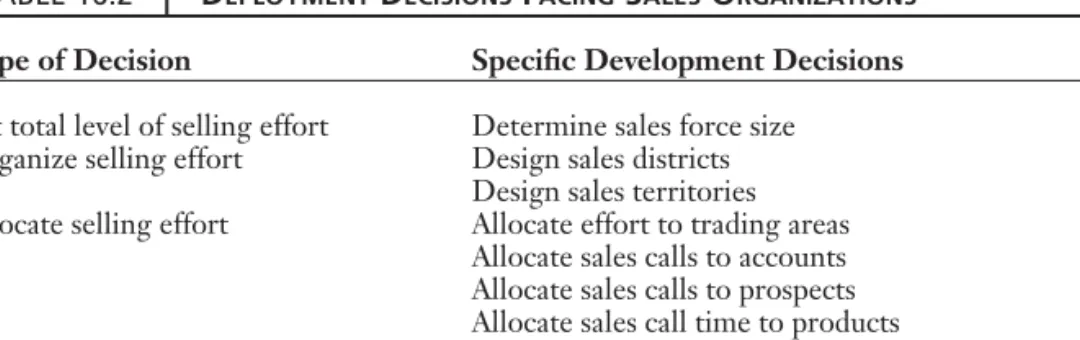
The size of the sales force establishes the level of selling effort that the business mar- keter can use. The selling effort is then organized by designating sales districts and sales territories. Allocation decisions determine how the selling effort is to be assigned to customers, prospects, and products. All these are illustrated in Table 16.2.
Proper deployment requires a multistage approach to i nd the most effective and efi cient way to assign sales resources (for example, sales calls, number of salespersons, percentage of salesperson’s time) across all of the planning and control units (PCUs) the i rm serves (for example, prospects, customers, territories, districts, products).47 Thus, effective deployment means understanding the factors that inl uence sales in a particular PCU, such as a territory.
Territory Sales Response What inl uences the potential level of sales in a particular territory? Table 16.3 outlines eight classes of variables. This list shows the complexity
45David W. Cravens, Thomas N. Ingram, Raymond W. LaForge, and Clifford E. Young, “Behavior-Based and Outcome-Based Salesforce Control Systems,” Journal of Marketing 57 (October 1993): p. 56.
46Richard L. Oliver, “Behavior- and Outcome-Based Sales Control Systems: Evidence and Consequences of Price-Form and Hybrid Governance,” Journal of Personal Selling & Sales Management 15 (Fall 1995): pp. 1–15.
47David W. Cravens and Raymond W. LaForge, “Sales Force Deployment,” in Advances in Business Marketing, vol. 1, Arch G. Woodside, ed. (Greenwich, CT: JAI Press, 1986), pp. 67–112; and LaForge and Cravens, “Steps in Selling Effort Deployment,” Industrial Marketing Management 11 (July 1982): pp. 183–194.
of estimating sales response functions. Such estimates are needed, however, to make meaningful sales allocations.
Three territory traits deserve particular attention in sales response studies:
potential, concentration, and dispersion.48 Potential (as discussed in Chapter 5) is a measure of the total business opportunity for all sellers in a particular market.
Concentration refers to how much potential lies with a few larger accounts in that territory. If potential is concentrated, the salesperson can cover with a few calls a large proportion of the potential. Finally, if the territory is geographically dispersed, sales are probably lower because of time wasted in travel. Past research often centered on territory workload—the number of accounts. However, Adrian Ryans and Charles Weinberg report that workload is of questionable value in estimating sales response:
“From a managerial standpoint, the recurrent i nding of an association between po- tential and sales results suggests that sales managers should stress territory potential when making sales force decisions.”49
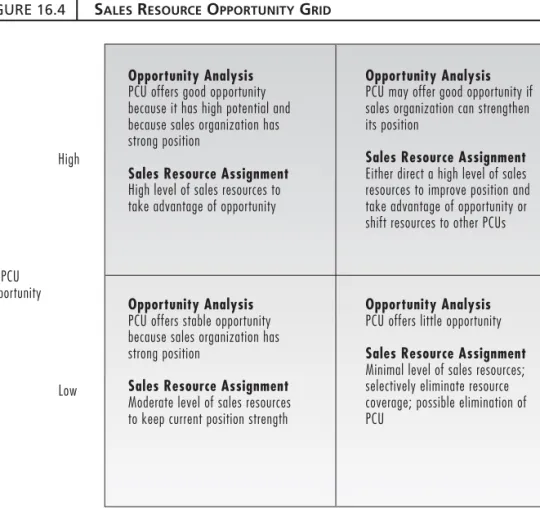
Sales Resource Opportunity Grid Deployment analysis matches sales resources to market opportunities. Planning and control units such as sales territories or districts
48Adrian B. Ryans and Charles B. Weinberg, “Territory Sales Response,” Journal of Marketing Research 16 (November 1979): pp. 453–465; see also Ryans and Weinberg, “Territory Sales Response Models: Stability over Time,” Journal of Marketing Research 24 (May 1987): pp. 229–233.
49Ryans and Weinberg, “Territory Sales Response,” p. 464.
TABLE 16.2 DEPLOYMENT DECISIONS FACING SALES ORGANIZATIONS
Type of Decision Specifi c Development Decisions Set total level of selling effort Determine sales force size Organize selling effort Design sales districts
Design sales territories Allocate selling effort Allocate effort to trading areas
Allocate sales calls to accounts Allocate sales calls to prospects Allocate sales call time to products Determine length of sales call
SOURCE: Reprinted by permission of the publisher from “Steps in Selling Effort Deployment,” by Raymond LaForge and David W. Cravens, Industrial Marketing Management 11 (July 1982): p. 184. Copyright © 1982 by Elsevier Science Publishing Co., Inc.
TABLE 16.3 SELECTED DETERMINANTSOF TERRITORY SALES RESPONSE
1. Environmental factors (e.g., health of economy) 2. Competition (e.g., number of competitive salespersons) 3. Company marketing strategy and tactics
4. Sales force organization, policies, and procedures 5. Field sales manager characteristics
6. Salesperson characteristics
7. Territory characteristics (e.g., potential) 8. Individual customer factors
SOURCE: Adapted from Adrian B. Ryans and Charles B. Weinberg, “Territory Sales Response,” Journal of Marketing Research 16 (November 1979): pp. 453–465.