Business Process in Procurement
(BPP)
Universitas Bina Darma
Purposes
• Memperkenalkan sistem pembelajaran BPP
– Mode Pembelajaran – Komponen Penilaian – Score Penilaian
– Sumber Materi Ajar – Dll.
• Mengetahui lingkup mata kuliah BPP
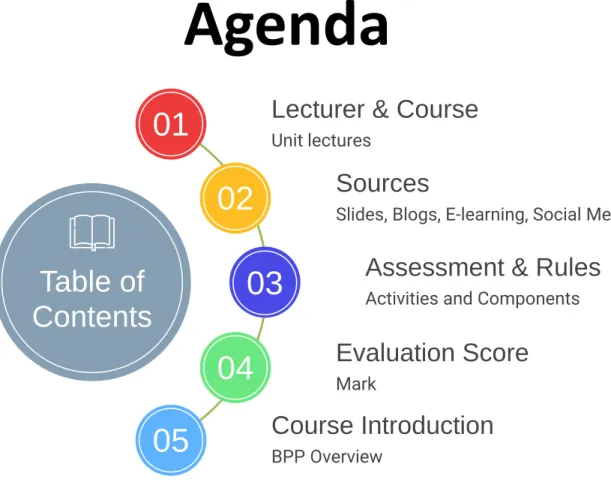
Agenda
Table of Contents
Unit lectures
Lecturer & Course
01
BPP Overview
Course Introduction
05
Mark
Evaluation Score
04
Slides, Blogs, E-learning, Social Meida
Sources
02
Activities and Components
Assessment & Rules
03
Lecturer Information
Computer Science &
Information Systems
Associate Professor
01
Enterprise Systems Research Group
Coordinator
06
Academic, Research, Community
Consultant
05
Publons, New ZealandMentor
04
HCI, KMS, CRM (Coordinator) SCM, SA&D, IS, DB, BPP, BP- HCM, ERP, etc.
Courses
03
Journals & Conferences
Editor & Reviewer
02
Leon A. Abdillah
List of Courses Taught
07
Algorithms, Programming, Data Structures
04
Human- Computer Interaction
01
Systems Analysis &
Design
09 Business Process
06 Human Capital Management
03 Research Methods
08 Supply Chain Management
05
Knowledge Management Systems
02 Enterprise
Systems
Unit Lectures
No Content No Content
1 Introduction 9 Order Monitoring
2 Procurement Life Cycle 10 Goods Receipt
3 Demand Determination 11 Invoice Verification 4 Source Determination 12 Payment Processing
5 Daily Exam 13 Tools Procurement
6 Supplier Selection 14 Public & International Procurement 7 Purchase Order Processing 15 Presentations
8 Mid Exam 16 Final Exam
Learning Media & Sources
WhatsApp Group of BPP
Moodle
Moodle elearning.binadarma.ac.id
Blogs
• blog.binadarma.ac.id/mleonaa
Teaching | Business Process in Procurement
• leonabdillah.wordpress.com | Teaching | Business Process in Procurement
BPP 2020-2021 Ganjil
Assessment Components
15%
Quiz & Presence
01
Class Activities
40%
Final Test
04
Final Exam
20%
Mid Test
02
Middle Exam
25%
Tasks & Presentation
03
Reports
Course Rules
Discipline < 15 min late
03
Academic Rules
05
Schedule
06
Attendance >= 80%
02
Registered in KRS
01 04
HonestEvaluation Score
5 10 15 20 25 30 35 40 45 50 55 60 65 70 75 80 85 90 95 100
A A A A
B B B C C C
D D D
E E E E E E E
Procurement Overview
• Overview SCM & Logistics
• Procurement Definition?
• What does the discipline of Procurement?
• Why study Procurement?
Background
• Today’s business environment is driven by the following (Keith, Vitasek, Manrodt &
Kling, 2016):
1. Globalization that is accelerating market interconnectedness.
2. A business environment challenged with increasing volatility and risk, including
international terrorism, sovereign debt defaults, natural disasters, and port slowdowns caused by labor disputes and inadequate transportation infrastructure
3. An increasingly fast consumer-driven society that demands more agile and flexible supply chains
4. The continued evolution of a service economy that is shifting to strategic, not just tactical, outsourcing
5. A shift in purchasing skills and processes to create value, not simply procure goods and services
6. The expansion and introduction of capabilities of cloud computing in procurement
activities
Logistics
• Logistik adalah tugas mengelola 2 (dua) arus utama(Harrison & Hoek, 2008):
1. Material flow barang fisik dari pemasok melalui distribusipusat ke toko;
2. Information flow data permintaan dari pelanggan
akhir kembali ke pembelian dan ke pemasok, dan
data pasokan dari pemasok ke pengecer, sehingga
aliran material dapat direncanakan dan dikendalikan
secara akurat.
SCM & Logistics
• Rantai pasokan (supply chain), yang juga disebut sebagai jaringan logistik (logistics network),
terdiri dari pemasok, pusat manufaktur, gudang, pusat distribusi, dan gerai ritel, serta bahan baku, inventaris dalam proses, dan produk jadi yang
mengalir di antara fasilitas (Simchi-Levi, Kaminsky
& Simchi-Levi, 2004).
Supply Chain
• A supply chain is a network of partners who collectively convert a basic commodity
(upstream) into a finished product (downstream) that is valued by end-
customers, and who manage returns at each
stage (Harrison & Hoek, 2008).
Logistics Network
(Simchi-Levi, Kaminsky & Simchi-Levi, 2004)
SCM
• Supply Chain Management (SCM) fokus pada
mata rantai pasokan dari hulu ke hilir untuk
mencapai tingkat efisiensi dan efektivitas
perusahaan yang optimal dan maksimal.
Supply Chain Network Context
•
(Harrison & Hoek, 2008)
SCM & ERP
• Enterprise Resource Planning (ERP) menjadi simpul
integrasi semua proses bisnis enterprise modern (Abdillah, 2020).
• The ERP system for a manufacturing organization typically encompasses SCM activities and manages the flow of
materials, information, and finances. Manufacturing ERP systems follow a systematic process for developing a
production plan that draws on the information available in
the ERP system database (Stair & Reynolds, 2018).
Enterprise Application Architecture
•
(O’Brien & Marakas, 2010)
Procurement
• Procurement is a pro-active, strategic corporate activity to ensure a continuing supply of goods and services to enable world-class organisational performance.
• Procurement manages supply chain risks through
the effective negotiation of contracts, cost and
price models, quality and other essential supply
characteristics.
Procurement
• Refers to the raw materials, component parts, and supplies bought from outside
organizations to support a company’s
operations
Procurement
• Procurement refers to the purchasing of goods and services that are required as inputs to the primary activities.
• Procurement receives, approves, and
processes requests for goods and services
from the primary activities and coordinates
the purchase of those items.
Value Chain Framework
Purchasing
• Strategic sourcing comprises the process of planning supply, selecting suppliers and contracting them in order to establish the potential for supply.
• Operative procurement encompasses the ordering of material and services, ensuring its delivery and, finally, activating the payment, thus executing the order.
• Strategic sourcing and operative procurement together
represent purchasing.
Purchasing
(Zijm, Klumpp, Heragu & Regattieri, 2019)
Why Study Procurement
• Mendukung tujuan dan sasaran organisasi
• Mengelola proses pembelian secara efektif dan efisien
• Mengelola basis pasokan
• Mengembangkan hubungan yang kuat dengan kelompok fungsional lainnya
• Mendukung kebutuhan operasional
Conclusion
• The Procurement discipline includes the study of:
– Logistics, Supply Chain Management – Procurement
– Bisnis, Ekonomi, Manajemen, dan Sistem Informasi
• Procurement is worth studying because it aligns both human capital and intellectual capital
29/09/2020 Leon Abdillah - BPP - 01 Introduction to BPP 28
Homework
1. Prepare your SocialMedia ID (FaceBook)
2. Set a group discussion consist of 2-4 students for small class (<=20), 5-6 students for medium class (21-35), or 7-8 students for large class (>36) 3. Create an account in CloudPrepare your blog using WordPress
[yourname], create a PAGE/laman of “BPP” or “Business Process in Procurement”.
4. Create a cloud repository (DropBox)
5. Develop your team project theme based on the information given from
several sources (journals, conference proceedings, books, or master
theses). You may use one of these sources: a) GOOGLE SCHOLAR
(http://scholar.google.com/) or b) MICROSOFT ACADEMIC SEARCH
(http://academic.research.microsoft.com/)
Assignment
• Assignment 01
– Browse at least 5 (five) definitions of Procurement (from Books, Journal Articles, etc.).
– Save your assignment in word as
• “BPP-2020-2021-01Ganjil-Class-01-Group/Name”
– Store it in DropBox, paste the URL from DropBox
into the submitted URL!
References
Abdillah, L. A. (2017). Business Modeling - Supply Chain Management Computer Science for Education. Palembang: Bina Darma University.
Abdillah, L. A. (2018). Supply Chain Management Computer Science and Information Systems. Palembang: Universitas Bina Darma.
Abdillah, L. A. (2020). Model Sistem Umum Perusahaan (Enterprise General Systems Model). In Sistem Informasi Managemen (Management Information Systems). Medan: Yayasan Kita Menulis.
Ahmed, A. (2014). The SAP Materials Management Handbook. Boca Raton, FL, USA: CRC Press (Taylor & Francis Group).
Baily, P., Farmer, D., Crocker, B., Jessop, D., & Jones, D. (2015). Procurement Principles and Management (11th ed.). Harlow, U.K.:
Pearson Education Limited.
Baltzan, P. (2019). Business Driven Information Systems (6th ed.). New York, USA: McGraw-Hill Education.
CIPS. (2020). Procurement and Supply Cycle. Retrieved October 6, 2020, from https://www.cips.org/knowledge/procurement- topics-and-skills/procurement-and-supply-cycle/
Davis, R. A. (2016). Demand-Driven Inventory Optimization and Replenishment (2nd ed.). New Jersey, USA: John Wiley & Sons, Inc.
Harrison, A., & Hoek, R. Van. (2008). Logistics Management and Strategy: Competing through the supply chain (3rd ed.). Essex, England: Prentice Hall (Pearson Education Limited).
Keith, B., Vitasek, K., Manrodt, K., & Kling, J. (2016). Strategic Sourcing in the New Economy: Harnessing the Potential of Sourcing
Khaled, A. A., Paul, S. K., Chakraborty, R. K., & Ayuby, S. (2011). Selection of Suppliers through Different Multi-Criteria Decision Making Techniques. Global Journal of Management and Business Research, 11(4), 1–12. Retrieved from
http://journalofbusiness.org/index.php/GJMBR/article/view/479
Lysons, K., & Farrington, B. (2016). Procurement and Supply Chain Management (9th ed.). Harlow, U.K.: Pearson Education Limited.
Mukherjee, K. (2017). Supplier Selection: An MCDA-Based Approach. In J. Kacprzyk (Ed.), Studies in Systems, Decision and Control.
New Delhi, India: Springer (India) Pvt. Ltd.
Murphy, K. (2017). What is the Procurement Management Process? Retrieved from https://www.purchasecontrol.com/blog/procurement-process-cycle/
Murphy, K. (2020). Invoice Verification Process And How To Improve It. Retrieved from https://www.purchasecontrol.com/blog/invoice-verification-process/
Musaad O, A. S., Zhuo, Z., Siyal, Z. A., Shaikh, G. M., Ali Shah, S. A., Solangi, Y. A., & Musaad O, A. O. (2020). An integrated multi- criteria decision support framework for the selection of suppliers in small and medium enterprises based on green
innovation ability. Processes, 8(4). https://doi.org/10.3390/PR8040418
O’Brien, J. A., & Marakas, G. M. (2010). Introduction to Information Systems (15th ed.). New York, USA: McGraw-Hill Companies, Inc.
O’Brien, J. (2014). Supplier Relationship Management: Unlocking the hidden value in your supply base. London, UK: Kogan Page Limited.
Razak M., A. (2017). SAP Invoice Verification. Retrieved from https://erproof.com/mm/free-training/sap-invoice-verification/
SAP AG. (2006). SAP01 : Fundamentals. Walldorf, Germany: SAP AG.
Simchi-Levi, D., Kaminsky, P., & Simchi-Levi, E. (2004). Managing the Supply Chain: The Definitive Guide for the Business Professional. New York, USA: McGraw-Hill Companies, Inc.
Schoenherr, T. (2019). The Evolution of Electronic Procurement. Cham, Switzerland: Springer International Publishing AG.
Stadtler, H., & Kilger, C. (Eds.). (2008). Supply Chain Management and Advanced Planning: Concepts, Models, Software, and Case Studies (4th ed.). https://doi.org/10.1007/978-3-662-04215-1
Stair, R. M., & Reynolds, G. W. (2018). Principles of Information Systems (13th ed.). Boston, MA, USA: Cengage Learning.
Valacich, J., & Schneider, C. (2018). Information Systems Today : Managing in the Digital World (8th ed.). New York, USA: Pearson Education, Inc.
Weigel, U., & Ruecker, M. (2017). The Strategic Procurement Practice Guide: Know-how, Tools and Techniques for Global Buyers.
Cham, Switzerland: Springer International Publishing AG.
Zijm, H., Klumpp, M., Heragu, S., & Regattieri, A. (2019). Operations, Logistics and Supply Chain Management.