
Kivett, Missouri Basin Project staff archaeologist (now director, Nebraska State Historical Society Museum). Excavation of some of the most important archaeological sites in the Garrison Reservoir area began in the 1950s.
INTRODUCTION
Smith of the Museum of Natural History, University of Kansas, welcomed expert advice on firearms and gave permission to reproduce his examination of materials of this nature from the site, as an appendix to this paper.
GENERAL OBSERVATIONS
This was not the case in 1951, and an extension of the bottom area between the first terrace and the main channel – probably the result of the build-up of bars at its mouth. This change in the relationship between the two streams apparently occurred at a period between 1870 and 1891, at which later date the maps of the Missouri River Survey were prepared, as the latter maps show the terrain at this point until it was covered through the waters of the reservoir (USA).
LEGEND —
In the vicinity of the post office the prairie grass lands doubtless originally supplied all grazing needs. The reservation map of 1870 (traced 1879), previously mentioned, shows the Douglas Creek postgarden, west of the fort.
EXCAVATIONS OF INDIVIDUAL SITE UNITS
In August 1867 de Trobriand noted that civilian employees numbered 40 persons, out of the 260 persons at the post. The practical lessons learned in the manufacturing process of the adobe bricks here are also important in this regard.
HOSPITAL
In connection with the poor construction practices mentioned, there is the related issue of the suitability of the plans for the buildings, and the suitability of the planning prior to actual construction. The frontier period was already over in 1897, and the needs of the region's permanent settlers left little room for such undertakings as the preservation of historic sites and buildings.
32MLI
Like most of the major buildings at Fort Stevenson, the hospital was constructed of wood, brick, common burnt brick, stone, and related materials. All the fragments appear to be of a modern thickness approaching the number 6 described today (about %6 inches).
SOUTH BARRACKS
Just like the Hospital grounds, this site was well covered with turf and weeds. Their regular piles of rubble of accidentally fired brick and regular fired brick were especially visible at the site of the West Wing (pis. 39, &; 41, &). 176 Grass in areas of lower elevation approximating that of the original terrain surface (as in the case of the "body" area).
The masonry feet found at the site of the southern barracks did not differ significantly from those previously seen at the site of the hospital. Only one major change had been carried out on the site of the southern barracks after the military period, namely the addition of the axister of masonry and Portland cement.
COMMISSARY STOREHOUSE
Only a prominent floor at the rear of the east wing of the building served to indicate the actual location of part of the whole (fig. 15). Parts of the remains of the original foundation were subsequently found along the line of the base of the front wall and at the said rear outer corners (Fig. 42, a). At the site of the cellar at the rear of the East Wing, no stone or other masonry of any kind was found until the excavation had almost reached the floor level of the original cellar.
At this point the remaining masonry, of the basement walls, was of plain red fired brick. The rocks were of the same type as had previously been found used elsewhere only for chimneys.
32MLI COMMISSARY
In this case, the bricks were laid flat and lengthwise with the longitudinal axis of the basement (i.e. north-south). It is likely that these columns were originally used in pairs and that there was another row in the unexcavated part of the basement. Near the floor recesses in the center of the cellar lay on the floor one heavily charred log, probably no larger than 2 by 4 inches in its original dimensions (Fig. 18; Fig. 42, 5).
Much of the rubbish accumulation found during the excavation of the basement was of recent origin. The only demarcation of the fill in the basement area was an irregular line between the construction debris and the later intentional fill.
SOUTH OFFICERS' QUARTERS
The site of the South Officers' Quarters (fig. 19; pi.. 44, a) was completely obscured to the surface of the ground when first approached, and covered by a continuous weight and a few weeds. Excavation began by excavating the presumed site of the southeast corner of the building, according to the 1879 plan. The photostat of the 1879 plan, in the files of the National Park Service Project Two and the Missouri Basin Project, is reduced by half. from the original.
There was also a great deal of fine gravel; this was probably introduced on the site of the southern officers' quarters at the time of the excavation of the basement below the commanders' quarters immediately to the north. These thresholds were probably parts of the frames of wooden ventilators that had given access to the space below the original floors of the building.

COMMANDING OFFICER'S QUARTERS
Work on the foot may have been stopped, and the remains of the masonry here consisted only of a few smaller stones and stones. The fans were not uniform in dimensions, but varied with the height of the original ground surface adjacent. Most of the brick originally in use here must have been removed by the time the building was demolished.
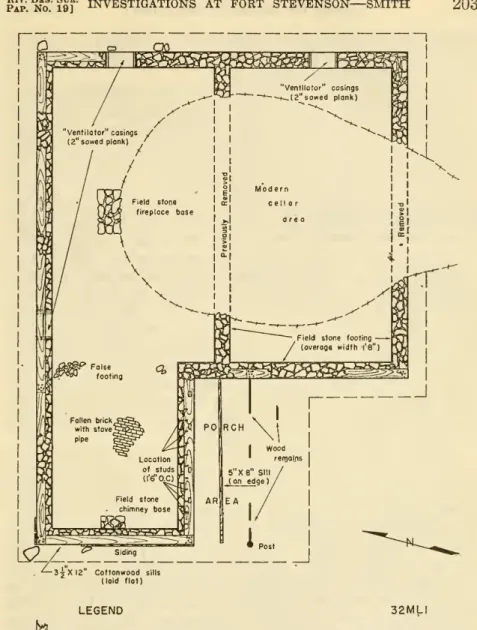
At the corners of the masonry, the sills were overlapped over the entire width (30 cm), at a right angle (Fig. 46, a). Elsewhere in the building's foundations, clear evidence of the building's late use as a granary was found, in small grains and straw among the construction debris.
OTHER SITE UNITS
It is possible that the building was partially made of adobe brick, as adobe bricks and adobe mud were seen near the edges of the pit at the surface, apparently in original position. In both cases, lime was used from time to time while the pits were open, and gravel and waste soil, in-.
OBJECTS RECOVERED
It is clearly impossible, from the fragments which survive from such a site as this, to reconstruct more than a small part of life at a military post, which was afterwards used as an Indian school, and finally as a farmstead. On the other hand, material is now available from this site that reveals bits of the physical history of the post that have not been preserved anywhere else, or have not been adequately preserved. During the development of industrial manufactures in the latter part of the 19th century, new and wider applications and uses were quickly made of raw materials that had previously been of limited or no use.
Materials such as the present collection thus reveal something of the rapidly changing nature of modern industrial manufacturing that has sometimes been under-appreciated. If the object, or an instance of the object group, is illustrated, reference is made to the illustration, also in parentheses.
MILITARY GOODS Unifokm and insignia
The size of the samples obtained {% inches in diameter) suggests that they were for blouse use. Similar specimens were excavated at Fort Laramie, Wyo., and Fort Ridgely, Minn. The design of these two is slightly different, although both are of the type we are generally familiar with today, having an internally formed thread to attach to a threaded wooden pin attached to the crossbar of a telegraph pole.
Cauvet, New York, N.Y., for such a telegraph insulator, probably one of the first uses of glass for insulation in this manner (U.S. According to the evidence of insulators found and the patent description, this type was not covered with wood, as was sometimes done on the frontier, mainly to prevent the Indians from destroying the insulators.
INDIAN SCHOOL GOODS
The base of a sheet steel heating stove, possibly suitable for use with the lignite available at the post office, was found in the excavation of the West Wing of the Hospital site. It was severely damaged by the heat of the fire that destroyed the building and was not saved. The army-type mess-kitchen range (p. 49, &) of sheet steel was found on the site of the Commissariat Depot, on the surface at the site of the basement,.
A fragment of the base of a whiskey mug (No. of clear bluish glass, is of a type familiar to glass specialists. The Elgin National Watch Company, incorporated in Illinois in 1865, adopted this form of the name in 1874.
MISCELLANEOUS
One of the specimens (no. 1366) is a fragment of sawn marble and may be part of a lamp base. It had been deeply notched across the central part of one surface and ground into a basin shape. A bulbous flake of "Knife River flint" (brown chalcedony) cut across most of the upper surface and with secondary chipping along the edges.
One (no. 1890) is a small, blocky portion of the scapula, with a hole cut out in the center; maybe a wrench.
CONCLUSION
However, the excavations made at the site allowed some final additional observations at the site, as well as providing, for the first time, actual object material properly documented for permanent preservation. Little more than the general plan of the whole post and of the general nature of individual buildings could be learned by excavation alone. The investigation of the site of Fort Stevenson was concluded due to the existence of a practical problem.
It is clear that knowledge of the physical remains of human history is insufficient until actual excavations, however limited, are carried out, and it is rarely possible to predict archaeological finds. The results obtained also suggest that the overall significance of the surviving remains was somewhat weak.
APPENDIX
In these cases, excavation could have yielded information that would now be available - but the opportunity for this MTork is gone. However, a comparative study of selected sites of similar origin seems to offer possibilities for knowledge of wider significance than any further data on Fort Stevenson itself. Investigations of historical sites of such comparatively late date in the West have been made little more than a beginning, and although the value of such studies cannot be predicted, they should be a valuable addition to ordinary historical research.
CARTEIDGES AND BULLETS FROM FORT STEVENSON,
NORTH DAKOTA
A Henry rifle, or Winchester Model 1866, using the .44 Henry cartridge was present, along with .45-caliber Colt revolvers, a .54-caliber Burnside carbine, and, possibly, a 12-gauge shotgun. The case is tapered and slotted to receive the flash from a separate shock cap located on the nipple mounted on the shirt stopper. Manufactured by Winchester fromca.186&-1890 for use in the Henry rifle, patented in 1860, for the Model 1866 Winchester and for several single-shot rifles.
Manufactured at Frankford Arsenal from March 1868 to about 1880 for use in the same weapon as no. 4 above.
34;Nitro Club," made by Remington-Union Metallic Cartridge Co. Missing 10-gauge, low base, brass, papers. Suffocated channel with raised lettering. Lewis and Clark in North Dakota; Original manuscript journals and text of the Biddle edition while the expedition remained in North Dakota.BULLETIN OF AMERICAN ETHNOLOGY BULLETIN 176 PLATE 37. the robbery of the southeast corner of the East Wing of the Hospital.
BUREAU OF AMERICAN ETHNOLOGY BULLETIN 176 PLATE 38 .. a, Interior view of plinth of northwest corner of main body of hospital, b, Detail of stonework. BULLETIN OF THE BUREAU OF AMERICAN ETHNOLOGY 176 PLATE .. a,Exterior view of southeast corner of West Wing of South Barracks, b,Interior view of southeast corner of West Wing of South Barracks.


