Lasherica Thornton University ofMississippi
Oxford, Mississippi December 2018
Approved by
~~A/
Advisor: Dr. Kathleen Wickham
---c ;_,e ~ r.u~
Re~:
Dr. Deborah Wenger
0( ~~~
Reader: Professor Ch;;trlie Mitchell
-
'·All That Glitters Is Not Gold: Media Coverage of the Golden State Killer Lasherica Thornton
University of Mississippi
Author’s Note
Lasherica M. Thornton, Meek School of Journalism and New Media and the Sally McDonnell Barksdale Honors College, University of Mississippi
Lasherica Thornton is a first-generation student, raising two daughters as she pursues her bachelor’s degree in journalism with an emphasis in news-editorial and a minor in legal studies.
She conducted this research in fulfillment of her honors requirement.
All questions, comments, and concerns should be addressed to Lasherica.
Contact: [email protected]
Abstract
This thesis focused on the media’s extensive coverage of serial killers and, thus, how it could propel them to a state of fame. It discusses that no matter a serial killer’s circumstance, the media typically finds a story. For example, a serial killer can be on a rampage or can be dormant, but in subsequent stories, the media will center a story around the killer’s first and/or recent crimes, his identity, or his possible next move.
The New York Times and Los Angeles Times coverage of the Golden State Killer frames the analysis of this manuscript. The purpose was to recognize the connection between extensive coverage and a serial killer’s state of fame while evaluating how journalists draw readers in and keep their attention with the weighted topic of serial murder. Furthermore, the goal was to identify common themes of serial homicide coverage across two news publications and
recognize a journalist’s ethical dilemma in focusing on the serial killer rather than the victims.
Based on an examination of more than two dozen articles, the research indicates that journalists bait readers with an entertaining aspect about a serial killer or an important fact
readers want to know. Once the readers are pulled in, they, unwillingly, begin to identify with the killers. Empathy was found as the overall tone as well as the most common theme in the majority of articles. More often than not, readers never know the names or lives of the victim, but end up knowing everything there is to know about the killer, which puts the killer in a spotlight for years.
Yet and still, the media must cover serial crime to keep the public informed or to remind the public of horrific crimes of the past. As media practitioners, journalists must not shrink from revealing the truths of society.
Keywords: serial killer, media coverage, Golden State Killer, New York Times, Los Angeles Times
Contents
Introduction 5
Literature Review 7
Background of Golden State Killer 15
Methodology 21
Results 23
Discussion 28
Works Cited 31
Appendices
Codebook 38
Analysis 40
Charges 48
Additional Resources 50
Introduction
Law & Order. Criminal Minds. NCIS. How to Get Away with Murder. These shows and others have played on television no matter the day or hour. Beyond mere television shows, though, cases of rape, murder, and anything in between are broadcast continuously on news outlets because people are attracted to disasters, drama, and tragedies. However, once a criminal is arrested and time passes after that arrest, the crime story usually fades away and so does media coverage. But, consider the names of Ted Bundy, John Wayne Gacy, the Green River Killer, Jeffery Dahmer, Jack the Ripper, the BTK Killer, Robert Hanson, and the Boston Strangler. All of them are serial killers. Furthermore, cases concerning them didn’t just fade away because their crime stories involved serial murder. One utterance of their names causes a recollection of a fact about their lives or their crimes. This is not because everyone has conducted in-depth research on all of them, but because of media coverage. When a story involves serial murder, the media coverage is not only extensive but also seemingly never-ending. A serial killer can be on a rampage or can be dormant, yet the media will ensure there is a story centered around the killer’s first and recent crimes, police pursuits, the killer’s identity, the killer’s next move, and so forth.
The following literature review encompasses a case study of the Golden State Killer with a historical narrative of current day serial killers dating back to the first publicized serialist in 1888 — the British Victorian serial killer Jack the Ripper, who killed in a small region of London but was never identified.
The purpose of this manuscript is to review and analyze media coverage in The New York Times and Los Angeles Times of serial killers and consequently how it could propel killers to a state of fame.
The specific research questions are:
RQ1: How did the headline draw the reader in?
RQ2: How was each article introduced through the lede?
RQ3: What is the overall tone of each article?
RQ4: What or who is the focus of the article?
RQ5: What are the common themes of serial killer coverage in the New York Times and LA Times?
Literature Review
Serial killers are a highly publicized and studied group of killers even with the smallest percentage of homicides, making up no more than 1 percent of murders (Bonn, 2014). FBI databases reveal there are about 15,000 murders a year and approximately 150 are serial
homicides. Furthermore, the bureau believes there could be 25 to 50 serial killers “operating” in the United States at any one time period with about three people killed annually (Bonn, 2014).
Investigative journalist Thomas Hargrove has challenged those statistics. More than 2,000 serial killers are at large, according to Hargrove, who, for years, has tracked and analyzed serial killers (Tron, 2017). He augmented FBI-provided data and gathered records from over 700,000 homicides since 1976 and 27,000 additional records from states that don’t report to the FBI. The counting of records not reported to the FBI explains his higher estimated number of murders (Hargrove, 2018).
Through his nonprofit Murder Accountability Project, he developed an algorithm to look for clusters of seemingly similar murders, by measuring comparable victims killed with similar modus operandi (MO) within a particular geography. Crimes found by the algorithm have an elevated probability to be a crime of serial murder. The algorithm functions solely to identify those clusters because an algorithm, by definition, is a mathematical series that produces a solution, which should remain constant or provide one answer (Hargrove, 2018).
Moreover, by links to DNA, he maintains that 1,400 unsolved homicides are serial acts.
While FBI statistics mark them as unique on the list of homicides, the media publicizes serial killers, dating back to the first publicized serial killer Jack the Ripper. The infamous nickname is
all the serial killer is known by because he was never caught and never named. He mutilated and murdered prostitutes in 1888 in the East End of London, a small part of London, but the poorest and most crime-ridden parts. The impact of his murders is thought to have impacted the society as a whole since the press and public learned of the “sordid underbelly of Victorian society”
(Jones, n.d.).
Jack the Ripper killed at least five victims over about twelve weeks, yet the unknown killer reigns as one of the most famous and most prolific serial killers worldwide. Just as the
newspapers do today, the newspapers, then, covered the crimes extensively, providing daily crime updates and making Jack the Ripper a media figure. The media, as watchdogs of
government and police, comprehensively follow a crime through each step of the criminal justice system, however. Although most of society viewed him as a personification of the evils of the area he terrorized, he became Jack the Ripper because of the media (Jones, n.d.). Jack the Ripper was only one of many to be named by the media. Nevertheless, naming serial killers may be a way to make them identifiable to the public. The media and public can better engage with each when there’s a name to a face, or in this case, a name to the suspect.
Furthermore, Kevin Haggerty, a University of Alberta sociologist and criminologist, accounts the “unnatural fascination” the media has with serial killers, calling it a “symbiotic relationship” where serial killers tell their stories and the media gives them fame or notoriety, which he said began with the Jack the Ripper murders in 1888 and hasn’t waned (Serial Killers Shaped by Society, Study Claims, 2009).
As with other cases, journalists’ media coverage remained all-encompassing. For instance, on December 22, 1978, the Chicago Tribune published a photo of the home of serial killer John Wayne Gacy with the caption “Numbered stakes indicate where the bodies of John Wayne
Gacy’s victims were found in the crawl space beneath his suburban home. Twenty-nine bodies, all young males, were recovered from Gacy’s home. Four others were found in Illinois rivers.”
Along with the photo, the newspaper included an exposé on “the country’s worst serial killer,”
his life, and his crimes (Smith, 2017).
At that time, hypothetically speaking, people might have felt mixed emotions, ranging from anger to sadness. For instance, people might have been furious at the fact the first murder occurred in 1972, yet Gacy eluded capture until 1978. Then again, citizens could have
experienced happiness accompanied by a sense of security with Gacy off the streets. But, those feelings were only replaced with sadness to grieve 33 lost lives. These emotions were drawn out over a long period of time as the media covered Gacy’s first murders of homeless male
prostitutes, his later killings of suburban teens, and the eventual crime scene described in the 1978 image caption. Likewise, the media covers Gacy to this very day.
In 2007, TIME highlighted the crimes of the century, including Gacy’s vicious, but notorious acts. In that article, Howard Chua-Eoan opened with “The warning signs were there: the arrest for sodomy with a minor; another sexual offense with a child; the strange smell, like dead things, in his house,” hinting there were, indeed, forewarning acts before Gacy became a serial killer as well as indications of wrongdoing afterwards. Quickly, though, Chua-Eoan noted how Gacy, too, was an upstanding citizen, causing reasonable doubt of any guilt.
Even in 2017, the online version of the Tribune displayed the archive photo with the same media coverage breakdown from years before, including a brief biography of Gacy and details of his crimes as well as his victims. For example, in the online republication, Sid Smith noted that although Gacy was a successful contractor, he usually lured his victims into his car, knocking
them unconscious with chloroform and typically torturing them for hours before stabbing, strangling, or suffocating them to death (Smith, 2017).
Recent news coverage of serialists tends to go back to the infamous killers, like Gacy, from decades ago. Published last year, “Decades of Questions Get Chilling Answer: He Was John Wayne Gacy’s Victim” revealed that Jimmy Haakenson, who disappeared in the late 70s, was identified and found to be a victim of Gacy. Previously known as victim #24, Haakenson was one of 29 bodies found around Gacy’s home, but it took four decades to make the discovery (Bosman, 2017).
In 1976, 16-year old Jimmy told his parents he’d visit Chicago, which wasn’t a problem to them because he often left home to escape the crowded house he called home but he always returned. Not long after safely reporting making it to Chicago, weeks passed and his family reported him missing. When Gacy was revealed as a killer, Jimmy’s mother theorized that one of the unidentified victims might have been her son. However, for whatever reason, the request for dental records were never received. For the most part, Jimmy’s name was unmentioned until his nephew (once grown and in the Air Force) started asking questions and searching for him. Then, a detective sought to solve Chicago’s cold case, which included Gacy’s unidentified victims.
When this was publicized, Jimmy’s nephew Jeff reached out, only to find out Jimmy was, indeed, victim #24 (Bosman, 2017).
Media still extensively covers serial killers like Gacy. Because of that, the next generation will know of the infamous John Wayne Gacy, not because he still rampages suburban
neighborhoods, but because the media continues to cover his life and his crimes, at times adapting the story for historical reference or using a new angle. Mike Cahill, an American screenwriter, published “7 Shocking Headlines from the Days When Serial Killers Dominated
the News” to demonstrate how extensive media coverage actually turned killers into celebrities (Cahill, 2015).
David Berkowitz, known to America as the Son of Sam, wore a grin in the August 1977 New York Post headline “CAUGHT!” With his face plastered across newspapers, America would not forget the man who taunted police with letters, only feeding his narcissistic ego. Even more so, America would remember Berkowitz’s own words, “I wanted to go out in a blaze of glory,” as the New York Post bolded his quote as a sub title. At the same time, the Daily News humanized Berkowitz when they printed his story under the headline “Sam Changed After LSD Trips.” In contrast between the two articles, based on the New York Post, America might despise Berkowitz as he took pride in his killing spree; however, due to the Daily News coverage, America could empathize with him or shift blame to his drug use (Cahill, 2015).
“GUILTY-48 TIMES” was the headline that stretched across the newspaper to report Gary Ridgway, the Green River Killer — a name dubbed by the media — pleading guilty to 48 counts of murder. In the article, one could see the names and faces of women — the women he killed.
By doing this, the media put names and faces to what would be 48 victims. The media included a quote from the Green River Killer, himself, saying, “I killed so many women, I have a hard time keeping them straight,” since he was thought to be responsible for up to 90 murders (Cahill, 2015).
During the 70s, 80s, and 90s, serial killers often dominated the headlines. As such, reporters, editors, and the public, alike, did not identify the trend. Now, though, secondary sources exist about extensive coverage of serial killers. Julie B. Wiest’s “Serial Killers as Heroes in the
Media’s Storybook of Murder: A Textual Analysis of The New York Times Coverage of the “Son of Sam,” the “Boston Strangler,” and the “Night Stalker,”” is a thesis-driven examination of the
media’s over-coverage of serial killers and its creation of serial-killer superstars. Wiest and others brought focus to the media’s knowledge of society’s obsession for drama. The media, hence, takes that obsession and extensively covers serial killers so that society is not merely familiar with the crimes but also the lives of the culprit and his or her way of thinking (Wiest, 3).
According to Wiest, media can help people understand societal values. “The newspaper is powerful, in that it has the ability to tell readers what is important, or what is news. Newspapers will have society believe that the story on the front page is the biggest and most important story,”
(Wiest, 3).
In the examples provided, the headlines on notorious serial killers expanded across the front pages of their respective newspaper outlets. So, to people, serial killers were the most important news of the day based on Wiest’s logic that the story on the front page is the biggest and most important story. Furthermore, the media covers serial killers regardless if they are dormant or not, whether it be a first or recent crime, and even after convictions and/or death, which can be a depiction as serial killers as the most important issue. Hall said, “Covering serial murder gives a newspaper news stories for a long time,” (Wiest, 3).
When covering serial killers, there is a new angle or story every time the killer strikes, for each interview, after interrogations or arrests, when there is a conviction, and during the criminal’s sentence. This may cause the notion that a serial killer becomes a celebrity, a
superstar, a hero even depending on the angle media takes in coverage. Wiest discusses the sale of “murderabilia,” or serial-killer memorabilia. She said books, T-shirts, trading cards, calendars, action figures, comic books, and magazines feature serial killers. Surprisingly enough, the
murderabila can be worth thousands, especially if the killer signs it (Wiest, 8-9).
Serial killers become the subject of biographies, television shows, and movies. For instance, Jeffrey Dahmer, who killed and dismembered 17 gay and bisexual men, was the subject of a film called Dahmer. In one scene, he carefully considers the fate of his next victim. At the same time, he experiences flashbacks of the events leading up to his evolution as one of America’s most notorious serial killers. In those flashbacks, the audience sees his agonizing relationship with his father, his first killings, and his patrols for victims in gay bars.
A year before Dahmer was released, From Hell premiered as number-one film in the country and earned $11.6 million in the first weekend. It was based on the British Victorian serial killer Jack the Ripper (Schmid, 31).
The number of movies and television shows based on the actual events of serial killers is not insubstantial either. Society views serial killers as important, which may be partly the result of the media’s extensive coverage of them. But, serial killers may just be “distorted reflections of society’s own values.” Simply put, serial killers are shaped not by psychology but by society and its values, according to Haggerty (Serial Killers Shaped by Society, Study Claims, 2009).
In his August 2009 published study, Haggerty discusses Robert Pickton, a Canadian pig farmer. Pickton bragged about murdering over 49 women. Because of his choice of victims, who were drug-addicted prostitutes, Haggerty argues that society’s perception of and marginalization of prostitutes not only made them undesirable but also aided Pickton in his decade-long serial rampage. In fact, Haggerty said had it been in the early modern period were prostitutes were a part of the community, Pickton wouldn’t have got away with his crimes for as long as he did (Serial Killers Shaped by Society, 2009).
Like Haggerty, Scott Bonn, a criminology professor, media expert and analyst, said serial killers reflect the dark, but real nature of society. More so, he attributes a number of reasons to
society’s fascination, even love for serial killers. His research for Why We Love Serial Killers reveals that people are drawn to the pathological minds of serial killers out of pure curiosity, or intense curiosity. A second reason is the public feels that they could be a potential victim even though the media seeks to calm those fears through serial killer coverage. Bonn also notes because serial killer behavior is often unexplainable and without motive, the public is compelled to gain an understanding, no matter how unrealistic. All in all, a key reason for the love of serial killers can be the “innate human tendency to identify or empathize with all things — whether good or bad — including serial killers,” (Here's Why We Love Serial Killers, n.d.)
Background on the Golden State Killer
A case study of the New York Times’ and Los Angeles Times’ coverage of the Golden State Killer serves as a protocol for media reportage on serial killers. In this case, the coverage is dense because the serial rapist and murderer eluded capture for more than 40 years. In fact, the killer, a former police officer, hid in plain sight as an average resident of a suburban
neighborhood in northeast Sacramento, California.
From 1974 to 1986, the Golden State Killer, also known as the Visalia Ransacker, the East Area Rapist or the Original Night Stalker before adopting the killer label, committed more than 50 rapes and 12 murders, according to investigators (Arango, 2018). Michelle McNamara, a crime writer who died in April 2016, created the killer label (Carroll, 2018). The cold case heated up when McNamara’s novel I’ll Be Gone in the Dark: One Woman’s Obsessive Search for the Golden State Killer came out posthumously in Feburary 2018. The meticulous
investigation into his identity publicized knowledge of his blood type, body type and habits as well as details of his unsolved crimes, learned over years of hunting the elusive killer
(Rosenberg, 2018).
Through sadistic rituals, he tormented his victims, once taunting a survivor with “You’ll be silent forever, and I’ll be gone in the dark.” Using different methods for the kills, he shot and killed some victims with a firearm and bludgeoned others to death with whatever was present at the time, even using a piece of firewood on one occasion. The masked killer who bound his victims initially raped single women; however, he evolved to raping married women in front of their husbands and killing them both afterwards.
The first time he attacked a couple occurred shortly after a town meeting where a man said it wouldn’t be possible for him to “get away with raping a woman in the presence of her husband, who would do everything in his power to prevent an assault.” Only months later, the then-East Area Rapist attacked that man and his wife. That was in 1977 when terrified residents attended community forums to express their fears. At that particular forum, held in a school cafeteria, Carol Daly, a Sacramento sheriff’s detective, taught attendants about defending themselves against an attacker. In April 2018, the retired detective said she had no doubt, the rapist was at that meeting (Barry, Arango, & Oppel, 2018).
Other than changes in methodology and victims, he killed in a range of locations. For example, in Ventura, he tied up a couple with a drapery cord and raped the wife before brutally beating them with a fireplace log; in Goleta, he bounded a couple—a doctor and his clinical psychologist wife—and shot them (Parvini, 2018). Although the rapes and kills seemed to have ended in 1986, the Golden State Killer, among the most notorious, was identified in late April 2018 as 72-year old Joseph James DeAngelo, Jr. (Fuller, 2018).
Even though technology wasn’t a crucial part of the era he terrorized, it was the source of his capture. With the stored DNA from crime scenes and the genetic profile of the suspect, investigators used an online genealogy database to narrow the list of potential suspects. The results confirmed the DNA matched more than 10 murders in California (Fuller, 2018).
Investigators created a fake profile and pseudonym on a genealogy website, GEDmatch, to crack the case. Most of the known DNA samples of the suspect had degraded over the years, but there was a sample that had never been touched from a 37-year-old murder in Ventura County; it still sat in a freezer. The pristine DNA sample matched several distant relatives — great-great-great-grandparents to be exact — of the suspect (Winton, Lien, John, & Oreskes,
2018). From there, with the help of several other genealogists, investigators narrowed in on DeAngelo as a suspect (Arango, Goldman, & Fuller, 2018). Once he was a suspect, investigators lifted DNA from his trash as he leisurely lived his daily life and from his car door at a Hobby Lobby as he shopped inside — both of which were considered public property. Authorities said the court records indicate the definitive link came from the DNA taken from the car, which matched semen recovered at several of the Golden State Killer crime scenes (John, Serna, Vives,
& Oreskes, 2018). Paul Holes, an investigator who worked the case for more than 20 years and who was responsible for the genealogy idea, contrasted the four months it took to arrest
DeAngelo following the DNA match with “decades of shoe-leather police work that had always come up empty,” (Arango, Goldman, & Fuller, 2018).
Once the genealogy site led to the home of DeAngelo, the police arrested and charged him with six counts of murder. The media interviewed his neighbors, who had no idea he was
“right under their noses.” Describing him as the man who often repaired his motorcycle in front of his neat, “meticulously maintained” beige home, neighbors also commented on his temper.
One neighbor said he frequently became “volatile” and angry, yet that only caused them to consider DeAngelo strange, not the serial rapist and murderer police accused him to be (Fuller, 2018).
But, as it turned out, DeAngelo had been living within a half-hour drive from where his 12-year rampage started (Fuller & Hauser, 2018). Authorities connected his first rapes in an old gold mining area east of Sacramento based on the crimes’ geographic proximity combined with a similar description of the attacker—a blond-haired white male not quite six feet tall. That blond hair had receded and grayed by the time of his capture at his home on Canyon Oak Drive in
Citrus Heights, a city in Sacramento County, California (Parvini, Mozingo, Winton, & Serna, 2018).
Unlike the big, thick, bushes that once covered and hid him on nights the police closed in on their manhunt, his own bushes were hand-trimmed, even if it meant crawling on his hands and knees around each decorative rock to edge the grass (Parvini, Mozingo, Winton, & Serna, 2018).
DeAngelo relaxed into a middle-class living after retiring from a 27-year stint as a truck mechanic. He wasn’t a loner, though. He was married, then separated, from Sharon Huddle, a family law attorney, for more than 40 years with three daughters, one who is an emergency room physician and another who is a graduate student. He shared the ranch home — where’d he lived the past 30 years — where he put so much care into with one of his daughters and grandchild (Parvini, Serna, John, & Hamilton, 2018).
In Golden State Killer: Did middle-class life provide suspect a perfect cover?, the author evaluated how this middle-class life might have been the perfect cover-up for his hidden identity as the Golden State Killer. In fact, when armed local and federal agents entered the quiet
subdivision to arrest the ex-police officer and Navy veteran, he was mowing his lawn as meat cooked in the oven inside (Parvini, 2018).
Looking at his life story didn’t “suggest alienation, or the sadism inherent in the charges he faces,” read the Los Angeles Times article, Golden State Killer suspect lived a quiet suburban life, with flashes of rage and anger. Serving in the Navy for 22 months, he did combat operations off the North Vietnam coast during the war. He went on to receive an associate’s degree in police science from Sierra College in Rocklin and a bachelor’s degree in criminal justice from Cal State Sacramento, where he met his wife. The year he said his vows, in 1973, he became a police officer in Exeter, a town outside of Visalia. As ironic as it may be, the local newspaper quoted
DeAngelo saying without law and order, there is no government and without that democratic government, there is no freedom. Saying “law enforcement was his career and serving the community was his job,” he did the exact opposite for the community he was supposed to serve (Parvini, Mozingo, Winton, & Serna, 2018).
DeAngelo earned his first nickname, the Visalia Ransacker, in Exeter, where his criminal life began, authorities believe. During the three years he was there, 100 break-in burglaries befell upon Visalia by a masked man. The break-ins stopped in 1975, coincidentally, the year before DeAngelo moved and was hired by an Auburn police department. This is when the rapes started.
As previously stated, he first would target single women, but he escalated to couples. In the latter, he would hold the women at gunpoint and force them to tie the men with a shoelace or cord before tying the women, himself. The way he tied the knots clued law enforcement that he was in either Boy Scouts or the Navy, in which the latter was the case. (Parvini, Mozingo, Winton, & Serna, 2018).
Usually attacking at night, the Golden State Killer did so with a plan derived from
studying the victims’ schedules. Before the attacks, he’d break into their homes, unlock windows or remove screens, and turn off porch lights. He would even hide shoelaces and ropes to use once he returned. There was a time he hid in a couple’s closet until they fell asleep, only for him to shine a flashlight on them, said a retired Sacramento County sheriff’s deputy. When the husband went for a gun next to the bed, the attacker again shined the flashlight, but this time on the bullets he was holding. He emptied the gun prior to the attack (Haag, 2018).
Often times, he made the men lie on their stomachs with cups or plates stacked on their backs. The purpose was to threaten them. If the dishes fell, he said he would kill them—a crime he hadn’t yet acted on at this point. He spent hours searching the house for items to steal, such as
jewelry or rare coins, eating and drinking, and repeatedly raping the women. Police had no doubt he was either military or law enforcement because of his elusive behavior and knowledge of police tactics. As years passed, in 1978, he killed for the first time, and his raping raid continued until a July 1979 incident and later August misdemeanor conviction for theft. He stole a hammer and can of dog repellent. Fired from the force, not only did his raping rampage go on but also did his killing spree. He did so until July 1981, which was six weeks before his first daughter was born. He waited almost five years, or until she would have reached school age, to continue his reign of terror until 1986, when the crimes seem to have come to a halt (Parvini, Mozingo, Winton, & Serna, 2018).
Even though he was arrested for six counts of murder, prosecutors from six California counties combined their cases for charges of 13 counts of murder and multiple kidnapping and weapons charges (Fuller, 2018). Since the statute of limitations to prosecute rape is long passed, the rapes were filed as kidnappings to commit robberies.
In August 2018, the Visalia Ransacker, the Original Night Stalker, the East Area Rapist, the Golden State Killer, now known as Joseph James DeAngelo, Jr., wore an orange jumpsuit as he was wheeled into a Sacramento courtroom handcuffed in a wheelchair to face 26 total charges
— a sight to see for the survivors of his crimes (Serna, John, & Winton, 2018 and Press, 2018).
“It is very fitting that this journey for justice that has been sought for over 40 years ends in Sacramento,” said Anne Marie Schubert, the district attorney for Sacramento County (Fuller, 2018).
Methodology
Utilizing a case study approach, the researcher followed the same process of analysis for each article. Each story was analyzed using a common codebook. See Appendix. With a basic online search of Golden State Killer, nearly 40 stories were found from February 15, 2018 until August 21, 2018. This compilation of stories represented the most recent developments as well as a comprehensive background of the crimes in light of the case’s reignition in the media.
In examining each story, the coder considered each component of it. It was crucial to understand how the story was written as this revealed what was most important to the journalist and consequently, what he or she believed was most important to the reader. The same logic applied to analyzing the lede and focus since each must pull the reader in and guide the reader throughout the story, from the headline to the closing quote or line.
Although a headline takes mere seconds to read, it is the life or death of a story; it decides if a reader will read the story or not. The headline should grab the reader’s attention and pique interest. At the same time, it should mirror what the story entails. Therefore, how the journalist chooses to present the headline is critical to the overall story. In this case, the journalist must draw the reader into a story about serial murder with less words than a sentence would use.
From the headline, the lede should follow through on that initial promise of intrigue with enough information to push the reader to the next paragraphs. The journalist must make the same decisions about how to do that, whether with empathy, fear, entertainment, or information. Once a reader is pulled in by the headline and with a lede, the journalist can push and tug the reader in several directions to achieve his or her purpose for writing the piece. The journalist can focus on
the killer, victim, their respective family members, the police, or others. The journalist can make the story about whatever he or she pleases. All of these decisions lie at the discretion of the journalist, who has power to influence the public. For example, if a journalist chooses to focus on the killer, set an empathetic tone, and create a common theme of empathy throughout the story, that is what the reader will take away.
By carefully reading each story and answering the questions with tally scores, the results were articulated with simple statistics to generate a picture of how reporters with the New York Times and Los Angeles Times presented serial killers to the public.
Results
Some articles were classified in more than one category.
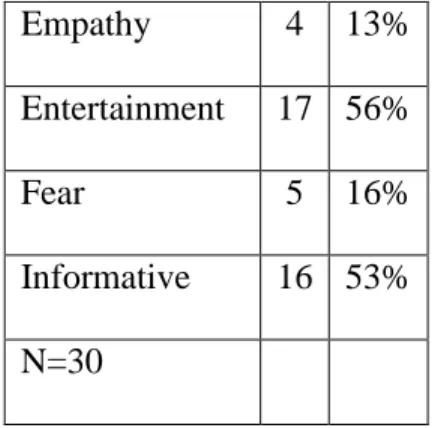
The first question focused on four elements: empathy, entertainment, fear, and informative.
As seen in Table 1, journalists either use a catchy, entertaining headline or a fact-driven headline to draw the reader in most often. See Table 1. While RQ1 shows journalists followed the top, basic rule of headline writing to make readers want to know more about the story, they did so by highlighting fascinating aspects of the case most often and using facts the second most often.
Journalists rarely used fear or empathy to lure readers because those techniques might not have been effective in quickly making readers want to seek out more information. In the seconds it takes to read a headline, readers shouldn’t be afraid to start a story nor should they be forced to empathize through a headline.
Table 1: How did the headline draw the reader in?
Empathy 4 13%
Entertainment 17 56%
Fear 5 16%
Informative 16 53%
N=30
*Percents may not total 100 % because some stories were coded in two categories.
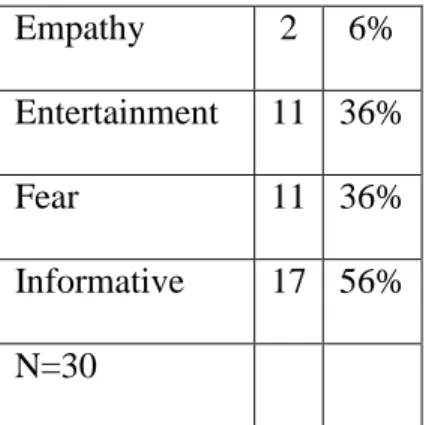
With the same four elements of empathy, entertainment, fear, or informative, the question asked if the lede used the same element as the headline to introduce the article. In Table 2,
however, informative ledes pushed the reader to start the story. See Table 2. With the same logic for RQ2, informative ledes enticed readers to at least start the stories 56 percent of the time.
Entertainment and fear were also used quite often at more than 36 percent. When something is entertaining, anyone wants to read it. But, fear was a successful tactic as a lede because as readers are frightened, they want to know what happened to eliminate the threat. Furthermore, they evaluate their own safety and how to maintain or secure it. Just as much as news coverage sometimes glorifies serial killers, it also intends to calm fears, at times.
Table 2: How was each article introduced through the lede?
Empathy 2 6%
Entertainment 11 36%
Fear 11 36%
Informative 17 56%
N=30
*Percents may not total 100 % because some stories were coded in two categories.
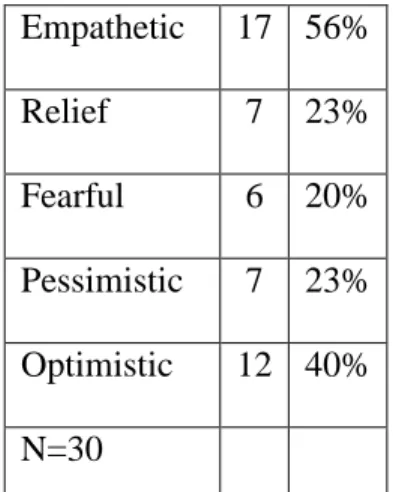
Even though the headline and lede were succumbed to four elements, the overall tone could have expanded to be empathetic, relief, fearful, pessimistic, or optimistic, which the third question asked. Despite the methods used to draw the readers in, the majority of stories, or more than 56 percent, took an empathetic tone. See Table 3. Once the headline, lede, and supporting graphs pulled readers in, the journalists, then, took that intrigue and made them empathize with the central character. Although entertainment, facts, or fear often grabbed the readers’ attention and guided them through the story, the overall tone was emphatic, identifying with the central character of the story.
Table 3: What is the overall tone of each article?
Empathetic 17 56%
Relief 7 23%
Fearful 6 20%
Pessimistic 7 23%
Optimistic 12 40%
N=30
*Percents may not total 100 % because some stories were coded in two categories.
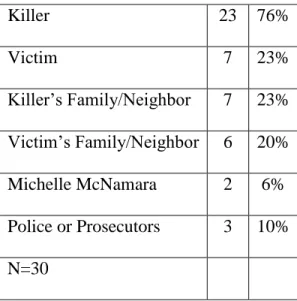
Media coverage of the Golden State Killer could focus on the killer, victim, the killer’s family or neighbors, the victim’s family or neighbors, Michelle McNamara, or police or prosecutors. Unfortunately, that main character was almost always the killer, according to the results of RQ4. See Table 4. Stories focusing on the victims equaled that of stories focusing on the killer’s family or neighbors at 23 percent. In the bulk of the articles, the focus was on the killer, as seen in Table 4.
Table 4: What or who is the focus of the article?
Killer 23 76%
Victim 7 23%
Killer’s Family/Neighbor 7 23%
Victim’s Family/Neighbor 6 20%
Michelle McNamara 2 6%
Police or Prosecutors 3 10%
N=30
*Percents may not total 100 % because some stories were coded in two categories.
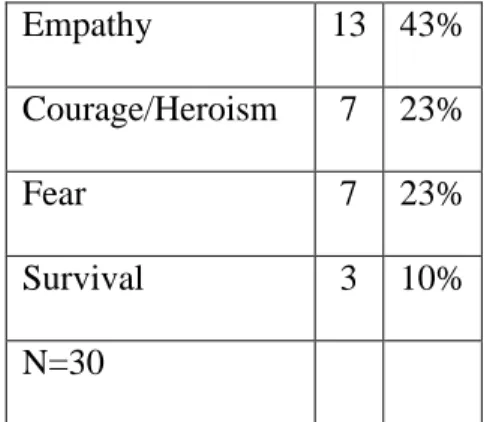
With the headline, lede, focus, story, and overall tone in mind, the common themes of serial killer coverage could be empathy, courage/heroism, fear, or survival, in which the fifth research question asked. Just as the overall tone revealed empathy, Table 5 shows the most common theme of serial killer coverage to be empathy as well. See Table 5. With each component of the stories in mind, empathy was the common theme throughout many of the articles about the Golden State Killer. Rather than show themes of courage, fear, or survival, which would most often be present with the victims or survivors, the journalists chose to present themes of empathy. Whereas that empathy could have been with victims and their families, that empathy was with the Golden State Killer, himself.
Table 5: What are the common themes of serial killer coverage in the New York Times’ and Los Angeles Times?
Empathy 13 43%
Courage/Heroism 7 23%
Fear 7 23%
Survival 3 10%
N=30
*Percents may not total 100 % because some stories were coded in two categories.
Discussion
Since that understanding the killer was a part of the overall tone and theme most often, it is surprising how the articles analyzed failed to evaluate the killer and his actions from a
psychological standpoint. The stories analyzed failed to delve into his childhood, find the missing pieces of his life, or include psychological profile. In that respect, the Golden State Killer stories only included an article about why he might have stopped. However, even as 30 articles seems to be many, it is a relatively small number of articles to evaluate; therefore, the sample was limited in number as well as in scope.
On another part of the sliding scale is the fact that more than 76 percent of the articles
analyzed focused on the killer while only 23 percent focused on the victim. For whatever reason, journalists feel this is who the reader wants to know about even though we are guided by a value to give voice to the voiceless. Perhaps, readers prefer to know about the killer rather than the victim, but this places journalists in an ethical dilemma to give readers what they want or to give victims a voice — perhaps what the public needs to know to better live in a democratic society.
A possible solution in this continuing battle between giving readers what they want and what they need to know is to find the right place between engaging and relevant information, fun and fascinating details, and what people need versus what they want. Because it seems that people want both news and fun, a journalist covering serial murder and other complex, weighted issues can give readers the information they need in a way they want it. In journalism, the best way to do this has been to push publications toward the middle of the continuum with superior reporting and production, or journalism as storytelling with a purpose.
Specifically speaking of serial murder, since Jack the Ripper, news coverage has
extensively covered serial killers to alert the public to what surrounds them. Had it not been for the media, the police might have let many cold cases remain cold, like the Golden State Killer case. However, establishing a medium between the two so that they aren’t covering too much or too little of crime is imperative. Journalists don’t want to give over-coverage to the point where the audience is negatively affected or drained, to where copy-cat criminals emerge, to where an important message is missed or to where journalists give serial killers fame. Yet, journalists must still ask why in order to inform the public about the issues of the world. Journalists should never leave any unanswered questions or shrink from finding the truth, and that includes stories about serial killers. The public has a right to know, and journalists’ job is to ensure the public’s right so it can be free and self-governing.
In keeping the public informed, journalists have overarching power and levels of influence because they decide what the news is. This discretion leaves it up to journalists to depict societal values. More often than not, journalists focus on the serial killer, as evidenced by the research of the most recent media coverage of the Golden State Killer. Perhaps, this reflects negatively on society, but journalists must maintain its first loyalty to the public. Therefore, being that people have an innate human tendency to empathize no matter the circumstance as well as an unnatural fascination with serial killers, journalists cannot simply stop reporting on serial murder. More important, the public has to know.
All of that goes to say, there is need for a middle ground between it all. A positive impact is undeniable despite how often reporters cover serial killers. With the Golden State Killer case and media coverage came the establishment of California’s DNA database, which collects DNA from all accused and convicted California felons. Also, the case, specifically DeAngelo’s arrest,
sparked conversations and concerns about the ethics of obtaining DNA from secondary sources, like genealogy sites.
Beyond the effects of the case, it is necessary to mention that the media is making strides to cover victims more than in the past. Even when there are victim-centered stories, there may be an unintentional perception of victim blaming. Furthermore, a series on victims may cause more harm than good, which would defy a journalistic value to minimize harm. In that way,
journalists, too, must know how much coverage to give victims so the public is not mentally drained just as the public shouldn’t be drained by coverage of a serial killer.
In the seemingly endless stories focused on serial killers, though, using entertaining methods to draw readers in isn’t the same as sensationalizing serial killers. Journalists have to draw interest in some way, and as the research shows, that is most often entertaining, but not sensational. Entertaining is used in the broadest sense throughout this research because journalists have to be compelling.
With all of that in mind, establishing a middle ground with the intent to alert, inform, calm, and better society should be the ultimate goal in covering serial killers. Society views serial killers as important, which may be partly the result of the media’s extensive coverage of them.
That media coverage can create the spotlight for serial killers to shine as the media continually covers their crimes no matter the circumstance. Because of the media’s power of influence, the media should practice caution in extensive coverage, but not fall from it. With that same sphere of influence, the media can and should continue to work toward empowering victims as well as bettering the public through the dissemination of information.
Works Cited
Alter, A. (2018, February 15). Michelle McNamara Hunted, and Was Haunted by, the Golden State Killer. Retrieved from https://www.nytimes.com/2018/02/15/books/michelle- mcnamara-patton-oswalt-book-serial-killer.html
Alter, A. (2018, April 26). Michelle McNamara Died Pursuing the Golden State Killer. Her Husband, Patton Oswalt, Has Questions for Him. Retrieved from
https://www.nytimes.com/2018/04/25/books/michelle-mcnamara-patton-oswalt.html Arango, T. (2018, May 03). The Cold Case That Inspired the ‘Golden State Killer’ Detective to
Try Genealogy. Retrieved from https://www.nytimes.com/2018/05/03/us/golden-state- killer-genealogy.html
Arango, T., Goldman, A., & Fuller, T. (2018, April 27). To Catch a Killer: A Fake Profile on a DNA Site and a Pristine Sample. Retrieved from
https://www.nytimes.com/2018/04/27/us/golden-state-killer-case-joseph-deangelo.html Barry, D., Arango, T., & Oppel, R. A. (2018, April 28). The Golden State Killer Left a Trail of
Horror With Taunts and Guile. Retrieved from
https://www.nytimes.com/2018/04/28/us/golden-state-killer-joseph-deangelo.html Bonn, S. (2014, October 24). 5 Myths about Serial Killers and Why They Persist [Excerpt].
Retrieved March 16, 2018, from https://www.scientificamerican.com/article/5-myths- about-serial-killers-and-why-they-persist-excerpt/
Bosman, J. (2017, August 01). Decades of Questions Get Chilling Answer: He Was John Wayne Gacy's Victim. Retrieved from https://www.nytimes.com/2017/08/01/us/john-wayne- gacy-
victim.html?rref=collection/timestopic/SerialMurders&action=click&contentCollection=t
imestopics®ion=stream&module=stream_unit&version=latest&contentPlacement=10&p gtype=collection)
Cahill, Mike. “What Happened When These 7 Serial Killers Were Finally Arrested Is Insane.” ViralNova.com. N.p., 23 May 2015. Web. 11 Apr. 2017.
<http://www.viralnova.com/serial-killer-headlines/>.
Carroll, L., McNamara, M., & LaVeris/FilmMagic, J. (2018, April 27). The Woman Who Deserves Credit For Bringing Down The Golden State Killer. Retrieved from https://www.refinery29.com/2018/04/197573/michelle-mcnamara-ill-be-gone-in-the -dark-golden-state-killer
Chang, C., Queally, J., Serna, J., Winton, R., Lien, T., Oreskes, B., . . . Parvini, S. (2018, April 29). From Golden State Killer to Grim Sleeper, DNA helping break serial killer mysteries from 1970s and 1980s. Retrieved from http://www.latimes.com/local/lanow/la-me-serial- killers-20180429-story.html
Chua-Eoan, Howard. “Crimes of the Century.” Time. Time Inc., 01 Mar. 2007. Web. 10 Apr.
2017.
<http://content.time.com/time/specials/packages/article/0,28804,1937349_1937350_1937 442,00.html>.
Donnelly, A. M. (2012), The New American Hero: Dexter, Serial Killer for the Masses. J Pop Cult, 45: 15–26. Doi:10.1111/j.1540-5931.2011.00908.x
Fuller, T. (2018, August 21). Golden State Killer Prosecutors Team Up to Try the Suspect.
Retrieved from https://www.nytimes.com/2018/08/21/us/golden-state-killer-trial- sacramento.html
Fuller, T. (2018, April 26). How a Genealogy Site Led to the Front Door of the Golden State
Killer Suspect. Retrieved from https://www.nytimes.com/2018/04/26/us/golden-state- killer.html
Fuller, T., & Hauser, C. (2018, April 25). Search for ‘Golden State Killer’ Leads to Arrest of Ex- Cop. Retrieved from https://www.nytimes.com/2018/04/25/us/golden-state-killer-
serial.html?hp&action=click&pgtype=Homepage&clickSource=story- heading&module=first-column-region®ion=top-news&WT.nav=top-news
Haag, M. (2018, April 26). What We Know About Joseph DeAngelo, the Golden State Killer Suspect. Retrieved from https://www.nytimes.com/2018/04/26/us/joseph-james- deangelo.html
Hargrove, T. (2018, June 6), telephone interview by author, Lasherica Thornton Here's Why We Love Serial Killers. (n.d.). Retrieved March 21, 2018, from
https://www.psychologytoday.com/us/blog/wicked-deeds/201409/here-s-why-we- love- serial-killers
Hoffman, J. (2018, April 26). Do Serial Killers Just Stop? Yes, Sometimes. Retrieved from https://www.nytimes.com/2018/04/26/health/serial-killers-golden-state.html
John, P. S. (2018, May 14). Possible 13th Golden State Killer slaying mentioned in search warrant, defense attorney says. Retrieved from http://www.latimes.com/local/lanow/la- me-ln-golden-state-killer-court-20180514-story.html
John, P. S. (2018, August 13). Golden State Killer suspect is charged with 13th murder, this time in Tulare County. Retrieved from http://www.latimes.com/local/california/la-me-
deangelo-snelling-20180813-story.html
John, P. S., Serna, J., Vives, R., & Oreskes, B. (2018, June 01). DNA lifted from Golden State Killer suspect at Hobby Lobby parking lot key to cracking case, documents show.
Retrieved from http://www.latimes.com/local/lanow/la-me-ln-golden-state-killer- deangelo-warrant-20180601-story.html
John, P.S., Serna, J. (2018, August). Golden State Killer suspect is facing new charges, will be tried in Sacramento County. Retrieved from https://www.msn.com/en-
us/news/crime/golden-state-killer-suspect-facing-new-charges-will-be-tried-in- sacramento-county/ar-BBMfDTA
Jones, R. Jack The Ripper - 1888. (n.d.). Retrieved from https://www.jack-the-ripper.org/
Kim, V., Parvini, S., Branson-Potts, H., Vives, R., & Mozingo, J. (2018, May 06). In the Golden State Killer's path, terror still runs deep. Retrieved from
http://www.latimes.com/local/california/la-me-ln-golden-state-killer-legacy-20180506- story.html
Kolata, G., & Murphy, H. (2018, April 27). The Golden State Killer Is Tracked Through a Thicket of DNA, and Experts Shudder. Retrieved from
https://www.nytimes.com/2018/04/27/health/dna-privacy-golden-state-killer- genealogy.html
Mason, M., Winton, R., Serna, J., Mozingo, J., Do, A., & Hamilton, M. (2018, April 26). Long, tortured hunt for Golden State Killer leads to arrest of ex-cop. Retrieved from
http://www.latimes.com/local/lanow/la-me-golden-state-killer-20180426-story.html Parvini, S., Hamilton, M., John, P. S., Mason, M., Winton, R., Serna, J., & Mozingo, J. (2018,
April 26). Golden State Killer suspect: Vietnam vet failed as a cop then went to work for grocery chain. Retrieved from http://www.latimes.com/local/lanow/la-me-golden-state- killer-what-we-know-deangelo-20180426-story.html
Parvini, S., Mozingo, J., Winton, R., & Serna, J. (2018, April 27). Golden State Killer suspect lived a quiet suburban life, with flashes of rage and anger. Retrieved from
http://www.latimes.com/local/lanow/la-me-golden-state-killer-profile-20180427- story.html
Parvini, S., Serna, J., & John, P. S. (2018, April 26). Golden State Killer: Did middle-class life provide suspect a perfect cover? Retrieved from http://www.latimes.com/local/lanow/la- me-ln-golden-state-killer-profile-20180426-story.html
Press, A. (2018, August 23). Prosecutors detail 26 charges in Golden State Killer case. Retrieved from https://www.dailymail.co.uk/wires/ap/article-6093013/Prosecutors-26-charges- Golden-State-Killer-case.html
Rosenberg, E. (2018, April 26). She stalked the Golden State Killer until she died. Some think her work led to the suspect’s arrest. Retrieved from
https://www.washingtonpost.com/news/true-crime/wp/2018/04/26/she-stalked-the- golden-state-killer-until-she-died-some-think-her-work-led-to-the-suspects-
arrest/?utm_term=.e73405013270
Schmid, David. Natural Born Celebrities, edited by David Schmid, University of Chicago Press, 2014. ProQuest Ebook Central,
http://ebookcentral.proquest.com/lib/olemiss/detail.action?docID=408385.
Schneider, Steven Jay. Post Script – Essays in Film and the Humanities; Commerce, Tex.22.2 (Winter 2002): 3-6.
Serial Killers Shaped by Society, Study Claims. (2009, October 26). Retrieved March 21, 2018, from https://www.seeker.com/serial-killers-shaped-by-society-study-claims-
1764728754.html
Serna, J., John, P. S., & Winton, R. (2018, April 27). Golden State Killer suspect appears in court, handcuffed in a wheelchair. Retrieved from
http://www.latimes.com/local/lanow/la-me-ln-golden-state-killer-genealogy-20180427- story.html
Serna, J., & Oreskes, B. (2018, May 25). Why did it take so long to arrest the Golden State Killer suspect? Interagency rivalries, old technology, errors and bad luck. Retrieved from
http://www.latimes.com/local/lanow/la-me-ln-golden-state-killer-case-20180525- estory.html
Serna, J., Winton, R., & Parvini, S. (2018, May 01). As a young cop, Golden State Killer suspect was aloof, ambitious, 'always serious'. Retrieved from
http://www.latimes.com/local/lanow/la-me-golden-state-cops-20180501-story.html
Serna, J., Winton, R., Parvini, S., Mason, M., & Myers, J. (2018, April 25). Suspected Golden State Killer, a former police officer, arrested on 'needle in the haystack' DNA evidence.
Retrieved from http://www.latimes.com/local/lanow/la-me-ln-golden-state-killer- 20180425-htmlstory.html
Smith, M., & Bank, J. (2018, April 27). What It Felt Like to Follow the News of the Golden State Killer. Retrieved from https://www.nytimes.com/2018/04/27/us/serial-killer- golden-state.html
Smith, Sid. “John Wayne Gacy, the Country’s Worst Serial Killer.” Chicago Tribune. N.p., 2017.
Web. 10 Apr. 2017. <www.chicagotribune.com/news/nationworld/politics/chi- chicagodays-gacy-story-story,amp.html>.
Tchekmedyian, A., Serna, J., & Bermudez, E. (2018, April 30). For victims of Golden State Killer, the horror never ended. Retrieved from http://www.latimes.com/local/lanow/la- me-ln-golden-state-victims-20180430-story.html
Tron, G. (2017, November 23). Report: There Are More Than 2,000 Serial Killers At Large In America. Retrieved March 11, 2018, from http://www.oxygen.com/blogs/report-there- are-more-than-2000-serial-killers-at- large-in-america
Wiest, Julie B. “Serial Killers As Heroes In The Media’s Storybook Of Murder: A Textual Analysis Of The New York Times Coverage Of The “Son Of Sam,” The “Boston Strangler,” And The “Night Stalker” By Julie B. Wiest (Under the Direction of Maria Carolina Acosta-Alzuru) Abstract.” Diss. N.d. Abstract. (2002): 3-10. University of Mississippi Libraries. Web. 12 Apr. 2017.
<https://getd.libs.uga.edu/pdfs/wiest_julie_b_200308_ma.pdf>.
Winton, R., Lien, T., John, P. S., & Oreskes, B. (2018, April 27). The first step in finding Golden State Killer suspect: Finding his great-great-great-grandparents on genealogy site.
Retrieved from http://www.latimes.com/local/lanow/la-me-golden-state-dna-match- 20180427-story.html
Winton, R. (2018, May 11). Golden State Killer suspect may be linked to earlier Cordova cat burglar attacks. Retrieved from http://www.latimes.com/local/lanow/la-me-ln-cat-golden- state-killer-20180510-story.html
Appendix I: Codebook All definitions are from Dictionary.com.
RQ1:
Headline – a heading in a newspaper for any written material, sometimes for an illustration, to indicate subject matter, set in larger type than that of the copy and containing one or more words and lines and often several banks.
Empathy – the psychological identification with or vicarious experiencing of the feelings, thoughts, or attitudes of another
Entertainment – the act of entertaining; agreeable occupation for the mind; diversion;
amusement
Fear – a distressing emotion aroused by impending danger, evil, pain, etc., whether the threat is real or imagined; the feeling or condition of being afraid.
Informative – a distressing emotion aroused by impending danger, evil, pain, etc., whether the threat is real or imagined; the feeling or condition of being afraid.
RQ2:
Article – a written composition in prose, usually nonfiction, on a specific topic, forming an independent part of a book or other publication, as a newspaper or magazine.
Lede – the opening sentence or paragraph of a news article, summarizing the most important aspects of the story; by 1965, alternative spelling of lead in the newspaper journalism sense
RQ3:
Tone – the general character or attitude of a place, piece of writing, situation, etc.
Empathetic – of, relating to, or characterized by empathy, the psychological identification with the feelings, thoughts, or attitudes of others
Relief – alleviation, ease, or deliverance through the removal of pain, distress, oppression, etc.
Fearful – causing or apt to cause fear; frightening:
Pessimistic – pertaining to or characterized by pessimism or the tendency to expect only bad outcomes; gloomy; joyless; unhopeful
Optimistic – reflecting a favorable view of events and conditions and the expectation of a positive outcome; demonstrating optimism
RQ4:
Focus – a central point, as of attraction, attention, or activity RQ5:
Theme – a subject of discourse, discussion, meditation, or composition; topic
Courage/heroism – the quality of mind or spirit that enables a person to face difficulty, danger, pain, etc., without fear; bravery/the qualities or attributes of a hero or heroine
Survival – the act or fact of surviving, especially under adverse or unusual circumstances
Appendix II: Analysis Stories: 30
Only 30 of the 40 most recent articles were used for the analysis because the others only mentioned the Golden State Killer in reference to other serial killers, not as the central focus in the story.
New York Times: 1-12 Los Angeles Times: 13-30
RQ1: How did the headline draw the reader in?
Story Number Empathy Entertainment Fear Informative
1 X
2 X
3 X
4 X
5 X
6 X X
7 X
8 X
9 X
10 X X
11 X
12 X
13 X X
14 X X
15 X
16 X
17 X
18 X
19 X X X
20 X
21 X X
22 X
23 X
24 X
25 X X X
26 X
27 X X
28 X X
29 X X
30 X
RQ2: How was each article introduced through the lede?
Story Number Empathy Entertainment Fear Informative
1 X
2 X
3 X
4 X
5 X X
6 X X
7 X
8
X
9 X X
10 X
11 X
12 X X
13 X X
14 X
15 X
16 X
17 X
18 X X
19 X
20 X X
21 X
22 X X
23 X
24 X X
25 X
26 X
27 X
28 X X
29 X
30 X X
RQ3: What is the overall tone of each article?
Story Number Empathetic Relief Fearful Pessimistic Optimistic
1 X
2 X X
3 X X
4 X X X
5 X X
6 X X
7 X X
8 X
9 X
10 X
11 X
12 X X
13 X X
14 X
15 X
16 X
17 X
18 X
19 X X
20 X
21 X X
22 X X
23 X X
24 X
25 X X X
26 X X
27 X
28 X X
29 X X X
30 X
RQ4: What or who is the focus of the article?
Story Number Killer Victim Killer’s
Family/Neighbors
Victim’s
Family/Neighbors
1 X
2 X X
3 X
4 X
5 X X
6 X
7 X
*8
9 X
10 X
*11
12 X X
13 X X
14 X
15 X X
16 X
17 X
18 X
19 X X
20 X X
21 X
**22 X
23 X X
**24 X X
25 X X X
26 X X
27 X
28 X X
29 X X X
**30 X
*indicates the story is about neither the killer nor the victim, but about Michelle McNamara, the woman responsible for his name and an exhaustive investigation into his identity.
**indicates the story focused not only on the killer or victim, but also on the police or prosecutors
RQ5: What are the common themes of serial killer coverage in the New York Times’ and LA Times?
Story Number Empathy Courage/Heroism Fear Survival
1 X
2 X X
3 X
4 X
5 X X
6 X
7 X
8 X
9 X
10 X
11 X
12 X
13 X X
14 X
15 X
16 X
17 X X
18 X
19 X
20 X
21 X
22 X X
23 X X
24 X
25 X X X
26 X
27 X
28 X X
29 X
30 X
Appendix III: Charges
Source: Sacramento County District Attorney’s Office as of August 23, 2018 article by The Associated Press
Number Charge Victim(s) Date(s) County
4 counts
Kidnapping to commit robbery using a gun and
knife
Jane Does 10-13
Between October 7, 1978 and June 11,
1979
Contra Costa
2 counts Murder (slaying)
Keith Harrington, 24, and Patrice Harrington,
27, of Dana Point
August 21, 1980 Orange
1 count Murder (slaying)
Manuela Witthuhn, 28, of Irvine
Feburary 6, 1981 Orange
1 count Murder (slaying)
Janelle Cruz, 18, or Irvine
May 5, 1986 Orange
2 counts Murder (shooting)
Kate Maggoire, 20, and Brian Maggoire, 21
February 2, 1978 Sacramento
9 counts
Kidnapping to commit robbery using a gun and
knife
Jane Does 1-9
Between September 4, 1976 and October 21, 1977
Sacramento
2 counts Murder (slaying)
Debra Manning, 35 and Robert Offerman, 44,
December 30, 1979 Santa Barbara
of Goleta
2 counts Murder (slaying)
Gregory Sanchez, 27, and Cheri Domingo,
35, of Goleta
July 27, 1981 Santa Barbara
1 count Murder (slaying) Claude Snelling, 45 September 11, 1975 Tulare
2 counts Murder (slaying)
Charlene Smith, 33, and Lyman Smith, 43,
of Ventura
Between March 13 and March 16,
1980
Ventura
Appendix IV: Summary of Additional Sources
Electronic Journal of Sociology (1998). (n.d.). Retrieved from http://www.sociology.org/ejs- archives/vol003.002/hinch.html
This sources revealed the stereotypical image of a serial killer and the media’s role in
fostering that image. Furthermore, playing into the stereotype are notions in the definition of who a serial killer is and what he or she does, which include the presumptions that they are male, kill mostly strangers, don’t kill for financial gain, and their victims are powerless.
When examining the conception of killers as males, researchers evaluate it differently.
For example, some don’t consider female serial murderers in analysis because of the small number and because of the view that it would be impractical if not impossible. On the other hand, other researchers find “strong empirical evidence” about female serial killers. After all, it’s important to note that woman make up 15% of serial killers, so without considering female serialists, researchers are only evaluating 85% of serial killers. Even more, the research is noteworthy to document:
“Males are significantly more likely to shoot, strangle/suffocate, stab, or bludgeon their victims. Only 5% of males use poisons to kill.
On the other hand, women are more likely to use poison to kill (35% use poison only, and 45% use poison in combination with some other means of killing)
The most frequent motives for male serialists are ”sex sometimes“ (46%), "control sometimes“ (29%), and ”money sometimes“ (19%).
For female serialists, the most frequent motives are ”money sometimes“ (47%), ”money only“ (27%), and ”control sometimes“ (13%).”
The story also says the definition about victims and offenders being strangers may be
“unwarranted” because evidence proves that serial murderers also kill people they know.
Preconceived assumptions are not beneficial in the research of serial murder.
Further, the definition limits serialists to those who don’t kill for financial gain; however, there are contract and black widow killers whose sole purpose is for money and they are still serial murderers. Researchers exclude them because they don’t match the one notion of not killing for financial gain. This, in itself, is a problem because the exclusion causes an incorrect statistical analysis.
The source also mentions the victimology of serial killers, highlighting how, overtime, serialists have gone from killing downward to killing upward. Meaning, they use to be high class individuals killing lower class members of society like prostitutes, but now they are often lower class killing those in higher positions. Even so, what one considers as high or low class can be drastically different from the next person because this source notes that Ted Bundy killed university women, who were considered in a higher class than he was because he sought to avenge his failed career in the school of law.
Other than the flaws of serial research because of the definition, problems exist due to typologies, or attempts to characterize a typical serial killer. Like with the definition,
assumptions (“serial killing is psychogenic, the locus of motives is internal, and the reward for killing is psychological”) influencing typologies are faulty because there is no such thing as a typical serial killer. Further, the source suggests these assumptions lead to serial killer
stereotypes.
In the conclusion of this article, the author suggested an expanded definition, among other things, to provide a better understanding of serial killers. Though that suggestion is plausible, it
must be noted that all the research cited in this source were in the eighties and nineties, which is a problem, in itself. In short, recent research is needed to better understand serial murder and is crucial to compare to older statistics.
Connelly, S. (2017, January 15). Journalist revisits ties with serial killer who slayed 8 in N.Y.
Retrieved March 11, 2018, from http://www.nydailynews.com/new-ork/journalist-revisits-ties- serial-killer-slayed-8-n-y-article-1.2946628
Journalist Claudia Rowe revisited her “relationship” with serialist Kendall Francois in a New York Daily News story. Her four-year correspondence, two visits to the prison, and hours of phone conversations were described as intense. Not only did this relationship cause her to learn about Francois and his murders, but it also forced her to deal with her history of assault. Like any reporter, or person, for that matter, there is history someone must deal with. Having a long-term relationship and learning about the gruesome details may bring horrid memories to light for a reporter. Even if a reporter doesn’t have such a history, he or she is still emotionally impacted by the grisly details of a serial killer’s crimes. Even more, imagine a serial killer viewing a reporter as a “friend” as Francois viewed Rowe.
Other than Rowe’s relationship with Francois, the writer describes the police hunt that overlooked Francois for years. He had a rap sheet long with arrests, but none for the homicides he committed; investigators didn’t have a clue. In fact, the main investigator was angered when he was forced to leave his serial killer manhunt to deal with Francois’s assault on a prostitute.
Based on serial killer profiles that the perpetrator rarely kills outside of his or her race, investigators didn’t consider Francois because he was black and they thought the killer to be white like his victims. Further, that same detective was in Francois’s bedroom, yet he never