Abstract: Each year, the American Cancer Society publishes a summary of its guidelines for early cancer detection, data and trends in cancer screening rates, and select issues related to cancer screening. In this issue of the journal, the current American Cancer Society cancer screening guidelines are summarized, and the most current data from the National Health Interview Survey are provided on the utilization of cancer screening for men and women and on the adherence of men and women to multiple recommended screening tests. CA Cancer J Clin 2019;69:
184-210. © 2019 American Cancer Society.
Keywords: breast neoplasms, cervical neoplasms, colon and rectum neoplasms, lung neoplasms, mass screening
Introduction
The American Cancer Society (ACS) provides an annual report for health care professionals and the public that summarizes the current ACS cancer screening guidelines, including current recommendations and updates, and guidance related to early cancer detection when a direct recommendation for screening cannot be made. This annual report also includes the most recent data on cancer screening rates and rates of adherence to multiple screening guidelines based on age, sex, and socioeconomic status along with a discussion of issues related to early cancer detection.
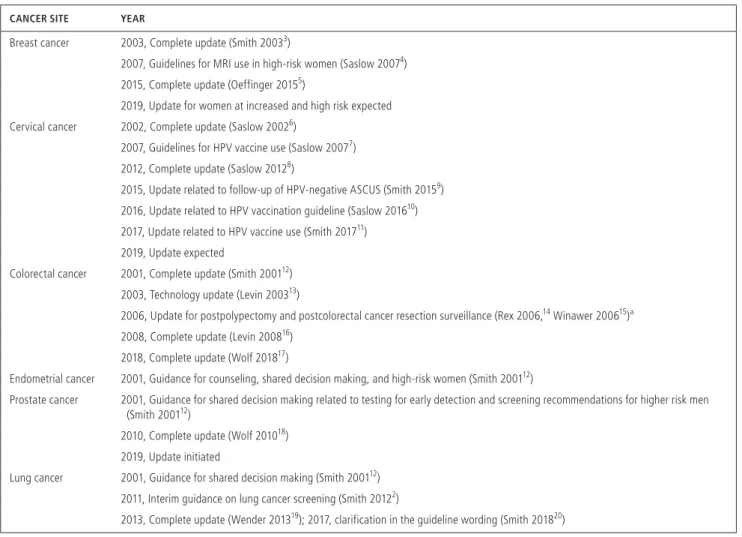
As part of the ongoing guideline development process, the ACS monitors the medical and scientific literature for new evidence that may support a change in current guidelines or the development of a new guideline, and new information about screening that should be conveyed to clinicians and target populations.1,2 These annual guideline reviews, as well as the more detailed individual cancer screening guideline updates, are published as stand-alone articles and are available online. Table 1 provides a recent history of ACS guideline updates as well as those in progress.2-22
In this update of ACS cancer screening guidelines, we describe the current guidelines (Table 2); recommendations from other organizations; the current is- sues shaping screening for breast, cervical, colorectal, lung, and prostate cancer;
and we present the most recent data on cancer screening from the National Health Interview Survey (NHIS).
Screening for Breast Cancer
Among women in the United States, breast cancer is the most common cancer, the second most common cause of death from cancer, and a leading cause of premature mortality as measured by the average and total years of life lost.23 In 2019, the ACS estimates that there will be 268,600 cases of invasive breast
Cancer Screening in the United States, 2019: A Review of Current American Cancer Society Guidelines
and Current Issues in Cancer Screening
Robert A. Smith, PhD1,*; Kimberly S. Andrews, BA2; Durado Brooks, MD, MPH3; Stacey A. Fedewa, PhD, MPH4; Deana Manassaram-Baptiste, PhD, MPH5; Debbie Saslow, PhD6; Richard C. Wender, MD7
1 Vice-President, Cancer Screening, and Director, Center for Quality Cancer Screening and Research, Cancer Control Department, American Cancer Society, Atlanta, GA; 2 Director, Guidelines Process, Cancer Control Department, American Cancer Society, Atlanta, GA; 3 Vice President, Cancer Control Interventions, Cancer Control Department, American Cancer Society, Atlanta, GA; 4 Senior Principal Scientist, Surveillance and Health Services Research, American Cancer Society, Atlanta, GA; 5 Director, Guidelines Process, Cancer Control Department, American Cancer Society, Atlanta, GA; 6 Senior Director, Human Papillomavirus-Related and Women’s Cancers, Cancer Control Department, American Cancer Society, Atlanta, GA; 7 Chief Cancer Control Officer, American Cancer Society, Atlanta, GA.
Corresponding author: Robert A. Smith, PhD, Vice President, Cancer Screening, Cancer Control Department, American Cancer Society, 250 Williams St, Suite 600, Atlanta, GA 30303; robert.smith@
cancer.org
DISCLOSURES: Debbie Saslow is the principal investigator for 2 cooperative agreements between the American Cancer Society (ACS) and the Centers for Disease Control and Prevention (CDC) to support the National Human Papillomavirus Vaccination Roundtable, and initiatives to increase human papillomavirus vaccination. The ACS receives partial funding from the CDC to support the National Colorectal Cancer Roundtable, of which Richard C. Wender is the Chair, Robert A. Smith is the Co-Chair, and Durado Brooks is a Steering Committee member, to support initiatives related to colorectal cancer screening. The ACS also received contributions from Bracco Diagnostics Inc, Polymedco Inc, Exact Sciences, Medtronic GI Solutions Inc, Quest Diagnostics, Epigenomics Inc, Clinical Genomics, Medial EarlySign, the American Society for GI Endoscopy, the American College of Gastroenterology, the Center for Colon Cancer Research, the Colon Cancer Coalition, the Colorectal Cancer Alliance, Fight Colorectal Cancer, Old Dominion Society of Gastroenterology Nurses and Associates, and the American
cancer diagnosed in US women, and 41,760 deaths.24 After a period of declining age-adjusted breast cancer incidence rates (1999-2004), there has been an average, delay-adjusted annual percentage increase of 0.4% from 2004 to 2015 in age-adjusted breast cancer incidence rates.23 Age-adjusted breast cancer mortality rates have declined 40% from 1989 through 2016,23 with an esti- mated 348,8000 expected deaths averted in US women over this period if the age-adjusted mortality rate had not declined since 1989.25 Unfortunately, these over- all favorable mortality statistics are not shared equally among all populations. Although declines in death rates
are observed in all racial/ethnic groups, a large dispar- ity in age-adjusted death rates emerged between black women and white women during the 1980s and contin- ued to increase for several decades. Although these dif- ferences have stabilized in recent years, over the period from 2011 to 2016, death rates were 41% higher in black women compared with white women.23
In 2015, the ACS issued a strong recommendation that average-risk women aged 45 years and older should undergo regular mammography screening and a qualified recom- mendation that women aged 40 to 44 years should have an opportunity to begin screening before age 45 years (Table 2).
Gastroenterological Association to support the annual meeting of the National Colorectal Cancer Roundtable. The ACS receives funding from AstraZeneca Inc to provide partial support for the National Lung Cancer Roundtable, of which Robert A. Smith is the principal investigator (but receives no salary support), to promote initiatives focused on public and provider education, shared decision making, screening, tobacco treatment, and guideline-adherent diagnosis and therapy. ACS cancer screening guideline development is supported by ACS operational funds; neither the Roundtables nor the sources of funding described in this disclosure have had any role or involvement in or have made any financial contribution to ACS screening guideline development or approval. The remaining authors report no potential conflicts of interest.
doi: 10.3322/caac.21557. Available online at cacancerjournal.com
TABLE 1. History of Recent Updates to American Cancer Society Cancer Early Detection Guidelines and Guidelines for HPV Vaccine Use
CANCER SITE YEAR
Breast cancer 2003, Complete update (Smith 20033)
2007, Guidelines for MRI use in high-risk women (Saslow 20074) 2015, Complete update (Oeffinger 20155)
2019, Update for women at increased and high risk expected Cervical cancer 2002, Complete update (Saslow 20026)
2007, Guidelines for HPV vaccine use (Saslow 20077) 2012, Complete update (Saslow 20128)
2015, Update related to follow-up of HPV-negative ASCUS (Smith 20159) 2016, Update related to HPV vaccination guideline (Saslow 201610) 2017, Update related to HPV vaccine use (Smith 201711)
2019, Update expected
Colorectal cancer 2001, Complete update (Smith 200112) 2003, Technology update (Levin 200313)
2006, Update for postpolypectomy and postcolorectal cancer resection surveillance (Rex 2006,14 Winawer 200615)a 2008, Complete update (Levin 200816)
2018, Complete update (Wolf 201817)
Endometrial cancer 2001, Guidance for counseling, shared decision making, and high-risk women (Smith 200112)
Prostate cancer 2001, Guidance for shared decision making related to testing for early detection and screening recommendations for higher risk men (Smith 200112)
2010, Complete update (Wolf 201018) 2019, Update initiated
Lung cancer 2001, Guidance for shared decision making (Smith 200112) 2011, Interim guidance on lung cancer screening (Smith 20122)
2013, Complete update (Wender 201319); 2017, clarification in the guideline wording (Smith 201820)
Abbreviations: ASCUS, atypical squamous cells of undetermined significance; HPV, human papillomavirus; MRI, magnetic resonance imaging.
aRecommendations for postpolypectomy and postcolorectal cancer resection surveillance have been updated independently (see Lieberman DA, Rex DK, Winawer SJ, Giardiello FM, Johnson DA, Levin TR. Guidelines for colonoscopy surveillance after screening and polypectomy: a consensus update by the US Multi- Society Task Force on Colorectal Cancer. Gastroenterology . 2012;143:844-85721 and Kahi CJ, Boland CR, Dominitz JA, et al. Colonoscopy surveillance after colorectal cancer resection: recommendations of the US Multi-Society Task Force on Colorectal Cancer. Gastroenterology . 2016;150:758-768.e11.22)
TABLE 2. American Cancer Society Recommendations for the Early Detection of Cancer in Average-Risk, Asymptomatic Adultsa CANCER SITEPOPULATIONTEST OR PROCEDURERECOMMENDATION BreastWomen aged 40-54 yMammographyWomen should undergo regular screening mammography starting at age 45 y; women aged 45-54 y should be screened annually; women should have the opportunity to begin annual screening between ages 40 and 44 y Women aged ≥55 yMammographyWomen aged ≥55 y should transition to biennial screening or have the opportunity to continue screening annually; women should continue screening mammography as long as their overall health is good and they have a life expectancy of 10 y or longer CervixWomen aged 21-29 yPap testCervical cancer screening should begin at age 21 y; for women aged 21-29 y, screening should be done every 3 y with conventional or liquid-based Pap tests Women aged 30-65 yPap test and HPV DNA testFor women ages 30-65 y, screening should be done every 5 y with both the HPV test and the Pap test (preferred) or every 3 y with the Pap test alone (acceptable) Women aged >65 yPap test and HPV DNA testWomen aged >65 y who have had ≥3 consecutive negative Pap tests or ≥2 consecutive negative HPV and Pap tests within the last 10 y, with the most recent test occurring in the last 5 y, should stop cervical cancer screening Women who have had a total hysterectomyWomen who have had a total hysterectomy should stop cervical cancer screening ColorectalMen and women, aged 45-75 y, for all tests listedFecal immunochemical test (annual), or high- sensitivity guaiac-based fecal occult blood test (annual), or multitarget stool DNA test (every 3 y, per manufacturer’s recommendation), or colonoscopy (every 10 y), or CT colonography (every 5 y), or flexible sigmoidoscopy (every 5 y)
Adults aged 45 y and older should undergo regular screening with either a high-sensitivity, stool-based test or a structural (visual) examination, depending on patient preference and test availability; as part of the screening process, all positive results on noncolonoscopy screening tests should be followed with timely colonoscopy; adults in good health with a life expectancy of greater than 10 y should continue screening through the age of 75 y Men and women aged 76 through 85 yScreening decisions should be individualized based on patient preferences, life expectancy, health status, and prior screening history; if a decision is made to continue screening, the patient should be offered options as listed above Men and women aged >85 yIndividuals should be discouraged from continuing screening EndometrialWomen, at menopauseAt the time of menopause, women should be informed about risks and symptoms of endometrial cancer and strongly encouraged to report any unexpected bleeding or spotting to their physicians LungCurrent or former smokers aged 55-74 y in good health with at least a 30–pack-y history of smoking
Low-dose helical CTAnnual screening in adults who: • Currently smoke or have quit within the past 15 y; and • Have at least a 30–pack-y smoking history; and • Receive evidence-based smoking cessation counseling, if they are current smokers; and • Have undergone a process of informed/shared decision making that included information about the potential benefits, limitations, and harms of screening with low-dose CT; and • Have access to a high-volume, high-quality lung cancer screening and treatment center ProstateMen aged ≥50 yProstate-specific antigen test with or without digital rectal examinationMen who have at least a 10-y life expectancy should have an opportunity to make an informed decision with their health care provider about whether to be screened for prostate cancer after receiving information about the potential benefits, risks, and uncertainties associated with prostate cancer screening; prostate cancer screening should not occur without an informed decision-making process Abbreviations: CT, computed tomography; HPV, human papillomavirus; Pap test, Papanicolaou test. a All individuals should become familiar with the potential benefits, limitations, and harms associated with cancer screening.
A “strong” recommendation is an indication of consensus that the benefits of the intervention outweigh undesirable effects and an expectation that most individuals would choose to undergo the recommended intervention. In con- trast, a “qualified” recommendation indicates consensus that there is evidence of benefit but less certainty either about the balance of benefits and harms or about patients’
values and preferences for the intervention. The ACS rec- ommends that women aged 45 to 54 years and those aged 40 to 44 years who choose to begin screening before age 45 years should be screened annually and that women aged 55 years and older should transition to biennial screening or can continue annual screening if that is their preference.
Women should continue screening mammography as long as their overall health is good and they have a life expec- tancy of 10 years or longer (qualified recommendation).5
The ACS breast cancer screening guideline emphasizes annual screening under 55 years, because biennial mammog- raphy screening in premenopausal women is associated with an increased risk of being diagnosed with advanced breast cancer, which is associated with an increased risk of breast cancer death, compared with annual screening.26 Among postmenopausal women, annual screening did not confer the same advantage of more favorable tumor characteristics that was observed in premenopausal women, except for women who were currently using menopausal hormone therapy. The ACS recommends that women aged 55 years and older can transition to biennial screening or, if it is their preference, may continue annual screening. The ACS does not set a stopping age for breast cancer screening but acknowledges the poten- tial for women aged 75 years and older in good health with an expected longevity of 10 or more years to benefit from continuing mammography screening.
Although there has been a long-standing debate over whether mammography screening in average-risk women should begin at age 40 or 50 years, the evidence generally has been considered narrowly by focusing only on me- ta-analyses of randomized controlled trials (RCTs) and re- sults from microsimulation models. In the 2015 update, the ACS examined the burden of disease over the 20-year period between ages 40 and 59 years, results from observational studies and individual RCTs in addition to meta-analyses, and new evidence on the risk of being diagnosed with a breast cancer that has advanced tumor features based on time since the last normal screening mammogram.
In framing the ACS recommendations, attention was given to indicators of the age-related burden of disease within smaller age ranges, particularly the absolute risk in 1-year and 5-year age groups, proportions of all incident breast cancer cases, proportions of annual breast cancer deaths attributable to an age at diagnosis, and potential person-years of life lost attributable to a death from breast cancer. What was clear was that traditional comparisons
between women aged 40 to 49 years versus 50 years and older or between those aged 40 to 49 years versus 50 to 59 years obscured important similarities in risk among the nearly 22 million women aged 45 to 54 years.27 The risk among women aged 40 to 44 years was lower and more similar to the risk among women in their late 30s, leading the ACS not to make a direct recommendation for screening in this age group but, rather, to endorse that women in this age group have an opportunity to choose whether to begin screening before age 45 years.5
There is consistent evidence from RCTs and observa- tional studies of modern service screening that invitation or exposure to mammography screening compared with usual care is associated with reduced breast cancer mortality over- all as well as in women aged 40 to 49 years and 50 years and older.28 The magnitude of the observed mortality reductions varied across the different study designs, ranging from 15% to 54% fewer deaths associated with mammogra- phy screening, depending on the study design and whether the mortality reduction was associated with invitation versus exposure to screening. In a supplemental analysis focused on the breast cancer screening interval, Miglioretti et al observed that menopausal status rather than age was associated with screening outcomes based on time since last normal screening mammogram. Women who were pre- menopausal and underwent biennial mammography had higher proportions of tumors that were stage IIB or higher, with tumor size greater than 15 mm, or had any unfavor- able prognostic characteristics compared with women who underwent annual mammography screening.26 In contrast, a 12-month versus 24-month screening interval was not associated with a higher rate of tumors with less favorable prognostic characteristics among postmenopausal women who were not using hormone-replacement therapy. These findings led the ACS to recommend a hybrid screening program in which women aged 45 to 54 years (and women aged 40-44 years who chose to begin screening before age 45 years) undergo annual screening, and women aged 55 years and older should transition to biennial screening, unless they chose to continue annual screening.
The process of screening necessarily involves potential harms, including false-positive findings associated with being recalled for further evaluation, a negative biopsy after referral based on abnormal mammography, and the anxi- ety that may be associated with each. Other harms include the possibility of overdiagnosis and overtreatment as well as radiation exposure. These differ quantitatively in terms of their observed and estimated occurrences and qualitatively in terms of the effect, importance, and degree of adverse effects experienced by different women. Because the bur- den of disease from age 40-44 is dissimilar to that of women aged 45-54, there was uncertainty as to whether most women would chose to begin screening at age 40 or wait until age
45, and thus a qualified recommendation for the opportunity to chose to begin screening between ages 40-44 was issued.
The ACS affirms that the benefits of screening outweigh the harms within the age groups for which breast cancer screen- ing is recommended directly or as an acceptable choice.
The ACS does not set an age at which to discontinue screening. More than one-third of all breast cancer deaths each year are attributable to women who are diagnosed after age 70 years,5 and since a significant fraction of women are in good health past the age of 70, the guide- line states that women in good health with at least 10 years of projected longevity should continue mammography screening. In applying clinical judgement about longevity, clinicians should use mortality indices that incorporate age, comorbidities, and functional status.29,30 In addition, women should be provided opportunities for individualized decision making that consider potential benefits and harms and incorporate health priorities and patient preferences.31
Although strong supporting evidence for the effec- tiveness of mammography continues to accumulate, from both individual studies32-34 and systematic reviews of the evidence,35 some investigators have evaluated registry data and concluded that observed declines in the breast cancer mortality rate mostly are attributable to advances in mod- ern therapy and not early detection.36,37 The study designs commonly used to draw this conclusion have been criticized principally for poor methodology (ie, the failure to distin- guish between screened and unscreened cohorts, including censoring deaths that occur in the screening era attribut- able to diagnoses in the prescreening era, lack of adequate follow-up time, and failures to adjust for changes in inci- dence rates over time).33,38
Two recent articles counter the argument that mam- mography has diminishing importance in the era of modern therapies and are instructive in how we should understand the benefits of mammography screening. Each also high- lights the limitations of drawing conclusions about the ben- efit of screening, or the relative contributions of screening versus therapy, without data on exposure to mammography at the time of diagnosis. Beau et al39 examined mammog- raphy screening in the Copenhagen and Danish national registers and compared the observed breast cancer mor- tality rate in women who were invited to screening with the expected rate in the absence of screening. The study included data from 976,743 Copenhagen women who were invited to screening and 17,804,549 control participants (from the rest of Denmark, excluding Copenhagen, Funen, Frederiksberg, Bornholm, and Vest Sjaelland) during the same period, totaling 18,781,292 person-years of data, with an average of 11.6 years of follow-up time from the date of invitation to screening. The statistical analysis was based on 3 hypothetical models. In what the authors labeled as the “naive model,” all breast cancer deaths occurring during
the follow-up period were included, without determination of exposure to mammography screening or whether the deaths were attributable to a diagnosis before the first invi- tation to screening. In this model, the benefit of mammog- raphy screening is diluted by deaths that occur in women not attending mammography screening and women who were diagnosed before the initiation of the mammogra- phy screening program. In the naive model, comparing the Copenhagen study group with the unexposed group, a 10% reduction in breast cancer deaths was observed. In the second model, the “follow-up model,” breast cancer deaths in the screening period attributable to cases in women who were diagnosed before the initiation of the screening period are censored, but there is no adjustment for deaths in women who were invited to screening but whose diagno- sis occurred after they were no longer eligible for screening (ie, after they had aged out of the screening program). In this model, the benefit of mammography is diluted by deaths that occur in women who were diagnosed after an age when they were no longer eligible for mammography screening. In the follow-up model, breast cancer mortality was 11% lower in the Copenhagen study group compared with the unexposed group. The third model, the “evalua- tion model,” examines the effect of mammography screen- ing only among the breast cancer cases diagnosed during the period when women were invited to screening. The evaluation model ensures that only women with the poten- tial to benefit from screening are included in the analysis (ie, it excludes women who have a breast cancer diagnosis after they are no longer eligible for screening). With greater specification of exposure to screening, a 20% difference in breast cancer mortality was observed in the Copenhagen group compared with the unscreened group. Most nota- ble in this analysis is that, compared with the naive and follow-up groups, only 43% of the observed breast cancer deaths occurred in women who were eligible for screen- ing and thus were included in the evaluation study design, highlighting the potentially very high rates of contamina- tion and bias in study outcomes that reflect breast cancer deaths in women who had no opportunity to benefit from mammography screening.39
The second study is an analysis from the Swedish Organized Service Screening Evaluation Group, which examined the incidence of fatal breast cancers over a 58- year period using comprehensive registries for population, screening history, breast cancer incidence, and disease-spe- cific death data from a defined population in Dalarna County, Sweden.40 Their analysis used a new methodol- ogy that examines the rate of breast cancers that are fatal within 10 and 20 years from the date of diagnosis in women attending and not attending mammography screening.
Because the denominator for the rate of fatal breast can- cer was based on the midyear population of women aged
40 to 69 years residing in Dalarna County during each of the years from 1958 to 2015, this methodology over- comes the influence of length bias when the denominator is breast cancer cases or deaths. Lead-time bias is largely overcome by the length of the follow up period, because most women who are destined to die from breast cancer will have died within 20 years.41,42 An adjustment for se- lection bias also was necessary because women who did not attend screening after 1989 had made a choice not to attend screening.43 The question about the relative influence of modern therapies is addressed by the simple fact that all women who were diagnosed with breast cancer during the evaluation period received the state-of-the-art therapy appropriate for the stage of diagnosis in the year their breast cancer was diagnosed, independent of the mode of detection.40 The investigators calculated the annual inci- dence of breast cancers that were fatal within 10 years and within 11 to 20 years of diagnosis among women aged 40 to 69 years who either did or did not participate in mam- mography screening during the 39-year period from 1977 to 2015. During the screening period, women who partic- ipated in the breast cancer screening program in the year of their diagnosis were 60% less likely to die from breast cancer within 10 years after diagnosis, and 47% less likely to die from breast cancer within 20 years after diagno- sis, compared with women who did not attend screening.
The authors concluded that, whereas advances in therapy benefit all women, those who have participated in mam- mography screening obtain a substantially greater benefit from the leading therapies available at the time of diagnosis compared with women who have not participated. These findings also refute assertions that the importance of early detection has diminished as treatments have improved.44 More to the point, we should not view the benefits of early detection and the benefits of treatment from the standpoint of which contributes the most to reducing breast cancer deaths. The observations from this study covering 58 years indicate that the best outcomes result from the combination of state-of-the-art screening and treatment.
Screening Women at High Risk
The ACS issued a guideline in 2007 for the use of magnetic resonance imaging (MRI) screening in selected groups of women at substantially increased risk for developing breast cancer.4 Annual screening mammography and MRI starting at age 30 years are recommended for women with a known BRCA mutation, women who are untested but have a first- degree relative with a BRCA mutation, or women with an approximately 20% to 25% or greater lifetime risk of breast cancer based on specialized breast cancer risk-estimation models capable of pedigree analysis of first-degree and sec- ond-degree relatives on both the maternal and paternal side.
Annual MRI and mammography also are recommended for
women who were treated for Hodgkin disease with radia- tion to the chest under age 30 years as well as women with Li-Fraumeni, Cowden, and Bannayan-Riley-Ruvalcaba syn- dromes and their first-degree relatives.4 At the time these rec- ommendations were issued, there was insufficient evidence to recommend MRI and mammography for women at elevated risk because of other risk factors. Currently, the ACS is updat- ing its guideline for women at increased and high risk.
Since publication of the 2007 ACS recommendations for women at high risk, several main points of criticism have been expressed in the academic literature and by practicing clinicians about the stated risk threshold and the suggested approach to risk assessment as a basis for decisions about dif- ferent screening.45-49 A principal issue that has been raised relates to the discordance among risk estimates resulting from use of the recommended tools (BRCAPRO, Claus, BOADICEA [Breast and Ovarian Analysis of Disease Incidence and Carrier Estimation Algorithm], and Tyrer- Cuzick)4 because of differences in underlying assumptions about the nature of genetic risks, different upper-age limits for lifetime risk estimates, the extent of family history in- cluded in each model, and the incorporation of other risk factors. Critical attention has also focused on relying on an estimate of remaining lifetime risk, the definition of which may vary and which is difficult to evaluate empirically, rather than on 5-year or 10-year risk estimates.46
For the current update, the ACS has commissioned a systematic review of the evidence to inform breast cancer screening recommendations for women at higher than aver- age risk. The evidence review will examine risk and screening outcomes in subgroups of women, including some for whom the available evidence was judged in 2007 as not sufficient to support a recommendation for differential screening. In ad- dition to confirmed or suspected mutation carrier status and family history, the review will examine risk and screening outcomes in women with a personal history of breast can- cer (including ductal carcinoma in situ); a history of biop- sy-confirmed, high-risk benign conditions (atypical ductal hyperplasia, lobular breast neoplasia [atypical lobular hyper- plasia and lobular carcinoma in situ], atypical columnar cell hyperplasia, papillary lesions of the breast, or radial scar);
significant mammographic breast density; recent or current use of hormone-replacement therapy; and in black women.
The International Guideline Harmonization Group for Late Effects of Childhood Cancers has conducted a syste- matic evidence review and is currently updating its recom- mendations for breast cancer screening in women who re- ceived treatment with radiation to the chest at a young age.50 Since 2007, ongoing research has focused on improving the accuracy of risk-assessment models, including expand- ing the number of risk factors that are incorporated into the models, and their use in clinical and research settings has increased.51 The ACS review and the guideline update
will address thresholds of risk related to various dominant or combinations of risk factors and the appropriate use of available risk-assessment tools.
Screening for Cervical Cancer
The ACS estimates that 13,170 women will be diagnosed with invasive cervical cancer, and 4250 women will die from the disease in 2019.24 Cervical cancer incidence and mortality rates have declined since the introduction of the Papanicolaou (Pap) test in the mid-20th century, and the rates continue to decline to this day.23 For the period from 2006 through 2015, delay-adjusted cervical cancer inci- dence rates have decreased nonsignificantly at an average annual percentage rate of 0.2% per year and, between 2006 and 2015, cervical cancer mortality rates have declined at an average annual rate of 0.7%.23
The 2012 joint guideline of the ACS, the American Society for Colposcopy and Cervical Pathology (ASCCP), and the American Society for Clinical Pathology (ASCP)8,9 recommends screening strategies and options based on a woman’s age, screening history, and choice of screening tests.
Women Aged 21 to 65 Years
• Screening for cervical cancer should begin at age 21 years.
Women younger than 21 years should not be screened re- gardless of the age of sexual initiation or other risk factors.
• For women aged 21 to 29 years, screening with cytology alone every 3 years is recommended. Human papilloma- virus (HPV) testing should not be used to screen women in this age group, either as a stand-alone test for or as a cotest with cytology.
• For women aged 30 to 65 years, the preferred approach is cotesting with an HPV test and cytology every 5 years. It is also acceptable for women to continue to be screened every 3 years with cytology alone.
• Women with an HPV-negative, atypical squamous cells of undetermined significance (ASC-US) result should return for screening in 3 years.9
• Recommended screening practices should not change based on a woman’s HPV vaccination status.
Women Older Than 65 Years
• Women should discontinue screening after age 65 years if they have had 3 consecutive negative cytology tests or 2 consecutive negative cotest results within the 10-year period before ceasing screening, with the most recent test occurring within the last 5 years. Women with an HPV- negative ASC-US result should be regarded as negative for the purpose of discontinuing screening.9 Once screen- ing is discontinued, it should not resume for any reason, including a woman having a new sexual partner.
• After spontaneous regression or appropriate management of cervical intraepithelial neoplasia 2 (CIN2), CIN3, or
adenocarcinoma in situ, routine screening should con- tinue for at least 20 years (even if this extends screening past age 65 years).
Additional details for managing cervical cancer screen- ing in women with abnormal findings or with different risk are detailed in the guideline.8,52 In 2019, ASCCP will host a consensus process to update the 2012 Consensus Guidelines for Managing Abnormal Cervical Cancer Screening Tests and Cancer Precursors. A description of the process and key literature that is being used to inform the guideline is available.53
Special Considerations
These recommendations are intended for women at average risk and do not apply to women with a history of cervical can- cer; women who were exposed in utero to diethylstilbestrol;
women who are immunocompromised by organ transplanta- tion, chemotherapy, or chronic corticosteroid treatment; or women who are positive for the human immunodeficiency virus (HIV). In addition, women who have had their cervix removed should not be screened unless they have a history of CIN2 or a more severe diagnosis (≥CIN2). Women who have undergone a subtotal (supracervical) hysterectomy should be screened following the recommendations for average-risk women who have not undergone a hysterectomy. Women who have a history of ≥CIN2 should continue to follow routine screening recommendations for women aged 30 to 65 years for at least 20 years, even if screening extends beyond age 65 years.
Authors of the 2012 guideline anticipated the emer- gence of HPV testing as a stand-alone screening test for cervical cancer and noted unresolved issues, which included the lack of management strategies for positive results, the lack of standards for HPV assays, and practi- cal implementation challenges.8 In 2014, the US Food and Drug Administration (FDA) approved an HPV DNA test for primary cervical cancer screening (ie, as a stand-alone test without concomitant cytology testing), and an addi- tional test was approved in 2018. In 2015, interim clinical guidance was developed for providers interested in primary HPV testing as a screening approach.54
The US Preventive Services Task Force (USPSTF) pub- lished updated recommendations for cervical cancer screen- ing in 201855 that are similar to those in the 2012 update56 but now include a recommendation for high-risk HPV (hrHPV) testing alone every 5 years as a screening option for women aged 30 to 65 years.55 The USPSTF recommends screen- ing for cervical cancer every 3 years with cervical cytology alone in women aged 21 to 29 years. For women aged 30 to 65 years, the USPSTF recommends screening every 3 years with cervical cytology alone, every 5 years with hrHPV test- ing alone, or every 5 years with hrHPV testing in combina- tion with cytology (cotesting). The draft recommendations
issued for public comment in 2017 did not include cotesting as a screening option, in large part based on a judgment that both the clinical trial evidence and modeling findings sug- gested that cotesting substantially increases the number of follow-up tests but does not lead to increased detection of
≥CIN3 compared with hrHPV testing alone.57 In the final recommendations, cotesting was restored as a third option for screening women aged 30 to 65 years.55 In its final rec- ommendation statement, the USPSTF acknowledged the influence of the many comments questioning the description of differences between cotesting and primary hrHPV test- ing and expressing concerns about the availability of FDA- approved tests for primary hrHPV cervical cancer screening.
Although there is little question that hrHPV testing alone eventually will dominate cervical cancer screening, there still is uncertainty about the best strategies for screening and man- agement, whether a primary hrHPV screening strategy is fea- sible for all women in all settings, and whether women and health care professionals who are still looking back to an older paradigm of annual Pap testing are ready to accept a strategy with a newer test and an extended screening interval. The accumulation of additional studies of the newer approaches to screening may lead to greater confidence in new testing pro- tocols. Other potential changes in screening protocols include the potential for HPV testing with self-sampling specimen collection at home as a means of increasing participation in screening.58 The 2018 USPSTF recommendations did not revisit the age at which to start or exit cervical cancer screen- ing, and the current and future impact of HPV vaccination on screening outcomes was not fully addressed in the evidence review or the recommendation statement.55,59 In addition, in this new era of cervical cancer prevention, important ques- tions remain about the appropriate intervals for screening and acceptable risk thresholds. An update of the ACS 2012 guideline is currently underway, with consideration being given to all these factors. As indicated by the USPSTF state- ment about their response to the public comments, there are acknowledged concerns about the speed of change in cervical cancer scientific understanding, technology, and screening recommendations and related expected challenges in national implementation.
Vaccination Against HPV
Persistent HPV infection accounts for virtually all of cer- vical cancers; 90% of anal cancers; 70% of oropharyngeal cancers; and 60% to 70% of vaginal, vulvar, and penile can- cers.60 Although 3 HPV vaccines have been approved by the FDA, the 9-valent HPV vaccine is the only vaccine cur- rently offered in the United States.61 According to a recent report from the Centers for Disease Control and Prevention (CDC), of the estimated 33,700 cancers attributable to HPV each year during 2011 through 2015, about 31,200 could have been averted by the 9-valent HPV vaccine.62
HPV vaccination results in lower prevalence of HPV- related cervical abnormalities and, subsequently, the lower positive predictive value of cytology. This observation is sup- ported in recent findings by Castle et al in their examination of the absolute and relative cumulative risks of ≥CIN2 and
≥CIN3 diagnoses in women aged 21 to 24 years undergoing cervical screening in a large, integrated health care system.63 Women who were vaccinated for HPV before age 18 years had less than one-half the estimated 3-year risks of ≥CIN2 and ≥CIN3 compared with unvaccinated women. The au- thors suggested a need to modify screening and management protocols for women who are vaccinated at a young age.63
Similar findings of HPV vaccine effects were reported in a Canadian population that implemented school-based HPV vaccination in 2008. Kim et al assessed the influence of vac- cination on Pap test cytology results using databases that linked vaccination and cervical cancer screening results.64 Kim et al reported reduced prevalence of HPV-related cervical abnormalities, particularly high-grade cervical ab- normalities. Similar findings from Australia, one of the earliest countries to implement HPV vaccination, reported that detection rates of histologically confirmed, high-grade cervical abnormalities and high-grade cytology were sig- nificantly lower for vaccinated women (any dose) compared with unvaccinated women.65 Those reports concluded that these and other similar favorable effects of HPV vaccination on pathology outcomes will reduce the positive predictive value of screening with cytology.66 Also, the reduced prev- alence of cervical abnormalities could result in the referral of fewer women to colposcopy, potentially disrupting the benefit-harm balance of current screening strategies.64,65
Authors of the 2012 ACS, ASCCP, ASCP guideline concluded that all screening recommendations, including age to initiate screening, screening interval, and acceptable screening technologies, should continue to be followed by all women, regardless of vaccination status. This was based in part on very low levels of vaccination coverage in the United States (and extremely small numbers of vaccinated women who had reached screening age). In Australia, which has had an effective, publicly funded, school-based vaccination pro- gram, the impact of HPV vaccination on lower risks for both vaccinated and unvaccinated young women was one (but not the only) factor in the recent change in the starting age (to age 25 years) in updated cervical cancer screening recom- mendations. As levels of vaccination at the recommended age slowly increase in the United States (and additional HPV types are covered by available vaccines), all guideline devel- opers are now anticipating the future impact of vaccination on screening outcomes and recommendations. At this time, it is important that all women, regardless of whether they have been vaccinated, get screened for cervical cancer and precancers according to current recommendations.10
The ACS endorses the Advisory Committee on Immunization Practices recommendations for use of HPV