(A Case in Class 1 A Religious Court of Padang)
Nurul Adha
Syarif Hidayatullah State Islamic University, Jakarta, Indonesia Jl. Ir. H. Juanda No. 59, Ciputat, Tangerang Selatan, Banten 15412 E-mail: [email protected]
Abstract: Causes of Divorces in the Perspective of Islamic Law (A Case in Class 1 A Religious Court of Padang). This study analyzed in depth some of the factors that led to the divorces in Padang Community. The aim is to obtain a comprehensive understanding of the phenomenon as well as to find alternative solutions that can be used to anticipate the occurrence of divorce. This study took place at Class 1 A Religious Court of Padang which is one of the institutions that deal with divorce issues. Based on existing data, from 2014 to 2016 divorce cases in the city of Padang showed quite high numbers.
This study identifies three main factors that caused the divorce in the city of Padang;
First, disharmony between partners, Second, disputes between partners, and third, no responsibility from one partner. These three factors, among others, have a significant role in the high percentage of divorce in the city.
Keywords: Islamic law, divorce, Class 1A Religious Court of Padang.
Abstrak: Analisis Penyebab Perceraian dalam Perspektif Hukum Islam: Studi Kasus di Pengadilan Agama Padang Kelas 1 A. Penelitian ini menganalisis secara mendalam beberapa faktor yang menyebabkan perceraian di Komunitas Padang. Tujuannya adalah untuk mendapatkan pemahaman yang komprehensif tentang fenomena tersebut serta untuk menemukan solusi alternatif yang dapat digunakan untuk mengantisipasi/mencegah terjadinya perceraian. Penelitian ini berlangsung di Pengadilan Agama Padang Kelas 1 A yang merupakan salah satu institusi yang menangani masalah perceraian. Berdasarkan data yang ada, dalam kurun waktu 2014-2016 kasus perceraian di Kota Padang menunjukkan angka yang cukup tinggi. Penelitian ini berhasil mengidentifikasi tiga faktor utama yang menyebabkan perceraian di kota Padang. Pertama, ketidakharmonisan antar pasangan.
Kedua, perselisihan antar pasangan, dan ketiga, tidak ada tanggung jawab dari salah satu pasangan suami isteri. Ketiga faktor ini, memiliki peran penting dalam tingginya persentase perceraian di kota.
Kata Kunci: hukum Islam, perceraian, Pengadilan Agama Padang
Introduction
Islam, as a religion, provides solutions for every problem faced by everyone, family and society.1 In the context of marriage, Islam does not view the bond of marriage as an absolute and eternal contract; Nor does it view that the sanctity of a marriage causes the marriage can’t be ended at all for any reason. On the contrary, Islam allows divorce as a last resort to end marriage ties when the family faces complex problems and has no solution other than separation.2 As Allah said:
ﮖ ﮕ ﮔ ﮓ ﮒﮑ ﮐ ﮏ ﮎ ﮍ ﮌ ﮋ
“But if they separate by divorce, Allah will enrich each of them from His abundance. and ever is Allah Encompassing and Wise”, (Q.S.
an-Nisa’ [4]: 130).
Islamic Law has stipulated and regulated the rules and conditions for divorce. This proves that Islam does not necessarily allow a husband to divorce his wife at any condition without sharia restrictions. Some provisions must be met for this.3 In the family, if one of the two parties (wife or husband) feels disadvantaged, then the disadvantaged person can submit a claim for divorce to the Religious Court. The claim must be submitted based on strong reasons and relevant to the facts to avoid divorce unilaterally. This problem causes the government to enact laws and regulations to deal with divorce and all its problems as a kind of social protection.4
Generally, the number of divorce cases that occur each year varies from one community to another, even from one country to another, depending on social, cultural, economic and other benchmark variables.5
1 Sami ibn abd al ‘aziz ad damig dkk, Masyru’ Al Ijraat Al Munazzhomah Li Ath Thalaq Wa Ma Yatarattabu Alaihi Az Zaujah Wa Al-Abna’ (Riyad: Muassasah Sultan Abd Al Aziz Ali Sa’ud Al Khairiyyah, 2000), p. 58.
2 Sami ibn Abd al ‘Aziz ad Damig dkk; Linda Azizah, ‘Analisis Perceraian dalam Kompilasi Hukum Islam’, Al-’Adalah, 10.2 (2012), 415–22; Latifah Ratnawaty, ‘Perceraian di Bawah Tangan dalam Perspektif Hukum Islam dan Hukum Positif’, Yustisi, 4.1 (2017), 112.
3 Baqir Syarif al Qursyi, Nizhâm Al Usrah Fi Al Islâm: Dirâsah Muqâranah (Beirut: Dar Al Adwak, 1988), p. 10.
4 Sami ibn Abd al ‘Aziz ad Damig dkk.
5 Aiyman asy Syabul, ‘Al Mutagairat Al Ijtimâ’iyah Wa Ats Tsaqafiyyah Li Zâhirah Ath
In Indonesian society the divorce rates tend to increase every year in many regions6, including in Padang. Based on the documents in the Class 1A Religious Court of Padang, the divorce rates in the region increases every year. In 2014, the documents showed 1,540 cases registered in the Court, 186 cases were newly filed, while 1,362 cases were unfinished cases of 2013. In 2015, the remaining unfinished cases of 2014 were added into 2015’s cases, reaching the amount of 1,282 cases. In 2016 there was a drastic increase in number, showing total 1,612 cases.7
The divorce phenomenon, especially in Padang, is important to be analyzed, to obtain a comprehensive understanding of the underlying variables factors as well as to find alternative solutions that can be used to minimize the number.
Research Methodology
This study used a combination method involving library research and field research. The method of collecting data used in this study was in-depth interviews, observation, and documentation. The interviewees were the Judges of the Religious Court of Padang Class 1 A while the documentation was all the relating documents available in the Court, along with books and scientific journals which were used as the references in this study. This work was aimed at obtaining general comprehension meaning (verstehen) from social reality.8 As David Silverman affirmed in his book entitled “Doing Qualitative Research” quoted by Denzin and Lincoln, the qualitative research method is a natural and real social construction, meaning there is a relationship between researchers and the knowledge that researchers have learned.9
Thalâq: Dirâsah Antropolojiyah Fi Buldah Ath Tharah),’ Majalah Jami’ah Dimasyq, 2010.
6 Isnawati Rais, ‘Tingginya Angka Cerai Gugat (Khulu’) di Indonesia: Analisis Kritis terhadapPenyebab dan Alternatif Solusi Mengatasinya’, Al-’Adalah, 12.1 (2014), 191–204 (p.
192) <https://doi.org/10.24042/adalah.v12i1.183>.
7 Dera Novitasari, ‘Maraknya Isteri Menggugat Cerai Suami di Pengadilan Agama Padang - Kementerian Agama Provinsi Sumatera Barat’, Portal Kementerian Agama Sumatera Barat, 2017
<http://sumbar.kemenag.go.id/v2/post/2056> [accessed 19 May 2019].
8 H Nauhi and Ismatu Ropi, dkk, Pedoman Penulisan Karya Ilmiah, Skripsi, dan Tesis, (Jakarta: CeQDA, 2007), p. 6.
9 David Silverman, Doing Qualitative Research, (Sydney: Sage Publication, 2005) p. 10.
The Divorce in Islamic Law Perspective A. Definition of Thalâq
Al-Fairuz Zabadi wrote that Thalâq means لاسرلإاو ةيلخلتاو ِّللحا (dissolution, liberation, and renunciation). As the following sentence exemplifies: اه ّلاخ ،تقلطف اهقّلطو ،الهاقع نع ةقالنا قلطأ, which means “he released a camel from the bond of its head, and he released it; he released the camel, freed it from the bond.”. Another example is in the sentence
“هُليبس ّلىخوهحّسر”, meaning “he let go and freed his way”, or هتأرما لجرلا قّلطو meaning a man divorces his wife, then he is قلاط.10 The man who releases or divorces was called قيلطو قلطُم whereas the term divorce itself is called as قلاطلا. If a husband uses a sighat of divorce explicitly or حيصر, the divorce is called قلاطلاا, but if he uses sighât of divorce as a satire word in Arabic practice, it is called as ةيانك.11 The Islamic scholars used some variation words to express the divorce, although they all have a similar meaning.
The following paragraph presents the divorce’s definitions according to some Islamic scholars:
Muhammad Amin al-Hanâfi wrote in his book that the literal definition of thalâq is releasing the bond, i.e releasing a marriage bond with a woman. But if the bond is not a marriage bond, it is called قلاطلاا.
Furthermore, based on the Islamic Law perspective, the definition of divorce is releasing lawfully the bond of marriage (legal contract) with one thalaq.
Such is called نئالباب, or with one thalaq with payment from the wife called عيجرلاب. Divorce is used with particular pronunciations that contain thalaq element which will differentiate between thalâq, fasakh and khiyâr.12
10 Muhammad Amin al-Fairuz Abadi, Al-Kamus Al-Muhith (Damaskus: Muhammad Amin al-Fairuz Abadi, 1995), p. 814; Musda Asmara(1*) and Reti Andira(2) (1) STAIN CURUP (2) Institut Agama Islam Negeri (IAIN) Curup (*) Corresponding Author, ‘Urgensi Thalâq di Depan Sidang Pengadilan Perspektif Maslahah Mursalah | Asmara | Al-Istinbath: Jurnal Hukum Islam’, p. 209 <http://journal.staincurup.ac.id/index.php/alistinbath/article/view/626> [accessed 30 May 2019]; Didin Komarudin, ‘Praktik Taklik Thalâq dan Gugat Cerai Serta Hubungannya dengan Tujuan Pernikahan (Studi Kasus di Kecamatan Gegesik Kabupaten Cirebon)’, Inklusif (Jurnal Pengkajian Penelitian Ekonomi dan Hukum Islam), 3.1 (2018), 75–90.\\uc0\\u8216{}
Praktik Taklik Talak Dan Gugat Cerai Serta Hubungannya Dengan Tujuan Pernikahan (Studi Kasus Di Kecamatan Gegesik Kabupaten Cirebon.
11 Jamal al-Din Abi al-Fadhal Muhammad bin Mukrim bin Manzhur al-Anshari, Lisân Al-‘Arab, 10, Cet. 1 (Beirut: dar-al-Fikr, 2002), p. 225.
12 Muhammad Amin bin Umar bin Abdul ‘Aziz and ‘Abidin al-Dimaski al-Hanafi, Rad
Ibn ‘Irfah, quoting the definition of Sham al-Dîn Abû Abdullah Muhammad Tharabilis in his book Muwâhab al-Jalîl, affirms that thalâq is a nature that indicates the decision to draw the right of a man to be a husband of his wife.13 Whereas al-Syarbini al-Shâfi’i asserts that Thalâq practically is the dissolution of the marriage contract using the pronunciation of قلاطلا or another related pronunciation.14 Similarly, al-Bhûti al-Hanbali writes in his book that the divorce practically is the release of a marriage contract or a part of the contract (if the divorce’s meaning is thalâq raj’ah).
B. The Legal Basis of Thalâq in Islam
All of the Islamic scholars agree that the first legal basis of divorce in Islamic Law is the al Qur’an, then the Hadith of the Prophet Muhammad and the Ijmâ.
1) Qur’an.
Allah says:
ﯔ ﯓ ﮱ ﮰ ﮯ ﮮﮭ ﮬ ﮫ ﮪ ﮩ ﮨﮧ ﮦ ﯣ ﯢ ﯡ ﯠ ﯟﯞ ﯝ ﯜ ﯛ ﯚ ﯙ ﯘ ﯗ ﯖ ﯕ ﯴ ﯳ ﯲﯱ ﯰ ﯯ ﯮ ﯭ ﯬﯫ ﯪ ﯩ ﯨ ﯧ ﯦ ﯥ ﯤ ﯹ ﯸ ﯷ ﯶ ﯵ
“Divorce is twice. Then, either keep her in an acceptable manner or release her with good treatment. And it is not lawful for you to take anything of what you have given them unless both fear that they will not be able to keep within the limits of Allah. But if you fear that they will not keep within the limits of Allah, then there is no blame upon either of them concerning that by which she ransoms herself.
Al-Muhtar ‘ala al-Dar al-Mukhtar Syarh Tanwîr al-Abshar, 10 (Beirut: dar al-Fikr, 1992), p. 322.
13 Syam al-Din Abu Abdullah Muhammad Tharabilis, Muwahabu Al-Jalil Fi Syarh Mukhtashar Halil, Jilid 5, cet. 3 (Beirut: Dar al-Fikr, 1992), p. 268.
14 Syam al-Din Muhammad bin Ahmad al-Khatib al-Syarbini al-Syafi’i, Mughnî Al-Muhtaj Ilâ Ma’rifah Ma’ani Alfâzh al-Minhaj, 1st edn (Beirut: dar al-Kutub al-‘Ilmiyah AL-Tabi’ah, 1994), xiii, p. 235.
These are the limits of Allah, so do not transgress them. And whoever transgresses the limits of Allah it is those who are the wrongdoers”, (Q.S. al-Baqarah [2]: 229).
Abû Ja’far al-Thabâri asserted that Islamic scholars had different interpretations to express the significance of this verse. Some jurists claimed that this verse is a proposition indicating the divorce, where a husband had the opportunity to reconcile his wife if the thalâq occurred in a certain amount of divorce.
Other Islamic scholars commented that this verse was revealed to the Prophet Muhammad as the knowledge of his servant that the husbands were allowed to divorce his wives on a certain amount. But it does not indicate any explanation about the possibility of a wife to divorce her husband. So the meaning of this verse, based on the riwayat of Urwah and Qatâdah and other narrators, Allah revealed this verse to Muhammad as a legal basis for the limit of thalâq that forbids a husband to reconcile with his wife when the limit is exceeded, and to rule out the period of reconciliation between a husband and his wife after divorce.15
2) The Sunnah of the Prophet Muhammad
ِللها ِلوُسَر ِدْهَع َ َع ٌضِئاَح َ ِهَو ُهَتَأَرْما َقَّلَط ُهَّنَأ ،َرَمُع ِنْبا ثيدح للها لىص ِللها َلوُسَر ِباَّطَْلا ُنْب ُرَمُع َلَأَسَف ،ملسو هيلع للها لىص هْرُم :ملسو هيلع للها لىص ِللها ُلوُسَر َلاَقَف ، َكِلذ ْنَع ملسو هيلع
ْنِإ َّمُث ،َرُهْطَت َّمُث ، َضيَِت َّمُث ،َرُهْطَت َّتىَح اَهْكِسْمُ ِل َّمُث اَهْعِجاَ ُيرْلَف
ِتَّلا ُةَّدِعْلا َكْلِتَف ؛ َّسَمَي ْنَأ َلْبَق َقَّلَط َءاَش ْنِإَو ،ُدْعَب َكَسْمَأ َءاَش
16
.ُءا َسِّنلا اَهَل َقَّل َطُت ْن َ
أ ُللها َرَم َ أ
Ibn ‘Umar’s r.a. said that during the Prophet’s period, he had divorced his
15 Muhammad bin Jarir al-Thabari, Jâmi’ Bayân Fî Takwîl al-Qur’an al-Ma’ruf Bi Tafsir al-Thabari (Beirut: Dar Hajr, 1990), p. 509.
16 Muhammad bin Ismail Abu ‘Abdullah al-Bukhori, Jami’ Al-Shahih, Fî Kitab Al-Thalaq, Bab Firman Allah: ةدعلا اوصحأو نهتدعل نهوقلطف ءاسنلا متقلط اذإ بيلنااهيأي, No. Hadis: 5251, 1st edn (Beirut: Dar Ibnu Katsir, 2002), p. 1338.
wife in menstruation period, then Umar ibn al-Khattab also asked about this thing to the Prophet Muhammad. Then the Messenger of Allah said,
“Order to ibn ‘Umar to reconcile with his wife, and he can hold her as his wife along the pure period, and menstruation period will return and the pure period will come back. So in the current period, he can still hold her as his wife, or divorce her with a thalaq. This is the right time of ‘iddah Allah has ordered in divorcing a wife.. (H.R. al-Bukhâri)”.17 Ibn Hajar commented that the significance of this hadith is that thalâq may only occur when a wife is not in the menstruation period.
If the thalâq falls during this menstruation period, it becomes a bid’ah, عيدب, and the husband sins because of his thalâq. This opinion has similarities with the opinions of other Islamic scholars.18
3) Ijmâ’ (the agreement) of ‘Ulama Fiqh
All Islamic Scholars agreed on the legality of divorce as the phenomenon has been existed since the period of Prophet Muhammad until now. Also, the thalâq is relevant to human reason. The divorce is an indication of a bad relationship in home life or the absence of right and obligation fulfillment. The divorce, therefore, becomes a practical way for a husband and a wife to prevent further possible consequences of the bad situation.19
C. The Pillars of Thalâq
The Islamic scholars agree that there are four pillars of thalâq as follows:
1). Husband (قلطلما). A husband has the right to divorce his wife.
However, Islamic scholars still argue whether or not a messenger or a representative of a husband sent to inform the thalâq to his wife will take an effect.
17 Muhammad Fuad Abdul Baqi, Al-Lu’lu’ Wa al-Marjan Fiima Ittafaqa ‘alaihi al-Syaikhân (Beirut: Dar al-Fikr, 1990), i, p. 445.
18 Ahmad bin ‘Ali bin Hajar Abu Fdhal al-‘Asqalani al-Syafi’i, Fath Al-Bari Li Ibni Hajar, (Beirut: Dar al-Ma’rifah, 1990), ix, p. 348; Kementerian Wakaf dan Administrasi Islam, ‘Al- Musu’ah al-Fiqhiyah’ (Kuwait, Kementerian Wakaf dan Administrasi Islam, 2006), p. 326.
19 Abdullah bin Ahmad bin Qudamah, Al-Mughni Fi Fikih al-Imam Ahmad Bin Hanbal al-Syaibani (Beirut: Dar al-Fikr, 1984), vii, p. 97.
2). Intention to divorce (قلاطلا لىإ دصقلا). The point is that the pronunciation of thalâq is intended by a husband proclaiming the divorce to his wife.20
3). The pronunciation of the thalâq قلاطلا ةغيص is an expression proclaimed by a husband to divorce his wife. The expression itself can be explicit (حيصر), analogical (ئيانك), written, or cues/signals for people having the limitations to speak or write.21
3). The wife (لحلما) The thalâq of a husband will occur if he pronounces it to his wife according to the rule of Islamic marriage law and the wife is still in the territory of marriage relationship or iddah period of thalâq raj’i.22
D. Kinds of Thalâq
The Islamic Scholars distinguish thalâq into several categories based on the contexts behind it. The thalâq becomes obligatory (wâjib) if the factor behind the thalâq forces a separation between the husband and his wife under the decision of the judges. On another condition, the thalaq will be recommended (sunnah) if it has resulted from a betrayal of a wife who cannot keep away from maksiat (bad things) or fail to perform her obligations as a wife. Meanwhile, the divorce becomes mubâh (permitted) if the wife has bad behaviors and the home life is not harmonious. The separation becomes Makrûh (hated) if the divorce is without any strong reasons or harmful situations. The Islamic scholars affirm that if the divorce occurs without a strong reason, it may turn out to be harâm (forbidden). The thalâq is also considered harâm if it is done in the menstruating period or the pure period of a woman while her husband has had sexual intercourse with her in that period.23
20 Abu Zakariya Muhbi al-Din Yahya bin Syaraf al-Nawawi, Raudhatu Al-Thalibin Wa
‘Umdatu al-Muftiyin (Beirut: al-Maktab al-Islami, 1983), viii, pp. 22–23.
21 Muhammad Syima’, Al-Mufid Min Al-Abhast Fi Ahkam Al-Zawaj Wa Al-Thalaq Wa Al-Mirast (Damaskus: Dar al-Qa’, 1995), p. 122–23.
22 Muhammad ‘Ali al-Sarthawi, Syarah Qanûn Al-Ahwal al-Syakhshiyah (’Iman: Dar al-Fikr wa Tauzi’, 1997), p. 33.
23 Muhammad Samarah, Ahkam Wa Astar Al-Zaujiyah, 1st edn (’Iman: Dar ‘ilmiah, 2002), p. 285.
E. Common Causes of Divorces
The Islamic scholars classify factors contributing the divorce into several causes, namely:
1. Economic factors.
Economic factors (قافنفلا مدع) in homelife can be referred to as the absence of infaq or necessities of home life from a husband to his wife or his family such as clothing, shelter, and all things that are needed by the family. Such obligations apply to all husbands regardless he is poor or rich.
However, Islamic scholars view differently whether or not the wife has the right to ask for divorce on account of the inability of his husband to give nafaqah either because he is unable to fulfill the needs or he is capable but intentionally not doing so. The majority of them, including Mâliki, Shâfi’i and Hanbali24, assert that the wife has the right to ask the judge to make her husband fulfill his obligations for home life because he is responsible for that. If he fails carry out, his wife has the right to complain to the court and ask for a divorce. Imam Malik said, “If a husband cannot provide his wife with income, then separate them both”. As Allah said:
ﮮﮭ ﮬ ﮫ ﮪ ﮩ
“…either retain them according to acceptable terms or release them according to acceptable terms…,” (Q.S. al-Baqarah [2]: 231).
In contrast, Al-Sarkhasi, Hanâfiyah and Zhâhiriyah view that if the husband has no money but the wife did not know this condition because the husband hid it from her, then the wife is not entitled to sue the divorce to the court”.25 They also reasoned that they did not know the facts showing that a wife sue the divorce due to the absence of an infaq. According to their arguments, instead of asking for a divorce, the wife may only ask the Judge to force her husband to pay the nafaqah and give punishment to him if he is unwilling to do so.26
24 Muhammad ‘Irfah al-Dasuki wa al-akharun, Hasyiyah Al-Dasuuki ‘Ala al-Syarah al-Kabir Ma’a Taqrirat al-Syaikh ‘Alaisy, Cet. 1 (Beirut: Dar al-Fikr, 1990), ii, p. 519.
25 Abu Bakar Muhammad Abu Sahal al-Sarkhasi, Al-Mabsuth, 1st edn (Beirut: Dar al- Ma’rifah, 1986), v, p. 187.
26 Ibnu Hazm, Al-Mahalli Bi al-Astar (Beirut: Dar al-Fikr, 1999), x, p. 94.
2. Bad Conducts
The divorce is mainly permissible on account of the bad morals or broken relationship between both parties in their domestic life. This is relating to one of divorce’s purposes which is protecting the relationship and domestic life.27 The Dispute or split between the married couple may be caused by either the husband’s conduct or the wife’s. From the husband’s side, the conflicts may arise because the husband does not treat his wife well as Allah has commanded. Whereas from the wife’s side, the conflict can be triggered by the wife’s conduct who neglects her obligations to her husband or who fails to carry out orders given by her husband (nusyûz).
Allah said:
ﭰﭯ ﭮ ﭭ ﭬ ﭫ ﭪ ﭩ ﭨ ﭼ ﭻ ﭺ ﭹ ﭸ ﭷﭶ ﭵ ﭴ ﭳ ﭲ ﭱ
“Men are in charge of women by (right of) what Allah has given one over the other and what they spend (for maintenance) from their wealth. So righteous women are devoutly obedient, guarding in (the husband) absence what Allah would have them, guard. But those (wives) from whom you fear arrogance (first) advise them (then if they persist) forsake them in bed, and (finally) strike them. But if they obey you (once more) seek no means against them. Indeed, Allah is ever Exalted and Grand”, (Q.S. an-Nisa’ [4]: 34).
The verse gives rights to the husband which must be fulfilled by his wife, but these rights demand not violating Islamic rules. If the wife is reluctant to carry out or fulfill her duty, Islam allows the husband to improve and direct his wife to behave under Islamic law; first by soothing advice to fear of breaking Allah’s rules. Then, if it does not work, the husband may take disciplinary action, starting from saying to her in a strong manner, neglect her in bed until beat her which does not hurt her. No violence in this disciplinary action is allowed.
27 Manshur bin Yunus bin Sholah al-Din bin Hasan bin Idris al-Bhuti al-Hanbali, Kisyafi Al-Kinâ’ ‘an Mutun al-Iqna, cet. 1 (Beirut: Dar al-Fikr, 1990), v, p. 232.
3. Continous Disharmony
If the husband and the wife have taken the path of reconciliation under Islamic law, but the existing conditions remain or even getting worse, this causes both of them to feel an uncomfortable or even bad life one to another. In such a situation, according to Mâlikiyah, Shâfi’iyah, and Hanâbilah scholars, a wife has the right to request the Judge to declare a divorce between her and her husband on the grounds of a dispute and quarrels that harm each other. As Allah said:
ﮉ ﮈ ﮇ ﮆ ﮅ ﮄ ﮃ ﮂ ﮁ ﮀ ﭿ ﮔ ﮓ ﮒ ﮑ ﮐ ﮏﮎ ﮍ ﮌ ﮋ ﮊ
“And if you fear dissension between the two, send an arbitrator from his people and an arbitrator from her people. If they both desire reconciliation, Allah will cause it between them. Indeed, Allah is ever Knowing and Acquainted (with all things)” (Q.S. an-Nisa’ [4]: 35).
4. Moral Crises
The term قلاخلأا (moral) is the plural form of قلخ, which means:
attitude, behavior, or character. In the perspective of Islamic law, the moral crisis is termed as قلاخلأا خوس which means: bad moral, bad deeds or bad character. According to Ibnu Manzhur, the term قلاخلأا خوس means: doing acts hated by others,28 whereas the influence of morals can be seen through the words, actions, and conditions of each person.29
Allah said:
ﯤﯣ ﯢ
“and live with them in kindness”, (Q.S. an-Nisa’[4]: 19).
ﮝﮜ ﮛ ﮚ ﮙ ﮘ
“and their right is similar to what is expected of them, according to what is reasonable”, (Q.S. al-Baqarah [2]: 228).
28 Jamal al-Din Abi al-Fadhal Muhammad bin Mukrim bin Manzhur al-Anshari, p. 95.
29 Muhammad Ibrahim bin Ahmad al-Ahmad, Suu Al-Khuluk, (Beirut: Dar al-Fikr, 2000), p. 11.
The meaning of the above two verses is the wife has the right that must be respected by the husband and also has obligations that must be done; similarly, the husband also has as much as she has. Therefore, a husband should treat his wife well and politely, do not hurt them, be merciful with his wife. Each husband and wife should respect each other with good and courteous morals, keeping their secrets or shortcomings from others. If the husband continues to be rude with his wife, his wife is also allowed to sue for divorce to protect herself.30
5. Detention
Detention or سبلحا means imprisonment. The difference between detention and نجسلا appears as the meaning of نجسلا is confinement. But indirectly both have the same meaning. Ibn Taimiyah and al-Mawardi said:
“Detention is an act of deterring a person, limiting and preventing him from behaving insanely, whether at home or in a mosque or by appointing the same opponent or agent or accompanying him”.31 If the husband is being detained in official custody then the wife may request a divorce as long as the husband is detained for 6 months, according to Ibn Qudâmah; one year, according to Mâliki; or four years, according to Ibn Taymiyah.32
According to Article 19 Government Regulation No. 9 of 1975 concerning the Implementation of Marriage Law No. 1 of 1974, a divorce may occur due to several conditions as follow:
1) The husband or the wife is an adulterer, a fraud, drunkard, a gambler, etc. which is difficult to cure.
2) He/she leaves the other for 2 (two) consecutive years without the permission of the other party and a valid reason or because of something else beyond his ability.
3) He/she gets imprisonment for about 5 (five) years or more after marriage.
30 Baqir Syarif al Qursyi, p. 6.
31 Abu Hasan Ali bin Muhammad bin Habib al-Basri al-Bagdadi al-Mawardi, Kitab Al- Ahkâm Al-Sulthâniyah, 1st edn (Beirut: Dar al-Fikr, 1966), xxxv, p. 398.
32 Abdullah bin Ahmad bin Qudamah, vii, p. 232.
4) He/she commits atrocities or severe abuse which endangers the other party.
5) One of the parties gets a disability or illness which results in not being able to carry out his obligations as a husband/wife.
6) Between husband and wife, there are continuing disputes and quarrels and it showed that is no hope of living in harmony again in the home life
Whereas Article 116 Compilation of Islamic Law (KHI) stipulates two additional situations for divorce namely:
1. Husband violates taklîq-thalâq (Marital promise)
2. Religious conversion or apostasy causing disharmony in the home life The above-mentioned reasons, as Lili Rasjidi and R. Sarjono asserted, are a strict formulation that no other reason can be used to a claim or to request a divorce beyond the above reasons. In other words, the Religious Court will not accept the claim.33
The Religious Courts of Indonesia, based on the Article 19 Government Regulation No. 9 of 1975 concerning the Implementation of Marriage Law No.1 of 1974, has identified 14 factors/reasons that may potential to cause divorces. 34 They are Moral Crisis, the Absence of Responsibility, Physical abuse, Mental abuse, Biological Disability, Polygamy, Jealousy, Forced Marriage, Economy, Under-age Marriage, No Harmony, Third Party Disorders, and Inter-Couple Disputes.35 From the 14 factors, 5 has been explained above and the rest will be explained as follow:
1. Excessive Jealousy
Most divorces that occur in the home life of Indonesian society are motivated by excessive jealousy between married couples. Excessive jealousy may result in suspecting or doubting one partner. It undermines common sense and uncontrollably attitude and ends with various
33 Lili Rasjidi, Alasan Perceraian Menurut UU No. 1 Tahun 1974 Tentang Perkawinan, (Jakarta: Ghalia Indonesia, 1985), p. 5.
34 Documents of the Class 1A Religious Court of Pada ‘Faktor-Faktor Penyebab Cerai Thalaq Tahun 2015’.
35 Based on the document in Class 1 A religious Court of Padang.
problems in home life. The home life will always be covered by accusations, distrust, fear, worries, and despair, which finally lead to conflicts between the two couples.36 Commonly, jealousy is experienced by men, although many women may also experience a similar feeling.
Certainly, the jealousy which is not based on reasonable justification will be put aside by a judge examining the case.37
2. Under-age Marriage
Experts claim that Marriage at the age of 18 may disturb the physical, psychological, social and cultural development processes of boys and girls. Husbands or wives who are under the age of 18 are psychologically immature. Socially, they just in the period of migration from childhood to adolescence. In this case, the husband cannot usually lead his family as he cannot make good decisions in his home life; while for the wife, she cannot take responsibility as a partner in the marriage relationship.38 Thus, under-age marriage often leads to divorce because the parties are not mature to assume responsibility either as a wife or a husband.
3. Third-party Disruption
Third-party disruption in Arabic is termed ينجوزلا دحأ ةنايخ. which means betrayal of a partner. Usually, this attitude leads to infidelity, stimulated by a lack of concern for another partner about his appearance or his/her condition. The partner does not care about the other as she/he is more interested in somebody else to find all the things which he/she does not obtain from their partners.39 4. Absence of Responsibility
The absence of responsibility commonly takes the form of husband or wife action dwarfing or excluding other rights.40 Such a phenomenon
36 Musa Kamil, Masail Fi Al-Hayh al-Zaujiyah: Muassasah al-Risalah (t. tempat: t. penerbit), p. 83.
37 Januar, Hakim Bidang Humas.
38 Sulaiman bin Abdullah bin Abd al-Aziz al’UqailSulaiman bin Abdullah bin Abd al-Aziz al’Uqail, Al-Asbâb Al-Muaddiyah Ilâ Al-Thalâq Min Wajhi Nazhar Al-Muthlaqin Wa Al-Muthallaqât Fi Muhâfazhah Gaza, (Gaza: al-Markaz al-Falistiniyin li Hilli al-Naza’ah, 2003), p. 3.
39 Muhammad bin Abdullah bin Muhammad al-Syamri, Al-Thalâq Wa Asbabuhu Wa Astaruhu ‘ala Al-Mujtama (Beirut: Dar al-Fikr, 2009), p. 18.
40 Baqir Syarif al Qursyi, p. 112.
may also occur when a husband is in exile or imprisonment. The lack of responsibility can provoke disputes between partners and may lead to family collapse with divorce. Besides, it also can affect of inferring other causes that also encourage divorce. A sense of responsibility between husband and wife, thus, must be maintained because it is the basis for building a harmonious marriage life.
5. Polygamy
Polygamy is a condition of a husband who has more than a wife through a legal marriage in one homelife. Often the bad polygamist relationship causes more than one domination of women to emerge in the home life. The situation worsens with increasing children and every wife tries to take a monument to dominate her husband’s attention to her and her children.41 Januar said, “This raises a problem because it results in differences in the husband’s treatment for each wife or in other words it starts to be unfair.
Also, polygamous life is more vulnerable to cause husbands to got difficulties in fulfilling family demands and home life. If the husband is continuously unable to fulfill his life needs and his family, then this becomes a strong factor causes conflict and problems between partners”.42 Most husbands who have more than one wife leave their responsibility as family heads at homelife. Consequently, the Religious Court often handles the mediation of married couples who sue for divorce according to the absence of responsibility from husband or wife”.
6. Inter-Couple Disputes
Inter-Couple Disputes or قاقشلا is the dispute between husband and wife. this dispute means a form of domination of hostility and disagreement between the husband and wife. So it causes differences in a relationship as irreconcilable between the two. This is usually called a rift within the homelife because each husband and wife
41Aidah Salim al-Jina’i, Al-Mutagairat Al-Ijtimâ’iyah Wa Al-Tsaqafiyah Li Zhâhirah Al-Thalâq:
Dirâsah Maidaniyah Li Zhâhirati Al-Thalâq Fi Madinah Bagdad (Bagdad: Dar al-Huriyah li al- Thalabah, 1983), p. 212.
42 Interview with Januar, a judge in the Class 1A Religious Court of Padang.
look limit themselves to one another by exposing the differences and hostilities to each other.43
7. Biological Disability
Biological Disability is listed in the classification of the Causes of Divorce in the Padang according to the Class 1A Religious Courts documents. Because based on Islamic law one of the Causes of Divorce to indicate the cause of divorce is not only a biological defect but also can be mentally handicapped. Based on the Islamic law that one of the Causes of Divorce is a disability, both disabled due to physical or mental deficiencies in one partner, which prevents the fulfillment of marriage purposes and the pleasure of living married.
Januar said, “The disability in the context of Causes of Divorce is divided into three categories: the first is a defect in men, the second is in women or wives, and the third is defects in both of them.”
According to Islamic scholars, the wife or husband has the right to raise her/his complaints because of her/his partner’s disability to the Religious Court.
8. Forced Marriage
Forced marriages are often known as a form of violence against women who do not have the freedom and the self-approval for marrying. Forced marriage, in its extreme form, may involve life- threatening behavior of a person, such as abduction, imprisonment, physical violence, rape and, in some cases, homicides.44 As the Committee on the Elimination of Discrimination against Women (CEDAW) asserts Gender-based violence may also emerge from the forced Marriage. Marriage should not be based on other violence and coercion. We must not justify gender-based violence, as a form of protection or arbitration of women. This violence removes women (and girls) from future happiness, and opportunities to develop their potential and knowledge.
43 Anwar Amirah Ahmad al-Amin, ‘Al-Thalaq Wa Al-Asbab Wa Turuk Al-‘Ilaj, Majalah Aman Al-Usrah,’ Riyad: Jami’ah Nayif Al-‘Arabiyah Li Al-‘Ulum Al-‘Amniyah, 2015, p. 8.
44 Sighma Huda-PBB, ‘Taqrir Al-Muqarrar al-Khashah al-Ma’inah Bi Jawanib Hukuk al-Insanli Dhuhaya al-Ittijar Bi al-Khasy La Siyama al-Insan Wa al-Athfal’, t.t, xxiii, p. 15.
Islamic law strongly opposes forced marriage as it violates human rights, taking away the fundamental freedoms of its victims.
Although free marriage will not guarantee happiness among the couples, it is not necessarily mean that there are no problems and differences that couples face. But it means they should have the ability to deal with homelife problems and try to solve it. On the other hand, differences in marriage relationship may have positive aspects when they enrich and develop marital relationships. A healthy marriage is not a free marriage without differences between husband an wife, otherwise, a healthy marriage is a marriage that can eventually overcome difficulties and challenges in their domestic life. The husband and wife should be able to make any difference or problem that exists to increase love for each other when struggling to deal with it so that each of them can solve problems and overcome them together.45
The Divorce Rates in Padang City A. A Brief Review of Padang City
Padang is the capital city of West Sumatra Province. The city is located on the western coast of Sumatra Island and has the following administrative boundaries. On the North it is bordered by Padang Pariaman Regency; On the East, it is bordered by Solok Regency; On the South, it is bordered by the South Coastal District; and on the West, it is bordered by the Indian Ocean and Mentawai District.
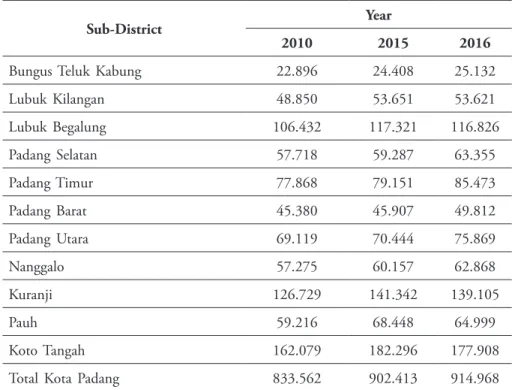
The city of Padang consists of 11 sub-districts with 104 villages.46 The population of this city is concentrated in 5 sub-districts of “old city area”
namely Nanggalo sub-district, North Padang sub-district, East Padang sub-district, West Padang sub-district, and South Padang sub-district.
45 Amal Salim al-‘Awawudah dkk, ‘Asbab Al-Naza’at al-Usriyah Min JihahNazhri al-Abna’:
Dirasah al-Thathbiqiyah,’ Majalah Al-Jami’ah al-Islamiyah Li al-Dirasah al-Tarbawiyah Wa al- Nafsiyah, p. 227 <http://www.iugaza.edu.ps/ar/periodical/>.
46Badan Pusat Statistik Kota Padang, ‘Kota Padang dalam Angka 2016’, pp. 7–8 <https://
padangkota.bps.go.id/publication/2016/07/15/4e3006466268af92b7bee727/kota-padang-dalam- angka-2016.html> [accessed 19 May 2019].
Table 1: Total Population and Population Growth Rate in Padang City in 2010, 2015, 2016 47
Sub-District Year
2010 2015 2016
Bungus Teluk Kabung 22.896 24.408 25.132
Lubuk Kilangan 48.850 53.651 53.621
Lubuk Begalung 106.432 117.321 116.826
Padang Selatan 57.718 59.287 63.355
Padang Timur 77.868 79.151 85.473
Padang Barat 45.380 45.907 49.812
Padang Utara 69.119 70.444 75.869
Nanggalo 57.275 60.157 62.868
Kuranji 126.729 141.342 139.105
Pauh 59.216 68.448 64.999
Koto Tangah 162.079 182.296 177.908
Total Kota Padang 833.562 902.413 914.968
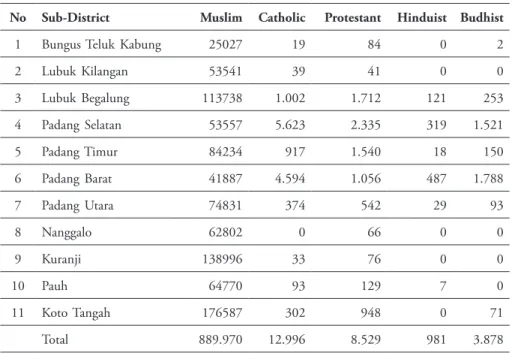
Padang society generally still adhere to religion and customs. Every order of city life is still influenced by the prevailing religion and customs.
The majority of the Padang residents are Muslim while sticking to the Minangkabau culture. This community with the Islamic majority became one of the factors that caused schools at all levels, both public and private require students to wear hijab since 2005. So that it is visible only students who attend non-Islamic and religious schools outside Islam are allowed to go to school without wearing hijab. This was continued to be maintained by the Padang government and even became an example and was adopted by regions in West Sumatra. Indirectly, dressing according to the Islamic Shari’a for women in this city is very much in accordance with Minangkabau customs which are preserved by the society.
47 Data merupakan hasil Survei Penduduk Antar Sensus (SUPAS) tahun 2016 di https://
padangkota.bps.go.id/linkTableDinamis/view/id/157 it’s accessed on April 22, 2017.
Tabel 2: Population by Religion in 201648
No Sub-District Muslim Catholic Protestant Hinduist Budhist
1 Bungus Teluk Kabung 25027 19 84 0 2
2 Lubuk Kilangan 53541 39 41 0 0
3 Lubuk Begalung 113738 1.002 1.712 121 253
4 Padang Selatan 53557 5.623 2.335 319 1.521
5 Padang Timur 84234 917 1.540 18 150
6 Padang Barat 41887 4.594 1.056 487 1.788
7 Padang Utara 74831 374 542 29 93
8 Nanggalo 62802 0 66 0 0
9 Kuranji 138996 33 76 0 0
10 Pauh 64770 93 129 7 0
11 Koto Tangah 176587 302 948 0 71
Total 889.970 12.996 8.529 981 3.878
Minangkabau custom requires all of its society member to dress modestly and politely under the traditional values of West Sumatra.
This situation is an implementation of the principle of society, namely
“adat basandi syarak, syarak basandi Kitabullah (tradition bases on Religion, Religion bases on the Holy Book”. In addition to maintaining a culture of dressing according to the Shari’a, Islamic rituals are also supported by the government by requiring students of all levels to carry out the Ramadhan Islamic Boarding School every year. In this annual events, students at the elementary school are required to attend the dawn education, while students of secondary and high school levels carry out youth wirid activities at the mosque weekly. Such is the socio-religious aspects of the daily lives of Padang’s society. The style of living in the region has often become a special interest of tourists.49
48 Badan Pusat Statistik Kota Padang, p. 166.
49 Badan Pusat Statistik Kota Padang, p. 169.
B. Divorce Rate and Its Underlying Factors
As stated earlier, the people of Padang city, like other big cities, are not immune to social problems, especially those related to family conflicts.
These conflicts, if not muted, will lead to an even worse atmosphere, namely divorce. In the city of Padang, the divorce rate in the past three years (2014-2016) showed a fairly high rate as shown in the following table.
Tabel 3: Divorce Rate in 2014-201650 Year Number of Divorces taken into Court
2014 365
2015 298
2016 313
The divorce rates as shown in the table above are only limited to divorce cases reported to the Padang City Religious Court. Beyond that, several divorce cases are not detected because they did not enter the courtroom.
If the number of divorces that occurred in 2014-1016 is related to its underlying factors this, the picture obtained is as shown in the following chart:
Chart 1: Number of Divorce and its underlying factors in Padang City51
50 Documents of Padang Religious Court 1A, ‘Factors Causing the Divorces from 2014 to 2016’.
51 Documents of Padang Religious Court 1A, ‘Factors Causing the Divorces in 2015’.
As shown in the chart above, the factors underlying the divorce in Padang every year are different. Based on existing data the biggest factors that most influence the occurrence of divorce in Padang City are:
Economic factors and disharmony in the household. As for the other factors the effect is not how even some even have no role at all.
So that the description of the effects of divorce factors can be understood more deeply, the following description provides a more detailed review as highlighted below:
Chart 2: Factors Causing Divorces in 201452
The eight factors that have been determined and classified by the Religious Courts class 1A Padang53 seem do not affect so much in the occurrence of divorces in Padang. In 2014, the highest number of divorces were generated by No Harmony factor, resulting in 146 cases; then the Absence of Responsibility which resulted in 54 cases; Third-Party Disorders which resulted in 49 cases; Jealousy caused 44 cases; Economic Factor caused 21 cases. The factor that obtained the least number of cases in 2014 was Forced Marriage with the number of cases as many as 16 cases.
In 2015, however, the factors causing divorce are slightly different as shown in the following Chart:
52 Documents of Padang Religious Court 1A, ‘Factors Causing the Divorces in 2014’.
53 These factors were: the crisis of moral, law reason (convicted), physical and mental cruelty, biological disability, bad polygamist relationship, early marriage and inter-couple disputes between husband and wife.
Chart 3: Factors causing the divorces in 201554
The above graph indicates that in 2015 factors causing divorce among families are quite similar to the factors in the previous years. In 2015, Moral crisis factor caused 3 divorce cases, No responsibility caused 8 cases, Jealousy resulted in 4 cases, Economic factors 7 cases, Third- party Disorders 12 cases. Whereas No Harmony factor “ has become the most influential factor in the occurrence of divorces in 2014 and 2015, generating 263 cases, which the highest of all.
In 2016, however, factors generating divorces among families change drastically. As the following chart indicates, in 2016, four factors caused divorces among the couples; the most influential was Inter-Couple Disputes and violence between the couple, generating 202 cases. No responsibility generated 82 cases; the Existence of Third Party Disorders resulted in 21 cases and No Harmony diminished to only 8 cases, differ from in 2014 and in 2015 which became the most influential factor in the occurrence of divorces.
Chart 4: Factors causing Divorce in 201655
54 Documents of Padang Religious Court 1A, ‘Factors Causing the Divorces in 2015’.
55 Documents of Padang Religious Court 1A, ‘Factors Causing the Divorces in 2016’.
Conclusion
Divorce problems are social problems that need serious treatment.
This is because it is not uncommon for a divorce to have a negative impact not only on divorced couples but also on offspring, even on the extended family of both parties. That is why even though divorce is permissible in religion, it is hated by God and is the last resort in overcoming family conflicts. In Padang City, as in other large cities, the factors that encourage divorce vary and are not limited to one factor.
The most influential factor in divorce cases in Padang City is the family economic factor and the irresponsibility of one of the parties in meeting the demands/needs of the family. These two factors need to be the attention of all parties if they want the realization sakînah, mawaddah, wa rahmah family that is happy, peaceful and prosperous family.
Bibliography
Abadi, Muhammad Amin al-Fairuz, Al-Kamus al-Muhith. Damaskus:
Muhammad Amin al-Fairuz Abadi, 1995.
Abdul Baqi, Muhammad Fuad. Al-Lu’lu’ Wa al-Marjan Fîma Ittafaqa
‘alaihi al-Syaikhan. Beirut: Dar al-Fikr, 1990.
Ad Damig, Sami ibn Abd al ‘Aziz dkk. Masyru’ Al Ijraat Al Munazzhomah Li Ath Thalaq Wa Ma Yatarattabu Alaihi Az Zaujah Wa al-Abna’.
Riyad: Muassasah Sultan Abd Al Aziz Ali Sa’ud Al Khairiyyah, 2000.
Al-‘Awawudah, Amal Salim, dkk, ‘Asbab Al-Naza’at al-Usriyah Min JihahNazhri al-Abna’: Dirasah al-Thathbiqiyah,’ Majalah Al-Jami’ah al-Islamiyah Li al-Dirasah al-Tarbawiyah Wa al-Nafsiyah <http://www.
iugaza.edu.ps/ar/periodical/>
Al-Amin, Anwar Amirah Ahmad. ‘Al-Talak Wa al-Asbab Wa Turuk al-
‘Ilaj, Majalah Aman al-Usrah,’ Riyad: Jami’ah Nayif al-‘Arabiyah Li al-‘Ulum al-‘Amniyah, 2015
Al-Anshari, Jamal al-Din Abi al-Fadhal Muhammad bin Mukrim bin Manzhur. Lisan Al-‘Arab, 10, Cet. 1 (Beirut: dar-al-Fikr, 2002) Al-Ahmad, Muhammad Ibrahim bin Ahmad. Suu Al-Khuluk. Beirut:
Dar al-Fikr, 2000.
Al-Akharun, Muhammad ‘Irfah al-Dasuki wa. Hasyiyah Al-Dasuuki ‘Ala al-Syarah al-Kabir Ma’a Taqrirat al-Syaikh ‘Alaisy, Cet. 1. Beirut:
Dar al-Fikr, 1990.
Al-Bukhori, Muhammad bin Ismail Abu ‘Abdullah. Jami’ al-Shahih, Fii Kitab al-Talak, Bab Firman Allah: نهتدعل نهوقلطف ءاسنلا متقلط اذإ بيلنااهيأي ةدعلا اوصحأو, No. Hadis: 5251, 1st edn Beirut: Dar Ibnu Katsir, 2002.
Al-Sarkhasi, Abu Bakar Muhammad Abu Sahal. Al-Mabsuth, 1st edn.
Beirut: Dar al-Ma’rifah, 1986.
Al-Mawardi, Abu Hasan Ali bin Muhammad bin Habib al-Basri al- Bagdadi. Kitab Al-Ahkâm al-Sulthâniyah, 1st edn. Beirut: Dar al- Fikr, 1966.
Al-Nawawi, Abu Zakariya Muhbi al-Din Yahya bin Syaraf. Raudhatu Al- Thalibin Wa ‘Umdatu al-Muftiyin. Beirut: al-Maktab al-Islami, 1983.
Al-Syafi’i, Ahmad bin ‘Ali bin Hajar Abu Fdhal al-‘Asqalani. Fath Al-Bari Li Ibni Hajar. Beirut: Dar al-Ma’rifah, 1990.
Al-Jina’i, Aidah Salim. Al-Mutagairat al-Ijtimâ’iyah Wa al-Tsaqafiyah Li Zhâhirah al-Talâk: Dirâsah Maidaniyah Li Zhahirati al-Talak Fi Madinah Bagdad. Bagdad: Dar al-Huriyah li al-Thalabah, 1983.
Asy Syabul, Aiyman. ‘Al Mutagairat Al Ijtima’iyah Wa Ats Tsaqafiyyah Li Zahirah Ath Thalaq: Dirasah Antropolojiyah Fi Buldah Ath Tharah),’
Majalah Jami’ah Dimasyq, 2010
Al-Sarthawi, Muhammad ‘Ali. Syarah Qanun Al-Ahwal al-Syakhshiyah.
’Iman: Dar al-Fikr wa Tauzi’, 1997.
Al-Thabari, Muhammad bin Jarir. Jami’ Bayan Fi Takwil al-Qur’an al- Ma’ruf Bi Tafsir al-Thabari. Beirut: Dar Hajr, 1990.
Al Qursyi, Baqir Syarif. Nizhâm Al Usrah Fi Al Islam: Dirâsah Muqâranah.
Beirut: Dar Al Adwak, 1988.
Al-Hanbali, Manshur bin Yunus bin Sholah al-Din bin Hasan bin Idris al-Bhuti. Kisyafi Al-Kina’ ‘an Mutun al-Iqna, cet. 1. Beirut: Dar al-Fikr, 1990.
Al-Hanafi, Muhammad Amin bin Umar bin Abdul ‘Aziz, and ‘Abidin al-Dimaski. Rad Al-Muhtar ‘ala al-Dar al-Mukhtar Syarh Tanwir al-Abshar, 10. Beirut: dar al-Fikr, 1992.
Al-Syamri, Muhammad bin Abdullah bin Muhammad. Al-Talak Wa Asbabuhu Wa Astaruhu ‘ala al-Mujtama. Beirut: Dar al-Fikr, 2009.
Al-Syafi’i, Syam al-Din Muhammad bin Ahmad al-Khatib al-Syarbini.
Mughni Al-Muhtaj Ila Ma’rifah Ma’ani Alfazh al-Minhaj, 1st edn.
Beirut: dar al-Kutub al-‘Ilmiyah AL-Tabi’ah, 1994.
Al’Uqail, Sulaiman bin Abdullah bin Abd al-Aziz al’UqailSulaiman bin Abdullah bin Abd al-Aziz. Al-Asbab al-Muaddiyah Ila al-Talak Min Wajhi Nazhar al-Muthlaqin Wa al-Muthallaqat Fi Muhafazhah Gaza.
Gaza: al-Markaz al-Falistiniyin li Hilli al-Naza’ah, 2003.
Asmara(1*), Musda, and Reti Andira(2) (1) STAIN CURUP (2) Institut Agama Islam Negeri (IAIN) Curup (*) Corresponding Author,
‘Urgensi Talak di Depan Sidang Pengadilan Perspektif Maslahah Mursalah | Asmara | Al-Istinbath : Jurnal Hukum Islam’ <http://
journal.staincurup.ac.id/index.php/alistinbath/article/view/626>
[accessed 30 May 2019]
Azizah, Linda. ‘Analisis Perceraian dalam Kompilasi Hukum Islam’, Al-
’Adalah, 10.2 (2012), 415–22.
Badan Pusat Statistik Kota Padang, ‘Kota Padang dalam Angka 2016’ <https://padangkota.bps.go.id/publication/2016/07/15/
4e3006466268af92b7bee727/kota-padang-dalam-angka-2016.html>
[accessed 19 May 2019].
Dokumen Pengadilan Agama Padang Kelas 1A, ‘Faktor-Faktor Penyebab Cerai Talak Dari Tahun 2014 Hingga Tahun 2016’
———. ‘Faktor-Faktor Penyebab Cerai Talak Tahun 2014’
———. ‘Faktor-Faktor Penyebab Cerai Talak Tahun 2015’
———. ‘Faktor-Faktor Penyebab Cerai Talak Tahun 2016’
H Nauhi, and Ismatu Ropi, dkk. Pedoman Penulisan Karya Ilmiah, Skripsi, Dan Tesis, (Jakarta: CeQDA, 2007)
Ibn Hazm. Al-Mahalli Bi al-Astar. Beirut: Dar al-Fikr, 1999.
Ibn Qudâmah, Abdullah bin Ahmad. Al-Mughnî Fî Fikih al-Imam Ahmad Bin Hanbal al-Syaibani Beirut: Dar al-Fikr, 1984.
Januar, Hakim Bidang Humas, the cause of divorve in the Padang city, 2017
Kementerian Wakaf dan Administrasi Islam. ‘Al-Musu’ah al-Fiqhiyah’.
Kuwait, Kementerian Wakaf dan Administrasi Islam, 2006.
Komarudin, Didin. ‘Praktik Taklik Talak dan Gugat Cerai Serta Hubungannya dengan Tujuan Pernikahan (Studi Kasus di Kecamatan Gegesik Kabupaten Cirebon)’, INKLUSIF (Jurnal Pengkajian Penelitian Ekonomi Dan Hukum Islam), 3.1 (2018), 75–90.
Muhammad Samarah, Ahkam Wa Astar Al-Zaujiyah, 1st edn (’Iman:
Dar ‘ilmiah, 2002)
Muhammad Tharabilis, Syam al-Din Abu Abdullah. Muwahabu Al-Jalil Fi Syarh Mukhtashar Halil, Jilid 5, cet. 3. Beirut: dar al-Fikr, 1992.
Muhammad Syima’, Al-Mufid Min al-Abhast Fi Ahkam al-Zawaj Wa al- Talak Wa al-Mirast (Damaskus: Dar al-Qa’, 1995)
Musa Kamil, Masail Fi Al-Hayh al-Zaujiyah: Muassasah al-Risalah (t. tempat:
t. penerbit)
Novitasari, Dera. ‘Maraknya Isteri Menggugat Cerai Suami Di Pengadilan Agama Padang - Kementerian Agama Provinsi Sumatera Barat’, Portal Kementerian Agama Sumatera Barat, 2017 <http://sumbar.kemenag.
go.id/v2/post/2056> [accessed 19 May 2019]
Rais, Isnawati, ‘Tingginya Angka Cerai Gugat (Khulu’) di Indonesia:
Analisis Kritis terhadapPenyebab dan Alternatif Solusi Mengatasinya’, AL-’ADALAH, 12.1 (2014), 191–204 <https://doi.org/10.24042/
adalah.v12i1.183>
Rasjidi, Lili. Alasan Perceraian Menurut UU No. 1 Tahun 1974 Tentang Perkawinan. Jakarta: Ghalia Indonesia, 1985.
Ratnawaty, Latifah, ‘Perceraian di Bawah Tangan dalam Perspektif Hukum Islam dan Hukum Positif’, Yustisi, 4.1 (2017), 112.
Silverman, David. Doing Qualitative Research. Sydney: Sage Publication, 2005.
Sighma Huda-PBB, ‘Taqrir Al-Muqarrar al-Khashah al-Ma’inah Bi Jawanib Hukuk al-Insanli Dhuhaya al-Ittijar Bi al-Khasy La Siyama al-Insan Wa al-Athfal’, t.t, xxiii