INTRODUCTION
232 INTRODUCTION
The earliest historical references to C'empoal appear in accounts of the conquest b}- Bernal Diaz del Castillo/' Francisco Lopez de Gomara* and other contemporaries. Examples of the circular type are not as well preserved as those of the rectangular type, but their shape is similar to that of the temple that wins in the ruins at Calera near the Puente Nacional.*. FEWKES] THE RUINS OF CEMPOALAN 289 pillars, two of which are still visible at the base of the pyramid.
At the foot of the staircase are visible the broken remains of hollow, chimney-like plaster columns which once supported the roof, formerly decorated on their flat sides with stucco. Looking at the well-preserved staircase, it will be noticed that this part of the structure is divided.
TEWKES] KUINS OF CEMPOALAX 241 into two parts, one above the other, the lower extending from the
Although nothing now remains of the panels forming the frieze of Cempoal's temple, the clay heads found at the base of the pyramid, as well as the statements of early visitors, indicate that those panels were decorated with such heads. and there was a square pit several feet deep in the middle of it. This ruin, like the others, is much damaged by the roots of large trees which have broken away from the cement, but the exposed surfaces are still well preserved—a remarkable fact considering given the age of these buildings and the corrosive action of the rain to which they have been subjected.
One feature of the second story, shown in the view from one corner (the platecii), is the parapet, or series of terra(;one projections, arranged along the main part of its platform. The lower stairs rise to the top of the base story, from where another staircase ascends to the platform, on which were the walls of a temple or sanctuary.).
MOUNDS NEAR ANTIGUA 243 BUILDING K
MOUNDS NEAR ANTIGUA
RUINS OF XICOCHIMALCO
FEWKES] RUIXS OF XICOCHIMALCO 245 climbing- the steep trails and entering Xico Viejo had they wished to
The relationship of the former inhabitants of this region is problematic, because there is no historical reference to them, and the objects found in this area bear no resemblance to this feature of Nahuatlor Totonac archaeology. The legends of the people of the inhabited or modern Pueblo Xico, which is Aztec, claim that they sound like Tcxo lower built by their ancestors, which may be true for certain families, but the objects found near them are not Aztec not. These objects also differ from those of the Totonac, but are more closely related to them than those of the ruin XicoViejo, where the Xico people lived at the time of the Conquest.
RUINS OF XICOCHIMALCO 247 object at Xico Viejo. When the idol wa« visited it had bananas upon
MODERN XK'(K'1IIMALC(
PAPANTLA 249
PAPANTLA
CASTILLO DE TEAYO
015.1ECTS FROM CEMPOALAN AND XICO
FEWKER] OBJECTS FROM CEMPOALAN AND XICO 251 considerable attention to a study of this collection bj" permission
FEWKER] OBJECTS FROM CEMPOALAN AND XICO 251 considerable attention to a study of this collection bj" permission.
FEWKES] OBJECTS FPOM CEMPOALAK AND XICO 253 between this stone ring and the closed j'oke. Its surface is not deco-
OPEN STONE YOKES"
Having placed the yoke horizontally, with the curved part of the arch to the left, the arm of the yoke can be distinguished as proximal and distal, the anterior curve defined the anterior part and the free arm posterior; the margin of the base is the bottom or bottom on which the 3-oke rests. The face of the head of the first subdivision has many human features, and the resemblance extends to the appearance of the appendages, which take the form of human arms and legs, hands and feet, rather than claws or hooves. The accompanying plate, (plate cxii, «,/;, c), chosen represents a decorated oke of the first type, is one of the best specimens in the Dehesa collection. As indicated by the human face, it belongs to the first subdivision of the first group, in which the human head is cut in relief in the curve, on the proximal and distal arms of the j'oke.
Of the same general character is the decoration of a yoke (shown in plate cxiv) owned by the Sonora News Company of Mexico City. One of the main variations in detail between the latter and the latter is the structure of the upper lip, which here is split into three parts - a not uncommon feature at that.

OBJECTS FROM CEMPOALAN AKD XICO 257 be additional incised or relief medallions of heads on the ends of the
CURVED STONES
OBJECTS FROM CEMPOALAN AND XICO 259 THEORIES OF THE USE OF STONE YOKES
The bus or place name, for example Nautziidan, consists of a 3'oke-shaped figure placed above the legs and abdomen of a human being and interpreted by Peiiafiela as 'a place of fertility'. According to this author, the figure of theyoke is 'a kind of vessel full of black spots, a symbol of motherhood, reproduction or fertility.' Mrs. Nuttall" and Doctor Rust* suggest that the curved stones used by the Californian Indians in certain puberty rituals may be related to the stone jokes of the Mexicans. This is consistent with the hypothesis that the latter were connected with germination rituals or with gods who were in charge of the germination, which according to the author is not far from the truth. .
The death's head and skeleton, so constantly repeated, do not in any way refer to the offerings of the victims to the ruler of the dead, the underworld where the ancients and other supernaturals dwell. Strebel has identified the majority of the second subdivision of the first gi-oup as seed forms; this identification may be goods as far as it goes, but it is not improbable that these frogs symbolize other notions, such as Sunor the Moon-god.
FEWKES] OBJECTS FROM CEMPOALAN AND XICO 261 likeness is e.specially striking in figures of gods and goddesses con-
OBJECTS FROM CEMPOALAN AND XICO 263 PADLOCK STONES
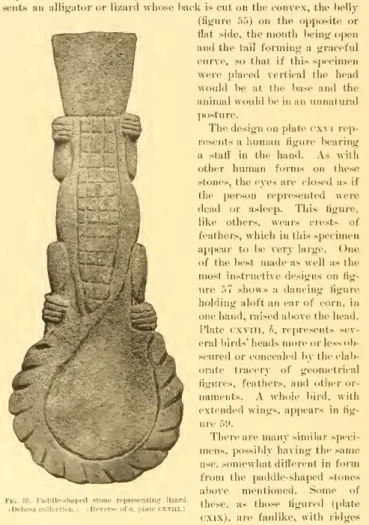
Among the many evidences of a high skill in artistic expression attained by the ancient people of eastern Mexico may be mentioned the carved stone heads, specimens of which are represented in plates xx and cxxi. The stone ring (plate cxx, f), with a handle on one side and evidence of another on the opposite end, from the Dehesa collection, is, so far as known, a uniquely shaped stone object from this region.
OBJECTS FROM CEMPOALAN AND XTCO 265 sents a laughing face, ^^'itli niouth wide open, tongue evident, but no
Astoneidol in the courtyards of Hacienda Bruno, Jalapa Viejo, represents a small stone image of Quetzalcoatl (Fig. 62), with a coiled body and upright head, with a j-shaped mouth revealing a human face behind sharp teeth. In one of the houses overlooking the church at Xico is a large stone idol, somewhat different from any Aztec or Totonac image yet found.
OBJECTS FROM CEMPOALAN AND XICO 267 modern appearance, there is no doubt of its antiquity. It is a
208 CERTAIN ANTIQUITIES OF EASTERN MEXICO [eth. asn.25 chaniftcristicTotouac Goddess Toci, our grandmother, one of the most prominent supernatural beings of the Gulf Coast people of ancient Mexico. The earthenware found at this locality is practically identical with that of Cempoalan, and from them we may get a fair idea of the general character of the Totonac pottery in this vicinity. Similar clay images once adorned the panels of the Cempoalan temples, especially the one called Caritas ("Little Heads") for this reason.
OBJECTS FROM CEMPOALAN AND XICO 269 being present, but no arms or leg's. Seen from one side this effigy
Some of the more striking forms of pottery in Sra Estefania's collection from Otates are figured in plates cxxv and cxxvi. The object has an anose ornament, the shape of which is reminiscent of the stone image from Xico Viejo, which has already been described. The decoration of the majority of flat bowls from Otatesis is as a rule on the outside and consists of spiral figures, as shown without Platexxv.
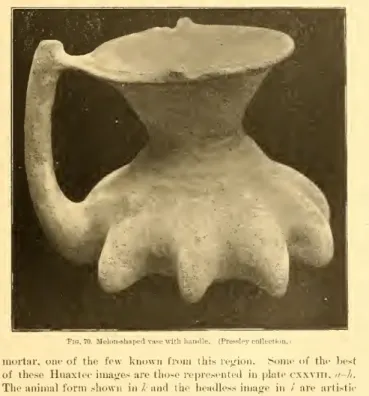
Other clay objects from the vicinity of Jalapa, other than the plate, are a classical jug («), several amphorae (c, d), clay heads (/, c/, h), and food bowls with legs {h, e).
FEWKES] MOUNDS NEAR TAMPICO 271
MOUNDS NEAR TAMPICO General Remarks
The region of ruins of the second type in central Mexico begins at Casadel Edificios near Quemada, about 30 miles north of the city of Zacatecas. If we follow the parallel of this ruin towards the Gulf of Mexico, it will be observed that to the south of it there are ruins of both tv weights, but that this region is essentially one of solid pyramidal mounds built as foundations for superstructures , a type of northern region rarely represented in this mountain line. The same relationship between climatic conditions and physiographic contours also applies, but less closely, to the distribution of these species in northern Mexico.
From VeraCruz to the mouth of the Panukoor River and beyond, the country is thickly studded with hills of the second kind, some of which, like those at Papantla, rank among the finest in Mexico. Although the ravines are known to belong to the same type as those in the Mississippi Valley, the nature of the hills (if any) between the Panuco and Louisiana remains unknown.
FBWKES] MOUNDS NEAR TAMPICO 273 region, were made for the purpose of adding- new facts bearing on a
274 SOME ANTIQUITIES OF EASTERN MEXICO [eth.ANN.. 25 . the following year D. Francisco de Garay sent an expedition to the province of Panuoo under the command of Alonso Alvarezde Peneda, which entered the mouth of the river, but was attacked and driven back, as was also Ruiz deAsis, who brought reinforcements to Peneda. *Governor Prieto's account deals more with the ruins north of Tam- . pico, near the Champayan Lagoon, including those in San Franciscorancho and Sierra de Palma, while DoctorSeler treats those south of the Panuco River, in Topila, Palacho and delsewhei'e in the Huaxtec state. Some of these mounds are practically identical with the so-called "temple mounds" of the lower Mississippi Valley.
Seven leagues north of Altamira, within the jurisdiction of that city, a small range of mountains extends in a general north-south direction, terminating near the Champayan lagoon. In examining the presentation of these latter, we are struck by their resemblance to the so-called pillar stones in the playgrounds of the prehistoric Puerto Ricans, referred to in the preceding pages.
ARCHEOLOGICAL OBJECTS
Prieto, who described these mountains, also gave in his article representations of several characteristic objects of stone and clay from the same place. Seler, whose brief account deals with all that has been published concerning them, speaks of aquadrangularplaza with a temple hill on one side and smaller pyramids on the other. He also speaks of stones found at the corners of the pyramids in Palacho, and describes and figures which are worked bases of both these ruins.
Dagiti Bato nga Idolo idiay Altamira Ti agdama a siudad ti Altamira, iti aplaya ti maysa a lagoon iti sumagmamano a milia iti amianan ti Tampico, ket impasdek ni Escandron idi Mayo 2, 1749. Manipud idi naipasdek ti agdama a Tampico, idi 1823, napukaw ti Altamira ti kinalatakna iti komersio ken panagbaba ti kinarang-ay}'.
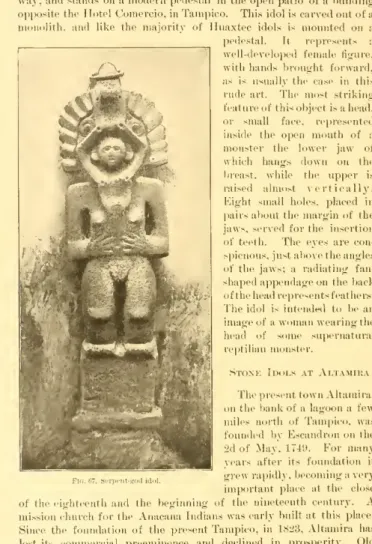
ARCHEOLOGICAL OBJECTS 279 suffered a similar decline. On his visit to Alttunira to investigate
On the figure of this turtle-shaped idol by Chaver, the ears have pendants in the form of hooks, reminiscent of the "epeollia" of the god Quetzalcoatl.
FEWKES] ARCHEOLOGICAL OBJECTS 281 of the river bank have been washed out bj^ freshets. Although not
The mounds in the middle neighborhood of Tampieo include shell mounds, pyramid foundations of temples and mortuary mounds, but none have yet been found with interior walls or protruding surfaces. The hills of Tamaulipas are related in shape and apparent structure to those of Cempoalan, but the building material used in the two regions is different. The pottery of the Huaxtec bears a general similarity to some of the Hopi pottery, especially that from along the Little Colorado, but the designs on it are somewhat different and characteristic.
The ancient people of the Panuco Valley were distinct potters, as the variety of forms they produced shows, and their descendants still preserve the art. These productions are found everywhere in the earth, especially near mounds, which occur at several specific points, especially by rivers and lagoons.
ARCHEOLOGICAL OBJECTS 283 clay figurines, .several forms of which are given in the accompanying
CO.NCLUSIOXS
INDEX
Ceron, distribution of slaves by 23 Champa YANlagoon, ruins near 276 Chanca, Doctor—. on the natives of Guadeloupe 198-199 on the second voyage of Columbus 203 on the rite for crops in Haiti 67 on the legend of the creation of Haiti 74 on utensils from the Amazon valley. Office Correspondence xix,xxiv CoRTfes, Hernando—. archeologicalcoUection.s 18 archaeological reconnaissances xiv- XT,xxvi. on the physical characteristics of the Carib 30-31 DEHE.SA. Governor Teodoro, admit-. 86 GaraY, Franciscode, expedition 274 Gatschet, DrA.S., work xi.x Gaw, Mr., thanks 235 GiBAROS, modern PortoRicannatives GiLii, on preparation of cas.sava 52 Gill, DeLancey, work xiii,.xxii-xxiii .. on Cempoalaaruins 2 3ii on sites established by Cortes 243 on Haitian harvest ritual 66-67. on Haitianmyth 73.
Page MOller.J.G.,on dance grounds so .. on Puerto Rican houses 41—12 MUNOz DOCUMENT,Redistribution of In-. diansamongEuropeans 24 MusEONacional,MexicoCity 234. Antillean shells found by 29 onclay idol from SantoDomingo 187 on deformed legs of Antilleans 144. on Puerto Rican pictography 148-149 Puerto Rican caves explored by 87 Colenory, Margalsten, 87 Piloten, Margal, B. ureav ix Plantingsticks,Antillean 196. on phallicisminWestIndies 100 Polishing stones, Antilleans 93 Polygamy among Antilleans 48 Ponce deLeon—. relations with AguebanatheFirst 36 Ponce, Juan, slayer of Aguebana. archaeological reconnaissance- xiv- XV.XXVI.XXVIII archaeological sites. RamonPane, Fray— . asahistorian 19-20 . quoted inhabitants of Haiti 139 Haiti and speech uttered by 77 on Antillean priesthood 147 on Haitian ceremonies for rain 65 on Haitian traditions 73-74 on polygamy among Borinqueiios 48 on Porto Rican legend ^ 109 on religion of Borinques ofnos, 3-1 6 treatments. on treatment of patients 61-62. on zemis .. origin of tortoise recorded by 197 Read, Mr., acknowledgments to 99 Reinoso, Alvaro.on Haitian agriculture.
Thomas, DrCyRU8, obra xix, xx Trikoniko a bato— .. panagsirarak kadagiti xvir Tabako, panagusar ti, AntiJleans 63-64 ToLENTiNO, Apo, amulct a nasarakan ni Luisde, pannakabagi ni Columbus 203 Torres, Louis Lawrence— . kadagiti daan a pagsasao ti Abagatan nga Amerika- 218 .. kadagiti pagsasao ti Antilles 78 . iti kueba ti Yobobala 56 .. ToTONAC, nagkauna nga agnanaed iti Vera .. nainayon kadagiti koleksion ti 17 a tallo ti murdongna a bato iti • 116 Urayoan, Porto Ricanchief 39 Vall ySpinosa, Federico, moderno a Porto. BUREAU OF AMERICANNETHNOLOGV DUAPULO KET LIMA A TINAWEN A REPORT PL.. 1.a'Dagiti Balay ti Panagkalap kadagiti Dunes ti Arecibo. /) Adda dagiti nabingay a diding ti mink;dagiti ramut ti garami, iti asideg ti Barceloneta. BUREAU OF AMERICAN!ETNOLOGY MAIKADUAPULO KET LIMA A TINAWEN A REPORT PL XXVI .. 1luiiiiiUi.iiuiahinuiuiili^iirj• \iviiKi-iiMpMerinooollcction);kangato5J.
BUREAU OF AMERICAN ETHNOLOGY, TWENTY-FIFTH YEAR REPORT PL.. SIDE AND TOP VIEWS OF A TRIPLE STONE FROM THE SECOND TYPE iLATIMER1 COLLECTION; 3 INCHES LENGTH.