David Foster works in the Faculty of Business at the University of the Sunshine Coast. André Habisch is Professor of Social Ethics at the Catholic University of Eichstaett-Ingolstadt and Director of the Center for Corporate Citizenship.
Introduction
We hope that the results of our research will prove valuable in terms of the knowledge and experience needed to research and further develop the CSR business case.
What is a business organization?
Setting the stage for transition
Contemporary organizational theory
Able to adopt an appropriate organizational (local) theory and concepts to respond to needs and expectations. Able to organize through its culture, structures, information and employees the satisfaction of those needs and expectations.
Business–society discourses
In recent decades, the influence of traditional institutions such as churches and schools has weakened significantly and the power of the state has eroded. One could say that CSR is about satisfying the needs and expectations of all stakeholders in the various discourses, but this is not a simple task.
Concepts of CSR
Do multinational companies apply the norms, standards and values of their country of origin, or do they act slightly above the compliance level of the countries in which they operate? If you look closely at what they actually do in terms of CSR, only 50 to 100 people deal with CSR in accordance with the fourth and fifth approaches described above.
Organizing and implementing CSR
The aim and structure of the book
CSR in its Context
This chapter looks at some of the scholarly works and thinkers that have been influential in the corporate social responsibility (CSR) debate over the past 50 years or so. Our central proposition is that fundamental change is a prerequisite for promoting corporate social responsibility;.
Capitalism
It offers an academic story of the most important social, economic and political concepts and themes from the very diverse and not always coherent discussion about corporate social responsibility. Simply put: who represents the interests of the future in the present?' (ibid.; see also Agle and Caldwell, 1999).
Citizenship
This would not be easy, as 'The basic legitimacy of the corporation was and is based on shareholder ownership' (ibid., p. 8). This will ensure that 'The total performance of the management will receive a searching audit', thereby relieving.
The moral zone
Perhaps one of the most insightful analyzes of business entrepreneurship in the early 1970s was that of Jacoby (1973), who developed a social environment model to explain corporate behavior as a response to market and non-market forces. that had an impact on cost. , revenues and profits (see also Marks and Minow, 1991). Davis (1977)—one of the authors in the Carroll collection—argued strongly for the recognition that social responsibility arose from social power.
Responsibilities and performance
This meant that "institutional adjustments in the structure and process of the market economy" had to be made (ibid., p. 2). Danley (1994) argued very strongly for the failure of the classical liberal and managerialist approaches to understanding corporate social responsibility.
Sustainability
Adapting a business strategy to include sustainable development requires a change in the culture of the organization, but it also opens up 'new opportunities to reassess other aspects of business' (ibid., p. 77). Central to the sustainable enterprise is the concept of stewardship, which Block (1993, p. 19) defines as that part of the workplace that has historically been most difficult to change, namely 'the distribution of power, purpose and rewards'. ' (see also Turner and Crawford, 1998).
Postcapitalism
1994) The Roll of the Modern Corporation in a Free Society (Notre Dame og London: University of Notre Dame Press). 1973) 'The Case For and Against Business Assumptions of Social Responsibilities', Academy of Management Journal, 16, s. 1977) 'Five Propositions for Social Responsibility', i A. 1972) 'The Emerging Public Corporation', Business and Society Review , 1, s. 1973) 'On the Economic Image of Corporate Enterprise', i R.
Corporate citizenship and social responsibility: old wine in older bottles?
There is a notable lack of critical examination of these concepts of corporate citizenship in the literature. The history of corporate citizenship goes hand in hand with the history of corporate power.
Sustainable development as corporate sustainability
Most of the literature on sustainable development is of this "eco-modernist" orientation and discusses ways to operationalize the Brundtland concept. The theoretical perspectives of the triple bottom line approach focus on maximizing sustainability opportunities (corporate social responsibility, stakeholder relations and corporate governance) while minimizing sustainability-related risks (enterprise risk management, environmental, health and safety audits and reporting).
The complicities of stakeholder theory
In any domain of corporate social responsibility, they are required to exercise such discretion as is available to them towards socially responsible outcomes.' The fallacy of managers is. Corporate stakeholder theory represents a form of stakeholder colonialism that serves to regulate stakeholder behavior.
Implications for theory and practice
Fischer (1997) 'The greening of industry or a sustainable future: Building an international research agenda', Business Strategy and the Environment, 6, pp. 1991). McIntosh (eds), Perspectives on Corporate Citizenship (Sheffield: Greenleaf), pp. 1991) 'Corporate social performance revisited', Academy of Management Review, 16(4), pp.
The development of organizations
The interaction and adaptation between organizational processes and work communities have become important factors for the success of the organization and the motivation of its employees. Value-based management to strengthen work communities and organizational identity is the other side of the coin.
Values and organizational identity
It also shapes the working community and the boundaries of that community with its environment (Schoemaker, 2003b). Is it possible to build a bridge between the market paradigm and the organizational identity of the working community.
Corporate social responsibility as an organizational value
Therefore, management practices in value-driven organizations, including CSR, must be embedded in the work community if they are to succeed. Is it possible to develop CSR as an organizational value, thus connecting the work community with market-driven organizational processes.
Conclusions
This chapter underlines the significance of social capital for business and the contribution that corporate social responsibility (CSR) can make to investments in social capital. The following sections explore the concept of social capital in more detail and relate it to business.
Social capital and business
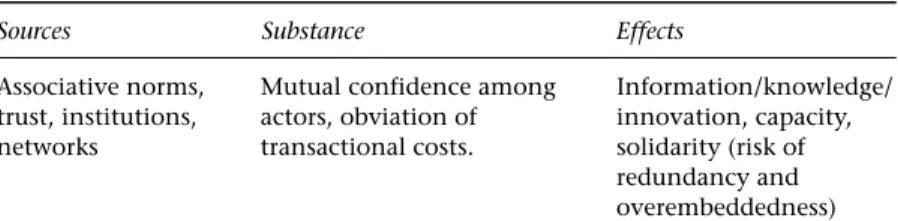
Fourth, social capital resembles physical and human capital, but differs from financial capital in that it requires maintenance. They also note the risks of social capital, which tend to be the result of excessive social capital.
What can CSR contribute to social capital?
Corporations need to be aware of the differences between these approaches to implementing CSR and the different types of social capital they can generate. Second, Adler and Kwon emphasize that managers must be aware of the different returns from and implications of social capital investment in 'bonding' (internal investment in employee welfare) and 'bridging' (external investments in stakeholder relationships).
Conclusion
Third, their suggestion that managers map their social capital ties also applies to the implementation of CSR policies. For a more detailed analysis of these findings in the context of social capital, see Moon (2001).
The causal factors of CSR: a macro view
The perception that some consequences of globalization are undesirable has led to demands for new forms of governance. The impact of the canvas consists of the demands that actors place on relationships.
A model of CSR in business
Ideas are necessary in the formulation and implementation of an original vision or to overcome obstacles to the achievement of the vision. Visioning, idea generation and connecting roles are part of the process of formulating and implementing a CSR approach.
Motives for adopting CSR
Porac (eds), Cognition Within and Between Organizations (London: Sage), p. 1999) 'Integrating environmental concerns into corporate decisions', in K. Strategies for Governments, Businesses and Communities (Washington, DC: Island Press), p. 2000) 'Globalization and sustainable development: Towards a transatlantic agenda', in C.
Organizing CSR
The theory of social dialogue and the practice of public engagement are based on democratic ideals of participation that remain elusive, despite a connection with established principles of Western democracy, a century of social science research, and more recently the growing practice of stakeholder consultation through businesses. As the explicit communication technique behind many new statements about corporate social responsibility, the latest practice of social dialogue seems too weak to maintain the interrogative attitude that dialogue implies.
Dialogue for corporations
Companies in particular have made enormous gains in efficiency and performance thanks to ICT, gains that have often come at the expense of democratic principles, for example through the ruthless marketing of economic consumption at the expense of sustainable alternatives (Monbiot, 2000). In the age of sustainability, the arguments for privilege are redundant because they dangerously limit the massive changes needed to ensure a just and sustainable future for all.
Dialogue defined
Over time, 'the mediatization of the lifeworld becomes its colonization' (Habermas 1987, p. 318, emphasis in the original), as rational technical interests diminish the ability of citizens to effectively represent themselves through public discourse. Dialogue as a complex communication process is also implied in the concept of 'argumentation' put forward in Haberma's (1984) theory of communicative action.
Dialogue democracy
By employing broad and enforceable notions of human rights to support the moral order rather than appeal to legal ends, there is a faint hope that social justice can be served. Participants in dialogues are in theory protected by rights laid down in the 1948 UN Charter of Human Rights.
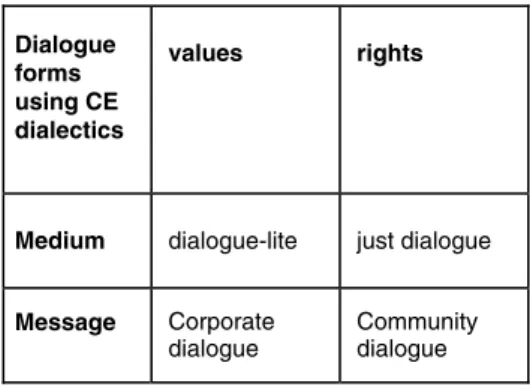
Dialogue and communication ethics
Chances are, when they use social accounts, the powerful and wealthy remain in control of both the agenda and the resources. Adding to the complexity of language are cultural factors and the different traditions and values held by gender, ethnic and economic groups (Makau and Arnett, 1997).
Professional dialogue
Anything less should be viewed with deep skepticism, especially when professional groups seek to assert their own power and authority over the process of democratic debate. Because the articulation of needs in accordance with technical knowledge can only be validated in the consciousness of the political actors themselves.
Tools for dialogue
Dialogue can thus be defined as dialogue where citizens control their own issues and debates free of professional interference. Dialogue can be seen as a process that encourages a deeper examination of shared, but not necessarily agreed upon, meanings.
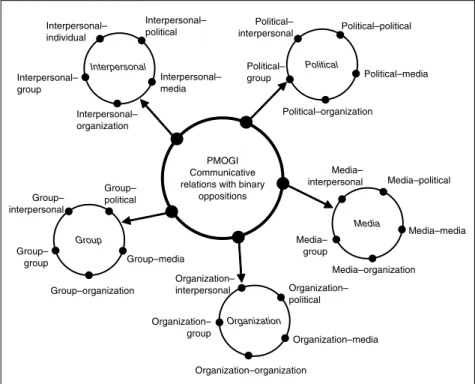
Communicative relations
This can be read (drawn) together with Figure 7.3 to give an image of the complexity inherent in all dialogue. Each of the PMOGI relational groups has its own dilemmas that are part of a matrix of tensions that lie behind dialogue and can reduce its effectiveness, especially if not opened up to scrutiny by the participants.
Applications
The dialogues should be recorded and the transcripts published to ensure fairness in the presentation of the results. The Structural Transformation of the Public Sphere (Cambridge: Polity). 1990) Moral Consciousness and Communicative Action (Cambridge: Polity Press).
Stakeholders
According to them, an important function of the organization was to adapt to what was happening in the world around it. Moreover, the relationship between the organization and its environment can be seen in terms of the organization's need to survive.
Towards a stakeholder theory of the firm
He proposes that a theory of the firm should have three components: (1) a worldview, (2) basic propositions, and (3) choice process(es) (Brenner and Cochran, 1991). This view is consistent with other stakeholder conceptualizations of the firm based on a 'bond of contracts'.
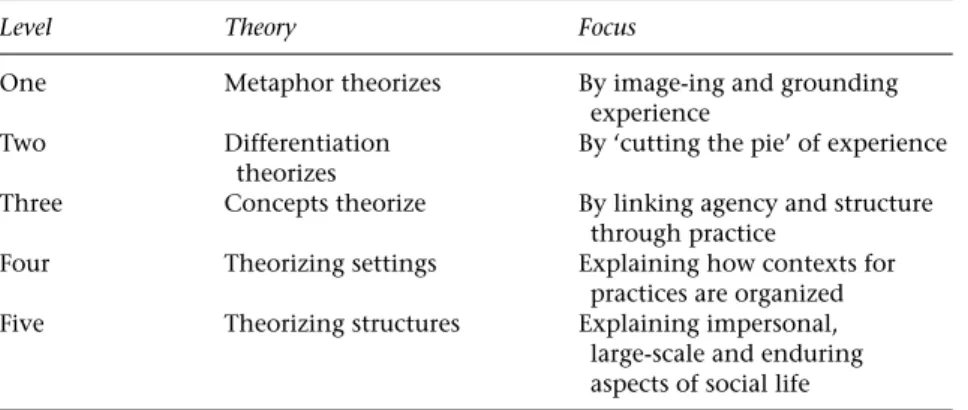
Categorizing organizations on the basis of their approach to stakeholder engagement
Organizations in Group 1 tend to be run by management as an isolated group that seeks to operate with minimal interaction with stakeholders, and when interaction does occur, it is generally on terms dictated by management. Management operates in an environment that must be faced and manipulation is part of the armor.
Each member buys into the community's values, shares the community's way of life, and joins the community's duties. Stakeholder engagement focuses on finding out as much as possible about the needs and expectations of the "other".
However, the continued existence of these groups does not contradict the basic stakeholder theory of the firm. Neither suppliers nor customers were firm insiders in the true sense of the word.
Why are stakeholder networks becoming more important?
As we see it, the convenor's role is to help a multi-stakeholder network tap its latent energy, resources and intelligence to generate new solutions and whole system innovations that no single member could achieve on its own . Kelly (2000, p. 7) reinforces this view with his observation that 'the network economy is based on technology, but can only be built on relationships.
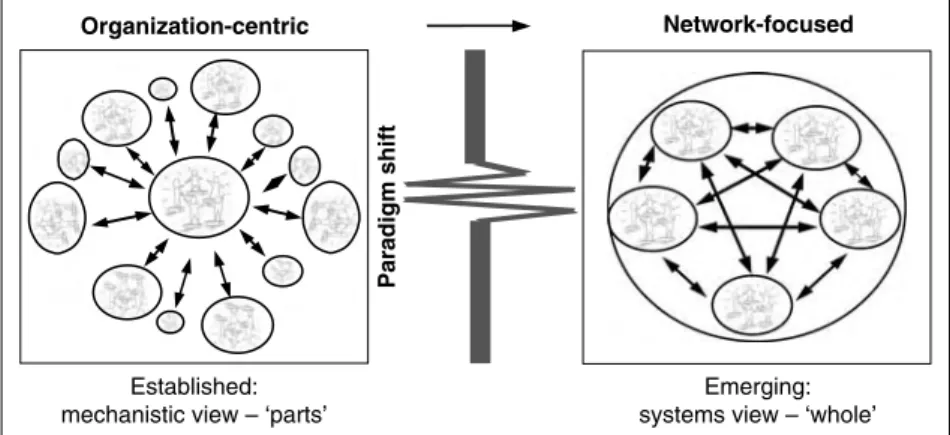
Building a new model of corporate stakeholder relations
In complex adaptive systems, the properties of the whole emerge from the relationship and interaction between its parts. In both of these examples, the properties and capabilities of the whole are greater than the sum of its parts.
Applying systems thinking to stakeholder relationships
When there is a high level of social capital, members of a network put the good of the group ahead of their own short-term interests. Social capital is a form of credit that is available to network members.
Cocreative model of stakeholder engagement
Good relationships between stakeholders are built in a continuous process of interaction and cooperation between network members. What external factors, events or potential events could affect the network's well-being now or in the future.

The benefits of cocreative network engagement
A process of co-creative engagement will develop the social capital necessary for continued collaboration among network members. 1979) 'A three-dimensional conceptual model of business performance', Academy of Management Review, 33, pp. 2000) The Rise of the Network Society (Oxford: Blackwell).
CSR as an organizational challenge
Broader, where more values are respected to take into account the interests of additional parties, but also other perspectives and alternatives. More defensible, where behavior is increasingly based on sound reasoning, taking into account the expectations of others involved.
Competences for CSR
Clarity: the extent to which the organization's expectations of employee moral behavior are precise, concrete, and complete. Consistency: the extent to which the organization's expectations of employee moral behavior are coherent, unambiguous, and compatible.
From individual to collective competences
Core values must match the traditions of the organization and the personal values of its employees. This interconnectedness between departments makes it necessary to have a shared understanding of the meaning of CSR throughout the organization.
Developing collective competences for CSR
In this way, the evaluation from and the reactions of the interested parties are combined with the processes that take place in the organization. Integration process: integration and anchoring of attention to social responsibilities in the primary and secondary processes of the organization.
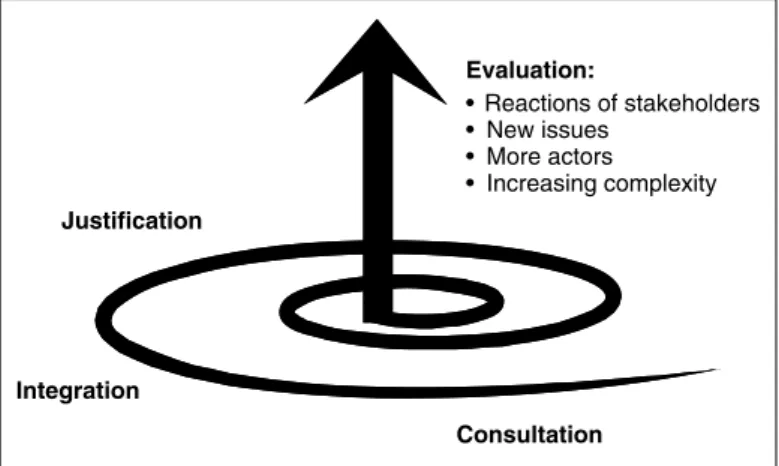
From model to practice
Some of the critical events mentioned in the interviews mainly focused on raising awareness of the significance of CSR for the organization. Discussions of the importance of CSR and the related values were included in the interviews with potential employees.
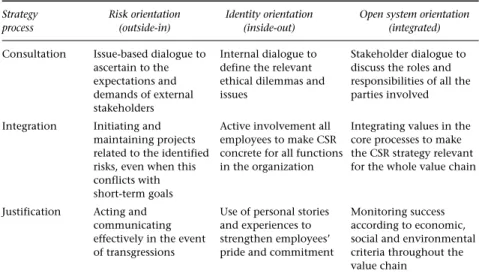
Towards an integrated framework for developing competences for CSR
In this step, the actions of the organization are evaluated to see if they have produced the desired reactions from stakeholders. In order to preserve the developed competencies, they must be anchored in the structure, culture and environment of the organization.
Final remarks
Our empirical research has shown that this list is quite comprehensive, but depending on the organization's CSR orientation and the organization's stage of development, some process competencies will sometimes be more important than others. The empirical part of the research consists of in-depth case studies of four Dutch companies.
The neglected debate
- definitions of CSR standards are taken for granted
- CSR can be standardized
- CSR standards are actually used
- CSR standards are desirable and useful for organizations
Therefore, further research is needed to obtain empirical evidence of organizations' actual use of CSR standards. This chapter focuses on the final assumption in the debate on CSR standards, namely that CSR standards are desirable and useful.
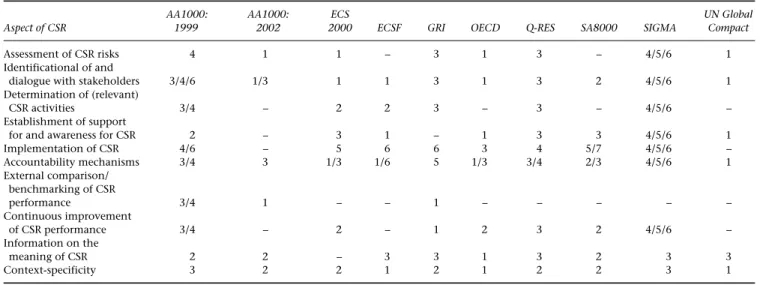
Criteria for CSR standards
Implementation of CSR: A CSR standard must deal with the question of how to implement CSR.*. External comparison/benchmarking of CSR performance: A CSR standard should deal with the possibility of measuring the CSR performance of individual companies or across sectors and industries.
Research results
Description of selected CSR standardization initiatives
The London-based Institute of Social and Ethical Accountability (Account-Ability) has developed AA1000, a set of principles for accounting for social and ethical accountability. The ECS2000 aims to establish and document a system for legal compliance (also known as compliance mechanisms).