COMPETITION IN THE
LODGING BUSINESS
Courtesy of Caesars Atlantic City.
Chapter
9
T H E P U R P O S E O F T H I S C H A P T E R
I
n this chapter, we are concerned with competition in lodging. As we did when we considered the food service business, we use the marketing mix as a framework for the analysis of competition.First, however, we must consider the somewhat special conditions in lodging under which this competition takes place. Then it is necessary to describe the way in which the marketing mix is applied to lodging. Finally, we use this perspective to consider the competitive practices of the industry.
TH I S C H A P TE R S H O U L D H E L P YO U
1. Identify the five conditions of competition in lodging, and explain their effects on the hotel business.
2. Explain how the four Ps of the marketing mix are applied in lodging competition.
3. Describe the upstairs-downstairs segmentation in the lodging industry and how it meets the differing needs of customers.
4. Describe and provide examples of how hotels differentiate themselves through the variety and mix they provide in food service options and other services and amenities.
5. List the strengths and weaknesses of the use of yield management in the hotel business.
6. Describe the effects on lodging of travel intermediaries and distribution channels.
7. Describe the impact of the Internet on the hotel industry.
8. Explain how partnerships and frequent-guest programs operate and why they are important to marketing the lodging industry.
Chapter
12
TH E C O N D ITI O N S O F C O M P E TITI O N
T
he beginning of the twenty-first century was characterized by extreme changes for the lodging industry and the North American lodging industry in particular. The losses experienced by the industry were related to a weakening economy, the tragedies of Sep- tember 11, the war in Iraq, and the outbreaks of SARS and H1N1. Unlike the lodging industry crisis of the 1990s, the challenging times starting in 2001 were not directly related to overbuilding of hotels and a surplus of room inventory. Overbuilding, however, is always a concern in terms of how it can significantly and negatively impact the industry even in better economic times, such as the turnaround that started in 2003 and the subsequent decline beginning in 2007. Indeed, the increasing role of public capital markets, which we discussed in the last chapter, increases the availability of capital for possible overbuilding.The low variable cost of the industry makes price cutting in the short run tempting—and price cutting is always tempting when overcapacity is a problem. Moreover, technological changes related to where, how, and when a hotel room is sold are changing the market- place every day. The impact of the Internet on the hotel pricing structure has been a major factor—more than ever could be imagined when hotel-related Web sites first emerged.
In the following sections, we discuss each of these conditions of competition. To begin this discussion, it is interesting to consider the top-ten hotel companies (see Figure 12.1).
Figure 12.1
Top-ten companies by number of hotels.
RANK COMPANY HOTELS
1 Wyndham Hotel Group 7,043
2 Choice Hotels International 5,827
3 IHG (InterContinental Hotels Group) 4,186
4 Best Western International 4,000
5 Accor 3,982
6 Hilton Hotels Corp. 3,265
7 Marriott International 3,178
8 Carlson Hotels Worldwide 1,013
9 Starwood Hotels & Resorts Worldwide Inc. 942
10 Groupe du Louvre 856
Source: HOTELS magazine, “World’s Largest Hotel Companies, January 10, 2010, www.hotelsmag.com.
A F R A G M E NTE D M A R KE T
The facts of the marketplace are that the ownership of hotel properties is spread among a wide number of individuals and corporations. The presence of national and regional hotel brands gives the appearance of a few dominant chains. Ownership in the hotel business, however, is not highly concentrated; rather, it is a highly fragmented market.
A hotel brand or franchise has come to be called a “flag.” Although it is not as easy for a hotel to drop a franchise as it is to take down a flag, the analogy is compelling.
Sometimes converting from a chain affiliation to becoming an independent is a volun- tary move on the part of the hotel’s ownership. Sometimes, however, the chain drops its affiliation with the hotel for a number of reasons. It could be that the hotel’s owners did not pay the required fees to the chain. It may have involved the hotel not main- taining the chain’s standards of service or cleanliness. Franchise agreements between franchisors and franchisees stipulate in detail reasons for terminating the relationship on both the part of the chain and the ownership of the hotel.
The lodging industry is not static in terms of the types of hotels that may be competing against one another. The pipeline forecast included 5,642 projects nationwide—including renovations, conversions from one flag to another, and new construction—equating to 740,272 rooms in late 2008. The segment mainly driving the pipeline was the midmarket property. Marriott, Hilton, and InterContinental are front runners of new hotels in this segment. Other strong developer favorites were Choice, Starwood, and Best Western. Overall, InterContinental had the largest roster of projects and is the only company with more than 1,000 projects in development.1
Supply and demand patterns are major causes of shifts in the hotel industry. Large firms have large stakes and are less likely to do something unpredictable. In a frag- mented market, with many small firms seeking their own interests and survival, A chain brand has come
to be called a “flag.”
(Courtesy of Carlson Hotels Worldwide.)
competition is much less predictable. When survival is at stake, as it often is in lodging, desperate measures taken by one or a few players can destabilize an entire market.
A C YC L I C A L M A R KE T
A second condition that shapes competition in lodging, as noted in Chapter 11, is that lodging is a cyclical industry, one that has been characterized by periods of demand outpacing supply as well as supply surpassing demand. The immediate outlook for the industry depends, in large part, on where the industry is in the cycle. Generally, when overcapacity threatens an industry, pricing stability is undermined.
C O ST STR U C TU R E
A third critical competitive characteristic of the lodging business is that it has a low variable cost in relation to sales and a correspondingly high fixed cost. A low variable cost means that there is very little cost associated with the sale of one more room.
The variable cost can be as low as $5 per rented room, ranging up to $15 or $20, while the corresponding room rate might range from $30 to $120. This large margin over costs makes it easy to cut prices and still show a profit—in the short run. The temptation to cut prices is particularly strong in periods where supply exceeds demand, occupancies and revenues fall, and the need to meet the burden of high fixed costs becomes more pressing.
S E C U R ITIZ ATI O N
Another related condition, also discussed in Chapter 11, is the growth in securitization in the industry. By making capital more readily available to developers, securitization makes overbuilding more of a threat. New sources of financing clearly increase the total financing available for purchase of hotels and bring an increased number of firms with deep pockets (i.e., well-financed firms) to the hotel business in all of its segments.
TE C H N O L O G I C A L R E V O L UTI O N
A final factor is the impact of technology on the hotel business. Technology and the change it brings cuts across all areas of the hotel business: improving service, facilitating control of costs, and heightening security, for example. As a condition of competition, however, we need to note that in the area of marketing, the technologi- cal revolution has fundamentally altered the way hotel rooms are offered for sale. The Internet has had a tremendous impact on the way hotels do business. Internet-based
The Marketing Mix in Lodging 391
Figure 12.2
The conditions of competition in lodging.
INDUSTRY CHARACTERISTIC IMPACT
Fragmented ownership Unpredictability, especially in down markets Cyclical Overcapacity exerts downward pressure on prices Periodic overbuilding
Low variable cost Exerts downward pressure on prices High fixed cost
Increasing securitization Technological revolution
Makes capital more available for development Heightens role of travel intermediaries (travel agents, reservation services, airlines, etc.), adding to marketing costs and reducing control over price
channels of distribution such as Travelocity and Expedia (as well as each company’s site) have put the hotel consumer in the driver’s seat in terms of shopping for the most competitive room rates. Finally, computerization of guest and customer prospect infor- mation makes possible the use of individualized information in planning and executing promotional plans.
Collectively, these five factors of competition describe an industry that is, on a scale of competitive to monopolistic, highly competitive. Within the boundaries of these conditions of competition, we can use the marketing mix to analyze competitive practices in lodging. Figure 12.2 summarizes the five conditions of competition in the lodging industry.
TH E M A R KE TI N G M IX I N L O D G I N G
T
he marketing mix is conventionally thought of as encompassing the four Ps: product, price, place, and promotion.2 In most cases, the application of these four terms varies somewhat as one moves from industry to industry. In lodging, then, we can hardly be surprised that we need to modify the four Ps to make the concepts that underlie them in lodging clearer.Product, for instance, includes both physical goods and services. It also involves characteristics that are present in the individual property, such as the guest rooms, the lobby, and the amenities package, and services offered by a hotel. However, product
also refers to the lodging system’s (chain’s or franchise group’s) services. Ultimately, the product the guest consumes is an experience—what happens to her or him, in its totality, during a visit.
Price refers not to some fixed rate but a price that varies with levels of demand and with customer groups served. Because there is no inventory of yesterday’s rooms, there is pressure to sell rooms each day. Alternatively, what is for sale is a fixed capac- ity, and so price tends to rise in periods of high demand. The truth is that the rack rate (the listed price you might find in a directory) is paid by only a small percentage of guests, probably less than one-fifth. It is more realistic, therefore, to speak of pricing policy rather than just price. As noted previously, the industry is cyclical, and fixed costs tend to exert downward pressure on prices in markets where there is overcapacity.
Place, referring to the location of an individual property, is a very important aspect of the lodging marketing mix, but the places where the hotel room is sold—for instance, travel agents and other travel intermediaries—are also extremely important. This latter aspect, we will find, is also a system characteristic in chains and other lodging groups.
Product in a Segmented Market 393
Promotion refers to marketing communication, generally taken to include per- suasive activities, such as advertising, sales promotion, and public relations. We also include here persuasive activities such as frequent-traveler programs and other indi- vidualized means to reward customers for brand loyalty.
Figure 12.3 summarizes the lodging marketing mix as it is discussed in this chapter.
In the next section, we explore these concepts in detail in terms of market tactics.
C O M P E TITI V E TA C TI C S
The competitive strategies and tactics used in the lodging marketplace are implemented by using the elements of the marketing mix to target guest segments and to differentiate one hotel offering from another. The notion that “If you build a better mousetrap, the world will beat a pathway to your door” may have an element of truth in it. The success of the hospitality transaction does begin with the product, but in a competitive market, it must be priced right and conveniently placed for the purchaser. Finally, the offer of the hotel must be persuasively communicated to the right target markets.
P R O D U C T I N A S E G M E NTE D M A R KE T
L
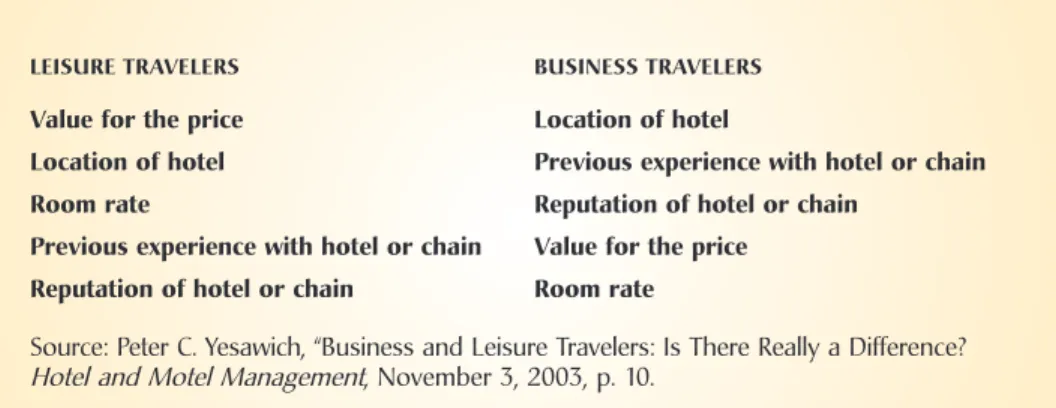
odging products are made up of both goods and services. By the term goods, we mean the tangible aspects of lodging, such as a lobby or a guest room. Services, however, involve guest interactions with staff or hotel facilities. Both goods and services are Figure 12.3Hotel/Resort selection factors—extremely/very influential in determining selection.
LEISURE TRAVELERS BUSINESS TRAVELERS
Value for the price Location of hotel
Location of hotel Previous experience with hotel or chain
Room rate Reputation of hotel or chain
Previous experience with hotel or chain Value for the price Reputation of hotel or chain Room rate
Source: Peter C. Yesawich, “Business and Leisure Travelers: Is There Really a Difference?
Hotel and Motel Management, November 3, 2003, p. 10.
crafted to meet the needs and preferences of particular target markets. At a very basic level, the industry is divided into properties that serve the “upstairs” guest and those that serve the “downstairs” guest.3
Upstairs guests are interested in what you find upstairs in a hotel, that is, guest rooms. They want comfortable, clean accommodations. This market is willing to give up extra services—that is, services that they don’t want—for a lower price. The success of the limited-service segment clearly indicates that there is a large upstairs market that focuses on just the basics in the guest room. Fairfield Inns, Comfort Inns, and Hampton Inns represent a midscale version of the upstairs market, while many all-suite properties represent a deluxe approach to the upstairs market, just as Motel 6 aims at the economy-minded. It is important to see how each focuses on guest preference in a different way.
The downstairs market, however, either needs the more extensive services of a full-service hotel or finds them desirable. Downstairs guests want the traditional lobby floor attractions of full-service hotels: dining rooms, cocktail lounges, meeting and banquet facilities, and the like. Downstairs guests are willing to pay for the additional services because they are necessary or because they can readily afford them. Gener- ally, we would include not only full-service transient hotels but also convention hotels, conference centers, and resort properties in the service-intensive downstairs segment.
One of the most basic service decisions involves food service. Another decision in- volves the level and kind of other services and amenities offered to the guest. We should note again that downstairs guests traveling on business during the week on an expense account may be upstairs guests seeking a lower price when traveling at their own expense on the weekend.
It is important to realize that the upstairs-downstairs segmentation represents basic strategies, active programs aimed at achieving customer patronage. The upstairs strategy reduces certain services to permit the property to operate profitably while offering the guest a superior guest room and a lower price. The downstairs strategy is more service-intensive and is aimed at a guest who is willing to pay for more service.
Another perspective regarding guest needs and expectations involves comparing leisure travelers to business travelers. The distinction between these two groups of guests is often stressed in the industry literature. Researchers regularly try to gauge what are the most important factors to each group as they travel and make hotel selections.
F O O D S E R V I C E
Hotels serving the upstairs market have chosen to eliminate or reduce drastically the food service available in the property. It is important, however, to realize that they have not ignored food service. Off-premise food service is almost invariably available
nearby, and basic guest needs—breakfast, for instance—are often met in the property.
Some examples of what we mean are described below.
L I M ITE D F O O D A N D B E V E R A G E. The practice of giving away a continental breakfast is certainly not new. It has been common in small hotels and inns for years. However, the advertised, standardized availability of a free breakfast—that is, one covered by the price of the room—has a special appeal. In the economy market, for instance, a con- tinental breakfast of juice, pastry, and coffee is generally all that is provided. In some all-suite properties, as well, a continental breakfast is the standard, but a number offer a full, cooked-to-order breakfast.
Many all-suite properties also provide a scaled-down on-premise restaurant, but very few offer substantial meeting and banquet facilities. Residence Inns has a grocery shopping service available to its guests, and Homewood Suites provides an on-premise convenience store. Because long-stay suites provide a full kitchen, they do not offer any food service beyond a complimentary breakfast. Among all-suite properties, then, Many hotels, such as Microtel Inns & Suites®, offer a free continental breakfast in pleasant surroundings.
(Courtesy Wyndham Hotel Group.)
there is not the uniformity in curtailment of food service that is found among most budget properties. In general, however, elimination or at least simplification of food service is the rule. The purpose is to meet the preferences of the upstairs guest while maintaining a competitive rate.
While limited food and beverage options are appropriate for many hotel guests, there are visitors that look forward to fine-dining experiences during their hotel stays or want the availability of room service or banquet facilities. Full-service hotels are going to be more appropriate for these guests who are, in most cases, willing to pay a higher room rate.
M A N A G I N G F O O D S E R V I C E. For full-service hotels, the option of discontinuing food service—or limiting it to breakfast—just won’t work. For lower-priced hotels, this option has been effective but has driven down margins. However, managing a food service operation presents many problems. Although growth in lodging food service is keeping pace with the food service industry growth overall—and as noted earlier—the overall profitability of the hotel restaurant is much less than that produced from room revenue.
This difference in profit generation is even more dramatic when capital costs and a fair share of undistributed operating expenses are allocated to the food service operation.
Operating a restaurant that is not very profitable or even losing money presents some real problems. The most obvious is a poor or negative return on investment, but this is really the least of the difficulties. More serious is the fact that an unsuccessful operation is always facing pressure to reduce costs, to cut the losses. There is a point, however, beyond which cost cutting impairs service and annoys or offends the guest, thus risking high-profit rooms revenue.
Even if the cost-cutting pressure is manageable, food service demands a great deal of attention from top management. When top managers in a hotel lack food service experience, it is difficult for them to supervise the skilled people they have hired to run the restaurant. Even where the general managers have the experience, they may feel their time and attention should be spent elsewhere.
Our discussion to this point makes a good case for turning the hotel’s restau- rant over to a company more expert in food service. The practice of outsourcing or leasing the restaurant to an outside food service operator has a long history in North America but is now being viewed in a new light. It is becoming particularly popular in small to midsize full-service operations and in all-suite hotels. Embassy Suites leases most of its restaurants, and because Embassy operates its own com- plimentary breakfast, basic services are assured for the rooms guests. Properties that have selected good operators generally have good results. Some hotels report having as much as doubled their food and beverage revenues after turning their restaurants over to a third party.
Product in a Segmented Market 397
Unfortunately, although leasing can solve some restaurant problems, there are some real disadvantages to leasing a hotel’s food service. The most fundamental prob- lem is that there are now two companies running major parts of the hotel, and each company has its own business objectives and priorities. In good times, the clash of interests is often not apparent. When business turns down, however, because of the restaurant’s higher variable cost structure, the restaurant company has to cut costs—
and services—to survive. However, this is just the point where the hotel needs its restaurant to be a service department if it is to be competitive. Maintaining service levels may benefit room sales—but there is no way for the restaurant to derive much benefit from the sale of a few more rooms. With this situation, it is no wonder that leased operations work out reasonably well until business goes through a bad patch, at which point disputes multiply.
R E D U C TI O N S I N F O O D S E R V I C E. Another option that hotels have at their disposal is simply to limit the food service options for their customers. For example, Marriott Courtyard (a 800-unit brand) offers a very limited food service program. When the company determined that, although it had strong breakfast and lunch sales, its din- ner business was minimal, it closed its restaurant at dinner and eventually for lunch, leaving the restaurant open for breakfast only. At one time this would have been an unthinkable reduction in service for a hotel, but with the great expansion in midprice and upscale dinner houses, there are undoubtedly plenty of restaurants in the imme- diate area of these hotels to fill their guests’ needs. Other hotels have since followed Marriott’s lead.
BRAND-NAME RESTAURANTS. At a minimum, the availability of some kind of food service in the immediate area is essential for most hotels that do not operate their own food service facilities. Probably the best-known company to rely on the on-site franchised restaurant is La Quinta Inns. This limited-service hotel chain, which has dedicated space for its complimentary breakfast, offers restaurant operators a build-to-suit leased res- taurant on the motel site. It has used this arrangement with several restaurant companies, including Denny’s, Cracker Barrel, Bob Evans Farms, Shoney’s, and Waffle House.4
Full-service hotels have begun to lease out their restaurants to franchisees of major food service chains. Alternatively, some hotel operators have become franchisees of these chains themselves. The names of chains now operating within a hotel, such as Denny’s, Pizza Hut, Bennigan’s, Applebee’s, and T.G.I. Friday’s, are well known to the traveling public and, as such, serve as a draw for the hotel. In addition, as franchisees, these operations receive field support and advice from the franchise organization that can help smooth out some of the rough spots.
L E A S E D S P E C I A LT Y R E STA U R A NT S. Upscale operators such as Hilton are generally not prepared to give up their basic food service operations. They have found, however, that leasing some space to a well-known brand-name operator not only will result in substantial revenue but will enhance the image of the hotel and act as a draw to rooms guests. One of the longest-standing examples of this tactic is Trader Vic’s, a Polynesian restaurant, which, after an initial success in Hilton’s Palmer House in Chicago, has gone on to lease and operate in other Hilton hotels, including the Beverly Hilton in California.
At the other end of the scale of complexity, Sheraton decided to improve its coffee sales and “jump on the bandwagon for recognizability” with its new long-term relationship with Starbucks Coffee. Sheraton is taking a two-tiered approach: Some hotels have run Starbucks outlets through licensing arrangements while other locations have a leased Starbucks. Starbucks outlets can also be found in numerous Marriott hotels. Starbucks Coffee Company and Marriott International, Inc. have a long-term licensing agreement for coffeehouse locations in select Marriott Hotels, Resorts, and Suites; Marriott Confer- ence Centers; and Renaissance Hotels, Resorts, and Suites properties.5
C O N V E NTI O N A L H OTE L R E STA U R A NT S. A single direction for hotels’ food services is by no means clear. Some hotel operators are finding that they can’t compete success- fully with local top-quality food service restaurants in attracting local trade and so are building smaller restaurants and reducing the number of food service outlets in the hotel from two or three to one. Some luxury hotels are opting for casual outlets rather than formal dining rooms. A growing number of hotels are opening European-style bistros and brasseries that combine a casual atmosphere with an upscale feel.
Upscale hotel companies such as Marriott and Hyatt, as well as luxury properties such as Four Seasons, continue to meet guest expectations for full service with a variety of restaurants in their properties, and these almost always include a top-of-the-line, luxury restaurant. The editor of Hotels put the case for hotel restaurants as follows:
Hotel companies such as Sheraton, Shangri-La, Kimpton Hotels, Disney, London’s Savoy Group and many others run successful restaurants and, in some cases, enormously successful banquet and catering departments. The potential residual effect of a well-run F&B department is increased occupancy—in some cases by as much as 33 percent—and support for your company’s quality image.6
It is true that food service has been greatly simplified in the economy segment that serves the upstairs market. It has frequently been deemphasized or leased out in some midscale properties. Nevertheless, in the downstairs market of convention, resort, and big-city luxury hotels, a successful food service operation continues to be absolutely essential.
R E STA U R A NT S A S A C O M P E TITI V E STR ATE GY. Hotel restaurants have historically not been profitable after all costs are considered. This difficulty arises because food service is one of a hotel’s service departments. The argument for devoting significant time and effort to food service, however, is fairly straightforward: In many markets, food service adds points to occupancy rates and secures local referrals. The resulting higher occupancies more than offset the lower profit on food service.
However (and perhaps as a result of their financial history), hotel food and bever- age departments have become much more profit-driven. After all of the restructuring, downsizing, reimaging, and outsourcing, there is evidence that suggests that food and beverage service has begun to contribute to a hotel’s profitability.
Properties serving the upstairs market have opted to offer limited services to guests—and, as a result, can offer attractive room rates. They know they can count on restaurants in their immediate area to supplement the complimentary services they offer in-house. In both cases—upstairs and downstairs—product, service, and resulting price are being crafted as a means to serve the guests’ needs and preferences and, thus, gain patronage in a highly competitive market.
OTH E R S E R V I C E S A N D A M E N ITI E S
Hotels use a wide range of services (other than food and beverage) to differentiate a property from its competitors. Differentiation can be achieved through distinctive physical plant features, upscale services, and other products as described below.
Upscale full-service hotels provide a variety of food and beverage options. (Courtesy of Caesars Atlantic City.)
TH E C O N C I E R G E A N D S U P E R F L O O R S. As we noted in Chapter 10, the basic func- tion of the concierge is to provide guest service and information. The crossed-keys symbol of the concierge is intended to convey a degree of expertise and knowledge significantly above that of the bell staff. The concierge knows the right restaurants and the best shows, and can probably get reservations or tickets if they are required. In many ways, the concierge acts as a friend to the stranger, giving service and rendering that
“extra” in service that makes a stay a distinctive experience in hospitality.
Many hotels have added a concierge to the lobby staff, whereas a number of com- panies associate the concierge closely or exclusively with their special areas, often restricted only to guests staying on floors such as executive floors and tower suites.
On these floors, special lounges and other services are commonly provided. Luxury hotels, such as the Four Seasons or Dallas’s Mansion at Turtle Creek, offer substantially the same services as those available on the executive floors, but to all their guests.
At the other extreme, limited-service operators, particularly in the economy and budget segments, have pared extras to the bone. As one well-known economy chain’s advertis- ing put it, “We don’t have it because you don’t want it.”
F ITN E S S FA C I L ITI E S. Fitness has become a major concern for many North Ameri- cans. It is not surprising, therefore, that fitness facilities of some kind have become fairly standard in most hotels. Some provision for fitness is commonly found even in economy hotels. One of the latest trends in this area is hotels providing fitness equip- ment that can be actually used in the guest room. Some hotels, like Hilton Hotels, are investing in portable equipment, such as StairMasters and treadmills, that can be easily brought to the guest room for private and flexible workout regimes.
Fitness facilities, such as these at the Days Inn® hotel, are increasingly in demand by travelers. (Courtesy Wyndham Hotel Group.)
Product in a Segmented Market 401
S PA P R O G R A M S. Tremendous growth has occurred in spa facilities, which are no longer limited just to resort properties. Hyatt, Fairmont, Four Seasons, and Ritz-Carlton hotel companies have urban spas catering to the needs of business travelers. These companies have found that business guests, needing relief from travel-related stress, have little price resistance. Both men and women relate the spa visits to increased per- formance whether related to helping mitigate jet lag, getting better rest during the stay, relieving stress, or overall just being more productive. The hotels have found that when the spa services get results, the fees are typically not an issue. Hotels with urban spas have found scheduling important to meet the demands of busy travelers, with many facilities open from early morning to late evening hours.7
B U S I N E S S C E NTE R S. Even with guest rooms equipped in many properties like mini office suites, business travelers expect and use business centers, particularly in full- service hotels. Although most business travelers are equipped with their own laptop computers, some business and leisure travelers may need the computer access typically found in a hotel’s business center. For other guests, the guest room Internet access and printer and/or fax machine may not be sufficient to handle larger projects. In such cases, a business center like the one found at the Marriott World Center in Orlando, Florida, is vital, with computers and copying equipment for large-scale jobs, faxes, secretarial support, and even a bindery for books. In Seoul, South Korea, the Radisson Hotel has a business center with two conference rooms, workstations, Internet hookups, audiovisual equipment, secretarial and translation services, courier and shipping services, and busi- ness card printing services. Even economy motels make business services available, but typically with limited, self-serve options. Business travelers are on the road frequently and are potential repeat guests. It makes sense to cater to their needs in order to gain their regular patronage.
S E R V I C E. Another differentiator that is very difficult to copy is excellence in service across the board, in all departments. In this connection, it is interesting to note that it was limited-service chains that led the way with the 100 percent satisfaction guarantee.
The guarantee, in turn, is based on an operating strategy of empowerment, that is, of giv- ing employees the discretion to take care of the guests’ needs or problems right away.
The result has been very high consumer satisfaction ratings and a more motivated workforce. Reportedly, the guarantee itself costs very little (0.3 percent of sales), and fulfill- ing it gains much more favorable public relations and word of mouth than could be purchased for such a modest cost.8 The degree to which service guarantees have been widely adopted, however, suggests that at least the statement of a guarantee is not dif- ficult to copy. The development of a company culture that is really capable of fulfilling the promise of the guarantee, however, is something that cannot be easily duplicated.
A S S E S S I N G S E R V I C E S A N D A M E N ITI E S. As a competitive tactic, what stands out is the ease with which many of the services and amenities we have been discussing can be copied. The first hotel in a city that put in a television set undoubtedly had an advantage—but not for long. In addition, shampoo—once rarely seen in a hotel room—has now become commonplace. Indeed, in regard to personal-care amenities, it is becoming necessary to have them just to avoid damaging the property’s reputation, but it is difficult to see them as offering any lasting competitive advantage. Similarly, exercise facilities are an easily duplicated service. However, finding or training a good concierge is almost as difficult as providing memorable food service. Again, food ser- vice is very difficult to do well, and its very complexity ensures that it will not be easy to copy. Although some property types may be able to dispense with food service and rely on restaurants in their neighborhood, it seems likely that they will have greater dif- ficulty in differentiating themselves from their competitors, especially as the number of properties multiplies and properties age. Industry Practice Note 12.1 illustrates one of the many forms of recognition given to hotels in highlighting their services and amenities.
SYSTE M W I D E S E R V I C E S
In franchise organizations, the franchisor is responsible for the design of the basic busi- ness system. A successful franchise will be designed to provide the services its target markets seek. Moreover, routine services such as those provided by property manage- ment systems will ensure error-free operation of functions including accounting, billing, and credit, which are important to the guest. Thus, the franchisor is responsible for establishing a mode of operations that is professional and leaves the guest feeling that he or she is in secure hands. This enhances the guest’s experience.
Wingate by Wyndham® and other chains provide business centers for their guests.
(Courtesy Wyndham Hotel Group.)
Franchising provides a brand with a means to move relatively quickly into many geographic markets. Although franchising is well established in the United States, it is still a fairly new business practice overseas, where conditions for franchising vary from one region to another.
The maintenance of quality in operations is a property-level responsibility, but quality assurance through inspection systems is a vital function of the franchisor.
You can maintain your property, but your reputation is really in the hands of all your fellow franchisees. Establishing an acceptable level of quality, ensuring that quality through frequent inspections, and providing assistance when a problem persists are all important activities of the franchisor, as is the encouragement of high operating standards. Some franchisors award ratings somewhat like the Forbes star rating sys- tem and publish those ratings in their directories. They also encourage franchisees to publicize their ratings in their advertising. Franchisors arrange for mentoring staff
I N D U S T R Y P R A C T I C E N O T E 1 2 . 1
Hotels Honored among World Business Hotels
In addition to hotel rating services such as Forbes and AAA, hotels can be recognized by professional associations and trade publications. One such publication is Institutional Investor, a trade publication that conducts an annual survey of frequent-traveling top executive officers regarding their travel experiences.
The survey measures room quality, service, dining, location, and overall design. Topping the 2008 survey of the world’s best hotels is the Bristol Hotel in Paris, which finished just ahead of the Park Hyatt Tokyo and Adlon Kempinski Berlin.
The Top Ten
RANK HOTEL/CITY
1 Bristol, Paris
2 Park Hyatt, Tokyo
3 Adlon Kempinski, Berlin
4 Four Seasons, Hong Kong
5 Ritz-Carlton, Battery Park, New York
6 Four Seasons, New York
7 Ritz-Carlton (Four Seasons), Chicago
8 Park Hyatt Paris—Vendôme, Paris
9 Claridge’s, London
10 Ciragan Palace, Kempinski, Istanbul
Source: Institutional Investor, December 3, 2009, www.iimagazine.com, December 3, 2009.
of properties that are experiencing quality problems by teams from more successful franchise members. Another important service rendered by the franchise or chain organization is a national or, more commonly, international reservation service. This topic is discussed in a later section.
An important aspect of product involves the brand name of the hotel. Brand is thought of as an aspect of product because it affects the consumer’s perception of the product. When you see a sign that says Motel 6, Hampton Inn, or Hilton, you undoubt- edly have different images before you set foot in the property. We will be concerned with brands again when we discuss advertising.
Brand names are not inexpensive. PKF Hospitality Research found franchising fees to average 6.1 percent of total revenues. There was variation, however, in franchis- ing fees based on the type of hotel. Suite hotels franchise fees averaged 9.2 percent whereas resorts averaged 4.4 percent.9 Figure 12.4 shows franchise fees as a percentage of total revenue for hotel companies based on category. Typical franchise fees include the initial fee, royalties, marketing contributions, reservations fees, loyalty-program expenses, and other applicable charges. Selecting a brand is a major decision of the property’s owners. According to one source, a major determinant in the selection pro- cess should be the central reservation contribution. A reasonable expectation is that central reservations will contribute from 15 percent to 20 percent of occupancy. Other items that an owner should analyze are how marketing dollars are spent, the availability of regional marketing support groups, stringency of quality standards, effectiveness of customer satisfaction scores, and frequency of property visits from sales and marketing staff and operations consultants. Industry Practice Note 12.2 discusses changes that are occurring between franchisors and franchisees.
Figure 12.4
Franchise fees (including marketing fees).
PROPERTY TYPE
RATIOS BASED ON TOTAL REVENUES
PER AVAILABLE ROOM PER YEAR
All Hotels 6.1% $2,448
Full Service 6.7% $2,672
Limited service 5.8% $1,145
Resort hotels 4.4% $2,490
Suite hotels 9.2% $3,365
Convention hotels 4.5% $2,307
I N D U S T R Y P R A C T I C E N O T E 1 2 . 2
Franchisors-Franchisees: A Growing Team Approach
The relationship between the franchisor and franchisee has not always been harmonious in many industry segments, including hospitality. There are several examples in the hotel industry of how franchisors and franchisees are starting to work as a team for the mutual benefit of both parties.
For example, historically, franchise fees have been set in stone by the franchisors, with no flexible relief allowed for franchisees. Vagabond Franchise System offers royalty and marketing fees that start at 3 percent for the first year and increase to 3.5 percent by year two and 4 percent by the third year and following years. The graduated fee structure acknowledges that a franchised hotel typically is not an instant success. The new hotel starts a process of building clientele by becoming known by the traveling public. The money saved in a cheaper royalty fee can be utilized for local marketing efforts in helping to build the business.
WestCoast Hospitality Corporation may offer one of the industry’s most flexible systems, with the roy- alty fee ranging from 2 percent to 4 percent of room revenue. WestCoast franchises the Red Lion brand.
The sliding scale system for Red Lion franchisees is based on the amount of room revenue contributed by the company’s central reservation system. If the central reservation system (CRS) contributes as much as 19.9 percent of the property’s room revenue, there is a 2 percent royalty charge. If the revenue ranges from 20 percent to 24.9 percent, the royalty fee goes up to 3 percent and 4 percent if more than 25 percent of the room revenue is generated through the CRS. WestCoast also provides windows in which the franchisee can terminate the franchise agreement without paying any fees if the franchisor’s contri- bution doesn’t exceed 15 percent of the hotel’s total revenue during the prior 12 months. According to executives with the franchisor WestCoast Hospitality, their approach focuses on the franchisor working for their money. One stated, “If we deliver reservations, franchisees will not want to leave. If we don’t deliver, they have the right to leave.”
WestCoast is not alone in its commitment to franchisor performance. Baymont Inns and Suites has performance benchmarks in the brand’s franchise agreements. If the benchmarks are not met, there is a sliding scale for fees. If the franchisor is not producing over a period of time, the franchisee can leave for no charge.
Another growing trend is the areas of protection that are increasingly being written into franchise agreements. A typical concern among hotel operators is the competition with another hotel under the same flag or with hotels in the same family of brands within a company. Franchisors are starting to commit to observing established zones around franchised hotels in which they will not license other hotel properties.
Sources: Bruce Adams, “Fee Structures under Microscope: Reservations, Years in Franchise System Can Determine Royalty-Fee Percentage,” Hotel & Motel Management, May 19, 2003, p. 1; Tony Dela Cruz, “Sliding Fee Scales, Areas of Protection Promote Fair Franchising,” Hotel & Motel Management, May 19, 2003, p. 24.
P R I C E A N D P R I C I N G TA C TI C S
S
ome would say that the goal of price is to maximize profit—and that may be the intention of many who set prices. However, in anything but the short term, the very competitive hotel market restrains price gouging. There is also a lower limit on rates, which is set by cost—the cost of the property (capital cost), the cost of operating the property, and a reasonable return for ownership. Otherwise, the hotel will go out of busi- ness. Thus, we can say that upper and lower boundaries for price are set by competition in the market and cost.With a low variable cost—say, $10 to rent one more room—and plenty of margin between that variable cost and a selling price of, say, $75, the decision to discount is not difficult. Add to that the fact that there are fixed costs (payroll for a minimum crew size, fixed overhead costs, a mortgage and interest or rent) that must be met to keep the doors open. Pricing is also subject to the fact that unsold rooms have no value the next day; that is, there is no inventory. As a result, during slow periods, whether a recession or just an off-season, there is a tendency toward discounting when demand is slack.
In times of peak demand, however, prices tend to be at their maximum. Pricing is subject to the pressure of limited capacity—there are only so many rooms that can be sold on any given night, so when demand is expected to be very high, there is very little give in rates. Limited capacity supports and raises price in good times.
Under these circumstances, there is a natural tendency for hotel prices to vary with demand: discounted during slow periods but at their upper limits when demand
Location is a critical factor in the success of a hotel, inn, or resort. (Courtesy of Four Seasons Hotels.)
Price and Pricing Tactics 407
is strong. However, hotels can’t afford to drift at the mercy of these short-run currents.
Hotel pricing, in practice, is proactive; that is, pricing, like other elements of the market- ing mix, should be used to attract customers’ long-run patronage, not just to generate revenue for the short run. If a convention will bring in 1,000 room nights (three days for 330 people), it may make sense to rent rooms with a regular rate of $175 for $165 to convention attendees in order to get the convention, especially considering the food and beverage, meeting room rental, and other spending such a large group will bring to the property. If there is logic to reducing rates in order to attract a convention, a similar process of reasoning can be used to set a special corporate rate for companies that will use, say, 1,000 room nights a year. The principle is that of a discount for a large-volume sale.
The regular rates may be too high for some types of customers who can’t afford full rates or who have a low level of reimbursement: clergy, government employees and military personnel, sports teams, and academics. These market segments might never consider the hotel if all that was available was the regular rate. Recall that a hotel has busy periods but also slow periods, and it becomes clear that these groups of people, even at reduced rates, can add significantly to profit as customers during a slow weekend or offseason period. The alternative is to have the rooms stand empty, yielding no revenue.
We could add to the list of special cases, but this should be enough to suggest why price is not some fixed figure but one that varies with conditions and with the customers being served. The question does arise, however, as to when special rates should be honored. Simple logic suggests that during very slow periods, a hotel might be glad to have all the special cases described previously, even at rates discounted 25 to 50 percent. However, a hotel is not interested in selling a $175 room for $95.50 during a period when the hotel is certain to be full. In between peaks and valleys in demand, there are times when the rates that should be charged are not quite so clear and may have to be decided on a day-by-day basis. To deal with this set of issues, the tool of yield management was adapted from a similar practice developed by the airlines.
YI E L D M A N A G E M E NT
No discussion of pricing is complete without mentioning yield management, a con- cept that is often misunderstood even by those who practice it. One researcher defines yield management as follows:
Yield Management is a method that can help a firm sell the right unit to the right customer at the right time and for the right price. It guides the decision of how to allocate undifferentiated units of limited capacity to available demand
in a way that maximizes profit or revenue. The question is, how much should one sell at what price and to which market segment.10
The process of developing a yield management system begins with a study of room demand in a property over a period of some years. Based on this history, regular patterns of slow and peak periods—and those in between—are identified, and, via dedicated software, the information is modeled so as to give a theoretical forecast of demand. Managers then begin to plan their pricing tactics based on history and a forecast of actual expected events. The following conversation might take place during a hotel’s planning session:
Week A is theoretically a busy week, but that’s because that’s when the Interga- lactic Homebrewer’s Association meeting is held. Since that piece of business has moved to another city, we’d better open up the special rate categories or we’ll be in real trouble. On the other hand, week B has usually been slow, but this year we have the World’s Best Bicycle Show and so we’ll be full. Let’s close out all special rates except to our best corporate accounts.
Yield management, then, is based on combining a history of room demand with a current forecast for demand. Normally, forecasts are made for a period of a year but reviewed quarterly, monthly, weekly, and, finally, daily. As demand shifts, apparent slow periods heat up, and forecasted busy days turn soft. Throughout this period, the rates are adjusted up and down to try to maximize revenue. Most hotels use proprietary software to manage yields, and, indeed, many central res- ervation systems have a yield management function built into their programs for each property served.
TH E P R O B L E M S O F YI E L D M A N A G E M E NT. Although yield management helps solve recurrent problems regarding day-to-day rate variations, its implementation presents some serious problems. From the customer’s point of view, pricing may appear arbitrary and unfair. Guest A visiting with Guest B in the lobby may discover that the two of them have identical rooms but quite different rates. The rate listed in a chain’s directory (often called the rack rate) may be charged to only a few unknowing customers.
Rate differentials, during the same time period and for the same room type, are due to a number of reasons as delineated below:
• The guest may have a group rate because of attending a conference, convention, or social event at or nearby the hotel.
• The guest may have a corporate or governmental special rate.
Price and Pricing Tactics 409
• The room was reserved at a different point in time—perhaps before room demand escalated (then the rate would likely be lower) or after the room demand escalated (resulting in a higher room rate).
• The rate is part of a package perhaps with an airline ticket, rental car, or event tickets included.
• The guest is staying for a longer period of time and subsequently received a lower rate.
• Increasingly, the consumer (i.e., guest) shopped on the Internet between hotel distributors such as Travelocity.com or Expedia.com and the hotel’s own Web site and found a discounted room rate.
There is no question that extensive discounting has taken place in the lodging industry. Discounting, as related to the impact of the Internet, is explored more in the next section. Whatever public perception there may be of inconsistent discounts, the pressures on managers to maximize revenue based on yield management are here to stay. One researcher suggests four ground rules for practicing yield management in ways that are more acceptable to guests:
1. Disclosure of the rate structure and the concessions offered should be available to customers. “For example, a hotel can advertise the various rates available and the restrictions or benefits associated with each of these rates.”
2. Cancellation restrictions can be offered along with a reduced rate so as to match the customer’s benefit with one for the hotel. “For example, Marriott offers a sub- stantially lower price for advance purchases.”
3. Other reasonable restrictions such as a minimum length of stay may be offered in exchange for a favorable rate.
4. Different prices are offered for products that are perceived to be different. A room with a view or one on an “executive” floor may carry a higher price; lower prices are seen as fair where these guarantees are not required.11
Another area of problems for yield management lies in staff training. If a customer stayed in a hotel for $75 last time and asks for the same rate, a well-trained reservation- ist can explain that that category of rooms is sold out. An untrained (or disgruntled) reservationist might respond instead, “Sorry, we’re almost full, so we’re only selling at our maximum rate.”
The reservationist and desk clerk’s jobs are to try to “sell up”—to get the highest rate possible. Today’s varying rate structures are complicated, however, and a poorly trained reservationist who does not know the twists and turns of special rates may end up having them explained to him or her by a regular guest. Once the guest is in control of the transaction, minimum rate and maximum upgrade are the most likely outcome.
P L A C E—A N D P L A C E S
L O C ATI O N
L
ocation is a widely recognized factor in the success of a hotel. Ideal hotel locations have long been at the center of travel networks and near destinations.Airport hotels and roadside hotels come to mind immediately. Downtown hotels were once located downtown because they were near the railroad station, then the hub of the principal means of transportation. Today, locations of downtown hotels are advantageous because they are close to the business and cultural destinations their guests come to visit.
The decision to build a specific hotel in a particular location is generally based on a feasibility study. The contents of a feasibility study are outlined in Figure 12.5. The location of an individual hotel is of vital importance to that property for the present and future. A feasibility study, therefore, must incorporate confirmed, tentative, and speculative plans for an area or city that could impact a hotel’s location.
D I STR I B UTI O N C H A N N E L S
There are a number of ways that connections are made between hotel rooms and prospective guests. Collectively, these “conduits” between potential guests and the hotel rooms awaiting their arrival are called distribution channels. The businesses and other entities that are active in the distribution channels are referred to as channel members. These entities include hotel chains, franchise systems, and referral (member- ship) services, as well as hotel sales and representation companies such as Utell. It is
Many American franchise operators have a presence overseas. (Radisson St. Thomas Mount [Chennai, India]; Courtesy of Carlson Hotels Worldwide.)
Place—and Places 411
rare that a hotel can fill its rooms from just one distribution channel. Each channel has a cost associated with it along with a rate structure that each channel delivers in selling the property’s rooms.
The changing dynamics of distribution channels is described in Industry Practice Note 12.3. Travel agents are channel members, as are other agencies that make travel arrangements, such as travel wholesalers and incentive houses. The latter put together packages to be used by companies to reward their employees and dealers for outstand- ing performance. Although individual hotels are channel members and can influence other channel members to gain sales, the franchisor (or chain headquarters) takes the heaviest responsibility for determining and maintaining the group’s relationship with the other channel members.
Hotel chains and franchise organizations maintain national and regional sales offices and provide central reservation services to hotels that are part of their system.
One group of franchises, owned by Choice Hotels, manages the nine different franchise brands shown in Figure 12.6. Providing an international central reservation system for hotels is one of the most important services a franchisor can provide to its franchise properties.
Figure 12.5
Contents of a feasibility study.
Site location Relative to transportation systems and destinations Demand analysis Demand in immediate areas as well as in the wider
(i.e., city- or areawide) community
Market characteristics Trends in demographic and economic conditions;
used to support demand projections Analysis of the competition 1. Quality of competitive operators
2. Number of competitive units relative to present and projected demand
3. Outlook for new competition
Financial analysis 1. Projection of occupancy, average rate, total income, and expense
2. Commentary on feasibility of the project
Source: Adapted from S. Pyo, H. Chang, & K. Chon, “Considerations of Management Objectives by Target Markets in Hotel Feasibility Studies, “ International Journal of Hospitality Management, Volume 14, June 1995, pp. 151-156. www.sciencedirect.com/science?_ob⫽ArticleURL&_udi⫽B6VBH-3Y45T3X-R&_
user⫽7810834&_coverDate⫽06%2F30%2F1995&_rdoc⫽1&_fmt⫽high&_orig⫽search&_origin⫽search&_
sort⫽d&_docanchor⫽&view⫽c&_searchStrId⫽1476167466&_rerunOrigin⫽google&_acct⫽C000011439&_
version⫽1&_urlVersion⫽0&_userid57810834&md⫽ee9fc1d0fbf52723a97af925fb388d9a&searchtype⫽a.
Travel agents have long played an important role in selling hotel rooms. Travel agency business has been severely affected by individuals’ increased use of the Internet to make their own travel arrangements. Many travel agencies have there- fore moved into specialization niches, such as working with corporate travel (approxi- mately 71 percent of their business), exotic travel, or particularly upscale or luxury
Travel Intermediaries: Utell Hotels and Resorts
In 1926, Henry Utell—founder of Utell Hotels and Resorts—was a journalist in Vienna who started one of the first newspaper travel sections. After immigrating to the United States in 1930, he realized the need among those crossing the Atlantic for a knowledgable agent to arrange accommodations. He began to serve in this role by sending letters to European hotels on behalf of his clients, essentially connecting the guest with the hotel.
Fast forward to 1994, when the very first online hotel reservation was made using technology cre- ated by Utell Hotels & Resorts’ owner, Pegasus Solutions, based in Dallas, Texas. Pegasus was named as one of the 500 fastest-growing U.S. companies and in 2006 was acclaimed as the World’s Leading Travel Distribution Service at the World Travel Awards.
Today, Utell Hotels & Resorts operates in every part of the world and provides fast and reliable reserva- tions for clients online, via travel agents, or over the telephone. Throughout all its many changes, which its founder could not have even predicted, Utell continues connecting guests with hotels. The reach of the parent company, Pegasus Solutions, is even greater. Pegasus serves the 10 largest U.S.-based travel agencies, 8 of the top 10 agencies in the United Kingdom, more than 86,000 hotel properties around the globe, and more than half of the 50 largest hotel companies in the world. More than 1,000 Web sites and services have their hotel reservations powered by Pegasus.
Source: www.utell.com and www.pegs.com.
CHOICE HOTELS INTERNATIONAL
Ascend Collection Mainstay Suites
Cambria Suites Quality Inn
Clarion Roadway Inns
Comfort Inn Sleep Inn
Comfort Suites Suburban
Econolodge
Figure 12.6
Different franchise brands owned by Choice Hotels.
Place—and Places 413
trip planning. There has been a huge increase in the number of online travel agencies (OTA).12
Another group of channel members is the airline central reservation system (CRS).
When making travel arrangements, an airline, via telephone, in person, or on the Internet, can offer to place customers’ room reservations for them as well. The large car rental companies and virtually all travel agents are also interfaced to one or more of the airline CRSs. A moment’s reflection suggests how many “virtual front desks” have been added to the hotel industry, not only through airline reservation systems but through all the other agencies interfaced to the airline systems. A study conducted by J.D.
Power and Associates, a global marketing information services firm, found that twice as many people book reservations directly with the airline, hotel, or rental agency Web site rather than the independent online agencies such as Hotwire, Expedia, or Hotels .com. According to the study, the main reason these branded Web sites are preferred has to do with convenience. When hotel reservations are made through an airline or car rental site, this service to the hotel is not free. Commissions are required for hotel reservations made through airline and other travel companies in very much the same way that they are for travel agents.13
The growth in channels of distribution has the favorable effect for hotels of in- creasing distribution—the number of places their product is sold. Channels, however, usually add marketing costs for the hotel and also another dimension to competition, putting added pressure on hotel prices. One factor that makes the Internet appear so very attractive to hotel operators is that it offers the chance to minimize the payment of fees to travel intermediaries.
The Internet is being used by hotels and customers for much more than individual travel. For example, Passkey is a Web-based booking product that includes online capability to create multiple attendee types and room blocks—two features that are very attractive to meeting planners. Large hotels and resorts, such as the Wynn Las Vegas, use MeetingBroker to manage hundreds of leads they receive each week from various channels. MeetingBroker is an Internet-based exchange lead management solution capable of capturing and integrating leads for hotel business from a variety of sources.14
More follows on the impact of the Internet and the various forms of Internet-related distribution channels.
INTERNET DISTRIBUTION CHANNELS. There are several different types of electronic business-to-consumer distribution channels for hotel rooms. One form is a chain’s own Web site. As described above, many chains have added the capability to market and book not only guest rooms but also banquets and other catered functions, meetings, and conferences. This distribution channel provides the hotel company an invaluable,
multimedia marketing tool if the business wants to invest the time, money, and mainte- nance of the Web site. The Internet contributed 40 percent, or 8,581,936 reservations, of the total Central Reservation Office (CRO) reservations at major hotel brands as of the third quarter in 2006. More recently, brand Web sites—those hosted by the individual hotel brand—were the source of more than 80 percent of all centrally booked Internet reservations.
There are also channels that utilize data and the reservation engine from the Global Distribution System (GDS). Examples of such companies are Expedia and Travelocity. An additional electronic channel is a company such as WorldRes, which is a Web-based channel with an inventory and reservation database maintained online. Last, there are the auction-style Web sites, such as Priceline.com, in which people try to get hotel rooms with the lowest bids. For the third quarter of 2006, the importance of GDS commerce was evident with 22.8 percent coming through those channels.15
TH E I M PA C T O F TH E I NTE R N E T. The impact of the Internet on the hotel industry, as well as on other facets of the broader travel industry, has been revolutionary. Half of all travelers buy travel online and even more go online to research travel plans.
PhoCusWright, a market research firm, reported that as of 2009, online leisure and business travel outperformed every other distribution channel. Moreover, it is likely that the majority of all bookings will occur through the Internet in the very near future.16
One study found that competitive pricing was the key motivating factor that encouraged consumers to purchase travel online. The pricing advantage outweighed the additional benefits of saving time, getting bonus loyalty club points, having more control, or obtaining better information. Third-party sites are increasingly used for hotel rate shopping prior to consumers booking directly on hotel Web sites. The response from hotel chains has been to withhold inventory from the online travel sites as well as to feature cheaper rates on their own Web sites. Independent hotels have benefited from the Internet as well. Customers can inspect the rooms and get information on the unfamiliar independent hotel’s services through the property’s Web site. These hotels subsequently can compete in ways that they could not prior to this technology.17
The Internet’s impact on hotel pricing is even more widespread in altering hotel group revenue and presenting challenges for meeting and convention planners. The traditional process has been for a hotel to “block,” or reserve, a number of guest rooms for a particular group. A specified rate is provided as the “group room rate.”
Oftentimes, room rates, along with the number of rooms to be reserved, are decided