CHAPTER 5
Competitor analysis and intelligence
LEARNING OBJECTIVES
After studying this chapter you should be able to:
integrate competition into an environmental analysis
discuss competition and competitors at different levels:
— budget competition
— core benefit competition
— product class competition
— brand competition
specify the levels in competitor awareness
describe how to design a competitor intelligence (CI) system
evaluate the information sources for CI
specify the contents of a competitor audit
evaluate the strengths and weaknesses of competitors
assess current strategies of main competitors
give examples of how to evaluate the strengths and weaknesses of competitors
assess current strategies of main competitors
outline possible response patterns of main competitors
5.1 INTRODUCTION
Most often competitive intelligenceis used to mean the action of gathering analysing and distributing information about products, customers, competitors and any aspect of the envir- onment needed to support executives and managers in making strategic marketing decisions for an organisation.Competitor intelligence (CI)is a more narrow term, as it only focuses on the competitor aspect.
Except for a minor section dealing with interaction between competitors (section 5.3) this chapter is mainly about how to analyse competitors, their behaviour and their strategies. A more comprehensive analysis of competitor relationships is given in Chapter 6 (section 6.6).
Competitor intelligence is the publicly available information and other types of infor- mation on competitors, current and potential, that is an important input in formulating a marketing strategy. Managers at all levels in organisations should conduct competitive in- telligence scanning to monitor market variables that are continuously shifting. To sustain competitive position, managers must prepare to respond quickly to changes in customer preferences, competitor strategies and technological advancements (Qiu, 2008; Dishman and Calof, 2008).
However, no general would order an army to march without first fully knowing the enemy’s position and intentions. Similarly, before deciding which competitive moves to make, a firm must be aware of the perspectives of its competitors. CI includes information beyond industry statistics and trade gossip. It involves the close observation of competitors to learn what they do best and why and where they are weak.
In most Western countries the development has resulted in a major intensification of com- petitor intelligence. The reasons for increasing CI are:
increasing competition between companies;
deregulation;
liberalisation;
globalisation;
periods of economic recession;
reduced product and service differentiation.
Factors inhibiting the growth of CI include:
data protection;
different legislation from country to country;
fear that competitive intelligence is unethical;
fear of counter-intelligence;
failure of competitive strategies to yield the expected gain.
The use of CI is increasing gradually. There is growing awareness of the need to have a com- petitor strategy, which is every bit as important as the customer strategies that are already commonplace (West, 1999).
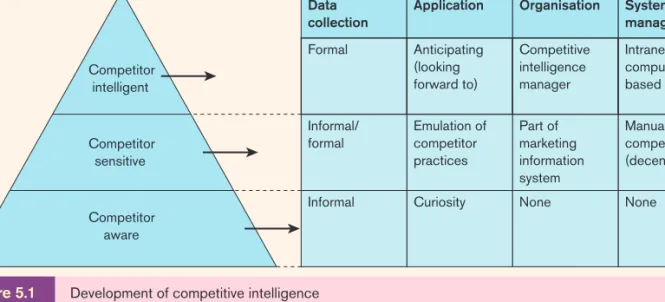
In terms of their use of CI, companies seem to go through a series of stages (see Figure 5.1).
At the first stage is competitor awareness. This stage is entered soon after a company is formed, or even before, when the start-up is being planned. Being competitor aware means that the key competitors are known and that there is some knowledge – usually incomplete and certainly unverified – about their products, their prices, the clients they have succeeded in winning business from, the market sectors they service and the staff they employ.
The organisation that is competitor aware rarely uses the data that it holds other than for occasional ad hoc tactical exercises, such as competitive pricing decisions, or as an input to a business plan that has to be submitted to an external organisation, such as a bank.
Competitive intelligence
Gathering, analysing and distributing information about products, cus- tomers, competitors and any aspect of the envi- ronment needed to sup- port executives and managers in making strategic marketing deci- sions for an organization Competitor
intelligence (CI) The process of identify- ing key competitors; as- sessing their objectives, strategies, strengths and weaknesses, and reac- tion patterns; and select- ing which competitors to attack or avoid. This analysis provides both an offensive and defensive strategic context through which to identify oppor- tunities and threats.
As companies grow they tend to become competitor sensitive, both in terms of their awareness of the damage competitors can inflict on their business and the need to win orders by competing more effectively. Unfortunately, being competitor sensitive does not always in- crease the demand for information on competitors. An alarming proportion of competitor sensitive companies continue to rely exclusively on informal information flows from their salesforces, business contacts and the trade press, rather than from a structured intelligence programme. When they do use sources other than the informal information channels the prime motive is usually emulation. They seek to copy what they perceive to be the best of their competitors’ practices. There is nothing wrong with emulation as a business process, providing it is factually driven using such techniques as reverse engineering and competitor benchmarking, but it represents a very limited source of data that can be derived about com- petitors’ activities.
The organisation that is competitor intelligent is one that devotes serious resources to studying its competitors and anticipating their actions. This includes identifying competitors’
physical and intangible resources; studying their organisations and their methods in as much detail as possible; and developing knowledge of their strategies and potential plans. The com- petitor intelligent organisation is continuously aware of the threats posed by competitors, the nature and seriousness of those threats and what needs to be done to counteract them. They recognise the need to look forward to anticipate competitive actions and to predict the likely responses to actions they are proposing to take themselves. They are also aware that the most serious threats may arise from companies that are not yet active in their business sector.
There is a close parallel between the growth in competitor analysis, and the development of customer analysis. There was a time when organisations were only customer aware. Interest in competitive strategy was nurtured by the publication of books such as Michael Porter’s Competitive Advantageand Competitive Strategy in the 1980s. This was accompanied by a short flirtation with marketing warfare that focused on beating the competition by adopting military tactics.
Competition is good for customers as it means that companies have to try harder or lose their customer base. In many markets competition is the driving force of change. Without competition, companies only satisfy: they provide satisfactory levels of customer value (satis- faction) but fail to excel. The conflict between improving customer value and costs is illus- trated by the competitive triangle (Figure 5.2).
Intranet/
computer based systems
Manual competitor files (decentralised)
None Competitive
intelligence manager
Part of marketing information system None Anticipating
(looking forward to)
Emulation of competitor practices
Curiosity Formal
Informal/
formal
Informal
Systems for managing Organisation
Application Data
collection
Characteristics of the three stages of competitive development
Competitor intelligent
Competitor sensitive
Competitor aware
Stages of competitive development
Figure 5.1 Development of competitive intelligence
Source: Adapted from West, C. (1999) Competitive intelligence in Europe, Business Information Review, 16(3) (September):
143–50. Copyright © 1999 Sage. Reproduced with permission of Sage Publications and C. West.
Competitor analysis The process of identify- ing key competitors; as- sessing their objectives, strategies, strengths and weaknesses, and reac- tion patterns; and select- ing which competitors to attack or avoid. This analysis provides both an offensive and defensive strategic context through which to identify oppor- tunities and threats.
This framework recognises that for example, for firm A to be a winner in the competition, it is no longer sufficient to be good at satisfying customers’ needs (producing customer value).
Companies also have to produce at a lower cost than other competitors (here competitor B).
This is called lower relative costs.
When developing a marketing strategy (Chapter 7), companies need to be aware of their own strengths (S) and weaknesses (W), customer needs (O, opportunities) and the competi- tors (T, threats). Altogether these four elements represent the SWOT analysis, which in Chapter 7 will be used as a basis for developing the firm’s marketing strategy. The focus of this chapter will be on analysing competitors at the strategic and tactical level.
Strategic intelligencelooks to the future and allows an organisation to make informed de- cisions concerning future conditions in the marketplace and/or industry.Tactical intelligence looks at the present. This level of intelligence provides decision makers with the information necessary to monitor changes in the company’s current environment and helps them search for new opportunities. To maximise the potential benefit of CI, the strategic and tactical lev- els must be coordinated. Because all the partner companies identified coordination as a high priority, these businesses create, continuously improve and use CI systems, processes and products that enable this to happen. Moreover, all of these companies believe that coord- inating strategic and tactical intelligence with sales and marketing has led to a strengthening in competitive positions as well as increases in customer satisfaction and retention.
Competitive analysis flows out of customer analysis. To truly know how you compare with your competitors, you first need to understand your customers’ wants and needs. Then you must identify both current and potential competitors in both your served and unserved mar- kets. Industry analysis is also important. You need to know about the suppliers to your indus- try as well as the channels which serve as intermediaries between you and your competitors and the end users. These players have an impact on your competitive position. Once you have identified your competitors, it may be possible to group them by factors, such as degree of specialisation or degree of globalisation, to make it easier to discern patterns of competitive behaviour. Now you should be in a position to do an in-depth analysis of competitors’ strate- gies. You must be careful not to focus simply on what your competitors are doing now. You must consider where your competitors are going.
This chapter focuses on eight issues.
1 Who are our competitors? (section 5.2)
2 How are the competitors interacting? (section 5.3) 3 How do we learn about our competitors? (section 5.4)
4 What are the strengths and weaknesses of our competitors (competitor audit)? (section 5.5) 5 Market commonality and resource commonality. (section 5.6)
6 What are the objectives and strategies of our competitors? (section 5.7) 7 What are the response patterns of our competitors? (section 5.8) 8 How can we set up an organisation for CI? (section 5.9)
Customer
Firm A Firm B
Relative cost Customer value A
(compared to price)
Customer value B (compared to price)
Figure 5.2 The competitive triangle
5.2 WHO ARE OUR COMPETITORS?
The danger when identifying competitors is that competitive myopia prevails (Levitt, 1960).
According to Levitt’s thesis, the mission of a business should be defined broadly: an airline might consider itself in the holiday business; a railway company should not consider other railway companies as competitors but rather consider themselves as in the transport business, competing with other transport methods such as roads and air.
Later on Levitt’s proposition was contradicted by some practical examples: among them was Coca-Cola, which in the early 1980s extended its business from being a soft drinks marketer to being a beverage company. Subsequently, the company bought three wine companies.
Competition for a certain product can be defined clearly at every level of the hierarchy shown in the examples of Figure 5.3.
The number of competitors grows as you go outwards from the centre. However, the terms industry and product class do not get to the heart of competition or market definition.
Ice cream
Soft drinks
Colas
Beverages
Diet cola Fast Wine
food
Regular cola
Flavoured cola
Caffeine- free cola Beer
Energy drink
Juices Flavoured
mineral water
Lemonade
Bottled
water Lemon
limes
Coffee Foot-
ball
Overall category for next level
Diet Coke Diet Pepsi Diet Virgin Dr Pepper
Video rentals
1st level Brand competition Diet cola brands
2nd level Product type Competitive colas
3rd level
Product class competition Soft drinks
4th level
Core benefit competition Beverages
5th level Budget competition Food and entertainment
Figure 5.3 Examples of competition against colas
A good definition of an industry is the following:
An industry should be recognisable as a group of products that are close substitutes to buyers, are available to a common group of buyers, and are distant substitutes for all products not included in the industry.
The key part of this definition is the fact that competition is defined by the customer, not by the marketing manager; after all, it is the customer who determines whether two products or services compete against each other.
An alternative way to define the competition that better incorporates the customer’s per- spective is also shown in Figure 5.3. The narrowest definition of competition that results in the fewest competitors would include only products or services of the same product types or brands. For a diet cola brand the narrowest way to define competition would be to include only the other diet cola brands.
Although there may be some product variations such as capacity, the most direct competi- tors are the brands that look like yours (first level of competition).
This narrow definition might be useful in the short term because these brands are your most serious competitors on a day-to-day basis. It is also a convenient definition of competi- tion because it mimics the way commercial data services (e.g. A. C. Nielsen) often measure market shares. However, this narrow definition may set an industry standard for looking at competition and market shares in a way that does not represent the true underlying competitive dynamics. Thus, the product type level, though perhaps providing the set of the closest com- petitors, is too narrow for a longer-term view of competition.
The second level of competition is based on products that have similar features and pro- vide the same basic function. In this type of competition, called product type competition, more brands are considered to be competitors such as Coca-Cola classic, Pepsi One, Caffeine Free Diet Pepsi.
At the third level (product class competition), other competitors are considered to be other soft drink brands such as Sprite, Dr Pepper and 7-Up. At the fourth level the products are competing generically because they satisfy the same need. In Figure 5.3 it is the need of thirst or the need of enjoying a beverage together with others.
The point is that there is a critical difference between generically defined competitors and product form or product category competition. The latter two are inward oriented, whereas generic competition is outward oriented. Product type and product class competitors are defined by products that look like yours. Generic competitors are defined by looking outside the firm to the customers. After all, the customer determines what products and services solve the problem at hand. Although in some cases there may be a limited number of ways to solve the same problem or provide the same benefit, in most instances focusing on the physical product alone ignores viable competitors.
The final level of competition (level 5) is the most general level, as many products and services are discretionary items purchased from the same general budget.
A person shopping in a department store in the housewares area faces many other dis- cretionary items for the home that are unrelated to making coffee or quenching thirst.
Products such as pots and pans and knives may find their way into the shopping basket and could be viewed as substitutable in the budget. This kind of competition is called budget competition.
5.3 HOW ARE THE COMPETITORS INTERACTING?
A competitive interaction occurs when a set of firms engages in a series of behaviours that affect each other’s outcomes and/or behaviours over time. In this situation, the competitors are ‘at war’; in other situations the interaction might be peaceful.
At a more general level, one can think of an interaction as consisting of a sequence of events, occurring as follows. Our firm and the competitor firm engage in a set of actions (e.g. marketing mix) that provoke a particular customer response.
While no interaction can be completely controlled, research and experience suggest that companies can influence competitive interactions to their advantage. To do so, though, they must know how to identify competitors, recognise their behaviours and the consequences, and then design effective actions and reactions.
Between two firms A and B, three types of interaction are possible (see Table 5.1): each competitor is aware of the other’s effect on it. When neither competitor is aware of the other, the interaction is an implicit one. When one firm is aware of the interaction but the other is not, the interaction is asymmetric. Each type of interaction is characterised by a typical pat- tern of behaviours.
In an explicit interaction, each firm is aware of its relationship with the other and attempts to manage that relationship to its advantage. The relationship behaviours may be benign or hostile. In a benign situation, the two firms work to maximise the profits of both partners in the interaction by engaging in positive behaviours such as joint marketing or product devel- opment, or at least by avoiding negative behaviours such as price cuts. In this connection, openness regarding one’s own marketing strategy (e.g. Firm’s A) may be advantageous be- cause if the competitor (Firm B) realises that the Firm A wants to focus on a special market then Firm B may search for other attractive markets. In a hostile situation, each firm tries to gain a sustainable advantage over the other, maximising its own gains. Explicit interactions are what we usually think of when we consider competitor interactions, such as Coca-Cola and Pepsi.
In an implicit interaction, the relationship is characterised by market behaviours alone.
Customer response to the two competitors’ actions creates certain outcomes for both organ- isations, but each firm is ignorant of the other’s effect on its business. This is most common in markets with a large number of small competitors. For example, all restaurants in a given city compete with each other to some degree. This also occurs when different companies meet the same needs in very different ways.
In an asymmetric interaction, the aware firm has the opportunity to exercise stealth, taking actions that the ignorant competitor will not see. Stealth may allow a firm to steal business from competitors without their knowledge. Asymmetry often arises from differences in firm size: the small firm knows well that it is in an interaction with the large firm, but for the large firm the small firm is inconsequential.
Firm A
Aware Unaware
Table 5.1 Types of competitive interaction
Aware Relationship behaviours (benign or hostile)
Firm A – Ignorance Firm B – Stealth
Asymmetric Implicit
Unaware
Firm A – Stealth B – Ignorance
Market behaviours (customer-mediated) Source: From Clark, B. H. (1998) Managing competitive interactions, Marketing Management, 7(4): 8–20. Reproduced with permission from the American Marketing Association.
Firm B
Explicit Asymmetric
EXHIBIT 5.1
McDonald’s and Burger King in a symmetric interaction
In the fast-food industry, two leading play- ers, McDonald’s and Burger King, face the same market trends but have re- sponded in markedly different ways to the obesity backlash. McDonald’s has rolled out a variety of foods it promotes as healthy. Burger King has introduced high- fat, high-calorie sandwiches supported by in-your-face, politically incorrect ads. As the dominant player, McDonald’s is the lightning rod for the consumer and gov- ernment backlash on obesity. It cannot afford to ignore these concerns. Smaller players like Burger King, realising this, see an opportunity to cherry-pick share in the less health-conscious fast-food segment.
Burger King competes asymmetrically.
Source: Adapted from Courtney et al.(2009).
Fast food’s leading players: McDonald’s and Burger King Source: © Graham Oliver/Alamy (top); © Tracey Foster/Alamy (bottom)
5.4 HOW DO WE LEARN ABOUT OUR COMPETITORS?
CI activities can theoretically be performed by any person or department in an organisation, not just by marketing or corporate strategy personnel. Traditional CI activities, unlike acts of corporate espionage, include obtaining publicly disseminated or publicly accessible informa- tion (such as analysing annual reports) and engaging in routine transactions in open product markets (such as buying and testing a competitor’s newest product). These activities are gen- erally viewed as being both legal and ethical (Calof and Wright, 2008).
Once a firm has decided to engage in CI, it can choose from the following classifications of CI (Hannon, 1997).
Proactive or reactive CI
By definition, a proactive approach involves conscious, premeditated acts to avoid being sur- prised. Proactive tactics include periodic surveillance, continuous monitoring and targeted studies. These acts are more offensive, since they target and investigate identifiable and realis- tic threats. On the other hand, reactive, more defensive, approaches are more likely to be undertaken in response to competitive threats, whether they are actually realised or merely expected. Of course, there are numerous cost/benefits trade-offs that affect how proactive or reactive a company can be at any given time.
Formal or informal CI
Formal acquisition is usually much quicker, better organised and more responsive. As might be imagined, it is usually also more expensive. Practically speaking, most formal corporate in- telligence systems have at their core a staff that is charged with responsibility for CI operating procedures such as developing a modus operandi for the routine submission of competitor reports. Alternatively, informal intelligence activities, which are the norm for many Western organisations, are often uncoordinated, unfocused and shallow. Not surprisingly, they are usually less expensive. When companies adopt a reactive approach, whether by design or default, individual employees, departments and strategic business units (SBUs)may all be engaged in intelligence activities. Unfortunately, these efforts, more often than not, are dis- jointed, ineffective and inefficient.
No matter how formally or informally the competition is to be monitored, it is imperative for firms to a least identify those competitors who merit surveillance and determine if there are appropriate information sources for finding out more about these companies.
Essentially, three sources of CI can be distinguished: what competitors say about themselves, what others say about them, and what employees of the firm engaged in competitive analysis have observed and learned about competitors. Much information can be obtained at low cost.
As far as information from its own sources is concerned, the company should develop a structured programme to gather competitive information. First, a detailed information gath- ering programme must be developed. Second, salespeople may be trained to carefully gather and provide information on the competition, using such sources as customers, distributors, dealers and former salespeople. Third, senior marketing people should be encouraged to call on customers and speak to them in-depth. These contacts should provide valuable informa- tion on competitors’ products and services. Fourth, other people in the company who happen to have some knowledge of competitors should be encouraged to channel this information to an appropriate office (Fleisher, 2008).
Information gathering on the competition has grown dramatically in recent years. Almost all large companies designate someone specially to seek CI. SMEs will normally not have the resources for that.
The information gathering techniques, summarised below, are all legal, although some may involve questionable ethics. A responsible company should carefully review each tech- nique before using it to avoid practices that might be considered illegal or unethical.
Gathering information from internal employees and employees of competing companies
Firms can collect data about their competitors through interviews with new recruits or by speaking with employees of competing companies.
When firms interview, for example, students for jobs, they may pay special attention to those who have worked for competitors, even temporarily. Job seekers are eager to impress and often have not been warned about what they can and cannot divulge.
Companies send engineers to conferences and trade shows to question competitors’ tech- nical people.
Strategic business unit (SBU) A unit of the company that has a separate mission, strategy and objectives and that can be planned independently from other company businesses. An SBU can be a company division, a product line within a division, or sometimes a single product or brand.
Probably the oldest tactic in corporate intelligence gathering, companies hire key execu- tives from competitors to find out what they know (Herstein and Mitki, 2008).
Gathering information from competitors’ customers
Some customers may give out information on competitors’ products. The close cooperative relationship that engineers cultivate with the customer’s staff often enables them to learn what new products competitors are offering.
Gathering information from competitors’ suppliers
A firm and its main competitor are sometimes supplied by the same subcontractor. As many firms today have close relations with their suppliers, some information exchange may be possible.
Gathering information by observing competitors or by analysing physical evidence Companies can get to know competitors better by buying their products or by examining other physical evidence. Companies increasingly buy competitors’ products and take them apart to determine costs of production and even manufacturing methods.
Gathering information from published materials and public documents This type of material could be:
financial reports of the firm
government reports
company presentation brochures
company portraits in industry journals.
Most of this information can be found on the Internet.
Why the Internet is a good source of CI
Internet resources will provide an array of basic information. To paraphrase the old saying,
‘All that glitters is not gold’, one should be reminded that just because it is on the Internet does not mean it is accurate. WWW is not the source of data, it is the contact connect sym- bol. The analyst must document the author, method of data collection, date, publisher loca- tion and purpose of printing the data.
All too frequently, novices think they have an authoritative report if a portion of a report is dotted with Internet footnotes. Experienced researchers question the authenticity of data until there has been an opportunity to assess the reliability of the Internet (or any) data source. Although sales exaggerations affect few people, the same practice on the Internet could lead to vastly different conclusions unless the information and source credibility are questioned by those who use information in making important strategic decisions.
Falsifying data on the Internet is rare. However, the inability to police the Internet could lead to inaccurate if not intentionally false data inputs. Always keep in mind the fact that it is up to the data collector to verify the quality of the information taken from the Internet.
Types of CI available
In the broadest sense, data sources are either free or available for a fee. Paid-for services are of three types:
1 a database that charges a monthly fee for access to the data provided;
2 services that provide data to subscribers on a per-inquiry basis;
3 research reports which one can acquire from research firms.
Reliability
If the same phenomenon is measured repeatedly with the same measure- ment device and the results are similar then the method is reliable (the ‘how’ dimension).
Subscription services
There are many online data links that will give subscribers access to special databases. A sub- scription to Lexis-Nexis is one possibility. Subscribers can get up-to-date information direct from Lexis-Nexis (www.lexisnexis.com). Lexis contains legal materials, whereas Nexis is not focused on legal issues, but is concerned about future interaction.
Lexis-Nexis is one of the leading business intelligence providers. Over 30,000 sources are covered; 3 billion searchable documents make up their service. Over a million new docu- ments are added every week.
Nexis will provide reports on a regular basis (such as Lexis Monthly). Each of these Lexis- Nexis monthly updates provides a list of any new articles on a selected subject that have been published in the past month.
5.5 WHAT ARE THE STRENGTHS AND WEAKNESSES OF OUR COMPETITORS?
Having identified our competitors and described how to collect CI the next stage is to com- plete a competitor audit in order to assess their relative strengths and weaknesses.
Whether competitors can carry out their strategies and reach their goals depends on their resources, capabilities and their resulting strengths and weaknesses. A precise understanding of competitor strengths and weaknesses is an important prerequisite for developing competi- tor strategy.
This information will enable predictions to be made about the competitor’s future behav- iour and reactions. It is not sufficient to describe how the competitor is performing in terms of market share and profits. A competitive analysis must diagnose how the competitor has man- aged to generate such performance outcomes, be they good or bad. In particular, it locates areas of competitive vulnerability. Military strategy suggests that success is most often achieved when strength is concentrated against the enemy’s greatest weakness.
The process of assessing a competitor’s strengths and weaknesses may take place as part of a marketing audit. As much internal, market and customer information as possible should be gathered. For example, financial data concerning profitability, profit margins, sales and investment levels, market data relating to price levels, market share and distri- bution channels used, and customer data concerning awareness of brand names, percep- tions of brand and company image, product and service quality, and selling ability may be relevant.
Not all of this information will be accessible, and some may not be relevant. The manage- ment needs to decide the extent to which each piece of information is relevant. For example, the management must decide how much to spend on measuring customer awareness and perceptions through market research. This process of data gathering needs to be managed so that information is available to compare our company with its chief competitors on the key factors for success in the industry.
A four-stage model, as represented by a competitive benchmarking, can then be used as follows (the result of the competitive benchmarking can be seen in the upper right corner of Figure 3.3):
1 Identify the major attributes that customers value. Ask customers what features and per- formance levels they look for in choosing a supplier or a product. Different customers will mention different features and benefits (value chain functions). Assess the importance of different attributes. Rate or rank the importance of different functions to customers. The highest ranked functions are called key success factors (KSFs).
2 Assess the company’s and the competitors’ performance on different value functions.
3 Examine how customers rate the company’s performance against a specific major com- petitor on an attribute-by-attribute basis. The key to gaining competitive advantage is to take each customer segment and examine how the company’s offer compares to that of its major competitor. If the company’s offer exceeds the competitor’s offer on all important attributes, the company can charge a higher price and earn higher profits, or it can charge the same price and gain more market share. However, if the company is seen as perform- ing at a lower level than its major competitors on some important attributes, it must in- vest in strengthening those attributes or finding other important attributes where it can gain an edge on the competitor.
4 Monitor customer values regularly. The company must review customer values and com- petitors’ standings periodically if it wants to remain strategically effective.
The competence profile for firm A in Figure 3.3 is an example of how a firm is not in accor- dance with the market (customer) demand in the form of key success factors. The company has its core competences in parts of the value chain’s functions where customers place little importance (e.g. market knowledge).
If there is a generally good match between key success factors and firm A’s initial position, it is important to concentrate resources and improve this core competence to create sustain- able competitive advantages.
If, on the other hand, there is a large gap between customers’ demands and the firm’s ini- tial position in key success factors as shown in Figure 3.3 (as with the personal selling func- tions), it may give rise to the following alternatives:
improve the firm’s initial position;
find business areas where firm A’s competence profile better suits the market demand and expectations.
As a new business area involves risk, it is often important to identify an eventual gap in a crit- ical success factor as early as possible. In other words, an early warning system must be estab- lished that continuously monitors the critical competitive factors so that it is possible to start initiatives that limit the size of an eventual gap as early as possible.
In Figure 3.3, the competence profile of firm B is also shown.
Assessing a competitor’s strengths and weaknesses begins with identifying relevant tech- niques and assets in the industry. Weaknesses might include resource limitations or lack of cap- ital investment. Ways of attacking competitors’ strengths and weaknesses include the following:
attack geographic regions where a rival has a weak market share or is exerting less compet- itive effort;
attack buyer segments that a rival is neglecting or is poorly equipped to serve;
attack rivals that lag on quality, features or product performance; in such cases, a challenger with a better product can often convince the most performance-conscious customers of lagging rivals to switch to its brand;
attack rivals that have done a poor job of servicing customers; in such cases, a service- oriented challenger can win a rival’s disenchanted customers;
attack rivals with weak advertising and brand recognition; a challenger with strong mar- keting skills and a good image can often take sales from lesser-known rivals.
5.6 MARKET COMMONALITY AND RESOURCE COMMONALITY
Chen (1996) proposed a model where both market commonality (market overlap) and re- source similarity (resource overlap) affect the awareness and motivation to take actions and await competitive responses (see Figure 5.4). In this model, a competitor’s likelihood of response is influenced by both market commonality and resource similarity.
The high market commonality between Amazon.com and Barnes & Noble explains the fierce competition between these two companies. Amazon.com became, in a few years, the leading online bookseller in the USA. Barnes & Noble was the largest bookstore chain in the world. It sold books only in the USA and owned at least one store in every major US city.
At the end of 1996, it operated 11.5 million square feet of selling space and had more than 20,000 employees. This market commonality explains the 1997 entry of Barnes & Noble into the online market and the subsequent moves and counter-moves of the two companies. On 28 January 1997, Barnes & Noble publicly announced that it planned to become the exclusive bookseller on America Online’s (AOL’s) Marketplace and to launch its own website later in the spring. On 10 March, Barnes & Noble announced that its website would feature a person- alised book recommendation service that the company had been working on since 1996. On 18 March, Barnes & Noble went online at AOL with a deep discount policy. Barnes & Noble launched its own website (bn.com) on 13 May 1997. Amazon reacted by reducing its prices, once on 10 June 1997 and again on 21 November 1997. Later, on 17 September 1999, Amazon launched Shop to sell rare and out-of-print books matching a service that had been offered by bn.com since November 1998.
The high resource commonalitybetween Amazon and eBay also explains the fierce rivalry between these two companies. The two firms are both pure online businesses with few
Low High
Resource/product similarity between A and B
LowHigh
Market similarities between A and B
A B
A B
+ B A
A B
A A B
B A A
B B +
= Resources/products of A and B
= Markets of A and B
+ +
complementary products and market development
complementary products in existing markets competition too tough
market development
Good possibilities: No good possibilities:
Good possibilities:
The best possibilities:
Figure 5.4 Possibilities of cooperation between two competitors A and B, showing market and resource-product commonality
Source: Adapted from Chen, M.-J. (1996) Competitor analysis and interfirm rivalry: toward a theoretical integration, Academy of Management Review, 21(1): 100–34. Copyright © 1996 Academy of Management (NY). Reproduced with permission via the Copyright Clearance Center.
tangible resources. Their main resources are their customer bases. eBay runs the largest person-to-person auction website, connecting some 3.8 million buyers and sellers world- wide. It helps people buy and sell collectibles and antiques as well as many other goods nor- mally sold through flea markets, antique stores and classified advertisements. The success of eBay’s dynamic pricing system has been considered as a threat to Amazon’s dominance of the online retail industry. So, on 30 March, 1999, Amazon’s president Jeff Bezos launched Amazon’s auctions in direct competition with eBay. As a reaction, eBay recently polled members on whether they would like to see fixed-price auctions (many said yes) and dealer storefronts.
This was a direct counter-attack against Amazon’s fixed-price business model.
5.7 WHAT ARE THE OBJECTIVES AND STRATEGIES OF OUR COMPETITORS?
Knowing a competitor’s objectives is crucial to predicting how it will respond to changes in the environment, and if strategic changes are likely. Also, a company’s strategies are driven by its goals and objectives. For example, in the USA K-Mart was alarmed by Wal-Mart’s entry and expansion efforts into areas promising high growth potential.
Understanding the objectives of competitors can give guidance to strategy development on three levels (Fahey, 2007). Goals can indicate where the company is intending to develop and in which markets, either by industry or internationally, major initiatives can be expected.
The areas of expansion could indicate markets that are to be particularly competitive but may also signify that companies are not so committed. Where the intention is profitable coexis- tence, it is often better to compete in areas that are deemed of secondary interest to major companies rather than to compete directly.
Reward structuresfor staff can also indicate objectives. Where sales staff, for example, are rewarded on a percentage of salescommission, that practice suggests that sales volume (rather than profitability) is a key objective.
When competing against a diversified company, ambitious goals in one sector may indi- cate that commitment to another is diminishing. Equally, very large and diversified compa- nies may often not be able to take advantage of their enormous financial strengths because of their unwillingness to make strategic shifts in their resources. There is also a chance that financially driven companies may be unwilling to take the risks of new ventures, preferring instead to pick the bones of those who were damaged in taking the risk.
Also indicative of future goals can be the ownership structureof the competitor. Competi- tors owned by employees and/or managers may set a higher priority on providing continuity of employment than those owned by conventional shareholders. Likewise, competitors in the public sector may set higher priorities on social goals than profitability. Competitors owned as part of diversified conglomerates may be managed for short-term cash rather than long-term market position objectives.
Assessing competitors’ current strategies
Assessing the current strategy involves asking the basic question: ‘What exactly is the com- petitor doing at the moment?’ This requires making as full a statement as possible of what competitors are trying to do, and how they are trying to achieve it.
Three main sets of issues need to be addressed with regard to understanding current com- petitor strategies, as follows:
1 identification of the marketor markets they have chosen to operate in: their selection of target markets;
Percentage of sales Setting the promotion budget at a certain per- centage of current or forecasted sales or as a percentage of the unit sales price.
2 identification of the way in which they have chosen to operate in those markets: the strategic focusthey are adopting with regard to the type of competitive advantage they are trying to convey;
3 the supporting marketing mixthat is being adopted to enable the positioning aimed for to be achieved.
Beyond these three core elements of strategy it can also be helpful to assess the organisa- tion of the marketing effort – the structures adopted – to facilitate implementation of the strategy.
Identification of competitors’ chosen markets Prices
Competitors’ prices will often be an indicator of the target market. In grocery retailing, for example, Aldi and Netto have consistently pursued a minimum-range, low-price strategy in attempts to attract price-sensitive, bulk grocery purchasers rather than compete directly with industry leaders such as Tesco and J. Sainsbury on quality and service.
Product features
The features built into products and the type and extent of service offered will be good indi- cators of the types of customer the competitor is seeking to serve. In the car industry, for example, the products made by Jaguar, a subsidiaryof Ford, indicate clearly the types of customer being pursued. Skoda, on the other hand, now owned by Volkswagen, offers very different cars to the market, suggesting a completely different target market.
Advertisements and other promotional materials can also give clues as to what the target markets are. The wording of advertisements indicates the values the advertiser is attempting to convey and imbue in the product or service offered. Traditional Volvo advertising has clearly focused on safety, which appeals to safety-conscious, middle-class families. BMW ad- vertising concentrates on technical quality and the pleasures of driving, suggesting a younger target market. The media in which the advertisements appear, or the scheduling adopted, will also give indications of the target market aimed for. Similarly, the distribution channels the competitor chooses to use to link the customer with offerings may give clues as to the targets it is aiming for.
Competitors’ strategic focus
As discussed in the competitive triangle model, there are two main routes to creating a competitive advantage. The first is through low costs relative to competitors. The second is through providing valued uniqueness, differentiated products and services that customers will be willing to pay for.
Competitors may be focusing on cost reducing measures rather than expensive product development and promotional strategies. If competitors are following this strategy it is more likely that they will be focusing research and development expenditure on process rather than product development in a bid to reduce manufacturing costs.
Information about a competitor’s cost structure is valuable, particularly when considering a low-cost strategy. Such cost structure information should include the competitor’s over- head, all costs, investments in assets, and size of labour force.
The most effective competitors compete on the basis of value, offering superior quality, price and reliability. A company with exclusive access to specific raw materials establishes a differential advantage over its competitors. Strategically manoeuvring the variables of the marketing mix can give the company a special edge over competitors. The cost lead- ershiproute is a tough one for any firm to follow successfully and requires close, relentless attention to all cost drivers. As noted above, in the UK grocery market Aldi and Netto
Subsidiary A company which is owned by another.
Cost leadership The achievement of the lowest cost position in an industry, serving many segments
have adopted this rigorous approach, restricting product lines and providing a ‘no-frills’
service.
Providing something different, but of value to customers, is a route to creating competitive advantage that all players in a market can adopt. The creative aspect of this strategy is to iden- tify those differentiating features on which the firm has, or can build, a defensible edge. Signals of differentiation will be as varied as the means of differentiation. All are highly visible to competitors and show the ground on which a given supplier has chosen to compete.
Strategies can also be defined in terms of competitive scope. For example, are competitors attempting to service the whole market, a few segments or a particular niche? If the competi- tor is a niche player, is it likely that it will be content to stay in that segment or use it as a beachhead to move into other segments in the future? Japanese companies are renowned for their use of small niche markets as springboards for market segment expansion (e.g. the small car segments in the USA and Europe).
Knowing the strategic thrust of competitors can help our strategic decision making. For example, knowing that our competitors are considering expansion in North America but not Europe will make expansion into Europe a more attractive strategic option for our company.
Competitors’ supporting marketing mix
Analysis of the marketing mix adopted by competitors can give useful clues as to the target markets at which they are aiming and the competitive advantage they are seeking to build with those targets. Analysis of the mix can also show areas where the competitor is vulnerable to attack.
The four Ps
Product
At the product level, competitor analysis will attempt to deduce positioning strategy. This in- volves assessing a competitor product’s target market and differential advantage. The market- ing mix strategies (e.g. price levels, media used for promotion, distribution channels) may indicate the target market, and market research into customer perceptions can be used to assess relative differential advantages.
Companies and products need to be continuously monitored for changes in positioning strategy. For example, Volvo’s traditional positioning strategy based on safety has been modi- fied to give more emphasis to performance.
Price
Analysis of competitor pricing strategies may identify gaps in the market. For example, a firm marketing vodka in the USA noted that the leader offered products at a number of relatively high price points but had left others vacant. This enabled the firm to position its own offer- ings in a different market sector.
Place
Understanding the distribution strengths and weaknesses of competitors can also identify op- portunities. Dell, for example, decided to market their PCs direct to businesses rather than dis- tribute them through office retail stores where their established competitors were already strong.
Promotion
Both the message and the media being used by competitors warrant close analysis. Some competitors may be better than others at exploiting new media such as satellite or cable.
Others may be good in using public relations. Again, analysis will show where competitors are strong, and where they are vulnerable.
5.8 WHAT ARE THE RESPONSE PATTERNS OF OUR COMPETITORS?
The ultimate aim of competitor analysis is to determine competitors’ response profiles – that is, how a competitor might behave when faced with various environmental and competitive changes.
To succeed in predicting a competitor’s next move, the marketing manager has to have a good feel for the rival’s situation, how its managers think, and what its options are. Doing the necessary research can be time consuming since the information comes in bits and pieces from many sources. But scouting competitors well enough to anticipate their next moves allows managers to prepare effective countermoves and to take rivals’ probable actions into account in designing the best course of action.
EXHIBIT 5.2
Predicting competitors in the video game console industry
In the video game console business, the strategies of Microsoft and Sony, which are attempting to dominate next-generation systems, are largely predictable – based on each company’s tangible and intangible assets and current market position. Although the core businesses of the two competitors will be affected by video game consoles differently, both sides see them as potential digital hubs replacing some current stand-alone consumer electronic devices, such as DVD players, and interconnecting with high-definition televisions, per- sonal computers, MP3 players, digital cameras, and so forth.
For Sony, which has valuable resources and assets in consumer electronics – and in audio and video con- tent (hardware) – it is important to establish the PlayStation as the living-room hub, so that any cannibalisation of the company’s consumer electronics businesses comes from within. After the victory of Sony’s Blu-ray stan- dard over Toshiba’s HD-DVD, Sony stands to realise a huge pay-off in future licensing revenues. The PlayStation, which plays only Blu-ray disks, is thus one of the company’s most important vehicles in driving demand for Blu-ray gaming, video and audio content.
Microsofthas limited hardware and content businesses but dominates personal computers and network software. Establishing the Xbox as the living-room hub would therefore help to protect and extend its soft- ware businesses. For Microsoft, it is crucial that the ‘digital living room’ of the future should run on Microsoft software. If Apple products occupy future ‘iHome’ living rooms, the Microsoft’s software business might suffer.
Sony and Microsoft therefore have different motives for fighting this console battle. It is predicted that they will produce consoles which, so far, have been far superior technologically to previous systems and in- terconnect easily with the Internet, computers and a wide variety of consumer electronics devices. It is also predicted that both companies would price their consoles below cost to establish an installed base in the world’s living rooms quickly. For Microsoft and Sony, the resource-based view of strategy helps us to under- stand that this battle is about far more than dominance in the video game industry – it is about ‘occupying the living room’.
Nintendo, in contrast, is largely a pure-play video game company and thus an asymmetric competitor to Mi- crosoft and Sony. Nintendo launched its Wii in November 2006. The resource-based view of strategy explains why Nintendo’s latest console, the Wii, focuses primarily on the game-playing experience and isn’t positioned as a digital hub for living rooms. The Wii’s most innovative feature is a new, easy-to-use controller appealing to new and hardcore gamers alike. The Wii has few of the expensive digital-hub features built into the rival con- soles and thus made its debut with a lower retail price.
The sales results in the world market indicates that the Wii’s easy-to-play concept is about to be the winner – at least short term (until summer 2009).
Source: Adapted from Courtney et al.(2009).
EXHIBIT 5.3
Role play in CI as a predictor of competitive behaviour
At last, it’s time to pull all of this together and come to something you can really use. Here are the vital sub-steps:
Write a ‘competitive novel’. If the competitor were a novel, what would be going on inside the heads of its key characters (including how they think about you)? Try this as an actual written exercise.
Role play possible sequels to the story so far. Given what you’ve learned of the goals and assumptions that drive the competitor (and those that drive your own company), how would they respond to actions you have planned? How would you then respond? Play two or more rounds against your plans, not in an effort to ab- solutely predict what the competitor’s actions will be, but to understand what kind of moves they would consider, and to make sure that you are prepared to deal with the consequences.
Assess results and identify new questions. Nothing is static in the competitive world. As you assess the results of your effort, new questions will arise. Given the possible response scenarios you’ve developed, it may now be important to know, for instance, whether they could launch their new product in 7 months, or whether it has to be 18. These critical questions become worthy of further research, analysis and monitoring.
Source: Adapted from House (2000).
In evaluating the response patterns of our competitors the following questions are important:
Is the competitor satisfied with the current position? If yes, this competitor may allow indirect competitors to exploit new markets without being perturbed. Alternatively, if this competitor is trying to improve its current position, it may be quick in chasing market changes or be obsessed by improving its own short-term profits performance.
Knowledge of a company’s future goals will clearly play an important part in answering this question.
What likely moves or strategy shifts will the competitor make? History can provide some guide as to the way that companies behave. Goals, assumptions and capabilities will also give some guidance to how the company can effectively respond to market changes. After looking at these a company may be able to judge which of its own alter- native strategies is likely to result in the most favourable reaction on the part of the competitors.
Where is the competitor vulnerable? In a competitive market success is best achieved by concentrating strength against weakness. It is foolish for a firm to attack a market leader in areas where it is strongest.
The complacency of leaders in markets can provide major opportunities. The competitor’s own feeling of invulnerability may be the weakness that could lead them to a downfall. What will provoke the greatest and most effective retaliation by the competitor?
Whereas market leaders may accept some peripheral activity, because of the low margins they perceive, or the low market volume involved, other actions are likely to provoke intense retaliation. This is often the case in price sensitive markets, where one competitor reduces the price (e.g. reducing petrol prices) in the hope of gaining market share. Sometimes the market leader may even go to the business press and claim that every price cut would be matched.
Sometimes this step prevents a fierce price war.
A result of the above is that most competitors fall into one of four categories:
1 The laid-back competitor: a competitor that does not react quickly or strongly to a rival’s move. Reasons for a slow response vary. Laid-back competitors may feel their customers are loyal; they may be milking the business; they may be slow in noticing the move; they may lack the funds to react. Rivals must try to assess the reasons for the behaviour.
2 The selective competitor: a competitor that reacts only to certain types of attack. It might respond to price cuts, but not to advertising expenditure increases. Shell and Q8 are selec- tive competitors, responding only to price cuts but not to promotions. Knowing what a key competitor reacts to gives its rivals a clue as to the most feasible lines of attack.
3 The tiger competitor: a competitor that reacts swiftly and strongly to any assault. Procter &
Gamble does not let a new detergent come easily into the market.
4 The stochastic competitor: a competitor that does not exhibit a predictable reaction pat- tern. There is no way of predicting the competitor’s action on the basis of its economic situation, history or anything else. Many SMEs are stochastic competitors, competing on miscellaneous fronts when they can afford to.
The aim of this step is to force a company to look beyond its own moves and towards those of its competitors and, like a great player of chess, think several moves ahead. It involves a firm thinking of its moves in a broad, strategic framework rather than the incremental manner in which strategies often emerge. Or, by following a series of seemingly small incremental shifts in pricing and promotion, a firm may be perceived to be making a major play in the market- place and incur the wrath of major players.
5.9 HOW CAN WE SET UP AN ORGANISATION FOR CI?
Competitive, or business, intelligence is a powerful new management tool that enhances a firm’s ability to succeed in today’s highly competitive global markets. It provides early warn- ing intelligence and a framework for better understanding and countering competitors’ ini- tiatives. Competitive activities can be monitored in-house or assigned to an outside firm.
Within the organisation, competitive information should be acquired both at the corpor- ate level and at the SBU level. At the corporate level, competitive intelligence is concerned with competitors’ investment strengths and priorities. At the SBU level, the major interest is in marketing strategy, that is, product, pricing, distribution and promotion strategies that a competitor is likely to pursue. The true pay-off of CI comes from the SBU review.
The CI task can be assigned to a SBU strategic planner, to a marketing person within the SBU who may be a market researcher or a product/market manager, or to a member of staff.
Whoever is given the task of gathering CI should be allowed adequate time and money to do a thorough job.
International CI structures
When establishing an international CI structure, there are several ways of constructing the responsibilities based on geographic information needs, resources available and anticipated demand. When anticipated demand is low, the assignment of international responsibilities should probably fall to the initial project analyst. When anticipated demand is high or mod- erate, more formal structures are beneficial.
Limited human resources/additional responsibilities
When staffing is limited, a single individual may need to be assigned to cover the entire world.
A better format though is to divide the world’s regions among the CI team. If only a single
EXHIBIT 5.4 Shadow teams in CI
Shadow teams provide a way of integrating the firm’s internal knowledge with external competitive intelli- gence. Shadow team members should represent a cross-functional composite, drawn from the organisation’s best and brightest people. Each team’s mission is to ‘shadow’ a chosen key competitor and to learn every- thing possible about the rival from published data, firm personnel, network connections, etc. As information is collected and analysed, the shadow team becomes a knowledge base that may soon operate as a think tank.
SHADOW TEAM CASE STUDY: PHARMACEUTICAL FIRM
A medium-size US pharmaceutical firm structured shadow teams around ailment classifications. During scan- ning activities, a shadow member heard a rumour from a US Food and Drug Administration contact, which was corroborated by a field sales person, that a new drug positioned to rival the firm’s market leader was close to receiving approval. An upcoming conference gave the shadow team an opportunity to gather intelli- gence and validate – or refute – the rumour. Network connections identified the academic institution that was conducting the competitor product trials. During an evening cocktail party, shadow team members independ- ently engaged scientists in discussions about chemistry and related topics. In time, they learned about the tri- als (although the product or sponsor was never noted by name), confirmed the rumour and, just as important, identified new procedures employed in clinical testing.
At the same time, the shadow team was charged with finding out why competitors were constantly beating the firm to market with new categories of drugs. Their experience with competitor scientists at the conference influenced the team’s decision to launch a counter-intelligence investigation of their own firm. They learned that their own scientists, both in-house and those contracted to run clinical trials, behaved in the same way as the scientists at the conference, by discussing chemical issues close to the trials.
This firm obtained two results from this:
It launched a campaign to bolster its product’s market share.
A programme was created to enhance awareness of protecting intellectual property and competitive infor- mation throughout the organisation. The shadow team drove home the importance not only of learning, but also of guarding knowledge.
Source: Adapted from Rothberg (1999).
region is of interest, such as Latin America, and the CI team has two full-time analysts, then assign each one half of the region; one would have South America, while the other would focus on, say, Central America, Mexico and the Caribbean. This division allows familiarity with and understanding of the culture, people, governments and commercial structures to grow. If only specific countries are being examined, then split them equally among the analysts.
Expanded human resources/single responsibility
In the event that budget or staffing can allow for specialists in specific international regions, based on demand, assign those responsibilities accordingly. A critical component of a single responsibility focus is the ability to maintain perspective within the scope of the organisation as a whole. The danger of confusing significant and insignificant information can be a prob- lem when analysts are not able to maintain size and scope perspectives.
Should the CI team be able to hire someone specifically for an internationally focused intelligence assignment, background and experience in that culture may be preferable, but
education and international orientation are the primary objectives. Specific requirements in- clude active reading and listening skills to break down artificial or secondary barriers caused by translation; interest and enjoyment in working with people from other socio-economic backgrounds and cultural upbringing, and awareness of the home culture’s biases, expecta- tions and beliefs. In other words, hire someone who understands and is sensitive to these facts.
For example, US citizens typically prefer space between themselves and those around them and tend to depend on schedules and set times. Latin Americans tend to interact when phys- ically closer, and are patient when the meeting scheduled at 1 pm takes place at 4 pm.
5.10 SUMMARY
This chapter has explored the key issues in analysing competitors and creating competitive advantage. Firms need to understand their competitors because corporate success results from providing more value to customers than the competition (competitive triangle). To pre- pare an effective marketing strategy, a company must study its competitors as well as its ac- tual and potential customers.
Competitor analysis and CI focus on competitor identification, an audit of competitor capabilities (strengths and weaknesses), their objectives and strategies and prediction of response patterns. The aim is to provide a basis for creating a competitive advantage, antici- pating future actions, and estimating how they will react to future actions our company may take.
There is no doubt that competitive pressure will continue to intensify in all markets. The forces that are active now are unlikely to diminish in the near future. Increasing numbers of companies will start to collect CI from internal and external sources and the number of spe- cialists from whom they can outsource will grow.
As important as a competitive orientation is in today’s global market, companies should not overdo the emphasis on competitors. Companies should manage a good balance of con- sumer and competitor monitoring.
In the next chapter we shall see that it might be beneficial to enter into relationships with former competitors.
On a lovely spring morning in April 2007, while giving her kids some Cheerios, the CEO of Cereal Partners Worldwide S.A. (CPW), Carol Smith, thinks about how CPW might expand international sales and/or capture further market shares in the saturated breakfast cereals market. Right now, CPW is the clear No. 2 in the world market for breakfast cereals, but it is a tough competi- tion, primarily with the Kellogg Company, which is the world market leader.
Maybe there would be other ways of gaining new sales in this competitive market? Carol has just read the
Cereal Partners Worldwide (CPW)
No. 2 world player is challenging the No. 1 – Kellogg
CASE STUDY 5.1
business bestseller Blue Ocean Strategy and she is fascinated by the thought of moving competition in the cereals breakfast market from the ‘red ocean’ to the
‘blue ocean’. The question is, how?
Maybe it would be better just to take the ‘head-on’
battle with Kellogg Company. After all, CPW has man- aged to beat Kellogg in several minor international mar- kets (e.g. in the Middle and Far East).
The children have finished their Cheerios and it is time to drive them to the kindergarten in Lausanne,
Switzerland, where CPW has its HQ.