Selecting Employees Who Fit
C h a p t e r 6
A M A N A G E R ’ S P E R S P E C T I V E
JAVIER’S MESSAGE FROM THE HUMAN RESOURCE DEPARTMENT FILLS HIM WITH BOTH ANXIETY AND EXCITEMENT. HE HAS JUST RECEIVED AUTHORIZA-
TION TO HIRE AN ADDITIONAL MEMBER FOR HIS CUSTOMER SERVICE TEAM. JAVIER IS EXCITED BECAUSE HIRING THE RIGHT PERSON COULD REALLY BOOST THE TEAM’S PERFORMANCE; HE IS ANXIOUS BECAUSE THIS WILL BE HIS FIRST HIRING DECISION.
Javier has total freedom to hire anybody he wants. What should he focus on when he makes his hiring decision? Should he hire someone who is likely to stay with the company for a long time?
Should he look for someone who already has the skills to do the job? Is it more important to hire someone with the potential to be a high performer in several different jobs? Should he try to find someone who is similar to current team members, or should he bring in new ideas by hiring someone very different?
One reason for Javier’s anxiety is a story he recently heard where a manager in a different department asked a number of illegal questions during an interview. He has also heard a num- ber of stories about managers being evaluated
negatively because they spent too much money searching for employees.
Javier has a general idea of the questions that should be avoided when
conducting interviews, but he makes himself a note to be sure to ask someone from the human resource department to remind him of potentially problematic questions. He also wants to get some help identifying the most cost-effective hiring methods.
Javier also thinks about the specific methods he might use to evaluate people. He has participated in several job interviews, and he knows that inter- views are important. But what questions should he ask? Should he ask everyone the same questions?
Will he be able to judge whether an answer is good or bad? Should he have someone else interview a group of finalists for the job?
Javier knows he won’t have time to interview everyone who will apply. How should he screen applicants? A friend recently told him about using personality tests for hiring. Javier also remem- bers taking some type of intelligence test when he applied for a different job a number of years ago. He thought the intelligence test was kind of
201
W H AT D O YO U T H I N K ?
Suppose you are listening to a conversation between Javier and another manager, Elena. Elena makes the following statements. Which of the statements do you think are true?
You should hire people who already have the skills and knowledge they will need on the job.
The benefits of making good hiring deci- sions are highest when the organization has a lot of job applicants.
Intelligence tests are very helpful for pre- dicting who will be effective in almost any job.
Reference checking provides valuable information about prospective employees.
You need to ask each job applicant indi- vidualized questions to determine his or her true strengths and weaknesses.
?
T OR F
T OR F
T OR F
T OR F T OR F
That Include Tests and Assessments to Help Them Hire the Right People
interesting, but he wonders if such tests really help organizations identify successful employees. Would using tests help him make a better hiring decision?
If so, how can he identify the tests that he should use? What about reference checking? He would like to talk to previous employers, but he knows that the policy of his own company is not to give refer- ences. Would it be worth the effort to try checking references?
How should the results of several different assessments be combined to arrive at a final hiring decision if he uses tests, reference checking, and interviewing? Would it be best to give scores on all of the measures the same emphasis? Should he give more weight to the interview? The hiring decision is an important one for Javier, as he well knows. He can prove himself as an up and coming leader if he makes a good choice. Not only that, his job as team leader will become easier if he hires a new team member who is a real contributor.
202 Chapter 6 • Selecting Employees Who Fit
Employee selection is the process of choosing people to bring into an organiza- tion. Effective selection provides many benefits. Selecting the right employees can improve the effectiveness of other human resource practices and prevent numerous problems. For instance, hiring highly motivated employees who fit with the organizational culture can reduce disciplinary problems and dimin- ish costs related to replacing employees who quit. Such benefits help explain why organizations that use effective staffing practices have higher annual profit and faster growth of profit.1 In short, a strategic approach to selecting employees can help an organization obtain and keep the talent necessary to produce goods and services that exceed the expectations of customers.
An interesting example of employee hiring was the 2010 census in the United States. Every ten years the government is required by the Constitution to locate and count each person. Much of the counting is done by mail, but about 35 million households fail to respond to mail requests for information.
This means that the Census Bureau must hire workers, called enumerators, to visit households and seek census information. For the 2010 census over 1 million people were hired to work as enumerators for a three-month period from May until August. Most of them worked part-time in the evenings and weekends when the people they were counting were most likely to be home.2
Just imagine the immense task of hiring over 1 million workers. The first action for the Census Bureau was to establish a list of qualifications for enu- merators. Enumerators needed to be 18 years old, have a driver’s license and available transportation, and a clean criminal record. Applicants who spoke multiple languages were also sought. Once a list of qualifications was made, the next step was to generate a pool of applicants. In early 2010 this was very easy, as there were a large number of unemployed people looking for work.
In fact, the Census Bureau attracted applications from many highly qualified people with advanced degrees and corporate experience. Applicants were willing to work in part-time jobs that paid about $12 per hour.3
People interested in working as an enumerator visited the Census Bureau website to learn about the job. The website included written information and Employee selection
The process of testing and gathering information to decide whom to hire.
After reading this chapter you should be able to:
Describe how employee selection practices can strategically align with overall HR strategy.
Explain what makes a selection method good; be able to apply the concepts of reliability, validity, utility, legality and fairness, and acceptability to appropriately evaluate different employee selection methods.
Describe several commonly used selection methods, evaluate their strengths and weaknesses, and explain how they link with particular employee selection strategies.
Explain how to combine scores from several different selection methods to arrive at a final selection decision.
L E A R N I N G O B J E C T I V E 1
L E A R N I N G O B J E C T I V E 2
L E A R N I N G O B J E C T I V E 3
L E A R N I N G O B J E C T I V E 4
How Can Strategic Employee Selection
Improve an Organization?
a short video that described the job of enumerator. The website directed them to local offices where they could formally apply for a position. The use of local offices was a critical part of the hiring strategy. The Census Bureau had determined that it was best to hire people who would work in their local communities. This preference was based on the notion that respondents are more willing to talk to people from their own community. Local offices also administered a 28-question test of clerical skills and basic mental abilities. The test helped identify the people who had the skills necessary to locate people, interview them successfully, and accurately report their findings. The overall hiring strategy thus included a centralized website that provided information and served as a gateway for applications, but final hiring decisions were made by managers in the field.4
As we can see from the Census Bureau example, hiring the right employees often takes a great deal of planning. An organization’s employee selection practices are strategic when they ensure that the right people are in the right places at the right times. This means that good selection practices must fit with an organization’s overall HR strategy. As described in Chapter 2, HR strategies vary along two dimensions: whether they have an internal or an external labor orientation and whether they compete through cost or differ- entiation. These overall HR strategies provide important guidance about the type of employee selection practices that will be most effective for a particular organization.
How Is Employee Selection Strategic?
L E A R N I N G O B J E C T I V E 1
U.S. C ENSUS B UREAU
The U.S. Census Bureau is a government agency that hired over 1 million temporary workers to complete the 2010 census. Hiring practices at the Census Bureau that facilitated this process included
• Determining the skills needed to perform the job and identifying recruits likely to have those skills.
• Combining the efficiency of a centralized website with local hiring decisions that left final decisions in the hands of managers who would actually be working with the new hires.
• Creating a paper-and-pencil test that helped screen out applicants who would not be able to perform the job successfully.
Building Strength
Through HR
ALIGNING TALENT AND HR STRATEGY
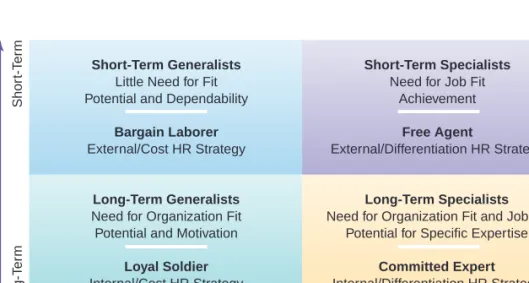
Figure 6.1 shows how selection decisions can be aligned with the HR strate- gies outlined in Chapter 2. Consistent with the overall HR strategies, strategic selection decisions are based on two important dimensions. The horizontal dimension of Figure 6.1 represents differences in the type of talent sought. At one end of the continuum is generalist talent—employees who may be excellent workers but who do not have particular areas of expertise or specialization.
Most of the people being hired as census enumerators would fit in this cat- egory. At the other end of the continuum is specialist talent—employees with specific and somewhat rare skills and abilities.5
The vertical dimension of Figure 6.1 represents the type of relationship between the employees and the organization. At one end of the continuum is long-term talent. Employees in this category stay with the organization for a long time and develop a deep understanding of company practices and operations. At the other end of the continuum is short-term talent. These employees move from organization to organization without developing expertise in how things are done at any particular place.6 Given that they only worked with the Census Bureau for a few months, enumerators for the 2010 census represented short-term talent.
Combining the two dimensions yields four general categories: short-term generalist talent, long-term generalist talent, long-term specialist talent, and short-term specialist talent. Next, we look at each of these categories in turn and consider how they fit with the HR strategies introduced in Chapter 2.
Short-Term Generalists
If you were hired to work at a drive-in restaurant, you would not need spe- cialized skills, you would not earn high wages, and you probably would not keep the job for a very long time. Fast-food workers are short-term generalists, who provide a variety of different inputs but do not have areas of special skill or ability. Other examples include some retail sales clerks and hotel house- keepers. Short-term generalist talent is most often associated with the Bargain Laborer HR strategy.7 Organizations with this HR strategy fill most positions Short-term generalists
Workers hired to produce general labor inputs for a relatively short period of time.
Figure 6.1 Strategic Framework for Employee Selection.
Short-Term Generalists Little Need for Fit Potential and Dependability
Bargain Laborer External/Cost HR Strategy
Long-Term Generalists Need for Organization Fit Potential and Motivation
Loyal Soldier Internal/Cost HR Strategy
Long-Term Specialists Need for Organization Fit and Job Fit
Potential for Specific Expertise Committed Expert Internal/Differentiation HR Strategy
Generalist
Long-TermShort-Term
Relationship Type
Specialist Talent Type
Short-Term Specialists Need for Job Fit
Achievement Free Agent
External/Differentiation HR Strategy
by hiring people just entering the workforce or people already working in similar jobs at other companies. Selection has the objective of identifying and hiring employees to produce low-cost goods and services, and selection decisions are based on identifying people who can perform simple tasks that require little specialized skill.
Hiring generalists can be beneficial because people without specialized skills do not generally demand high compensation, which keeps payroll costs as low as possible. Because generalists lack specific expertise, they also are usually more willing to work in routine jobs and do whatever they are asked.
Long-Term Generalists
If you were to take a job working for an electricity provider, you might not need specialized skills, but you would most likely plan to remain with the orga- nization for a long career. People working for utility companies are often long- term generalists who do not have technical expertise but who develop skills and knowledge concerning how things are done in a specific organization.
Other common examples of long-term generalists are people who work for government agencies and for some package delivery companies. These work- ers contribute in a number of areas but do not need specific technical skills and abilities. Long-term generalists are beneficial for organizations using the Loyal Soldier HR strategy.8 Organizations with this HR strategy focus on keep- ing employees once they are hired. Staffing still has the objective of hiring employees to produce low-cost goods and services, but a stronger commit- ment is formed, and efforts are made to identify people who will remain with the organization for a long time.
The generalist’s lack of specific expertise allows firms to reduce payroll costs. Here, however, employees develop skills and abilities over time that are only valuable to the specific organization, which reduces the likelihood that they will move to another employer. People develop relationships and form a strong sense of commitment to the organization as they work in many differ- ent jobs over a long period of time.
Long-Term Specialists
Suppose you took a job as an accountant with a large firm that makes and sells consumer goods such as diapers and cleaning products. People doing this job are most often long-term specialists who develop deep expertise in a particular area. Pharmaceutical sales representatives and research scientists are also commonly employed as long-term specialists. People in these jobs are expected to develop specialized skills and stay with the organization for a long time. The use of long-term specialists fits the Committed Expert HR strategy.9 Organizations that use this HR strategy develop their own talent. Selection has the objective of identifying people capable of developing expertise in a particular area so that they can innovate and produce superior goods and services over time.
Hiring people who can develop specialized skills over time enables orga- nizations to create and keep a unique resource of talent that other organiza- tions do not have. Employees are given the time and assets to develop the skills they need to be the best at what they do.
Short-Term Specialists
Information technology specialists often work as short-term specialists—
employees who provide specific inputs for relatively short periods of time.
Long-term generalists Workers hired to perform a variety of different jobs over a relatively long period of time.
Long-term specialists Workers hired to develop specific expertise and establish a lengthy career within an organization.
Short-term specialists Workers hired to provide specific labor inputs for a relatively short period of time.
These workers are valuable for organizations using the Free Agent HR strategy.10 Organizations with this HR strategy hire people away from other organizations. Staffing is aimed at hiring people who will bring new skills and produce innovative goods and top-quality service, and selection decisions focus on identifying people who have already developed specific skills. Other examples of this type of talent include investment bankers and advertising executives.
Hiring short-term specialists allows firms to quickly acquire needed exper- tise. New hires bring unique knowledge and skills to the organization. The organization pays a relatively high price for such knowledge and skills but makes no long-term commitments.
MAKING STRATEGIC SELECTION DECISIONS
Another way to examine how organizations make employee selection deci- sions focuses on two primary factors: the balance between job-based fit and organization-based fit and the balance between achievement and potential.
As you can see in Figure 6.1, both factors relate clearly to the talent categories just discussed.
Balancing Job Fit and Organization Fit
The first area of balance concerns whether employees should be chosen to fit in specific jobs or to fit more generally in the organization. When job-based fit is the goal, the organization seeks to match an individual’s abilities and interests with the demands of a specific job. This type of fit is highly depen- dent on a person’s technical skills. For instance, high ability in mathematics results in fit for a job such as financial analyst or accountant. In contrast, organization-based fit is concerned with how well the individual’s characteris- tics match the broader culture, values, and norms of the firm. Organization- based fit depends less on technical skills than on an individual’s personality, values, and goals.11 A person with conservative values, for example, might fit well in a company culture of caution and tradition. Employees who fit with their organizations have higher job satisfaction, and better fit with the orga- nization has been shown to lead to higher performance in many settings.12 As described in the “How Do We Know?” feature, an interviewer’s perception of job-based fit can be very different from the same interviewer’s perception of organization-based fit.
As suggested earlier, we can combine the concept of fit with the talent- based categories discussed earlier. In general, job-based fit is more important in organizations that seek to hire specialists than in those that seek gener- alists. Similarly, organization-based fit is more important for long-term than for short-term employees. These differences provide strategic direction for employee selection practices.
Organizations pursuing Bargain Laborer HR strategies and seeking short- term generalists are not highly concerned about either form of fit. Employees do not generally bring specific skills to the organization. Neither are they expected to stay long enough to necessitate close organizational fit. Thus, for firms pursuing a Bargain Laborer HR strategy, fit is not strategically criti- cal, and hiring decisions tend to focus on obtaining the least expensive labor regardless of fit.
Organizations pursuing the Loyal Soldier HR strategy and seeking long- term generalists benefit from hiring employees who fit with the overall Job-based fit
Matching an employee’s knowledge and skills to the tasks associated with a specific job.
Organization-based fit Matching an employee’s characteristics to the general culture of the organization.
organization. Job-based fit is not critical. Employees rotate through a number of jobs, and success comes more from loyalty and high motivation than from specific skills. In contrast, lengthy expected careers make fit with the organi- zation very important. Employee selection decisions in organizations with a Loyal Soldier HR strategy should thus focus primarily on assessing personality, values, and goals.
Organizations pursuing a Committed Expert HR strategy and seeking long-term specialists require both job-based fit and organization-based fit.
Organization-based fit is necessary because employees need to work closely with other members of the organization throughout long careers. Job-based fit is necessary because employees are expected to develop expertise in a spe- cific area. Even though new employees may not yet have developed specific job skills, general aptitude in the specialized field, such as accounting or engineering, is important. Selection decisions in firms pursuing Committed Expert HR strategies should thus be based on a combination of technical skills and personality, values, and goals.
Job-based fit is critical for organizations pursuing a Free Agent HR strat- egy and seeking short-term specialists. These organizations hire employees specifically to perform specialized tasks and expect them to bring required knowledge and skills with them. An employee’s stay with the organization is
D O R ECRUITERS R EALLY A SSESS F IT ?
What do interviewers think about when deciding whom to hire? Do they pay attention to specific job skills? How about values and personality traits?
Do all interviewers focus on the same things? Amy Kristof-Brown conducted two studies to answer these questions. In the first study, 31 recruiters from consulting organizations viewed videotapes of students being interviewed. The recruiters also looked at the résumés of the students. They then indicated which of the students they thought would fit best with their organizations and with particu- lar jobs. The recruiters were also asked to explain the characteristics they used to make their assess- ments of fit. In the second study, a different group of 46 recruiters conducted actual interviews with students for jobs in consulting firms. After the interviews, the recruiters provided ratings of per- ceived job fit and organization fit and made hiring recommendations.
The first study found that the recruiters used measures of specific knowledge, skills, and abilities to predict job-based fit, whereas they relied more on values and personality traits to predict organization-
based fit. Interestingly, however, the skills, abilities, traits, and values that were seen as important for fit often differed for recruiters from the same organi- zation. The second study showed that job-based fit and organization-based fit involved two different judgments and that the recruiters took both kinds of fit into account when making hiring decisions.
The Bottom Line. Job-based fit and organiza- tion-based fit involve two different perceptions.
Recruiters base their decisions about these two types of fit on different types of information.
Unfortunately, a given recruiter’s perceptions of fit may be based on his or her unique beliefs.
Professor Kristof-Brown concludes that organiza- tions can benefit from finding out which recruit- ers have the most accurate judgments of fit. Other recruiters can then be trained to use the same information to improve their judgments.
Source: Amy Kristof-Brown, “Perceived Applicant Fit:
Distinguishing between Recruiters’ Perceptions of Person- Job and Person-Organization Fit,” Personnel Psychology 53 (2000): 643–671.
How Do We Know?
expected to be relatively short, which means that fit with the organization is not critical. Selection decisions in organizations with a Free Agent HR strategy should thus focus primarily on assessing technical skills and abilities.
Balancing Achievement and Potential
The second area of balance concerns whether employees should be chosen because of what they have already achieved or because of their potential for future accomplishments. Assessments aimed at measuring achievement focus on history and past accomplishments that reveal information about acquired abilities and skills. For instance, a job applicant for an elementary school teaching position might have graduate degrees and years of experience that demonstrate teaching skills. In contrast, assessments aimed at measuring potential are future-oriented and seek to predict how a person will learn and develop knowledge and skill over time.13 In this case, an applicant for an ele- mentary teaching position may just have graduated with high honors from a prestigious university, demonstrating high potential.
Again, we can relate the choice between achievement and potential to the framework in Figure 6.1. Organizations that use Bargain Laborer HR strate- gies seek short-term generalists for jobs that do not require highly developed skills.14 Measures of achievement are not required. For these organizations, selection methods assess potential by predicting whether applicants will be dependable and willing to carry out assigned tasks.
Hiring people based on potential is critical for organizations with long- term staffing strategies. These organizations provide a great deal of training, which suggests that people learn many skills after they are hired. With a Loyal Soldier HR strategy, selection measures should focus on ability, motivation, and willingness to work in a large variety of jobs. For a Committed Expert HR strategy, the focus is on assessing potential to become highly skilled in a par- ticular area.
Organizations seeking short-term specialists focus on measuring achieve- ment, because they seek employees who already have specific skills. Required skills change frequently, and a general lack of training by the organization makes it very difficult for these employees to keep up with new technologies.
Hiring practices for organizations with Free Agent HR strategies thus focus on identifying individuals who have already obtained the necessary skills and who have demonstrated success in similar positions.
Gaining Competitive Advantage from Alignment
Of course, not all organizations have selection practices that are perfectly aligned with overall HR strategies. Some firms hire long-term generalists even though they have a Free Agent HR strategy. Other firms hire short-term spe- cialists even though they have a Bargain Laborer HR strategy. The selection practices in such organizations are not strategic, and the organizations often fail to hire employees who can really help them achieve their goals. In short, organizations with closer alignment between their overall HR strategies and their specific selection practices tend to be more effective. They are success- ful because they develop a competitive advantage by identifying and hiring employees who fit their needs and strategic plans.15 What works for one orga- nization may not work for another organization with a different competitive strategy. A key for effective staffing is thus to balance job fit and organization fit, as well as achievement and potential, in ways that align staffing practices with HR strategy.
Achievement A selection approach emphasizing existing skills and past accomplishments.
Potential
A selection approach emphasizing broad characteristics that foreshadow capability to develop future knowledge and skill.
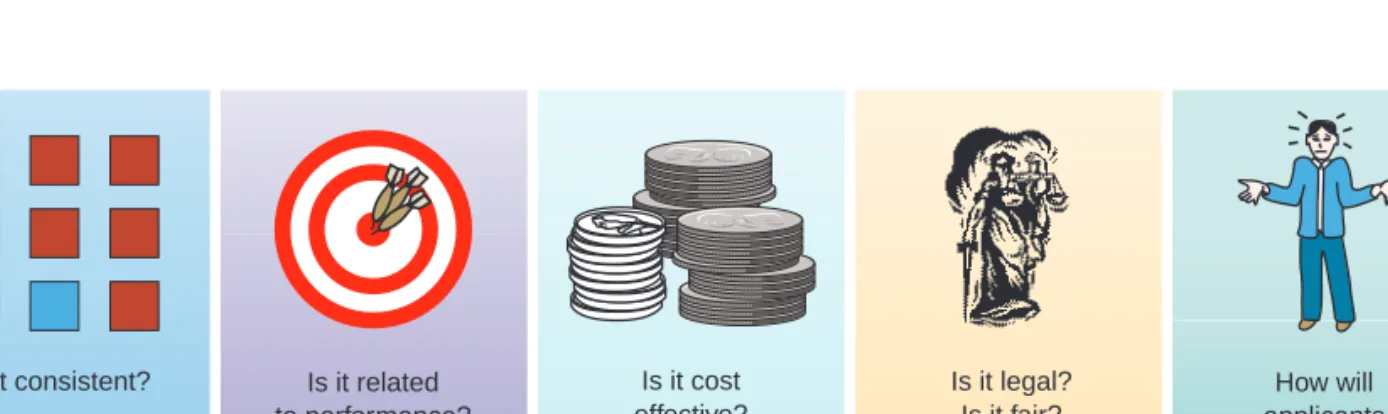
We have considered strategic concerns in employee selection. The next step is to evaluate specific methods that help accomplish strategy. How can an orga- nization go about identifying tests or measures that will identify people who fit or who have the appropriate mix of potential and achievement? Should prospective employees be given some type of paper-and-pencil test? Is a back- ground check necessary? Will an interview be helpful? If so, what type of inter- view is best? Answers to the questions provide insights about theaccuracy, cost effectiveness, fairness, and acceptability of various selection methods. Next, we examine a few principles related to each question. These principles include reliability, validity, utility, legality and fairness, and acceptability. Figure 6.2 illustrates basic questions associated with each principle.
RELIABILITY
Reliability is concerned with consistency of measurement. An example that illustrates this concept relates to a simple bathroom scale. Suppose you wake up one morning and step on the scale. The number on the scale says 150 pounds.
You brush your teeth and step back on the scale. It says 180 pounds. We know enough about weight to be quite certain that your weight has not varied this much in such a short period. We say that the scale is unreliable. It does not yield consistent values from measurement to measurement.
Reliability
An assessment of the degree to which a selection method yields consistent results.
? CONCEPT CHECK
1. What are the four types of talent, and how do they fit with the four approaches to overall HR strategy?
2. What is the difference between organization fit and job fit, and which is most critical for each of the HR strategies?
3. How do achievement and potential fit with strategic selection?
What Makes a Selection Method Good?
L E A R N I N G O B J E C T I V E 2
Figure 6.2 What Makes a Selection Method Good?
Is it related to performance?
Is it cost effective?
How will applicants
react?
Is it legal?
Is it fair?
Is it consistent?
VALIDITY UTILITY LEGALITY/FAIRNESS ACCEPTABILITY
RELIABILITY
Consider another example of a reliability problem. Imagine that two coaches for a football team have just returned from separate recruiting trips.
They are meeting to discuss the recruits they visited. The first coach describes a great recruit who weighs 300 pounds. The second coach reports about someone able to bench press 500 pounds. Which player should the coaches select? It is impossible to compare the recruits, since different information was obtained about each person. The measures are not reliable.
The football example may seem a bit ridiculous, but it is not much dif- ferent from what happens in many organizations. Just think of the interview process. Suppose five different people interview a person for a job. In many organizations, the interviewers’ judgments would not be consistent.
How, then, can we determine whether a selection method is reliable? One way to evaluate reliability is to test a person on two different occasions and then determine whether scores are similar across the two times. We call this the test-retest method of estimating reliability. Another way to evaluate reli- ability is to give two different forms of a test. Since both tests were designed to measure the same thing, we would expect people’s scores to be similar.
This is the alternate-forms method of estimating reliability. A similar method involves the use of a single test that is designed to be split into two halves that measure the same thing. The odd- and even-numbered questions might be written so that they are equivalent. We call this the split-halves method of estimating reliability. A final method, called the inter-rater method, involves having different raters provide evaluations and then determining whether the raters agree.
Each method of estimating reliability has its own strengths and weaknesses.
However, all four methods rely on the correlation coefficient, a numeri- cal indicator of the strength of the relationship between two sets of scores.
Correlation coefficients range from a low of 0, which indicates no relation- ship, to a high of 1, which indicates a perfect relationship. Figure 6.3 provides an illustration of correlation coefficients. Two scores for each person are rep- resented in the graph. The first score is plotted on the horizontal axis, and the second score is plotted on the vertical axis. Each person’s two scores are thus represented by a dot. In the graph representing a low correlation, you can see that some people who did very well the first time did not do well the second time. Others improved a lot the second time. The scores are quite scattered, and it would be difficult to predict anyone’s second score based on his or her first score. In the graph representing a high correlation, the scores begin to follow a straight line. In fact, scores with a correlation of 1 would plot as a single line where each person’s second score could be predicted perfectly by his or her first score.
Correlation coefficients can also be negative (indicating that high scores on one measure are related to low scores on the other measure), but we do not generally observe negative correlations when assessing reliability. When it comes to reliability estimates, a higher correlation is always better. A correla- tion coefficient approaching 1 tells us that people who did well on one of the assessments generally did well on the other.
Just how high should a reliability estimate be? Of course, this depends on many different aspects of the assessment situation. Nevertheless, a good guideline is that a correlation coefficient of .85 or higher suggests adequate reliability for test-retest, alternate-forms, and split-halves estimates.16 Inter- rater reliability estimates are often lower because they incorporate subjective judgment, yet high estimates are still desirable.
Test-retest method A process of estimating reliability that compares scores on a single selection assessment obtained at different times.
Alternate-forms method A process of estimating reliability that compares scores on different versions of a selection assessment.
Split-halves method A process of estimating reliability that compares scores on two parts of a selection assessment.
Inter-rater method A process of estimating reliability that compares assessment scores provided by different raters.
Correlation coefficient A statistical measure that describes the strength of the relationship between two measures.
Knowing in general how high reliability estimates should be makes manag- ers and human resource specialists better consumers of selection procedures.
Consulting firms and people within an organization often propose many dif- ferent selection methods. Important decisions must be made about which of the many possible methods to use. The first question to ask about any selec- tion procedure is whether it is reliable. Information about reliability should be available from vendors who advocate and sell specific tests and interview methods.
VALIDITY
Once reliability has been established, we can turn to a selection method’s validity. Suppose the football coaches in the earlier example have been taught about reliability. They go back to visit the recruits again and obtain more information. This time they specifically plan to obtain consistent information.
When they report back, one of the coaches states that his recruit drives a blue car. The second coach says that his recruit drives a green car. The problem of reliability has been resolved. The coaches are now providing the same infor- mation about the two recruits. However, this information most likely has nothing to do with performance on the football field. We thus conclude that the information does not have validity, which means that it is not relevant for job performance.
How do we know if a test is valid? Evidence of validity can come in many forms, and assessments of validity should take into account all evidence sup- porting a relationship between the assessment technique and job perfor- mance.17 Nevertheless, as with reliability, certain methods for determining validity are most commonly used.
One method, called content validation strategy, involves determining whether the content of the assessment method is representative of the job situation. For instance, a group of computer programmers might be asked to look at a computer programming test to determine whether the test mea- sures knowledge needed to program successfully. The experts match tasks from the job description with skills and abilities measured by the test. Analyses are done to learn if the experts agree. The content validation strategy thus relies on expert judgments, and validity is supported when experts agree that the content of the assessment reflects the knowledge needed to perform well
Validity
The quality of being justifiable.
To be valid, a method of selecting employees must accurately predict who will perform the job well.
Content validation strategy A process of estimating validity that uses expert raters to determine if a test assesses skills needed to perform a certain job.
Figure 6.3 Graphical Illustration of Correlations.
Test Time 2
40 50 60 70 80 90
40 50 60 70 80 90 100
Test Time 1 LOW CORRELATION 100
Test Time 2
40 50 60 70 80 90
40 50 60 70 80 90 100
Test Time 1 HIGH CORRELATION 100
on the job. Content validation is a particularly important step for developing new tests and assessments. As a student, you see content validation each time you take an exam. The course instructor acts as an expert who determines whether the questions on the exam are representative of the course material.
A second method for determining validity is known as the criterion-related validation strategy. This method differs from the content validation strategy in that it uses correlation coefficients to show that test or interview scores are related to measures of job performance. For example, a correlation coeffi- cient could be calculated to measure the relationship between a personality trait and the dollars of business that sales representatives generate. A posi- tive correlation coefficient can indicate that those who have high scores on a test of assertiveness generate more sales. In this case, a negative correlation co efficient might also be instructive, as it would indicate that people who have lower scores on a particular trait, such as anxiety, have higher sales figures.
Either way, the test scores will be helpful for making hiring decisions and pre- dicting who will do well in the sales position.
In practice, two methods can be used to calculate criterion-related valid- ity coefficients. One method uses the predictive validation strategy. Here, an organization obtains assessment scores from people when they apply for jobs and then later measures their job performance. A correlation coefficient is calculated to determine the relationship between the assessment scores and performance. This method is normally considered the optimal one for estimating validity. However, its use in actual organizations presents certain problems. One problem is that it requires measures from a large number of people. If an organization hires only one or two people a month, it might take several years to obtain enough information to calculate a proper correlation coefficient. Organizations may also be reluctant to pay for assessments, espe- cially when they do not have evidence that the assessments are really useful for predicting performance.
A second method for calculating validity coefficients uses the concurrent validation strategy. Here, the organization obtains assessment scores from people who are already doing the job and then calculates a correlation coef- ficient relating those scores to performance measures that already exist. In this case, for example, a personality test could be given to the sales represen- tatives already working for the organization. A correlation coefficient could be calculated to determine whether sales representatives who score high on the test also have high sales figures. This method is somewhat easier to use, but it too has drawbacks. One problem is that the existing sales representa- tives do not complete the personality assessment under the same conditions as job applicants. Applicants may be more motivated to obtain high scores and may also inflate their responses to make themselves look better. Existing sales representatives may have also learned things and changed in ways that make them different from applicants, which might reduce the accuracy of the test for predicting who will perform best when first hired.
Neither the predictive nor the concurrent strategy is optimal in all con- ditions. However, both yield important information, and this information comes in the form of a correlation coefficient. How high should this correla- tion coefficient be? Validity coefficients are lower than reliability coefficients.
This is because a reliability coefficient represents the relationship between two things that should be the same. In contrast, a validity coefficient repre- sents a relationship between two different things: the test or interview and job performance. Correlation coefficients representing validity rarely exceed .50.
Criterion-related validation strategy A process of estimating validity that uses a correlation coefficient to determine whether scores on tests predict job performance.
Predictive validation strategy A form of criterion-related validity estimation in which selection assessments are obtained from applicants before they are hired.
Concurrent validation strategy A form of criterion-related validity estimation in which selection assessments are obtained from people who are already employees.
Many commonly used assessment techniques are associated with correlation coefficients that range from .25 to .50, and a few that are useful range from .15 to .25. This suggests that, as a guideline for assessing validity, a coefficient above .50 indicates a very strong relationship, coefficients between .25 and .50 indicate somewhat strong relationships, and correlations between .15 and .25 weaker but often important relationships.18 Once again, this information can help managers and human resource specialists become better consumers of assessment techniques. As with reliability, information about validity should be available for properly developed selection methods.
One additional concept related to validity is generalizability, which con- cerns the extent to which the validity of an assessment method in one context can be used as evidence of validity in another context. In some cases, differ- ences in the job requirements across organizations might result in an assess- ment that is valid in one context but not in another. For instance, a test that measures sociability may predict high performance for food servers in a sports bar but not for servers in an exclusive restaurant. This is known as situational specificity. In other cases, differences across contexts do not matter, and evi- dence supporting validity in one context can be used as evidence of validity in another context, a condition known as validity generalization. A common example of a personality trait that exhibits generalization is conscientious- ness. Being organized and goal oriented seems to lead to high performance regardless of the work context. We return to this subject later in discussions about different forms of assessment.
UTILITY
The third principle associated with employee selection methods is utility, which concerns the method’s cost effectiveness. Think back to the football example. Suppose the university has decided to give all possible recruits a one- year scholarship, see how they do during the year, and then make a selection decision about which players to keep on the team. (For the moment, we will ignore NCAA regulations.) Given an entire year to assess the recruits, the uni- versity would likely be able to make very good selection decisions, but the cost of the scholarships and the time spent making assessments would be extremely high. Would decisions be improved enough to warrant the extra cost?
Several factors influence the cost effectiveness, or utility, of a selection method. The first issue concerns validity. All other things being equal, selec- tion methods with higher validity also have higher utility. This is because valid selection methods result in more accurate predictions. In turn, more accurate predictions result in higher work performance, which leads to greater organi- zational profitability.
A second issue concerns the number of people selected into a position.
An organization can generate more money when it improves its hiring proce- dures for jobs it fills frequently. After all, a good selection procedure increases the chances of making a better decision each time it is used. Even though each decision may only be slightly better than a decision made randomly or with a different procedure, the value of all the decisions combined becomes substantial. This explains why even selection decisions with moderate to low validity may have high utility.
A third issue concerns the length of time that people stay employed. Utility is higher when people remain in their jobs for long periods of time. This principle is clear when we compare the probable monetary return of making
Situational specificity The condition in which evidence of validity in one setting does not support validity in other settings.
Validity generalization The condition in which evidence of validity in one setting can be seen as evidence of validity in other settings.
Utility
A characteristic of selection methods that reflects their cost effectiveness.
a good selection decision for someone in a summer job versus someone in a 40-year career. Hiring a great employee for a few months can be very help- ful. Hiring a great employee for an entire career, however, can yield a much greater financial benefit.
A fourth issue that influences utility is performance variability. To under- stand this concept, think about the difference in performance of good and bad cooks at a fast-food restaurant versus the difference in performance of cooks at an elite restaurant. The fast-food cooking process is so standardized that it usually does not matter who cooks the food. In this case, making a great selection decision has only limited value. In contrast, the cooking process at an elite restaurant requires the cook to make many decisions that directly influence the quality of the food. Selecting a good cook in this situation is often the difference between a restaurant’s success and failure. Measuring performance variability for specific jobs can be somewhat difficult. Just what is the dollar value associated with hiring a good candidate versus a bad one?
A number of studies suggest that salary provides a good approximation of this value.19 Variability in performance increases as salary increases. The dollar value of hiring a good company president is greater than the dollar value of hiring a good receptionist, and this difference is reflected in the higher com- pensation provided to the CEO.
A fifth issue involves the ratio of applicants to hires for a particular position and concerns how choosy an organization can be. An organization that must hire three out of every four applicants is much less choosy than an organiza- tion that hires one out of every ten. If an organization hires almost everyone who applies, then it will be required to hire people even when the selection method suggests that they will not be high performers. Because people are hired regardless of the assessment results, very little value comes from devel- oping quality selection procedures. In contrast, an organization that receives a large number of applications for each position can benefit from good selec- tion techniques that help accurately predict which of the applicants will be the highest performer.
Still another issue related to utility is cost. Cost issues associated with selec- tion methods can be broken into two components: fixed costs associated with developing an assessment method and variable costs that occur each time the method is used. For example, an organization may decide to use a cognitive ability test to select computer programmers. The organization will incur some expenses in identifying an appropriate test and training assessors to use it.
This cost is incurred when the test is first adopted. Most likely, the organiza- tion will also pay a fee to the test developer each time it gives the test to a job applicant. In sum, utility increases when both fixed and variable costs are low.
In general, less expensive tests create more utility, as long as their validity is similar to that of more expensive tests.
Let’s look more closely at the variable costs of the assessment. Because it costs money for each person to take an assessment, utility decreases as the number of people tested or interviewed increases. However, there is a trade-off between the number of people being assessed and selectivity. Unless a test has low validity and is very expensive, the tradeoff usually works out such that the costs associated with giving the test to a large number of people are outweighed by the advantages of being choosy and hiring only the very best applicants.
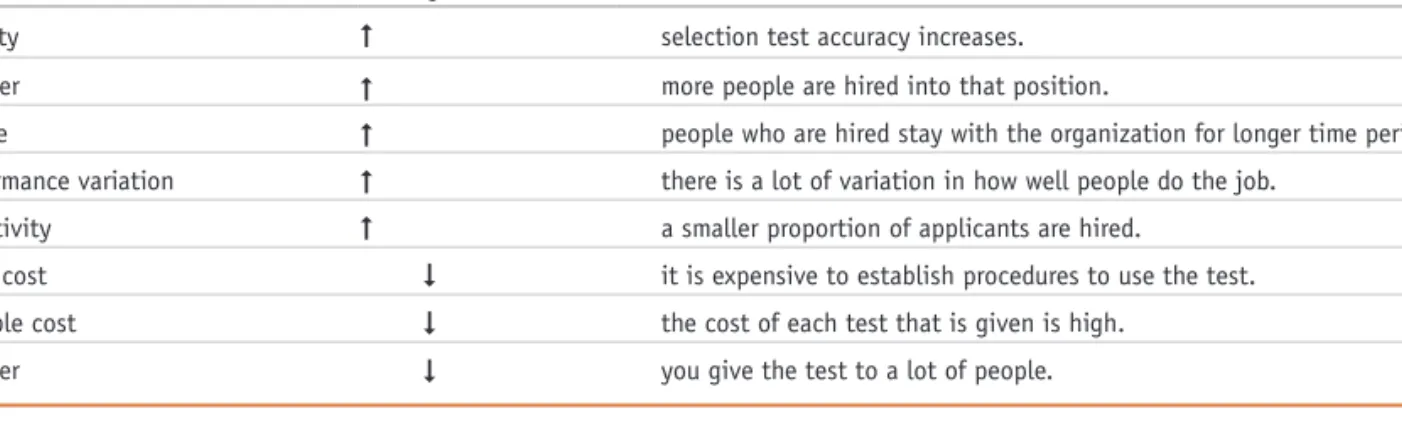
Table 6.1 summarizes factors that influence utility. Of course, dollar esti- mates associated with utility are based on a number of assumptions and rep- resent predictions rather than sure bets. Just like predictions associated with
financial investments, marketing predictions, and weather forecasting, these estimates will often be wrong. Some research even suggests that providing managers with detailed, complex cost information does not help persuade them to adopt the best selection methods.20 This does not, however, mean that cost analyses are worthless. Utility estimates can be used to compare human resource investments with other investments such as buying machines or expanding market reach. Estimates are also more likely to be accepted by managers when they are presented in a less complex manner and when they are framed as opportunity costs.21 Managers can use utility concepts to guide their decisions. For instance, managers should look for selection procedures that have high validity and relatively low cost. They should focus their atten- tion on improving selection decisions for jobs involving a large number of people who stay for long periods of time. They should also focus on jobs in which performance of good and bad employees varies a great deal and in which there are many applicants for each open position.
LEGALITY AND FAIRNESS
The fourth principle associated with selection decisions concerns legality and fairness. Think back to the football example again. Suppose the coaches decided to select only recruits who could pass a lie detector test. Is this legal?
Chapter 3 specifically described a number of legal issues associated with human resource management.
Validity plays an important role in the legality of a selection method. As we discussed in Chapter 3, if a method results in lower hiring rates for members of a protected subgroup of people—such as people of a certain race—then adverse impact occurs. In this case, the company carries the burden of proof for demonstrating that its selection methods actually link with higher job per- formance. Because adverse impact exists in many organizations, being able to demonstrate validity is a legal necessity.
High validity may make it legal for an organization to use a test that screens out some subgroups at a higher rate than others, but this does not necessarily mean that everyone agrees that the test is fair and should be used. Fairness goes beyond legality and includes an assessment of potential bias or discrimi- nation associated with a given selection method. Fairness concerns the prob- ability that people will be able to perform satisfactorily in the job, even though the test predicted that they would not.
Fairness
A characteristic of selection methods that reflects individuals’
perceptions concerning potential bias and discrimination in the selection methods.
Table 6.1 Factors Influencing Utility of Selection Methods
Factor Utility When . . .
Validity selection test accuracy increases.
Number more people are hired into that position.
Tenure people who are hired stay with the organization for longer time periods.
Performance variation there is a lot of variation in how well people do the job.
Selectivity a smaller proportion of applicants are hired.
Fixed cost it is expensive to establish procedures to use the test.
Variable cost the cost of each test that is given is high.
Number you give the test to a lot of people.
From the applicants’ perspective, selection procedures are seen as more fair if they believe they are given an opportunity to demonstrate their skills and qualifications.22 Because of this and other factors, assessments of fairness often depend a great deal on personal values. The very purpose of employee selection is to make decisions that discriminate against some people. Under optimal conditions, this discrimination is related only to differences in job performance. Yet no selection procedure has perfect validity. All techniques screen out some people who would actually perform well if given the oppor- tunity. For example, some research has found that tests can unfairly screen out individuals who believe that people like them don’t perform well on the specific test.23 For instance, a woman may not perform well on a mathemat- ics test if she believes that women aren’t good at math. Simply seeing the test as biased can result in decreased motivation to try hard and thereby lower scores, even though these people have the skills necessary to do the job.
The number of people who are unfairly eliminated decreases as validity increases, meaning that more valid tests are usually more fair. Unfortunately, even tests with relatively high validity screen out a number of people who could perform the job. One concern is that the number of people improp- erly screened out may include a higher percentage of women and minorities.
Thus, some employee selection procedures may provide economic value to organizations at the expense of individuals who are screened out even though they would perform well. This situation creates a tradeoff between a firm’s desire to be profitable and society’s desire to provide people from all sub- groups with an equal chance to obtain quality employment. Perceptions of the proper balance between these values differ depending on personal values, making fairness a social rather than scientific concept.
ACCEPTABILITY
A final principle for determining the merit of selection techniques is accept- ability, which concerns how applicants perceive the technique. Can a selection method make people see the organization as a less desirable place to work?
Think back to the football coaches. Suppose they came up with a test of men- tal toughness that subjected recruits to intense physical pain. Would complet- ing the test make some recruits see the school less favorably? Would some potential players choose to go to other schools that did not require such a test?
This example shows that selection is a two-way process. As an organiza- tion is busy assessing people, those same people are making judgments about whether they really want to work for the organization. Applicants see selec- tion methods as indicators of an organization’s culture, which can influence not only their decisions to join the organization but also subsequent feelings of job satisfaction and commitment.24 Organizations should thus be careful about the messages that their selection techniques are sending to applicants.
In general, applicants have negative reactions to assessment techniques when they believe that the organization does not need the information being gathered—that the information is not job related. For instance, applicants tend to believe that family and childhood experiences are private and unre- lated to work performance. Applicants also tend to be skeptical when they believe that the information from a selection assessment cannot be evaluated correctly. In this sense, many applicants react negatively to handwriting analy- sis and psychological assessment because they do not believe these techniques yield information that can be accurately scored.25
Acceptability
A characteristic of selection methods that reflects applicants’ beliefs about the appropriateness of the selection methods.
One interesting finding is that perceptions of fairness differ among coun- tries. For instance, people in France see handwriting analysis and personality testing as more acceptable than do people in the United States. At the same time, people in the United States see interviews, résumés, and biographical data as more acceptable than do people in France.26
There is also some evidence that applicants react more positively to a particular assessment when they believe they will do well on it. One study, for example, found people who use illegal drugs to be less favorable about drug testing.27 Although this is hardly surprising, it does illustrate the complexity of understanding individual reactions to employee selection techniques.
? CONCEPT CHECK
1. What criteria are used to determine whether employee selec- tion methods are good?
2. What are ways to assess selection method validity?
3. What influences the cost effectiveness of a selection method?
Methods for selecting employees include testing, gathering information, and interviewing. We discuss particular practices associated with each of these cat- egories in the sections that follow.
TESTING
Employment testing provides a method for assessing individual characteristics that help some people be more effective employees than others. Tests provide a common set of questions or tasks to be completed by each job applicant.
Different types of tests measure knowledge, skill, and ability, as well as other characteristics, such as personality traits.
Cognitive Ability Testing
Being smart is often measured through cognitive ability testing, which assesses learning, understanding, and ability to solve problems.28 Cognitive ability tests are sometimes referred to as “intelligence” or “mental ability” tests. If you took the SAT or ACT test before applying to college, then you have taken a test similar to a cognitive ability test. Some measure ability in a number of specific areas, such as verbal reasoning and quantitative problem solving.
However, research suggests that general mental ability, which is represented by a summation of the specific measures, is the best predictor of performance in work contexts.29 Of course, cognitive ability is somewhat related to educa- tion, but actual test scores have been shown to predict job performance better than measures of educational attainment.30
Cognitive ability testing Assessment of a person’s capability to learn and solve problems.
What Selection Methods Are Commonly Used?
L E A R N I N G O B J E C T I V E 3
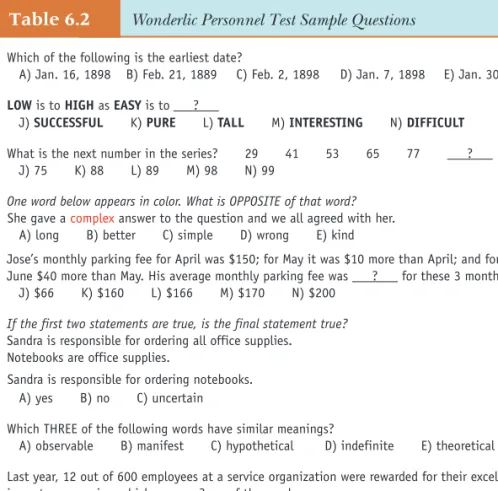
1. Which of the following is the earliest date?
A) Jan. 16, 1898 B) Feb. 21, 1889 C) Feb. 2, 1898 D) Jan. 7, 1898 E) Jan. 30, 1889 2. LOW is to HIGH as EASY is to ?
J) SUCCESSFUL K) PURE L) TALL M) INTERESTING N) DIFFICULT 3. What is the next number in the series? 29 41 53 65 77 ?
J) 75 K) 88 L) 89 M) 98 N) 99
4. One word below appears in color. What is OPPOSITE of that word?
She gave a complex answer to the question and we all agreed with her.
A) long B) better C) simple D) wrong E) kind
5. Jose’s monthly parking fee for April was $150; for May it was $10 more than April; and for June $40 more than May. His average monthly parking fee was ? for these 3 months.
J) $66 K) $160 L) $166 M) $170 N) $200 6. If the first two statements are true, is the final statement true?
Sandra is responsible for ordering all office supplies.
Notebooks are office supplies.
Sandra is responsible for ordering notebooks.
A) yes B) no C) uncertain
7. Which THREE of the following words have similar meanings?
A) observable B) manifest C) hypothetical D) indefinite E) theoretical 8. Last year, 12 out of 600 employees at a service organization were rewarded for their excellence
in customer service, which was ? of the employees.
J) 1% K) 2% L) 3% M) 4% N) 6%
Correct An swers: 1. E,
2. N, 3. L, 4. C, 5. M,
6. A, 7. CDE, 8. K
Table 6.2 Wonderlic Personnel Test Sample Questions
Source: Sample items for Wonderlic Personnel Test-Revised (WPT-R). Reprinted with permission from Wonderlic, Inc.
Examples of items from a widely used cognitive ability test are shown in Table 6.2. How would you score on such a test? Cognitive ability tests have high reliability; people tend to score similarly at different times and on differ- ent test forms.31 In addition, these tests are difficult to fake, and people are generally unable to substantially improve their scores by simply taking courses that teach approaches to taking the test.32 Validity is higher for cognitive abil- ity tests than for any other selection method.33 This high validity, combined with relatively low cost, results in substantial utility. Cognitive ability tests are good, inexpensive predictors of job performance.
A particularly impressive feature of cognitive ability tests is their validity generalization. They predict performance across jobs and across cultures.34 Everything else being equal, people with higher cognitive ability perform better regardless of the type of work they do.35 Nevertheless, the benefits of high cognitive ability are greater for more complex jobs, such as computer programmer or physician.36 One explanation of why these tests predict per- formance across jobs and organizations, especially when work is complex, is the link between cognitive ability and problem solving. People with higher cognitive ability obtain more knowledge.37 Researchers have also posited that people with higher cognitive ability adapt to change more quickly, although the actual evidence supporting better adaptation is inconsistent.38
I S I T B ETTER TO B E S MART OR B EAUTIFUL ?
Do smart people have a better chance of getting rich? How about people who are physically attrac- tive? Are they more likely to be rich? Timothy Judge, Charlice Hurst, and Lauren Simon sought to answer these questions with a study of 191 randomly selected people between the ages of 25 and 74. Participants completed a cognitive abil- ity measure. They also provided a photograph that was rated for physical attractiveness. Participants also reported on their level of education attain- ment and their core self-evaluations (levels of con- fidence, self-esteem, sense of internal control, and lack of anxiety). At a later time, participants also reported their income.
Results showed a positive effect on income for both intelligence and beauty. Smarter people had higher income, as did people who were rated higher on physical attractiveness. Smarter people attained more education and had more positive
perceptions about themselves, which in turn trans- lated into higher income. The effect was similar for physical attractiveness. Better-looking people similarly attained more education and had more positive self-perceptions, which corresponded with increased income.
Bottom Line. Being either smart or good look- ing makes someone more likely to be rich. But if you had to choose one or the other, choose being smart, as the effect of being smart was twice as large as the effect of being beautiful. Nevertheless, the authors conclude that being beautiful does indeed provide people with a seemingly unfair advantage.
Source: Timothy A. Judge, Charlice Hurst, and Lauren S.
Simon, “Does It Pay to Be Smart, Attractive, or Confident (or All Three)? Relationships Among General Mental Ability, Physical Attractiveness, Core Self-Evaluations, and Income,” Journal of Applied Psychology 94 (2009): 742–755.
How Do We Know?
A concern about cognitive ability tests is that people from different racial groups tend to score differently.39 This does not mean that every individual from a lower-scoring group will score low. Some individuals from each group will score better and some will score worse, but on average, some groups do worse than others. The result is adverse impact, wherein cognitive ability tests screen out a higher percentage of applicants from some minority groups.
Because of their strong link with job performance, cognitive tests can be used legally in most settings. However, a frequent social consequence of using cog- nitive ability tests is the hiring of fewer minority workers.
In terms of acceptability, managers see cognitive ability as one of the most important predictors of work performance.40 Human resource professionals and researchers strongly believe in the validity of cognitive ability tests, even though some express concern about the societal consequences of their use.41 In contrast, job applicants often perceive other selection methods as being more effective.42 Not surprisingly, negative beliefs about cognitive ability tests are stronger for people who do not perform well on the tests.43
In summary, cognitive ability tests are a useful tool for determining whom to hire. As discussed in the “How Do We Know?” feature, these tests can predict long-term success. They predict potential more than achievement, making them best suited for organizations pursuing long-term staffing strate- gies. High cognitive ability is particularly important for success in organiza- tions with long-term sta