CHARISMATIC LEADERSHIP
in Organizations
CHARISMATIC LEADERSHIP
in Organizations
Jay A. Conger
RabindraN.Kanungo
SAGE Publications
InternationalEducational'andProfessionalPublisher Thousand Oaks London New Delhi
All rights reserved. No part of this book may be reproduced or utilized in any form or by any means, electronic or mechanical, including photocopying, recording, or by any information storage and retrieval system, without permission in writing from the publisher.
For information:
SAGE Publications, Inc.
2455 Teller Road
Thousand Oaks, California 91320 E-mail: [email protected] SAGE Publications Ltd
1 Oliver's Yard 55 City Road L o n d o n EC1Y ISP
SAGE Publications India Pvt Ltd B-42, Panchsheel Enclave Post Box 4 1 0 9
N e w Delhi 110 0 1 7 Printed in the United States of America
Library of Congress Cataloging-in-Publication Data Conger, Jay Alden.
Charismatic leadership in organizations / by Jay A. Conger and Rabindra N. Kanungo.
p. cm.
Includes bibliographical references and index.
ISBN 0-7619-1633-4 (acid-free paper) ISBN 0-7619-1634-2 (pbk.: acid-free paper) 1. Executive ability. 2. Leadership. 3. Organizational effectiveness. I. Kanungo, Rabindra Nath. II. Title.
HD38.2 .C658 1998
658.4Ό92—ddc21 98-9003
03 10 9 8 7 6 5 4
Acquiring Editor:
Editorial Assistant:
Production Editor:
Editorial Assistant:
Typesetter/Designer:
Indexer:
Marquita Flemming Heidi Van Middlesworth Diana E. Axelsen Lynn Miyata Danielle Dillahunt Trish Wittenstein
Contents
Preface vii
PART I: Theory Development
1. Evolution of the Field 3 2. A Model of Charismatic Leadership 35
3. Charismatic Leadership: Measurement and Empirical Validity 71
PART II: Components of Charismatic Leadership
4. The Leader's Search for Opportunity 121 5. Aligning the Organization Through Vision 153
6. Implementing the Vision 189
PART III: Remaining Challenges
7. The Shadow Side of Charisma 211
8. Looking to the Future 241 Appendix: The Conger-Kanungo Charismatic
Leadership Questionnaire 251
References 255 Index 271 About the Authors 287
Preface
When
we first set out to explore charismatic leadership in organizations a decade ago, there were but a handful of references concerning the topic. We felt very much like adventurers exploring a new land. Today, it is with a sense of surprise that we see how the field has flourished. The saying "let a thousand flowers bloom" would certainly be appropriate to describe how interest has unfolded. Given the growing attention to the topic, it seemed timely to introduce a book that would not only aim to integrate what we have learned to date but also would push our frontiers of knowledge further. We trust that readers will feel that we have succeeded in both of these objectives.To understand scientifically a phenomenon as elusive as charismatic leader- ship, three vital steps must be undertaken. First, a conceptual or theoretical framework is needed that can adequately describe the phenomenon and at the same time strip away its surrounding aura of mystery for both management scholars and practitioners. Second, the framework must then be empirically validated through systematic investigation looking at the nature, causes, and consequences of charis- matic leadership. Finally, after such validation efforts, the framework can and should be used to explain and predict charismatic leadership in actual observed cases in organizations. The first two chapters of this book are devoted to the first step.
They explore how theory has developed over the past decade and specifically how our own theoretical framework has evolved. They close with a model of charismatic leadership in organizations. Chapter 3 looks at the second step—
empirical validation. In this chapter, we examine a series of studies undertaken to test our theory and to develop a measure of charismatic leadership. These investigations confirm the validity of the model and have resulted in a reliable measure of what has heretofore been considered a highly elusive form of
vii
leadership. Chapters 4 through 6 are devoted to the third step—the explanation of charismatic leadership as observed in company case studies. Here we illustrate our framework using examples of business leaders as well as expand on our model. Our final two chapters look at the challenges facing the field—the liabilities of charismatic leadership and future areas of research. Although charismatic leadership is often known for its positive consequences, it has a shadow side that has been poorly explored. In Chapter 7, we begin to address this important gap in our knowledge. Finally, while interest has grown dramati- cally in the topic, some might say that we have only scratched the surface.
Chapter 8 therefore looks at where future attention must be directed if we are to more fully understand the many dimensions of charismatic leadership. We also include a discussion of the challenges facing leaders in the upcoming century and why charismatic leadership is particularly well suited to address these.
In our writing throughout this book, we have both been guided by a belief that charismatic leadership is a critically important topic within the larger field of leadership studies, one deserving far greater attention than it has received in the past.
We say this because charismatic leaders are often exemplars of the qualities we normally associate with leadership. For example, they can be remarkable change agents, able to reinvent entire organizations and societies. They are also superb examples of leaders who are master communicators and motivators. As such, they provide many important lessons for those who wish to lead others or for those who wish to study leadership. Paradoxically, these same leaders also provide us with lessons about the greatest dangers of leadership. Throughout history, certain charismatic leaders have proved themselves master manipulators and purveyors of evil. They have been responsible for the collapse of corpora- tions and of nations. Given these two faces of this form of leadership, it is imperative that we learn as much about it as we can for the well-being of ourselves, our organizations, and our society. It is our hope, therefore, that this volume will stimulate continued inquiry into this potent source of leadership.
In writing this manuscript, we have been fortunate in having wonderful help.
We especially want to thank Kim Jaussi and Gretchen Spreitzer for their review of our manuscript. Their comments have played an important role in improving this volume. We also want to thank Sanjay Menon and Purnima Mathur, who collaborated with us in conducting several of the validation studies reported in Chapter 3. They were instrumental both in helping us collect data and in analyzing it. Finally, we are especially grateful for the patience, fortitude, and skills of Deletha Gafford and Kristen Martin. They did a remarkable job not only of transforming our handwritten notes and script into text but also of managing the modern process of producing a book, one that has been assembled through e-mail messages and computer disks.
PART
THEORY DEVELOPMENT
1
Evolution of the Field
It is a commonplace observation that leadership plays an important role in the creation, survival, growth, and decay of organizations. Considering its impor- tance, numerous books and articles have been written on leadership (see, e.g., Bass, 1990; Yukl, 1994) during the past half century, yet social scientists and managerial scholars started to show a genuine interest in studying the phenome- non of charismatic leadership in organizations only during the past decade. In this introductory chapter, we will look at how research on charismatic leadership in organizations has evolved over this decade. When we wrote the book Char- ismatic Leadership (Conger & Kanungo, 1988b) in 1988, the field was still very young. We commented at the time:
The topic has actually suffered from a serious lack of attention. To put its neglect into perspective, we turn to Stogdill's Handbook of Leadership (Bass, 1981), which is considered the reference book on leadership studies. Combing through the more than 5,000 studies included in the handbook, only a dozen references to charismatic leadership are to be found. This is an ironic and disheartening discovery given the profound impact of charismatic leaders, (p. 12)
More recently, this situation has begun to reverse itself. Today interest in charismatic leadership has blossomed. What is particularly surprising is the number of empirical studies that have appeared. Most of the academic work up to the publication of Charismatic Leadership had been largely theoretical in nature, with little empirical research. Today that situation has changed dramatically.
3
Several dozen empirical investigations of charismatic leadership in organi- zations have now been conducted. They have involved a wide range of samples such as middle- and lower-level managers (Bass & Yammarino, 1988; Conger
& Kanungo, 1994; Conger, Kanungo, Menon, & Mathur, 1997; Deluga, 1995;
Hater & Bass, 1988; Koene, Pennings, & Schrender, 1991), senior executives (Agle, 1993; Agle & Sonnenfeld, 1994; Conger, 1985, 1989a), U.S. presidents (House, Spangler, & Woycke, 1991), educational administrators (Koh, Terborg,
& Steers, 1991; Roberts & Bradley, 1988; Sashkin, 1988), military cadets and leaders (Atwater, Camobreco, Dionne, Avolio, & Lau, 1997; Curphy, 1990;
Howell & Avolio, 1993; Koene et al., 1991; Waldman & Ramirez, 1992), and students who were laboratory subjects (Howell & Frost, 1989; Kirkpatrick, 1992; Kirkpatrick & Locke, 1996; Puffer, 1990; Shamir, 1992, 1995). In addition, the subject has been explored using a wide variety of research methods.
For example, there have been field surveys (Conger & Kanungo, 1992, 1994;
Hater & Bass, 1988; Podsakoff, MacKenzie, Moorman, & Fetter, 1990), labo- ratory experiments (Howell & Frost, 1989; Kirkpatrick, 1992; Kirkpatrick &
Locke, 1996; Puffer, 1990), content analyses of interviews and observation (Conger, 1989a; Howell & Higgins, 1990), and analyses of historical archival information (Chen & Meindl, 1991; House et al., 1991; Shamir, Arthur, &
House, 1994).
What is more remarkable than this flowering of research is the relative uniformity of findings despite some differences in theoretical approaches. As Shamir, House, and Arthur (1993) have noted, findings across the board dem- onstrate that leaders who engage in the behaviors that are theorized to be charismatic actually produce the charismatic effects that theory predicts. In addition, many of these studies have shown that leaders who are perceived as charismatic receive higher performance ratings, are seen as more effective leaders than others holding leadership positions, and have more highly motivated and more satisfied followers than others in similar positions (e.g., see Agle &
Sonnenfeld, 1994).
Given this new body of research, this chapter aims to trace the evolution of the field over the last decade. The goal is to identify both advances and remaining gaps in our understanding of charismatic leadership in organizations. We begin our discussion, however, by exploring the backdrop of changes in the business world that not only have served as catalysts for the growing interest but also have shaped how researchers have approached the subject.
Following this discussion, we will describe contributions since the late 1980s.
When Charismatic Leadership was published in 1988, the field was in its
infancy, and the existing body of research at that time could be broken down into three distinct clusters based on (1) behavioral dimensions of the charismatic leader, (2) the psychological characteristics or dispositions of charismatic lead- ers, and (3) the institutionalization of charisma. Today, our knowledge has deepened in these areas. In addition, several other topic areas have received some attention. These include the dimensions of (1) contextual factors, (2) suc- cession and maintenance factors, and (3) the dark side of charismatic leadership.
In the second section of this chapter, we will cover developments in all these areas.
BACKGROUND FORCES IN THE BUSINESS WORLD
To understand why the subject of charismatic leadership has grown in interest for organizational theorists, we must look at the world around us—a larger backdrop of global competition. The rise of Asian economic powers, such as Japan and the Little Dragons, as well as European players like Germany, shattered the market dominance of North American companies. This had a dramatic impact not only on industry but also, in turn, on research within business schools. In terms of the world of commerce, it forced many large corporations to reinvent themselves radically after enjoying several decades of what in hindsight appears to have been relative stability. As companies attempted to adapt, they discovered that the process of reinvention was extremely difficult.
For example, rarely did company insiders possess the courage and change management skills needed to orchestrate large-scale transformations. The lead- ership talent necessary for such undertakings essentially was in short supply.
A second dilemma facing these organizations was employee commitment. In the midst of their change efforts, companies resorted to extensive downsizing as well as to new organizational arrangements such as flatter hierarchies and strategic business units. While often improving bottom-line performance, these initiatives took their toll on worker satisfaction and empowerment. In the process, the old social contract of long-term employment in return for employee loyalty was broken. The net result was disenfranchisement for many in the workforce. This occurred just at the moment when corporations were demanding ever greater performance and commitment from employees. For companies, the challenge became a question of how to orchestrate transformational change
while simultaneously building employee morale and commitment—a seemingly contradictory endeavor.
These important events in the business world had a direct impact on the study of leadership. Because the majority of organizational scholars who studied leadership held positions within business schools, their attention turned to the role of leadership in addressing these twin challenges of transformational leadership and empowerment. They would also feel a need to explain why so many organizations had been slow to change and why turnaround efforts often were unsuccessful. To address these issues, researchers turned to a simple dichotomy: Managers and leaders were different.
Up to this point in time, leadership researchers had rarely drawn a clear distinction between the roles of leading and managing. The idea that leadership and management might stand for different phenomena or roles or personalities was novel. Not even in its selection of candidates for study had the leadership field discriminated between the two notions. Instead, it was assumed that anyone in a management position essentially was in a "leadership role." A consensus is emerging, however, among management scholars that the concept of leadership must be distinguished from the concept of supervision/managership for the purpose of developing future research agendas and addressing organizational challenges (Adler, 1997; House, 1995; Kanungo & Mendonca, 1996b; Zaleznik, 1990). In light of this, the earlier streams of leadership research conducted in the 1950s and 1960s at Ohio State University and the University of Michigan, identifying the task or initiating structure and the person or consideration roles of leadership, would today be reclassified as more managerial because of the activities on which they focused.
One of the first appearances of a distinction between leading and managing can be traced back to 1975. Abraham Zaleznik and Manfred Kets de Vries (1975) argued in a book titled Power and the Corporate Mind that there were two types of organizational leaders: the maximum man and the minimum man. In business, the maximum man was the creative institution builder, and the minimum man was the modern-day manager:
[Maximum man's relationship to subordinates] is usually simple: He is their leader. At times he may be recognized practically on sight because of the glow of confidence his inner light gives him. He is charismatic, people are drawn to him by the power of his convictions and visions of reality. His presence inspires both dread and fascination; he evokes mystical reactions The minimum man is concerned with the opinion of his peers. He would rather have egalitarian
relations with men as brothers than be in the socially distant position of a father figure. He does not, therefore, lead public opinion, but follows it. (pp. 237-241) Their notions of "maximum man" and "minimum man" were rooted in the work of the early American psychologist William James (1958), who had formulated a theory of personality types called the "once-borns" and the "twice- borns." The once-borns, James proposed, were individuals who experienced the flow of life as relatively straightforward from the time of birth. Their family life was harmonious and peaceful. The twice-borns experienced quite the opposite.
They faced great struggles. Their lives were never easy, and unlike the once- borns, they could take little for granted. As a result, the two personalities developed not only very different perspectives on the world but also different expectations of achievement. The once-borns went on to become managers:
"Managers perceive life as a steady progression of positive events . . . " (Zaleznik, 1990, p. 9). Leaders, on the other hand, were the twice-born personalities:
Leaders are twice-born individuals who endure major events that lead to a sense of separateness, or perhaps, estrangement from their environment. As a result, they turn inward in order to reemerge with a created rather than an inherited sense of identity. That sense of separateness may be a necessary condition for the ability to lead. (Zaleznik, 1990, p. 9)
This theme of essential differences between managers and leaders would be further accentuated in the 1980s, when a group of organizational theorists initiated what would in essence become a new paradigm of leadership theory.
At the core of this group was a small number of individuals (e.g., Bass, 1985;
Bennis & Nanus, 1985; Conger & Kanungo, 1987; Kotter, 1988; Kouzes &
Posner, 1987; Peters & Waterman, 1982; Tichy & Devanna, 1986), most of whom were examining executives and managers involved in transforming their organizations. Called the "new leadership school" by Bryman (1992) and the
"neo-charismatic paradigm" by House (1995), these researchers constructed their notions of leadership around contrasts with the role of management. For example, Bennis and Nanus (1985) would argue:
By focusing attention on a vision, the leader operates on the emotional and spiritual resources of the organization, on its values, commitment, and aspira- tions. The manager, by contrast, operates on the physical resources of the organization, on its capital, human skills, raw materials, and technology An
excellent manager can see to it that work is done productively and efficiently, on schedule, and with a high level of quality. It remains for the effective leader, however, to help people in the organization know pride and satisfaction in their work. (p. 92)
Kotter (1988) would argue similarly that the fundamental difference between leadership and management was that the former is concerned with activities that produce "constructive or adaptive change," whereas the latter is concerned with producing "consistency and order." Leadership focused on the long-term issues of the organization, whereas management attended to the short-term. Leadership acquired commitment to performance through empowerment, whereas manage- ment acquired it through contractual arrangements.
As a result of these new conceptualizations, we today conceive of the role activities of leading and managing as distinct (as outlined in Table 1.1). A person in a managerial position may have to execute administrative, supervisory, and leadership functions for the organization. Administrative functions involve the procurement and deployment of available resources to maintain the day-to-day operations of the organization. Supervisory functions require looking after the efficient and effective day-to-day utilization of human resources so as to accom- plish previously set operational tasks and organizational objectives. Execution of both functions ensures the maintenance of standard job behavior on the part of employees. Thus, both administration and supervision are directed toward maintaining the status quo. Both aim to achieve short-term, operational objec- tives of the organization, primarily by using control strategies and tactics. The execution of these functions is the primary objective of "managership." Lead- ership functions, on the other hand, require an executive or manager to formulate long-term objectives for the organization that are novel and therefore different from the status quo. The essential characteristics of leadership become (1) chal- lenging the status quo, (2) engaging in creative visioning for the future of the organization, and (3) promoting appropriate changes in followers' values, atti- tudes, and behaviors by using empowering strategies and tactics.
Distinguishing leading from managing, the new leadership school argued that the inability of North American corporations to adapt to a changing world could be traced back largely to organizations directed by too much management and too little leadership. A severe shortage of leadership talent, it was thought, was at the heart of the problem (Bennis & Nanus, 1985; Kotter, 1988). Although this position would be challenged by writers such as Nadler and Tüshman (1990), who argued that the two roles needed one another in any change effort, this viewpoint continues to be popular. Among leadership researchers (e.g., Hickman,
TABLE 1.1 Distinguishing Leadership From Managership
Managership Leadership 1. Engages in day-to-day activities: Formulates long-term objectives for
Maintains and allocates resources. reforming the system: Plans strategy and tactics.
2. Exhibits supervisory behavior: Acts to Exhibits leading behavior: Acts to bring make others maintain standard job about change in others congruent with
behavior. long-term objectives.
3. Administers subsystems within Innovates for the entire organization.
organizations.
4. Asks how and when to engage in Asks when and why to change standard
standard practice. practice.
5. Acts within established culture of the Creates vision and meaning for the
organization. organization and strives to transform
culture.
6. Uses transactional influence: Induces Uses transformational influence: Induces compliance in manifest behavior using change in values, attitudes, and behavior rewards, sanctions, and formal authority. using personal examples and expertise.
7. Relies on control strategies to get things Uses empowering strategies to make done by subordinates. followers internalize values.
8. Supports the status quo and stabilizes Challenges the status quo and creates
the organization. change.
1990; Kotter, 1988; Yukl, 1994). however, it is widely believed that although it is useful to conceive of leadership and management as distinct roles, it is not helpful to view managers and leaders as distinct types of people: Individuals can and do embody both roles.
Interestingly, many of the proponents of this* distinction between managing and leading were influenced profoundly by the writings of political scientist James McGregor Burns. In his 1978 book Leadership, Burns concluded that leaders could be separated into two types: the "transformational" and the
"transactional." For the field of organizational behavior, these would be trans- lated by researchers into the roles of leadership (transformational leadership) and management (transactional leadership).
For Burns, leadership at its essence can be distilled down to the notion of an exchange. Both the leader and the follower have something to offer one another.
It is in the nature of what was exchanged that his model came into play. For Burns, transformational leaders offered a transcendent purpose as their mission—one
that addressed the higher-order needs of their followers. In the process of achieving this mission, both the leaders and the led were literally transformed or actualized as individuals—hence the term transforming. As Burns explained,
"The result of transforming leadership is a relationship of mutual stimulation and elevation that converts followers into leaders and may convert leaders into moral agents" (p. 4). At the other end of the spectrum is transactional leadership, by far the more common of the two forms. Transactional leadership is based on a relationship with followers that consists of mundane and instrumental ex- changes: *The relations of most leaders and followers are transactional—leaders approach followers with an eye to exchanging one thing for another: jobs for votes, or subsidies for campaign contributions. Such [instrumental] transactions comprise the bulk of the relationships . . . " (p. 4).
Burns's conceptualization influenced the thinking of many scholars in the organizational leadership field. For example, Bernard Bass (1985) would build much of his model of transformational leadership for organizational leaders around Burns's ideas. In drawing the essential distinction between managing and leading, Bennis and Nanus (1985) referred back to Burns's notion of what was exchanged:
Management typically consists of a set of contractual exchanges, "you do this job for that reward," . . . "a bunch of agreements or contracts." What gets exchanged is not trivial: jobs, security, money. The result, at best, is compliance;
at worst, you get a spiteful obedience. The end result of the leadership we have advanced is completely different: it is empowerment. "Not just higher profits and w a g e s . . . but an organizational culture that helps employees generate a sense of meaning in their work and a desire to challenge themselves to experience success.*' (p. 218)
Not so surprisingly, the core idea of leadership as an exchange had been around for some time in the organizational literature. For example, we find it central to the leader-member exchange (e.g., Graen & Cashman, 1975; Graen
& Scandura, 1987), operant conditioning (Luthans & Kreitner, 1975; Podsakoff, Todor, & Skov, 1982; Sims, 1977), and path-goal models (Evans, 1970; House, 1971; House & Mitchell, 1974). In each, the relationship between the leader and led depends on a series of trades or bargains that are mutually beneficial and are maintained as long as the benefits to both parties exceed the costs (Bass, 1970).
In Burns's terms, however, these exchanges are "transactional," not "transfor- mational." Missing is the element of higher-order needs being met and the elevation of both the leader and led to a more evolved state of being. This was
the critical contribution that Burns brought to the existing organizational theory.
As a result, as Howell (1996) points out, the notion of leaders who manage meaning, infuse ideological values, construct lofty goals and visions, and inspire was missing entirely from this literature of leadership exchange. What is intriguing about the influence of Burns, then, is not so much the notion of leadership as an exchange but the idea that certain forms of leadership create a cycle of rising aspirations that ultimately transform both leaders and their followers.
In the 1980s, Burns's ideas would have great appeal to organizational theorists grappling with the twin issues of organizational change and empower- ment. The model of the transformational leader spoke to both these issues. After all, these were leaders concerned about transforming the existing order of things as well as directly addressing their followers' needs for meaning and personal growth. On the other hand, the transactional dimensions came to be associated with management. This dichotomy separating the two forms into distinct roles of leading and managing, however, has not proved to be entirely accurate:
Studies of leadership show leaders employing both transformational and trans- actional approaches.
At this point in our discussion, readers may be wondering how these ideas of managing versus leading and transformational versus transactional leadership bridge back to charismatic leadership. In a nutshell, many researchers postulated that charisma is an important attribute of leaders who serve in the change agent or transformational roles (Bass, 1985; Weber, 1947; Zaleznik & Kets de Vries, 1975). Others believed that charismatic leadership was the most exemplary form that transformational leaders could assume (Conger, 1989a; Conger & Kanungo, 1987). (As we shall argue, there is far more overlap between the two than there are differences.) If we wished to understand the role of leaders in organizational change, therefore, it might be wise to study the most outstanding examples.
In concluding this introductory section, we can say that the forces of an intensely competitive, global business world and the paradigms of "managing versus leading" and "transactional versus transformational leadership" not only serve as catalysts to study charismatic leadership but also shape how it was studied and described. For example, as we are about to see, the emphasis on the act of leading change encouraged a focus on the behaviors and activities of individuals who were actually leading. The focus on the exchange would promote thinking about the effect of leader behavior on follower outcomes.
These early influential theoretical distinctions have clearly shaped what has been studied and what has not in the field of charismatic leadership in organizations.
CONTRIBUTIONS FROM THE FIELD OF ORGANIZATIONAL BEHAVIOR
Any discussion of charismatic leadership in organizations must start with a particular German sociologist, Max Weber, who applied the term charismatic to leaders in the secular world. His typology of three types of authority in society (the traditional, the rational-legal, and the charismatic) established charismatic leadership as an important term to describe forms of authority based on percep- tions of an extraordinary individual. (For a more in-depth discussion of Weber's contribution, see Conger, 1988, 1993.) In contrast to authority derived from traditions and rules that conferred legitimacy on individuals, the holder of charisma is
set apart from ordinary men and is treated as endowed with . . . exceptional powers and qualities . . . [which] are not accessible to the ordinary person but are regarded as of divine origin or as exemplary, and on the basis of them the individual concerned is treated as a leader. (Weber, 1947, pp. 358-359)
Although Weber did not provide a tight theoretical model of this form of leadership, his writings (Willner, 1984) provide us with elements of the character and the course of charismatic leadership: the condition under which it typically arises (distress), one requirement for its maintenance (success), its likely out- come over time (institutionalization), and some of the means by which charis- matic leaders exercise their authority (powers of mind and speech, heroism, magical abilities). Because of Weber's sociological perspective, however, the issues of personal attributes and relational dynamics between the leader and followers were largely overlooked. Organizational theorists would focus much of their attention on these particular gaps. Because there has been a tremendous amount written about Weber's contributions to the field of charismatic leadership (for example, see Bryman, 1992; Conger, 1993; Conger & Kanungo, 1987), we simply point out his role here and nothing more. It is interesting to note that although Weber's work spurred a great deal of interest in charismatic leadership in the fields of sociology and political science in the 1960s through the early 1980s, attention from these fields has since largely died out. Instead, the greatest current interest in the subject can be found among organizational theorists.
Our focus from this point on will center on the contributions made by organizational theorists. We will organize the existing research using a frame- work built around the following general dimensions: (1) the charismatic leader's
behavior, (2) the followers' characteristics and dynamics, (3) contextual influ- ences, (4) routinization and succession forces that institutionalize various out- comes of the leader-follower relationship, and (5) liabilities of charismatic leadership.
The Charismatic Leader's Behaviors
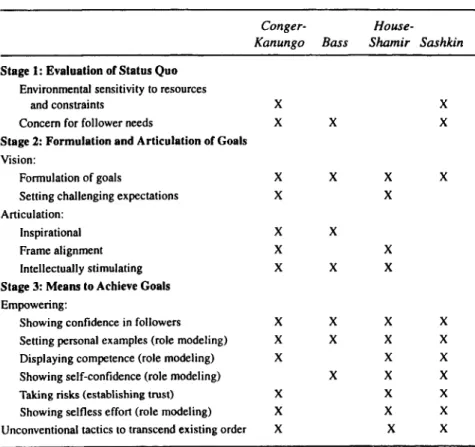
The greatest amount of both theoretical development and empirical research on charismatic leadership to date has been in the area of leader behaviors. This is due largely to the backgrounds of the researchers, most of whom have a strong behavioral orientation. Essentially, there are four groups of researchers who have carved out their own models—though each has a measure of overlap with the others in the attributes they identify. They are (1) Bernard Bass, Bruce Avolio, and their colleagues; (2) Jay Conger and Rabindra Kanungo, (3) Robert House, Boas Shamir, Jane Howell, and their colleagues, and (4) Marshall Sashkin. In this section, we will examine in depth the work of Bass/Avolio and House/Shamir/
Howell. Our own research will be presented in the next chapter. We will discuss only briefly here the fourth model, proposed by Sashkin (1988) under the label of "visionary leadership," because it has not been the subject of extensive theory development. It was presented in our book Charismatic Leadership in 1988.
Although his model has received limited research attention, it does highlight the importance of visioning behavior, a core element in charismatic leadership.
Besides visioning behavior, Sashkin identified five other behaviors: (1) creating attention of others on key issues through unconventional and creative actions, (2) effective interpersonal communication, (3) demonstrating trustworthiness, (4) showing self-respect and respect toward others, and (5) taking personal risk.
Bass and Avolio:
Transformational Leadership
As noted earlier, Bass and, later, his colleague Avolio would build on Burns's notion of transformational leadership and develop a similar model for organiza- tional leaders. As Bryman (1992, pp. 97-98) has pointed out, their model goes farther conceptually than Burns's original model. In his 1985 book titled Leadership and Performance Beyond Expectations, Bass conceptualized the transactional and transformational dimensions as separate, whereas Burns had defined them as two ends of a spectrum. For Bass, therefore, a leader could be both transformational and transactional. In addition, Bass was determined to
more precisely identify the actual behaviors that these leaders demonstrated, whereas Burns was content with more of a "big picture" overview.
At the heart of Bass and Avolio's model of transformational leaders is the notion that these leaders are able to motivate subordinates to performance levels that exceed both their own and their leader's expectations. Transformational leaders accomplish this by raising the importance of certain goals, by demon- strating the means to achieve them, and by inducing subordinates to transcend their self-interests for the goals' achievement. In the process, these leaders also stimulate and meet subordinates' higher-order needs—for example, Maslow's (1968) self-actualization need—which in turn generates commitment, effort, and ultimately greater performance.
Bass and Avolio (1993) built their model of transformational leadership around four behavioral components of the leader: (1) charisma or idealized influence, (2) inspiration, (3) intellectual stimulation, and (4) individualized consideration. Charisma is a separate component and is defined in terms of both the leader's behavior (such as articulating a mission) and the followers' reactions (such as trust in the leader's ability) (Bass & Avolio, 1993). The emphasis, however, is on charisma's role in enabling the leader to influence followers by arousing strong emotions and identification with the leader. Identifying with the leader reduces follower resistance to change, while emotional arousal creates a sense of excitement about the mission. Bass (1985) argues, however, that charisma alone is insufficient for transformational leadership: "Charisma is a necessary ingredient of transformational leadership, but by itself it is not sufficient to account for the transformational process" (p. 31).
Although originally treated as a subfactor within charismatic leadership, the component of inspiration is designed to motivate. Much of this dimension centers around communication, in that the transformational leader "communi- cates high expectations, uses symbols to focus efforts, expresses important pur- poses in simple ways" (Bass, 1990, p. 22). Intellectual stimulation concerns the leader's provision of a flow of new ideas and perspectives that challenge followers to rethink old and conventional ways of approaching organizational tasks.
The fourth component of individualized consideration is similar to the early Ohio State notions of consideration. Providing encouragement and support to followers, assisting their development by promoting growth opportunities, and showing trust and respect for them as individuals are activities under this dimension.
Its role is to bond the leader and the led and to build follower self-confidence and heighten personal development.
In Bryman's Charisma and Leadership in Organizations (1992), the meth- odological shortcomings of the Bass model have been well highlighted. Because
both of the measures to capture transformational leadership (the Leadership Behavior Description Questionnaire [LBDQ] and the Multifactor Leadership Questionnaire [MLQ]) are based on subordinate ratings, there are potential problems of contamination by implicit leadership theories. Bass and Avolio, for example, discovered that descriptions of the transformational leader are signifi- cantly closer to subordinates' images of the ideal leader than descriptions of transactional leadership are. There are also issues of whether respondents' ratings of their leader's behavior are affected by their knowledge of the leader's effectiveness. In other words, perceptions of effectiveness may result in height- ened attributions of leadership despite reality. There is little appreciation for contextual variables or differences, and partly as a result, the implications for situational differences under the model remain unexplored (Bryman, 1992, pp. 128-129).
In addition, Bryman (1992) points out that Bass's measure of charisma itself may be a bit flawed. For example, vision is treated as a component of inspira- tional, rather than charismatic, leadership. The bulk of the literature in the field, however, sees vision as a component of charismatic leadership. Furthermore, Max Weber believed that the basis for charismatic leadership was a perception by followers that their leader was extraordinary. At best, only 2 of Bass's 10 measurement items could be considered to convey this quality (Bryman, 1992, p. 130). Moreover, despite some modifications, the measure includes items that are a mix of both leader behaviors and follower effects. As such, it blurs the distinctions between the two. Yet it is crucial that we be able to separate out the effects of individual leader behaviors on specific follower outcomes.
As one might imagine, there also has been some confusion as to the essential differences between the Bass and Avolio transformational leadership model and other models of charismatic leadership. As Bryman (1992) notes, the Bass model is built around the leader who articulates a vision that excites followers and who engages in behaviors that build intense loyalty and trust. These dimensions overlap considerably with those postulated by charismatic leadership theories.
This is especially true given that the role of charisma in the Bass model is very important. In their empirical studies (e.g., Avolio & Yammarino, 1990; Bass, 1985; Hater & Bass, 1988; Yammarino & Bass, 1990), the component of charisma generally has the strongest correlation of any of the model's dimensions with subordinates' ratings of leadership effectiveness and their own satisfaction. It is clearly the most influential. (A comparison of the Bass model with other charismatic theories is presented in the next chapter. Such a comparison reveals that, in essence, there is little real difference in behavioral components. In the literature itself, we also see the two terms used interchangeably, and sometimes
authors describe them as one or even use the label "charismatic/transformational leadership"; for example, Avolio and Gibbons, 1988; House and Shamir, 1993;
Hunt, 1991).
House and Shamir: Charismatic Leadership
In one of the field's earliest writings on charismatic leadership in organiza- tions, Robert House (1977) published a book chapter titled "A 1976 Theory of Charismatic Leadership." It outlined not only the leader behaviors that were possibly associated with charismatic leadership but also certain personal traits and situational variables. In it, House argued that charismatic leaders could be distinguished from others by their tendency to dominate, a strong conviction in their own beliefs and ideals, a need to influence others, and high self-confidence.
Through emotionally appealing goals and the demonstration of behaviors that aroused followers' own needs for achievement, affiliation, and power, the charismatic leader was able to motivate high levels of task accomplishment. In addition, House theorized that these leaders simultaneously communicated high performance expectations as well as confidence in their followers' ability to meet such expectations. These actions, in turn, enhanced follower expectations that their efforts would lead to accomplishments. Through role-modeling, charis- matic leaders demonstrated the values and beliefs they wished for followers to endorse so that the mission would be successful.
Like most models in the early stages of theory development, House's had several important shortcomings. As Yukl (1994) notes, House's description of the influence process was rudimentary, especially in the light of the profound influence he argued that charismatic leaders had over their followers. Second, his theory was based largely around dyads—the leader and "the follower"—
rather than collectives that are the basis of organizations. Finally, absent from his theory were certain components that would appear in later theories, such as the notion of self-sacrifice, unconventional behavior, and the use of nontradi- tional strategies and tactics (Conger, 1989a; Conger & Kanungo, 1988b).
Since that time, House and a series of colleagues (House & Howell, 1992;
House & Shamir, 1993; House et al., 1991; Shamir et al., 1993) have made revisions to his earlier theory. The most important and significant revision was by Shamir and colleagues (1993) in an article titled "The Motivational Effects of Charismatic Leadership: A Self-Concept Based Theory." Focused on explain- ing the profound levels of motivation typically associated with charismatic leadership, they postulated that these motivational effects could best be ex- plained by focusing on the self-concept of the followers. Citing supporting
research (e.g., Csikszentmihalyi & Rochberg-Halton, 1981; Kinder & Sears, 1985; Prentice, 1987; Snyder & Ickes, 1985), they point out that as human beings we seek to establish and affirm a sense of identity for ourselves (known as the self-concept). What charismatic leaders do is tie these self-concepts of followers to the goals and collective experiences associated with their missions so that they become valued aspects of the followers' self-concepts.
In terms of details, their theory hypothesizes that charismatic leadership transforms follower self-concepts and achieves its motivational outcomes through at least four mechanisms: (1) changing follower perceptions of the nature of work itself, (2) offering an appealing future vision, (3) developing a deep collective identity among followers, and (4) heightening both individual and collective self-efficacy. The processes that Shamir and colleagues (1993) de- scribe as producing these effects follow in the paragraphs below.
Charismatic leaders transform the nature of work (in this case, work meant to achieve the organization's vision) by making it appear more heroic, morally correct, and meaningful. They in essence de-emphasize the extrinsic rewards of work and focus instead on the intrinsic side. Work becomes an opportunity for self- and collective expression. The reward for individual followers as they accomplish mission tasks is one of enhanced self-expression, self-efficacy, self-worth, and self-consistency. The idea is that eventually followers will come to see their organizational tasks as inseparable from their own self-concepts.
To accomplish this change in perceptions of work, the charismatic leader uses several means. One of the most important mechanisms, as described by Shamir and colleagues (1993), is the leader's vision, which serves to enhance follower self-concepts through three paths. By offering an optimistic and appealing future, the vision heightens the meaningfulness of the organization's goals.
Second, the vision is articulated as a shared one, promoting a strong sense of collective identity. Presumably, the vision is also unique, and by stressing that the vision is the basis for the group's identity, the charismatic leader distin- guishes his or her followers from others and further encourages followers to transcend their individual self-interests for the collective's. Third, the leader's expression of confidence in followers' abilities to achieve the vision heightens their sense of self-efficacy. They come to feel capable of creating a reality out of what is currently a lofty and U t o p i a n set of ambitions.
Integral to the Shamir and colleagues' theory is the charismatic leader's ability to create a deep collective identity. As just noted, the shared vision is one of the principal means. In addition, the charismatic leader actively promotes perceptions that only by banding together can group members accomplish exceptional feats. Furthermore, the leader uses his or her own behaviors to
increase identification with the collective through the deployment of rituals, ceremonies, slogans, symbols, and stories that reinforce the importance of a group identity. The significance of creating this collective identity is in the follower outcomes that it is able to produce. Specifically, the authors cite research (Meindl & Lerner, 1983) indicating that a shared identity among individuals increases the "heroic motive" and the probability that individual self-interests will be abandoned voluntarily for collective and altruistic under- takings. As a result, as charismatic leaders cultivate a collective identity in their followers' self-concepts, they heighten the chances that followers will engage in self-sacrificial, collective-oriented behavior. The group identification in es- sence strengthens the shared behavioral norms, values, and beliefs among the members. All of this ensures a concerted and unified effort on the part of followers to achieve the mission's goals.
Finally, Shamir and colleagues argue that charismatic leaders achieve their extraordinary levels of follower motivation by focusing their efforts on building follower self-esteem and self-worth. They accomplish this by expressing high expectations of their followers and great confidence in the followers' abilities to meet these expectations (Eden, 1990; Yukl, 1989). This in turn enhances the perceived self-efficacy of followers. From the research of Bandura (1986), we know that the sense of self-efficacy can be a source of strong motivation. For example, it has been shown that individuals with a high sense of self-efficacy are more willing to expend greater work effort and to demonstrate persistence in overcoming obstacles to achieve their goals. By also fueling a collective sense of self-efficacy, the charismatic leader feeds perceptions of the group that they together accomplish tremendous feats. In addition, when collective self-efficacy is high, members of an organization are more willing to cooperate with one another in joint efforts to realize their shared aims (Yukl, 1994).
In Shamir and colleagues' revised theory, what we see is a shift from House's earlier conceptualization, in which charismatic leadership was viewed more as a dyadic process, to one in which it is a collective process. As Yukl (1994) has noted, the recent theory also places more emphasis on the reciprocal nature of the influence process under charismatic leadership. For example, charismatic leadership is likely to be far more motivational when the leader chooses a vision that is congruent with the followers' own values and identities. Likewise, followers are more likely to select as their leader an individual who espouses their core values, beliefs, and aspirations, despite the fact that these may not always be clearly articulated by followers themselves.
In conclusion, on the dimension of leader behaviors, there has been consid- erable attention directed toward specific behaviors and activities such as
(1) vision, (2) inspiration, (3) meaning-making, (4) empowerment, (5) setting of high expectations, and (6) fostering of collective identity. These charac- teristics have now formed a standard "paradigm" for the field in that there is fairly universal agreement concerning their importance. The question, of course, remains: What have we overlooked? As we shall see shortly, other behavioral characteristics play important roles. We suspect there may be others that we have yet to identify.
Follower Characteristics and Dynamics
The topic of the followers of charismatic leaders is very poorly explored.
There are few studies in this area, especially in business contexts. Earlier research on charismatic leaders by political scientists and psychoanalysts (e.g., Downton, 1973; Kets de Vries, 1988) proposed that the followers of charismatic leaders were more likely to be those who, because of an essentially dependent character, were easily molded and persuaded by such dynamic leaders. They were drawn to the charismatic leader because he or she exudes what they lack:
self-confidence and conviction.
From a psychoanalytic viewpoint, the argument essentially goes that follow- ers are attempting to resolve a conflict between who they are and what they wish to become. They accomplish this by substituting their leader as their ideal, or in psychoanalytic terms, their ego ideal. Some psychoanalysts (e.g., Downton,
1973; Erikson, 1968) trace this type of need back to an individual's failure to mature in adolescence and young adulthood. Because of absent, oppressive, or weak parents, individuals may develop a state of identity confusion. Associating emotionally with the charismatic leader is a means of coping with this confusion and achieving maturity. Given that the leader is in essence a substitute parent and model, a powerful emotional attachment naturally is formed by followers.
Wishing to garner the leader's attention and affection, followers enthusiastically comply with his or her wishes. The assumption underlying this scenario of follower-leader dynamics is that followers are fulfilling a pathological need rather than a healthy desire for role models from whom to learn and grow. There has been support for these dynamics in research on cults and certain political movements. For example, in a study of the charismatic religious leader Reverend Sun Moon, Lodahl (1982) discovered that followers had greater feelings of helplessness, cynicism, and distrust of political action, as well as less confidence in their sexual identity, than a sample of college students. Other studies (e.g., Davies, 1954; Freemesser & Kaplan, 1976; Galanter, 1982) found followers of charismatic political and religious leaders to have lower self-esteem, a higher
intolerance for indecision and crisis, and more experiences of psychological distress than others.
These studies, however, were conducted almost entirely on populations of individuals who voluntarily joined movements and were often disaffected by society or elsewhere, in contexts of crisis where individuals are needy by definition. In the corporate world, the situation is somewhat different. For example, in a large corporation, the subordinate of a charismatic leader may not have voluntarily chosen to belong to that leader's unit. More commonly, bosses are hired or promoted into positions, and the subordinates are already in place.
For subordinates, then, there often is little freedom to select who will lead them.
Likewise, leaders may find themselves inheriting a staff of confident, assertive employees. In the case of entrepreneurial companies founded by charismatic leaders, followers may be drawn to such contexts because of the challenge and opportunity. They may be seekers of the risk and uncertainty associated with a new venture—quite in contrast to followers who are dependent seekers of certainty.
Given this, there is a second school of thought that theorizes that followers are attracted to the charismatic leader because of a more constructive identifica- tion with the leader's abilities, a desire to learn from him or her, a quest for personal challenge and growth, and the attractiveness of the mission. This, of course, is largely what the theories in the previous section argued. With Bass (1985), it is the opportunity to fulfill higher-order needs. In the theory of Shamir and colleagues (1993), it is an opportunity to have one's self-esteem, self-worth, and self-efficacy constructively enhanced.
Confirming these theoretical speculations, Conger (1989a) found in field studies of charismatic leaders in business that subordinates often described their attraction to the leader's qualities of self-confidence, strong convictions in the mission, a willingness to undertake personal risks, and a history of prior accomplishment. As a result, subordinates felt a sense of fulfilling their own potential as they met their leader's high expectations. In addition, as others have found (e.g., Avolio & Bass, 1988; Bass, 1985), the leader's vision offered attractive outcomes that were motivating in themselves. Conger, however, felt that simple identification and an attractive vision did not fully explain the commitment and motivation that followers demonstrated for their charismatic leaders.
Instead, as theory suggested, Conger discovered that the personal approval of the charismatic leader became a principal measure of a subordinate's self- worth. A dependency then developed to the point that the leader largely defined one's level of performance and ability. As Shamir and colleagues (1993) also
noted, the leader's expression of high expectations set standards of performance and approval, while a continual sense of urgency and the capacity to make subordinates feel unique further heightened motivation. Taken together, these actions promoted a sense of obligation in followers to continually live up to their leader's expectations. As the relationship deepens, this sense of obligation grows. The leader's expression of confidence in subordinates' abilities creates a sense of duty and responsibility. Subordinates can validate the leader's trust in them only through exceptional accomplishments.
Over the long term, a dilemma naturally occurs for many followers. As the subordinates' self-worth is increasingly defined in their relationship to the leader, a precarious dependence is built. Without the leader's affirmation, subordinates can feel that they are underperforming and even failing. In addition, there are fears of being ostracized. As one subordinate explained to Conger (1989a),
There's a love/hate element [in our relationship]. You love him when you're focused on the same issues. You hate him when the contract falls apart. Either you're part of the team or not—there's a low tolerance for spectators. And over a career, you're in and out. A lot depends upon your effectiveness on the team.
You have to build up a lot of credibility to regain any ground that you've lost. (p. 133)
The dark-side dynamics of this dependence will be discussed further in a later section.
In conclusion, we do have some insights into follower dynamics, but gener- ally, our knowledge here is limited in the sense that it is based on only a few case studies and theoretical speculation. This is one area in need of significant attention in the future.
Contextual Influences
Until very recently, interest in the role of context and situational factors has been limited. This is due largely to the backgrounds of those researching leadership. "Micro theorists" (those with a psychological or social psychological orientation) have dominated the field. Few researchers with a more "macro" or sociological perspective have been active in studying leadership. As a result, environmental or contextual investigations rarely have been applied to leader- ship studies outside the fields of political science and religion. Our knowledge
in this area therefore remains poor, and what does exist is largely theoretical and speculative.
The most common speculation has been that periods of stress and turbulence are the most conducive for charismatic leadership. This argument is derived from the work of political scientists looking at charismatic leadership in political and religious contexts; see Cell (1974) and Toth (1981). Max Weber (1925/1968), for example, specifically focused on times of "crisis" as facilitating environ- ments. The basic assumption is either that times of stressful change encourage a longing among individuals for a leader who offers attractive solutions and visions of the future or that charismatic leaders have an easier time promoting a transformational vision during times of uncertainty, when the status quo appears no longer to function (Bryman, 1992).
To date, the most important empirical study to examine situational factors in organizational contexts was conducted by Roberts and Bradley and reported in our volume Charismatic Leadership (1988b). Using a field study, they looked at a school superintendent who was perceived by her organization as a charis- matic leader. In a later appointment to state commissioner of education, that perception of her failed to transfer. In Roberts and Bradley's search to explain why the individual's charisma did not transfer, they discovered several essential differences between the two contexts.
In terms of the organizational environment, the individual's first context, a school district, was one in crisis—confirming the hypothesis that crisis may indeed facilitate the emergence of charismatic leadership. In contrast, the leader's second context at the state government level was not in a similar state of distress. The public's perception was that the state's schools were basically sound and simply in need of incremental improvements. The individual's authority also differed in the two situations. As a superintendent, she had much more control and autonomy. At the state level as commissioner, quite the opposite was true. Her number one priority was political loyalty to the governor.
She no longer possessed the freedom to undertake actions as she deemed necessary. Instead, they had to be cleared through the governor's office. Her relationships also were different. Whereas the district organization had been small, localized geographically, and with limited stakeholders, the situation at the state level was at the opposite end of the spectrum. The agency was far greater in size, complexity, and bureaucracy. The numerous committees and associa- tions in which she had to participate meant that she had little time to build the deep, personal bonds that she had established at the district level. As a result, her impact at the state level was no longer personal, and perceptions of her as a charismatic leader did not materialize.
From the Roberts and Bradley study, we might conclude that context shapes charismatic leadership in at least two ways. First, an environment in crisis is indeed more receptive to leadership in general and is more likely to be open to proposals—common to charismatic leaders—for radical change such as those embodied in the superintendent's vision. Second, there are characteristics of organizations that influence an individual's latitude to take initiative and to build personal relationships, which in turn shape perceptions of charismatic leader- ship. More latitude for initiative on the job simply may result in more opportu- nities to demonstrate leadership. Closer proximity to followers may permit greater relationship building. The superintendent's position allowed the leader far more autonomy to act than did the commissioner's position. The superinten- dent's responsibilities were more geographically concentrated and involved a more limited number of stakeholders, which resulted in deeper working rela- tionships at the district level and also inspired affection and trust in her leader- ship. These in turn heightened perceptions of her charisma.
With findings like Roberts and Bradley's in mind, we can think of the contexts of organizations as divided into an outer and an inner context (Pettigrew, 1987), the outer being the environment beyond the organization and the inner including the organization's culture, structure, power distribution, and so on. Using this simple framework, it is useful to divide our discussion around these two contextual dimensions. We will start with the external environment.
On the issue of whether crisis is the critical external condition, Conger (1993) hypothesized that there actually could be much more variability in environ- mental conditions than we might think. He argued that charismatic leadership is not necessarily precipitated by conditions of crisis and distress but also may be found in entrepreneurial environments. In earlier research looking at charis- matic business leaders (Conger, 1989a), he found charismatic leaders who were entrepreneurs operating in environments not so much of crisis but of great opportunity, munificence, and optimism. Instead of crisis being the sole contex- tual condition, there may instead be at least two conducive environments, one demanding a major reorientation of the existing order because of a perceived state of distress and the other involving the emergence or creation of a new order based on a "munificence entrepreneurial" context. Both environments, however, share conditions of uncertainty.
In addition, Conger argued that more of an interplay exists between the leader and the context. In other words, context is not the key determinant, but rather the leader and the context influence one another, with the relative weight of each's influence varying from situation to situation. For example, Willner (1984) found that among charismatic leaders in the political arena, some were able to
induce or create through their own actions the necessary contextual conditions of a crisis. Similarly, we might be able to find charismatic leaders who are able to foster perceptions of munificence and great entrepreneurial opportunity.
Conger also went on to propose that the more conducive the existing contex- tual conditions, the less the magnitude or the fewer the number of charismatic attributes required for a leader to be perceived as charismatic. Likewise, the greater the intensity or the number of "charismatic attributes" present in a leader, the less need would exist for the context to be characterized by extreme crisis or rich entrepreneurial opportunities. Given a wealth of charismatic attributes, the leader may be able to create such interpretations of the environment through his or her own actions. Such hypotheses are speculative and still in need of research attention.
Beyond these limited efforts focusing on the external environments of char- ismatic leadership, there has been only one major theoretical work focusing on contextual conditions within organizations that may influence charismatic lead- ership. Pawar and Eastman (1997) proposed four factors of organizations that might affect receptivity to transformational leadership (see also Shamir, House,
& Arthur, 1993, p. 578).1 The four factors that Pawar and Eastman have identi- fied are
1. the organization's emphasis on efficiency versus adaptation,
2. the relative dominance of the organization's technical core versus its boundary- spanning units,
3. organizational structures, and 4. m o d e s o f governance.
Their model is built around the central notion that transformational and charis- matic leadership is essentially about leading organizational change. A critical premise is that only organizations that are receptive to change are likely to respond to and aid leadership that offers a new vision, new values, and a collective identity. Using a series of ideal types, Pawar and Eastman attempt to differentiate between organizations that are more conducive to change and therefore to charismatic and transformational leadership and those that are not.
They begin with the notion that organizations are seeking one of two basic goals—efficiency or adaptation (Selznick, 1948). The challenge is that the goals of efficiency and adaptation have conflicting purposes, the former requiring organizational stability and the latter centered around change. In reality, as we know today, most business organizations are attempting both simultaneously,
and this highlights one of the dilemmas of Pawar and Eastman's theory. It is built around idealized polarities that provide a simple elegance in terms of theory building but may not reflect the complexities of reality. Nevertheless, they hypothesize that an efficiency orientation requires goal stability and, necessarily, administrative management or transactional leadership to achieve its goals.
During adaptation periods, on the other hand, the leader's role is to overcome resistance to chang