PROPOSAL|2023
PT. STRIVECHEM INDONESIA
SUBSIDARY OF SISKEM GROUP
Ref : 1/MKT-…./Q/IV/2023
CHEMICAL CLEANING
& LUBE OIL CLEANING FOR
BOILER PACKAGE
SULUT-1 CFSPP 2 x 50 MW PROJECT
LOCATION : BOLANG MONGONDOW, SULAWESI UTARA
PROPOSAL|2023
PT. STRIVECHEM INDONESIA
SUBSIDARY OF SISKEM GROUP
GENERAL
The efficiency of a boiler is dependant on the heat transfer capacity of the heating surfaces, and this is seriously impaired by the internal surfaces of tubes if they get coated with deposits, as occurs naturally in the course of normal running.
Also, a newly erected boiler, or one on which extensive repairs to pressure parts have been carried out , may have an oil or grease film on internal areas which is impossible to wholly remove by manual cleaning. Since oil and grease have a very low rate of heat transfer, tubes contaminated by them can become over heated when subjected to high temperatures. This will lead to blistering or burning of the tube metal with consequent risk of rupture. Chemical cleaning of boiler pressure parts is carried out to over come the above problems. This is to be carried out at following stages.
a. Prior to commissioning a newly erected boiler.
b. Following extensive repairs to boiler pressure parts.
c. When it is suspected that the internal heating surfaces are fouled with deposits from normal running. Due to poor quality of feed water.
NOTE :
Water quality should be the prime concern for operator to have long life of pressure parts.
INITIAL PREPARATION
a) Boiler hydraulic is complete.b) Power supply is available to run the drives.
c) Water & Chemicals are available.
d) Boilers filling arrangements are complete.
e) Fuel is available.
In order to prevent fouling of internal parts having small clearances during the initial boil out and acid cleaning, the drum internals / corrugated plates are not erected. However, they are to be thoroughly cleaned with wire brush air or steam blown before installation.
PROPOSAL|2023
PT. STRIVECHEM INDONESIA
SUBSIDARY OF SISKEM GROUP
It is essential to have spare gaskets for upper and lower drums as drum inspection has to be carried out after alkali boil and after chemical cleaning to ensure effectiveness of the alkali boil out and chemical cleaning.
1.1 SCOPE
Generating surfaces, drum and economizer are covered under the chemical cleaning.
The Chemical Cleaning work to be perform, consist of :
No Service Item Quantity Description
1 Chemical Cleaning Package of Boiler Package, est. volume system 110 m3 x 2 Boiler
2 Packages Soda Boil Out (Degreasing)
2 Chemical Cleaning Package of Pre- Boiler System, est. volume system 60 m3 x 2 Boiler
2 Packages Alkali Cleaning (Degreasing)
3 Lube Oil Flushing 4 Packages Cleaning (Degreasing)
There are step of chemical cleaning :
§
PRECLEANING/DEGREASING
To remove the accumulation of foreign matter.
All new equipment should be precleaned for removal of grease, oil, corrosion products/rust, mill scale, and dirt. Clean surfaces enable corrosion inhibitors to promote a uniform protective film.
•
PASSIVATION
To promote the rapid formation of an inhibiting film.
Most methods of corrosion control involve the formation of a film to act as a barrier to corrosion. The effectiveness of the treatment depends largely on the rate at which the barrier film is formed.
PROPOSAL|2023
PT. STRIVECHEM INDONESIA
SUBSIDARY OF SISKEM GROUP
1.2 PRODUCTS - CLEANING CHEMICALS AS SISKEM RECOMMENDATION :
A. CLEANING BOILER Soda Boil Out (Degreasing)
S-4221 Boiling Out Agent 10 kg for each 1 m3
S-4110 Surfactant 0.10 kg for each 1 m3
B. CLEANING PRE-BOILER Alkali Cleaning (Degreasing)
S-4224 Alkaline Cleaning Agent 10 kg for each 1 m3
S-4110 Surfactant 0.10 kg for each 1 m3
C. LUBE OIL CLEANING Alkali Cleaning (Degreasing)
S-4224 Alkaline Cleaning Agent 10 kg for each 1 m3
S-4110 Surfactant 0.10 kg for each 1 m3
PROPOSAL|2023
PT. STRIVECHEM INDONESIA
SUBSIDARY OF SISKEM GROUP
1.3 PROCESS EXECUTION
A. CLEANING BOILERq
CHEMICAL CONSUMPTION
q
MATERIAL & PREPARATION
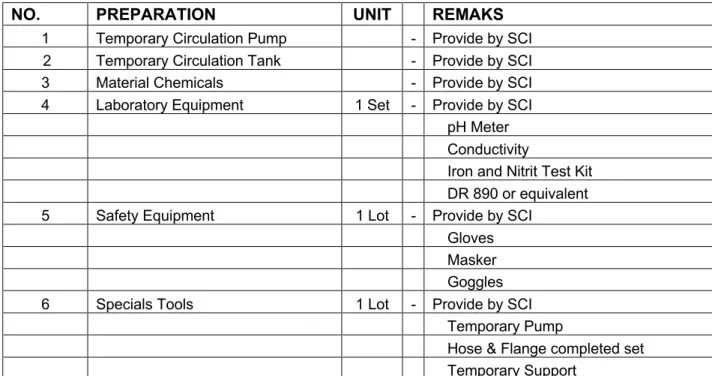
Table below are lists of the equipment would be used during cleaning :
NO. PREPARATION UNIT REMAKS
1 Temporary Circulation Pump - Provide by SCI 2 Temporary Circulation Tank - Provide by SCI
3 Material Chemicals - Provide by SCI
4 Laboratory Equipment 1 Set - Provide by SCI pH Meter Conductivity
Iron and Nitrit Test Kit DR 890 or equivalent
5 Safety Equipment 1 Lot - Provide by SCI
Gloves Masker Goggles
6 Specials Tools 1 Lot - Provide by SCI
Temporary Pump
Hose & Flange completed set Temporary Support
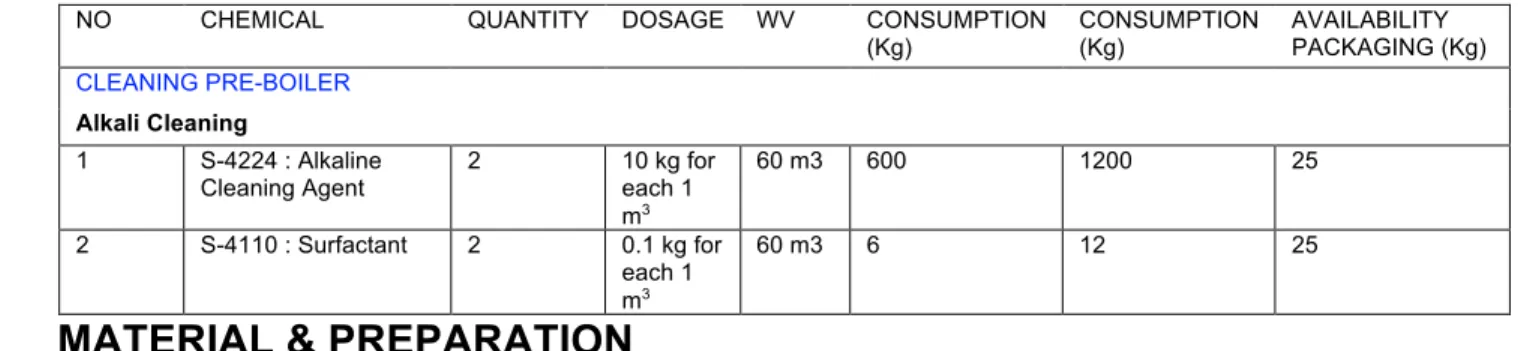
NO CHEMICAL QUANTITY DOSAGE WV CONSUMPTIO
N (Kg)
CONSUMPTION (Kg)
AVAILABILITY PACKAGING (Kg) CLEANING BOILER
Soda Boil Out (Degreasing) 1 S-4221 : Boiling Out
Agent
2 10 kg for
each 1 m3
110 m3 1100 2200 25
2 S-4110 : Surfactant 2 0.1 kg for each 1 m3
110 m3 11 22 25
PROPOSAL|2023
PT. STRIVECHEM INDONESIA
SUBSIDARY OF SISKEM GROUP
q
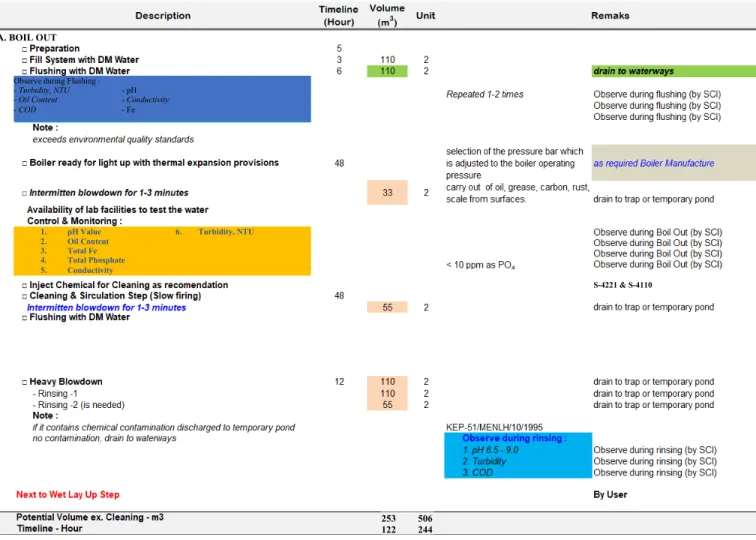
PROCESS TIMELINE & MONITORING
Table below are lists of step of procedure and monitoring during cleaning :
S-4221 & S-4110
253 506 122 244 A. BOIL OUT
5. Conductivity 6. Turbidity, NTU
1. pH Value 6. Turbidity, NTU
2. Oil Content 3. Total Fe 4. Total Phosphate 5. Conductivity Observe during Flushing :
- Turbidity, NTU - pH
- Oil Content - Conductivity
- COD - Fe
PROPOSAL|2023
PT. STRIVECHEM INDONESIA
SUBSIDARY OF SISKEM GROUP
Observe during Flushing : - Turbidity, NTU
- Oil Content - COD
q
PROCEDURE ALKALI BOILING OUT
The Boiler has to be flushed with demin water water as follows :
1.1 The Boiler is filled through economizer or filling line using boiler filling pump up to the bottom of the manhole door of the drum.
2.1 After filling, the water is drained partially by opening all the furnace bottom header drain valves for a few minutes. This process is to be repeated 1 - 2 times till the water collected from drains is reasonably clear.
3.1 Filling system with demin water, for starting ALKALI BOILING OUT.
Paralel inject Chemical as recommendation with options : OPTION 1 :
Mix the required quantity of chemicals in the separate mixing drum, mix with water and transfer in small increment to boiler drum through open manhole door. After adding the chemical to boiler, close the drum manhole door.
OPTION 2 :
Mix the required quantity of chemicals in the separate mixing drum, mix with water and transfer in small increment to boiler with injection facilities maintenance chemical.
4.1 Light-up the boiler and start heating with slow-firing to raise the temperature at a very slow rate (1ºC per minute for change in saturated steam temperature). Slow firing during 24 hour.
Note :
q Selection of the pressure bar which is adjusted to the boiler operating pressure.
q As required boiler manufactured.
Observe during Flushing :
- Turbidity, NTU - pH
- Oil Content - Conductivity
- COD - Fec
PROPOSAL|2023
PT. STRIVECHEM INDONESIA
SUBSIDARY OF SISKEM GROUP
Availability of lab facilities to test the water Control & Monitoring :
1. pH Value 2. Oil content 3. Total Fe
4. Total Phosphate
5.1 Maintain boil-out conditions (ie blowdown, make-up, chemical levels and pressure) for a period of at least 48 hours. The best guide for determining when to end the boil-out is the condition and appearance of water blown from the boiler. A leveling off of the oil and grease, suspended solids, dissolved solids concentrations, and colour indicate that maximum capacity of alkaline boil-out cleaning solution is attained.
Sample to be taken before two hour at the end of each stage and analysis are to be carried to determine the following :
6.1 Fire boiler and slowly increase pressure to its 1/3 operating pressure.
7.1 Hold pressure for four hours, remove heat and allow to sit for 15 minutes, blow out all boiler connections for 10 15 seconds, re fill boiler with make up water, apply heat, and raise pressure. Hold pressure for one hour and repeat blowdown, treated water re fill, heat and pressure sequence.
8.1. When completely drained, open boiler for inspection. If wetted surfaces or boiler are free of oil and grease, boil-out is complete, but if a film of oil and grease are present, repeat boiler cleaning procedure.
1. pH Value 6. Turbidity, NTU 2. Oil Content
3. Total Fe 4. Total Phosphate 5. Conductivity
PROPOSAL|2023
PT. STRIVECHEM INDONESIA
SUBSIDARY OF SISKEM GROUP
B. FOR CLEANING PRE-BOILER
q
CHEMICAL CONSUMPTION
q
MATERIAL & PREPARATION
Table below are lists of the equipment would be used during Boiling Out :
No. Description Unit Remaks
PRE-BOILER
1 Using existing facilities - By user
2 Temporary facility chemical injection - By user
3 Material Chemicals - Provide by SCI
4 Laboratory Equipment 1 Set - Provide by SCI
pH Meter Conductivity
Iron and Nitrit Test Kit DR 890 or equivalent
5 Safety Equipment 1 Lot - Provide by SCI
Gloves Masker Goggles
6 Tools 1 Lot - Provide by SCI
Hose Flange
Temporary Support
NO CHEMICAL QUANTITY DOSAGE WV CONSUMPTION
(Kg)
CONSUMPTION (Kg)
AVAILABILITY PACKAGING (Kg) CLEANING PRE-BOILER
Alkali Cleaning
1 S-4224 : Alkaline Cleaning Agent
2 10 kg for
each 1 m3
60 m3 600 1200 25
2 S-4110 : Surfactant 2 0.1 kg for each 1 m3
60 m3 6 12 25
PROPOSAL|2023
PT. STRIVECHEM INDONESIA
SUBSIDARY OF SISKEM GROUP
q
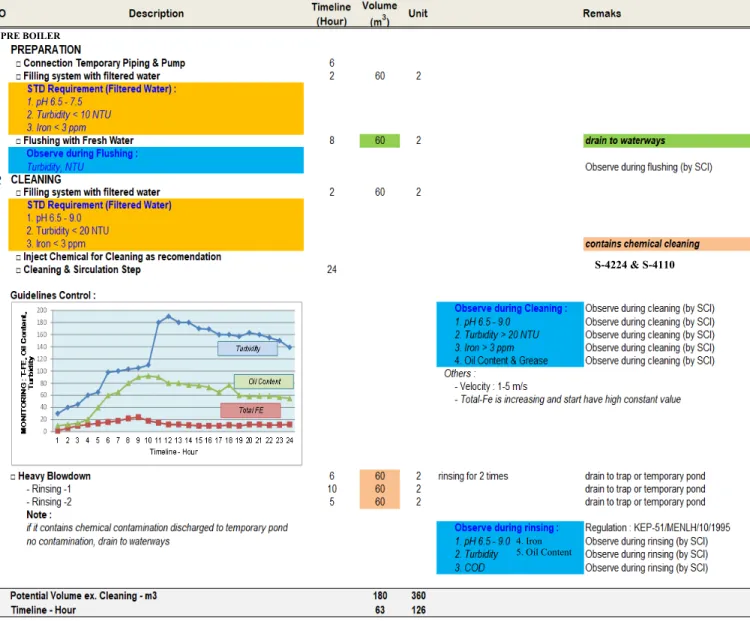
PROCESS TIMELINE & MONITORING
Table below are lists of step of procedure and monitoring during cleaning :
S-4224 & S-4110
4. Iron 5. Oil Content B. PRE BOILER
PROPOSAL|2023
PT. STRIVECHEM INDONESIA
SUBSIDARY OF SISKEM GROUP
q
PROCESS LAY OUT
Flow Scheme of Chemical Cleaning for Pre-Boiler System
TEMPORARY CHEMICAL TANK
LP HEATER
DEAERATOR
BFW PUMP
HP HEATER Temporary Line
PROPOSAL|2023
PT. STRIVECHEM INDONESIA
SUBSIDARY OF SISKEM GROUP
q
PRE-BOILER CLEANING PROCEDURE
1. Fill system with filtered water.Note :
STD Requirement Filtered Water
§ pH 6.5 – 7.5
§ Turbidity < 10 NTU
§ Iron < 3 ppm
2. Flushing system during 4-8 hour to carry out debris from the surface. Observe turbidity during flushing. After flushing drain to waterways.
3. Fill system with filtered water, establish circulation and inject S-4224 & S-4110 at an acceptable concentration during 24 hour.
Velocity of the circulating system should exceed 1-5 m/s to ensure that potential precipitates stay in suspension. Take a baseline measurement of pH, Total Fe, Turbidity and oil content
Maintain the recirculation, monitored T-Fe during recirculation. When T-Fe is increasing and start have high constant value, start adjust blowdown to help reduce T-Fe in the system.
It should be have trending similar with shown below :
0 20 40 60 80 100 120 140 160 180 200
1 2 3 4 5 6 7 8 9 10 11 12 13 14 15 16 17 18 19 20 21 22 23 24 MONITORING : T-FE, Oil Content, Turbidity
Timeline - Hour
Turbidity
Oil Content
Total FE
PROPOSAL|2023
PT. STRIVECHEM INDONESIA
SUBSIDARY OF SISKEM GROUP
After 2 hours of circulation, collect water samples from at least three different locations in system.
If any foaming, add S-9101 as recommended.
4. After 24 hour circulation, dump spent cleaning solution to disposal/temporary pond, and rinsing system with filtered water. Repeat step 3 until water samples collected from system are free of oil, grease, and turbidity.
5. Drain system completely, including all system low points and perform visual inspections of metal surfaces at three different locations.
Observe during Cleaning :Observe during cleaning (by SCI) 1. pH 6.5 - 9.0 Observe during cleaning (by SCI) 2. Turbidity > 20 NTU Observe during cleaning (by SCI) 3. Iron > 3 ppm Observe during cleaning (by SCI) 4. Oil Content & Grease Observe during cleaning (by SCI) Others :
- Velocity : 1-5 m/s
- Total-Fe is increasing and start have high constant value
PROPOSAL|2023
PT. STRIVECHEM INDONESIA
SUBSIDARY OF SISKEM GROUP
C. FOR LUBE OIL FLUSHING
q
CHEMICAL CONSUMPTION
q
MATERIAL & PREPARATION
Table below are lists of the equipment would be used during cleaning :
NO. PREPARATION UNIT REMAKS
1 Temporary Circulation Pump - Provide by SCI 2 Temporary Circulation Tank - Provide by SCI
3 Material Chemicals - Provide by SCI
4 Laboratory Equipment 1 Set - Provide by SCI pH Meter Conductivity
Iron and Nitrit Test Kit DR 890 or equivalent
5 Safety Equipment 1 Lot - Provide by SCI
Gloves Masker Goggles
6 Specials Tools 1 Lot - Provide by SCI
Temporary Pump
Hose & Flange completed set Temporary Support
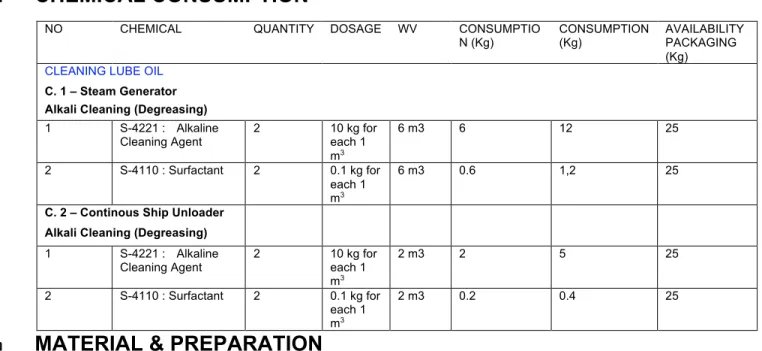
NO CHEMICAL QUANTITY DOSAGE WV CONSUMPTIO
N (Kg) CONSUMPTION
(Kg) AVAILABILITY
PACKAGING (Kg) CLEANING LUBE OIL
C. 1 – Steam Generator Alkali Cleaning (Degreasing) 1 S-4221 : Alkaline
Cleaning Agent 2 10 kg for each 1 m3
6 m3 6 12 25
2 S-4110 : Surfactant 2 0.1 kg for each 1 m3
6 m3 0.6 1,2 25
C. 2 – Continous Ship Unloader Alkali Cleaning (Degreasing) 1 S-4221 : Alkaline
Cleaning Agent
2 10 kg for
each 1 m3
2 m3 2 5 25
2 S-4110 : Surfactant 2 0.1 kg for each 1 m3
2 m3 0.2 0.4 25
PROPOSAL|2023
PT. STRIVECHEM INDONESIA
SUBSIDARY OF SISKEM GROUP
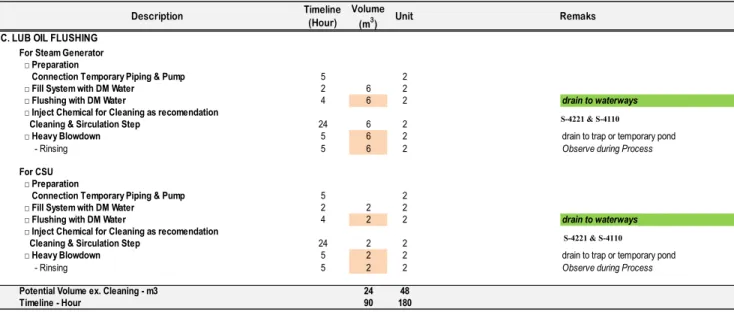
□ PROCESS TIMELINE & MONITORING
Table below are lists of step of procedure and monitoring during cleaning :
C. LUB OIL FLUSHING For Steam Generator
□ Preparation
Connection Temporary Piping & Pump 5 2
□ Fill System with DM Water 2 6 2
□ Flushing with DM Water 4 6 2 drain to waterways
□ Inject Chemical for Cleaning as recomendation S-4220
Cleaning & Sirculation Step 24 6 2
□ Heavy Blowdown 5 6 2 drain to trap or temporary pond
- Rinsing 5 6 2 Observe during Process
For CSU
□ Preparation
Connection Temporary Piping & Pump 5 2
□ Fill System with DM Water 2 2 2
□ Flushing with DM Water 4 2 2 drain to waterways
□ Inject Chemical for Cleaning as recomendation S-4220
Cleaning & Sirculation Step 24 2 2
□ Heavy Blowdown 5 2 2 drain to trap or temporary pond
- Rinsing 5 2 2 Observe during Process
Potential Volume ex. Cleaning - m3 24 48
Timeline - Hour 90 180
Description Timeline
(Hour) Volume
(m3) Unit Remaks
S-4221 & S-4110
S-4221 & S-4110
PROPOSAL|2023
PT. STRIVECHEM INDONESIA
SUBSIDARY OF SISKEM GROUP
q
LUBE CLEANING PROCEDURE
1. Fill system with filtered water.Note :
STD Requirement Filtered Water
§ pH 6.5 – 7.5
§ Turbidity < 10 NTU
§ Iron < 3 ppm
2. Flushing system during 4-8 hour to carry out debris from the surface. Observe turbidity during flushing. After flushing drain to waterways.
3. Fill system with filtered water, establish circulation and inject S-4221 & S-4110 at an acceptable concentration during 24 hour.
Velocity of the circulating system should exceed 1-5 m/s to ensure that potential precipitates stay in suspension. Take a baseline measurement of pH, Total Fe, Turbidity and oil content
Maintain the recirculation, monitored T-Fe during recirculation. When T-Fe is increasing and start have high constant value, start adjust blowdown to help reduce T-Fe in the system.
It should be have trending similar with shown below :
0 20 40 60 80 100 120 140 160 180 200
1 2 3 4 5 6 7 8 9 10 11 12 13 14 15 16 17 18 19 20 21 22 23 24 MONITORING : T-FE, Oil Content, Turbidity
Timeline - Hour
Turbidity
Oil Content
Total FE
PROPOSAL|2023
PT. STRIVECHEM INDONESIA
SUBSIDARY OF SISKEM GROUP
After 2 hours of circulation, collect water samples from at least three different locations in system.
If any foaming, add S-9101 as recommended.
4. After 24 hour circulation, dump spent cleaning solution to disposal/temporary pond, and rinsing system with filtered water. Repeat step 3 until water samples collected from system are free of oil, grease, and turbidity.
5. Drain system completely, including all system low points and perform visual inspections of metal surfaces at three different locations.
Observe during Cleaning :Observe during cleaning (by SCI) 1. pH 6.5 - 9.0 Observe during cleaning (by SCI) 2. Turbidity > 20 NTU Observe during cleaning (by SCI) 3. Iron > 3 ppm Observe during cleaning (by SCI) 4. Oil Content & Grease Observe during cleaning (by SCI) Others :
- Velocity : 1-5 m/s
- Total-Fe is increasing and start have high constant value
PROPOSAL|2023
PT. STRIVECHEM INDONESIA
SUBSIDARY OF SISKEM GROUP
3.4 WASTE WATER DISPOSAL
Wastewater discharged into a municipal sanitary sewer system from existing or new systems shall be within the limits established by local authorities.
We recommend as follows :
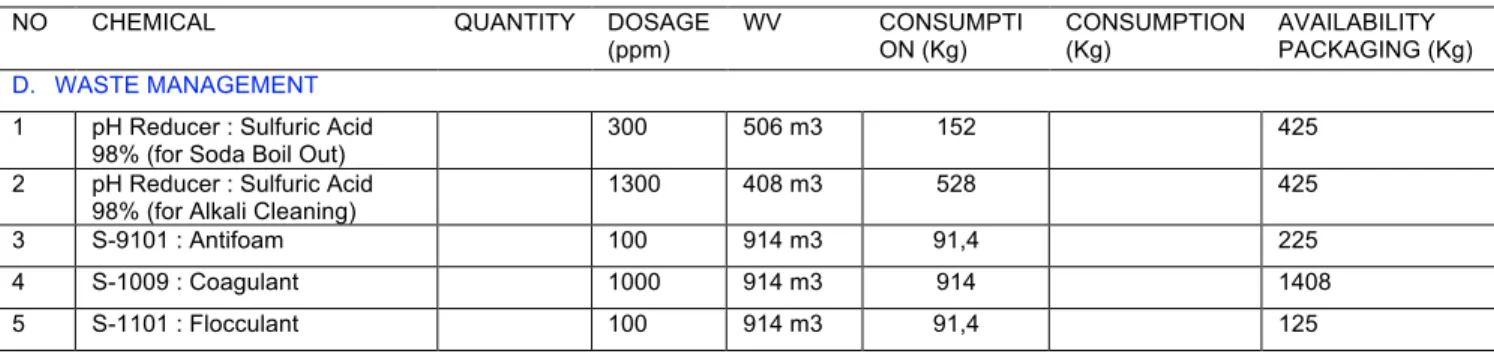
E. PROCESS TIMELINE & MONITORING
Table below are lists of step of procedure and monitoring during treatment :
NO CHEMICAL QUANTITY DOSAGE
(ppm)
WV CONSUMPTI
ON (Kg)
CONSUMPTION (Kg)
AVAILABILITY PACKAGING (Kg) D. WASTE MANAGEMENT
1 pH Reducer : Sulfuric Acid
98% (for Soda Boil Out) 300 506 m3 152 425
2 pH Reducer : Sulfuric Acid 98% (for Alkali Cleaning)
1300 408 m3 528 425
3 S-9101 : Antifoam 100 914 m3 91,4 225
4 S-1009 : Coagulant 1000 914 m3 914 1408
5 S-1101 : Flocculant 100 914 m3 91,4 125
D. WASTE WATER TREATMENT KEP-51/MENLH/10/1995
Observe during Treatment :
1. pH 6.0 - 9.0 Monitoring during treatment (by SCI)
2. Turbidity < 30 NTU Treated by Coagulant/FlocculantMonitoring during treatment (by SCI)
3. Iron < 3 ppm Treated by Coagulant/FlocculantMonitoring during treatment (by SCI)
4. COD < 300 Treated by Coagulant/FlocculantMonitoring during treatment (by SCI)
Remaks
Description Volume
(m3) Unit
PROPOSAL|2023
PT. STRIVECHEM INDONESIA
SUBSIDARY OF SISKEM GROUP
F. PROCESS LAY OUT
The following is Flow Chart Diagram Waste Handling as follows are :
Processing Waste Water Treatment :
A B
Temporary Waste Water Cap.2 x 80 m3
Clarifier Tank Cap. 10 m3/hr
TREATED WATER A : Chemical Tank Coagulant S-1009 C/W Chemical Dosing Pump
B : Chemical Tank Coagulant S-1101 C/W Chemical Dosing Pump
Neutralization :
1. Solution Caustic Flake 98% (48%) 2. Solution Sulfuric Acid (40%)
START
WWTP Facility
CLEANING
Temporary &
Neutralizing Pit
River
Coagulant /pH Adjustment
Waste water from processing of water cleaning transfer to neutralizing Pit .
Inject coagulant or / and in line pH adjustment to meet water
effluent spesification OPTIONAL
Based on KPI
FOR PRE-BOILER ALKALI BOIL - OUTBOILING-OUT
PRE-BOILER LUBE OIL CLEANING
1. Solution Sulfuric Acid (98%)
A : Chemical Tank Coagulant S-1009 C/W Chemical Dosing Pump B : Chemical Tank Flocculant S-1101 C/W Chemical Dosing Pump
Temporary Pond for Waste Water Cap : 120 m3 12m x 10m x 1m
Treated Water
PROPOSAL|2023
PT. STRIVECHEM INDONESIA
SUBSIDARY OF SISKEM GROUP
LAMPIRAN C : KEPUTUSAN MENTRI NEGARA LINGKUNGAN HIDUP NOMOR : KEP-51/MENLH/10/1995
TENTANG : BAKU MUTU LIMBAH CAIR BAGI KEGIATAN INDUSTRI TANGGAL : 23 OKTOBER 1995
PROPOSAL|2023
PT. STRIVECHEM INDONESIA
SUBSIDARY OF SISKEM GROUP
Chemical Material Specification :
-4110
SECTION 1. PRODUCT IDENTIFICATION
TRADE NAME :S-4110
DESCRIPTION : Surfactant for multi purpose cleaner
SECTION 2. COMPOSITION/INFORMATION ON INGREDIENTS
Non Hazardous Chemical
SECTION 3. HAZARD IDENTIFICATION
May cause drowsiness or dizziness if inhaled, harmful to aqua life
SECTION 4. FIRST AID MEASURES
INHALATION: If breathed in, move person into fresh air. If not breathing, give artificial respiration.
SKIN CONTACT: Wash off with soap and plenty of water.
EYE CONTACT: Immediately flush eyes with water for 15 minutes as a precaution.
INGESTION: Never give anything by mouth to an unconscious person. Rinse mouth with water.
SECTION 5. FIRE-FIGHTING MEASURES
SUITABLE EXTINGUISHING MEDIA: Use water spray, alcohol-resistant foam, dry chemical or carbon dioxide.
SPECIAL PROTECTIVE EQUIPMENT: Wear self contained breathing apparatus for fire fighting if necessary.
HAZARD DECOMPOSTION PRODUCTS: Fire may create toxic fume/gas/mist of : Carbon oxides (COx).
Sulphur oxides (SOx). Nitrogen oxides (SOx) FURTHER INFORMATION : No information available
SECTION . ACCIDENTAL RELEASE MEASURES
PERSONAL PRECAUTIONS, PROTECTIVE EQUIPMENT AND EMERGENCY PROCEDURES: Avoid breathing vapors, mist or gas.
ENVIRONMENTAL PRECAUTIONS: Do not let product enter drains.
METHODS AND MATERIALS FOR CONTAINMENT AND CLEANING UP: Keep in suitable, closed containers for disposal.
REFERENCE TO OTHER SECTIONS: For disposal see section 13.
SECTION . HANDLING AND STORAGE
CONDITIONS FOR SAFE HANDLING: Do not get in eyes, skin or clothing.
Page| 1
PROPOSAL|2023
PT. STRIVECHEM INDONESIA
SUBSIDARY OF SISKEM GROUP
S-4221 (Boiling Out Agent) 1. PRODUCT IDENTIFICATION
Product name : S-4221 Information : Boiling Out Agent
2. COMPOSITION/INGREDIENTS No data
3. HAZARD IDENTIFICATION Not harmful
4. FIRST AID MEASSURES
Eye contact : Immediately wash with water for 15 minutes. Immediately take it to the doctor Skin contact : Immediately wash with water for 15 minutes
swallowed : Immediately vomit, drink lots of water and immediately take it to the doctor Respiration : Take it to a fresh place, take action according to the victim's condition
and immediately take it to the doctor
5. FIRE FIGHTING MEASURES
FIRE EXTINGUISHER: Extinguishing media suitable for the surrounding fire must be used HAZARD EXPOSURE : in combustion emits toxic fumes
6. ACCIDENTAL RELEASE MEASURES
SPILL AND LEAK RESPONSE: This product can be collected by carefully scooping a container, tissue paper or other impregnating material.
7. HANDLING AND STORAGE Handling Avoid spreading dust in the air Storage stored in a cool and well ventilated place 8. EXPOSURE CONTROLS AND PROTECTION
Protective Respirator : protective breathing device with a particulate filter FEET PROTECTION : Rubber boots
HAND PROTECTION: Rubber Gloves BODY PROTECTION: Normal work clothes
EYE PROTECTION: Goggles or safety glasses with side shields 9. PHYSICAL AND CHEMICAL PROPERTIES PHYSICAL FORM: white crystal
Odor : Slight odor Solubility in water : soluble pH : 12
Material Safety Data Sheet
PROPOSAL|2023
PT. STRIVECHEM INDONESIA
SUBSIDARY OF SISKEM GROUP
S-4224 (Alkaline Cleaning Agent)
1. PRODUCT IDENTIFICATION Trade Name : S-4224
Trade Name : Alkaline Cleaning Agent
2. COMPOSITION/INGREDIENTS No data
3. HAZARD IDENTIFICATION
This product may be: : corrosive, toxic and a major potential hazard upon contact to skin and eyes.
Toxicity routes of exposure : Ingestion can cause severe burning and pain in lips, mouth, Overexposure
Cancer information : Not applicable
Medical conditions aggravated by exposure : Chronic eye or skin conditions
4. FIRST AID MEASSURES Eyes
Skin : Remove contaminated clothing and immediately wash skin for a minimum of 15 minutes. Call or see a physician.
Inhalation : Remove to fresh air. If breathing stops, administer artificial respiration. See a physician.
Ingestion
5. FIRE FIGHTING MEASURES
Autoignition Point : Not Applicable Flammability/Explosive limit : Not Applicable
Fire/explosion Hazrds : Contact with strong acids may generate enough heat to ignite combustibles
Fire prevention : Not Applicable
6. ACCIDENTAL RELEASE MEASURES
7. HANDLING AND STORAGE
Storage Requirements : Keep container tightly closed For small volume : Maybe stored in plastic jugs For large volume : Store in steel storage tanks Incompatible materials : Store away from acids
8. EXPOSURE CONTROLS AND PROTECTION
Adequate ventilation needed. TLV C : 2 mg/m3
Protective equipments for eyes and skin : Goggles, respirator, disposable latex/ rubber apron, PVC rain suit, rubber boots with pant legs over boots.
9. PHYSICAL AND CHEMICAL PROPERTIES
State : liquid
Appearance : Colorless or slightly turbid
pH : Strong base
Flash point : Not determined Specific Gravity : 1.51-1.54
IN CASE OF SPILL OR RELEASE : Completely contain material with dikes, sandbags, etc., and prevent into the ground or surface waters or sewers. Recover as much caustic material as possible into containers for disposal. Add water and neutralize remaining caustic material with dilute hydrochloric acid, citric acid or another solid acidic material to a pH between 6 and 9. Collect neutralized caustic with a dry sorbent. Flush residual neutralized waste to the drain with excess water.
Material Safety Data Sheet
: tongue, throat and stomach. Death can result from ingestion. Causes burns and scarring.
: Immediately flush eyes with large amount of water, occasionally lifting the upper and lower eyelids and rotating the eyeballs.
Continue flushing for a minimum of 15 minutes. See a physician.
: DO NOT induce vomiting. If person is conscious, give 2 or more glasses of water. If unconscious, never give anything by mouth.
See a physician immediately.
Precautionary Hygine/control measures: Avoid contact with skin, eyes, and clothing.
Do not breathe mist or vapor. Wash thoroughly after handling. Safety showers and eye wash fountains should be available in storage and handling area.