
The Chemistry of Tris(phosphino)borate Manganese and Iron Platforms
Thesis by Connie Chih Lu
In partial fulfillment of the requirements for the degree of Doctor of Philosophy
California Institute of Technology Pasadena, California
2006
(Defended May 26, 2006)
© 2006 Connie C. Lu All Rights Reserved
One of the pleasures of finishing this document is the opportunity to thank the many people who have helped me through these past years. My advisor, Jonas Peters, is an inspiration. Jonas is a great model of someone who truly loves what he does. His tenacity and passion for science are traits that I encounter nearly every time I speak with him. My committee members, John Bercaw, Brian Stoltz, and Bill Goddard, were helpful in preparing me for this final hurdle. I would like to thank John for his many words of wisdom packed into short amounts of time, especially during my prop exam.
The Peters group has been a second family and a good source of support and entertainment. My colleagues from the start are an unforgetful bunch of characters. My first boxmate, Chris Thomas, welcomed me to the lab and taught me to be a meticulous and skeptical scientist. Ted Betley and Steve Brown were the strongmen of the group, and they pulled their weight to keep the lab shipshape for everyone. I recall fondly working with Dave Jenkins on many problem sets. Seth Harkins had many pearls of wisdom, though unfortunately, I won’t be able to repeat them here. Chris(tine) Thomas has also been a supportive labmate, and it has been an inspiration to see her succeed.
Many talented post-docs have trekked through the lab. I would like to thank Cora MacBeth foremost because she single-handedly had the strongest influence on me during my time at Caltech. She taught me nearly half of the physical methods I use today. Her generosity and her good deeds place her in a realm above most of us. Mark Mehn has been my trustworthy scientific critic these past few years. Bruce MacKay, Xile Hu, Arjun Mendiratta, Eric Rivard, and Philip Collier have generously provided feedback on proposals/papers at different stages of my grad studies. I would be remiss not to thank
undergrad days.
I’ve also had the pleasure of working with Erin Daida, Claire Jacobs, Baixin Qian, and Megumi Abe. Also, there is the new Peters avant-garde to recognize. Matt Whited and Neal Mankad are leaders who are bringing the lab and its science to the next stage. I am grateful to Caroline Saouma for maintaining the glove-box and editing my drafts.
Alex Miller has been patient and helpful with my computer problems. I wish Valerie Scott, Jill Dempsey, and the rest of the Peters crew successes and happiness in the upcoming years. I would also like to thank Kathleen Hand for her kind friendship throughout the years.
The mechanism of doing research would not have been possible without the efforts of many staff personnel. Larry Henling has spent much of his time teaching and re-teaching crystal structure refinement. I would also like to thank Mike Day, Mona Shahgholi, Angelo di Bilio, Dr. Robert Lee, Scott Ross, and Dan Nieman for technical assistance. I thank Dian Buchness, Pat Anderson, Shirley Feng, and Tess Legaspi for making paperwork and scheduling meetings as painless as possible. Bill Gunderson and Professor Mike Hendrich provided the Mössbauer data. Todd Younkin and Andy Waltman helped set up my earliest polymerization experiments.
Finally, I would like to give thanks to my friends for all the great memories I can take with me, and my family for their encouragement and support. Special thanks are in order for Carole and Atti, who gave me extra servings of food, love, and happiness.
The coordination chemistry of monovalent and divalent manganese complexes supported by the anionic tris(phosphino)borate ligand, [PhBPiPr3] (where [PhBPiPr3] = [PhB(CH2PPiPr ) ]2 3 –), is presented. The halide complexes, [PhBPiPr3]MnCl and [PhBPiPr3]MnI, have been characterized by X-ray diffraction, SQUID magnetometry, and EPR spectroscopy. The halide [PhBPiPr3]MnI serves as a precursor to a series of manganese azide, alkyl, and amide species: [PhBPiPr3]Mn(N ), [PhBP3 iPr
3]Mn(CH Ph), [PhBP
2 iPr3]Mn(Me), [PhBPiPr3]Mn(NH(2,6-iPr Ph)), [PhBP2 iPr
3]Mn(dbabh), and [PhBPiPr3]Mn(1-Ph(isoindolate)). Collectively, they represent an uncommon structural motif of low-coordinate polyphosphine-supported manganese species. Two monovalent manganese species have also been prepared. These include the Tl-Mn adduct, [PhBPiPr3]Tl-MnBr(CO) , and the octahedral complex [PhBP4 iPr
3]Mn(CNtBu) . Some of our initial synthetic efforts to generate [PhBP
3
iPr3]Mn≡N species are briefly described, as are theoretical DFT studies that probe the electronic viability of these types of multiply bonded target structures.
x
Two new tris(phosphino)borate ligands, [PhB(CH2P(m-terphenyl)2)3]¯ ([PhBPter3]) and [PhB(CH2P(CH2Cy)2)3]¯ ([PhBPCH2Cy3]), are introduced that feature terphenyl and methylcyclohexyl groups on the phosphine arms, respectively. The iron chlorides, [PhBPter3]FeCl and [PhBPCH2Cy3]FeCl, have been characterized by crystallography and cyclic voltammetry. The Fe(II)/Fe(I) potential of [PhBPCH2Cy3]FeCl at -1.94 V is ~100 mV more anodic relative to the potential of [PhBPiPr3]FeCl. A similar shift is observed for [PhBPter3]FeCl relative to [PhBP3]FeCl. The preparation of iron nitrides has been probed with the nitride transfer reagent, Li(dbabh) (where dbabh = 2,3:5,6-dibenzo-7-
defined mixture, [PhBPCH2Cy3]FeCl and Li(dbabh) produced the terminal nitride, [PhBPCH2Cy3]Fe(N), cleanly at -50 ºC. The 15N NMR spectrum of the labeled species, [PhBPCH2Cy3]Fe(15N), contains a peak at 929 ppm, consistent with a terminal nitride functionality. Mössbauer spectroscopy of the nitride shows a low isomer shift value of -0.34(1) mm/s, which is consistent with high valent iron, and an exceptionally large quadrupole splitting of 6.01(1) mm/s.
The sodium amalgam reduction of [PhBPCH2Cy3]FeCl gives a masked iron(I) species that is highly reactive. Combustion analysis of this species is consistent with
“[PhBPCH2Cy3]Fe.” Other physical methods including VT NMR, EPR, and IR spectroscopies suggest the presence of a paramagnetic S = ½ species in equilibrium with a diamagnetic species. The paramagnetic component is postulated to be an Fe(III) hydride, wherein a ligand C-H bond has been cyclometalated at the metal center. The reactivity of “[PhBPCH2Cy3]Fe” is consistent with iron(I). For example, its reaction with PMe3 and 1-adamantylazide affords the phosphine adduct, [PhBPCH2Cy3]Fe(PMe3), and the iron imide, [PhBPCH2Cy3]Fe(NAd), respectively. Interestingly, “[PhBPCH2Cy3]Fe”
undergoes redox reactions with benzene to give initially a benzene adduct, {[PhBPCH2Cy3]Fe}2(μ-η3:η3-C6H6), which decomposes to {[PhBPCH2Cy3]Fe}2(μ-η5:η5- 6,6'-bicyclohexadienyl) via radical C-C bond coupling. Finally, “[PhBPCH2Cy3]Fe” readily reduces CO2 at rt to give as the major product {[PhBPCH2Cy3]Fe}2(μ-CO)(μ-O), wherein a C=O bond has been cleaved. The minor product has not been definitively established, but one possibility is the oxalate-bridged dimer {[PhBPCH2Cy3]Fe}2(μ-η2:η2-O2CCO2) that results from reductive coupling of two CO2 molecules.
Acknowledgments….………. iii
Abstract……….. v
Table of Contents……….. vii
List of Figures……… xii
List of Tables………... xv
List of Abbreviations and Nomenclature………... xvii
1 Introduction to Tripodal (Phosphino)borate Metal Platforms 1
1.1 Overview of (Phosphino)borate Ligands.……… 2
1.2 Electronic Structure and Implications for M≡Nx Species……….……….. 3
1.3 Redox Reactivity of the Iron Systems– Towards Activation of Small Molecules………. 6
1.4 Chapter Summaries……….. 9
References Cited……… 10
2 Pseudotetrahedral Manganese Complexes Supported by the Anionic Tris(phosphino)borate Ligand [PhBPiPr3] 14 2.1 Introduction………... 15
2.2 Results and Discussion………...………... 17
2.2.1 Synthesis and Characterization of [PhBPiPr3]Mn(II) Halides…... 17
2.2.2 Synthesis and Characterization of [PhBPiPr3]Mn(II) Azide, Alkyls, and Amides………..………... 25
2.2.4 DFT Models of Mn=NtBu and Mn≡N Species……….……….. 35
2.3 Concluding Remarks……… 38
2.4 Experimental Section………... 40
2.4.1 General Considerations………..………. 40
2.4.2 Magnetic Measurements………..………... 40
2.4.3 EPR Measurements………..………... 41
2.4.4 Electrochemical Measurements………... 41
2.4.5 DFT Calculations……….... 42
2.4.6 Starting Materials and Reagents………. 42
2.4.7 Synthesis of Compounds………... 42
2.4.8 X-ray Experimental Data……….... 47
References Cited……… 52
3 Targeting Terminal Iron Nitrides Using the Bulky Tripodal Phosphine Ligands [PhBPter3] and [PhBPCH2Cy3] 60
3.1 Introduction………... 61
3.2 Results and Discussion……… 62
3.2.1 Preparation and Characterization of [PhBPR3]Tl Species ………... 62
3.2.2 Preparation and Characterization of [PhBPR3]Fe Complexes…... 64
3.2.3 Targeting [PhBPR3]Fe(N) Complexes………... 67
3.3 Conclusions……….. 72
3.4 Experimental Section………... 73
3.4.2 Electrochemical Measurements………. 73
3.4.3 Mössbauer Measurements .………...………. 73
3.4.4 Starting Materials and Reagents………... 73
3.4.5 Synthesis of Compounds………... 73
3.4.6 X-ray Experimental Data……….... 78
References Cited………. 80
4 Reduction of Carbon Dioxide and Organic Molecules by a Masked Iron(I) Species 83 4.1 Introduction………. 84
4.2 Results and Discussion……….... 84
4.2.1 Synthesis and Characterization of “[PhBPCH2Cy3]Fe”….……… 84
4.2.2 General Reactivity Studies ……….... 88
4.2.3 Reduction of CO2 ………..……….... 95
4.3 Conclusions………. 101
4.4 Experimental Section………... 101
4.4.1 General Considerations………... 101
4.4.2 EPR Measurements………... 102
4.4.3 DFT Calculations……… 102
4.4.4 Starting Materials and Reagents………. 103
4.4.5 Synthesis of Compounds………... 103
4.4.6 X-ray Experimental Data……… 107
Appendix A: Catalytic Copolymerization of CO and Ethylene with a Charge
Neutral Palladium(II) Zwitterion 114
A.1 Introduction………...………….. 115
A.2 Results and Discussion………...…………... 116
A.3 Conclusions………..……….…….. 122
A.4 Experimental Section………...………... 123
A.4.1 General Considerations………...………... 123
A.4.2 Starting Materials and Reagents……… 124
A.4.3 Synthesis of Compounds……… 124
A.4.4 Ethylene and CO Copolymerization Studies...………... 128
A.4.5 X-ray Experimental Data………... 128
References Cited……… 131
Appendix B: Synthetic, Structural, and Mechanistic Aspects of an Amine Activation Process Mediated at a Zwitterionic Palladium(II) Center 134 B.1 Introduction………...………….. 135
B.2 Results……….………...…………... 136
B.2.1 Synthesis and Structural Characterization of [[Ph2BP2]Pd(THF)2][OTf] and [Ph2BP2]Pd(THF)(OTf)………... 136
B.2.2 Reactivity of [[Ph2BP2]Pd(THF)2][OTf] with Arene Substrates….. 140
B.2.3 Activation of Trialkylamines by [[Ph2BP2]Pd(THF)2][OTf]……… 141
B.2.5 Probing the Reversibility of Palladacycle Formation ……….. 146
B.2.6 Addition of tert-Butyl Isocyanide and Sodium Cyanide to [Ph2BP2]Pd(N,C:η2-NEt2CHCH3)………. 148
B.2.7 Kinetic Data………. ………... 149
B.2.8 Observation of Intermediates by VT NMR Spectroscopy………… 152
B.2.9 Comparison to the System [(Ph2SiP2)Pd(THF)2][OTf]2…………... 154
B.3 Discussion.………..……….……... 156
B.3.1 General Summary……….. 156
B.3.2 Reactivity of the Palladacycles………. 157
B.3.3 Mechanism………...………. 159
B.3.4 Rate Law in THF……….………. 162
B.3.5 Reaction Profile as a Function of Solvent and Temperature.……... 164
B.3.6 Reaction Profile as a Function of Charge on Palladium…….…….. 165
B.4 Conclusions………..……….…….. 165
B.5 Experimental Section………...………... 166
B.5.1 General Considerations………...………... 166
B.5.2 Starting Materials and Reagents………... 167
B.5.3 Synthesis of Compounds.………... 167
B.5.4 Kinetic Studies………... 180
B.5.5 X-ray Experimental Data………... 181
References Cited……… 185
1.1 Tripodal (phosphino)borate ligands featuring various ligand arms.………… 3 1.2 Comparison of d-orbital splitting diagrams for Co2+ in Td, C3v and Cs……… 4 1.3 The electronic configurations for structurally related iron imides……… 5 1.4 [PhBPiPr3]Fe complexes with a wide range of nitrogenous ligands..………... 7 1.5 Nitrogenases and the Haber-Bosch process reduce dinitrogen to ammonia… 8 1.6 Examples of hydrogenations of Fe-N bonds that are relevant
to N2 reduction………. 9
2.1 50% thermal ellipsoid representations of
[PhBPiPr3]MnCl and [PhBPiPr3]MnI………. 19 2.2 50% thermal ellipsoid representations of {[PhBPiPr3]Mn(μ-Cl)}2…………... 20 2.3 SQUID plots of μeff vs. T and χMT vs. T for
[PhBPiPr3]MnCl and [PhBPiPr3]MnI………. 22 2.4 EPR spectra of glassy 2-(methyl)THF solutions of
[PhBPiPr3]MnCl and [PhBPiPr3]MnI………. 24 2.5 50% thermal ellipsoid representations of
[PhBPiPr3]Mn(N3) and [PhBPiPr3]Mn(CH2Ph)………….………. 27 2.6 50% thermal ellipsoid representations of [PhBPiPr3]Mn(NH(2,6-iPr2Ph)),
[PhBPiPr3]Mn(dbabh), and [PhBPiPr3]Mn(1-Ph(isoindolate))………... 30 2.7 Cyclic voltammogram of [PhBPiPr3]Mn(dbabh)……….. 31 2.8 50% thermal ellipsoid representation of [PhBPiPr3]Tl–MnBr(CO)4……….... 32 2.9 50% thermal ellipsoid representation of [PhBPiPr3]Mn(CNtBu)3……….…… 34
2.11 DFT-optimized structures for singlet and triplet [PhBPiPr3]Mn(NtBu)..….…. 36 2.12 DFT-optimized structures for doublet and quartet [PhBPiPr3]Mn(N)……….. 38
3.1 Examples of iron(V) nitrides ………... 61 3.2 50% thermal ellipsoid representations of
[PhBPter3]FeCl and [PhBPCH2Cy3]FeCl………...……... 65 3.3 Cyclic voltammograms of [PhBPter3]FeCl and [PhBPCH2Cy3]FeCl…………... 67 3.4 Mössbauer spectra of [PhBPiPr3]Fe≡N and [PhBPCH2Cy3]Fe≡N………... 69 3.5 Representative examples of iron complexes
with unusually large quadrupole splittings………... 71
4.1 31P VT NMR spectra of “[PhBPCH2Cy3]Fe”……….. 86 4.2 EPR spectrum of “[PhBPCH2Cy3]Fe” ………... 87 4.3 Possible structures and their interconversions for the components
of “[PhBPCH2Cy3]Fe” in THF solution.……….…...…………. 88 4.4 50% thermal ellipsoid representation of [PhBPCH2Cy3]Fe(PMe3)..…………... 89 4.5 50% thermal ellipsoid representation of [PhBPCH2Cy3]Fe(NAd)...…………... 90 4.6 50% thermal ellipsoid representation of {[PhBPCH2Cy3]Fe}2(μ-η3:η3-C6H6)... 92 4.7 50% thermal ellipsoid representation of
{[PhBPCH2Cy3]Fe}2(μ-η5:η5-6,6'-bicyclohexadienyl)………..……. 93 4.8 50% thermal ellipsoid representation of
{[PhBPCH2Cy3]Fe}2(μ-η5:η5-azobenzene)………..…..……. 95
4.10 NIR data for {[PhBPCH2Cy3]Fe}2(μ-CO)(μ-O)……….……… 98 4.11 HOMO and LUMO diagrams for {[PhBPMe3]Fe}2(μ-CO)(μ-O)……… 99 4.12 Ball and stick representation of {[PhBPCH2Cy3]Fe}2(μ-η2:η2-O2CCO2)……... 100 4.13 NIR data for “[PhBPCH2Cy3]Fe,” [PhBPCH2Cy3]Fe(PMe3), and
{[PhBPCH2Cy3]Fe}2(μ-η3:η3-C6H6) in THF.………..……… 102 4.14 1H NMR spectrum for “[PhBPCH2Cy3]Fe” in THF-d8 at 60 °C…………... 104
A.1 Comparing a neutral palladium zwitterion with its cationic relatives……….. 116 A.2 50% thermal ellipsoid representation of {[Ph2BP2]Pd}2………... 118 A.3 Eyring plot for the migratory insertion reaction in [Ph2BP2]PdMe(C2H4)... 122
B.1 Relationship between amine-to-iminium ion and
alcohol-to-ketone oxidation reactions ………..…..……… 136 B.2 50% thermal ellipsoid representation of [Ph2BP2]Pd(THF)(OTf)…………... 139 B.3 50% thermal ellipsoid representations of
[Ph2BP2]Pd(N,C:η2-NCy2CHMe) and [Ph2BP2]Pd(N,C:η2-NMeCH(CH2)3) 144 B.4 Limiting resonance forms for the palladacycles………...…………... 146 B.5 Eyring plot for the reaction of [[Ph2BP2]Pd(THF)2][OTf] with NiPr2Et……. 150 B.6 Rate dependence on [NiPr2Et]………. 150 B.7 Reaction profile followed by 31P{1H} NMR spectroscopy of
[[Ph2BP2]Pd(THF)2][OTf] and 50 equivalents NEt3 in d8-toluene…………. 154 B.8 Comparison of intermediate B and (dippp)Pd(CH2CH2-μ-H)+………... 160
2.1 Crystallographic data for [PhBPiPr3]MnCl, {[PhBPiPr3]Mn(μ-Cl)}2, and
[PhBPiPr3]MnI ………... 48 2.2 Crystallographic data for [PhBPiPr3]Mn(N3), [PhBPiPr3]Mn(CH2Ph), and
[PhBPiPr3]Mn(NH(2,6-iPr2Ph))………... 49 2.3 Crystallographic data for [PhBPiPr3]Mn(dbabh),
[PhBPiPr3]Mn(1-Ph(isoindolate)), and [PhBPiPr3]Tl-MnBr(CO)4………. 50 2.4 Crystallographic data for [PhBPiPr3]Mn(CNtBu)3……… 51
3.1 Selected bond distances and angles for [PhBPter3]FeCl, [PhBP3]FeCl,
[PhBPCH2Cy3]FeCl, and [PhBPiPr3]FeCl………. 65 3.2 Mössbauer parameters for various iron(IV) species………. 70 3.3 Crystallographic data for [PhBPter3]FeCl and [PhBPCH2Cy3]FeCl ……… 79
4.1 Crystallographic data for [PhBPCH2Cy3]Fe(PMe3), [PhBPCH2Cy3]Fe(NAd),
and {[PhBPCH2Cy3]Fe}2(μ-η3:η3-C6H6)……….…………... 108 4.2 Crystallographic data for
{[PhBPCH2Cy3]Fe}2(μ-η5:η5-1,1'-bicyclohexadienyl), and
{[PhBPCH2Cy3]Fe}2(μ-η5:η5-azobenzene)………. 109
A.1 Copolymerization results for catalysts [Ph2BP2]PdMe(THF),
[(dppp)Pd(Me)(THF)][B(C6F5)4], and [(PhSiP2)Pd(Me)(THF)][B(C6F5)4]…. 118 A.2 Crystallographic data for {[Ph2BP2]Pd}2……… 130
and [Ph2BP2]Pd(N,C:η2-NMeCH(CH2)3)………... 145 B.2 Summary of observations for various reaction conditions……….. 164 B.3 Crystallographic data for [Ph2BP2]Pd(THF)(OTf) and
[Ph2BP2]Pd(o-phenylpyridine)(OTf)……….………... 183 B.4 Crystallographic data for [Ph2BP2]Pd(N,C:η2-NCy2CHMe) and
[Ph2BP2]Pd(N,C:η2-NMeCH(CH2)3)………... 184
[BP3] general tris(phosphino)borate ligand [PhBP3] [PhB(CH2PPh2)3]-
[PhBPCH2Cy3] [PhB(CH2P(CH2Cy)2)3]- [PhBPiPr3] [PhB(CH2PPiPr ) ]2 3 -
[PhBPter3] [PhB(CH2P(m-terphenyl)2)3]- [PhBPtBu2(pz)] [PhB(CH2PPtBu ) (pyrazolyl)]2 2 -
[Ph2BP2] [Ph2B(CH2PPh2)2]- (Ph2SiP2) Ph2Si(CH2PPh2)2
[PhTptBu] phenyl tris(3-tert-butylpyrazolyl)borate {1H} hydrogen-1 decoupled
° degrees, a measure of angle
°C degrees Celsius
1H hydrogen-1
11B boron-11
15N nitrogen-15
19F fluorine-19
31P phosphorus-31 Å Angstrom, 10-10 m
Ax EPR coupling constant where X is the nucleus coupling to the unpaired electron
ACN acetonitrile
Ad 1-adamantyl
atm atmosphere
ave average
B3LYP Becke three-parameter function with Lee-Yang-Parr correlation br broad
nBu n-butyl
sBu sec-butyl
tBu tert-butyl
C3, Cs Schoenflies symmetry designations
ca. circa
CCD charge-coupled device
CCDC Cambridge Crystallographic Data Centre cm centimeter(s)
cm-1 inverse centimeters or wavenumbers cm3 cubic centimeters
COD 1,5-cyclooctadiene Cp cyclopentadienyl
Cp* pentamethylcyclopentadienyl
Cy cyclohexyl
d doublet
dn d-electron count of n-electrons for a transition metal dbabh 2,3:5,6-dibenzo-7-aza bicycle[2.2.1]hepta-2,5-diene Dcalc calculated density
deg degrees
DFT density functional theory
dippp 1,3-diisopropylphosphinopropane dppp 1,3-diphenylphosphinopropane dt doublet of triplets
E an atom or functional group forming a metal-ligand multiple bond E/D rhombicity of a metal center
EPR electron paramagnetic resonance equiv equivalents
ESI/MS electrospray ionization mass spectrometry Et2O diethylether
EtOH ethanol
eV electron volt
EXAFS extended X-ray absorption fine structure Fc calculated structure factor
Fc/Fc+ ferrocene/ferrocenium Fo observed structure factor fw formula weight g gram(s) g g-factor G Gauss
GC/MS gas chromatography mass spectrometry
GPC gel permeation chromatography h hour(s)
H applied magnetic field
Hm meta-H
Ho ortho-H
HOMO highest occupied molecular orbital
Hp para-H
Hz hertz
I intensity
In nuclear spin of atom n IR infrared
nJA-B coupling constant between nuclei A and B over n bonds (NMR)
k rate constant
K degrees in Kelvin kcal kilocalories
Keq equilibrium constant kHz kilohertz
kobs observed rate constant
L dative ligand for a transition metal LACVP Los Alamos core valence potential LN2 liquid nitrogen
LUMO lowest unoccupied molecular orbital
M concentration in molarity M general transition metal m- meta position of an aryl ring
Me methyl
mg milligram(s)
MHz megahertz, 106 Hertz
min minute(s)
mL milliliter(s)
mm millimeter
mmol millimole(s) MO molecular orbital
mol mole(s)
ms intrinsic spin quantum number ms millisecond(s)
MS mass spectrometry mT millitesla(s) mV millivolt(s) mW milliwatt(s)
NIR near-infrared nm nanometer(s) NMR nuclear magnetic resonance Nx general nitrogen-bound ligand
p- para position of an aryl ring Pax axial phosphorous
Ph phenyl pin pinacol ppm parts per million
psi pound-force per square inch q quartet
R general alkyl or aryl substituents
R1 R-factor (XRD)
rt room temperature
s second(s)
s singlet
S spin
SCF self-consistent field SD standard deviation
SOMO singly occupied molecular orbital
SQUID superconducting quantum interference device
sqrt square root
t triplet T temperature Td tetrahedral symmetry THF tetrahydrofuran
tmeda tetramethylethylenediamine TMS trimethylsilyl
tol toluene tolyl -C6H4CH3
TON turnover number
Tp general hydrotris(pyrazolyl)borate ligand TpMe2 hydrotris(3,5-dimethylpyrazolyl)borate triphos H3CC(CH2PPh2)3
UV-vis ultraviolet-visible V volume
VT NMR variable temperature nuclear magnetic resonance wR2 weighted R-factor (XRD)
X monoanionic atom or group, e.g., halide XAS X-ray absorption spectroscopy
XRD X-ray diffraction
χ magnetic susceptibility χM molar magnetic susceptibility
δ chemical shift
δ isomer shift
ΔEQ quadrupole splitting
ε extinction coefficient in M-1 cm-1 ηn hapticity of order n
λmax wavelength of maximum absorption μ absorption coefficient (XRD)
μ-A bridging atom
μB Bohr magnetons
μeff effective magnetic moment μL microliter(s) μmol micromole(s)
ν frequency
ω omega (XRD)
ϕ phi (XRD)
π bonding interaction that has a nodal plane including the internuclear axis π∗ anti-bonding interaction with a node that is perpendicular to the
internuclear axis
σ bonding interaction that contains the internuclear axis with no nodes σ∗ anti-bonding interaction with a node along the internuclear axis
Chapter 1: Introduction to Tripodal (Phosphino)borate Metal Platforms
The properties of a transition metal center are strongly influenced by the electronics and sterics of its ligand environment. Even subtle changes in the ligand architecture may induce novel reactivity at a metal site. One area of research in the Peters lab has been the study of the effect of adding an anionic borate to the backbone of polyphosphines.1-7 These ligands become more electron-releasing due to the addition of the charge. This effect has been observed in several systems featuring mid-to-late transition metals and may manifest in quicker reactivity, higher catalytic activity, a change in the reaction mechanism, and/or a different product outcome.8-13
In particular, the tris(phosphino)borate ligands, [PhBP3] and [PhBPiPr3], and the hybrid bis(phosphino)pyrazolyl borate ligands [PhBP2(pz)] (shown in Figure 1.1) have highlighted fundamentally new aspects in the coordination chemistry of both cobalt and iron.14-20 These ligands have stabilized the first examples of mononuclear terminal imides and nitrides (M≡N) of cobalt and iron.16-19 The ligands are structurally similar to other tripodal ligands, including triphos, hydrotris(pyrazolyl)borates (Tp), tris(thioether)borates,21-26 and the recent tris(carbenes)27-31 and tris(carbene)borates.32-34 They are also comparable by isolobal analogy to the well-known family of cyclopentadienyl ligands. Nonetheless, comparative studies have demonstrated that the [PhBP3] ligand is significantly more electron-releasing than either Cp* or TpMe2.5 The strong-ligand-field attribute of [PhBP3] may be further underscored by the fact that the only other four-coordinate cobalt imides, which feature TpMe,tBu and the tris(carbene) as ligands, are less stable.35, 36
Figure 1.1. Tripodal (phosphino)borate ligands featuring various ligand arms.
1.2 Electronic Structure and Implications for M≡Nx Species
An early demonstration that the tripodal (phosphino)borate ligands can reveal novel aspects in the metal’s coordination chemistry was provided by the cobalt complex, [PhBP3]CoI.14 Its low-spin ground state is unprecedented for tetrahedral or distorted tetrahedral Co(II), which are exclusively high spin otherwise. The low-spin configuration is consistent with a two-over-three d-orbital splitting diagram, which would result if a high-lying orbital in the t set drops to low energy (Figure 1.2). The near 90° P-Co-P angles observed in [PhBP3]CoI represent an axial distortion from Td symmetry. One consequence of this distortion is that the dz2 orbital can be significantly stabilized to produce the two-over-three splitting diagram.
The two high-energy orbitals are symmetrically poised to form two equivalent π- bonds with a ligand in the apical site. These π-interactions do not change the two-over- three splitting diagram as these orbitals are already destabilized by σ* interactions with the phosphines. Indeed, the d6 [BP3]-supported cobalt imides are stable and exhibit singlet ground states.18
Figure 1.2. Comparison of d-orbital splitting diagrams for Co2+ in Td, C3v (with axial distortion), and Cs geometry.
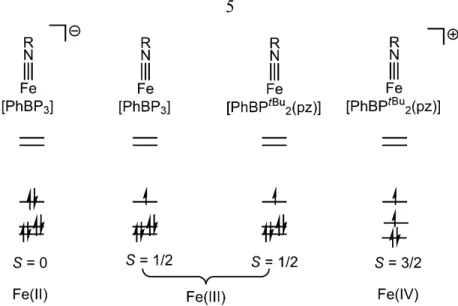
The discovery of the first cobalt imide was inspiring because metal-ligand multiply bonded species are rare for the late transition metals, especially for the first-row metals. An inspection of the d-orbital splitting diagram led to speculations that the d5 electronic configuration may be viable. The formal removal of an electron should not alter the M-N bond order if the three low-lying orbitals are truly non-bonding. Indeed, the d6 Fe(II) and d5 Fe(III) imides supported by [PhBP3] have nearly identical Fe-N bond lengths in their solid-state structures (Figure 1.3).17, 37 Also quite interesting is that the unprecedented Fe(IV) imides of the type [PhBP2(pz)]Fe(NR)+ exhibit an S = 3/2 ground state and show remarkably similar Fe-N bond distances.19
Figure 1.3. The electronic configurations for structurally related iron imides in three different oxidation states and spin states.
The stability of the various electronic configurations for the iron imides suggests that M≡Nx species of other mid-to-late transition metals may be electronically accessible.
One plausible target is the d4 manganese imide [BP3]Mn(NR). This hypothetical species is isolobal to the Fe(IV) imides and is an unusual example of a low-valent manganese imide.
By switching to the [PhBPiPr3] ligand, the novel Fe(IV) terminal nitride [PhBPiPr3]Fe(N) was prepared.16 This species is stable at 0 °C, but it thermally degrades via bimolecular coupling to the bridged-dinitrogen dimer, {[PhBPiPr3]Fe}2(μ-N2). The few examples of terminal iron nitrides are generated and characterized at very low temperatures (30 to 70 K),38-42 so this species shows dramatically increased stability.
Compared to the imides, the nitride has a different orbital splitting diagram in which the dz2 orbital is strongly destabilized by increased antibonding interactions with the nitride and phosphines. Because only two orbitals remain at low energy, the d4 configuration of
imides, it is also worthwhile to consider the stability of a d3 metal nitride such as the hypothetical manganese nitride, [BP3]Mn(N). General efforts to prepare manganese imides and nitrides are presented in Chapter 2. Also, efforts to prepare stable iron(IV) nitrides motivated the development of new [BP3] ligands. The ligand preparations and their ability to stabilize Fe(IV) nitrides are discussed in Chapter 3.
1.3 Redox Reactivity of the Iron Systems– Towards Activation of Small Molecules Another facet of these ligands is that they support a wide range of metal oxidation states. In particular, the versatility of [PhBPiPr3]Fe to accommodate multiple redox states is highlighted by the variety of nitrogen-containing ligands, ranging from the π-acidic N2
to the π-basic imides and nitrides that are supported on this single platform.15, 16 Collectively, these compounds, which are shown in Figure 1.4, may represent intermediates in the transformation of dinitrogen to ammonia at a single iron site in a Chatt-type cycle. Therefore, an understanding of their spectroscopy and reactivity patterns may elucidate structure-function relationships that are relevant to dinitrogen fixation. Indeed, some of the proposed steps in dinitrogen fixation have already been demonstrated using these complexes. For instance, the Fe(N2) adduct, [[PhBPiPr3]Fe(N2)]2[Mg(THF)4], reacts with 2 equivalents of MeOTs to yield 2 equivalents of the diazenido species, [PhBPiPr3]Fe(N2Me).15
Figure 1.4. [PhBPiPr3]Fe complexes with a wide range of nitrogenous ligands are structurally similar to proposed intermediates in a Chatt-type cycle at a single iron site.
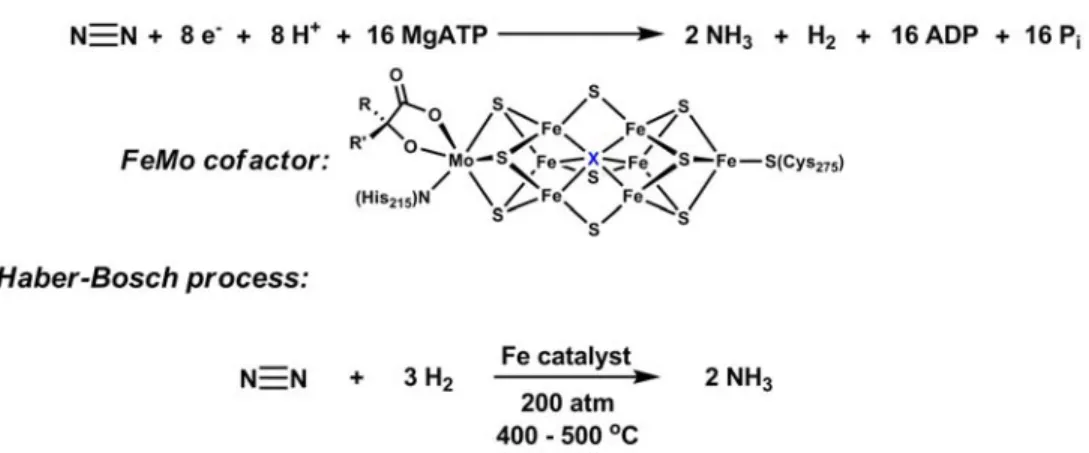
The conversion of dinitrogen to ammonia occurs naturally within nitrogenases and industrially in the Haber-Bosch process (Figure 1.5). Despite detailed structural knowledge of the FeMo cofactor in the MoFe-nitrogenases,43-46 the site(s) of N2 binding and reduction are not well understood.47-49 Molybdenum and iron are both implicated as the active sites, though iron is the only transition metal common to all nitrogenases. Iron is also the preferred catalyst for the Haber-Bosch process. The chemical equation by which nitrogenases reduce N2 to ammonia utilizes protons and electrons (Figure 1.5). The Haber-Bosch process, on the other hand, uses hydrogen at high pressures and
mechanisms are virtually unknown.
Figure 1.5. Nitrogenases and the Haber-Bosch process reduce dinitrogen to ammonia.
The recent discovery of well-defined [BP3]Fe≡Nx species provides a unique opportunity to study their plausible roles as intermediates in dinitrogen fixation.
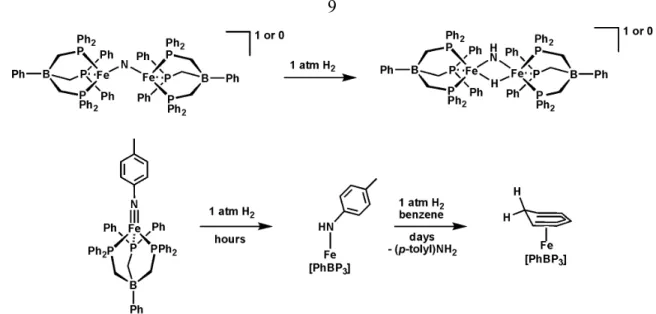
Interestingly, the Fe≡Nx species show a propensity to undergo functionalization at the nitride and imide moiety, sometimes with full scission of the Fe-N linkage. For example, the nitride [PhBPiPr3]Fe(N) liberates ammonia in moderate yield (~50%) upon exposure to protons and electrons.16 Another interesting reaction is the hydrogenation of the bridged iron nitrides, [{[PhBP3]Fe}2(μ-N)]n (where n = 0, -1), to give the bridged imides, [{[PhBP3]Fe}2(μ-NH)(μ-H)]n.52 Additionally, the hydrogenation of the iron imide [PhBP3]Fe(N(p-tolyl)) gives initially the iron amide, which reacts further with hydrogen to liberate the amine and generate a solvent-trapped iron hydride.53
Figure 1.6. Examples of hydrogenations of Fe-N bonds that are relevant to N2
reduction.
The above discussions showcase the rich redox chemistry of the [BP3]Fe platforms for the fixation of N2. This redox versatility, however, may be generally exploited for the activation of other small molecules. For instance, the conversion of CO2, an abundant pollutant, to a useful precursor for chemical synthesis or fuel production is highly desirable. The potential utility of the [BP3]Fe scaffolds for activating CO2 and other small substrates is explored in Chapter 4.
1.4 Chapter Summaries
Chapter 2 presents aspects of the coordination chemistry of monovalent and divalent manganese complexes supported by [PhBPiPr3]. The halide complex [PhBPiPr3]MnI serves as a useful precursor to a series of Mn azide, alkyl, and amide species. These pseduotetrahedral compounds represent an uncommon structural motif for low-coordinate, polyphosphine-supported Mn complexes. Two monovalent manganese
species are briefly described, as are theoretical DFT studies that probe the electronic viability of these types of multiply bonded target structures.
Chapter 3 introduces two new tris(phosphino)borate ligands, [PhB(CH2P(m- terphenyl)2)3]¯ and [PhB(CH2P(CH2Cy)2)3]¯, which feature terphenyl and methylcyclohexyl groups on the phosphine arms, respectively. The ligand syntheses and their iron metallation are described. Notably, a terminal iron nitride supported by the methylcyclohexyl ligand can be prepared and characterized, albeit only at temperatures below -50 °C. One interesting feature of this nitride is an unusually large quadrupole splitting observed by Mössbauer spectroscopy.
Chapter 4 describes the reduction of [PhBPCH2Cy3]FeCl to give a masked iron(I) species. Though the exact nature of this compound remains unknown, it is highly reactive and reductively activates a host of small molecules. Of particular interest is the reductive cleavage of CO2 to give the iron dimer, {[PhBPCH2Cy3]Fe}2(μ-CO)(μ-O), wherein a C=O bond has been cleaved by two electrons. Another possible functionalization of CO2 is presented, where two CO2 molecules are reductively coupled to generate an oxalate functionality.
References Cited
1. Betley, T. A.; Peters, J. C. Inorg. Chem. 2003, 42, 5074.
2. Shapiro, I. R.; Jenkins, D. M.; Thomas, J. C.; Day, M. W.; Peters, J. C. Chem.
Commun. 2001, 2152.
3. Thomas, C. M.; Peters, J. C. Inorg. Chem. 2004, 43, 8.
5. Feldman, J. D.; Peters, J. C.; Tilley, T. D. Organometallics 2002, 21, 4050.
6. Barney, A. A.; Heyduk, A. F.; Nocera, D. G. Chem. Commun. 1999, 2379.
7. Thomas, J. C.; Peters, J. C. Inorg. Synth. 2004, 34, 8.
8. Lu, C. C.; Peters, J. C. J. Am. Chem. Soc. 2004, 126, 15818.
9. Thomas, J. C.; Peters, J. C. J. Am. Chem. Soc. 2003, 125, 8870.
10. Betley, T. A.; Peters, J. C. Angew. Chem. Int. Ed. 2003, 42, 2385.
11. Lu, C. C.; Peters, J. C. J. Am. Chem. Soc. 2002, 124, 5272.
12. Thomas, J. C.; Peters, J. C. J. Am. Chem. Soc. 2001, 123, 5100.
13. Daida, E. J.; Peters, J. C. Inorg. Chem. 2004, 43, 7474.
14. Jenkins, D. M.; Di Bilio, A. J.; Allen, M. J.; Betley, T. A.; Peters, J. C. J. Am.
Chem. Soc. 2002, 124, 15336.
15. Betley, T. A.; Peters, J. C. J. Am. Chem. Soc. 2003, 125, 10782.
16. Betley, T. A.; Peters, J. C. J. Am. Chem. Soc. 2004, 126, 6252.
17. Brown, S. D.; Betley, T. A.; Peters, J. C. J. Am. Chem. Soc. 2003, 125, 322.
18. Jenkins, D. M.; Betley, T. A.; Peters, J. C. J. Am. Chem. Soc. 2002, 124, 11238.
19. Thomas, C. M.; Mankad, N. P.; Peters, J. C. J. Am. Chem. Soc. 2006, 128, 4956.
20. Thomas, C. M.; Peters, J. C. Angew. Chem. Int. Ed. 2006, 45, 776.
21. Fujita, K.; Rheingold, A. L.; Riordan, C. G. Dalton Trans. 2003, 2004.
22. Schebler, P. J.; Mandimutsira, B. S.; Riordan, C. G.; Liable-Sands, L. M.;
Incarvito, C. D.; Rheingold, A. L. J. Am. Chem. Soc. 2001, 123, 331.
23. Ohrenberg, C.; Riordan, C. G.; Liable-Sands, L.; Rheingold, A. L. Coord. Chem.
Rev. 1998, 174, 301.
37, 4754.
25. Ge, P. H.; Riordan, C. G.; Yap, G. P. A.; Rheingold, A. L. Inorg. Chem. 1996, 35, 5408.
26. Ohrenberg, C.; Ge, P. H.; Schebler, P.; Riordan, C. G.; Yap, G. P. A.; Rheingold, A. L. Inorg. Chem. 1996, 35, 749.
27. Hu, X.; Castro-Rodriguez, I.; Meyer, K. Organometallics 2003, 22, 3016.
28. Hu, X.; Meyer, K. J. Organomet. Chem. 2005, 690, 5474.
29. Hu, X. L.; Castro-Rodriguez, I.; Meyer, K. Chem. Commun. 2004, 2164.
30. Hu, X. L.; Castro-Rodriguez, I.; Olsen, K.; Meyer, K. Organometallics 2004, 23, 755.
31. Hu, X. L.; Castro-Rodriguez, I.; Meyer, K. J. Am. Chem. Soc. 2003, 125, 12237.
32. Nieto, I.; Cervantes-Lee, F.; Smith, J. M. Chem. Commun. 2005, 3811.
33. Fränkell, R.; Birg, C.; Kernbach, U.; Habereder, T.; Noth, H.; Fehlhammer, W. P.
Angew. Chem. Int. Ed. 2001, 40, 1907.
34. Kernbach, U.; Ramm, M.; Luger, P.; Fehlhammer, W. P. Angew. Chem., Int. Ed.
Eng. 1996, 35, 310.
35. Shay, D. T.; Yap, G. P. A.; Zakharov, L. N.; Rheingold, A. L.; Theopold, K. H.
Angew. Chem. Int. Ed. 2005, 44, 1508.
36. Hu, X.; Meyer, K. J. Am. Chem. Soc. 2004, 126, 16322.
37. Brown, S. D.; Peters, J. C. J. Am. Chem. Soc. 2005, 127, 1913.
38. Aliaga-Alcalde, M.; George, S. D.; Mienert, B.; Bill, E.; Wieghardt, K.; Neese, F.
Angew. Chem. Int. Ed. 2005, 44, 2908.
Chem. 2000, 39, 5306.
40. Meyer, K.; Bill, E.; Mienert, B.; Weyhermüller, T.; Wieghardt, K. J. Am. Chem.
Soc. 1999, 121, 4859.
41. Wagner, W. D.; Nakamoto, K. J. Am. Chem. Soc. 1989, 111, 1590.
42. Wagner, W. D.; Nakamoto, K. J. Am. Chem. Soc. 1988, 110, 4044.
43. Einsle, O.; Tezcan, F. A.; Andrade, S. L. A.; Schmid, B.; Yoshida, M.; Howard, J.
B.; Rees, D. C. Science 2002, 297, 1696.
44. Howard, J. B.; Rees, D. C. Chem. Rev. 1996, 96, 2965.
45. Kim, J. S.; Rees, D. C. Nature 1992, 360, 553.
46. Kim, J. S.; Rees, D. C. Science 1992, 257, 1677.
47. Rees, D. C.; Howard, J. B. Curr. Opin. Chem. Biol. 2000, 4, 559.
48. Burgess, B. K.; Lowe, D. J. Chem. Rev. 1996, 96, 2983.
49. MacKay, B. A.; Fryzuk, M. D. Chem. Rev. 2004, 104, 385.
50. Ertl, G. Chem. Rec. 2001, 1, 33.
51. Ertl, G., Catalytic Ammonia Synthesis: Fundamentals and Practice. Plenum Press: New York, 1991; p 109.
52. Brown, S. D.; Mehn, M. P.; Peters, J. C. J. Am. Chem. Soc. 2005, 127, 13146.
53. Brown, S. D.; Peters, J. C. J. Am. Chem. Soc. 2004, 126, 4538.
Chapter 2: Pseudotetrahedral Manganese Complexes Supported by the Anionic Tris(phosphino)borate Ligand [PhBPiPr3]
2.1 Introduction
Transition metal complexes containing metal-ligand multiple bonds figure prominently in coordination chemistry, especially in atom- and group-transfer processes.1, 2 Metal species of the types LnM=E and LnM≡E, where E = O, NR, CR2, can act as intermediates in numerous catalytic reactions including epoxidation,3-6 aziridination,7-10 cyclopropanation,11-13 olefin metathesis,14-17 and C-H bond insertion.10, 18 Besides having broad synthetic utility, metal-to-ligand multiply bonded species also serve as biomimetic models of active sites in metalloenzymes.19-22 Until a few years ago, examples of stable complexes featuring metal-to-ligand multiple bonds were rare for the later metals,23-25 especially for those in the first row.26 While the paucity of these compounds was typically attributed to an inherent incompatibility of high d-electron counts with multiply bonded π-donor substituents, low-coordinate geometries have provided one strategic path to circumvent this limitation. The recent rise in literature reports of well-defined LnM=E and LnM≡E systems for the metals M = Fe,27-33 Co,34-38 Ni,39-43 and Cu44, 45 strongly attests to the viability of these types of species for the first- row, mid-to-late metals.
Manganese compounds featuring multiply bonded terminal functionalities such as nitrides and imides are far more abundant than their later first-row counterparts.46 For example, Mn(V) nitrides are well known to be stabilized by various ligand auxiliaries, including porphyrins,47-51 macrocyclic amines,52, 53 cyanides,54 and Schiff bases.55-58 In contrast, Mn(VI) and Mn(VII) nitrides are rare. Wieghardt and coworkers prepared two examples of Mn(VI) nitrides in situ, but neither compound has been fully characterized.52,
54 Hursthouse and coworkers isolated the sole example of a Mn(VII) nitride,
[Mn(N)(NtBu)3]2-, which is supported by imido ligands.59 Other relevant manganese imides from the Hursthouse group include species of the type MnVII(NtBu)3X, as well as the homoleptic compound [MnVI(NtBu)4]2-.60-62 Terminal Mn(V) imides are also stabilized by corroles, as recently reported by Abu-Omar and coworkers.63-65 Finally, elegant work from Groves and Carreira strongly implicates Mn(V) acylimides (generated in situ from the nitrides) as effective group-transfer catalysts to olefin and enol ether substrates.47, 55, 66
We have been investigating the tris(phosphino)borate (generally denoted as [BP3]) and hybrid bis(phosphino)pyrazolylborate ([PhBP2(pz)]) ligands as scaffolds for M≡E linkages. Thus far, these ligands have stabilized Co(III)36 and Fe(II/III) imides, 27, 29 as well as distinctive examples of Fe(IV) imides and nitrides.28, 67 Motivated by these results, we wish to extend this chemistry to other mid-to-late first-row metals such as Ni68 and Mn. In particular, we are interested in whether [BP3]Mn≡Nx species (d3 and d4) are electronically accessible and in defining synthetic methods for their generation. In pursuit of this task, we began to study aspects of the fundamental coordination chemistry of previously unexplored [BP3]Mn-systems. In this chapter, the synthesis and characterization of a family of mono- and divalent manganese compounds supported by the [PhBPiPr3] ligand (where [PhBPiPr3] = [PhB(CH2PPiPr ) ]2 3 –) are reported.
Complementary theoretical studies are described for hypothetical imide [PhBPiPr3]Mn(NtBu) and nitride [PhBPiPr3]Mn(N) systems. These species appear to be plausible target structures based upon electronic considerations. While studies towards well-defined [BP ]Mn≡N systems are ongoing, the four-coordinate [PhBP3 x iPr
3]Mn(II)
species that are described here represent structurally unusual examples of low-coordinate manganese complexes supported by polyphosphine ligands.
2.2 Results and Discussion
2.2.1 Synthesis and Characterization of [PhBPiPr3]Mn(II) Halides
The Mn(II) halides [PhBPiPr3]MnCl (2.1) and [PhBPiPr3]MnI (2.2) were readily prepared by mixing the thallium reagent [PhBPiPr3]Tl with MnX2 (where X = Cl or I) (Equation 2.1).69 This methodology has been used previously to prepare related compounds of divalent Fe, Ru, Co, and Ni.68, 70, 71 The halides 2.1 and 2.2 are colorless in solution and can be crystallized from benzene/petroleum ether. Compound 2.1 provided light pink blocks in low yield (33%), while 2.2 was obtained as colorless blocks in moderate yield (62%). Because of its higher crystalline yield, compound 2.2 was used as the preferred starting material throughout the research described herein.
The halides 2.1 and 2.2 were characterized by various techniques including X-ray crystallography, SQUID magnetometry, and EPR spectroscopy. The solid-state structures of 2.1 and 2.2 are shown in Figures 2.1 and 2.2. The chloride complex 1 crystallizes as a mixture of its monomer (2.1a) and its dimer {[PhBPiPr3]Mn(μ-Cl)}2 (2.1b), whereas the iodide complex 2.2 crystallizes exclusively as a monomer. A similar monomer-dimer equilibrium was observed for [PhBP3]CoX systems in solution (where X = Cl or Br).71 Solid-state structures of monomeric 2.1a and 2.2 are pseudotetrahedral with approximate
three-fold symmetry about the axis containing B, Mn, and X (I-Mn-B = 176.6°, Cl-Mn-B
= 175.5°). The Mn-P bond distances are nearly equal, as well as the P-Mn-P bond angles.
For example, monomer 2.1a has Mn-P distances of 2.53 Å and P-Mn-P angles that are near 90º (90.6 to 92.6°). Likewise, compound 2.2 exhibits a narrow spread in its Mn-P bond distances (2.524 to 2.538 Å) and P-Mn-P angles (90.7 to 91.4°). The Mn-P bond distances are not unusual for high-spin Mn(II),72 but are significantly longer than those of tris(phosphino)borate complexes of later first-row transition metal ions. The series of structurally characterized chloride complexes, [PhBPiPr3]MCl for M = Mn, Fe, Co, and Ni, shows decreasing M-P bond distances, which reflect both their decreasing ionic radii across the series as well as their total spin S.
The dimer {[PhBPiPr3]Mn(μ-Cl)}2 (2.1b) crystallizes in the triclinic crystal system Pī and features a Mn2Cl2 core that contains an inversion center. The chloride and one PPiPr unit are disordered, but both can be independently refined in two positions of nearly equal populations. The solid-state structure of one conformer is shown in Figure 2.2 (top). A simplified structure containing all of the disordered atoms in the core is shown below it. In the dimer, the Mn center is five-coordinate and roughly square pyramidal.
Two phosphorus atoms and two chlorides comprise the base, with an axial phosphine at the apex of the pyramid. The Mn-P bond distances in the dimer are even more elongated relative to the monomer 2.1a (Mn-P = 2.613, 2.616, and 2.552 Å). One of these bonds (Mn-P3) is slightly shorter than the other two and corresponds to the Mn-P bond. The Mn-Cl bonds in the dimer are also significantly longer (2.463 and 2.533 Å) compared to the monomer (2.269 Å).
2
ax
Figure 2.1. 50% thermal ellipsoid representations of [PhBPiPr3]MnCl (2.1a) and [PhBPiPr3]MnI (2.2). Hydrogen atoms and solvent molecules have been omitted for clarity. Selected bond distances (Å) and angles (deg.) for 2.1a: Mn–Cl 2.2687(7), Mn–P1 2.5300(6), Cl–Mn–P1 125.38(2), Mn–P2 2.5298(6), Mn–P3 2.5289(6), Cl–Mn–P2 120.22(2), Cl–Mn–P3 126.14(2), P1–Mn–P2 90.55(2), P2–
Mn–P3 92.64(2), P1–Mn–P3 92.22(2). For 2.2: Mn–I 2.6394(4), Mn–P1 2.5351(7), Mn–P2 2.5238(7), Mn–P3 2.5379(6), P1–Mn–I 127.19(2), P2–Mn–I 122.27(2), P3–Mn–I 124.09(2), P1–Mn–P2 91.39(2), P2–Mn–P3 90.68(2), P1–
Mn–P3 90.95(2).
Figure 2.2. 50% thermal ellipsoid representations of {[PhBPiPr3]Mn(μ-Cl)}2
(2.1b) (top). Hydrogen atoms have been omitted for clarity. Selected bond distances (Å) and angles (deg.) for 2.1b: Mn–ClA 2.4625(9), Mn–ClA 2.5327(9), Mn–ClB 2.4630(9), Mn–ClB 2.525(1), Mn–P1 2.6162(7), Mn–P2 2.6132(7), Mn–
P3A 2.552(4), Mn–P3B 2.580(4), P1–Mn–P2 86.38(2), P3A–Mn–P1 87.13(7), P3B–Mn–P1 94.03(7), P3A–Mn–P2 92.55(8), P3B–Mn–P2 86.26(7). View of the core of 2.1b showing both positions of the disordered chloride and P3 atom (bottom). The angle between the Mn2(ClA)2 and Mn2(ClB)2 planes is 41 degrees.
Magnetic susceptibility (SQUID) data were obtained on polycrystalline samples of 2.1 and 2.2. The μeff versus T plots are nearly identical and show very little temperature dependence (Figure 2.3A). From 60 to 300 K, the μeff values average 5.94 μB
for 1 (calculated as a monomer) and 5.97 μB for 2.2. The μeff value for 2.1 is identical to its solution magnetic moment of 5.9(1) in benzene, where we presume the monomeric form is favored over the dimer form (Evans method, 3 runs).73, 74 These values are consistent with five unpaired electrons per Mn, verifying the high-spin configuration of these [PhBPiPr3]MnX species. The proximity of μeff to the spin-only value (5.92 μB) further suggests that the ground states of 2.1 and 2.2 are orbitally nondegenerate as expected for a ground-state electronic configuration where all the d-orbitals are singly populated (6S). The χMT versus T plots for 2.1 and 2.2 are also similar, but distinct at very low temperatures. From 4 to 75 K, χMT dips slightly for 2.2, perhaps due to intermolecular paramagnetic quenching (Figure 2.3B). The χMT versus T plot for 2.1, however, shows a gradual increase in χMT in the same temperature range. The small rise in χMT from 4.43 to 4.71 cm3 K/mol might be indicative of weak ferromagnetic coupling.
Similarly weak coupling has been observed in another Mn(μ-Cl) dimer and might thus arise from the presence of the dimer 2.1b.75
0 1 2 3 4 5 6 7
0 100 200 300
Temperature (K)
μ
eff(BM) (A)
0 1 2 3 4 5
0 100 200 300
Temperature (K) χMT(cm3 mol-1 K)
(B)
Figure 2.3. (A) SQUID plots of μeff (μB) versus T and (B) χMT (cm3K/mol) versus T for [PhBPiPr3]MnCl, 2.1, (■), and [PhBPiPr3]MnI, 2.2, (□). An expansion of the χMT versus T plot at low temperatures (4 to 30 K) is shown in the inset.
EPR spectra were also recorded on the halides in methyl-THF glass at 8 K. The iodide 2.2 has an axial spectrum with transitions at ~120 and 330 mT (Figure 2.4A). The observed g values, ~ 6 and 2, match the calculated transitions for the ms = ± ½ states of a S = 5/2 paramagnet with E/D ~ 0. Hyperfine structure due to the 55Mn nucleus (I = 5/2) is evident in the g = 2 signal, which shows a six-line splitting with A ~ 63 G. The octahedral complexes MnX2(dmpe)2 (where X = Br, I) show nearly identical EPR signatures.76 Unlike 2.2, the chloride 2.1 has an EPR spectrum with numerous transitions occurring from 0 to 1000 mT (Figure 2.4B). The complicated spectrum is difficult to interpret and is tentatively attributed to a superposition of the monomer (~ 130 and 360 mT) and dimer forms of 2.1. The dimer, an S = 5 paramagnet, could itself give rise to multiple transitions. For both 2.1 and 2.2, hyperfine coupling to the 31P nucleus (I = ½) is not observed, suggesting that the spin density is tightly localized on Mn and therefore indicative of attenuated covalent character at the Mn-P bond by comparison to other [BP3]M paramagnets we have studied.27, 71, 77

![Figure 1.4. [PhBP iPr 3 ]Fe complexes with a wide range of nitrogenous ligands are structurally similar to proposed intermediates in a Chatt-type cycle at a single iron site](https://thumb-ap.123doks.com/thumbv2/123dok/12114004.0/31.918.167.757.85.549/figure-complexes-nitrogenous-ligands-structurally-similar-proposed-intermediates.webp)
![Figure 2.1. 50% thermal ellipsoid representations of [PhBP iPr 3 ]MnCl (2.1a) and [PhBP iPr 3 ]MnI (2.2)](https://thumb-ap.123doks.com/thumbv2/123dok/12114004.0/43.918.225.753.231.512/figure-thermal-ellipsoid-representations-phbp-mncl-phbp-mni.webp)
![Figure 2.2. 50% thermal ellipsoid representations of {[PhBP iPr 3 ]Mn( μ -Cl)} 2](https://thumb-ap.123doks.com/thumbv2/123dok/12114004.0/44.918.226.748.238.578/figure-thermal-ellipsoid-representations-phbp-ipr-mn-cl.webp)
![Figure 2.8. 50% thermal ellipsoid representation of [PhBP iPr 3 ]Tl–MnBr(CO) 4](https://thumb-ap.123doks.com/thumbv2/123dok/12114004.0/56.918.243.732.530.808/figure-thermal-ellipsoid-representation-phbp-ipr-tl-mnbr.webp)
![Figure 2.11. DFT-optimized structures (Jaguar 5.0, B3LYP/LACVP**) for (A) singlet [PhBP iPr 3 ]Mn(N t Bu) and (B) triplet [PhBP iPr 3 ]Mn(N t Bu)](https://thumb-ap.123doks.com/thumbv2/123dok/12114004.0/60.918.246.734.480.805/figure-optimized-structures-jaguar-b3lyp-lacvp-singlet-triplet.webp)
![Table 2.1. Crystallographic data for [PhBP iPr 3 ]MnCl, 2.1a; {[PhBP iPr 3 ]Mn( μ -Cl)} 2 , 2.1b;](https://thumb-ap.123doks.com/thumbv2/123dok/12114004.0/72.918.176.795.211.785/table-crystallographic-data-phbp-ipr-mncl-phbp-ipr.webp)