Volume 13 • Number 1 • 2023
OTORITAS : Jurnal Ilmu Pemerintahan
Published by the Department of Government Studies,
Faculty of Social and Political Sciences, Muhammadiyah University of Makassar For further information, please visit: https://journal.unismuh.ac.id/otoritas
ISSN: 2088-3706 (Print) | 2502-9320 (Online) | DOI : 10.26618
Firstpublished in April 2011
Please send all articles, essays, reviews, and documents to:
Regular Mail:
Department of Government Studies Faculty of Social and Political Sciences
5th Floor of Menara Iqra, Muhammadiyah University of Makassar Jl. Sultan Alauddin No.259 Makassar, 90221
South Sulawesi, Indonesia E-Mail:
OTORITAS : Jurnal Ilmu Pemerintahan is an internationally peer-reviewed open access journal published triannual in April, August and December, aims to publishes significant
and cutting-edge research drawn from all areas of politics and governmental studies and promotes scholarly, theoretical, pragmatic, and contemporary research, which makes a clear conceptual and methodological contribution to existing international
literature.
OTORITAS : Jurnal Ilmu Pemerintahan indexed by :
OTORITAS : Jurnal Ilmu Pemerintahan have been double blind-reviewed by international peer reviewers. The decision on whether the scientific article is accepted
or not in this journal will be the Editorial Board’s right based on peer reviewer's recommendation.
About the Journal
OTORITAS : Jurnal Ilmu Pemerintahan, with registered number ISSN 2088-
3706 (Print), ISSN 2502-9320 (Online), is an internationally peer-reviewed open access journal published triannual in April, August and December by Department of Government Studies, Faculty of Social and Political Sciences, Universitas Muhammadiyah Makassar in collaboration with Muhammadiyah’s College Association of Government Studies (AIPPTM) and Asia Pacific Society for Public Affairs (APSPA).
OTORITAS : Jurnal Ilmu Pemerintahan aims to publishes significant and
cutting-edge research drawn from all areas of politics and governmental studies and promotes scholarly, theoretical, pragmatic, and contemporary research, which makes a clear conceptual and methodological contribution to existing international literature.
OTORITAS : Jurnal Ilmu Pemerintahan Starting from 2015 it is available in e-
journal version and has been currently indexed by both national and international indexer institutions such as: ESCI Web of Science (International), DOAJ (International), ASEAN Citation Index (International), Dimensions (International), Garba Rujukan Digital (National), Google Scholar (International), Crossref (International), BASE (International), SINTA (National), and Indonesia One Search (National).
OTORITAS : Jurnal Ilmu Pemerintahan Starting from 2016 and for the
upcoming years, the process of manuscript submission and other management processes will be conducted online through Otoritas : Jurnal Ilmu Pemerintahan website and for the betterment of the quality and quantity of Otoritas : Jurnal Ilmu Pemerintahan qualified reviewers and editors are recruited. Besides that in the same year we collaborated with Muhammadiyah's College Association of Government Studies (AIPPTM) on the publication of this journal.
OTORITAS : Jurnal Ilmu Pemerintahan Starting from 2018, we collaborated
with Asia Pacific Society for Public Affairs (APSPA) on the publication and has
been accredited by National Journal Accreditation (ARJUNA) Managed by Ministry
of Research, Technology, and Higher Education of Republic Indonesia.
Focus and Scope
Otoritas: Jurnal Ilmu Pemerintahan (Journal of Political Science and
Government) promotes scholarly, theoretical, pragmatic, and contemporary research, making a clear conceptual and methodological contribution to existing international literature. Its spesific aim is to enhance the broad scholarly understanding of governance, public administration, public law, religion and politics, comparative politics, international studies, and democratic institutions in emerging countries.
Otoritas : Jurnal Ilmu Pemerintahan (Journal of Political Science and
Government) is committed to disseminating rigorous, high-quality research and
debate with a scientific influence on the international society. To that purpose,
the Editorial team follows a meticulous editorial procedure, bringing the most
sophisticated research on modern politics and governance to the academic
community and policymakers. The journal is online and has open access, and its
internal publication procedure enables it to distribute its research findings
internationally promptly.
Editorial Board
EDITOR-IN-CHIEF
Andi Luhur Prianto, Scopus ID: 57208214401, Universitas Muhammadiyah Makassar, Indonesia
MANAGING EDITORS
Nur Khaerah, Scopus ID: 57708938300, Universitas Muhammadiyah Makassar, Indonesia
ACCOCIATE EDITORS
Abel Kinyondo, Scopus ID: 55293738000, University of Dar Es Salaam, Tanzania Abel Polese, Scopus ID: 57201804952, Dublin City University, Ireland
Ilyas Mohammed, Scopus ID: 57221933986, University of Liverpool, United Kingdom Michael Hatherell, Scopus ID: 56433408300, Deakin University, Australia
Nursaleh Hartaman, Scopus ID: 57395318100, Universitas Muhammadiyah Makassar, Indonesia Riccardo Pelizzo, Scopus ID: 6507727385, Nazarbayev University, Kazakhstan
INTERNATIONAL EDITORIAL
Adam Tyson, Scopus ID: 35337925000, University of Leeds, United Kingdom
AKM Ahsan Ullah, Scopus ID: 10043791400, Universiti Brunei Darussalam, Brunei Darussalam Ahmad Harakan, Scopus ID: 57203222670, Universitas Muhammadiyah Makassar, Indonesia Andreas Ufen, Scopus ID: 24280605600, German Institute of Global and Area Studies, Germany
Farida Tadjine, Scopus ID: 57678049100, University of Kasdi Merbah Ouargla, Algeria Mergen Dyussenov, Scopus ID: 57190342068, National University of Singapore, Singapore
Mohd Afandi Salleh, Scopus ID: 55582821500, Universiti Sultan Zainal Abidin, Malaysia Mubashar Hasan, Scopus ID: 45861188500, Oslo University, Norway
Muh Firyal Akbar, Scopus ID: 57210750267, Universitas Muhammadiyah Gorontalo, Indonesia Ni Putu Tirka Widanti, Scopus ID: 57970637000, Universitas Ngurah Rai, Indonesia Nuryanti Mustari, Scopus ID: 57395318000, Universitas Muhammadiyah Makassar, Indonesia
Önder KUTLU, Necmettin Erbakan Universitesi, Turkey
Rudi Hardi, Scopus ID: 57395626900, Universitas Muhammadiyah Makassar, Indonesia Wolfgang Drechsler, Scopus ID: 36840148600, University College London, United Kingdom
EDITORIAL ASSISTANTS
Abdillah Abdillah, Scopus ID: 57697035900, Universitas Muhammadiyah Makassar, Indonesia Hamrun Hamrun, Scopus ID: 57395116400, Universitas Muhammadiyah Makassar, Indonesia
Table of Contents
The excellence scholarships program: Analysis of implementation aspects and societal impact
Achmad Kosasih1, Nurzela Eka Juniarfa2, Yusuf Fadli3, Adie Dwiyanto Nurlukman4, Abdul Basit5
1,2,3,4 Department of Government Science, Faculty of Social and Political Sciences, Universitas Muhammadiyah
Tangerang, Indonesia
5 Department of Communication Science, Faculty of Social and Political Sciences, Universitas Muhammadiyah Tangerang, Indonesia
1-15
How to deal with children’s violence? Implementation of child protection policies in Bekasi Regency, Indonesia
Aos Kuswandi1, Ainur Rofieq2, Siti Nuraini3, Noer Kholis4
1, 3, 4 Department of Government Science, Graduate School, Universitas Islam 45, Indonesia
2 Department of Government Science, Faculty of Social and Political Sciences, Universitas Islam 45, Indonesia
16-29
Unfolding women’s role in small-scale fishing community in The Philippines toward formulating a gender-sensitive local government policy
Joy Tricia Mae Corpuz1, Reynald Cacho2, Brenda Villamor3, Maria Gracia Samson4, Ma.
Sheila Simat5
12345 Philippine Normal University - South Luzon, Philippines
30-43
Regional head elections, high-cost politics, and corruption in Indonesia
Leo Agustino1, M Dian Hikmawan2, Jonah Silas3
1 Department of Public Administration, Faculty of Social and Political Science Universitas Sultan Ageng Tirtayasa, Indonesia
2 Department of Government Science, Faculty of Social and Political Sciences, Universitas Sultan Ageng Tirtayasa, Indonesia
3 Indonesian Politics Research & Consulting (IPRC), Indonesia
44-59
Territorial reform of areas with concentrated residence of minorities within decentralization policy under polyethnicity in Ukraine
Sierhiei Sakhanienko1, Natalia Kolisnichenko2*), Oleg Dolzhenkov3
1 Public Administration and Regional Studies Chair, Odessa Regional Institute for Public Administration of the National Academy for Public Administration under the President of Ukraine
2 Odessa Regional Institute for Public Administration of the National Academy for Public Administration under the President of Ukraine
3 Educational Management and Civil Service Chair, South Ukrainian National Pedagogical University named after K.D. Ushynsky.
60-79
The implementation of
Sewakadharmawork culture to improve public service quality in Denpasar City, Indonesia
Ni Putu Tirka Widanti
Departement of Public Administration
Postgraduate Program, Universitas Ngurah Rai, Indonesia
80-91
Mainstreaming state auxiliary agency to handling revenge porn victims in Indonesia, 2020-2021
Pamela Setya Miliasari1, Dede Sri Kartini2, Nandang Alamsah Delianoor3
123 Department of Government Studies, Postgraduate Program, Faculty of Social and Political Sciences, Universitas Padjajaran, Indonesia
92-110
Public service transformation trough digital-based services during Covid-19 pandemic in Riau Province, Indonesia
Panca Setyo Prihatin1, Pahmi Amri2, Agung Wicaksono3
1,2 Department of Government Studies, Faculty of Social and Political Sciences, Universitas Islam Riau, Indonesia
3School of International Relations and Political Science, Corvinus University of Budapest, Hungary
111-124
Islamophobia as a religious-based horizontal conflict and its resolution
Rodon Pedrason1*), Waluyo Handoko2, Paulus Israwan Setyoko3, Denok Kurniasih4
1 Departement of Defense Diplomacy, Faculty of Social and Political Science Universitas Pertahanan Indonesia, Kawasan - Indonesia Peace and Security Center (IPSC), Indonesia
2 Departement of Political Science, Faculty of Social and Political Science, Universitas Jenderal Soedirman, Indonesia
3,4 Department of Public Administration, Faculty of Social and Political Sciences, Universitas Jenderal Soedirman, Indonesia
125-140
Social capital as a political strategy: evidence from Nasdem Party in Makassar City, Indonesia
Suhardiman Syamsu1, Andi Muhammad Rusli2, Miranda Malinda Hamka3
1,2 Department of Government Studies, Faculty of Social and Political Sciences, Universitas Hasanuddin, Indonesia
3 Department of Social Anthropology, Faculty of Social and Political Sciences, Universitas Hasanuddin, Indonesia
141-155
Local development and enviromental governance: Experienced from extractive industry in East Luwu, Indonesia
Umar Congge1, Srirath Gohwong2
1 Departement of Public Administration, Faculty of Social and Political Sciences, Universitas Muhammadiyah Sinjai, Indonesia
2 Department of Political Science and Public Administration, Faculty of Social Sciences, Kasetsart University, Thailand
156-168
Policy model for development of tourism villages based on local wisdom towards self-reliant village in Pangandaran Regency, Indonesia
Yaya Mulyana1, Abu Huraerah2, M. Budiana3,Regan Vaughan4
1 Departement of Administration and Public Policy, Graduate Program, Universitas Pasundan, Indonesia
2 Departement of Social Welfare, Faculty of Social and Political Science, Universitas Pasundan, Indonesia
3 Departement of International Relations, Faculty of Social and Political Science, Universitas Pasundan, Indoenesia
4 Departement of Public Administration, Faculty of Social and Political Science, Universitas Pasundan, Indonesia
169-181
Article Guidelines
Article Title: Segoe UI, 14pt Bold, alignment centered, single-line spacing and All Caps. Article title should be written briefly and clearly. It shows exactly the issue to be discussed and should not create misinterpretations. Article title is written in capital letters symmetrically and does not contain unusual abbreviations. Express the main idea of a new article and followed by another explanation.
Author Details: Segoe UI, alignment centered, Article title, author's name (without academic degree(s)), and author's affiliate address are written in the center on the first page under the article title. The distance between title and author's name is double-spacing; meanwhile the distance between author's affiliate address and abstract title is single-spacing. Keywords should be written under abstract for each language. It is arranged alphabetically and separated by a semicolon consisted of 3-5 words. For Indonesian article, the title is translated into English at the beginning of English abstract (see the example above).
Corresponding Author should be marked with an asterisk and followed by a comma "*)" as the example above. At the bottom of the left column on the first page/abstract, it is written the Corresponding Author’s mark and his/her email address (see example). Article revisions and final decisions will only be communicated through the Corresponding Author’s email.
If there is more than one author, write the authors’ names separated by a comma (,). If the author's name consists of two words, the first name should not be abbreviated. If the author’s name consists of only one word, write his/her actual name in one word. However, the online version (HTML) will be written in two words consisting of the same name (repeatedly) for metadata indexation purpose (Camdali & Tunc, 2006; Fridman, 2008).
Introduction: Introduction consists of (in sequence) general background, state of the art as the basis for the scientific novelty statement of the article, scientific novelty statement, and research problem or hypothesis. In the end, introduction should mention the purpose of article review.
Literature review is not allowed in the scientific article format, so it is replaced by the state of the art to prove the novelty of the article.
Research Methods: Method is implemented to solve problems, including analytical method.
The method used to solve the research problems is described in this section.
Results and Discussion: This section consists of results and discussion. Every result should be supported by sufficient data. Then, result should be able to answer the research question or hypothesis stated earlier in the introduction.
Conclusion: Conclusion states the answer of the hypothesis and/or research objective or scientific finding. Conclusion is not the repetition of findings and discussion, but it is the summary of findings as expected in the objective or hypothesis. If necessary, conclusion can also be ended with the next idea to be implemented to the study.
Acknowledgment: Acknowledgment are primarily addressed to research funders or donors.
Acknowledgment can also be dedicated to people who contribute in the study.
References: All references used in the article should be listed in the References section.
References should contain reference literature originating from primary sources (scientific journals at least 80% of the entire references) published in the last 10 (ten) years. Each article contains at least 10 (ten) references. It is better to write the reference system in the article and in the references section using the reference management programs such as Mendeley, EndNote, Zotero, or others.
Publication Ethics
Otoritas : Jurnal Ilmu Pemerintahan, with registered number ISSN 2088-3706 (Print), ISSN 2502-9320 (Online) is a peer-reviewed journal, available in print and online and published tri-annual. This statement clarifies ethical behaviour of all parties involved in the act of publishing an article in this journal, including the author, the chief editor, the Editorial Board, the peer-reviewer and the publisher (Department of Government Studies, Faculty of Social and Political Sciences, Universitas Muhammadiyah Makassar in collaboration with Muhammadiyah’s College Association of Government Studies (AIPPTM) and Asia Pacific Society for Public Affairs).
This statement is based on COPE’s Best Practice Guidelines for Journal Editors.
ETHICAL GUIDELINE FOR JOURNAL PUBLICATION
The publication of an article in a peer-reviewed Otoritas : Jurnal Ilmu Pemerintahan is an essential building block in the development of a coherent and respected network of knowledge.
It is a direct reflection of the quality of the work of the authors and the institutions that support them. Peer-reviewed articles support and embody the scientific method. It is therefore important to agree upon standards of expected ethical behaviour for all parties involved in the act of publishing: the author, the journal editor, the peer reviewer, the publisher and the society.
Department of Government Studies, Faculty of Social and Political Sciences, Universitas Muhammadiyah Makassar in collaboration with Muhammadiyah’s College Association of Government Studies (AIPPTM) and Asia Pacific Society for Public Affairs as publisher of Otoritas : Jurnal Ilmu Pemerintahan takes its duties of guardianship over all stages of publishing seriously and we recognize our ethical and other responsibilities. We are committed to ensuring that advertising, reprint or other commercial revenue has no impact or influence on editorial decisions.
PUBLICATION DECISIONS
The editor of the Otoritas : Jurnal Ilmu Pemerintahan is responsible for deciding which of the articles submitted to the journal should be published. The validation of the work in question and its importance to researchers and readers must always drive such decisions. The editors may be guided by the policies of the journal's editorial board and constrained by such legal requirements as shall then be in force regarding libel, copyright infringement and plagiarism.
The editors may confer with other editors or reviewers in making this decision.
FAIR PLAY
An editor at any time evaluate manuscripts for their intellectual content without regard to race, gender, sexual orientation, religious belief, ethnic origin, citizenship, or political philosophy of the authors.
CONFIDENTIALITY
The editor and any editorial staff must not disclose any information about a submitted manuscript to anyone other than the corresponding author, reviewers, potential reviewers, other editorial advisers, and the publisher, as appropriate.
DISCLOSURE AND CONFLICTS OF INTEREST
Unpublished materials disclosed in a submitted manuscript must not be used in an editor's own research without the express written consent of the author.
DUTIES OF REVIEWERS:
Contribution to Editorial Decisions
Peer review assists the editor in making editorial decisions and through the editorial communications with the author may also assist the author in improving the paper.
Promptness
Any selected referee who feels unqualified to review the research reported in a manuscript or knows that its prompt review will be impossible should notify the editor and excuse himself from the review process.
Confidentiality
Any manuscripts received for review must be treated as confidential documents. They must not be shown to or discussed with others except as authorized by the editor.
Standards of Objectivity
Reviews should be conducted objectively. Personal criticism of the author is inappropriate.
Referees should express their views clearly with supporting arguments.
Acknowledgement of Sources
Reviewers should identify relevant published work that has not been cited by the authors. Any statement that an observation, derivation, or argument had been previously reported should be accompanied by the relevant citation. A reviewer should also call to the editor's attention any substantial similarity or overlap between the manuscript under consideration and any other published paper of which they have personal knowledge.
Disclosure and Conflict of Interest
Privileged information or ideas obtained through peer review must be kept confidential and not used for personal advantage. Reviewers should not consider manuscripts in which they have conflicts of interest resulting from competitive, collaborative, or other relationships or connections with any of the authors, companies, or institutions connected to the papers.
DUTIES OF AUTHORS Reporting standards
Authors of reports of original research should present an accurate account of the work performed as well as an objective discussion of its significance. Underlying data should be represented accurately in the paper. A paper should contain sufficient detail and references to permit others to replicate the work. Fraudulent or knowingly inaccurate statements constitute unethical behaviour and are unacceptable.
Originality and Plagiarism
The authors should ensure that they have written entirely original works, and if the authors have used the work and/or words of others that this has been appropriately cited or quoted.
Multiple, Redundant or Concurrent Publication
An author should not in general publish manuscripts describing essentially the same research in more than one journal or primary publication. Submitting the same manuscript to more than one journal concurrently constitutes unethical publishing behaviour and is unacceptable.
Acknowledgment of Sources
Proper acknowledgment of the work of others must always be given. Authors should cite publications that have been influential in determining the nature of the reported work.
Authorship of the Paper
Authorship should be limited to those who have made a significant contribution to the conception, design, execution, or interpretation of the reported study. All those who have made significant contributions should be listed as co-authors. Where there are others who have participated in certain substantive aspects of the research project, they should be acknowledged or listed as contributors. The corresponding author should ensure that all appropriate co- authors and no inappropriate co-authors are included on the paper, and that all co-authors have seen and approved the final version of the paper and have agreed to its submission for publication.
Disclosure and Conflicts of Interest
All authors should disclose in their manuscript any financial or other substantive conflict of interest that might be construed to influence the results or interpretation of their manuscript. All sources of financial support for the project should be disclosed.
Fundamental errors in published works
When an author discovers a significant error or inaccuracy in his/her own published work, it is the author’s obligation to promptly notify the journal editor or publisher and cooperate with the editor to retract or correct the paper.
16 Otoritas : Jurnal Ilmu Pemerintahan Vol. 13, No.1, 2023
DOI: https://doi.org/10.26618/ojip.v13i1.8904
How to deal with children’s violence? Implementation of child protection policies in Bekasi Regency, Indonesia
Aos Kuswandi1*), Ainur Rofieq2, Siti Nuraini3, Noer Kholis4
1, 3, 4 Department of Government Science, Graduate School, Universitas Islam 45, Indonesia
2 Department of Government Science, Faculty of Social and Political Sciences, Universitas Islam 45, Indonesia
Abstract
Keywords: children’s violence, child protection policies, policy implementation
Introduction
The passing of Law No. 35 of 2014, which amended Law No. 23 of 2002, pertaining to Child Protection, has facilitated the implementation of heightened safeguards for minors. The term "violence against children" refers to any form of maltreatment or abusive conduct directed towards children by their parents, guardians, or other individuals. This treatment is considered violence against children as long as the victim is still a child in the eyes of the law (Aidy & Sanaky, 2022). Physical, psychological, sexual, and social violence are the different categories of violence against children (Suharto, 1997).
The legislative act identified as Law Number 35 of 2014 has introduced modifications to Law No. 23 of 2002, which concerns the safeguarding of minors.
Specifically, Article 1 (paragraph 15 and paragraph 15a) of the aforementioned law elucidates the rights of children that are mandated to be safeguarded by all concerned parties. Instances of violence against children continue to be prevalent in Indonesia.
The state of child abuse in Bekasi Regency, located in the West Java Province, exhibits
*) Correspondence Author
E-mail : [email protected]
According to data from the Ministry of Women Empowerment and Child Protection, the region of West Java has witnessed 819 cases of child violence. The West Java Province records indicate that Bekasi Regency has the highest incidence of child violence cases. The purpose of this study was to investigate the implementation of Law No. 35 of 2014, which amended Law No. 23 of 2002 on Child Protection, in the region of Bekasi Regency. This study used the qualitative research method with six variable of policy implementation are examined; 1) resources, 2) policy measures and standards 3) implementing agents' traits, 4) implementers' attitudes and tendencies, 5) interorganizational communication, and 6) social, economic, and political circumstances. The research outcomes indicate that the legislative policy has been effectively executed with respect to its scale and policy benchmarks, the attributes of the implementing actors, the disposition and inclination of the implementers, and inter-organizational communication. The enhancement of child protection in Bekasi Regency necessitates improvements in resource allocation, as well as the social, economic, and political circumstances.
17 similarities to the overall situation in Indonesia. Cases of violence that occur range from instances of bullying (bullying), sexual harassment, sexual deviation, domestic violence, and dropping out of school, to not getting a proper opportunity to live in the form of child neglect.
As a means of mitigating instances of violence against women and children, as well as the involvement of minors in criminal activities, the Bekasi Regency Government has pledged to provide support for child abuse concerns through the Department of Women's Empowerment and Child Protection. The Women's Empowerment and Child Protection Office is a regional organisation that has been established to undertake responsibilities and adhere to operational procedures pertaining to the empowerment of women and protection of children.
Cases of child abuse are not only in the form of physical violence but can be in the form of emotional violence, medical abuse, neglect of children, or neglect of children. Parents and caregivers are rarely aware of the neglect and neglect of children, even though this case is also a type of child abuse. The impact of neglect cases on children is very diverse and requires proper handling before the child imitates the abandoned parent's behavior toward his child. It is known that some parents who neglect their children also experience the same thing as a child, so the appropriate treatment will break the chain of abuse and neglect of children in the future. The issuance of the UN Convention on the Rights of the Child changes the status of children from passive recipients to rights holders. The Convention is one of the most comprehensive human rights instruments ratified in most countries in the world.
However, efforts to stop all forms of violence against children seem to be running slowly. This has an impact on achieving the SDG 16.2 target in 2030. (M’jid, 2020).
Violence against children is a very critical issue that occurs in a society that affects millions of children around the world. The Covid-19 pandemic has further increased the risk of violence against children in their families, communities, and online environments (Bhatia et al., 2021).
As of December 31, 2018, there were 819 cases of child abuse in West Java, as reported by the Ministry of Women's Empowerment and Child Protection's online information system for the safeguarding of women and children. In West Java Province, Bekasi Regency falls into one of the top three categories for child abuse complaints. 64 instances of child abuse were reported between January and March 24, 2019 (Sapto Budoyo, 2022).
The Bekasi Regency Women's Empowerment and Child Protection Office noted that cases of violence against children in Bekasi Regency in 2019 were 69 cases, while in 2020 there were 51 cases. This number is higher than the cases recorded in 2018 which amounted to 18 cases (Hutabarat, Mahayoni, Laufra, & Sutrisno, 2021). There has been an upward trend in the incidence of neglect cases between 2018 and 2020. The observed increase in cases of neglect may be attributed to issues surrounding the implementation of Law Number 35 in 2014, which pertains to the modifications made to Law Number 23 in 2002 concerning Child Protection. With the objective of improving the safety of children, Law No. 35 Year of 2014 Concerning Amendments to Law No. 23 Year of 2002 Concerning Child safety is outlined (Aidy & Sanaky, 2022). The law has 92 articles that regulate Child Protection and Special Protection.
In comparison, Kenya being a signatory to the UN Convention on the Rights of the Child, has implemented policies aimed at safeguarding children, particularly against sexual abuse. The Kenyan government has implemented harsh penalties for violations.
However, there are still weaknesses, especially the absence of policies on sex education
18 and incomplete handling procedures. There is an urgent need to review existing policies as well as multisectoral development (Wangamati, Yegon, Sundby, & Prince, 2019).
In the context of Qatar, diverse strategies are implemented to safeguard minors against any type of maltreatment, which encompasses the utilisation of legal frameworks. The challenge at hand pertains to the insufficient preparedness towards mitigating instances of violence directed towards children (Al-Mohannadi et al., 2022).
Several studies were carried out to see whether this law had been implemented properly or not in various regions and on several articles in the law such as in Gianyar (Ariani, 2014), for children who were victims of divorce (Wiradharma, Budiartha, &
Sukadana, 2020) as well as the factors that affect the effectiveness of protection for child victims of violence (Adiyuwana, 2016).
Talking about policy implementation, there are several theories by public policy experts. The policy describes the actions taken by the government to overcome a problem (Novrianna, Ngarawula, & Prianto, 2022). Public policy refers to the decisions and actions taken by the government, as opposed to decisions and actions not taken, that affect the well-being of the general public (Yuaningsih, 2016). According to Nugroho (2004), Public policy possesses two distinct characteristics, easy to understand and easy to measure. The public needs to understand the context of a policy that has been issued by the government. In addition, to determine whether a policy has been implemented well or not, the policy must be easy to measure (Nugroho, Zuiderwijk, Janssen, & de Jong, 2015). According to Agustino (2014), the policy implementation model uses a top-down approach. Van Metre and Van Horn developed a policy implementation model which is commonly referred to as "A Model of Policy Implementation". This model not only explains each independent variable and the dependence of each variable but also clearly states the relationship between these variables. This relationship will symbolize predictions that can be tested empirically, and indicators of satisfaction with the policy can be prepared appropriately based on the data to be collected.
Gordon 1979 explains that for a program to be implemented, an implementation stage is needed (Aini, 2016). Akib (2012) posits the theory of direct and indirect impact of implementation. According to the literature, policy implementation success is dependent on four critical factors: communication, resources, disposition, and the structure of the bureaucracy. The behavioral tendency of policymakers is related to whether policymakers desire that the objectives of policy-making can be carried out or not (Mubarok, Zauhar, Setyowati, & Suryadi, 2020). According to Nugroho (2004), hypothesize that the success of a public policy is strongly influenced by the ability to identify various variables that are likely to affect achievement during policy implementation (Nugroho et al., 2015). 3 (three) Variables affect the implementation of a policy according to Mazmanian and Sabatier, namely the bond between existing problems, the ability of a policy to map implementation patterns and external variables.
According to Mutiarin (2014) states that when goals and objectives have been established, programs have been created, and funds have been allocated to meet those goals, the general implementation process can begin. The fundamental prerequisites, namely the policy content, and the contextual aspects of policy formulation, are integral components of policy development. According to Merilee S. Grindle, the effectiveness of policy implementation is determined by two primary factors: the appropriateness of the underlying policy concept and the attainment of policy
19 objectives through a community-oriented approach. According to Agustino (2014) in the top-down approach, policies are implemented centrally and carried out by actors at the central level. The top-down approach stems from the view that policies that have been set by policymakers at higher levels must be implemented by implementers or bureaucrats at lower levels. Implementation with this approach can be assessed or evaluated based on the behavior of the implementers that are adjusted to the policies and goals that have been made by policymakers at the top level (Agustino, 2008).
The theory of policy implementation with the top-down approach above is in any theory of van Meter & van Horn, George C Edward III, Merilee S. Grindle, and Mazmanian & Sabatier. The theories from each of the above experts regarding the implementation of public policies have their respective points of view to be able to assess whether a public policy has been implemented properly. The theoretical framework used in this study, developed by Van Metre and Van Horn, contends that six elements policy standards and objectives, resources, interorganizational communication, strengthening initiatives, implementing agent characteristics, and social, economic, and political circumstances have an impact on how well policies are implemented. Researchers can conduct a more thorough analysis of the application of child protection policies by using this theory. In terms of implementing child protection policies, a study conducted by (Dastina, 2017) explains the implementation of Law No.
35 of 2014 in schools in Makassar City. Meanwhile, a study conducted by (Roria, 2019) explains the implementation of Law No. 35 of 2014 from the point of view of victims of violence with a locus in Tulungagung Regency. The thing that distinguishes it is the approach used, namely sociological juridical. Still related to the aspect of the victim's point of view, the study conducted by (Trisna & Zulbaidah, 2020) places more emphasis on legal approaches with normative juridical and empirical juridical methods with a locus in Nagan Raya Regency. The study conducted by (Novianti & Sahrul, 2020) focused on the implementation of Law No. 35 of 2014 article 9 paragraph 1. The approach used was library research, especially focused on child abuse in educational institutions.
The issue is stated in the following manner: What is the current status of the implementation of Law No. 35 of 2014, which pertains to the modifications made to Law No. 23 of 2002 on the topic of safeguarding children in Bekasi Regency? The aforementioned issue's contextual backdrop and the escalating incidence of child maltreatment in Bekasi Regency serve as the foundation for this analysis. The objective of this study is to offer a rationale for the utilization of Law No. 35 of 2014, which amended Law Number 23 of 2002 pertaining to the safeguarding of minors.
Research Methods
The present investigation employs a qualitative methodology. The research object is situated at the Office of Women's Empowerment and Child Protection in the Bekasi Regency Government Office Complex, located in the Central Cikarang District of Bekasi Regency. The study conducted by Van Meter & Van Horn (1975) aims to investigate the perspectives of six distinct entities regarding the implementation of amendments to Law No. 23 of 2002 on child protection in Bekasi Regency, as stipulated by Law No. 35 of 2014. The aforementioned perspectives encompass various factors that are crucial to the implementation of a given policy. The aforementioned factors encompass a range of considerations, such as policy measures and standards, available resources, the attributes of those responsible for implementation, the disposition and proclivity of the implementers, inter-organizational communication, and prevailing
20 social, economic, and political circumstances. The study utilized primary data sources, specifically interviews, direct field observation, and documentation, as well as secondary data sources obtained from literature reviews, journals, and online sources. The present study employs an interactive model for data analysis techniques as proposed by Miles and Huberman (1994). The model comprises three key steps, namely data reduction, data presentation, and conclusion (Miles & Huberman, 1994).
Results and Discussion
Data related to Child Protection in Bekasi Regency
Based on the data consistently tracked by the Office of Women's Empowerment and Child Protection in Bekasi Regency, the primary manifestation of violence in the present year is the maltreatment of minors, as illustrated in Figure 1. The information presented herein is derived from the publication entitled "Profile of Women and Children of Bekasi Regency 2021 Edition (Sofiana, 2022).
There appears to be a decline in incidents of violence perpetrated against minors in the year 2020 in contrast to the preceding year, 2019. However, there seems to be a resurgence in such cases in the year 2021. The Office of Women's Empowerment and Child Protection in Bekasi Regency closely monitors and analyzes the trend of violence cases against children. This information serves as a foundation for policy-making regarding child protection activities. Data pertaining to acts of violence against children is utilized to facilitate coordination with other regional entities in order to engage in activities aimed at safeguarding children.
Based on Figure 1, cases of violence against children that are ranked second and third most in 2021 are cases of child pornography and physical violence against children. These two cases also show an increasing trend from 2018 to 2021. Child neglect cases have a different trend, increasing in 2020 and decreasing in 2021.
Analysis Based on Aspects of Policy Size and Objectives
According to Van Metre and Van Horn, the initial component of the implementation model concerns the policy's scope and aims. In accordance with Child Protection Law No. 35 of 2014, the Bekasi Regency must establish the Office of Women's Empowerment and Child Protection. The development of women's
Figure 1. Violence against Women and Children Data in Bekasi Regency (Source: Office of Women's Empowerment and Child Protection Bekasi Regency, 2021) 0
20 40 60 80 100 120 140
2018 2019 2020 2021
Violence against women Violence against children Total violence
21 empowerment and the protection of children in Bekasi Regency are two goals that this unit works to achieve.
Figure 2. Types of Cases of Violence against Children in Bekasi Regency 2018-2021 Source: Office of Women's Empowerment and Child Protection Bekasi Regency, 2021
There is evidence that the Bekasi Regency Office for the Empowerment of Women and Child Protection adheres to professional norms commensurate with the scope and goals of its mission to advance the status of women and children in the region. The primary basis for the Office of Women's Empowerment and Child Protection Bekasi Regency in carrying out governmental affairs with the goal of empowering women and safeguarding children is Bekasi Regent Regulation No. 75 of 2016, as amended as Bekasi Regent's Regulation Number 105 of 2020, pertaining to the Position, Organisational Structure, Duties, Functions, and Work Procedure of the Bekasi Regency Women's Empowerment and Child Protection Office. The strategy plan for The Office of Women's Empowerment and Child Protection Bekasi Regency covers the years 2017 through 2022 and was prepared after the regent's regulation was published. Specifically addressing the areas of women's empowerment and child protection, this plan lays out the goals and indicators that the Office of Women's Empowerment and Child Protection in Bekasi Regency has set for itself.
There are two medium-term targets for The Office of Women’s Empowerment and Child Protection Bekasi Regency. The first is increasing women's empowerment in development with indicators of the Gender Development Index, and the second is the realization of Bekasi Regency as a Child-friendly Regency/city. Following up on the mandate of The Office of Women’s Empowerment and Child Protection Bekasi Regency Strategic Plan for 2017-2022, the Bekasi Regency Government has made Bekasi Regency Regional Regulation Number 2 the year 2019 concerning the Implementation of Child-Friendly Districts (Rahman & Sarip, 2020). The Bekasi Regency Government won the Primary Level award as a Child-Friendly District in the Child-Friendly City/Regency Award event from 2018 to 2021 (Satispi, 2019). Bekasi Regency's dedication to the implementation of a child rights-based development system has been recognised with this award (Patilima, 2018).
0 5 10 15 20 25 30
Neglect Child Abuse Pedophilia Brawl Juvenile Delinquency
Shackling Physical Violence against Children
Child Pornography
Bullying General Criminal
2018 2019 2020 2021
22 The Office of Women's Empowerment and Child Protection Bekasi Regency's Strategic Plan is based on informant interviews and serves as a guide for putting the provisions of Law No. 35 of 2014 into effect, particularly with regard to child protection.
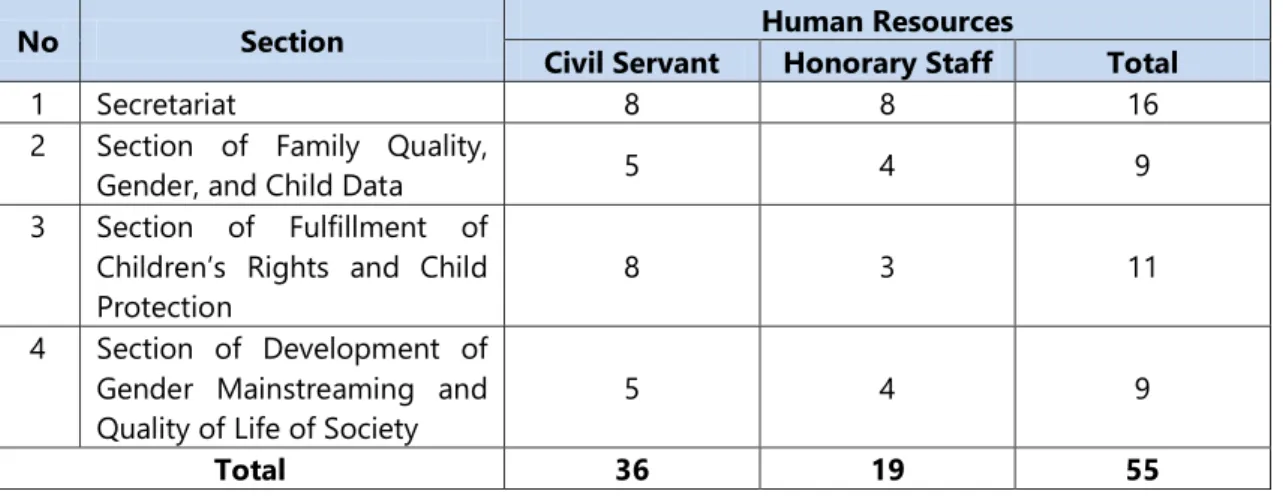
Table 1. Human Resources at The Office of Women’s Empowerment and Child Protection Bekasi Regency
No Section Human Resources
Civil Servant Honorary Staff Total
1 Secretariat 8 8 16
2 Section of Family Quality,
Gender, and Child Data 5 4 9
3 Section of Fulfillment of Children’s Rights and Child
Protection 8 3 11
4 Section of Development of Gender Mainstreaming and Quality of Life of Society
5 4 9
Total 36 19 55
Source: Office of Women’s Empowerment and Child Protection Bekasi Regency, 2021
Analysis Based on Resource Aspect
Van Meter and Van Horn's implementation model comprises of a second aspect, which pertains to the accessibility of resources. The present study draws upon informant interviews conducted at The Office of Women's Empowerment and Child Protection Bekasi Regency, as well as data obtained from Table 1. The findings indicate that The Office of Women's Empowerment and Child Protection Bekasi Regency employs a total of 55 human resources, with 20% of these personnel being tasked with the responsibility of safeguarding children's rights and ensuring their protection.
Moreover, there exists supplementary personnel pertaining to minors, particularly within the realm of gender and juvenile statistics.
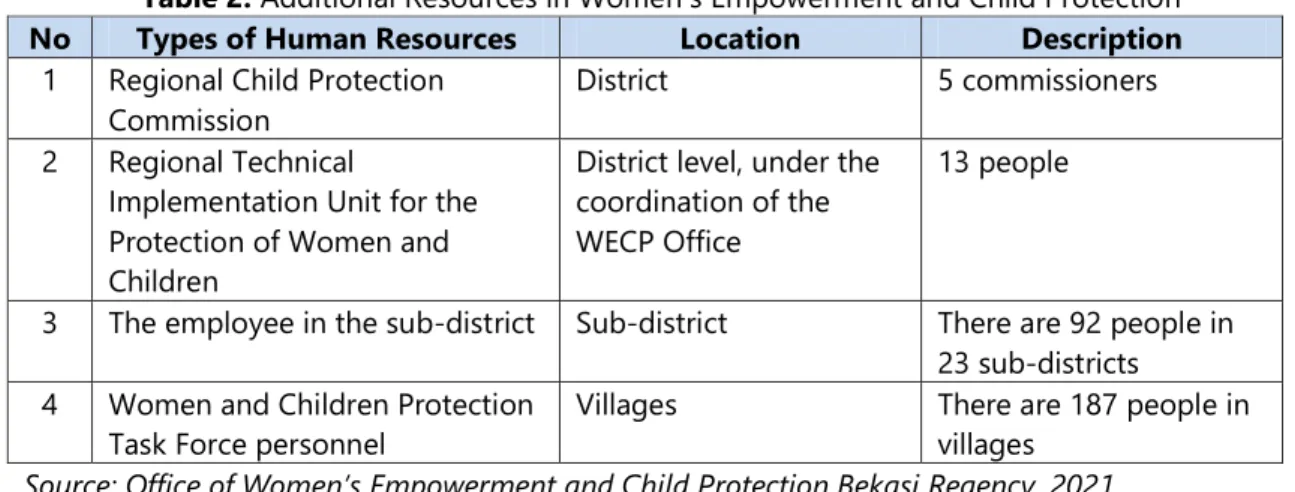
Data pertinent to the protection of women and children is implemented and monitored by a number of human resources in different departments, as indicated in Table 2. Members of the sub-district staff, the regional technical implementation unit for the protection of women and children, the regional child protection commission, and the task force are all part of these organisations. Safeguarding Women and Children in Lesser Governed Areas.
The availability of the activity budget is another resource that is evaluated. The Office of Women's Empowerment and Child Protection in Bekasi Regency utilizes budgetary sources from the local government budget for its activities. The Office of Women's Empowerment and Child Protection Bekasi Regency allocates approximately 52% of its total budget to the Quality of Life Improvement and Child Protection program, which encompasses various activities pertaining to safeguarding children.
When compared to the number of people employed by the Bekasi Regency government's Office for Women's Empowerment and Child Protection, this sector is quite sizable. Another aspect of resources that is a supporting factor in the protection of child victims of violence is the availability of an organizational structure (Adiyuwana, 2016), as can be seen in Bekasi Regent Regulation No. 96 in the year 2021.
Drawing from the aforementioned data, one may infer that there persists a dearth of personnel engagement. The Office of Women's Empowerment and Child
23 Protection in Bekasi Regency is persistently striving to optimize the existing resources and collaborate with various relevant regional apparatus organizations and non- governmental organizations that are committed to child protection. The Bekasi Regency Government's commitment to implementing child protection policies and funding supervision is evidenced by the relatively significant allocation of budget towards this area. This allocation highlights the government's efforts to ensure the effective implementation of child protection policies (Suharno, 2013).
Table 2. Additional Resources in Women's Empowerment and Child Protection No Types of Human Resources Location Description
1 Regional Child Protection Commission
District 5 commissioners
2 Regional Technical
Implementation Unit for the Protection of Women and Children
District level, under the coordination of the WECP Office
13 people
3 The employee in the sub-district Sub-district There are 92 people in 23 sub-districts 4 Women and Children Protection
Task Force personnel
Villages There are 187 people in villages
Source: Office of Women’s Empowerment and Child Protection Bekasi Regency, 2021
Analysis Based on Characteristic Aspects of Implementing Agent
Attributes of the agents carrying out the policy provide the third dimension of Van Metre and Van Horn's model of policy implementation. Organisations, both formal and informal, may need to work together to carry out public policies. The Office of Women's Empowerment and Child Protection in Bekasi Regency adheres to the organizational framework established by the Ministry of Women and Children Empowerment, while also being accountable to the Regent of Bekasi Regency. The implementation of a policy is contingent upon the presence of external pressure on the organizational unit. As per the informant's statement, it can be inferred that while the organizational structure of The Office of Women's Empowerment and Child Protection Bekasi Regency is modeled after the ministry structure, it also holds direct accountability to the Regent of Bekasi Regency. The implementation of agents in the Women's Empowerment and Child Protection Service of Bekasi Regency exhibits favorable characteristics, as the agency's organizational structure has been established.
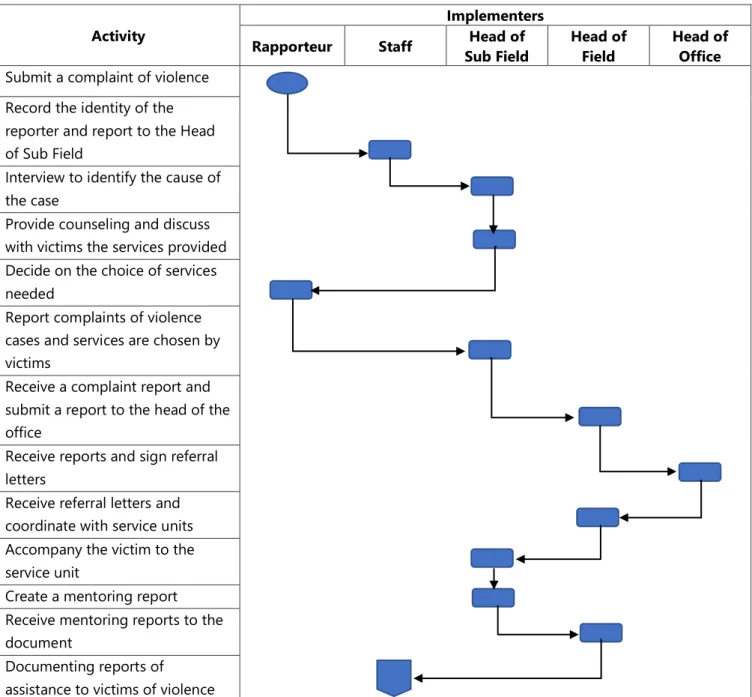
The characteristics of agent implementation can be discerned by the existence of Standard Operating Procedures (SOP), which facilitate task execution and delineate the sequential procedure for accomplishing work. The Standard Operating Procedures (SOPs) that pertain to the protection of children encompass the SOP for the registration of complaints regarding women and children who have been subjected to violence.
This is to be done through the Integrated Service Centre for Empowerment of Women and Children in Bekasi Regency, as illustrated in Figure 3. Additionally, the SOP for providing aid to women and children who have been victims of violence is also directed to the Integrated Service Centre for Empowerment of Women and Children (ISC-EWC) in the Bekasi Regency, as depicted in Figure 4.
The aforementioned data indicates that the attributes of executing agents have demonstrated efficacy, as evidenced by the comportment of the executors during the
24 discharge of their duties and the existence of established standard operating procedures (SOP) to serve as a reference for executing agents. The involvement of diverse organisational units in the communication process serves as evidence of the commitment of The Office of Women's Empowerment and Child Protection Bekasi Regency to attaining the established objectives.
Activity
Implementers Rapporteur Staff Head of
Sub Field
Head of Field
Head of Office Submit a complaint of violence
Record the identity of the reporter and report to the Head of Sub Field
Interview to identify the cause of the case
Provide counseling and discuss with victims the services provided Decide on the choice of services needed
Report complaints of violence cases and services are chosen by victims
Receive a complaint report and submit a report to the head of the office
Receive reports and sign referral letters
Receive referral letters and coordinate with service units Accompany the victim to the service unit
Create a mentoring report Receive mentoring reports to the document
Documenting reports of
assistance to victims of violence
Figure 3. Operating Procedure for Case Complaints for Women and Children Victims of Violence toISC-EWC) Bekasi Regency
Source: Office of Women’s Empowerment and Child Protection Bekasi Regency, 2021
25 Activity
Implementers
Rapporteur Volunteers
Head of Child Protection
Sub- Division
Head of P2TP2A
Submit a letter requesting case assistance
Receive a case assistance request letter
Submit a letter requesting case assistance
Create a case assistance approval letter
Verifying the case assistance consent letter
Sign a letter of consent for case assistance
Identify cases
Report case identification results Decide to assist according to the needs of the victim
Assistance for mediation Assistance to Religious Courts
Assistance to the Police Figure 4. Operating Procedure Case Assistance for Women and Children Victims of Violence to
ISC-EWC) Bekasi Regency
Source: Office of Women’s Empowerment and Child Protection Bekasi Regency, 2021 Analysis Based on Aspects of Attitudes and Tendencies of Implementers
The attitude and propensity of the implementers make up the fourth component of Van Meter and Van Horn's model for implementing policies. The acceptance or rejection of the implementers' attitude will have a significant impact on whether public policy implementation is successful or unsuccessful (Agustino, 2008).
The Office of Women's Empowerment and Child Protection Bekasi Regency's apparatus carried out activities in accordance with the major tasks and functions that had been determined, handling and accompanying each incoming case report by the relevant SOP, according to the findings of interviews pertaining to the attitudes or tendencies of the implementers. This shows the attitude of acceptance of implementing agencies in implementing government policies.
Analysis Based on Communication Aspects Between Organizations and Implementing Activities
The understanding of the standard goal by the people (implementors) who are responsible for achieving the standards and policy objectives is necessary for public policy to be implemented effectively, according to Van Meter and Van Horn's policy implementation model. Therefore, through a coordination mechanism between the
26 pertinent parties, the standards and objectives must be communicated to the implementers.
If a report comes in, it will be followed up immediately, and if it requires inter- sectoral involvement, the regional organizations/related institutions will be involved.
The communication that is built includes coordination of correspondence, involvement in activity meetings, and socialization with the community. Based on the information above, it can be concluded that The Office of Women’s Empowerment and Child Protection Bekasi Regency always communicates with regional organizations and related institutions.
Analysis Based on Aspects of the Economic, Social, and Political Environment Van Meter and Van Horn's policy implementation model identifies the economic, social, and political environment as the sixth aspect. The present study draws on interview data collected from informants affiliated with The Office of Women's Empowerment and Child Protection Bekasi Regency, sub-district officers, and community activists. The findings indicate a general lack of understanding among the populace of Bekasi Regency with regard to child protection. There exist numerous methods to disseminate knowledge among the general populace regarding the issue of children being subjected to violence. The impact of the social and economic environment is significant. An amicable environment and a thriving economy are conducive to positive conduct in contrast to individuals who rely on a less accommodating social milieu.
Ramadhani (2021) states that internal and external factors can trigger acts of violence against children by parents. Emotional conditions are one of the external factors that cause parents to think that an alternative solution to disciplining and teaching children is to commit acts of violence (Abdul Kadir, 2020; Dewi Eko Wati, 2018). The impact of children who get acts of violence from their parents is a lack of motivation and self-esteem (Agustin, Saripah, & Gustiana, 2018), aggressive behavior outside the home and quiet at home, malnutrition, or feeling physically sick.
The political dimension constitutes a crucial determinant of policy implementation efficacy. The issue of child protection in Bekasi Regency has been addressed through the establishment of The Office of Women's Empowerment and Child Protection Bekasi Regency in 2019, which demonstrates a strong commitment from the political infrastructure. Additionally, a significant portion of the budget allocated to The Office of Women's Empowerment and Child Protection Bekasi Regency, amounting to 52% of the total budget, is dedicated to child protection initiatives. Based on the aforementioned data, it is evident that there exist obstacles in both the economic and social domains, despite favorable political backing, with respect to endeavors aimed at safeguarding children in Bekasi Regency.
Conclusion
The implementation of child protection policies in Bekasi Regency has shown good results. This is shown by the existence of policies at the regional level that support the realization of child-friendly city policies. The Bekasi Regency Government also continues to maximize the potential of human and financial resources to support the policy.
Likewise, an established Standard Operating Procedure (SOP) exists as a point of reference for the guidance of mentoring minors who have experienced violence. The ramifications encompass promptness in addressing instances of aggression and the
27 engagement of multiple parties. The degree of community involvement is a significant determinant of the efficacy of child protection legislation.
The recommendation provided entails augmenting the quantity of personnel engaged in managing child safeguarding. Furthermore, it is imperative to prioritize the examination of the social, economic, and political factors that contribute to the support system surrounding child protection concerns. The approach employed involves community empowerment through a range of initiatives, including skills development programs and information-sharing events such as seminars. It is imperative to provide the community with a comprehensive comprehension of the protocols pertaining to the management of instances of child violence, alongside endeavors to enhance the synchronization and communication among institutions.
Acknowledgment
The research team thanked all parties, especially the Bekasi Regency Office of Women's Empowerment and Child Protection who had helped provide data and information.
References
Adiyuwana, Y. K. (2016). Perencanaan dan Implementasi Perlindungan Perempuan dan Anak Korban Kekerasan di DIY (Studi pada P2TPA “RDU” DIY). Jurnal Ilmiah Administrasi Publik, 2(1), 27–38. https://doi.org/10.21776/ub.jiap.2016.002.01.4 Agustin, M., Saripah, I., & Gustiana, A. D. (2018). Analysis typical of violence in children,
effect and the underlying factors. Jurnal Ilmiah Visi PGTK PAUD Dan DIKMAS, 13(1), 1–10.
Agustino, L. (2014). Dasar-Dasar Kebijakan Publik. Bandung: Alfabeta.
Agustino, Leo. (2008). Dasar-dasar kebijakan publik. Bandung: Alfabeta.
Aidy, W. R., & Sanaky, M. S. R. (2022). Victims of Child Sexual Violence from a Legal
Perspective. Jurnal Hukum Sasana, 8(1), 125–144.
https://doi.org/10.31599/sasana.v8i1.1063
Aini, N. (2016). Pengembangan Dosen Di Lingkungan Sekolah Tinggi Ilmu Sosial Dan Ilmu Politik Amal Ilmiah Yapis Wamena Kabupaten Jayawijaya. Agustus-Desember, 3(2), 93–100.
Akib, H. (2012). Implementasi kebijakan: Apa, mengapa dan bagaimana. Ilmu Administrasi Publik, 1(1), 1–11.
Al-Mohannadi, A. S., Al-Harahsheh, S., Atari, S., Jilani, N., Al-Hail, G., & Sigodo, K. (2022).
Addressing violence against children: A case review in the state of Qatar. Frontiers in Public Health, 10. https://doi.org/10.3389/fpubh.2022.859325
Ariani, N. V. (2014). Implementasi Undang-Undang Nomor 11 Tahun 2012 tentang sistem peradilan pidana anak dalam upaya melindungi kepentingan anak. Jurnal Media Hukum, 21(1)(16). https://doi.org/https://doi.org/10.18196/jmh.v21i1.1160 Bhatia, A., Fabbri, C., Cerna-Turoff, I., Turner, E., Lokot, M., Warria, A., … Devries, K.
(2021). Violence against children during the COVID-19 pandemic. Bulletin of the
World Health Organization, 99(10), 730–738.
https://doi.org/10.2471/BLT.20.283051
Dastina, D. (2017). Implementasi Undang-Undang Nomor 35 Tahun 2014 tentang Perlindungan Anak terhadap Kekerasan Anak di Lingkungan Sekolah. Universitas Islam Negeri Alauddin Makassar.
Hutabarat, C., Mahayoni, M., Laufra, F. M., & Sutrisno, S. (2021). The Role of Parents in Building Children’s Character at Home During the Covid-19 Pandemic. RERUM:
Journal of Biblical Practice, 1(1), 63–75. https://doi.org/10.55076/rerum.v1i1.14
28 M’jid, N. M. (2020). Global status of violence against children and how implementation of SDGs must consider this issue. Child Abuse & Neglect, 110, 104682.
https://doi.org/10.1016/j.chiabu.2020.104682
Miles, M. B., & Huberman, A. M. (1994). Qualitative data analysis: An expanded sourcebook. sage.
Mubarok, S., Zauhar, S., Setyowati, E., & Suryadi, S. (2020). Policy Implementation Analysis: Exploration of George Edward III, Marilee S Grindle, and Mazmanian and Sabatier Theories in the Policy Analysis Triangle Framework. Journal of Public
Administration Studies, 005(01), 33–38.
https://doi.org/10.21776/ub.jpas.2020.005.01.7
Mutiarin, D. (2014). Manajemen birokrasi dan kebijakan: penelusuran konsep dan teori.
Pustaka Pelajar.
Novianti, R., & Sahrul, M. (2020). Implementasi kebijakan perlindungan anak (telaah uu nomor 35 tahun 2014 pasal 9 ayat 1). Khidmat sosial: Journal of Social Work and Social Services, 1(2), 139–147.
Novrianna, W., Ngarawula, B., & Prianto, B. (2022). Study of Settlement of Industrial Relation Disputes through Mediation. International Journal of Research in Social Science and Humanities, 03(08), 07–14. https://doi.org/10.47505/IJRSS.2022.V3.8.2 Nugroho, R. (2004). Kebijakan publik. Jakarta: PT Alex Media Komputindo.
Nugroho, R. P., Zuiderwijk, A., Janssen, M., & de Jong, M. (2015). A comparison of national open data policies: lessons learned. Transforming Government: People, Process and Policy, 9(3), 286–308. https://doi.org/10.1108/TG-03-2014-0008
Patilima, H. (2018). Kabupaten Kota Layak Anak. Jurnal Kriminologi Indonesia, 13(1).
Rahman, N., & Sarip, S. (2020). Child Protection Policy for Victims of Sexual Crimes.
Varia Justicia, 16(1), 15–30. https://doi.org/10.31603/variajusticia.v16i1.3057
Roria, R. (2019). Implementasi undang-undang nomor 35 tahun 2014 tentang perlindungan anak terhadap perlindungan hak-hak anak korban kekerasan seksual (studi di unit layanan terpadu perlindungan sosial anak integratif kabupaten Tulungagung). Sakina: Journal of Family Studies, 3(3).
Sapto Budoyo. (2022). the urgency of legal protection to the woman and children exploitation in the new broadcaster and social media. journal equitable, 7(2), 157–
174. https://doi.org/10.37859/jeq.v7i2.4169
Satispi, E. (2019). Policy Development of the Child-Friendly City: Case Study of South Tangerang City Regional Government. International Journal of Social and
Administrative Sciences, 3(2), 105–112.
https://doi.org/10.18488/journal.136.2018.32.105.112
Simatupang, P., & Akib, H. (2015). Efektivitas Implementasi Dan Dampak Kebijakan Dalam Konteks Desentralisasi Pemerintahan. Jurnal Ilmiah Ilmu Administrasi Publik, 2(1), 1. https://doi.org/10.26858/jiap.v2i1.871
Sofiana, N. E. (2022). Urgensitas penyelesaian sengketa status anak: kajian perkara No.
49/Pdt.P/2020/PA.Pnj. Al-IHKAM: Jurnal Hukum Keluarga Jurusan Ahwal Al- Syakhshiyyah Fakultas Syariah IAIN Mataram, 14(1), 69–82.
https://doi.org/10.20414/alihkam.v14i1.4751
Suharno, S. (2013). Dasar-Dasar Kebijakan Publik: Kajian Proses dan Analisa Kebijakan.
Yogyakarta: Penerbit Ombak.
Suharto, E. (1997). Pembangunan, Kebijakan Sosial dan Pekerjaan Sosial. Spektrum Pemikiran: Bandung.
Trisna, N., & Zulbaidah, I. (2020). IMPLEMENTASI UNDANG-UNDANG NOMOR 35 TAHUN 2014 TENTANG PERLINDUNGAN ANAK (Studi Kasus Penanganan Anak