
AN ECONOMIC ACCOUNT OF THE TAKINGS CLAUSE
An Economic Account of the Takings Clause and
On this view, then, compensation serves the laudable purpose of helping to create efficient regulatory incentives by forcing the government to internalize the costs it imposes. By requiring the government to compensate the heavily burdened property owner, the majority of 99 members is forced to internalize the costs of government action.
The Public Choice Theory Critique and
LOCAL GOVERNMENT POLITICS: PROPERTY VALUES
Local Governments' Majoritarianism
Homeowners Dominate Local Politics
There is no need for a majority of homeowners to vote if all available local election choices are likely to serve their fundamental interests.96. It also provides evidence that the size of government is still very important for political participation. Organizational costs depend on the size and heterogeneity of the involved group, so local authorities with smaller, homogeneous groups of voters face lower costs.10 4.
105 FISCHEL, supra note 11, at 87-88; see also Bahl, supra note 78, at 77 ("The most important budgetary role in local government is to decide the level and mix of taxes and expenditures that best meet the needs and preferences of the local population. That local governments assignment function seriously is evident from the wide variety of choices they actually make."). Homeowners' control over local governments meets one of the central conditions for traditional economic accountability of the Takings Clause. For compensation to work as the traditional economic narrative of the Takings Clause suggests, the majority must also internalize both the costs and benefits of government action.
Property Taxes Fund Local Governments
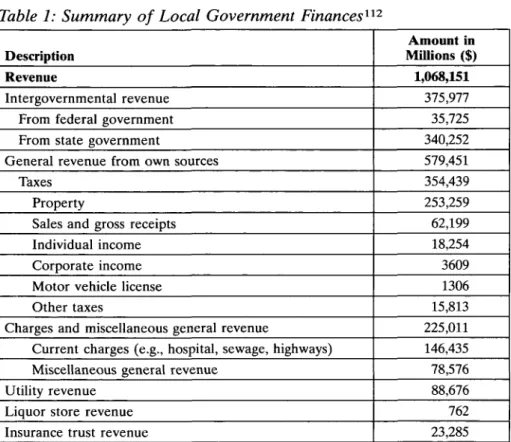
Census for which data are currently available, property taxes accounted for an average of only 27% of the total budgets of all local governments." Taken at face value, the relatively small percentage of municipal revenue from property taxes suggests that homeowners do not, in fact, have to internalize the most budget expenditures If a local government chooses to regulate property in a way that requires compensation, how much of that compensation must come from local property taxes.
So when it comes to compensating aggrieved property owners, the money should still come from local property taxes. Cities, unlike cities and suburbs, are more likely to raise a larger share of their tax revenue through sales taxes and other alternatives to property taxes. Data that combine cities and smaller local governments will therefore underestimate the role of property taxes in financing the acquisitions of private property that this article focuses on.
Property Values Respond to Local Government
122 Fischel primarily makes this argument in the context of zoning, arguing that any changes in land use have the potential to affect the values of adjacent properties in unpredictable ways. A decline in the quality of local schools can have as negative an impact on property values as any locally undesirable land use. If property values are rising compared to other cities, it means local officials would do well to get the right mix of services and property taxes.
Oates, The Effects of Property Taxes and Local Spending on Property Values: An Empirical Study of Tax Capitalization and the Tiebout Hipothesis, 77 J. Oates, The Effects of Property Taxes and Local Public Spending on Property Values: A Reply and Yet Further Results, 81 J. Daar is natuurlik geen manier om in abstrak te weet of grondgebruikregulasies of groeikontroles eiendomswaardes sal verhoog nie.
Local Governments and Larger Governments
LIMITS ON LOCAL GOVERNMENT EFFICIENCY
Local Governments' Risk Aversion
Why Governments Are Risk Averse
Government risk aversion resources are much more likely to be present in local governments. 162 While governments themselves, as abstract legal entities, may not be risk averse, this article uses the term "government risk aversion" as shorthand for the risk aversion of government decision makers. Blume and Rubinfeld make the same decision in their brief discussion of government risk aversion.
An interesting consequence of governments' response to their voters' risk aversion is that the greater the number of voters, the less risk averse the government will be.173 It is as if governments diversify their exposure to risk by the large number of their voters. . Larger governments have professional planners who may suffer from their own form of risk aversion. Even if excessive optimism prevails later, risk aversion will still have a powerful influence on local government decision-making.
Locating the Risk in Regulating
The choice facing the government after a trial on the issue of damages is only whether the proposed action is worth the amount it will have to pay to compensate the aggrieved property owner. At first glance, this is consistent with the traditional economic account of the Takings Clause, as it forces the government to decide whether a conviction at a given price is worth more to the government than it will cost. The government knows the cost of a conviction before it has to decide whether to proceed.
In these cases, at any rate, there is no obvious place for risk aversion to enter into government decision-making. When considering new regulation, the government may not be able to predict the actual costs. Instead, the government must factor in the possibility that it will be forced to pay—either just compensation for the entire property, fair rental value, or legal fees—and this in turn creates different incentives for the government to act depending on its relative risk aversion.
The Effects of Risk Aversion on Regulatory
Even procedural protections at sentencing, while preserving the government's right to withdraw, come with a potentially significant cost in the form of attorneys' fees. Therefore, the government will not be able ex ante to balance the benefits of a plan against its costs, at least not in any precise way. Chances are, the government is right: Regulation will bring substantial benefits and require no compensation.
If the condemnation of the property is expected to cost the park something less than $80, say $75, then the park will make a positive profit and a well-calibrated compensation regime should encourage the government to act. The $20 discount taken from the conviction value is therefore multiplied by this factor, resulting in a discount of $30.196. The present value of the park is now only US$70 and the government can abandon the project. Even if risk aversion is factored into the cost side of the equation, this effect will be magnified, as with all regulatory takeovers.
Local Externalities
Positive Externalities
Restrictions on factories and other sources of air pollution benefit property owners in neighboring cities as well as the city that regulates the regulation. If a homeowner lives near a smelly landfill, she will suffer, whether the landfill is in her town or in a neighboring town. These types of positive externalities predictably lead to underregulation by local governments, as measured by the net increase in welfare for all affected people.20 6 Imagine that a local government decides whether to ban adverse use despite a demand for compensation burdened property owners.
Under the model developed in Part II, the local government will weigh the benefits to local property owners of banning use against the costs of higher taxes resulting from compensating taxed property owners. 204 These benefits include both increases in the value of adjacent properties and reductions in the property taxes of adjacent homes. 205 Landmark designation can impose significant costs on property owners and reduce property values.
Negative Externalities
Even in the face of an offset claim, some of the costs of local growth controls do not translate into local property taxes and therefore may be ignored by local decision makers. True, local governments today can avoid some of the costs of regulation, but they are also unable to capture all of the benefits. In particular, they should be willing to incorporate more of the benefits created by local regulations.
Proposals to account for local governments' risk aversion on the cost side of the equation take a more familiar form. He points out that most of the money came from the federal government in the form of project-specific grants. If the purpose of the Takings Clause is to force the government to internalize the costs of its actions, then all of these costs and benefits must be considered.
UPDATING LOCAL GOVERNMENTS' REGULATORY
Accounting for Risk Aversion
Reducing the Expected Costs of Government
It is the first of the three compensation practices identified above, which offset compensation with reciprocal benefits, that appears to be particularly appropriate for the valuation of income by local governments. Epstein, one of the primary proponents of radically expanded property rights, recognizes that the existence of these implicit benefits in kind provides an appropriate defense to an expropriation claim.221. If the government takes a piece of property for a new road, but in the process increases the value of the remaining property because of the new road, that increase in value can be deducted from the compensation owed.
Instead of asking how much the property owner was harmed, some of the jurisprudence on compensation appears to focus on what the government took.230 The two are not necessarily symmetrical. Moreover, any perceived unfairness to an aggrieved property owner must be weighed against the fairness of the entire system. 233 For a comprehensive treatment of the importance of egress and voice, see generally Been, supra note 134.
Insurance for Litigation Costs and for
Spreading the costs of lawsuits over a much wider community would allow for greater risk spreading and mitigate the risk aversion of local governments. 240 Insurance pools have become increasingly common for local authorities, but are usually used to cover everyday risks such as accident liability. The solution is to create a risk-spreading regime that does not completely insulate local governments from the costs of their actions.
Forcing local governments to internalize some, but not all, of the costs of adoption litigation and temporary adoptions is best achieved by charging local governments the equivalent of an insurance premium that tracks the content of their land use regulations in terms of the likelihood of litigation, or the equivalent of a surcharge for actual litigation costs incurred. Sometimes local governments then have to internalize the costs imposed by excessive litigation and temporary adoptions. The final concern is that insurance for litigation costs will lead local governments to low-ball property owners when exercising eminent domain.
Accounting for Local Governments' Externalities
But the extent of positive externalities will also depend on substantive judgments about the benefits of externalities. The amount of the grant is a direct expression of the state or federal government's judgment of the extent of the positive externalities that the local project will generate. 270 For a discussion of the relationship between property taxes and property values, see FISCHEL, supra note 11, at 40-42.
272 Ellickson has provided a compelling account of the various costs that local land use regulations can impose. For a discussion of the difficulties associated with valuing externalities, see Dana, supra note 39, at 1267-69. If a local government were forced to pay for the benefits it receives from the exclusion, rather than the harms the exclusion imposes on others, local governments may be better deterred from taking such exclusionary measures in the first place.
