Clinid Fishes of Chile and Peru, with Description of a New Species,
Myxodes ornatus, from Chile
JOHN S. STEPHENS, JR.
and
VICTOR G. SPRINGER
SMITHSONIAN CONTRIBUTIONS TO ZOOLOGY • NUMBER 159
S E R I A L P U B L I C A T I O N S O F T H E S M I T H S O N I A N I N S T I T U T I O N The emphasis upon publications as a means of diffusing knowledge was expressed by the first Secretary of the Smithsonian Institution. In his formal plan for the Insti- tution, Joseph Henry articulated a program that included the following statement:
"It is proposed to publish a series of reports, giving an account of the new discoveries in science, and of the changes made from year to year in all branches of knowledge."
This keynote of basic research has been adhered to over the years in the issuance of thousands of titles in serial publications under the Smithsonian imprint, com- mencing with Smithsonian Contributions to Knowledge in 1848 and continuing with the following active series:
Smithsonian Annals of Flight Smithsonian Contributions to Anthropology
Smithsonian Contributions to Astrophysics Smithsonian Contributions to Botany Smithsonian Contributions to the Earth Sciences
Smithsonian Contributions to Paleobiology Smithsonian Contributions to Zoology Smithsonian Studies in History and Technology
In these series, the Institution publishes original articles and monographs dealing with the research and collections of its several museums and offices and of professional colleagues at other institutions of learning. These papers report newly acquired facts, synoptic interpretations of data, or original theory in specialized fields. These pub- lications are distributed by mailing lists to libraries, laboratories, and other interested institutions and specialists throughout the world. Individual copies may be obtained from the Smithsonian Institution Press as long as stocks are available.
S. DILLON RJPLEY
Secretary
Smithsonian Institution
Clinid Fishes of Chile and Peru, with Description of a New Species,
Myxodes ornatus, from Chile
John S. Stephens, Jr.
and Victor G. Springer
SMITHSONIAN INSTITUTION PRESS City of Washington
1973
ABSTRACT
Stephens, John S., Jr., and Victor G. Springer. Clinid Fishes of Chile and Peru, with Description of a New Species, Myxodes ornatus, from Chile. Smithsonian Contributions to Zoology, number 159, 24 pages, 15 figures, 1974.—Five genera and 10 species of clinid fishes are found in Chile and/or Peru. Of these, three genera and eight species are endemic. The other two genera and species are wide-ranging forms in the eastern Pacific with centers of distribution in the tropics. Of the 30 nominal species-group names available for the clinids of Chile and Peru, 15, including several of the oldest, have no extant type-material. The lack of type-material for some names has resulted in involved nomenclatural problems, three of which we have solved by designating neotypes based on the holotypes of other nominal species (thus creating objective synonyms). Neotypes are designated for Blennius tetranemus Cope, Clinus peruvianus Valen- ciennes, and Clinus guttulatus Valenciennes. Only one nominal species is un- accounted for—Clinus fernandezianus Guichenot. The description of this species pertains to no known clinid and no clinids are known from the type-locality, Juan Fernandez Islands.
A key is presented to the species treated and all species of the endemic genera (Myxodes, Auchenionchus, Calliclinus) are illustrated and described in a com- mon format.
We have synonymized the clinid subtribe Calliclinidi Hubbs with the sub- tribe Cryptotremidi Hubbs. These clinids are distinguished from all others in having some caudal-fin rays branched.
OFFICIAL PUBLICATION DATE is handstamped in a limited number of initial copies and is recorded in the Institution's annual report, Smithsonian Year. SI PRESS NUMBER 4925. SERIES COVER DESIGN: The coral Montastrea cavernosa (Linnaeus).
Library of Congress Cataloging in Publication Data Stephens, John Stewart
Clinid fishes of Chile and Peru.
(Smithsonian contributions to zoology, no. 159)
1. Clinidae. 2. Fishes—Chile. 3. Fishes—Peru. 4. Myxodes ornatus. I. Springer, Victor Gruschka, 1928- joint author. II. Title. III. Series: Smithsonian Institution. Smith- sonian contributions to zoology, no. 159.
QL1.S54 no. 159 [QL6S8.C63] 591'.08s [597'.88] 73-9864 For sale by the Superintendent of Documents, U.S. Government Printing Office, Washington, D.C. 20402
Price 70 cents
Page
Introduction 1 Key to Clinid Fishes from Peru and Chile 3 Subfamily Clininae 4 Tribe Myxodini 4 Myxodes ornatus, new species 4 Myxodes viridis Valenciennes 7 Myxodes cristatus Valenciennes 8 Subfamily Labrisoiriinae 9 Tribe Labrisomini 10 Malacoctenus tetranemus (Cope) 10 Labrisomus (Labrisomus) multiporosus Hubbs 10 Labrisomus (Labrisomus) philippii (Steindachner) 10 Tribe Cryptotremini 11 Auchenionchus Gill 11 Auchenionchus variolosus (Valenciennes) 11 Auchenionchus microcirrhis (Valenciennes) 14 Auchenionchus crinitus (Jenyns) 17 Callidinus Gill 19 Calliclinus geniguttatus (Valenciennes) 20 Literature Cited 23
Clinid Fishes of Chile and Peru, with Description of a New Species,
Myxodes ornatus, from Chile
John S. Stephens, Jr.
and Victor G. Springer
Introduction The clinid fishes of the temperate waters of Peru and Chile are, essentially, a geographically restricted group. Of the five genera and ten species that we recognize, three genera and eight species are en- demic to the area. The other two genera and species are wide-ranging members of the tropical Panamic fauna with distributions extending from the Gulf of California to Peru or Chile.
The clinid fishes of Peru and Chile have not pre- viously been treated as a group, although Hilde- brand (1946) discussed the Peruvian species, and DeBuen (1962), the Chilean species. Hubbs (1953) and Springer (1959) included information on the Peruvian and Chilean species of the clinid genera Labrisomus and Malacoctenus in their revisions of those genera.
Our study was initiated when we found it impos- sible to identify Chilean clinids using DeBuen's (1962) study. We believe that he misidentified most of his material. We have synonymized all the new taxa he proposed (one genus, two subgenera, six species), as well as several other previously recog- nized taxa of Chilean and Peruvian clinids.
The nomenclature of the Chilean and Peruvian clinids is unusually complex for so small a number of species. This complexity is the result of high in-
John S. Stephens, Jr., Department of Biology, Occidental Col- lege, Los Angeles, California 90041. Victor G. Springer, Di- vision of Fishes, National Museum of Natural History, Smithsonian Institution, Washington, D.C. 20560.
traspecific variability, inadequate species descrip- tions, and nonexistence, or loss, of type-material, including that for some of the oldest names. Of the 30 nominal species-group taxa of clinids previously described or reported from the area, we have been able to locate primary or secondary types for only 15. A recent attempt by R. Lavenberg of the Los Angeles County Museum of Natural History to ex- amine or obtain DeBuen's type-specimens for us was unsuccessful. A tidal wave at Montemar in 1968 and an earthquake at Santiago in 1970 apparently destroyed DeBuen's specimens, as well as those of other early Chilean ichthyologists.
Among the nominal clinid species, Clinus magel- lanicus Philippi and C. foncki Philippi, both listed originally in Delfin (1899), are nomina nuda.
Clinus foncki was synonymized with Myxodes viridis by Hubbs (1952), who erroneously attributed the name C. foncki to Philippi (1896). The systematic position of Clinus fernandezianus Guichenot in Gay (1848) is presently indeterminable. The description pertains to no known clinid; there is no type-ma- terial; and no clinids are known to occur at the type- locality, Juan Fernandez Islands.
METHODS.—Counts and measurements follow those of Hubbs (1952) except that the last two dor- sal- and anal-fin rays were counted separately and the interorbit was measured at its narrowest point.
In most clinids each segmented dorsal- and anal-fin ray is supported by a separate pterygiophore, but in
SOC
M
LATERAL DORSAL
FIGURE 1.—Cranial sensory pore pattern in Myxodes cristatus (10 — infraorbital series; LI «•
lateral line; M - mandibular series; N - nasal series; OC - occipital series; OCC - occipital commissural pore; PO - postorbital pore; POP - preopercular series; SO - supraorbital series;
SOC - supraorbital commissural pore).
most specimens of Calliclinus the last dorsal- and anal-fin pterygiophores each bear two rays, the pos- teriormost of which is considerably reduced and easily overlooked. Our counts of dorsal- and anal- fin rays of Calliclinus nevertheless include both of the last two rays in each fin. Cranial sensory pores are illustrated in Figure 1.
The synonymies include only references to orig- inal descriptions. The key is based solely on the characters of specimens examined. Many of the fin- ray counts reported by DeBuen (1962) for Chilean clinids are not duplicated in any of our specimens.
DeBuen did not indicate how he made his counts and we suspect that in several instances he was in error.
Ranges for meristic characters are given followed by the mean in parentheses. Measurements, except standard length, are in percent standard length.
Standard length and total length are abbreviated as
SL and TL. Vertebral counts were taken from radio- graphs.
The following is a list of institutional abbrevia- tions used: USNM, United States National Museum of Natural History; MNHN, Museum National d'Histoire Naturelle, Paris; SIO, Scripps Institution of Oceanography; UCLA University of California, Los Angeles; CAS, California Academy of Sciences;
ANSP, Academy of Natural Sciences of Philadel- phia; BMNH, British Museum (Natural History), London; EBM, Estacion de Biologia Marina, Mon- temar, Chile. After each collection number, the number of specimens is recorded followed by the range in standard length to the nearest mm in pa- rentheses.
Collections bearing the abbreviation USNM (the former United States National Museum) are de- posited in the National Museum of Natural His- tory, Smithsonian Institution, Washington, D.C.
ACKNOWLEDGMENTS.—We wish to thank the fol- lowing individuals and institutions for loan of speci- mens: R.H. Rosenblatt and J.C. McCosker, Scripps Institution of Oceanography; B.W. Walker and J.
Bleck, University of California, Los Angeles; J.C.
Tyler, formerly Academy of Natural Sciences, Phila- delphia; and P. H. Greenwood, British Museum (Natural History). Special thanks must go to R.
Lavenberg, Los Angeles County Museum, for at- tempting to locate DeBuen's specimens; and to M.K.
Oliver, Occidental College, for examining the holo- type of Auchenionchns crinitus; M.L. Bauchot, Mu- seum National d' Histoire Naturelle, Paris, for as- sistance in utilizing the collection and providing a photograph of the manuscript figure upon which the description of Clinns peruvianus is based; and J.E. Bohlke, Academy of Natural Sciences of Phila- delphia for attempts to locate Cope's types. A por- tion of the work reported here was supported by N.S.F. research grant GB-27266 to the senior author.
Key to Clinid Fishes from Peru and Chile
1. Dorsal fin XXXII-XXXVIII.3-7; pectoral-fin rays 11-14 (usually 12); scales with radii on all margins (subfamily Clininae) 2 Dorsal fin XVII-XXVI, 9-14; pectoral-fin rays 13-16; scales with radii on anterior margin only (subfamily Labrisominac) 4 2. Dorsal-fin membrane noticeably notched between third and fourth spines (Figure 2);
total dorsal- plus anal-fin elements 60-63; dorsal fin XXXII-XXXIV.4; anal fin 11,22-23;
4 sensory pores on each side of mandible anterior to rictus (Figure 1); 1-2 sensory pores in supraorbital series posterior to commissural pore; infraorbital pores 7; vertebrae 15
+ 30-31 = 45-46; dusky bands on body and dorsal and anal fins
Myxodes ornatus, new species Dorsal-fin membrane not notched (Figures 3, 4); total dorsal- plus anal-fin elements 64-70;
dorsal fin XXXIV-XXXVII.3-7; anal-fin rays 11,23-26; 5 sensory pores on each side of mandible anterior to rictus; 3-6 sensory pores in supraorbital scries posterior to com- missural pore; infraorbital pores 7-11; vertebrae 16-19 + 30-34 = 48-52; no bands on body and dorsal and anal fins 3 3. Dorsal fin XXXVI-XXXVIII,3-4; anal fin 11,25-26; orbital cirrus length 1.5-2.2 in eye diameter, longer than nasal cirrus; tip of depressed longest anal-fin ray reaches almost to caudal-fin base; body uniformly dark brown in preserved specimens
Myxodes cristatus Valenciennes Dorsal fin XXIV-XXVJ.,6-7; anal fin 11,24-25; orbital cirrus length 3.0-4.0 in eye diameter, usually almost equal in length to nasal cirrus; distance from tip of depressed longest anal-fin ray to caudal-fin base almost equal to half caudal peduncle length; body pale or tan to colorless in preserved specimens, usually with horizontal stripe behind eye (stripe may extend across opercle, occasionally present on the body)
Myxodes viridis Valenciennes 4. Dorsal-fin spines XVII-XXI; caudal-fin rays unbranched; lateral-line scales 53-74 (Tribe Labrisomini) 5 Dorsal-fin spines XXIV-XXVI; central caudal-fin rays usually branched (if unbranched, fewer than 45 lateral-line scales); lateral-line scales 39-64 (Tribe Cryptotremini) 7 5. Teeth in jaws uniserial; palatine teeth absent; upper jaws less than 11.5 percent SL; lateral- line scales 53-59 Malacoctenus tetranemus (Cope) Patch of small teeth present behind outer row of large teeth in both jaws; palatine teeth
present; upper jaw more than 13.0 percent SL; lateral-line scales 64-74 6 6. Pectoral-fin rays 14-16 (usually 15); lateral-line scales 68-74 (rarely 68-69)
Labrisomus philippii (Steindachner) Pectoral-fin rays 13-15 (usually 14); lateral-line scales 64-69 (rarely 69)
Labrisomus multiporosus Hubbs 7. Lateral-line scales 40-48; 3 patches of nape cirri (one on each side and one median); gill rakers 3-5 + 7-10; orbital cirrus multifid from simple fleshy base; pelvic fin I, 3-4;
pectoral-fin rays 14-15 Calliclinus geniguttatus (Valenciennes) Lateral-line scales 56-64; 2 patches of nape cirri (one on each side) usually present (one
or both occasionally absent); gill rakers 2 + 6-7; orbital cirrus simple to multifid, when multifid never from single base; pelvic fin I, 3; pectoral-fin rays 13-14 (Auchenionchus Gill) 9 9. Pectoral-fin rays 14; dorsal fin XXIV-XXV (usually XX1V),11-12; anal fin 11.22; orbital
cirrus multifid, obvious; nape cirri present, obvious, raultifid and palmate (except in holotype, see discussion); peritoneum black; dorsal-fin spines without cirrus-like pro- jections; squamation incomplete in specimens up to 174 mm SL (complete in holotype, 240 mm SL); belly with almost no scales; usually only 25-40 scales on pectoral-fin base;
no scales on fin membranes; lateral line with 32-35 unnotched and 24-26 notched scales;
greatest body depth 3.0-3.8 in SL; head profile steeply declivous from dorsal-fin origin to snout; top of head smooth Auchenionchus variolosus (Valenciennes) Pectoral-fin rays 13; dorsal fin XXV-XXVI ,9-12; anal fin 11,23-24 orbital cirrus variable:
0-11 simple cirri, usually tiny, occasionally a single large cirrus (half eye diameter) or large cirrus and several minute ones; nape cirri usually present, always small, simple to palmate; peritoneum white; dorsal-fin spines with simple cirrus-like projections at tips;
scales covering entire body and fin bases, extending onto most fin membranes in speci- mens larger than 50 mm SL; lateral line with 35-38 unnotched and 21-29 notched scales;
greatest body depth 3.5-4.8 in SL; head profile gently curved from dorsal-fin origin to snout; top of head covered with wart-like protuberances in specimens greater than 100 mm SL, smooth on smaller specimens 10 10. Total number of orbital and nape cirri (free tips of both sides) 20-45 in specimens larger than 50 mm SL; all orbital cirri tiny; fewer than 18 teeth present in each palatine patch;
dorsal fin XXV-XXVI (XXVI in 93 percent of specimens),11-12 (11 in 86 percent of specimens); anal fin 11,23-24 (24 in 86 percent of specimens); caudal fin with single line of large spots traversing distal half; spots absent from gill membranes, present on lips;
pectoral fins usually unmarked; body generally mottled, often with large spots or bands;
young with two white bands, one at base of caudal, one behind head
Auchenionchus crinitus (Jenyns) Total number of orbital and nape cirri less than 20 (occasional large specimens, 220-250
mm SL, may have as many as 24); males with one large orbital cirrus and usually 1-3 tiny ones; numerous small teeth cover palatines (about 50-100 in each patch in specimens larger than 100 mm SL, 10-20 in specimens 50-100 mm SL); dorsal fin XXV-XXVI (XXV in 85 percent of specimens),11-12; anal fin 11,23-24 (23 in 95 percent of specimens);
caudal fin. uniformly dark brown in adults, banded in young; spots present on head and gill membranes but usually absent from upper lips anteriorly; pectoral fins uniformly brown or striped; body generally uniformly brown, but small specimens (less than 100 mm SL) sometimes covered with large brown spots
,Auchenionchus microcirrhis (Valenciennes)
Subfamily CLININAE Tribe MYXODINI
Springer (1970) differentiated the genera of the tribe Myxodini, in which he recognized two South American genera, Myxodes, with two species, from the eastern Pacific, and Ribeiroclinus, monotypic from the western Atlantic. The new Pacific species, Myxodes ornatus, described below is superficially similar to Ribeiroclinus in color pattern and dorsal- fin shape. While some of the meristic characters of M. ornatus are intermediate between those of Myxodes and Ribeiroclinus as reported by Springer, its morphometric characteristics (Tables 1-2), 2 epurals, and biserial jaw teeth seem to ally it more closely with Myxodes.
The head, eye diameter, first dorsal-fin spine, and pelvic fin of Ribeiroclinus are longer than those of Myxodes. Most of these differences apparently re-
flect the shorter body of Ribeiroclinus, which has a markedly lower number of vertebrae (40-41 vs 45- 51 in Myxodes). Although the number of dorsal- and anal-fin elements almost overlap in Ribeiro- clinus and M. ornatus, the former has at least four fewer vertebrae than the latter, and therefore a dif- ferent relationship exists between its vertebrae and median-fin pterygiophores.
Myxodes ornatus, new species
FIGURE 2
HOLOTYPE.—SIO 65-678, 9, 54.3 mm SL, col- lected by B. W. Walker and party, La Ventana, Chile, 28 December 1965.
PARATYPES.—3 9 9, 50.8-59.1 mm SL, same data as holotype.
DESCRIPTION.—The diagnostic characteristics of this species are presented in the key. Table 1 lists
w Jlilln
FIGURE 2.—Myxodes ornatus, holotype, SIO 65-678, female. 54.3 mm SL, La Ventana, Chile: a, lateral view; b, enlarged view of portion of lateral line and surrounding scales. (Drawn by J. R. Schroeder.)
counts and measurements of the holotype and three paratypes and presents comparable information for Ribeiroclinus eigenmanni. Table 2 compares me- dian fin-ray differences between Myxodes and Rib- eiroclinus.
Pores: Preoperculomandibular series: 1 commis- sural, 2-5 occipital, 7-8 preopercular, 4 mandibular;
1 in postorbital series; 7 in infraorbital series; supra- orbital series: 4-6 and commissural; nasal 2; lateral- line series: 22-24 simple pores in anterior arched portion extending to midline of body, 25-27 short, superficial tubes in posterior straight portion.
Upper jaw with about 20-22 enlarged teeth in outer row followed posteromedially by inner row of
12-28 smaller teeth; lower jaw with 20-24 enlarged outer teeth and 8-16 smaller inner teeth; palatine and vomerine teeth absent; gill rakers 3 + 7 on first arch.
Orbital cirrus simple, subcircular flap; nasal cir- rus tiny, simple flap on tube of anterior nares.
Scales small, imbedded, well developed, dense on
anterior half of body, becoming sparse to absent on posterior half; caudal peduncle naked; head, fins, and pectoral-fin base unsealed.
Color pattern (females only): Body tan to brown, marked with nine dark brown bands, an- terior three not reaching ventral contour of body, posterior bands extending onto median fins. Several small, pale spots on body; head dark brown with pale horizontal stripe extending from eye to anterior border of opercle, another stripe extending from lower margin of eye over posterior half of jaws;
some small unpigmented spots below jaws on an- teroventral edge of opercle; dorsal fin with several irregular dark brown bands; caudal fin dark brown, usually with narrow pale band at peduncle; anal fin with several dark bands; pectoral and pelvic fins mottled, bases with unpigmented areas; orbital cir- rus dark brown; nasal cirrus unpigmented.
SPECIES COMPARISON.—Myxodes ornatus may be distinguished from the other species of Myxodes by
TABLE 1.—Counts and measurements of Myxodes ornatus and Ribeiroclinus eigenmanni (measurements in mm, percent SL in parentheses)
Character
Myxodes ornatus SIO 65-678 Holotype Paratypes
Ribeiroclinus eigenmanni USNM 142904
Dorsal fin Anal fin Pectoral fin Pelvic fin Caudal fin Standard length Head length Head depth Head width Upper jaw length ..
Orbit length Snout length Interorbital width . Predorsal length . . . Preanal length Caudal peduncle
length Caudal peduncle
depth
Distance from last anal-fin ray tip to caudal base First dorsal-fin
spine length . . . Fourth dorsal-fin
spine length . . . . Distance between
dorsal-fin spines 1 and 3 Distance between
dorsal-fin spines 3 and 4
Pectoral-fin length . Pelvic-fin length . . . Innermost pelvic-fin
ray length Caudal-fin length . Orbital cirrus length
XXXII-4 II-22 12-12 1-3 12 54.3 12.0 (22.0)
7.8 (14.4) 6.2 (11.4) 3.5 ( 6.4) 2.9 ( 5.3) 2.8 ( 5.2) 1.5 ( 2.8) 7.8 (14.4) 22.5 (41.4)
XXXIV-4 11-23 12-12 1-3 12 59.1 12.0 (20.3)
8.2 (13.9) 6.7 (11.3) 4.0 ( 6.8) 3.0 ( 5.1) 3.0 ( 5.1) 1.5 ( 2.5) 8.2 (13.9) 22.8 (38.6)
XXXII-4 II-22 12-12 1-3 12 50.8
11.7 (23.0) 8.0 (15.7) 6.2 (12.2) 3.2 ( 6.3) 2.9 ( 5.7) 2.7 ( 5.3) 1.3 ( 2.6) 7.2 (14.2) 22.0 (43.3)
XXXII-4 11-22 12-12 1-3 12 56.8
12.0 (21.1) 7.9 (13.9) 6.2 (10.9) 6.2 (10.9) 3.0 ( 5.3) 2.6 ( 4.6) 1.5 ( 2.6) 7.5 (13.2) 23.0 (40.5) 5.9 (10.9) 6.2 (10.5) 6.1 (12.0) 6.7 (11.8) 3.2 ( 5.9) 3.0 ( 5.1) 3.0 ( 5.9) 3.1 ( 5.5)
3 5 ( 5.9) 2.1 ( 3.6) 3.3 ( 6.5) 3.2 ( 5.6) 4.8 ( 8.8) 4.5 ( 7.6) 4.6 ( 9.1) 5.5 ( 9.7) 3.0 ( 5.5) 2.8 ( 4.7) 3.0 ( 5.9) 3.0 ( 5.3)
25 ( 4.6) 2.2 ( 3.7) 2.3 ( 4.5) 2.8 ( 4.9)
2.5 ( 4.6) 3.0 ( 5.1) 8.0 (14.7) 8.1 (13.7) 6.5 (12.0) 6.5 (11.0) 4.5 ( 8.3) 4.2 ( 7.1) 9.2 (16.9) 9.5 (16.1) 1.7 ( 3.1) 1.2 ( 2.0)
2.6 ( 5.1) 2.6 ( 4.6) 8.3 (16.3) 8.0 (14.1) 6.5 (12.8) 6.7 (11.8) 5.0 ( 9.8) 4.5 ( 7.9) 8.4 (16.9) 9.0 (15.8) 1.3 ( 2.6) 1.8 ( 3.2)
X X X I I - 2 11-21 13-12 1-3 13 47.2
11.8 (25.0) 8.5 (18.0) 6.5 (13.8) 3.6 ( 7.6) 3.6 ( 7.6) 3.0 ( 6.4) 1.8 ( 3.8) 7.7 (16.3) 22.0 (46.6)
XXXIII-2 11-21 12-12 1-3 12 46.0 11.8 (25.7)
8.2 (17.8) 6.5 (14.1) 4.1 ( 8.9) 3.6 ( 7.8) 3.2 ( 7.0) 2.0 ( 4.0) 8.2 (17.8) 20.0 (43.5)
XXXII-2 11-21 12-12 1-3 13 49.7
12.1 (24.3) 8.5 (17.1) 6.8 (13.8) 4.2 ( 8.5) 3.8 ( 7.6) 3.2 ( 6.4) 1.8 ( 3.6) 8.2 (16.5) 23.6 (47.5)
XXXII-2 11-22 12-12 1-3 12 46.2
12.0 (26.0) 8.2 (17.7) 6.6 (14.3) 3.9 ( 8.4) 3.8 ( 8.2) 3.0 ( 6.5) 1.8 ( 3.9) 8.2 (17.7) 21.5 (46.5) 3.8 ( 8.1) 3.7 ( 8.0) 3.3 ( 6.6) 3.6 ( 7.8) 3.2 ( 6.8) 3.0 ( 6.1) 3.5 ( 7.0) 3.2 ( 6.9)
0 0 0 0 6.0 (12.7) 6.5 (14.1) 5.7 (11.5) 6.7 (14.5) 2.8 ( 5.9) 3.2 ( 7.0) 3.1 ( 6.2) 3.1 ( 6.7)
2.5 ( 5.3) 2.2 ( 4.8) 2.5 ( 5.0) 2.0 ( 4.3)
2.5 ( 5.3) 3.0 ( 6.5) 8.7 (18.4) 8.7 (18.9) 7.8 (16.5) 7.8 (17.0) 4.2 ( 8.9) 4.0 ( 8.7) 7.6 (16.1) 10.1 (22.0) 1.2 ( 2.5) 1.4 ( 3.0)
3.2 ( 6.4) 2.7 ( 5.8) 8.8 (17.7) 8.5 (18.4) 8.2 (16.5) 8.2 (17.7) 4.6 ( 9.3) 4.2 ( 9.1) 9.7 (19.5) 9.8 (21.2) 1.6 ( 3.2) 1.5 ( 3.2)
TABLE 2.—Frequency distributions of numbers of median-fin elements in Ribeiroclinus and Myxodes
Species
Ribeiroclinus eigenmanni Myxodes
ornatus viridis cristatus
Total dorsal-fin elements 34 35 36 37 38 39 40 41 42 43
3 1 3 - 1
11 9 1 4 4 1
Dorsal-fin spines 32 33 34 35 36 37 38
3 1 3 - 1
1 17 3 1 7 1
Segmented dorsal-fin rays 2 3 4 5 6 7
4 4
12 9 3 6
Segmented anal-fin rays 21 22 23 24 25 26
3 1 3 1
15 6 1 7
t ,
""
FICURE 3.—Myxodes viridis, SIO 65-678, female, 73.4 mm SL, La Ventana, Chile. (Drawn by J. R. Schroeder.)
its distinctive color pattern, low number of median (in rays, notched spinous dorsal fin, and lower num- ber of mandibular and supraorbital cranial sensory pores.
DISTRIBUTION.—Known only from La Ventana, Chile.
Myxodes viridis Valenciennes
FICURE 3
Myxodes viridis Valenciennes in Cuvier and Valenciennes, 1836:398 [coast of Chile; holotype, MNHN A. 4139].
Myxodes ocetlatus Valenciennes in Cuvier and Valenciennes, 1836: 400 [Valparaiso; holotype, MNHN A.1705].
Myxodes schmitti Hubbs, 1952:109 [Independencia Bay, Peru;
erroneously reported as Santa Cruz Island, Galapagos Islands in original description; holotype, LJSNM 102008].
Hubbs (1952) first synonymized Af. ocellatus with Af. viridis but gave no reason for his action.
We have examined the holotypes of both species and agree with Hubbs' action. The color pattern differences upon which Valenciennes distinguished the two species are representative of normal varia- tions encountered in a single collection.
Hubbs described Af. schmitti from the erroneous type-locality of Santa Cruz Island, Galapagos. The locality was corrected to Independencia Bay, Peru, by Springer (1970). Hubbs reported that Af.
schmitti had a longer head (approximately 20 per- cent SL) and deeper body (approximately 22 per- cent SL) than Af. viridis (head length and body depth both supposedly approximately 17 percent SL). Our methods must be different from Hubbs', for we find that head length ranges from 20.5-22.2 percent SL and body depth 19.1-20.9 percent SL in
specimens of Af. viridis, including the holotype of Af. schmitti. We therefore find no reason to main- tain Af. schmitti.
DESCRIPTION.—Salient specific characters are pre- sented in the key. Dorsal fin XXXIV-XXXVI (35.1), 6-7 (6.4); total dorsal-fin elements 41^3;
anal fin II, XXXIV-XXXVI 24-25 (24.2); pectoral fin 11-12 (12); pelvic fin I, 3; caudal fin 11-13 (12);
vertebrae 16-18 + 31-34 = 48-51.
Morphometric characters of eleven specimens ex- amined: SL 46.1-127.0 mm, head length 20.5-22.2, head depth 14.2-15.7, head width 10.9-12.6, upper- jaw length 6.7-8.1, eye diameter 4.6-5.7, snout length 4.7-6.9, interorbital width 2.7-3.4, predorsal length 14.8-16.6, preanal length 39.7-45.0, body depth 19.1-20.9, caudal-peduncle length 9.1-12.9, caudal-peduncle depth 5.7-6.6, length first dorsal- fin spine 4.6-7.3, length fourth dorsal-fin spine 4.6- 6.0, distance between dorsal-fin spines three and four 3.3-4.5, distance between dorsal-fin spines one and three 3.2-4.7, pectoral-fin length 12.3-17.0, pel- vic-fin length 9.5-11.6, length inner pelvic-fin ray 6.7-9.3, orbital-cirrus length 1.0-1.6, nasal-cirrus length 0.9-1.3.
SPECIES COMPARISON.—Myxodes viridis is similar to Af. cristatus in total number of median-fin rays and vertebrae as well as number of mandibular and supraorbital sensory pores. The two species differ from each other in color pattern, number of dorsal- fin spines, segmented dorsal- and anal-fin rays (Table 2), orbital-cirrus length, first dorsal spine length (Figure 5), caudal-peduncle length (Figure 6), and interorbital width (Figure 7). DeBuen (1962) gives higher pectoral-fin ray counts (13-14) for C. viridis than any we have found. All our speci-
FIGURE 4.—Myxodes cristatus, USNM 205103, male, 81.4 mm S L, La Ventana, Chile. (Drawn by J. R. Schroeder.)
mens of M. cristatus and the majority of our speci- mens of Af. viridis, including the holotypes, have
12 pectoral-fin rays; 11 rays were only found in 2.8 percent of our specimens of Af. viridis.
Early in our study of Myxodes we thought that Af. cristatus and Af. viridis represented males and females of a single dimorphic species. All our sexed specimens (N = 8, the types were not sexed) of Af.
cristatus are males, and all but one of our specimens of Af. viridis are either females or immature (N — 66: 5 9 9, 1 $, 60 immature). The fact that both Af. cristatus and Af. ornatus are known only from a single sex may indicate that the sexes are segre- gated, possibly in their depth distributions, as sug- gested by Williams (1954) for the myxodinine genus Gibbonsia.
DISTRIBUTION.—All three species of Myxodes were taken in the same collection (SIO 65-678) at La Ven- tana, Chile. Myxodes viridis occurs north at least to Independencia Bay, Peru, and on the basis of our collections does not occur south of Valparaiso.
Myxodes cristatus, on the other hand, is known to occur only from La Ventana south, our most south- ern record being Puerto Auchemo (43°O1' south latitude). It appears, therefore, that Af. viridis and Af. cristatus are largely allopatric.
MATERIAL EXAMINED.—Chile: Valparaiso, MNHN A-4139 (holotype of Af. viridis, 125); La Ventana, SIO 65-678 (57:43-128), USNM 205104 (3:53-95), USNM 208072 (1:74); Vina del Mar, UCLA 66-58 (1:65); Montemar, USNM 200673 (2:58-92); Coast of Chile, MNHN A-1705 (holotype of Af. ocellatus, 123); Peru, 14° 16' south latitude, USNM 203558 (1:42); Independencia Bay, USNM 102008 (holo- type of Af. schmitti, 146).
Myxodes cristatus Valenciennes
FIGURE 4
Myxodes cristatus Valenciennes in Cuvier and Valenciennes, 1836:401 [coast of Chile; holotype and paratypes, MNHN A.21O3].
DESCRIPTION.—Salient characters are listed in the key and Table 2. Dorsal fin XXXVI-XXXV1II (37.0),S-4 (3.7); total dorsal-fin elements 40-42; anal fin 11,25-26 (25.8); pectoral fin 12; pelvic fin I, 3;
caudal fin 11-12 (12); vertebrae 16-17 + 32 = 48- 49 (3 specimens).
oo o
40 50 60 70 80 90 100 110 120 130 STANDARD LENGTH IN MM FICURE 5.—Relationship of first dorsal spine length to stand-
ard length.
Myxodes cristatus % Myxodes viridis Q
40 SO 60 70 80 90 100 110 120 130 STANDARD LENGTH IN MM FIGURE 6.—Relationship of caudal peduncle length to stand-
ard length.
Myxodes cristatus % Myxodes viridis Q
Morphometric characters of eight specimens ex- amined: SL 70.0-123.0 mm; head length 20.8-22.5;
head depth 14.3-15.6; head width 10.4-11.5; upper- jaw length 6.5-7.8; eye diameter 4.0-4.9; snout length 4.4-5.8; interorbital width 2.1-2.5; predorsal length 13.0-14.7; preanal length 39.4-44.6; caudal- peduncle length 6.3-8.3; caudal-peduncle depth 5.2-6.2; length first dorsal-fin spine 8.1-10.4; length fourth dorsal-fin spine 5.8-6.4; distance between dorsal-fin spines three and four 3.7-4.6; distance be- tween dorsal-fin spines one and three 3.9-5.7;
pectoral-fin length 13.5-18.9; pelvic fin length 9.0-11.4; length inner pelvic-fin ray 6.5-8.7; orbital- cirrus length 1.7-2.5; nasal-cirrus length 0.6-1.5.
SPECIES COMPARISON AND DISTRIBUTION.—See M.
vtridis.
SPECIMENS EXAMINED (those specimens indicated by an asterisk were lost in the mail subsequent to our examination of them).—Chile: MNHN A-2103 (holotype, 105 ± 15, and paratype, 148); La Ven- tana, USNM 205103 (1:81), SI0 65-678 (1:80); Vina del Mar, UCLA 66-58 (2:24-83); Gulf of Ancud, USNM 203557 (3:108-123);* Puerto Auchemo, USNM 176543 (1:71)-*
m z
OS KLU Q
O O o o #o# •
40 50 60 70 80 90 100 110 120 130 STANDARD LENGTH IN MM
FIGURE 7.—Relationship of interorbital width to standard length.
Myxodes cristatus # Myxodes viridis O
Subfamily LABRISOMINAE
Hubbs (1952) erected the tribe Labrisomini for the genera Labrisomus, Malacoctenus, Aucheni- onchus, Calliclinus, and Myersichthys. He erected the subtribe Labrisomidi for the first two of these genera and the subtribe Calliclinidi for the other three. He distinguished the subtribes by the presence of branched caudal-fin rays in the Calliclinidi and simple caudal-fin rays in the Labrisomidi. Inter- estingly, he erected a tribe, Cryptotremini, for two other genera (Cryptotrema, Alloclinus) of the sub- family Labrisominae with branched caudal-fin rays.
He differentiated the tribe Cryptotremini from the tribe Labrisomini because the first three dorsal- fin spines of the Cryptotremini were soft and flexi- ble, whereas those of the Labrisomini were sup- posedly sharp and rigid. However, the anterior dorsal-fin spines of one species of Labrisomini (Labrisomus filamentosus Springer, described after Hubbs' study) are soft and flexible, and the spines of Cryptotrema corallinum Gilbert at best only questionably conform to Hubbs' description. Thus, the characters used by Hubbs to define the Crypto- tremini are distributed mosaically among Hubbs' tribes Cryptotremini and Labrisomini.
We believe that the presence or absence of flexi- ble anterior dorsal-fin spines is a character of little consequence for maintaining higher categories of clinids. We prefer to unite those clinids with branched caudal-fin rays into a single tribe, Crypto- tremini, under which we synonymize the Calli- clinini. In doing so we recognize that branched caudal-fin rays represent the unspecialized (plesio- morphic) condition in clinids. According to the tenets of Phylogenetic Systematics (Hennig, 1966) we are unjustified in recognizing relationships based
10 SMITHSONIAN CONTRIBUTIONS TO ZOOLOGY
on a plesiomorphic character. Our tribe Crypto- tremini is based on similarity, and may well be reorganized when the phylogenetic paradigm is em- ployed in an analysis of the Clinidae. We retain the tribe Labrisomini for Malacoctenus and Labri- somus, which genera have specialized caudal fins with unbranched rays (this character is, however, typical of all clinids except the Cryptotremini; for other characters separating the tribes of the sub- family Labrisominae see Hubbs, 1952, and Rosen- blatt and Taylor, 1971).
It is of interest, if coincidental, that the geo- graphic distribution of the Crytotremini, which we consider to be the least specialized tribe of the sub- family Labrisominae, is antitropical, just as is the distribution of the Myxodini, which we consider (Springer, 1970) to be the least specialized tribe of the other clinid subfamily, Clininae. None of the other clinid tribes is antitropical in distribution.
Tribe LABRISOMINI Malacoctenus tetranemus (Cope)
Blennius tetranemus Cope, 1877:42 [Pacasmayo Bay, Peru;
types lost].
Labrisomus afuerae Hildebrand, 1946:400 [Lobos de Afuera Island, Peru; holotype USNM 128213].
Malacoctenus afuerae multipunctatus Springer, 1959:462 [southwest end of San Lucas Bay, Baja California; holo- type CAS SU 49596].
This species, as Malacoctenus afuerae, has been adequately described and differentiated by Springer
(1959).
The depository of the holotype of Blennius tetra- nemus was not given in the original description, but most logically would have been the Academy of Natural Sciences, Philadelphia. Repeated searches of that collection, and many others, have failed to locate the holotype. The description clearly applies to a clinid as no other family of fishes exhibits the combination of dorsal- anal- and pectoral-fin element combinations, dorsal-fin shape and posi- tion, disposition of head cirri, and color pattern.
Of those clinids known from Peru it could only apply to Labrisomus multiporosus or Malacoctenus afuerae, both well-known, but infrequently re- ported, species. Both of these names are more recent than tetranemus and are thus in jeopardy.
We therefore prefer to recognize Blennius tetrane- mus as a senior synonym of Labrisomus afuerae and
to stabilize the nomenclature by designating the holotype of L. afuerae as the neotype of B. tetra- nemus. As a result of this action L. afuerae is an objective junior synonym of B. tetranemus.
Malacoctenus afuerae multipunctatus was be- lieved to be restricted to the Pacific coast of Mexico north of the Gulf bf Tehuantepec, and was differ- entiated from the iiominal subspecies in having the belly densely spotted, as opposed to lacking spots on the belly. Recently collected specimens of M.
tetranemus from Ecuador and the Galapagos Is- lands (new locality records for the species) exhibit variation in the amount of spotting on the belly, ranging from dense to absent. Recently collected specimens from Peru either lack spotting or have broad dark markings on the belly. In view of the large variation of color pattern within a popula- tion we do not believe that subspecies in M. tetra- nemxis are warranted.
RANGE.—From the northern end of the Gulf of California to the Lobos de Afuera Islands, Peru.
MATERIAL (in addition to that reported by Springer, 1959).—Ecuador: Bahia Santa Elena, USNM 207595 (1:59); Galapagos Islands: USNM 205842 (22:29-49); Peru: Lobos de Afuera Islands, USNM 205843 (11:42-72).
Labrisomus (Labrisomus) multiporosus Hubbs
Labrisomus (Labrisomus) multiporosus Hubbs, 1953:131 [Tur- tle Bay, Baja California, to Lobos de Afuera Island, Peru;
holotype CAS SU 17553, Ormos in Acapulco Harbor, Guer- rero, Mexico].
This species was fully treated by Hubbs (1953), and we have no information of consequence to add to his report. The species has not been recorded from south of northern Peru.
Labrisomus (Labrisomus) philippii (Steindachner)
Clinus philippii Steindachner, 1866:210 [west coast of South America; holotype presumably at the Naturhistorisches Museum, Vienna].
Clinus fortidentatus Cope, 1877:42 [Callao Bay; holotype ap- parently lost].
Clinus chilensis Sauvage, 1883:157 [Chile; holotype, MNHN A. 4870].
This species was adequately described by Hubbs (1953). He erroneously listed Steindachner's descrip- tion as "Labrisomus philippii" and failed to note that Clinus chilensis Sauvage was a synonym of
L. philippii, which Bauchot (1967) was first to recognize.
The species is commonly represented in collec- tions from Peru, and is known to range from close to the northern border of Peru (Isla Lobos de Tierra) to Coquimbo, Chile. The species is ap- parently uncommon south of the upper third of the Chilean coast; it was not reported by DeBuen (1962) in any of his collections from Montemar (near Valparaiso) or points south.
Tribe CRYPTOTREMINI Auchenionchus Gill
Auchenionchus Gill, 1860:103 [originally given as Ancheni- onchus; first corrected spelling in Abbott, 1899; original orthography considered in error by Jordan, 1919; type- specks: CUnits variolosus Valenciennes, by original designa- tion].
Flabelliclinus DeBuen, 1962:57 [proposed as a subgenus of Auchenionchus; type-species: Auchenionchus verrucosus DeBuen, 1962 (= Clinus microcirrhis Valenciennes), by original designation].
Chalucoclinus DeBuen, 1962:57 [proposed as a subgenus of Auchenionchus; type-species: Auchenionchus chalaco De- Buen, 1962 (= Clinus crinitus Jenyns), by original designa- tion].
DeBuen (1962) differentiated his subgenus Flabel- liclinus from Auchenionchus on the structure of their supraorbital and nuchal tentacles (our trans- lation of his differentiation follows):
Males with a thick, fleshy supraorbital tentacle with small basal tentacles. Females only with the basal tentacles. Nuchal tentacles absent or represented by small membranous laminae Auchenionchus Supraorbital tentacles consisting of small, fingerlike pro- jections, similar among themselves. Nuchal tentacles small and palmate Flabelliclinus
Only the males of the subgenus Auchenionchus would be readily distinguished by the orbital cirrus (supraorbital tentacles) character while the nape cirri (nuchal tentacles) appear to be extraordinarily variable, and often are damaged or missing. There- fore, these differences in cirri do not appear worthy of subgeneric status. DeBuen examined only one specimen (the holotype of A. verrucosus) attributed by him to the subgenus Flabelliclinus. He refers only to literature citations for the other included species, A. crinitus. In his description of A. verru- cosus he does not mention its sex (it appears to be a female based on the nature of the spotting of the illustrated specimen, and we consider it a synonym of A. microcirrhis). The nature of the cirri and spot-
ting on the head can be used in conjunction with additional characters (see key) to distinguish A.
microcirrhis from A. crinitus, but we do not believe that subgeneric separation is warranted.
DeBuen distinguished his subgenus Chalacoclinus from Auchenionchus and Flabelliclinus by the presence of two pelvic-fin rays in Chalacoclinus and three in Auchenionchus and Flabelliclinus. De- Buen had a single specimen, which served as the basis for both his new subgenus, Chalacoclinus, and new species, Auchenionchus chalaco. We believe that the pelvic fins of that specimen are anomalous.
We have seen other specimens of clinids, including at least two from Chile, with bilaterally malformed pelvic fins. DeBuen's description of A. chalaco, ex- cept for the number of pelvic-fin rays is applicable to Auchenionchus crinitus, and the color pattern he describes and the number of orbital and nape cirri are descriptive only of A. crinitus. We, there- fore, have synonymized A. chalaco with A. crinitus.
The three species of Auchenionchus fall into two groups based on the number of pectoral-fin rays.
If subgenera should be recognized in Aucheni- onchus, then either Flabelliclinus or Chalacoclinus would be available for the group that is different from the one including the type-species of Aucheni- onchus.
All three species of Auchenionchus occur together at La Ventana, Chile (SIO 65-678), in the vicinity of Valparaiso (33°S). A. crinitus was originally described from Coquimbo (30°S) and subsequently listed from Iquique (20°S) (Steindachner 1898);
its synonym, A. chalaco, was described from Anto- fagasta (23°S), and we have one specimen from Pucusana, Peru (12°30'S)- A. microcirrhis was originally described from Valparaiso and is known to occur as far north as Independencia Bay, Peru (Cope, 1877, listed it from Callao). Mann (1954) lists A. variolosus from Iquique to the "extreme austral" region of Chile. Our most southerly speci- men is from Tome (36°38'S). It is possible that A. variolosus is primarily distributed to the south of Valparaiso while A. microcirrhis and A. crinitus are generally distributed to the north, with the former the most northerly in distribution.
Auchenionchus variolosus (Valenciennes)
FIGURE 8
Climis variolosus Valenciennes in Cuvier and Valenciennes, 1836:381 [Valparaiso, Chile; holotype, MNHN A.2170].
TABLE 3.—Frequency distribution for meristic characters in Auchenionchus (asterisk denotes holotype)
Species
Total dorsal- fin elements 35 36 37 38
Dorsal-fin spines 24 25 26
Segmented dorsal-fin rays
11 12
Pectoral- fin rays 13 14
Segmented anal-fin rays 21 22 23 24
Lateral-line scales 56 57 58 59 60 61 62 63 A. microcirrhis (N — 23) .
A. crinitus (N = 14) A. variolosus (N = 5) . . . .
7 12 4«
3* 11
!• 4
18 5«
14*
8 15"
3» 11
!• 4 46#
28*
22*
3 !!•
10*
1 2 2 4 2* 6 2 2 2» 2 1 1 1 1
1 1
Calliclinus validus DeBuen, 1962:80 [zone of Valparaiso;
holotype EBM 10.390, apparently destroyed].
DESCRIPTION.—Counts, including those of holo- type, are summarized in Table 3. Salient characters are presented in the key. Dorsal fin XXIV, 11-12;
total dorsal-fin elements 35-36; anal fin 11,22; pec- toral fin 14; pelvic fin 1,3; caudal fin 13; lateral-line scales 56-59; vertebrae 12-13 + 29-30 = 42 (based on 5 specimens).
Morphometric characters of four specimens ex- amined: SL 101.2-178.0 mm; head length 29.7- 31.5; head depth 21.9-24.1; head width 16.6-21.6;
upper jaw length 12.1-14.5; eye diameter 5.0-6.1;
snout length 8.0-10.0; interorbital width 3.1-3.4;
predorsal length 21.1-24.3; preanal length 49.4- 53.3; caudal-peduncle depth 7.9-8.6; caudal-pe- duncle length 6.9-8.2; pectoral-fin length 22.0-24.4;
pelvic-fin length 14.2—17.5; length first dorsal-fin spine 5.6-7.1; length fourth dorsal-fin spine 8.0-11.2.
Orbit with cluster of 8-20 cirri (more than 10 in specimens longer than 157 mm), some simple, others bifid to multifid; all cirri contiguous at base but no common raised stalk present. In 3 specimens the nape cirrus consists of 4-10 free tips arrayed along a palmate, flattened, transverse flap (in USNM 208293 the nape cirrus is absent on one side; the holotype of C. variolosus has a simple cirrus on one side; the cirrus on the other side is missing) ; nasal cirri of 3-6 branches arising from a common base. Each jaw with about 20 widely spaced, large, recurved teeth on border; teeth variable in size, largest anteriorly; patch of small teeth posterio- medially; palatines and vomer covered with small teeth; no cirrus-like projections at tips of fin rays;
anal fin not bound to caudal peduncle; no scales on head anterior to angle of opercle, none on oper- culum or gill membranes, weakly developed or ab- sent on belly, pectoral-fin base and fins; lateral line horizontal, high on body anteriorly, then abruptly dropping to midline; numerous tubercle-like head pores around orbit, nasal, and postorbital region
dorsally, numerous sensory pores on head. No wart- like protuberances covering top of head.
Color in alcohol (USNM 208293): Ground color deep tan with slightly reddish hue; head darker than body, not obviously patterned, lightly pig- mented beneath jaws and on branchiostegal mem- brane; head cirri unpigmented; body and dorsal fin traversed by five well-developed, black bars; bars wide (each covering four rays), obvious on dorsal fin, becoming indistinct black mottling toward anal fin; first bar crosses first two dorsal spines, its pos- terior margin even with angle of opercle, its anterior limit coalescing indistinguishably with darkly pig- mented head; belly unmarked; caudal fin mottled, without distinct bands; anal fin dark brown at base, fin rays unpigmented distally; pectoral fin brown, uniformly pigmented; pelvic fin paler than pectoral, unmarked; peritoneum black.
One specimen (SIO 65-678) differs from above description in having dark brown spots on jaws and belly and distinct bands on caudal and pectoral fins. This is the only female specimen avail- able, and these differences may be sexually asso- ciated. In many species of clinids the females are more heavily spotted than the males.
The holotype of Clinus variolosus, the largest specimen of the species available, is gutted and in poor condition. Much of the color pattern has faded, but it is possible to discern that the entire head, body, and all the fins are densely covered with small dark spots.
DISCUSSION AND COMPARISON.—DeBuen (1962)
placed A. variolosus in the genus Calliclinus, in which he also recognized four other species: geni- guttatus, coventryi, guttulatus and, validus. De- Buen's allocation of C. coventryi was based solely on Fowler's (1940) inadequate description. C. cov- entryi is a synonym of Calliclinus geniguttatus.
DeBuen's C. geniguttatus and C. guttulatus appear to be misidentifications of specimens referable to Auchenionchus variolosus, and his new species, C.
validus, also appears identifiable with A. variolosus.
FIGURE 8.—Auchenionchus variolosus, USNM 208293, male, 162 mm S L, Montemar, Chile: a, lateral view; b, enlarged view of nasal cirrus; c, enlarged view of orbital cirri; d, enlarged view of nape cirri; e, enlarged view of tips of some dorsal fin spines. (Drawn by J. R. Schroeder.)
If one ignores DeBuen's apparently inaccurate fin- ray counts, his main characteristics for separating the several species of Calliclinns (except C. coven- tryi) were the form and number of the nuchal and orbital cirri. In our five specimens of A. variolosus the nuchal cirri are variable, and the orbital cirrus, though always multifid, varies in its degree of branching. DeBuen's new species, C. validus, is based on a single specimen, the description of which agrees with the holotype of C. variolosus, except that there are only four gill rakers on the lower limb of the first arch. None of our specimens, in-
cluding the holotype, have less than seven gill rakers, although the lower two or three are usually rudimentary. We prefer at this time to treat C.
validus and all other Auchenionchus with 14 pec- toral-fin rays as a single species, A. variolosus.
Besides pectoral-fin ray number, A. variolosus may be differentiated from other species of the genus by its well-developed orbital cirrus, with some bifid to multifid members, reduced squamation, lateral-line pattern, black peritoneum, and low number of dorsal-fin spines (24 rather than 25-26) and segmented anal-fin rays (22, rather than 23-24).
14 SMITHSONIAN CONTRIBUTIONS TO ZOOLOGY
m b
FIGURE 9.—Auchenionchus microcirrhis, SIO 65-678, male, 120 mm S L, La Ventana, Chile: a, lateral view; b, enlarged view of nasal cirrus; c, enlarged view of orbital cirrus; d, enlarged view of nape cirrus; e, enlarged view of some dorsal fin spines. (Drawn by J. R. Schroeder.)
SPECIMENS EXAMINED.—Chile: Valparaiso, MN- HN A. 2170 (holotype of C. variolosus, 246);
Tome, USNM 77380 (1:178); Montemar, USNM 208293 (1:162); La Ventana, SIO 65-670 (1:101) ; SIO 65-678 (1:157).
Auchenionchus microcirrhis (Valenciennes)
FIGURE 9
Clinus microcirrhis Valenciennes in Cuvier and Valenciennes, 1836:384 [coasts of Valparaiso; syntypes, MNHN, A.2O72.
A.2126; lectotypc designated in specimens examined be- low].
Clinus peruvianus Valenciennes, 1836:383 [no type or type- locality designated; probably Peru; described from a draw- ing reproduced herein as Figure 10].
Clinus niger Philippi, 18%: 377 [Chile; holotype apparently destroyed].
Auchenionchus tentaculatus DeBuen, 1962:63 [Auca; holo- type, EBM 10.356, apparently destroyed].
Auchenionchus verrucosus DeBuen, 1962:68 [Antofagasta;
holotype, EBM 10.021, apparently destroyed].
Auchenionchus miniatus DeBuen, 1962:60 [zone of Valpa- raiso; holotype, EBM 10.372, apparently destroyed].
DESCRIPTION.—Counts are summarized in Table 3. Salient characters are presented in the key. Dorsal fin XXV-XXVI.11-12; total dorsal-fin elements 36- 38; anal fin 11,23-24; pectoral fin 13; pelvic fin 1,3;
caudal fin 13; lateral-line scales 56-63; vertebrae 12-13 + 29-31 = 32-33.
Morphometric characters of eleven specimens ex- amined: SL 64.0-252.0 mm; head length 26.4-30.0;
head depth 18.8-22.9; head width 13.8-21.6; upper- jaw length 11.9-15.0; eye diameter 4.6-7.7; snout length 7.7-12.0; interorbital width 2.4-4.6; pre- dorsal length 23.2-26.6; preanal length 46.3-52.4;
FK.I RE 10.—Photocopy of illustration serving as basis for description of Clinus peruvianus Valenciennes. (Original illustration in library of the Museum National d'Histoire Naturelle de Paris.)
caudal peduncle depth 7.7—9.4; caudal-peduncle length 6.0-9.4; pectoral-fin length 16.6-20.8; pelvic- fin length 9.1-14.0; first dorsal-fin spine length 5.9-7.6; fourth dorsal-fin spine length 6.5-8.2.
Color in alcohol: Ground color dark brown be- coming light brown to tan ventrally; few distinct markings on large adults; orbital region of head and cirri almost black, a well-developed large brown spot covers dorsal half of opercle of some specimens;
brown spots on branchiostegal membrane and pel- vic base, spotting sometimes covering jaws below lips; body with some irregular mottling, a sprinkling of small, dark brown spots on belly and under axilla; spots vary in size from tiny dots to pupil-sized markings; dorsal fin brown, darker anteriorly, with line of dark pigment along proximal edge pos- teriorly; occasional specimens with 5 faint, black bars along dorsal-fin base that extend across fin; anal fin light brown with few dark-brown spots along proximal portion of membrane; caudal and pec- toral fins uniformly dark brown; pelvic fins light brown. A 140 mm SL specimen (SIO 65-678) has a vertical white band crossing body at posterior extention of pectoral fin. Specimens less than 65 mm have distinctly banded caudal and pectoral fins and well-developed, dark-brown band at caudal fin base. No obvious sexual dichromatism present, though males tend to be darker and females may have more extensive ventral spotting.
DISCUSSION.—There are seven names available for the two species of Auchenionchus with 13 pectoral
rays. The two oldest names that can be assigned definitely to our specimens are C. microcirrhis and C. crinitus. The characters separating these two species are not obvious, and it is only with some hesitation that a synonymy can be developed from those nominal species without extant types. C.
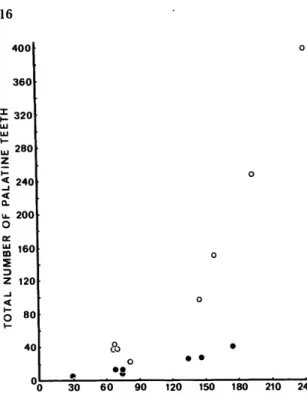
microcirrhis applies to specimens with well-de- veloped palatine dentition (Figure 11), few orbital cirri (Figure 12), modally 25 dorsal-fin spines and 11,23 anal-fin elements. The holotype of C. crinitus has 12-15 teeth on each palatine and the orbital
"cirrus" consisting of 11 separate cirri, 26 dorsal-fin spines, and an anal-fin count of 11,24. All of these characters are consistent with our non-microcirrhis specimens with 13 pectoral-fin rays, and we there- fore apply to these the name Auchenionchus crini- tus.
Clinus peruvianus was described from an illustra- tion, which is reproduced here as Figure 10. The figure appears to represent a specimen whose dorsal fin and nape were malformed or badly damaged and healed. This would explain the presence of only 18 dorsal-fin spines and the position of the fin origin posterior to the limit of the opercle. The 21 anal- fin rays are close to the number found in the genus Auchenionchus but are more numerous than those of the only other clinid genus (Labrisomus) to which the description and figure could be referred. The pectoral-fin count (10) is obviously erroneous, un- less the fin was aberrant. In order to remove this name from nomenclatural contention we designate
16
H i
400
360
320
280
z
< 240
Q.
u. 200 O oc
£ 160 S Z 120
-i
O 80
i-
40
30 60 90 120 150 180 210 240 STANDARD LENGTH IN M M
FIGURE 11.—Relationship of number of palatine teeth to standard length.
Auchenionchus microcirrhis Q Auchenionchus crinitus #
the lectotype of C. microcirrhis as neotype of C.
peruvianus and, as first revisors, arbitrarily accord C. microcirrhis senior synonymy even though its original description appeared on a later page of
the same book in which the original description of
50 40 30 20 10
Hi Ml OH Q .
C. peruvianus appeared. C. peruvianus thus be- comes a junior objective synonym.
Clinus niger Philippi was synonymized with A.
microcirrhis by Hubbs (1952). C. niger was based on a laquered specimen (present existence un- known) differentiated by Philippi from C. micro- cirrhis by color alone, "El color es negro, con excepcion de la garganta y el vientre." Of the counts (dorsal fin XXV, 10; anal fin XVI.6; pectoral fin 14) given for the holotype, that of the anal fin is obviously inaccurate. The presence of 14 pectoral rays could ally C. niger with A. variolosus, but the lack of noticeable head cirri of C. niger supports its synonymy with A. microcirrhis. We therefore follow Hubbs in recognizing C. niger as a junior synonym of A. microcirrhis.
DeBuen (1962) differentiated A. miniatus from A. microcirrhis on the basis of color alone, yet he had only a single specimen of A. microcirrhis and four of A. miniatus. His description of A. miniatus fits our description of A. microcirrhis, and we con- sider it synonymous.
Auchenionchus tentaculatus was separated by DeBuen from A. microcirrhis by its larger eye (16- 17 percent of head rather than 12.5-15.5 percent).
Eye size decreases relative to SL, and in our speci- mens (60.0-245.0 mm SL) varies from 27.5 to 13.1 percent of head length. While DeBuen's specimens of A. microcirrhis were all large (275 mm-382 mm TL) and had relatively small eyes, his specimens of tentaculatus (280-360 mm TL) average 28 mm TL shorter than those of his microcirrhis group. We
0 20 40 60 80 100 120 140 160 180 200 220 240 STANDARD LENGTH IN MM
FIGURE 12.—Relationship of total number of free tips on orbital and nasal cirri to standard length.
Auchenionchus microcirrhis Q Auchenionchus crinitus #