Cohomology of group theoretic Dehn fillings
By Bin Sun
Dissertation
Submitted to the Faculty of the Graduate School of Vanderbilt University
in partial fulfillment of the requirements for the degree of
DOCTOR OF PHILOSOPHY in
Mathematics June 30, 2019 Nashville, Tennessee
Approved:
Denis Osin, Ph.D.
Michael Mihalik, Ph.D.
Alexander Olshanskiy, Ph.D.
Robert Scherrer, Ph.D.
To my dear father and mother,
ACKNOWLEDGMENTS
I would like to express my sincere gratitude to my supervisor, Prof. Denis Osin, for all the advice and supporting my travels. You are so kind and patient and always share with me your ideas on various aspects, ranging from beginner textbooks to latest research papers, from useful courses to interesting conferences, from methods that initiate a new research project to skills that expose the final results, from job applications to relaxing entertainments, such as hiking. I will always be grateful for you in my academic life.
Many thanks to all my committee members, Prof. Michael Mihalik, Alexander Olshanskiy, and Robert Scherrer, for spending your precious time on helping me revise my qualifying paper and Ph.D. dissertation and evaluating me at different points of my graduate life. Many thanks to the entire faculty of the math de- partment of Vanderbilt, for the amazing courses that your have been providing, for the valuable discussions, and for teaching me how to be a good teacher. Many thanks to all the office assistants for helping me dealing with different kinds of processes, say, expense reports.
I would also like to thank all the fellow graduate students, for making my graduate life enjoyable. Special thanks to Longxiu Huang, for your extensive help with my job and OPT applications, to Arman Darbinyan, for your suggestion when I was seeking a supervisor, to Bin Gui, for helping me in my daily life, and for Sahana Balasubramanya, for the information that you shared with me.
Last but not the least, I would like to express my greatest and deepest gratefulness to my parents, for all the support that you have been always giving to me. You taught me basic living skills, shared with me your attitude towards life, provided me with the best education that you could provide, and brought me to travel to broaden my horizon. You always carefully observe me to decide whether I need help, and always try your best to help me whenever I am in trouble. I can never imagine how my life would be without you, in which case any sense of success would be merely impossible.
TABLE OF CONTENTS
Page
ACKNOWLEDGMENTS . . . iii
LIST OF FIGURES . . . vii
Chapter . . . 1
1 INTRODUCTION AND MAIN RESULTS . . . 1
1.1 Introduction . . . 1
1.1.1. Dehn surgery of3-manifolds. . . 1
1.1.2. Group theoretic Dehn fillings. . . 1
1.1.3. Motivation: a question on group cohomology. . . 3
1.2 Main results . . . 3
1.2.1. Cohen-Lyndon type theorems forhhNii. . . 3
1.2.2. Structure of relative relation modules. . . 5
1.2.3. A spectral sequence for Dehn fillings. . . 6
1.2.4. Homological properties of Dehn filling quotients. . . 7
1.2.5. Quotients of acylindrically hyperbolic groups . . . 9
2 PRELIMINARIES . . . 11
2.1 Words and Cayley graphs . . . 11
2.2 Van Kampen diagrams . . . 12
2.3 Gromov hyperbolic spaces and Gromov boundary . . . 14
2.4 Acylindrically hyperbolic groups . . . 15
2.5 Hyperbolically embedded subgroups and group theoretic Dehn fillings . . . 15
2.6 Isolated components . . . 18
2.7 Diagram surgery . . . 19
2.8 Direct sums and products of abelian group homomorphisms . . . 22
2.9 Chain complexes . . . 24
2.10 Resolutions andExtfunctor . . . 24
2.11 Group cohomology . . . 27
2.12 Coinduced modules . . . 29
2.13 A generalization of Shapiro’s lemma . . . 29
2.14 Group triples and Cohen-Lyndon property . . . 31
2.15 Spectral sequences of cohomological type . . . 32
2.16 Cartan-Eilenberg resolutions . . . 46
3 COHEN-LYNDON TYPE THEOREMS . . . 49
3.1 Construction of the transversals . . . 49
3.2 Proof of Theorem 3.0.1 . . . 51
3.3 Relative relation modules . . . 64
4 COHEN-LYNDON PROPERTY AND SPECTRAL SEQUENCES . . . 69
4.1 Idea towards proving Theorem 1.2.10 . . . 70
4.2 Isomorphism of iterative cohomology groups . . . 71
4.2.1. Ext∗hhN ii(Z[G/Hλ], A)∼=GCoIndG HλH∗(Nλ;A) . . . 72
4.2.2. Proof of Proposition 4.2.3 . . . 79
4.2.3. Proof of Proposition 4.2.1 . . . 90
4.3 Morphisms of Lyndon-Hochschild-Serre spectral sequences . . . 91
4.3.1. Lyndon-Hochschild-Serre spectral sequences . . . 91
4.3.2. Compatibility ofhM SSandN ABG . . . 94
4.3.3. IdentifyinghM SS2p,qwithN ABp,q G . . . 98
4.4 Proof of Theorem 4.0.1 . . . 103
5 APPLICATIONS . . . 106
5.1 Computations with spectral sequences . . . 106
5.2 Cohomology of Dehn filling quotients . . . 117
5.3 Cohomology and embedding theorems . . . 126
5.4 Common quotients of acylindrically hyperbolic groups . . . 130
BIBLIOGRAPHY . . . 144
LIST OF FIGURES
Figure Page
2.1 A refinement of a van Kampen diagram over the presentationG=ha, b|aba−1b−1 = 1i . . 14
2.2 How to produce a cut system . . . 21
3.1 An illustration of Case 1 in the proof of Lemma 3.2.7 . . . 55
3.2 Cases 1 through 6 in the proof of Lemma 3.2.12 . . . 59
3.3 The construction ofp . . . 62
5.1 The second pages ofE1 andE2 . . . 107
5.2 The third pages ofE1andE2 . . . 108
CHAPTER 1
INTRODUCTION AND MAIN RESULTS
1.1 Introduction
1.1.1. Dehn surgery of 3-manifolds. In3-dimensional topology, Dehn surgery is an operation of mod- ifying a3-manifold by cutting off a solid torus and then gluing it back in a different way. The Lickorish- Wallace theorem, which states that every closed orientable connected3-manifold can be obtained from the 3-dimensional sphere by performing finitely many Dehn surgeries, serves as a motivation of the study of Dehn surgeries.
The second step of the surgery, calledDehn filling, can be formalized as follows. LetMbe a3-manifold with toral boundary. Topologically distinct ways of gluing a solid torus to M are parametrized by free homotopy classes of essential simple closed curves of∂M, calledslopes. For a slope s, the Dehn filling M(s)is obtained by attaching a solid torusS1×D2to∂M such that∂D2is mapped to a curve of the slope s. The following is a particular case of Thurston’s hyperbolic Dehn filling theorem.
Theorem 1.1.1 ([33, Theorem [TH1]]). LetM be a compact orientable3-manifold with toral boundary such thatM\∂M admits a complete finite-volume hyperbolic structure. ThenM(s)is hyperbolic for all but finitely many slopess.
1.1.2. Group theoretic Dehn fillings. In group theoretic settings, Dehn filling can be generalized as fol- lows. LetGbe a group, letHbe a subgroup ofG, and letNbe a normal subgroup ofH. Thegroup theoretic Dehn fillingassociated with the data(G, H, N)is the process of forming the quotient groupG/hhNii, where hhNiiis the normal closure ofN inG.
Under the assumptions of Theorem 1.1.1, let G = π1(M). The natural map π1(∂M) → π1(M) is injective. We think ofπ1(∂M)as a subgroup ofπ1(M)and letH =π1(∂M). LetN Hbe the subgroup generated by the slopes. ThenG/hhNii=π1(M(s))by the Seifert-van Kampen theorem.
Dehn filling is a fundamental tool in group theory. The solution of the virtually Haken conjecture uses Dehn fillings of hyperbolic groups [2]. For a large number of relatively hyperbolic groups, Dehn fillings are
used to prove the Farrell-Jones conjecture [5] and solve the isomorphism problem [12]. By considering Dehn fillings of hyperbolically embedded subgroups, [13] constructs purely pseudo-Anosov normal subgroups of mapping class groups. Other applications of Dehn fillings can be found in [3, 16].
In group theoretic settings, Thurston’s theorem was first generalized by Osin [27], and independently by Groves-Manning [15] to Dehn fillings of peripheral subgroups of relatively hyperbolic groups. More re- cently, Dahmani-Guirardel-Osin [13] proved an analog of Thurston’s theorem in the more general settings of groups with hyperbolically embedded subgroups (see Theorem 1.1.4 below and the discussion afterwards).
We discuss here some examples and refer to Section 2.5 for the definition. We useH ,→hGto indicate that His a hyperbolically embedded subgroup ofG.
Example 1.1.2. If H is a peripheral subgroup of a relatively hyperbolic group G, then H ,→h G. For example,
(a) if a groupGdecomposes as a free productG=A∗B, then we haveA ,→h GandB ,→h G;
(b) under the assumptions of Theorem 1.1.1, we haveπ1(∂M),→hπ1(M).
Example 1.1.3. LetGbe a group acting acylindrically on a Gromov hyperbolic space and letgbe a loxo- dromic element ofG. Then there exists a maximal virtually cyclic subgroupE(g) 6 Gcontaininggsuch thatE(g),→hG. In particular,
(a) ifGis a free group andHis a maximal cyclic subgroup ofG, thenH ,→h G;
(b) if G is a hyperbolic group (resp. the mapping class group of a punctured closed orientable sur- face, outer automorphism group of a finite rank non-abelian free group) andgis a loxodromic (resp.
pseudo-Anosov, fully irreducible) element, thenE(g),→h G.
Other examples of hyperbolically embedded subgroups can be found in [13].
Theorem 1.1.4 ([13, Theorem 2.27]). LetGbe a group with a subgroupH ,→h G. Then there exists a finite setF ⊂H\{1}such that ifNHandN∩F =∅, then the natural homomorphismH/N →G/hhNii mapsH/N injectively onto a hyperbolically embedded subgroup ofG/hhNii.
Under the assumptions of Theorem 1.1.1, the above theorem, together with some basic facts about relatively hyperbolic groups, implies thatπ1(M(s))is non-virtually-cyclic and word-hyperbolic for all but
finitely many slopess. Thurston’s geometrization conjecture, proved by Perelman, implies that this algebraic statement about π1(M(s))is equivalent to the hyperbolicity of M(s). Thus, the above theorem indeed provides a generalization of Theorem 1.1.1.
1.1.3. Motivation: a question on group cohomology. Note that in the settings of Thurston’s theorem, i.e., ifG=π1(M), H =π1(∂M),andM(s)admits a hyperbolic structure, we have
H∗(G/hhNii;·)∼=H∗(π1(M(s));·),
which can be computed viaM(s). Indeed, as M(s) admits a hyperbolic structure, the universal cover of M(s)isH3, which is contractible, and thusM(s)is a model ofK(G/hhNii,1).
However, there are no analogous methods for Dehn fillings of hyperbolically embedded subgroups. The main question motivating our research is the following.
Question 1. For a groupGwith a subgroupH ,→h Gand a normal subgroupN H, what can be said aboutH∗(G/hhNii;·)?
In this thesis, we answer this question and discuss some applications. The first task is to understand the structure ofhhNii, which is solved by Chapter 3. In Chapter 4, we combine structural results obtained in Chapter 3 and the Lyndon-Hochschild-Serre spectral sequence to computeH∗(G/hhNii;·). In Chapter 5, we estimate the cohomological dimension ofG/hhNiiand discuss some applications to acylindrically hyperbolic groups.
1.2 Main results
1.2.1. Cohen-Lyndon type theorems forhhNii. In general, hhNiidoes not need to have any particular structure. Nevertheless, it turns out that ifN avoids a finite set of bad elements, thenhhNiienjoys a nice free product structure. In order to state our main results, we introduce the following terminology.
Definition 1.2.1. Let Gbe a group with a subgroupH ,→h G. We say that a property P holds for all sufficiently deepnormal subgroupsN H if there exists a finite setF ⊂ H\{1}such thatP holds for all normal subgroupsNHwithN ∩ F =∅.
Definition 1.2.2. LetGbe a group with a subgroupHand letNH. We say that the triple(G, H, N)has theCohen-Lyndon propertyif there exists a left transversalT ofHhhNiiinGsuch thathhNiidecomposes as a free producthhNii=Q∗
t∈T Nt, whereNg=gN g−1forg∈G.
The latter definition is motivated by the following result [11, Theorem 4.1], which was later generalized by [14, Theorem 1.1] to free products of locally indicable groups.
Theorem 1.2.3 (Cohen-Lyndon). Let F be a free group and letC be a maximal cyclic subgroup ofF. Then for allf ∈C, the triple(F, C,hfi)has the Cohen-Lyndon property.
By Example 1.1.3, we haveC=E(f),→hF and thus the above theorem fits in the general framework of group theoretic Dehn fillings. For general hyperbolically embedded subgroups, a weak version of the Cohen-Lyndon property is given in [13, Theorem 2.27].
Theorem 1.2.4 (Dahmani-Guirardel-Osin). LetGbe a group with a subgroup H ,→h G. Then for all sufficiently deepNH,
hhNii=
∗
Y
t∈T
Nt
for some subsetT ⊂G.
The main difference between Theorems 1.2.4 and 1.2.3 is that in Theorem 1.2.4,T is just some subset ofG, instead of being a left transversal ofHhhNiiinG. Our result improves Theorem 1.2.4.
Theorem 1.2.5. Suppose thatGis a group with a subgroupH ,→h G. Then(G, H, N) has the Cohen- Lyndon property for all sufficiently deepNH.
In the special case where GandH are finitely generated andGis hyperbolic relative to H, Theorem 1.2.5 is proved in [16, Theorem 4.8]. The proofs of [13, Theorem 7.15] and [16, Theorem 4.8] use tech- nicalities such as windmills, very rotating families, and spiderwebs. The proof of Theorem 1.2.5 is easier and only uses surgeries on van Kampen diagrams and geometric properties of geodesic polygons of Cayley graphs.
Remark 1.2.6. In fact, we prove Theorem 1.2.5 in much more general settings of a groupGwith a family ofweakly hyperbolically embedded subgroups(see Definition 2.5.4 for the definition). As an application, we also obtain Cohen-Lyndon type theorems for graphs of groups, e.g., amalgamated free products and HNN-extensions (see Corollaries 3.3.8, 3.3.9, and 3.3.10).
Combining Theorem 1.2.5 and Example 1.1.2, we obtain:
Corollary 1.2.7. LetGbe a group acting acylindrically on a Gromov hyperbolic space, and letg∈Gbe a loxodromic element. Then(G, E(g), N)has the Cohen-Lyndon property for all sufficiently deepNE(g).
In the case where G = F andH = C, we recover Theorem 1.2.3 for sufficiently deep (but not all) hfiC. In the case whereGis a free product of locally indicable groups, by considering the action of Gon the corresponding Bass-Serre tree, we also recover [14, Theorem 1.1] for sufficiently deep normal subgroups.
1.2.2. Structure of relative relation modules. LetRel(G,hhNii)andRel(H, N)be therelative relation modulesof the exact sequences
1→ hhNii →G→G→1 and
1→N →H →H→1,
respectively, i.e.Rel(G,hhNii)(resp. Rel(H, N)) is theZG-module (resp.ZH-module) whose base set is the abelianization ofhhNii(resp. N) and theG-action (resp. H-action) is induced by conjugation. IfGis free, thenRel(G,hhNii)is called arelation module. For sufficiently deepN, it follows immediately from Theorem 1.1.4 that the natural map identifiesH with a subgroup of G. We can then further identifyZH with a subring ofZG. Thus, given anyZH-moduleA, it makes sense to talk about theinduced moduleof AfromZHtoZG, which is denoted byIndG
HA=ZGN
ZHA.
IfG=F andH=C, Theorem 1.2.3 directly impliesZG-module isomorphisms
Rel(F,hhfii)∼=Z[F/Chhfii]∼=IndGHZ∼=IndGHRel(C,hfi).
In general, we have the following corollary of Theorem 1.2.5.
Corollary 1.2.8. LetGbe a group with a subgroupH ,→h G. Then for all sufficiently deepN H, there is an isomorphism ofZG-modules
Rel(G,hhNii)∼=IndGHRel(H, N). (1.1)
Remark 1.2.9. Merely knowing thathhNii=Q∗
t∈TNtfor some subsetT ⊂Gis not enough to guarantee (1.1). For example, letGbe any abelian group and letHbe a proper subgroup ofG. Then for any subgroup N of H,hhNii = N = Q∗
t∈{1}Nt. But Rel(G,hhNii) (resp. Rel(H, N)) is aZG-module (resp. ZH- module) with the trivialG-action (resp.H-action) and thusRel(G,hhNii)6∼=IndGHRel(H, N).
1.2.3. A spectral sequence for Dehn fillings. Assuming the Cohen-Lyndon property, we obtain a spectral sequence to compute cohomology of Dehn filling quotients. LetGbe a group, letH be a subgroup ofG, and letN be a normal subgroup ofH. For simplicity, letG=G/hhNiiandH=H/N.
Theorem 1.2.10. If the triple (G, H, N) has the Cohen-Lyndon property, then for every ZG-module A, there exists a spectral sequence of cohomological type.
E2p,q=
Hp(H;Hq(N;A)) , ifq 6= 0 Hp(G;A) , ifq = 0
⇒Hp+q(G;A). (1.2)
Usually, a spectral sequence is used to compute its limit. However, the point of Theorem 1.2.10 is that information about H∗(G;A) andH∗(H;Hq(N;A))can be used to deduce properties ofH∗(G;A) and answer Question 1. To enhance our answer, we also supplement Theorem 1.2.10 by relating the differentials of (1.2) to the differentials of the standard Lyndon-Hochschild-Serre spectral sequence of the extension 1 → N → H → H → 1 (see Remark 4.0.2). In Chapter 5, we use Theorem 1.2.10 to study certain homological properties of Dehn fillings.
Remark 1.2.11. In fact, we deal with a general version of the Cohen-Lyndon property which is defined for a family of subgroups and normal subgroups. The corresponding generalized version of Theorem 1.2.10 turns out to be useful in Chapter 5 when we construct particular quotients of acylindrically hyperbolic groups.
Remark 1.2.12. Historically, spectral sequences were introduced by Leray [21] in his attempt to compute cohomology of sheafs. In the proof of Theorem 1.2.10, we make use of the Lyndon-Hochschild-Serre spectral sequence, which was discovered by Lyndon [22] and then put into its current form by Hochschild- Serre [17].
Remark 1.2.13. LetGbe a group with a subgroupH. Relative cohomologyH∗(G, H;·)was introduced by [7], which shows that absolute and relative cohomology groups fit into a long exact sequence.
Proposition 1.2.14 ([7, Proposition 1.1]). LetGbe a group and letHbe a subgroup ofG. Then for every ZG-moduleA, there exists a long exact sequence
· · · →H`(G, H;A)→H`(G;A)→H`(H;A)→H`+1(G, H;A)→ · · ·
whose arrows are natural maps of cohomology.
IfH ,→h G,N His sufficiently deep, and some additional assumptions are met, [35, Theorem 1.1]
provides a spectral sequence of homological type which computesH∗(G, H;ZG)from certain combination of homology and cohomology. Clearly, Theorem 1.2.10 (resp. [35, Theorem 1.1]), together with Proposition 1.2.14, can be applied to compute H∗(G, H;ZG) (resp. H∗(G;ZG)). However, (1.2) and the spectral sequence of [35] are essentially different, as there is no homology involved in (1.2).
It is worth noting that ifH has finite cohomological dimension, then Theorem 1.2.10 and Proposition 1.2.14 implyH`(G, H;A)∼=H`(G;A)for everyZG-moduleAand sufficiently large`(see Remark 1.2.17 below).
1.2.4. Homological properties of Dehn filling quotients. Recall that thecohomological dimensionof a groupGis
cd(G) = sup{`∈N|H`(G, A)6={0}for someZG-moduleA}
(in this paper, the setNof natural numbers contains0, while the set of positive natural numbers is denoted asN+). A groupGis oftypeF P∞if there is a projective resolution
· · · →P1 →P0 →Z→0
overZGsuch thatPnis finitely generated for eachn∈N. A groupGis oftypeF P if (a)cd(G)<∞and (b)Gis of typeF P∞.
Theorem 1.2.15. LetH ,→h Gbe groups. IfN His sufficiently deep, then for all`> cd(H) + 2and anyZG-moduleA, we have
H`(G, A)∼=H`(G, A)M
H`(H, A). (1.3)
In particular,
cd(G)6max{cd(G), cd(H) + 1, cd(H)}.
Remark 1.2.16. In case G is a free group and H 6 G is a maximal cyclic subgroup, the direct sum decomposition (1.3) is proved by [23, Theorem 11.1]. In caseG = G1 ∗G2 is a free product of locally indicable groupsG1, G2 andH 6Gis the cyclic subgroup generated by an elementg ∈ Gsuch thatgis not a proper power and does not conjugate into eitherG1 orG2, (1.3) is proved by [18, Theorem 3]. Note that in these two cases,His a hyperbolically embedded subgroup ofGby Example 1.1.3. Thus, Theorem 1.2.15 recovers the results of [23, 18] for sufficiently deep (but not all) normal subgroups.
Notice that, (1.3) does not hold for ` 6 cd(H) + 1. For instance, letG be a group freely generated by two elementsxandyand letH = hhi 6 Gwithh =xyx−1y−1. Then H ,→h Gby Example 1.1.3 andcd(H) + 1 = 2. LetN = hhkiH with k large enough so that N is sufficiently deep. By [23, Theorem 11.1],H2(G;Z) ∼=Z, and it is well-known thatH2(G;Z) ={0}andH2(H;Z)∼=Z/kZ. Thus, H2(G;Z)6∼=H2(G;Z)L
H2(H;Z).
Remark 1.2.17. As a by-product of the proof of Theorem 1.2.15, we show that for`>cd(H)+2, the natural mapH`(G;A)→H`(H;A), induced by the inclusionH ,→G, is surjective, and the kernel of this natural map can be identified with H`(G;A). This, together with Proposition 1.2.14, implies H`(G, H;A) ∼= H`(G;A)for`>cd(H) + 3, and for`=cd(H) + 2, there is a surjectionH`(G, H;A)H`(G;A).
Theorem 1.2.18. LetH ,→h Gbe groups. Suppose thatN His sufficiently deep andG, H are of type F P∞(resp.F P). If either one of the following conditions holds, thenGis also of typeF P∞(resp.F P).
(a) N is of typeF P∞.
(b) His of the formH=K×F, whereKis a finite group andFis a finite rank free group, andN 6F. Remark 1.2.19. The seemingly unnatural condition (b) of Theorem 1.2.18 will be used in Chapter 5 to deal with acylindrically hyperbolic groups. For acylindrically hyperbolic groups, [13, Theorem 6.14] constructs hyperbolically embedded subgroups of the form described in condition (b). In most of the interesting cases, N H is a free group of infinite rank and thus is not of typeF P∞, in which case condition (a) does not hold. It is unclear to us though whether the conclusion of Theorem 1.2.18 still holds if conditions (a) and (b) are dropped.
Remark 1.2.20. In Theorem 1.2.18, the condition that H is of typeF P∞is necessary. Indeed, for suffi- ciently deep Dehn fillings,Hembeds onto a hyperbolically embedded subgroup ofG. IfGis of typeF P∞, then [13, Theorem 2.11] implies thatHis also of typeF P∞.
Remark 1.2.21. In fact, we consider the general case of a family of weakly hyperbolically embedded subgroups. The corresponding general versions of Theorems 1.2.15 and 1.2.18 can be applied to graph of groups (see Remark 1.2.6).
1.2.5. Quotients of acylindrically hyperbolic groups The notion of acylindrically hyperbolic groups was introduced by Osin [28] as a generalization of non-elementary hyperbolic and non-elementary relatively hyperbolic groups. Examples of acylindrically hyperbolic groups can be found in many classes of group that interest group theorists for years, e.g., mapping class groups of surfaces, outer automorphism groups of free groups, small cancellation groups, convergence groups, Cremona groups, tame automorphism groups, etc.
We refer to [29] for details and other examples of acylindrically hyperbolic groups.
It is known that acylindrically hyperbolic groups have a lot of quotients. For instance, every acylindri- cally hyperbolic groupGisSQ-universal[13], i.e., every countable group can be embedded into a quotient ofG. Also, if two finitely generated acylindrically hyperbolic groupsG1andG2are given, one can construct a common acylindrically hyperbolic quotient ofG1 andG2[19]. As an application of our main results, we study homological properties of those quotients.
For the following theorems, recall that every acylindrically hyperbolic group Ghas a maximal finite normal subgroupK(G)[13, Theorem 6.14].
Theorem 1.2.22. LetGbe an acylindrically hyperbolic group, and letCbe any countable group. ThenC embeds into a quotientGofGsuch that
(a) Gis acylindrically hyperbolic;
(b) cd(G)6max{cd(G), cd(C)};
(c) ifK(G) ={1}, then for all`>3and anyZG-moduleA, we have
H`(G;A)∼=H`(G;A)M
H`(C;A);
(d) ifCis finitely generated, thenC ,→hG;
(e) ifGandCare of typeF P∞, then so isG.
Theorem 1.2.23. LetG1andG2be finitely generated acylindrically hyperbolic groups. Then there exists a common quotientGofG1andG2such that
(a) Gis acylindrically hyperbolic;
(b) cd(G)6max{cd(G1), cd(G2)};
(c) ifK(G1) =K(G2) ={1}, then for all`>3and anyZG-moduleA, we have
H`(G;A)∼=H`(G1;A)M
H`(G2;A);
(d) ifG1andG2are of typeF P∞, then so isG.
Remark 1.2.24. Except for the homological conditions, Theorems 1.2.22 and 1.2.23 are proved by [13, Theorem 8.1] and [19, Corollary 7.4], respectively. The benefit of Theorems 1.2.22 and 1.2.23 is that they allow constructions of various acylindrically hyperbolic groups satisfying certain homological conditions.
CHAPTER 2
PRELIMINARIES
We introduce conventions and notations and recall preliminaries in this chapter. In Sections 2.1 and 2.2, we recall the notation of Cayley graphs and van Kampen diagrams. Section 2.3, whose main references are [8, 34], reviews the notions of Gromov hyperbolic spaces and Gromov boundaries. In Sections 2.5 through 2.7, whose main references are [13, 29], we recall the definition and basic information about acylindrically hyperbolic groups and (weakly) hyperbolically embedded subgroups. In Sections 2.6 and 2.7, we review the concepts of isolated components and diagram surgery, which were introduced by Osin [27] and are useful in the proof of Cohen-Lyndon type theorems in Chapter 3.
In Section 2.8, we introduce notations related to direct sums and products of abelian group homomor- phisms. Sections 2.9 through 2.13, whose main references are [10, 31], are devoted to a series of concepts related to group cohomology. Section 2.14 defines the Cohen-Lyndon property and introduces related no- tations. Sections 2.15 and 2.16, whose main references are [31, 36], are devoted to spectral sequences and related concepts, which are used in the Chapter 4 when we study certain spectral sequences with the aid of the Cohen-Lyndon property.
2.1 Words and Cayley graphs
LetXbe an alphabet. Given a wordwoverX, thelengthofw, denoted askwk, is the number of letters inw. If X is the generating set of a group G, theword length of an element g ∈ Gwith respect to X, denoted as|g|X, is the length of a shortest word (geodesic word)woverXsuch thatwrepresentsginG. If Xis understood from the context, we will simply write|g|instead of|g|X.
There are two types of equalities for words over X. Given two words u and v overX, the notation u≡vindicates the letter-by-letter equality betweenuandvand the notationu=Gvindicates thatuandv represent the same element ofG.
If u is a word over X, then u−1 denotes the inverse of u. If, in addition, g ∈ GandS ⊂ H, then we write u = g to indicate that u represents g inG, and writeu ∈ S to indicate that the element of G represented byuis inS.
The Cayley graph Γ(G, X) is the labeled directed graph with vertices labeled by elements of Gand directed edges labeled by elements ofX. In G (resp. Γ(G, X)), we use1 to denote the identity (resp.
identity vertex). The word metric ofΓ(G, X)with respect to the alphabetXis denoted asdX. Letpbe an edge path inΓ(G, X). Then`X(p) denotes the length ofpunderdX. Lab(p) denotes thelabelofp, i.e., Lab(p) is obtained by concatenate labels of edges ofp. p−(resp. p+) denotes the initial (resp. terminal) vertex ofp. IfS ⊂Γ(G, X), thendiamX(S)denotes the diameter ofSunderdX. IfT is another subset of Γ(G, X), thendHau(S, T)denotes the Hausdorff distance betweenSandT.
2.2 Van Kampen diagrams
LetGbe a group given by the presentation
G=hA | Ri, (2.1)
whereAis a symmetric set of letters andRis a symmetric set of words inA(i.e., for everyw∈ R, every cyclic shift ofworw−1belongs toR).
Avan Kampen diagram∆over (2.1) is a finite oriented connected planar2-complex with labels on its oriented edges such that
(a) Each oriented edge of∆is labeled by a letter inA ∪ {1};
(b) If an oriented edgeeof∆has labela∈ A ∪ {1}, thene−1has labela−1, wheree−1 (resp. a−1) is the inverse ofe(resp.a).
Here,1is identified with the empty word overAand thus1 = 1−1. By convention, the empty word of Arepresents the identity ofG.
Letp=e1· · ·ekbe a path in a van Kampen diagram over (2.1). The initial vertex (resp. terminal vertex) ofpis denoted asp−(resp. p+). Thelabelofp, denoted asLab(p), is obtained by first concatenating the labels of the edgese1, ..., ek and then removing all1’s, as1is identified with the empty word. Therefore, the label of a path in a van Kampen diagram is a word over A. Ifw is a word overA, then the notation Lab(p)≡windicates a letter-by-letter equality betweenLab(p)andw.
Remark 2.2.1. Suppose that pis a path in a van Kampen diagram over (2.1) withLab(p) ≡ w1 · · ·wk. Then we can decomposepin the following way: Letpw1 be the maximal subpath ofpsuch thatp−w1 =p−
andLab(pw1) ≡ w1. For i = 2, ..., k, let pwi be the maximal subpath of p such thatp−wi = p+wi−1 and Lab(pwi)≡wi.
Edges labeled by letters fromAare calledessential edges, while edges labeled by the letter1are called non-essential edges. A faceof ∆is a2-cell of ∆. Let Π be a face of∆, the boundary of Π is denoted as∂Π. Likewise, the boundary of∆is denoted by∂∆. Note that if we choose a base point for∂Π(resp.
∂∆), then∂Π(resp. ∂∆) becomes a path in∆. For a wordwoverA, we use the notationLab(∂Π) ≡w (resp. Lab(∂∆)≡w) to indicate that one can pick a base point to turn∂Π(resp.∂∆) into a pathpso that Lab(p)≡w.
Remark 2.2.2. Suppose that ∆is a diagram withLab(∂∆) ≡ w1· · ·wk. Then we can decompose∂∆
in the following way: Letpb be vertex of∂∆such that when we usepb as the base point of∂∆, we can turn∂∆into a pathpwithLab(p) ≡w1· · ·wk. And then we use Remark 2.2.1 to decomposepand thus decompose∂∆.
Consider the following additional assumption on van Kampen diagrams:
(c) For every faceΠof a van Kampen diagram∆over the presentation (2.1), at least one of the following conditions (c1) and (c2) holds.
(c1) Lab(∂Π)is equal (up to a cyclic permutation) to an element ofR.
(c2) ∂Πeither consists entirely of non-essential edges or consists of exact two essential edges with mutu- ally inverse labels (in addition to non-essential edges).
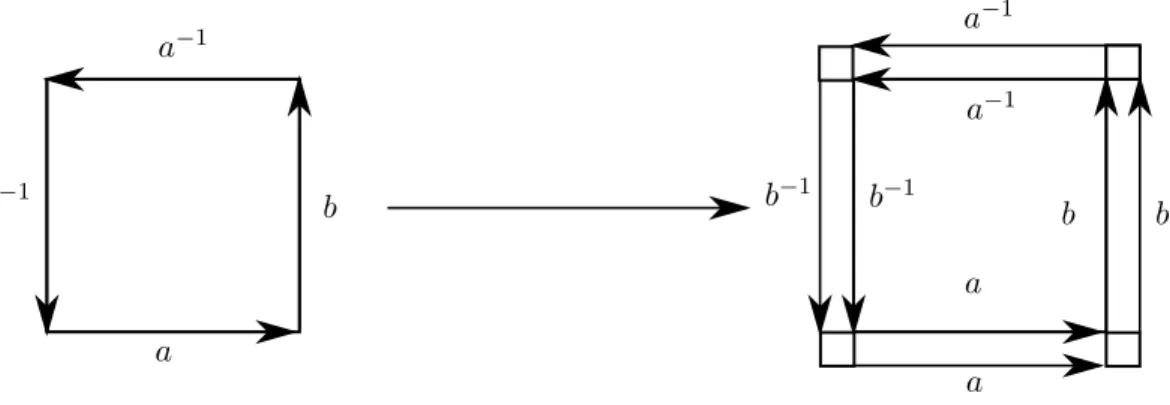
A face satisfying (c2) is called anon-essential face. All other faces are called essential faces. The process of adding non-essential faces to a van Kampen diagram is called arefinement. Figure 2.1 illustrates a refinement on a van Kampen diagram, where the unlabeled edges are labeled by1. The interested readers are referred to [25] for a formal discussion. By using refinements, we can ensure
(d) Every face is homeomorphic to a disc, i.e., its boundary has no self-intersection.
Assumption 2.2.3. In the sequel, the above assumptions (c) and (d) will be imposed on van Kampen dia- grams.
a−1
a
b−1 b
a−1 a−1
a a
b b−1 b−1 b
Figure 2.1: A refinement of a van Kampen diagram over the presentationG=ha, b|aba−1b−1 = 1i
The well-known van Kampen lemma states that a wordwoverArepresents1inGif and only if there is a van Kampen diagram∆over (2.1) such that∆is homeomorphic to a disc (such diagrams are calleddisk diagrams), and thatLab(∂∆)≡w.
Remark 2.2.4. If a van Kampen diagram∆is homeomorphic to a disc, andO is a vertex of∆, then there exists a unique continuous mapµfrom the1-skeleton of∆to the Cayley graphΓ(G,A)sendingO to the identity vertex, preserving the labels of the essential edges and collapsing non-essential edges to points.
2.3 Gromov hyperbolic spaces and Gromov boundary
Let(S, d)be a geodesic metric space and let∆be a geodesic triangle consists of three geodesic segments γ1, γ2, γ3. For a numberδ > 0,∆is calledδ-slimif the distance between every point ofγi and the union γj ∪γkis less thanδ, wherei, j, k∈ {1,2,3}, i6=j, j6=k, k6=i.
Notation 2.3.1. We use(S, d)to denote a space S with metricd. If the metric dis unnecessary or well- understood, we will omit it and writeSfor a metric space.
Sis called aδ-hyperbolic spaceif geodesic triangles inSare allδ-slim.Sis called aGromov hyperbolic spaceif it isδ-hyperbolic for someδ >0. Gromov hyperbolic spaces generalize notions such as simplicial trees and complete simply connected Riemannian manifolds with constant negative sectional curvature while preserving most of the interesing properties.
Remark 2.3.2. In literature, properness is often part of the definition of a Gromov hyperbolic space. How- ever, in this thesis, we do not assume that a Gromov hyperbolic spaceSis proper, i.e. some closed balls of Smight not be compact.
LetSbe a Gromov hyperbolic space. TheGromov productis defined by
(x·y)z = (d(x, z) +d(y, z)−d(x, y))/2.
Pick a point e∈ S, viewing as the base point of the Gromov product. TheGromov boundary∂Seof Swith respect toeis defined as follows. A sequence of points{sn}n>1 ⊂S is called a Gromov sequence if(si·sj)e → ∞asiandj → ∞. We say that two Gromov sequences{xn}n>1,{yn}n>1 areequivalent and write{xn}n>1 ∼ {yn}n>1 if(xn·yn)e→ ∞asn→ ∞. ∂Seis then defined as the set of all Gromov sequences modulo the equivalence relation ∼. Elements of∂Se are just equivalence classes of Gromov sequences inSand we say a sequence{xn}n>1 ∈S tends toa boundary pointx∈∂Seand writexn→ x asn→ ∞if{xn}n>1∈x.
If eandf are two points of S, then ∂Se and∂Sf can be naturally identified [34]. We thus obtain a well-defined notion of theGromov boundary∂SofS.
2.4 Acylindrically hyperbolic groups
Let(S, d)be a Gromov hyperbolic space and letGbe a group acting onSby isometries. The action of Gis calledacylindricalif for every > 0there existR, N > 0such that for every two pointsx, ywith d(x, y)>R, there are at mostN elementsg∈Gsatisfying bothd(x, gx)6andd(y, gy)6. Thelimit setΛ(G)ofGon∂Sis the set of limit points in∂Sof aG-orbit inS, i.e.
Λ(G) ={x∈∂S | there exists a Gromov sequence inGstending tox, for somes∈S}.
IfΛ(G)contains more than two points, we say the action ofGisnon-elementary. Acylindrically hyperbolic groups are defined in [28].
Definition 2.4.1. A groupGisacylindrically hyperbolicifGadmits a non-elementary acylindrical action on some Gromov hyperbolic spaces by isometries.
2.5 Hyperbolically embedded subgroups and group theoretic Dehn fillings
LetGbe a group, let{Hλ}λ∈Λbe a family of subgroups ofG, letX be a subset ofGsuch thatGis generated by X together with the union of allHλ, λ ∈ Λ, and let H = F
λ∈ΛHλ. Consider the Cayley
graphΓ(G, Xt H). Note thatΓ(G, Xt H)is a metric space under the word metric.
Remark 2.5.1. It is possible thatX andHλ, λ ∈ Λ, as subsets ofG, have non-empty intersections with each other. As a consequence, several letters ofXt Hmight represent the same element ofG. If this is the case, the Cayley graphΓ(G, Xt H)will have multiple edges corresponding to those letters.
Note that for eachλ ∈ Λ, the Cayley graph Γ(Hλ, Hλ)can be identified as the complete subgraph of Γ(G, Xt H)whose vertex set isHλ, and edges are the ones labeled by letters fromHλ.
Definition 2.5.2. Fixλ ∈ Λ. A (combinatorial) pathp inΓ(G, X t H) between vertices ofΓ(Hλ, Hλ) is called Hλ-admissible if it does not contain any edge of Γ(Hλ, Hλ). Note that a Hλ-admissible path pis allowed to pass through vertices ofΓ(Hλ, Hλ). For every pair of elementsh, k ∈ Hλ, letdbλ(h, k) ∈ [0,+∞]be the length of a shortestHλ-admissible path connectingh, k. If no such path exists, setdbλ(h, k) = +∞. The laws of summation on [0,+∞) extend naturally to [0,+∞]and it is easy to verify that dbλ : Hλ×Hλ → [0,+∞]defines a metric onΓ(Hλ, Hλ)called therelative metric onΓ(Hλ, Hλ)with respect toX.
Remark 2.5.3. Letpbe a path inΓ(G, Xt H)withLab(p) ≡h ∈ Hλ, for someλ∈Λ. For simplicity, we denotedbλ(1, h)byb`λ(p).
Definition 2.5.4. LetGbe a group, let{Hλ}λ∈Λ be a family of subgroups ofG, letX be a subset ofG, and letH=F
λ∈ΛHλ. We say that{Hλ}λ∈Λisweakly hyperbolically embedded into(G, X)(denoted as {Hλ}λ∈Λ,→wh(G, X)) ifGis generated by the setXtogether with union of allHλ, λ∈Λ, and the Cayley graphΓ(G, Xt H)is a Gromov hyperbolic space.
If the collection {Hλ}λ∈Λ ,→wh (G, X) and for each λ ∈ Λ, the metric space (Hλ,dbλ) is proper, i.e., every ball of finite radius contains only finitely many elements, then{Hλ}λ∈Λis calledhyperbolically embedded into(G, X)(denoted as{Hλ}λ∈Λ,→h (G, X)).
Further, the collection {Hλ}λ∈Λ is called weakly hyperbolically embedded into (resp. hyperbolically embedded into) G, denoted as{Hλ}λ∈Λ ,→wh G (resp. {Hλ}λ∈Λ ,→h G), if there exists some subset X⊂Gsuch that{Hλ}λ∈Λ,→wh(G, X)(resp.{Hλ}λ∈Λ,→h(G, X)).
Remark 2.5.5. Note that if the family{Hλ}λ∈Λ,→wh(G, X)for some subsetX⊂GandY =X∪X−1, then we also have{Hλ}λ∈Λ ,→wh (G, Y). In the sequel, we always assume that the relative generating set Xis symmetric, i.e.,X =X−1.
Notation 2.5.6. LetG, H be groups and letX ⊂ G. If{H} ,→h (G, X), then we drop braces and write H ,→h (G, X) andH ,→h G. IfH is not a subgroup ofGbut there is a subgroupK ,→h Gsuch that H∼=K, then we will slightly abuse notation and writeH ,→h G.
Examples of hyperbolically embedded subgroups can be found in acylindrically hyperbolic groups. In particular, we have the following.
Theorem 2.5.7 ([13, Theorem 6.14]). LetGbe an acylindrically hyperbolic group. ThenGhas a maximal finite normal subgroup K(G). Moreover, for n ∈ N, there exists a free group F of rank n such that F×K(G),→h G.
Remark 2.5.8. If a groupGcan be decomposed as a free productG=G1∗G2, then
{G1, G2},→h (G,∅)
by [13, Example 4.12]. In this case, the relative metrics
db1 :G1×G1 →[0,+∞], db2 :G2×G2 →[0,+∞]
with respect to∅satisfy
db1(1,1) =db2(1,1) = 0, db1(1, g1) =db2(1, g2) = +∞
forg1 ∈G1\{1}, g2∈G2\{1}.
Note that ifG=G1∗G2, then we also have
G1,→h (G, G2).
Proposition 2.5.9 ([13, Proposition 4.35]). IfG, H, K are groups andX ⊂G, Y ⊂H such thatK ,→h (H, Y)andH ,→h(G, X), thenK ,→h (G, X∪Y).
Theorem 2.5.10 ([13, Theorem 4.24]). LetG be a group with a family of subgroups {Hλ}λ∈Λ and let X⊂G. Then the following are equivalent.
(a) {Hλ}λ∈Λ,→h (G, X).
(b) There exists a strongly bounded relative presentation ofGwith respect toXand{Hλ}λ∈Λwith linear relative isoperimetric function.
For the definition of a strongly bounded relative presentation (resp. a linear relative isoperimetric func- tion), the reader is referred to [13, Definition 4.22] (resp. [13, Section 3.3]).
Definition 2.5.11. Suppose thatGis a group with a family of subgroups{Hλ}λ∈Λ,→wh(G, X)for some subsetX ⊂ G. Forλ∈ Λ, letdbλ be the relative metric onΓ(Hλ, Hλ) with respect toX. We say that a propertyPholds for all sufficiently deep Dehn fillings of {Hλ}λ∈Λ(orfor all sufficiently deepNλHλ, λ∈ Λ,) if there exists a numberC >0such that ifNλHλanddbλ(1, n)> Cfor alln∈Nλ\{1}, λ∈Λ, then P holds.
One remarkable property of weakly hyperbolically embedded subgroups is the following group theoretic Dehn filling theorem.
Theorem 2.5.12 ([13, Theorem 7.15]). LetGbe a group with a family of subgroups{Hλ}λ∈Λ,→wh(G, X) for some subsetX⊂G. Then for all sufficiently deepNλHλ, λ∈Λ, we have:
(a) For eachλ∈Λ, the natural homomorphismiλ :Hλ/Nλ →G/hhN iiis injective (i.e.,Hλ∩ hhN ii= Nλ ), whereN =S
λ∈ΛNλ.
(b) {iλ(Hλ/Nλ)}λ∈Λ ,→wh (G/hhN ii, X), where X is the image of X under the quotient mapG → G/hhN ii.
(c) There exist subsetsTλ ⊂G, λ∈Λ, such thathhN ii=Q∗
λ∈Λ,t∈TλNλt, whereNλt =tNλt−1forλ∈Λ andt∈Tλ.
2.6 Isolated components
Let us assume, until the end of Section 2.7, thatGis a group with a family of subgroups{Hλ}λ∈Λ,→wh (G, X) for some symmetric subsetX ⊂ G. For eachλ ∈ Λ, letdbλ be the relative metric onΓ(Hλ, Hλ) with respect toX, and letH=F
λ∈ΛHλ. The following terminology goes back to [26].
Definition 2.6.1. Letpbe a path inΓ(G, Xt H). Fixλ∈Λ. AnHλ-subpathqofpis a nontrivial subpath ofp labeled by a word over the alphabetHλ (if p is a cycle, we allow q to be a subpath of some cyclic
shift ofp). AnHλ-subpath q ofp is called anHλ-component ifq is not properly contained in any other Hλ-subpath. TwoHλ-componentsq1, q2ofpare calledconnectedif there exists a pathcinΓ(G, Xt H) such thatcconnects a vertex ofq1to a vertex ofq2, and thatLab(c)is a letter fromHλ. AnHλ-component qofpis calledisolatedif it is not connected to any otherHλ-component ofp.
The key property of isolated components is that, in a geodesic polygon (i.e., a polygon in Γ(G, X t H) with geodesic sides) p, the total `-length of isolated components is uniformly bounded above by ab linear function of the number of sides. The following result is proved in [13, Proposition 4.14], which is a straightforward generalization of [27, Proposition 3.2].
Lemma 2.6.2 (Dahmani-Guirardel-Osin). There exists a positive numberDsatisfying the following prop- erty: Letpbe ann-gon inΓ(G, Xt H)with geodesic sidesp1, ..., pnand letIbe a subset of the set of sides ofpsuch that every sidepi ∈Iis an isolatedHλi-component ofpfor someλi ∈Λ. Then
X
pi∈I
`bλi(pi)6Dn.
Remark 2.6.3. Theorem 2.5.12 asserts the existence of a constantC such that ifdbλ(1, n) > C for every n∈Nλ\{1}andλ∈Λ, thenHλ∩ hhN ii=Nλfor allλ∈Λ. In fact, one can letC= 4D, whereDis the constant provided by Lemma 2.6.2 (see [13]).
2.7 Diagram surgery
The diagram surgery surveyed in this section was first introduced by Osin [27], where he proved a group theoretic Dehn filling theorem for relatively hyperbolic groups. Later, Dahmani et al. generalized this technique to deal with weakly hyperbolically embedded subgroups [13].
Consider a symmetric setRof words over the alphabetXt Hsuch thatGhas the presentation
G=hXt H | Ri, (2.2)
and that for allλ∈Λ,Rcontains all words over the alphabetHλwhich represent the identity.
Suppose thatNλ is a normal subgroup ofHλ for eachλ∈ Λ. Denote the union ofNλ, λ ∈ Λ, byN. The normal closure ofN inG, denoted as hhN ii, is the smallest normal subgroup of Gcontainning N.
KillinghhN iiinGis equivalent to adding, toR, all words overHλ which represent elements ofNλ, for all λ∈Λ, to form a new presentation
G=G/hhN ii=hXt H,R ∪ Si, (2.3)
whereS =S
λ∈λSλ andSλconsists of all words overHλrepresenting elements ofNλinG.
In the sequel, letDbe the set of all van Kampen diagrams∆over (2.3) such that:
(D1) Topologically∆is a disc withk>0holes. The boundary of∆can be decomposed as∂∆ =∂ext∆∪
∂int∆, where ∂ext∆ is the boundary of the disc, and ∂int∆consists of disjoint cycles (connected components)c1, ..., ckthat bound the holes.
(D2) Fori= 1, ..., k,ciis labeled by a word fromS.
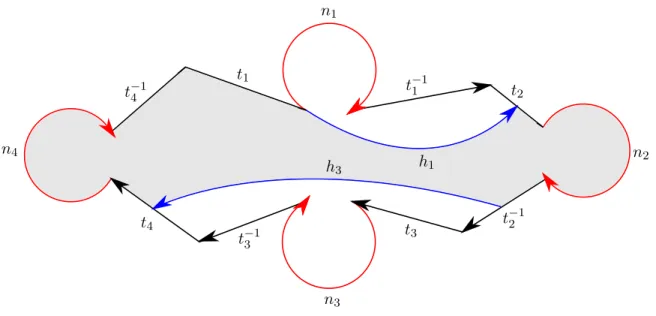
(D3) Each diagram∆is equipped with acut system that is a collectionT = {t1, ..., tk}of disjoint paths (cuts)t1, ..., tkin∆without self-intersections such that, fori= 1, ..., k, the two endpoints oftibelong to∂∆, and that after cutting∆alongti for alli = 1, ..., k, one gets a disc van Kampen diagram∆e over (2.2).
See Figure 2.2 for an illustration of a diagram inD.
Lemma 2.7.1. A wordwoverXt Hrepresents1inGif and only if there is a diagram∆∈ Dsuch that Lab(∂ext∆)≡w.
Proof. Letwbe a word overXt H. If there is a diagram∆∈ Dsuch that∂ext∆≡w, by filling the holes of∆with faces whose boundaries are labeled by words fromS, one creates a disc van Kampen diagram over (2.2), whose boundary is labeled by w. Conversely, ifw represents 1 inG, then there exists a disc van Kampen diagram ∆over (2.2) with Lab(∂∆) ≡ w. By removing all faces of∆ labeled by words fromS, we obtain a diagram∆0 satisfying (D1) and (D2). To produce a cut system, choose a vertexOin
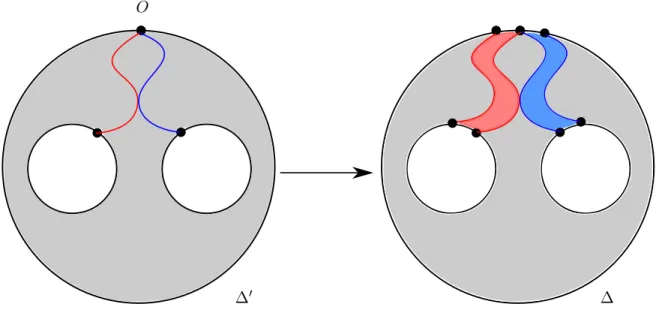
∂ext∆0. ConnectO with each component of ∂int∆0 by a path so that these paths do not cross each other (although they do intersect each other). By passing to a refinement of∆0, one can separate these paths so that they no longer intersect each other and thus creates a diagram∆satisfying (D1), (D2), and (D3) with Lab(∂ext∆)≡w.
O
∆0 ∆
Figure 2.2: How to produce a cut system
Figure 2.2 illustrates the last step of the above proof. The left half shows the diagram∆0 with red and blue paths connect O with two components of ∂int∆0. By thickening these paths with a refinement, we obtain the right half. The red and blue regions consist of non-essential faces, while the outside red and blue paths form a cut system.
Let∆be a diagram inDand let∆e be the disc van Kampen diagram resulted from cutting∆along its set of cuts. Defineκ:∆e → ∆to be the map that “sews” the cuts. Fix an arbitrary vertexOin∆e and letµ be a map sending the1-skeleton of∆toΓ(G, Xt H), as described by Remark 2.2.4.
Definition 2.7.2. Let ∆1 and∆2 be two diagrams ofD and letΓ1 (resp. Γ2) be the subgraph of the1- skeleton of∆1 (resp. ∆2 )consisting of∂∆1(resp. ∂∆2 )and all cuts of∆1 (resp. ∆2 ). We say that∆1 and∆2areequivalentif there exists a graph isomorphismΓ1 →Γ2which preserves labels and orientations of edges, and maps the cuts and boundary of∆1to the cuts and boundary of∆2, respectively.
The following Lemmas 2.7.3 and 2.7.8 are results from [13], which are straightforward generalizations of results of [27]. Note that the authors of [13] assume that the presentation (2.2) has a linear relative isoperimetric function, but this assumption is not used in the proofs of those lemmas.
Lemma 2.7.3 ([13, Lemma 7.11] ( see also [27, Lemma 4.2])). Leta, bbe two vertices on∂∆and letea,eb be two vertices on∂∆e such thatκ(ea) =a, κ(eb) =b. Then for any pathpinΓ(G, Xt H)connectingµ(ea)
toµ(eb), there is a diagram∆1∈ Dwith the following properties:
(a) ∆and∆1are equivalent.
(b) There is a path q in ∆1 without self-intersections such that (1) q connects a and b, (2) q has no common vertices with the cuts of∆1except possibly fora, b, and (3)Lab(q)≡Lab(p).
Definition 2.7.4. Fixλ ∈ Λ. An Hλ-subpath in ∂∆ (resp. ∂∆) for somee ∆ ∈ D is a path labeled by a nontrivial word over Hλ. An Hλ-subpath p of ∂∆ (resp. ∂∆) is called ane Hλ-component if p is not properly contained in any otherHλ-subpath. TwoHλ-componentsp, q of∂∆areconnected if there exist Hλ-componentsa, bin∂∆e such thatκ(a)(resp. κ(b)) is a subpath ofp(resp. q), and thatµ(a), µ(b)are connected inΓ(G, Xt H)(in the sense of Definition 2.6.1).
Remark 2.7.5. The definitions ofHλ-subpaths,Hλ-components, and connectedHλ-components in∂∆for a van Kampen diagram∆∈ Dor∂∆e do not depend on the pre-chosen vertexO.
Definition 2.7.6. Thetypeof∆is defined by the formula
τ(∆) = (k,
k
X
i=1
kLab(ti)k),
where k is the number of holes in ∆ and t1, ..., tk are the cuts. We order the types of diagrams in D lexicographically:(k1, `1)<(k2, `2)if and only if eitherk1 < k2 ork1=k2and`1 < `2.
Definition 2.7.7. For any word w over X t H, let D(w) be the set of diagrams ∆ ∈ D such that Lab(∂ext∆)≡w.
Lemma 2.7.8 ([13, Lemma 7.17] (see also [27, Lemma 5.2])). Suppose that for everyλ ∈ Λandn ∈ Nλ\{1}, we havedbλ(1, n)>4D, whereDis the constant given by Lemma 2.6.2. Letwbe a geodesic word overXt Hrepresenting1inG, and let∆be a diagram inD(w)of minimal type. Then there existλ∈Λ and a connected componentcof∂int∆such thatcis connected to anHλ-component of∂ext∆.
2.8 Direct sums and products of abelian group homomorphisms
Letfλ :Xλ →Y, λ ∈Λ,be homomorphisms between abelian groups. Thedomain sumoffλ, λ∈ Λ, denoted as
Dom
M
λ∈Λ
fλ:M
λ∈Λ
Xλ−→Y,
is defined as follows. For everyλ∈Λ, letiλ :Xλ → L
λ∈ΛXλbe the natural inclusion. ThenLDom λ∈Λ fλ is the unique abelian group homomorphism such that
Dom
M
λ∈Λ
fλ◦iλ =fλ
forλ∈Λ.
Iffλ :Xλ → Yλ, λ ∈Λ,are abelain group homomorphisms, then we define thedomain-target sumof fλ, denoted as
DT
M
λ∈Λ
fλ:M
λ∈Λ
Xλ−→M
λ∈Λ
Yλ,
by the following rule. For eachλ∈Λ, letpλ :L
λ∈ΛYλ→Yλbe the natural projection. ThenLDT λ∈Λfλis the unique abelian group homomorphism such that
pλ◦
DT
M
λ∈Λ
fλ◦iλ =fλ
forλ∈Λ.
In contrast, if fλ : X → Yλ, λ ∈ Λ,are homomorphisms between abelian groups, then the target productoffλ, λ∈Λ, denoted as
T ar
Y
λ∈Λ
fλ :X−→ Y
λ∈Λ
Yλ,
is defined as follows. For eachλ∈Λ, letπλ :Q
λ∈ΛYλ →Yλbe the coordinate projection. ThenQT ar λ∈Λfλ
is the unique abelian group homomorphism such that
πλ◦
T ar
Y
λ∈Λ
fλ =fλ
forλ∈Λ.
Iffλ :Xλ→ Yλ, λ∈Λ,are abelain group homomorphisms, then we define thedomain-target product offλ, denoted as
DT
Y
λ∈Λ
fλ: Y
λ∈Λ
Xλ −→ Y
λ∈Λ
Yλ,
by the following rule. Every element ofQ
λ∈ΛXλis a tuple(xλ)λ∈Λ. We demand thatQDT
λ∈Λfλsends each
(xλ)λ∈Λ∈Q
λ∈ΛXλto(fλ(xλ))λ∈Λ∈Q
λ∈ΛYλ. 2.9 Chain complexes
Let R be a ring. Agraded abelian group (resp. R-module) is an abelian group (resp. R-module) A equipped with a direct sum decompositionA = L
`∈ZA`. By referring toAas a graded abelian group or R-module and writingA = L
`>kA` for somek ∈ Z, we assume implicitly thatA` = {0} for` < k.
Amorphism f : A → B between graded abelian groups (resp. R-modules) of degrees ∈ Zis a group (resp. R-module) homomorphism such thatf(A`) ⊂ B`+s. For` ∈ Z and a morphismf : A → B of degreesbetween graded abelian groups orR-modulesA =L
`∈ZA`andB =L
`∈ZB`, we writef` for the`-component of f, i.e.,
f` :A` →B`+s, f`(a) =f(a)
for alla∈A`. Achain complex(A, d)of abelian groups (resp.R-modules) is a graded abelian group (resp.
R-module)Aequipped with a morphismd:A→Aof degree−1such thatd◦d= 0. This morphismdis called thedifferentialofA. We callAanexact chain complexifker(d) = im(d).
In certain cases, we will write a graded abelian group orR-module asA=L
`∈ZA`. Iff :A→Bis a morphism between graded abelian groups orR-modulesA =L
`∈ZA` andB =L
`∈ZB`, then we write f` for the`-component off. A cochain complex(A, d)of abelian groups (resp. R-modules) is a graded abelian group (resp.R-module)A=L
`>0A`equipped with a morphismd:A→A(thedifferentialofA) of degree1, where superscripts are used instead of subscripts to indicate cochain complexes. Achain map f : (A, dA)→(B, dB)between chain or cochain complexesAandB is a graded abelian group morphism of degree0such thatf ◦dA=dB◦f.
Remark 2.9.1. We write(A, d)for a chain or cochain complex. However, if the differentialdis understood, we will simply writeAinstead of(A, d).
2.10 Resolutions andExtfunctor
Aprojective (resp. free) resolutionof anR-moduleSoverRis an exact chain complexP =L
`>−1P` ofR-modules such thatP−1 =SandP`is a projective (resp. free)R-module for`>0. Such a projective resolution is denoted asP → S. In the case whereRis the group ringZGfor some groupG, thestandard
free resolution P → Z ofZoverZG is a free resolution(P, ∂) such thatP` is the abelian group freely generated by ordered(`+ 1)-tuples ofGand the boundary operator∂satisfies
∂`(g0,· · ·, g`) =
`
X
i=0
(−1)`(g0,· · ·, gi−1, gi+1,· · ·, g`)
for allg0,· · ·, g`∈G.
Given a projective resolution P → S over a ringR and anR-moduleM, we can apply the functor HomR(·, M)toP →Sto form adeleted cochain complex
HomR(P, M) : 0−→HomR(P0, M)−→HomR(P1, M)−→ · · ·
whose arrows (except for the left most one) are induced by the differential ofP. In contrast, the non-deleted cochain complex is
0−→HomR(S, M)−→HomR(P0, M)−→HomR(P1, M)−→ · · ·
By definition, for`>0, the groupExt`R(S, M)is the cohomology group of the deleted cochain complex HomR(P, M)at dimension`. Note thatExt`R(S, M), `>0,form a graded abelian group
Ext∗R(S, M) =M
`>0
Ext`R(S, M).
LetR0 be a ring and letS0, M0 beR0-modules. Suppose that a ring homomorphismR0 → R is given.
ThenSandMcan be regarded asR0-modules. The homomorphismR0 →Rinduces a chain map
HomR(P, M)−→HomR0(P, M).
Suppose further thatR0-module homomorphismsS0 → S andM → M0 are given. LetP0 → S0 be a projective resolution overR0. ThenS0 → Sinduces a chain map fromP0 → S0 toP → S, which further induces a chain map
HomR0(P, M)−→HomR0(P0, M).
Finally, the module homomorphismM →M0gives rise to a chain map
HomR0(P0, M)−→HomR0(P0, M0).
The composition of the above three chain maps gives rise to a chain map
HomR(P, M)−→HomR0(P0, M0),
which induces a0-degree morphism of graded abelian groups
N T R:Ext∗R(S, M)−→Ext∗R0(S0, M0).
It is well-known that the definition ofN T Rdoes not depend on the choices of resolutions (for example, see [31, Theorem 6.17]).N T Ris called thenatural mapinduced byR→R0, S0 →S,andM →M0. Remark 2.10.1. IfR =R0, we will simply say thatN T Ris induced byS0 →SandM →M0. Moreover, we treat the casesS =S0andM =M0in the same manner.
Suppose thatR=ZGandR0 =ZH for some groupsG>Hand the ring homomorphismR0 →Ris induced by the inclusionH ,→G, we will say thatN T Ris induced byH ,→Ginstead ofZH →ZG.
Similarly, aninjective resolutionof theR-moduleMoverRis an exact cochain complexI =L
`>−1I` ofR-modules such thatI−1 =M andI` is an injectiveR-module for`>0. Such an injective resolution is denoted as M → I. Given an injective resolution M → I over a ring R, we can apply the functor HomR(S,·)toM →I to form adeleted cochain complex
HomR(S, I) : 0−→HomR(S, I0)−→HomR(S, I1)−→ · · ·
whose arrows (except for the leftmost one) are induced by the differential ofI. In contrast, thenon-deleted cochain complexis
0−→HomR(S, M)−→HomR(S, I0)−→HomR(S, I1)−→ · · ·
One can use injective resolutions to give an alternative definition of Ext∗R(S, M). For ` > 0,