The Beringian Coevolution Project: holistic
collections of mammals and associated parasites reveal novel perspectives on evolutionary and environmental change in the North 1
Joseph A. Cook, Kurt E. Galbreath, Kayce C. Bell, Mariel L. Campbell, Suzanne Carrière, Jocelyn P. Colella, Natalie G. Dawson, Jonathan L.
Dunnum, Ralph P. Eckerlin, Vadim Fedorov, Stephen E. Greiman, Genevieve M.S. Haas, Voitto Haukisalmi, Heikki Henttonen, Andrew G. Hope, Donavan Jackson, Thomas S. Jung, Anson V. Koehler, John M. Kinsella, Dianna Krejsa, Susan J. Kutz, Schuyler Liphardt, S. O.
MacDonald, Jason L. Malaney, Arseny Makarikov, Jon Martin,
Bryan S. McLean, Robert Mulders, Batsaikhan Nyamsuren, Sandra L.
Talbot, Vasyl V. Tkach, Albina Tsvetkova, Heather M. Toman, Eric C.
Waltari, Jackson S. Whitman and Eric P. Hoberg
Received 15 September 2016. Accepted 23 December 2016.
J.A. Cook, K.C. Bell, J.P. Colella, D. Jackson, D. Krejsa, S. Liphardt, and B.S. McLean.Museum of Southwestern Biology and Biology Department, University of New Mexico, Albuquerque, NM, USA.
K.E. Galbreath, G.M.S. Haas, and H.M. Toman.Biology Department, Northern Michigan University, Marquette, MI, USA.
M.L. Campbell, J.L. Dunnum, and S.O. MacDonald.Museum of Southwestern Biology, University of New Mexico, Albuquerque, NM, USA.
S. Carrière and R. Mulders.Environment and Natural Resources, Government of Northwest Territories, Yellowknife, NWT, Canada.
N.G. Dawson.Department of Ecosystem and Conservation Sciences, University of Montana, Missoula, MT, USA.
R.P. Eckerlin.Mathematics, Science and Engineering Division, Northern Virginia Community College, Annandale, VA, USA.
V. Fedorov.Institute of Arctic Biology, University of Alaska Fairbanks, Fairbanks, AK, USA.
S.E. Greiman.Biology Department, Georgia Southern University, Statesboro, GA, USA.
V. Haukisalmi.Tampere, Finland.
H. Henttonen.Natural Resources Institute Finland, Helsinki, Finland.
A.G. Hope.Division of Biology, Kansas State University, Manhattan, KS, USA.
T.S. Jung.Yukon Department of Environment, Whitehorse, YT, Canada.
A.V. Koehler.Faculty of Veterinary and Agricultural Sciences, University of Melbourne, Parkville, Australia.
J.M. Kinsella.HelmWest Laboratory, Missoula, MT, USA.
S.J. Kutz.Department of Ecosystem and Public Health, Faculty of Veterinary Medicine, University of Calgary, Calgary, AB, Canada.
J.L. Malaney.Department of Biology, Austin Peay State University, TN, USA.
A. Makarikov.Institute of Systematics and Ecology of Animals, Siberian Branch, Russian Academy of Sciences, Novosibirsk, Russia.
J. Martin.University of Alaska Southeast, Sitka, AK, USA.
B. Nyamsuren.Department of Biology, National University of Mongolia, Ulaan Baatar, Mongolia.
S.L. Talbot.US Geological Survey, Alaska Science Center, Anchorage, AK, USA.
V.V. Tkach.Biology Department, University of North Dakota, Grand Forks, ND, USA.
A. Tsvetkova.Institute of Ecology and Evolution A.N. Severtsov RAS, Saratov, Russia.
E.C. Waltari.Aaron Diamond AIDS Research Center, New York, NY, USA J.S. Whitman.Tendoy, ID, USA.
E.P. Hoberg.Animal Parasitic Disease Laboratory, USDA Agricultural Research Service, Beltsville, MD, USA.
Corresponding author:Joseph A. Cook (email: [email protected]).
1This paper is part of a Special issue entitled“Arctic Museum Collections: Documenting and understanding changes in biological and cultural diversity though time and space”.
This article is open access. This work is licensed under a Creative Commons Attribution 4.0 International License (CC BY 4.0).
http://creativecommons.org/licenses/by/4.0/deed.en_GB.
ARTICLE
Arctic Science :3585 617 (2017) dx.doi.org/10.1139/as-2016-0042– Published at www.nrcresearchpress.com/as on 23 December 2016.
Arctic Science Downloaded from www.nrcresearchpress.com by USDANALBF on 09/06/17 For personal use only.
Abstract: The Beringian Coevolution Project (BCP), a field program underway in the high northern latitudes since 1999, has focused on building key scientific infrastructure for integrated specimen-based studies on mammals and their associated parasites. BCP has con- tributed new insights across temporal and spatial scales into how ancient climate and envi- ronmental change have shaped faunas, emphasizing processes of assembly, persistence, and diversification across the vast Beringian region. BCP collections also represent baseline records of biotic diversity from across the northern high latitudes at a time of accelerated environmental change. These specimens and associated data form an unmatched resource for identifying hidden diversity, interpreting past responses to climate oscillations, docu- menting contemporary conditions, and anticipating outcomes for complex biological systems in a regime of ecological perturbation. Because of its dual focus on hosts and parasites, the BCP record also provides a foundation for comparative analyses that can document the effects of dynamic change on the geographic distribution, transmission dynamics, and emergence of pathogens. By using specific examples from carnivores, eulipotyphlans, lagomorphs, rodents, ungulates, and their associated parasites, we demonstrate how broad, integrated field collec- tions provide permanent infrastructure that informs policy decisions regarding human impact and the effect of climate change on natural populations.
Key words: Arctic, Beringia, bioinformatics, climate change, ecological perturbation, geographic and host colonization, museum specimen archives.
Résumé : Le « Beringian Coevolution Project » (BCP), un programme sur le terrain en cours aux latitudes boréales polaires depuis 1999, se concentre sur le développement d’une infrastructure scientifique clé aux fins d’études intégrées sur les mammifères et les para- sites qui leur sont associés, et ce, en se fondant sur des spécimens. Le projet BCP a contribué à de nouvelles perspectives à l'échelle temporelle et spatiale à savoir comment les change- ments climatiques et environnementaux anciens ont formé les faunes, et ce, en mettant en évidence les processus d'assemblage, de persistance et de diversification dans la vaste région béringienne. Les collections du BCP représentent aussi des relevés de base de diver- sité biotique à travers les latitudes boréales polaires à une période de changement environ- nemental accéléré. Ces spécimens et les données connexes forment une ressource inégalée afin d’identifier la diversité cachée, d’interpréter les réponses passées aux oscillations cli- matiques, de documenter les conditions contemporaines et de prévoir les conséquences sur les systèmes biologiques complexes se trouvant dans un régime de perturbation écologi- que. À cause de l’accent double du projet sur les hôtes et les parasites, le rapport du BCP apporte aussi le fondement pour des analyses comparatives pouvant documenter les effets de changement dynamique sur la répartition géographique, la dynamique de transmission et l'apparition de pathogènes. En utilisant des exemples précis de carnivores, d’eulipotyph- lans, de lagomorphes, de rongeurs, d’ungulates et des parasites qui leur sont associés, nous démontrons comment de vastes collections de terrain intégrées fournissent l'infrastructure permanente qui informe des décisions stratégiques quant à l'impact humain et l'effet du changement climatique sur les populations naturelles.
Mots-clés : Arctique, Béringie, bio-informatique, changement climatique, perturbation écologique, colonisation géographique et d’hôte, archives de spécimens en musée.
Introduction
The Arctic is experiencing pronounced environmental perturbation driven by accelerat- ing climate warming and related anthropogenic forces (ACIA 2005; Hansen et al. 2010;
IPPC 2013; Meltofte et al. 2013; Arctic Council 2016). Understanding historical patterns and anticipating the outcomes of contemporary processes of environmental change requires knowledge of communities, species, and populations, considered across expansive geo- graphic and temporal scales. Such a knowledge base is fundamental for understanding the continuity of natural systems, the interface between people and the environment, and emer- gent pathogens and diseases, and for establishing efficient management and conservation practices for systems now undergoing dynamic change. Put simply, we cannot begin to recognize or understand the processes and impacts of environmental change in the Arctic without a refined picture of faunal and floral diversity across time and space. Until recently, this picture was blurred by a lack of a comprehensive historical sampling of environments and the organisms they support.
Arctic Science Downloaded from www.nrcresearchpress.com by USDANALBF on 09/06/17 For personal use only.
To begin to fill this void for mammals and associated parasites, the Beringian Coevolu- tion Project (BCP) was initiated in 1999 with a National Science Foundation (NSF) award to Joseph Cook (then at the University of Alaska), Eric Hoberg (US Department of Agriculture (USDA), US National Parasite Collection), and Sam Telford (then at Harvard University), which supported field expeditions to collect and archive specimens from localities across Alaska and Far Eastern Russia. A second grant from NSF was awarded in 2004 to Cook (University of New Mexico) and Hoberg, supporting additional collections in Beringia, and finally, a third grant for fieldwork to Cook, Hoberg, Kurt Galbreath (Northern Michigan Uni- versity), and Eric DeChaine (Western Washington University) was awarded in 2012, allowing mammal/parasite collections to be extended beyond the traditional boundaries of Beringia into central Asia (Mongolia) and interior Canada. A series of collaborative efforts with state (e.g., Alaska Department of Fish and Game) and federal agencies (e.g., US Forest Service, US Geological Survey, National Park Service) and international partners (e.g., Institute of Biological Problems of the North in Magadan, Siberia, Yukon Department of Environment, National University of Mongolia) augmented NSF-funded fieldwork and significantly expanded geographic and taxonomic sampling of mammal and parasite populations radiating from the Bering Strait (e.g., Hoberg et al. 2003, 2012a; Cook et al. 2005). These museum collections are site-intensive and taxonomically diverse and span the entire Holarctic nexus, providing unequaled research infrastructure to address pressing issues of global significance.
Our research group and many others have used these key Arctic snapshots to explore fundamental questions about the assembly, evolution, and ecology of northern biotas that have dominated Beringian biodiversity studies since the 1930s (e.g., Hultén 1937;
Rausch 1994). Specifically, BCP questions targeted five themes: (1) the timing and direction of dispersal and subsequent contact of hosts and parasites across the Beringian nexus, (2) the role of Beringia as a refugium and driver of Arctic diversification, (3) the historical interactions of climate and landscape heterogeneity in structuring diversity across the high latitudes and adjoining regions, (4) impacts of accelerated warming in the Arctic on the dynamics of host–parasite associations and emerging disease, and (5) the pressing need to reframe conservation strategies and priorities.
New perspectives on high-latitude mammals and parasites have continually emerged from the BCP through historical ecology and biogeography, molecular phylogeography, phylogenetics, and predictive modeling. Using an integrated approach, our studies (and the work of others that incorporated BCP specimens) shed light on the pivotal roles of Beringian and other northern refugia in faunal diversification, colonization, coevolutionary processes, and community assembly. Although we restrict this paper to reviewing BCP stud- ies of mammals and their associated parasites, we note that a number of parallel efforts have focused on other taxa (e.g., plants: Wen and Ickert-Bond 2009; Eidesen et al. 2013;
Wen et al. 2016). Our combined insights up to this point form just a preamble to under- standing the complex evolutionary and ecological forces that govern the dynamic Arctic region. Continued development of these archives will be necessary to anticipate how com- munities in the North are responding to contemporary climate change and other anthropo- genic impacts. Therefore, we also focus on how the BCP approach facilitates core insights into biological patterns and processes across multiple scales and is thus a model for inves- tigations in additional biomes.
The setting
Quaternary glacial-interglacial oscillations (recurrent for the last 2.6 million years) formed a theater for the evolution of modern ecosystem structure at high northern latitudes. During glacial advances, the ranges of many high-latitude terrestrial species Arctic Science Downloaded from www.nrcresearchpress.com by USDANALBF on 09/06/17 For personal use only.
contracted or shifted to occupy refugial (ice-free) regions scattered across Europe, Asia, and North America (Pielou 1991). Persistence in these isolated refugial zones led to diversifica- tion over millennial time frames, while in other cases, extinction led to relaxation of fauna and flora (Hewitt 2000; Hoberg et al. 2012a). Paradoxically, even as glacial advances caused range retraction within continents for many species, they also exposed (via polar ice buildup and sea-level decrease) a vast plain connecting Asia and North America known as Beringia. What followed was a complex pattern of intercontinental expansion and exchange across Beringia.
Climate forcing of biological patterns and processes, however, was not restricted to long glacial periods. As glacial periods waned, intermittent warming periods drove many terres- trial species to expand from glacial refugia where they were isolated and had developed independent evolutionary trajectories. Recolonization by these source populations across the vast, previously ice-covered regions created zones of secondary contact both between divergent lineages of the same species and between distinct species (Hewitt 2004; Runck et al. 2009). It is this“replaying”of history, in terms of repeated episodic range expansion and contraction across the Quaternary, that produced the diverse faunal mosaic across tem- poral and spatial scales linking landscapes to regional ecosystems and communities in the North (e.g., Cook et al. 2006; Hoberg et al. 2012a; Hoberg and Brooks 2015).
In the Arctic, climatological forcing and environmental perturbation shape not only vertebrate community assembly and phylogeographic structure but also the distribution and assembly of associated parasite faunas. Parasites are elegant proxies for understanding contemporary and historical community ecology, biogeography, and the complexity of evolutionary diversification (e.g., Hoberg 1997; Hoberg and Klassen 2002; Nieberding and Olivieri 2007; Hoberg et al. 2012a, 2012b). For example, parasites often reveal “cryptic events”that are not apparent from host genetic signatures alone (Hoberg 1995; Wickström et al. 2003; Koehler et al. 2009a). Processes that unfolded across Beringia through the Quaternary contribute to a general model for exploring the impact of recurrent expansion, geographic colonization, faunal mixing, and host switching in the development and persis- tence of complex biotas (e.g., Hoberg and Brooks 2008, 2015; Araujo et al. 2015; Galbreath and Hoberg 2015). Understanding these assemblages has direct implications for recognizing and anticipating changes in pathogen distributions and potential for emergent disease among both wild mammals and humans (e.g., Kutz et al. 2004; Altizer et al. 2013; Hoberg et al. 2013; Jenkins et al. 2013; Brooks et al. 2014; Dudley et al. 2015).
The BCP has stimulated exploration of biodiversity across the Holarctic and beyond the boundaries of Beringia, but has also served as a powerful model for understanding global processes of environmental change. The BCP builds on a tradition of comprehensive (i.e., hosts and parasites collected together) specimen-based inventory established in Alaska and Siberia over the past 70 years (e.g., Rausch 1994). Early studies focused on discovery, documenting the complexity and structure of host–parasite systems in a poorly known and logistically challenging environment. A specimen-rich infrastructure for authoritative identification, delimitation, and description of new species and lineages, coupled with con- sideration of environmental connectivity through both evolutionary and ecological time, constitutes a cornerstone for systematic and historical biogeographic studies (e.g., summa- rized in Hoberg et al. 2003, 2012a; Cook et al. 2005). Critically, this foundation provides a trajectory for development and application of new methods for exploring genomic diversi- ty, molecular systematics, ecology, phylogeography, conservation genetics, physiology, and epidemiology. Effective integration of these disciplines remains highly dependent on main- tenance and growth of well-documented specimen archives (i.e., museum collections) from throughout the Arctic and globally (Cook et al. 2013).
Arctic Science Downloaded from www.nrcresearchpress.com by USDANALBF on 09/06/17 For personal use only.
BCP: an integrated international approach
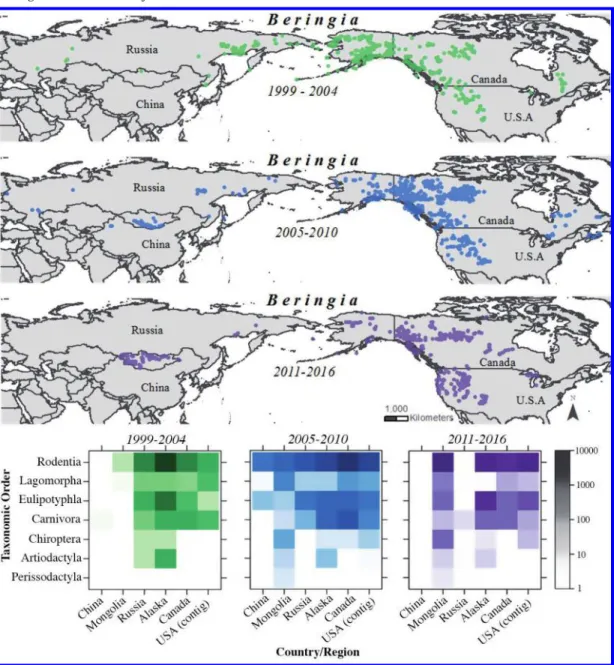
BCP field inventories of mammals and associated parasites were designed to address a range of specific hypotheses and to broadly sample habitats across latitudinal and longitudinal gradients. Fieldwork has emphasized the concurrent collection and holistic preparation of mammal and parasite specimens to ensure their potential for a range of interrelated studies. The BCP aimed to define and investigate diversity and evolutionary and ecological processes across regions, ecosystems, species, and populations using extend- ed transect surveys (Fig. 1).
Fig. 1.Collecting localities for Beringian Coevolution Project specimens are shown for three periods. Heat-maps showing the taxonomic density of specimens (number of specimens per mammalian order) preserved through the Beringian Coevolution Project since 1999.
Arctic Science Downloaded from www.nrcresearchpress.com by USDANALBF on 09/06/17 For personal use only.
Overview of fieldwork
Diverse mammal and associated parasite specimens were acquired using a range of methods (Fig. 1) (MacDonald and Cook 2009). Large-bodied animals (e.g., Carnivora and Artiodactyla) were collected through collaborative efforts with various natural resource agencies. In these cases, the status of populations and geographic ranges are fairly well known, but little genetic or parasite material exists. Smaller animals (chiefly Eulipotyphla, Rodentia, and Lagomorpha) were collected through site-intensive field surveys that were conducted as either longitudinal transects across the Arctic or latitudinal transects into the Arctic from the south. As a supplement to these efforts, and through NSF and other fed- eral and state support, we developed an extensive collaborative network across wildlife agencies in the United States, Canada, and Russia that has also provided substantial series of mammal specimens, ranging from shrews to moose. Maintaining ties with long-term small mammal monitoring projects, subsistence and commercial hunting operations for ungulates (e.g., moose, caribou, muskoxen, and Dall’s sheep), and commercial trappers of furbearers generated samples of high-latitude specimens that might otherwise be unavail- able to science (e.g., Kutz et al. 2012).
Parasitological specimens were acquired principally via immediate examination and necropsy of mammalian specimens in the field. Mammalian specimens collected directly by BCP field crews of mammalogists and parasitologists were screened for macroparasites (helminths and arthropods), which were preserved using methods appropriate to the taxon (e.g., heat-killing in saline for nematodes and hot water for cestodes and trematodes) and to maximize the utility of specimens for both morphological and molecular studies (e.g., frozen or preserved in 70% ethanol). Various tissues (e.g., lung, blood, tissue cysts, and gut contents) were also preserved (e.g., flash frozen or preserved in 95% ethanol) to enable future investigations of the occurrence, identity, and distribution of microparasites (e.g., viruses, bacteria, and protozoans). These protocols emphasize the necessity of preserving vouchers that document the structure of diversity in space and time (e.g., Hoberg et al.
2009; McLean et al. 2016a).
Uses of collections
Specimens collected through the BCP provide a biodiversity reference for resource man- agement, policy, and education (e.g., MacDonald and Cook 2009; Cook et al. 2014, 2016a) and a foundation for addressing diverse research questions (e.g., Weksler et al. 2010; Hoberg et al. 2013; Knowles et al. 2016). Consistent with their preservation as vouchers, they serve as the basis for authoritative identification of the existence of an individual organism (and the particular species it represents) at a specific time and location. Authoritatively identified specimens are the foundation for our understanding of diversity and the infor- mation that can be applied in understanding and defining the implications of host and par- asite distributions. All mammal specimens were deposited at the University of Alaska Museum (before 2003) and Museum of Southwestern Biology (2003 to present).
BCP collecting methods ensure the preservation of high-quality samples that permit investigations spanning broad spatial and temporal scales, including topics such as deep phylogenetic relationships (Cook et al. 2004; Koehler et al. 2009b; Lanier and Olson 2009;
Esteva et al. 2010; Haukisalmi et al. 2010; Kohli et al. 2014), the mode and timing of specia- tion (Hope et al. 2011, 2013), community assembly and faunal mixing through time (Cook et al. 2006; Galbreath and Hoberg 2012, 2015; Hoberg et al. 2012a; Cook and MacDonald 2013; Hope et al. 2015), demographic responses to regional climate through interactions with major biotic and abiotic forces (e.g., Hope et al. 2014), conservation implications of population fragmentation and expansion (Small et al. 2003; Cook and MacDonald 2013;
Arctic Science Downloaded from www.nrcresearchpress.com by USDANALBF on 09/06/17 For personal use only.
Malaney et al. 2013; Malaney and Cook 2013), recurrent gene flow (Runck et al. 2009;
Lindqvist et al. 2010; Miller et al. 2012; McLean et al. 2016b), and isotopic investigations of dietary niche space (O’Brien et al. 2017). Museum specimens lend themselves to integrated approaches to science, especially sample-intensive fields of study that now are experiencing rapid technological and methodological advances (stable isotopes, disease ecology, and predictive modeling: Cook et al. 2013; McLean et al. 2016a; Dunnum et al. 2017).
Results
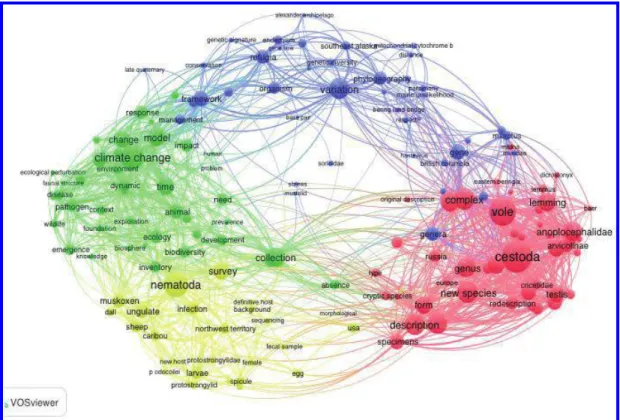
Field collections completed under the BCP and related projects resulted in 53 043 mam- mal specimens and in excess of 14 000 lots of endoparasites and ectoparasites (ranging from single specimens to mixed species assemblages involving hundreds of specimens in a single host) collected from 8761 localities (unique georeferenced specimens) (Fig. 1). As evidence of the broad influence of integrated archives, the comprehensive specimen-based approach of the BCP has yielded over 200 publications and 20 graduate theses or disserta- tions with impacts in diverse fields (Fig. 2).
Mammalian diversity
BCP and related collection efforts have resulted in specimens from seven mammalian orders and 27 families, with the majority of specimens being rodents. The sampled
Fig. 2.Specimen-based research integrates diverse approaches and stimulates new linkages across various themes in Arctic biology. The network is based on terms contained in the titles and abstracts of 174 publications resulting from the Beringian Coevolution Project that were accessed and downloaded from Web of Science. The network was constructed using Vosviewer v1.6.4 (van Eck and Waltman 2010) based on 169 unique terms withfive or more occurrences across the publication records. Default clustering and attraction/repulsion settings were used. The sizes of both text and circles are scaled to reflect differences in term co-occurrences, with larger text/circles denoting more commonly occurring and co-occurring terms.
Arctic Science Downloaded from www.nrcresearchpress.com by USDANALBF on 09/06/17 For personal use only.
mammalian orders and families have varied through time (Fig. 1), depending on region being sampled and on particular collaborative projects with natural resource agencies and commercial trappers. Within most of the mammalian species examined using molecular genetic analyses, substantial phylogeographic structure and cryptic species have been iden- tified (e.g., Cook et al. 2001; Dawson et al. 2014; Sawyer and Cook 2016).
Parasite diversity
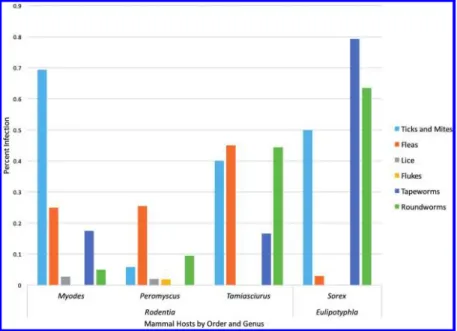
Sampling of mammalian host–parasite assemblages has revealed a diverse array of virus- es, bacteria, protozoans, arthropods, and helminths (e.g., Table 1; Fig. 3). Given that parasite diversity substantially exceeds that of potential mammalian hosts, a synoptic treatment of micro- and macroparasites remains in development. However, substantial insights have been established for certain groups, including platyhelminths in rodents and mustelids and pulmonary and gastrointestinal nematodes among artiodactyls, by integrating
Table 1.Ectoparasite and endoparasite diversity and prevalence in small mammals collected from Fairbanks, Alaska, to Terrace, British Columbia, along the Alaska and Cassiar Highways in 2013.
Mammal order
Mammal genus
No. of hosts examined
for ectoparasites
No. of hosts infested
with ectoparasites
Ectoparasite prevalence
(%)
No. of hosts examined for endoparasites
No. of hosts infected with endoparasites
Endoparasite prevalence
(%)
Rodentia Microtus 1 1 100 1 0 0
Rodentia Myodes 36 28 78 40 7 18
Rodentia Peromyscus 51 16 31 53 6 11
Rodentia Tamiasciurus 20 12 60 18 10 56
Eulipotyphla Sorex 34 18 53 63 60 95
Carnivora Mustela 1 0 0 2 0 0
Total/
average
143 75 52 177 83 46
Fig. 3.Histogram showing the diversity and prevalence of parasites collected from the most common mammalian genera across the Alaska–Cassiar latitudinal transect conducted in 2013.
Arctic Science Downloaded from www.nrcresearchpress.com by USDANALBF on 09/06/17 For personal use only.
morphology and molecular genetics to reveal history and phylogeographic structure (e.g., Cook et al. 2005; Hoberg et al. 2012a).
Initial field assessments of diversity demonstrate how species of parasites are parti- tioned across mammalian taxa and how characteristics of specific geographic sites along a transect may influence the structure of parasite faunas. For example, we have observed changing patterns of diversity for helminths in Peromyscus across a latitudinal transect between Yukon and British Columbia, with greater parasite diversity evident at lower lati- tudes. Such a pattern could reflect the dynamics of southern isolation and subsequent post-glacial expansion to the north. Further, this transect crossed the broad contact zone forMyodes rutilusandM. gapperi(Runck et al. 2009), a region already known to be associated with a substantial shift in tapeworm diversity (e.g., Makarikov et al. 2013). From this single temporal/spatial slice, we can begin to explore how endoparasite and ectoparasite faunas may be isolated or shared among cricetids, sciurids, and other mammals to better under- stand the ecological and historical processes associated with parasite circulation and faunal assembly.
The BCP has already substantially altered the existing view of northern systems as rela- tively simple and taxonomically depauperate in comparison to other regions of the world (e.g., Hoberg et al. 2013). Since the late 1990s, the BCP has been instrumental in establishing nine new higher-level taxa (genera of tapeworms) and recognition and (or) description of 63 previously unknown viral, protozoan, and helminth species while establishing a funda- mentally new understanding of host and geographic distribution (e.g., Wickström et al.
2005; Makarikov et al. 2013; Haukisalmi et al. 2014, 2016). High levels of cryptic parasite diversity demonstrate how holistic surveys are necessary to comprehensively understand historical and contemporary patterns of faunal assembly and diversification (Fig. 4).
Discussion
BCP field collections coupled with molecular methods and new theoretical and analyti- cal approaches in population genetics, genomics, and systematics are yielding novel insights into biogeographic history, enabling tests of earlier concepts about this northern
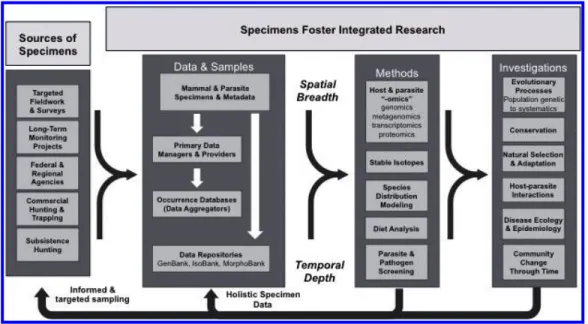
Fig. 4.Specimens help integrate across diverse research agendas and provide ready access to data and samples for scientists, managers, and policy makers.
Arctic Science Downloaded from www.nrcresearchpress.com by USDANALBF on 09/06/17 For personal use only.
crossroads and generating new hypotheses of dispersal and diversification across the region. While coarse sampling was sufficient for early Beringian biogeographers to docu- ment general patterns (MacPherson 1965; Kontrimavichus 1976; Ryzhikov et al. 1978, 1979;
Hoffmann 1981; Rausch 1994), BCP-based phylogeographic studies draw on more extensive sampling and are revealing considerable complexity belying the impacts of ancient, often-rapid climate change (e.g., Waltari et al. 2007; Hoberg et al. 2012b; Haukisalmi et al.
2016; McLean et al. 2016b). Here we outline longstanding concepts in Beringian science and discuss specific examples of BCP-enabled refinement of these ideas.
Beringia: crossroads of northern continents—mammals and parasites address classic questions of intercontinental dispersal, contact, and exchange
As a land bridge that repeatedly linked Eurasia to North America, Beringia mediated the flow of diversity between Arctic continents. During the Quaternary, the flow was predomi- nantly west to east due to climatological gradients that developed in the late Pliocene and the relative size and timing of major dispersal barriers across the region (Hopkins et al.
1982; Waltari et al. 2007; Hoberg et al. 2012a). The general eastward trend (Rausch 1994), however, contrasts with some histories revealed by BCP analyses that reflect an important North American influence on Asian faunas (e.g., Demboski and Cook 2003; Hope et al. 2012).
For example, data from cold-adapted species such as pikas (Galbreath and Hoberg 2012), arctic ground squirrels (Galbreath et al. 2011; McLean et al. 2016b), American marten now resident in interior Alaska (Small et al. 2003), jumping mice (Malaney and Cook 2013), and shrews (Hope et al. 2012) show evidence for distinct episodes of northward expansion from temperate North American latitudes into eastern Beringia or even farther into Asia.
New evidence for multiple distinct transberingian colonization events by helminths associ- ated with pikas as well as the presence of parasite lineages in Asia that may have North American ancestry (Toman and Galbreath, unpublished data), indicate a more important role for North American faunas (hosts and parasites) as a source for westward colonization than previously recognized. Further, phylodemographic studies are revealing complex episodes of geographic contraction and range expansion out of Asia (Fig. 5). For example, separate lineages of both northern red-backed voles (Myodes rutilus) and brown lemmings (Lemmus trimucronatus/sibiricus) appear to have undergone range retraction and subsequent recolonization across western Beringia (Fedorov et al. 1999; Kohli et al. 2015). Each of these snapshots of population history yields insight into the role and timing of processes shaping communities, such as the consequences of abiotic forces (e.g., climate change) for species range dynamics and population divergence (Hope et al. 2014). Still, issues such as the causes of the Late Pleistocene pause in eastward colonization of North America (Tamm et al. 2007;
Meiri et al. 2014) or the influence of a possible mesic“buckle”in Beringia (Guthrie 2001) will be more clearly defined in the near future.
In addition to mediating intercontinental faunal exchange, climatic oscillations at northern high latitudes created new opportunities for population- and species-level contact.
New specimen-derived genetic data from these areas have contributed to our general under- standing of diversification and the permeability of species boundaries in the face of gene flow. In three species of Urocitellus ground squirrels, two sequential instances of ancient gene flow were identified, each resulting in mitochondrial capture (McLean et al. 2016b).
Unlike many other examples of high-latitude hybridization, these taxa (U. parryii,U. richard- sonii, and U. elegans) are now largely allopatric, demonstrating that historic genetic exchange among high-latitude mammals cannot be predicted based on current distribu- tions alone. This and other instances of hidden gene flow within Beringian faunas are best understood when placed in the context of continental-scale analyses, an approach that BCP specimen archives are poised to contribute to significantly.
Arctic Science Downloaded from www.nrcresearchpress.com by USDANALBF on 09/06/17 For personal use only.
Investigation of distinct lineages of ermine (Mustela erminea) utilizing BCP specimens led to novel insights about the origin of endemic, at-risk island populations (Colella et al., unpublished data) in the Alexander Archipelago. Additionally, next-generation DNA sequencing uncovered highly divergent brown bear (Ursus arctos) populations (Lindqvist et al. 2010; Miller et al. 2012) within the same archipelago. Admiralty Island, in particular, supports distinctive lineages of both ermine and brown bears. These discoveries highlight shared demographic histories across topographically complex regions of Beringia and the role of glaciation events in driving diversity.
Beringia: a northern refugium and engine of diversification— arvicolines, ground squirrels, and tapeworms challenge ideas of northern diversification
As an expansive region that remained relatively ice-free during Pleistocene glacial periods, Beringia served as a refuge for populations of northern species through repeated climatic oscillations. It also provided a source for post-glacial recolonization of high latitudes. However, questions have persisted regarding the existence of additional smaller refugia in the North and their relative contributions to diversity and post-glacial coloniza- tion (Fedorov and Stenseth 2002; Fleming and Cook 2002; Shafer et al. 2010). For example, divergent genetic lineages endemic to Beringia were found (Fedorov et al. 1999; Fedorov and Stenseth 2002; Brunhoff et al. 2003; Fedorov et al. 2003) in the collared lemming (Dicros- tonyx), brown lemming (Lemmus), and tundra vole (Microtus oeconomus), a finding that
Fig. 5.Generalized model for the primary colonization pathways, contact zones, and hypothesized source refugia for the greater Beringian region (Table 2). Black arrows denote expected movement during cold periods of glacial maxima when sea levels were lower, while white arrows depict general pathways of colonization during warmer interglacials. These events likely played out repeatedly across a dynamic history of climate oscillation, environmental perturbation, and stability during the Quaternary.
Arctic Science Downloaded from www.nrcresearchpress.com by USDANALBF on 09/06/17 For personal use only.
Table2.SummaryofthetaxaexploredordiscoveredbyBCP-basedinvestigationstodateandthetentativeassessmentofcolonizationhistory,potentialcontactzones betweenspeciesordistinctivelineages,andrefugialoriginformammalsandhelminthparasites. Focalgroup/hostTaxonOriginColonizationContactCitation(s) Mammal Higher-leveloriginsLepusNA/EuA/NAW/E/NBeringia,HA,1 OchotonaAsia/NAE/NseBeringia2,3,4 DicrostonyxEuAE,BEKolymaR,BStrait,e Beringia5,6,7,8,9 LemmusEuAE,REKolymaR,eBeringia5,9,10, MicrotusEuA/NAE/NOmolonRiver,e Beringia9,11,12 MyodesEuAEwBeringia9,13,14,15,16 MyopusEuAEseSiberia17 TamiasciurusNANseAK,sBeringia18 UrocitellusNAN/WCentralBeringia,eAsia19,20 ZapusNANNone21 SorexEuA/NAE/WBStrait,seAK9,22,23,24,25 CanisEuAE?26,27 MartesEuA/NAE/NseAK28,29,30,31,32 MustelaEuA/NAE/NseAK,eBeringia33,34 InterspecificpairsLepustimidus/L.othusEuAN/ABStrait35 Dicrostonyxtorquatus/D. groenlandicusBeringiaN/ABStrait5,6,7,9 Lemmussibiricus/L.trimucronatusBeringiaN/AKolymaR,eBeringia5,9,10 Sorexcamtschatica/S.ugyunakNAN/ABStrait25 Sorexportenkoi/S.ugyunakNAN/ABStrait25 Sorexugyunak/S.cinereusNAN/AnAK25 Martescaurina/M.americanaNAN/AseAK,WYtoBC28,29,30,31,32 Ochotonacollaris/O.princepsNAN/ANone2,3,4 Myodesrutilus/M.gapperiEuA/NAN/AseAKtoHudsonBay9,13,14,15,16,37 HolarcticspeciesLemmustrimucronatusNABE,NeBeringia10 MicrotusoeconomusEuABESiberia,OmolonR12,38,39 MyodesrutilusEuABEKolymaR13,16,37,39 UrocitellusparryiiNABE/CHACentralBeringia19,29,40 SorexminutissimusEuAEUralMtns9,23
Arctic Science Downloaded from www.nrcresearchpress.com by USDANALBF on 09/06/17 For personal use only.
Table2(continued). Focalgroup/hostTaxonOriginColonizationContactCitation(s) SorextundrensisEuAEBStrait&Palearctic9,24 CanislupusEuAECoastRange26,27,41,42 UrsusarctosEuAEseAK,eBeringia GuloguloEuAEAK/Yukon? MustelaermineaEuAseAKendemic/EseAK,eBeringia33,34 PalearcticendemicspeciesLepustimidusEuAWidespreadNone35 DicrostonyxtorquatusEuAREKolymaR5,6,7,9 LemmussibiricusEuAREKolymaR5,9,10 MyopusschisticolorEuAEseSiberia17 SorexcamtschaticaNABENone25 SorexportenkoiNABENone25 NearcticendemicspeciesLepusothusEuABENone35 OchotonacollarisNABENone3 DicrostonyxgroenlandicusNABE,HighArcticeBeringia5,6,7,8,9 LemmustrimucronatusNABE,NeBeringia5,9,10 MicrotuslongicaudusNAseAK,BE,NseAK,seBeringia44,45 Microtusmiurus?BEeBeringia11 MicrotuspennsylvanicusNANNone46 TamiasciurushudsonicusNABE,NseBeringia47 ZapushudsoniusNANNone48 ZapusprincepsNANNone49 SorexcinereusNANNone25 SorexugyunakNABENone25 SorexmonticolaNANseAK50 SorexpalustrisNANNone51 UrsusamericanusNAN?52,53 MartescaurinaNAseAKendemicNone28,29,30,31,32,54 MartesamericanaNANNone28,29,30,31,32 HostParasite EulipotyphlaEucestoda-Hymenolepididae SorexmonticolusStaphylocystoidesgulyaevi★NAseAKendemic??55 SorexcinereusStaphylocystoidessphenomorphus◉NARE(Cal-AK-RockyMtns)??56
Arctic Science Downloaded from www.nrcresearchpress.com by USDANALBF on 09/06/17 For personal use only.
Table2(continued). Focalgroup/hostTaxonOriginColonizationContactCitation(s) S.cinereus,S.tundrensis,S.ugyunakStaphylocystoidesserrula◉NAWidespread(AK-TN)??56 S.araneus,S.caecutiens,S.tundrensis, S.gracillimus,S.unguiculatusStaphylocystoidesspasskii◉EuAESiberia(Baikal-w Beringia)??56 S.minutissimusStaphylocystoidessp.◉NAEBeringia(AK-YK)??57 S.cinereusSpasskylepisrauschi★NABE??58 S.minutissimusLineolepisparva◉NAWidespread(AK-IA)??57 S.tundrensisNeoskrjabinolepisfertilis★Beringia?BE(Chukotka-Seward Peninsula)??59 S.tundrensisNeoskrjabinolepishobergi★NABE??59 Eucestoda-Dilepididae S.caecutiens,S.daphaenodonMonorcusdokuchaevi★EuABE??60 Nematoda-Dioctophymatoidea S.cinereus,S.unguiculatus,S. tundrensisSoboliphymebaturini◉Asia?Holarctic??32,61,62,63 Rodentia,ArvicolinaeEucestoda-Hymenolepididae (+Neotominae/Geomyidae/ Heteromyidae)ArostrilepisEuAMultipleEexpansionsStikineR& Liard-MacKenzieR64,65,66 Cricetidae/Neotominae/SciuridaeHymenolepisEuAEexpansion??67,68 MyodesgapperiArostrilepiscooki★wNAN??65 Myodesrufocanus,Microtus oeconomusArostrilepisgulyaevi★AsiaWidespreadSiberia??65 Microtusoeconomus,M.longicaudus, M.miurus,M.pennsylvanicus,M. xanthognathus
Arostrilepisrauschorum★wNA????65 MyodescalifornicusArostrilepiskontrimavichusi◆wNAPacificCoastendemic??69 MicrotusoeconomusArostrilepisc.f.janickii◉eBerwAKendemic??65 Lemmustrimucronatus,Synaptomys borealisArostrilepisberingiensis◉AsiaHolarctic??65,90 Myodesrutilus,Microtus xanthognathus,Tamiasciurus hudsonicus Arostrilepismacrocirrosa◉AsiaEintoNAKolymaR65,90 Myodesrufocanus,M.rex,M.rutilus, M.glareolusArostrilepistenuicirrosa◉AsiaWacrossAsia??116 MicrotuspennsylvanicusHymenolepisevaginata◉eNALE(Manitoba)??90
Arctic Science Downloaded from www.nrcresearchpress.com by USDANALBF on 09/06/17 For personal use only.
Table2(continued). Focalgroup/hostTaxonOriginColonizationContactCitation(s) Eucestoda-Anoplocephalidae ArvicolinaeAnoplocephaloidesEuAWandEexpansion??70,71 ArvicolinaeMicrocephaloidesEuA?E???72 ArvicolinaeParanoplocephalacomplexEuAMultipleexpansions??73,74,75,76 ArvicolinaeGulyaeviaEuA????74,75, ArvicolinaeMicroticolaEuA?E??76,77 ArvicolinaeBeringitaeniaNA?????76 ArvicolinaeArctocestusEuA?E???76,78 ArvicolinaeRauschoidesEuA?Multipleexpansions??8,76 ArvicolinaeDouthittiaEuAMultipleexpansions??70,79,80 ArvicolinaeRodentocestusEuA?E???74,76 Microtusoeconomus,M.miurus,M. pennsylvanicusAnoplocephaloidesc.f.dentataIII★◉AsiaEintoNA??70,71 MicrotusxanthognathusAnoplocephaloidesc.f.dentataIV★◉NAeBE??71 SynaptomysborealisAnoplocephaloideskontrimavichusi 1★◉NARE(BC-AK)??70,71,81 SynaptomysborealisAnoplocephaloideskontrimavichusi 2★◉NARE(BC-AK)??70,71,81 Lemmustrimucronatus,L.sibiricusAnoplocephaloideslemmi1★◉BeringiaHolarcticKolymaR70,71,81 LemmussibiricusAnoplocephaloideslemmi2★◉AsianSiberiaendemic??70,71,81 MicrotusxanthognathusMicrocephaloidesn.sp.2★◉NAeBE??82 MicrotuslongicaudusMicrocephaloidesn.sp.3★◉NAeBE??82 MicrotusmiurusMicrocephaloidesn.sp.5★◉NAeBE??82 Microtuspennsylvanicus,M. longicaudusMicrocephaloidesn.sp.6★◉NARE(Cal-Ak)??82 Microtusmiurus,MyodesrutilusParanoplocephalabatzlii★◉NAeBE??74,75,76 MicrotusoeconomusParanoplocephalajarrelli★EuAEintoNA??74,76 Microtussp.Paranoplocephalac.f.omphalodesn. sp.I★◉EurWidespreadEuropeN/A70,76,80,83 MicrotusoeconomusParanoplocephalac.f.omphalodesn. sp.II★◉EuA?Holarctic??70,76,80,83 Microtusoeconomus,M.miurusParanoplocephalac.f.omphalodesn. sp.III★◉NAeBE??70,76,80,83
Arctic Science Downloaded from www.nrcresearchpress.com by USDANALBF on 09/06/17 For personal use only.