Volume 6 Issue 01
JALREV 6 (1) 2024 January 2024
ISSN Print: 2654-9266 ISSN Online: 2656-0461
Collective Agreement as Evidence with Binding Legal Force in Decision of Industrial Relations
Court
Andari Yurikosari1
Sugeng Santoso PN2
1Faculty of Law, Universitas Trisakti, Indonesia.
2Faculty of Law, Universitas Brawijaya, Indonesia.
@2024 - Andari Yurikosari and Sugeng Santoso PN Under the license CC BY-SA 4.0
Article Info Abstract
Submitted: Jun 21, 2023 Revised: Jan 13, 2024 Accepted: Jan 25, 2024 Keywords:
Collective agreement;
Evidence; Industrial Relations Court.
How to cite [Chicago Manual of Style 17th edition (full note)]:
Yurikosari, Andari, and Sugeng Santoso PN.
“Collective Agreement as Evidence with Binding Legal Force in Decision of Industrial Relations Court.”
Jambura Law Review 6, no. 1 (2024): 66–87.
A Collective Agreement, once registered and ratified at the Industrial Relations Court, should be regarded as authentic evidence possessing binding legal force for all parties, including judges. However, in various rulings from both the District Court and Supreme Court levels, the Collective Agreement has been consistently disregarded as evidence with enduring legal implications and enforceability on the involved parties. The central issue investigated in this research pertains to how judges perceive the Collective Agreement as evidence and the position it holds as binding evidence in the decisions of the Industrial Relations Court. This research employs a normative legal analysis approach (statute case) and conducts a case study by examining multiple industrial relations court decisions that have overlooked Collective Agreements as evidence with binding legal force. In contrast to several prior studies and writings conducted by other entities, which have primarily confined the role of the Collective Agreement to being binding on the parties and admissible as evidence in the Industrial Relations Court, this research scrutinizes the Collective Agreement, asserting that it should be established with unequivocal legal force for the involved parties, rendering it conclusive and precluding further legal actions. Nevertheless, in various Industrial Relations Court Decisions, these agreements are, in fact, overlooked and not treated as evidence with binding legal force, thereby introducing legal ambiguity for the parties involved. Additionally, despite the ideal scenario of the Collective Agreement being crafted as an authentic deed to ensure its binding nature, practical instances reveal instances where Collective Agreements are private deeds, each possessing distinct evidentiary powers.
1. Introduction
Collective Agreement serves as documentary evidence tools1 in resolution of industrial relations disputes at the Industrial Relations Court, aiming to facilitate resolution of conflicts between involved parties.2 At the commencement of employment, the parties are required to establish an employment agreement. Termination of employment relationship between workers and employers,3 arising from the existence of work agreement, is theoretically within the rights of the parties.4 In practice, termination of employment relationship between involved parties, particularly concerning termination, doesn't consistently unfold seamlessly as per their mutual agreement.5 This often leads to industrial relations disputes,6 where the Collective Agreement can
1 According to Rizky Pratama Putra Karo-karo, evidence is the key or bullet that the Plaintiff has in a court’s case. See, Rizky Pratama Putra Karo Karo, “Pembuktian Terhadap Perkara PHK Dan Kewenangan Hakim PHI Menjatuhkan Putusan Berdasarkan UU Cipta Kerja, Putusan MK Terhadap UU Cipta Kerja,”
in Masalah-Masalah Hukum Pasca Putusan Mahkamah Konstitusi No. 19/PUU-XVIII/2020 (Depok:
Rajawali Buana Pustaka, 2022), 144.
2 Basically, numerous industrial relations disputes culminate in labor strikes, reduced productivity, workplace sabotage, a substantial turnover of workers, diminishing moral values, increased absenteeism, and a decline in workers' capacity and efficiency. Theoretically, there is no established model for crafting a Collective Agreement following an industrial relations dispute between the involved parties. Intrinsically, formulating a Collective Agreement is a complex, time-consuming, and challenging undertaking for the parties involved. However, the primary aim of the negotiation process is to achieve an agreement, which may not necessarily address all the contentious issues in dispute. See, Asamu Festus Femi et al., “Industrial Conflict and Collective Bargaining: Evidence From North Central Region of Nigeria,” International Journal of Mechanical Engineering and Technology 10, no. 3 (September 11, 2019):
120–28.
3 Employment relations stand as a different concept separate from industrial relations. As articulated by Sejal Murarka, Industrial Relations can be characterized as interactions within the industry, particularly among employees, management, trade unions, and government. These interactions, whether direct or indirect, play a role in the advancement of industrial and economic development. The practices of Industrial Relations hold significant relevance in developing nations, such as India. Consequently, Indonesia, being a developing country, employs industrial relations practices different from employment relations. This specifically encompasses interactions between two principal parties: the entrepreneur or employer and the worker. Notably, industrial relations also encompass state intervention in handling industrial relations matters, including the resolution of Industrial Relations Disputes. See, Sejal Murarka, Prarthana Fabyani, and Shweta Bobhate, “A Study of Worker’s Participation in Management Practices to Deal with Uncertainty in Industrial Relations-A Theoretical Framework,”
Annual Research Journal of Symbiosis Centre for Management Studies, Pune 9 (March 2021): 22.
4 Andari Yurikosari, Pemutusan Hubungan Kerja Di Indonesia (Jakarta: Penerbit Fakultas Hukum Universitas Indonesia, 2010), 3.
5 According to Agus Pramono, the emergence of disputes between workers and entrepreneurs is inherently challenging to prevent, as they may arise even in the absence of violations by either party.
Apart from societal conditions, the intricacies of daily life also significantly impact work relationships.
See, Agus Pramono, “Settlement of Industrial Relations Disputes and Termination of Work Relations According to the Applicable Legislation,” Walisongo Law Review (Walrev) 2, no. 2 (December 20, 2020):
170, https://doi.org/10.21580/walrev.2020.2.2.6671.
6 Siti Hajati Hoesin and Fitriana, Memahami Hubungan Kerja Dan Hubungan Industrial Di Indonesia (Jakarta: Damera Press, 2023), 153. According to Siti Hajati Hoesin and Fitriana, cited by Budi Santoso,
serve as a resolution tool to facilitate an agreement between the parties. This agreement, formed through the Collective Agreement, holds binding significance for the involved parties. This perspective aligns with Sugeng Santoso's viewpoint in the article "Eksekusi Putusan Pengadilan Hubungan Industrial" in Bunga Rampai Hukum Ketenagakerjaan dalam Perubahan Iklim Ketenagakerjaan,
It is asserted that industrial relations disputes resolved through the Industrial Relations Court in the District Courts of Jakarta, Semarang, Surabaya, and Medan do not seem to adhere to the principles of being inexpensive, expeditious, accurate, and equitable. This observation is drawn from numerous Industrial Relations Court decisions at both the primary and cassation levels, which, despite having attained permanent legal force (inkracht van gewisjde), remain unexecuted due to a lack of good faith on the part of entrepreneurs to implement these permanent legal force binding decisions. Notably, the absence of legal sanctions further compounds the issue.7 In this context, the presence of a Collective Agreement, ratified by the Industrial Relations Court and endowed with the power of executory confiscation, can serve as a tool to enforce decisions made by the Industrial Relations Court.
Article 7 of Law Number 2 of 2004 stipulates that if the deliberations mentioned in Article 3 lead to a settlement agreement, the parties shall create and sign a Collective Agreement. This Collective Agreement holds binding authority and is considered a legal document that both parties are obligated to implement. Additionally, the parties involved must register the Collective Agreement with the Industrial Relations Court, specifically at the District Court in the jurisdiction where the agreement was established. Registered Collective Agreements are issued a Deed of Proof of Registration, an integral component of the Collective Agreement.
they contend that the termination of employment by either party is permissible based on their individual preferences, without the requirement of a court decision, as long as they adhere to the reasons and procedures outlined in statutory regulations. On the other hand, court intervention becomes necessary for the termination of employment relationship if there is a significant reason (gewichtige reden), requiring the prompt termination of the employment relationship. See, Budi Santoso, “Justification of Efficiency as a Reason for Termination of Employment,” Mimbar Hukum 25, no. 3 (2021): 405. See also, Article 1603, Republic of Indonesia, “Code of Civil Law” (1945).
7 Sugeng Santoso PN, “Eksekusi Putusan Pengadilan Hubungan Industrial,” in Hukum Ketenagakerjaan Dalam Perubahan Iklim Ketenagakerjaan, Ed.1, Cet. 1 (Depok: Rajawali Pers, 2023), 473.
According Moch Ansori et al.,8 a Collective Agreement, once signed by the parties but not registered in court, cannot be annulled or repudiated by either party. This is because the Collective Agreement holds binding authority over the parties, akin to law, as explicitly outlined in Article 7, Paragraphs (2) and (3) of Law Number 2 of 2004 on Settlement of Industrial Relations Disputes. The law clearly mandates that the Collective Agreement, as specified in Paragraph (1), is binding, assumes the status of law, and must be adhered to by the involved parties. For proper recognition, the Collective Agreement referred to in Paragraph (1) must be registered by the parties at the Industrial Relations Court, specifically at the District Court in the jurisdiction where the agreement was formed. The registration of the Collective Agreement, as outlined in Paragraph (3), is accompanied by a deed of proof of registration, which is an integral and inseparable part of the Collective Agreement.9
Concerning various perspectives on the power of the Collective Agreement as evidence in the Industrial Relations Court, there exists a debate on whether the mere act of parties signing the Collective Agreement renders it a binding legal force or if its a binding legal force is conferred post-ratification by the Industrial Relations Court during the registration process. Alternatively, Juanda Pangaribuan posits, in accordance with Law Number 2 of 2004 on Settlement of Industrial Relations Disputes, that the Collective Agreement inherently possesses binding legal force, equivalent to the rulings of the Industrial Relations Court with permanent legal force. A prerequisite for this status is the obligation for one or both parties to register the Collective Agreement with the local Industrial Relations Court.10 Reytman Aruan shares a similar viewpoint, asserting that when parties come to an agreement, a Collective Agreement is formulated, endorsed by the negotiators, and subsequently recorded at the Industrial Relations Court within the jurisdiction of the District Court where the agreement was established. Consequently, the Collective Agreement attains binding
8 Moch Anshori, Anas Lutfi, and Syafrizal Syafrizal, “Perjanjian Bersama dalam Penyelesaian Sengketa Hubungan Industrial,” Jurnal Magister Ilmu Hukum 6, no. 1 (August 2, 2021): 1, https://doi.org/10.36722/jmih.v6i1.795.
9 Article 7 Paragraph (2) and (3), Republic of Indonesia, “Law Number 2 of 2004 Concerning Settlement of Industrial Relations Disputes” (2004).
10 Juanda Pangaribuan, Seluk Beluk Hukum Acara Pengadilan Hubungan Industrial, Ed. 1, Cet. 1 (Jakarta:
MISI, 2017), 194.
status, akin to law, compelling the parties to abide by its terms. This signifies that the forged agreement holds validity and imposes binding obligations on both parties.11 In the event that one of the parties fails to implement the Collective Agreement, the affected party has the option to file a request for execution with the Industrial Relations Court, particularly at the District Court where the Collective Agreement is registered, to secure an execution decree. In cases where the Execution Applicant resides outside the jurisdiction of the District Court where the Collective Agreement is registered, the Execution Applicant can file an execution request through the Industrial Relations Court, specifically at the District Court in their residence, to be subsequently forwarded to the competent Industrial Relations Court at the District Court level for execution.
The understanding of Collective Agreements in Indonesia differs from that of Collective Labor Agreements. As stated by M. Hadi Shubhan, a Collective Labor Agreement incorporates aspects of both civil law and public law.12 It is founded on an agreement between the involved parties—the employer and the workers' union within the company.13 This agreement must encompass standalone norms or rules, such as the Company regulations established by the Company. The Collective Labor Agreement is legally binding on the parties involved, and according to the provisions of the laws and regulations, it must be registered with the employment agency within the jurisdiction of the parties. In the context of discussing employment relations, the presence of a Collective Labor Agreement, serving as a foundational element of employment relations, should not conflict with the collective labor agreement, with the risk of facing cancellation for any violations.14
11 Reytman Aruan, Hukum Acara Perselisihan Hubungan Industrial: Teori, Praktik dan Permasalahannya (Yogyakarta: Deepublish, 2020), 51.
12M Hadi Shubhan, “Industrial Relation and Criminal Sanction the Case of Indonesia,” International Journal of Civil Engineering and Technology 10, no. 3 (2019): 1134.
13 "A Collective Work Agreement is an Agreement arising from negotiations between a Trade Union/Labor Union or multiple such unions registered with the agency overseeing employment matters, and an entrepreneur or a group of entrepreneurs or an association of entrepreneurs. It encompasses the terms of employment, as well as the rights and obligations of both parties." Article 1 Number 21, Republic of Indonesia, “Law Number 13 of 2003 on Manpower” (2003).
14 Ari Hernawan, Dasar-Dasar & Perkembangan Hubungan Kerja Di Indonesia: Sebuah Telaah Kritis (Yogyakarta: UII Press, 2023), 81.
Diverging from a Collective Labor Agreement, a Collective Agreement is established by the entrepreneur or company (employer) and the worker or Trade Union following an agreement reached subsequent to an industrial relations dispute. A registered Collective Agreement that has been submitted for ratification at the Industrial Relations Court holds the power as evidence with binding legal force.15 Similar to agreements in general, as per the Civil Code, a Collective Agreement is an act in which one or more individuals bind themselves to one or more individuals external to them.16 For an agreement to be valid, it must meet the legal requirements outlined in the Civil Code, namely17 "a. Mutual agreement between both parties; b. Legal competence of the parties to undertake legal actions; c. Existence of a specific subject matter; and d.
Lawful (halal) reasons." Conditions a and b (Agreement and skills of the parties) are subjective prerequisites, whereas conditions c and d (Existence of the object of the agreement and a lawful cause) are objective conditions. Failure to fulfill the subjective requirements may lead to the cancellation or voidability of the established agreement.
On the other hand, if the objective conditions are not fulfilled, the agreement will be deemed null and void. To prevent deficiencies in the agreement, collective agreements for resolving industrial relations disputes must be executed by competent parties.
The Collective Agreement in resolving industrial relations disputes should, among other things, contain the following important matters:
1) Competent parties must establish a Collective Agreement to satisfy the validity requirements specified in Article 1320 of the Civil Code, preventing any flaws in the Collective Agreement.
2) A Collective Agreement, once registered with the Industrial Relations Court and accompanied by a Deed of Proof of Registration, possesses executory force. In
15 According Juanda Pangaribuan, prior to the enactment of the PHI Law as positive law, the resolution agreement for industrial relations disputes were commonly stipulated in collective agreements (KB).
Fundamentally, KB serves a similar purpose as PB. A recurring issue arises when employers or workers fail to adhere to the New Testament (NT), where coercive remedies are unavailable. Consequently, uncertainties regarding dispute resolution through family planning emerge. These uncertainties stem from the fact that, at that time, labor law did not address the legal status of family planning to the same extent as the New Testament. See, Pangaribuan, Seluk Beluk Hukum Acara Pengadilan Hubungan Industrial, 195.
16 Article 1313, Republic of Indonesia, Code of Civil law.
17 Article 1320, Republic of Indonesia.
the event that either party fails to adhere to the provisions of the Collective Agreement, the aggrieved party foregoes filing a lawsuit with the Industrial Relations Courts but instead submits a request for execution to the Industrial Relations Courts.18
In essence, based on the second point mentioned earlier, the Collective Agreement should ideally be registered with the Industrial Relations Court. This registration bestows upon it the status of an authentic deed, serving as a tool for executing seizures19 from the Industrial Relations Court at the District Court level. An issue arises when a Collective Agreement, used as evidence, has not undergone registration and ratification by the Industrial Relations Court at the District Court level. The evidentiary strength of a private deed is undoubtedly not on par with the evidentiary strength of an authentic deed in court. In such instances, the Industrial Relations Court judge may disregard a Collective Agreement classified as a private deed in comparison to one with the evidentiary power of an authentic deed.
In the Industrial Relations Court Decision Number 127/Pdt.Sus-PHI/2022/PN.Bdg, the panel of judges, in their deliberations and rulings, continued to treat the Collective Agreement as evidence with binding legal force. Despite the Collective Agreement being submitted as a private deed and not registered with the Industrial Relations Court, this instance suggests that certain judges in the Industrial Relations Court still recognize the Collective Agreement's potential as evidence with binding legal force, even in its private deed status without ratification by the District Court.
In practice, a Collective Agreement must meet specific conditions to be legally recognized as an authentic deed; it requires registration with the Industrial Relations
18 Asriyadi Tanama, “Perjanjian Bersama Dalam Penyelesaian Perselisihan Hubungan Industrial,” HT &
Partners Legal Consult (blog), December 27, 2021, https://htlegalconsult.com/perjanjian-bersama- dalam-penyelesaian-perselisihan-hubungan-industrial/.
19 According to Andari, in the judicial practice in Indonesia, executing a decision is not necessarily a straightforward process, even when the decision holds permanent legal force. Consequently, the execution of decisions in the Industrial Relations Court, from the standpoint of workers/laborers, emphasizes their interests as parties in a vulnerable position. Following the announcement of the court decision, it becomes imperative to ensure its effective implementation, allowing the interests and rights of workers/laborers pertaining to the decision to be implemented. See, Andari Yurikosari, “Perlunya Lembaga Sita Eksekusi Pada Pengadilan Hubungan Industrial Di Indonesia,” Jurnal Hukum PRIORIS 10, no. 2 (December 12, 2022): 128, https://doi.org/10.25105/prio.v10i2.17016.
Court at the local District Court level. A registered Collective Agreement with the Industrial Relations Court, accompanied by a Deed of Proof of Registration, holds executorial force. Often, the corresponding parties applying registration of a Collective Agreement fail to fulfill several conditions required for the process. The prerequisites for seeking ratification of a Collective Agreement with the Industrial Relations Court involve submitting a Letter of Application for a Collective Agreement along with the necessary documents such as;20
1) Application letter from entrepreneur/company and worker (stamped);
2) Original & photocopy of the Collective Agreement (stamped) which has been legalized from the Legal Registrar's Office in 3 (three) copies;
3) Original piece of Power of Attorney, Stamped Letter of Assignment and Photocopy from the Company Director (Legalized at the Legal Registrar's Department);
4) Photocopy of Proof/Receipt of Severance Pay;
5) Photocopy of Employment Agreement Letter (SPK);
6) Photocopy of Worker's ID Card (KTP);
7) Photocopy of Deed of Establishment, Amendments and Director's ID Card.
Given the above-mentioned requirements, parties often encounter challenges in obtaining a photocopy of the Deed of Establishment and Amendments, the Director's KTP, and attaching proof or a receipt of severance pay. It is because some companies only disburse severance pay if a Collective Agreement has been issued and ratified by the Industrial Relations Court at the District Court level. This raises the question of whether a Collective Agreement, without ratification or without a request for ratification from the Industrial Relations Court at the local District Court, can serve as evidence with binding legal force for the parties. Additionally, can it be utilized as evidence for executing seizures at the District Court in connection with the outcomes
20Pengadilan Negeri Makassar Kelas I A Khusus, “Syarat Pendaftaran Perjanjian Bersama (Bipartit),”
accessed January 29, 2024, https://www.pn-makassar.go.id/website/index.php/layanan- hukum/prosedur-berperkara/954-syarat-pendaftaran-perjanjian-bersama-bipartit.
of the Industrial Relations Court Decision and/or the Cassation Decision of the Industrial Relations Court at the Supreme Court level.21
The subsequent issue is that, fundamentally, every Collective Agreement, endowed with the binding force of evidence through the ratification process at the Industrial Relations Court, differs from a Collective Agreement that hasn't been registered and submitted for ratification at the Industrial Relations Court. It becomes problematic if the judge persists in employing the Collective Agreement as a basis for deliberation in making decisions, despite discovering that the contents of the Collective Agreement conflict with Law Number 13 of 2003 on Employment.
In the Industrial Relations Court Decision Number 677/K/Pdt.Sus-Industrial Relations Courts/2023, the panel of judges, recognizing an error in drafting the Collective Agreement, opted to annul the previously agreed Collective Agreement. Subsequently, they proceeded to regulate (revise) the contents of the Collective Agreement. This interpretation suggests that certain judges recognize that a Collective Agreement may not automatically serve as evidence with binding legal force if, in their judgment, the agreement contains errors or violations.
2. Problem Statement
The presence of court decisions that disregard cooperation agreements as evidence in industrial relations cases is a crucial issue in this research. This research will explore how judges in the court perceive and position cooperative agreements as evidence in industrial relations cases.
3. Methods
This research is a normative study using a statutory approach and a case approach. The statutory approach is intended to analyze various regulations related to industrial relations. Meanwhile, the use of the case approach serves as an optical lens to examine
21 With regard to industrial relations disputes concerning the termination of employment relations, which have been adjudicated at the cassation level by the Supreme Court with Decision Number 237 K/Pdt.Sus/2012. In this decision, the panel of judges, in their legal deliberations, solely relied on the collective agreement crafted by the plaintiff and defendant when resolving the dispute at the bipartite level, despite the content of the collective agreement conflicting with Law Number 13 of 2003 on Manpower. See, Indi Nuroini, “Penerapan Perjanjian Bersama Dalam Pemutusan Hubungan Kerja,”
Jurnal Yudisial 8, no. 3 (December 1, 2015): 1, https://doi.org/10.29123/jy.v8i3.61.
several court decisions that disregard cooperative agreements as legally binding evidence. Various legal materials gathered are then analyzed prescriptively.
4. Judge's Consideration of the Collective Agreement as Evidence
According to Article 7 of Law Number 2 of 2004 on Settlement of Industrial Relations Disputes, the Collective Agreement is declared as binding, becomes legal, and must be enforced by the involved parties. However, subsequent to its creation, signing by the parties, and the approval request from the Industrial Relations Court to grant legal validity as an authentic deed, it has been revealed upon re-examination that there are errors or violations of statutory regulations, including those outlined in the Employment Law.
The regulations for addressing industrial relations disputes, as outlined in Law Number 2 of 2004 on Settlement of Industrial Relations Disputes, particularly concerning the presence of Collective Agreements, seem to remain unaltered, unchanged, or appended in Law Number 6 of 2023 on Determination of Government Regulations in Lieu of Law Number 2 of 2023 on Job Creation as it has become legal.
A Collective Agreement, stemming from a resolution process involving bipartite negotiations, mediation, and conciliation, when created in accordance with the provisions of Article 1320 of the Civil Code, is theoretically binding on the involved parties as per the provisions of Article 1338 of the Civil Code. This aligns with the regulations stated in Article 7 of Law Number 2, 2004, on the Settlement of Industrial Relations Disputes. Furthermore, this provision is consistent with the regulations outlined in Law Number 30 of 1999 on Arbitration and Alternative Dispute Resolution, emphasizing that negotiation outcomes must be documented in a written agreement, such as a Collective Agreement.
The distinction between the negotiation provisions outlined in Law Number 30 of 1999 and the bipartite provisions stipulated in Law Number 2 of 2004 lies in the fact that the peace agreement generated by the parties under Law Number 30 of 1999 lacks executorial force. Consequently, this implies that the peace agreement cannot be enforced through court execution. In contrast, the Collective Agreement resulting from bipartite negotiations conducted by the parties in accordance with Law Number 2 of
2004 possesses executorial force, allowing for its implementation or execution to be sought through the District Court in cases where one of the parties fails to adhere to it.22
The judge's considerations regarding the Collective Agreement are articulated in various considerations, exemplified by Decision Number 237 K/Pdt. Sus/2012. The panel of judges essentially hold opinion that regardless of the reason for termination of a quo employment relationship in the present case, the termination had evidently transpired through an agreement, marked by the claimant receiving settlement or compensation for the termination in the form of a termination letter, recommendation, and severance pay slip from the defendant. Consequently, the Supreme Court affirmed that an agreement had been reached between the plaintiffs and the defendant in resolving layoffs, as delineated in the collective agreement dated 30 December 2010, aligning with the provisions of Article 7 of Law Number 2 of 2004 on Settlement of Industrial Relations Disputes.
Due to the agreement reached between the plaintiffs and the defendant in resolving the dispute concerning the termination of employment relations, as stipulated in Article 7 of Law Number 2 of 2004, all claims presented by the plaintiffs, seeking resolution for the termination of employment relations in question, must be dismissed.
The cassation panel, in its decision, primarily relied on the Collective Agreement dated 30 December 2010 as the main legal basis for granting the cassation request from PT.
SMM, leading to the annulment of Pekanbaru Industrial Relations Court decision Number 23/G/2011/PHI. Pbr. Upon examining various legal considerations surrounding the existence of the collective agreement, the author holds the opinion that certain legal considerations, particularly those in point c containing the clause
"That regardless of the reason for a quo layoff, considering that a quo dismissal is an agreement has been made accompanied by acceptance of settlement/compensation for layoffs," are inappropriate. This seems to overlook the provisions outlined in the articles of Law Number 13 of 2003 on Manpower, which specify the grounds for layoffs and define the corresponding entitlements such as severance pay, long service awards,
22 Suratman, Pengantar Hukum Ketenagakerjaan Indonesia (Jakarta: RajaGrafindo Persada, 2019), 238.
and replacement rights for workers/laborers affected by layoffs, in connection to the reasons behind the layoffs.
A Collective Agreement that has been signed but not officially registered with the court cannot be invalidated or repudiated by either party. This is because the Collective Agreement legally binds the parties (Article 1338 of the Civil Code in conjunction with Articles 7, 13, 23 of Law No. 2 of 2004 on Settlement of Industrial Relations Disputes).
Consequently, a problem arises as the aforementioned Collective Agreement appears to overlook the provisions concerning severance pay, etc., which are outlined in Law Number 13 of 2003 on Employment.
On the other hand, in practical terms, parties involved in employment relations use Collective Agreements not solely for resolving industrial relations disputes but also for addressing various issues within employment relations that may arise without triggering industrial relations disputes. A Collective Agreement is not limited to being a post-dispute mutual agreement; rather, it can serve as an agreement between the parties concerning legal events or actions in employment relations. For instance, it could be an agreement between employers and workers (trade unions) to replace one of the provisions in the Collective Labour Agreement that requires alteration due to the evolving needs in industrial relations.
The Collective Agreement serves as a resolution adopted by the parties in industrial relations to ensure harmonious work relations between the entrepreneur/company and workers. Nevertheless, a challenge arises when the terms of the work agreement conflict with or violate the legal provisions outlined in the Collective Labour Agreement. If the new provisions established through the Collective Agreement benefit the workers more than the stipulations in the Collective Labour Agreement and the law, it poses no issue. However, if the situation is reversed, it could undoubtedly lead to a dispute.
In a case before the Industrial Relations Court, there was a lawsuit seeking the annulment of the Collective Agreement, even though, basically, the annulment of a Collective Agreement cannot be pursued at the Industrial Relations Court at the District Court level. Nevertheless, the author identified several Industrial Relations Court
decisions that were subsequently upheld at the cassation level, asserting that the Collective Agreement was null and void.
In Decision Number: 232/Pdt.Sus-PHI/2015/PN.Bdg, that according to the Panel of Judges, the reasons for the Counterclaim Plaintiff/Conference Defendant to demand cancellation of the Collective Agreement can be justified according to law because they are based on Law Number 40 of 2007 on Limited Liability Companies, Article 98 Paragraph (1): "The Board of Directors represents the Company both inside and outside the Court", and further in Article 103 it is regulated: "The Board of Directors can give written power of attorney to 1 (one) employee of the Company or more or to other people for and in the name of the Company carries out certain legal actions as described in the power of attorney" and furthermore, since Mr. K and HW lack the Power of Attorney to act on behalf of the Director of PT.UI for drafting and signing of the Collective Agreement dated 19 February 2015, they lack the competence or legal capacity to act as parties in forming the Collective Agreement. Consequently, the fulfillment of condition 2 for the validity of the agreement, as referred to in Article 1320 of the Civil Code, is not fulfilled, leading to the declaration that the collective agreement can be declared void.
In the Reconvention Decision, the Panel of Judges decided: "Declaring that the agreement made on 19 February 2015 is not legally binding on the Convention Defendant (Reconvention Plaintiff) and the Convention Plaintiff (Reconvention Defendant)."
Concerning the cassation application filed in accordance with Decision Number:
232/Pdt.Sus-PHI/2015/PN.Bdg, the Supreme Court, through Decision Number 545 K/Pdt.Sus-PHI/2016, explicitly rejected the plaintiff's cassation application.
Consequently, the combined effect of Decision Number 232/Pdt.Sus- PHI/2015/PN.Bdg in conjunction with Decision Number 545 K/Pdt.Sus-PHI/2016 affirms the authority of the Industrial Relations Court to nullify a Collective Agreement previously reached by the parties in the context of their employment relationship. On the contrary, in accordance with Article 7 of Law Number 2 of 2004 on Settlement of Industrial Relations Disputes, the situation is reversed. The lawsuit was filed with demands seeking the court's affirmation of the legal validity and binding nature of the Collective Agreement dated 2 October 2014 for both the Plaintiff and the Defendant.
Subsequently, it urged the Court to make a decision on the termination of employment relations between the Plaintiff and the Defendant starting from 30 April 2016 and requested the Defendant to fulfill the Plaintiff's legal rights.
The outcome of Industrial Relations Court Decision Number 55/Pdt.Sus- PHI/2016/PN.Bdg dismissed the entirety of the Plaintiffs' lawsuit. In elucidating the decision, the Panel of Judges declared:
"Considering, that based on the considerations mentioned above, the Panel of Judges have an opinion that for the sake of legal order and so that there is no overlapping of a quo cases, legal action is taken against the Collective Agreement which has been registered and has a Deed of Proof of Registration, that as Article 7 paragraph (5) of Law Number 2 of 2004 is a request for a decree of execution to the Industrial Relations Court at the Bandung District Court Special Class 1A, not by lawsuit"; "That being said, regarding all of the Plaintiffs' petitum petitions, because all of the Plaintiffs' petitions for petitum lawsuits are based on the Collective Agreement dated 2 October 2014 which has been registered at the Industrial Relations Court at the Bandung District Court Special Class 1 A with Deed of Registration Number 1656/BP/2016/PHI/PN.Bdg., the Panel of Judges have the opinion that based on Article 7 paragraph (5) of Law Number 2 of 2004, where the legal remedy for non-implementation of the Collective Agreement by one of the parties, is a request for a decree of execution rather than with the lawsuit, then the plaintiffs' entire petitum petition for the lawsuit is declared rejected entirely;"
Subsequently, the Plaintiffs filed an appeal against Decision Number 55/Pdt.Sus- PHI/2016/PN.Bdg. Nonetheless, the Supreme Court, in Decision Number 36 K/Pdt.Sus- PHI/2017, declared its refusal to entertain the cassation application put forth by the Plaintiffs.
In conclusion, the analysis of the judge's consideration on the Collective Agreement as evidence reveals two distinct views in Industrial Relations Court Decisions. Firstly, some judges regard the Collective Agreement as written evidence in the form of a private deed. Secondly, other judges perceive the Collective Agreement as written evidence in the form of an authentic deed.
5. The Position of Collective Agreements as Legally Binding Evidence in Industrial Relations Court Decisions
The author categorizes Collective Agreements into two groups based on their status:
first, Collective Agreements made by the parties without registration with the Industrial Relations Courts, and second, Collective Agreements made by the parties that have been registered with the Industrial Relations Courts and have obtained a Deed of Registration for Collective Agreement. This classification is derived from trial practices and arrangements as outlined in Article 7 of Law Number 2 of 2004 on Settlement of Industrial Relations Disputes.
The Collective Agreement, which is essentially proof that dispute resolution has been carried out through bipartite, mediation or conciliation, turns out to be often not complied with by the parties and it has been proven that there are many cases in the Industrial Relations Court which have questioned the existence of the Collective Agreement. If the Collective Agreement is disputed again in court, the position of the Collective Agreement as evidence will be the most determining factor in the judge's decision.
The Collective Agreement, serving as evidence of dispute resolution through bipartite, mediation, or conciliation, frequently faces non-compliance by the parties. Numerous cases in the Industrial Relations Court have cast doubt on the effectiveness of the Collective Agreement. In the event of a renewed dispute in court, the status of the Collective Agreement as evidence becomes a crucial factor influencing the judge's decision.
Article 57 of Law Number 2 of 2004 on Settlement of Industrial Relations Disputes stipulates that the procedural law governing the Industrial Relations Court is the Civil Procedure Law applicable to the General Court. Consequently, Law Number 2 of 2004 does not specifically address the evidence applicable to the Industrial Relations Court, and therefore, the evidence admissible in the Industrial Relations Court aligns with the provisions applicable to the General Court.
The evidence system established in the Civil Procedure Law does not follow a negative system according to the law (negatief wettelijk stelsel) as in the criminal investigation
process. The truth sought and recognized by the judge is limited to formal truth (formeel waarheid).23
In civil procedural law, evidence is regulated by Articles 164, 153, and 154 of the Herzien Inlandsch Reglement (HIR), as well as Articles 284, 180, and 181 of the Rechtreglement voor de Buitengewesten (RBG). As stipulated in Article 164 HIR/284 RBG, valid evidence under civil procedural law includes: Letters, Witnesses, Allegations, Confession and Oath.
Evidence of Letters as defined by Sudikno Mertokusumo, refers to material containing discernible signs that convey readable content and express ideas admissible as evidence. This form of documentary evidence is categorized into two main types:24
Deed; And
A deed is a deliberately crafted document intended for evidentiary purposes. In terms of form, deeds can be categorized into authentic deeds and private deeds. Deeds are further classified into:
1. Authentic deeds
As per Article 1868 of the Civil Code, an authentic deed is a document of which form is prescribed by law, created by or in the presence of public officials vested with authority in the location where the deed is executed. Public officials in this context include notaries, polices, and judges.
2. Private deeds
A private deed is a deed made and approved by the involved parties, and its legal validity is applicable to those parties. Unlike an authentic deed, a private deed is not crafted before an authorized official, such as a notary; instead, it is solely prepared by the parties entering into the agreement.
a) Ordinary letter
An ordinary letter is documentary evidence that was not initially created for the purpose of being used in legal proceedings. However, if the content of the letter becomes relevant in proving a case in court, it can be presented and accepted as evidence.
According to these provisions, a Collective Agreement created by the parties but not yet registered with the Industrial Relations Courts is considered similar to a private deed. On the other hand, a Collective Agreement crafted by the parties, registered with
23 M. Yahya Harahap, Hukum Acara Perdata: Tentang Gugatan, Persidangan, Penyitaan, Pembuktian, dan Putusan Pengadilan (Jakarta: Sinar Grafika, 2017), 568.
24 Sudikno Mertokusumo, Hukum Acara Perdata Indonesia (Yogyakarta: Maha Karya Pustaka, 2021), 177.
the Industrial Relations Courts, and granted a Deed of Registration of Collective Agreement is regarded as equivalent to an authentic deed.
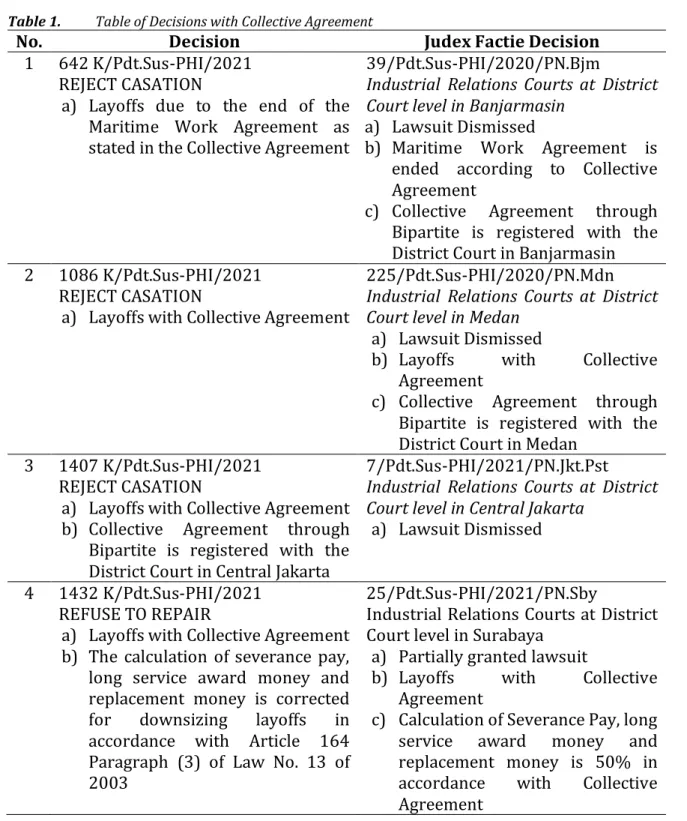
Whether these positions confer binding force or not will be determined by the judge's considerations and decisions, as illustrated in the table below:
Table 1. Table of Decisions with Collective Agreement
No. Decision Judex Factie Decision
1 642 K/Pdt.Sus-PHI/2021 REJECT CASATION
a) Layoffs due to the end of the Maritime Work Agreement as stated in the Collective Agreement
39/Pdt.Sus-PHI/2020/PN.Bjm
Industrial Relations Courts at District Court level in Banjarmasin
a) Lawsuit Dismissed
b) Maritime Work Agreement is ended according to Collective Agreement
c) Collective Agreement through Bipartite is registered with the District Court in Banjarmasin 2 1086 K/Pdt.Sus-PHI/2021
REJECT CASATION
a) Layoffs with Collective Agreement
225/Pdt.Sus-PHI/2020/PN.Mdn Industrial Relations Courts at District Court level in Medan
a) Lawsuit Dismissed
b) Layoffs with Collective Agreement
c) Collective Agreement through Bipartite is registered with the District Court in Medan
3 1407 K/Pdt.Sus-PHI/2021 REJECT CASATION
a) Layoffs with Collective Agreement b) Collective Agreement through Bipartite is registered with the District Court in Central Jakarta
7/Pdt.Sus-PHI/2021/PN.Jkt.Pst Industrial Relations Courts at District Court level in Central Jakarta
a) Lawsuit Dismissed
4 1432 K/Pdt.Sus-PHI/2021 REFUSE TO REPAIR
a) Layoffs with Collective Agreement b) The calculation of severance pay, long service award money and replacement money is corrected for downsizing layoffs in accordance with Article 164 Paragraph (3) of Law No. 13 of 2003
25/Pdt.Sus-PHI/2021/PN.Sby
Industrial Relations Courts at District Court level in Surabaya
a) Partially granted lawsuit
b) Layoffs with Collective Agreement
c) Calculation of Severance Pay, long service award money and replacement money is 50% in accordance with Collective Agreement
d) Collective Agreement through Bipartite is registered with the District Court in Surabaya
5 225 K/Pdt.Sus-PHI/2022 REFUSE TO REPAIR
a) Layoffs with Collective Agreement b) Added decision
“Reject the lawsuit other than and beyond”
86/Pdt.Sus-PHI/2021/PN.Smg
Industrial Relations Courts at District Court level in Semarang
a) Verstek Verdict
b) Sentencing the Defendant to carry out Collective Agreement
c) Collective Agreement through Bipartite is registered with the District Court in Semarang
6 10 K/Pdt.Sus-PHI/2023 REJECT CASATION
a) Layoffs with Collective Agreement
127/Pdt.Sus-Industrial Relations Courts/2022/PN.Bdg
Industrial Relations Courts at District Court level in Bandung
a) Partially granted lawsuit
b) Declared that the PB is binding on the 20 Plaintiffs
c) 6 Plaintiffs were excluded because they had not gone through the Tripartite
d) Downsizing layoffs
e) Collective Agreement is not registered with District Court during the District Service Mediation in Purwakarta
Source: General Registrar of the Civil Chamber of the Supreme Court of the Republic of Indonesia, 2023
The table illustrates that the Collective Agreement carries binding force akin to an authentic deed, and the judge, in his considerations and decisions, is obligated by the Collective Agreement presented as evidence by the parties. The Supreme Court of Indonesia's Decision Number 1432 K/Pdt.Sus-PHI/2021 in the case of Anis Herawati et al against PT. Daimatu Industry indeed revised the decision of the Industrial Relations Court at the District Court in Surabaya with the case number 25/Pdt.Sus- PHI/2021/PN.Sby. The considerations made by the Industrial Relations Court at the District Court in Surabaya can be summarized as follows:
Evidence in the form of Exhibit T-11, a deed confirming proof of registration, reveals that the Collective Agreement Letter dated June 03, 2020, was officially registered on July 06, 2020, by the involved parties: PUK FSPTSK SPSI PT. Daimatu Industry Indonesia and the Defendant (PT. Daimatu Industry Indonesia). This registration was
conducted with the Industrial Relations Court at the District Court in Surabaya, as substantiated by the Deed of Proof of Registration of the Collective Agreement Through Bipartite, numbered 16160/Bip/2020/PHI.SBY, dated July 06, 2020. Since the termination of employment relations has been mutually agreed upon, as indicated in the Collective Agreement Letter dated June 03, 2020, and substantiated by evidence T- 13.D, the Plaintiffs were officially acknowledged to have terminated their employment relations with the Defendant on July 29, 2020. Consequently, the Defendant's action of terminating the employment relations with the Plaintiffs on July 29, 2020, in accordance with the provisions of the Collective Agreement Letter dated June 03, 2020, is legally valid.
In response to the decision from the Industrial Relations Court at the District Court level in Surabaya, the Plaintiffs pursued a legal action through cassation. However, the Supreme Court's considerations was basically as follows: "Considering that the calculation of severance pay is based on Government Regulation Number 35 of 2021, which has not been widely disseminated, it is deemed reasonable and just that, in relation to severance pay, the calculation should continue to be based on Article 164 Paragraph (3) of Law Number 13 of 2003 on Employment." Consequently, the Supreme Court amended the Judex Factie decision, incorporating the calculation of severance pay and thereby altering the initially agreed Collective Agreement between the parties.
The author finds the Supreme Court's deliberations in this case intriguing, as the Supreme Court Panel revised the initial decision and altered the content of the previously agreed Collective Agreement, which had also been officially registered with the local court. The action taken by the Supreme Court Panel, as evident in Republic of Indonesia Supreme Court Decision Number 1432 K/Pdt.Sus-PHI/2021 between Anis Herawati et al against PT. Daimatu Industry, essentially annulled the Collective Agreement, despite it being authentically made by the parties and duly registered with the Industrial Relations Court that it acted as an authentic deed.
The conclusion from the discourse on the Collective Agreement's position as binding evidence in court decisions is that fundamentally, the court is obligated to honor the Collective Agreement, particularly those falling under the category of authentic evidence. This is due to the fact that the Collective Agreement is created in accordance
with Article 7 of Law Number 2 of 2004 and has undergone registration in the local court as evidenced by the registration deed issued by the Industrial Relations Court.
5. Conclusion
The judge's consideration of the Collective Agreement as evidence involves categorizing it into two distinct groups. Some judges regard the Collective Agreement as written evidence in the form of a private deed, while others consider it as written evidence in the form of an authentic deed. The Collective Agreement's position as binding evidence in court decisions implies that the court is inherently obligated to uphold the Collective Agreement, especially when it is classified as authentic evidence.
This categorization is substantiated by the fact that the Collective Agreement is crafted in accordance with Article 7 of Law Number 2 of 2004 and has been officially registered in the local court through the issuance of the Collective Agreement registration deed by the Industrial Relations Court. Consequently, the disputing parties are required to submit and adhere to the established Collective Agreement. The author suggests that variances in judges' opinions and perspectives when rendering decisions concerning the validity of the Collective Agreement as binding legal evidence are most effectively addressed through the establishment and articulation of internal regulations.
Specifically, these regulations should be in the form of the Supreme Court Circular Letter (SEMA) and/or Supreme Court Regulations (PERMA). This ensures that judges, particularly those in the Industrial Relations Court, share a common views and legal basis when making decisions regarding the Collective Agreements as evidence possessing binding legal force within the Industrial Relations Court.
References
Anshori, Moch, Anas Lutfi, and Syafrizal Syafrizal. “Perjanjian Bersama dalam Penyelesaian Sengketa Hubungan Industrial.” Jurnal Magister Ilmu Hukum 6, no.
1 (August 2, 2021): 30. https://doi.org/10.36722/jmih.v6i1.795.
Aruan, Reytman. Hukum Acara Perselisihan Hubungan Industrial: Teori, Praktik dan Permasalahannya. Yogyakarta: Deepublish, 2020.
Festus Femi, Asamu, Abiola John Asaleye, Ogadimma Arisukwu, and Bamidele Rasak.
“Industrial Conflict and Collective Bargaining: Evidence From North Central
Region of Nigeria.” International Journal of Mechanical Engineering and Technology 10, no. 3 (September 11, 2019): 120–28.
Harahap, M. Yahya. Hukum Acara Perdata: Tentang Gugatan, Persidangan, Penyitaan, Pembuktian, dan Putusan Pengadilan. Jakarta: Sinar Grafika, 2017.
Hernawan, Ari. Dasar-Dasar & Perkembangan Hubungan Kerja Di Indonesia: Sebuah Telaah Kritis. Yogyakarta: UII Press, 2023.
Hoesin, Siti Hajati, and Fitriana. Memahami Hubungan Kerja Dan Hubungan Industrial Di Indonesia. Jakarta: Damera Press, 2023.
Karo, Rizky Pratama Putra Karo. “Pembuktian Terhadap Perkara PHK Dan Kewenangan Hakim PHI Menjatuhkan Putusan Berdasarkan UU Cipta Kerja, Putusan MK Terhadap UU Cipta Kerja.” In Masalah-Masalah Hukum Pasca Putusan Mahkamah Konstitusi No. 19/PUU-XVIII/2020. Depok: Rajawali Buana Pustaka, 2022.
Mertokusumo, Sudikno. Hukum Acara Perdata Indonesia. Yogyakarta: Maha Karya Pustaka, 2021.
Murarka, Sejal, Prarthana Fabyani, and Shweta Bobhate. “A Study of Worker’s Participation in Management Practices to Deal with Uncertainty in Industrial Relations-A Theoretical Framework.” Annual Research Journal of Symbiosis Centre for Management Studies, Pune 9 (March 2021): 21–31.
Nuroini, Indi. “Penerapan Perjanjian Bersama Dalam Pemutusan Hubungan Kerja.”
Jurnal Yudisial 8, no. 3 (December 1, 2015): 319–38.
https://doi.org/10.29123/jy.v8i3.61.
Pangaribuan, Juanda. Seluk Beluk Hukum Acara Pengadilan Hubungan Industrial. Ed. 1, Cet. 1. Jakarta: MISI, 2017.
Pengadilan Negeri Makassar Kelas I A Khusus. “Syarat Pendaftaran Perjanjian Bersama (Bipartit).” Accessed January 29, 2024. https://www.pn- makassar.go.id/website/index.php/layanan-hukum/prosedur-
berperkara/954-syarat-pendaftaran-perjanjian-bersama-bipartit.
PN, Sugeng Santoso. “Eksekusi Putusan Pengadilan Hubungan Industrial.” In Hukum Ketenagakerjaan Dalam Perubahan Iklim Ketenagakerjaan, Ed.1, Cet. 1., 471–88.
Depok: Rajawali Pers, 2023.
Pramono, Agus. “Settlement of Industrial Relations Disputes and Termination of Work Relations According to the Applicable Legislation.” Walisongo Law Review (Walrev) 2, no. 2 (December 20, 2020): 169–94.
https://doi.org/10.21580/walrev.2020.2.2.6671.
Republic of Indonesia. Code of Civil law (1945).
———. Law Number 2 of 2004 concerning Settlement of Industrial Relations Disputes (2004).
———. Law Number 13 of 2003 concerning Manpower (2003).
Santoso, Budi. “Justification of Efficiency as a Reason for Termination of Employment.”
Mimbar Hukum 25, no. 3 (2021): 405.
Shubhan, M Hadi. “Industrial Relation and Criminal Sanction the Case of Indonesia.”
International Journal of Civil Engineering and Technology 10, no. 3 (2019):
1132–40.
Suratman. Pengantar Hukum Ketenagakerjaan Indonesia. Jakarta: RajaGrafindo Persada, 2019.
Tanama, Asriyadi. “Perjanjian Bersama Dalam Penyelesaian Perselisihan Hubungan Industrial.” HT & Partners Legal Consult (blog), December 27, 2021.
https://htlegalconsult.com/perjanjian-bersama-dalam-penyelesaian- perselisihan-hubungan-industrial/.
Yurikosari, Andari. Pemutusan Hubungan Kerja Di Indonesia. Jakarta: Penerbit Fakultas Hukum Universitas Indonesia, 2010.
———. “Perlunya Lembaga Sita Eksekusi Pada Pengadilan Hubungan Industrial Di Indonesia.” Jurnal Hukum PRIORIS 10, no. 2 (December 12, 2022): 125–38.
https://doi.org/10.25105/prio.v10i2.17016.