Primary health care – the concept, 33 Primary health care and the NHS, 36 Primary health care in. What community nurses for people with learning disabilities do – the new evidence base, 226 The future role of community nursing.
Contributors
Sue Boran, Senior Lecturer in Community Nursing, Faculty of Health and Social Care, London South Bank University, London, UK. Maxine Jameson Senior Lecturer in Community Nursing (School Nursing), Faculty of Health and Social Care, London South Bank University, London, UK.
Preface
The Context of Primary Health Care Nursing
To meet the demands of the new flexible workforce, primary care services will need to create, implement, share. Development of shared learning with GPs, social workers and other members of the healthcare team (including mid-professionals).
Social Policy
The most significant change that could not be the introduction of the internal market to the NHS. This may be due to the nature and scale of public health issues in the UK.
The Origins of Contemporary Primary Health Care
1999 Health21 – the Health for All Policy Framework for the WHO European Region, published (WHO/EURO 1999). This started in 1985 in the WHO European Region, involving a small network of European cities (Tsouros 1990).

Community Development in Public Health and Primary Care
Definitions of community development and community empowerment and how it differs from community-based health promotion. Standing Conference on Community Development 2001 and at www.sccd.org.uk) Some of the key principles that underpin. In the UK the growth of community development approaches can be traced to the Community Development Project launched by the Home Office in 1969.
Therefore, community development as an approach must be distinguished from community-based health promotion. Community development prioritizes issues identified by the community itself and Box 4.1 Some key principles of. At a critical juncture, the true nature of community development is beginning to be more widely contested.
Successful community development also depends on recognizing the need to start with priorities identified by the local community (see Chapter 22). This example raises questions about the practitioner's role in community development and the extent to which they move beyond being catalysts and facilitators.
Health Needs Assessment and the Community Nurse
There is also increasing recognition that health and health care are everyone's business and more members of the interprofessional team have developed collaborative approaches to needs assessment (Horne & Costello 2003). The definition of HNA health needs assessment is often described as: "a systematic review of health problems facing a population that leads to agreed priorities and resource allocation that will improve health and reduce inequalities" (Hooper & Longworth 2002). It deals less with community perspectives on an issue and often starts with a specific topic to be explored.
A further approach to consider and which can be seen as related to the empowerment framework is that of the asset-based model (Macdowell et al. 2006). Care must be taken to avoid tokenism and it is necessary to ensure that all parts of the community are represented. A fuller discussion of the challenges of patient and public involvement can be found in Chapter 24.).
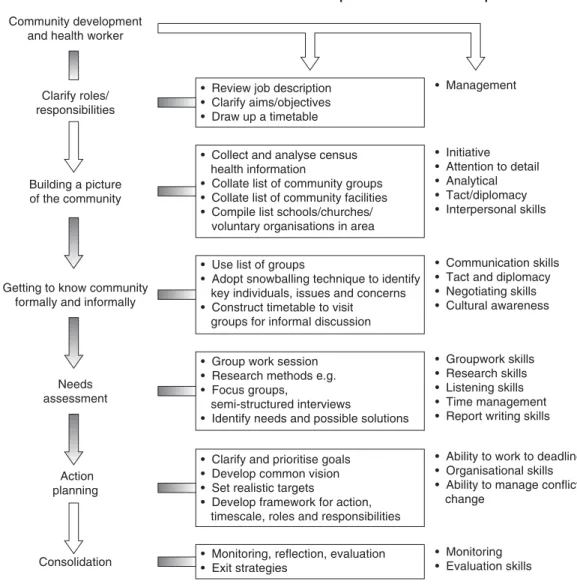
This planning phase should include agreement on the theoretical approach to be used and the appropriate needs assessment methods that will support this approach. While the community nurse's role has traditionally often been limited to assessing the health needs of individuals, there is potential for their role to be far more influential.
Research Perspectives Applied to Primary Health Care
The aim of the York center is to "promote the application of research-based knowledge in health care". In the following section, the stages of the research process and a variety of research methodologies and methods related to different types of knowledge are considered. Government policies have placed health promotion and public health at the center of the debate.
The need to implement the NHS plan and national service framework standards requires practitioners with public health roles, skills and functions. The hierarchy is usually based on the scientific rigor of the studies and the ability of the results to be generalized to the wider population. Study design includes each phase of the study Table 6.1 Levels of evidence according to the National Institute for Health and Clinical Excellence (Marks 2002).
The Danish Health Authority has undertaken the management of the initiative for the assessment of health consequences. Observations were also made of the interactions between the nurses and the patients they examined.
Health Visiting
However, a recent major review of the role of health visitors called for by the Secretary of State for Health (Facing the Future, Department of Health [DH] . 2007a), has given health visiting a clearer direction and has firmly decided his profession. role in the arena of public health. Salford and is generally acknowledged to be the beginning of the health visiting profession (Mason 1995). Modernizing the role of the health visitor – a public health approach Health visiting has a strong tradition of working proactively with individuals, families, groups and communities (DH 2001).
The health visitor review 2007 The aim of the review, Facing the Future, was to make recommendations for a renewed role for health visitors within the changing context of public health and healthcare (DH 2007a). Nevertheless, the identification of actual and potential health needs is a cornerstone of the public health approach and remains fundamental to the planning of healthcare interventions in the modern NHS. However, Wanless (2004) warned about the general lack of evidence on the cost-effectiveness of public health work.
Council for the Education and Training of Health Visitors (1977) A Study of the Principles of Health Visiting. Department of Health (2007b) Government response to facing the future: A review of the role of health visiting.
General Practice Nursing
The practice nurse's role can be extremely broad and span the entire age range of the practice population. However, it is on the shoulders of practicing nurses that the requirements in the contract fall. Practice nurses are ideally placed to deliver the clinical standards cited within the clinical domain by taking the lead in managing the identified long-term condition areas.
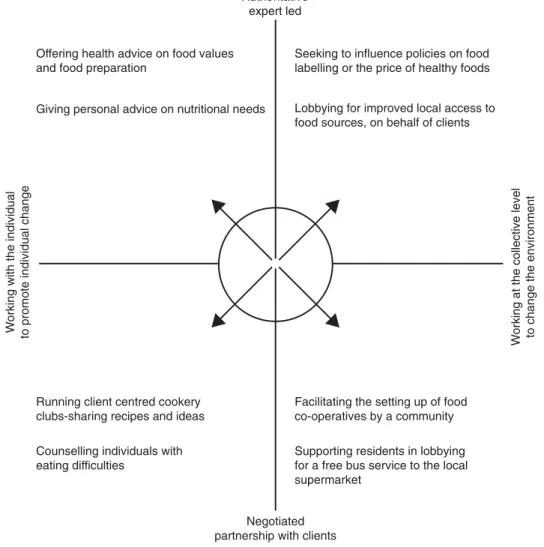
In general practice, much of the practice nurse's role will focus on affirming health promotion activities. Practice nurses are an integral part of the practice team and require a range of knowledge and skills to participate in the development of the practice profile (for further information see Chapters 5 and 7). Part of the practice nurse's role will be to collaborate in the development of practice profiles and develop presentation and influencing skills in order to articulate the resultant and identified needs.
Box 8.5 identifies a case scenario typical of the type of consultation for long-term conditions undertaken by a practice nurse. These will continue to have a profound effect on community nursing and the role of the district nurse.

Contemporary Issues in District Nursing
Have a better understanding of the impact on patients and families and the appropriate ongoing care and management of long-term conditions. Meeting these goals is a huge task that places complex demands on the role of community nurse. As part of the primary health care team, the community nurse is at the intersection of health and social care delivery and takes on a vital and increasingly complex role.
In line with these changes, the role of the district nurse will need to evolve and expand even further. Traditionally, the charge of the district nurse has been to care for patients with long-term illnesses, the elderly and those who are terminally ill. As team leader, the district nurse has primary responsibility for the care delivered by all members of the district nursing team.
This chapter has only touched on the role of the district nursing team in supporting those patients and families seeking palliative and terminal care. And this growth in CCN services has continued into the early years of the twenty-first century.
Community Children’s Nursing
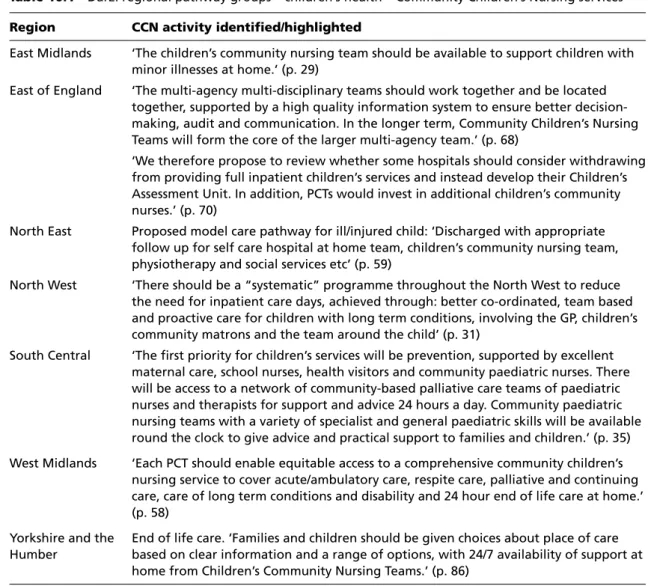
East Midlands 'The children's community nursing team should be available to support children with minor illnesses at home.' (p. 29). In the longer term, Community Child Nursing Teams will form the core of the larger multi-agency team.' (p. 68). Caring for children with life-threatening illnesses has played a major role in the work of the Darzi Child Health Clinic pathways.
Community children's nurses provide nursing care and support to children and young people (CYPs) and their families at home, school or other community settings (RCN 2000). The Children's NSF (DH 2004c) stated that CCN services should be an integral part of primary health care and community provision. For many young people on CCN's caseload, the transition from children's services to adults can be a time of significant challenges.
For children with complex health needs, community children's nurses have been identified as a key component of the transition process (DCSF/DH 2007), perhaps in the role of lead professional. Royal College of Nursing (2000) Children's Community Nursing: Promoting effective teamwork for children and their families.

School Nursing
School nursing is at the forefront of policy change in the UK, and school nurses are seen as vital to child-centred public health practice. This is a compelling reason for school nurses to develop targeted and specific. interventions for children and young people, such as smoking cessation groups. School nurses are ideally placed to become involved in public health promotion with these groups.
Anecdotal reporting shows wide variation in the number of children or schools covered by school nurses. Supporting individuals and groups of children will be at the core of many school nurses' activities. School nurses working alongside community health project coordinators are increasingly involved in assessing and referring children and young people who are overweight and encouraging them to eat healthily and exercise regularly.
With the development of children's trusts and the provision of statutory guidance on inter-agency working, and collaboration to improve the wellbeing of children and young people, school nurses must work hard to build links with education and social care teams. School nurses are ideally placed to help make the UK the best place for children and young people to grow up.