A COMPARISON OF AMERICAN FOOTBALL CLEATS AND SOCCER CLEATS ON MEASURES OF FORCE IN A COUNTERMOVEMENT VERTICAL JUMP
By Jessica Hiskey
A thesis submitted to the faculty of The University of Mississippi in partial fulfillment of the requirements of the Sally McDonnell Barksdale Honors College.
Oxford, MS May 2016
Approved By
Advisor: Dr. John C. Garner
Reader: Dr. Kerry Bowers
© 2016
ACKNOWLEDGEMENTS
I would like to thank Dr. John Garner and Jacob Gdovin for their instruction, advice, and guidance throughout this process. My thesis project would not have been possible if not for them, and I cannot express my appreciation enough for the countless hours spent helping me complete the final product. I would also like to thank Dr. Kerry Bowers and Dr. Mark Loftin for agreeing to act as my second and third readers. Finally, I would like to extend my gratitude towards the Sally McDonnell Barksdale Honors College and the University of Mississippi for allowing me to take part in this experience that has been a vital part in the challenging and rewarding education I have received over the past four years.
ABSTRACT
JESSICA HISKEY: A Comparison of American Football Cleats and Soccer Cleats on Measures of Force in a Countermovement Vertical Jump (Under the Direction of Dr.
John Garner)
The configuration of cleats has been reported to affect force production in several performance-related tasks such as running and cutting, and it may have the ability to alter vertical jump performance. The purpose of this study was to analyze the effects of cleat configuration in American football and soccer cleats on force production resulting from a maximal countermovement vertical jump. Ten recreationally trained male participants (age: 21.6 ± 1.35 years; height: 180.0 ± 4.51 cm; mass: 83.89 ± 6.74 kg) volunteered to participate in one three-hour testing session. A counterbalanced, controlled cross-over design was utilized for the three footwear conditions, which included the Nike Alpha Strike 2 TD football cleat (FC), Nike Tiempo Rio 2 FG soccer cleat (SC), and the Nike Dart running shoe (RS). The session consisted of a warm-up followed by the execution of three maximal vertical jumps on a force platform covered by artificial turf for each footwear condition. Data from the force plate allowed determination of three of the dependent variables [ground reaction force (Fz), normalized ground reaction force (nFz), and rate of force development (RFD)], while a Vertec measuring device was used to obtain vertical jump height (VJH). No statistically significant differences were found (p>.05) between conditions for any of the dependent variables. Therefore, this study shows there is no advantage of wearing a certain cleat type during vertical jump performance.
TABLE OF CONTENTS
CHAPTER I: INTRODUCTION ... 1
CHAPTER II: REVIEW OF LITERATURE ... 7
CHAPTER III: METHODS ... 20
CHAPTER IV: RESULTS ... 30
CHAPTER V: DISCUSSION ... 31
LIST OF REFERENCES ... 35
CHAPTER I INTRODUCTION
The turn of the century brought an increase in the need to improve an athlete’s on- field performance, a need that many believed could be met by focusing on footwear as can be seen by surveys of soccer players conducted in 1998 and 2006 (Hennig, 2011).
When asked about the features critical in utilizing cleats, the importance of surface traction and shoe weight showed a marked increase in the span of eight years (Hennig, 2011). Numerous studies over the past decade have analyzed the impact of cleats on player performance breaking it down into various components that include amount of force production, shoe-surface interactions, and the amount of impulse produced (Sims et al., 2007; Queen et al., 2008; Kalva-Filho et al., 2013). The countermovement vertical jump (CMVJ) has the ability to measure those specific variables and is therefore a
reliable test to utilize when studying the effects of cleats on player performance (Bosco et al., 1983). Researchers have already seen that altering types of tennis shoes can affect vertical jump (Laporta et al., 2013; Zhang et al., 2015), and this has raised the question as to the effect different cleats have on a CMVJ.
The CMVJ is considered an appropriate indicator of athletic performance since it is an applied measure analyzing force and velocity across various sports while
demonstrating a strong positive correlation between jump height and sprint speed (Bosco et al., 1983; Maulder et al., 2005; Yanci et al., 2014). Based on this knowledge,
Basgier et al. (2004) and Gheller et al. (2015) both investigated the idea of squat depth and initial positioning as major influences in jump height capabilities. One factor that was seen to affect performance was compressional clothing, according to Doan et al. (2003), whose study utilized a newer form of compression shorts that helped to increase the impulse force produced by the individual. Theories based on this idea of compression were further tested by other researchers and were expanded to include the actual footwear worn by individuals (Zhang et al., 2015; Stefanyshyn & Nigg, 2000).
Stefanyshyn and Nigg (2000) tested vertical jump differences based on variances in the stiffness of tennis shoes. The stiffness of the shoe was created by inserting carbon fibers at the midsole to produce the stiff shoe condition. Results found that stiffer shoes produce greater vertical jump heights. A study completed by Zhang et al. (2015) supports these findings, specifically that the greater rigidity of the shoe allows for larger impulse forces. Cleats were also used in vertical jump testing (DeBiasio et al., 2013; Butler et al., 2014), where the focus centered on force production during the vertical jump, but the surface interactions of the different cleats with various turf and grass surfaces were also seen as a factor (Kent (A) et al., 2012; Kent (B) et al., 2015; Kent (C) et al., 2015). While research supports the notion that footwear does affect vertical jump performance and that variance in cleat configurations affect force production, there is still some uncertainty in how those cleats with dissimilar stud configurations alter CMVJ performance. Therefore, the purpose of this study was to analyze ground reaction forces (Fz and nFz), rate of force development (RFD), and vertical jump height (VJH) in three different footwear
conditions (American football cleat, American soccer cleat, and running shoe) in recreationally trained men.
Hypotheses:
Ground Reaction Force
H01: There will be no significant difference between footwear conditions in highest vertical force measured from the force platform.
HA1: Vertical force differences between footwear conditions measured from the force platform will be statistically significant in that the trials with cleats will produce greater vertical forces.
Laporta et al. (2013) compared barefoot and minimalist footwear with tennis shoes in a vertical jump test and found that individuals produced the greatest force when in the barefoot and minimalist footwear. The tennis shoe condition did not generate as much force because the thick sole of the shoe absorbed more of it.
This study expects to reject the null hypothesis for ground reaction force because both of the cleated footwear conditions have a more slender sole than the tennis shoe condition.
Normalized Ground Reaction Force
H02: There will be no significant differences between the calculated normalized ground reaction force values.
HA2: The differences between the normalized ground reaction force values will be statistically significant in that the trials with cleats will have greater calculated normalized ground reaction force values.
The rationale explained above contributes to the expectation of this study to reject the null hypothesis. The calculation of normalized ground reaction force values uses the data from the same force plate as ground reaction forces and is simply divided by the body weight of the individual.
Rate of Force Development
H03: There will be no significant differences between the calculated rates of force development of the three footwear conditions.
HA3: The differences between the rates of force development between conditions will be statistically significant in that the trials with cleats will produce higher rates of force development.
Kent (C) et al. (2015) performed a vertical jump study with varying cleat
conditions. Researchers found variance in force production for the separate cleats across horizontal surface conditions. Based on this difference in force production found by Kent (C) et al. (2015), this study expects to reject the null hypothesis of no statistically significant differences in the rates of force development between footwear conditions.
Vertical Jump Height
H04: There will be no significant differences between vertical jump height values between conditions.
HA4: The differences between vertical jump heights between footwear will be statistically significant in that the trials with cleats will produce greater jump height values.
Studies including one performed by DeBiasio et al. (2013) have found disparities between vertical jump heights for tennis shoes and different types of cleats. The presence of the studs on the cleats was hypothesized to be the factor contributing to the higher jump height, as well as the stiffness of the cleat. This study therefore expects to see an increase in vertical jump height for the conditions wearing cleats and reject the null hypothesis.
Definitions:
Acceleration: The first derivative of velocity involving the change of velocity divided by
time (Rodgers & Cavanagh, 1984)
Anthropometric: Describes measurements relating to the dimensions of the body and its
distributions across segments (Rodgers & Cavanagh, 1984)
Concentric Force Production: occurs when the vertical force factor of the ground
reaction force curve exceeds body weight (N) (Rodgers & Cavanagh, 1984) Force: The action of one body on another (Rodgers & Cavanagh, 1984)
Force plate: A mechanical apparatus that measures ground reaction forces by sending
electric signals based on the forces present on it (Rodgers & Cavanagh, 1984) Ground Reaction Force: The force that acts on a body in response to the ground; is
equal and opposite to the forces applied to the ground (Rodgers & Cavanagh, 1984)
Normalized Ground Reaction Force: ground reaction force measured from the force plate divided by the weight of the subject, measured in Newtons/kilogram (Rodgers & Cavanagh, 1984)
Power: The rate at which work is performed (Rodgers & Cavanagh, 1984)
Rate of Force Development (RFD): the slope of the ground reaction force curve at the start of concentric muscle action over a time interval of 200 milliseconds
(Rodgers & Cavanagh, 1984)
Velocity: A form of measurement of motion, including both one’s magnitude and
direction (Rodgers & Cavanagh, 1984)
Vertec: A device used to measure height based on how many vanes on the apparatus are
knocked out of position (Rodgers & Cavanagh, 1984)
CHAPTER II
REVIEW OF LITERATURE
Sports are a well-accepted and promoted aspect of today’s society and have been throughout history. Currently, two of the most popular sports include American football and soccer with over 265 million current soccer players (Hennig, 2011) and over one million current American football players (“Probability of Competing,” 2015). As competition continuously increases, the need and desire to increase performance grows amongst athletes. Among other things, performance can be viewed as how well an individual competes against an opponent. In both football and soccer, one feature that is required to best an adversary consists of power. The ability of muscles to produce the necessary demands at maximal effort is one of the factors that separate professionals from recreational players. In order to best know how to increase athletic performance this way, it is first vital to acquire an understanding of power and how it is measured.
The definition of power is the rate of work performed by an individual (Rodgers et al., 1984). In simpler terms, it can be determined by dividing the amount of work done by the time taken to perform that work, or otherwise seen as the product of force and velocity. In athletics, work performed in a shorter amount of time is essential when facing an opponent. Therefore, increased power output in a shorter amount of time is a trait most athletes strive to achieve. A common method of determining power is by measuring rate of force development (RFD) (Dysterhelft et al., 2013).
RFD is an expansion on the measurement of power and is accepted as the speed at which maximum force is produced. In relation to soccer and football, the importance of this factor cannot be stressed enough, as the first five meters of a sprint requires the greatest acceleration and may be the farthest distance one runs at a time in a match (Dysterhelft et al., 2013). On average, in a ninety-minute game of soccer, players will only run 14 meters at a time, showing that the initial power output and RFD must be high if the opponent is to be beaten in these instances (Reilly, 1997; Kalva-Filho et al., 2013;
Yanci et al., 2014).
Due to the start and stop nature of these sports, it is not only aerobic capacity that sets a baseline for fitness and power, but anaerobic capacity as well which relates more to short bursts of explosive power. The vertical jump is a useful test for determining
anaerobic capacity and has been around for over fifty years (Bosco et al., 1983). Thus, the motivation of athletes and coaches to increase an individual’s vertical jump is high, and many factors that are considered influential have been studied.
Many scholars have investigated whether the height of a vertical jump can also be correlated to the speed and acceleration of an individual. Studies by both Mero et al.
(1983) and Young (1995) presented a strong correlation between vertical jump height and both the 10 and 20-meter sprint performance (Maulder et al., 2005). This was done by testing a sample of 18 males in a variety of both vertical and horizontal jump tests, as well as sprint tests to determine the relationships in existence. Following the application of paired t-tests, his study found that the data from the horizontal jump tests had a
stronger correlation to sprint speed than the vertical jump tests. It was noted that all of the jump tests still produced a significant correlation with sprint speed; however, it should be
emphasized that Maulder et al. (2005) found horizontal jump tests to be better predictors of speed than vertical jump tests.
This exploration into speed and jump correlation is still a current subject.
Similarly, Yanci et al. (2014) performed a study trying to determine if there was a correlation between speed and jump height using amateur male soccer players. Results showed that the horizontal jump showed a stronger correlation with sprint speed than the vertical jump. However, both were seen to have a significant correlation with the sprint speed of the players, lending more support to the idea that improving vertical jump height is beneficial in producing greater acceleration which is a skill desired by top-level
athletes.
In the quest to enhance vertical jump height, research has explored many of the factors that have been seen to affect performance, including squat depth. This can be measured as the range of countermovement achieved before pushing off the force plate.
A countermovement, in the execution of a vertical jump, is defined as an initial
downward motion in which the knees and hips flex and elongate before the shortening of the muscles occurs for the upward motion of the jump (Kim et al., 2014). Studies
conducted by Moran and Wallace (2007) and Salles et al. (2011) involved 20 male collegiate volleyball and basketball players (Gheller et al., 2015). Jumps were conducted with individuals in various squat depths with knee flexion of 70°, 90°, and 110°. It was observed that jumps performed with a greater countermovement (greater squat depth) resulted in greater heights (Gheller et al., 2015). However, greater force production and power output were observed in the jumps performed with less squat depth.
The inconclusive results do not support the idea of squat depth as a variable during the vertical jump, but these findings agree with a similar study performed by Basgier et al. (2004). Basgier et al. (2004) used members of the Auburn University swim team as test subjects and had them participate in a nine-week countermovement vertical jump training program. Half of the subjects trained using a half-squat position prior to their jumps, and the other half used a parallel squat position. No significant differences were found between the two groups at the end of the nine weeks, and it was concluded that neither position was found to be more effective than the other.
In addition to research regarding body kinematics, other factors such as clothing, have the potential to act as an ergogenic aid. A new form of compression shorts, called hyper-compressive, were utilized by Doan et al. (2003) and are designed to be more elastic and impact absorbing compared to older styles of compression shorts. The testing was done on both male and female track athletes, and various sprint and jump tests were performed in order to gauge the effects of the compression shorts on performance compared with athletic shorts.
Video analysis was used to compare the oscillation of the thigh muscles during the vertical jump movement between the two conditions and less oscillation was found for the jumps made in the compression shorts (Doan et al., 2003). A significant statistical increase in jump height from the countermovement vertical jump was also seen in the trials with compression shorts. The implications of these results may include better technique and reduced fatigue due to the reduced muscle displacement upon landing, an effect of the hyper-compressive shorts, as well as increased vertical jump performance.
These findings contradict previous studies utilizing compression shorts such as one
completed by Kraemer et al. (1996). However, the difference can be attributed to the new type of material used by Doan et al. (2003) which increases elasticity and therefore impulse force. It is agreed upon, however, that further research in this area is needed to determine whether the improvement in performance is significant enough to attribute to the new style of compression shorts (Doan et al., 2003).
The theories behind compression clothing provide a basis for studies involving the foot and how changing the tightness of the material surrounding the metatarsals may affect vertical jump performance. Zhang et al. (2015) conducted a study comparing vertical jump heights from varying degrees of foot compression by means of an elastic bandage wrapped in an ‘eight’ pattern around the foot. Three levels of tightness, denoted as non-strapping, moderate strapping, and high strapping, were tested in a study of 12 male athletes. The vertical jump was repeated five times under each condition, and data was collected by an 8-camera motion analysis system. The results showed that the high strapping condition increased the jump height compared to the other conditions by 2.3 centimeters, almost matching the 2.4 centimeter increase that was seen in a previous study of vertical jumps with compression shorts (Doan et al., 2003). The elastic wrapping resulted in a more rigid foot at the moment of the jump, allowing for a greater force production and therefore a greater jump height. This finding supports earlier studies performed by Stefanyshyn and Nigg (2000) done regarding stiffness of tennis shoes.
Stefanyshyn and Nigg (2000) took commercially available running shoes and changed the stiffness of the midsole by inserting carbon fibers for the stiff shoe condition.
Twenty-five male distance runners completed three vertical jumps for both the control
an average of 1.7 cm higher with the stiff shoe condition, a number determined to be statistically significant between the shoe conditions (Stefanyshyn & Nigg, 2000). The results can be explained by the reduction of energy absorbed at the metatarsophalangeal joint on the foot due to the increase in stiffness of the shoe. Less energy absorbed means more energy is available to contribute to the jump, therefore increasing the jump height.
The strapping conditions, implemented by Zhang et al. (2015), then follow the same theory of thought in reducing energy absorption in the foot.
The interest in the kinematics of the feet and how they are affected by different footwear conditions is ongoing. In 2013, Laporta et al. investigated the variances in vertical jump between three footwear conditions - barefoot, minimalist footwear, and tennis shoes. Laporta et al. (2013) reported a lack of studies focusing on the effects of jumping with different footwear as opposed to just running, because the two activities require very different actions from the foot.
Ten males and ten females participated in this study, which included several vertical jump tests in the different footwear conditions. The data obtained showed significantly higher jump values in the trials using barefoot and minimalist footwear as opposed to tennis shoes. The thicker sole of the tennis shoe can explain these results, as more of the impact produced by an individual can be absorbed as one begins to apply force. Less force is available to contribute to the jump, resulting in a lower jump height.
The conclusion reached by Laporta et al. (2013) promotes the use of barefoot or
minimalist footwear during training as a way to increase performance both in the vertical jump and in competition.
Further research regarding footwear has been conducted, with results supporting the findings of Laporta et al. (2013). Harry et al. (2015) used a similar methodology while using only male subjects, exploring the effects of different footwear conditions on vertical jump performance. Harry et al. (2015) found conflicting results as their data did not show an increase in jump height with barefoot and minimalist footwear. It was hypothesized that this dissimilarity was due to the participants performing all of the jumps for all conditions in a single day (Harry et al., 2015). The variability in testing conditions allowed for no conclusive arguments to be made involving footwear conditions, except for the need for further research to be conducted on the matter.
The studies like those previously mentioned involving footwear and performance have paralleled interest in the footwear choices of high-level athletes, specifically cleats.
A three-year study of football cleats conducted by Torg and Quedenfeld (1971; 1973;
1974) sparked public attention, specifically regarding the impact of cleat design on injury. Torg and Quedenfeld (1971; 1973; 1974) used two high school football leagues to obtain over 500 subjects. During this study, standard football cleats had seven long spikes and were worn for two seasons while standard soccer cleats had fourteen shorter spikes that were worn the third year. The number of serious knee injuries significantly decreased in relation to the change in cleat type. These findings led researchers to classify the then- standard design of football cleats as dangerous. The fewer and longer studs in the commonly worn football cleats were found to produce a greater foot fixation and force transmission with the ground, creating a situation in which injuries, predominately knee injuries, are more likely (Torg & Quedenfeld, 1971; Torg & Quedenfeld, 1973; Torg &
Following the groundbreaking findings of Torg and Quedenfeld (1971; 1973;
1974), new regulations were implemented to ensure cleat safety. Focus on the impact of cleat design on performance then increased. Surveys conducted in 1998 and 2006 show the shift towards interest in cleats designed to improve performance on the field (Hennig, 2011). When asked about the features most important in choosing cleats, athletes chose comfort compared to shoe weight and its ability to create traction (Hennig, 2011).
One main factor that has been evaluated is the plantar loading distribution given by different styles of cleats. As an introduction to this topic, Sims et al. (2007) explored the alterations in the distribution of pressure across the foot between males and females in football cleats by having subjects perform a series of cutting and acceleration tasks.
Results displayed a significant difference between the plantar loading of the two genders, specifically that males produced greater pressure on the lateral side of both the forefoot and midfoot. This opened the pathway for more tests involving the effects of different cleats and whether varied stud patterns could alter the plantar loading (Sims et al., 2007).
The expansion of this form of testing was done by Queen et al. (2008) the following year. Queen et al. (2008) asked both male and female subjects to execute a side-cut and crosscut task in four different cleat types - hard ground, bladed, firm ground, and turf. It was found that the turf shoe produced less force and pressure than the other footwear conditions due to the increase in the number of shorter studs present in the turf cleat configuration, as well as a cushioned sole. Due to the subsequent loss of traction, turf cleats are rarely used in competition. Queen et al. (2008) was unable to find
significant differences between the other three cleats in the cutting tasks but a potential limitation could have been the large similarities in construction of the three cleats.
The focus on plantar loading has not been limited to running tasks. In a study performed by DeBiasio et al. (2013), a group of 27 men and women were tested in a bladed cleat, turf cleat, and tennis shoe as they completed seven trials of a jumping pattern that involved a forward jump followed by a vertical jump. Results were consistent with previous research regarding plantar loading in that the bladed cleats produced the highest load and greatest force. DeBiasio et al. (2013) hypothesized that this disparity was present because of the low number of studs on the bladed cleat, as well as the greater degree of stiffness. The emphasis is on maximum energy transfer, so less cushioning is put on these cleats in order to provide that feature for the athletes. This view is supported by a similar study completed by Butler et al. (2014), which reinforces the idea of a
difference in landing effects between a bladed and turf cleat based on a varying stiffness of the cleat.
Researchers have also investigated the surface interactions between cleats and playing surfaces. Kalva-Filho et al. (2013) noted the lack of studies involving these variables at short, intermittent intervals, something that is extremely applicable to the game of soccer. Using eight soccer players, sprint times in two footwear-surface
conditions - tennis shoes on a track and cleats on a grass field were compared. Six trials of 35-yard sprints were done for each condition, with one condition being performed each day. Performance was seen to be higher in the trials with tennis shoes on a track, and Kalva-Filho et al. (2013) attributed this to several factors. First, the change in terrain was a large factor. On grass, 35% more of the impact is absorbed than on a track, lowering elastic energy and efficiency available to the individual (Kalva-Filho et al., 2013). This
can be seen by the slower times in the trials on grass. The footwear worn was also determined to be a factor in the difference in performance. The cleats were suspected to increase the amount of contact time with the ground, further increasing the time required to complete the sprint.
Choice of terrain, including natural grass versus various types of turf, has been evaluated to determine the optimal material for testing involving footwear and surface interactions. There are currently several forms of third generation turf, which consists of longer fibers than previous forms of turfs, as well as a different infill. Turf with infill comprised of sand and rubber models a natural grass playing surface the best, but turf with no infill reduces the heat produced by the rubber (Smeets et al., 2012).
Semisynthetic turf is also in existence, which is a combination of natural grass and artificial turf. Smeets et al. (2012) appraised the variations in frictional forces produced on these forms of turf using a mechanical foot and cleat apparatus for both a bladed and studded cleat. It was found that the turf with sand and rubber infill produced the greatest frictional force, creating the highest risk for injury among surface types. The
semisynthetic turf was most consistent through wet and dry conditions, and produced forces lower than natural grass, deeming it safer than a natural grass surface (Smeets et al., 2012). Many European models now use semisynthetic turf for their professional teams, but there are still a wide variety of turf types in use around the world. The testing of turf that was started by FIFA in 2001 has not been conclusive in its recommendations of the best surface, in part due to the number of turf producers in existence (Smeets et al., 2012).
The notion of differing surface interactions with varying cleats has been further investigated. McGhie et al. (2013) performed a study similar to Kalva-Filho et al. (2013), but chose to compare turf cleats with the more traditional bladed cleats that have longer and fewer studs. He also varied the type of turf used, as several forms have been in existence in the past few decades. The two sprint tasks utilized included a straight sprint, stopping immediately following completion of the sprint, and a cut sprint, where a 90- degree turn was made before stopping. Five trials of each sprint were performed, and the turf cleat was shown to produce the least impact force. The variations in turf (recreational and professional) seemed challenging to analyze, and the researchers found it difficult to make conclusive statements regarding the effects of them. This was due to the possibility that the force plates placed underneath may have altered the results, while specifications of turf throughout previous literature have not been consistent. McGhie et al. (2013) also found the differences between round, bladed, and turf cleats not to be significant enough in terms of speed and contact time during the cut sprints. It is important to note that outstanding variables were present, and this study made it difficult to create correlations between the large quantities of factors.
The similarities between cleat configurations are supported by more than the testing by McGhie et al. (2013). Galbusera et al. (2013) performed a study comparing cleats with various studs: bladed, molded, and metal, and no significant differences between the shoe-surface interactions were found. Artificial turf consistent with the turf used by McGhie et al. (2013) as well as a natural turf designed to replicate grass were used. The testing procedures did not use human subjects - the interactions of the three
throughout the three cleat conditions. Regarding the two surface types, the natural turf was reported as having less stiffness than the artificial turf, but the differences in data obtained were consistent in relation to the changing cleat types, showing that surface interactions can either be performed with different cleat types on one surface, or one cleat on several different surfaces.
The study of shoe-surface interactions involving one cleat and several different surfaces has been seen. Kent (A) et al. (2012) tested a football cleat on two different types of natural grass on three separate occasions, in order to account for varying weather conditions. A mechanical apparatus was again used in this testing and both translational and vertical forces were measured. Kent (A) et al. (2012) found that the friction generated for each measurement were not consistent with the other, and noted that in tests of this kind, the traction from each test, either vertical or translational, should be taken into account together.
Kent (A) et al. (2012) expanded upon his initial research by using 8 different playing surfaces to compare the different surface interactions with cleats (Kent (B) et al., 2015). This study utilized the same mechanical methods previously used (Kent (A) et al., 2012) and surfaces included both natural grasses and artificial turfs. The results of the peak forces from a vertical drop test were consistent across the varying artificial turf surfaces, and the natural grass surfaces were seen to have a lower stiffness. The increased resistance seen in the artificial turf suggests that greater force can be generated on a turf surface rather than on natural grass, allowing for maximal performance by an individual (Kent (B) et al., 2015).
A variety of cleats on a limited number of surfaces were also used to compare shoe-surface interactions. Kent (C) et al. (2015) used the same methods to test the effects of 19 different types of cleat configurations over just two different surfaces. In the natural grass trials, it was seen that differences did exist in the forces produced by the varying cleat configurations. As much as a 20% increase in force production was seen between some of the different cleats, and Kent (C) et al. (2015) confirmed the hypothesis that the pattern of the studs did have an effect on surface interactions. However, in the vertical drop test results, there was no significant difference between the results of the cleats, suggesting that vertical forces rely more on differing surface conditions rather than the cleat type. Kent (C) et al. (2015) acknowledged the limitations of this statement, as results may have changed if various heights were used for the drop test, advising more research to be done regarding this aspect.
The literature in existence supports the idea that differences exist between cleats of varying stud patterns. Surface interactions have been measured, and cleat patterns do alter the forces produced on diverse surfaces. How cleat patterns actually impact player performance, however, has not been fully quantified. Further research combining cleat configurations with a measurement of power is therefore needed to determine the effects of stud pattern on athletic performance. Therefore, the purpose of this study is to utilize the vertical jump test to investigate the differences in power between American football and soccer cleats, both of which have contrasting stud configurations.
CHAPTER III METHODS
The designed study was carried out to explore the variations in an individual’s performance of a countermovement vertical jump (CMVJ) in different athletic cleats.
Three footwear conditions were implemented for testing the CMVJ which consisted of the Nike Alpha Strike 2 TD football cleat, Nike Tiempo Rio 2 FG soccer cleat, as well as the Nike Dart running shoe. Both the soccer and football cleats were chosen based upon their popularity among Division-I National Collegiate Athletic Association (NCAA) athletes at the University of Mississippi. The Nike Dart is a running shoe with no cleat spikes present while the Nike Tiempo Rio 2 FG and Alpha Strike 2 TD cleats both use the molded stud design. The Nike Tiempo Rio 2 FG uses a 14-stud configuration with spikes lengths ranging from 1.7-2.4 cm. The Alpha Strike 2 TD implements a modified 7- stud system consisting of 12 non-detachable studs, with lengths ranging from 1.6-2.1 cm.
Figure 1: Nike Alpha Strike 2 TD Football Cleat
Figure 1: Weight: 0.318 kg; Spike Lengths: 2.1 cm (heel, medial/lateral forefoot), 1.6 cm (mid-forefoot, toe)
Figure 2: Nike Tiempo Rio 2 FG Soccer Cleat
Figure 2: Weight: 0.213 kg; Spike Lengths: 2.4 cm (heel), 2 cm (medial/lateral forefoot), 1.7 cm (mid-forefoot)
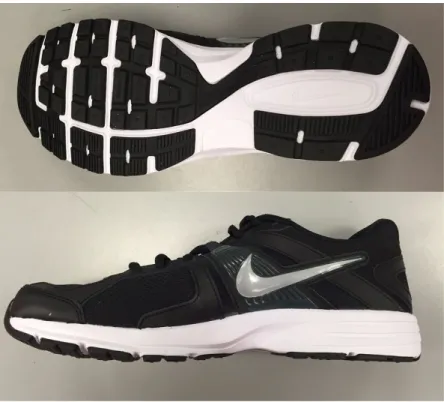
Figure 3: Nike Dart Running Shoe
Figure 3: Weight: 0.289 kg
Subjects were required to attend one, three-hour testing session, which started with obtaining anthropometric measurements of the individual, including height and weight. The subjects were provided with the compulsory outfit worn throughout the duration of the testing procedure, consisting of compression shorts and shirt, as well as socks. The researchers laced the shoes before providing them to the subjects in order to eliminate possible variability and the subjects were instructed to tie the shoes with the ankle in a maximum dorsiflexion position. Retro-reflective markers were placed on the lower body of the test subject following a dynamic warm-up. A counterbalance crossover design was utilized to ensure that the order in which subjects wore the three different shoes varied between subjects.
Participants:
Subjects recruited for this study included recreationally trained males, ages 18-30, who participated in either American football and/or soccer for a minimum of one hour per week in cleats. The American College of Sports Medicine [ACSM] currently recommends 30-60 minutes of moderately intense exercise at least 5 days/week to distinguish between a sedentary and active individual (n.d.). All subjects must have met this requirement while the time spent playing football and/or soccer counted towards their weekly activity time. Those with any lower-body musculoskeletal injuries in the past six months or anterior cruciate ligament injuries or surgeries in the past three years were excluded from this study. Possible risks and all information regarding procedures were disclosed to the participants and University approved Institutional Review Board consent forms were signed prior to testing.
This study was normalized based on the weight of the individual and not the height; thus subjects were recruited in an attempt to remain as homogenous as possible in regards to height. While twelve subjects were recruited, nine participants completed the study.
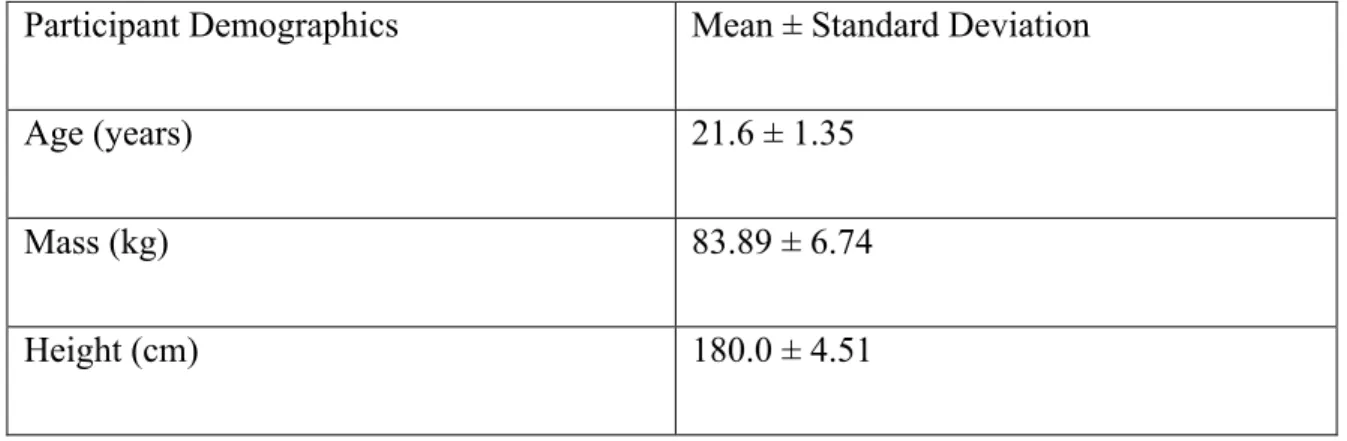
Table 1: Anthropometric Measures
Participant Demographics Mean ± Standard Deviation
Age (years) 21.6 ± 1.35
Mass (kg) 83.89 ± 6.74
Height (cm) 180.0 ± 4.51
Procedures:
Once the subject arrived for testing, anthropometric data was obtained and the researchers provided a compression shirt, shorts, and pair of socks. For ten minutes the subject sat with their feet in socks only in order to standardize for the time between all trials. The subject was required to perform a dynamic warm-up supervised by a certified professional that included: 25 jumping jacks, 10 body weight squats, 10 knee hugs, 10 forward lunges on each leg, 10 straight leg marches per leg, and 10 push-ups,
respectively. The participant then performed a maximal countermovement vertical jump (CMVJ). Three trials of the CMVJ were performed, with 30 seconds of rest between each trial. Following completion of all trials with one of the footwear conditions, the
participant removed the footwear, while keeping the socks on, and rested in a seated position for a minimum of 10 minutes in order to washout the effects of the previous condition. Subjects were then allowed to change into the next footwear condition and repeat the procedure. Variables measured and calculated for the CMVJ included vertical jump height, ground reaction force, normalized ground reaction force, and rate of force development.
The CMVJ assessment (Baechle, 2008) was performed three times for each shoe condition by jumping off and landing back on the same force platform, with participants exerting maximal effort. The highest value for jump height of the three trials was
recorded, and accurate measurement of the height was determined using a Vertec commercial measurement device. The Vertec was first adjusted for each participant in order to permit accurate measurement of the individual maximal height values. This was
width apart while reaching for the highest vane possible with his right arm straight up.
The body positioning instructions for the jumps were then explained to subjects, and the proper initial position was assumed for each trial. This involved starting with feet flat and shoulder width apart on the force plate and arms in a normal athletic position comfortable for the individual. Following this assumption of position, each trial was performed by the subject bending his knees slightly and giving a comfortable arm swing while executing the maximal vertical jump in order to knock as many of the vanes on the Vertec out of alignment as possible. This resulted in a standard method of jump height measurement, which was taken to the nearest half inch, and the highest value was recorded. After 30 seconds of rest, these steps were repeated twice more for each footwear type, giving each testing condition three trials.
Equipment:
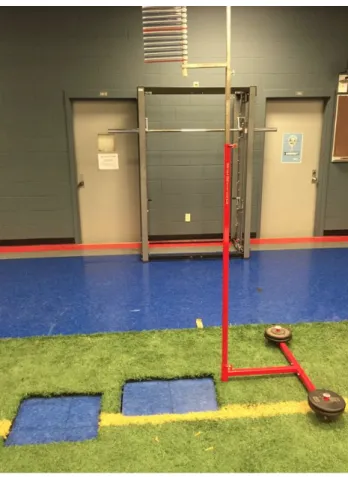
The Vertec is a commercial measuring device that provides data based upon how many vanes are reached and hit out of position by an individual. In this experiment, it is used to measure the first variable of interest, height. The Vertec was placed next to the subject so that the vanes were directly above the initial starting position for the jump trials.
Figure 4: Vertec Measuring Device
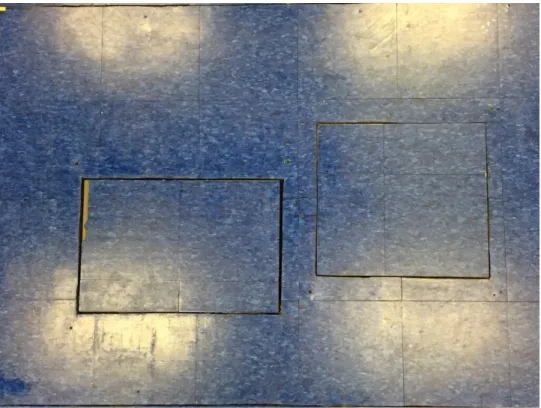
The force plate used was a Bertec device with dimensions of 600mm x 400mm.
All jump trials were conducted on this force plate, which measures ground reaction forces (Fz) of the individual. From this measurement, normalized ground reaction forces can be calculated.
Figure 5: Bertec Force Plate
The four variables studied were computed based on the maximal height of the countermovement jump at a sampling rate of 1000Hz. Ground reaction force (Fz) was measured and then used to calculate normalized ground reaction force (nFz) by dividing by the weight, in kilograms, of the relevant subject. The rate of force development (RFD) was determined to be the slope of the ground reaction force curve at the start of
concentric muscle action. The slope will be calculated over a time interval of 200
milliseconds. The concentric force production occurs when the vertical force factor of the ground reaction force curve exceeds body weight (N), otherwise seen as the moment when the subject pushes off the ground to perform the jump, and the eccentric
lengthening of the muscles used to jump transitions to concentric action, or shortening.
Statistical Analysis:
A 1x3 (group by condition) repeated measures analysis of variance (ANOVA) was utilized to analyze each dependent variable. If significant differences were found a bonferroni post-hoc adjustment was used to determine those specific differences. An a priori analysis using data from the male subjects in Butler et al. (2014) estimated 12 participants were needed. All analyses were conducted using SPSS 21 software with an alpha level set at 0.05.
CHAPTER IV RESULTS
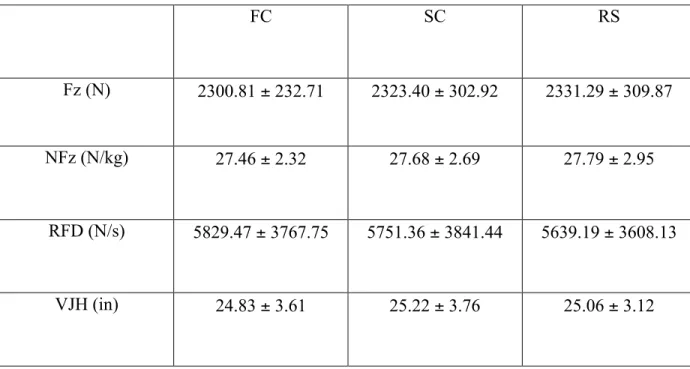
Four 1 x 3 (footwear by condition) repeated measures ANOVA were conducted to determine if any differences existed between footwear conditions. An alpha level was set at .05 and the statistical software SPSS 21 was utilized to analyze all data. There were no statistically significant differences between footwear conditions in any of the four
dependent variables, as can be seen by the p-values for Fz (p=.665), nFz (p=0.708), RFD (p=.897), and VJH (.467). Descriptive results for each footwear condition are in depicted in Table 2.
Table 2: Mean Data and Standard Deviation
FC SC RS
Fz (N) 2300.81 ± 232.71 2323.40 ± 302.92 2331.29 ± 309.87
NFz (N/kg) 27.46 ± 2.32 27.68 ± 2.69 27.79 ± 2.95
RFD (N/s) 5829.47 ± 3767.75 5751.36 ± 3841.44 5639.19 ± 3608.13
VJH (in) 24.83 ± 3.61 25.22 ± 3.76 25.06 ± 3.12
CHAPTER V DISCUSSION
The purpose of this study was to evaluate the potential effects of stud
configuration between American football and soccer cleats on applied force measures of a CMVJ. The four variables analyzed consisted of vertical jump height (VJH), vertical ground reaction force (Fz), normalized ground reaction force (nFz), and rate of force development (RFD). Jump tests were performed by recreationally trained males in a laboratory setting for each of the three footwear conditions. The results showed no statistically significant differences between footwear conditions for any of the four variables.
The data produced from this study is not consistent with what was expected based upon the literature surrounding this subject. According to previous research, wearing cleats should increase the amount of force capable of being produced, in part due to the minimal amount of cushioning (DeBiasio et al., 2013; Butler et al., 2014). Running shoes, in contrast, consist of more cushioning, and should therefore produce less force.
This view is supported by the study conducted by Laporta el al. (2013), which found greater values obtained from a vertical jump test in the trials performed while wearing minimalist footwear or no footwear. Tennis shoes were seen to reduce jump height values and force production due to the greater impact absorbed by the soles of the shoes.
However, it has been observed that controversy is present in regards to the study
study with corresponding techniques and reported no significant differences between footwear conditions. While the dissimilarity in data was attributed to a slight variability in procedure, it should be noted that conflicting results were present. Queen et al. (2008) tested force production in cleats by utilizing several cleats with varying stud
configurations in cutting tasks. Their findings showed the turf shoe with the cushioned sole produced less force than any of the other cleats. These force production values are in line with data collected by DeBiasio et al. (2013) in a forward and vertical jump test in that the trials performed with cleats resulted in the greatest force production.
Support for differences between cleat configurations has also been seen in the previous literature. Kent (C) et al. (2015) used nineteen types of cleat configurations to test both translational and vertical forces through use of a mechanical apparatus. The pattern of the studs on the cleats was confirmed to have an effect on force production in regards to translational forces, but it is imperative to comment that the study was unable to confirm similar effects for vertical forces (Kent (C) et al., 2015). The study
hypothesized that the type of surface, not the footwear, has more of an effect on vertical forces, a hypothesis that our study’s data supports through the usage of just one artificial turf surface for all trials.
Both the abnormalities in our data regarding the tennis shoe trials and the expected responses in the comparison of the cleat trials can be rationalized by several limitations and delimitations of the study. First, this study utilized solely recreationally trained males. It is entirely possible that inconsistent jumping techniques were
implemented on any and all of the trials, both within and between footwear conditions, producing data that does not correctly represent the true effects of the different footwear.
Regardless of what the true results should be, using highly trained athletes as subjects would offer data based on the theory that the subjects are correctly trained in performing vertical jumps.
The sample size of just nine participants had the ability to be a limitation of this study, as previous literature suggested that twelve subjects were needed as a sample size (Butler et al., 2014). However, because our p-values were so far out of range of our alpha level of .05, the data obtained from three more subjects would not have been enough to alter our results
The configuration of studs on the football and soccer cleats may not have consisted of a precise pattern to produce any statistically significant differences in force production data. This theory was hypothesized as a limitation in the study conducted by Queen et al. (2008) and is prevalent in our study because of the use of only two types of cleats. While Kent (C) et al. (2015) overcame this factor by utilizing nineteen various configurations and still found no significant differences in the data, it is still possible that our data may have produced those differences with an expansion on the number of cleats implemented, which was not possible due to cost restrictions.
Our selection of participants was a delimitation of this study. By purposefully choosing only recreationally trained males age 18-30, we excluded a large portion of the population that includes women, both trained and untrained, professionally trained men, and men that fall outside of that age category. This exclusivity allowed us to closely examine a portion of part of the population on a small-scale while remaining within our budget and time constraints. Further studies can expand upon these findings by utilizing a
In the future, a study such as this would benefit by increasing the number of footwear conditions to take into account the vast amount of variations that exist in cleat configurations, including stud location, placement, and number. Additionally,
professionally trained athletes, women, both trained and untrained, and those of different age groups should be used as test subjects in order to help produce a wider range of data.
Conclusion
In conclusion, this study has shown that the effects of stud configuration on American football and soccer cleats are statistically similar when measured as variables of ground reaction force, normalized ground reaction force, rate of force development, or vertical jump height. While literature has generally shown at least an increase in force production for cleats in comparison to running shoes, in this case the results were not supportive of this theory. Overall, it seems that when testing the vertical force production of cleats, the cleat configuration does not have an effect. Further research is
recommended to continue testing the potential variances in force production between cleats in other sport-specific tasks such as running, jumping, and cutting.
LIST OF REFERENCES
American College of Sports Medicine. (n.d.). Retrieved March 27, 2016, from http://www.acsm.org/
Baechle, Thomas R., Earle, Roger W., & National Strength & Conditioning Association.
(2008). Essentials of strength training and conditioning. Leeds: Human Kinetics.
Basgier, M. K., Karkoska, B.W., & Grandjean, P.W. (2004). The effectiveness of half- vs.
parallel-squat countermovement jump training on power indices in collegiate swimmers. Medicine and Science in Sports and Exercise, 36(5), 53.
Bosco, C., Luthanen, P., & Komi, P. (1983). A simple method for measurement of
mechanical power in jumping. European Journal Of Applied Physiology, 50(2), 273- 282.
Butler, R. J., Russell, M. E., & Queen, R. (2014). Effect of soccer footwear on landing mechanics. Scandinavian Journal Of Medicine & Science In Sports, 24(1), 129-135.
DeBiasio, J. C., Russell, M. E., Butler, R. J., Nunley, J. A., & Queen, R. M. (2013). Changes in plantar loading based on shoe type and sex during a jump-landing task. Journal Of Athletic Training (Allen Press), 48(5), 601-609.
Doan, B., Kwon, Y., Newton, R., Shim, J., Popper, E., Rogers, R., et al. (2003). Evaluation of a lower-body compression garment. Journal of Sports Sciences, 21(8), 601.
Dysterheft, J. L., Lewinski, W. J., Seefeldt, D. A., & Pettitt, R. W. (2013). The influence of start position, initial step type, and usage of a focal point on sprinting performance.
International Journal Of Exercise Science, 6(4), 320-327.
Galbusera, F., Tornese, D. Z., Anasetti, F., Bersini, S., Volpi, P., Barbera, L. L., & Villa, T.
(2013). Does soccer cleat design influence the rotational interaction with the playing surface? Sports Biomechanics, 12(3), 293-301.
Gheller, R. G., Dal Pupo, J., Pereira, d. L., Monteiro, d. M., & dos Santos, S. G. (2014).
Effect of squat depth on performance and biomechanical parameters of
countermovement vertical jump. Brazilian Journal of Kineanthropometry & Human Performance, 16(6), 658-668.
Gheller, R. G., Pupo, J. D., Ache-Dias, J., Detanico, D., Padulo, J., & dos Santos, S. G.
(2015). Effect of different knee starting angles on intersegmental coordination and performance in vertical jumps. Human Movement Science, 42, 71-80.
Harry, J. R., Paquette, M. R., Caia, J., Townsend, R. J., Weiss, L. W., & Schilling, B. K.
(2015). Effects of footwear condition on maximal jumping performance. Journal Of Strength & Conditioning Research (Lippincott Williams & Wilkins), 29(6), 1657- 1665
Hennig, E. M. (2011). The influence of soccer shoe design on player performance and injuries. Research In Sports Medicine, 19(3), 186-201.
Kalva-Filho, C. A., Loures, J. P., Franco, V. H., Kaminagakura, E. I., Zagatto, A. M., &
Papoti, M. (2013). Comparison of the anaerobic power measured by the RAST test at
different footwear and surfaces conditions. Revista Brasileira De Medicina Do Esporte, 19(2), 139-142.
Kent, R., Crandall, J., Forman, J., Lessley, D., Lau, A., & Garson, C. (2012). Development and assessment of a device and method for studying the mechanical interactions between shoes and playing surfaces in situ at loads and rates generated by elite athletes. Sports Biomechanics, 11(3), 414-429.
Kent, R., Forman, J. L., Lessley, D., & Crandall, J. (2015). The mechanics of American football cleats on natural grass and infill-type artificial playing surfaces with loads relevant to elite athletes. Sports Biomechanics, 14(2), 246-257.
Kent, R., Forman, J. L., Crandall, J., & Lessley, D. (2015). The mechanical interactions between an American football cleat and playing surfaces in-situ at loads and rates generated by elite athletes: a comparison of playing surfaces. Sports Biomechanics, 14(1), 1-17.
Kim, S., Park, S., & Choi, S. (2014). Countermovement strategy changes with vertical jump height to accommodate feasible force constraints. Journal of Biomechanics, 47(12), 3162-3168.
Laporta, J. W., Brown, L. E., Coburn, J. W., Galpin, A. J., Tufano, J. J, Cazas, V. L., et al.
(2013). Effects of different footwear on vertical jump and landing parameters.
Journal of Strength & Conditioning Research (Lippincott Williams & Wilkins), 27(3), 733-737.
Maulder, P., & Cronin, J. (2005). Horizontal and vertical jump assessment: reliability, symmetry, discriminative and predictive ability. Physical Therapy In Sport, 6(2), 74- 82.
McGhie, D., & Ettema, G. (2013). Biomechanical analysis of surface-athlete impacts on third-generation artificial turf. American Journal Of Sports Medicine, 41(1), 177-185.
Mero, A., Luhtanen, P., & Komi, P. V. (1983). A biomechanical study of the sprint start.
Scandinavian Journal of Sports Science, 5(1), 20–28.
Moran, K.A., & Wallace, E.S. (2007). Eccentric loading and range of knee joint motion effects on performance. Human Movement Science, 26, 820-840.
Probability of competing in sports beyond high school. (2015). Retrieved from
http://www.ncaa.org/about/resources/research/probability-competing-beyond-high- school
Queen, R. M., Charnock, B. L., Garrett Jr., W. E., Hardaker, W. M., Sims, E. L., & Moorman III, C. T. (2008). A comparison of cleat types during two football-specific tasks on FieldTurf. British Journal Of Sports Medicine, 42(4), 278-284.
Reilly, T. (1997). Energetics of high-intensity exercise (soccer) with particular reference to fatigue. Journal of Sports Sciences 15, 257-263.
Rodgers, M. M., & Cavanagh, P. R. (1984). Glossary of biomechanical terms, concepts, and units. Physical Therapy, 64(12), 1886-1902.
Salles, A.S., Baltzopoulos, V., & Rittweger, J. (2011). Differential effects of
countermovement magnitude and volitional effort on vertical jumping. European Journal Applied Physiology, 111, 441-448.
Sims, E. L., Hardaker, W. M., & Queen, R. M. (2008). Gender differences in plantar loading during three soccer-specific tasks. British Journal Of Sports Medicine, 42(4), 272- 277.
Smeets, K., Jacobs, P., Hertogs, R., Luyckx, J., Innocenti, B., Corten, K., Ekstrand, J., &
Bellemans, J. (2012). Torsional injuries of the lower limb: an analysis of the frictional torque between different types of football turf and the shoe outsole. British Journal of Sports Medicine, 46(10), 1-7.
Stefanyshyn, D.J., & Nigg, B. M. (2000). Influence of midsole bending stiffness on joint energy and jump height performance. Medicine & Science in Sports and Exercise, 32(2), 471-476.
Torg, J.S., Quedenfeld, T. (1971). Effect of shoe type and length on incidence and severity of knee injuries among high school football players. Research Quarterly, 42(2), 203- 211.
Torg, J.S., Quedenfeld, T. (1973). Knee and ankle injuries traced to shoes and cleats.
Physician and Sports Medicine, 1, 39-43.
Torg, J.S., Quedenfeld, T. (1974). The shoe-surface interface and its relationship to football knee injuries. The Journal of Sports Medicine, 2(5), 261-269.
Yanci, J., Los Arcos, A., Mendiguchia, J., & Brughelli, M. (2014). Relationships between sprinting, agility, one- and two-leg vertical and horizontal jump in soccer players.
Kinesiology, 46(2), 194-201.
Young, W. (1995). A simple method for evaluating the strength qualities of the leg extensor muscles and jumping abilities. Strength and Conditioning Coach, 2(4), 5–8.
Zhang, Y., Baker, J. S., Ren, X., Feng, N., & Gu, Y. (2015). Metatarsal strapping tightness effect to vertical jump performance. Human Movement Science, 41, 255-264.