This work is licensed under a Creative Commons Attribution-NonCommercial- ShareAlike 4.0 International License.
18
THE CONTRIBUTION OF MORALIST
LEADERSHIP TO THE PERFORMANCE OF STATE PRIMARY SCHOOL TEACHERS IN LUBUK
BASUNG DISTRICT
Irawati
Email: [email protected] Padang State University, Indonesia Yahya
Email: [email protected] Padang State University, Indonesia Rifma
Email: [email protected] Padang State University, Indonesia Anisah
Email: [email protected] Padang State University, Indonesia
Abstract: The phenomenon found shows that the performance of state elementary school teachers in Lubuk Basung District is relatively low. This research aims to reveal whether the two factors of moralist leadership and adhocracy organizational culture contribute to the performance of state elementary school teachers in Lubuk Basung District. The hypothesis proposed in this research is:
Moralist leadership contributes to teacher performance. The research population was 300 public elementary school teachers in Palembayan District. Sampling was carried out using a stratified proportional random sampling technique. The selected sample was 90 people. To test the hypothesis, correlation and regression analysis techniques are used. Data collection uses a questionnaire that has been tested for validity and reliability. The results of data analysis show that: Moralist leadership contributes 22.1% to teacher performance. The results of this research indicate that moralist leadership needs to be implemented by school principals to improve the performance of state elementary school teachers in Lubuk Basung District.
Keywords: moralist leadership, teacher performance, phenomenon Available online https://journal.yaspim.org/index.php/IJIERM/index
This work is licensed under a Creative Commons Attribution-NonCommercial- ShareAlike 4.0 International License.
19 INTRODUCTION
The educational problem faced by Indonesian society today is regarding the quality of education. Efforts made by the government to improve the quality of education include; improving facilities and infrastructure, improving and refining the curriculum, as well as teacher training to improve teacher welfare. Organizing workshops, workshops and seminars also contributes to improving the quality of education 1.
As a formal educational institution, schools carry out educational functions based on the principle of responsibility which includes: a) Responsibility of formal institutions in accordance with the functions and objectives determined according to applicable provisions, in this case the education law; UUPN Number 20 of 2003 which has regulated it. b) Scientific responsibility based on the form, content, objectives and level of education entrusted to him by society and the nation. c) Functional responsibility, is the professional responsibility of education managers and implementers who accept this accuracy based on the terms of their position.
This responsibility is a delegation and trust of parents/community to the school. Teachers have a very important role in advancing the quality of education, carrying out socio-cultural tasks that function to prepare the younger generation, in accordance with the nation's ideals 2.
In carrying out their duties, teachers are required to have high performance. Performance can be interpreted as work performance or work implementation or performance results. Performance is a work result that is expected from a teacher. Teacher work is a condition or process that allows better results to be obtained in achieving the goals of the educational institution itself 3.
1 Jawad Abbas, “Impact of Total Quality Management on Corporate Green Performance through the Mediating Role of Corporate Social Responsibility,” Journal of Cleaner Production 242 (2020), https://doi.org/10.1016/j.jclepro.2019.118458.
2Jumirah Jumirah, “Pengaruh Kepemimpinan Kepala Sekolah, Budaya Sekolah Dan Pendidikan Pelatihan Terhadap Kinerja Guru Sekolah Dasar,” Media Manajemen Pendidikan 3, no. 2 (2020), https://doi.org/10.30738/mmp.v3i2.4507.
3 Laode Ismail Ahmad, “KONSEP PENILAIAN KINERJA GURU DAN FAKTOR YANG MEMPENGARUHINYA,” Idaarah: Jurnal Manajemen Pendidikan 1, no. 1 (2017), https://doi.org/10.24252/idaarah.v1i1.4133.
This work is licensed under a Creative Commons Attribution-NonCommercial- ShareAlike 4.0 International License.
20
Díez et. al (2020) states that teacher performance is closely related to the learning activities they carry out. In general, it can be said that teacher performance is influenced by internal and external factors.6 Internal factors that influence teacher performance include motivation, positive emotions, negative emotions, responsibility for tasks, discipline in completing tasks, concern for students, and job satisfaction. Meanwhile, external factors that influence teacher performance include leadership style, work environment, evaluation and supervision mechanisms, information and communication technology facilities, as well as facilities in the school environment such as clean water, sanitation, electricity and the condition of school buildings 4.
Optimal teacher performance is the hope of all school service users as educational servants for the wider community. Teacher performance is an indicator of school performance as an educational institution. This is in accordance with what was stated by Choi et al. (2018) that good teacher performance will provide an optimal contribution in achieving national education goals, therefore as teachers teachers are required to carry out their duties with full responsibility for the learning process 5.
In this case, teacher performance is performance related to their duties in the student learning process. Learning performance can mean changes in the learning process, adding input to the learning process (using various kinds of learning resources), increasing the intensity of student interaction with learning resources, or a combination of all three in learning activities to produce better quality 6.Optimal teacher work performance is
4 Eliana Setyanti, “Pengaruh Kompetensi Dan Motivasi Berprestasi Terhadap Kinerja Guru Yang Bersertifikasi,” SIKIP: Jurnal Pendidikan Agama Kristen 1, no. 1 (2020), https://doi.org/10.52220/sikip.v1i1.38.
5 Vincent Greenier, Ali Derakhshan, and Jalil Fathi, “Emotion Regulation and Psychological Well-Being in Teacher Work Engagement: A Case of British and Iranian
English Language Teachers,” System 97 (2021),
https://doi.org/10.1016/j.system.2020.102446.
6 Hastuti Mulang, “Pengaruh Kompetensi Dan Motivasi Terhadap Kinerja Pegawai,” Jesya 6, no. 1 (2023), https://doi.org/10.36778/jesya.v6i1.894.
This work is licensed under a Creative Commons Attribution-NonCommercial- ShareAlike 4.0 International License.
21
not easy to obtain because it is believed that many factors influence it, both internal and external 7.
Based on the considerations above, it is impossible for the management of the teaching and learning process to run well without the support of good teacher performance. So a teacher's performance is very important in the student education process because it is related to work performance or the results achieved in carrying out tasks. In carrying out the teaching and learning process, teacher performance is of course related to how to plan, implement, evaluate and follow up on learning 8.
The reality on the ground, based on initial surveys conducted at several state elementary schools in Lubuk Basung District, shows that the performance of some teachers is less than satisfactory. From the resulting data, 40% think that teachers' abilities in planning learning such as annual programs, semesters, syllabi and lesson plans are not good. There are also opinions of teachers who consider lesson planning not important, but what is more important is teaching. If it is discovered that without careful planning, the implementation of learning will certainly be disrupted 9.
Learning that is not carried out well by teachers is shown by the fact that there are still teachers who are not guided by existing plans. There are still teachers who lack discipline both at that time and when they come in and out. There are even teachers who leave the classroom during class time.
Class management is not well organized to support learning. Apart from that, learning methods and media have not been used in a diverse manner, the use of learning media is very minimal.
Learning evaluation has not been carried out well. This is indicated by the preparation of questions that do not meet standards due to poor
7 Peggy A. Ertmer et al., “Teacher Beliefs and Technology Integration Practices: A Critical Relationship,” Computers and Education 59, no. 2 (2012), https://doi.org/10.1016/j.compedu.2012.02.001.
8 Sri Wahyuni et al., “GAYA KEPEMIMPINAN OTORITER (OTOKRATIS) DALAM MANAJEMEN PENDIDIKAN,” Educational Leadership: Jurnal Manajemen Pendidikan 1, no. 2 (2022), https://doi.org/10.24252/edu.v1i2.26148.
9 Beta Salsabilla et al., “Tipe Dan Gaya Kepemimpinan Pendidikan,” Jurnal Pendidikan Tambusai 6, no. 2 (2022).
This work is licensed under a Creative Commons Attribution-NonCommercial- ShareAlike 4.0 International License.
22
planning. The tendency for creating questions precedes the question grid 10. There are still teachers who do not analyze evaluation results, there is a tendency for some teachers to use analysis of evaluation results as promotional material, even though this analysis is very necessary in implementing follow-up programs 11.
Apart from the above, there are still teachers who are less willing to implement further programs in the form of enrichment or remedial programs. Some teachers ignore students who are slow learners without trying to provide remedial programs. Likewise, students' self-development receives less attention due to lack of facilities, lack of time, and many other reasons 12.If the above phenomenon is left alone, it will certainly have an impact on the quality of education. The phenomenon of low teacher performance certainly will not occur by itself without the influence of various factors, both from within and outside the teacher. It is on this basis that research on teacher performance becomes important. Several studies on the Influence of Leadership on Teacher Performance that the author has read generally describe the leadership of school principals in general. However, in the research that the author conducted, the author focused more on moralist leadership. Because in previous studies no one has discussed research similar to this. The novelty here is that this research will not examine the leadership style of school principals in general, but rather examine the leadership style of school principals specifically, namely Moralist leadership.
BASIC THEORY Moralistic Leadership
Moralist leadership style is a leadership style that values its subordinates the most, usually a moralist-style leader is warm and polite to
10 Malayu S. P Hasibuan, Manajemen Sumber Daya Manusia, Edisi Revisi Jakarta: Bumi Aksara ( Bumi Aksara, 2011).
11 Jaliah Jaliah, Happy Fitria, and Alfroki Martha, “Pengaruh Kepemimpinan Kepala Sekolah Dan Manajemen Kepala Sekolah Terhadap Kinerja Guru,” Journal of Education Research 1, no. 2 (2020), https://doi.org/10.37985/joe.v1i2.14.
12 Eun Ha Choi, Eun Kyung Kim, and Pil Bong Kim, “Effects of the Educational Leadership of Nursing Unit Managers on Team Effectiveness: Mediating Effects of Organizational Communication,” Asian Nursing Research 12, no. 2 (2018), https://doi.org/10.1016/j.anr.2018.03.001.
This work is licensed under a Creative Commons Attribution-NonCommercial- ShareAlike 4.0 International License.
23
everyone.18 This means that this leadership upholds basic moral and ethical values, these leaders believe that it is important to act ethically and responsibly, both in personal and professional life. They also believe that it is important to create a supportive and respectful work environment. As a leader, having strong relationships with subordinates is an important factor in achieving organizational success. A trusting, respectful, and supportive relationship between leaders and subordinates can increase motivation, performance, and job satisfaction. Moralist leadership has high empathy for all the problems of its subordinates, also patient, generous, all forms of virtues are in the leader.14 These virtues such as empathy, honesty, firmness, and justice. So the characteristics of moralist leadership include:
(1) High empathy
Empathy is the ability to understand and share the feelings of others.
Moralist leaders have high empathy towards their subordinates, leaders understand and care about the needs and feelings of their subordinates. Empathy is important for moral leadership because it helps leaders to build strong relationships with their subordinates.
When subordinates feel that their leaders understand and care about them, they are more likely to follow the leadership and give their best. In addition to subordinates, empathy can also help leaders to make more ethical decisions. When leaders can understand the impact of their decisions on others, they are more likely to make fair and beneficial decisions. Examples of how moralist leaders show empathy include taking the time to listen to what subordinates have to say, showing support to subordinates when they need it, and showing understanding when subordinates make mistakes.
(2) Having honesty
Honesty is one of the most important moral values. Moralist leaders are highly honest in their actions and words. They always try to tell the truth, even if it is difficult. Honesty is important for moral leadership because it builds trust and integrity. When subordinates believe that their leaders are honest, they are more likely to follow their leaders and give their best. Honesty can also help leaders to make more ethical decisions. When leaders are honest in their
This work is licensed under a Creative Commons Attribution-NonCommercial- ShareAlike 4.0 International License.
24
decision-making process, they are more likely to make fair and beneficial decisions.
(3) Have decisiveness
Decisiveness is the ability to stand firm on moral principles, even when difficult. Moralist leaders are highly assertive in applying their moral values. They will not compromise on what they believe in, even if it means making difficult decisions. Assertiveness is important for moral leadership because it helps leaders to make ethical decisions. When leaders are assertive in applying their moral values, they are more likely to make fair and beneficial decisions.
Assertiveness can also help leaders to build trust and integrity. When subordinates see that their leaders are assertive in applying their moral values, they are more likely to trust and respect their leaders.
(4) Promote justice
Justice is one of the most important moral values. Moralist leaders are highly fair in their treatment of all people. They do not discriminate against people based on race, religion, gender, or other backgrounds. Fairness is important to moral leadership because it helps create a positive and productive work environment. When subordinates feel that they are treated fairly, they are more likely to feel satisfied and motivated. Fairness can also help leaders to make more ethical decisions. When leaders are fair in their decision- making process, they are more likely to make decisions that benefit everyone.
Teacher Performance
Teacher performance is a description of the attitudes, skills, values, and knowledge of teachers in carrying out their duties and functions, which are shown in their appearance, actions, and work achievements 13. Teacher performance is a work achievement in implementing an education program that must be able to produce graduates/outputs that are of increasing quality, able to show the community in the form of good service, costs borne
13 Mulyasa, “Uji Kompetensi Dan Penilaian Kinerja Guru,” Uji Kompetensi Dan Penilaian Kinerja Guru, 2013.
This work is licensed under a Creative Commons Attribution-NonCommercial- ShareAlike 4.0 International License.
25
by consumers or people who entrust their children are affordable and not burdensome, task implementers are getting better and developing and are able to keep up with the dynamics of community needs that are always changing in accordance with the advances and demands of the times.
Meanwhile, according to Kempa, teacher performance is the overall behavior of the teacher in achieving goals in carrying out the tasks assigned to him both as a teacher, trainer, supervisor, coaching and educator of students, so that from mastering these main tasks it can improve the teaching profession. more focused on the behavior of an educator in his work and the effectiveness of educators in carrying out their duties and responsibilities which can influence students to the desired goal 14.
Sardiman states that in connection with several functions that teachers have, there are several main aspects which are basic skills and knowledge for teachers, namely: 1) Teachers must be able to understand and place his maturity. As an educator, he must be able to make himself a role model where the teacher must be able to set an example of good behavior, be open, and avoid all despicable actions and behaviors that can bring down the dignity of the educator. 2) Teachers must know their students. 3) Teachers must have the ability to provide guidance. 4) Teachers must have a broad knowledge base about the objectives of education in Indonesia in general in accordance with the stages of development. 5) Teachers must have a rounded and new knowledge of the knowledge being taught 15. Based on the Regulation of the Minister of National Education of the Republic of Indonesia Number 16 of 2007, the Academic Qualifications and Teacher Competency Standards are developed into 4 main competencies, these indicators are used to measure teacher performance, the 4 main competencies of teacher performance can include 16:19
14 F. Díez et al., “Impact of Quality Management Systems in the Performance of Educational Centers: Educational Policies and Management Processes,” Heliyon, 2020, https://doi.org/10.1016/j.heliyon.2020.e03824.
15 Mohamad Muspawi, “Strategi Peningkatan Kinerja Guru,” Jurnal Ilmiah Universitas Batanghari Jambi 21, no. 1 (2021), https://doi.org/10.33087/jiubj.v21i1.1265.
16 Abd. Khalid Hs. Pandipa, “Kinerja Guru Dalam Meningkatkan Mutu Pendidikan Di Sma Negeri 1 Lore Utara.”
This work is licensed under a Creative Commons Attribution-NonCommercial- ShareAlike 4.0 International License.
26
(1) Teacher pedagogical skills: teacher pedagogical skills can include the ability to manage learning, the ability to develop student potential, and the ability to assess student learning outcomes.
Examples of teacher pedagogical skills. Examples of teacher pedagogical competencies include creating a conducive learning atmosphere that is easy for students to understand, using various learning methods according to subject matter and student criteria, and being able to analyze the results of each student's abilities and achievements.
(2) Personality competence: Personality competence is the teacher's ability to present themselves as a stable, noble person, acting according to religious, legal and social norms so that they can be a role model for students. Some examples of teacher personality competence include maintaining behavior according to religious and social norms, being honest and fair, and always respecting others.
(3) Social competence: Social competence is the teacher's ability to communicate and interact effectively with students, fellow teachers, parents, and the community. Examples of teacher social competence include teachers using polite language when in the school environment, establishing communication between fellow workers in the school environment and participating in social activities held in the school environment.
(4) Teachers' professional skills: teachers' professional skills can include the ability to keep up with developments in science and technology, the ability to write scientific papers, and the ability to collaborate with others. Examples of teachers' professional skills include being able to keep up with developments in science and technology, being able to write scientific works such as journals or books, and being able to collaborate with fellow teachers, parents or the community to improve the quality of education.
RESEARCH METHODS
This research is a quantitative study with a correlational approach to see the contribution of moralist leadership to the performance of public elementary school teachers in Lubuk Basung District. Quantitative research
This work is licensed under a Creative Commons Attribution-NonCommercial- ShareAlike 4.0 International License.
27
according to Sugiyono is a research method based on the philosophy of positivism, as a scientific or scientific method because it has fulfilled scientific rules concretely or empirically, objectively, measurably, rationally, and systematically 17. The variables studied consist of independent variables, namely Moral Leadership (X1), while the dependent variable is Teacher Performance (Y).
Population and Sample
The research population was all state elementary school teachers who had Civil Servant (PNS) status in Lubuk Basung District. The total population is 300 people spread across 61 state elementary schools grouped into 6 clusters. A cluster is a collection of schools consisting of one core elementary school and several secondary elementary schools. The goal is that through clusters it will make it easier for researchers to collect research data. The population is heterogeneous in terms of age and length of service.
Age background and years of service are assumed to influence teacher performance.
The research sample was taken using stratified proportional random sampling technique. Stratified sampling is a way of drawing samples for populations which has heterogeneous characteristics or the characteristics of the population vary 18.Then balancing is done for each individual in the stratum so that all members of the stratum in the population are given the same opportunity to be selected as the research sample. Sample selection was carried out through four stages, namely: (1) identifying and classifying the population based on strata, (2) calculating the proportion of strata, (3) determining the sample size, and (4) determining the subjects to be used as respondents.
Data collection
Data collection was carried out by distributing questionnaires to predetermined respondents from 6 to 11 April 2023. This was done by
17 Sugiyono, “Sugiyono, Metode Penelitian Dan Pengembangan Pendekatan Kualitatif, Kuantitatif, Dan R&D , (Bandung: Alfabeta, 2015), 407 1,” Metode Penelitian Dan Pengembangan Pendekatan Kualitatif, Kuantitatif, Dan R&D, no. 2015 (2015).
18 Nur Fadilah Amin, Sabaruddin Garancang, and Kamaluddin Abunawas,
“Konsep Umum Populasi Dan Sampel Dalam Penelitian,” Jurnal Pilar 14, no. 1 (2023).
This work is licensed under a Creative Commons Attribution-NonCommercial- ShareAlike 4.0 International License.
28
visiting respondents at their respective workplaces, namely State Elementary Schools in Lubuk Basung District. The questionnaire is filled out directly at the workplace and is not taken home with the aim of ensuring the validity and accuracy of the data.
Data Analysis
Data collected from respondents was analyzed using correlation and regression techniques. This analysis is used to test each hypothesis. Data analysis used the statistical analysis program SPSS Version 29.00. The analysis steps are as follows:
(1) Data description
Data description aims to describe the frequency distribution of data for each variable and determine the level of achievement. The formula used is:
Score rate-rate
Achievement level = --- X 100 % Maximum ideal score
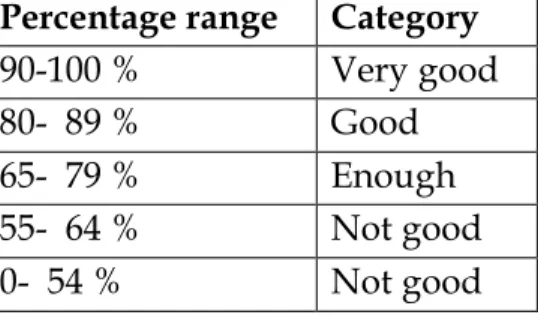
To categorize respondents' achievement scores, the classification proposed by Sugiyono (2010) is used, namely:
Table 1. Percentage range of variable achievement categories Percentage range Category
90-100 % Very good
80- 89 % Good
65- 79 % Enough
55- 64 % Not good
0- 54 % Not good
(2) Testing analysis requirements
In this test, several things are done, namely:
a. Normality checking uses a test formulaKolmogorov-Smirnov. The goal is to check whether the data comes from a normally distributed population or not.
b. Checking the homogeneity of data using a testLevene Statistic. The aim is to find out whether there is population group variance or not.
This work is licensed under a Creative Commons Attribution-NonCommercial- ShareAlike 4.0 International License.
29
c. Checking independence between independent variables using the formulaPearson Correlation. The goal is to find out whether each predictor is independent.
d. Test linearity with simple regression techniques.
(3) Hypothesis testing
a. Testing the first and second hypotheses uses simple correlation and regression analysis techniques.
b. The third hypothesis was analyzed using correlation and multiple regression techniques. To make predictions conditionally using partial correlation techniques.
RESULTS AND DISCUSSION
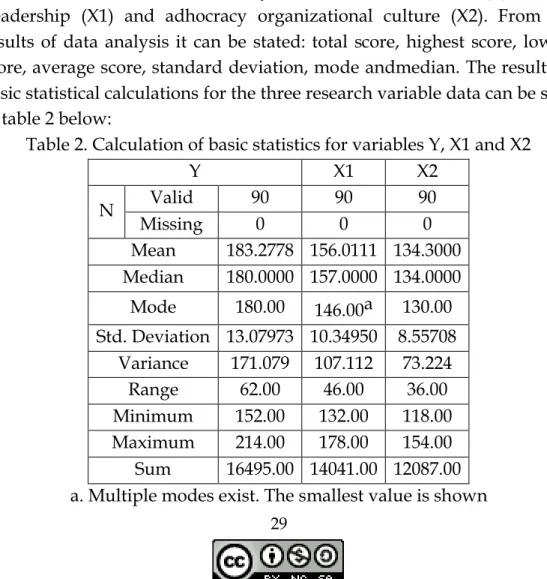
In this research, data collection was carried out by administering a questionnaire in the form of a scaleLikert to respondents. The research data includes three variables, namely: Teacher Performance (Y), Moral Leadership (X1) and adhocracy organizational culture (X2). From the results of data analysis it can be stated: total score, highest score, lowest score, average score, standard deviation, mode andmedian. The results of basic statistical calculations for the three research variable data can be seen in table 2 below:
Table 2. Calculation of basic statistics for variables Y, X1 and X2
Y X1 X2
N Valid 90 90 90
Missing 0 0 0
Mean 183.2778 156.0111 134.3000 Median 180.0000 157.0000 134.0000 Mode 180.00 146.00a 130.00 Std. Deviation 13.07973 10.34950 8.55708
Variance 171.079 107.112 73.224 Range 62.00 46.00 36.00 Minimum 152.00 132.00 118.00 Maximum 214.00 178.00 154.00 Sum 16495.00 14041.00 12087.00 a. Multiple modes exist. The smallest value is shown
This work is licensed under a Creative Commons Attribution-NonCommercial- ShareAlike 4.0 International License.
30 (1) Teacher Performance Variable (Y)
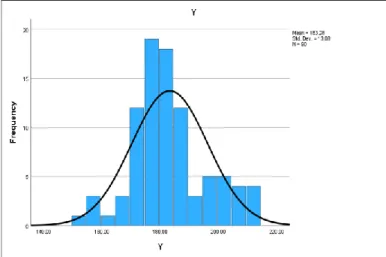
From data processing results, it can be seen that the distribution of respondents' answer scores spreads from the lowest score of 152.00 and the highest of 214.00 with an average score of (mean) 183.28, median 180.00 mode 180.00, and the standard deviation (standard deviation) 13.08. Score rate-rate, median, and mode not much different (less than 1.SD). The level of achievement of the teacher performance variable score of 83.18% is in the good category. The histogram of teacher performance variable scores is as shown in Figure 1 below:
Figure 1. Histogram of Performance Variable Scores Guru (Y)
Furthermore, a recapitulation of research data for each teacher performance indicator can be seen in table 3.
Table 3. Recapitulation of Research Data for Each Teacher Performance Indicator
Indicator Ideal Score Average Score
%Achievement
Rate Category
Planning learning 90 79,1 87,90 Good
Carrying out
learning 50 40,00 80,00 Good
Conduct learning
evaluations 55 44,58 81,05 Good
This work is licensed under a Creative Commons Attribution-NonCommercial- ShareAlike 4.0 International License.
31 Carry out learning
follow-up 25 19,6 78,20 Enough
Overall Ideal Score 81,79 Good
Based on the data in table 3 above, it can be seen that the highest indicator achievement level score (87.90%) in the good category is planning learning. Furthermore, the lowest indicator achievement level score was carrying out learning follow-up (78.20%) in the sufficient category. In general, the level of teacher performance achievement is 81.79 in the good category. This shows that the performance of public elementary school teachers in Lubuk Basung District seen from the aspects of planning learning, implementing learning, evaluating learning and carrying out learning follow-up according to civil servant teachers at public elementary schools in Lubuk Basung District is good.
(2) Moralist Leadership Variable (X1)
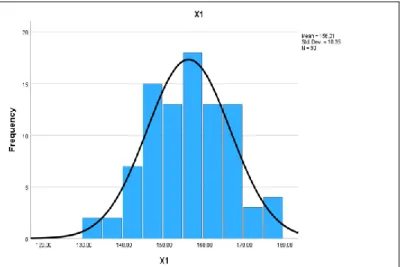
From the results of research data processing, it is known that the distribution of respondents' answer scores spread from the lowest score of 132.00 to the highest score of 178.00. Based on the score distribution, an average score is obtained (mean) of 156.01, median, 157,00 andmode of 146.00 with a standard deviation (standard deviation) 10,35. Score rate-rate (mean), median, andmode not much different (less than 1 SD). The level of achievement of the moralist leadership score of 86.67% is in the good category. The histogram of the moralist leadership variable scores can be seen in Figure 2.
This work is licensed under a Creative Commons Attribution-NonCommercial- ShareAlike 4.0 International License.
32
Figure 2. Histogram of Moralist Leadership Variable Scores (X1) Furthermore, a recapitulation of research data for each indicator of moralist leadership can be seen in table 4.
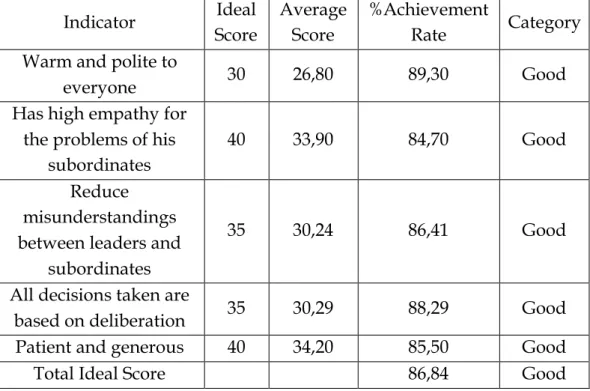
Table 4. Recapitulation of Research Data for Each Moralist Leadership Indicator
Indicator Ideal Score
Average Score
%Achievement
Rate Category Warm and polite to
everyone 30 26,80 89,30 Good
Has high empathy for the problems of his
subordinates
40 33,90 84,70 Good
Reduce misunderstandings between leaders and
subordinates
35 30,24 86,41 Good
All decisions taken are
based on deliberation 35 30,29 88,29 Good
Patient and generous 40 34,20 85,50 Good
Total Ideal Score 86,84 Good
This work is licensed under a Creative Commons Attribution-NonCommercial- ShareAlike 4.0 International License.
33
Based on the data in table 4 above, it can be seen that the highest indicator achievement level score (89.30%) in the good category is Warm and polite to everyone. Furthermore, the lowest indicator achievement level score was carrying out learning follow-up (84.70%) in the good category. In general, the level of Moral Leadership achievement is 86.84% in the good category. This shows that the moral leadership of the Lubuk Basung District public elementary school principal is seen from the aspect of being warm and polite to everyone, having the highest empathy for the problems of his subordinates, reducing misunderstandings between leaders and subordinates, making all decisions based on deliberation, and being patient and generous. According to civil servant teachers at public elementary schools in Lubuk Basung District, the heart is in the good category.
Test Requirements Analysis
Analysis of research data was carried out using descriptive and inferential statistical methods. The analysis techniques used are correlation, simple regression and multiple regression. Before using parametric statistical formulas and regression analysis, it is necessary to test the analysis requirements. According to Sudjana (1996), these requirements are:
a) sample data for each variable must be normally distributed, b) population variance between homogeneous groups, and c) independence test between variables.
(1) Data Normality Check
The purpose of checking data normality is to find out whether the distribution of research data follows or approaches a normal distribution or not. Good data is data that has a pattern like a normal distribution, that is, the data distribution does not skew to the left or skew to the right.
To find out whether the data is normally distributed, use the testKolmogorov-Smirnov at a significance level of.
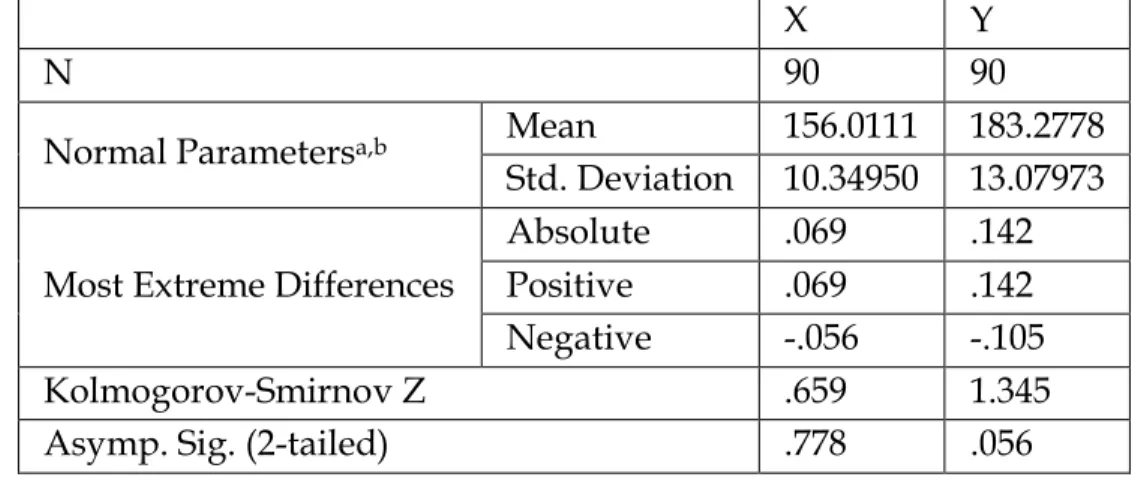
From the results of the normality test analysis, it can be concluded that the two variables can be declared to have a normal distribution. A summary of the analysis results can be seen in Table 5 below:
Table 5. Normality Test Results for Variables X and Y
This work is licensed under a Creative Commons Attribution-NonCommercial- ShareAlike 4.0 International License.
34
X Y
N 90 90
Normal Parametersa,b Mean 156.0111 183.2778 Std. Deviation 10.34950 13.07973 Most Extreme Differences
Absolute .069 .142
Positive .069 .142
Negative -.056 -.105
Kolmogorov-Smirnov Z .659 1.345
Asymp. Sig. (2-tailed) .778 .056
In Table 5 above it can be seen that the significance figure (asymp.
sig) for the teacher performance variable (Y) is 0.056, the moralist leadership variable (X) is 0. Both variables have a significance number >
the specified significance number, namely 0.05. Based on this, it can be concluded that the variables teacher performance (Y), moralist leadership (X) are normally distributed.
(2) Data Homogeneity Check
Homogeneity checks are carried out to determine whether a group of data has the same variance among group members. To test homogeneity, analysis is carried outLevene test. A good regression model is if it fulfills the assumption that there is equal variance from the residuals of one observation to another. If the residual from one observation to another is constant, then it is declared homogeneous. A summary of the results of the analysis of the homogeneity examination for the moralist leadership variable (X) can be seen in Table 6 below:
Table 6. Homogeneity Check for Variables X and Y Test of Homogeneity of Variances X, Y
Sum of Squares Df Mean
Square F Sig.
Between Groups 6604.791 39 169.354 2.892 <,001 Within Groups 2928.198 50 58.564
Total 9532.989 89
This work is licensed under a Creative Commons Attribution-NonCommercial- ShareAlike 4.0 International License.
35
From the summary of analysis results in Table 6 above it can be seen that variableprobability) is 0.01, which turns out to be smaller than the specified probability number, namely 0.05. Based on testLife Statistics it can be concluded that the population variances are identical or the data comes from a homogeneous population.
Hypothesis test
(1) First Hypothesis Testing
The first hypothesis proposed in this research is that moralist leadership contributes to teacher performance. Testing of the hypothesis was carried out by correlation and regression analysis using the SPSS version 29.00 program. A summary of the results of the correlation analysis of moralist leadership (X) on teacher performance can be seen in Table 7 below.
Table 7. Correlation of Moral Leadership (X1) on Teacher Performance (Y) Model Summary
Mode R
R Square
Adjusted R Square
Std. Error of the Estimate
1 .470a .221 .212 11.60856
a. Predictors: (Constant), X1
b. Dependent Variable: Y
In Table 7 above, it can be seen that there is a significant contribution between moralist leadership on teacher performance with the correlation coefficient figurerx1.y = 0.470 and the coefficient of determination (r²) is 0.221 and the contribution is 0.221 x 100% = 22.1 %
To see the contribution of the moralist leadership variable (X) to teacher performance (Y), a simple regression analysis was carried out. A summary of the analysis results can be seen in Table 8 below.
Table 8. Significance test of the regression equation X on Y Anova
Model Sum of Squares Df Mean Square F Sig.
1 Regression 3367.297 1 3367.297 24.988 <,001b
This work is licensed under a Creative Commons Attribution-NonCommercial- ShareAlike 4.0 International License.
36
Residual 11858.758 88 134.759 Total 15226.056 89
a. Dependent Variable: Y
b. Predictors: (Constant), X
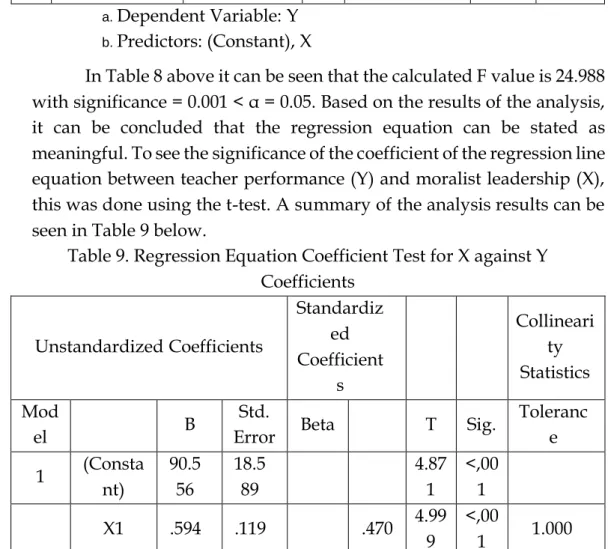
In Table 8 above it can be seen that the calculated F value is 24.988 with significance = 0.001 < α = 0.05. Based on the results of the analysis, it can be concluded that the regression equation can be stated as meaningful. To see the significance of the coefficient of the regression line equation between teacher performance (Y) and moralist leadership (X), this was done using the t-test. A summary of the analysis results can be seen in Table 9 below.
Table 9. Regression Equation Coefficient Test for X against Y Coefficients
Unstandardized Coefficients
Standardiz ed Coefficient
s
Collineari ty Statistics Mod
el B Std.
Error Beta T Sig. Toleranc e 1 (Consta
nt)
90.5 56
18.5 89
4.87 1
<,00 1
X1 .594 .119 .470 4.99
9
<,00
1 1.000 In Table 9 above it can be seen that the constant value is 90.556 with t = 4.871, sig = 0.001 and the regression direction coefficient is 0.954, t = 4.999, sig. = 0.001. It turns out that the direction coefficient of the regression equation X is very significant <0.05. It can be stated that there is a very significant contribution between the Moralist Leadership variable (X) to the Teacher Performance variable (Y).
The simple linear regression equation is Ŷ = 90.556 + 0.954 X1 which can be stated to be very significant. This means that the constant starts from 90.556, then every time moralist leadership increases by one unit,
This work is licensed under a Creative Commons Attribution-NonCommercial- ShareAlike 4.0 International License.
37
performance will increase by 0.594. It can be concluded that the hypothesis proposed "Moralist leadership contributes to teacher performance is acceptable and very significant.
DISCUSSION
From the test results through statistical analysis, it can be stated that the two independent variables of moralist leadership contribute significantly to the teacher performance variable. Furthermore, the results of the analysis also obtained information that moralist leadership (X1) contributed to the performance of 22.1%. The simple linear regression equation between the moralistic leadership variable and teacher performance is very significant. The regression model is a good model for predicting teacher performance because it has been tested empirically and statistically.
In an effort to improve the performance of public elementary school teachers in Lubuk Basung Subdistrict, one of the main focuses that principals need to pay attention to is improving moral leadership.
Moralistic leadership is a variable that receives special attention because it is believed to contribute to improving teacher performance. Data analysis shows a positive and parallel (linear) relationship between moralistic leadership (X) and teacher performance (Y). Thus, if moralistic leadership can be applied appropriately, it is predicted that teacher performance will also improve significantly. Therefore, focusing on the development of appropriate moral leadership is expected to be an effective strategy in improving the performance of teachers in the school environment.
Based on the results of the analysis, it was revealed that the level of score achievement for the moral leadership variable was in the good category, which amounted to 86.67%. However, it should be kept in mind that to achieve more optimal performance improvement, efforts are needed to maintain and improve moral leadership consistently. Theoretically, there is an understanding that moralist leadership contributes significantly to the level of teacher performance in carrying out their duties. Therefore, to maximize the potential of teachers' performance, it is important to maintain the consistency and sustainability of moralistic leadership that has reached
This work is licensed under a Creative Commons Attribution-NonCommercial- ShareAlike 4.0 International License.
38
a good level, and try to improve it further to have a more positive impact on the quality of teaching and learning in the school.
Based on the results of the analysis, it is known that the responses to both variables are in the good category. In this context, planned steps are needed from principals and supervisors of primary schools in Lubuk Basung sub-district to maintain and promote moralistic leadership practices in carrying out their roles as leaders. This shows that the good level of response to these variables indicates a great potential to develop and maintain moralistic leadership practices in the school environment.
Therefore, there is a need for targeted and planned collaborative efforts between school principals and supervisors to create a supportive environment for moralistic leadership practices to be adopted and maintained consistently in their leadership duties.
The results of this study are in line with the results of previous research by Irawati et al., showing that: 1) Moralist leadership contributes 22.1% to teacher performance, 2) Adhocratic organizational culture contributed 19.7% to teacher performance, and 3) Moralist leadership and adhocratic organizational culture together contributed 31.9% to teacher performance. The level of score achievement for the three variables (teacher performance, moralist leadership, and adhocratic organizational culture) is in the good category. The results of this study indicate that moralist leadership and adhocratic organizational culture are two factors that need to be applied by principals to improve the performance of public elementary school teachers in Lubuk Basung District.
Moralist leadership has a significant contribution to the teacher performance variable. This is based on the finding that effective moralist leadership practices are positively associated with improved teacher performance. Data analysis showed a strong correlation between moralistic leadership practices and teacher performance, where the better the implementation of moralistic leadership by school leaders, the higher the level of teacher performance that can be achieved. Therefore, it can be concluded that moralist leadership has an important role in influencing the quality of teacher performance, which in turn can affect educational outcomes in the school environment.
This work is licensed under a Creative Commons Attribution-NonCommercial- ShareAlike 4.0 International License.
39
The moralist leadership style is the leadership style that values its subordinates the most. The basic personality of this model leader is blue.
Usually a moralist-style leader is warm and polite to everyone. Moralist- style leaders basically have high empathy for the problems of their subordinates. All forms of benevolence are in this leader. People come for his warmth despite all his shortcomings. A moralistic leader is very emotional. He is very unstable, sometimes can seem sad and terrible, sometimes can be very pleasant and friendly. This moralist leadership style is effective when a moralist leader's success in overcoming his emotional instability is often a lifelong struggle and learns to trust others or let them do it their way, not yours 19. Characteristics of Moralist Leadership include20. Subordinates are given leeway or flexibility in carrying out their duties, but carefully set clear boundaries by managers or leaders. This boundary setting aims to guide and direct subordinates in performing their duties, so that the work process remains structured and directed. Although there is flexibility, the existence of these limits provides important guidelines for subordinates, so that the balance between autonomy at work and compliance with company policies or standards is maintained.
The relationship between subordinates and superiors is established in a good atmosphere, which generally indicates that managers act quite well. In this condition, interactions between subordinates and superiors are based on mutual understanding, open communication, and the existence of an overall positive work environment. The manager's perceived good actions in relationships with subordinates could mean that the manager is able to support, inspire, and provide appropriate direction to subordinates by accommodating their needs in carrying out daily tasks in the work environment. The advantage of this moralist leadership style is that they are generally very and polite to everyone. They have high empathy for all the problems of their subordinates, also patient, generous All forms of virtues
19 Abdul Razak et al., “International Review of Management and Marketing Effect of Leadership Style, Motivation and Work Discipline on Employee Performance in PT.
ABC Makassar,” International Review of Management and Marketing 8, no. 6 (2018).
20 R M Ojokuku, T A Odetayo, and A S Sajuyigbe, “Impact of Leadership Style on Organizational Performance: A Case Study of Nigerian Banks,” American Journal of Business and Management 2, no. 1 (2013), https://doi.org/10.11634/216796061706212.
This work is licensed under a Creative Commons Attribution-NonCommercial- ShareAlike 4.0 International License.
40
are in the leader. People will come to him for his warmth despite all his shortcomings. The weakness of this kind of leader is his emotions. The average person like this is very unstable, sometimes it can seem sad and very terrible, sometimes it can also be very pleasant and friendly 21.
Efforts to measure leadership style, the following indicators are used:18 a. Charisma The charisma of a leader will influence subordinates to do and behave in accordance with the wishes of the leader. b. Ideal influence A good leader must be able to have a positive influence on his subordinates. c. Inspiration The leader must have the ability to be a source of inspiration for his subordinates, so that subordinates have the initiative to develop and have the ability as desired by the leader. d. Intellectual stimulation The ability to intellectually stimulate the subordinates to develop and have the ability as desired by the leader. Intellectual stimulation The intellectual ability of a leader will be able to lead his subordinates to be more advanced and creative-minded and full of innovation to develop further. e. Individualized consideration (individual attention) The attention of a leader to his subordinates individually will affect subordinates to have high loyalty to their leaders.
CONCLUSION
Based on the results of research data analysis and hypothesis testing, several conclusions can be put forward as follows: The level of respondents' achievement of the moralist leadership score was 86.67% of the ideal score and was in the Good category. Moralist leadership makes a very significant contribution to teacher performance. The contribution of moralist leadership to teacher performance is 22.1%. The regression equation tested was also stated to be linear and very significant. This means that if the school principal carries out leadership with a moralistic leadership style, the performance of state elementary school teachers in Lubuk Basung District will be better. This shows that if the school principal carries out leadership with a moralist leadership style in his work environment, the
21 Mattayang, “TIPE DAN GAYA KEPEMIMPINAN: SUATU TINJAUAN TEORITIS.”
This work is licensed under a Creative Commons Attribution-NonCommercial- ShareAlike 4.0 International License.
41
performance of state elementary school teachers in Lubuk Basung District will be better.
BIBLIOGRAPHY
Abbas, Jawad. “Impact of Total Quality Management on Corporate Green Performance through the Mediating Role of Corporate Social Responsibility.”
Journal of Cleaner Production 242 (2020).
https://doi.org/10.1016/j.jclepro.2019.118458.
Abd. Khalid Hs. Pandipa. “Kinerja Guru Dalam Meningkatkan Mutu Pendidikan Di Sma Negeri 1 Lore Utara.” Jurnal Ilmiah Administratie 12, no. 1 (2019).
Ahmad, Laode Ismail. “KONSEP PENILAIAN KINERJA GURU DAN FAKTOR YANG MEMPENGARUHINYA.” Idaarah: Jurnal Manajemen Pendidikan 1, no.
1 (2017). https://doi.org/10.24252/idaarah.v1i1.4133.
Amin, Nur Fadilah, Sabaruddin Garancang, and Kamaluddin Abunawas.
“Konsep Umum Populasi Dan Sampel Dalam Penelitian.” Jurnal Pilar 14, no.
1 (2023).
Choi, Eun Ha, Eun Kyung Kim, and Pil Bong Kim. “Effects of the Educational Leadership of Nursing Unit Managers on Team Effectiveness: Mediating Effects of Organizational Communication.” Asian Nursing Research 12, no. 2 (2018). https://doi.org/10.1016/j.anr.2018.03.001.
Díez, F., A. Villa, A. L. López, and I. Iraurgi. “Impact of Quality Management Systems in the Performance of Educational Centers: Educational Policies and
Management Processes.” Heliyon, 2020.
https://doi.org/10.1016/j.heliyon.2020.e03824.
Ertmer, Peggy A., Anne T. Ottenbreit-Leftwich, Olgun Sadik, Emine Sendurur, and Polat Sendurur. “Teacher Beliefs and Technology Integration Practices: A Critical Relationship.” Computers and Education 59, no. 2 (2012).
https://doi.org/10.1016/j.compedu.2012.02.001.
Greenier, Vincent, Ali Derakhshan, and Jalil Fathi. “Emotion Regulation and Psychological Well-Being in Teacher Work Engagement: A Case of British and Iranian English Language Teachers.” System 97 (2021).
https://doi.org/10.1016/j.system.2020.102446.
Hasibuan, Malayu S. P. Manajemen Sumber Daya Manusia. Edisi Revisi Jakarta: Bumi Aksara. Bumi Aksara, 2011.
Irawati, Irawati, Yahya Yahya, Rifma Rifma, and Anisah Anisah. “The Contribution of Moralist Leadership and Adhocracy Organizational Culture
This work is licensed under a Creative Commons Attribution-NonCommercial- ShareAlike 4.0 International License.
42
to the Performance of Public Elementary School Teachers in Lubuk Basung District.” Journal of Social Research 2, no. 9 (2023): 3117–34.
———. “The Contribution of Moralist Leadership and Adhocracy Organizational Culture to the Performance of Public Elementary School Teachers in Lubuk Basung District.” Journal of Social Research 2, no. 9 (2023).
https://doi.org/10.55324/josr.v2i9.1371.
Jaliah, Jaliah, Happy Fitria, and Alfroki Martha. “Pengaruh Kepemimpinan Kepala Sekolah Dan Manajemen Kepala Sekolah Terhadap Kinerja Guru.” Journal of Education Research 1, no. 2 (2020). https://doi.org/10.37985/joe.v1i2.14.
Jumirah, Jumirah. “Pengaruh Kepemimpinan Kepala Sekolah, Budaya Sekolah Dan Pendidikan Pelatihan Terhadap Kinerja Guru Sekolah Dasar.” Media
Manajemen Pendidikan 3, no. 2 (2020).
https://doi.org/10.30738/mmp.v3i2.4507.
Lailatussaadah, Lailatussaadah. “Upaya Peningkatan Kinerja Guru.” Intelektualita 3, no. 1 (2015).
Mattayang, Besse. “TIPE DAN GAYA KEPEMIMPINAN: SUATU TINJAUAN TEORITIS.” JEMMA | Journal of Economic, Management and Accounting 2, no.
2 (2019). https://doi.org/10.35914/jemma.v2i2.247.
Mulang, Hastuti. “Pengaruh Kompetensi Dan Motivasi Terhadap Kinerja Pegawai.” Jesya 6, no. 1 (2023). https://doi.org/10.36778/jesya.v6i1.894.
Mulyasa. “Uji Kompetensi Dan Penilaian Kinerja Guru.” Uji Kompetensi Dan Penilaian Kinerja Guru, 2013.
Munawir, Munawir, Yuyun Fitrianti, and Eka Nur Anisa. “KINERJA GURU PROFESIONAL SEKOLAH DASAR.” JPG: Jurnal Pendidikan Guru 3, no. 1 (2022). https://doi.org/10.32832/jpg.v3i1.6251.
Muspawi, Mohamad. “Strategi Peningkatan Kinerja Guru.” Jurnal Ilmiah Universitas Batanghari Jambi 21, no. 1 (2021).
https://doi.org/10.33087/jiubj.v21i1.1265.
Ojokuku, R M, T A Odetayo, and A S Sajuyigbe. “Impact of Leadership Style on Organizational Performance: A Case Study of Nigerian Banks.” American Journal of Business and Management 2, no. 1 (2013).
https://doi.org/10.11634/216796061706212.
Razak, Abdul, Sarpan Sarpan, Ramlan Ramlan, Jakarta Indonesia, and Bupati Mamasa Sulawesi Barat Indonesia. “International Review of Management and Marketing Effect of Leadership Style, Motivation and Work Discipline on Employee Performance in PT. ABC Makassar.” International Review of Management and Marketing 8, no. 6 (2018).
This work is licensed under a Creative Commons Attribution-NonCommercial- ShareAlike 4.0 International License.
43
Salsabilla, Beta, Febria Indah Lestari, Maya Erlita, Ranisha Dian Insani, Rani Santika, Restika Amalia Ningsih, Triska, and Dea Mustika. “Tipe Dan Gaya Kepemimpinan Pendidikan.” Jurnal Pendidikan Tambusai 6, no. 2 (2022).
Setyanti, Eliana. “Pengaruh Kompetensi Dan Motivasi Berprestasi Terhadap Kinerja Guru Yang Bersertifikasi.” SIKIP: Jurnal Pendidikan Agama Kristen 1, no. 1 (2020). https://doi.org/10.52220/sikip.v1i1.38.
Sihotang, Rondang Widya K. “Gaya Kepemimpinan Dan Kesantunan Berbahasa Seorang Kepala Sekolah Dalam Berkomunikasi Ditinjau Dari Aspek Prinsip Kesopanan Dan Ciri-Ciri Kepemimpinan.” Seminar Nasional Pendidikan Dasar Universitas Negeri Medan, 2017.
Sugiyono. “Sugiyono, Metode Penelitian Dan Pengembangan Pendekatan Kualitatif, Kuantitatif, Dan R&D , (Bandung: Alfabeta, 2015), 407 1.” Metode Penelitian Dan Pengembangan Pendekatan Kualitatif, Kuantitatif, Dan R&D, no.
2015 (2015).
Wahyu Ziaulhaq. “POLA KEPEMIMPINAN KEPALA MADRASAH DALAM MENJAGA KUALITAS KERJA GURU DI MASSA PANDEMI COVID 19 PADA MADRASAH ALIYAH SWASTA PERSIAPAN NEGERI BESITANG.”
AL-MUNADZOMAH 2, no. 1 (2022).
https://doi.org/10.51192/almunadzomah.v2i1.305.
Wahyuni, Sri, Sukatin Sukatin, Inda Nur Fadilah, and Winda Astri. “GAYA KEPEMIMPINAN OTORITER (OTOKRATIS) DALAM MANAJEMEN PENDIDIKAN.” Educational Leadership: Jurnal Manajemen Pendidikan 1, no. 2 (2022). https://doi.org/10.24252/edu.v1i2.26148.