Copyright © 2015 Bennett Wade Rogers
All rights reserved. The Southern Baptist Theological Seminary has permission to reproduce and disseminate this document in any form by any means for purposes chosen by the Seminary, including, without limitation, preservation or instruction.
JOHN CHARLES RYLE:
AN INTELLECTUAL BIOGRAPHY
__________________
A Dissertation Presented to the Faculty of
The Southern Baptist Theological Seminary
__________________
In Partial Fulfillment
of the Requirements for the Degree Doctor of Philosophy
__________________
by
Bennett Wade Rogers December 2015
APPROVAL SHEET
JOHN CHARLES RYLE:
AN INTELLECTUAL BIOGRAPHY
Bennett Wade Rogers
Read and Approved by:
__________________________________________
David L. Puckett (Chair)
__________________________________________
Michael A.G. Haykin
__________________________________________
Thomas J. Nettles
Date ______________________________
To Christie,
for your patience and encouragement, and to
Henry and Hugh, for your love and laughter
TABLE OF CONTENTS
Page
LIST OF TABLES ……….. vii
PREFACE ……….. viii
Chapter 1. CHRISTIAN AND CLERGYMAN ………. 1
Introduction ………..……. 1
Family ……….. 4
Education ………..…… 8
Conversion ………..………… 16
Religious Opinions ……….. 19
Ordination ………...…… 25
Early Ministry ……….……… 29
Conclusion ……….. 32
2. PREACHER ………...…… 35
Ryle’s Homiletical Development ……… 36
The Crucified Style ………. 39
Classical Influence ….………...……… 39
Simplicity in Preaching …..………...……… 45
A Rhetorical Comparison ………...……… 47
Ryle’s Popularity as a Preacher ...……… 54
3. PASTOR ... 58
Evangelical Tracts ...……… 58
Expository Thoughts on the Gospels ...……… 65
Chapter Page
Hymn-books ……… 70
Conclusion ………..……… 84
4. CONTROVERSIALIST ………...…....……….………. 86
Ritualism ………...……… 87
The Lord’s Supper ………..……… 90
Auricular Confession ………..……… 97
Ritualistic Innovation ……… 100
Interpreting Anglicanism ………..……… 105
The Church Association ………..……. 110
Conclusion ………...……… 113
Neology ………...……… 115
The Inspiration of Scripture ………...………. 120
The Rejection of Dogma ………...………… 131
Eternal Punishment ………...…… 136
Conclusion ………....……… 142
Keswick Spirituality ………..……… 143
Mass Meetings ………...……… 148
Sin ………...……… 149
Perfection ………..……… 152
The Role of Faith ………..……… 154
Entire Consecration ………...………. 158
Conclusion ………...……… 162
Ryle’s Reputation as a Controversialist ………...…. 163
5. A NATIONAL MINISTRY ……….……… 165
Uniting Evangelicals ………...……… 165
Conclusion ………....……… 176
Chapter Page
Defending the Establishment ……… 177
Conclusion ………....……… 203
Reforming the Church ……….……….. 206
Conclusion ……… 232
Conclusion ... 239
6. BISHOP ………...……… 240
The Second City of the Empire ……….……… 241
Challenges Facing the Diocese ………. 246
The Appointment ………...……… 251
Ryle’s Diocesan Strategy ………...………. 252
More “Living Agents” ………...………. 253
More Places of Worship ………...…………. 258
A Cathedral Fit for the Second City ……….………… 262
Evaluation ………...……… 263
The Bishop and the Church ………...……… 278
Disestablishment ………...……… 278
Decay of Doctrinal Religion ……….……… 281
Higher Criticism and H.E. Ryle ………...……. 284
James Bell Cox and Ritualism ……….. 290
Evaluation ………. 295
Farewell to the Diocese ………....…………. 296
7. WHO WAS J. C. RYLE? ………....…………. 298
Appendix 1. VICTORIAN PERIODICALS………..………… 303
2. J. C. RYLE’S CHURCH CONGRESS PARTICIPATION ……….…… 304
BIBLIOGRAPHY ………...……… 306
LIST OF TABLES
Table Page
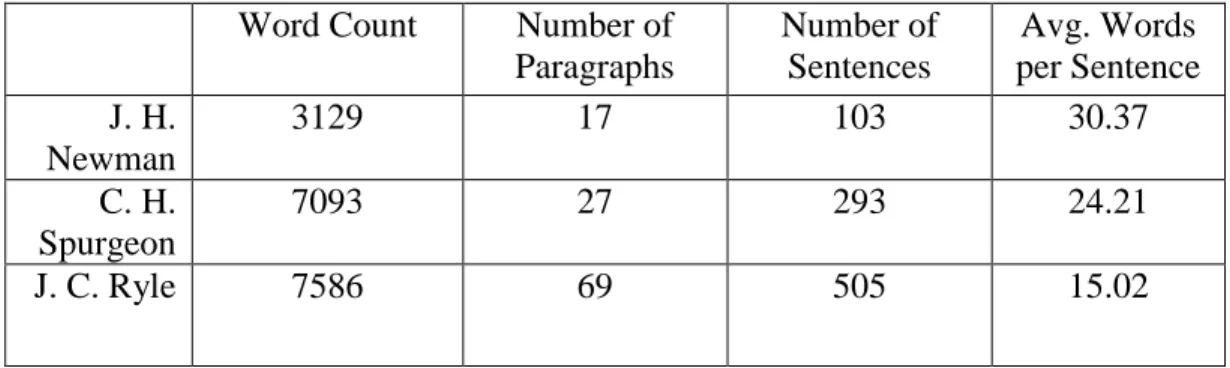
1. An analysis of the composition of sermons by J. H. Newman,
C. H. Spurgeon, and J. C. Ryle on John 11:1-44 ………...………….. 53
2. Church of England church accommodation 1695-1851 ... 247
3. The number of clergy in the Diocese of Liverpool 1880-1897 ... 264
4. Total number of new churches built 1880-1900 ... 265
5. The number of Anglican worshippers in the City of Liverpool in comparison to the population based on the 1851 Religious Census and the Liverpool Daily Post ... 267
6. Alastair Wilcox’s adjusted data on Anglican worshippers as a percentage of Liverpool’s population ... 268
7. Attendance at eight working class parish churches 1881-1902 ... 270
PREFACE
At the close of this dissertation I would like to thank some of the people who helped turn this dream into a reality. I would like to thank Dr. David Puckett, my doctoral supervisor, for pointing me in Ryle’s direction and for his advice and encouragement along the way. Dr. Michael Haykin’s interest and example has spurred me on as well.
I owe a debt of gratitude to an army of librarians in Liverpool, Oxford, Cambridge, Bristol, Glasgow, and London for granting me access to sources that are not available in the US, and to Southern Seminary for generously giving me a field study grant which allowed me to visit them. Ben Ruppert and his predecessors at the Southern Seminary Interlibrary Loan Office have been a tremendous help in tracking down obscure Victorian sources. And I would like to thank Dr. Miles Van Pelt and Rev. John McCarty for giving me a research room in the RTS Jackson Library and allowing me to camp out there for the last three years.
I have been blessed by the love and support I have received from good friends.
The Davises of Vicksburg, Mississippi, have been a constant source of encouragement.
The Shearers of Anchorage, Kentucky, were our home away from home. And Ben Bailie has been a sounding-board, wise counselor, and sympathetic listener since my first day on campus. His insight and friendship enriched my time at SBTS, this dissertation, and my life.
No words can adequately express my appreciation to my wife, Christie. Your sacrifice, encouragement, and faith in me have made this dream a reality.
Bennett Wade Rogers Louisville, Kentucky
December 2015
CHAPTER 1
CHRISTIAN AND CLERGYMAN Introduction
J. C. Ryle is the most popular and neglected evangelical Anglican of the Victorian era. He became the undisputed leader and spokesman of the Evangelical party within the Church of England in the last half of the nineteenth century, and his works continue to be read by evangelicals of various denominational stripes more than a century after his death. Despite this popularity, he has been virtually ignored. An illuminating comparison can be made by comparing Ryle to one of his most famous contemporaries, Charles Haddon Spurgeon. In the year that Spurgeon died (1892), at least eighteen biographies were written about him. Less than half that many have been written about Ryle in the one hundred and fifteen years since his death in 1900.
M. Guthrie Clark (1947) and G. W. Hart (1963) produced the first biographies of Ryle, but they are brief and based on minimal research. Marcus Loane published a short biography in 1953 and enlarged it in 1967 and again in 1983. Loane’s biographies present Ryle as a model Christian and an example of evangelical continuity within the Church of England. While Loane’s works utilize more primary and secondary source material than either Clark or Hart, these works tend to be more hagiographic and devotional than critical or scholarly.
In 1975 Reiner Publications released an autobiographical fragment that Ryle composed for his family in 1873 which covered his life from 1816 to 1860. Peter Toon edited the volume and Michael Smout added a biographical postscript which discussed Ryle’s life after 1860. Following its publication, Toon, Smout, and Eric Russell set out to write the definitive critical biography of Ryle, but fell short of their goal. Eric Russell
was forced to abandon the project due to prior vocational commitments. Soaring production costs restricted the work to less than one hundred pages. Moreover, the authors concluded that a definitive life could not be written until more was known about evangelicalism in the Church of England and G. R. Balleine’s The History of the
Evangelical Party was replaced.1 Despite these setbacks, their work remained the fullest treatment of Ryle until Eric Russell’s biography replaced it in 2001.
Russell’s biography, J. C. Ryle: That Man of Granite with the Heart of the Child, is the fullest treatment of Ryle to date. Russell presents Bishop Ryle as an exemplary church leader – one who was able to combine leadership, conviction, and compassion. He delves more deeply into Ryle’s thought than the previous biographers, and uncovers new and valuable material (especially in Liverpool), but in the end
Russell’s work has more in common with Clark, Hart, and Loane, than Toon and Smout.
Several other studies deserve mention. Ian Farely’s work, J. C. Ryle, First Bishop of Liverpool: A Study in Mission Amongst the Masses, focuses exclusively on Ryle’s episcopacy in Liverpool. John Newby systematized Ryle’s theology under the traditional theological loci in an unpublished dissertation entitled “The Theology of John Charles Ryle.” J. I. Packer penned an appreciative and insightful survey of Ryle’s life and work in Faithfulness and Holiness: The Witness of J. C. Ryle. David Bebbington
evaluated Ryle’s ministry and outlook in The Heart of Faith: Following Christ in the Church of England. Alan Munden contributed a short but remarkably comprehensive account of Ryle’s life to the Day One Travel Guide Series entitled, Travel with Bishop J.
C. Ryle.
The purpose of this dissertation is to produce the first intellectual biography of J. C. Ryle. Toon and Smout were unable to produce such a work in 1975, and in many
1Peter Toon and Michael Smout. John Charles Ryle: Evangelical Bishop (Swengal, PA: Reiner Publications, 1976), 5.
respects, this work seeks to complete what they started. Thankfully, a number of
excellent studies have shed new light on Anglican evangelicalism,2 and Balleine’s work has been replaced by Kenneth Hylson-Smith’s Evangelicals in the Church of England:
1734-1984. Therefore, I believe an undertaking of this kind is now possible.
The primary question of this dissertation is who is J. C. Ryle? The typical answer is epitomized by the nom de plume he used in the correspondence columns of the Evangelical press – “an old soldier.” Both friend and foe alike regard him as an “icon of unbending traditionalism.”3 I argue that he is far more dynamic and complex, progressive and pragmatic, creative and innovative, than is often realized. Ryle simply defies simple categorization. He could be traditional, moderate, and even radical, and was called such at different times by different groups during his fifty-eight year ministry. Perhaps the difficulty in understanding the man is attributable to the many and varied roles he played in the Victorian Church. He began his ministerial career as a rural parish priest; he ended it as the bishop of the Second City of the British Empire. In the time between, he became a popular preacher, influential author, effective controversialist, recognized party leader, stalwart Church defender, and radical Church reformer. Much of the work that has been done on Ryle has focused on certain aspects of his ministry or treated the whole more
2See David Bebbington, Evangelicalism in Modern Britain: A History from the 1730s to the 1980s (Grand Rapids: Baker Book House, 1989); Grayson Carter, Anglican Evangelicals: Protestant Sessions from the Via Media, 1800-1850 (Oxford: Oxford University Press, 2001); Christopher J.
Cocksworth, Evangelical Eucharistic Thought in the Church of England (Cambridge: Cambridge University Press, 1993); Boyd Hilton, The Age of Atonement: The Influence of Evangelicalism on Social and Economic Thought (Oxford: Oxford University Press, 1991); John Kent, Holding the Fort: Studies in Victorian Revivalism (London: Epworth Press, 1978); Doreen Roseman, Evangelicals and Culture, 2nd ed.
(Eugene, OR: Pickwick Publications, 1992); Mark Smith and Stephen Taylor, eds., Evangelicalism in the Church of England c.1790-c.1890: A Miscellany (Woodbridge, UK: Boydell Press, 2004); Peter Toon, Evangelical Theology 1833-1856: A Response to Tractarianism (Atlanta: John Knox, 1979); Martin Wellings, Evangelicals Embattled: Responses of Evangelicals in the Church of England to Ritualism, Darwinism, and Theological Liberalism 1890-1930 (Carlisle, UK: Paternoster Press, 2003); and Anne Bentley, “The Transformation of the Evangelical Party in the Church of England in the Latter Nineteenth Century” (Ph.D. diss., University of Durham, 1971).
3Martin Welling, introduction to “J. C. Ryle: ‘First Words.’ An Opening Address Delivered at the First Liverpool Diocesan Conference, 1881,” in Evangelicalism in the Church of England c.1790- c.1890: A Miscellany (Woodbridge, UK: Boydell Press, 2004), 286.
generally. As a result, some aspects of Ryle’s life and work have never been discussed in detail, and others have never been discussed at all. The aim of this dissertation is to present J. C. Ryle’s thought, life, and ministry in its fullness and in context. In so doing, I hope to provide a more thorough answer to the central question of this work than has hitherto been given, and shed further light on Victorian evangelicalism in general and evangelicalism within the Church of England in particular.
This dissertation is organized chronologically and topically. Each chapter focuses on a particular period of Ryle’s life and analyzes a particular aspect of his thought and work. Each chapter follows the previous in time and builds upon it thematically. For example, Ryle’s preaching in Helmingham, which is the subject of chapter 2, created a market for his pastoral writings, which is the subject of chapter 3.
This dissertation concludes with a summary of Ryle’s thought and life.
Family
John Charles Ryle was born on May 10, 1816, at Park House, Macclesfield. He was the fourth of six children and the eldest son. The Macclesfield of Ryle’s birth was a growing factory village with a population of 17,746 according to the census of 1821.4 It was situated on a main route from London to the North West and was linked to the major industrial centers of Manchester and Liverpool by canals. It was home to a copperworks and a number of cotton mills, but the silk industry dominated all others.5 The silk trade
4For the history of Macclesfield, see C. Stella Davies, A History of Macclesfield (Manchester:
Manchester University Press, 1961); J. P. Earwaker, East Cheshire Past and Present: A History of the Hundred of Macclesfield, in the County of Palatine of Chester, 2 vols. (London: J. P. Earwaker, 1877, 1880); George Ormerod, The History of the County of Palatine and the City of Chester, 3 vols. (London:
George Routledge and Sons, 1882).
5 The religious character of Macclesfield, shortly before Ryle’s birth, was strongly Protestant, Anglican, and evangelical. Lollardly took root in Macclesfield during the fifteenth century, its forest providing a safe-haven for worshippers. There no available evidence about the response of the town to the Reformation, but based on subsequent history, it was probably well received. Puritanism flourished in Cheshire in general and Macclesfield in particular. As early as the late sixteenth century Puritan services, the Geneva gown, and popular religious lectures could be found in the Macclesfield church. Roman Catholicism, on the other hand, almost vanished altogether after the Reformation; it survived only the
prospered during the closing decades of the eighteenth century, and that prosperity was accelerated by the Napoleonic Wars, which made French silks scarce. During these years many industrialists made a fortune in silk. John Ryle (1744-1808), John Charles’s
grandfather, was one of them.
By all accounts John Ryle was a remarkable man. He became a successful silk manufacturer, prosperous landowner, and a respected banker. When he died in 1808, he left his son, J. C. Ryle’s father, somewhere between £250,000-500,000. John’s success also extended to the political sphere. He was elected alderman and then mayor of Macclesfield. John was also a committed evangelical Christian, Methodist, and
philanthropist. His mother had been converted after hearing John Wesley preach in 1745, and through her influence he became a Christian. Wesley and Ryle became intimate friends, and Wesley often stayed at Ryle’s home when he visited Macclesfield, which he did regularly from 1759 until his death in 1791.6 Ryle provided the site for the
construction of a Methodist meeting house in 1764, and the land and the funds for another in 1779. John Charles never knew his grandfather or his grandmother; both died
households of a few wealthy Catholic families. Given the town’s Puritan sympathies, it is not surprising that it supported the Parliamentarians during the Civil War, nor is it surprising that ten ministers within the Deanery of Macclesfield lost their livings as a result of the Great Ejection. The reception of the Evangelical Revival in Macclesfield deserves special attention. Evangelical preaching and doctrines were first brought to the town by the itinerant John Bennet of Chinley in the early 1740’s. John Wesley came in 1745 and then again in 1759. From that time on he visited regularly. One of the more remarkable features of Wesley’s ministry in Macclesfield was his unusually strong relationship with to the established church in the community. The vicar of St. Michael’s, James Roe (1711-65), became an evangelical late in life. David Simpson (1745-99), the vicar of Christ Church, was an ardent and enthusiastic evangelical. He was an active pastor, prolific author, a local itinerant, and intimate friend of John Wesley. For a season, all of the parish churches in Macclesfield were in Evangelical hands, and local Methodists were all communicants in the Church of England.
6John Wesley often mentioned these visits in his journals. See The Journal of the Rev. John Wesley, A.M. Sometime Fellow of Lincoln College, Oxford (London: Charles H. Kelly, 1909-16), 4: 310; 6:
14, 100, 226, 411; 7: 300. For more information about Methodism in Macclesfield, see Benjamin Smith, Methodism in Macclesfield (London: Wesley Conference Office, 1875); and R. B. Walker, “Religious Changes in Cheshire, 1750-1850,” Journal of Ecclesiastical History 17 (1966): 77-94.
before he was born. However, he spoke of them and their evangelical faith with great admiration in his autobiography.7
John Charles’ parents, John Ryle (1783-1862) and Susanna Hurt, form an interesting contrast with his grandparents. Like his grandfather, his father was a
professional success. He continued to run the lucrative family silk business. He purchased more land and properties and expanded the family’s holdings. He also took over a failing bank in 1800 and made it profitable for decades. Like his grandfather, his father was interested in politics and public service. He was elected mayor of Macclesfield in 1809 and 1810. He became the first MP for Macclesfield elected under the reformed
Parliament in 1832, and he held that seat until 1837.8 He later became the High Sheriff of Cheshire. Before his bank crashed in 1841, he was so excessively popular that he was practically the “king of the place.”9 His mother, Susanna Hurt, also came from a wealthy, land-owning family. She was related to Sir Richard Arkwright, the inventor of the
spinning-jenny. However, neither John nor Susanna showed much interest in spiritual matters.
John Charles records in his autobiography that his home was destitute of real spiritual religion. Family prayers were almost never said. His father’s spiritual instruction consisted of showing the children pictures in an old Bible on sleepless Sunday nights. His mother’s spiritual instruction consisted of nothing more than occasionally listening to the children recite the Church Catechism in “a very grave and rather gloomy manner.”10 Sometimes the elderly members of the family read sermons silently on winter Sunday nights, but they looked so “unutterably grave and miserable” that Ryle concluded that
7See J. C. Ryle, A Self-Portrait, ed. Peter Toon (Swengel, PA: Reiner Publications, 1975), 4.
8Ryle described him as a Liberal in support of Lord Gray, and then a Liberal-conservative in support of Lord Derby. Ryle, A Self-Portrait, 4.
9Ibid., 4.
10Ibid., 36-37.
sermons must be very dull and religion must be very disagreeable.11 His first governess was a Socinian, and none of her successors had “any real spirituality about them.”12 The Christian Sabbath was not kept, they had no religious friends or family members, and no Christians ever visited them or brought them any religious books or tracts.13
The family regularly attended Christ’s Church, which was one of only two parish churches in Macclesfield. For a brief period of time, both churches had
Evangelical incumbents, which was unusual for the time.14 They were not, however, succeeded by Evangelical clergymen. John Charles describes the incumbents of St.
Michael’s and Christ’s Church of his childhood as “wretched high and dry sticks of the old school,” and remarked, “I can truly say that I passed through childhood and boyhood without hearing a single sermon likely to do good to my soul.”15 In fact, he was brought up to regard Evangelical clergymen as “well-meaning, extravagant, fanatical enthusiasts, who carried things a great deal too far in religion.”16
John Charles summed up the spiritual condition of his family and childhood as follows:
The plain truth is that neither in my own family nor among the Hurts or Arkwrights with whom I was most mixed up when young can I remember that there was a whit of what may be called a real spiritual religion. There was literally nothing to make us young people thorough Christians. We never heard the gospel preached on
11Ryle, A Self-Portrait, 36.
12Ibid., 37.
13Ryle said that the only two books that affected him as a child were Bunyan’s Pilgrim’s Progress and Mrs. Sherwood’s Conversations on the Church Catechism.
14The Rev. Charles Row, the incumbent of St. Michael’s, had an evangelical conversion late in life. The Rev. David Simpson, the minister of Christ’s Church from 1779-1799, was an outspoken
evangelical, popular preacher, and energetic pastor. He regularly allowed John Wesley to preach in his pulpit. See Mark Smith, “David Simpson,” in Oxford Dictionary of National Biography (Oxford: Oxford University Press, 2004), 683-84.
15Ryle, A Self-Portrait, 36.
16Ibid., 37.
Sunday and vital Christianity was never brought before us by anybody from the beginning of the year to the end or on a weekday.17
Education
John Charles was a precocious child and an eager learner. Isaac Eaton, the clerk of St. Michael’s, taught John Charles to read, write, and ‘cipher’ at an early age.
Miss Holland, his sister’s Unitarian governess, instructed him in the rudiments of Latin as well. By the age of four he had become a proficient reader and extremely fond of books, especially books about travel, natural history, military battles, and shipwrecks.18
At the age of eight (1824) John Charles was sent to a preparatory school run by the Rev. John Jackson, vicar of Over. This was not a happy time in his life. The
accommodations were rough and uncomfortable. He was one of seventeen pupils who were lodged in two rooms and shared one washroom. He later remarked, “of course at this rate we could not be very clean.”19 There was also a great deal of “petty bulling and tyranny.” For example, with the master’s permission, he was tossed in a blanket by the older boys for not rising with the rest. He was thrown to the ceiling and then fell to the floor when one student let go of one corner of the blanket. He suffered a concussion and was sick for some time, but the incident was hushed up and his family was never told.20 Furthermore, the pupils were often left unsupervised for long periods of time while Rev.
Jackson attended to the needs of his parish.
In terms of academics, things were more tolerable. The students were well grounded in Latin and Greek. They were also taught writing, arithmetic, history,
17 Ryle, A Self-Portrait, 37.
18Ibid., 10. Military battles and seafaring remained a life-long fascination for Ryle. He regularly used military and maritime illustrations in his sermons.
19Ibid., 12.
20Ibid., 13.
geography, French, and dancing. The two most popular sports were cricket and stone throwing, and John Charles excelled at both. Religious instruction was nonexistent, and as a result, the moral condition of the school was deplorable. He later recalled, “As to the religion at the private school there was literally none at all, and I really think we were nothing better than little devils. I can find no other words to express my recollection of our utter ungodliness and boyish immorality.”21
John Charles’ three and a half years at the Rev. Jackson’s preparatory school gave him a good grounding in Latin and Greek, produced a sturdy, independent, and combative young man,22 and laid a good foundation for future academic success at Eton and beyond. However, from a moral and spiritual standpoint, his education was a complete failure. “I am quite certain that I learned more moral evil in a private school then I ever did in my whole life afterwards and most decidedly got no moral good.”23 The King’s College of Our Lady of Eton beside Windsor was founded by Henry IV in 1440 to combat heresy and provide a clerical education for the middle class.24 When John Charles entered in January 1828, it was doing neither. His classmates were hardly middle class. Most of them were the sons of noblemen, aristocrats, or the rich and well-connected. Religion had no place in the curriculum. The headmaster of the school was the infamous Dr. John Keate, who stands out in the public mind as the
21Ryle, A Self-Portrait, 37.
22“I don’t think I was an ill-natured, bad-tempered boy, but I was sturdy, very independent and combative. I had a very strong opinion of my own, and never cared a bit for being a minority, and was ready to fight anybody however big if necessary.” Ibid., 13.
23Ibid., 14.
24For two of the best histories of Eton, see H. C. Maxwell Lyte, A History of Eton College 1440-1875 ( London: Macmillan and Company, 1877), and Christopher Hollis, Eton: A History (London:
Hollis and Carter, 1960). See also William Lucas Collins, Etoniana, Ancient and Modern (London:
William Blackwood and Sons, 1865), Lionel Cust, A History of Eton College (New York: Charles Scribner’s Sons, 1899), Wasey Sterry, Annals of the King’s College of our Lady of Eton Beside Windsor (London: Methuen and Company, 1898), and Francis St. John Thackeray, Memoir of Edward Craven Hawtrey D.D., Headmaster and Afterward Provost of Eton (London: George Bell and Sons, 1896).
supreme symbolic figure of the old unreformed Eton.25 Keate was an excellent classical scholar, a poet, and an accomplished teacher, but he is probably best remembered for his savage floggings. The curriculum under Keate was exclusively, narrowly, and
monotonously classical. Homer, Virgil, and Horace were read in extenso. A student could expect to read through the Iliad and Aeneid twice during his tenure at Eton under Keate.
Translations from books of extracts, such as Scriptores Graeci, Scriptores Latini, and Scriptores Romani rounded out the curriculum. Mathematics was optional. History, English literature, and geography were studied only in so far as they had a bearing on the Classics. The only natural science that was offered consisted of occasional guest lectures.
Religious instruction was nonexistent and even discouraged until the Duke of Newcastle established a scholarship to encourage the study of divinity in 1829.26
Upon entering Eton, students were divided into groups or “houses.” John Charles was assigned to Hawtrey’s House, which was named for the assistant master Edward Craven Hawtrey.27 This assignment was extremely fortunate for young Ryle. By all accounts, Hawtrey’s house was the best in Eton in every respect. It was comfortable,
25Christopher Hollis, Eton: A History (London: Hollis and Carter, 1960), 191.
26Keate’s antagonism to religious instruction has been well documented. John Bird Sumner, the Archbishop of Canterbury, was forbidden “from saying a single word about God to his pupils” while serving as an Assistant-master at Eton from 1802 to 1817. Every Sunday afternoon between two and three all the boys of the upper school were required to hear “prayers” read by the Headmaster. The “prayers”
turned out to be discourses on abstract morality from Blair’s Sermons, the Spectator, or a pagan moral philosopher like Epictetus. Eton historian Henry Maxwell Lyte said, “It seems incredible that there should ever have been an entire absence of religious teaching at the greatest school in Christian England; yet such, from all accounts, must have been the case at Eton until about sixty years ago.” See H. C. Maxwell Lyte, A History of Eton College 1440-1875 ( London: Macmillan and Company, 1877), 361.
Ryle later returned to Eton to rectify this deficiency personally. He was invited to preach at chapel in 1871, and though the sermon has not survived, according to his friend, Rev. C. W. Furse, he proclaimed the uselessness of “high morality” and “gentlemanly conduct” apart from the saving grace of God. See the Authorized Report of the Church Congress Held at Nottingham (London: W. Wells Gardner, 1871), 414-15.
27Edward Craven Hawtrey was assistant master from 1814-34, headmaster from 1834-53, and provost from 1853-62. See Francis St. John Thackeray, Memoir of Edward Craven Hawtrey D.D., Headmaster and Afterward Provost of Eton (London: George Bell and Sons, 1896).
the boys were well cared for, and there was no “positive cruelty.” Moreover, Hawtrey was an attentive and encouraging tutor, which was unusual for Eton at the time. Though Eton had not yet adopted the “private system” pioneered by Thomas Arnold at Rugby, Ryle received something akin to it from him. Under Hawtrey’s tutelage, Ryle studied French, history, and English literature, in addition to Keate’s narrow selection of Greek and Latin authors. He also personally helped Ryle prepare for Oxford. Under his guidance, Ryle read nearly every book in which he was later examined in for first class honors at Oxford. Although Ryle had almost nothing positive to say about Keate, he remained grateful to his tutor for the rest of his life. In 1890, Bishop Ryle said, “I am certain that if it had not been for Hawtrey, I should never have been a First-class man side by side with Dean Stanley in classics, or Craven University Scholar.”28
John Charles described his first year and a half at Eton as “thoroughly
miserable.” He did not know any of the six hundred boys at the school. He was awkward, shy, younger than many first-years, and felt out of place in the South. Shortly thereafter, he began to flourish. He made steady academic progress during his six and a half years at Eton. He rose to the top of his class by the time he reached the fifth form. He placed fourth in the Newcastle Scholarship, to the surprise of many. He joined the debating society and took a prominent part in its proceedings as well. By his sixth year, he was regarded as one of the most prominent boys in the school. He believed he could have achieved even more academically if his tutor was ill less frequently.
John Charles academic success was equaled by his athletic prowess. He was blessed with a tall, robust, and athletic frame, which earned him the nickname
“Magnus.”29 He took fencing lessons, enjoyed rowing, and excelled in hockey, but
28Francis St. John Thackeray, Memoir of Edward Craven Hawtrey D.D., Headmaster and Afterward Provost of Eton (London: George Bell and Sons, 1896), 51.
29Ryle’s size and stature were impressive even later in life. For example, at the Swansea Church Congress (1876), one of the speakers said the following of the sixty-three year old Ryle: “Canon Ryle dropped a hint that he was ready to turn up his sleeves, and double his fists, and square his shoulders,
cricket was his great love.30 He was a member of the Eton’s cricket club. The top eleven cricketers were chosen to represent Eton in matches against Harrow and Winchester. He made the Cricket XI and went on to become its captain. He later said that his time as captain of the XI helped prepare him for leadership in the Church.31
John Charles time at Eton also proved to be a time of limited spiritual awakening. Though Headmaster Keate discouraged religious instruction and gave it no place in the school’s official curriculum, the founding of the Newcastle Scholarship in 1829 encouraged the study of divinity. Those competing for the prize – £50 a year for three years – had to demonstrate proficiency in Greek and Latin and submit three papers:
one on the Gospels, one on Acts, and one on general divinity and church history.
Preparing for the Newcastle examination exposed John Charles to dogmatic Christianity for the first time, and he traced the beginning of his first clear doctrinal views back to his preparation for this exam. He later wrote, “It is a simple fact, that the beginning of any clear doctrinal views I have ever attained myself, was reading up the Articles at Eton, for the Newcastle Scholarship.”32
John Charles completed his education in 1834 and left with “unfeigned regret.”
His last two years at Eton were some of the happiest of his life, but he felt compelled to leave. He was ready to compete for first class honors in the classics at either Oxford or Cambridge. He decided on Christ Church, Oxford, and entered in October of 1834.
against any one who should say a word in favour of confession. It seemed that at this point he drew the line.
Certainly I should not like to accept battle with him for I am afraid, judging from the Canon's build, I should, get in plain English, an awful drubbing.” The Official Report of the Nineteenth Annual Church Congress Held at Swansea (London: John Hodges, 1879), 397.
30“Nothing did I enjoy so much as cricket when I was in the XI and as long as I live I think I shall say, that the happiest days I ever spent in a simple, earthly way were the days when I was captain of the XI in Eton playing-fields.” Ryle, A Self-Portrait, 20-21.
31Ibid., 21.
32J. C. Ryle, Who Is the True Churchman? Or, the Thirty-Nine Articles Examined (London:
William Hunt and Company, 1872), 38.
Christ Church was founded as Cardinal College by Cardinal Wolsey in 1525 for the education of the youth in virtue and the maintenance of the Christian Church and faith.33 It received a new name, Christ Church, and a new royal foundation from King Henry VIII in 1546. Under the leadership of Cyril Jackson (Dean from 1783-1809), Christ Church became preeminent among the colleges of Oxford. Jackson’s success, however, was not maintained by his successors. When John Charles entered Christ Church in October of 1834, Thomas Gaisford was Dean. Though his scholarship was legendary, he opposed all reform, and as a result Christ Church suffered.
John Charles’ tutors at Christ Church were Augustus Short and Henry Liddell.
He had nothing positive to say about Short. “Short as a tutor was perfectly useless,” he complained, “and I never learned anything from him.”34 Liddell, on the other hand, was
“a very good tutor and I heartily wished I had been under him during the whole time I was at Oxford.” He later remarked that “If I had only had such a wise and kind tutor as Liddell was all the time I was there, I believe I might have carried off three times as many honors as I did.”35
As it was, he managed to carry off a number of honors during his three years at Oxford. He won a Fell Exhibition at the end of his first year. He won the Craven
University Scholarship at the end of his second year. At the end of his third and final year he won a “very brilliant” first-class in Literae Humaniores, an achievement that remained
33For the history of Christ Church, see Judith Curthoys, The Cardinal’s College: Christ Church, Chapter and Verse (London: Profile Books, 2012). See also W. G. Hiscock, A Christ Church Miscellany (Oxford: Oxford University Press, 1946), Henry L. Thompson, Christ Church (London: F. E.
Robinson and Company, 1900). For a superb study of nineteenth-century Oxford, see M. G. Brock, and M.
C. Curthoys, eds., Nineteenth-Century Oxford, Part 1, vol. 6 of The History of the University of Oxford (Oxford: Oxford University, 2007).
34Ryle, A Self-Portrait, 29.
35Ibid., 29, 34. For a life of Liddell, see Henry L. Thompson, Henry George Liddell: A Memoir (New York: Henry Holt and Company, 1899). Ryle is specifically mentioned on p. 27 as one of Liddell’s first thirteen pupils. Liddell described this first group of students as “a very good set who will keep all my wits at work.” His relationship with his students was also described as “more directly pastoral.”
a source of pride for him for the rest of his life.36 Following his spectacular “first,” he was urged to come forward as a candidate for a fellowship at Christ Church, Brasenose, or Balliol, but declined all such offers believing his future was in politics not academia.
In addition to academic success, Ryle continued to excel in cricket. He made the University XI all three years he was at Oxford, and was the captain of the team during his second and third years. He also helped revive the old Oxford versus Cambridge matches by contacting his former Etonian classmates at Cambridge.37
Despite his success, John Charles was not happy during his time at Oxford. He disliked the tone of society among the undergraduates. The “miserable idolatry” of money and aristocratic connection disgusted him so completely that he contemplated becoming a republican. His classmates were distant and cold, and he missed the
camaraderie he experienced at Eton. And the tutors, with the exception of Liddell, gave him no help, counsel, or advice, and seemed generally disinterested. As a result, he developed a “rather soured misanthropical view of human nature,” and concluded that the whole system needed reform. Though John Charles’ academic and athletic career at Christ Church were, by all accounts, outstanding, he said, “I left Oxford with a brilliant reputation for the honors which I had taken but with very little love for the university and very glad to get away from it.”38
Before moving forward, something should be said about Ryle’s spiritual and theological development during this period of his life. Ryle entered Oxford as the first of the Tracts for the Times were being published by the leaders of the Oxford Movement. In fact, E. B. Pusey, one of the movement’s principle leaders, was the Regius Professor of Hebrew at Christ Church. Ryle appears to have been completely indifferent to
36There were eleven first classes honors award in 1837, but the examinations of Ryle, Arthur Stanley, and Henry Heighton so far exceeded the rest that making a small class of these men was discussed.
37Toon and Smout, John Charles Ryle, 30n3.
38Ryle, A Self-Portrait, 31.
Tractarianism at the time.39 Nor was he drawn to evangelicalism. Ryle notes that that there were a good number of evangelical men at Oxford at the time, but their preaching was “very defective.”40 He does, however, speak positively of the preaching of Edward Denison and Walter Hamilton at St. Peter’s in the East, who were sympathetic to
evangelicalism at this point in their ministries.41 Ryle also wrestled with skepticism for a time – a fact which he omits in his autobiography.42 He was delivered from it by reading George Stanley Faber’s The Difficulties of Infidelity.43 For the most part, Ryle was generally indifferent to religion during his time at Oxford until midsummer of 1837.
Despite his personal indifference, Ryle was compelled to study divinity as a part of the requirements for his degree. The new examination statute of 1800, which introduced the concept of honours degrees, required that every candidate demonstrate a knowledge of the Gospels in Greek, the Thirty-nine Articles, and Bishop Butler’s Analogy (William Paley’s Natural Theology could be substituted). Ryle’s account of the viva voce portion of his examination sheds further light on his reading. In addition to the
39Tractarianism had little influence in Christ Church. J. H. Newman complained to H. W.
Wilberforce that “Christ Church alone is immobile.” Oriel, Trinity, and Exeter were the Tractarian
strongholds. See P. B. Nockles, “Lost Causes and . . . Impossible Loyalties: The Oxford Movement and the University,” in Nineteenth-Century Oxford, Part 1, vol. 6 of The History of the University of Oxford (Oxford: Oxford University, 2007), 232.
40Ryle’s comment about the noticeable presence of evangelical men seems to confirm J. C.
Reynolds’ contention that evangelicals were well represented at Oxford at this time, and their strength should not be gauged exclusively by their response to the Tracts. He writes, “Thus the evangelicals at Oxford were not context with defending their theological views. They were still busy extending their spiritual work. During a critical period they can be said to have neglected neither doctrine nor practice.” J.
S. Reynolds, The Evangelicals at Oxford 1735-1871: A Record of an Unchronicled Movement with the Record Extended to 1905 (Oxford: Marcham Manor Press, 1975), 115.
41Hamilton later became an Anglo-Catholic.
42Years later he recalled, “I can remember the days when I tried hard to be an unbeliever, because religion crossed my path, and I did not like its holy requirements. I was delivered from that pit, I believe, by the grace of God leading me to . . . Faber’s Difficulties of Infidelity. I read that book, and felt that it could not be answered.” J. C. Ryle, Unbelief a Marvel (London: William Hunt and Company, 1880), 17.
43George Stanley Faber, The Difficulties of Infidelity (Philadelphia: Thomas Kite, 1829).
Articles, Bible, and Butler/Paley, Ryle was examined on the Prayer-Book, Church history and tradition, the Fathers, the Creeds, Augustine, and Pelagius.44 Through his pursuit of first-class honors at Oxford, Ryle unintentionally, and perhaps to some degree
unwillingly, received a substantial theological education.
Conversion
In the autumn of 1837, before he took his degree, Ryle underwent an evangelical conversion. He described it as a gradual process as opposed to “a sudden immediate change.” This process began with the Newcastle Scholarship, preparing for an honors degree at Oxford, and the preaching of Denison and Hamilton. In his
autobiography Ryle mentions a number of significant events that he believed the Holy Spirit used in a special way to convert him.
The first was a rebuke from a friend. While out hunting with a group of friends about a year after leaving Eton, John Charles swore in the presence of Algernon Coote, who proceeded to rebuke him sharply. The rebuke pricked his conscience and made a deep and lasting impression on him. It made him consider the sinfulness of sin for the first time, and it was the first time someone ever told him to think, repent, and pray. He later said that this rebuke “was one of the first things that I can remember that made a kind of religious impression upon my soul.”45
The second was the evangelical ministry of a newly opened church in Macclesfield – St. George’s in Sutton. St. George’s was originally opened as a
Congregational chapel in 1824, but it was re-opened for Church of England services in
44Ryle, A Self-Portrait, 32-33. For more information, see The Student’s Guide to a Course of Reading Necessary for Obtaining University Honours by a Graduate of Oxford (Oxford: Henry Slatter, 1837). This is practically a CliffsNotes to honors degrees, but even this condensed reading list shows how much divinity Ryle would have been responsible for. This anonymous graduate encourages students to make an outline of Jewish history from the Old Testament; memorize the Thirty-nine Articles; familiarize themselves with the major arguments of Butler, Paley, and Sumner; and read the Bible thoroughly.
45Ryle, A Self-Portrait, 39.
1828 after a dispute divided the congregation. The Bishop of Chester was asked to bring St. George’s under episcopal authority. It was officially consecrated in 1834 and the land for the church and the churchyard was donated by John Charles’ father. The newly appointed Bishop of Chester, the evangelical John Bird Sumner, appointed an Evangelical clergyman, the Rev. William Wales, to be its first minister.46 He was succeeded by another Evangelical in 1834, the Rev. John Burnet. According to John Charles, the “gospel was really preached” by these men, and they introduced “a new kind of religion” into the Church of England in that part of Cheshire.47 He attended St.
George’s with his family while home on holiday, and its evangelical ministry began to
“set him thinking about religion.”
The third was the conversion of Harry Arkwright, John Charles’ first cousin.
He was converted while preparing for ordination with Rev. Burnet of St. George’s. Ryle was struck by the “great change” that took place in Harry’s character and opinions.
Shortly thereafter, Ryle’s sister, Susan, “took up Mr. Burnet’s opinions” and was converted as well. As a result, evangelical religion became the subject of many family conversations, and he began to think more deeply about it.
The fourth was a severe illness that struck in the middle of the summer of 1837 as he was preparing for his exams. He was confined to his bed for days and was brought
“very low for some time.” During this “very curious crisis,” he began to read the Bible and pray for the first time. He latter credited these new habits with helping him go through his exams “very coolly and quietly.”48
The fifth and final event was hearing a lesson from the second chapter of Ephesians read one Sunday morning. Around the time of his examinations, John Charles
46For a solid biography of John Bird Sumner, see Nigel Scotland, John Bird Sumner:
Evangelical Archbishop (Leominster, UK: Gracewing Books, 1995).
47Ryle, A Self-Portrait, 39.
48Ibid., 40.
attended a church in Oxford feeling somewhat depressed and discouraged. The reader of the lesson made some lengthy pauses when he came to verse 8: “By grace—are ye saved—through faith—and that, not of yourselves—it is the gift of God.” This unusual and emphatic reading of Ephesians 2:8 made a tremendous impact on him and led to his own evangelical conversion.49 By year’s end, John Charles Ryle was “fairly launched as a Christian.”
The beginning of John Charles Christian pilgrimage was not easy. He had no spiritual mentors or guides. He was left to “fight out everything” for himself, and as a result, “made sad blunders.”50 Through this process of trial and error, he finally found the guidance he so desperately wanted in books. Those that helped him most were William Wilberforce’s Practical View of Christianity, John Angell James’ The Christian
Professor, Thomas Scott’s Reply to Bishop Tomline, John Newton’s Cardiphonia, Isaac Milner’s Church History, and Edward Bickersteth’s The Christian Student.
Moreover, his new evangelical convictions were challenged almost as soon as they were embraced. The opponents of evangelicalism within his family, and his cousin Canon John Ryle Wood in particular,51 were horrified by his evangelical conversion, and they tried to convince him to abandon his new religious principles. Contending for his newly-found evangelical faith only rooted him more deeply in it and attached him more firmly to it. He explained,
. . . [T]he whole result was that the more they argued, the more I was convinced that they were wrong and I was right, and the more I clung to my new principles.
Nothing I believe roots principles so firmly in people’s minds as having to fight for them and defend them . . . . What is won dearly is prized highly and clung to firmly.52
49Ryle had Ephesians 2:8 engraved on his gravestone.
50Ryle, A Self-Portrait, 40.
51The Rev. John Ryle Wood was Canon of Worcester from 1841-1886. He also served as tutor to Prince George.
His refusal to abandon his evangelical faith came with heavy personal costs. It caused “great uncomfortableness” among in his family. He was estranged from friends and relatives, and this “miserable state of things” continued for a period of about three and a half years. Though he lost many friends at this time as a result of his conversion, he made some new ones in Evangelical circles, which he described as a “kind of immediate free-masonry.”53 Among them were John Thornycroft and his two sisters, Mr. Harry Arkwright, Mr. Massey, the two Miss Leycesters of Toft, Admiral Harecourt and his wife, Admiral Sir Harry Hope, and Mrs. Georgina Tollechmache. John Charles said these friends “strengthened me in my principles, encouraged me in my practice, solved many of my difficulties, assisted me by their advice, counseled me in many of my perplexities, and cheered me generally by showing me that I was not quite alone in the world.”54
Religious Opinions
By the winter of 1837, John Charles had developed “strongly marked,
developed, and decided” religious opinions. He said his new views “seemed to flash out before my mind, as clearly and sharply as the pictures on a photographic plate when the developing liquid is poured over it.”55 He summarized them as follows:
The extreme sinfulness of sin, and my own personal sinfulness, helplessness, and spiritual need: the entire suitableness of the Lord Jesus Christ by His sacrifice, substitution, and intercession to be the Saviour of a sinner’s soul; the absolute necessity of anybody who would be saved being born again or converted by the Holy Ghost; the indispensable necessity of holiness of life, being the only evidence of a true Christian; the absolute of coming out from the world and being separate from its vain customs, recreations, and standards of what is right, as well as its sins;
the supremacy of the Bible as the only rule of what is true in faith, or right in
practice, and the need of regular study and reading it; the absolute necessity of daily
52 Ryle, A Self-Portrait, 41.
53Ibid., 43.
54Ibid., 44.
55Ibid., 41-42.
private prayer and communion with God if anyone intends to live the life of a true Christian; the enormous values of what are called Protestant principles as compared to Romanism; the unspeakable excellence and beauty of the doctrine of the Second Advent of our Lord and Saviour Jesus Christ; the unutterable folly of supposing that baptism is regeneration or formal going to church Christianity or taking the
sacrament a means of wiping away sins, or clergymen to know more of the Bible than other people or to be mediators between God and men by virtue of their office.56
Though the previous quotation provides a good summary of his theology, some
clarification is desirable. J. C. Ryle’s theology is best described as Protestant, Reformed, Puritan, evangelical, Anglican, and premillennial.
It is difficult to overstate the importance of the Protestant Reformation for Ryle. It saved English Christianity, gave birth to the Reformed Church of England, and is the source of all of England’s spiritual and material prosperity under God. His view of the English Reformation will be discussed at greater length in chapter four. However, in terms of his religious opinions, there are three doctrines that he particularly associates with the Reformation. The first is the sufficiency and supremacy of the Holy Scriptures, which makes it the only rule of faith and practice. The second is right, duty, and necessity of private judgment. The third is justification by faith alone. These three doctrines are the
“principles which won the battle of the Protestant Reformation” and are the “keys of the whole controversy between the Reformers and the Church of Rome.”57
In terms of soteriology, Ryle is best described as a moderate or evangelical Calvinist. He writes, “In a word, I believe that Calvinistic divinity is the divinity of the Bible, of Augustine, and of the Thirty-nine Articles of my own Church.”58 He believed that as a result of the Fall, man was dead in sin and had no power to turn to God.59 He
56 Ryle, A Self-Portrait, 42.
57J. C. Ryle, Prove All Things: A Tract on Private Judgment (Ipswich: Hunt and Son, 1851), 3.
58J. C. Ryle, The Christian Leaders of the Last Century; Or, England A Hundred Years Ago (London: T. Nelson and Sons, 1869), 379.
59J. C. Ryle, “Your Election,” in volume 8 of Home Truths: Being Miscellaneous Addresses and Tracts by the Rev. J.C. Ryle, B.A. (Ipswich: W. Hunt and Sons, 1872), 151.
believed that election was unconditional.60 He believed that God’s saving grace worked monergistically and efficaciously. He believed in the perseverance of the saints. Yet he believed that Christ’s death was sufficient for the whole world, that he “tasted death for every man,” and that he bore the sins of the whole world.61 He believed that God loves all mankind, not just the elect. He denied that the doctrine of election destroys human
responsibility or the free offer of the gospel. He rejected the doctrine of double predestination. Such are the contours of Ryle’s Calvinism.
In terms of personal piety, Ryle’s view of the Christian life is definitely cast in the Puritan mold.62 He believed that the Holy Spirit is the source and sustainer of all spiritual life. Like the Puritans, he believed that the Spirit always works in a similar manner or pattern, and thus he stressed the importance of “marks” or “evidences” of the Spirit’s work. His spirituality was also christocentric. More specifically, it was focused
60“The true doctrine of election I believe to be as follows. God has been pleased from all eternity to choose certain men and women out of mankind, whom by His counsel secret to us, He has decreed to save by Jesus Christ. None are finally saved except those who are thus chosen. Hence the Scripture gives to God's people in several places the name of “God's elect,” and the choice or appointment of them to eternal life is called “God's election.” Those men and women whom God has been pleased to choose from all eternity, He calls in time, by His Spirit working in due season. He convinces them of sin.
He leads them to Christ. He works in them repentance and faith. He converts, renews, and sanctifies them.
He keeps them by His grace from falling away entirely, and finally brings them safe to glory. In short God's eternal election is the first link in that chain of a sinner's salvation of which heavenly glory is the end. None ever repent, believe, and are born again, except the elect. The primary and original cause of a saint's being what he is, is in one word, God's election.” Ryle, “Your Election,” 148.
61“I confess, boldly, that I hold to the doctrine of particular redemption, in a certain sense, as strongly as any one. I believe that none are effectually redeemed but God’s elect. They and they only are set free from the guilt, and power, and consequences of sin. But I hold no less strongly, that Christ’s work of atonement is sufficient for all mankind. There is a sense in which He has tasted death for every man, and has taken upon Him the sin of the world. I dare not pare down, and fine away, what appear to me the plain statements of Scripture. I dare not shut a door which God seems, to my eyes, to have left open. I dare not tell any man on earth that Christ has done nothing for him, and that he has no warrant to apply boldly to Christ for salvation. Christ is God’s gift to the whole world.” J. C. Ryle, Do You Believe? (London:
William Hunt, 1860), 12-13.
62Ryle admired the Puritans and published approving biographical sketches of a number of them when they were generally very unpopular among churchmen. For Ryle’s defense of the Puritans, see Light from Old Times; Or, Protestant Facts and Men With an Introduction for Our Own Days, 2nd ed.
(London: Chas J. Thynne, 1898), xiv-xviii. Furthermore, he quotes from Puritan divines extensively in Holiness.
on Christ’s atonement, ongoing intercession, and Second Advent.63 He also stressed the importance of the diligent use of the means of grace. These included Bible reading, private prayer, regular attending public worship, the regular hearing of the preaching of God’s Word, and regular reception of the Lord’s Supper. Finally, he stressed the importance of observing the Christian Sabbath as well.
J. I. Packer argues that Ryle’s ministerial agenda, as well as his spirituality, was influenced by the Puritans as well. Ryle’s desire to evangelize the English people, purify and reform the national Church, unite all English Christians, and promote the holiness of English believers matches what Packer calls the “Puritan quadrilateral.”64
Ryle regularly and repeatedly identified himself as an “evangelical,” and evangelical religion, according to Ryle, was characterized by five leading features.65 First, evangelicals assign absolute supremacy to the Holy Scripture and regard it as the only rule for faith and practice. Second, evangelicals emphasize the doctrine of human sinfulness and corruption and the need for a radical cure. Third, evangelicals attach paramount importance to the person and work of Christ and the necessity of faith in him.
Fourth, evangelicals stress the importance of the inward work of the Spirit in the heart of the believer and an experimental acquaintance with it. Finally, evangelicals insist that the inward work of the Spirit will always be manifested outwardly by a holy life. For Ryle, these points constitute the essence of the evangelical gospel and the Christian faith.
Ryle was a committed Anglican Churchman. He regarded the Thirty-nine Articles, the Church’s confession of faith, as the greatest human doctrinal standard. He loved the Prayer-book, its liturgy, and its forms of prayers. He affirmed, with the Thirty-
63The christocentrism of Ryle’s hymnals, which are an excellent (and neglected) source of his spirituality, will be discussed below in chapter three
64J. I. Packer, Faithfulness and Holiness: The Witness of J. C. Ryle (Wheaton, IL: Crossway Books, 2002), 37-43.
65J. C. Ryle, Evangelical Religion: What it is, and What it is Not (London: William Hunt and Company, 1867).
fifth Article, that the Homilies contain “godly and wholesome Doctrine.” He repeatedly quoted from the Church Catechism with approbation. Furthermore, Ryle was firmly attached to the episcopal form of church government. He considered it to be the most scriptural form of church government and the best means of providing pastoral oversight for the nation. In short, when properly administered, the Church of England was the best church on earth. This deeply held conviction led Ryle to become an enthusiastic Church reformer and defender.
In terms of eschatology, Ryle was a premillennialist.66 He summarized the chief articles of his “prophetical creed” as follows:
(I) I believe that the world will never be completely converted to Christianity by any existing agency, before the end comes. (II) I believe that wide-spread unbelief, indifference, formalism, and wickedness, which are seen throughout Christendom, are only what we are taught to expect in God’s Word. (III) I believe that the grand purpose of the present dispensation is to gather out of the world an elect people, and not to convert all mankind. (IV) I believe that the second coming of our Lord Jesus Christ is the great event which will wind up the present dispensation, and for which we ought daily to long and pray. (V) I believe that the second coming of our Lord Jesus Christ will be a real, literal, personal, bodily coming . . . . (VI) I believe that after our Lord Jesus Christ comes again, the earth shall be renewed, and the curse removed; the devil shall be bound, the godly shall be rewarded, the wicked shall be punished; and that before he comes there shall neither be resurrection, judgment, nor millennium, and that not till after he comes shall the earth be filled with the
knowledge of the glory of the Lord. (VII) I believe that the Jews shall ultimately be
66I would have liked to address this aspect of Ryle’s thought (as well as the other ones), but space did not permit a more extensive treatment. Alan Munden has a helpful summary of Ryle’s
eschatology. See Alan Munden, “The ‘Prophetical Opinions’ of J. C. Ryle,” Churchman 125 (2011): 251- 62.
Ryle apparently began reading works on eschatology shortly after his ordination. In 1853 he specifically mentions having read the following works: The Mystery of Israel’s Salvation by Increase Mather, Prophetical Landmarks by Horatius Bonar, Redemption Drawing Nigh by Alexander Bonar, Popular Objections to the Premillenial Advent Considered by George Ogilvy, Sermons on the Second Advent by Hugh M’Neile, The Restoration of the Jews and A Practical Guide to the Prophecies by Edward Bickersteth, and Isaiah As it It: Judah and Jerusalem the Subject of Isaiah’s Prophesying by Alexander Keith. His interest in this subject appears to have peaked in the 1850s. Ryle preached a number of sermons on the subject at that time and later published them as tracts. He also attended the annual Lent sermons at St. George’s, Bloomsbury at the invitation of Henry Montagu Villiers, later Bishop of Carlisile, which focused on unfulfilled prophecy. Ryle addressed this gathering 1851, 1853, and 1855. However, the second advent of Christ and the future gathering of the Jews remained prominent emphases for the rest of his ministry.