I dedicate this project to the members of Mount Washington Baptist Church who have faithfully invested themselves in the process of spiritual transformation through practice. NICNT New International Commentary of the New Testament NICOT New International Commentary of the Old Testament NIGTC New International Greek Testament Commentary NTL New Testament Library.
INTRODUCTION
God's people will be influenced by time spent in the Bible and meditating on the wonders of the Lord. Both the memory of failure and the memory of God's sovereignty illuminate the path of covenant outcome. What is associated with the application of God's truth is the putting to death of sin and the sanctification of the believer.
Meditation is a means of bringing awareness of the believer's newfound state in the presence of God through God's design and power.
Assessing Knowledge and Practice of Spiritual Disciplines Spiritual Disciplines
However, question 5 asked whether participants believe their corporate worship is affected, either positively or negatively, by their use of personal spiritual disciplines. This is also a useful indication of what I assumed in creating this project; participants will find greater inclination to practice their faith as they train in the spiritual discipline of biblical meditation. As mentioned above, the pre-survey included a section assessing the participant's current practice and attitude towards spiritual disciplines.
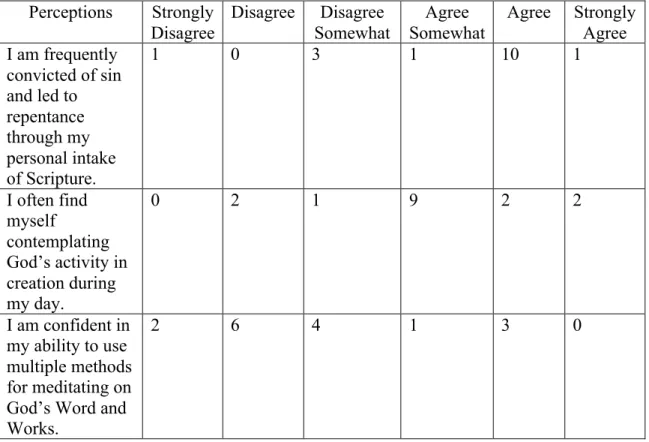
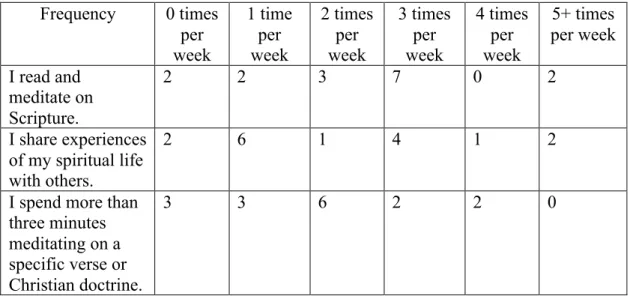
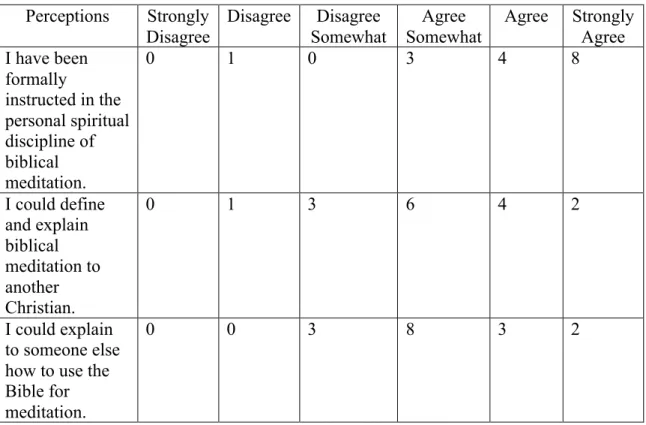
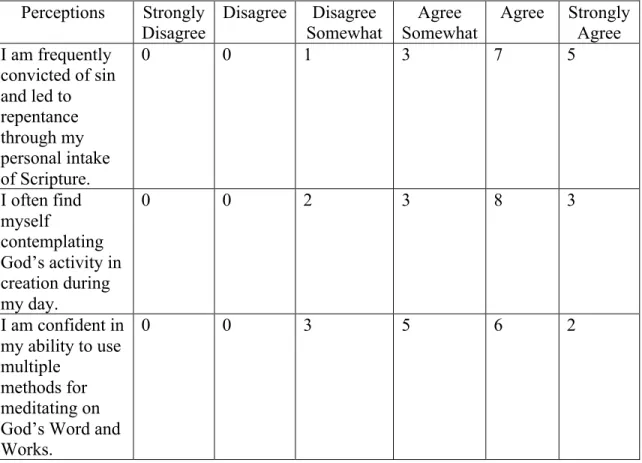
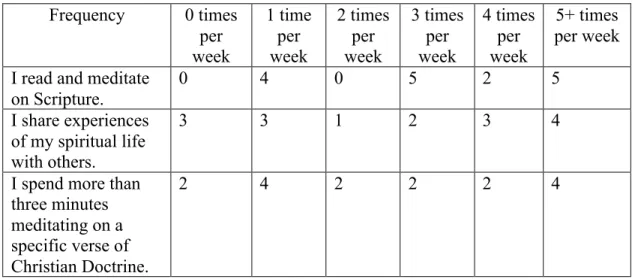
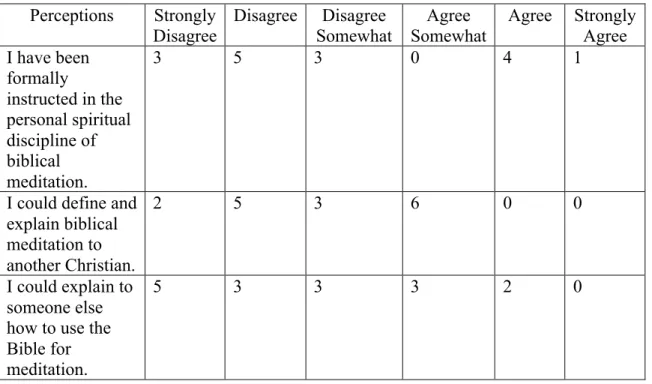
Apart from this mental discipline assessment, the majority of the pre-survey was identical to the post-survey. Twenty questions in the survey provided preliminary data on participants' perceptions and frequency patterns in biblical meditation. The participants' pre-survey results show that there was in fact a need for greater knowledge in biblical meditation.
Finally, when asked if they could explain biblical meditation to someone else, they scored just 44 percent. These scores are not unreasonable for these particular individuals given what was revealed in the perception portion of the pre-survey. The feasibility study helped to ensure that the course and accompanying guidebook would be truly useful to those participants who wanted to grow in their faith by learning and practicing the discipline of biblical meditation.
Development of Curriculum
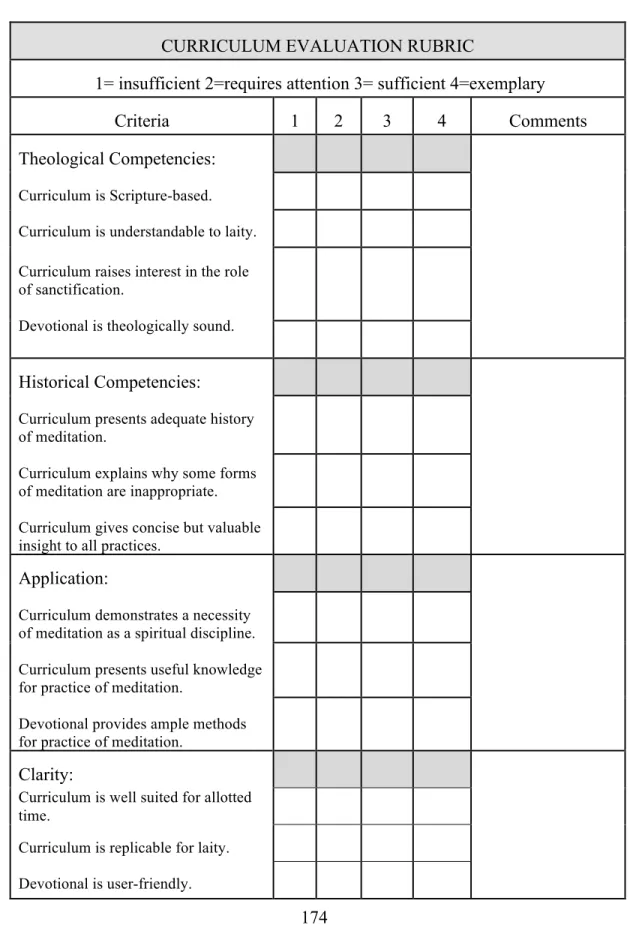
The curriculum met the standards of the panel while the guidebook exceeded the necessary requirements and was said to be beyond what was needed for the project. The first lesson served as an introduction to biblical meditation and as a comparison of how one goes about it. The second lesson briefly touched on progressive sanctification and the purpose of the spiritual disciplines in a sanctification framework.
This lesson presented questions about how one attains knowledge or what is the ultimate goal of the act of scriptural meditation. The purpose of the manual was to present the same information and suggestions for practicing biblical meditation to all participants. The end result would be for MWBC members to practice biblical meditation themselves to the point that after the course they could communicate to other MWBC members how they practice this discipline.
I decided to focus on specific meditation methods, but the same question of advocating biblical meditation came up. The last day served as a repetition of the verse from the first day of training (Ps 23:1) as a conclusion to the experience. I was determined to finally increase the knowledge and improve the practice of biblical meditation among MWBC members.
Increase of Knowledge and Enhancement of Practice Enhancement of Practice
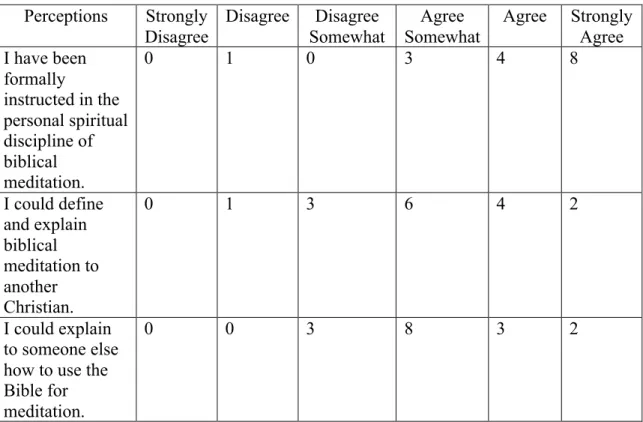
This assessment was surprising as the interviewees indicated the power of the manual in their meditation practice. Considering the outlier who seemed to be skewing the frequency category numbers, I ran the data again and by the grace of God the results showed what was observed in the qualitative data. Prior to the course and use of the manual, participants were largely uneducated in the discipline of biblical meditation.
A consensus grew from each interview, none of the participants were aware of the particular spiritual discipline of biblical meditation. The interviewees agreed that the guidance was something they would refer to and use for their personal practice of the discipline, even after the course ended. Each goal, when accomplished, prepared for and served as the foundation for the previous goal's success.
Since completing the course I observe the merits of basing the curriculum on the contextual weaknesses in the group. The assessment of spiritual disciplines was something I cared little about before my analysis of the post-survey. MWBC discussed their time spent in biblical meditation using the guide in their recent meeting about a month since the post-survey.
Objectives
Come to the "table" with the intention of listening to God's Word, willing to mold your mind accordingly. God's promised and provided solution to the problem of human rebellion against him and its consequences. Gary Millar, Calling on the Name of the Lord: A Biblical Theology of Prayer (Downers Grove, IL: InterVarsity Press, 2016), 17.
Our good works follow this process, by the grace of God in our progressive sanctification. Whether you enjoy writing or not, there is no dry benefit from putting pen to paper with the experience of meditating on God's Word. Explain the text as a means of worshiping God; "Why (or how) do I worship God through this Scripture?" When you have explained the text, then apply the text to yourself.
Edmund Clowney claims, "Meditation reflects on the truth of God in the presence of God" (46). Let's look at our triangle (figure A1) to see more details of the logic and proper practice of biblical meditation. Contemplation in itself is empty, but as Christians our reflections should be guided by God's Word in Scripture through the Holy Spirit, as noted in the Baptist Confession of 1689 (10.1): “He enlightens their minds.
Ask about the first week using the guidebook
A proper understanding of how we enter meditation leads us to understanding how we then proceed to meditate on the text. Tonight we will find that the shape and form we are looking at is from the Bible. As Christians entering into biblical meditation, it should be obvious that we want to meditate biblically, that is, how the Bible teaches the practice.
First we look at the vocabulary used in the Bible about meditation, its practice, methods and purpose. Sakal - consider, understand, be wise, show yourself attentive, prosper (Isa 41:20 “that they may see and know, may think and understand together, that the hand of the Lord has done this, the Holy One of Israel has created it. "). 8 Finally, Brethren, whatever is true, whatever is honorable, whatever is just, whatever is pure, whatever is lovely, whatever is praiseworthy, if there is any excellence, if there is anything that is praiseworthy, think on these things.
Enthumeomai – ponder, contemplate, reflect (Matt 1:20 "But while he was considering these things, an angel of the Lord appeared to him in a dream and said: To get into the mindset of the biblical principle of meditation, let's describe some of the ways you think or imagine a person in the OT and NT to meditate Now how would you describe some of the differences we discussed in the first lesson.
Ask about second week utilizing the guidebook
Looking through history, we find that there is a fine thread that moves from the first century to us. We look to the Puritans for models of biblical meditation, not simply because there is an abundance of teaching, but because their teaching is primarily biblical. Look at the John Main quote, the same way we looked at the false Buddha quote in Lesson 1, and analyze how it is terrible: “In our meditation we begin to enter into this.
We will look at the difference in the practice of these examples: theological factors, the Holy Spirit, Sanctification, etc. Even when he is not meditating on Scripture, Jonathan Edwards shows through occasional meditation that we can still be asked by biblical doctrines such as the Trinity. Do you think there might be more benefit to studying God's word as opposed to just emptying your mind or meditating on nature.
Why do you think there is such a bent/stress to make spirituality so process driven or achievement driven.
Post-Class Discussion)
Post-test survey and gratitude night) Ask about fourth week utilizing the guidebook
Handout, Part 1 What is “Biblical Meditation”?
Handout, Part 2
Handout, Part 1 Occasional (Spontaneous) Meditation is
Handout, Part 2 We discuss the Spiral Method of meditation
Handout, Part 1 Biblical resources for “meditation”
Handout, Part 2 Turns of phrase and interesting instances
Handout, Part 1 Two Streams
Dionysus shows that the author's claim to be Dionysus of Acts 17:34 is false. A Benedictine monk known for his writings and ongoing conflicts regarding the work and relationship of the Holy Spirit. A Franciscan cardinal bishop who is known for the great influence of Augustine and Anselm; writing and arguing mainly on the existence of God and meditation.
The author of the cloud was probably one of the many spiritualists who developed during this time period. Carmelite and Spanish mystic, ancestor of the 'Discalced Carmelites', or simply put, mystics who ignore the physical world or use it to become more holy. Because of his faith, he disagreed and was forced to rebel against religious and political leaders.
Author of several books on biblical spirituality and Dean of the School of Theology at the Southern Seminary.
Handout, Part 2 Specifically looking at Puritan practices
I hope this guide helps in the future; reminds you that true insight comes from the enlightenment of the Spirit through the reading of God's Word. We do not come to the text blindly, but with the expectation that the Word will actually do something to us. Finding the original intentions of the text as well as modern purposes from God.
This is the fulcrum or hinge of the spiral as it moves further from the text and closer to the person. The spiral is something to keep in mind as we look at the seven practices of the biblical meditation method. By the end of the week you will be quite familiar with the various methods of gathering God's Word.
5Joseph Hall, "The Art of Divine Meditation," in Works of the Right Reverend Joseph Hall, vol. Then Jonah prayed to the LORD his God from the belly of the fish, saying: Life in the Trinity: An Introduction to Theology with the Help of the Church Fathers.