Copyright © 2013 Gustavo Vicente Suárez
All rights reserved. The Southern Baptist Theological Seminary has permission to reproduce and disseminate this document in any form by any means for purposes chosen by the Seminary, including, without limitation, preservation or instruction.
A CRITICAL ANALYSIS OF SOUTHERN BAPTIST HISPANIC CHURCH-PLANTING STRATEGIES
IN NORTH AMERICA, 1970-1994
__________________
A Dissertation Presented to the Faculty of
The Southern Baptist Theological Seminary
__________________
In Partial Fulfillment
of the Requirements for the Degree Doctor of Philosophy
__________________
by
Gustavo Vicente Suárez December 2013
APPROVAL SHEET
A CRITICAL ANALYSIS OF SOUTHERN BAPTIST HISPANIC CHURCH-PLANTING STRATEGIES
IN NORTH AMERICA, 1970-1994
Gustavo Vicente Suárez
Read and Approved by:
__________________________________________
Adam W. Greenway (Chair)
__________________________________________
Timothy K. Beougher
__________________________________________
M. David Sills
Date______________________________
To Diana,
who faithfully and lovingly
walked the church-planting journey with me, to Phillip, Megan, and Matthew, who bring exceeding joy to my life, and to our grandchildren, Cooper and Camryn,
may God’s Word be a lamp to your feet and a light to your path.
TABLE OF CONTENTS
Page
LIST OF ABBREVIATIONS . . . viii
LIST OF TABLES AND FIGURES . . . ix
PREFACE . . . x
Chapter 1. INTRODUCTION . . . 1
A Nation of Immigrants . . . 1
Thesis . . . 3
Definitions . . . 12
Background . . . 16
Research Methodology . . . 20
2. HISTORICAL CONTEXT: THE EMERGENCE OF SOUTHERN BAPTIST LANGUAGE MISSIONS . . . 24
Makers of Ethnic Histories . . . 26
Emergence of Language Missions in North America . . . 34
The American Mosaic . . . 34
Asian Church Growth and the American Mosaic . . . 40
Hispanics and the American Mosaic . . . 47
The West . . . 47
The Midwest . . . 52
Chapter Page
The South . . . 54
The Northeast . . . 64
Who Are These Hispanics? . . . 69
Important Hispanic Cultural Characteristics . . . 70
1970s: The Years of Immigration . . . 75
1980s: The Years of Growth . . . 77
1990s: The Years of Transition . . . 79
Conclusion . . . 82
3. OSCAR ISHMAEL ROMO . . . 83
Oscar Romo’s Theology of Pluralism . . . 84
A Language Mission’s Philosophy . . . 90
Oscar Romo’s Leadership and Influence . . . 100
Partnership with Cuba . . . 110
Conclusion . . . 125
4. CHURCH-PLANTING STRATEGIES . . . 126
Introduction . . . 126
Challenges Presented by the American Mosaic . . . 128
Language Missions Strategies . . . 133
Conclusion . . . 166
5. ANALYSIS, EVALUATION, AND CRITIQUE OF THE CHURCH-PLANTING STRATEGY . . . 167
Introduction . . . 167
Primary Strategies . . . 169
Chapter Page
Strategy 1–Ethnic Church Growth Concept . . . 170
Strategy 2–Ethnic Leadership Development . . . 178
Strategy 3–National Language Strategy . . . 184
Strategy 4–Ethnic Fellowships . . . 189
Secondary Strategies . . . 192
Strategy 1–Leadership Conferences . . . 193
Strategy 2–Ministry to Immigrants and Refugees . . . 197
Strategy 3–Language Material Consortium . . . 200
Strategy 4–Hispanic Church-planting Strategies and Models . . . 203
Ethnic Church Growth . . . 206
Conclusion . . . 214
6. CONCLUSION . . . 215
Introduction . . . 215
Lessons Learned . . . 216
Current Church-planting Practices of the North American Mission Board . . . 224
Observations of Current Church-planting Strategies . . . 227
Recommendations . . . 233
Conclusion . . . 240
Appendix 1. A PHILOSOPHY OF MISSION TRAINING . . . 244
2. NATIONAL STRATEGY . . . 250
Appendix Page 3. DEPLOYMENT OF PERSONNEL:
CATEGORY OF LANGUAGE WORKERS . . . 262
4. LASER THRUST CHURCH GROWTH, 1978-1994 . . . 267
5. SBC SEMINARIES HISPANIC ENROLLMENT . . . 268
6. 10-YEAR HISPANIC CHURCH GROWTH STUDY, 1980-1989 . . . 269
7. SEND CITY STATISTICS (MIDWEST) . . . 271
8. SEND CITY STATISTICS (SOUTH) . . . 272
9. SEND CITY STATISTICS (NORTHEAST) . . . 273
10. SEND CITY STATISTICS (WEST) . . . 274
BIBLIOGRAPHY . . . 275
LIST OF ABBREVIATIONS
BCNM Baptist Convention of New Mexico BGCT Baptist General Convention of Texas CLD Contextualized Leadership Development ELD Ethnic Leadership Development
FMB Foreign Mission Board
GCRTF Great Commission Resurgence Task Force GCRTF Great Commission Resurgence Task Force GGBTS Golden Gate Baptist Theological Seminary HMB Home Mission Board
IMB International Mission Board
MBTS Midwestern Baptist Theological Seminary M.E.T.A. Multi Ethnic Theological Association NAMB North American Mission Board
NOBTS New Orleans Baptist Theological Seminary PIB Primera Iglesia Bautista
SBC Southern Baptist Convention
SBTS Southern Baptist Theological Seminary SEBTS Southeastern Baptist Theological Seminary SWBTS Southwestern Baptist Theological Seminary
LIST OF TABLES AND FIGURES
Table Page
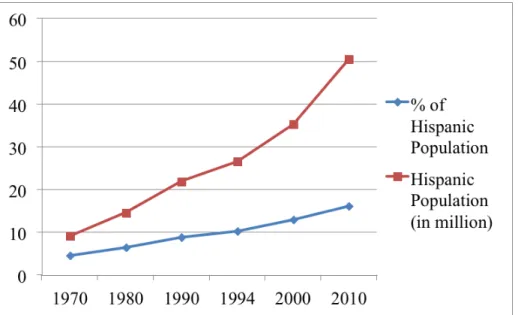
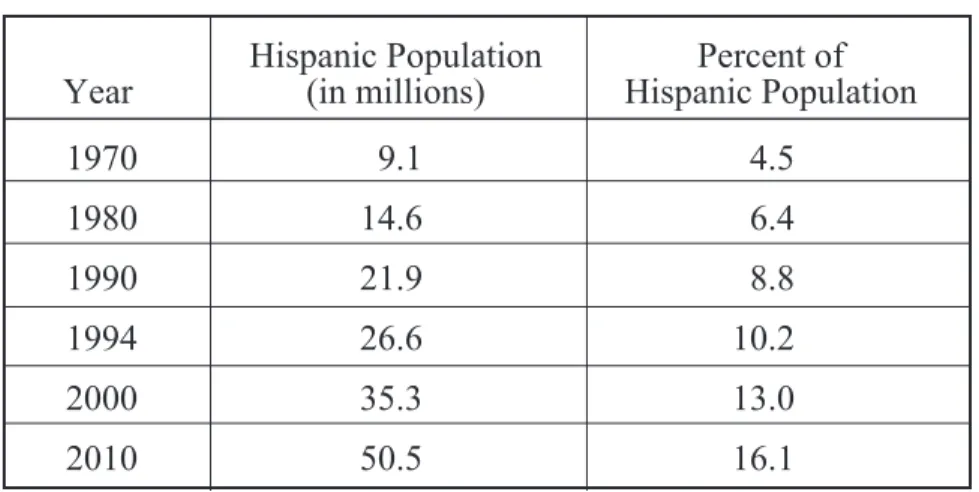
1. Growth of Hispanic population . . . 127
2. New Hispanic congregations . . . 208
3. Hispanic baptisms . . . 209
4. Hispanic total membership . . . 209
5. Hispanic church program organizations . . . 210
6. Hispanic total receipts . . . 210
7. Hispanic mission gifts . . . 211
8. Hispanic Cooperative Program gifts . . . 211
9. Hispanic church growth, 1990-1994 . . . 212
10. Population of four SEND regions . . . 228
Figure 1. Growth of Hispanic population . . . 127
2. New Hispanic churches, 1972-1978 . . . 208
PREFACE
This dissertation grows out of more than thirty years of experience in ministry among language cultural people in the United States. As I reflect on these years, the influence relationships and organizations played in shaping my life and ministry is evident. The experience with different cultural groups helped enrich my understanding of different belief systems and also to solidify my biblical worldview. A work of this magnitude is impossible to write without the assistance of friends, family, and organizations.
I would like to express my profound gratitude of debt to these people:
Robert “Bob” Langel and Charles A. Chilton from Berwyn Baptist Church in Berwyn, Maryland, for holding my hand as I took the first steps in my Christian walk. Bob welcomed me to Berwyn Baptist Church a few days after I came to know Christ. Bob worked as a scientist for Goddard Space Flight Center (NASA) but spent a considerable amount of hours teaching and discipling young college students. Bob discipled me for eighteen months until I left for seminary. Charles A. Chilton, pastor of Berwyn Baptist Church, was my first pastor. He taught me a passion to preach the Word of God and for evangelism.
Gray Allison and Elías Dávila Pantoja for setting strong foundations and standards that shaped my life. In 1971, Gray Allison, in the midst of a dangerous theological shift among Southern Baptists, founded Mid-America Baptist Theological Seminary in Memphis, Tennessee. As a new believer, without any theological training, I was able to receive sound conservative theological training. I am thankful for
his faithfulness to obey Christ. Elías Pantoja taught me about doing ministry in an
ethnolinguistic context. He gave me the first opportunities to teach, preach, and learn about church planting.
The Home Mission Board and state conventions for the opportunities you gave me to serve with some incredible people in ministry. My wife, Diana, and I were appointed as home missionary in 1985. Since that time, we have been blessed to serve with the Baptist Convention of Maryland/Delaware, the Baptist Convention of New Mexico, the Northwest Baptist Convention, and, most recently, as Professor of Church Planting at Midwestern Baptist Theological Seminary.
Oscar Ishmael Romo for the vision and passion you gave me to take the gospel
“to the ends of the earth” and start new churches. Your vision to reach the “American Mosaic” was compelling and contagious. You taught me to have urgency for the gospel, the need to plan ahead, respect for denominational structures, and the value of good relationships in ministry. No other person on this earth has influenced my missiology more than you.
Fermín A. Whittaker, Daniel R. Sánchez, and Merry Romo for the friendship and magnificent support all three of you gave me during the years of ministry. Fermín Whittaker processed my wife and me as we were going through the process of missionary appointment with the Home Mission Board. He has been a very good friend for more than thirty years. Daniel Sánchez helped with quality information as I was working with the Doctor of Ministry at Golden Gate Baptist Theological Seminary, and also with the Doctor of Philosophy at The Southern Baptist Theological Seminary. I have known Sánchez for more than twenty years. Merry Romo was the administrative secretary for Oscar Romo. I first met Merry as I was starting ministry in 1983. Merry Romo has provided excellent information on this subject since 2010 when I first became interested in the possibility of writing about Hispanic Church Planting Strategies in North America.
Adam Greenway for the friendship and helpful direction you gave me during these years of study. Your comments, constructive criticism, and encouragement helped
shape and improve the quality of this dissertation. You have been there with me as a professor with red ink pen in hand, you have been there as a coach cheering me on, and, most of all, you have been there as a friend standing by my side. Thank you, friend!
My wife, Diana Suárez, for the incredible support you have always given to me. You have shared the journey with me for thirty-three years. Thank you for faithfully praying for me. You listened when I wanted to read a portion of the dissertation to you and encouraged me when you sensed discouragement. When I wanted to quit, you reminded me to take “one day at a time.” Your constant love was my motivation. You, indeed, have been a strong tower! Thank you.
Gustavo Vicente Suárez Kansas City, Missouri
December 2013
CHAPTER 1 INTRODUCTION
A Nation of Immigrants
The Statue of Liberty stands on Liberty Island in New York Harbor as a symbol of liberty and freedom. Since the early nineteenth century, however, it has been a symbol of freedom from political oppression for immigrants fleeing persecution in their homeland. Global events such as the Vietnam War, famines and political unrest in African countries, unstable political environments in Latin America, and the passage of the Immigration Act of 19651 brought people from Canada, Western Europe, Latin America, and Asia to the United States. Michael Pocock and Joseph Henriques note that
“the promise of freedom, security, and prosperity all serve as magnets to draw people to America and the West.”2
The land that received the world’s tired, poor, and huddled masses that yearn to be free was becoming the “American Mosaic,” a mosaic reflected in the diversity of cultural and linguistic values.3 The landscape of North America has rapidly changed from
1The Immigration Act of 1965, also known as the Hart-Cellar Act, changed the method by which immigrants are admitted into the United States. The bill abolished the national origin quota and established a new immigration policy based on reuniting immigrant families and attracting skilled labor to the United States. Under the Act, 170,000 immigrants from the Eastern Hemisphere are granted residency, with no more than 20,000 per country. One hundred and twenty thousand immigrants from the Western Hemisphere, with no “national limitations,” are also to be admitted into the country. Over the next decades, the policies put into effect in 1965 would greatly change the demographic makeup of the American population, as immigrants entering the United States under the new legislation came increasingly from countries in Asia, Africa, and Latin America, as opposed to Europe. President Lyndon B. Johnson signed this bill into law on 3 October 1965.
2Michael Pocock and Joseph Henriques, Cultural Change and Your Church: Helping Your Church Thrive in a Diverse Society (Grand Rapids: Baker Books, 2002), 16.
3Oscar I. Romo, “Ethnic Missions in America” (Atlanta: Language Missions Department, Home Mission Board, SBC, n.d.), 1.
a primarily homogeneous culture to a more multicultural society. These changes have implications for both the local church and mission agencies. Strategically, it is important to understand these changes in order to determine the most effective and appropriate strategies to reach the growing diverse ethnic population.
Manuel Ortíz recognized the complexity of the massive cultural transitions in the United States. On one hand, there are the immigrant populations who once lived in areas where now gentrification is occurring, and these people groups have been relocated to the outskirts of American cities. On the other hand, neighborhoods once filled with first-generation immigrants are now bilingual and increasingly more English speaking.4
This cultural transition is not new to the Hispanic church, but it is much more complex and intergenerational in nature today than twenty years ago. Yet, the need to evangelize the lost, start new congregations, train leaders, and send them forth to the harvest has not changed. Understanding the dynamics of cultural transitions is necessary to churches and mission agencies in developing effective strategies to reach the different ethna in their communities.
North American Christians have a remarkable mission opportunity right at our own doorsteps. It appears that God is bringing the world to the United States. Pocock and Henriques react strongly to the response of some Christians and local churches to these ethnic transitions in their neighborhoods. They observe that “they [the churches]
have faithfully responded to Christ’s Great Commission in Matthew 28:19-20, sending missionaries around the globe, but they have not always been so diligent or even friendly when the peoples of the world have come to their neighborhood!”5
Oscar I. Romo, who led the Language Missions Division of the Southern Baptist Convention’s Home Mission Board from 1971-1994, understood the cultural
4Daniel A. Rodriguez, A Future for the Latino Church: Models for Multilingual, Multigenerational Hispanic Congregation (Downers Grove, IL: InterVarsity, 2011), 4.
5Pocock and Henriques, Cultural Change, 16-17.
challenge of his days. David Terry, who served with Romo for nine years, describes him as “quite a visionary who understood the changing nature of the United States and North America and had an awareness of not only the Hispanic culture, but the cultures of Eastern Europe, Asia and the Caribbean countries. He believed you had to strategically prepare and plan ahead, and cultivate relationships.”6 Romo had an intentional strategy not only to reach the lost, but to develop leaders and involve other Southern Baptist agency leadership for effective ministry to language groups in North America.7 The question one must continually ask is: What is the most effective way to reach the world at my doorsteps?
Thesis
I personally witnessed the ministry of Oscar Romo for fifteen years.
Beginning in 1983, I served as a language pastor in Buffalo, New York, and later I was a Language Catalytic Missionary with the Baptist Convention of Maryland/Delaware.
Romo later recommended me to the Baptist Convention of New Mexico where I served for thirteen years, first as Language Missions Director and the last seven years as State Director of Missions. After numerous interactions with and observations of Romo, his ministry, people who served alongside him, and initial research I have done of the twenty-five-year period that this dissertation covers, I hypothesize that a detailed analysis of the development of Hispanic church-planting strategies in North America between 1970 and 1994 shows that those were both important and influential days
6Mickey Noah, “Oscar Romo, Ethnic Ministry Pioneer, Dies,” Baptist Press, 19 January 2009 [on-line]; accessed 17 April 2012; available from http://www.bpnews.net/bpnews.asp?id=29692; Internet.
7Oscar Romo developed the Ethnic Leadership Development (now called Contextualized Leadership Development) in partnership with Bill Pinson and the Golden Gate Baptist Theological Seminary. He led Southern Baptists to provide contextual language materials in more than sixteen languages and involved many of the Southern Baptist agencies, such as the Annuity Board (now
GuideStone Financial Resources), the Baptist Sunday School Board (now LifeWay Christian Resources), and the Woman’s Missionary Union. Romo was also intentional to provide equipping opportunities to the missionaries and agency leaders. Romo’s administrative skills helped the expansion of language missions with the development of a five-year national strategy plan to assist in strategy implementation in the local field.
for language missions among Southern Baptists. While there were many people who contributed to this greatness, Oscar Romo’s leadership, in particular, was a defining moment for Southern Baptists’ intentional, strategic, and effective outreach to a diverse North America.
The purpose of this dissertation is to analyze, critique, and evaluate Hispanic church-planting strategies in North America from 1970 to 1994. I have developed this subject by introducing the reader to the historical context that outlines the rise and development of language missions, influential people, and the strategies developed for language missions in North America. This dissertation seeks to apply lessons learned from the period 1970-1994 to contemporary church-planting activities among Southern Baptists in North America.
I have explored six areas8 and answered at least six primary questions: How did Oscar Romo’s theology influence his methodology? What leadership principles did Oscar Romo demonstrate? Who were the influential people during this period? What are the missiological, ecclesiological, and sociological principles that are applicable to contemporary church planting? What historical lessons are applicable to contemporary church planting? Finally, what are some key church-planting concepts that contributed to language missions effectiveness?
The Southern Baptist Convention, from its beginnings, has been involved in reaching out to the “Negroes, Indians, and Foreigners.”9 The United States’ growing diversity, changes in technology, and changes in the political systems of various countries
8This dissertation explores six areas of interest: a brief historical overview of the development of language missions, within the limitations stated later in this prospectus under Limitations and
Delimitations; people who were influential during the twenty-five-year period; Oscar Romo’s theology, missiology, and leadership principles; and, finally, the Church Growth Concepts used during this period.
9These are the terms used in the Proceedings of the Southern Baptist Convention of 1845- 1912. These three terms are not proper to use in the twentieth-first century due to the changing times, vocabularies, and the history of race relations in the United States. Acceptable terms are Black, African- Americans, Native Americans or First Nation people, and immigrants. The terms “Indian,” “American Indian,” and “Native American” appear in different sections of this dissertation because I chose to keep the terms that were used in that particular period of time.
required different methodologies as well as more appropriate descriptive terminology.
Nonetheless, Southern Baptists have remained true to the mandate given to the Domestic Board of Missions, later renamed the Home Mission Board.10
To explore the development of Hispanic church-planting strategies in North America is difficult without first understanding the background of the dominant Hispanic group in the United States, the Mexicans. Joshua Grijalva best describes the plight of the people he calls the “new Mexican American.”
The year was 1848. The treaty had been signed between Mexico and the United States. Under the terms of the treaty the southwestern part of the country, including Texas, New Mexico, Arizona, California, and parts of other states, was ceded to the United States by Mexico. The war ended, and Mexico received $15,000,000 for the Mexican borderland territory. Seventy-five thousand Mexicans living in the territory were given the option of returning to Mexico. Only 1,500 “returned,” for most of the Mexicans had never lived elsewhere; the Southwest was their home. Overnight, they became strangers and “foreigners” in the land of their birth. Because they spoke Spanish and not English, they were viewed with suspicion. Legally they were now Americans; culturally they were isolated from Mexico. The new Mexican American was born.11
The following snapshots are only glimpses of a developing language mission field in North America.
Missionary Expansion, 1845-1940
The first century of Home Missions was marked by geographical and linguistic expansion. The most extensive work was among the Indians in the West of the United States. Although Indian work began among the eastern tribes, the “Indian Removal Act”
10The Southern Baptist Convention established the Domestic Board of Missions at the organizational meeting in Augusta, Georgia, in 1845 to be headquartered in Marion, Alabama. Ten years later, in 1855, the work of the Board was enlarged when the Convention voted to accept transfer of the work of the American Indian Mission Association. The agency was renamed the Domestic and Indian Mission Board. In 1873, the Southern Baptist Convention consolidated the Sunday School Board with the Domestic and Indian Mission Board and renamed the agency Domestic and Indian Mission Board and Sunday School Board. In 1874, the title was changed to the Home Mission Board. In 1997, the Home Mission Board became the North American Mission Board.
11Joshua Grijalva, “The Story of Hispanic Southern Baptists,” Baptist History and Heritage 18, no. 3 (July 1983): 40.
relocated Native American tribes living east of the Mississippi River to land west of the river.12 New geographical expansion was influenced by territorial expansion occurring between 1845 and 1860. The flow of population moved from the states of the initial colonies along the Atlantic seaboard, dependent upon the waterways for transportation, to the vast territory in the West obtained from France by the Louisiana Purchase in 1808.13 James W. Marshall’s fortuitous discovery of gold in California was a significant event
“almost depleting some sections of the Eastern states.”14
The geographical expansion was not only an opportunity for the Domestic Board of Missions to reach out to the different tribes of Indians in the West,15 but also to explore new mission opportunities. Additionally, language mission opportunities took place among the Germans, French, Italians, and Slavic people living in New York, Baltimore, New Orleans, and St. Louis.16
Asian outreach occurred among the Chinese in Sacramento, California. John Lewis Shuck, who had returned from Shanghai in 1854, organized the first Chinese church in America.17 While Southern Baptists expanded to the West, “it is to be noted that the major immigrant work has been carried on by the American Baptist Home Mission Society, and quite understandably so, for the greatest numbers of foreign- speaking peoples have settled in the northern and western states.”18
12Indian removal was a nineteenth-century policy of the government of the United States to relocate Native American tribes living east of the Mississippi River to lands west of the river. The Indian Removal Act was signed into law by President Andrew Jackson on May 26, 1830.
13J. B. Lawrence, History of the Home Mission Board (Nashville: Broadman, 1958), 30.
14Ibid.
15For example, Joshua Grijalva, comp., Ethnic Baptist History, pt. 2 (Miami: Meta
Publications, 1992). In this book, Grijalva relates the expansion of language work to the various tribes in the West. See p. 4, n. 9, of this dissertation for an explanation of the use of the term “Indian.”
16Arthur B. Rutledge and William G. Tanner, Mission to America: A History of Southern Baptist Home Missions (Nashville: Broadman, 1969), 153-56.
17Robert G. Torbert, A History of the Baptists, 3rd ed. (Valley Forge: Judson Press, 1963), 381.
18Ibid., 382.
As early as 1879, Cuban Baptists were asking for help. The Florida Baptist Convention determined that they needed to take immediate action and started a mission in Cuba in 1885.19 The next year, during the 1886 annual meeting of the Southern Baptist Convention, the Foreign Mission Board presented this matter to the Convention:
In 1879 and in 1881 the Board reported this subject to the Convention. In the latter year the Convention decided that the time had not come for our Board to enter that field. Recently new religious interest has sprung up in the island. Through the courtesy of the Home Board the attention of our Board was called to the subject;
and by the invitation of prominent brethren of Florida, deeply interested in a Cuban mission, our Corresponding Secretary visited the Baptist Convention of that State, last November, in order to obtain further information which might aid the Board to decide wisely whether it should undertake this new mission. From the action of the Florida Convention we extract the following: “We conceive that this Convention is able to undertake this work at once, i.e., the preliminary or provisional work–to go and prepare the way, to lay foundations, to throw up breast-works, and hold the fort till the Foreign Mission Board of the Southern Baptist Convention can come to the rescue, which we hope will be not later than the next meeting of the Southern Baptist Convention.” The means of doing all that the Providence of God indicates should be done, are in the hands of God’s duty, and the question of duty in the premises is respectfully submitted to the wisdom of the Convention.20
The Home Mission Board enthusiastically accepted the responsibility for Cuba. Isaac Taylor Tichenor, the Executive Secretary of the Home Mission Board from 1882 to 1899, “became so personally involved that he was called the ‘father of Cuban Mission.’”21 The work in Cuba progressed until 1895 when Cuba demanded independence from Spain resulting in the War of Independence (1895-1898). The effect of the war years resulted in many pastors fleeing to Florida, leaving the churches without pastoral leadership, the mission work in Cuba almost destroyed, and little left than the property owned by the Home Mission Board.22
19Grijalva, Ethnic Baptist History, 88.
20H. A. Tupper Jr., “Annual Foreign Mission Board Report,” in Southern Baptist Convention–
Thirty-First Session, held in Montgomery, May 7-11, 1886 (Atlanta: Jas. P. Harrison and Co. Printers, 1886), xxiii.
21Lawrence, History of the Home Mission Board, 78.
22Ibid.
The construction of the Panama Canal, started on January 1, 1882, brought people from many nations to Panama. In fact, “it was claimed in 1908 that fifty different languages were spoken in the Canal Zone.”23 The Home Mission Board responded by commissioning J. L. Wise as general missionary to the Canal Zone.24 The first fifteen years of the twentieth century brought many social, economic, and political changes that positively opened many doors to Christian missions.25
The political situations of the 1960s to the 1980s present a second glimpse of a developing language mission field in North America.
Political Unrest, 1960-1980
The decade of the 1960s brought many changes to Cuba, resulting in at least four gradual exoduses of Cubans to Florida. Fidel Castro declared himself to be a Marxist-Communist in 1959, producing a political migration of Cubans to the United States “harboring distinct waves of immigrants as well as distinct refugee, ‘vintages,’
alike only in their final rejection of Cuba.”26 Each of the major waves of migration has been characterized by a very different social composition. Silvia Pedraza identifies the first wave as the Elite, the second wave as Cuba’s petite bourgeoise or the middle class, the third wave as the Marielitos, and the fourth wave as the Balseros or Cuban raft people. Many of these Cubans transported Cuban churches initially to South Florida and then spread throughout the United States.
23Rutledge and Tanner, Mission to America, 165.
24Ibid. France’s attempt to build the Panama Canal connecting the Atlantic and Pacific oceans failed due to finances and the death of more than 20,000 workers from tropical diseases. The United States bought the right to build the canal in 1903. The canal was completed in 1914, but not before the additional loss of 5,600 lives.
25Lawrence, History of the Home Mission Board, 85.
26Silvia Pedraza, “Cuba’s Refugees: Manifold Migration” (Washington, DC: Association for the Study of the Cuban Economy, 1995), 311 [on-line]; accessed 10 May 2012; available from http://www.
ascecuba.org/publications/proceedings/volume5/pdfs/FILE26.pdf; Internet.
In the United States, Americans demonstrated against the Vietnam War, African Americans demonstrated for civil rights, and women demonstrated for equal treatment. Three national leaders were assassinated within five years–President John Kennedy in 1963, his brother Robert Kennedy in 1968, and Martin Luther King in 1968.
The Vietnam War agitated the political instability in Southeast Asia causing many Vietnamese, Laotians, and Cambodians in the 1970s to seek refuge in the United States. Immigrants from Central American countries arrived in the United States in large numbers in the 1980s, fleeing political unrest. Some of these came as refugees and others were undocumented.27 Additional refugees arriving in the United States in the 1980s, as the result of political unrest, were people from Egypt, Syria, Iran, Armenia, and India.
Within this national cultural context, the Home Mission Board called Oscar Romo to serve as Director of the Language Missions Division in 1970. This appointment was an historical step in that he was the first Hispanic person to hold a national position among Southern Baptists.
Oscar I. Romo
Oscar Romo was born of Mexican-American parents in Lockhart, Texas, on January 29, 1929. His parents attended the Methodist church in Austin, and they were the only Hispanic Evangelical family in town. At that time, the U.S. was experiencing the effect of a worldwide financial crisis, the Great Depression. Romo remembers walking to his schools, past the schools for Anglos, and wondering why he could not go there. The word “Mexican” was a slur and children would “get switched” for speaking Spanish.28 The “fundamental and permeating Christianity” of Romo’s parents nurtured in him a powerful sense of identity.29 Certainly, these events helped shaped his life and ministry.
27Martin N. Marger, Race and Ethnic Relations: American and Global Perspectives, 8th ed.
(Belmont, CA: Wadsworth Cengage Learning, 2009), 220.
28Oscar I. Romo, “Heirs of the Faith,” MissionsUSA 63, Supp. 92 (July-August 1992): 2-3.
29Ibid.
Romo brought a new philosophy to language missions, one that went against the practice of that day and one that would ultimately transform Southern Baptists’
language missions. Possibly due to the cultural, religious, and political struggles
experienced by immigrants and Americans, many denominations believed in integration and assimilation. Like most Americans, many denominational leaders believed that immigrants needed to learn the culture and the language of the new country. Others suggested that they should renounce their culture and adopt the new ways. Romo, on the other hand, rejected the idea of the “melting pot” and frequently spoke of the American Mosaic.30 He saw that “America, a cultural mosaic of mankind, has the world at its doorstep.”31 He proposed that America’s diversity called for strategies that are contextualized to a particular language group.
Romo often reminded his leadership that “America’s pluralism calls for the
‘development of approaches compatible with the New Testament concept of the church;
yet they must permit the sharing of the gospel contextually.’”32 He also made a shift from Anglo leadership to deploying more indigenous workers.
The perceived emphasis of some Anglo churches was on Americanization and not evangelization. He knew, early in life, that the idea of the “melting-pot” was a myth.33 Yet, he believed that the gospel was for all people everywhere regardless
30Daniel R. Sánchez, telephone interview by author, 20 July 2010. Oscar Romo understood the concept of the “melting pot,” as used during these days, as communicating the idea that many will assimilate to the American culture once they come to the United States. He rejected this view and
championed the idea of the “American Mosaic.” Romo often presented the idea that the United States was more like a “stew” or a “salad bowl.” Each of the ingredients add their unique flavor without losing their characteristic.
31Oscar I. Romo, American Mosaic: Church Planting in Ethnic America (Nashville:
Broadman, 1993), 41-42.
32Oscar I. Romo, “The Turn of the Century,” in From Sea to Shining Sea: Challanges to Reach Our Nation for Christ, ed. William G. Tanner (Nashville: Broadman, 1986), 127.
33Romo, American Mosaic, 106.
of language usage and cultural heritage. People need not negate “a rich language and cultural heritage to become a Christian.”34
Romo introduced Southern Baptists to new missiological terminologies and concepts such as Laser Church Growth Thrust, the Catalytic Church Growth, and Kaleidoscopic Church Growth. He also helped establish churches among seventy-six ethnic groups in seventeen years, for a total of 102 ethnic groups who used ninety-eight languages weekly and among ninety-five Native American tribes.35
Oscar Romo’s ministry was a critical turning point for Southern Baptists’
intentional, strategic, and effective outreach to an increasingly diverse North America.
Romo served as a catalyst for the growth of language missions among Southern Baptists.
His emphasis on indigenous churches, church planting, leadership development, and strategies to reach language groups helped strengthen language congregations.
The story of Southern Baptist Hispanic Church-planting Strategies in North America has not been fully told. There are Doctor of Ministry projects that treat some aspects of language missions and strategies, both regionally and among Baptist state conventions. For example, Eduardo DoCampo’s Doctor of Ministry project explores the development of a language mission strategy design for Southern Baptist state conventions.36 In 1993, Richard Alford’s Doctor of Ministry project treated the development and implementation of Laser Thrust project directors for the Language Missions Division of the Home Mission Board.37 James B. Boswell’s Doctor of Ministry project shows “the urgent need for training of Hispanics with meager educational
34Ibid.
35Merry P. Romo, “Oscar’s Bio,” e-mail to author, 4 September 2010.
36Eduardo DoCampo, “Development of a Language Missions Strategy Design for a Southern Baptist State Convention” (D.Min. diss., Golden Gate Baptist Theological Seminary, 1993).
37Richard Alford, “The Development and Implementation of Training for Laser Thrust Project Directors for the Language Church Extension Division, Home Mission Board, Southern Baptist Convention” (D.Min. diss., Golden Gate Baptist Theological Seminary, 1993).
opportunities to minister to the overwhelming immigration of Latinos who lack in education also.”38 Twyla Hernandez’ doctoral dissertation, “A Missiological Response to the Emergent Latino Population in the United States,” examines the need for a three-pronged missiological response to the emergent Latino population in the United States.39 Hernández’ three-pronged missiological response includes church planting, social ministries, and theological education. Eric J. Tucker’s Ph.D. dissertation explores and analyzes the unique competencies required for effective church planting among the Hispanics of Miami from the perspectives of pastors and church planters in Miami.40
The particular story of these twenty-five years of effective language missions among Southern Baptists has yet to be told. This dissertation is original work from which others in the future could make additional scholarly contributions.
Definitions
Understanding the terminologies used by the leadership of the Home Mission Board is helpful in order to be properly conversant with key words, concepts, and expressions commonly used with those serving language/cultural people in the U.S.
Hispanics or Latinos
A significant challenge for many people confounded by properly labeling others’ ethnic identities is how to refer to people born in Spanish-speaking countries.41 Is it proper to call them “Hispanic” or “Latino?” In a recent article by the Pew Hispanic
38James B. Boswell, “A Strategy of Training Latino Laymen to Minister in the U.S.A.” (Ph.D.
diss., Liberty Theological Seminary, 2010), iii.
39Twyla Hernandez, “A Missiological Response to the Emergent Latino Population in the United States” (Ph.D. diss., The Southern Baptist Theological Seminary, 2005).
40Eric J. Tucker, “Competencies of Effective Hispanic Church Planters in Miami, Florida as Perceived by Reformed Hispanic Church Planters and Pastors” (Ph.D. diss., Trinity Evangelical Divinity School, 2006).
41 The U.S. Census Bureau collects racial data in accordance with guidelines provided by the U.S. Office of Management and Budget (OMB), and these data are based on self-identification. The racial categories included in the census questionnaire generally reflect a social definition of race recognized in
Research, “When Labels Don’t Fit: Hispanics and Their Views of Identity,” the authors wrestle with the complexity of labeling Hispanics. The study shows that 24 percent of adult Hispanics prefer the name Hispanic or Latino. Conversely, 51 percent identify themselves by their family’s place of origin.42 Personally, if I am asked by someone, “are you Hispanic?” my response is, “I am Cuban.” If I need to fill out a document, however, then I would put “Hispanic.”
The Pew Research survey also shows that 51 percent do not have a preference for either Hispanic or Latino, 33 percent prefer Hispanic, and 14 percent prefer the term Latino.43 In this dissertation, I use the term Hispanic primarily because it is the more inclusive term.
Anglo
The term “Anglo” normally refers to an English-speaking person, especially a white North American.
this country and not an attempt to define race biologically, anthropologically, or genetically. In addition, it is recognized that the categories of the race item include racial and national origin or sociocultural groups.
People may choose to report more than one race to indicate their racial mixture, such as “American Indian”
and “White.” People who identify their origin as Hispanic, Latino, or Spanish may be of any race. OMB requires five minimum categories: White, Black or African American, American Indian or Alaska Native, Asian, and Native Hawaiian or Other Pacific Islander.
Brian M. Howell and Jenell Williams Paris, Introducing Cultural Anthropology: A Christian Perspective (Grand Rapids: Baker Academic, 2011), 79. Howell and Paris state that “Hispanics” refers to people that come from Spanish-speaking countries of Central or South America, and may be of any racial group. The Hispanic or Latino category is not based on a shared history or identity. Although all Hispanics speak Spanish, they have very different cultures and histories.
In explaining these two terms, the American Heritage Dictionary said that “though often used interchangeably in American English, Hispanic and Latino are not identical terms, and in certain contexts the choice between them can be significant. Hispanic, from the Latin word for ‘Spain,’ has the broader reference, potentially encompassing all Spanish-speaking peoples in both hemispheres and emphasizing the common denominator of language among communities that sometimes have little else in common. Latino–
which in Spanish means ‘Latin’ but which as an English word is probably a shortening of the Spanish word latinoamericano–refers more exclusively to persons or communities of Latin American origin. Of the two, only Hispanic can be used in referring to Spain and its history and culture; a native of Spain residing in the United States is a Hispanic, not a Latino.
42Paul Taylor et al., “When Labels Don’t Fit: Hispanics and Their Views of Identity”
(Washington, DC: Pew Hispanic Center, 2012), 10 [on-line]; accessed 10 May 2012; available from http://
www.pewhispanic.org/files/2012/04/PHC-Hispanic-Identity.pdf; Internet.
43Ibid.
Race or Ethnicity
The federal government, in its classification system, “recognizes just one ethnic group, Hispanic/Latino, which is defined as follows: A person of Cuban, Mexican, Puerto Rican, South or Central American, or other Spanish culture or origin, regardless of race. The term, ‘Spanish origin,’ can be used in addition to ‘Hispanic or Latino.’”44 The five racial groups’ classifications used by the government are white; black; American Indian or Alaska Native; Asian; and Native Hawaiian or Pacific Islander. Race is based on people’s origin from a particular region of the world.45
Ethnic
According to Paul G. Hiebert in Transforming Worldviews, this term normally refers to a larger group of people in a society who shares a distinctive race, nationality, culture, and religion. The term “ethnic” can be very ambiguous and often meaningless as an analytical term.46
Language/Cultural
When referring to people, the term “Language/Cultural” describes a particular group whose language might be English yet they are bound together by the
44Ibid., 11. Jeffrey Passel, Senior Demographer for the Pew Research Center in Washington, DC, clarified the confusion that exists with the U.S. Census classification in an e-mail to me. Passel explained that the Office of Management and Budget mandates collection of data on “race” and
“Hispanic origin.” Currently, in the decennial census and its surveys, the federal government uses two questions to collect this data. One question uses categories of white, black, Asian, Native Hawaiian or Pacific Islander (NHPI), and American Indian or Alaska Native (AIAN). These groups are designated as “race” groups. Various subcategories (particularly of “Asian” and “NHPI”) could be treated as nationalities or “ethnic” groups–for example, Chinese, Japanese, or Hawaiian. The other question asks people if they are “Hispanic,” “Latino,” or “Spanish origin.” In the definition of this concept, these groups are treated as “nationalities” or “ethnic groups.” These two questions have appeared on the full decennial census since 1980. The American Community Survey (ACS) and various other government surveys collect additional information on ancestry or ethnic origin. This information is collected on an additional question. The so-called “ancestry” question was not on the 2010 census and has not appeared in the “complete count” (i.e., non-sample) portion of the census.
45Ibid.
46Paul G. Hiebert, Transforming Worldviews: An Anthropological Understanding of How People Change (Grand Rapids: Baker Academic, 2008), 253-54.
unique cultural characteristics of the group. When referring to a church, it describes a congregation that worships in English, yet it is deeply rooted in the culture of the people.
The Filipino congregations in North America are examples of English speaking-Filipino culture churches.
Catalytic Church Growth Concept
The Catalytic Church Growth Concept grew out of a desire to move from paternalism to fraternalism. It allows for the “twofold approach of language mission philosophy–the planting and development of the ethnic church into a self-reliant, self- governing, and self-multiplying church in an ethno-linguistic context.”47 On the other hand, it allows churches to develop crosscultural outreach using language and/or culture as a strategy to minister to language/cultural groups.
Kaleidoscope Church Growth Concept
The Kaleidoscope Church Growth Concept allows the church to serve a
“mobile, transitional, and/or ethnic-linguistic setting.”48 The concept is very effective in transitional areas with different ethnic groups. Language congregations share facilities with a church in the area. Each congregation shares costs and the use of facilities. The Kaleidoscope concept is indigenous in nature. As such, the leadership identifies with the people in the community since the leaders come from among that ethnic group. The concept also helps break down language and cultural barriers because it communicates in the language and culture of the people. Therefore, the kaleidoscopic church will express itself “in a variety of life styles, economic variances, education levels, racial tensions, linguistic channels, cultural uniqueness, geographical barriers, and living conditions.”49
47Grijalva, Ethnic Baptist History, 145.
48Ibid., 147.
49Joshua Grijalva, “Grijalva Manuscript–Ethnic Baptist History” (Nashville: Home Mission Board Ethnic Ministries Collection, AR 631-12, Southern Baptist Historical Library and Archives, 1987), 676.
In the 1980s, some churches that used the Kaleidoscopic Church Growth Concept included Highland Baptist Church, New York City; South Main Baptist Church, Houston; First Chinese Baptist Church, Los Angeles; and Flagler Street Baptist Church, Miami.50
Laser Church Growth Concept
Laser Thrusts are conducted during a weeklong period of time. People with knowledge of the language and culture of the target group are place in geographical areas.
During that week, the missionary targets and seeks out leaders from among the target group, establishes communication with them, shares their testimonies, attempts to lead people to Christ, and establishes new units of work.
North America
North America is the world’s third largest continent. In this dissertation, North America refers to Canada, the United States, Mexico, Central America, and the Caribbean islands. Languages spoken are primarily English, Spanish, French, and Creole.
The term “North America” is used when referring to a larger territory than the United States.
SEND NA
The SEND North America church-planting strategy is a coordinated national strategy of mobilizing both individuals and churches into all regions of North America to start new congregations.
Background
As I reflect on my spiritual and academic journey, I believe the initial seed that created a desire for this topic was first planted in 1979 during my first year at Mid-
50Ibid.
America Baptist Theological Seminary. Professor John Floyd taught a church growth course that used as the principle text, Understanding Church Growth,51 written by Donald A. McGavran.
The initial seed was nurtured over the next thirty years of ministry, serving among Southern Baptist churches, associations, and state conventions. An overarching concern for me during this time was: how can we do effective evangelism in the midst of such diversity? Each place of ministry helped answer this question by providing practical experiences among diverse language/cultural groups and using a wide variety of strategies and methodologies.
During my seminary years at Mid-America, I served as the Associate Pastor of Templo Bautista in Memphis. In this position, I was privileged to work primarily with first-generation Mexicans. My pastor, Elías Pantoja, a Mexican born in Texas, was serving with the Home Mission Board as Catalytic Missionary for the Shelby Baptist Association. During these early formative years of my ministry, I first attempted to apply the concepts of the Homogeneous Unit Principle, championed by McGavran, in our Hispanic ministry.
As I served as the Hispanic Catalytic Missionary with the Baptist Convention of Maryland/Delaware (1985-1992), two things further shaped my interest in this topic.
First, although my initial role was only among Hispanics, I also became involved with the growing numbers of the immigrant population such as Vietnamese, Laotians, Hmong, and Filipinos. This experience forced me to think of the need for contextualized materials, training, and strategies to effectively reach ethnic populations. Second, I was exposed to Oscar Romo’s philosophy of Language Missions through his writings, materials from the Language Missions Division, and the annual Catalytic Conferences.
51Donald Anderson McGavran, known as the “Father of the Church Growth Movement,” first published this book in 1970. Understanding Church Growth skillfully combines theological convictions, empirical research, sociological principles, and spiritual insights that shaped an effective evangelism strategy for both the United States and also abroad. Donald A. McGavran, Understanding Church Growth, 2nd ed. (Grand Rapids: Eerdmans, 1980).
The years I served with the Baptist Convention of New Mexico (1992-2005) demonstrated clearly to me the uniqueness of each ethnic group represented among
“111 ethnic congregations speaking twelve languages and as many dialects, representing forty-one different cultures.”52 Native Americans alone included nineteen Indian pueblos (Spanish for “village”) and the Navajo nation. How does one begin to put his arms, much less his thinking, around such complexity? These years further solidified my belief in the Homogeneous Unit Principle. I was convinced that if the growing diversity of cultures is to be reached with the gospel of Jesus Christ, it will only happen by removing as many barriers to the gospel as possible.53 I learned about the importance of indigenous leadership, the need for spiritual conversion rather than merely adopting a new culture, and people group conversion.54 During these years, I began to strategize and use the church growth concepts of “Catalytic Missions,” “Laser,” and “Kaleidoscope.”
The two years I was the Executive Director of the Northwest Baptist Convention (2005-2007) further highlighted the challenge of the growing population of immigrants and the presence of second generations in urban areas such as Portland, Oregon and Seattle, Washington. I believe that Seattle is a Gateway to the East. Reaching the immigrants in Seattle is not only important in reaching the city, but also in reaching the Asian world. Seattle’s demographics in 2004 revealed a racial makeup of: White
52Daniel R. Carnett, Contending for the Faith: Southern Baptists in New Mexico, 1938-1995 (Albuquerque: University of New Mexico Press, 2002), 44.
53McGavran believed that “people like to become Christians without crossing racial, linguistic, or class barriers.” Donald A. McGavran, Understanding Church Growth, 3rd ed. (Grand Rapids: Eerdmans, 1990), 163.
54Ibid., 227. For example, McGavran describes people movement as “a multi-individual, mutually independent conversion process.” He further defines multi-individual to mean “many people participating in the act of making a decision for Christ.” He defines mutually interdependent to mean that
“all those making the decision are intimately known to each other and take the step in view of what the other is going to do.”
67.9 percent, Asians 13.5 percent, Blacks 8.3 percent, Hispanics 5.3 percent, Native Americans 1 percent, and other minorities 4 percent.55
The “ethnic minority population in Washington state increased from 13 percent in 1990 to 21 percent in 2000,” to 24 percent in 2010.56 Overall, the ethnic minority population in Washington increased by 45.8 percent during this twenty-year period.
One large practical lesson learned is the difficulty of communicating a vision to reach a growing minority population at our doorsteps.
Finally, in the fall of 2010, during my doctoral studies at The Southern Baptist Theological Seminary, a History of Missions seminar taught by Professor George Martin allowed me to reflect, research, and write on Oscar I. Romo. Suddenly, I was able to see all the disconnected church growth principles I have learned and practiced for the previous thirty years coming together as an effective tool to reach the growing diversity of people in the United States.
During the same semester, I took Colloquium on Evangelism and Church Growth, taught by Professor Chuck Lawless. One of the books for the seminar was Building a Multi-Ethnic Church by Mark DeYmaz.57 Although I believe that DeYmaz’
methodology is needed to reach a segment of the ethnic population in North America, it grossly ignores those characteristics that are ethnically unique, such as language, ideas, beliefs, values, and behavioral patterns. In order to reach this nation for Christ, both methodologies, the multiethnic and homogeneous strategies, are needed. This book ignited my motivation to tell the story of an earlier and different methodology to reach
55Tom Boyer, Justin Mayo, and Stuart Eskenazi, “Race, Ethnic and National Origin Population in Seattle,” The Seattle Times [on-line]; accessed 12 May 2012; available from http://www.prolades.com/
urban_usa/Seattle/ethnic_and_religious_diversity_in_seattle.htm; Internet.
56Washington Education Association, “Ethnic Minority/Persons of Color” [on-line];
accessed 12 May 2012; available from http://www.washingtonea.org/index.php?option=com_
content&view=article&id=195/; Internet.
57Mark DeYmaz, Building a Healthy Multi-Ethnic Church: Mandate, Commitments and Practices of a Diverse Congregation (San Francisco: Jossey-Bass, 2007).
ethnic North America with the gospel. It is a story that allowed Southern Baptists, for more than twenty years, to experience its greatest days in language missions.
Research Methodology
The research methodology commenced with a study of Home Mission Board materials stored at the Southern Baptist Historical Library and Archives in Nashville, Tennessee. Second, Merry Purvis Romo, widow of Oscar Romo, has helped me with her impressions, materials, and remembrances. Third, I interviewed a selected number of people who served in language missions during the period of 1970-1994. Fourth, I examined materials from an extensive body of written data that was published by the Language Missions Division, including books, manuals, and pamphlets.
Primary Sources
A first step in the research methodology includes materials written by Oscar Romo and the staff of the Language Missions Division. These include American Mosaic and Ethnic Baptist History, as well as other written articles related to language missions, strategies, and historical background.
A second important step in the research methodology involves Merry Purvis Romo. Merry was Oscar Romo’s secretary. She was instrumental in many of the publications of the Language Missions Division. Oscar Romo and Merry Purvis were later married after the death of Romo’s first wife, Zoe.
A third step in the research methodology is an extensive review of Home Mission Board material at the Southern Baptist Historical Library and Archives in Nashville, Tennessee. The library contains 176.5 linear feet of material related to my research topic contained in 212 boxes.
I have identified seven sources of information from the archives. First, AR 631–4 covers a date span from 1950-1989. Included are records from Loyd Corder who
“served as the first Secretary of Language Missions from 1950-1965 and later became
Associate Director, Missions Division, of the Home Mission Board.”58 Also included are materials from Corder’s successor, Gerald Palmer, who was
Secretary from 1966-1970, and later became Eastern Regional Coordinator for the Home Mission Board. Oscar I. Romo was the director of the Language Missions Division from 1971 until [1994], and oversaw the creation of the Language Church Extension Division that replaced the Language Missions Division in 1989. During Romo’s tenure, the division produced America’s Ethnicity of the Eighties with multiple revised editions that compiled census data on American ethnic groups and reports about missions activities with them.59
Second, AR 631–7 covers the years 1948-1977. The collection includes language missions clippings, correspondence, cost analysis of language groups’
ministries, minutes of conferences, Cuban missions, and Cuban refugees.
Third, AR 631–10 covers the years 1927-1990 and includes materials
documenting Wendell Belew’s career with the Home Mission Board. The collection also includes files related to language missions.
Fourth, AR 631–12 includes the Home Mission Board’s ethnic ministries collection covering the years 1961-1987. These materials include articles, clippings, correspondence, histories, and manuscripts. One valuable jewel is the collection of papers by Joshua Grijalva, a missionary for the Language Missions Division of the Home Mission Board from 1941-1983.
Fifth, AR 631–20 covers the years from 1866-2000. This collection is arranged into four administrative areas: evangelism, missions, planning, and service. Some of the subjects covered that are of interest to me are church planting, Cuba missions, ethnic missions, language missions, and migrant missions.
Sixth, AR 631–22 covers primarily two areas: recordings and productions from 1953-1997. Recordings are from live events from the Home Mission Board such
58“Home Mission Board Ethnic Ministries Collection, AR 631–4,” Southern Baptist Historical Library and Archives, prepared by Dorothy A. Davis, March 2009, 2 [on-line]; accessed 30 March 2012;
available from http://www.sbhla.org; Internet.
59Ibid., 2-3.
as annual meetings and Home Mission week in both Ridgecrest, North Carolina, and Glorieta, New Mexico. Material of interest to me in this collection relates to Larry Lewis, last president of the Home Mission Board, as well as material explaining language
missions concepts of Catalytic Missions and Ethnic Leadership Development.
Seventh, the archives have a collection of all the Southern Baptist Convention annuals from 1845 to the present. These annuals provide additional historical perspective, particularly on the development of language missions in the Southern Baptist Convention.
Secondary Sources
Larry Lewis is a valuable source of information related to leadership emphasis and language missions strategies from his perspective as President of the Home Mission Board from 1987-1996. Charles L. Chaney, Vice President for Church Extension from 1988-1996, is also a secondary source in providing his personal views, conversations, and emphasis of language missions development and strategies.
Another important source of secondary information is provided through
interviews of people who served in different areas of the country and different position of responsibilities. For example, I interviewed people who served on staff with Oscar Romo.
Daniel Sánchez and Fermín Whittaker both served at the Home Mission Board and state conventions. Additional people I interviewed served as Language Mission Program leaders, State Directors of Missions, Catalytic Missionaries, and language pastors.
Additionally, other secondary sources are people who had important parts in language missions during these years. For example, Don Kammerdiener was instrumental in the transfer of Cuba from the Home Mission Board to the Foreign Mission Board in 1989. Others who contributed primary information related to Cuba are Leoncio Veguilla, pastor and former President of the Cuban Convention, and Heberto Becerra, pastor in Plantation, Florida, and also a former President of the Cuban Convention.
Limitations and Delimitations
I recognize that this dissertation is limited by several factors. First, while there is extensive information to support this dissertation, it is difficult to interview and/or visit persons who live in other countries. Second, some of the people I interviewed are advanced in age and are in frail health, which possibly limited their memory or mental acumen. Third, this study is limited in that respondents have a natural bias in favor of language mission strategies, and/or Oscar Romo, and/or the Home Mission Board.
In terms of delimitation, this study did not attempt to be a comprehensive study of church growth thought or the history of language-based church planting beyond a survey. The purpose of the historical survey of language missions serves as necessary foundational information. In addition, the study is delimited to church-planting strategies in North America during the years 1970 to 1994 to present the reader with concise but essential background information on language missions during the period of Loyd Corder and Gerald Palmer, 1950-1970. This information is crucial because Oscar Romo not only worked with these two men, but also built his ministry upon their work in language missions.
CHAPTER 2
HISTORICAL CONTEXT: THE EMERGENCE OF SOUTHERN BAPTIST LANGUAGE MISSIONS
People from all over the world come to the United States for different reasons and under different circumstances. Some, for instance, come for economic reasons, while others come to give their children a better future. Others, as with my family, come fleeing the oppression of communism, and still others come to receive an education in North American institutions. The United States is rapidly becoming a nation of immigrants as many people from the world come in search of the American dream.
The last four hundred years of Spanish history left a lasting mark upon many generations of Hispanics living in what is known today as the Southwest. Don Juan de Oñate, under contract by King Phillip II of Spain to settle New Mexico, crossed the Rio Grande after making a formal declaration of possession of New Mexico on April 30, 1598.1 In 1848, the United States annexed the Southwest after the Mexican- American War. This war did what most wars do–it began with a bullet, it took lives, it took territories, and it ended with a treaty, making its mark in the life of generations of Mexicans. One consequence of the Treaty of Guadalupe Hidalgo was surrendering Upper California and New Mexico to the United States under the terms of the treaty.
The “Mexican Cession” refers to lands surrendered, which included present-day Arizona and New Mexico, as well as parts of Utah, Nevada, and Colorado. Mexico relinquished all claims to Texas and recognized the Rio Grande as the southern boundary of the
1“Juan de Oñate,” New Mexico Office of the State Historian [on-line]; accessed 28 July 2012;
available from http://www.newmexico history.org/filedetails.php?fileID=312/; Internet.