All rights reserved. The Southern Baptist Theological Seminary has permission to reproduce and disseminate this document in any form by any means for purposes chosen by the Seminary, including, without limitation, preservation or instruction.
WORSHIP THEOLOGY AND PRAXIS AMONG REGULATIVE PRINCIPLE ADHERENTS
__________________
A Thesis Presented to the Faculty of
The Southern Baptist Theological Seminary __________________
In Partial Fulfillment
of the Requirements for the Degree Doctor of Educational Ministry
__________________
by
Howard Thomas Ohman May 2022
APPROVAL SHEET
JOHN CALVIN, THE PURITANS, AND JOHN FRAME: WORSHIP THEOLOGY AND PRAXIS AMONG REGULATIVE PRINCIPLE ADHERENTS
Howard Thomas Ohman
Read and Approved by:
__________________________________________
Matthew D. Westerholm (Faculty Supervisor)
__________________________________________
R. Scott Connell
Date______________________________
For the glory of God and the health of the church
I dedicate this thesis to my wife, daughters and sons: Dawnie Ohman, Brandon and Madeline Storz, Tyler Ohman, and Mackenzie Ohman
TABLE OF CONTENTS
Page
LIST OF TABLES ... viii
PREFACE ... ix
Chapter 1. INTRODUCTION ...1
Thesis ...5
Scope and Delimitations ...6
Familiarity with the Literature ...7
Void in the Literature ...11
Outline of Chapters ...12
Chapter Two: Calvin and the Inception of the Regulative Principle ...12
Chapter Three: The Puritan Codification of the Regulative Principle ...13
Chapter Four: John Frame’s Broad View of the Regulative Principle ...15
Chapter Five: The Regulative Principle and Hierarchy ...17
2. JOHN CALVIN AND THE INCEPTION OF THE REGULATIVE PRINCIPLE ...20
Introduction ...20
Calvin’s Historical Context and Influence ...21
Calvin’s Continuing Influence ...27
Calvin’s Theology of Worship: The Foundation of the Regulative Principle ...29
Chapter Page
God’s Honor and Glory ...35
Ecclesiastical Center ...37
Communion with God ...39
Calvin’s Liturgical Emphases: The Application of the Regulative Principle ...41
The Primacy of the Word of God ...42
The Fear of Rome’s Errors ...43
The Reformation Church’s Endangered Status ...46
Accommodation and Adiaphora ...50
3. THE PURITAN CODIFICATION OF THE REGULATIVE PRINCIPLE ...63
Introduction ...63
The Historical Context of the Regulative Principle ...66
The Origin of the Puritans and the Church of England ...67
The Rise of the Puritans in the Late Sixteenth and Early Seventeenth Centuries ...72
The Context of the Westminster Assembly ...75
The Westminster Assembly: National Factors ...76
Westminster Assembly: Theological Factors ...83
The Development of the Regulative Principle ...86
The Occasion of the Regulative Principle ...86
The Motivation of the Regulative Principle ...101
The Documents of the Regulative Principle ...104
4. JOHN FRAME’S BROAD VIEW OF THE REGULATIVE PRINCIPLE ...112
Chapter Page
Introduction ...112
Introduction to John Frame ...113
Frame on sola Scriptura ...115
Threats to sola Scriptura: Traditionalism ...116
Threats to sola Scriptura: Liturgicalism ...119
Frame’s Regulative Principle of Worship ...122
Frame’s Perspectives ...123
Frame on Westminster Formulations ...124
Frame on Elements and Circumstances ...130
Frame on Levels of Specificity ...135
Frame on Contemporary Worship Music ...137
Intelligibility ...140
5. THE REGULATIVE PRINCIPLE AND HEIRARCHY ...146
Hierarchical Dangers: Reverence over Joy and Celebration ...147
The Case for Reverence ...147
The Case for Celebration and Joy ...151
Implications ...152
Hierarchical Dangers: Spirituality over Materiality ...155
Calvin’s Legacy ...155
The Diminishment of Physical Gesture ...158
Hierarchical Dangers: Specificity over Principles ...164
The Origins of Specificity ...165
The Ill Effects of Specificity ...170
Hierarchical Dangers: New Testament over Old Testament ...173
Origins of Elevating the New Testament over the Old Testament ...173
Page Consequences of Elevating the New Testament over the Old
Testament ...177
Conclusion ...180
Scripture and Simplicity ...182
Scripture and Aesthetics ...185
Scripture and Confessions ...186
Scripture and Tradition ...187
Scripture and Answers ...188
BIBLIOGRAPHY ...193
LIST OF TABLES
Table Page
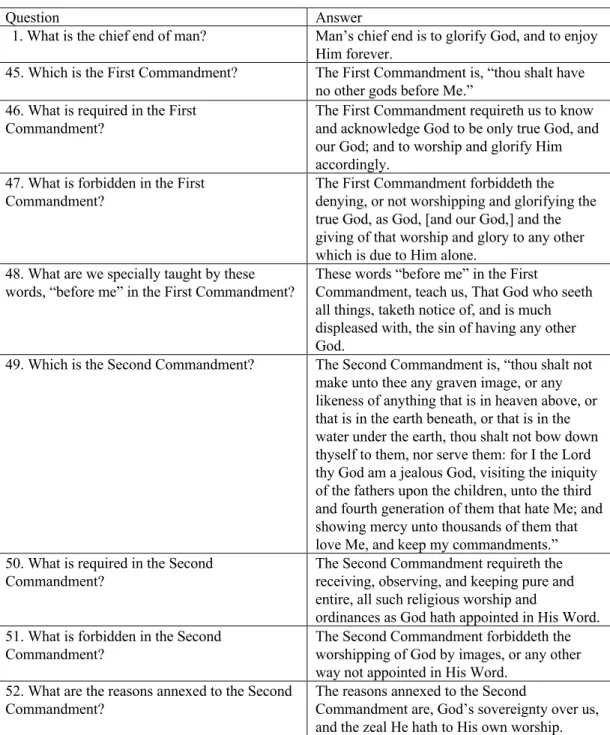
1. Catechism questions and answers relative to the regulative principle ...110
PREFACE
“Yet he did not waver through unbelief regarding the promise of God, but was strengthened in his faith and gave glory to God.” (Rom 4:20 NIV) The completion of a thesis is an occasion for huge gratefulness and an
acknowledgment page is a paltry response to so many people that I am humbled to have their support throughout ministry experiences in Arizona, Texas, Michigan, Kentucky, Maryland, and South Carolina and each one has made a significant contribution.
Special thanks to my extended family: Parents Maurice and Carolyn Ohman, stepmom Mary Lou Powell, Lois Clough, Terry and Laurie Rogers, Kurt and Sharolyn Liljekvist, Julie Ohman, Tim Ohman, Brenda Booher, Andy and Janet Ohman; Steve and Bonnie Hamner; John and Connie Hamner, Vicki and Bill Hutchinson; Mark and Kelly Bohstedt, Jerry and Marsha Bohstedt, and Erwin and Kathleen Bohstedt.
Thank you to all the faithful people that served as instrumentalists, vocalists, choir members, and tech members of the churches God has given me to serve: Galilee Baptist, Kingwood Community, Gracespring Bible, Paducah First Baptist, Hunt Valley, and Mauldin First Baptist.
Special thanks to Mike and Sandy Schafer for the life-giving week at Sonscape in 2012 and to Dr. Theresa Anderson-Varney for her vital role in my spiritual health.
Special thanks to Rob and Teresa Rogers, for their friendship and support during a unique and painful time. God showed His goodness in your gift of friendship to my wife and I.
Thank you to the young marrieds “small group” –– you are life-long friends where the bond remains strong: Jon and Kristin Laning, Todd and Cyndie Moore, Michael and Tracy Wright, Brad and Christie Fadden, and Brian and Erin Beute.
Thank you to the associate pastors I have served with: Brian Peach, Jeff Grote,
Dave Norris, Jeff Chandler, Pam Hiatt, Allen Bartimioli, Andy Jacobs, Larissa Koslek, Selena Newton, Art Cosgrove, Tim Mauriello, Bob Feitl, Dr. Rob Cook, Jeremy Heavey, Michael Fernihough, Jason Stiger, Mark Jevert, Dr. David Barnett, Russ Wilson, Rusty Banks, Steve Moore, Rev. Tommy Tucker, Julio Acosta, Rev. Bill Vorhees, Paula Southwell, and Tory Almond. And thank you to the senior pastors who have invested in my growth and development and freedom to explore meaningful worship experiences:
Dr. Wendell Graham, Dr. David Slottje, Rev. Larry Kiser, Dr. Charles Moore, and Rev.
Wade Leonard.
The Southern Baptist Theological Seminary has been a place of growth for me and sharpened my thinking. I am especially grateful for Dr. Joe Crider and Dr. Stephen Cannell. And special thanks to my supervisor chair, Dr. Matthew Westerholm, for your unflinching assessment of my early writing and your patience as I slowly understood the process. I am in your debt. (I will also never turn down a story about “John” from you!)
To my accountability partner, Brad Fadden, thank you for your life-giving friendship, counsel, and laughter.
Thank you to my daughters and sons: Brandon and Maddie Storz, Tyler Ohman, and Mackenzie Ohman for support, interest, and belief in your “ole dad.”
I am incredibly grateful to my amazing wife Dawnie for your personal
sacrifice for this thesis research and education push these last few years. You are my best friend and have shown me so much loyalty and support through some very rocky terrain these past ten years. I could not have done this without your constant support and belief in me. May we show continual trust in God and that path he has for us ahead.
Howie Ohman Fountain Inn, South Carolina
May 2022
CHAPTER 1 INTRODUCTION
Worship regulation was at the core of the Reformation. Worship regulation began because of the excess and egregious errors of the Roman Catholic church.
Liturgical practice, after centuries of authoritarian practice, had left little for the congregation to do except observe.
In medieval worship a congregation would passively observe the liturgy, comprehend little that was said, and pray privately.1 Congregational singing had long been neglected in favor of the Schola Cantorum, the group of singers and teachers
entrusted with the training of boys and men as church musicians.2 The Lord’s Supper had been reduced by half, for only the bread was issued to worshippers, and then as
infrequently as once a year.3 Priests largely did not teach the Scriptures, but instead played a significant role in the perpetuation of the superstitious mystery of their actions.4 Behind a roodscreen, the priest would mutter prayers5 in an increasingly unfamiliar
1 John Witvliet and Nathan Bierma, “Liturgy,” in The Calvin Handbook, ed. Herman J.
Selderhuis (Grand Rapids: Eerdmans, 2009), 417.
2 Donald Jay Grout, A History of Western Music, rev. ed. (New York: W. W. Norton, 1973), 20-21.
3 Witvliet and Bierma, “Liturgy,” 414.
4 Old states, “About the year 800, Alamar of Metz, one of Charlemagnes’ bishops, wrote a commentary on the liturgy which gave an allegorical meaning to every gesture, every movement, every act of the liturgy. More and more the faithful understood the liturgy as a sacred drama to be watched with awe.
The allegorical explanations which began to multiply from this time on had the effect of inspiring even more ceremonials which could be interpreted and read by the spectators. Even though the worshipers might not understand the liturgical language, they could understand the visual ceremonies.” Hughes Oliphant Old, Guides to the Reformed Tradition (Atlanta: John Knox Press, 1984), 125.
5 Witvliet and Bierma, “Liturgy,” 410. This mode of praying would later become a concern for Calvin as he addressed this troubling pattern for congregants in Geneva.
tongue,6 creating long spells of unintelligibility,7 a whisper that “differs in no way at all from magical incantations.”8 Priests thus increased the superstitious impact of the miracle of the bread becoming the sacred Host.9 Catholic worship clearly needed reform.
Additionally, ceremonies and rites created by priests and laced with salvific import were tyrannically imposed upon congregants.10 This was fuel for Calvin’s fiery opposition to the Catholic church.11 For the Roman Catholic church, with absolute authority, there was little concern for a scriptural basis for these rites.
The Reformation’s liturgical focus was to return worship response and
participation to the people. The Reformation’s theological focus was to return authority to the Scriptures. Calvin articulated his opposition against Rome forcefully in the preface to his Institutes of the Christian Religion.12 For the Reformers, scriptural authority was
6 Old states, “By the time of Charlemagne (742-814), the power of Christendom had moved North across the Alps. Islam had begun to eclipse the influence of the Christian East but the barbarian tribes of France and Germany were infusing fresh vigor into the Christian faith. Although for these Northerners Latin was a foreign language, they wanted their religion to be Roman just as they wanted to make their barbarian empire Roman, and so they maintained Latin, the Roman language, in their worship.
It gave their worship a mystique of learning and culture. Not understanding the liturgical language, the use of ceremonies, symbols, vestments, pictures, and images began to be more and more important.” Old, Guides to the Reformed Tradition, 125.
7 Horton Davies, Worship and Theology in England: From Cranmer to Baxter and Fox, 1534- 1690 (1970; repr., Grand Rapids: Eerdmans, 1996), 140.
8 John Calvin, The Necessity of Reforming the Church, trans. Casey Carmichael (Sanford, FL:
Reformation Trust, 2020), 17.
9 Davies states that for this era, “[seeing] the sacred Host became the principal, if not the exclusive, concern of worshippers in the High Middle Ages. In the cities the people ran from one church to another in the hope of witnessing the miracle often.” Davies, Worship and Theology in England, 140.
10 John Calvin, Institutes of the Christian Religion, trans. Henry Beveridge (Peabody, MA:
Hendrickson, 2008), 4.10.6.
11 Calvin says, “Our false bishops, therefore, burden our consciences with new laws on the pretext that they have been appointed by the Lord spiritual lawgivers, as a consequence of which the government of the church has been entrusted to them. Accordingly, they contend that whatever they command and prescribe must of necessity be observed by Christian people. Anyone who violates it they hold guilty of double disobedience, because he is a rebel against God and the church.” Calvin, Institutes of the Christian Religion 4.10.6.
12 Calvin, Institutes of the Christian Religion xxvii. Calvin says, “It was a father who
pronounced it rashness, in an obscure question, to decide in either way without clear and evident authority from Scripture. They forgot this landmark when they enacted so many constitutions, so many canons, and so many dogmatical decisions, without sanction from the word of God.”
significant because the Scriptures were considered the sole authority above church tradition and practice. This became known as sola Scriptura (Scripture alone). A fundamental principle in sola Scriptura is not only that Scripture itself is the final authority of faith and practice, but also that Scripture is sufficient in all matters of faith and practice. Consequently, this tenet from the Reformers had an impact on liturgical practice.13 This thorough application of Scripture in worship praxis became known as the regulative principle. Thus, sola Scriptura was the foundation in the creation of the
regulative principle, its origins based in the ethos of the Reformation itself.14 The application of scriptural principles to worship praxis extends past the Westminster Assembly and continues to influence Reformed churches today.15
The original purpose of the regulative principle was to make the Scriptures the ultimate authority in worship practice. In its goal of regulating the worship practices of the church, the regulative principle makes key distinctions between “elements,”
“circumstances,” and the “forms” of worship. These three terms are the ultima ratio (the final argument) of the regulative principle. There has been much debate over these three terms over the centuries, starting with the Reformation era through the Puritan era of the seventeenth century and continuing through today.
Defining and applying these three terms consistently and evenly has been problematic in the worship of the church. For Calvin and for the Puritans in attendance at
13 R. Scott Clark, Recovering the Reformed Confession: Our Theology, Piety, and Practice (Phillipsburg, NJ: P&R, 2008), 247. Clark states, “The first stage of the reformation of worship established the formal principle of the Reformation: sola scriptura. The Reformed churches applied the Scripture principle most thoroughly to the practice of worship.”
14 Clark, Recovering the Reformed Confession, 229. Clark comments, “Calvin, Ursinus, and the Westminster divines after them understood that the Reformed principle of worship is sola scriptura applied to the act of corporate worship.”
15 J. Ligon Duncan III, “Does God Care How We Worship?,” in Give Praise to God: A Vision for Reforming Worship; Celebrating the Legacy of James Montgomery Boice, ed. Philip Graham Ryken, Derek Thomas, and J. Ligon Duncan III (Phillipsburg, NJ: P&R, 2003), 21. Duncan says, “This strong and special emphasis on the corporate worship of God being founded positively on the directions of Scripture came to be known as the regulative principle. It is an extension of the Reformational axiom of sola scriptura.”
the Westminster Assembly in 1649,16 the difference was not so much in the definitions of the three terms, for much of the same language was shared regarding the regulative principle. Because of the varied interpretations and debates of the terms—elements, forms, and circumstances—attention is diverted from the sufficiency and meaning of Scripture itself to the regulative principle contained in the Westminster documents.
Ironically, one of the tenets of the Westminster Assembly was the preservation of
Scripture’s authority. The danger of diverting attention away from Scripture existed in the era of the Westminster Assembly and has continued into the twenty-first century.17
Authority rests in Scripture alone because of its divine origin. Documents of human origin must always take a subordinate role, even if the purpose of their creation was the preservation of scriptural authority.
This study attempts to discover the differences within the church regarding the application of the regulative principle in worship theology and praxis. How do fellow believers, who all hold to the authority of Scripture, come to disparate views in the application of the regulative principle? Are there inconsistencies in theological
understanding or merely inconsistencies in the application of the regulative principle?
This thesis will explore and examine those differences between John Calvin, the Puritans, and contemporary theologian John Frame considering common commitments to the sufficiency of Scripture.
16 John H. Leith, Assembly at Westminster: Reformed Theology in the Making (1973; repr., Eugene, OR: Wipf and Stock, 2008), 29-30. This was the end date of the last plenary session of the Westminster Assembly that met from July 1, 1643, to February 22, 1649. However, members of the Assembly met occasionally after that to examine and license candidates to the ministry until 1652.
17 Martyn Lloyd-Jones, Puritans: Their Origins and Successors; Addresses Delivered at the Puritan and Westminster Conferences, 1959-1978 (Edinburgh: Banner of Truth Trust, 1987), 209. Lloyd- Jones states, “Another danger which Calvinism without Methodism is prone to is that Confessions of Faith, instead of being subordinate standards, tend to be the primary and supreme standard, replacing the Bible in that position. . . . Officially we say these Confessions are the ‘subordinate standard’; the Bible comes first then these. But there is always a danger that the Calvinist may reverse the order.”
The regulative principle makes key distinctions between elements, forms, and the circumstances of worship. This thesis examines worship theology and praxis between three distinct views of the regulative principle: (1) the original Reformers’ view as articulated by Calvin, (2) the narrow view of the Puritans as codified by the Westminster Assembly, and (3) a broad view as espoused by modern-day theologian John Frame.
This thesis traces the contours of Calvin’s regulative principle to the Puritans’
regulative principle of worship before culminating with Frame’s application of the regulative principle. This tracing invites a host of related questions: What theological commitments were sustained from Calvin to the Puritans? Conversely, what theological commitments were not sustained from Calvin to the Puritans, and why? How does the theology of John Frame fit into this picture? Does Frame follow closely the path of the Puritans or does Frame’s understanding of the regulative principle follow Calvin?
Working backwards chronologically, John Frame’s controversial application of the regulative principle cannot be understood without understanding the Puritan
codification at the Westminster Assembly. Subsequently, the Puritans’ codification of the regulative principle cannot be understood without understanding Calvin’s foundation of this principle. Moreover, this thesis examines and compares the regulative principle of worship between a person in a particular historical setting (John Calvin) with a group in another historical setting (the Puritans). This kind of comparison (person-to-group) inherently comes with distinct challenges. Yet the historical narrative demands this type of comparison where the regulative principle is concerned. This thesis will answer these questions and synthesize subsequent answers for coherent analysis as it relates to the regulative principle of worship.
Thesis
The contemporary discussion concerning the regulative principle needs a fresh examination of how the sufficiency of Scripture guides the church’s theology and
worship praxis. From John Calvin to the Puritans to John Frame, the regulative principle has been understood and applied in disparate ways. This thesis will argue that when the sufficiency of Scripture is mistaken for the specificity of Scripture, principles become rigid commands, and restrictive conclusions ensue. Such was the historical sequence from Calvin in the mid-sixteenth century to the Puritans almost a century later. Calvin also argued for worship practices that were “expressly set down in Scripture,” yet balanced that conviction with his concern for unity and practiced accommodation in matters of adiaphora (indifferent things).
The Puritans applied Calvin’s scriptural edicts with rigidity and neglected Calvin’s balance. This thesis claims that Calvin’s full impact on the principle of
regulation cannot be critically evaluated unless there is reconciliation between Calvin’s
“expressly set down in Scripture” edict and his principle of accommodation. Calvin’s worship theology is commonly recognized in his polemical edicts. Lesser known is Calvin’s principle of accommodation. Both emphases accurately reveal the full import of Calvin’s impact. Omitting either perspective leaves Calvin’s views on worship regulation unbalanced and misconstrued.
This thesis presents a taxonomy of views among regulative principle adherents, exploring strengths and weaknesses and showing how a balance of biblical principles and biblical freedom provides a necessary framework for worship praxis in the church.
Scope and Delimitations
This thesis makes claims concerning Calvin and the Puritans. The Puritans, as a group, emerged out of the Church of England in 1567. They emerged because the Church of England retained an excess of Rome’s corrupt practices and errant theology. As frustration increased, so did the desire to eradicate theological error and liturgical excess.
This desire for a full Reformation reached its culmination in the Westminster Assembly.18 Ironically, though Puritans themselves were known for precision,19 defining Puritanism precisely today remains elusive. This was because the Puritans were more amorphous, with various groups within Puritanism, but also because Puritan interests changed from one decade to another, beginning in the 1570s.20 Therefore, the Puritans are delimited in this thesis to their characteristics and identity at the time of the Assembly.
Familiarity with the Literature
Bruce Gordon’s Calvin is a preeminent, authoritative, and comprehensive biography of Calvin’s life.21 Providing rationale and context into Calvin’s acerbic personality and prodigious intellect, Gordon gives historical context to Calvin: husband, student, Reformed leader, preacher, continental collaborator, networker, theologian, author, and humanist. Carlos Eire’s work, War on Idolatry: The Reformation of Worship from Erasmus to Calvin, traces the issue of idolatry as central to the Reformation.22 Eire explains Calvin’s identifiable convictions: his denial of compromise, his spiritual
worship, and his iconoclasm. Richard A. Muller explores and examines the theology of Calvin and its theological influence in history in After Calvin: Studies in the Development of a Theological Tradition.23 Muller debunks much of the “Calvin vs. the Calvinists”
thinking that has been the accepted rule of thought for many following Calvin’s death.
18 Chad Van Dixhoorn, God’s Ambassadors: The Westminster Assembly and the Reformation of the English Pulpit, 1643-1653, Studies on the Westminster Assembly (Grand Rapids: Reformation Heritage Books, 2017), 11.
19 Leith, Assembly at Westminster, 71.
20 Davies, Worship and Theology in England, 255.
21 Gordon,Calvin.
22 Carlos M. N. Eire, War against the Idols: The Reformation of Worship from Erasmus to Calvin (Cambridge: Cambridge University Press, 1986).
23 Richard A. Muller, After Calvin: Studies in the Development of a Theological Tradition, Oxford Studies in Historical Theology (Oxford: Oxford University Press, 2003).
Muller gives perspective to Calvin’s influence as a Reformer and his use of the scholastic method. He makes the case that Calvin was not the sole arbiter of Reformed confessional identity in his own lifetime, and he ought not to be arbitrarily selected as the arbiter of what was Reformed in the generations following his death.
John D. Witvliet’s Worship Seeking Understanding devotes three chapters to historical studies, of which two are devoted solely to Calvin.24 Negatively, Witvliet identifies four liturgical sins that Calvin warned against: disobedience, hypocrisy,
superstition, and idolatry. Positively, Calvin is replete with spatial and sensory metaphors that frame the essence of worship. Herman Selderhuis provides readers with a
comprehensive view of Calvin in The Calvin Handbook.25 Selderhuis serves as
contributing author and editor of this multi-authored work that examines Calvin from a diversity of perspectives. The Theater of God’s Glory: Calvin, Creation, and the
Liturgical Arts is W. David O. Taylor’s contribution to Calvin’s world.26 Taylor’s focus is on Calvin’s understanding of materiality and the doctrine of creation. Taylor gives a surprising but balanced view of Calvin’s strengths and weaknesses concerning the liturgical arts.
Calvin’s Ladder, by Julie Canlis, highlights the motivations behind Calvin’s acerbic, though warranted, writing on idolatry.27 Worship is the ascent of the soul, a window into Trinitarian koinonia where the individual is allowed to engage in
participation with God. This is spiritual communion with God, highlighted by material
“ladders” that God ordains to help the individual ascend as Christ ascends. God comes
24 John D. Witvliet, Worship Seeking Understanding: Windows into Christian Practice (Grand Rapids: Baker, 2003).
25 Herman J. Selderhuis, ed., The Calvin Handbook (Grand Rapids: Eerdmans, 2009).
26 W. David O. Taylor, The Theater of God’s Glory: Calvin, Creation, and the Liturgical Arts, The Calvin Institute of Christian Worship Liturgical Studies Series (Grand Rapids: Eerdmans, 2017).
27 Julie Canlis, Calvin’s Ladder: A Spiritual Theology of Ascent and Ascension (Grand Rapids:
Eerdmans, 2010).
down to us so that we might go up to him. Canlis explains that this could unlawfully elevate the worshiper’s status and exalt humanity, and Calvin’s needed corrective for this error was the transcendence of God.
The historical period in England between Calvin and the Puritans is detailed in Leslie Williams’ Emblem of Faith Untouched: A Short Life of Thomas Cranmer.28
Cranmer’s life gives us the context from which the Puritans sprang several decades later, and from which emerges their strong motivations. While the Puritans’ focus on preaching is an undeniable historical reality, Chad Van Dixhoorn’s God’s Ambassadors: The
Westminster Assembly and the Reformation of the English Pulpit, 1643-165329 provides a rationale that combines pragmatic concerns and theological conviction. The number of available preachers and quality of preaching was at an all-time low in the years
immediately preceding the Assembly. Van Dixhoorn gives historical context to the dearth of preaching during that era in England and how the Assembly initiated measures to correct this weakness.
Bryan D. Spink’s Sacrament, Ceremonies and the Stuart Divines gives background behind England and Scotland’s interconnected history, providing historical context to the Westminster Assembly.30 The Westminster Assembly: Reading Its Theology in Historical Context is Robert Letham’s informative contribution to this thesis.31
Providing rich detail about the Assembly itself, its people, debates, and theological climate, Letham also highlights an under-represented aspect of the Assembly: its
predominate English character. Horton Davies’ initial foray, The Worship of the English
28 Leslie Williams, Emblem of Faith Untouched: A Short Life of Thomas Cranmer (Grand Rapids: Eerdmans, 2016).
29 Van Dixhoorn, God’s Ambassadors.
30 Bryan D. Spinks, Sacraments, Ceremonies and the Stuart Divines: Sacramental Theology and Liturgy in England and Scotland, 1603-1662 (London: Routledge Taylor and France, 2002).
31 Robert Letham, The Westminster Assembly: Reading Its Theology in Historical Context (Phillipsburg, NJ: P&R, 2009).
Puritans, followed by his comprehensive opus, Worship and Theology in England: From Cranmer to Baxter and Fox, 1534-1690, traces origins and developments of all ecclesial institutions within England.32 Davies chronicles developments within architecture, music, art, and theology. John Leith’s Assembly at Westminster: Reformed Theology in the Making presents the Westminster Confession as normative and authoritative theology.33 Leith gives another account of the background and character of the Assembly and puts the Confession in its historical, political, cultural, and theological contexts.
Bridging the gap between the historic Reformed ecclesial concerns and
present-day ecclesial realities, R. Scott Clark’s Recovering the Reformed Confession: Our Theology, Piety, and Practice bemoans the loss of a distinctive Reformed identity.34 This loss of identity has occurred because the Reformed churches have been affected deeply by two alien impulses: the quest for illegitimate religious certainty (QIRC) and the quest for illegitimate religious experience (QIRE). These alien and distinct impulses, Clark maintains, have come from a church that has neglected Calvin and the Puritans in the regulative principle of worship. T. David Gordon’s essay, “Some Answers about the Regulative Principle,” maintains that Frame presents a straw man argument and has entirely misunderstood the primary impulses of the regulative principle.35 Terry L.
Johnson’s Worshipping with Calvin: Recovering the Historic Ministry and Worship of Reformed Protestantism is another advocate for a return to the Puritan standard of the regulative principle.36 Johnson warns against evangelical syncretism and insists that
32 Davies, The Worship of the English Puritans; Davies, Worship and Theology in England.
33 John H. Leith, Assembly at Westminster: Reformed Theology in the Making (1973; repr., Eugene, OR: Wipf and Stock, 2008).
34 Clark, Recovering the Reformed Confession.
35 T. David Gordon, “Some Answers about the Regulative Principle,” Westminster Theological Journal 55, no. 2 (1993): 321-29.
36 Terry L. Johnson, Worshipping with Calvin: Recovering the Historic Ministry and Worship of Reformed Protestantism (Grand Rapids: EP Books, 2014).
Reformed churches cannot have Reformed theology without traditional Reformed worship. Contrastingly, John Frame’s Worship in Spirit and Truth and Contemporary Worship Music: A Biblical Defense provide rationale for his broad interpretation of the regulative principle.37 Frame makes connections from Calvin and the Puritans to present- day liturgical realities that present a broad understanding of “circumstances” in worship praxis. Covenantal Worship: Reconsidering the Puritan Regulative Principle articulates R. J. Gore’s contribution to the conversation concerning worship praxis.38 Connecting the Westminster Assembly’s work with Calvin’s writing on adiaphora (indifferent things), Gore attempts to balance biblical and pastoral concerns with the conclusion that the regulative principle is unworkable.39
Void in the Literature
The three views of Calvin, the Puritans, and John Frame turn on the definitions of “circumstances,” “prescribed,” “warranted,” and “commanded.” The second and third views claim Calvin as their spiritual progenitor, yet they each express contradictory expressions of the regulative principle. This thesis will show the inconsistencies of each view’s conclusions from their employed hermeneutic. There are subtle dangers of the narrow application of the regulative principle. Additionally, with surprising inconsistency, too few mention John Calvin’s application of the regulative principle. This project
contends that faulty conclusions are often a result of unwarranted hermeneutical
hierarchies. As legalists restrict behavior and suppress authentic spiritual life, so too does
37 John M. Frame, Worship in Spirit and Truth (Phillipsburg, NJ: P&R, 1996); John M. Frame Contemporary Worship Music: A Biblical Defense (Phillipsburg, NJ: P&R, 1997).
38 R. J. Gore Jr., Covenantal Worship: Reconsidering the Puritan Regulative Principle (Phillipsburg, NJ: P&R, 2002).
39 R. J. Gore Jr., “Covenantal Worship: Reconsidering the Critics,” The Westminster Theological Journal 67, no. 2 (2005): 377.
the narrowly applied regulative principle. This error leads to unproductive disputes and conflicts within the church, needlessly stunting her witness to a dying culture.
Outline of Chapters
The following chapters support this thesis, presenting a taxonomy of views of regulative principle adherents.
Chapter Two: Calvin and the Inception of the Regulative Principle
The foundation of the regulative principle begins with Calvin. Chapter 2 explores Calvin’s influence within the Reformation following Luther while carrying the mantle of Zwingli’s fight against idolatry. It was an era that saw a nascent church break from Rome’s dominant tyranny40 during the Middle Ages and Medieval era. As it unfolded, the Reformation was tenuous, and its success was far from guaranteed. As a prolific writer and communicator with other leaders around the continent, Calvin enjoyed a unique perspective from which to understand and influence the Reformed church during its first decades. Calvin considered issues through the lens of what would be harmful and what would be beneficial to the church.41
Numerous threats jeopardized the success of Reformation efforts. Breaking away from Rome without a titular head of these reformational efforts, such as the pope with Roman Catholicism, required monumental effort to ward off the threat of
factionalism. The belief in the authority of Scripture aligned all those within the
Reformation, but the authority of Scripture did not always align worship praxis within the Reformation. Regional accommodations, theological differences, intertwined church-state
40 Calvin, Institutes of the Christian Religion 4.10.6.
41 Graham Keith, “Too Narrow a Straightjacket? Reflection on the Historical Development of the Regulative Principle in Worship,” Scottish Bulletin of Evangelical Theology 26, no. 1 (Spring 2008): 7.
relationships, and differing convictions all played a role in creating a diverse worship praxis among the churches of the Reformation. As a result, Calvin’s regulative principle of worship is both complex and nuanced.
Calvin’s view on worship regulation stems from his comprehensive theology.
The second section of chapter 2 identifies three distinct yet connected theological thrusts that form the boundaries of Calvin’s concern for worship regulation. These theological thrusts form the foundation of Calvin’s regulative principle.
In the last section, chapter 2 explores Calvin’s distinct application of the regulative principle. This exploration begins with the primacy of the Word—an expression of the Reformation’s value, sola Scriptura. Calvin and the Puritans travel virtually the same path when articulating the heart of the regulative principle, yet their paths diverge when addressing Calvin’s principle of accommodation and his treatment of adiaphora (indifferent things). The Puritans applied Calvin’s principles with a rigidity that Calvin himself did not display. This chapter will advance the claim that the Puritans’
application of the regulative principle showed a significant narrowing of Calvin’s understanding of adiaphora and neglected Calvin’s principle of accommodation.42 Chapter Three: The Puritan
Codification of the Regulative Principle
The Puritans’ articulation of the regulative principle of worship via the Westminster Assembly is the locus classicus of worship regulation. Four distinct documents from the Westminster Assembly contributed to the regulative principle: the
42 Calvin states, “But as in external discipline and ceremonies, he has not been pleased to prescribe every particular that we ought to observe (he foresaw that this depended on the nature of the times, and that one form would not suit all ages), in them we must have recourse to the general rules which he has given, employing them to test whatever the necessity of the Church may require to be enjoined for order and decency. Lastly, as he has not delivered any express command, because things of this nature are not necessary to salvation, and, for the edification of the Church, should be accommodated [emphasis added] to the varying circumstances of each age and nation, it will be proper, as the interest of the Church may require, to change and abrogate the old, as well as to introduce new forms.” Calvin, Institutes of the Christian Religion 4.10.30.
Publick Directory of Worship, the Westminster Confession of Faith, the Larger
Catechism, and the Shorter Catechism. The regulative principle contributed positively to the church by establishing the church’s foundation for worship practice and limiting the church’s authority for prescribing ceremonies and rites to Scripture alone. Scripture- supported worship praxis was a significant Puritan corrective for the church.
Yet these Puritan correctives, as codified at the Westminster Assembly and laden with good intentions, were guilty of going beyond Scripture. While the Puritans took seriously Calvin’s concern that true worship should not be identified with externals, the Westminster Assembly felt it had to be more precise in proscribing improper
ceremonies.43 This tendency to be “more precise” became characteristic of the Puritans, as they insisted on an explicit biblical sanction for every ordinance of worship and almost every detail of worship, displaying their desire to faithfully follow the New Testament.44 The Puritans sustained, even exceeded, Calvin’s commitment to scriptural fidelity. Yet the Puritans mistook scriptural sufficiency for specificity in worship practice and displayed increasingly hardened positions, largely due to the political and ecclesiastical realities of their time.45 Ultimately, this resulted in narrowing the conditions favorable to label worship practices as adiaphora.
Even before the Assembly convened, Reformed theology was, as a movement, already on a path toward fastidious refinement of theological definitions and positions.46 It preferred an exact theology, requiring abstract words and logical formulations.47 Now,
43 Keith, “Too Narrow a Straightjacket?,” 26.
44 Davies, Worship and Theology in England, 256.
45 Keith links Queen Elizabeth’s imposition of the Book of Common Prayer with the hardening of the Puritans’ position: “In short, the intransigence of the Anglican Establishment forced the Puritans into an elaboration of the Regulative Principle beyond [emphasis added] what Calvin would have envisaged.”
Keith, “Too Narrow a Straightjacket?,” 17.
46 Leith, Assembly at Westminster, 66.
47 Leith, Assembly at Westminster, 71.
with sola Scriptura as liturgical criterion,48 the Puritans went on a quest to turn
intermittent hints of liturgical direction in the New Testament into inviolable edicts.49 The corrective efforts of the Westminster Assembly were stringent, scrupulous, and dogmatic, displaying an obduracy with which the Puritans claimed the sanction of the entire New Testament.50 This thesis argues that in these Puritan iconoclastic tendencies, they distanced themselves from Calvin’s principle of accommodation.51 The Puritans
narrowed Calvin’s category of adiaphora, displaying a significant discontinuity from his application of the regulative principle. This chapter explores the three major motivations behind the Puritans’ convictions along with the unique historical circumstances that shaped their emergence. This chapter will advance the claim that these motivations were the primary shaping force of the Westminster formulations of the regulative principle.
Chapter Four: John Frame’s Broad View of the Regulative Principle
All adherents to the regulative principle of this thesis support the basic tenets of Calvin’s worship regulation. John Frame is a modern-day Reformed theologian who reaffirms his commitment to the regulative principle.52 However, it is clear from the outset that his language and terms are crucial to this discussion. Frame affirms that
“worship must be scriptural (i.e., consistent with Scripture) and, indeed, limited by
48 Davies, Worship and Theology in England, 259.
49 Davies, Worship and Theology in England, 258.
50 Horton Davies, The Worship of the English Puritans (1948; repr. Morgan, PA: Soli Deo Gloria, 1997), 110.
51 Gore states, “Calvin used both leavened and unleavened bread in communion. He accommodated himself to the Genevan practice of using unleavened bread during his first stay.” Gore, Covenantal Worship, 76. See also pages 65-70. This thesis will treat Calvin’s principle of accommodation and adiaphora as intrinsically linked.
52 Frame, “Some Questions about the Regulative Principle,” Westminster Theological Journal 54, no. 2 (Fall 1992): 357-66.
Scripture.”53 At first glance, this would seem to be evidence of the affirmation of the narrow view which uses the abbreviated “whatever is not commanded is forbidden”
designation. Yet Frame contends that in Westminster’s formulation, “commanded” is not used, nor is “prescribed” or “warranted.” Indeed, these are, for Frame, questions that need answers. Frame believes that there is little distinction between worship and life with the regulative principle. Hence, Frame’s category of circumstances is large and gives much latitude in the application of the regulative principle.
Contrastingly, many believe that Frame has distorted the intention of the regulative principle and his application is unbiblical, unreasonable, non-Reformed, and even deceptive.54 Many believe his application of circumstances stretches the limits of what the regulative principle actually regulates.55 For many, Frame’s Worship in Spirit and Truth is the epitome of what the Puritans were against and has put a stain upon the Reformed community’s long-held views of worship.56
Yet others contend that Frame has faithfully applied Calvin’s regulative principle, albeit with different and much broader conclusions.57 Frame believes the believer’s entire life should be regulated by Scripture, and the regulative principle of worship is a restatement of this broader principle. Accordingly, chapter 4 will explore Frame’s application of the regulative principle and continuities and discontinuities with both Calvin and the Puritans. Chapter 4 will include a taxonomy of views that have
53 Frame, “Some Questions about the Regulative Principle,” 357.
54 Clark, Recovering the Reformed Confession, 240.
55 Terry L. Johnson, “The Regulative Principle of Worship,” in The Worship of God: Reformed Concepts of Biblical Worship (Fearn, Scotland: Christian Focus, 2005), 19-20.
56 Gordon, “The Westminster Assembly’s Unworkable and Unscriptural View,” 353. Gordon contends that Frame displays an “unwillingness to discuss the historic principle within the arena in which it was historically developed.”
57 Jeffrey Meyers states, “John Frame’s Worship in Spirit and Truth . . . is helpful in so far as he provides a biblical critique of a strict use of the traditional regulative principle of worship.” Jeffrey J. Meyers, The Lord’s Service: The Grace of Covenant Renewal Worship (Moscow, ID: Canon Press, 2003), 408.
engaged with him either in support or in opposition to his views. Finally, this chapter concludes by evaluating whether Frame’s critics’ objections stem from philosophical misalignment with the regulative principle or from a difference in a preferred worship aesthetic.
Chapter Five: The Regulative Principle and Hierarchy
The final chapter will analyze and synthesize each view for modern application in the church today via hierarchy. When arbitrary priorities are imposed artificially on scriptural texts, the result is unwarranted hierarchies that impact worship praxis. Chapter 5 explores critical questions: Does the regulative principle have a crucial place in the modern church, or is it an antiquated tool with an expiration date after almost four hundred years? This thesis contends that when a human-originated principle, whose reforming intention was solely Scripture, becomes as authoritative as divine Scripture, then a step has been taken down an unnecessarily restrictive path. The modern-day Reformed community can become over-scrupulous when semantic meanings are mined for minutia. The danger is that this diligence is applied to a human, rather than a divine, document. Human documents, such as the Westminster Confession––however noble and worthy of admiration––will always carry with it two extant realities: (1) they are of fallible human origin, not divine origin and, (2) they will always be susceptible to the era from which they sprang, which speaks to their limitation.
Analysis of the regulative principle itself can also lead to much confusion.
Letham mentions that “when denominations in practice adhere to their own interpretation of the Assembly’s theology and, indeed, add other elements unknown to the divines, inevitable questions follow.”58 For example, whose regulative principle is under
consideration? Is it Calvin’s, the Westminster divines’, or the subsequent three hundred
58 Letham, The Westminster Assembly, 8.
fifty years’ worth of historical interpretation of the regulative principle? How does one honor 350 years of ecclesial insight while avoiding the danger of elevating this insight to the status of holy Scripture? Ironically, these questions have a similar thrust as those of the Reformers over five hundred years ago. Does tradition carry as much authority as Scripture? The Reformers’ answer was sola Scriptura.
As this thesis discovers the original intent of Calvin’s words, as well as the Westminster divines’, there are still larger issues to consider. Is it possible that the Westminster divines were in error in any part of their articulation of worship? Is it possible that Calvin was in error? The Reformed conviction of sola Scriptura demands that these possibilities must be considered. Nautical destinations from the same starting point can be thwarted when the departed courses differ by scant degrees. Does the Reformed church worship milieu of today represent the arrival of a course that was launched almost five hundred years ago by Calvin and almost four hundred years ago by the Puritans at the Westminster Assembly? These questions are not to disparage, because the church’s worship regulation today is built upon the foundation laid by the divines at the Assembly. But what if the Puritans’ compass was off by a few degrees? What if Calvin was off by even less, but still misguided?
This is where Frame’s answers have the most value. Not because he is immune to error, but because Frame has courageously questioned Calvin and the Westminster divines for scriptural accuracy, a direction that the Reformed community today rarely travels. Calvin’s scriptural interpretations in worship regulation are accepted as fact, and there is significant pressure to accept Calvin’s hermeneutic in toto, lest one be considered part of the liturgically “loose” adherents of the normative principle. Moreover, when denominational minister ordinations include full adherence to the Westminster
standards,59 these human documents give the regulative principle creedal status.60 When the debate reaches the stage of the minutiae surrounding the variant readings between a comma or a semicolon in a human document, the church is in danger.61 This chapter concludes by drawing implications from the error of unwarranted hierarchies.
The church’s motto should echo the humanist motto: “Back to the original sources.” Otherwise, great pinnacles of theological enterprise, such as the Westminster Assembly, could assume primary roles instead of subordinate roles. When commitment to the regulative principle becomes the criterion by which the contemporary Reformed church ensures theological adherence, the church is in dangerous territory of departing from sola Scriptura.
59 John M. Frame, John Frame’s Selected Shorter Writings, vol. 3 (Phillipsburg, NJ: P&R, 2016), 260.
60 Keith, “Too Narrow a Straightjacket?,” 28.
61 Gore, Covenantal Worship, 34.
CHAPTER 2
JOHN CALVIN AND THE INCEPTION OF THE REGULATIVE PRINCIPLE
Introduction
While Henry Ford did not actually invent the automobile, he popularized it and made such an indelible impression on the public’s consciousness of the automobile that when one thinks of the beginning of the automobile, Henry Ford comes to the forefront.
Similarly, while John Calvin did not invent the regulative principle, he wrote about worship extensively as the center of the church, and because the regulative principle is an extension of Calvin’s theology of worship, much material is germane.
Calvin’s influence behind the regulative principle is partially due to his proclivity in writing. Calvin produced and printed over one hundred thousand words every year from 1550-1563.1 It was fortuitous that he lived in Geneva, since it was an important center in the printing industry. During the 1550s, Calvin’s writings accounted for nearly one-fourth of Geneva’s publishing efforts.2 Calvin was influential in many other ways: his liturgical praxis, ecclesiastical boundaries, and theological acumen dominate the landscape when it comes to the inception of the regulative principle. As Graham Keith notes, “John Calvin did not originate the Regulative Principle . . . . It was already an important theme with Zwingli and with his successor at Zurich, Bullinger.
There can, however, be no doubt that Calvin was the Reformer who put this Principle on
1 Bruce Gordon,Calvin (New Haven, CT: Yale University Press, 2009), 288.
2 Raymond A. Mentzer, “Calvin and France,” in The Calvin Handbook, ed. Herman J.
Selderhuis (Grand Rapids: Eerdmans, 2009), 80.
a sound theological footing.”3Because of these reasons, Calvin’s dominant influence was behind the inception of the regulative principle.
Consequently, this chapter will endeavor to demonstrate how the regulative principle ostensibly begins with Calvin. This will be demonstrated by three areas of focus. First, this chapter will begin with an overview of Calvin’s influence: (1) his place in the Reformation and (2) his continuing influence around the theme of the regulative principle. Second, the chapter will turn its attention to Calvin’s theology of worship—the foundation of the regulative principle—as expressed by Calvin’s emphases on God’s honor and glory, Christianity’s ecclesiastical center, and communion with God. Third, the regulative principle will be examined through the lens of Calvin’s liturgical application and counsel. Here, the material will focus on the Word’s primacy before examining Calvin’s writing on the regulative principle. Finally, this section will be concluded by observing Calvin’s style of accommodation and Puritan discontinuities with Calvin in worship praxis.
Calvin’s Historical Context and Influence
While the codification of the regulative principle belongs to the divines at the Westminster Assembly (1643-1652), the genesis of this principle belongs to the events and figures of the Reformation more than a century earlier. If it is germane to say that the Puritans of the Westminster Assembly “birthed” the regulative principle, certainly the conception of this principle began with the Reformers who dared to conceive of a break with Rome and of a church that follows the scriptural admonitions and patterns that
3 Graham Keith, “Too Narrow a Straightjacket? Reflection on the Historical Development of the Regulative Principle in Worship,” Scottish Bulletin of Evangelical Theology 26, no. 1 (Spring 2008):
11.
identifies it as truly Christian. These seminal thoughts about the church and its worship are found in the writings of many Reformers, especially John Calvin.
John Calvin, son of Gerard Cauvin, was born in Noyon, France in 1509 and died in Geneva, Switzerland in 1564. Calvin began his theological studies at College des Capettes in Noyon before he moved to Paris to study for priesthood at College do la Marche. Eventually, Calvin settled at the more prestigious College de Montaigu at the end of 1523. He had a hard, cruel, and disciplined life there in an educational setting where Erasmus and Ignatius Loyola, founder of the Jesuits, also received training.4 Calvin moved to Orleans in 1528 and switched his focus to study law where long hours of study and rigorous legal training left its imprint.5 In 1533 Calvin experienced a sudden shift from obstinacy to teachableness and was converted.6 Calvin lived in an era of humanistic ideals but also an age “when events moved quickly and information very slowly. Their actions and thoughts were profoundly shaped by a world over which they had little control.”7
The Reformation was a turbulent and chaotic time in its opposition to Rome.
Rome’s powerful and prevailing influence over the entire European continent was pervasive for hundreds of years. Corruption, theological error, and the doctrine of papal infallibility contributed to an oppressive environment. Scripture had been usurped, for tradition and ceremonial rites were being venerated for their inherent value. Reformation efforts focused on this egregious error. Carlos Eire writes, “Protestantism claimed that the medieval Church had fallen into idolatry . . . opposed to the worship revealed by God in
4 Gordon, Calvin, 6-7.
5 Gordon states that studying law “sharpened his mind to interpret texts and for precise arguments based on humanist methods; it provided him with a thorough grasp of subjects, ranging from marriage and property to crime. He was taught to frame legislation, write constitutions and offer legal opinions, all of which would loom large in his Genevan career.” Gordon, Calvin, 22.
6 Gordon, Calvin, 22.
7 Gordon, Calvin, x.
scripture . . . . [The] Church had set itself up as an idol, substituting its own decrees for those of God.”8 Reformers drew a sharp distinction between “good” and “evil,” or “true”
and “false” worship, and Rome was considered Baal. As Calvin says,
Now then let the papists, in order to extenuate their vices as much as possible, deny, if they can, that the state of religion is as much vitiated and corrupted with them as it was in the kingdom of Israel under Jeroboam. They have a grosser idolatry, and in doctrine are not one whit more pure; rather, perhaps, they are even still more impure.9
Calvin unleashed his rhetorical tirades towards the one opponent that he believed
deserved it and grounded his comparison with the abuses of Israel in the Old Testament.10 While Protestantism pulled in one direction against a common enemy, their lack of theological consensus prevented them from exhibiting a unified approach. Historian J.
Marius J. Lange Van Ravenswaay writes, “The Reformers were all unified that the Catholic church was the false religion. Yet, this holy war against ‘false religion’ was far from unified. Differences of opinion on theology and reforming policy led to struggles within Protestantism itself, pointing to divisions that would plague the Reformation for years to come.”11
Some of these differences consisted of complementary but different theological focuses. Luther’s Reformation efforts centered around justification and the mercy of God, while Zwingli’s centered on an uncompromising transcendentalism.12 For Luther, the
8 Carlos M. N. Eire, War against the Idols: The Reformation of Worship from Erasmus to Calvin (Cambridge: Cambridge University Press, 1986), 54.
9 John Calvin, Institutes of the Christian Religion, trans. Henry Beveridge (Peabody, MA:
Hendrickson, 2008), 696.
10 Van Ravenswaay states, “Calvin used the same argument against his opponents time and again. Believers had to . . . make a choice between God and Baal. The Catholic Church was the sixteenth- century Baal.” J. Marius J. Lange Van Ravenswaay, “Calvin and His Opponents,” trans. Judith J. Guder, in Selderhuis, The Calvin Handbook, 157.
11 Eire, War against the Idols, 55.
12 Eire, War against the Idols, 86. Eire states, “Until Calvin emerged as the new leader of the war against idolatry, Zwingli remained the principal interpreter of ‘true religion,’ and his uncompromising transcendentalism continued to function as the heart of a rapidly growing body of iconoclasts.”
alternative to faith is works, represented by the Judaistic heresy. For Zwingli, the alternative to faith is every kind of idolatry, represented by pagan doctrine.13 Calvin followed Zwingli in picking up the theme of idolatry and emerged as a leader in opposing idolatry.14 He saw himself as a prophet of the church, and he brooked no rivals.15 Calvin’s Reformation efforts aimed at reestablishing the correct worship and veneration of God.16 He gave considerable weight to false worship in his writings and was relentless in writing polemics against this Roman error––his prolific writings throughout the sixteenth-century bearing witness to this datum.17
Calvin was an influential figure of the Reformation and made a substantial contribution to the political, ecclesiastical, and social changes in the western world.18 Yet he was far from the only significant figure of the Reformation. He was one of several influential Reformers that followed the contours of the first Protestant leaders. Calvin was one among many influential theologians of his generation along with, for example,
13 Locher further explains, “For Zwingli and his followers, no less than for Luther and his, the Reformation was above all a religious movement that included concrete social changes. The main
difference is that, for the Zwinglians, the Reformation decision consisted not so much in finding a just God, but rather in turning away from idolatry to the true God.” Gottfried Wilhelm Locher, “Zwingli’s Thought:
New Perspectives,” in Studies in the History of Christian Thought, vol. 25 (Leiden: Brill, 1981), 34.
14 Eire, War against the Idols, 86.
15 Gordon, Calvin, vii.
16 Christopher Strohm, “The Law and Canon Law,” trans. Randi H. Lundell, in Selderhuis, The Calvin Handbook, 399.
17 Calvin states, “I mean the unspeakable idolatry present in the Mass. They pretend that bread is clothed with divinity, and raise it aloft to be adored as God. Once elevated, all worship it. This is so loaded with outrage and so shameful that no one could really believe it without seeing it for themselves. . . . A little crust of bread, I say, is displayed, adored, and prayed to as God. Finally, they believe that this little crust is God. No pagan ever believed this about his statues!” Jean Calvin, God or Baal: Two Letters on the Reformation of Worship and Pastoral Service, trans. David C. Noe (Grand Rapids: Reformation Heritage Books, 2020), 33.
18 Herman J. Selderhuis, “Calvin Images: Images and Self-Image,” in Selderhuis, The Calvin Handbook, 5. Historian Stephan Ehrenpreis adds, “The age of Calvin was the time of the Reformation and humanism. In his role as lawyer, humanist, and reformer of the church, Calvin embodied both intellectual movements.” Stefan Ehrenpreis, “Education and Pedagogy,” trans. Randi H. Lundell, in Selderhuis, The Calvin Handbook, 428.
Peter Martyr Vermigli, John a Lasco, Martin Bucer, and Heinrich Bullinger.19 Calvin was part of a diverse tradition that emphasized opposition to Rome, scriptural authority over ecclesiastical traditions, and doctrinal preaching. Calvin made a significant contribution to the efforts of the Reformation, along with several others such as Peter Martyr, John a Lasco, Martin Bucer, and Heinrich Bullinger.20His main contribution was as a second- generation codifier of the Reformation,21 leaving a legacy for Reformed generations to come and further refining Zwingli’s theology of idolatry.22
Calvin’s influence also existed because of his skill at writing. Exposed to the classics and educated during a period of humanistic ideals, Calvin exhibited considerable skill in writing.23 Calvin’s writing output, as already mentioned, was prolific. His
Institutes of the Christian Religion could be considered the epitome of Calvin’s entire writing output. The 1536 version of Institutes was originally conceived as catechetical in nature, but by 1539 it became a book of instruction for ministers. Calvin, Gordon
explains, was “a man who rarely, if ever, changed his mind on a topic, yet continuously and restlessly reformulated and rewrote his thoughts in pursuit of greater clarity and
19 Carl R. Trueman, “Calvin and Reformed Orthodoxy,” in Selderhuis, The Calvin Handbook, 476. Theologian Richard A. Muller clarifies, “Specifically, Calvin’s work ought to be understood as a development of a Reformed tradition that began with such Reformers as Zwingli, Bucer, and
Oecolampadius and, as such, represent one contribution, albeit a significant one, among others made by thinkers of Calvin’s generation (e.g., Bullinger, Vermigli, Viret, Musculus, Hyperius, a Lasco) toward the confessional and dogmatic codification of a tradition.” Richard A. Muller, Calvin and the Reformed Tradition: On the Work of Christ and the Order of Salvation (Grand Rapids: Baker Academic, 2012), 41.
20 Trueman, “Calvin and Reformed Orthodoxy,” 476. Trueman adds, “Indeed, it is arguable that the single most dominant theological figure in the Reformed tradition was actually Augustine, and that much of Reformed theology represents a distinctive form of Protestant dialogue with his thought rather than that of Calvin or any other sixteenth-century figure.”
21 Muller, Calvin and the Reformed Tradition, 36.
22 Eire, War against the Idols, 206. Eire states, “Calvin further refines the theology of idolatry that had already been developed by Zwingli. Though Calvin’s predecessors had also placed the blame for idolatry in human beings rather than in the material world, they had focused on this problem in isolation from the doctrine of the Fall.”
23 Gordon states, “Calvin loved to write and took delight in crafting elegant prose. His Latin was largely Ciceronian in style and wonderfully clear . . . . [To] read Calvin is to be in the hand of a master of language.” Gordon, Calvin, 148.