All rights reserved. The Southern Baptist Theological Seminary has permission to reproduce and disseminate this document in any form by any means for purposes chosen by the Seminary, including, without limitation, preservation or instruction.
ECUADORIAN CUENCANO MESTIZOS
__________________
A Dissertation Presented to the Faculty of
The Southern Baptist Theological Seminary __________________
In Partial Fulfillment
of the Requirements for the Degree Doctor of Philosophy
__________________
by
James Howard Winfrey December 2021
APPROVAL SHEET
THE ENCROACHMENT OF SECULARISM AMONG YOUNG ECUADORIAN CUENCANO MESTIZOS
James Howard Winfrey Read and Approved by:
__________________________________________
John M. Klaassen (Chair)
__________________________________________
George H. Martin
__________________________________________
J. Keith McKinley
Date______________________________
For Heather, my God-given partner in life and missions.
For my children—Willow, Walker, Waverly, Weston, Wallace, and Windsor.
May God grant each of you with the desire to proclaim his gospel as far as the curse is found.
TABLE OF CONTENTS
Page LIST OF FIGURES ... VII PREFACE ... VIII Chapter
1. INTRODUCTION ...1
Background ...2
Thesis and Research Questions ...3
Terminology ...3
Limitations and Delimitations ...5
Methodology ...6
Review of Literature ... 7
Qualitative Inquiry ... 8
Missiological Significance ...10
Chapter Summaries ...10
2. A SURVEY OF SECULARIZATION ...13
The Three Pillars of a Worldview ...14
The Essence of Secularism...15
The Encroachment of Secularism upon the Western World ...19
A Survey of the History of Secularization ...22
Metaphysics: The Enchanted West ... 22
The Reformation and Disenchantment ... 25
Renaissance to Romanticism to Enlightenment ... 32
Chapter Page
Modern Secularism ... 54
Ethics: Practical Consequences of Modern Secularism ... 66
Conclusion ...70
3. THE ECUADORIAN CONTEXT ...72
Ecuadorian Religious History: From Incan Animism to Catholic Syncretism ...73
Pre-Columbian Ecuador: From the Inca Empire’s Rise to the Spanish Conquest ... 74
The Rise of Catholicism and Catholic Missions in Ecuador ... 77
Conclusion ...81
4. RESEARCH METHODS AND FINDINGS...83
Research Methodology ...83
Research Findings ...89
Preliminary Observations ... 90
Findings Via Qualitative Fixed Questionnaire ... 93
Findings Via Follow-Up Qualitative Interviews ... 102
Conclusion ...108
5. EQUIPPING EVANGELICAL LEADERS TO COMBAT SECULARISM ...110
Effective Missiological Practices for Training Indigenous Evangelical Leaders ...111
The Indigenous Approach to Missions ... 112
The Importance of Pastoral Training ... 118
Three Specific Ways for Pastors to Combat Encroaching Secularism ...127
Combatting Secularism within the Institution of the Local Church via Expository Preaching ... 129
Combatting Secularism within the Institution of the Home via Parental Discipleship ... 137
Combatting Secularism within the Culture via Apologetics ... 147
Chapter Page Conclusion ...153 6. CONCLUSION ...155 Final Considerations ...158 Appendix
1. QUALITATIVE RESEARCH INSTRUMENTATION ...160 2. SAMPLING OF QUALITATIVE RESEARCH SURVEY RESPONSES ....161 3. DECENTRALIZED THEOLOGICAL TRAINING MODULE ...213 BIBLIOGRAPHY ...222
LIST OF FIGURES
Figure Page
1. Paul Hiebert’s “Excluded Middle” ...20
2. “An Old Man in Red” ...38
3. Generational differences in religious adherence ...56
4. Young Cuencano Mestizos in typical Western dress ...91
5. Generational responses grouped by 3 key worldview categories ...93
6. Generational responses to all qualitative research questions...161
PREFACE
This dissertation would not have been possible without the encouragement and sacrifice of my wife, Heather. She has been by my side from the very beginning, never failing to spur me on to perseverance during the difficult days of completing this project.
Likewise, I am grateful for the expertise and clear instruction of my committee, and particularly the consistent guidance of my faculty supervisor Dr. John Klaassen. I also want to thank my pastor and friend, Dr. Jim Orrick, who provided wise counsel and affirmation that I should pursue a Doctor of Philosophy degree in the first place. May this work serve the church for the glory of God.
James H. Winfrey Cuenca, Ecuador
December 2021
CHAPTER 1 INTRODUCTION
We’re all secular now. The secular touches everything. It not only makes unbelief possible; it also changes belief—it impinges upon Christianity and all religious communities.1
Serving as a missionary in Cuenca, Ecuador for several years afforded me the opportunity to observe major cultural differences between Ecuadorian customs and those of my home country, the United States. These distinctions extend to many areas of everyday life including work, leisure, religion, and family. However, much like the USA, Ecuador does not have a uniform nationwide culture. Cultural variances are evident among Ecuador’s diverse regions and people groups. There are the Afro-Ecuadorians of the western coast, the indigenous Quichua tribes of the central Andean mountains, the mestizos of the major cities, and the numerous native tribes of the Amazon rainforest in the East. Despite these significant societal distinctives, one particular development has become increasingly notable in my experience—namely, many younger Ecuadorians have adopted a much more secular worldview than that of their parents’ generation.
Having observed this development among the younger generation, the goals for this research project emerged: to investigate, analyze, and describe the secularization of worldview among younger Cuencano mestizos in central Ecuador. Additionally, the need for Ecuadorian Christian leaders to address and combat this supposed increase in secularization has become readily apparent. Therefore, considerations will be made as to how pastors may be prepared to understand secularism in order to equip their
1 James K. A. Smith, How (Not) to be Secular: Reading Charles Taylor (Grand Rapids:
Eerdmans, 2014), 65.
congregations to withstand its encroachment.
Background
I serve with Reaching and Teaching International Ministries. Our primary focus as a missions organization is making mature disciples, establishing healthy churches, and training local leaders.2 My principle method of serving the Kingdom of Christ in Ecuador has consisted of providing theological education and pastoral training for Christian leaders without access to formal instruction. As a result, I have organized and led a variety of classes throughout the country. For example, in the nation’s third largest city, Cuenca, I have taught a room full of mestizos, meaning mixed, who are descended from both indigenous and Spanish lineages. I have also taught in the small town of Tambo to a class almost entirely comprised of indigenous Quichua people—the largest native people group in the Americas today.3
Such contrasts among cultures in Ecuador are commonplace. What has been remarkable is that everywhere I have been I have consistently observed younger Ecuadorians’ attraction to Western culture and secularization.4 Certain generational distinctives have become consistently apparent: the younger generation’s desire to speak English, their clothing, their view of marriage and the family (specifically a desire to marry much later in life, if ever), and their increasing lack of traditional religiosity in their overall worldview. Consequently, the need for a plan for preparing Ecuadorian pastors to combat secularism has become clear.
2 For more information on Reaching and Teaching International Ministries, refer to the following article: Reaching and Teaching, “About Us,” last modified 2021, https://rtim.org/about-us/.
3 Ray Waddington, “The Quichua People,” The Peoples of the World Foundation, accessed April 6, 2020, http://www.peoplesoftheworld.org/text?people=Quichua.
4 Chap. 2 of this dissertation will seek to further explain the historical roots of Western secularism. See the section on “terminology” below for a baseline understanding of the term.
Thesis and Research Questions
My thesis is that several key indicators of a significant increase in secularism are evident among the younger generation of Cuencano mestizos, those between 18 and 35.5 Therefore, the purpose of this dissertation is to identify key markers of secularization based upon relevant literature, to demonstrate how increasing secularism has affected younger Cuencanos in comparison to their parents, and to propose a missiological paradigm to equip Ecuadorian Christian leaders to combat secularization from a biblical worldview.
In order to determine the veracity of my thesis, I will seek to address the following research questions: What is secularism and how has it impacted cultures throughout history? What worldview shift, if any, has occurred among young Cuencano mestizos in comparison to their parents? How should evangelical Christian leaders be effectively trained and equipped to combat secularism with biblical truth?
Terminology
The most important term to define in this dissertation is secularism. Chapter 2 of this dissertation will be devoted to the task of defining secularism and tracing its development and spread throughout Western culture. Numerous books and scholarly articles have been written seeking to address the nature of secularism and its effects.
However, I am convinced that the following definition captures the essence of the term:
“[Secularism is] any movement in society directed away from otherworldliness to life on earth.”6 Secularism, broadly speaking, entails the gradual increase of “a belief system,
5 My years of participant observation within the Cuencano culture has allowed me to conclude that the traditional age range for youth extends from the age of eighteen all the way to approximately age thirty-five. It is not at all uncommon for an unmarried college graduate to continue living with their parents until their mid-thirties. Additionally, most church youth groups include all singles in this age range.
6 “Secularism: Social Movement,” Encyclopedia Britannica, last modified October 2019, https://www.britannica.com/topic/secularism.
attitude and/or style of life that denies or ignores the reality of God.”7 Ultimately,
secularism does not result in the absence of worship. Instead, it results in an indifference or hostility toward the transcendent which eventually leads people to so intensely focus on the immanent sphere that thoughts of the divine all but disappear.8 For example, Charles Taylor, in his seminal work on secularism entitled A Secular Age, notes that a vital aspect of secularism is an increased focus on the physical world to a point in which thoughts of the spiritual world are virtually non-existent. Taylor writes:
Part of our story seems to lie in the increasing interest in nature, as it were, for its own sake, not simply as a manifestation of God; an interest which can be seen in science (e.g., the recovery of Aristotle in the thirteenth/fourteenth centuries); in art (e.g., the new “realism” of Giotto, who seems to have put the people around him, closely observed, into his painting); in ethics (the recovery of ancient ethics of
“nature”, Aristotle, the Stoics) … They have taken the first step on a journey which leads to us. It suffices that they take more and more interest in nature-for-its-own- sake, and gradually this will grow, while the reference to the divine atrophies. Until finally, they are modern exclusive humanists, or at least secularists.9
Another term pertinent to this dissertation is globalization. Contemporary secularism and globalization are so intertwined that one can scarcely be discussed without the other. The term encompasses several facets of meaning regarding global interdependence. The following definition, offered by Bryant L. Meyers, concisely and effectively communicates the various aspects of interrelation that the term
entails: “Globalization is the widening, deepening, and speeding up of worldwide interconnectedness in all aspects of contemporary social life, from the cultural to the
7 C. Stephen Evans, Pocket Dictionary of Apologetics and Philosophy of Religion: 300 Terms and Thinkers Clearly and Concisely Defined (Downers Grove, IL: IVP, 2013), 104.
8 Transcendence and immanence are theological terms most often used to describe God’s interaction with his creation. Transcendence refers to “God as being greater than the creation and independent of it.” Wayne Grudem, Systematic Theology (Leicester, England: InterVarsity Press, 2000), 267. Whereas immanence refers to the opposite, yet not contradictory, aspect of God “existing or remaining in [creation]. The term is used in theology to speak of God’s involvement in creation.” Grudem, Systematic Theology, 267. Immanence, as used throughout this dissertation, more precisely refers to the “here-and- now” of the physical, material world as opposed to the other-worldly, spiritual aspects of the transcendent realm. For an excellent analysis of these aspects of the secular worldview, refer to the entirety of chapter 2 of Charles Taylor, A Secular Age (Cambridge, MA: Harvard University Press, 2007).
9 Charles Taylor, A Secular Age (Cambridge, MA: Harvard University Press, 2007), 90.
criminal, the financial to the spiritual.”10
Finally, culture is a common term that must be adequately defined in order to properly engage the arguments within this dissertation. Prominent Christian
anthropologist and missiologist Paul Hiebert offers a helpful definition of culture: “The integrated system of learned patterns of behavior, ideas, and products characteristic of a society.”11 The shared values and customs that make up a culture are inevitably impacted by the overarching worldviews of its members. Therefore, this study of the proposed increase in secularism among young Cuencano mestizos requires a thorough examination of Cuencano culture. Chapter 3 will serve to provide a survey of the history of
Ecuadorian culture to provide a baseline for the contrasting values of Western secularism.
Limitations and Delimitations
Cultural researchers born outside of the target people group for any given research project are, by nature, approaching the people group from an etic—outsider’s—
perspective with the goal of better understanding the emic—insider’s—perspective of the individuals within the target people group. Ultimately, as Bronislaw Malinowski states, the researcher’s goal is to “grasp the native’s point of view, his relation to life, to realize his vision of the world.”12 This dissertation will be limited by my etic perspective of the Cuencano mestizo culture. It is not possible for someone born outside a culture to fully integrate and understand every aspect of a people group. Therefore, I will survey a controlled number of people with an emic perspective in order to better grasp how secularism is affecting the younger generation of mestizos in Cuenca. I will survey at least thirty members of the older and younger generations. From research among the
10 Bryant L. Myers, Engaging Globalization: The Poor, Christian Mission, and Our Hyperconnected World (Grand Rapids: Baker Academic, 2017), 33.
11 Paul Hiebert, Cultural Anthropology (Grand Rapids: Baker Books, 1983), 25.
12 Bronislaw Malinowski, A Diary in the Strict Sense of the Term (London: Routledge and Kegan, 1967), 4.
older generation, I will establish a baseline of traditional principles and attitudes regarding religion. From research among the younger generation, I will evaluate any discovered changes in beliefs and core values in order to discern whether the key indicators of secularism are present.
The scope of this research project will be delimited to the mestizo people of Cuenca, Ecuador. My research among the younger generation of Cuencano mestizos will be limited to individuals between the ages of eighteen and thirty-five. Via a review of relevant literature, I will examine the formation of religious principles from as far back as the Inca conquest in the fifteenth century until the present day. This overview will allow for a detailed description of the traditional Cuencano religious worldview—many aspects of which I suppose still influence members of the older generation.
My research will also be confined to the study of secularization within Western cultures, such as those of the United States and Western Europe. According to my
experiences with young Cuencano mestizos, globalization in the society and the proposed resulting secularization appears to stem primarily from Western cultures such as the United States. Therefore, this delimitation should provide a research focus upon the most influential strand of secularism that is encroaching upon Cuencano culture.
Methodology
Identifying the distinct worldviews of the mestizo Cuencanos is vital to understanding their shifting religious, moral, and familial values. Various ethnographic research methods and worldview identification tools are available to cultural researchers, but methodology often determines the quality of results. Therefore, I carefully selected the following research methods to complete this study: a review of relevant literature and qualitative inquiry.
In order to properly answer the proposed research problem, several key questions need to be explored. What are the key markers of secularization in Western
culture? Are these markers of secularization occurring among the younger generation of mestizos in present-day Cuenca? If so, what are the consequences of a secularizing worldview in practical areas of life such as attitudes toward religion, family, and
education? Finally, are there means of theological education and pastoral training which have proven effective in equipping pastors to prepare their congregations for significant cultural changes such as secularization?13 Answering these questions will be critical to confirming the central thesis of this dissertation and thereby equipping evangelical Ecuadorian Christian leaders to understand and address this worldview shift in a biblical manner.
Review of Literature
The focus on the shifting worldview of Cuencano mestizos requires a literary survey on both the nature of secularism and the primary indicators of increasing
secularization in a society. Targeting these topics provides an understanding of how secularism has historically encroached upon societies and what Cuencano mestizos might expect in their own culture. I conducted a review of literature examining how secularism first arose in Western society. I subsequently assessed which ideas and philosophies were principally responsible for the initial development and spread of secularism. Examining the expansion of secularism from its roots in Medieval Europe throughout Western culture and into Latin American countries like Ecuador is necessary for understanding the proposed secularization of young Cuencano mestizos.
13 One of the primary characteristics of secularism is a self-focused personal autonomy. Colin Hansen argues that as secularism began to take hold of Western culture, this inward turn to self has influenced evangelicalism in a way which has proven to weaken its ability to combat the onslaught of secularism. Hansen states that the fundamental question for our secular age is “Does God get to be God?
The answer, even for many self-described Christians, is, ‘No, only on our terms.’” Collin Hansen, ed., Our Secular Age: Ten Years of Reading and Applying Charles Taylor (Wheaton, IL: The Gospel Coalition, 2017), 6. Therefore, an examination of effective methods for equipping indigenous Ecuadorian pastors to prepare evangelicals in their country for the coming tides of secularism will be vital to helping educate Ecuadorian Christian leaders. Chapter 5 of this dissertation will seek to establish missiological practices for equipping evangelical leaders to combat secularism within the Cuencano mestizo context.
An extensive review of relevant literature is the principal method of investigation for discovering and analyzing these important facets of the history of secularization. Some of the resources referred to in this work are part of my personal library. Additionally, I consulted my fellow Reaching and Teaching missionaries, resources from the James P. Boyce Centennial Library of The Southern Baptist
Theological Seminary, and Spanish-language resources at a local bookstore in Cuenca and at El Seminario Bautista in Guayaquil. I also utilized online platforms to consult academic articles and previous dissertations regarding pertinent subjects.
Qualitative Inquiry
Qualitative inquiry provides the opportunity to gain insight from an emic perspective. Herbert Rubin and Irene Rubin explain, “[E]very step of [qualitative inquiry]
brings new information and opens windows into the experiences of the people you meet.
Qualitative [inquiry] is a way of finding out what others feel and think about their experiences and reconstruct events in which you did not participate.”14
The qualitative inquiry I utilize in this dissertation consists of open-ended survey questions to localize the larger cultural phenomenon of secularization. By hearing the thoughts of Cuencanos directly, it becomes possible to determine from an emic perspective whether a significant worldview shift is taking place.
Several cultural researchers, including Carol McKinney, suggest that using a fixed questionnaire as an instrument during qualitative inquiries allows the researcher to collect data “systematically and efficiently.”15 Therefore, I employed a survey consisting of questions related to the primary cultural markers of secularization, which I developed
14 Herbert J. Rubin and Irene S. Rubin, Qualitative Interviewing: The Art of Hearing Data, 3rd ed. (Los Angeles: Sage Publications, 2012), 1.
15 Carol McKinney, Globe-Trotting in Sandals: A Field Guide to Cultural Research (Dallas:
SIL International, 2000), 104.
through my review of literature.16 The survey included two primary sample groups of random Cuencano mestizos: ages 18 to 35, and 36 and older. Each sample size consisted of interviews with at least thirty people. I found survey participants in a variety of venues including malls, parks, and college campuses.
The survey questions serve to “elicit a broad picture of the participants’ world and to map the cultural terrain.”17 The questions were open-ended, encouraging
participants to explain how and why they feel the younger generation is more or less secular. Following the initial completion of the survey, I later reached out to the participants who provided contact information in order to ask “follow up and probing questions.”18 This type of qualitative inquiry served to reveal whether the key indicators of secularization are present among my surveyed group of contemporary young
Cuencano mestizos.
The results of my qualitative inquiry are detailed in chapter 4 of this
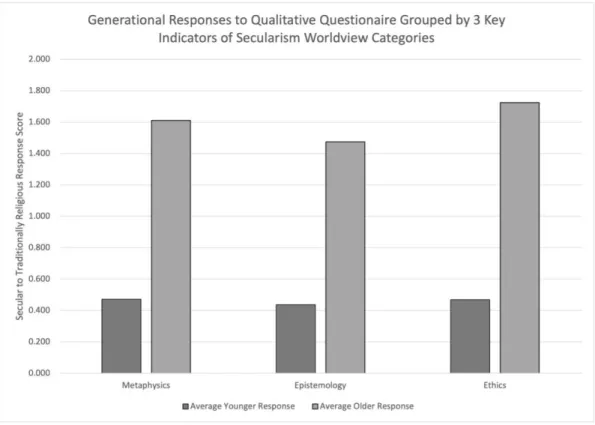
dissertation. I assessed the results and categorized them in statistical form via the process of data coding.19 After analyzing the responses and searching for thematic concepts, I catalogued the answers as numbers: very secular response (0), somewhat secular response (1), or traditionally religious response (2). The coded data was then transferred to a spreadsheet in order to statistically evaluate responses regarding whether significant worldview differences exist between the younger and older generations of Cuencano mestizos. This final step of qualitative inquiry serves to determine the validity of my
16 See Appendix 2 for a sampling of the qualitative research surveys I developed.
17 David M. Fetterman, Ethnography: Step by Step, 2nd ed. (Thousand Oaks, CA: Sage Publications, 1998), 51.
18 This particular form of qualitative inquiry serves to “clarify and complete the answers, making them intelligible . . . in order to get the depth that is a hallmark of qualitative inquiry by pursuing themes that are discovered, elaborating the context of answers, and exploring the implications of what has been said.” Rubin and Rubin, Qualitative Interviewing, 145-151.
19 According to Herbert and Irene Rubin, data coding is “the process of grouping interviewees’
responses into categories that bring together the similar ideas, concepts, or themes you have discovered, or steps or stages in a process.” Rubin and Rubin, Qualitative Interviewing, 238.
hypothesis, namely, that a significant increase in secularism is taking place among young Cuencano mestizos.
Missiological Significance
The missiological ramifications of the encroachment of secularism upon a society should not be underestimated. This research project will be directed primarily toward equipping evangelical Christian leaders to recognize and address the advance of secularism from a biblical worldview. Leaders must be taught to disciple believers to live as Christians in a secular context no matter the spiritual consequences. Ecuadorian Christian leaders must be equipped to disciple believers not only to evangelize in a secular context, but also to train the younger generation of Christians to prepare for the lasting spiritual consequences of an increasingly secularized society.
In order to equip evangelical church leaders throughout Ecuador, the following question will be posed and examined in chapter 5: What missiological practices have proven to be effective among missionaries seeking to train indigenous leaders who, in turn, are then able to train up other leaders through deep discipleship among their own cultural contexts?20 Determining the answer to this question is crucial to addressing the central argument of this dissertation. In order to find answers to this vital research question, biblical and historical precedents for theological education, pastoral
discipleship, and effective conferral of generational faithfulness will be surveyed. Finding biblically faithful responses to combat the key markers of secularization will be the goal.
Chapter Summaries
This introductory chapter serves to present the main aspects of the dissertation.
20 In chapter 5 the indigenous approach to missions will be examined and contrasted with a missionary-centric approach to cross-cultural ministry. This contrast of missiological methods will serve to determine effective missiological practices for raising up churches that best impact their own cultures from a consistent biblical worldview.
My research thesis and methodologies are stated and explained. Important terminology regarding key aspects of my research is provided. Additionally, the missiological importance of understanding secularization in order to raise up indigenous evangelical leaders is stated. The need to prepare pastors who are equipped to combat a tremendous shift in worldview within their own cultural context is highlighted.
Chapter 2 will survey the history of secularization in Western culture. The origins of secularism will be examined with a focus on the work of Charles Taylor in A Secular Age, in addition to a literary review of other relevant sources. I will assess key historical indicators of encroaching secularism in order to identify whether those same markers are now present in young Cuencano mestizos.
Chapter 3 will explore the Ecuadorian context. I will focus on the traditional religious worldview of Ecuadorians from the Spanish conquest of the Inca empire to the present day. I will pay particular attention to Ecuador’s unique dichotomy as a conquered nation that officially adopted the Spanish conquistadors’ Catholicism while maintaining aspects of its animistic, Incan worldview. Ways in which these syncretistic, traditional beliefs still influence present-day Cuencano mestizos will be detailed.
Chapter 4 will detail my research methodology and report the results of my qualitative inquiry. The qualitative surveys of at least thirty young Cuencano mestizos will reveal whether their worldviews reflect the presence of the key indicators of
secularism, as established in chapter 2, more than the previous generation. The end of the chapter will include a statistical analysis of the collected qualitative data between the two generations to determine if significant secularization is occurring.
Chapter 5 will seek to establish a missiological paradigm for equipping evangelical leaders to combat secularism within the Cuencano mestizo context. I will seek to determine effective methods for theological education and pastoral training with a focus on developing a comprehensive and consistent biblical worldview—one capable of combating secularism and every worldly philosophy within the vital institutions of the
church, the family, and the culture.
The conclusion of this dissertation will tie together the previous chapters in order to determine if the thesis of the project was proven correct. Additionally, the
concluding chapter will seek to restate which effective missiological practices ought to be employed to equip Christian leaders to prepare their congregations for the potential encroachment of secularism.
CHAPTER 2
A SURVEY OF SECULARIZATION
The increase in secularism among Western cultures is a thoroughly modern phenomenon.1 A secular society is essentially defined by its indifference toward transcendence and the divine. This apathy toward the supernatural is virtually absent throughout the rest of human history. Humanity has always had an eye to the sky, contemplating the beyond. It would be an unenviable task to try to discover a society in all of history without some form of religion at its core. A primary source of reference in this chapter will be Taylor’s seminal work A Secular Age. In the opening chapter, Taylor notes that human history is impossible to study without reference to religion—and not just Christian societies but even early human history: “[I]f you go back even farther in human history, you come to archaic societies in which the whole set of distinctions we make between the religious, political, economic, social, etc., aspects of our society ceases to make sense. In these earlier societies, religion was ‘everywhere’, was interwoven with everything else, and in no sense constituted a separate ‘sphere’ of its own.”2 However, numerous modern secularized Western societies are, in fact, characterized by their fixation on the immanent sphere of reality. This chapter will examine the history of
1 Carl Trueman argues that the unique challenges of our secular age are indeed unprecedented, yet at the same time are the result of hundreds of years of historical developments that have led to this moment in time. Trueman writes, “Rieff and Taylor are both correct in seeing psychological man and the expressive individual as the result of a long historical process and as the normative types in this present age. The psychologized, expressive individual that is the social norm today is unique, unprecedented, and singularly significant. The emergence of such selves is a matter of central importance in the history of the West as it is both a symptom and a cause of the many social, ethical, and political questions we now face.”
Carl Trueman, The Rise and Triumph of the Modern Self: Cultural Amnesia, Expressive Individualism, and the Road to Sexual Revolution (Wheaton, IL: Crossway, 2020), 70. The historical secularization of religion, philosophy, and worldview within Western culture from Medieval Europe to the present day will the primary subject of this chapter.
2 Charles Taylor, A Secular Age (Cambridge, MA: Harvard University Press, 2007), 2.
secularism as a viable philosophical and practical option among Western societies. Then I will survey the historical progression of secularization followed by its societal and
cultural consequences.
The Three Pillars of a Worldview
The process of identifying the worldview of the mestizo Cuencanos is vital to determining if secularization is taking place among the younger generation. In order to identify a worldview, one must first realize the significance of the concept of worldview itself. The term worldview comes from the German word Weltanschauung.3 A worldview is defined as “a set of presuppositions (assumptions which may be true, partially true or entirely false) which we hold (consciously or subconsciously, consistently or
inconsistently) about the basic makeup of our world.”4 Worldviews matter because they are not just sets of ethereal presuppositions which philosophers debate. Rather, one’s worldview affects every area of one’s life. How a person answers the most basic questions regarding existence will inevitably affect how that person goes about living life.
Every worldview is based upon an individual’s beliefs regarding three foundational aspects of interpreting reality: namely metaphysics (objective reality), epistemology (subjective knowledge), and ethics (practical morality).5 These basic philosophical categories answer the three foundational questions of worldview formation respectively: “(1.) What exists outside of our minds? (2.) What exists inside of our
3 According to David Naugle, the first instance of Weltanschauung appears in Immanuel Kant's work Critique of Judgment in 1790. David Naugle, Worldview: The History of a Concept (Grand Rapids:
Eerdmans, 2002).
4 James W. Sire, Naming the Elephant: Worldview as a Concept (Downers Grove, IL:
Intervarsity, 2015), 195.
5 Jeffrey D. Johnson, The Absurdity of Unbelief: A Worldview Apologetic of the Christian Faith. (Conway, AR: Free Grace Press, 2016), 1321, Kindle.
minds?, and (3.) How do we feel about it?”6 Philosopher and apologist Greg Bahnsen concluded, “Worldviews are systems of interlocking presuppositions. As systems they include metaphysics, epistemology, and ethics all bound up together in a mutually self- supporting system.”7 Therefore, this survey of the development of secularism as a plausible worldview will include an examination of how secularism responds to these three pillars of worldview formation. As purposed in the beginning of this dissertation, key markers of secularization will be discovered based upon the three philosophical categories of worldview formation, namely metaphysics, epistemology, and ethics.
The Essence of Secularism
Several terms are important to understand in order to properly commence a survey of secularism. Chief among these terms is secularism itself. The modern English word secular stems from the Latin saeculum meaning century or age.8 The term
originally referred to periods of time related to the Roman calendar. However, as the Roman Empire was eventually Christianized, the word began to refer to the world’s present age, particularly in contrast to the eternal heavenly realm. The saeculum would come to be contrasted with monastic life. Those who lived in the saeculum were often politicians focused on the ordinary issues of culture as opposed to those, such as priests, who had dedicated themselves to a life focused on the eternal. Thus, secular time began to be associated with the mundane aspects of life as opposed to the spiritual.9
There are several schools of thought as to the extent of everything modern secularism entails. Some define secularism in terms of its relation to politics and
6 Johnson, Absurdity of Unbelief, 1321, Kindle.
7 Greg L. Bahnsen, Pushing the Antithesis: The Apologetic Methodology of Greg L. Bahnsen (Atlanta: American Vision, 2007), 211.
8 Susan Dunning, “Saeculum,” Oxford Classical Dictionary, last modified November 20, 2017, https://doi.org/10.1093/acrefore/9780199381135.013.8233.
9 Taylor, A Secular Age, 54.
government; they say religion or any reference to the divine should play virtually no part in governmental thought and action. Others define secularism in regard to overall
religious adherence among a culture, i.e., a “secular” society refers to one in which a significant number of people no longer adhere to a particular religion.10
However, the best conception of secularism takes all of these factors into account. Secularism connotes the shift in the default conditions of a culture’s values and beliefs—from a world in which the consideration of God is a given, to one in which even the existence of the divine is doubted and challenged.11 Secularism produces a vacuum of indifference toward the transcendent; in its place comes a focus on the immanent.
Transcendence and immanence are two more important terms to define.
Transcendence refers to the aspect of reality which is superior to and beyond the physical realm.12 Immanence refers to the opposite; it emphasizes the here-and-now, the material realm. One could consider transcendence to be a reference to the supernatural and
10 According to an article in the Oxford Research Encyclopedia, “At its most basic level secularism simply entails a normative commitment to neutrality on the part of the state toward religious affairs, necessitating that the state should neither favor, disfavor, promote, nor discourage any particular religious (or nonreligious) belief and viewpoint over another … secularism at its most elementary level is simply a separation of church and state.” This is a clear example of basing an understanding of secularism on a purely political level. Steven Kettell, “Secularism and Religion,” Oxford Research Encyclopedia, last modified January 25, 2019, https://doi.org/10.1093/acrefore/9780190228637.013.898.
11 Taylor describes these three common schools of thought regarding secularism as follows:
“(1) One understanding of secularity then is in terms of public spaces. These have been allegedly emptied of God, or of any reference to ultimate reality. Or taken from another side, as we function within various spheres of activity—economic, political, cultural, educational, professional, recreational—the norms and principles we follow, the deliberations we engage in, generally don’t refer us to God or to any religious beliefs. (2) In this second meaning, secularity consists in the falling off of religious belief and practice, in people turning away from God, and no longer going to church. In this sense, the countries of western Europe have mainly become secular—even those who retain the vestigial public reference to God in public space. (3) Now I believe that an examination of this age as secular is worth taking up in a third sense, closely related to the second, and not without connection to the first. This would focus on the conditions of belief. The shift to secularity in this sense consists, among other things, of a move from a society where belief in God is unchallenged and indeed, unproblematic, to one in which it is understood to be one option among others, and frequently not the easiest to embrace.” Taylor, A Secular Age, 2-3.
12 C. Stephen Evans offers a more thorough definition of transcendence in his Pocket Dictionary of Apologetics Philosophy of Religion: “That which is higher than or surpasses other things.
What is transcendent is thus relative to what is transcended. God is conceived by traditional theologians as being transcendent with respect to the created universe, meaning that he is outside the universe and that no part of the universe is identical to him or a part of him. To think of God as transcendent with respect to time is to conceive him as timeless. Theologians have usually balanced an emphasis on God’s transcendence with an emphasis on God’s immanence within the created world as embodied in his knowledge of and action within that world.” (Downers Grove, IL: InterVarsity Press, 2013).
immanence an allusion to the natural, material world. For Taylor, the major question of Western secularization was the sorting out of how Western culture progressed from viewing all aspects of life in terms of the transcendent to being able to view everything solely through an immanent frame of reference:
Our question is how we moved from a condition in 1500 in which it was hard not to believe in God, to our present situation just after 2000, where this has become quite easy for many. A way of putting our present condition is to say that many people are happy living for goals which are purely immanent; they live in a way that takes no account of the transcendent . . . by which it became possible to relate to certain realities as purely “natural”, and disintricate them from the transcendent; whereby it eventually became possible to see the immediate surroundings of our lives as existing on this “natural” plane, however much we might believe that they indicated something beyond.13
Secularism, by nature, produces an indifference or hostility toward the transcendent. In his book Seculosity, David Zahl describes how an obsession with the immanent replaces the transcendent as the default sphere of worship in a secular society (a position clearly noted in the subtitle to Seculosity: How Career, Parenting,
Technology, Food, Politics, and Romance Became Our New Religion and What to Do About It), “Secularism operates squarely within ‘the immanent frame,’ removed from the transcendent realities that have defined the faith throughout the millennia. Eventually, one starts to wonder if our near-myopic focus on this life masks a faltering confidence in the one to come.”14
This newfound focus on the material world to the detriment of the transcendent does not mean that secularists have ceased to worship. The Scriptures are clear that all humans are made to worship (e.g., Isa 43:21, Ps 150:6, Matt 4:10, Rom 1:1-32, Rev 15:4 etc.,). In his book, Cultural Apologetics, Paul Gould notes that a secular culture’s fixation on the immanent is just another form of idolatry:
13 Taylor, A Secular Age, 143.
14 David Zahl, Seculosity: How Career, Parenting, Technology, Food, Politics, and Romance Became Our New Religion and What to Do about It (Minneapolis: Fortress Press, 2019), 174.
As Paul noted in Athens, human beings are inherently religious (Acts 17:16, 22).
We all worship something: either the true God or some created portion of reality.
“Idolatry is inherently a rejection of God’s authority and a quest for self-definition, self-importance, and self-fulfillment on our own terms.” In a disenchanted culture, our restless hearts and minds seek satisfaction, solace, or love in anything other than God. This is modern idolatry. Believers and nonbelievers in every culture and time have struggled with idolatry, but disenchantment contributes to the pervasiveness and entrenchment of our idolatry. The temptation to engage in false worship is especially strong for us today because it is possible to orient one’s entire life without any appeal to transcendent reality.15
Consequently, a secular society does not produce a religion-free society because a society without worshippers is an impossibility. Rather, a focus on the immanent sphere produces a worldly dogmatism that few religions can equal. Zahl recounts a humorous anecdote that illustrates this fact:
Tales of friends who’d left small towns for big cities in search of a more open- minded environment, only to discover that their new surroundings weren’t as orthodoxy-free as they’d hoped, had become almost cliché. It sounds like a Portlandia sketch, but it is empirically true: the religious impulse is easier to rebrand than to extinguish. This runs counter to popular perception. Bombarded with poll results about declining levels of church attendance and belief in God, we assume that more and more people are abandoning faith and making their own meaning. But what these polls actually tell us is more straightforward. They tell us that confidence in the religious narratives we’ve inherited has collapsed. What they fail to report is that the marketplace in replacement religion is booming. We may be sleeping in on Sunday mornings in greater numbers, but we’ve never been more pious. Religious observance hasn’t faded apace “secularization” so much as migrated—and we’ve got the anxiety to prove it. We’re seldom not in church.16
The search for meaning and significance is ingrained in humanity. Secularism cannot replace it, but only redirect it inward. As a result, situations like the one that Zahl describes are commonplace. Even in a secular society, human beings still long for meaning, community, and purpose. The difference is found in the fact that secular
societies seek to find those traditionally “transcendental” aspects of existence exclusively in the material realm.
15 Paul Gould, Cultural Apologetics (Grand Rapids: Zondervan, 2019), 77.
16 Zahl, Seculosity, 3.
The Encroachment of Secularism upon the Western World
How did this shift from an almost universally devout focus on the transcendent in the Western world to a virtual antipathy toward even the thought of the divine take place? What occurred over the past centuries to facilitate it? Historian Kevin Madigan tried to answer these questions. He notes that from the 7th century to the 17th century much of humanity was quite uniform in their beliefs about the divine:
Very few [in Medieval European culture] would have doubted the existence of a triune God who had sent his “Son,” both human and divine, to redeem humankind and to set the normative and salvific pattern for human life. Nor would many have doubted that life on this earth was a journey, or pilgrimage, to a domain more real, more permanent—indeed eternal—to be spent in everlasting beatitude with God or never-ending punishment.17
Obviously, much has changed in the last 400 years. The primary research question to be addressed in this chapter is this—what happened in Western society that made it possible for virtually all areas of culture—family, government, education etc.—to function without reference to the divine? And how has this seismic shift shaped vital societal structures? Taylor states the dilemma of cultural secularization this way:
[T]he change I want to define and trace is one which takes us from a society in which it was virtually impossible not to believe in God, to one in which faith, even for the staunchest believer, is one human possibility among others … Belief in God is no longer axiomatic. There are alternatives. And this will also likely mean that at least in certain milieux, it may be hard to sustain one’s faith. There will be people who feel bound to give it up, even though they mourn its loss. This has been a recognizable experience in our societies, at least since the mid-nineteenth century.
There will be many others to whom faith never even seems an eligible possibility.
There are certainly millions today of whom this is true.18
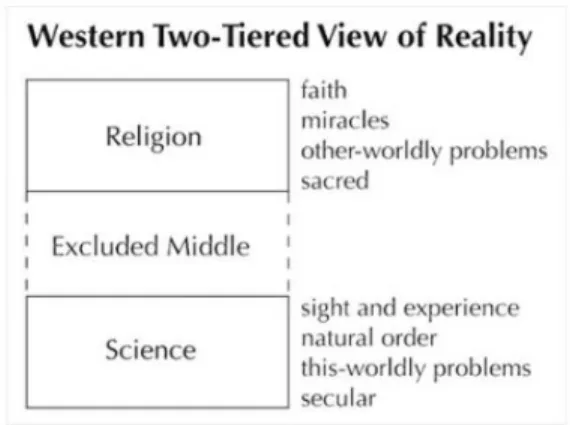
An important aspect of secularization to consider will be the diminishment of what missiologist Paul Hiebert referred to as “the excluded middle.”19 Hiebert notes that many non-Western cultures are animistic in nature. That is to say, they attribute actions in
17 Kevin Madigan, Medieval Christianity: A New History (New Haven, CT: Yale University Press, 2015), xix.
18 Taylor, A Secular Age, 3.
19 Paul G. Hiebert, “The Flaw of the Excluded Middle,” Missiology: An International Review 10, no. 1 (January 1982), accessed October 12, 2020, https://doi.org/10.1177%2F009182968201000103.
the physical realm to spirits, ancestors, and other invisible forces. However, even among professing Christians in the West, many who devote themselves to worshipping a
transcendent God often fail to consider the middle realm. See Figure 1 below for an illustration of the various elements of Western two-tiered reality.
Figure 1. Paul Hiebert’s “Excluded Middle”
Hiebert notes that the “two-tiered” worldview began to emerge in the 17th and 18th
centuries with the rise of reliance upon scientific knowledge and materialistic naturalism.
He writes,
The result was the secularization of science and the mystification of religion.
Science dealt with the empirical world using mechanistic analogies, leaving religion to handle other-worldly matters, often in terms of organic analogies. Science was based on the certitudes of sense experience, experimentation and proof. Religion was left with faith in visions, dreams and inner feelings. Science sought order in natural laws. Religion was brought in to deal with miracles and exceptions to the natural order, but these decreased as scientific knowledge expanded.20
As I will explore in the following chapter, Ecuador has an ingrained heritage of animism dating back to the time before the Inca empire. As a result, the “middle-level”
consciousness that ascribes unseen causes for common, everyday experiences is a lasting
20 Hiebert, “Excluded Middle,” 43.
remnant among the older generation of Cuencanos. However, as will be further explored in chapter 4, younger Cuencanos are becoming much more secular. As a result, very little thought is given to middle-level experiences among the younger generation. This chapter will seek to explore how secularization has historically produced a paradigm shift away from middle-level thinking as well as the consequences for that shift in life and society.
A glimmer of the divine. It has already been asserted that secularism produces less consideration of spiritual forces in everyday life. Nonetheless, an interesting
phenomenon has been observed among the most secularized cultures. In short, people who live in secularized cultures become more and more dissatisfied with exclusively material explanations and merely immanent life goals. This purely immanent reality often leaves secularists feeling empty and unfulfilled, a fact only further accentuated by
brushes with the transcendent: beautiful sunsets, a baby’s smile, or an awe-inspiring piece of artwork.
These gifts produce a spiritual nostalgia in even the most ardent secularist.
Charles Taylor deems this the “Nova-Effect.”21 James K.A. Smith, in his book How Not to Be Secular: Reading Charles Taylor, helps the lay reader better understand Taylor’s dense, voluminous book. Smith explains that the Nova-Effect is the result of a “cross- pressured” culture in which people feel “the simultaneous pressure of various spiritual options; or the feeling of being caught between an echo of transcendence and the drive toward immanentization.”22 This cross-pressured echo of transcendence wars against what Taylor argued is the drive toward a totally secular “buffered self” which seeks to insulate the modern materialistic individual from all reference to the spiritual realm.23
21 Taylor, A Secular Age, 299-321.
22 James K. A. Smith, How (Not) to be Secular: Reading Charles Taylor (Grand Rapids:
Eerdmans, 2014), 140.
23 Taylor, A Secular Age, 26-42.
The remainder of this chapter will seek to explain how Western society has
“progressed” from a world in which middle level consideration was given to even the most mundane experiences to a society in which the average individual gives little thought to the supernatural. Regardless, it will be shown that even thoroughly secular individuals remain haunted by thoughts of transcendence triggered by unavoidable
spiritual experiences. Atheism once seemed inconceivable to individuals characterized by
“porous” attitudes toward the transcendent.24 Now, in order to understand the modern secular milieu, one must understand what changed over the last 500 years to produce the possibility of atheism—or at least agnosticism—moving from inconceivable to the common default worldview in the West.
A Survey of the History of Secularization
The cultural setting of pre-Reformation Western society is important to consider in order to understand what events took place to produce the possibility of our modern secular age. As Taylor consistently emphasizes, the explanation is not a linear story that is easily traceable. Rather, the causal connections stem from multiple distinct streams of thought and events which culminate in the current cultural moment. The story of secularization begins with an “enchanted” Western world that saw spiritual forces at work around every corner.
Metaphysics: The Enchanted West
Pre-Reformation Western Europe was very different than today’s secular Europe. Centuries of Catholic syncretism resulted in an animistic world that attributed middle-level causes to virtually all common events. Medieval Christendom was characterized by sacraments, superstition, and relics. Each of these aspects conveyed a
24 Taylor described the pre-secular West as consisting of “porous-selves” which were always open—porous—to spiritual experiences and explanations in contrast to the modern “buffered-self” which is closed off to transcendent explanations. Taylor, A Secular Age, 20-27.
spiritual or even magical meaning to everyday life. It is difficult to overestimate just how integral ecclesiastical ritual was to the life of the common citizen in medieval Europe.
Madigan explains how ubiquitous the Christian influence was over the Western world for nearly a millennium:
The church not only formed the institutional framework within which one lived out one’s life. Every important event for the individual from birth to death (including, from the ninth century, marriage) was marked by ecclesiastical ritual. The same set of sacraments (set at seven in the late twelfth century) punctuated the lives of Christians in northern England and Iceland, southern Italy, western Spain, and Poland. Monasteries, churches, chapels, parish churches, convents, cathedrals, and simple stone crosses covered the landscape—all professing or representing the same creed. Clergy—priests, bishops, deacons—were everywhere, as were monks, nuns, and other religious. More or less the same liturgy of the Mass was celebrated in the same language across the Continent. Certainly, there were “outsiders” in this culture—principally Jewish communities and sects of heretics—but they were
“minorities” in every sense of that modern word. This culture was held together by religious belief expressed in ancient creeds whose authority very few challenged or from which they dissented.25
The established church influenced virtually every sector of society. The metaphysical presupposition of virtually every individual was based on the objective reality that the God of the Bible was real and involved in every aspect of life. The religious landscape also made a solely immanent material world implausible. Medieval Catholic theology taught that mediation—from priests, saints, and relics—was necessary for access to the transcendent.26 Therefore, any hope of answered prayers in regard to health, fertility, or production required these mediators’ middle-level intervention. For this reason, throughout the Middle Ages, objects considered today as purely physical took on extremely important spiritual value. Any object that could be associated with a
mediator—water, fabric, art, shrines, tombs—became “sacralized” in order to convey spiritual import to the desperate seeker. Eventually, physical access to the spiritual realm would always be connected to individuals through the Rosary which allowed devotees of
25 Madigan, Medieval History, 264.
26 Madigan, Medieval History, 260.
Mary to access her help by reciting the “Ave, Maria” while touching beads that were worn on a bracelet and therefore continually accessible.27
The Social Imaginary. A vital aspect of analyzing any culture is to understand what Taylor described as the “social imaginary.” More than just the intellectual
framework that dominates a culture, Taylor described the social imaginary as “the way ordinary people ‘imagine’ their social surrounding, and this is often not expressed in theoretical terms, it is carried in images, stories, legends, etc.”28 In other words, the social imaginary defines what a people view as more or less believable.
In his excellent work on reaching a secular world with the gospel, Sam Chan argues that communities informally determine which belief systems are plausible. In fact, the subtitle of his book asserts that Christians need to be aware of these plausibility structures, or social imaginaries, in order to learn How to Make the Unbelievable News about Jesus More Believable.29 Chan states that all people have culturally formed
plausibility structures that prejudice the population toward judgments about the truth. He defines plausibility structures as, “accepted beliefs, convictions, and understandings that either green-light truth claims as plausible or red-light them as implausible.”30 Chan goes on to highlight the role community plays in forming plausibility structures:
Our community—our trusted friends and family—has a powerful role in forming our beliefs. Our community also shapes how we interpret our experiences. Our community also shapes how we interpret facts, evidence, and data … Here is the key idea you need to grasp: people will find a story more believable if more people in their community, their trusted friends and family, also believe the story.31
27 Madigan, Medieval History, 267.
28 Taylor, A Secular Age, 171.
29 Sam Chan, Evangelism in a Skeptical World: How to Make the Unbelievable News about Jesus More Believable (Grand Rapids: Zondervan, 2018), 41.
30 Chan, Evangelism in a Skeptical World, 43.
31 Chan, Evangelism in a Skeptical World, 43.
Understanding how the social imaginary works is vital to understanding the
“enchanted” world of Medieval Europe. Individuals in the Middle Ages who saw spiritual influences around every corner could not imagine our secular age. Virtually everyone in their society interpreted reality via the same social imaginary. The plausibility structures of their time never gave “red lights” to the reasonableness of raiding the tomb of a saint in order to find a relic that would lead to the healing of a sick family member. In the same way, a Millennial in modern San Francisco never blinks at the logical dissidence of the idea that it should be legal to kill a baby in the womb at forty weeks but the moment the child passes through the birth canal he or she “magically”
gains personhood and the right to life. The two distinct social imaginaries each produce plausibility structures that support equally radical beliefs within their own time and culture. The devoted adherence to plausibility structures in a culture can lead to both outlandish views of reality. The influence of our social imaginary and the plausibility structures it sustains cannot be overstated.
The Reformation and Disenchantment
The enchanted world of the Middle Ages made atheism seemingly
inconceivable—both practically and philosophically. Smith summarizes Taylor’s three reasons for this:
1) The natural world was constituted as a cosmos that functioned semiotically, as a sign that pointed beyond itself, to what was more than nature. 2) Society itself was understood as something grounded in a higher reality; earthly kingdoms were grounded in a heavenly kingdom. 3) In sum, people lived in an enchanted world, a world “charged” with presences, that was open and vulnerable, not closed and self- sufficient. It’s not that these features guarantee that all medieval inhabitants “believe in God”; but it does mean that, in a world so constituted, “atheism comes close to being inconceivable” because one can’t help but “see” (or “imagine”) that world as sort of haunted—suffused with presences that are not “natural.”32
Ultimately, these deeply ingrained spiritual beliefs infused medieval Western
32 Smith, How (Not) to be Secular, 27.
European culture, making the emergence of secularism virtually impossible. Therefore, the question must be raised: What changed? How then did Western society move from being such a bulwark against secularism to its birthplace? How did the metaphysical default transition from ultimate objective reality being based upon the God of the Bible, to a metaphysical presupposition that virtually ignored any mention of the transcendent?
In short, the answer is that the West became “disenchanted.” Drawing upon Max Weber’s The Protestant Ethic and the Spirit of Capitalism, Taylor describes how the West eventually began to focus almost entirely on the “natural order.” Interestingly, Taylor does not argue that this disenchantment began with the Enlightenment’s emphasis on naturalistic humanism—nor does he lay the blame at the feet of the scientific
revolution spurred by Charles Darwin. Rather, Taylor insists that many Christians became disenchanted long before Darwin was on the scene. More specifically, Taylor traces the beginnings of disenchantment—one could even say Western secularism itself—to a surprising source: the Protestant Reformation.
As we consider Taylor’s critique of the Protestant Reformation, it should be noted that he is a committed Roman Catholic who has displayed a misunderstanding of biblical Protestant beliefs.33 However, his thesis is not without its merits.34 In fact, noted Presbyterian church historian Carl Trueman agrees with Taylor’s analysis of the
historical narrative regarding the impact of the Reformation in serving to further the disenchantment of 16th century Europe:
33 See Smith for a summary of the biases displayed by Taylor throughout his work. For example, Smith disputes Taylor’s explanation of the need for activities like Carnival to resolve and distinguish the relationship between the secular and the sacred. Smith writes: “I do think this is a uniquely
‘Roman Catholic’ framing of the matter and ultimately assumes an implicit understanding of the
nature/grace relation. I’m not just saying that the medieval world assumed this Catholic framing, but that Taylor’s framing it this way also reflects a certain bias in this respect. For example, Protestant heirs of Calvin’s vision of ‘Reform’ would see more continuity between the expectations and demands of creational flourishing and eternal flourishing.” Smith, How (Not) to be Secular, 46.
34 For further treatment of this subject, see Brad S. Gregory, The Unintended Reformation:
How a Religious Revolution Secularized Society (Cambridge: Harvard University Press, Belknap Press, 2012).
From a Reformation-Protestant perspective, perhaps the most serious claim is that [Taylor] sees the rise of voluntarism and nominalism in the late Middle Ages as laying the foundation for shifting from a world that naturally carries its own rich meaning(s) to one where human beings create such meaning for themselves. The Reformation, as early fruit of nominalism/voluntarism, plays a central role in the narrative. By abolishing the traditional hierarchical distinction between the sacred and the secular, and thereby sanctifying the ordinary, it performed a twofold service.
First, it released Christendom from the monopoly of Rome by offering an alternative (soon to become many alternatives). Second, by making the secular sacred it inadvertently created a context where the sacred could ultimately become secular. The first point is uncontestable. The Reformation did shatter the religious unity of Western Europe and did ultimately make religious commitment a matter of choice rather than of geographical birthplace. The idea of “choosing” a church remains a profoundly Protestant idea, one that is confusing to traditional Roman Catholics.35
When the Reformation began to preach against the ability of Catholic
sacraments to impart salvific grace upon its recipients, the everyday connection between the porous self and the spiritually infused natural elements began to disappear. Suddenly, the power of God’s Word was the source of grace—not saints and sacraments. Trueman concludes, “The physical and the corporate gave way to the doctrinal and the
individual.”36
To appreciate the transformational nature of this shift from the physical to the mental we must understand just how powerful “sanctified” objects were for people in the premodern West. The material world was so charged with spiritual power that the line between personal volition and involuntary spiritual forces acting upon the natural world was virtually indistinguishable. People assumed their destinies were at least somewhat at the whims of the external world. Smith recounts Taylor’s summation of the relationship between personal volition and external forces:
In this premodern, enchanted universe, it was also assumed that power resided in things, which is precisely why things like relics or the Host could be invested with spiritual power. As a result, “in the enchanted world, the line between personal agency and impersonal force was not at all clearly drawn.” There is a kind of
35 Carl Trueman, “Taylor’s Complex, Incomplete Historical Narrative,” in Our Secular Age:
Ten Years of Reading and Applying Charles Taylor, ed. Collin Hansen (Wheaton, IL: The Gospel Coalition, 2017), 13-14.
36 Trueman, “Taylor’s Complex, Incomplete Historical Narrative,” 16.