Copyright © 2011 Lorrie Elizabeth Francis
All rights reserved. The Southern Baptist Theological Seminary has permission to reproduce and disseminate this document in any form by any means for the purposes chosen by the Seminary, including, without limitation, preservation or instruction.
LEARNING THEORY IN ADULT DISCIPLESHIP:
A QUASI-EXPERIMENT ASSESSING ADULT LEARNING IN A SUNDAY SCHOOL CONTEXT
A Dissertation Presented to the Faculty of
The Southern Baptist Theological Seminary
In Partial Fulfillment
of the Requirements for the Degree Doctor of Philosophy
by
Lorrie Elizabeth Francis December 2011
APPROVAL SHEET
LEARNING THEORY IN ADULT DISCIPLESHIP:
A QUASI-EXPERIMENT ASSESSING ADULT LEARNING IN A SUNDAY SCHOOL CONTEXT
Lorrie Elizabeth Francis
Read and Approved by:
__________________________________________
Gary J. Bredfeldt (Chair)
__________________________________________
Timothy Paul Jones
Date ______________________________
Dedicated to my grandmother, June Reid.
her unflinching support and unconditional love for me have been a source of strength when times were challenging and a fine example of the love we should all give to one another.
iv
TABLE OF CONTENTS
Page
LIST OF ABBREVIATIONS . . . viii
LIST OF TABLES . . . ix
LIST OF FIGURES . . . x
PREFACE . . . xi
Chapter 1. RESEARCH CONCERN . . . 1
Introduction to the Research Problem . . . 1
Learning and Development Theory . . . 2
Vygotsky and the Zone of Proximal Development . . . 6
Sunday School as Adult Learning Context . . . 9
Spiritual Formation . . . 10
Research Purpose . . . 11
Delimitations of the Study . . . 11
Research Questions . . . 12
Research Hypotheses . . . 12
Terminology . . . 12
Procedural Overview . . . 16
Research Assumptions . . . 17
v
Chapter Page
2. PRECEDENT LITERATURE . . . 18
Foundations in Theology . . . 18
Education in the Family . . . 19
Education through the Community . . . 20
Education During and After the Exile . . . 22
Role of Wisdom Literature in Jewish Education . . . 23
Jesus’ Methods of Teaching . . . 29
Paul as a Teacher . . . 37
Summary . . . 39
Foundations in Literature . . . 40
Vygotsky and the Zone of Proximal Development . . . 41
Sunday School as Context for Adult Education . . . 53
Spiritual Formation . . . 55
Profile of Current Study . . . 62
3. METHODOLOGICAL DESIGN . . . 63
Synopsis of Research Questions . . . 63
Design Overview . . . 64
Validity and Reliability . . . 65
Population . . . 71
Samples and Delimitations . . . 71
Limitations of Generalization . . . 72
Instrumentation . . . 73
vi
Chapter Page
Procedures . . . 78
4. ANALYSIS OF FINDINGS . . . 84
Compilation Protocol . . . 84
Demographic and Sample Data . . . 87
Findings Related to Research Question 1 . . . 92
Findings Related to Research Question 2 . . . 94
Evaluation of Research Design . . . 100
5. CONCLUSIONS . . . 102
Research Purpose . . . 102
Research Questions . . . 102
Research Hypotheses . . . 102
Summary of Results . . . 103
Research Implications and Applications . . . 106
Research Limitations . . . 116
Further Research . . . 117
Appendix 1. LESSON PLAN . . . 125
2. INSTRUMENTATION . . . 130
3. AFTER LESSON ACTIVITIES . . . 141
4. QUANTITATIVE DATA . . . 147
5. QUALITATIVE DATA . . . 162
vii
Appendix Page
6. PILOT STUDY DATA . . . 171 REFERENCE LIST . . . 176
viii
LIST OF ABBREVIATIONS
LTG Life Transformation Group SBC Southern Baptist Convention SDL Self-Directed Learning
ZPD Zone of Proximal Development
ix
LIST OF TABLES
Table Page
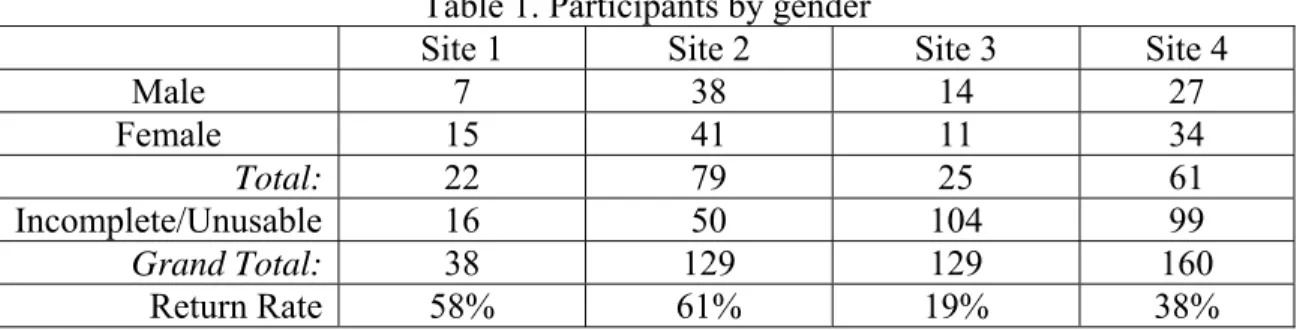
1. Participants by gender . . . 87
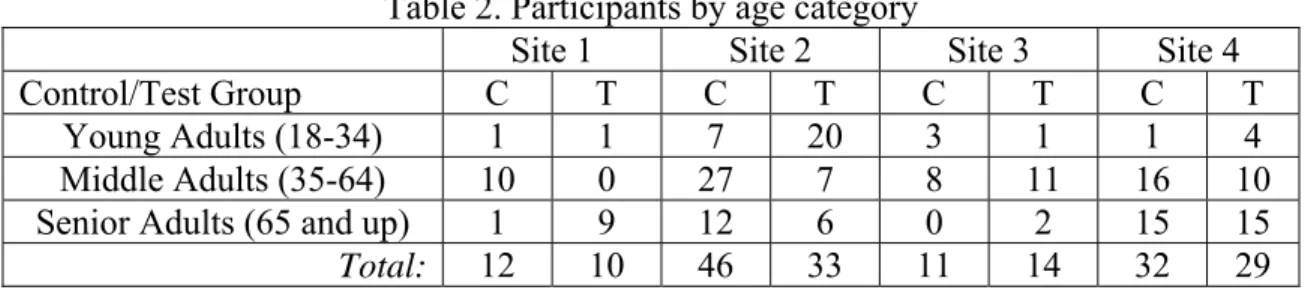
2. Participants by age category . . . 88
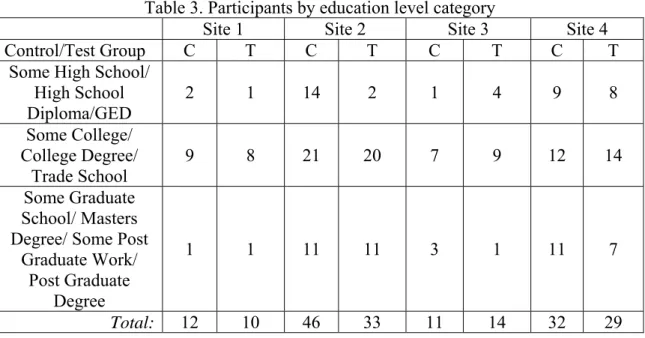
3. Participants by education level category . . . 89
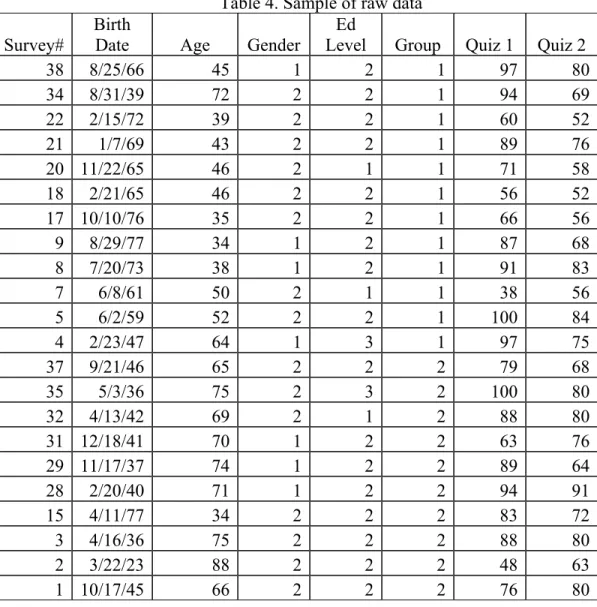
4. Sample of raw data . . . 91
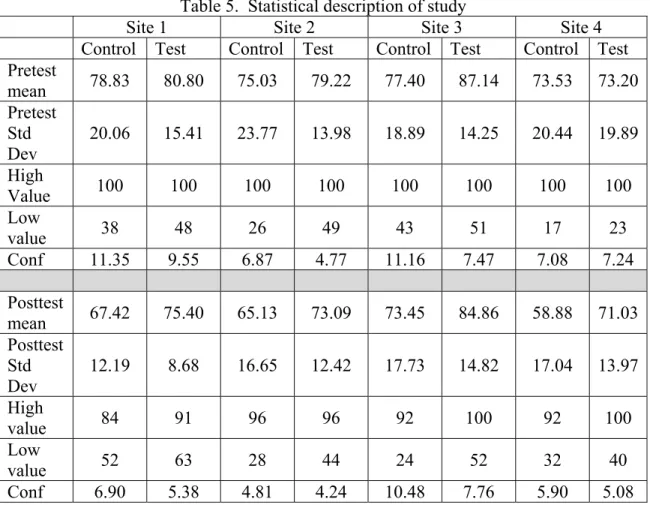
5. Statistical description of study . . . 92
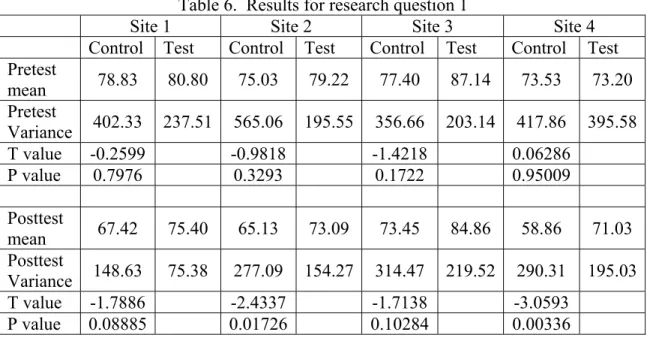
6. Results for research question 1 . . . 93
7. Results for research question 2, site 1 . . . 95
8. Results for research question 2, site 2 . . . 96
9. Results for research question 2, site 3 . . . 97
10. Results for research question 2, site 4 . . . 99
A1. Sample site 1 raw data . . . 148
A2. Sample site 2 raw data . . . 150
A3. Sample site 3 raw data . . . 154
A4. Sample site 4 raw data . . . 158
A5. Pilot study raw data . . . 173
x
LIST OF FIGURES
Figure Page
1. Zone of proximal development. . . 8
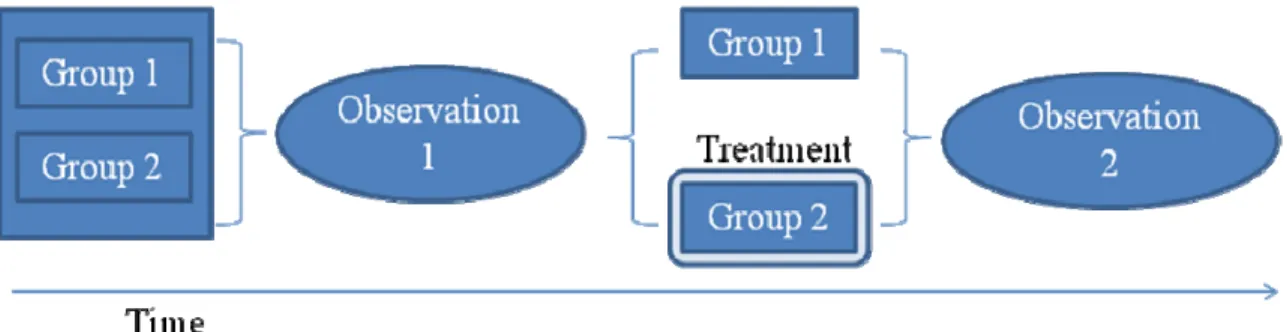
2. Research design schematic . . . 65
A1. Bible knowledge test . . . 132
A2. Posttest - Nahum . . . 137
xi PREFACE
Throughout this journey, wonderful, gracious people have provided support and encouragement. Special thanks to the members of Seaton Park Baptist Church for their care and support during my time as a student at Southern Seminary.
I also want to express gratitude for the support of my parents, Roger and Linda Francis, who gave me the foundation of love, faith, and determination to reach this goal.
As my supervisor, Gary Bredfeldt has provided direction for the future and encouragement to continue on this journey to see where God is taking me. Timothy Paul Jones has provided insight as well in his role on my dissertation committee.
Other instructors along the way have molded and shaped me into the person I am today. My thanks to Michael Wilder, Hal Pettegrew, Brian Richardson, Dennis Williams, T. J. Betts, and Tom Nettles for opening new avenues of study that I never expected to explore, much less enjoy.
I could not have made it without the continual encouragement of my co-laborer and sole classmate, Jim Fain, nor the wisdom of those who went before us: Kristi Van Dyke Williams, Carol Olsen, and Steve Yates.
For the understanding and support when long hours were needed to complete this work, I thank the members of the Student Housing staff over the years of our journey together and Andy Vincent, for his patience and quiet support of this endeavor.
xii
Those who provided me with a place to stay while completing my research activities, including Joe and Leila Odum, Paul and Kristina Francis, and Joe and Julia Jordan, gave me an immeasurable gift toward the success of this endeavor.
Finally, thanks to God for His grace that shows me each day His love for me that is from everlasting to everlasting (Jer 31:3). My prayer is that in the years ahead I might be able to share even the smallest part of what His grace has done for me with students so that they may learn the freedom of God’s amazing grace.
Lorrie E. Francis Louisville, Kentucky
December 2011
1 CHAPTER 1 RESEARCH CONCERN
The processes of learning and development are a part of human life from its beginning. Some aspects of learning and development are obvious – a child learning to walk and talk, the same child growing, attending school, and experiencing the physical and emotional changes of puberty. Learning and development can also be more subtle.
As a person moves into and through adulthood, the physical changes of aging may be more visible than any learning or cognitive development taking place. Yet each year, hundreds of thousands of adults participate in formal and informal learning activities (O’Donnell 2006, 7, 38). This study looked at the application of a particular concept, the Zone of Proximal Development (ZPD), to adult learners in the adult learning context of Sunday school in Southern Baptist churches, in order to illustrate quantitatively the ZPD’s usefulness as a foundation for teaching strategies for adult learners.
Introduction to the Research Problem
According to a National Center for Education Statistics study conducted between January and April 2005, 44% of adults in the United States ages sixteen and older, reported participating in part-time formal adult education during the previous twelve months (O’Donnell 2006, 7). Participation in informal education was reported at 70 % (O’Donnell 2006, 38). With educational participation at such a high level, it is important for educators of adults to understand the learning and development needs of their learners. Adult learners have been studied in order to identify their unique
2
characteristics and needs. Several theories that have resulted from these studies are described in the following section.
Learning and Development Theory
If a theory is “a comprehensive, coherent, and internally consistent set of ideas about a set of phenomena” (Knowles, Holton, and Swanson 1998, 17), then development theories describe the phenomena of development in human beings. Some of the
developmental theories, such as those of Jean Piaget and Lev Vygotsky are also
considered learning theories, describing what is taking place during the phenomenon of learning. Adult education has its own set of learning theories as will be seen in the following section.
Adult Learning
Traditionally, the art and science of teaching has been known as pedagogy (Knowles, Holton, and Swanson 1998, 36) as most of the early work in teaching and learning was concerned with children (Knowles 1984, 5). In fact, most people believed that education was for children and that adults had no need to learn (Lindeman [1926]
1961, 3). It was not until the 1920s that adult learning was considered separately from that of children when adult education became a recognized field of professional practice (Merriam 2001, 3).
Early studies of adult learning focused primarily on whether or not adults could learn through the work of Edward L. Thorndike and his colleagues entitled Adult Learning and published in 1928. Looking specifically at learning ability, Thorndike showed scientifically that adults could learn using processes very similar to those applied
3
by adolescents but with different experiences, interests, and motives to draw upon (Thorndike et al. 1928, 168). At about the same time, Eduard Lindeman was seeking to discover how adults learn, publishing The Meaning of Adult Education in 1926 which laid a foundation for “a systematic theory about adult learning” (Knowles, Holton, and
Swanson 1998, 37). Lindeman described education as life (Lindeman [1926] 1961, 4) and the purpose of adult education as putting “meaning into the whole of life” (Lindeman [1926] 1961, 5). He also indicated that the search for knowledge in general or for
specialization does not yield real meaning until employed in social contexts (Lindeman [1926] 1961, 94).
Malcolm Knowles built upon the foundation of those previous efforts, suggesting that adult learning takes a different form than the learning of children thus needing its own designation. The transition to studying adult learning as distinguished from childhood learning was fueled largely by Knowles’ proposal to label this new area of inquiry as andragogy in 1968 (Merriam 2001, 4).
Andragogy
Malcolm Knowles developed a set of six assumptions concerning adult learners that altered the course of adult education as a profession. These are
1. The need to know: Adult learners must be helped to recognize the value or benefit of the learning to be undertaken before it begins
2. The learners’ self-concept: Adult learners find a conflict between his or her self- concept of independence and the conditioned response of education being a passive, dependent interaction. The conflict must be resolved for successful learning to take place
3. The role of the learners’ experience: Adult learners have a greater volume and variety of experience that can be used as part of the learning process. Experience
4
may also have a negative effect due to bias. Adults may feel rejected personally if their experience is discounted
4. Readiness to learn: Adult learners become ready to learn when they recognize the need in order to deal with real-life situations
5. Orientation to learning: Adult learners are life- or task-centered rather than subject centered. Their learning is focused on gaining the knowledge or skill necessary for real-life situations
6. Motivation: Adult learners are more motivated by internal pressures than external pressures. (Knowles, Holton, and Swanson 1998, 64-68)
Assumptions 1 and 6 were not part of the original set put forth, but have been added over time (Knowles, Holton, and Swanson 1998, 68). Knowles’ work contributed to a
revolution in research concerning how adults learn. A number of others followed Knowles, looking at the requirements of adult learning processes, the impacts of various learning contexts, and comparisons with traditional learning and development theories.
Self-Directed Learning
One model that began at essentially the same time as Knowles’ andragogy is known as self-directed learning or SDL. Allen Tough used the term ‘self-teaching’
which his research found to represent nearly 70% of the learning projects undertaken in his 1970 survey (Tough 1979, 93). SDL is one aspect of Knowles’ view of adult learning that has been nearly universally accepted (Knowles, Holton, and Swanson 1998, 135). In SDL, the process of learning is expected to be learner-directed rather than teacher-
directed, leading to personal autonomy as an indicator of being fully “adult” (Knowles, Holton, and Swanson 1998, 135-36).
Another aspect of SDL is informal learning. This is learning that takes place outside of traditional institutions or formal group settings such as colleges or universities,
5
workers’ education, or military training (Brookfield 1986, 147-48). Stephen Brookfield looked at two informal learning settings in particular: learning networks and community action groups (Brookfield 1986, 148). In each case, he found that the community of learners, whether united by a common concern, shared status, or purpose as in a learning network (Brookfield 1986, 151) or collaborating with other adults for the common good or political agenda (Brookfield 1986, 159), the consistent factor was that learning takes place within a group of people, not in isolation. Brookfield found that successful self- directed learners viewed peers and fellow learners as important resources, as models, reinforcers, and counselors thus making the social setting a critical part of SDL (Brookfield 1986, 44). The autonomy of SDL resides in the choice to learn and the content and direction of learning, but others are needed to successfully reach the goal for learning. The social aspects of SDL lead into discussions of critical reflection
(Brookfield 1985, 15), social change and ultimately transformation as seen in Mezirow’s transformation theory.
Transformational Learning
Transformation Theory begins with the premise that “there are no fixed truths or totally definitive knowledge” (Mezirow 2000, 3), and learning is defined as a process of finding or making meaning through the creation of new or revised interpretations of experience based on prior interpretations (Mezirow 2000, 5). Transformative learning takes place when those previous interpretations of experience are questioned to the point of being changed to be more inclusive and open to new perspectives (Cranton 2006, 36).
Conversation with others is a necessary component of identifying those interpretations that need to be changed, finding alternative views, and assessing the validity of those
6
views (Cranton 2006, 36). According to Mezirow and others who favor the
transformative learning process, learning requires other people to be involved in the process (Baumgartner 2001, 19).
A common theme of the adult learning theories discussed previously is the influence of the community on the learning that takes place. Members of the community can be resources, advisors, or partners in dialogue, but they are a critical component of many learning experiences for both children and adults. Vygotsky’s sociocultural theory, including the ZPD, is based on the influence and assistance of others in the learning process.
Vygotsky and the Zone of Proximal Development
In the latter half of the twentieth century a voice that had been lost to Western developmental theory was rediscovered after being hidden behind the Iron Curtain since the mid-1930s (Wertsch 1985, 14) – the voice of Lev Semyonovitch Vygotsky. With minimal training in psychology, Vygotsky entered the Soviet psychological community in 1924 by catching the attention of Alexander Luria and Konstantin Kornilov when presenting a paper at the Second Psychoneurological Congress in Leningrad (Kozulin 1986, xvi-xvii; Veer 2007, 22). His presentation resulted in an invitation to join the Moscow Institute of Psychology (Kozulin 1986, xvii). Over the next ten years Vygotsky worked at an incredible pace, addressing areas of psychology and development such as illiteracy, cultural differences, and education for the mentally and physically handicapped (Wertsch 1985, 11). He taught psychology, helping to train the next generation of Soviet psychologists and teachers in Tashkent (Uzbekistan) (Wertsch 1985, 12).
7
Vygotsky’s perspective was unique. He was formally educated in literature (Luria 1978, 15), law, history, and philosophy (Kozulin 1986, xiii) but had no formal medical training until 1931 (Veer 2007, 24). Yet he was able to see connections between the disciplines that those who were more highly trained in one aspect or another could not. Vygotsky’s work led him to the development of a concept he called the Zone of Proximal Development or ZPD.
Vygotsky defined the ZPD as “the distance between the actual development level as determined through independent problem solving and the level of potential development as determined through problem solving under adult guidance or in
collaboration with more capable peers” (Vygotsky 1978, 86). In other words, children’s learning is extended from what can be accomplished independently to higher levels when guided by adults in areas they could not learn on their own (English Literacy Professional Learning Resource 2009, 2L3_ZPD.htm). This concept is illustrated in Figure 1.
Vygotsky provided an illustration of how the ZPD works in an essay included in the compilation Mind in Society. Two children who are chronologically-aged 10 and mentally-aged 8 are provided with opportunities to solve problems with assistance. As a result of the assistance, one child can handle problems up to the level of age 12 while the other can work problems up to age 9. The difference between 8 and 12 or 8 and 9 is each child’s zone of proximal development (Vygotsky 1978, 85-86).
Work on the ZPD and other learning concepts halted due to Vygotsky’s untimely death in 1934 and the subsequent banning of his work by Stalin’s regime
8
Figure 1. Zone of proximal development
(Wertsch 1985, 14). After Stalin’s death in 1953, publication of Vygotsky’s work resumed in the Soviet Union in 1956 (Wertsch 1985, 14) and slowly began to spread to other parts of the world. Educators and developmental psychologists have used
Vygotsky’s research and concepts as the basis for a number of approaches to education such as situated learning (Lave and Wenger 1991) and cognitive apprenticeship (Rogoff 1990). Perhaps the most widely known and used of the approaches based on Vygotsky’s work is known as scaffolding.
Scaffolding
In scaffolding, a teacher, parent, or other more advanced learner provides support to a child engaged in an activity that the child could not complete without such support. Through repeated efforts on the same or similar activities, the amount of support provided is reduced as the child shows greater competence in completing the activity (Berk and Winsler 1995, 171) in a manner similar to construction scaffolding which is
ZPD
9
removed when the structure can stand on its own. This concept was first described in an article concerning tutoring by David Wood, Jerome S. Bruner, and Gail Ross in 1976 (Wood, Bruner, and Ross 1976, 96) and has been studied and used in various contexts since then. Scaffolding has been used in classrooms for children (preschool, elementary and secondary levels), but it has also been applied to adult learning in teacher education (Brodie 2000), military training (Hannafin et al. 2001) and medical training programs (Dunphy and Dunphy 2003). Both children and adults need the assistance of others for at least some learning tasks.
Attempts have been made in the past to measure the ZPD in children or at least measure the amount of learning that is taking place. Pamela Hayward found that most studies reviewed for her work did not actually succeed in measuring the ZPD (Hayward 1995). Using the context of Sunday school in Southern Baptist churches, this study has shown quantitatively that the ZPD concept can be applied to adults.
Sunday School as Adult Learning Context
Adult learning takes place in different ways, both formally and informally.
Formal learning in colonial America was initially religiously based. Yale, Harvard, and other early institutions of higher education were founded for the purpose of training ministers and others in orthodoxy (Anthony and Benson 2003, 303). Over time, the focus of these institutions changed. The challenges of war and broadening of curriculum led the schools away from their Christian roots, but the formal academic setting was maintained (Anthony and Benson 2003, 304).
With the official founding of Sunday school in 1781 England (Booth 1980, 100), the opportunity was created for the church to conduct less formal education.
10
Although originally started for children (Pray 1847, 134-35), Sunday school arrived in America by 1791 (Anthony and Benson 2003, 268) and was established for adults by 1815 (Pray 1847, 211). Today, more than 4.6 million adults over age 18 are enrolled in Sunday school in SBC churches and approximately half of these adults attend on a regular basis (Lifeway 2008, 3). Sunday school provides a laboratory for examining adult learning in the United States and served as the context for this particular research.
Spiritual Formation
Spiritual formation has been described as “the intentional communal process of growing in our relationship with God and becoming conformed to Christ through the power of the Holy Spirit” (Wilhoit 2008, 23). This and similar descriptions emphasize the continuing nature of spiritual formation; significant permanent change in the person engaged in spiritual formation; and the goal of becoming more like Jesus Christ.
As indicated by the term, spiritual formation involves a process which is called sanctification (Johnson 1989, 104). This lifelong process begins at conversion when the person’s legal status before God is changed (Erickson 1998, 980) and continues as character matures and the person becomes more and more conformed to the image of Christ (Grudem 1994, 746).
Sanctification is a supernatural process in which the Holy Spirit works to transform a Christian into the likeness of Christ (Erickson 1998, 980; Grudem 1994, 754). The evidence of the Holy Spirit’s work is the production of the fruit of the Spirit:
love, joy, peace, patience, kindness, goodness, faithfulness, gentleness, and self-control (Gal 5:22-23) (Grudem 1994, 754).
11
Spiritual formation also requires the Christian to take an active role in the development of holiness (Erickson 1998, 983). Sanctification must be intentionally cultivated through activities such as Bible reading, meditation, worship, fellowship, and service (Grudem 1994, 755), called spiritual disciplines. The community plays a crucial role in spiritual formation (Estep 2002, 61). The disciplines of fellowship and service require participation in a community. Worship can be accomplished privately or in community with others. Personal devotions and Bible reading are very important, but maximum spiritual growth cannot be attained in isolation (Waggoner 2008, 310).
Community provides accountability, encouragement, and support for the spiritual formation process.
Learning in different contexts, theories, and life stages have been found to share the common element of community. This aspect of learning is foundational for Vygotsky’s ZPD and for spiritual formation. This study has shown that more learning takes place in community, rather than isolation, and through the use of teaching techniques invoking the ZPD.
Research Purpose
The purpose of the research was to explore the application of Lev Vygotsky’s Zone of Proximal Development to adults in a Sunday school context.
Delimitations of the Study
Few studies can hope to be broad enough to answer all questions in a particular area. This study was delimited to adults ages 18 and older attending Sunday school in a Southern Baptist church. The study was also delimited by focusing only on the
12
application of Vygotsky’s Zone of Proximal Development and not other specific learning theories. Four SBC churches were used as sample sites, further delimiting the study results to those sample churches.
Research Questions
The following questions have been addressed through this study:
1. Will adults taught in small groups learn significantly more than those adults left to learn on their own?
2. Does the relationship persist even while taking into account age, gender, and educational level?
Research Hypotheses
For the purposes of this primarily quantitative research, the research hypotheses were as follows:
1. Additional small group discussion and learning opportunities will produce more measureable learning in adults than only large group presentation of material.
2. As adults age, the benefit of small group learning opportunities decreases but is not eliminated.
3. Gender is not a determining factor in the amount of learning that takes place in small groups.
4. Education level is not a factor in the amount of learning resulting from small group learning activities.
Terminology
The following terms were defined for use in this research study:
Discipleship. Discipleship is the process of becoming and being a disciple. J.
Oswald Sanders defined a disciple “a learner or pupil who accepts the teachings of Christ, not only in belief but also in lifestyle” (Sanders 1994, 8). For the purposes of this
13
study, discipleship was the intentional gathering together of small groups of people in order to learn the teachings of Jesus Christ and to provide accountability for the application of those teachings to everyday life.
Formal adult education. Formal adult education requires an instructor. These learning activities exclude “full-time only enrollments in college/university or
vocational/technical credential programs” (O’Donnell 2006, 48). Activities included in this area are ESL classes, GED preparation classes, part-time college/university degree or certificate programs, part-time vocational/technical credential programs, apprenticeships, work- related courses, and personal-interest programs (O’Donnell 2006, 48).
Hawthorne effect. Defined as “an observed change in the behavior of subjects in a research investigation based upon their awareness of participating in an experiment, their knowledge of the researcher’s hypothesis, or their response to receiving special attention” (Gough 2001, 324), this phenomenon is a threat to external validity because the results may not be as a result of the treatment but the participants’ realization “of their role as guinea pigs” (Cohen, Manion, and Morrison 2007, 156). It was first discovered during worker productivity research in 1927 at the Western Electric Company’s
Hawthorne plant in Cicero, Illinois (Gough 2001, 324).
Informal adult education. Informal adult education includes activities engaged in for personal interest without an instructor. These include computer software tutorials, reading books or manuals, watching videos or television, reading how-to or consumer magazines, attending clubs or support groups, and attendance at conventions or conferences (O’Donnell 2006, 52).
14
Learning. Learning is the demonstrable addition of knowledge,
comprehension and application as defined using Bloom’s taxonomy. The taxonomy is organized such that the objectives of one class are likely to be built on those of the preceding classes. The entire taxonomy consists of six classes in the following order:
knowledge, comprehension, application, analysis, synthesis and evaluation (Bloom 1956, 17-18). For the purposes of this study, only the first three classes were considered in testing for learning that has taken place.
Middle adult. Middle adults are those persons between the ages of 35 and 64 at the time of the study. The age range was chosen to coincide with the population data available from Lifeway Research which maintains two groups designated as Adults for Sunday school enrollment: ages 35-54 and 55-64 (Lifeway Research 2008, 4).
Nonrandomized control group pretest-posttest design. A quasi-experimental research design that uses a pretest in order to confirm similarity between two groups – one serving as a control group – without selecting the members of each group randomly.
The non-control group experiences a treatment prior to both groups undergoing a posttest to identify the possible results of the experimental treatment (Leedy and Ormrod 2005, 227).
Open group. An open group is defined as “an ongoing class that allows entry at any point” (Rainer 2010, 5). This term was used for the purposes of this study as part of the definition of a Sunday school class.
Scaffolding. Scaffolding has been defined as “a changing quality of support over a teaching session, in which a more skilled partner adjusts the assistance he or she provides to fit the child’s current level of performance. More support is offered when a
15
task is new; less is provided as the child’s competence increases, thereby fostering the child’s autonomy and independent mastery” (Berk and Winsler 1995, 171). For this research, the functional definition was a teaching technique in which a teacher or more capable peer provides varied levels of support based on the learner’s competence in addressing a particular problem or activity over time.
Senior adult. Senior adults are those persons aged 65 and older at the time of the study. The age range was chosen to coincide with the population data available from Lifeway research which maintains one group designated as Senior Adults for Sunday school enrollment, ages 65 and up (Lifeway Research 2008, 4).
Spiritual formation. Spiritual formation includes both the progressive
supernatural work of the Holy Spirit in sanctification (Erickson 1998, 980; Grudem 1994, 754) and the activities of the Christian in response to that work which together transform a person into the likeness of Christ (Erickson 1998, 983; Grudem 1994, 755). Spiritual formation is the ultimate purpose of Christian education in the church as seen in Romans 12:2, “Be transformed by the renewing of your mind.”
Sunday school. “Sunday school is the foundational strategy in a local church for leading people to faith in the Lord Jesus Christ and for building Great Commission Christians through Bible study groups that engage people in evangelism, discipleship, fellowship, ministry, and worship” (Barnes 2000, 4). For the purpose of this study, Sunday school was considered as using the above definition for open group classes meeting on Sunday in conjunction with a worship service at the primary church facility.
Young adult. Young adults are those persons aged 18 to 34 at the time of the study. The age range was chosen to coincide with the population data available from
16
Lifeway Research which maintains two groups designated as Young Adults for Sunday school enrollment, ages 18-24 and 25-34 (Lifeway Research 2008, 4).
Zone of proximal development. The ZPD was defined by Lev Vygotsky as
“the distance between the actual development level as determined through independent problem solving and the level of potential development as determined through problem solving under adult guidance or in collaboration with more capable peers” (Vygotsky 1978, 86).
Procedural Overview
This study was conducted using a nonrandomized pretest-posttest control group research design (Leedy and Ormrod 2005, 227). At each of four sample sites, the adults were administered an objective basic Bible knowledge test (pretest). One to four weeks later, a video Bible lesson was presented to the adults after which the large group was divided into control and test groups. All participants received an after lesson handout with instructions. The control group participants were dismissed while participants in the test group worked through the activities on the after lesson handout together in small groups. One week later, both groups were tested over the Bible lesson (posttest) in order to obtain data on the amount of learning for each group.
Following the posttest, volunteers from the control and test groups were asked to describe their perceptions of the benefit, if any, of the after lesson handout activities and any impact those may have had on their learning. The qualitative data gathered was primarily to provide insight concerning the research design and for future research.
The pretest was an objective 20-question Bible knowledge test previously given to freshmen students at Wheaton College (Black 2005, daveblack050513.htm).
17
Scores on this test were used to show essential equality between the control and test groups with regard to Bible knowledge prior to the experimental procedure. The posttest used an instrument testing the learners in the stages of knowledge and memory,
understanding and comprehension, and application from Bloom’s taxonomy (Bloom 1956, 17-18). The format of the posttest was multiple-choice. Both tests also collected demographic data including gender, date of birth, and education level for use in
identification of group assignments and statistical analysis.
Statistical analysis was used to determine if the learning of the test group was significantly different from that of the control group. Demographic data collected with each test was used to identify other correlations between learning as the dependent variable and the independent variables of age, gender, and education.
Research Assumptions
The following assumptions influenced this study and the researcher.
1. The researcher assumed that secular learning theories can be used without accepting the theoretical assumptions of the originating theorists.
2. The research assumed that learning is measurable and can be described quantitatively.
3. The researcher assumed that the experimental procedure would provide access to the desired data.
18 CHAPTER 2
PRECEDENT LITERATURE
The foundation for research is found in the writings and work of those who have gone before. For a study undertaken through a theological institution, the first layer of a strong foundation is found in Scripture which undergirds the layers to be constructed from precedent literature.
Foundations in Theology
Both the Old and New Testaments of the Bible reveal aspects of history in the Judeo-Christian tradition. Educational concepts are the focus of the current study, particularly as associated with partnered or community-based learning. From the Old Testament, a brief snapshot will be shown of the educational system for the people of Ancient Israel followed by a discussion of the portion of Scripture known as wisdom literature. Consideration of New Testament education will focus on teaching methods employed by Jesus and Paul.
The foundation for education among Christians began with the early
foundations of Christianity and Judaism – the Hebrews. A nomadic people, there is no clear evidence of formal education among the most ancient Hebrews. Education was rather a family- and community-centered practice which focused on skills for daily living, trade or vocation, and the teachings of God (Estep 2003b, 2.2).
19
Education in the Family
During patriarchal times, the time of Abraham, Isaac, and Jacob, and even earlier, education among the Hebrews and their predecessors was first and foremost a family responsibility (Anthony and Benson 2003, 25). Fathers taught their sons the skills necessary to tend the livestock, keeping the animals safe, fed, and watered. Any
vocational skills would traditionally be passed along through sons observing and assisting their fathers (Anthony and Benson 2003, 27). These were also times of teaching spiritual things for all of life was considered to be about pleasing God and living according to His directives.
Deuteronomy 6:4-9, illustrates the educational method and focus of the young Hebrew nation. It states,
Hear O, Israel: The Lord our God, the Lord is one. Love the Lord your God with all your heart and with all your soul and with all your strength. These
commandments that I give you today are to be upon your hearts. Impress them on your children. Talk about them when you sit at home and when you walk along the road, when you lie down and when you get up. Tie them as symbols on your hands and bind them on your foreheads. Write them on the doorframes of your houses and on your gates.
Verse 4, the first sentence in the passage above, is known as the Shema. In the Jewish tradition this was the “heart of the Law” and was quoted by Jesus as “the
fundamental tenet of Jewish faith (Matt. 22:34-39, Mark 12:28-31, Luke 10:25-28)”
(Merrill 1994, 163). As part of his pronouncements concerning the importance of the Law, Moses declared to the people in Deuteronomy 4:9, “Only be careful, and watch yourselves closely so that you do not forget the things your eyes have seen or let them slip from your heart as long as you live. Teach them to your children and to their children after them.” Therefore, the instructions found in Deuteronomy 6 to include
20
God’s commands in everyday life formed the educational imperative for the Hebrew people from that point forward (Merrill 1994, 166-68).
At the same time, girls and young women were educated in the duties and responsibilities of the home by their mothers. Skills of sewing, cooking according to the dietary laws, and childcare were learned by the women of the household working
together. Formal schooling was not needed by girls whose place was to be in the home (Anthony and Benson 2003, 27).
In both practical daily skills and spiritual growth, Hebrew parents and other members of the household (Estep 2003b, 2.4) fulfilled the role of the “more
knowledgeable other” in Vygotsky’s model. They taught the children by incorporating them into the activities of daily life – likely allowing the children to participate more and more as skill increased. Children of various ages worked together in a learning
community to accomplish the task and support the younger children (Estep 2003b, 2.4).
The family is the first community to which a child is introduced and the education provided in that family community helps prepare the child for learning in the wider community beyond his or her home.
Education through the Community
As the Hebrew people grew in number and became a nation, they formed into tribes based on their ancestral ties to Jacob’s sons (Gen 49:28) leading to broader
community-based education. Following the departure of the nation from Egypt in what is known as the Exodus (Exod 12:31-41), Moses, their leader, was given the Ten
Commandments by God (Exod 20:2-17). The Ten Commandments or Decalogue contained the central commandments or instructions for the people, but Moses was also
21
given instructions concerning worship and sacrifices, cleanness rituals, dietary restrictions, and other guidelines regarding social behavior and religious obligation.
Many of these are recorded in the book of Leviticus.
Just prior to arriving in their new homeland, the tribe of Levi was given the responsibility to teach the people the law (Deut 33:10) in addition to their duties assisting the priests (Bramer 1996, 479). Public readings of the Law were held on special
occasions and the Levites were called upon to explain the Law to the gathered people (Zuck 2001b, 233).
Another aspect of community-based education among the ancient Hebrews involved the national feasts and festivals that dotted their calendar (Anthony and Benson 2003, 27). Leviticus 23 records God’s instructions to Moses and the people concerning key feasts to be held regularly. First and foremost was the Sabbath (Exod 20:8-11; Lev 23:3) which occurs every seventh day; set aside as a holy day of rest in commemoration of God’s work in Creation (Gen 2:2-3) (Siew 2001, 325). The Passover and Feast of Unleavened Bread (Lev 23:4-8) were to be celebrated to remember the nation’s
deliverance from Egypt and the haste with which they departed. Another annual feast is called the Feast of Tabernacles or Booths (Lev 23:33-43) which celebrates the harvest while commemorating the time when the people lived and worshiped in tents during their journey from Egypt to Canaan, their new homeland. All the feasts and festivals were a form of community, experiential learning during which children were involved and could ask questions in order that the meaning of the events could be passed down from
generation to generation (Siew 2001, 325). Vygotsky’s work was based on the idea that learning was socially and culturally driven (Vygotsky 1978, 90). The Hebrew children
22
learned about their history during feasts, festivals, and public reading of the Law as part of their culture which led to their continued development.
Education During and After the Exile
In 586 B.C., the Babylonians under Nebuchadnezzar overran Jerusalem, destroyed the temple, and carried most of the people off to other parts of their empire.
The Jewish communities that developed from this dispersion of the people later came to be known as the Diaspora. This was also the beginning of the approximately seventy- year period called the Exile (Estep 2003a, 3.1). While in exile and without a temple to serve as the center for religious practice and education, the Jews created the synagogue to serve as a means for maintaining the religious and cultural identity of the Hebrews who became known as Jews during this time (Anthony and Benson 2003, 34; Estep 2003a, 3.1-4). The primary curriculum was the Law or Torah. This system continued even after the Jews were allowed to return to Jerusalem and the Temple was rebuilt (Estep 2003a, 3.4-5).
During the post-exilic period into the first century A.D., education among the Jews became more formalized through the synagogues and with the introduction of rabbinical schools. While the synagogues were originally for worship and adult (male) religious education, the leaders determined that childhood education was necessary. The Diaspora had created a multicultural- and multilingual-people. Parents were no longer able to adequately prepare their children for further education. Formal education became necessary to maintain the unique Jewish religion, traditions and identity (Estep 2003a, 3.5-6). Formal educational institutions for boys were created beginning in the fourth century B.C. Ben Sira formed one of the most well known of the early schools in the
23
second century B.C. (Heaton 1994, 6). Eventually, a three-level educational system was created including elementary, secondary, and higher education.
The diversity which became part of the Jewish people through the Diaspora also expanded the educational needs of the people beyond that which could be provided by parents and community alone. As Vygotsky would later show, formal instruction was needed to continue the children’s learning and therefore development in the expanding world of the Roman empire to which the Jews belonged.
Role of Wisdom Literature in Jewish Education
Biblical wisdom literature is contained within the scriptural grouping known to the Jews as the Writings. Included in the wisdom literature designation are the books of Proverbs, Job, and Ecclesiastes and several of the individual psalms (Bullock 1996, 823).
Within wisdom literature are two types of writing: speculative or high wisdom which is found in Job and Ecclesiastes, and low or practical wisdom found primarily in Proverbs.
The wisdom psalms are split between the two different types (Shupak 1993, 12; Bullock 1996, 823). Each type will be addressed in the paragraphs to follow.
Of first concern is the purpose and use of wisdom literature in ancient Israel and Jewish education. The general consensus is that wisdom literature was used for educational purposes (Swift 1919, 84; Zuck 2001c, 233-34; Morgan 2002, 30).
According to James L. Crenshaw, the nature and structure of Ecclesiastes suggests use in a school environment (Crenshaw 1998, 228); however, Michael Fox wrote that there is no clear evidence from Proverbs that they were created specifically for school use (Fox 1996, 229-32). The uses most accepted by scholars are for family education or private study (Scott 1995, 67; Fox 1996, 232; Bullock 1995, 23).
24
From an educational perspective, an important characteristic of biblical wisdom literature compared with the books of the Law and Prophets is its orientation on the individual rather than the nation. Wisdom writings address the individual and work up through society while the law and prophetic writings are addressed to the nation with the intention of filtering the information down (Bullock 1996, 823). Individuals form the building blocks of a society and thus must meet community expectations for moral and ethical behavior (Bullock 1996, 823). Another characteristic of wisdom literature is the experience upon which it is based. Wise leaders distill the lessons they have learned through their own lives and the lives of their contemporaries into sayings that are easy to remember and provide the kernel of knowledge to pass along to future generations (Crenshaw 2005, 110). Both of these characteristics support the community and family based educational methods of ancient Israel. Vygotsky found in his research that children are learning from the very beginning of their lives as they imitate parents and others older than themselves to learn language and behavioral norms (Vygotsky 1978, 84). Those behavioral norms for the Jewish people were codified within the wisdom literature.
Influence of Other Wisdom Traditions
Wisdom literature was a common genre in the ancient Near East. Biblical wisdom literature reflects the influence of wisdom traditions from other countries with scripture alluding to the wisdom of Egypt in 1 Kings 4:30 (Ross 1995, 37). The clearest example is found in Proverbs 22:17-24:22 titled The Words of the Wise. This passage has frequently been compared to the Egyptian document known as the Instruction of
Amenemope from the New Kingdom period (1580 to 1100 B.C.) (Ross 1995, 36). The document was written by Amenemope to instruct his youngest son (Shupak 2005, 208;
25
Ross 1995, 36). Nili Shupak presents an analysis of the arguments for and against influence of this particular document on Proverbs 22:17-24:22. For example, Proverbs 23:4-5 reads, “Do not wear yourself out to get rich; have the wisdom to show restraint.
Cast but a glance at riches, and they are gone, for they will surely sprout wings and fly off to the sky like an eagle” while the Instruction of Amenemope states in 9:14-10:4,
“Labor not to seek increase . . . [perchance] they have made themselves wings like geese, they have flown to heaven” (Waltke 1995, 62). According to Shupak, R. N. Whybray’s writings against Amenemope’s influence do not provide sufficient evidence to refute J.
A. Emerton’s arguments or her own findings (Shupak 2005, 216). Whybray argued that the author of Proverbs had no direct contact with the Instruction of Amenemope because only some subjects in the Instruction are found in Proverbs; the order of appearance of these subjects is not identical; the book of Proverbs is not one homogeneous unit but material compiled from a number of sources; and the passage in question is more similar to Proverbs 1-9 than the Instruction of Amenemope (Shupak 2005, 206-07). Emerton countered Whybray’s arguments including his interpretations of Kethiv and Qere which have been translated in a manner parallel to the Egyptian writing’s ‘thirty’ indicating a connection between the passages (Shupak 2005, 207-08). In addition, Shupak found that the Hebrew text is much easier to understand when taken in light of the Egyptian text;
and the use of concepts, terms, and images common to an Egyptian context rather than a Hebrew context in the Proverbs passage makes the influence of the Instruction of
Amenemope or another Egyptian document highly likely (Shupak 2005, 210-14).
Influence by other documents and traditions does not negate the divine inspiration of the biblical text (Ross 1995, 36). The Jewish writings remain unique in
26
their emphasis on a personal relationship with God (Ross 1995, 38). He is able to use the form and content of other writings for His purposes. This is particularly evident in the book of Proverbs.
Proverbs
The book of Proverbs is a compilation of several sections from different sources and time periods (Crenshaw 1998, 232). The most common structure within the book of Proverbs is a proverb which is described as “a brief pungent maxim crystallizing experience. It is not intended to be a precise statement that can be taken as a promise or an absolute, but instead is a general principle crafted to be memorable” (Estes 2005, 219).
From an educational perspective, the book of Proverbs is “unparalleled as an educational guide to a meaningful, fulfilling life . . . a teaching manual with instructions on relationships in the home, business, and society” (Zuck 2001c, 234). Primarily didactic in nature, proverbs can be formal instructions using imperatives or prohibitions;
sayings that identify traits or actions to be followed or avoided; example stories; wisdom speeches; or numerical sayings (Ross 1995, 42). For example, Proverbs 16:3 which reads, “Commit to the Lord whatever you do, and your plans will succeed” is an imperative proverb while 6:16-19 represent a numerical saying. Proverbs also use structural methods for instruction such as repetition, contradiction (Yoder 2005, 175-83), and parallelism (Ross 1995, 42). According to R. B. Y. Scott, the couplet-parallel couplet form of many proverbs may have had a catechetical type instructional purpose with the teacher reciting the first line and students answering with the second line.
Examples of these proverbs include 10:1, 14:9, 14:27, and 16:26, which says, “The laborer’s appetite works for him; his hunger drives him on.” Perhaps this type of
27
instruction is what Isaiah was thinking of in 28:10, “For it is: do and do, do and do, rule on rule, rule on rule, a little here, a little there” (Scott 1995, 71-72).
Theologically, the book of Proverbs is significant for its clear affirmation that God brought wisdom into existence, revealed it to humanity, and maintains it (Waltke 1995, 63). However, the sayings contained in the book are not strictly religious but rather apply to the problems of all humanity not just a religious community (Ross 1995, 42). As part of the wisdom literature, Proverbs provides the instructions for living a “useful and effective life” (Ross 1995, 35). The practical wisdom of Proverbs is supplemented by the speculative wisdom of Job and Ecclesiastes (Estes 2005, 281).
Job and Ecclesiastes
The books of Job and Ecclesiastes are classified as speculative or reflective wisdom (Estes 2005, 281). These books may have been intended to practice writing while providing resources for reflection (Crenshaw1998, 222).
More specifically, the message of Job is the struggle to comprehend the ways of God (Fee and Stuart 2002, 121; Estes 2005, 27). Another aspect of the book’s message is a search of the source for wisdom, ultimately found in God (Fee and Stuart 2002, 121). The book of Job is representative of the breadth of Old Testament wisdom as
“it probes the deepest theological and philosophical questions” (Estes 2005, 24).
In Ecclesiastes, the message is that “a comprehensive biblical worldview must account for all of life, even those portions that most resist typical categories” (Estes 2005, 281). Also referred to as Qoheleth, which is Hebrew for teacher, the nature of the book suggests it was likely that advanced students read it as part of their studies (Crenshaw
28
1998, 228). One of the philosophical areas explored in Ecclesiastes in the question of human significance (Estes 2005, 276).
Together, Job and Ecclesiastes provide the depth to match the breadth of subjects considered in Proverbs. Psalms provides additional resources for teaching and expressing God’s wisdom.
Wisdom Psalms
The psalms identified as wisdom psalms are 1, 37, 49, 73, 112, 127, and 128 (Bullock 1996, 823). Of these, 37, 49, and 73 are considered speculative wisdom while 1, 112, 127, and 128 are classified as didactic psalms (Bullock 1996, 823). Other sources identify psalms 33 and 78 as wisdom psalms as well (Fee and Stuart 2002, 131-43).
The entire collection is known as Israel’s hymnal (Zuck 2001c, 233; Estes 2005, 141) which is also a powerful educational tool. Contained within its verses, the book of Psalms provides its readers with doctrinal content, frequent reminders that God teaches, and demonstrations of how learning can be encouraged through the words and structure of individual psalms (Zuck 2001c, 233-34).
Contributions of Wisdom Literature
As described previously, biblical wisdom literature is made up of the books of Job, Proverbs, and Ecclesiastes, and parts of Psalms. Some authors include Song of Songs in this category (Fee and Stuart 2002, 119-20). Whether part of the practical or speculative tradition, each of these resources provided instructional material for Jewish education. Much of that education seems to have taken place in the home or through the community. Wise persons shared their experience and knowledge with those younger
29
and less experienced, often in the form of proverbs or sayings such as those collected in the book of Proverbs. In this way, the community’s expectations were passed along to future generations as part of their culture.
The wisdom of other nations was brought into the Jewish tradition as well, expanding the knowledge base to apply generally to all of humanity while maintaining the specific Jewish worldview necessary for inclusion in their collection of authoritative writings (Ross 1995, 38). Whether the wisdom literature truly constituted curriculum for formal education or not, it is clear from the research that there was an educational
purpose for the books. That educational purpose is consistent with Vygotsky’s concepts.
Parents, older children, and teachers, using material such as proverbs, provide learning opportunities for children in order to create what Vygotsky would call a zone of proximal development so that the children would continue to grow in their knowledge and
understanding of the behavioral expectations of the culture.
Jesus’ Methods of Teaching
Of all the teachers in history, Jesus has been called “the most famous teacher of the Western world” (Highet 1950, 190). The available records of his teaching are not in a textbook or handbook of pedagogical methods, but through the accounts provided in the Bible, educational principles and the seeds of current teaching methods can be found including those of Lev Vygotsky.
The purpose of Jesus’ teaching was two-fold. First, he came and taught so that
“they might have life and have it to the full” (John 10:10) (Price 1946, 31). This
individual focus included the ideas of loving God with the entire being and loving others (Mark 12:30-31). The second part of Jesus’ teaching purpose was to prepare the nations
30
for “the Kingdom of God is near” (Mark 1:15) (Richardson 1932, 21). In this case, Jesus was calling the people to repent or turn from their sinful ways and make ready for the advent of a new covenant, the fulfillment of God’s promise to restore the relationship between Himself and humanity (Brooks 1991, 47). Both purposes include community, first in cultivating relationships through personal actions, and second by drawing people together into a community of Jesus’ followers.
The content of Jesus’ teaching was radical for his time. He did not teach political uprising or rebellion, nor did he teach that all aspects of the current religious practice were wrong. Instead he taught about being a servant leader (John 13:1-17) (Zuck 1995b, 245), developing a personal and intimate relationship with God (John 3:3;
Mark 12:30) (Price 1946, 36-37), and becoming part of a new primary family – the family of God (Hellerman 2009, 64-67).
In order to teach there must be learners. Jesus taught four distinct groups with varying degrees of success. Many times in Jesus’ ministry his learners were a part of crowds (Richardson 1932, 191; Zuck 1995b, 118). Another group Jesus taught included the scribes, Pharisees, and Sadducees – the religious leaders of his day. Limited success in reaching these Jewish leaders can be seen through Jesus’ interaction with Nicodemus (John 3) and his subsequent defense of Jesus before the other Pharisees (John 7:50-52) and participation in Jesus’ burial (John 19:38-42), but it was primarily an adversarial relationship (Zuck 1995b, 134-54). The third group Jesus taught was his disciples, including the twelve apostles. Frequently, Jesus taught them all together, but he also spent time separately with the group of twelve for special training. A final group
consisted of Peter, James, and John. This core group received a few special opportunities
31
to observe and participate in Jesus’ work such as at the resurrection of Jairus’ daughter (Mark 5:22-23, 35-43; Luke 8:40-41, 49-56), during the Transfiguration (Matt 17:1-13;
Mark 9:2-12; Luke 9:28-36), and at the Garden of Gethsemane (Matt 26:36-46; Mark 14:32-42), as preparation for their future leadership roles in the early church. Each of these groups represents a community brought together by common interests, beliefs, or experiences. Different communities require the use of a variety of teaching methods.
Jesus used a variety of methods to present his message to the people he encountered (Marquis 1913, 28-33). He told stories, asked questions, modeled character and principle. He used figures of speech, object lessons and lectures (Marquis 1913, 28- 33; Price 1946, 92-115). For the purposes of this study, the discussion is centered on four particular methods or approaches Jesus used in his teaching: parables, questions,
modeling and mentoring, and laboratory teaching.
Parables
Jesus was a prolific teller of stories or parables and a significant number are recorded in the synoptic books of Matthew, Mark and Luke (Zuck 1995b, 310). The word “parable” is defined by Robert Stein as “an analogy used in an illustrative way”
(Stein 1994, 34). Another way to describe a parable is “a story that places one truth beside another to clarify or emphasize a point” (Zuck 1995b, 307). Both of these definitions describe ways Jesus made use of parables in his teaching.
Some of the most well-known of Jesus’ parables are the Good Samaritan (Luke 10:25-37), the Lost or Prodigal Son (Luke 15:11-32), and the parable of the Sower (Matt 13:5-8; Mark 4:3-8; Luke 8:4-8, 11-15) (Stein 1994, 33). The first two parables may be considered example or illustrative parables, those which aided his listeners in
32
understanding the point that was being made (Price 1946, 104). Through the parables, Jesus was able to convey information to a large group of people at one time using a story to which they could relate (Yount 1996, 355) in much the same way proverbs were taught to illustrate important truths and wisdom.
Other parables, such as the parable of the Sower, were apparently used to hide the true meaning of Jesus’ message from his enemies or others who were not ready or able to discern its import (Stein 1994, 39). In Mark 4:11 Jesus states, “The secret of the kingdom of God has been given to you [disciples]. But to those on the outside everything is said in parable.” Jesus had reason not to speak plainly when teaching larger groups or addressing the scribes and Pharisees. There were those within the government and religious leadership who would have misunderstood his message to be a political threat (Stein 1994, 40). The parables also kept the specific hope of Jesus’ message from those whose hearts were not receptive to what he was sharing (Zuck 1995b, 313). When necessary, Jesus took the time to explain the meaning of the parables to his disciples in private (Mark 4:34).
Questions
Another tool that Jesus used in his teaching was the question. Jesus used questions for a number of reasons: to attract attention, get a point of contact, help his listeners think and reflect, emphasis, application, force an admission, or answer a question (Price 1946, 111-14; Delnay 1987, 74-82). For example, in Luke 10:36
following his parable of the Good Samaritan, Jesus asked, “Which of these three do you think was a neighbor to the man who fell into the hands of robbers?” Here, Jesus reverses the question from 10:29 that prompted the parable and forces the lawyer to
33
answer the real question of how to be a good neighbor (Stein 1992, 317-18). In Matthew 20:22, Jesus asks James and John a question in response to their mother’s request that they be seated to his right and left, the seats of honor, when his kingdom comes. “Can you drink the cup I am going to drink?” With “cup” being a “common Old Testament metaphor for suffering” Jesus was asking James and John if they truly understood the enormity of what they were asking (Blomberg 1992, 306-07). As seen in this example, the “supreme value of almost any question is that it invites a person to think” (Delnay 1987, 73). Questions allowed Jesus to draw his listeners into his teaching and interact with them in ways that discourse or other methods did not.
Modeling and Mentoring
Even when the crowds were gone and all was quiet, Jesus lived with character and integrity, setting the example for his community of followers. He was a part of the daily lives of his disciples, especially the Twelve, which gave them the opportunity to observe and compare his words and actions (Marquis 1913, 34-35; Phipps 1993, 62).
Jesus may have had an unusually significant amount of informal contact with his
disciples, especially when compared to modern instructors (Phipps 1993, 61). The close contact also allowed Jesus to know the small details of their lives and to be present to take advantage of “teachable moments” whenever and wherever those arose (Marquis 1913, 34-39).
Peter and his brother Andrew were fishermen. In one of those teachable moments, Jesus found them casting their nets and called out to them, “Come follow me . . . . and I will make you fishers of men” (Matt 4:20). As disciples, Peter and Andrew
34
would try to gather in more followers of Christ with the net of the gospel in a manner similar to casting their nets and gathering in fish (Blomberg 1992, 91).
Through their close association, Jesus developed relationships with his disciples to the point of understanding their personalities and learning challenges (Richardson 1932, 130-33). He was mentoring them, training them for their future ministry. Jesus invested himself in their lives as individuals and in the entire group (Richardson 1932, 130-33). Living among the disciples allowed Jesus to be a living example of applying his teachings and wisdom for the people of the community.
While serving as a mentor and model for the disciples, Jesus also modeled specific actions for the Twelve. One of the best known accounts of Jesus modeling a concept for the disciples took place at the Passover meal just before Jesus’ arrest (Phipps 1993, 65-66). Recorded in John 13, Jesus took on the role of a slave and washed the disciples’ feet. Through his actions, Jesus was “modeling true servanthood” (Burge 2000, 368). When finished, Jesus first asks if the men understand what he has done then provides them with the explanation,
You call me Teacher and Lord, and rightly so, for that is what I am. Now that I, your Lord and Teacher, have washed your feet, you should also wash one another’s feet. I have set you an example that you should do as I have done for you. I tell you the truth, no servant is greater than his master, nor is a messenger greater than the one who sent him. Now that you know these things, you will be blessed if you do them. (John 13:13-17)
According to Gary Burge, Jesus’ “model of self-giving love can become a natural feature of the community that follows him and imitates him” (Burge 2000, 371). Jesus did not allow the disciples to be completely passive in their training; rather he required them to practice what they had observed him doing.
35 Laboratory Teaching
In educational settings, laboratories are usually provided for learners to practice the knowledge and techniques they have been learning. The same method is found in Jesus’ teaching (Price 1946, 43).
Recorded in Matthew, Mark, and Luke is the account of Jesus sending out the twelve apostles. In Matthew 9:35, “Jesus went through all the towns and villages,
teaching in their synagogues, preaching the good news of the kingdom, and healing every disease and sickness.” The disciples were with him and observed Jesus’ actions. Then Matthew 10:1 records that Jesus called the Twelve together and gave them the authority to heal and drive out evil spirits before giving them the charge to “Go rather to the lost sheep of Israel. As you go, preach this message: ‘The kingdom of heaven is near.’ Heal the sick, raise the dead, cleanse those who have leprosy, drive out demons. Freely you have received, freely give” (Matt 10:6-8). The Twelve were sent out by twos (Mark 6:7) into Israel and did as Jesus had directed them: preaching repentance, driving out demons and healing the sick (Mark 6:12-13) (Phipps 1993, 67-68). This mission served as a type of apprenticeship for the disciples, forming in them the means of communicating the Gospel that they would use in their future ministries. They also had time to reflect for themselves on who Jesus was (Stein 1992, 266). According to Mark and Luke, when the twelve returned from their journey they shared all that they had done with Jesus (Mark 6:30; Luke 9:10). The book of Luke also records Jesus sending out another larger group for much the same purpose (Luke 10).
Despite the apparent success of the mission, when several of the disciples encountered a boy possessed by a demon while Jesus, Peter, James, and John were on the
36
Mount of Transfiguration (Luke 9:28-36), they were unsuccessful in driving it out (Matt 17:15-16; Mark 9:17-18; Luke 9:39-40). Jesus healed the boy, driving out the demon.
When the disciples asked why they were unsuccessful, Jesus explained they had taken their ability for granted and not depended on God, through prayer and faith, to work through them (Matt 17:19-20; Mark 28-29) (Brooks 1991, 145-46).
Jesus used many means to share his message of repentance and the coming kingdom with the different people he met during his ministry. Some of his methods were applied to large groups, others to small groups. He set himself up as the example of all he taught and allowed his followers to practice what they had learned from him. His particular attention was focused on training twelve men who would become the leaders of the future and preparing them for that ministry.
Several Vygotsky-like concepts are found in Jesus’ teaching. Through his parables, Jesus provided socially and culturally based instruction that built upon what was already known by his learners. He encouraged development of higher thinking by asking questions that required more thought concerning the particular situation. By living with the disciples, Jesus cam to know them personally so that his methods focused on their continued development while at the same time he served as the “more
knowledgeable other” who was the example for them of how to respond and find resolutions. Jesus did not give his learners all the information directly. He used the parables and questions to encourage their thinking then sent them out to apply their newfound knowledge and understanding so they could continue to grow and develop.
Hundreds of years before Vygotsky observed the social learning and development of