Copyright © 2014 Lucas Nathaniel Butler
All rights reserved. The Southern Baptist Theological Seminary has permission to reproduce and disseminate this document in any form by any means for purposes chosen by the Seminary, including, without limitation, preservation or instruction.
TRUSTING THE FAITHFUL AND DISCREET SLAVE:
A CRITIQUE OF THE AUTHORITY OF THE JEHOVAH’S WITNESSES
A Dissertation Presented to the Faculty of
The Southern Baptist Theological Seminary
In Partial Fulfillment
of the Requirements for the Degree Doctor of Philosophy
by
Lucas Nathaniel Butler December 2014
APPROVAL SHEET
TRUSTING THE FAITHFUL AND DISCREET SLAVE:
A CRITIQUE OF THE AUTHORITY OF THE JEHOVAH’S WITNESSES
Lucas Nathaniel Butler
Read and Approved by:
____________________________________________
Timothy K. Beougher (Chair)
____________________________________________
James D. Chancellor
____________________________________________
George H. Martin
Date________________________________
To my bride, Laura, whose love and encouragement
sustain me.
TABLE OF CONTENTS
Page
PREFACE . . . vi
Chapter 1. INTRODUCTION . . . 1
History of the Jehovah’s Witnesses . . . 2
Statement of the Problem . . . 15
Research Methodology . . . 17
Organization of Study . . . 23
2. IDENTITY OF THE FAITHFUL AND DISCREET SLAVE . . . 25
Context of Matthew 24:45-47 . . . 25
Context of Luke 12:42-45 . . . 34
Faithful and Discreet Slave Parable . . . 43
Conclusion . . . 61
3. AUTHORITY OF THE FAITHFUL AND DISCREET SLAVE . . . 62
Organizational Structure of the Society . . . 63
From Bethel to the Kingdom Hall . . . 77
Message of the FDS . . . 82
The Sheep and their Slave . . . 101
Conclusion . . . 106
4. DISAPPEARANCE OF THE FAITHFUL AND DISCREET SLAVE . . . 107
Identity of the 144,000 . . . 108
Open or Closed Membership . . . 115
Future of the 144,000 . . . 124
Conclusion . . . 130
Page Chapter
5. UNCERTAIN WATCHTOWER . . . 131
Waning Watchtower . . . 131
Conflict with the Slave . . . 141
Reaching the Witnesses . . . 148
Conclusion . . . 155
Appendix 1. ORGANIZATIONAL TIMELINE . . . 157
2. RESEARCH QUESTIONNAIRE . . . 160
BIBLIOGRAPHY . . . 162
PREFACE
This work would not have been a reality without the encouragement of many supportive voices and hearts. The Lord used Dr. James Chancellor to stir my mind and heart toward a desire to understand new religious movements. I am forever indebted to Dr.
Chancellor’s instruction throughout my graduate studies. As a new chapter opened in Dr.
Chancellor’s journey, I was blessed with a new supervisor and friend, Dr. Timothy Beougher.
Reminding me to fully commit to the Great Commission and stretching me to make my scholarship reflect the Lordship of Christ, Dr. Beougher provided me with unwavering support throughout the dissertation process.
Our family saw several transitions during my doctoral studies; however, the support of our families and friends remained steadfast. Their prayers and visits helped us embrace the various peaks and valleys we have experienced along the way. While hundreds of miles separated us, we always knew that their prayers were near.
As I began the dissertation phase, our family relocated, and I had to reestablish relationships with local Jehovah’s Witnesses. Thankfully, not long after our move, Penny and Darryl Camp were out sharing in our neighborhood. Since our first meeting, the Camps have been a blessing to my research and my family. I am incredibly thankful to their receptiveness to my questions and to their provision of Watchtower resources. Unfortunately, Penny lost her battle with cancer before the completion of this dissertation. My prayer is that the truth set her free. Without Darryl’s help and hers, this dissertation would not have been possible.
It is impossible to articulate how much my wife and our sons have supported me throughout this pursuit. My two spies, Caleb and Joshua, and my prophet, Elijah, have been my greatest treasure over the past six years. Their antics and their love for baseball have provided a welcome distraction from my studies. They are my biggest fans and I am theirs.
My bride sacrificed so much for me to achieve this goal. Singlehandedly she cared for our
wrote. She believed in me when I struggled to believe in myself. A gift from God, she has sustained me and pushed me to be the man I am today. I look to what the Lord holds for us as we enter this new chapter of our lives together.
For it is the grace of God that I am most thankful. Without His favor through Christ, I am a corrupt vessel; however, because of His love I can be used for His purposes.
May this dissertation be used to further His kingdom among the nations!
Lucas N. Butler Louisville, Kentucky
December 2014
CHAPTER 1 INTRODUCTION
According to the Watchtower Bible and Tract Society, God installed Jesus Christ as King in the invisible heavens nearly one hundred years ago. Since this glorious event in 1915, the Society has taught that one group of Christians have sought to proclaim the blessings that Christ’s kingdom will bring.1 The Jehovah’s Witnesses believe themselves to be the only remaining true Christians; therefore, the Lord has entrusted them alone with the message of his kingdom. Seeking to reach all people, the Society reports that they have 7,965,954 active publishers2 worldwide. With missionaries around the world, Witnesses spent over 1.8 million hours in field service in 2013.3 The message they proclaim sets their organization apart from other “Christian-based” faiths. The group’s understanding of Matthew 24:45-474 and Luke 12:42-445 serve as the anchor of their corporate uniqueness.
Within these synoptic passages, readers find Jesus’ parable of “the faithful and discreet
12014 Yearbook of Jehovah’s Witnesses (Brooklyn, NY: Watchtower Bible and Tract Society, 2014), 2.
2All Jehovah’s Witnesses are known as publishers. This designation comes from their distribution of published materials about Jehovah’s Kingdom. The Society notes that only those involved in field service (door-to-door ministry) are considered “active publishers.” Witnesses that participate in more than 30 hours a month in field service are “auxiliary pioneers.” Those that can devote more than 70 hours per month are
“regular pioneers,” while those that spend 130 hours or more a month in field service are “special pioneers.” See Who Are Doing Jehovah’s Will Today? (Brooklyn, NY: Watchtower Bible and Tract Society, 2012), 15.
32014 Yearbook, 176.
4“Who then is the faithful and wise servant, whom his master has set over his household, to give them their food at the proper time? Blessed is that servant whom his master will find so doing when he comes.
Truly, I say to you, he will set him over all his possessions”( Matt 24:45-47). All biblical quotations will be taken from the English Standard Version unless otherwise noted.
slave” (FDS). It is the Watchtower Society’s understanding of this faithful slave that undergirds their organization and their prophetic voice.
This dissertation explores the Society’s understanding of the FDS and the implications of their teachings on the matter. In order to grasp the significance of the FDS parable to the Watchtower organization, a brief historical sketch of the movement is necessary. The following section will track the development of the movement from its founder to its modern-day expression.
The History of the Jehovah’s Witnesses
In 1869, under the preaching of an Adventist minister, Charles Taze Russell (1852- 1916) developed a new zeal for discovering Scriptural truth. Disheartened by the perceived glimpses of the truth that “were buried under a morass of pagan teachings”6 in Christendom’s churches, Russell collaborated with a few acquaintances to form a Bible study group in Allegheny, Pennsylvania.7 As they studied together, the group came to realize what they believed to be as errors of long-held doctrines such as the immortality of the human soul and the physical return of Jesus Christ. While contemplating the implications of these newly acquired interpretations, Russell encountered the religious periodical, Herald in the
Morning.8 Within the pages of this January 1876 edition, Russell found affirmation as well as further insight into his group’s revelations.
5And the Lord said, “Who then is the faithful and wise manager, whom his master will set over his household, to give them their portion of food at the proper time? Blessed is that servant whom his master will find so doing when he comes. Truly, I say to you, he will set him over all his possessions” (Luke 12:42-44).
6Jehovah’s Witnesses: Proclaimers of God’s Kingdom (Brooklyn, NY: Watchtower Bible and Tract Society, 1993), 43. The majority of Watchtower publications do not ascribe any credit to human authorship;
therefore, an author’s name will not be found in the bibliographic information for Watchtower resources.
7Ibid., 44.
8Ibid., 46.
Having discarded the doctrine of the visible second advent of Christ, the Allegheny group found solace in the Herald’s end time prophecies. The paper’s editor, Nelson H.
Barbour,9 wrote that Christ had begun his invisible parousia10 in 1874. Convinced that Christ had already begun his heavenly reign, Russell understood human history to have shifted into a harvest period in which the spread of the Truth became paramount.11 Desiring to refute Christendom’s false teachings about Christ’s return, Russell began to write alongside
Barbour in the Herald. The two theologians published Three Worlds, and the Harvest of this World in 1877 in which they directed their readers to 1914 as the year in which the Gentile times would end and the year in which the Messianic kingdom would become a reality.12 United in many doctrines but divided on the nature of Christ’s sacrifice, the partnership split in 1879 and Russell began publishing Zion’s Watch Tower and Herald of Christ’s
Presence.13
Known as “Bible Students,” Russell’s small band of followers expanded into a readership numbering in the thousands. With more readers responding to his teachings, Russell sought ways to connect Watch Tower readers with each other. In the spring of 1880, he announced plans to visit particular cities and encouraged readers to gather for his visits.
9Nelson Barbour (1824-1905) is associated with the Adventist movement of the late nineteenth century. He later abandoned his invisible presence teachings but continued to propose dates for Christ’s return.
With each unfulfilled prediction, Babourites faded into obscurity. See B. W. Schulz and Rachael de Vienne,
“Nelson Barbour: The Time-ists Last Breath,” Journal from the Radical Reformation (Spring 2008): 54-56.
10Russell and current Jehovah’s Witnesses render the Greek term parousia as “presence” whereas most biblical translations of the Greek Scriptures render the word as “advent” or “coming.” The Watchtower Society notes that the translation of parousia as “coming” places greater emphasis on Christ’s arrival and obscures the significance of the presence that follows. Just as the Old Testament contains accounts of Jehovah being invisibly present on the earth, Christ has the power to be invisibly present after his resurrection. His presence would be spiritually invisible to all except his faithful followers. See “Presence,” in Insight on the Scriptures (Brooklyn, NY: Watch Tower Bible and Tract Society, 1988), 2: 676-79.
11Jehovah’s Witnesses: Proclaimers, 47.
12Nelson H. Barbour and Charles T. Russell, Three Worlds, and the Harvest of This World (Rochester, NY: n.p., 1877), 83, accessed January 11, 2013, http://www.a2z.org, archive.htm.
13Ibid., 48.
These gatherings soon developed into weekly meetings in which Bible Students studied the Watch Tower publications and prepared for preaching the good news.14 As the number of Bible Student groups grew and the urgency of the message intensified, Russell realized the need for greater organization and incorporated the Zion’s Watch Tower Tract Society in 1884.15
Russell’s teaching received greater recognition with the publication of The Divine Plan of the Ages in 1886. This book was the first of six volumes16 that conveyed Russell’s teachings on the Scriptures. As a series, the books were known as Millennial Dawn.17 Within the pages of this series, Russell laid the groundwork for many of the doctrines that have long been associated with the Jehovah’s Witnesses.
The last decade of Russell’s life set the tone for the future of the Watchtower organization. In 1909, the founder had the Society’s publication headquarters moved from their humble starting point of Allegheny to Brooklyn, New York. Naming the complex
“Bethel,” Russell and his followers truly believed this “house of God” would serve as the beacon from which Jehovah’s message would reach the world.18 With a new base of
operations, Pastor Russell and his students launched their greatest evangelistic endeavor up to that point in history. In 1914, they invited the world to embrace their “Photo-Drama of
14Jehovah’s Witnesses: Proclaimers, 51.
15The Zion’s Watch Tower Tract Society later became known as the Watch Tower Bible and Tract Society of Pennsylvania. However, in 1909, Russell moved the organization’s headquarters to Brooklyn, New York, and formed the People’s Pulpit Association, which is now called the Watchtower Bible and Tract Society of New York, Incorporated. See M. James Penton, Apocalypse Delayed: The Story of the Jehovah’s Witnesses, 2nd ed. (Toronto: University of Toronto Press, 1997), 29.
16The six volumes of Millennial Dawn are the following: (1) The Divine Plan of the Ages (1886);
(2) The Time Is at Hand (1889); (3) Thy Kingdom Come (1891); (4) The Day of Vengeance (1897); (5) The Atonement Between God and Man (1899); (6) The New Creation (1904).
17Jehovah’s Witnesses: Proclaimers, 52. In 1904 Millennial Dawn became known as Studies in the Scriptures.
18Ibid., 59.
Creation.” This evangelistic tool was part motion picture and part slideshow with musical recordings and recorded speeches.19 Lasting four hours, this Watchtower production was seen by nearly ten million viewers in the United States alone.20
As noted earlier, Russell taught that the year 1914 would have a unique
significance. Preparing for the end of the Gentile times, the Bible Students anxiously awaited their heavenly reward. With the outbreak of World War I, the signs appeared to be evident;
however, Russell and his followers remained on earth. Realizing the widespread disappointment, the founder directed his students to embrace additional time the Lord provided for the harvest.
We imagined that the harvest work of gathering the church would be accomplished before the end of the Gentile Times; but nothing in the Bible so said. Our thought was purely an inference, and now we see that it was an unjustified one. This harvest work belongs to the new dispensation and cannot be identified with the old.
Are we regretful that the harvest work continues? Nay, verily; we rejoice and have the pleasure each day of showing forth the praises of him who hath called us out of darkness into his most marvelous light; and we delight in seeing how others are being benefited and made to rejoice. Are we regretful of the experiences we have had in coming to this present point? Do we feel like repining that the Lord did not force upon us more careful attention to the parallelism? Nay, verily; the Lord's leadings have been good.21
The dashed expectations surrounding 1914 served as fodder for the first major doctrinal realignment for the Society. Maintaining that 1914 ushered in the end of the Gentile times, Russell now taught that the outbreak of war would produce the battle of Armageddon, which in turn would culminate with entrance of the Messianic kingdom and the saints’ exaltation.22
19Ibid., 60.
20Penton, Apocalypse Delayed, 29.
21“Take Heed to Yourselves,” The Watchtower and Herald of Christ’s Presence (September 1916):
265, accessed January 21, 2014, http://www.a2z.org, archive.htm.
22“Views from the Watchtower,” The Watchtower and Herald of Christ’s Presence (February 15, 1916), 52, accessed January 21, 2014, http://www.a2z.org, archive.htm.
The Watchtower Society experienced its first change in leadership in 1916.
Battling personal illness and his tumultuous touring schedule, Russell died on October 31, 1916 on a train in Texas. The organization notified the throngs of Bible students in
November edition of The Watchtower.
We rejoice to know that instead of sleeping in death, as the saints of old, he is numbered among those whose “works follow him.” He has met the dear Lord in the air, whom he so loved as to lay down his life faithfully in his service.23
Amidst opposition, Joseph (Judge) Rutherford succeeded Russell as the Society’s next president. Controversy seemed to follow Rutherford during his early years as the organization’s leader.
One of Rutherford’s first orders of business was to continue Russell’s legacy. In 1917, the Society published The Finished Mystery, the seventh volume in the founder’s Studies in the Scriptures. Proclaimed as a posthumous work of Russell, the book incited conflict with mainstream culture with its teachings against the clergy class and military service. With a world at war, the Society’s rhetoric was not well received and in 1918 seven directors of the Society along with Rutherford were sentenced to twenty years in prison for sedition under the American Espionage Act.24 With its leadership in prison, the movement’s publication efforts suffered. Faced with a shortage of supplies and guidance, the Bethel headquarters closed and operations returned to Allegheny.25 However, Rutherford and his directors were soon released in March of 1919.
Newly released from federal prison, Rutherford sought to reenergize the Society with a flurry of publications and speeches. Based upon a speech he delivered before his
23“Death of Charles T. Russell,” The Watchtower and Herald of Christ’s Presence (November 15, 1916), 338, accessed January 21, 2014, http://www.a2z.org, archive.htm.
24Jehovah’s Witnesses in the Divine Purpose (Brooklyn, NY: Watchtower Bible and Tract Society, 1959), 74-80.
25Jehovah’s Witnesses: Proclaimers, 71.
imprisonment, the president published Millions Now Living Will Never Die in 1920. Within the pages of this work, Rutherford pointed Bible Students to a new date for their hope to be realized.
Seventy jubilees of fifty years each would be a total of 3500 years. That period of time beginning 1575 before A.D. 1 of necessity would end in the fall of the year 1925, at which time the type ends and the great antitype must begin. What, then, should we expect to take place? In the type there must be a full restoration; therefore the great antitype must mark the beginning of restoration of all things. The chief thing to be restored is the human race to life; and since other Scriptures definitely fix the fact that there will be a resurrection of Abraham, Isaac, Jacob and other faithful ones of old, and that these will have the first favor, we may expect 1925 to witness the return of these faithful men of Israel from the condition of death, being resurrected and fully restored to perfect humanity and made the visible, legal representatives of the new order of things on earth.26
With the publication of Millions, the organization now feverishly published with 1925 as their impetus. Members of the Society began to get their affairs in order as that long- anticipated year approached.
As the return of the faithful ones from days gone by loomed, Rutherford continued to highlight the uniqueness of the Society. Equating the Society was the true church; he boldly alienated the organization from other “Christian” congregations.
We should expect the concluding work of the church to be done in an orderly way by a concerted, organized movement. We believe that the Watch Tower Bible & Tract Society is such an organized arrangement for the carrying on of the Lord’s work. While the Society is a body corporate, with required officers and servants, yet these alone do not constitute the Society. In the broader sense the Society is composed of the body of Christians organized in an orderly manner under the Lord’s direction for the carrying on of his work; and all the consecrated ones this side the vail harmoniously working
together for the proclamation of the message of the kingdom now due to be promulgated constitute the Society.27
Proclaiming the Watchtower Society as the Lord’s sole representative, Rutherford continued his assault on Christian clergy by equating them with the “goat class” of individuals as seen
26Joseph F. Rutherford, Millions Now Living Will Never Die (Brooklyn, NY: International Bible Students Association, 1920), 88.
27“Keeping His Commandments,” The Watchtower and Herald of Christ’s Presence (November 1921), 329, accessed January 21, 2014, http://www.jwfacts.com, historical-publications.php.
in Jesus’ parable in Matthew 25.28
While Rutherford directed the Bible Students to the promise of 1925, he also pointed them to the past for realignment. As noted earlier, Russell taught that Christ’s invisible presence began in 1874 but Rutherford now pointed followers to 1914.
The Scriptural evidence in the light of recent events shows that the Lord began his reign in 1914. There the nations became angry. The World War, famine, pestilence, and revolution followed. The due time for the Lord’s people to specifically obey these commandments when they see and appreciate the time in which we are living. Speaking to his faithful followers, he in substance says: ’Go tell the nations of earth this message.
Tell them that the Lord reigns; that the first work of his reign is the dashing to pieces of Satan’s empire; that this work is in progress; but comfort their hearts with the message that the King of kings and Lord of lords comes to judge the people righteously and to give them all the truth.’29
This adjustment made sense of the disappointment of 1914. The Lord was indeed at work in this fateful year. For it was now the year he enthroned Christ in the heavens. Through
“earnest reexamination of the Scriptures,” Rutherford redirected the dashed hopes that lingered within the movement.30
With the expectation of the resurrection of the faithful men of old and the subsequent heavenly reward for the anointed in 1925, the long-anticipated year came and went. Amidst great disappointment, Rutherford urged the Bible Students to press forward in promoting Jehovah’s kingdom.
It seems to be a weakness of many Bible Students that if they locate a future date in the Bible, immediately they center as many prophecies upon that date as possible. This has been the cause of many siftings in the past. As far as we recall, all the dates foreseen were correct. The difficulty was that the friends inflated their imaginations beyond reason; and that when their imaginations burst asunder, they were inclined to throw away everything. . . Many can remember how "absolutely sure" some were about 1914.
No doubt the Lord was pleased with the zeal manifested by his servants; but did they
28“The Parable of the Sheep and Goats,” The Watchtower and Herald of Christ’s Presence (October 15, 1923), 310-13, accessed January 21, 2014, http://www.jwfacts.com, historical-publications.php.
29“Advertise the King and Kingdom,” The Watchtower and Herald of Christ’s Presence (December 15, 1922), 394, accessed January 21, 2014, http://www.jwfacts.com, historical-publications.php.
30“Make Jehovah’s Reminders the Exultation of Your Heart,” The Watchtower Study Edition (September 2013), 15.
have a Scriptural basis for all they expected to come to pass that year? Let us be cautious, therefore, about predicting particulars. The Lord will make them clear as fast as they become meat in due season. However, we feel sure that he will not chide us if we earnestly and reverently search for what may be revealed, watching also the facts about us.31
The Society’s president pointed to inflated imaginations as the reason for their corporate disillusionment. Without admitting fault, Rutherford continued to encourage the Students by proclaiming that the signs of the times certainly pointed to the Lord’s imminent deliverance.
With hopes dashed thousands of followers left the movement, but many remained zealous for the Lord and his organization.32
Under Rutherford’s leadership, the organization embraced a new name in 1931. In order to distinguish his followers from other Bible Students that had left the Society, the president announced that they now desired to be known as “Jehovah’s Witnesses.”33 Basing the new name on Isaiah 43:10-12, Rutherford directed his followers to embrace their name as a reminder of their existing mission to bear witness to Jehovah’s name and his kingdom.
James Penton noted that the selection of a new name provided “a major psychological break”
with the movement’s past and helped create a centralized arrangement under Rutherford and his directors.34
The years that followed birthed several distinctive marks for the Watchtower Society. Urged to advertise the kingdom, Witnesses began regular door-to-door preaching.
Members illustrated their faithfulness by having “an active share” in the field ministry.35 Fruitful associates also learned to forsake holidays and birthdays. In 1934, Rutherford
31“The Year of Jubilee,” The Watchtower and Herald of Christ’s Presence (February 15, 1925), 57, accessed January 26, 2014, http://www.a2z.org, archive.htm.
32Penton, Apocalypse Delayed, 58.
33Jehovah’s Witnesses: Proclaimers, 82.
34Penton, Apocalypse Delayed, 62.
directed his followers to a new motivation for their organizational evangelism.
The offering of Isaac as a sacrifice by Abraham foreshadowed that God would permit his beloved Son to be put to death at the hands of Satan and that Jehovah would demonstrate his supreme power and the vindication of his own name by raising his beloved Son out of death. It was a triumph to Jehovah and a vindication of his name.
God provided that the death of Christ Jesus, his beloved Son, should furnish the ransom or redemptive price for man; but that goodness and loving-kindness toward mankind is secondary to the vindication of Jehovah’s name. All who believe on the Lord Jesus Christ and obey him, and who receive life, will be a vindication of Jehovah’s name and his word.36
The primary purpose of Christ’s ransom work was the vindication of the God’s name. Just as the vindication of his own name was paramount to Jehovah, his Witnesses must share in that same pursuit. Associates began to go house-to-house attempting to champion the name of Jehovah.
Not only did the Witnesses receive a new impetus, they learned more about some possible spiritual companions. In 1935, Rutherford officially introduced “the other sheep”
(John 10:16, Matt 25:31-46) or “the great multitude” (Rev 7:9) to the anointed Witnesses.
This new spiritual class of individuals had a different eternal hope than the 144,000. They had the opportunity to dwell forever on a paradisiacal earth.37 From this point forward, the evangelistic focus of the Witnesses broadened.
Not only must the spiritual food provided for God's people be directed to these spirit- begotten ones but it must also now supply nourishment fit to strengthen those whose Scriptural hopes were entirely earthly. No longer were the remnant going into the field looking for just the scattered sheep of Jehovah's anointed ones. Now these ministers must begin to look for the "other sheep." They must prepare for bringing to Christ's fold the many "other sheep" eagerly seeking the divine will and ready to perform whatever was given them to do.38
35“Testing and Sifting in Modern Times,” The Watchtower (June 15, 1987), Watchtower Library [CD-ROM] (Brooklyn, NY: Watch Tower Bible and Tract Society, 2011).
36Joseph F. Rutherford, Jehovah (Brooklyn, NY: Watchtower Bible and Tract Society, 1934), 320.
37Jehovah’s Witnesses in the Divine Purpose, 140.
38Ibid.
Struggling with cancer, Rutherford died on January 8, 1942 at Beth Sarim.39 Five days later the Society’s vice president, Nathan H. Knorr, succeeded the fallen leader. 40 Penton wrote that Rutherford’s “real monument” was not some crypt but the way he led the movement through the dark days of World War I and the thereafter. Rutherford made the Witnesses into what they are today.41
As president, Knorr led the Watchtower Society into an era of increased education.
In 1943, the organization established the theocratic ministry school for local congregations and the training school of Gilead for foreign missionaries.42 The Society introduced The Watchtower’s sister publication Awake! and produced its own translation of the Bible. In 1950, the Witnesses published The New World Translation of the Greek Scriptures and nearly a decade later released The New World Translation of the Holy Scriptures.43 The Society desired to equip its followers for effective door-to-door ministry.
The era during Knorr’s presidency was characterized by growth and tension.
Following World War II, German Witnesses that survived Hitler’s concentration camps made the most of their reclaimed freedom. The Society’s ranks in Europe experienced a swell of growth.44 Jehovah’s Witnesses also began to find themselves in courtrooms around the world fighting for the right to observe some of their organizational tenets. Whether the issues
39The Society built Beth Sarim, or the “House of Princes,” in 1929 in San Diego, California, as a home for the soon to be resurrected faithful ones of old. The president of the Society and his assistants could use the home, but it was to be at the disposal of the resurrected princes. “It was thought well and pleasing to God that the aforementioned house be built as a testimony to the name Jehovah and showing faith in his announced purposes.” Joseph F. Rutherford, Salvation (Brooklyn, NY: Watchtower Bible and Tract Society, 1939), 311-12.
40Jehovah’s Witnesses: Proclaimers, 90-91.
41Penton, Apocalypse Delayed, 75.
42Jehovah’s Witnesses in the Divine Purpose, 201-5.
43Jehovah’s Witnesses: Proclaimers, 97-99.
441947 Yearbook of Jehovah’s Witnesses (Brooklyn, NY: Watchtower Bible and Tract Society, 1947), 137-149.
surrounded school-age children or young men refusing to fight a war, the Witnesses’ legal battles helped shape First Amendment law.45
In 1966, the Watchtower Society attempted again to point its followers to a prophetic date. After enduring another round of biblical calculations, the organization revealed that it had nearly been 6,000 years since man’s creation. In fact, they taught that 1975 would usher in the seventh period of a thousand years of human history. This last final period of one thousand years would fittingly be Christ’s millennial reign.46 Perhaps learning from their past, the Society did not take a definitive stance on the significance of the year but urged followers to look toward 1975 and perhaps beyond.
They have not dedicated their lives to serve Jehovah only until 1975. Christians have been running this way ever since Christ Jesus blazed the trail and commanded his disciples. “Follow me!” So keep this same mental attitude in you that was in Christ Jesus. Let nothing slow you down or cause you to tire and give out. Those who will flee Babylon the Great and this Satanic system of things are now running for their lives, headed for God’s kingdom, and they will not stop at 1975. O no! They will keep on in this glorious way that leads to everlasting life, praising and serving Jehovah forever and ever!47
As expected 1975 came and went without the final battle of Armageddon and the
establishment of the Messianic kingdom. Again disappointment settled within the rank and file members of the Society. This prophetic miscue went essentially unmentioned by the leadership for nearly five years; however, the 1980 Yearbook recorded that during the 1979
“Living Hope” Convention the organization provided a talk entitled “Choosing the Best Way of Life” in which the Society’s acknowledged responsibility for the disappointment of
45An excellent resource on the role of Jehovah’s Witness and the First Amendment law is Shawn Francis Peter’s Judging Jehovah’s Witnesses. Judging Jehovah’s Witnesses: Religious Persecution and the Dawn of the Rights Revolution (Lawrence: University Press of Kansas, 2000).
46Life Everlasting in Freedom of the Sons of God (Brooklyn, NY: Watchtower Bible and Tract Society, 1966), 28-30.
47“Why Are You Looking Forward to 1975?” The Watchtower (August 15, 1968), 501, Watchtower Library [CD-ROM] (Brooklyn, NY: Watch Tower Bible and Tract Society, 2011).
1975.48
The Governing Body of the Jehovah’s Witnesses found a more defined expression near the end of Knorr’s tenure. Beginning in 1944, the Society acknowledged the existence of a governing body within the Christian congregation much like the apostles of the early
church. The organization made a distinction between the governing body and the Society’s Board of Directors in 1971. They were not one and the same.49 On January 1, 1976, all the activities of the Watchtower Society and of the local congregations were brought under the supervision of the Governing Body.50 The authority of the Society’s president diminished as the control of the organization now shifted to the anointed men who comprised the
Governing Body of the Jehovah’s Witnesses.
Nearly a year and a half after the authority shift, Knorr died on June 22, 1977.
Frederick W. Franz assumed the role of the Society’s fourth president but the new
organizational arrangement assured that he would be a different type of president than those who had served before him.51 Gone were the days of the autocrat. During his presidency, the organization grew from slightly over 2 million active Witnesses52 to 4.2 million.53 Frederick Franz died on December 22, 1992, and was succeeded by Milton G. Henschel.54
In 2000, members of the Governing body resigned from their executive positions
481980 Yearbook of Jehovah’s Witnesses (Brooklyn, NY: Watchtower Bible and Tract Society, 1980), 30-31.
49“A Governing Body as Different from a Legal Corporation,” The Watchtower (December 15, 1971), 755, Watchtower Library [CD-ROM] (Brooklyn, NY: Watch Tower Bible and Tract Society, 2011).
50Jehovah’s Witnesses: Proclaimers, 109.
51Ibid.
521978 Yearbook of Jehovah’s Witnesses (Brooklyn, NY: Watchtower Bible and Tract Society, 1978), 30.
531993 Yearbook of Jehovah’s Witnesses (Brooklyn, NY: Watchtower Bible and Tract Society, 1993), 33.
54“Rewarded with ‘the Crown of Life,’” The Watchtower (March 15, 1993), 32, Watchtower Library [CD-ROM] (Brooklyn, NY: Watch Tower Bible and Tract Society, 2011).
within the corporation of Jehovah’s Witnesses in order to focus on the spiritual needs of the organization. At that time, Henschel stepped down as the acting president. The Witnesses made distinctions between their religious organization and their corporations.55 Currently, the Watchtower Bible and Tract Society of Pennsylvania is the main legal entity of the Witnesses and the current president of this corporation is Don A. Adams. The Watchtower Bible and Tract Society of New York, Inc. handles the administrative concerns for the religious group and its president is Leon Weaver Jr. The Witnesses’ third corporation is the Christian Congregation of Jehovah’s Witnesses, Inc., which oversees the congregational affairs of Jehovah’s Witnesses. In the United Kingdom, the Witnesses also have the International Bible Students Association to oversee their operations. 56
In 2007, the Society made another significant adjustment to their prophetic timeline. Since 1966, the Witnesses had taught that the “heavenly call” had ceased in 1935.
In other words, no one else could be added to the 144,000 anointed after that year. Only if the anointed Christians revealed themselves to be unfaithful then others could be ordained as
“replacements.” The May 2007 edition of The Watchtower noted that Jehovah’s election window appears to still be open.
On the other hand, as time has gone by, some Christians baptized after 1935 have had witness borne to them that they have the heavenly hope. Thus, it appears that we cannot set a specific date for when the calling of Christians to the heavenly hope ends.57
While the number of the anointed remains the same, the window of history appears to remain open indefinitely for the gathering of Jehovah’s remnant. This recent development will receive greater attention in chapter 4 of this dissertation.
55“A Special Announcement,” The Watchtower (January 15, 2001), 31, Watchtower Library [CD- ROM] (Brooklyn, NY: Watch Tower Bible and Tract Society, 2011).
56Richard N. Ostling, “Jehovah’s Witnesses Order Shake-Up,” The Washington Post (9 October 2000), accessed January 10, 2013, http://www.washingtonpost.com.
57“Questions from Readers,” The Watchtower (May 2007), 31.
The Watchtower Society delighted the rank and file members in late 2013 with the introduction of a revised edition of the New World Translation of the Holy Scriptures. The Bible Translation Committee’s goal was to produce “a translation that is not only faithful to the original texts but also clear and easy to read.”58 The new edition of the New World Translation (NWT) contains numerous study aids that the former edition did not include.
Throughout the history of the Jehovah’s Witnesses, one truth has remained the same. The organization has taught that the faithful and discreet slave of the end times exists within their membership. As one can imagine, the Society’s understanding of the FDS has evolved somewhat over the years but nevertheless Witnesses continue to believe that they possess the sole voice of Jehovah in today’s depraved world.
Statement of the Problem
As God’s special servant, the FDS believes they alone have the authority to impart Jehovah’s saving truth. According to the Society, if someone decides to partake of spiritual food from another source other than the FDS, he or she runs the risk of being spiritually poisoned:
Those who are without are not cooperating with the Watch Tower Bible & Tract Society and therefore cannot help you, for they do not have the Lord’s blessing, and you will be dishonoring God the Provider. There are those who try serving up meals for the Lord’s people on their own tables independent of the Lord’s, but it is of no use, for once they have left the Lord’s household and set up housekeeping their food gets stale, and so do they; and, besides, consider the fateful results to those who treat the Lord’s table with contempt. The safest way for members of God’s household is to be content with the food of the Master’s providing and as served only by his “faithful and wise servant.”
Masticate the food well, and you will rejoice and be strong.59
58New World Translation of the Holy Scriptures, rev. ed. (Brooklyn, NY: Watchtower Bible and Tract Society, 2013), 39.
59“Serving with the Servant,” The Watchtower (August 1950), Watchtower Library [CD-ROM]
(Brooklyn, NY: Watch Tower Bible and Tract Society, 2011).
The Watchtower organization claims to have a monopoly on God’s truth. Therefore, those who choose to practice their faith outside the Society and its teachings cannot find salvation.
Jehovah’s Witnesses boldly place themselves at opposition with all other religious groups that profess Christianity. As noted earlier, the Society believes itself to be the sole voice of Jehovah in a world rapidly approaching Armageddon. Such a teaching places other
“Christian” groups outside of God’s favor. Viewed as promoters of apostasy, these other groups are not acceptable vehicles of the Lord’s new spiritual light.60 For the Witnesses, it is only the FDS that provides saving truth.
If the Society’s claims are genuine, what can be said about their conflicts with certain biblical teachings? The faithful slave’s denial of the immortality of the soul contradicts the historical teaching of eternal torment. Their end time chronology and its implications deny the promise of Christ’s physical return. The Witnesses’ message about salvation creates classes of individuals instead offering a heavenly hope to all that exercise faith in Christ. Should other “Christians” embrace the teachings of the FDS as new or recovered truth? On the other hand, should the Christian community view the Jehovah’s Witnesses as false prophets who are in need of correction?
A larger question looms concerning the future of the Society. If the Jehovah’s Witnesses alone possess the truth, what is the future state of the movement once the remnant of the anointed disappears? According to Watchtower theology, Jehovah only permits members of the heavenly class to partake of the Lord’s Evening Meal.61 Jesus intended the
60“The Things Revealed Belong to Us,” The Watchtower (May 1986), Watchtower Library [CD- ROM] (Brooklyn, NY: Watch Tower Bible and Tract Society, 2011).
61Jehovah’s Witnesses refer to communion or the Lord’s Supper as the Lord’s Evening Meal, or the Memorial, since it was Jesus’ last meal with his disciples. The meal commemorates the death of Jesus;
therefore, it is a memorial of his death. Witnesses believe it to be the only event that Jesus commanded his followers to memorialize. The Memorial is observed once a year after sundown on Nisan 14. See “Memorial,”
in Reasoning from the Scriptures (Brooklyn, NY: Watchtower Bible and Tract Society, 1989), 266-69.
meal for only those whom he was inviting to share with him in the heavenly kingdom.
Therefore, only the remaining members of the heavenly class can participate in the Memorial.
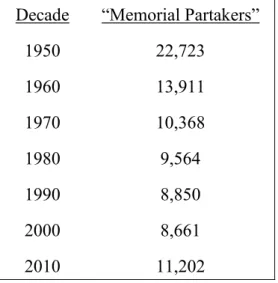
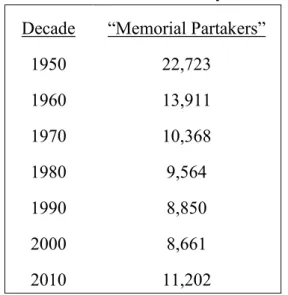
According to the 2013 commemoration of the Memorial, only 13,204 anointed took the emblems.62 This number reveals that just a little more than nine percent of the heavenly class remains on the earth.
Thesis
Because of the theological paradigm shift necessary to embrace the teachings of the Jehovah’s Witnesses, I am skeptical of the authority that the Watchtower Society has entrusted to the FDS. An examination of the authority vested in the Governing Body of the Society will reveal grave errors in the Witnesses’ claims. Along with the seriousness of the Society’s errors, the shrinking number of the anointed class jeopardizes the future of the movement. Therefore, the thesis of this dissertation is that the Jehovah’s Witnesses’ reliance on “the faithful and discreet slave” coupled with the remnant’s eventual disappearance continues to necessitate major theological realignments, which in turn lays the apologetic groundwork for evangelism to the Witnesses.
Research Methodology
In order to examine the Watchtower’s understanding of the FDS, I employed a variety of methods. While information was certainly gleaned from other scholarly works, primary sources provided the bulk of the data for this study. Along with Watchtower publications, interviews with Witnesses and attendance at local congregations offered the greatest insight into the Society’s understanding of the FDS.
622014 Yearbook of the Jehovah’s Witnesses (Brooklyn, NY: Watchtower Bible and Tract Society, 2014), 176. The emblems of the Memorial Meal are simply the wine and bread.
Summary of Scholarly Work
My initial research revealed twenty-five dissertations containing the Jehovah’s Witnesses as the subject. Thirteen of these dissertations deal with the Society’s struggle for civil rights and the precipitate persecution. Another seven works focus on sociological issues pertaining to the movement’s recruitment, growth and loss of members. The five remaining dissertations concentrate on the Watchtower Society’s history and theological development.
Nonetheless, no one has given the Jehovah’s Witnesses’ FDS concept adequate treatment.
For the most part, the majority of the works acknowledged the totalitarian nature of the movement but are devoid of any substantial treatment of the FDS concept. Raised as a Jehovah’s Witness, Heather Botting in her dissertation described the Governing Body of the Society as the “lawmakers” instead of mere “advocates” of the law.63 While she explored the perceived divine right of the Governing Body, Botting did not venture into the formulation and evolution of the FDS concept. Her work presented the “microsociety” created by the Watchtower Society and examined the responses of five select Witness families as they endured the ebb and flow of the organization’s doctrinal vacillation.
Melvin Curry, in his dissertation, “Jehovah’s Witnesses: The Effects of
Millenarianism on the Maintenance of a Religious Sect,” highlighted the “epistemological authoritarianism” of the Society but did not examine the eschatological foundation behind the FDS class’ authoritative claims.64 The focus of his work centered on the classification of the Jehovah’s Witnesses by which he concluded that the Society was “a sectarian group because
63Heather Denise Botting, “The Power and the Glory: The Symbolic Vision and Social Political Dynamic of Jehovah’s Witnesses” (Ph.D. diss., University of Alberta, 1982), 213-14.
64Melvin Dotson Curry, Jr. “Jehovah’s Witnesses: The Effects of Millenarianism on the Maintenance of a Religious Sect” (Ph.D. diss., The Florida State University, 1980), 186-87.
they advocate a monopolistic authoritarian posture for universe maintenance and have created a radical millenarian community that is characterized by a deviant belief system.”65
The Jehovah’s Witnesses’ social construction of reality was the focus of Daniel D.
Cronn-Mills’ dissertation, “A Social Construction of Reality Evident in the Discourse of the Jehovah’s Witnesses.” In his dissertation, Cronn-Mills sought to discern the meaning and the understanding Witnesses embraced from their given paradigm. Amidst his observations, he noted the tension between three worlds: Satan’s, the Witnesses’, and Jehovah’s.66 While Cronn-Mills presented the Watchtower prescribed reality, he did not examine the evolution or impact of the FDS upon their social construct.
One work that bears some similarities to my dissertation is Don Cameron’s book, Captives of a Concept: Understanding the Illusionary Concept that Holds Jehovah’s
Witnesses Captive.67 Cameron emphasized the significance of Matthew 24:45-47 (the FDS passage) and its impact on the development of the Watchtower Society. He examined the Witnesses’ FDS doctrine and compared the Society’s pre-1918 teachings. He concluded that the movement’s teachings were contradictory and could not have warranted the designation of the FDS at Jesus’ supposed examination of God’s household in 1918. According to Cameron, if Christ did indeed inspect the church in 1918 the Watchtower would not have been deemed faithful.68
Another book that treads common ground with this dissertation is Daniel Rodriquez’s The Watchtower’s Coming Crisis. Distributed by Chick Publications,
65Ibid., 243.
66Daniel D. Cronn-Mills, “A Social Construction of Reality Evident in the Discourse of the Jehovah’s Witnesses” (Ph.D. diss., The University of Nebraska, 1994),182.
67Don Cameron, Captives of a Concept: Understanding the Illusionary Concept that Holds Jehovah’s Witnesses Captive (Morrisville, NC: Lulu Press, 2008).
68Ibid., 23-40.
Rodriquez’s primary focus is the evangelism among Jehovah’s Witnesses. He makes a distinction between true or historic Jehovah’s Witnesses and those who claim the Witness name but are mere members of the great crowd. Rodriquez does devote some space to the identity of the FDS and its importance, but again sets his focus on delineating the identity of a true Jehovah’s Witness. He argues that helping members of the great crowd to realize their real place within the Society’s world will in turn open their hearts to biblical truth.69
In his book 20 Questions Jehovah’s Witnesses Cannot Answer, Charles Love introduced the pending dilemma of the fading anointed class. Writing as former Jehovah’s Witness, he notes the following:
According to the Witnesses Jehovah would only work through the Spirit led anointed class. It was only the anointed class that could dispense spiritual food to the Great Crowd. Now that the anointed are almost all gone or too old to function in the capacity as leader, Jehovah’s Witnesses have an organization being run by non-anointed
Jehovah’s witnesses. That can’t be. That can’t work! It goes against the whole basis of Jehovah’s Witnesses doctrine.70
Love essentially stirs the proverbial pot of questions surrounding the disappearance of the anointed class but does not present any resolutions to the movement’s imminent crisis.
Watchtower Resources
Since Russell penned the first Watchtower periodical in 1879, the Jehovah’s Witnesses have used print as their primary source for evangelism. The Watchtower Bible and Tract Society has published over twenty billion pieces of “bible-based” literature over the past ten years.71 There was no shortage of published material to aid in the composition of this dissertation. Witnesses boast of circulating Bible-based materials in over 500 languages.
69Daniel Rodriquez, The Watchtower’s Coming Crisis (Ontario, CA: Chick Publications, 2009), 49- 57.
70Charles Love, 20 Questions Jehovah’s Witnesses Cannot Answer (Maitland, FL: Xulon Press, 2005), 99.
71“Fast Facts – Worldwide,” accessed October 19, 2012, http://www.jw.org, jehovahs-witnesses.
Currently, the Witnesses provide 205 translations of The Watchtower periodical and 116 versions of the New World Translation.72 For the sake of this dissertation, I will confine my research to the English language versions of the Witnesses’ publications.
Over the past three and a half years, I have had the opportunity to build
relationships with local Witnesses, which have provided valuable resources for my research.
One couple in particular has been instrumental in my collection of Watchtower publications.
Darryl and Penny Camp73 of Rome, Georgia, are two Witnesses that have become close family friends. In the past few years, they have met with me in my home and worked through the Watchtower publication What Does the Bible Really Teach?74 They have graciously provided me with The Watchtower and Awake periodicals each month as well as other available Society resources that I did not already possess. Aside from their friendship, the greatest resource that the Camps have supplied was the Watchtower Library CD-ROM.75 This resource provides its user with access to the entire Watchtower library from 1950 to 2010.
My relationship with the Camps has also awarded me an open invitation to the local Kingdom Hall. Over the past two years, I have made it a regular occurrence to attend their Theocratic Ministry School76 on Wednesday nights. I have also attended The
72The Watchtower (March 2013), accessed 14 January 2013; available from http://www.jw.org, media_magazines; Internet.
73Darryl and Penny Camp are both lifetime Jehovah’s Witnesses. They have always lived in Rome, Georgia. They have a son and a daughter, who are Witnesses as well. Darryl is an elder at the Rome
congregation. He was imprisoned during the Vietnam War for his refusal of conscription.
74What Does the Bible Really Teach? (Brooklyn, NY: Watchtower Bible and Tract Society, 2005).
75Watchtower Library [CD-ROM] (Watch Tower Bible and Tract Society of Pennsylvania, 2011).
76The Theocratic Ministry School lasts for about thirty minutes at the Kingdom Hall’s midweek evening services. This portion of the night begins with a discussion of an assigned selection from the Bible.
Those who are enrolled in the school give short presentations demonstrating the use of publications and other evangelistic tools. An elder oversees the demonstrations and provides insight to the students. See Who Are Doing Jehovah’s Will Today? (Brooklyn, NY: Watchtower Bible and Tract Society, 2012), 7.
Watchtower Study Meetings on Sundays and several district conventions. Over time, I have built other relationships, one of such being with an elder and former Bethel77 missionary, Michael Spratling. In addition to providing additional resources for my research, Elder
Spratling has reviewed some of my writings on the Witnesses and has spoken openly with me about my perspectives on Watchtower theology.
Within the past two years, the Watchtower Society has made a concerted effort to increase the accessibility of their resources through the internet. The official website for the Jehovah’s Witnesses (www.jw.org) now provides access to many of their publications whereas in the past an interested party would have to contact a local Kingdom Hall for the resources. Currently, the site hosts downloadable versions of the New World Translation, recent editions of The Watchtower and Awake magazines, recordings for private worship, educational videos, and nearly eighty other books or brochures. Aside from the downloadable material, the site also provides an online library that permits its users to search Watchtower publications from 2000 to the present. This online library is also accessible through a data application (JW Library) for smartphones.
Concerning research materials published before 1950, I possess a CD-ROM resource from Bible Students Publications.78 This disc contains the complete works of Charles Taze Russell including his sermons dating back to 1903. I have also acquired Russell’s Studies in the Scriptures,79 which contains six volumes of his writings beginning with The Plan of the Ages originally published in 1886 and concluding with The New
77As noted earlier, Bethel is the designation for the facilities that the Jehovah’s Witnesses have established to direct and support the preaching work. Those who serve at the world headquarters in New York are known as the Bethel family. The men and women who live at Bethel do not receive a salary but receive room and board. All at Bethel have a special assignment, whether it is in an office, a kitchen, housekeeping, laundry, printing or bindery. See Who Are Doing Jehovah’s Will Today? 21.
78Bible Study Library [CD-ROM] (Bensonville, IL: Bible Students Publications, 2007).
79Charles T. Russell, Studies in the Scriptures (Fort Worth: Fort Worth Bible Students, 1999).
Creation published in 1904. Concerning other early works, I have another CD-ROM of Rutherford’s rainbow book collection, which dates from 1928 to 1940. Other early out of print Watchtower writings are accessible through the Internet. Useful websites such as WTArchive,80 Watchtower Documents,81 Watchtower Archive,82 and JWFacts83 provided convenient downloadable access to periodicals and documents that date back to the founding of the Watchtower Society.
Field Interviews
This dissertation used the published works of the Watch Tower Bible and Tract Society to determine the Jehovah’s Witnesses’ understanding of “the faithful and discreet slave” and the possible implications of such an understanding. In order to discover the level of commitment to the FDS within a local congregation, I have conducted interviews and distributed questionnaires among a local Kingdom Hall congregation in Rome, Georgia.
These interviews and questionnaires have provided valuable insight into the local Witnesses’
perception of the importance of the FDS and the future of the movement.
Organization of Study
Chapter 2 of this dissertation explores the FDS passages of Matthew 24:45-47 and Luke 12:42-45. This portion of the paper examines the biblical context of both selections and seeks to discern the meaning of the FDS parable. Within the second chapter, readers will also find the Watchtower’s understanding of the FDS passages and the evolution of the identity of the FDS within the Society.
80“WTArchive, ” http://www.a2z.org.
81“Watchtower Documents,” http://www.watchtowerdocuments.com, documents.html.
82“Watchtower Archive,” http://www.wtarchive.svhelden.info, books-and-tracts.
83“Historical Watchtower Publications,” http://www.jwfacts.com, historical-publications.php.
Chapter 3 focuses on the workings of the FDS within the Watchtower organization. A survey of the organizational structure provides insight in the FDS
stewardship of Jehovah’s resources. This section of the dissertation covers the methods that the Society employs to disseminate its message. Finally, the chapter offers a synopsis of the
“gospel” message provided by the FDS.
Chapter 4 delves into the pending dilemma of the disappearance of the anointed class. This chapter explores the problem of the shrinking number of the 144,000 still on earth.
An examination of the lack of authority entrusted to the great crowd reveals the magnitude of the FDS’ disappearance. The chapter investigates the Witnesses’ annual reports to analyze the anointed presence at recent Memorial meals.
Chapter 5 examines the implications for the Watch Tower Society following the imminent disappearance of the FDS class. The chapter analyzes the crisis the movement will face when their millennial message faces unfulfillment. This portion of the dissertation also investigates possible solutions the Society might embrace to solve such crisis. More
importantly, the final chapter proposes the path for evangelism to the Witnesses.
CHAPTER 2
THE IDENTITY OF THE FAITHFUL AND DISCREET SLAVE
In order to understand the Jehovah’s Witnesses’ current perception of the faithful and discreet slave (FDS), an examination of Matthew 24:45-47 and Luke 12:42-45 will be provided. The context of both passages will be explored to highlight any clues that might help readers discover the biblical meaning of these select passages. This chapter will also provide interpretative insight from several biblical scholars in order to uncover the identity of the FDS that Jesus described in Matthew and Luke. After a survey of the relevant historical interpretations, the focus will shift to the evolution of the Watchtower Society’s perception of the FDS beginning with Charles Taze Russell’s teachings on the concept and concluding with the Society’s October 2012 statement on the FDS identity.
The Context of Matthew 24:45-47
Matthew’s Gospel places the FDS passage within the context of the Passion Week.
During the week leading up to the crucifixion and resurrection, Jesus shared with His
disciples about His future Parousia. Matthew chapters 24 and 25 record His teachings on the matter. Within these two chapters, many of Jesus’ sayings have produced a multitude of interpretations over the ages. For the sake of this discussion, an in-depth commentary on the context surrounding the FDS passage will not be provided.
Chapter 24 opens with Jesus’ description of the signs that must accompany His second advent. Referred to as the Olivet Discourse, this body of teaching depicts future events that will precede “the end of the age.” Describing these signs as “birth pains”(v. 8),
Jesus instructed His followers to watch for the threat and reality of wars (v. 6), widespread global tension (v. 7), natural disasters (v. 7), persecution of the brethren (v. 9), dispersion of followers (v. 10), rise of false prophets (v. 11), and the proclamation of the gospel in the whole world (v. 14). 1
After listing these nine precursory events, Jesus informed His disciples that there would be a defining event that would impact redemptive history. The “abomination of desolation” (24:15) would usher in a time of great distress. While scholars throughout the ages have had much to say about this “desolating sacrilege” and its timing, Jesus focused His attention on the severity of the days that would follow the event.2
Biblical scholars such a Craig L. Blomberg and Robert H. Stein note that Christ’s words in Matthew 24:15 foreshadow the destruction of Jerusalem and the temple in A.D. 70.
Linking Luke 20:21-24 with the Matthean passage, Stein suggests that Matthew used
Jerusalem’s destruction as an example of the type of the persecutions that would accompany the end of time.3 Again examining the synoptic relationship between the Lukan and Matthean passages, Blomberg points to the actual events of the first century and Luke’s more explicit wording to build his case for the fact that Matthew’s text was focused on the events that would unfold in A.D. 70.4 However, John Calvin protests to such interpretation while
insisting that it is an error to suppose that Matthew 24:15 denotes the siege of Jerusalem.5 He
1Craig Blomberg in his commentary on Matthew notes that like a woman’s contraction before her eminent delivery, these preliminary events would remind followers of the inevitability of Jesus’ return. He also suggests that just as a woman may endure false labor are accompanied by genuine contractions, they still leave her uncertain about the precise time of delivery. Therefore, the events described in Matt 24:4-8 do not enable believers to pinpoint the time of Christ’s parousia. See Craig L. Blomberg, Matthew, The New American Commentary, vol. 22 (Nashville: Holman Reference, 1992), 401.
2Ibid., 406.
3Robert H. Stein, Luke, The New American Commentary, vol. 24 (Nashville: Holman Reference, 1993), 519.
4Blomberg, Matthew, 406.
acknowledged the events of A.D. 70 but proposes a more devastating event in Jerusalem in the future that would precede the return of Christ.6
Following his mention of this desolation, Jesus informed his followers of the severity of the days to follow. Matthew 24:16-20 reveals the haste people must exhibit in order to escape the distress of those days. Individuals must be ready to flee at a moment’s notice. Readers of the Matthean account will notice a shift between verses 20 and 21.
Matthew introduced an unrivaled “great tribulation” in verse 21. Jesus stated that this tribulation would be one that “such has not occurred since the beginning of the world until now, nor ever will.” The unparalleled nature of this tribulation directs readers to a future event, one that could not have been fulfilled in A.D. 70. Noting a gap of at least two thousand years, Blomberg suggests that this period of great tribulation refers to span of time between the Jerusalem destruction of the first century and progressing until Christ’s return.7 Whether this time of distress began nearly two millennia ago and has increased in severity to this day or it has yet to be initiated with a future “abomination of desolation,” the fact of the matter is that a season of unfathomable tribulation will precede the Second Advent.
Amidst his words of warning, Christ offered consolation to his disciples. In verse 22, Jesus revealed to his disciples that these days of tribulation will be “cut short.” This mercy will be for the sake of the “elect.” Calvin noted that God would never permit his wrath to proceed to the degree that he could not provide for the safety of the elect.8 Believers would indeed face unparalleled distress but the Lord’s mercy would result in their eventual
deliverance.
6Ibid., 135.
7Blomberg, Matthew, 407.
8Calvin, Commentaries, 17:138.