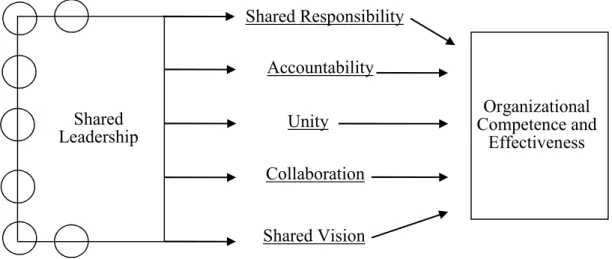
A relevant assumption is the fundamental difference between the church's view of group leadership and the secular view of shared leadership. Conger, eds., Shared Leadership: Reframing the Hows and Whys of Leadership (Thousand Oaks, CA: Sage, 2003), 1. Both shared leadership and team leadership have their place in the secular organization and the church.
PREMISES
The first and obvious implication of the church being called the body of Christ is the explicit identification the church has with Christ. The second implication of the church being referred to as the body of Christ is. The apostle's vision of the church rests firmly on the foundational event of his conversion.
A third implication of the church being the body of Christ is found in each person in the body having a specific function within the body. Despite the diversity found in the church, the well-being of the church is discovered within the unity of the body's functions. 19. Moving on to the fourth implication that the church is the body of Christ, Paul emphasizes the unity factor.
In the picture there may be a suggestion that Christ is the source of the Church's life. Inasmuch as Christ is the head of the church, the church is governed and its destiny is certain.
Functioning within One’s Spiritual Giftedness Spiritual Giftedness
Paul's admonition to the Corinthian Church, a church that is clearly dysfunctional,7 is that each member must function within their role: “The. Thiselton, The First Epistle to the Corinthians, The New International Greek Testament Commentary (Grand Rapids: William B. Eerdmans. At that time the leaders raised up other men, full of wisdom and full of the spirit to fulfill the necessary role, that the Apostles can return the.
A further and more in-depth reading of the Acts of the Apostles would show that because of this strategy the church also prospered and grew in numbers and influence. It would be inappropriate to conclude that God's work of functional creation ended in the Genesis account. Instead, we see that the Spirit that forms the spiritual body still continues its work, even to the present age.9 Furthermore, "to try to classify some gifts as more important than others, let alone as necessary marks of advanced status, for which all should to strive for is to offer a blasphemous challenge to God's freedom to choose whatever is his good will for his people both collectively and individually.”10.
Shared leadership requires that everyone within the church function within the boundaries of their role, responsibility and giftedness: “Each member of the church has his gifts and his functions. The Spirit has assigned him to the place he occupies in the great organism.
Deference
Because of social anxiety, language barriers, or emotional distress, today's Christianity, whether consciously or unconsciously, has chosen to use a more socially acceptable way of describing the role and responsibilities of a servant. While on the one hand it is commendable not to be offensive in an exercise in semantics, on the other hand it shows that this type of shift, which strives to eradicate the biblical image of a slave from a contemporary application, can have a profound impact in a biblical understanding Christian leadership.17 The image of a servant/slave provides the imagery that Jesus uses to challenge his disciples to achieve greatness (Matthew 20:20-28). In the Roman Empire, a servant/slave could be defined as "someone whose person and service belong entirely to another."18 Although there are cases where the terms servant and slave are used interchangeably, at other times such freedom would be.
Vincent, The Epistles to the Philippians and to Philemon, The International Critical Commentary on the Holy Scriptures of the Old and New. 15Frederick William Danker, ed., A Greek-English Lexicon of the New Testament and other Early Christian Literature, 3rd ed. As such, "a servant can be anyone who works for someone more powerful than he."19 In this regard, a servant of Christ following in his footsteps and showing reverence for others, in the spirit of establishing stability and harmony in the Church.
Here Paul discusses the different roles of leaders within the church and asserts, "I planted, Apollos watered, but God was causing the growth." Soards writes. However, a proper secondary meaning is seen in the fact that Paul was planting and Apollos was watering; each deferring to the other as the case may be.21.
Team-Based Ministry Approach
The news about them reached the ears of the Jerusalem church and they sent Barnabas to Antioch. And in proportion as any of the disciples had, each of them determined to send a contribution for the relief of the brethren who lived in Judea. Specifically, in this passage the Gentiles of Antioch were coming to faith in Christ in great numbers, and the church in Jerusalem sent Barnabas to Antioch to witness to this great movement.22 In the midst of this great exciting time for the church new, a spirit of cooperation and teamwork is evident in several ways.
The church could not turn a blind eye to what God was doing in that part of the world. Saul recognized the voice of God in the words of Barnabas, and the two friends hurriedly traveled to the Syrian metropolis. 26. At this point, not only are the shared qualities of leadership embodied in the sending of Barnabas, but now Paul and Barnabas enter into a cooperative and cooperative relationship as they promote God's work in Antioch.
Barnabas's wisdom, fullness of the Spirit, background with the people and encouraging temperament, or Paul's calling in Christ and ability to teach the Scriptures, would in themselves have given good leadership in the church. Reading a little further into this passage reveals that the disciples in the church had learned about this spirit of cooperation.
Rather, for him, the partnership contributed to a mutually agreed upon, common goal.31 Although scholarship debates to some extent the depth of Paul's associations, the following list represents a group of people whom he considered partners in ministry. It is for this reason that Paul's vocabulary should be carefully examined as it sheds light on the designations he assigns to the many people with whom he worked. Paul's reference to Philemon being a brother is a most effective indictment, as it fully "acknowledges that in all these acts Philemon had shown himself a true brother to Paul, and an exhortation now to show himself a such brother in the manner in which he should receive Onesimus.”37 Indeed, Paul's metaphor of Christ's body being a family is not lost on Paul, and here he refers to this relationship to inspire a broken relationship to become again whole; again showing a lateral relationship over a hierarchical relationship.
Paul's Epistles to the Colossians, Thessalonians, Timothy, Titus, and Philemon (Minneapolis: Augsburg. Paul's expression in this passage comes from a root verb meaning "to place under (the executioner's axe)." 41. It is unclear what prompted this apparent act of solidarity, but regardless, the act of Prisca and Aquila spoke volumes in Paul's life, as illustrated by the definition of a co-worker.Paul's view of Timothy was more than a child in the faith or a brother in Christ.
Paul's language does not indicate that he regarded others as inferior or that he was superior. Paul's acknowledges many people in his writing, and links himself to a network on which you see the many designations as mentioned earlier.
Paul’s Instructions to Church Leaders
Service is lived through the context of relationships, and leadership is exercised in a matrix of partnerships. Another example of Paul's instruction supporting common leadership can be seen in his admonition to Timothy: "Let no one look at our youth, but rather in speech, in conduct, in love, in faith and in purity, be an example to those who believe." Probably the most compelling argument is made when we consider Paul's commission to Timothy to preach the Word.
That is why Paul's teaching in verse 17 is important because he notes that "the Holy Scriptures are a perfect and sufficient guide in all doctrines and duties, fully equipping a man who uses them properly for every good work."52 The reason that common leadership is enduring discipline in the life of the church is, for Paul, marching. In light of the apostasy occurring in the lives of individuals in the church, Paul issues a renewed plea for Timothy to be sober, endure hardship, do the work of an evangelist, and finally fulfill his ministry. While it is true that verse 5 is the last verse in Paul's charge to Timothy, we must at least consider the following verses to put the former in proper context.
Beginning in verse 6, Paul begins to hand over the mantle of his ministry to his brother and son in the faith, Timothy. While it would be inappropriate to suggest that the aforementioned six principles constitute an exhaustive list that confirms Paul's view of shared leadership, they are certainly sufficient.
CONCLUSIONS
7William Hendriksen, Exegesis of the Gospel of Matthew, Commentary on the New Testament (Grand Rapids: Baker. Furthermore, most important to the role of leadership in the life of the church is the ability to have a common vision that can be accepted and expressed throughout the entire leadership structure Kistemaker, Exposition of the Second Epistle to the Corinthians, New Testament Commentary (Grand Rapids: Baker, 1997), 70.
Finally, shared leadership must be willing to invest time and effort in discovering both the needs of the church and the gifting of people. This thesis was primarily intended to deal with shared leadership in and throughout the life of the apostle Paul. This was achieved by looking at Paul's functional view of the church and how it was influenced by religious heritage and cultural norms.
One Body in Christ: A Study of the Church's Relationship to Christ in the Epistles of the Apostle Paul. The Gift of the Church: Ecclesia Crucis, Peccatrix Maxima and the Missio Dei.” In Evangelical Ecclesiology: Reality of Illusion, edited by John G. This dissertation studies the presence and role of shared leadership as evidenced by the ministry of the Apostle Paul.
Nevertheless, the task of this study is to distinguish and establish a working definition for the discipline of shared leadership and to examine Paul's view of the church.