Copyright © 2014 Nicholas John Ostermann
All rights reserved. The Southern Baptist Theological Seminary has permission to reproduce and disseminate this document in any form by any means for purposes chosen by the Seminary, including, without limitation, preservation, or instruction.
A TRIPERSPECTIVAL APPROACH TO SHARED PASTORAL LEADERSHIP BASED ON THE MUNUS TRIPLEX CHRISTI
__________________
A Thesis Presented to the Faculty of
The Southern Baptist Theological Seminary
__________________
In Partial Fulfillment
of the Requirements for the Degree Doctor of Education
__________________
by
Nicholas John Ostermann December 2014
APPROVAL SHEET
A TRIPERSPECTIVAL APPROACH TO SHARED PASTORAL LEADERSHIP BASED ON THE MUNUS TRIPLEX CHRISTI
Nicholas John Ostermann
Read and Approved by:
__________________________________________
Michael S. Wilder (Chair)
__________________________________________
Shane W. Parker
Date ______________________________
TABLE OF CONTENTS
Page
LIST OF TABLES AND FIGURES . . . v
PREFACE . . . vi
Chapter 1. LEADING LIKE JESUS . . . 1
Presentation of the Research Problem . . . 1
When Christian Leadership Meets Secular Theory . . . 4
Summary of the Research Problem . . . 7
Research Question . . . 9
2. LITERATURE REVIEW . . . 11
Reviewing Current Approaches to Christian Leadership . . . 13
3. EPISTEMOLOGICAL, BIBLICAL, AND HISTORICAL FOUNDATIONS . . . 37
Epistemological Foundations . . . 38
Biblical Foundations . . . 44
Historical Foundations . . . 49
Summary of Foundations . . . 51
4. PASTORS AS PROPHETS, PRIESTS, AND KINGS . . . 52
The Prophet . . . 53
The Priest . . . 59
The King . . . 62
Mimicking and Mingling the Three Roles . . . 67
Chapter Page 5. PRACTICING THREEFOLD LEADERSHIP IN THE
LOCAL CHURCH AND INTO THE FUTURE . . . 71
Visualizing the Roles . . . 72
Tension . . . 74
Valuing the Threefold Pastoral Team . . . 78
Conclusion . . . 79
BIBLIOGRAPHY . . . 82
LIST OF TABLES AND FIGURES
Table Page
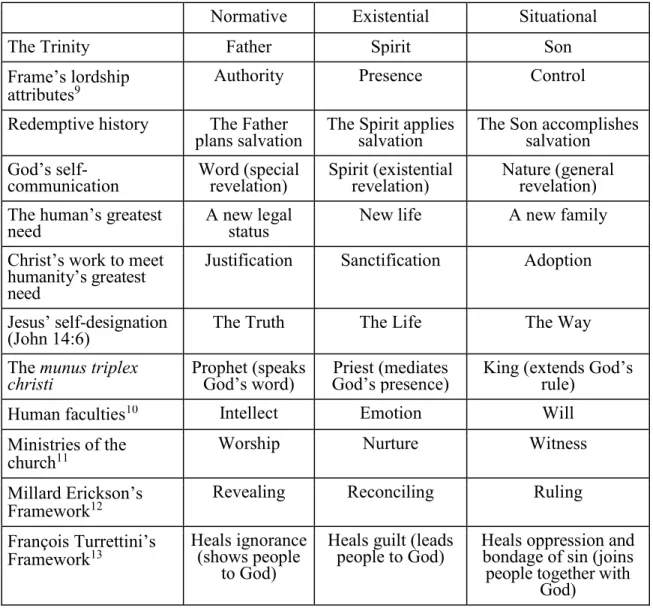
1. Examples of Frame’s triperspectival epistemology applied theologically . . . 41 Figure
1. Three models of Christian leadership: heroic, servant, trinitarian . . . 15 2. The pastoral prophet, priest, and kings’ leadership function
in the local church . . . 73
PREFACE
I never thought I could or would be a doctor of anything. Yet in this endeavor, as well as in every other of any significance, it was my wife, Tessa, who believed in me, encouraged me, and, as much as another person can, enabled me to do what I thought I could not. This educational work and to whatever it may lead is for her, our family, and the accomplishment of the dreams God has put in us.
I am thankful for my parents, Gene and Kay, for cheering me on and consistently valuing the role of education in my life. I also thank the hundreds of men who comprise the Acts 29 Network and who have encouraged and edified me in church planting and pastoral ministry over the years. I am still learning what it means to be a pastor from their collective wisdom. Dr. Michael Wilder and Dr. Timothy Jones re- kindled my love for the classroom and, through their kindness and graciousness, helped me to enjoy the kind of scholarly research that takes place at a great institution like Southern.
Lastly, I thank my friends at The Rooted Church and The City Church. These brothers and sisters have spurred me on and supported me in this pursuit, even when my weaknesses as a leader have been abundantly evident. To the elders, I am honored to serve alongside of godly and yet imperfect men who together cling to a perfect Savior.
What an adventure it is to experience both the unity and diversity that come as we try our best, by the power of God at work in us, to lead together as prophets, priests, and kings.
Nicholas Ostermann Fort Worth, Texas
CHAPTER 1 LEADING LIKE JESUS
Pastors must lead like Jesus. Christ told his disciples when reminding them of his role as servant, “I have given you an example, that you also should do just as I have done to you” (John 13:15). Whatever ministry the Christian pastor executes, it is
ultimately not his own but is a continuation of Christ’s ministry on earth.1 The Scriptures are clear that Jesus Christ is the head of the church (Eph 1:22-23; 4:15; 5:23), Jesus is the Apostle who plants the Church (Heb 3:1), Jesus is the leader who builds the Church (Matt 16:18), and it is ultimately Jesus who closes churches down when they have become faithless or fruitless (Rev 2:5).2 Jesus is the primary minister (Heb 8:2), the Good Shepherd (John 10:11), the Chief Shepherd (1 Pet 5:4), and the Great Shepherd (Heb 13:20). The ministry of the pastor, then, is the ministry of Jesus Christ, to the Father, through the Holy Spirit, for the sake of the church and the world.3 Through his own union with Christ, the pastor shares in the ministry of his pastoring God.
Presentation of the Research Problem
A more firm footing for pastoral ministry is needed amidst a landscape of pastoral confusion, frustration, and fakery. Even while “ministry” is commonly used to
1The more appropriate term for what is generally known as “pastor” is “elder.” The noun
“pastor” appears only once in the New Testament and is used as a descriptive metaphor rather than an ecclesiastical office. Still, in light of the overwhelming popularity and familiarity with the term “pastor”
and the subsequent discipline known as “pastoral ministry,” the term “pastor” will be used throughout.
2Mark Driscoll, On Church Leadership (Wheaton, IL: Crossway, 2008), 12.
3Stephen Seamands, Ministry in the Image of God: The Trinitarian Shape of Christian Service (Downers Grove, IL: InterVarsity, 2005), 9-10.
denote a concept so basic to religious faith and practice that its meaning appears on the surface to be self-evident, divergent theologies, ecclesiologies, and approaches to cultural interaction have led to a lack of consensus, not to mention articulation, concerning the nature of pastoral ministry.4 More than that, American society now largely regards terms such as “Rabbi,” “priest,” “pastor,” and “imam” as interchangeable designations for essentially identical religious offices. The religious climate of Western culture, particularly in the United States, has lumped such roles together under the category of
“religious leaders,” leading to a generalized and superficial conception of what ministry must mean for each, and therefore trivializing them all. Accordingly, pastors often have little idea of what exactly they are to be doing.5
Furthermore, of over a thousand Reformed and Evangelical pastors surveyed, more than three-quarters said they did not have a good marriage, almost the same number only used their Bibles when preparing to teach, 7 out of 10 admitted they battled
depression beyond fatigue on a weekly or even daily basis. More than 80 percent could not point to any effective effort to deepen the faith of the souls in their churches. Less than a quarter said they were content with their standing in Christ, in their church, and in their home. Thirty percent have had an affair with a parishioner. Over half would leave the ministry if they had a better place to go.6
The typical response to such a state of affairs is to offer tips and tricks that claim to lighten the load. Charles Scalise writes,
Too many Christian leaders have been seduced by programs claiming to show “five simple ways” to build a great church, “six easy steps” to sanctification, or “seven perfect practices” to know God. The shelves of Christian bookstores are lined with
4Earl E. Shelp and Ronald H. Sunderland, A Biblical Basis for Ministry (Philadelphia:
Westminster, 1981), 11.
5Ibid., 17-18.
6Richard J. Krejcir, “Statistics on Pastors,” accessed 15 June 2014, http://www.intothyword.org/
apps/articles/?articleid=36562. This study represents the culmination of eighteen years of research into
volumes on ministry or “pastoral theology,” which, instead of offering critical reflection upon Christian action, consist of marketable “helps and hints” on succeeding in ministry or exploit the latest fad or social issue.7
Almost fifty years ago, Orley Berg had already observed the growing list of roles that were expected to be filled by the pastor: administrator, organizer, promoter, salesman, businessman, financier, fund-raiser, builder, public relations expert, personnel director, marriage and family counselor, preacher, shepherd, and soul winner.8 For those that are able to hang on, they know that “the life of a pastor can leave you feeling like a ringmaster–scrambling to run a three-ring circus and keep all the tigers and clowns in their places.”9 Such an abnormal, pedestal-sized load of expectations is enough to crush any man, no matter how deft he may be at navigating the circus.
Unfortunately, instead of pastoral ministry returning to its biblical and theological heritage, it has been in recent years more influenced by the insights and practices of the behavioral sciences, the marketplace, and emerging technologies. The result has been a perhaps well-intentioned yet appallingly adolescent and culturally obedient American evangelicalism; adolescent because it has kept in step with the juvenilization of the wider culture,10 culturally obedient because it now reflects more often than subverts the wider culture.11 Such a state of affairs underscores the urgency and necessity of returning to and investigating the classical biblical and theological foundations of the nature and scope of pastoral ministry.
7Charles J. Scalise, Bridging the Gap: Connecting What You Learned in Seminary with What You Find in the Congregation (Nashville: Abingdon, 2003), 18.
8Orley Berg, The Work of the Pastor (Nashville: Southern Publishing Association, 1966), 10.
9Richard Stoll Armstrong, Help! I’m a Pastor: A Guide to Parish Ministry (Louisville:
Westminster John Knox, 2005), 3-4.
10Thomas Bergler, The Juvenilization of American Christianity (Grand Rapids: Eerdmans, 2012).
11Ross Douthat, Bad Religion: How We Became a Nation of Heretics (New York: Free Press, 2012); Leslie Newbigin, Truth to Tell: The Gospel as Public Truth (Grand Rapids: Eerdmans, 1991).
An overarching schema is desperately needed by which pastors are able to think about themselves and their work, one with a center and a legitimate chance at healthy sustainability, one that is built upon the person and work of the Great Shepherd.
Thomas Oden says in his seminal work on pastoral theology, life in Christ is the single center around which all the varied activities of the pastor must revolve.12 A theological and, more specifically, christological understanding of who the pastor is and what he is doing will become the backbone that holds up a lifetime of fruitful and joyful ministry.
When Christian Leadership Meets Secular Theory
Before a christological model of shared pastoral leadership can be proposed, existing popular models of leadership that have influenced the landscape of pastoral ministry must be examined. Professors of leadership Robert Banks and Bernice Ledbetter summarize the trends in academic leadership study during the last century and a half.13 During the latter half of the nineteenth century, leadership research concentrated on the so-called Great Man theory. This theory focused on those men who had affected the course of history due to superior leadership capacities or particular circumstances. In the first half of the twentieth century, the focus shifted to identifying traits characteristic of leaders, including intelligence, self-confidence, determination, integrity, and sociability.
Throughout the 1950s and 1960s, attention in leadership studies moved from leadership traits to leadership activity, especially leaders’ behaviors and styles, resulting, for example, in popular tools such as The Managerial Grid.14 During the 1970s and 1980s, leadership studies paid increasing attention to the context in which leadership took place,
12Thomas C. Oden, Pastoral Theology: Essentials of Ministry (New York: Harper Collins, 1983), 3.
13Robert Banks and Bernice M. Ledbetter, Reviewing Leadership: A Christian Evaluation of Current Approaches (Grand Rapids: Baker, 2004), 49-56.
14Robert R. Blake and Jane S. Mouton, The Managerial Grid III: A New Look at the Classic That Has Boosted Productivity and Profits for Thousands of Corporations Worldwide (Houston: Gulf,
for example, leadership styles best suited to military contexts. Over the last two decades, leadership study has grown more complex, focusing on areas such as social
responsibility, shared or distributed authority, spiritual influences, ethical codes, and the global and multicultural character of leadership.
These historical trends in leadership theory are often reflected in the contributions of Christian practitioners. Modern discussions on Christian leadership generally fall into a handful of categories. The Great Man theory of leadership is
reflected in the character studies of Old Testament saints or early church leaders who are said to have displayed extraordinary leadership that can be practiced today.15 Studies dealing in the positive character traits of effective leaders are reflected in the work of Robert Greenleaf and subsequent works on servant leadership.16 More current discussions of shared leadership and distributed authority are reflected in works on Trinitarian-based and team-based approaches to Christian leadership.17 While many of these contributions
15See Christopher A Beely, Leading God’s People: Wisdom from the Early Church for Today (Grand Rapids: Eerdmans, 2012); Hans Finzel, The Top Ten Leadership Commandments (Colorado Springs: David C. Cook, 2012); Kenneth O. Gangel, Team Leadership In Christian Ministry: Using Multiple Gifts to Build a Unified Vision (Chicago: Moody, 1997); John C. Maxwell, Running with the Giants: What the Old Testament Heroes Want You to Know about Life and Leadership (Brentwood, TN:
FaithWords, 2002); Gregory K. Morris, In Pursuit of Leadership: Principles and Practices from the Life of Moses (Lakeland, FL: Leadership, 2013); Gil Rendle and Susan Beaumount, When Moses Meets Aaron:
Staffing and Supervision in Large Congregations (Herndon, VA: The Alban Institute, 2007); Lorin Woolfe, The Bible on Leadership: From Moses to Matthew: Management Lessons for Contemporary Leaders (New York: Amacon, 2002).
16See Robert K. Greenleaf and Larry C. Spears, Servant Leadership: A Journey into the Nature of Legitimate Power and Greatness (Mahwah, NJ: Paulist, 1977); Robert K. Greenleaf, The Power of Servant Leadership (San Francisco: Berrett-Koehler, 1998). See also James A. Autry, The Servant Leader:
How to Build a Creative Team, Develop Great Morale, and Improve Bottom-Line Performance (New York: Three Rivers, 2001); Ken Blanchard and Phil Hodges, The Servant Leader: Transforming Your Heart, Head, Hands, and Habits (Nashville: Thomas Nelson, 2003); James C. Hunter, The World's Most Powerful Leadership Principle: How to Become a Servant Leader (New York: Crown Business, 2004);
Larry C. Spears and Michele Lawrence. Focus on Leadership: Servant Leadership for the Twenty-First Century (New York: John Wiley & Sons, 2002).
17See George Barna, The Power of Team Leadership (Colorado Springs: Waterbrook, 2001);
George Cladis, Leading the Team-Based Church: How Pastors and Church Staffs Can Grow Together into a Powerful Fellowship of Leaders (San Francisco: Jossey-Bass, 1999); Gangel, Team Leadership in Christian Ministry; Stephen Pickard, Theological Foundations for Collaborative Ministry (Burlington, VT:
Ashgate, 2009).
provide helpful insights, they often follow the trends of popular leadership study at the time and attempt to “christianize” secular theory. Few works on Christian leadership offer a model that is clearly and thoroughly grounded in the person and work of Jesus Christ and therefore may be called uniquely and distinctively Christian. Unfortunately, the foundation for what often passes as Christian leadership is superficial and sentimental spirituality that is far removed from biblical Christianity.
Management specialist Stephen Pattison argues provocatively that business leaders and managers have become the cultural heroes of the modern era, and that much so-called secular thinking and writing about managerialism has evolved into a sort of utopian religious faith. Theories of Christian leadership are regularly baptized into this modern day faith, taking on its values and practices and celebrating and emulating its secular heroes. Pattison helpfully applies the same critical spirit that theologians have applied to religious belief to this utopian faith. His analysis of several leading writers on leadership reveal that many current ideas on leadership spring from a particular
worldview permeated by quasi-religious ideas. He makes his case in four areas.18 First, Pattison argues that many leadership theorists are in essence selling
“faith, hope, and meaning” through the religious-sounding possibilities they offer,
possibilities based on the beliefs that human beings have the capacity to control the world and shape the future, that the customer’s immediate gratification is ultimately sovereign, that everything significant can be measured objectively, and that the success of an
organization is the greatest good. Such beliefs stem from Enlightenment thinking and the Industrial Revolution and are essentially inadequate from a Christian perspective. He likewise details the pervasive use of mystical language and metaphors in leadership literature (terms such as vision, mission, and service). Such religious language reveals the
18Stephen Pattison, The Faith of the Managers: When Management Becomes Religion (London: Cassell, 1997); idem, “Recognizing Leaders’ Hidden Beliefs,” in Faith and Leadership: How Leaders Live Out Their Faith in Their Work and Why It Matters, ed. Robert Banks and Kim Powell (San
basic beliefs and ultimate concerns of leaders. He also examines “sacramental rituals” (an organization’s customary ways of doing things that assume symbolic importance) that operate in a way similar to religious rituals. Finally, Pattison addresses parallels between assumptions and behaviors in the business world and those in evangelical Christian groups, including corporate identity and adherence; conversion to an organization’s aims, values, and practices; a sense of purpose and belonging; the search for excellence; and values of obedience and conformity in the midst of rhetoric on individual empowerment.
Pattison concludes,
Belief or faith free leadership is probably not realistic or even desirable. . . .
[Leadership] contains important symbolic, non-rational, and even spiritual elements.
It is easy to deny them, but instead . . . leaders might become more critically aware of their basic beliefs and assumptions. This awareness would allow them to engage in more careful assessment of the nature, content, effects, and desirability of their beliefs.19
Summary of the Research Problem
If, as Pattison proposes, leadership is unavoidably religious, is Christian leadership merely a subset of a generalized spirituality that pervades all leadership? Are exemplary Old Testament figures or general ideas of servanthood sufficient to provide a framework for leadership that is distinctively Christian? In considering the widespread development of leadership theory over the past century and a half, Banks and Ledbetter propose that leadership bearing the “imprint of faith” includes the characteristics of intentionality, reflection, self-evaluation, covenant building, intellectual and ethical integrity, followership, and perpetual learning and development.20 But is this sufficient?
Do the above eight characteristics or something like them outline a kind of leadership that is sufficiently and uniquely Christian? Are they adequate to inform an understanding of faithful pastoral leadership?
Such approaches are inadequate. Not only must an understanding of pastoral
19Pattison, The Faith of the Managers, 152.
20Banks and Ledbetter, Reviewing Leadership, 55-56.
theology center on the person of Jesus Christ, it must derive its methodology of pastoral work from that of Jesus himself. Such is the case made by Professor of Pastoral Theology Andrew Purves: “We should think about ministry as empowerment for faithfulness that God does in and through us by joining us to the faithfulness of Jesus Christ.”21 He explains how union with Christ is the foundation for pastoral ministry:
Through our union with Christ, ministry is accordingly shaped to the christological pattern. Thus Jesus’ statement at John 14:6, “I am the way, and the truth, and the life,” is the singular basis not only for piety and faith, but also for life and ministry, for it is in union with Christ that we can walk the way, know the truth, and live the life of those who serve in the name of Christ. In this way we share in his ministry, in which he ministers the things of God to us and the things of humankind to God, to the glory of the Father and for the sake of the world. Apart from union with Christ, ministry is cast back upon us to achieve.22
Pastors must consistently remember that their ministry is not their own, somehow separate from or in addition to Jesus’ own. Rather, faithful pastoral work is an extension of Jesus’ own pastoral work. He shepherds his sheep through faithful under- shepherds as they are united to him and his ministry by faith.
Such is the pattern and power for ministry throughout the New Testament. As the local church is rooted and grounded in love, strengthened to comprehend the love of Christ, and filled with the fullness of God (Eph 3:17-19), believers share in Christ’s ministry from the Father. Jesus prays to the Father for the church: “As you have sent me into the world, so I have sent them into the world” (John 17:18). Likewise, “As the Father has sent me, so I send you” (John 20:21). Purves explains that
as the body of Christ the Holy Spirit joins us to Christ to share not only in his communion with the Father, but also in his mission from the Father. . . . It is the job
21Andrew Purves, Reconstructing Pastoral Theology: A Christological Foundation (Louisville:
Westminster John Knox, 2004), 43.
22Ibid., 45. It should be noted that Purves does indeed provide a wonderful and comprehensive Christological foundation for pastoral ministry. Oden calls it “the most significant and substantive
reflection on the christological foundation of pastoral theology in this decade.” Thomas C. Oden, endorsement to Purves, Reconstructing Pastoral Theology, dust jacket. Yet Purves considers Christ’s twofold ministry as Apostle and High Priest rather than his threefold ministry of prophet, priest, and king.
of the church to be the present form of God in Christ in and for the world . . . . Thus the ministry of God becomes the ministry of the church.23
In union with Christ, that which is his becomes ours.24
Research Question
If shared pastoral ministry is to be a reflection and extension of Jesus’ own ministry, one must answer the question: Who is Jesus in his ministry to his people?25 Only after adequately answering this first question can an answer to a second begin to form: How can pastoral ministry reflect and be an extension of the ministry of Jesus?
Regarding the first question, the Westminster Shorter Catechism (1648) poses,
“What offices doth Christ execute as our Redeemer? Christ, as our Redeemer, executeth the offices of a prophet, of a priest, and of a king, both in his estate of humiliation and exaltation.”26 Historically referred to as the munus triplex Christi (threefold office of Christ), Jesus serves as Chief Shepherd of his people through his roles as prophet, priest, and king. Unfortunately, as J. Robert Clinton, Senior Professor of Leadership at Fuller Theological Seminary, remarks, “Of the leadership models in Christ’s ministry, only the servant model has received any in-depth treatment.”27 As valuable as this servant model is, much treasure has yet to be mined from Jesus’ leadership according to his munus triplex.28 Because Jesus serves as Chief Shepherd of his people through his roles as
23Ibid., 41-42.
24Ibid., 171.
25Certainly there are aspects to Christ’s ministry and leadership that are unique to him (i.e., vicarious substitution, securing redemption, receiving worship, pronouncing certain judgments, etc.).
26Westminster Shorter Catechism Project, “Question 23,” accessed February 10, 2013, http://www.shortercatechism.com/resources/wsc/wsc_023.html.
27Robert J. Clinton, endorsement to Timothy S. Laniak, While Shepherds Watch Their Flocks:
Reflections on Biblical Leadership (Matthews, NC: ShepherdLeader, 2007), dust jacket. Clinton recognizes that Laniak’s work begins to fill this void by providing a detailed treatment of the shepherd model.
28In 1994, As Gary Breshears of Western Seminary wrote, “To my knowledge no one has attempted to define the Church in relation to the offices of Christ.” Gary Breshears, “The Body of Christ:
Prophet, Priest, or King?” Journal of the Evangelical Theological Society 37, no. 1 (March 1994): 5.
prophet, priest, and king, and because faithful pastoral ministry must be a reflection and extension of Jesus’ own ministry, the munus triplex Christi provides a remarkable Christ- centered model for shared pastoral leadership in the local church.
Though some progress has been made in years since, the gap remains very large.
CHAPTER 2 LITERATURE REVIEW
Shared leadership in the local church is a topic starving for attention. While a handful of works have made important contributions, in light of the grand scale and scope of works on leadership in general, relatively little has been done in the area of shared leadership, particularly for pastoral ministry.1 Early leadership scholars argued for the importance of leadership being shared among team members.2 Gibb, the first to so argue, stated, “Leadership is probably best conceived as a group quality, as a set of functions which must be carried out by the group. This concept of ‘distributed leadership’ is an important one.”3 Nevertheless, subsequent research in the field of shared leadership has been largely concentrated on individual contributions rather than those aspects shared among many. Carson, Tesluk, and Marrone explain, “Most existing research on team leadership has focused narrowly on the influence of an individual team leader (usually a manager external to a team), thus largely neglecting leadership provided by team
members.4
1Such neglect is grave indeed, especially in light of the clear biblical data concerning the plurality of elders/pastors. The apostles always established plural oversight within the churches they planted. There were elders (plural) in Jerusalem (Acts 11:30), the four churches in South Galatia (Acts 14:23), Ephesus (Acts 20:17), Philippi (Phil 1:1), and the churches in Judea (Jas 5:14), and they were to be acknowledged in each city in Crete (Titus 1:5). To speak of pastoral ministry in the local church is to necessarily speak of shared pastoral ministry. See also Acts 11:29-30; 15:2-6, 22-40; 21:17-18; Eph 4:11; 1 Thess 5:12-13; 1 Tim 4:14; 5:17-19; Heb 13:7, 17, 24; 1 Pet 5:1-2.
2C. A. Gibb, D. T. Gilbert, and G. Lindzey, Leadership (New York: John Wiley & Sons, 1954), 54; D. Katz and R. Kahn, The Social Psychology of Organizations, 2nd ed. (New York: Wiley, 1978).
3Gibb, Gilbert, and Lindzey, Leadership, 884.
4Jay B. Carson, Paul E. Tesluk, and Jennifer A. Marrone, “Shared Leadership in Teams: An Investigation of Antecedent Conditions and Performance,” Academy of Management Journal 50, no. 5
The overemphasis on individual leadership is certainly due in part to the lack of a common understanding of what is meant by shared leadership. Bass’s encyclopedic Handbook of Leadership, considered the standard in collecting and presenting leadership theory, includes nearly 10,000 references. Still, no agreed upon definition of shared leadership, or even of the term leadership, has ever been established.5 For purposes of the present research, shared leadership simply refers to a team process where leadership is carried out by the team as a whole, rather than solely by a single designated individual.6 This model of leadership contrasts with the conventional paradigm (referred to as
“vertical leadership” by Pearce and Sims)7, which emphasizes the role of the manager who is positioned hierarchically above and external to a team, has formal authority over the team, and is responsible for the team’s processes and outcomes.8 Carson, Tesluk, and Marrone describe the general concept of shared leadership:
Building on these ideas of distributed influence and drawing upon Gibbs’s original conceptualization, we believe shared leadership can be conceptualized along a continuum based on the number of leadership sources (i.e., team members) having a high degree of influence in a team. Anchoring the low end of the continuum are
(2007): 1217.
5Bernard M. Bass, The Bass Handbook of Leadership: Theory, Research, and Managerial Applications, 4th ed. (New York: Free Press, 2008).
6Michael D. Ensley, Keith M. Hmieleski, and Craig L. Pearce, “The Importance of Vertical and Shared Leadership within New Venture Top Management Teams: Implications for the Performance of Startups,” The Leadership Quarterly 17, no. 3 (June 2006): 217-31. Carson, Tesluk, and Marrone offer a very similar definition: “A team property whereby leadership is distributed among team members rather than focused on a single designated leader.” Carson, Tesluk, and Marrone, “Shared Leadership in Teams,” 218.
7C. L. Pearce and H. P. Sims, “The Relative Influence of Vertical vs. Shared Leadership on the Longitudinal Effectiveness of Change Management Teams,” Group Dynamics: Theory, Research, and Practice 6, no. 2 (2002): 172-97.
8For example, see V. U. Druskat, and J. V. Wheeler, “Managing From the Boundary: The Effective Leadership of Self-Managing Work Teams,” Academy of Management Journal 46 (2003): 435- 57; J. R. Hackman and R. E. Walton, “Leading Groups in Organizations,” in Designing Effective Work Groups, ed. P. S. Goodman and Associates (San Francisco: Jossey-Bass,1986), 72-119; S. W. J. Kozlowski et al., “Team Leadership and Development: Theory, Principles, and Guidelines for Training Leaders and Teams,” in Advances in Interdisciplinary Study of Work Teams: Team Leadership, ed. M. M. Beyerlein and D. A. Johnson (Greenwich, CT: JAI, 1996), 3:25-92; Carson, Tesluk, and Marrone, “Shared Leadership in
cases in which team members follow the leadership of a single individual. Although the leadership exhibited by this single individual might be quite strong, leadership here originates from only a single source. In contrast, at the high end of the shared leadership continuum are teams in which most, if not all, team members provide leadership influence to one another. Here, the source of leadership influence is distributed among team members rather than concentrated or focused in a single individual. In these teams, team members both lead and follow one another in such a way that at a given time, members are both providing leadership for certain aspects of team functioning and also responding to the leadership provided by other team members in different areas. Teams with high levels of shared leadership may also shift and/or rotate leadership over time, in such a way that different members provide leadership at different points in the team’s life cycle and development.9
With this definition of shared leadership in place, current models of Christian leadership can now be examined. It must be noted that ideas of shared leadership in the church have not been developed like they deserve. Instead, three models of leadership in general dominate the landscape of leadership in the local church. While only one
(trinitarian) specifically lends itself to shared leadership, all three must be critiqued in order to understand how leadership is typically viewed and practiced in the church today as well as to appreciate the necessity of an alternative model that is distinctively and uniquely Christian. Figure 1 demonstrates these three dominant models of Christian leadership.
Reviewing Current Approaches to Christian Leadership
As mentioned, Banks and Ledbetter have summarized the trends in academic leadership study during the last century and a half.10 Whether focusing on the Great Man theory, leadership style, or the contexts of leadership, they argue that such academic work has filtered down into popular writing on leadership oriented more to practitioners than to academics. Whatever the differences among them, these writers tend to share a number of common emphases:
1. They frequently define leadership as potential in everyone, not just a special group.
2. They see authority as shared, distributed, or pervasive throughout an organization.
9Carson, Tesluk, and Marrone, “Shared Leadership in Teams,” 220.
10Robert Banks and Bernice M. Ledbetter, Reviewing Leadership: A Christian Evaluation of Current Approaches (Grand Rapids: Baker, 2004): 49-56.
3. They emphasize the servant-leader paradigm or an image of the leader as a steward or trustee.
4. They use the language of organizational purpose and vision rather than positional power.
5. They focus on transformational language, attitudes, and practices.
6. They believe leaders model the way for and are prime encouragers of others.
7. They see leaders as key figures on a team rather than as soloists.
8. They see a reciprocal relationship with the empowerment of followers as a vital theme.
9. They emphasize the importance not only of ethics but also of wider values in relation to leadership.11
These emphases are important to note not only to summarize popular thought on leadership in general, but also to point out just how similar these emphases are with those found in the three most prevalent models of Christian leadership. Albert Mohler, President of Southern Seminary, laments,
In too many cases, Christians have just imported models and concepts of leadership from the secular world. Much of the supposedly “Christian” literature about
leadership is just secular thought with a few Bible verses printed alongside. This can lead to the importing of unbiblical models of leadership into the church, and it has produced an evangelical culture of pragmatism that is subversive of both the gospel and of the church itself.12
Figure 1. Three models of Christian leadership: heroic, servant, trinitarian
11Ibid., 53.
12R. Albert Mohler, Jr., “Leadership and Conviction: Recovering the Vision,” Southern
Christian Leadership
Heroic Servant Trinitarian
Heroic Leadership
Heroic leadership, like the more secular Great Man theory of the nineteenth century, is the category of leadership theory concentrated on men who have affected the course of history. For Christians, this means key biblical figures through whom God worked to accomplish significant events in redemption history. Adam, Noah, Abraham, Moses, Joshua, David, Nehemiah, Isaiah, Jeremiah, John the Baptist, Peter, James, John, Barnabas, and Paul are all commonly viewed as exemplary leaders who should be emulated today.13 These heroes of the Bible, considered heroic because they faithfully and at great cost carried out the leadership roles God had assigned them, all followed timeless and transcendent leadership principles that many have attempted to articulate and apply for leadership today. Banks and Ledbetter offer a list of leadership attributes that “bear the imprint of faith,” including intentionality, reflection, self-evaluation, covenant building, intellectual integrity, ethical integrity, followership, and perpetual learning and development.14 Their list serves as a prime example of those attributes promoted by advocates of heroic leadership. A similar approach has been articulated in Clinton’s “leadership emergence theory,” which looks both to Scripture and to the great men and women of Christian history for patterns of leadership development that could be
13For example, see George Barna, The Power of Team Leadership (Colorado Springs:
Waterbrook, 2001); Christopher A. Beely, Leading God’s People: Wisdom from the Early Church for Today (Grand Rapids: Eerdmans, 2012); Hans Finzel, The Top Ten Leadership Commandments (Colorado Springs: David C. Cook, 2012); Kenneth O. Gangel, Feeding and Leading (Grand Rapids: Baker, 1989).
Kenneth Gangel writes, “A theology of leadership is best learned by the study of the lives of people whom God used.” (Kenneth O. Gangel, Team Leadership In Christian Ministry: Using Multiple Gifts to Build a Unified Vision [Chicago: Moody, 1997], 45). See also John C. Maxwell, Running with the Giants: What the Old Testament Heroes Want You to Know about Life and Leadership (Brentwood, TN: FaithWords, 2002);
Gregory K. Morris, In Pursuit of Leadership: Principles and Practices from the Life of Moses (Lakeland, FL: Leadership, 2013); Gil Rendle and Susan Beaumount, When Moses Meets Aaron: Staffing and Supervision in Large Congregations (Herndon, VA: The Alban Institute, 2007); L. O. Richards and C.
Hoeldtke, A Theology of Church Leadership (Grand Rapids: Zondervan, 1980); J. Oswald Sanders, Spiritual Leadership: Principles of Excellence for Every Believer (Chicago: Moody, 1994), 39-50, 163-66;
D. A. Steele, Images of Leadership and Authority for the Church: Biblical Principles and Secular Models (Lanham, MD: University, 1986); Lorin Woolfe, The Bible on Leadership: From Moses to Matthew—
Management Lessons for Contemporary Leaders (New York: Amacon, 2002).
14Banks and Ledbetter, Reviewing Leadership, 55.
seen as transhistorical in relevance.15
Foremost among the great heroes of the Bible, of course, is Jesus Christ.
Without necessarily viewing him as the Son of God or savior of sinful humanity, a number of authors still consider him to be the foremost leader in history. Many popular texts take a rather eisegetical approach, finding a plethora of modern managerial practices in the life and ministry of Jesus.16
Kennenth Gangel offers what he calls a biblical theology of leadership by examining key biblical characters and identifying fifteen dimensions of leadership:
Biblical team leadership takes place when divinely appointed men and women accept responsibility for obedience to God’s call. They recognize the importance of preparation time, allowing the Holy Spirit to develop tenderness of heart and skill of hands. They carry out their leadership roles with deep conviction of God’s will, clear theological perspective from His Word, and an acute awareness of the contemporary issues which they and their followers face. Above all, they exercise leadership as servants and stewards, sharing authority with their followers and affirming that leadership is primarily ministry to others, modeling for others, and mutual membership with others in Christ’s body.17
Gangel provides as good a summary of heroic leadership as anyone. Yet as positive as his contribution is, what he provides are aspects of leadership rather than a framework for leadership: “In reality Christian leadership ought to be characterized by all the legitimate earmarks of effective secular leadership, plus factors that make it
distinctively Christian.” He goes on to mention the “obvious spiritual elements” of faith, prayer, the Holy Spirit, and the authority of God’s Word. These elements are surely necessary for Christian leadership, yet they are necessary for all Christians, leaders or
15J. R. Clinton, The Making of a Leader (Colorado Springs: Navpress, 1988).
16For example, see J. D. Batten, G. Batten, and W. R. Howard, Leadership Principles of Jesus:
Modern Parables of Achievement and Motivation (Joplin, MO: College, 1997); W. Beausay, The Leadership Genius of Jesus: Ancient Wisdom for Modern Business (Nashville: Nelson, 1998); B. Briner, The Management Methods of Jesus: Ancient Wisdom for Modern Business (Nashville: Nelson, 2005); L. B.
Jones, Jesus CEO: Using Ancient Wisdom for Visionary Leadership (New York: Hyperion, 1996); idem, Jesus, Entrepreneur: Using Ancient Wisdom to Launch and Live Your Dreams (New York: Crown, 2002);
C. Manz, Leadership Wisdom of Jesus: Practical Lessons for Today (San Francisco: Berrett-Koehler, 1998).
17Gangel, Team Leadership, 64.
not. There is nothing unique in their necessity for leadership specifically. Gangel then spends time explaining how, beyond these obvious elements, “spiritual” leadership is marked by an acceptance of responsibility, meekness and humility, teachableness, and care for followers.18 This time, the elements he lists as necessary speak to leadership specifically, but they are not uniquely Christian. What is needed is a framework that is both distinctively and uniquely Christian and at the same time specific to leadership.
The heroic approach to Christian leadership is open to the most critique. It is obvious that key characters in Scripture exercised leadership, both good and bad. It may also be appropriate to glean general leadership principles from their faithful and effective leadership. Who would dare argue that risk-taking (e.g., Abraham), delegating (e.g., Moses), and casting a vision (e.g., Nehemiah) are important considerations for a leader?
Yet such an approach falls far short of providing a Christian theology of leadership.
First, general principles do not lead to a comprehensive theory. Positive leadership traits may provide some of the content for a theory of leadership, but they do not provide the framework into which such content is placed. Second, the leadership qualities so often heralded as revolutionary by advocates of heroic leadership are generally common sense. Biblical figures may have very well displayed such qualities, not because they or the principles were inspired by God, but simply because general revelation tells that such qualities are good. Third, a concentration on emulating biblical figures leaves one prone to picking and choosing. Just which aspects of their lives reflect godly leadership and which must be avoided? Often those aspects regarded as ancient leadership principles end up looking suspiciously similar to prominent principles of secular leadership theory of the day. Fourth, and most important, these qualities are often so general and universal that they cannot be claimed as distinctively Christian.
Teachability, integrity, and humility are indeed positive character qualities in the leader,
18Ibid., 84-86.
but they can be and are in varying degrees practiced by the non-Christian leader just as they are by the Christian one. Some have agreed, and therefore emphasize as well the role of the Holy Spirit in cultivating such qualities in the Christian leader in ways they never could be in the non-Christian leader. While the Holy Spirit is absolutely necessary, the list of character qualities remains the same, lacking distinctiveness, and the missing comprehensive framework for leadership has still not been addressed.
Servant Leadership
Some see in Jesus Christ more than just a great figure who displayed strong leadership skills. They see a unique figure whose pattern of life is to be emulated by all leaders. Servant leadership involves serving others and placing their good and that of the organization over the leader’s self-interest.19 Robert Greenleaf introduced the idea of servant leadership during his time as a manager at AT&T. A Quaker by background, Greenleaf encountered the writings of the famous German novelist Herman Hesse (who was largely influenced by Eastern thought) and developed the idea of the servant as leader. Greenleaf saw the servant leader motif displayed most prominently in the life of Jesus, the archetypal leader, though he also made reference to servant leadership as seen in figures such as Lao Tzu, Buddha, and Confucius.
Larry Spears has identified characteristics of servant leadership from
19For example, see James A. Autry, The Servant Leader: How to Build a Creative Team, Develop Great Morale, and Improve Bottom-Line Performance (New York: Three Rivers, 2001); Ken Blanchard and Phil Hodges, The Servant Leader: Transforming Your Heart, Head, Hands, and Habits (Nashville: Thomas Nelson, 2003); Gangel, Team Leadership; Robert K. Greenleaf, The Power of Servant Leadership (San Francisco: Berrett-Koehler, 1998); Don N. Howell, Jr., Servants of the Servant: A Biblical Theology of Leadership (Eugene, OR: Wipf & Stock, 2003); James C. Hunter, The World's Most Powerful Leadership Principle: How to Become a Servant Leader (New York: Crown Business, 2004); Peter G.
Northouse, Leadership: Theory and Practice (Thousand Oaks, CA: Sage, 2012), 241; Sanders, Spiritual Leadership, 21-26; Perry W. Shaw, “Vulnerable Authority: A Theological Approach to Leadership and Teamwork,” Christian Education Journal 3 (2006): 119-33; Larry C. Spears and Michele Lawrence, Focus on Leadership: Servant Leadership for the Twenty-First Century (New York: John Wiley & Sons, 2002);
Larry C. Spears, Servant Leadership: A Journey into the Nature of Legitimate Power and Greatness (Mahwah, NJ: Paulist, 1977).
Greenleaf’s work, including the ability to listen to others and discern the will of a group, have empathy, help make both others and oneself whole, rely on persuasion rather than coercion and positional authority, think and act beyond day-do-day realities, hold in trust and be a good steward of an institution, and build community among one’s colleagues and fellow workers.20
Walter Wright, also influenced by Greenleaf, offers a similar list of working principles of servant leadership: influence and service, vision and hope, character and trust, relationships and power, and dependency and accountability.21
Works on servant leadership have arguably been the most influential in Christian leadership. After all, Jesus is the consummate servant, not only modeling servant leadership, but also commanding that his followers serve as he served. In Mark 10:42-45 Jesus explains to his disciples,
You know that those who are considered rulers of the Gentiles lord it over them, and their great ones exercise authority over them. But it shall not be so among you. But whoever would be great among you must be your servant, and whoever would be first among you must be slave of all. For even the Son of Man came not to be served but to serve, and to give his life as a ransom for many.
Philippians 2:5-7 commands Christians to “have this mind among yourselves, which is yours in Christ Jesus, who, though he was in the form of God, did not count equality with God a thing to be grasped, but made himself nothing, taking the form of a servant.”
There is great value in the servant leadership model. It is clear in Scripture that servanthood is to be the disposition of the leader. It encourages the humility and
sacrificial service that Christ calls his people to. It is a helpful model when navigating interpersonal relationships, allowing the leader to consider the good of others before his own. Quite simply, servanthood is Christlike.
Still, servant leadership is inadequate as a framework for Christian leadership.
20Larry Spears, ed., Reflections on Leadership: How Robert K. Greenleaf’s Theory of Servant Leadership Influenced Today’s Top Management Thinkers (New York: Wiley, 1995), 4-7.
21Walter C. Wright, Relational Leadership: A Biblical Model for Leadership Service (Exeter, UK: Paternoster, 2000), 13-17.
The work of Greenleaf as well as many of those who followed him is built on presuppositions that cannot be squared with biblical theology. Servant leadership
generally implies a very optimistic view of humanity. Leaders are encouraged to tap into their inherent goodness in their quest to be servant leaders. It is assumed that it is within human nature to be a servant, ignoring the necessity of the new nature that comes only by repentance and faith in Christ. Put simply, Greenleaf believes one can be like Jesus apart from Jesus. He also does not sufficiently address what will inevitably become an
unwillingness to continue in servant leadership when suffering and sacrifice become too much and internal resources have been exhausted. Greenleaf also displays a pervasive distaste for existing institutions and communities (e.g., the church) and instead wants to create new ones. It is interesting that so many Christians look to his work when it diminishes the very context in which they are looking to apply it. Finally, Greenleaf and his disciples encourage leaders to move people towards a goal, but that goal is never defined. Greenleaf and others expect these end goals to be defined by an organization’s leadership. Whether customer satisfaction, increased profits, or the fulfillment of a corporation’s mission statement, these goals are insufficient for Christian leadership.
Even when the model of servant leadership is strengthened by those who take biblical theology more seriously, it still fails to answer a fundamental question: what are the means by which Jesus is a servant? Or, to reiterate one of the driving research
questions, who is Jesus in his ministry to his people Yes, Jesus is a servant. But how is he a servant? Because the model of servant leadership reduces the answer to mere traits such as dependency and accountability, it cannot be said to provide an adequate framework for leadership that is distinctively and uniquely Christian.
Interestingly, at least one author sees the framework of threefold leadership, which is offered as an alternative model for shared pastoral ministry in the next chapter,
as inadequate because it fails to encompass the role of servant.22 He makes the mistake, however, of seeing Jesus’ prophetic, priestly, and kingly roles as somehow separate from his role as servant. It is precisely in these three roles that Jesus carries out his service to his people. He humbly serves as prophet as he announces and declares the words of God;
he humbly serves as priest as he offers his own life as a final sacrifice for the life of his people; and he humbly serves as king as he exercises power and authority not in order to destroy or cast his people out, but to enliven them, inviting them into his kingdom, and sharing with them his rule and reign. Threefold leadership, then, actually carries forward and completes the servant model of leadership.
Trinitarian Leadership
Trinitarian leadership speaks to Christian leadership in light of the Trinity.23 In the sixth century, the doctrine of perichoresis was articulated to temper the suggestion of tri-theism in Trinitarian debates.24Perichoresis means mutual indwelling, permeation
22John Begley, “Prophet, Priest, and King,” in The Word in the World: Essays in Honor of Frederick L. Moriarty, ed. Richard J. Clifford and George W. MacRae (Cambridge, MA: Weston College Press, 1973), 153.
23For an introduction to the doctrine of the Trinity and its application to Christian leadership, see Stanley Grenz, Theology for the Community of God (Grand Rapids: Eerdmans, 2000); Jim Horsthuis,
“Participants with God: A Perichoretic Theology of Leadership,” Journal of Religious Leadership 10, no. 1 (2011): 81-107; Jurgen Moltmann, The Trinity and the Kingdom: The Doctrine of God (Minneapolis:
Fortress, 1991); Stephen Seamands, Ministry in the Image of God: The Trinitarian Shape of Christian Service (Downers Grove, IL: IVP, 2005); Thomas Tumblin, “The Trinity Applied: Creating Space for Changed Lives,” Journal of Religious Leadership 6, no. 2 (2007), 65-73; Dwight Zscheile, “The Trinity, Leadership, and Power,” Journal of Religious Leadership 6, no. 2 (2007): 43-63. See also Barna, The Power of Team Leadership; George Cladis, Leading the Team-Based Church: How Pastors and Church Staffs Can Grow Together into a Powerful Fellowship of Leaders (San Francisco: Jossey-Bass, 1999);
Gangel, Team Leadership; Stephen Pickard, Theological Foundations for Collaborative Ministry (Burlington, VT: Ashgate, 2009); R. Scott Rodin, The Steward Leader: Transforming People, Organizations and Communities (Downers Grove, IL: InterVarsity, 2010), 29-49.
24G. L. Prestige, God in Patristic Thought (London: William Heinemann, 1936), 293; Graham Buxton, The Trinity, Creation and Pastoral Ministry: Imaging the Trinitarian God (London: Paternoster, 2005), 130.
without confusion,25 the reciprocal interiority of the Trinitarian persons.26 It therefore speaks to both the unity and diversity among the members of the Trinity. Verna Harrison illustrates this by saying,
The Father gives all that he is to the Son. In return, the Son gives all that he is to the Father, and the Holy Spirit, too, is united to the others in mutual self-giving. This relationship among the persons is an eternal rest in each other but also an eternal movement of love, though without change or process.27
Perichoresis attempts to get at the mysterious truth Jesus articulated during his high priestly prayer in John 17:20-23:
I do not ask for these only, but also for those who will believe in me through their word, that they may all be one, just as you, Father, are in me, and I in you, that they also may be in us, so that the world may believe that you have sent me. The glory that you have given me I have given to them, that they may be one even as we are one, I in them and you in me, that they may become perfectly one, so that the world may know that you sent me and loved them even as you loved me.
Later, 1 John 4:13 speaks to how the Holy Spirit is wrapped up in this perichoretic
relationship: “By this we know that we abide in him and he in us, because he has given us of his Spirit.”
In short, because God is both plural and singular, and because of how Jesus opens up the rich relational environment of God to his disciples (not just so that they might mirror at a distance the unity of the Godhead, “that all of them may be one,” but, profoundly, that they “may also be in us”), life in Christ, which includes any roles in Christian leadership, is best experienced in relationship and in community with one another. Horsthuis writes,
We do not lead churches, but we are participants in Christ’s leading of the church by the Father’s will and the Holy Spirit’s enablement. The doctrine of perichoresis is
25Catherine Mowery LaCugna, God for Us: The Trinity and Christian Life (San Francisco:
HarperCollins, 1991), 270-71.
26Miroslav Volf, After Our Likeness: The Church as the Image of the Trinity (Grand Rapids:
Eerdmans, 1998), 209.
27Verna Harrison, “Perichoresis in the Greek Fathers,” St. Vladimir’s Theological Quarterly 35 (1991): 53-65.
essential to establishing this participative understanding because it roots this practice of leadership in the richest theological context possible, the Triune God.28
Trinitarian leadership is an attempt to practice in leadership what is true of humanity in general as image bearers of a triune God. In the literature, this practice is conveyed through a number of leadership principles. Shaw defines these as full equality, glad submission, joyful intimacy, and mutual deference.29 Seamands builds off Shaw’s work by stressing Christian leadership that is characterized by relational personhood, joyful intimacy, glad surrender, complex simplicity, gracious self-acceptance, mutual indwelling, and passionate mission.30 Zscheile offers his own derived principles:
1. Community: Leadership communities in the image of the Trinity embrace a level of mutuality, reciprocal acknowledgement of each other’s gifts, vulnerability to one another, and genuine shared life that transcends simply getting the job done.
2. Collaboration: Rather than construing the leader as operating alone, wielding authority in isolation from others, the Trinity points toward a collaborative, shared, team-based approach.
3. Common Mission: Just as the Trinity has a common goal, so do leadership teams.
God as a communion of distinct yet inseparably united divine persons shares a common life of mutual love and creativity. That love is not inward-looking or closed, but rather outward-reaching and generative. The Triune God is always seeking to invite and draw all creation into the reconciled communion of the divine life. Such is the ultimate destiny of the church and indeed the cosmos. As such, it is the ultimate end or telos of Christian leadership.
4. Diversity in Unity: In a trinitarian perspective, otherness is not to be erased,
diminished or overwhelmed, but rather treasured and enhanced within the pattern of a larger unity and purpose. Thus reconciled diversity, not uniformity or division, becomes normative for a trinitarian understanding of human community. Diversity- in-unity operates not only in the form of social differences (race, class, gender, culture, etc.) but also charismas.
5. Cruciform Leadership: God’s manner of identification with humanity is one of self- emptying power, prestige, and honor into the other (humanity) in order to serve and redeem. Dietrich Bonhoeffer said: “God is a God who bears.”31 The Son of God bore our flesh, he bore the cross, he bore our sins, thus making atonement for us. In
28Horsthuis, “Participants with God,” 86.
29Mark Shaw, Doing Theology with Huck and Jim (Downers Grove, IL: InterVarsity, 1993), 63.
30Seamands, Ministry in the Image of God.
31Dietrich Bonhoeffer, Discipleship (Minneapolis: Fortress, 2001), 90.
the same way, his followers are also called upon to bear. Cruciform leadership involves such a deep other-orientation that one’s own status, power, and prestige are put at stake in order that the other may flourish.
6. Visioning: An emphasis on individualism, self-reliance, autonomy, and heroic ideas of leadership in modern American culture have tended to foster a solitary
conception of visioning, in which the leader huddles with God privately and then returns to dictate the vision to the people. A collaborative, trinitarian approach calls instead for the leader to listen attentively in community for God’s movement in its midst and in the world, particularly at the grass roots.32
Trinitarian leadership, especially when compared with heroic and servant models, takes seriously biblical doctrine as well as the nature of God himself. Advocates of this model attempt to emulate the best practice of shared leadership in existence, God himself. Subsequently, they derive important principles that can inform human
leadership, especially in the church. This model provides a rich and mysterious framework when considering leadership. It offers particular value in its emphasis on intimacy, deference, and diversity in unity. While such characteristics of leadership may be advocated across other models, trinitarian leadership promotes them from within a framework that is uniquely centered on the person and work of God.
One difficulty of the model advocated by Grenz, Horsthuis, Seamands, Zscheile, and others is its somewhat abstract and mysterious nature. Scripture provides glimpses of the intra-trinitarian life, and those glimpses are no doubt helpful as leadership and service toward others are considered. Yet it is easy to make speculative inferences regarding how God thinks, plans, decides, and acts within himself. One may say, “I can imagine this is how it must take place within the Trinity, therefore this is how we will do it as well.”
There is much to learn from what God has revealed about both his unity and plurality.
Yet care also must be taken when deriving universal principles and applications from God’s nature that are not already explicit in scripture.
One significant difference between trinitarian leadership and what is being presented as threefold leadership is that of emphasis. The trinitarian model concentrates
32Zscheile, “The Trinity, Leadership, and Power,” 43-63.
on the Father, Son, and Holy Spirit; the threefold model concentrates more narrowly on the person and work of the Son, Jesus Christ. Because Jesus is the head of the Church (Eph 1:22–23; 4:15; 5:23), the primary minister (Heb 8:2), the Good Shepherd (John 10:11), the Chief Shepherd (1 Pet 5:4), and the Great Shepherd (Heb 13:20), and because the pastor shares in the ministry of a pastoring Savior through his own union with Christ, pastoral ministry is best modeled not after the Trinity in general, but after the incarnate Son in particular. Scripture was not written primarily to reveal the inner workings of the triune God. It was, however, written to reveal the person and work of Jesus Christ (John 5:39; 2 Tim 1:10), that his followers might build their lives and ministries upon his.
One may suspect that because Trinitarian members are being dealt with in either case, significant commonalities may be found among trinitarian and threefold leadership. This will in fact prove to be true. As will be shown, the triperspectival foundation of threefold leadership is also a strong foundation for trinitarian leadership, and therefore the pastor and pastoral team will find invaluable insights from the interaction of both models.
A Fourth Model: Threefold Leadership
With the three most prevalent models of Christian leadership addressed, a fourth model can now be examined. Threefold leadership is named from its basis in the threefold office of Christ. Before the philosophy and practice of this model are discussed, it is valuable to briefly trace the development of the munus triplex Christi as well as examine the literature regarding its interaction with Christian ministry and leadership theory.
Seeing Jesus as the fulfillment of the Old Testament offices of prophet, priest, and king is as old as the New Testament accounts themselves. The process of drawing out their theological significance for life and ministry, however, has developed over centuries.
The prophetic, priestly, and kingly offices of Christ were placed side by side as early as
the fourth century by Eusebius of Caesarea.33 In Ecclesiastical History, Eusebius recognized that prophets, priests, and kings were typological foreshadowings of Christ.
After Eusebius, the threefold office of Christ was also recognized and increasingly articulated by John Chrysostom (c. 347-407), Peter Chrysologus (c. 400-450), and Thomas Aquinas (1225-1274). The first Protestants to portray Christ in these terms were Andreas Osiander (1496-1552) and Martin Bucer (1491-1551). Bucer apparently inspired John Calvin to employ this framework, as Calvin spent three years in Strasbourg at Bucer’s invitation and, in certain respects, under his tutelage.34 Though articulated in more
rudimentary ways before him, it was Calvin and his Institutes of the Christian Religion who introduced into modern systematic theology the threefold pattern of Christ’s office.
Wayne Grudem agrees that “John Calvin was the first major theologian to apply these three categories to the work of Christ.”35
In Book II of Institutes, Calvin writes, “Therefore, that faith may find in Christ a solid ground of salvation, and so rest in him, we must set out with this principle, that the office which he received from the Father consists of three parts. For he was appointed both Prophet, King, and Priest.”36 Calvin connects these three offices with the concept of messiah and its relation to anointing, noting that three specific spiritual offices in the Old Testament received a holy anointing by God: prophet, priest, and king. The Heidelberg Catechism (1563) makes this same connection:
Question 31. Why is he called “Christ”, that is, the anointed? Answer: Because he is ordained of God the Father, and anointed with the Holy Ghost, to be our chief
33Eusebius of Caesarea, Ecclesiastical History, trans. Kirsopp Lake, Loeb Classical Library 153 (Cambridge, MA: Harvard University Press, 1926), 35.
34Robert Sherman, King, Priest, and Prophet: A Trinitarian Theology of Atonement (New York: T & T Clark, 2004), 66.
35Wayne Grudem, Systematic Theology: An Introduction to Biblical Doctrine (Grand Rapids:
Zondervan, 1994), 633.
36John Calvin, Institutes of the Christian Religion, trans. Henry Beveridge (Grand Rapids: