50.Jordan and the United States: The Political Economy of Trade and Economic Reform in the Middle East Imad El-Anis. 52.Identity and Turkish Foreign Policy: The Kemalist Influence on Cyprus and the Caucasus Umut Uzer. 53.US Foreign Policy in the European Media: Framing the Rise and Fall of Neoconservatism George N Tzogopoulos.
55. The Government and Politics of East Timor: From Occupation and Conflict to the Nation State of Timor Leste.
INTRODUCTION
To summarize, it can be said that global governance has expanded into and been transformed in the sphere of counterterrorism. One main protagonist of constructivism even goes a step further to argue for the necessity of global governance in the form of a world state (Wendt 2003). Regions as an element in the multi-level architecture of global governance, the EU serves as a model.
Also, in the sphere of soft power, the US is a strong actor (in terms of the diversion of the war in Iraq, which led to a significant but temporary decline in soft power due to the unilateral application of force) .

PARTICIPATION IN GLOBAL GOVERNANCE AND ITS CAUSES 12
Fisher and Green also write about participation in global governance in the case of civil society and that of developing countries. In the case of cooperation, his actions are in the interest of the actors addressed. Structural features refer to position in the world system and in the normal usage of the term.
Hegemony (dominance by one actor, USA) is believed to lead to participation in the GWOT.
REGIONAL ACTORNESS IN COUNTERTERRORISM: THE EU
AS AN EXAMPLE 20
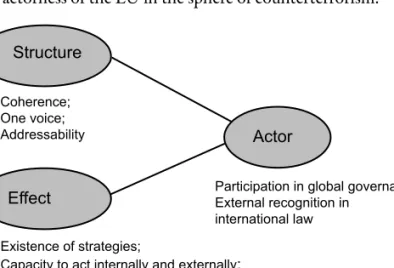
On the question of whether the EU is indeed an actor, especially in the field of security, one must first look at the concept of actorness in IR. The concept was slightly simplified with the next edition of The European Union as a Global Actor (the five criteria above were summarized under 'presence', 'the ability to formulate policies' and the 'availability of policy instruments') and it was now used to describe the EU as an actor in more than one policy dimension (Bretherton and Vogler 2005). The concept will be used to test for actorness of the EU in the field of counter-terrorism.
In the examples available worldwide, the EU is certainly the most state-like region. The two permanent members of the UN Security Council – the United Kingdom and France – showed a strong interest in avoiding the issue outside the UN, and especially within the EU. While Poland and other countries supported the US, France used the EU to 'balance' the US.
Later, in the context of the conflicts with Iran and North Korea, the EU showed less resistance to the US position, but did not. A problem for counter-terrorism 'inside' the EU is that it is not a well-defined policy area. Externally, the EU is collectively active, for example in Afghanistan, where the member states participate in the International Security Assistance Force (ISAF).
The EU strongly supports and engages in international cooperation in the fight against terrorism. Others have also argued for an EU actor role: for example, Monar (2004) described the EU as an international actor in the field of justice and home affairs (now called police and judicial cooperation in criminal matters).
EU COUNTERTERRORISM
PARTICIPATION AND CAUSES
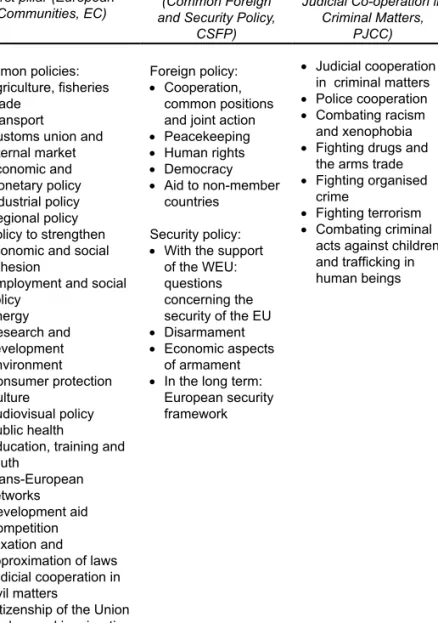
With the Maastricht Treaty, police cooperation was introduced into the common policies of the EU (Lugna 2006: 116). A general arrest warrant has been introduced in the EU, as well as a common definition of terrorism. The EU's counter-terrorism structures are very complex, and it was the task of the coordinator to rationalize them.
In the military plane, the EU is very weak compared to the US and others. Kahl (interview with the author, 2007) confirms the leading role of the US and emphasizes that the EU has relatively little competence in the fight against terrorism. Also, Singore (interview with the author, 2007) emphasizes that there was no pressure on the EU to cooperate.
On the other hand, EU strategies refer directly to the UN, which has a higher legitimacy than the US. Responses to terrorism differ from those in the US because terrorism in the EU is understood more as a crime than a military problem. While terrorism is lower on the agenda in the EU than in the US, as he claims, the threat.
Moreover, terrorism is mentioned in the EU Security Strategy as one of the five most important threats facing the EU. Even though the US is clearly dominant, the EU seems to be a strong collective actor in the field of counter-terrorism.
ASEAN COUNTERTERRORISM
PARTICIPATION AND CAUSES 25
Plus Three' states (China, Japan and the Republic of Korea) in the GWOT were considered. Due to the rise of terrorism in Southeast Asia, the US after 9/11 declared the region as the 'second front' in the GWOT. Regional programs were to be established to increase capacity in the fight against terrorism.
ASEAN's role at the international level in the fight against terrorism is expected to be strengthened, as is regional and international cooperation (ASEAN Secretariat 2001c). As part of the intervention in Iraq, Thailand participated in joint military exercises with the United States. ASEAN is a project of the urban elite in the capitals (Liow, interview with the author, 2006).
Singh concludes that in economic terms the US is no longer the only actor in the region. The United States is not in a position to control' (Nathan, interview with the author, 2006). Even the military presence of the US in the region is not considered a threat.
He also states that the US must be sensitive in dealing with cultural conditions in the region. Nathan argues that the perception of the terrorist threat, relations with the US and participation in the GWOT are interdependent.

THE GLOBAL GOVERNANCE OF COUNTERTERRORISM 28
Under 'next steps', it is claimed that: 'In the short term, the fight [against terrorism]. This new paper first describes the successes in the GWOT and the phenomenon of terrorism itself. Also, the bombings in the framework of the war in Afghanistan, which caused many civilian deaths, have been criticized by these organizations.
In this context coercion was used by the US, as will be explained in the next chapter. In the field of international aviation security, it has participated in the Aviation Security (AVSEC) panel of the International Civil Aviation Organization (ICAO) (United States Consulate General to Hong Kong and Macau n.d.). A number of the suspected hijackers were trained as pilots in the United States (US Department of Justice 2001).
The US administration saw the country exposed to a "terrorist wave" after 9/11; and terrorism was understood to be present in the US as well. It also again called on countries to cooperate in the fight against terrorism (United Nations Security Council 2009). The rhetoric of the main powers in the Security Council and the General Assembly can be described as very idealistic.
The United States only became active in the wake of the attacks on the American embassies in East Africa. GA, especially in the 1970s and 1980s, was a strong supporter of the argument that the root causes of terrorism needed to be addressed in order to counter it. Regarding influence at the United Nations in general, Millar stated that the pressure the United States exerts in counterterrorism is usually through bilateral capacity building.
In general, the US is thought to have a large influence on the UN, even through its (still) strong contribution to the organization's budget (22 percent, according to McCaleb 2001).
HEGEMONIC GOVERNANCE
POWER AND HIERARCHY IN GLOBAL GOVERNANCE
In the following, therefore, hegemony will be understood as the exercise of power by a superior actor in the international system, and moreover as implicitly based on consensus. US hegemony contributed to world order by countering the enemies of Cold War capitalism through containment, rebuilt postwar Europe by providing financial aid through the Marshall Plan, stabilized Asia, and aided prosperity in the. His argument, that there is unipolarity (which he defends), but not hegemony, is based on the observation that the 'dominant capability' of the US is.
Structural features refer to the hegemon's position in the world system, and given the common use of the term in the literature, hegemony is clearly based on unipolarity (within a specific regional framework or even the entire international system). A hegemon must be willing to make short-term sacrifices in order to achieve long-term gains. However, in relation to the current international system, we find an obvious anomaly: it is often characterized by "unipolarity" (McInerney 2002; Ikenberry Brooks and Wohlforth meaning that there is only one dominant power in the entire system (i.e. the US) with no major challengers.
Only the EU member states together achieve an equal economic power to the USA (Central Intelligence Agency 2009), but not so in the military field. In the following, American power is measured in Waltz's dimensions over the period observed in this study (2001-8). American industry produces 27 percent of the global total, equal to the sum of that produced by the three next largest economies (Japan, Germany, and France) combined; 59 of the world's 100 largest companies are based in the USA (compared to 31 in Europe and seven in Japan), and 219 of the largest 500 (compared to 158 in Europe and 77 in Japan, Nye 2003: 162 ).
US foreign investment and foreign investment in the US are double the comparable figures for the next largest country, the United Kingdom. US per capita income, based on GDP, is about 30 percent higher than the average of the traditional 15 member states of the European Union” (Julius 2005: 17).