The fourth and most significant indication is an increase in the intellectual and empirical depth of recent work on entrepreneurial entrepreneurship among academics. Innovation and Business Entrepreneurship 3 purpose of this seventh part in the series Progress in Entrepreneurship, Business Emergence and Growth.
For the rest of the book, we'll switch gears and focus on connections to earlier parts of this series. First, in Chapter 8 we continue our discussion of the distinctive domain of entrepreneurship previously offered by Venkat (Venkataraman, 1997) and Per (Davidsson, 2003).
CORPORATE ENTREPRENEURSHIP BEHAVIOR AMONG MANAGERS
A REVIEW OF THEORY, RESEARCH, AND PRACTICE
INTRODUCTION
Corporate entrepreneurship (CE) and the behavior through which it is practiced has been initiated in organizations established for a variety of purposes, including those of profitability (Vozikis et al., 1999; Zahra, 1993), strategic renewal (Guth .. amp; Ginsberg, 1990), innovativeness (Baden-Fuller, 1995), gaining knowledge to develop future revenue streams (McGrath, Venkataraman & MacMillan, 1994), international success (Birkinshaw, 1997) and effective configuration of resources as the toward developing competitive advantages (Borch, Huse. We review empirical and conceptual research that validates many components of the model and describe the results of a corporate entrepreneurship strategy at a Fortune 500 company that emphasizes many components of the model.
CORPORATE ENTREPRENEURSHIP AND THE ROLE OF MANAGERS
The strategic role of middle managers focuses on the effective communication of information between the company's two internal managerial stakeholders (top-level managers and operational-level managers). The strategic role of operational-level managers is to respond to information obtained from outside the firm, while also responding to the communication of information by managers based on decisions made by top-level managers (Floyd & Lane, 2000).
A MODEL OF MANAGERS’ CORPORATE ENTREPRENEURIAL BEHAVIOR
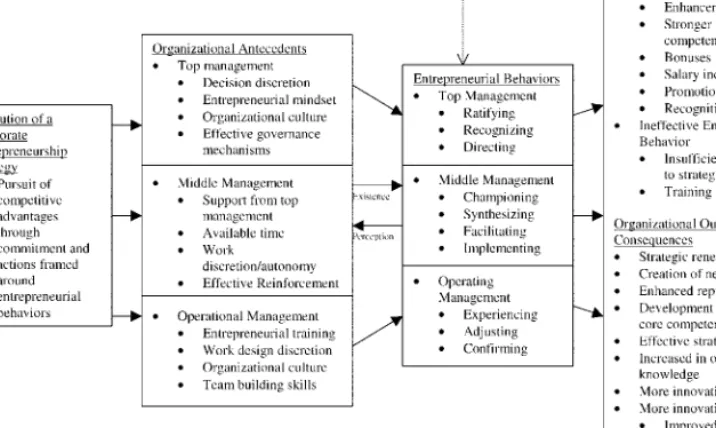
Corporate entrepreneurial behavior among managers 13 increases understanding of the drivers of a CE strategy as well as the antecedents that lead managers to engage in entrepreneurial behavior and subsequently whether or not to support that behavior. Effective entrepreneurial behavior on the part of managers is a necessary step in achieving the objective the firm seeks (eg, innovation, renewal, and so on) when engaging in corporate entrepreneurship.
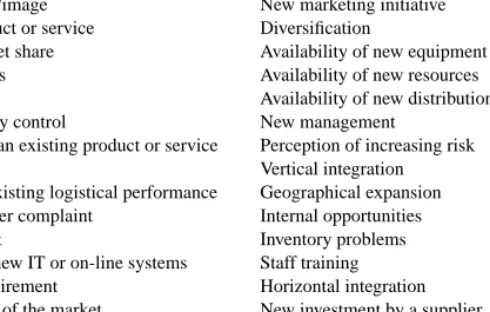
PRECIPITATING EVENTS (TRIGGERS)
Meyer (1982) developed a model of the antecedents, dynamics and consequences of organizational adaptations to significant changes (or shocks) in the firm's external environment. Meyer's (1982) model incorporates the stimulus-response paradigm and the variation-selection-retention mechanism (Weick, 1976) by proposing that when shocks appear in firms' external environment, organizations select and interpret stimuli according to theories of action (Argyris , 1976), which are encoded in prevailing strategies and ideologies (Miles & Snow, 1978). While conditions in the company's internal environment can also stimulate the use of CE, our focus is on triggers from the external environment.
CORPORATE ENTREPRENEURSHIP STRATEGY
Today's decision makers increasingly interpret environmental triggers as requiring the design and application of corporate entrepreneurship as the core of a firm's strategic adaptation efforts. However, this focus does not mean that we do not recognize the importance of autonomous strategic behavior for the successful use of corporate entrepreneurial action.
ORGANIZATIONAL ANTECEDENTS
Top managers must therefore verify whether there are organizational antecedents that will elicit and support value-creating entrepreneurial behavior (in the form of autonomous strategic behavior) on the part of managers. The results of the study's factor analyzes suggested that there are five stable antecedents of managers' entrepreneurial behavior.
ENTREPRENEURIAL BEHAVIOR
When acting entrepreneurially, first-level managers experiment (learn and improve), adjust and adapt (respond to the challenges posed by pursuing entrepreneurial opportunities and engage in entrepreneurial behaviors necessary to do so), and conform ( serve others loyally while they a corporate entrepreneurship strategy) (Floyd & Lane, 2000). To successfully engage in these entrepreneurial behaviors, middle managers foster (nurturing and advocating), synthesizing (categorizing and selling issues to others), facilitating (sharing information and directing adaptive behavior) and implementing (motivating and inspiring, revising and adapting) (Floyd & Lane, 2000).
ENTREPRENEURIAL OUTCOMES AND CONSEQUENCES
One outcome in the model is the manager's perception that the results of entrepreneurial behavior will meet or exceed expectations. It is proposed that the manager enters the process with expectations of the external and internal outcomes that will result from the initiation of entrepreneurial behavior.
EXPERIENCE FROM A CORPORATE ENTREPRENEURSHIP STRATEGY
Rewards/reinforcement were related to overall satisfaction, use of raises, and recognition of time for new ideas. The business strategy of Acordia, Inc. was a success, with entrepreneurial actions being applied across all Acordia companies.
CONCLUSION/DISCUSSION
Which outcomes (either behavioral or financial) account for the most variance when the organization evaluates whether corporate entrepreneurship as a strategy should continue or not. An empirical comparison between objective and subjective measures of the scope of product innovation of corporate entrepreneurship.
CENTRAL PROBLEMS IN MANAGING CORPORATE
ENTREPRENEURSHIP
Central Problems in the Management of Corporate Innovation and Entrepreneurship 49 new ideas in good currency; (3) a structural problem of managing relationships;. As previously mentioned, mobilizing external relations to build an industrial infrastructure for entrepreneurship is a central problem of CE.
THE HUMAN PROBLEM – MANAGING ATTENTION
The limitations posed by mental models based on established technologies and companies are exacerbated under conditions of discontinuous environmental change. Barr, Stimpert, and Huff (1992) argue that when faced with discontinuous changes in the environment, managers' mental models must change to develop effective methods of dealing with these changes.
THE PROCESS PROBLEM – IMPLEMENTING IDEAS INTO GOOD CURRENCY
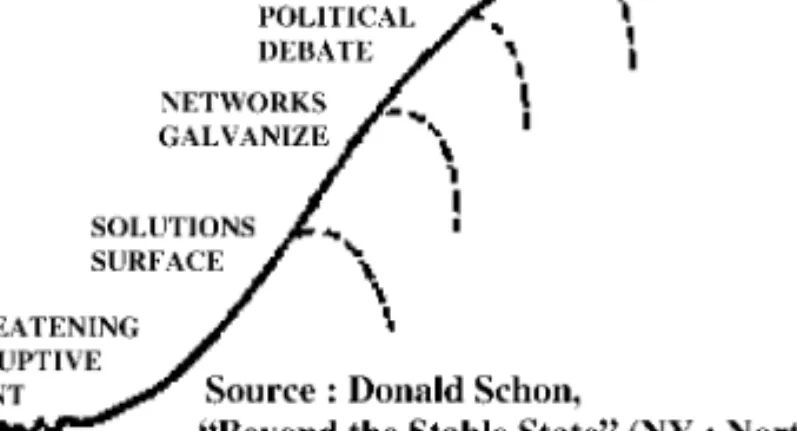
Schon's (1971) description of the emergence and industrialization of public policy illustrates the sociopolitical process of converting and converting innovative ideas into good currency. Figure 1 illustrates the process. Schon's description of the stages at which ideas become institutionalized is instructive because of its focus on the sociopolitical dynamics of the innovation process.
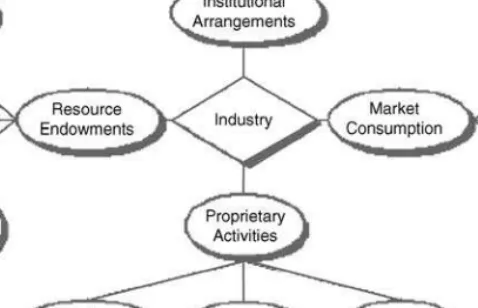
THE STRUCTURE PROBLEM – BUILDING THE INFRASTRUCTURE FOR ENTREPRENEURSHIP
As a result, the technological designs of the first movers often do not become the dominant design that ultimately yields the greatest profits. And followers, who are observing the practice of the first mover, can make adjustments to their technologies.
THE LEADERSHIP PROBLEM – BALANCING PLURALISTIC INTERESTS
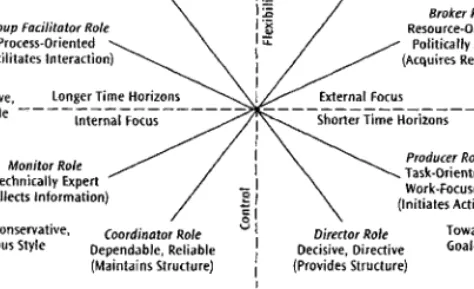
But the search for leaders can divert our attention from a deeper need—the need to understand why it is that these institutions find it so difficult to evolve in the first place. The price we pay is incalculable: institutions that go from crisis to crisis, constantly stressing the members of those institutions...the belief that ordinary people are powerless to change things - only mythical leaders have such power (Senge, 1994 , p. 2).
CONCLUSION
Left to their own devices, they will design impeccable microstructures for the innovation process that often result in macro-nonsense. The running-in-packs metaphor has been proposed for designing the innovation process in such a way that individual organizations collaborate with other organizations, industries and nations as no actor has sufficient resources, competences or legitimacy to do it alone.
ACKNOWLEDGMENTS
Crisis and the content of managerial communications: A study of the focus of attention of top managers in surviving and failing firms. Science as process: An evolutionary account of the social and conceptual development of science.
THE RELEVANCE OF THEORIES OF CHANGE FOR CORPORATE
ENTREPRENEURSHIP SCHOLARS
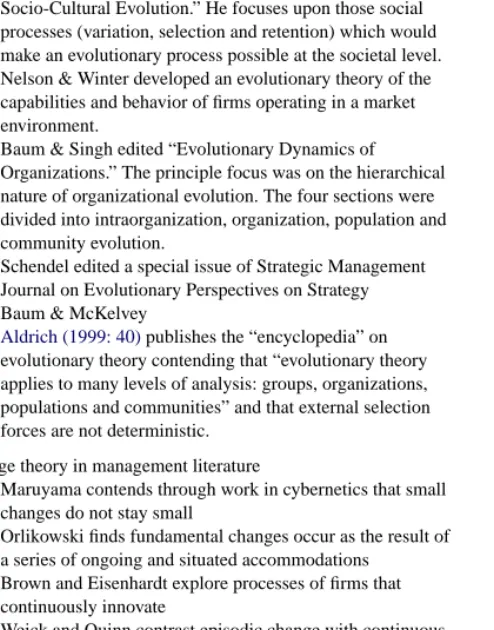
Behind each of these theories are different views on the role of the environment, the organization, management and individual members of the organization. This chapter begins with a discussion of the relationship between organizational change and corporate entrepreneurship, followed by a section on each of the theoretical perspectives.
ORGANIZATIONAL CHANGE AND CORPORATE ENTREPRENEURSHIP
Each of the change theories discussed in this chapter will be explored through historical development (original thinkers, fields of study, and influential research that brought the theories to the organization), level of analysis, time frame, agents of change, contributions to corporate entrepreneurship, and finally future research questions suggested by each of the important theories. In each of the three types of corporate entrepreneurial changes listed above (corporate venture, transformation and development of entrepreneurial.
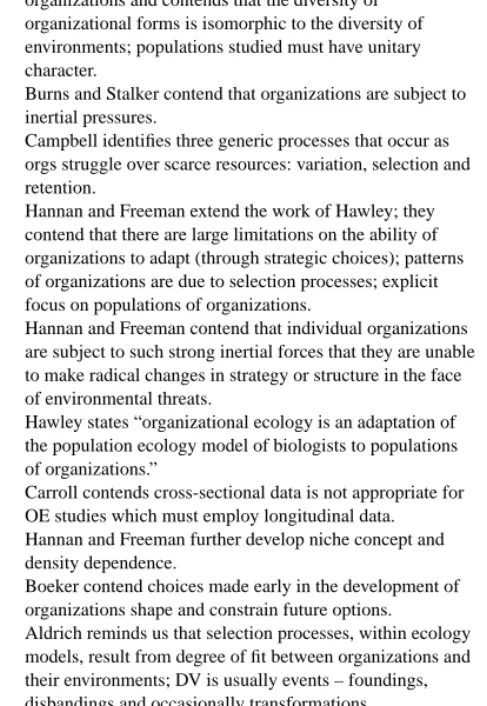
ORGANIZATIONAL ECOLOGY
1988 Hawley states that "organizational ecology is an adaptation of biologists' population ecology model to populations of organizations." Further development of the construct will make it possible to better empirically test the relationship between absorptive capacity and firm survival.
EVOLUTIONARY THEORY
Each of the three areas mentioned above discusses important areas of research within OE and the entrepreneurial firm. Population ecologists view the process of variation as one that occurred at the birth of the organization, with variation being introduced by new organizations.
CONTINUOUS CHANGE
On the contrary, researchers are quick to point out that ongoing change is cumulative and substantial. In the continuous change view, organizations change through both reactive and proactive adjustments led by individuals within the organization.
COGNITIVE THEORY
In the area of decision making and choice, two important research questions emerge for corporate entrepreneurship. In the field of culture, an important area of research is how organizations should develop an entrepreneurial culture.
DISCUSSION
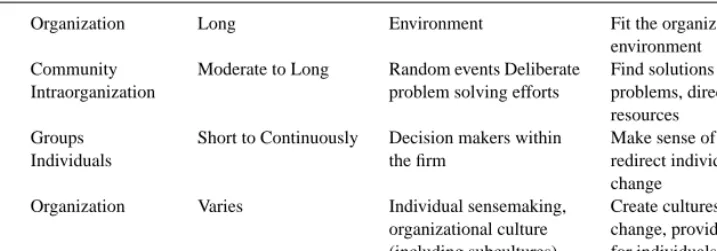
From the point of view of OE, the role of the entrepreneur is to adapt the organization to the environment. In the perspective of constant changes, the role of the entrepreneur is to make sense of his environment and redirect individuals and implement changes in the environment.
EQUIFINALITY, CORPORATE ENTREPRENEURSHIP AND
PERFORMANCE RELATIONSHIPS
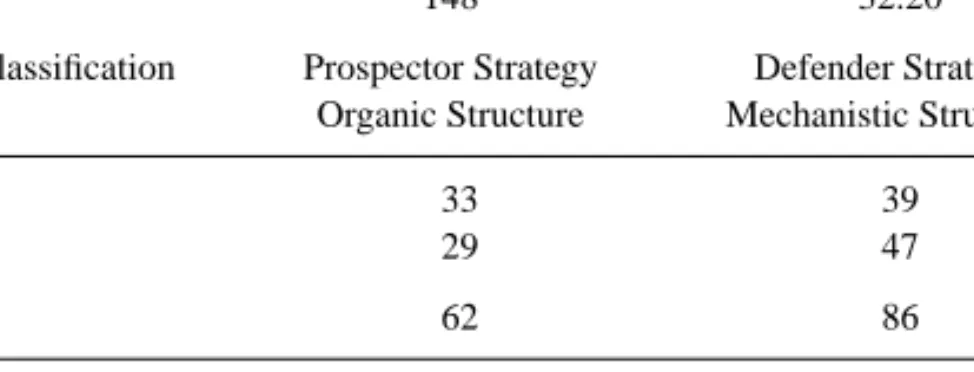
To investigate the relationship between strategy-structure-performance and corporate entrepreneurship, we used the notion of equivalence and explored 148 U.S. We identified corporate and non-corporate (conservative)1 electricity distributors and then reviewed their strategy-structure-performance. relationships.
THEORETICAL APPROACH AND HYPOTHESES
H2b: Performance differences measured by an earnings-to-turnover ratio will occur among entrepreneurial electrical distributors that have a defensive strategy-mechanistic structure. (c) conservative electrical distributors with a prospector-strategy-organic structure with the best strategy-structure match; and (d) conservative electrical distributors with a defense strategy–mechanistic structure that has the best strategy–structure match.

RESEARCH METHODS
H3b: Entrepreneurial electric distributors that have the best hedging strategy-mechanical structure match will have the highest performance as measured by the ratio of earnings and returns, compared to other hedging electric distributors strategy-mechanical structure. H3d: Electric conservative distributors that have the best hedging strategy-mechanistic structure match will have the highest performance as measured by an earnings-to-turnover ratio, compared to other electric conservative hedging strategy-mechanistic structure matches.
RESULTS
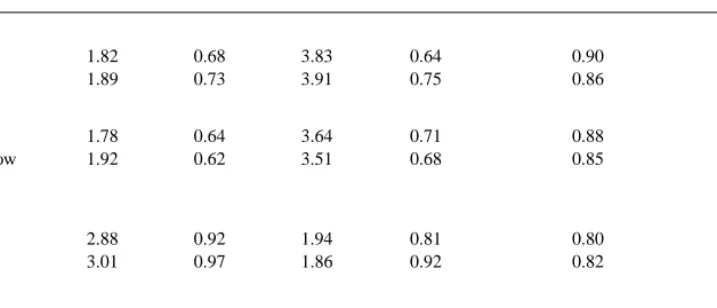
Entrepreneurial electricity distributors with the best match between strategy and defender mechanical structure will have the best performance compared to other entrepreneurial electricity distributors with a defender. Also, the electricity distributors with the best strategy structure correspond to category 2 (entrepreneurial electricity distributors with a defender strategy-mechanical structure), category 3 (conservative electricity distributors with a prospector strategy-organic structure) and category 4.
NOTES
- RESEARCH QUESTIONNAIRE USED TO MEASURE CORPORATE ENTREPRENEURSHIP
- RESEARCH QUESTIONNAIRE USED TO MEASURE ORGANIZATIONAL STRATEGY
- RESEARCH QUESTIONNAIRE USED TO MEASURE ORGANIZATIONAL STRUCTURE
- PERFORMANCE MEASURES
Business entrepreneurship in high-tech and low-tech industries: a comparison of strategic variables, strategy patterns, and performance in global markets. Integrating customer orientation, entrepreneurship and learning orientation in organizations-in-transition: an empirical investigation.
INTERNATIONAL CORPORATE ENTREPRENEURSHIP AND
ORGANIZATIONAL COMPETENCE
A KNOWLEDGE-BASED PERSPECTIVE
Our discussion of the different roles senior managers play in cultivating and exploiting knowledge from international markets fills a gap in research on the role of entrepreneurial activities in international operations. The first is examining ICE, which is a young but growing area of the literature.
INTERNATIONAL CORPORATE ENTREPRENEURSHIP (ICE)
Each stream, however, makes different assumptions about the nature of learning and has implications for our understanding of the payoff of ICE. The second contribution of the chapter is to show how ICE can create strategic value through knowledge creation and exploitation in international markets.
ICE AND ORGANIZATIONAL LEARNING
Informal ICE efforts are investigations into the future, and feedback from these experiments can shape corporate thinking about formal ICE efforts to be undertaken in international markets. The organizational learning perspective suggests that companies entering international markets can acquire a great deal of knowledge that they can use in their operations (Huber, 1991).
LEARNING THROUGH INTERNATIONALIZATION
The first is learning by doing where firms gain knowledge by addressing the various challenges associated with identifying, evaluating and exploiting opportunities in their international markets. They must remain current in order to develop the dynamic capabilities that companies need to succeed in their global markets (Eisenhardt & Martin, 2000; Teece, Pisano & . Shuen, 1997).
FOUR MODELS
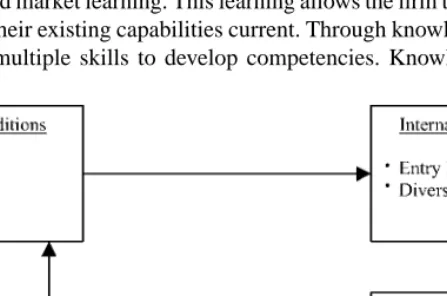
This learning allows the company to develop unique skills and keep their existing capabilities current. Locational advantages arise from the firm's ability to utilize unique resources and assets in given locations.
THE GEOPOLITICAL MOSAIC OF ICE AND ITS IMPLICATIONS FOR ORGANIZATIONAL LEARNING
International Corporate Entrepreneurship 155 technological knowledge, as found by Almeida and Kogut (1994) in their study of the USA, therefore, internationalization is motivated by the need to gain access to knowledge residing in other parts of the globe. .
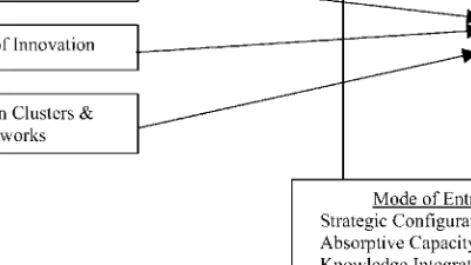
THE ROLE OF ABSORPTIVE CAPACITY
Assimilation of imported knowledge is also difficult because of the "not invented here" syndrome that makes some companies reluctant to use ideas or technologies developed elsewhere. Assimilation of incoming knowledge also requires immersion in that knowledge, and few managers have the time or incentive to do so.
KNOWLEDGE INTEGRATION AND LEARNING IN ICE
The importance of new knowledge is determined not only by time and space, but also by the creativity and ingenuity of recipient companies. While it is essential for a firm to engage in knowledge integration, how the new (i.e. combined) knowledge is viewed and exploited is very important.
VICIOUS OR VIRTUOUS ICE CYCLE: IMPLICATIONS FOR COMPETENCE DEVELOPMENT
Knowledge gained through acquisitions and mergers may be difficult to understand or even apply to the company's operations. The process of company internationalization – A model of developing knowledge and increasing commitment to foreign markets.

INTERNATIONALIZING CORPORATE ENTREPRENEURSHIP: THE
IMPACT ON GLOBAL HR MANAGEMENT
The initial research on corporate entrepreneurship that emerged in the last two decades focused on new business ventures, ie. scholars have repeatedly recognized the important role effective human resource management (HRM) plays in successful corporate entrepreneurship (e.g., Kanter MacMillan, 1987; Stevenson & Jarillo, 1990), including both formal.
INTERNATIONAL CORPORATE ENTREPRENEURSHIP DEFINED
By combining the definitions of corporate and international entrepreneurship, a definition of international corporate entrepreneurship arises: International corporate entrepreneurship is entrepreneurial activities and orientations within an existing organization with a focus on conducting business across national borders. An organization can develop and promote international business entrepreneurship by focusing on some key organizational elements presented below.
ORGANIZATIONAL ELEMENTS IMPORTANT FOR DEVELOPMENT OF INTERNATIONAL
CORPORATE ENTREPRENEURSHIP
Organizational support for entrepreneurship was found to be the most important element for the development of corporate entrepreneurship (Antoncic & Hisrich, 2001). Management involvement (Merrifield, 1993), as well as top management support, commitment and style, as well as staffing and rewarding entrepreneurial activities (MacMillan, 1986) were important to corporate entrepreneurship.

HUMAN RESOURCE MANAGEMENT ISSUES
This suggests several aspects of an organization's human resource system that are essential for successful international entrepreneurship. Recruiting individuals with the right skills for international entrepreneurship alone is not enough; additional global training and knowledge transfer skills should also be promoted through global HR practices.
CONCLUSIONS AND IMPLICATIONS
In the United States, blue-collar jobs declined from 40% of the workforce at the end of World War II to 27% today. It is hoped that this chapter on the subject will bring attention to the subject and illustrate its ever-increasing importance in today's dynamic market and in the future.