6120123,4:31 AM Universitas Mulawarman Mail - USSER] Editor Decision
Nurlaili Nurlaili <[email protected]>
IJSSERI Editor Decision
1 message
Bulent Tarman <[email protected]>
To: nurlaili@fkip. unmul.ac.id
Fri, Mar 24,2023 at4:22 AM
Nurlaili Nurlaili:
We have reached a decision regarding your submission to Journal of Social Studies Education Research, "Measuring the Competitive-High Quality Graders of Vocational School with Leadership Style: A Case Study in Samarinda".
Our decision is: "Revisions Required"
Please see the comments of the reviewers given below and revise your manuscript accordingly. Please also address each of the reviewer's comments point by point in a cover letter upon resubmission. Proofreading the whole paper and removing spelling and grammar mistakes is necessary. Make sure to Proof-edited by a native English language specialist" Please revise your manuscript in 10 days and upload it through the online management system of the journal and please confirm your recipient of this message.
Regards,
Dr. Bulent Tarman Editor-in-Chief,
Journal of Social Studies Education Research [email protected]
ReviewerA:
Relevance of the title with content:
Yes
Type of manuscript (Research, Lit. review etc.):
Research
Quality of the work:
Good
Theoretical Framework:
Properly defined
Objectives and Rationale:
properly defined Method:
Good and comprehensive Findings:
Fit to design and data analysis, implication, and limitation already provided Conclusion:
proper to results; suggestions for future research are added smoothness:
already edited by native, good Originality:
good
Note for Author/s:
Check the galleys before publishing
6120123,4:31 AM Universitas Mulawarman Mail - [JSSER] Editor Decision
Reviewer B:
Please address the following corrections/suggestions to make this article better for publication.
1-lnclude novelty of the research into the study.
2-Results must be clearly explained and discussion section needs alignment with the previous research, 3- Expand the references with current research studies
4- Make sure to use the latest version of APA (7th edition) throughout the paper.
$
4899-13979-1-RV.docx 365KI
Revision list of the article: Measuring the Competitive-High Quality Graders of Vocational School with Leadership Style: A Case Study in Samarinda
No Points to revise considering reviewers suggestions Actions REVIEWER A
1 Add the references from OpenED Network journal Citation is made 4 sources 2 Statistical procedures be checked Statistical procedures have
been adjusted & revised 3 Send to the native expert editing to improve your
academic English
Academic English has been revised through trackchanges
& clean version editing 4 Research methods be improved to make all aspects
proper
Adjustment to the methods sections are made
REVIEWER B
1 Include novelty of the research into the study Novelty has been defined in the implication section 2 Results must be clearly explained and discussion
section needs alignment with the previous research
Results have been modified 3 Expand the references with current research studies References have been added 4 Make sure to use the latest version of APA (7th
edition) throughout the paper
APA (7th edition) has been implemented thoroughly
Measuring the Competitive-High Quality Graders of Vocational School with Leadership Style: A Case Study in Samarinda
Abstract
The purpose of this study is to examine whether vocational graduate competitive advantage is associated with servant leadership, participative leadership, democratic leadership, and graduate competence. It also aims to examine the extent to which graduate competency acts as a moderator. A structural equation modeling (SEM) is used to analyze the study data. The study adopted the quantitative survey design to examine responses from school principals, staff, teachers, and students at a vocational school in Samarinda, East Kalimantan, Indonesia. The study results show that servant leadership and participative leadership positively and significantly affect vocational graduates' competitive advantage. Graduate competence strengthens the relationship between leadership styles (serving, participatory, and democratic leadership) and vocational graduate competitive advantage.
These findings revealed that the competitiveness of vocational school graduates in East Kalimantan can achieve optimal results if vocational school leaders are able to anticipate and track organizational changes through their authority to build structures, people, technology, and mechanisms that can create a new and more productive culture. Such findings could help Indonesian policymakers increase vocational school graduates with a competitive advantage to compete in the industrial world.
Keywords: leadership style, competence of graduate, vocational graduate competitive advantage
Introduction
Education must pay close attention to high moral and spiritual ethics to fully embody the vision and goal of education (Wibowo, 2016). It is necessary to produce competitive human development resources (Zakaria et al., 2022). In this case, the systematic improvement of
every aspect of education, including the quality and equitable distribution of teachers, improved curricula, learning resources, adequate facilities and infrastructure, a supportive learning environment, and central and local government policies, has an impact on educational quality (Endaryono et al., 2021). It requires a leader who comprehends the organization's approach to achieving these objectives and can encourage people or subordinates to work at their highest potential (Sinha & Hanuscin, 2017).
Leadership is an essential part of an organization that guides the organization through the management and governance of transformation so that the presence of a leader has a positive impact on organizational growth (Sihite & Saleh, 2019). Leaders can also be defined as exerting influence over other individuals or groups regardless of their natural shape (Madiistriyatno, 2020; Qurnain, 2020). In other words, the achievement of an organization's goals greatly depends on the leadership style employed (Prasetyono & Ramdayana, 2020).
Leadership styles also evolved from the servant (Bakry & Syamril, 2021; Rizal, 2019; Salam
& Kewo, 2017; Waruwu, 2021), participative (Ade, 2018; Alina & Umar, 2022; Azis, 2017), and democratic leadership (Devi & Subiyantoro, 2021; Raupu et al., 2021; Setyaningsih, 2019; Zakaria et al., 2022). As is well known, the daytime power of vocational high school graduates in Indonesia is very low because the current curriculum is not more industry oriented. Teachers with practitioner background have not been employed appropriately.
Likewise, there is not much cooperation between schools and industry (Prasetyono &
Ramdayana, 2020; Rapoport & Demir, 2022)).
It is as if the industry is running away from the vocational high schools, and the school is trying to catch up with these various lags, but it has never been achieved (Prabowo, 2022). As a result, many vocational high school graduates are unemployed because they have less than the minimum qualification required by the company. The low competitiveness of vocational high school students is also due to the fact that schools have not chosen the right apprenticeship places for students so far. Students find internship locations based solely on the introduction of Waruwu (2021). As a result, students do not receive challenges in accordance with the skills program learned in class (Raupu et al., 2021; Greasley &
Bocârnea, 2014; Zakaria et al., 2022). Students do completely different things than they do in school and they do not know the progression of theoretical skills learned in class not know the progression of the theoretical skills learned in the classroom after completing the internship (Devi & Subiyantoro, 2021). Supposedly, schools choose internship locations, and students are placed in sections or sub-sections that are suitable for the student's specialization program. Schools that give students the freedom to choose their own internship places
should be stopped (Bakry & Syamril, 2021; Rizal, 2019; Salam & Kewo, 2017). Students who are not placed in accordance with their specialization programs must be immediately withdrawn to school to be transferred to another internship place suitable for their specialization programs. This is where school principals play an important role in formulating appropriate policies so that the competence and competitiveness of post-apprentice students can increase considerably (Alina & Umar, 2022).
The school principal should be able to participate and conduct the planning, organizing, implementation and evaluation activities, when implementing the apprenticeship program for the students. Evaluation of the apprenticeship program should be performed after the completion of the apprenticeship to school. However, it must be also conducted while students are still in the field with the hope that when various obstacles and problems interfere with the implementation of apprenticeship practices, they can be addressed and followed up immediately (Ade, 2018; Aziz, 2017).
Research Questions
To guide the research process, the following 6 research questions are sought:
1) Does servant leadership relate to vocational graduate competitive advantage?
2) Does participative leadership relate to vocational graduate competitive advantage?
3) Does democratic leadership relate to graduate competitive advantage?
4) Does graduates' competence in servant leadership and professional graduate competitive advantage have moderate correlation?
5) Does graduate competence in participatory leadership and professional graduate competitive advantage have moderate correlation?
6) Does graduate qualification in democratic leadership and professional graduate competitive advantage have moderate correlation?
Hypothesis
H1: Servant leadership relates to vocational graduate competitive advantage H2: Participative leadership relates to vocational graduate competitive advantage H3: Democratic leadership relates to graduate competitive advantage
H4: Graduates' competence in servant leadership and professional graduate competitive advantage have a moderate correlation
H5: Graduate competence in participatory leadership and professional graduate competitive advantage have a moderate correlation
H6: Graduate qualification in democratic leadership and professional graduate competitive advantage have a moderate correlation
Literature Review
Servant Leadership and Vocational Graduate Competitive Advantage
Servant leadership is where leaders and followers collaborate to achieve the organization’s objectives (Irving, 2004; Oktavia & Devie, 2014). Meanwhile, Wong & Page (2003) described leaders adopting servant leadership as those who seek growth and prosperity for the benefit of others to achieve common objectives. According to Greasley & Bocârnea (2014), servant leadership has 10 characteristics: 1) Paying close attention to others; 2) Attempting to understand colleagues and being capable of empathizing with others; 3) Capable of causing emotional healing 4) Awareness to comprehend emerging issues; 5.) Viewing the situation from a neutral standpoint; 6) Persuading others instead of coercing them; 7) Having visionary and comprehensive approach in interrelated components lessons; 8) Current reality and potential future outcomes of decisions, 9) Openness, and 10) Commitment to the advancement and building of communities.
The systematic and positive influence of a principal will provide positive vibes to encourage and improve teacher school-based performance. As a result, the exercise of servant leadership is evident in its impact on teacher quality and graduate competitiveness (Bakry & Syamril, 2021; Zhang et al., 2012). Meanwhile, servant leadership is where the leader and followers have a mutual relationship.
Initially, the leader appears to be a party trying to serve the requirements of the followers. It eventually enables a leader to gain recognition and respect (Hutabarat et al., 2021; Kineman
& Poli, 2014; Zhang et al., 2012). In other words, it shows tremendous servant leadership characteristics and offers the community the chance for to learn the acceptable behaviors that people experience for quality service (Koyuncu et al., 2014). Therefore, the study hypotheses are as follows:
H1: Servant leadership are related to vocational graduate competitive advantage
Participative Leadership and Vocational Graduate Competitive Advantage
Expected organizational goals, namely producing competent and competitive graduates, will be met with a quality education process supported by corporate governance and reflective quality that includes participative leadership capabilities (Kusuma, 2012). As the primary precondition for school administration, the principal is accountable for developing plans or
making improvements and creating effective teaching systems in schools through participative leadership (Juniawati, 2017).
According to Yukl (2015), participative leadership entails various elements, including deliberation, collaborative decision-making, delegation of authority, decentralization (centered on superiors), participation, and representative democracy management.
Meanwhile, Kompri (2015) defined participative leaders as those who believe that the most effective method for motivating individuals is to engage them in decision-making processes by instilling a sense of connection to goals and shared objectives. Therefore, the hypothesis proposed in this study is as follows:
H2: Participative leadership is related to vocational graduate competitive advantage
Democratic Leadership and Vocational Graduate Competitive Advantage
Democratic leadership is effective, evolving, and guided leadership (Rachman, 2017), distinguished by a framework whose advancement is based on collaborative working decision-making (Jamaluddin et al., 2017), by distributing operational procedures in a systematic and responsible way (Bagyo, 2013; Qurnain, 2020). Furthermore, Qurnain (2020) assessed that a successful leader can efficiently perform managerial functions to accomplish organizational objectives and provide motivation to staff through grade increases, which can also improve performance. In developing and establishing a sophisticated spirit of competitive advantage, students require a figure who can guide them to achieve a goal.
There is a need for a leadership style led by top management using the principles of democracy, which can be achieved by having democratic leaders (Afifandasari &
Subiyantoro, 2022; Sanjani, 2019). Suppose there are problems with other leadership style models. In that case, the impact of adopting a positive leadership style is increased by increasing the competence of leadership elements, program evaluation is carried out objectively and continuously, and innovative leadership model ideas are provided (Endaryono et al., 2021). Thus, the hypothesis proposed in this study is as follows:
H3: Democratic leadership is related to graduate competitive advantage
Competence of Graduates as a Moderator
Competitiveness is defined as an individual's ability of an attempt to gain advantage over how another individual or organization acts in a competitive market that provides the same goods or services and where organizations have the capacity, performance, skill, or
accomplishments to improve customer service, quick performance or more important than another individual or organization (Sutrisno & Cokro, 2018).
Vocational high school graduates perform a role in responding to the requirements of the job market as a middle-level workplace; in addition to mastering in subject matter competencies, they should also be able to engage in personality to be successful now and in the future following the requirements of the instances (Wibowo, 2016). Also, vocational education contributes considerably to economic competitiveness and prosperity in a global knowledge- based economy (Hrmo et al., 2016).
It is critical to pay attention to the needs of the labor market and collaborate among implementing agencies (Perdana, 2019). Career planning programs that are constantly developing both during the learning system and after students graduate (Misbahudin &
Asmaul, 2022; Enright & Toledo, 2023).
The competence of graduates should be capable of working on their competencies as skilled intermediaries in the industry and as having perceptions, insight, skills, knowledge, and experience that someone who has gone through a learning system run by an academic institution possesses (Binawan, 2023; Andayani 2021; Hariyani & Roesminingsih, 2019).
They should also be ready to grow mentally in addition to basic abilities to adapt to certain changes regularly (Yayuk & Sugiyono, 2019). With this requirement, vocational school graduates are requested not only to be deeply embedded in existing job types but also to be incentivized to create new positions by growing and developing their creativity and initiative (Fakhri & Yufridawati, 2014; Lestari & Pardimin, 2019).
H4: Graduates' competence in servant leadership and professional graduate competitive advantage is moderate
H5: Graduate competence in participatory leadership and professional graduate competitive advantage is moderate
H6: Graduate qualification in democratic leadership and professional graduate competitive advantage is moderate
Methods Research design
This study adopted a quantitative design, especially correlational. Based on the analysis, this research can also be categorized as descriptive verification research. Descriptive research aims to describe data from the field by looking at trends, while verification research attempts to verify hypotheses with the study data at hand.
Study Sample
The research was conducted at private vocational schools in Samarinda, East Kalimantan, Indonesia. The study population consisted of 32 schools with offices in Samarinda City Education and Culture Office. The study used purposive sampling method and the study sample consisted of teachers, employees, and students, with 10 chosen from each school so that the number of samples used was 10 people multiplied by 32. Thus, the number of the selection is 320.
Data collecting
A total of 400 questionnaires were distributed face-to-face and through the Google Forms. A total of 312 respondents returned, and valid data suitable for the analysis were 293 questionnaires.
The questionnaire includes closed-ended questions measuring respondents' views on vocational graduate competitive advantage as the dependent variable, servant, participative, and democratic leadership as independent variables and the competence of graduates as moderating variables. This study adopts four vocational graduate competitive advantage items from Dardiri (2015). Ten items for servant leadership were adopted from the study by Greasley & Bocârnea (2014). Six items for participative leadership were adopted from Yukl (2015).
Five items for democratic leadership were adopted from the study of Sanjani (2019). Ten items for the competence of graduates were adopted from the study of Andayani (2021). The researcher measured respondents' views on a five-point Likert scale from strongly disagree (1) to strongly agree (5). The researcher examined the questionnaire from October 2022 to December 2022.
Validity and Reliability
The researcher used the convergent technique to determine the indicator's validity, which was then expressed as the value of the external loading factor. It specifies that the value range of 0.50 to 0.70 for the loading factor is still enough for exploratory investigations, which are the preliminary phases of constructing a measurement scale. In this particular investigation, the external loading value of each indicator was greater than 0.70, allowing it to pass muster in terms of convergent validity. The following step evaluated a variable's discriminant validity by contrasting the extracted square root coefficient of variance (AVE) from each latent factor to the correlation coefficient between the other factors in the model. It was performed to
determine whether the variable could differentiate between groups. The AVE value suggests that it has a significance greater than 0.5. Table 3 shows that the constructs investigated in this research had a discriminant validity greater than 0.50 (Fornell & Larcker, 1981). The value of the variable indicators is determined through composite reliability in the last phase.
Results were considered reliable whenever the composite reliability and Cronbach's alpha were significantly higher than 0.70 (Chin, 2010) (Table 1). Results of validity and reliability test appear in appendix 1.
Data analysis
A structural equation modeling (SEM) using SmartPLS for data analysis and Statistical Package for Social Sciences (SPSS) were used for hypothesis testing. The author performed this to determine if the SEM test goes through the assumption test first, even though SEM with SmartPLS can be analyzed without going through the assumption test first (Ghozali, 2015).
Results
Results of this study depict two broad categories: Assumption test and hypothesis testing. The assumption test consists of normality test and multicolliearity test. Normality test aims to see whether the sample of this study is normally distributed from the population.
Multicollinearity test sees whether several independent variables in a model are correlated.
Hypothesis testing shows the results of test that see whether the statistical hypothesis of this study is accepted or rejected.
Assumption test Normality
The normality test is performed by looking at the dots on the Normal Probability Plot to see if they spread along the diagonal line. The histogram figure demonstrates the collected data with a distribution that is close to being normal and may be visualized using Kolmogorov- Smirnov test.
Table 1
Kolmogorov-Smirnov Test Result
Unstandardized residual
Information
N 293
Data is normally distributed
Normal parameters,b Mean .0021312
Std. deviation .9901281 Most extreme differences Absolute .079
Positive .079
Negative -.082
Test statistic .079
Asymp. Sig. (2-tailed) .200c,d
One-sample Kolmogorov-Smirnov test, the outcomes of data processing are derived from the Asymp value. Sig.2 (- Tailed) > 0.05. Thus, it would be safe to say that the data are normally distributed and acceptable for research (see Table 2).
Figure 2
Histogram of Regression Standard Residual
On the histogram display normal curve, the slope on the left and right sides of the almost perfect bell-shaped curve tends to be balanced (Figure 2). Then, the normality test with the P- Plot of regression standardized residual shows that the data have a normal distribution, and the regression model has met the normality assumption (Figure 3).
Figure 2
Normal P-Plot of Regression Standard Residual
Multicollinearity
The existence or absence of multicollinearity symptoms is determined by evaluating the value of the correlation matrix obtained during data processing and the VIF value and its tolerance.
Table 3
Multicollinearity, Autocorrelation, Heteroscedasticity Test Results
Model
Model 1 Model 2 Model 3 Information
tolerance VIP DW t Sig.
1 There is no multicollinearity
event
SL_X1 .135 3.136
PL_X2 .127 3.262
DL_X3 .155 5.452
CG_Z .167 7.325
2 Durbin-Watson 2.0199 There is no autocorrelation
3 Glejser test
SL_X1 .521 .316 There is no heteroscedasticity
PL_X2 .566 .329
DL_X3 .883 .415
CG_Z 1.521 .077
No variable has a tolerance value of 0.01, showing no relationship between independent variables with a value greater than 95%. The results of calculating VIF also showed that no independent variable has a VIF more significant than 10. This regression model contains no multicollinearity event between independent variables (Table 3). The autocorrelation test determines if the misleading error in time t and the misleading error in time t-1 are correlated in the linear regression model. A vital characteristic of a reliable regression model is the absence of autocorrelation. If this occurs, it is known as an autocorrelation issue. The magnitude of the Durbin-Watson table for dL = 1.563 and the magnitude of Durbin Watson for dU (inner limit) of 1.9787. The magnitude of the value of 4-dU (4-1.9787= 2.0213) and
the value of 4-dL (4-1.563= 2.437). Then 2.0213 < 2.0199 < 2.437. Therefore, there is no symptom of autocorrelation between variables.
Heteroscedasticity tests are used if the regression model's residuals are unequally distributed.
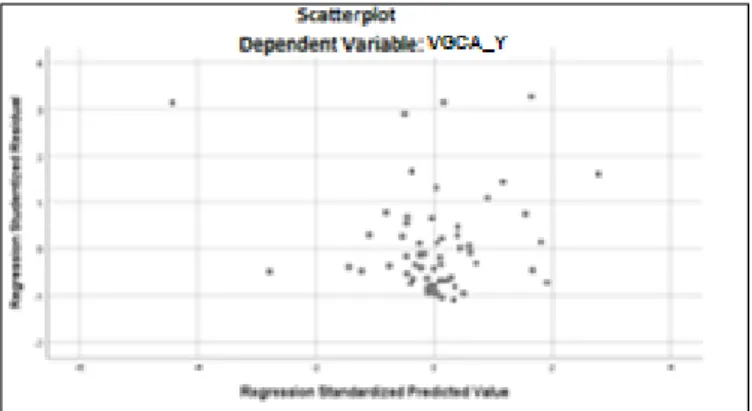
Homoscedasticity is when the residual variance remains the same between observations, while heteroscedasticity is when it changes. Homoscedasticity or no heteroscedasticity are effective regression models. This exam uses a scatter plot. Check the regression scatterplot dots for heteroscedasticity. No heteroscedasticity if it spreads randomly above and below zero on the Y-axis. Regressing the independent variables to the absolute residual value strengthens the Glejser test. The significant value of all research variables is greater than 0.05. The servant leadership variable has a significant value of 0.316, participative leadership has a significant value of 0.329, democratic leadership has a significant value of 0.415, while competence of graduates has a significant value of 0.077. Therefore, the study's results do not exhibit heteroscedasticity.
Figure 4
Heteroscedasticity
Figure 4 demonstrates that the heteroscedasticity test in the scatterplot shows that the dots are not random, form a clear or regular pattern, and are dispersed above and below Y-axis 0.
Thus, this regression model lacks heteroscedasticity.
Hypothesis Testing
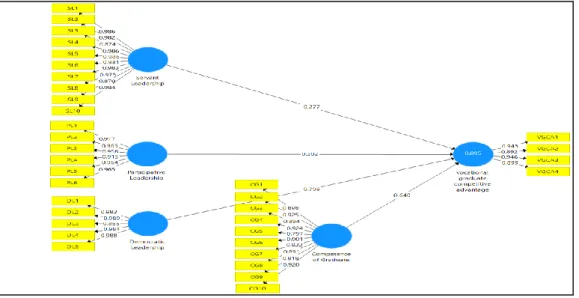
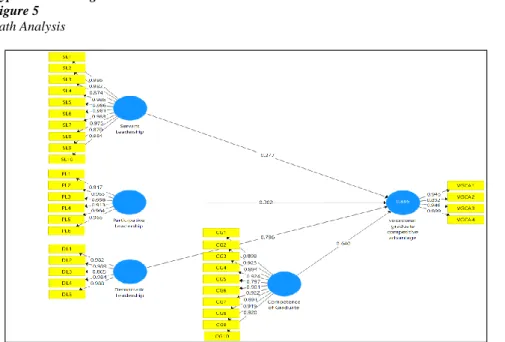
Hypothesis testing aims to see if independent variables contained in the six hypotheses of this study have significant relationship to the dependent variables. The hypothesis testing is operated using Path Analysis. In the path analysis, path coefficient evaluation performs the
strong effects of the independent variable on the dependent variable. Results of Path Analysis operated under SmartPLS appear in the following Figures.
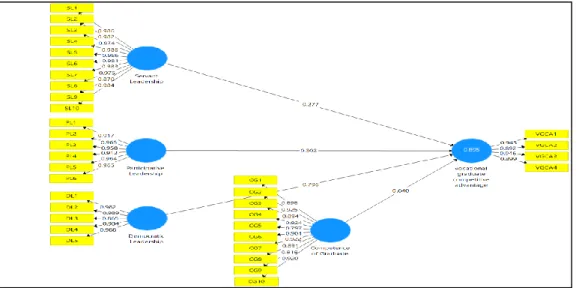
Figure 5 Path Analysis
Figure 5 illustrates the findings of data processing using SmartPLS, which show that all construct manifestations in this investigation have loading values greater than 0.70. It demonstrates that the manifest variable with a loading value greater than 0.70 satisfies convergent validity due to its high level of validity.
On the sample, each relationship is examined using a simulation based on the bootstrap approach. This test tries to reduce the incidence of anomalous research data. Test outcomes using the bootstrap approach (Figure 6).
Path coefficient evaluation is used to demonstrate the strength of the effect of the independent variable on the dependent variable. Figure 6 illustrates that the relationship between the competence of graduate and vocational graduate competitive advantage has the highest path coefficient value (14.664). Then comes the 5.859 impact of democratic leadership on vocational graduate competitive advantage. Then, the 3.152 impacts of participative leadership on vocational graduate competitive advantage. The last, 3.013 impacts of servant leadership on vocational graduate competitive advantage. Based on the above results, all variables in this model have positive path coefficients. It indicates that the effect of an independent variable on a dependent variable is proportional to its path coefficient value.
Figure 6
Bootstrapping Inner Model
Examining the p-values allows one to determine the significance level attached to accepting a hypothesis. The study hypothesis may be validated if the p-values are less than 0.05. In SmartPLS, a bootstrapping procedure is performed on a valid and trustworthy model that satisfies the feasibility requirements to get the p-value of the model. The results of bootstrapping are shown in the Table 4.
Table 4
Path Coefficient Result
Hypothesis Path Original sample
Standard deviation
T statistics P values Results
H1 SL ->
VGCA
0.277 0.273 3.013 0.000 Accepted
H2 PL ->
VGCA
0.302 0.262 3.152 0.000 Accepted
H3 DL ->
VGCA
0.796 0.136 5.859 0.000 Accepted
*) SL=Servant leadership; PL= Participative leadership; DL= Democratic Leadership; VGCA=
Vocational graduate competitive advantage
Based on the path coefficient obtained between servant leadership and vocational graduate competitive advantage of 0.277 with a p-value of 0.000 <0.05, it would be safe to say that servant leadership significantly affects vocational graduate competitive advantage. Parameter coefficients with positive values show that the greater the servant leadership, the greater the effectiveness of the school; then H1 is accepted. It is known that the correlation between participative leadership and vocational graduate competitive advantage is 0.302 with a p- value of 0.000 <0.05, so it can be concluded that there is a significant relationship between the two; therefore, H2 is supported. In addition, democratic leadership can improve graduate competitive advantage, as evidenced by the original sample value of 0.796 with a statistical t- value of 5.859; the conclusion can draw that H3 is accepted.
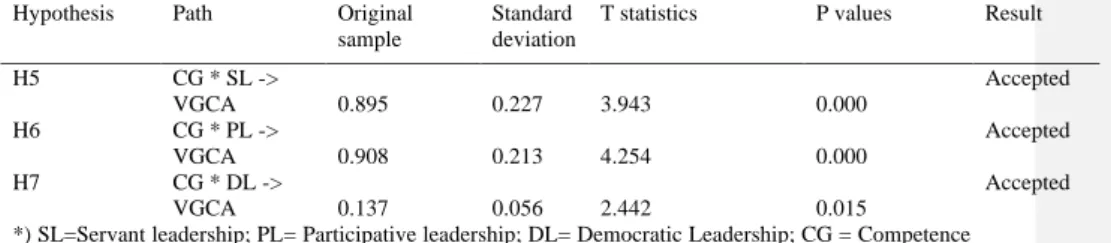
In addition, the following route coefficients are examined to determine if a graduate's competence can moderate the relationship between servant leadership, participative leadership, and vocational graduate competitive advantage (Table 5).
Table 5
Moderation Test
Hypothesis Path Original
sample
Standard deviation
T statistics P values Result
H5 CG * SL ->
VGCA 0.895 0.227 3.943 0.000
Accepted
H6 CG * PL ->
VGCA 0.908 0.213 4.254 0.000
Accepted
H7 CG * DL ->
VGCA 0.137 0.056 2.442 0.015
Accepted
*) SL=Servant leadership; PL= Participative leadership; DL= Democratic Leadership; CG = Competence of Graduate; VGCA= Vocational graduate competitive advantage
To clarify further, the moderating relationship between variables can be seen from the simple slope analysis data, as shown in Figures 7–9.
Based on Figure 7, respondents with high competence of graduates will have high-servant leadership with a vocational graduate competitive advantage and vice versa. If they have a low-competence of graduate, it will impact their low-servant leadership with graduate entrepreneurial skills. Even though the impact is minimal, as shown in the figure on the equation line. It can conclude that the graduate's competence strengthens or weakens the relationship between servant leadership and vocational graduate competitive advantage.
Figure 7
SL on VGCA and CG as Moderator
Figure 8
PL on VGCA and CG as Moderator
High competence of graduate will have a high participative leadership with a vocational graduate competitive advantage and vice versa. If they have a low-competence of graduate, it will impact their low participative leadership with graduate entrepreneurial skills. Even though the impact is minimal, as shown in the figure on the equation line (see Figure 8), it can conclude that the graduate's competence strengthens or weakens the relationship between participative leadership and vocational graduate competitive advantage.
Figure 9
DL on VGCA and CG as Moderator
Respondents with a high graduate competence will have a high democratic leadership with a vocational graduate competitive advantage and vice versa (see Figure 9). If they have a low
graduate competence, it will impact their low democratic leadership with graduates' entrepreneurial abilities. The lines of the equation that tend to change show that competence of graduate strengthens or weakens the relationship between democratic leadership and graduates' entrepreneurial skills.
Based on the moderation test, with a p-value of 3.943 > 1.96 and a significance level of 5%, SMK graduates' competence significantly affects vocational graduate competitive advantage.
As a result, graduate competencies can strengthen or weaken the relationship between servant leadership and the vocational graduate competitive advantage; thus, Hypothesis 5 is accepted.
In addition, graduate competency and participative leadership have a large relationship with the vocational graduate competitive advantage, with a p-value of 4.254 > 1.96 and a significance level of 5%. As a result, the implications of graduate competence can reduce the relationship between participative leadership and the vocational graduate competitive advantage; thusH6 can be accepted. Furthermore, graduate competence can moderate the relationship between democratic leadership and the vocational graduate competitive advantage, as evidenced by the p-value of 2.442 > 1.96; thus H7 can be accepted.
Discussion and Conclusion
Results of this study obtain that six independent variables indicate strung relationship to the dependent variable. The six independent variables consist of three independent variables, Servant leadership, Participative leadership, Democratic leadership that have direct effect to the dependent variables, that is graduate competitive advantage (Ghozali, 2015; Fornell &
Larcker, 1981). The other three are variables that have indirect impacts, namely: Graduates' competence in servant leadership and professional graduate competitive advantage, Graduate competence in participatory leadership and professional graduate competitive advantage, and Graduate qualification in democratic leadership and professional graduate competitive advantage (Binawan, 2023; Chin, 2010; Ghozali, 2015). These results imply the discussion in the following sections.
Acceptance of Hypothesis 1 means that this study emphasizes that servant leaders' quality relationships enable students to develop competencies and increase competitiveness. The characteristics of servant leaders are rooted in their desire to encourage, advise, bring hope, and provide trusting relationships by developing quality interactions with those around them (Ghozali, 2015; Enright & Toledo, 2023). Servant leadership inspires school leavers to exert more and show greater consideration for the institution and its skill-building (Fakhri &
Yufridawati, 2014; Lestari & Pardimin, 2019).
Servant leaders foster an environment where vocational school graduates feel welcome despite their failures, enabling their creative thinking and professional growth (Ghozali, 2015). Students feel more empowered to communicate, which reduces their understanding of status and authority to the point where they consider themselves equal partners in the school environment (Lestari & Pardimin, 2019). The findings of the study are based on the effect of servant leadership on the competitiveness of vocational school graduates (Bakry & Syamril, 2021).
This finding supports the findings of Zhang et al. (2012), who concluded that servant leadership can reflect the best use of a leader's strengths through a serving style and that having the character of a leader willing to ‘‘listen’’ has a sense of ‘‘empathy.’’ Lestari &
Pardimin (2019) emphasize Encouraging sharing and mutual respect is a style of leadership highly anticipated by organizational members. Thus, servant leadership characters can foster creativity and boost vocational school graduates' competitiveness (Kineman & Poli, 2014;
Zhang et al., 2012).
Regarding Hypothesis 2, the findings support Juniawati (2017) that a participative leadership style promotes two-way communication based on mutual trust. Leaders will involve other educational components (Zhang et al., 2012), such as teachers and students, in solving educational problems so that decisions follow needs and are appropriate to the problems encountered, allowing students to be more competitive when they graduate and enter the workforce (Lestari & Pardimin, 2019). Participative leadership proposes a system of deliberation with other leaders, teachers, and students. Leaders succeed when each leader understands the tasks that must complete through consultation with colleagues (Kineman &
Poli, 2014; Zhang et al., 2012). Furthermore, leaders must establish good collaborative relationships with subordinates to create a working environment in which subordinates feel safe, secure, and free to develop their ideas to achieve the set of common goals (Kineman &
Poli, 2014; Zhang et al., 2012). Principals at Samarinda vocational schools should be involved in decision-making, directly involving the school to increase students' sense of belonging to the school community.
Citizens' sense of belonging will grow, as will their sense of responsibility and dedication to their leaders. Prioritizing participatory decisions is the essence of leadership. Group leadership, as the process by which an individual influences other individuals or groups, is crucial to the development of an organization (Raupu et al., 2021; Greasley & Bocârnea, 2014). When people are organized, they need direction to achieve a goal. Thus, vocational school graduates have been shaped by a participatory environment that can boost their
competitiveness (Zakaria et al., 2022). Based on empirical findings on democratic leadership and the competitive advantage of vocational graduates (H3), these findings support Endaryono et al. (2021), showing that the leadership style of the Head of SMK in Samarinda in improving the quality of competitive graduates is democratic. Leaders always provide equal opportunities for team members to participate more actively in decision-making process (Zakaria et al., 2022). This style understands the concept of leadership and can help a person and organization work more effectively and efficiently in achieving the desired goals and conditions. Using a democratic leadership style is to learn about other people's ideas or opinions (Raupu et al., 2021; Greasley & Bocârnea, 2014).
This finding is consistent with Afifandasari & Subiyantoro's (2022) research, which shows that democratic leadership has three main characteristics: (1) Dual approaches. This characteristic differs from the autocratic model, which uses a one-way approach from subordinates as the leadership encourages discussion and deliberation (Raupu et al., 2021). A democratic leader must hear everyone's voice to make decisions. Democratic leaders make decisions based on their moral ethics, norms, and values, which influence the views of all decision-makers. (2) Encourage involvement and participation. This characteristic allows one to express thoughts, suggestions, and criticisms (Andayani 2021; Hariyani & Roesminingsih, 2019).
Participation is essential to increase productivity. In this case, group participation results in decisions made as a participative leader rather than just one person's decision. (3) Value ideas and creativity (Andayani 2021; Hariyani & Roesminingsih, 2019).
Another characteristic of democratic leadership is its reliance on ideas and creativity. In this case, the leader positions himself/herself as someone other than the most knowledgeable person and vice versa (Andayani 2021; Hariyani & Roesminingsih, 2019). The leader cannot assume that other members are inexperienced. Democratic leaders have the characteristics of honesty, bravery, intelligence, fairness, and competence and these three characteristics can be used to train students to be disciplined, improve student competency competence, instill a work mentality that allows them to easily adapt to situations in the industrial world, master managerial fields, and produce marketable products (Raupu et al., 2021; Greasley &
Bocârnea, 2014). Acceptance of hypotheses 4, 5, and 6 demonstrates that the competency of Samarinda vocational school graduates can strengthen the relationship between leadership styles (servant, participative, and democratic leadership) and vocational graduate competitive advantage (Kineman & Poli, 2014). The learning process in vocational schools requires three competence areas: cognitive, affective, and psychomotor. Human resources (HR) that can
adapt to advances in science and technology are required of vocational schools (Zhang et al., 2012).
The primary goal of the learning process in vocational schools is to produce a ready-to-work workforce by providing students with knowledge and skills that align with the competence of their respective expertise programs (Zhang et al., 2012). Vocational school graduates play a role in meeting the needs of the business world as a middle-level workforce. In addition to mastering field-specific competencies, they should also be able to engage in self-development to compete now and in the future according to the demands of the times (Andayani 2021).
Graduates of vocational schools are equipped with cognitive abilities (knowledge) and psychomotor abilities or skills (Kineman & Poli, 2014). The next domain aims to equip graduates with adaptive abilities, particularly the ability to make adjustments and self- development following existing technological and industrial developments (Greasley &
Bocârnea, 2014; Zakaria et al., 2022). The adaptive competencies provided are basic knowledge materials in the field of technology based on their respective fields (Andayani 2021; Hariyani & Roesminingsih, 2019).
To conclude, Servant leadership, Participative leadership, Democratic leadership that have direct effect to the dependent variables are direct determinant to contribute professionalism and school leadership. In addition, the indirect variables to affect competitive advantages on graduate competence lay on Graduates' competence in servant leadership and professional graduate competitive advantage, Graduate competence in participatory leadership and professional graduate competitive advantage, and Graduate qualification in democratic leadership and professional graduate competitive advantage.
Implication, Limitation, and Further Research
This study contributes to the existing literature by demonstrating the novelty that school entities adopting servant leadership, participative leadership, democratic leadership, and good graduate competencies can improve vocational graduate competitive advantage. To increase graduates' competitiveness, we recommend that vocational school leaders be able to anticipate and follow organizational changes through their authority to build structures, people, technology, and mechanisms that can create a new, more productive culture.
For schools to effectively produce competitive graduates, a leader must have at least seven main components: 1) always thinking creatively; 2) experiment with developing academic quality in a scientific, planned, and systematic manner; 3) responsive to internal and external problems; 4) capable of instilling subordinate initiative; 5) prioritizing independence and
cooperation; 6) making decisions after careful consideration; and 7) always oriented toward competition for the betterment of the school it manages. The limitations listed below should serve as a guide for future research for this study. First, a representative sample of SMKs in Samarinda, East Kalimantan, was used in the early stages of this process. As a result, further research should replicate the participation of representatives from other districts/cities to generalize the findings to other schools, both public and private vocational schools. Future research could consider using mixed methods with larger sample sizes and data triangulation with expert informants. Second, more research should investigate how servant leadership, participative leadership, democratic leadership, and graduate competencies affect vocational graduate competitive advantage.
Third, this study does not consider teacher competence, infrastructure, or other factors that may affect the competitive advantage of vocational graduates. In investigating the effect of these variables on vocational graduate competitive advantage, future research should include these indicators as control, mediating, or moderating variables, respectively. Finally, additional research is needed to determine whether the vocational graduate competitive advantage is related to servant leadership, participative leadership, democratic leadership, and graduate competence in the school environment rather than just in districts/cities and also on a provincial and national scale.
References
Ade, F. (2018). Participative leadership at SMA lab school Kebayoran Jakarta. Tasharruf:
Journal Economics and Business of Islam, 3(1).
Afifandasari, T., & Subiyantoro, S. (2022). Pengembangan Jiwa Edupreneurship Melalui Kepemimpinan Yang Demokratis Di Lembaga Pendidikan. Jurnal Eduscience, 9(1), 279–287. https://doi.org/10.36987/jes.v9i1.2638
Alina, H., & Umar, A. (2022). The influence of leadership style and motivation on the performance of teachers in senior high school state and private district Obi. Jurnal Ilmiah Wahana Pendidikan, 8(1), 461–479.
Andayani, I. (2021). Analisis Kompetensi Lulusan SMK dalam Menghadapi Dunia Kerja (Studi Kasus di Kabupaten Aceh Tamiang) Badan Pusat Statistik Aceh Tamiang pada lulusan Sekolah Menengah Kejuruan Kota Lhoksemawe menjadi Kota. JoIEM, 2(2), 19–27.
Azis, A. Q. (2017). Pengaruh Gaya Kepemimpinan Partisipatif Kepala Sekolah Dalam Teori Path-Goal Terhadap Kinerja Guru Di SMK Negeri 11 Bandung. Universitas Pendidikan Indonesia.
Bagyo, Y. (2013). Engagement as a variable to improve the relationship between leadership, organizational culture on the performance of employees. Journal of Business and Management (IOSR-JBM), 14(4), 1–8.
Bakry, B., & Syamril, S. (2021). Pengaruh servant leadership terhadap Nilai Kinerja Guru.
Jurnal Manajemen Dan Supervisi Pendidikan, 5(1), 24.
https://doi.org/10.17977/um025v5i12020p298
Binawan, L.A. (2023) New Concepts of Ecological-Social Justice: A Micro-Optic Reflection on Ecological Citizenship Education in Indonesia, Journal of Social Studies Education Research (JSSER), 13(3), 143-168. www.jsser.org
Chin, W. W. (2010). How to write up and report PLS analyses. In Handbook of Partial Least Squares (pp. 188–194).
Dardiri, A. (2015). Optimalisasi Kerjasama Praktik Kerja Industri Untuk Meningkatkan Citra Sekolah Dan Daya Saing Lulusan SMK. Jurnal Pendidikan Dan Pembelajaran (JPP), 22(2), 162–168. http://journal.um.ac.id/index.php/pendidikan-dan- pembelajaran/aticle/view/
Devi, A. D., & Subiyantoro, S. (2021). Implementation of democratic leadership style and transformational head of madrasah in improving the quality. Nidhomul Haq: Jurnal Manajemen Pendidikan Islam, 6(1), 14–26.
Endaryono, B. T., Wasliman, I., Iriantara, Y., & Sauri, U. S. (2021). Gaya Kepemimpinan Demokratis Kepala Smk Dalam Meningkatkan Mutu Lulusan Berdaya Saing Di Smk Bina Mandiri Dan Smk Karya Guna 2 Kota Bekasi. JABE (Journal of Applied Business and Economic), 7(3), 357. https://doi.org/10.30998/jabe.v7i3.9125
Enright, AE & Toledo, W. (2023). What Type of Citizen Am I? Examining the Development of Preservice Teachers’ Civic Identities, Journal of Social Studies Education Research (JSSER), 13(3), 83-109. www.jsser.org
Fakhri, E., & Yufridawati. (2014). Relevansi Kompetensi dan Tingkat Daya Saing Lulusan SMK dalam Dunia Kerja (Studi kasus pada SMK Teknik Otomotif di empat kabupaten/kota). Repositori Institusi Kementerian Pendidikan, Kebudayaan, Riset, Dan Teknologi, 1–18.
Fornell, C., & Larcker, D. F. (1981). Evaluating structural equation models with unobservable variables and measurement error. Journal of Marketing Research, 18(1), 39–50.
Ghozali, I. (2015). Partial least squares (Konsep, Teknik dan Aplikasi menggunakan Program SmartPLS 3.0). Badan Penerbit UNDIP.
Greasley, P. E., & Bocârnea, M. C. (2014). The relationship between personality type and the servant leadership characteristic of empowerment. Procedia - Social and Behavioral Sciences, 124, 11–19. https://doi.org/https://doi.org/10.1016/j.sbspro.2014.02.454
Hariyani, A., & Roesminingsih, E. (2019). Efektivitas SMK Model Terhadap Kompetensi Lulusan di Kabupaten Bangkalan. Inspirasi Manajemen Pendidikan, 7(3), 1–13.
https://core.ac.uk/display/230625482
Hrmo, R., Miština, J., & Krištofiaková, L. (2016). Improving the quality of technical and vocational education in Slovakia for European labour market needs. International Journal of Engineering Pedagogy (IJEP), 6(2), 14–22.
Hutabarat, C., Suharyono, S., Utami, H. N., & Prasetya, A. (2021). Servant leadership, business transformation, and corporate competitiveness. Journal of Asian Finance,
Economics and Business, 8(2), 1091–1099.
https://doi.org/10.13106/jafeb.2021.vol8.no2.1091
Irving, J. A. (2004). Servant leadership and the effectiveness of teams: Findings and implications. Proceedings of the 2004 Servant Leadership Research Roundtable.
Jamaluddin, J., Yunus, H., & Akib, H. (2017). Pengaruh budaya organisasi terhadap kinerja pegawai pada dinas pendidikan provinsi sulawesi selatan. Jurnal Administrare, 4(1).
Juniawati, N. (2017). Kontribusi Kepemimpinan Partisipatif Dan Supervisi Kepala Sekolah Terhadap Kinerja Mengajar Guru SD Negeri Se-Bandung Timur. Jurnal Administrasi
Pendidikan, 24(2), 121–130.
Kineman, J. J., & Poli, R. (2014). Ecological literacy leadership: Into the mind of nature. The Bulletin of the Ecological Society of America, 95(1), 30–58.
https://doi.org/https://doi.org/10.1890/0012-9623-95.1.30
Kompri. (2015). Manajemen Sekolah Orientasi Kemandirian Kepala Sekolah. Pustaka Pelajar.
Koyuncu, M., Burke, R. J., Astakhova, M., Eren, D., & Cetin, H. (2014). Servant leadership and perceptions of service quality provided by front-line service workers in hotels in Turkey: Achieving competitive advantage. International Journal of Contemporary Hospitality Management, 26(7), 1083–1099. https://doi.org/10.1108/JEA-06-2013-0067 Kusuma, M. (2012). Pengaruh Gaya Kepemimpinan Partisipatif, Kompensasi, dan Motivasi
Terhadap Kinerja Karyawan Di Sekolah Tinggi dan Politeknik Cahaya Surya Kediri.
Jurnal Ilmu Manajemen, REVITALISASI, 1(3), 1–12.
Lestari, B., & Pardimin, P. (2019). Manajemen Kemitraan Sekolah Dengan Dunia Usaha dan Industri Untuk Meningkatkan Kompetensi Lulusan SMK. Media Manajemen Pendidikan, 2(1), 113.
Madiistriyatno, H. (2020). Pemimpin dan Memimpin. Bintang Pustaka Mandiri.
Misbahudin, A. R., & Asmaul, R. (2022). Upaya Meminimalkan Gap Antara Kompetensi Lulusan SMK dengan Tuntutan Dunia Industri. Jurnal Teknik WAKTU, 20(3), 12–14.
http://nwlink.com/~donclark/hrd/aho
Oktavia, P. N., & Devie. (2014). Analisis Dampak Servant leadership Terhadap competitive advantage. Business Accounting Review, 2(2), 244–251.
Perdana, N. S. (2019). Analisis Permintaan Dan Penawaran Lulusan Smk Dalam Pemenuhan Pasar Tenaga Kerja. Refleksi Edukatika: Jurnal Ilmiah Kependidikan, 9(2).
https://doi.org/10.24176/re.v9i2.2948
Prasetyono, H., & Ramdayana, I. P. (2020). Pengaruh servant leadership, komitmen organisasi, dan lingkungan fisik terhadap kinerja guru. Jurnal Akuntabilitas Manajemen Pendidikan Volume 8, No. 2, September 2020 (108-123) Online: 8(2), 108–123.
Qurnain, N. (2020). Pengaruh Gaya Kepemimpinan Demokratis dan Motivasi Terhadap Kinerja Karyawan Baitul Mal Wal Tanwil Nuansa Ummah (Bmt Nu) Cabang Galis Kabupaten Pamekasan. Assyarikah: Journal of Islamic Economic Business, 3(1), 41–52.
Prabowo, LS. (2022). The effect of ISO and leadership quality on the sustainable development of academic competence and student performance. Journal of Social Studies Education Research (JSSER), 13(3), 31-55. www.jsser.org
Rachman, E. (2017). Sukses Jadi Pemimpin. Gramedia Pustaka Utama.
Rapoport, A & Demir, V. (2022). Social Studies Teachers’ Interpretations of Global Citizenship. Journal of Social Studies Education Research (JSSER), 13(4), 1-23.
www.jsser.org.
Raupu, S., Maharani, D., Mahmud, H., & Alauddin, A. (2021). Democratic leadership and its impact on teacher performance. Al-Ishlah: Jurnal Pendidikan, 13(3), 1556–1570.
Rizal, S. (2019). Servant leadership Dalam Implementasi Nilai-Nilai Trilogi Dan Panca Kesadaran Santri. Evaluasi: Jurnal Manajemen Pendidikan Islam, 3(2), 162–182.
Salam, A. A., & Kewo, C. L. (2017). Servant leadership: Model kepemimpinan kontemporer kepala sekolah. JMSP (Jurnal Manajemen Dan Supervisi Pendidikan), 2(1), 75–82.
Sanjani, M. A. (2019). Kepemimpinan demokratis kepala sekolah. Jurnal Serunai Administrasi Pendidikan, 7(1), 75–83. https://doi.org/10.37755/jsap.v7i1.131
Setyaningsih, K. (2019). Democratic leadership: Upaya Kepala Sekolah dalam Membangun Kualitas Peserta Didik di Sekolah Dasar (SD) Tunas Teladan Palembang. Manageria:
Jurnal Manajemen Pendidikan Islam, 4(1), 1–18.
Sihite, M., & Saleh, A. (2019). Peran Kepemimpinan Dalam Meningkatkan Daya Saing Perguruan Tinggi: Tinjauan Konseptual. Jurnal Ilmu Manajemen METHONOMIX, 2(1), 29–44.
Sinha, S., & Hanuscin, D. L. (2017). Development of teacher leadership identity: A multiple case study. Teaching and Teacher Education, 63, 356–371.
Sutrisno, W., & Cokro, S. (2018). Analisis Pengaruh Edupreneurship Dan Mentoring Terhadap Peningkatan Daya Saing Lulusan Perguruan Tinggi. Research and Development Journal of Education, 5(1), 114. https://doi.org/10.30998/rdje.v5i1.3392 Waruwu, M. (2021). Kepemimpinan Kepala Sekolah dalam perspektif Servant leadership.
IMPROVEMENT Jurnal Ilmiah Untuk Peningkatan Mutu Manajemen Pendidikan, 8(02), 138–153.
Wibowo, N. (2016). Upaya Memperkecil Kesenjangan Kompetensi Lulusan Sekolah Menengah Kejuruan dengan Tuntutan Dunia Industri. Jurnal Pendidikan Teknologi Dan Kejuruan, 23(1), 45. https://doi.org/10.21831/jptk.v23i1.9354
Wong, P. T. P., & Page, D. (2003). Servant leadership: An opponent-process model and the revised servant leadership profile. Proceedings of the Servant Leadership Research Roundtable, 1(11).
Yayuk, S., & Sugiyono, S. (2019). Pengaruh kepemimpinan kepala sekolah dan biaya pendidikan terhadap kualitas proses belajar mengajar dan dampaknya dengan kompetensi lulusan SMK di kabupaten Gunungkidul. Jurnal Akuntabilitas Manajemen Pendidikan, 7(1), 84–96.
Yukl, G. (2015). Kepemimpinan dalam Organisasi Edisi Ketujuh. Permata Puri Media.
Zakaria, Ganefri, Asmar, & Yulastri. (2022). Pengembangan Jiwa Edupreneurship Siswa Melalui Kepemimpinan yang Demokratis di Sekolah. Jurnal Valuasi: Jurnal Ilmiah Ilmu Manajemen Dan Kewirausahaan, 2(3), 944–955.
Zhang, Y., Lin, T., & Foo, S. F. (2012). Servant leadership: A preferred style of school leadership in Singapore. Chinese Management Studies, 6(2), 369–383.
Appendix 1.
Explanatory Result of validity and feliability
Variable Items Cross loading
Cronbach's alpha
rho_A CR AVE
Servant leadership SL1 0.986 0.991 0.993 0.992 0.925
SL2 0.982 SL3 0.874 SL4 0.986 SL5 0.986 SL6 0.981 SL7 0.983 SL8 0.975 SL9 0.870 SL10 0.984
Participative leadership PL1 0.917 0.977 0.984 0.981 0.898 PL2 0.965
PL3 0.958 PL4 0.913 PL5 0.964 PL6 0.965
Democratic leadership DL1 0.982 0.980 0.980 0.984 0.927 DL2 0.989
DL3 0.865 DL4 0.984 DL5 0.988
Competence of graduate CG1 0.898 0.974 0.975 0.977 0.810 CG2 0.925
CG3 0.894 CG4 0.924 CG5 0.797 CG6 0.901 CG7 0.922 CG8 0.891 CG9 0.919 CG10 0.920 Vocational graduate
competitive advantage
VGCA1 0.945 0.940 0.941 0.957 0.848 VGCA2 0.892
VGCA3 0.946 VGCA4 0.899
*) SL=Servant leadership; PL= Participative leadership; DL= Democratic Leadership; CG= Competence of graduate; VGCA= Vocational graduate competitive advantage
The calculation of the composite reliability yielded a range of 0.957 to 0.992 (greater than 0.70), which showed that the variable's indicators were dependable. Cronbach's alpha scores ranged between 0.940 and 0.991 A value greater than 0.7 shows that the indications were reliable and could be considered free of errors (Chin, 2010).
JSSER, REVISION REQUIRED
-Add references from OpenED Network Journals -check your statistical procedures
Measuring the Competitive-High Quality Graders of Vocational School with Leadership Style: A Case Study in Samarinda
Abstract
The purpose of this study is to examine whether vocational graduate competitive advantage is associated with servant leadership, participative leadership, democratic leadership, and graduate competence. It also aims to examine the extent to which graduate competency acts as a moderator. A structural equation modeling (SEM) is used to analyze the study data. The study adopted the quantitative survey design to examine responses from school principals, staff, teachers, and students at a vocational school in Samarinda, East Kalimantan, Indonesia. The study results show that servant leadership and participative leadership positively and significantly affect vocational graduates' competitive advantage.
Graduate competence strengthens the relationship between leadership styles (serving, participatory, and democratic leadership) and vocational graduate competitive advantage. These findings revealed that the competitiveness of vocational school graduates in East Kalimantan can achieve optimal results if vocational school leaders are able to anticipate and track organizational changes through their authority to build structures, people, technology, and mechanisms that can create a new and more productive culture. Such findings could help Indonesian policymakers increase vocational school graduates with a competitive advantage to compete in the industrial world.
Keywords: leadership style, competence of graduate, vocational graduate competitive advantage
Introduction
Education must pay close attention to high moral and spiritual ethics to fully embody the vision and goal of education (Wibowo, 2016). It is necessary to produce competitive human development resources (Zakaria et al., 2022). In this case, the systematic improvement of every aspect of education, including the quality and equitable distribution of teachers, improved curricula, learning resources, adequate facilities and infrastructure, a supportive learning environment, and central and local government policies, has an impact on educational quality (Endaryono et al., 2021). It requires a leader who comprehends the organization's approach to achieving these objectives and can encourage people or subordinates to work at their highest potential (Sinha & Hanuscin, 2017).
Leadership is an essential part of an organization that guides the organization through the management and governance of transformation so that the presence of a leader has a positive impact on organizational growth (Sihite & Saleh, 2019). Leaders can also be defined as exerting influence over other individuals or groups regardless of their natural shape (Madiistriyatno, 2020; Qurnain, 2020). In other words, the achievement of an organization's goals greatly depends on the leadership style employed (Prasetyono & Ramdayana, 2020).