On Earth, the production of cosmogenic isotopes is mainly driven by high-energy neutrons that are part of the nuclear cascade of atmospheric secondaries (Cocconi, 1947; . Cocconi et al., 1950). Because of these differences, the production rate of 3He may change differently than larger isotopes as a function of the nucleon energy spectrum at different locations on the Earth's surface (Gayer et al., 2004).
Previous Production Rate Estimates for 3 He and 21 Ne
The production rate in garnet has been calibrated against 10Be in glacial moraine rocks of the Nepal Himalaya (Gayer et al., 2004). In addition, Kober et al. 2005) provide estimates of element-specific 3He production rates based on a combination of field calibration and neutron bombardment experiments.
New Problems Addressed in This Thesis
Production rates of 3He in apatite, zircon, titanite, and Fe-Ti oxides were determined by cross-calibration against cosmogenic 21Ne in Andean tuffs (Farley et al., 2006; Kober et al., 2005). Detailed analyzes of different grain sizes from both studies confirm that newly formed 3H nuclei experience redistribution into adjacent mineral phases due to their small size and high energy (Farley et al., 2006).
ANOMALOUS COSMOGENIC 3 HE PRODUCTION AND ELEVATION SCALING IN THE HIGH HIMALAYA
Introduction
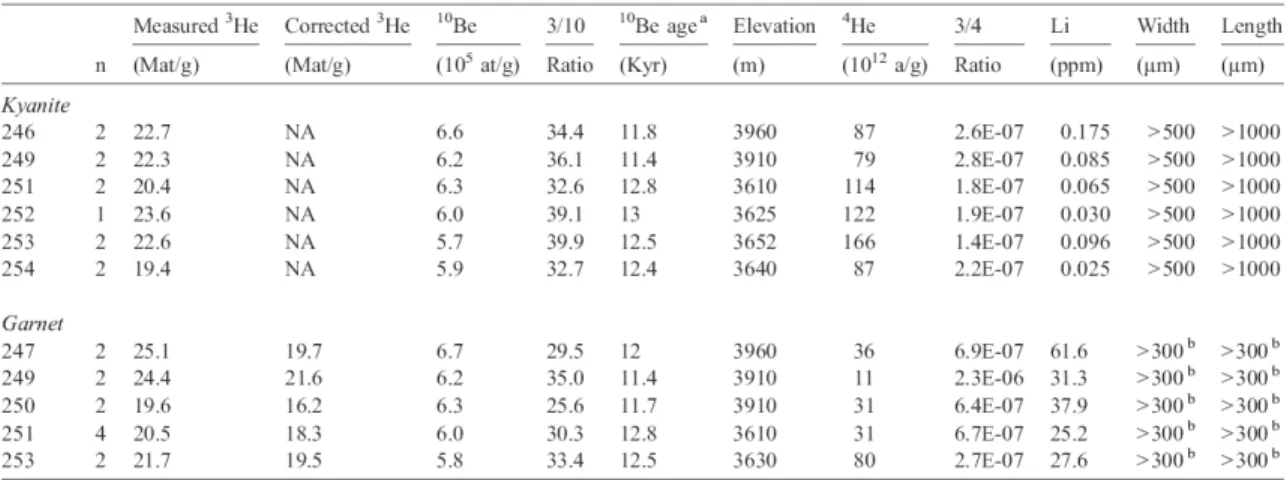
Similarly, the production rate in garnet has been calibrated against 10Be in glacial moraine rocks of the Nepalese Himalaya (Gayer et al., 2004). Our approach and sampling locality are similar to the study of cosmogenic 3He in garnet by Gayer et al.
Methods
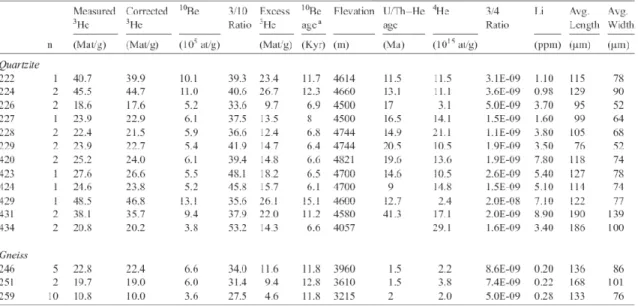
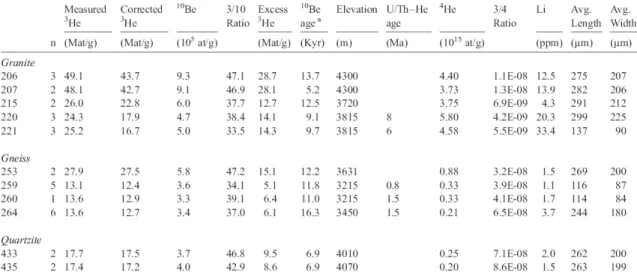
Samples of Durango apatite exposed to heavy fluids were found to yield Li concentrations within error of the non-immersed samples. Most of the quartzites have zircon-helium ages from ~13-20 Ma, whereas zircons from the gneisses have ages from 1.5 to 2 Ma (Table 2.1).
Results
- Lithium Contents
Plot of corrected 3He/10Be ratios for apatite against elevation, showing an increase with elevation. Zircons from gneisses have Li contents of 0.17-0.30 ppm, while zircons from quartzites range between ~1.6-9 ppm.
Discussion
- Sources of 3 He in Minerals
- Calculating Cosmogenic 3 He Production Rates
- Limited Importance of Non-Cosmogenic 3 He
- Increasing 3 He Production Rate With Elevation
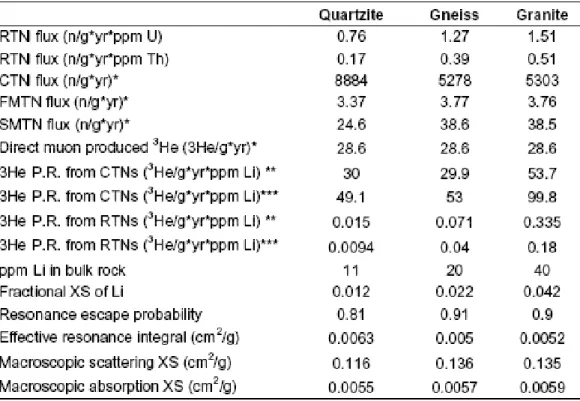
This is done by calculating the apparent production rate in the mineral according to Farley et al. The apparent 3He production rate (Pa) is then multiplied by the surface exposure age (from 10Be) to determine 3Hecn.
Possible Causes of Anomalous Production Rates
- Altitudinal Variations in the Neutron Energy Spectrum
- The Effect of Snow Cover
To predict the neutron flux and energy spectrum at each height, we use the analytical equations of Sato et al. We suspect that the calculations of Dunai et al. 2007) overestimates the magnitude of the effect, and for this reason, together with the absence of a correlation between.
Conclusions
However, the apparent production rates of kyanite and garnet are consistent with those observed in Himalayan garnet by Gayer et al. 2004), and are consistent with the recently published element-specific production rates of Kober et al. The increased production rates in our study area are not due to cosmogenic thermal neutron capture, as suggested by Dunai et al.
COSMOGENIC 3 HE AND 21 NE PRODUCTION RATES CALIBRATED AGAINST 10 BE MINERALS FROM THE COSO VOLCANIC FIELD
- Geologic Overview
- Methods .1 Sampling
- Helium Analyses
- Li Analysis
- Determining Average Host Mineral Li Contents
- Results .1 10 Be Results
- Helium results
- Neon Results
- Li Concentrations
- Compositional Analysis
- Data Interpretation
- Interpretation of Measured 3 He
- The Magmatic He Component
- Quantifying Li-Produced 3 He Components
- Cosmogenic 3 He Production Rates
- Cosmogenic 21 Ne Production Rates
- Discussion
- An Alternate Method of Calculating Li-Produced 3 He
- Conclusions
A sample of the rhyolite (designated co-5) was collected from the surface, along with an andesitic inclusion (sample co-5x). Since the size of the 3He component produced by Li depends on the grain size, this must be subtracted.

COSMOGENIC 3 HE PRODUCTION RATES IN APATITE, ZIRCON AND PYROXENE INFERRED FROM BONNEVILLE FLOOD
Geologic Background and Sampling
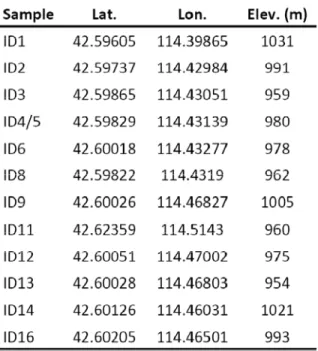
The study area is near Twin Falls, Idaho where the Snake River carved a canyon through which the floodwaters of the Bonneville eruption passed at ∼17.5 ka (Figure 4.1). The merging of these two channels coincides with an abrupt widening of the canyon, as well as the emergence of a large amphitheater-headed side canyon (Blue Lakes Cove) and a massive hydraulically scoured "pot hole" (Malde, 1968). . Although some authors have proposed that these are the result of the Bonneville flood, our results as well as those from recent studies suggest that these features, and similar features nearby, may have formed during earlier flood events (Cerling et al ., 1994; Lamb et al., 2008).
As the overlying lithology consists of a fine-grained matrix, all samples collected from this lithology and 16) showed patinated surfaces that preserve slide grooves and/or 5–30 cm wide slide holes. All exposed samples were 4-5 cm thick and were collected from almost horizontal surfaces without topographical protection.
Methods
In some cases, pyroxene was ground under vacuum in a steel tube according to previously published procedures (Patterson et al., 1997). Zircon and apatite crystals were degassed by heating platinum packets to >1100 °C for 30 min using a 1064 nm Nd:YAG laser, similar to previously published procedures (Amidon et al., 2008a; House et al., 2000) . For high 4He analyzes (zircon), sensitivity was determined by in-run enrichment of samples with the “MM” standard, which causes a significant increase in 3He while only increasing the total He pressure by <1% (Amidon et al., 2008a ).
Very high 4He concentrations in zircon were determined on an aliquot of the sample gas by peak height measurement on a Balzers Prisma quadropole mass spectrometer. Major element concentrations were determined by XRF, whereas trace elements and REEs were measured by LA-ICPMS following standard procedures at the Michigan State University laboratory (Vogel et al., 2008).
Results
Although Fe-rich and Fe-Ca pyroxenes were present in most samples (Table 4.7), only pyroxenes with Fe-Ca composition, (Mg0.62Fe0.58Ca0.74)Si2O6, were analyzed for 3He. However, Li concentrations in most of the rocks are significantly different between the two units, with ~15 ppm in the upper unit and ~21 ppm in the lower unit (Table 4.6). The contrast in Li content between the upper and lower units is magnified in the pyroxenes.
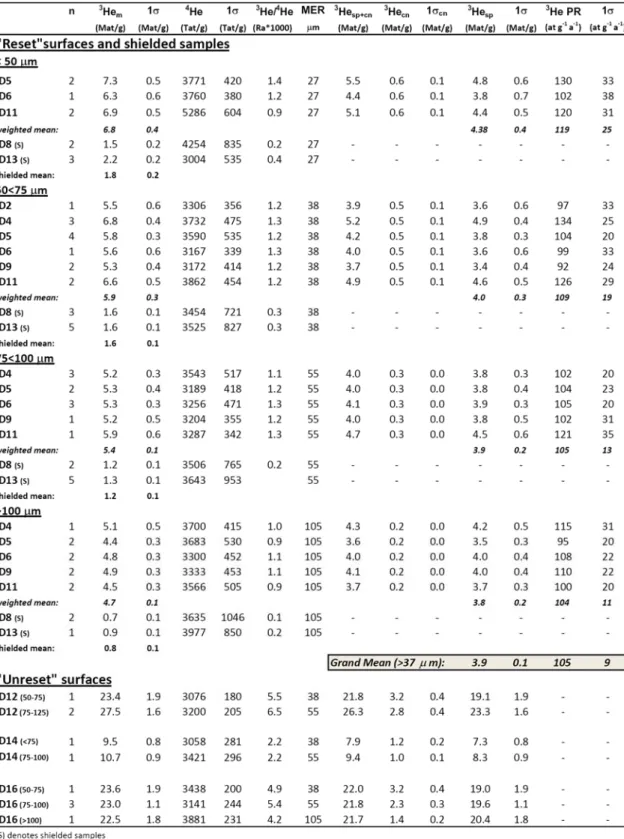
Measured 3He in shielded zircons (black squares), reset surfaces (open squares), and 3He-induced fracturing at reset surfaces (gray squares). Gray symbols indicate the fractionation produced by 3He in the same samples after subtracting all Li produced.
Analysis
- The Nucleogenic 3 He Component in Shielded Samples
- Additional 3 He Components
- Inherited Component ( 3 He in )
- Nucleogenic Component ( 3 He nuc )
- Cosmogenic Neutron and Muogenic Components ( 3 He cn and 3 He mu ) Although muogenic production has been explicitly considered in previous studies, it is
- Uncertainty of 3 He sp Estimates
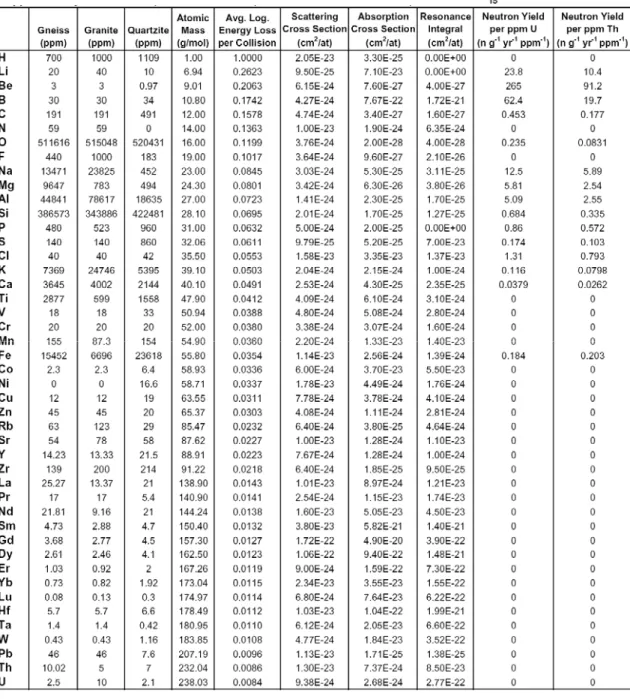
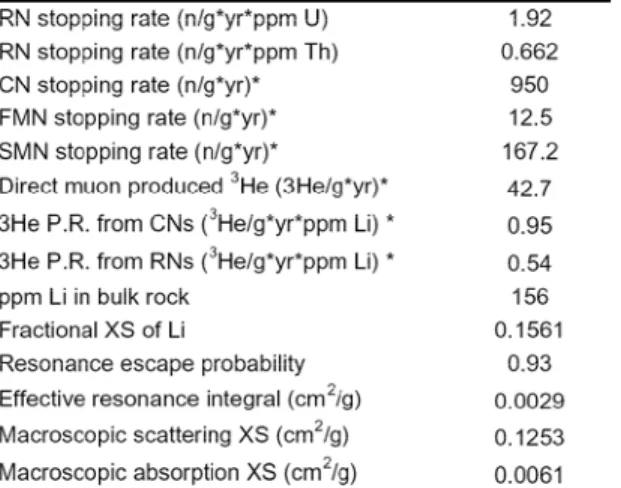
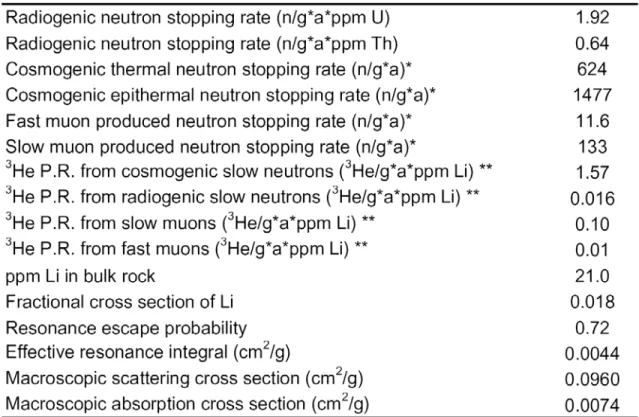
Because some elements have very large neutron capture cross sections (Li, B, Gd, etc.), the neutron flux is a sensitive function of the bulk rock concentration of these elements. Crushing experiments show that the captured magmatic component is < 2% of the measured 3He in our samples. This is useful because the Li content of adjacent phases is required for the calculation of the 3Hecn component for exposed samples.
Because the apparent deficit is so large, it is difficult to attribute it to the incorrect calculation of one of the 3He components produced by Li. The uncertainties about our final 3Hesp concentrations combine analytical errors with the uncertainty in the calculation of the components produced by Li (Tables 4.1-4.3).
Discussion
- Production Rates of Spallogenic 3 He
- Criteria for 3 He Dating With Zircon and Apatite
- Geomorphic Implications
The most fundamental limitation of the technique is the size of the 3He component produced by fragmentation (3Hesp) relative to the 3He components produced by Li (3Henuc, 3Hecn, 3Hemu). While the magnitude of the 3Hesp component is entirely dependent on location and age of exposure, the Li-produced components are additionally dependent on Li content, age of closure and, to a lesser extent, grain size. For a given apparent Li concentration, the 3Hesp/3Hetot ratio is a function of the exposure age and the He confinement age of the specific analyzed mineral.
Calculations showing the fraction of splatter produced 3He in apatite as a function of He confinement age, apparent Li content, and exposure age at a 1000-m altitude, high-latitude site. Based on the above observations, it appears that the depth and width of the canyon below the Perrine Bridge were not significantly altered by the flooding of the Bonneville eruption.
Conclusions
MASS SPECTROMETRIC 3 HE MEASUREMENT IN 4 HE-RICH PHASES: TECHNIQUES AND LIMITATIONS FOR COSMOGENIC 3 HE
DATING OF ZIRCON, APATITE, AND TITANITE
- Introduction
- Helium Extraction and Mass Spectrometry
- Determining Instrument Sensitivity
- Determining Abundance Sensitivity
- Precision of 3 He Measurements
- Discussion
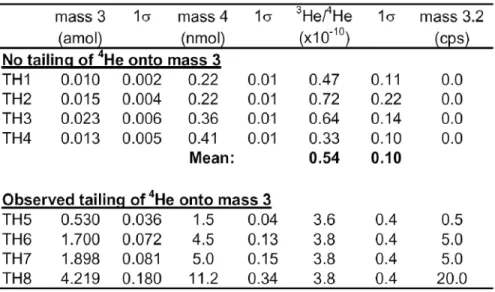
The feasibility of accurately measuring cosmogenic 3He in high 4He phases depends on the 3He/4He ratio of the mineral. Above this hard limit, the lowest measurable 3He/4He ratio is determined by the sensitivity of the mass spectrometer as a function of the 4He amount. Our experimental data show that the rate of rise of the 3He signal correlates with the amount of 4He in the mass spectrometer (Figure 5.5).
The lowest achievable uncertainty for a given 3He/4He ratio is determined by the number of 3He counts and the slope of time versus Each curved line represents the evolution of the 3He/4He ratio for a unique multiple of the closure age (Ga) and EU content (ppm).
CONCLUSIONS AND FUTURE APPLICATIONS
Summary of Findings
Another unique aspect of cosmogenic 3He dating in zircon and apatite is their small grain size that makes them vulnerable to redistribution from both spallation and Li-produced 3He and 3H. Because zircon tends to have a lower Li uptake and 3He production rate than its neighboring minerals, redistribution of 3He is always expected to result in a negative relationship between grain size and 3He concentration. For example, in the Coso and Nepal studies, the concentration of spallation produced 3He (after subtracting Li-produced components) is within error for all zircon grain size fractions.
While the details of grain size-dependent production rates remain an open question (see below), it appears that this is not a significant issue for zircons larger than 50 m, or for mineral phases with production rates of spray similar to the average one. rock Although this is not discussed in the thesis chapters, it is a very practical limitation of the technique.
Open Questions and Potential Applications
Such experiments are ideally performed at high-stiffness limits, where the height-dependent changes in the energy spectrum are most pronounced. The difference in the energy dependence of 3He production compared to other isotopes could also lead to changes in the 3He/21Ne production ratio with rock depth. Thus, information about the history of erosion is contained not only in the cosmogenic concentration, but also in the ratio of the two nuclides.
Cosmogenic 3He in zircon and apatite is an ideal isotope system for such an application because it is a stable isotope that can be measured in the same samples used for cooling ages. If the amount of cosmogenic 3He in zircon is used to directly dissolve for the total residence time of zircon in the upper 3-5 meters of soil and sapprolite, the rate of chemical weathering can also be obtained.
Regional 10 Be production rate calibration for late-glacial northeastern North America
Geological research in the Himalayas of Nepal, Annapurna-Manaslu-Ganesh Himal; announcement of geological map 1:200.000. Transition from diagenesis to metamorphism in the Paleozoic to Mesozoic succession of Dolpo-Manang. Calibration of cosmogenic 3He production rates from Holocene lava flows in Oregon, USA and effects of the Earth's magnetic field.
Production of the cosmogenic isotopes 3H, 7Be, 10Be and 36Cl in the Earth's atmosphere by solar and galactic cosmic rays. I have included the spreadsheet in the .zip file for comparison with the results of the matlab script.
Lifton_scaling.m”
Lifton_err_calc.m”
I_ss=sum(data(:,5).*data(:,6)); %integral effective resonance for absorption of epithermal neutrons from air (cm^2/g). Circle_a=1; %normalization factor for neutron production rate in air (unitless) NOTE: difference from that defined in Liu et al. 12 (n/cm^2*yr) theoretical epithermal neuatron flux in rock at the surface, if air had the same properties.
ID_plot_errors.m”
Slope_errors.m”
Ratio_Plotter.m”
Compute_errors2.m”
Slope_errors_auto.m”