Jurnal Komunikasi
The Influence of Knowledge about Korean Culture on Decision of Purchasing Korean Mobile phones
Arbaiyah Satriani, Rini Rinawati
Branding a Memorable: Case Study on Residivist Streetwear Bandung Safiratul Zakiyah, Yulianti
Dedi Mulyadi Political Branding in Identifying Sundanese Purwakarta Characters Nila Nurlimah, Aziz Taufik Hirzi, Leti Kamila, Nur Fitriastuti
Successful Social Media Advertising Activities For Micro, Small And Medium Enterprises
Joko Suryono, Nuryani Tri Rahayu, Purwani Indri Astuti, Nunun Tri Widarwati The Influence of President Joko Widodo's Instagram Content on Beginner Voters
Participation in the 2019 General Elections Marsha Ruth Handoko, Yolanda Stellarosa
Changes in Organic Composition of Capital Behind Pikiran Rakyat Strategy of Convergence
Muhammad Ashari
Local Newspaper Strategy to Survive in the Digital Era Hendra Alfani
Organization Communication: Internal Conflict in Hospitality Industri Putri Ekaresty Haes, I Wayan Joniarta
Media Literacy in Information Chaos Era: Qualitative Study Bandung Literacy Activist Cevi Mochamad Taufik, Suhaeri
Voter Attitudes toward Hoax Information Sources At the 2019 Presidential Election in West Sumatra
Mohammad Isa Gautama
Building Social Message in the “Cerdas Melanggar” Short Film by Story Telling on the Cameo Project Youtube Channel
Ricky Wattimena, Mariska Eunike
Samarinda City Branding through Tourism Communication of Dayak Village in Pampang
Tuti Widiastuti, Eli Jamilah Mihardja, Prima Mulyasari Agustini Sadfishing Phenomenon of #Justiceforaudrey (Hashtag) on Twitter
Citra Eka Putri, Novita Damayanti, Radja Erland Hamzah
Editor In Chief Ferry Darmawan (Universitas Islam Bandung)
Journal Manager Dadi Ahmadi (Universitas Islam Bandung)
Editorial Board
Alex Sobur (Universitas Islam Bandung) Arbaiyah Satriani (Universitas Islam Bandung)
Dadang S. Anshori (Scopus ID: 57192007858, Universitas Pendidikan Indonesia) Deddy Mulyana (Scopus ID: 56716431500, Universitas Padjadjaran) Deni Darmawan (Scopus ID: 56866119600, Universitas Pendidikan Indonesia)
Erik Setiawan (Universitas Islam Bandung) Husen Hendriyana (Institut Seni Budaya Bandung)
Maman Suherman (Universitas Islam Bandung) Mohammad Isa Gautama (Universitas Negeri Padang)
Wiki Angga Wiksana (Universitas Islam Bandung) Yadi Supriadi (Universitas Islam Bandung)
Editorial Office Andalusia Neneng Permatasari
Dian Widya Putri Yuristia Wira Cholifah
Muhammad Ridha Purnama Graphic Designer
Ferry Darmawan Venny Sevtiany
EDITORIAL TEAM
FOCUS AND SCOPE
Mediator: Jurnal Komunikasi focuses on communication studies and media.
Although centered on communication, Mediator is open and welcomes the contribution of many disciplines and approaches that meet at crossroads with communication studies.
Type of writing is in the form of scientific articles (the results of field research, conceptual articles, or desk studies). This journal is intended as a medium of scientific study to communicate
vision, reflection, conceptual thinking, research results, interesting experiences in the field, and critical analysis-studies on contemporary communication issues.
Sekretariat:
MediaTor: Jurnal Komunikasi
Gedung Dekanat Unisba Lt. 7 - Jl. Tamansari No.24/26 Bandung 40116 Telp. 022-4203368 ext.7805
website: http://ejournal.unisba.ac.id/index.php/mediator/
E-mail: [email protected] | [email protected]
TABLE OF CONTENTS
SALAM ... ii- iv
Arbaiyah Satriani, Rini Rinawati ... 1-10
Muhammad Ashari ... 11-23
Marsha Ruth Handoko, Yolanda Stellarosa ... 24-38
... 39-48
Ricky Wattimena, Mariska Eunike ... 49-57
Citra Eka Putri, Novita Damayanti, Radja Erland Hamzah ... 58-67
Tuti Widiastuti, Eli Jamilah Mihardja, Prima Mulyasari Agustini ... 68-78
Mohammad Isa Gautama ... 79-90
... 91-100
Putri Ekaresty Haes, I Wayan Joniarta ... 101-107
Joko Suryono, Nuryani Tri Rahayu, Purwani Indri Astuti, Nunun Tri Widarwati . 108-117
Hendra Alfani ... 118-131
... 132-140
Our Social Media And Media Literacy
has recently become the topic of conversation among the world community. No exception,
throughout Asia and other parts of the world, since the late 1990s.
dance and ballet, musical theater, modern art, modern literature, to culinary issues. Not
products such as televisions and cellular phones (cell phones). and electronic products.
That is also one of the reasons the Mediator journal tries to raise this phenomenon
quantitative methods with a total of 40 respondents. The results showed that knowledge of
Muhammad Ashari presented a different topic in his writing, “Changes in the
(1887). This theory describes the interaction between increased technology (constant capital) and mobilized labor (variable capital) in the production process, the main purpose
journalists. The method used for analysis is case study. The author of this article said that the convergence strategy was carried out by integrating the content of all subsidiaries through news rooms and e-mail, which aims to disseminate news content to various platforms. There is an increasing amount of content from this effort. However, it also has consequences for journalists and editors who are forced to produce stories for multiple platforms.
Another interesting article was presented by Marsha Ruth Handoko and Yolanda Participation of Beginner Voters in the 2019 General Election.” According to these two authors, Instagram is not only used for fun but is also used as a source of political information.
President Joko Widodo. In the 2019 election, Jokowi again ran as a presidential candidate
content has on the participation of voters in the 2019 general election.
Characters of Sundanese People in Purwakarta.” This research examines how the politics of branding carried out by the Regent of Purwakarta, Dedi Mulyadi, in organizing and actualizing Purwakarta as a city with Sundanese characters. This study uses a qualitative method with a case study approach.
Cameo Youtube Channel” is the title of another article by Ricky Wattimena and Mariska
concepts such as humans are the creators of storytellers, good judgment, good judgment is determined by human characters, rationality and story selection. This, in the view of the two authors, is because Youtube has a medium for creation and as a place for networking and storytelling.
“Sad Phenomenon of #Justiceforaudrey (Hashtag) on Twitter.” This issue is the study of the writers of articles consisting of Citra Eka Putri, Novita Damayanti, and Radja Erland Hamzah. According to them, People use social media as a means to share everything about themselves and their daily life. Many users tell stories or things they see that can attract in early 2019 was the case of alleged violence that befell the age of 17 at SMPN Pontianak (Junior High School), a student named Audrey who claimed to have been abused by several high school students. The Audrey case drew the attention of many circles and went viral even occupied world trending.
The next article came from Tuti Widiastuti, Eli J. Mihardja, and Prima M.
Agustini, who examined the issue of “Samarinda City Branding through Dayak Tourism Communication in Pampang Village. This village has cultural potential, particularly performing arts, which is utilized to support regional tourism development. Research symbols in Pampang Village are used as a strategy for Samarinda city branding.
Hoax Information Sources in the 2019 Presidential Election in West Sumatra.” West Sumatra is known as a rational province. So, it is very interesting to reveal the rationality of voters in West Sumatra regarding the 2019 Presidential Election. This research instrument uses a survey method,
for them to return to the middle Public.
Hospitality Industry” is an interesting subject of study. Putri Ekaresty Haes and I Wayan Joniarta. The two researchers examined it through observation data collection techniques, unstructured interviews, and documentation. While the data analysis technique used several stages, namely the data reduction stage, the data display stage and conclusion and Three other articles as the closing articles of this edition of the Journal of Mediator
Communication, present themes about the contribution of social media and local print media.
“Successful Social Media Advertising Activities for Micro, Small and Medium Enterprises”
was written in four series: Joko Suryono and Nuryani Tri Rahayu ,, Purwani Indri Astuti, and Nunun Tri Widarwati. Meanwhile, “Local Newspaper Strategies to Survive in the Digital Age”, was written by Hendra Alfani. Then, “Media Literacy in the Age of Information Disorder: A Qualitative Study for Bandung Literacy Activists” was written by Cevi perspectives, of course with all their advantages and disadvantages. Hopefully everyone can inspire.
Happy reading.
Salam,
Editorial Board
The Influence of Knowledge about Korean Culture on Decision of Purchasing Korean Mobile phones
1Arba’iyah Satriani, 2Rini Rinawati
Fakultas Ilmu Komunikasi, Universitas Islam Bandung, Jl. Tamansari No. 1, Bandung, Indonesia.
E-mail : 1[email protected], 2[email protected]
Abstract. Indonesian society is currently experiencing a wave of Korean culture (Hallyu) which has also hit various countries. The wave of Korean culture began from a decade ago and has been more intense until now. Korean cultures that are loved by many Indonesian are Korean drama, K-Pop and reality shows that feature Korean artists. Therefore, many business men to take advantage of this situation by utilizing the three types of Korean entertainment to market their products. One of the products is mobile phone namely Samsung and LG. This research seeks information about the relationship between knowledge about Hallyu with Samsung or LG cellphones purchasing decisions that is made by Korean culture fans. This research implements quantitative method with a total of 40 respondents. The results showed that the knowledge of Korean culture through drama and variety shows “Running Man” contributed substantially to respondents in deciding to buy Korean Samsung and LG mobile phones. On the contrary, knowledge about K-Pop music did not contribute much to respondents in deciding to buy Korean Samsung and LG mobile phones.
Keywords: buying decision, mobile phone Samsung/LG, Korean Wave
INTRODUCTION
Data from Indonesian Ministry of Communication and Information (Kemeninfo) shows that Indonesia is a giant of digital technology of Asia that is sleeping. With the number of Indonesian citizen which is around 250 million, this country is becoming a big market. The user of smartphones in Indonesia is also growing. Based on the data from research institution, digital marketing Emarketer, in 2018, the number of smart phone users in Indonesia is more than 100 million people. It poses Indonesia as the fourth largest country with the active users of smart phone, after China, India and The US (Kemeninfo RI, 2015)
Indonesian are using smart phones for various purposes in their daily lives.
This is because smart phones is currently providing diverse facilities that can be used by its owners to access different things. The findings from the Indonesian Digital Association (IDA) Research, which is supported by Baidu Indonesia, and carried out by the global research institute GfK (Okezone, 2016) shows that Indonesian urban communities are fond of news consumption through smart phones.
The percentage reached 96 percent which is the highest compared to other media such as television 91 percent, newspapers 31 percent and radio 15 percent.
Various smart phones that are popular in Indonesia are still dominated by smart phones from Korea, especially South Korea. According to Hamidah and Anita (2013) the use of Samsung brand
mobile phones with Android operating system in Indonesia continues to increase because it is not only a necessity of communication and lifestyle complement but also helps business activities or various activities in the office. On the other hand, the superiority use of Samsung smart phones in Indonesia is inseparable from the Korean government’s assistance in promoting the mobile phone along with K-Pop culture which is currently being favored throughout the world. The wave of Korean culture which is known as the Hallyu phenomenon (Korean Wave) is being loved by many countries, especially in Asia including Indonesia. For the first time, the term Hallyu appeared in China.
This term was introduced by journalist in Beijing as a form of shock at the rapid growth of Korean popularity and culture in China (Ardia, 2014).
Hallyu is a term that means the influence of modern Korean culture in other countries. According to Irwansyah (2011 in Raharja 2013) Korean fever in Indonesia has begun since the 2000s with the inclusion of Korean drama in the television in this nation. Audiences who are exposed to Korean culture according to Zakiah et. all (2019) are a group of adolescents with the range of age between 15 years and 25 years. They are generally living in big cities like Bandung, Jakarta, Solo and Surabaya (Zakiah et all, 2019).
Several factors that become criterion of development of Hallyu in many various countries are as follow., The first, the success of marketing of Asian values in a modern style or what Kim Song Hwan, a manager of a South Korean television broadcast syndicate, calls “Asian Values-Hollywood Style.”
The second, the work ethic of Koreans who are willing to meet their fans in many countries. This brings the artists closer to their fans (Kim, Y., 2007).
According to Yeon (2008) as quoted by Ariffin et al (2018) the advancement
of Korean culture that has invaded many countries today is due to several things.
Among these are incorporating elements related to Confucianism into music and drama, image visualization supported by technological advancements, as well as producers who are actively airing dramas on South Korean television. This was also supported by the sudden economic downturn in several Asian companies which made the Asian market ready to accept new Asian products, including from Korea (Yeon, 2008 in Ariffin et al (2018)).
Since mobile phones are the main devices of communication in the modern society, it is necessary to find out what information people are looking for before they decide to buy a communication device, especially cellphones. Information that was explored was related to Korean culture which is currently happening.
Knowledge about this will help stakeholders in deciding to market their products and the communication approach that can be conducted to reach the target market. The aim of this research is to find the relationship between knowledge about Korean culture and purchasing decisions of mobil phones from Korea (Samsung and LG).
METHOD
This research implements quantitative approach with a co- relational approach, The method is used because it will explore a relationship between Korean cultural variables as an independent variable, and purchasing decisions as a dependent variable. The co- relational method according to Rakhmat (in Dermawan dan Rinawati, 2014: 87) has several aims, namely (1) measuring relationship among several variables; (2) predicting dependent variables from our knowledge about independent variables;
(3) paving the way to create experimental research designs.
The aim of a co-relational research is to investigate the relationship between Korean cultural knowledge through Korean movies, K-Pop and reality show and a purchasing decision of Korean cellphones, Samsung and LG. The theory that is used to analyse the result of the research is the theory of planned behaviour that is created by Ajzen and Fishbein (1980 in Mahyarni, 2013). This theory looks at the behavior displayed by individuals as a result of the influence of things from outside. This theory fits to the problem of this study because there is an assumption that an individual is usually quite rational and systematically uses provided information to consider the consequences of her/his action before decided whether or not to display a behavior.
In general, the model of Theory of Planned Behaviour can be seen at the FIGURE 1.
The population of this research is the users of Korean cellphones, especially the brand of Samsung and LG. The reason is because the users of Korean cellphones are very numerous in Indonesia. On the other hand, the motives behind the purchasing decision of those brands are not yet widely known.
The research population was obtained based on their voluntary willingness to involved in this research.
The population was random since the researchers announced the need of respondents of the research through social media. The research target is the users of Korean and Samsung cellphones. In addition, the respondents are asked to inform their e-mail address so that researchers can send them the questionnaire. The number of respondents are 40 people which is similar to the number of population. Hence, the technique of sampling research is the total sampling.
The next step was researchers sent a set of research questions or questionnaire to be filled and sent it back to the researchers soon after it. The returned answer of questionnaires was 36. These 36 people, then, became the respondent of the research.
RESULT
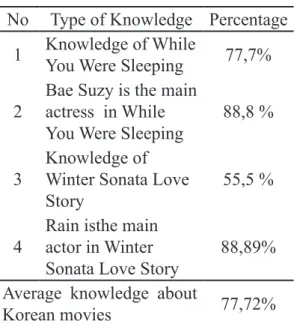
Research about knowledge of Korean movies especially the title of While You Were Sleeping shows as in TABLE 2. The result shows that respondents has a good knowledge about Korean movies both While You Were FIGURE 1. Theory of Planned Behaviour (Ajzen, 2005)
Source : Ramdhani, 2009
Sleeping and Winter Sonata Love Story.
It can be seen from Figure 1. that the average of their knowledge about Korean movies is over 75 per cent. This finding illustrates that as part of Hallyu Korean movies are one of cultures that are loved by Indonesian. This is not surprising because most of respondents are over 26 years old which means they have been following the progress of Hallyu for a long time.
From the result of knowledge about K-Pop, it can be seen from TABLE 3.
Finding of the research about K-Pop shows that respondents cognize many Korean songs that are distributed in Indonesia. This means that Korean music as part of Hallyu is loved by Indonesian.
Several respondents even stated that they could listen to Korean music many times in a day.
In regards to respondents knowledge about Korean variety show that is broadcasting in Indonesian television, it can be seen from TABLE 4.
Finding of the research elaborates that most of respondents has an adequate knowledge from variety show that is broadcasted in Indonesia television. One of the variety shows that attract many audiences is ‘Running Man’.
In addition, the result of research about purchasing decision of KOrean cellphones (Samsung dan LG) can be seen from FIGURE 5.
The result of research suggested that majority of respondents who bought Samsung or LG cellphones knew about the products. Information about Korean cellphones is provided through various Korean cultures. This is recognized by majority of respondents that acknowledge that information about Samsung and LG are conveyed through K-Pop music and No Type of Knowledge Percentage
1 Knowledge of While You Were Sleeping 77,7%
2 Bae Suzy is the main actress in While
You Were Sleeping 88,8 % 3 Knowledge of
Winter Sonata Love
Story 55,5 %
4 Rain isthe main actor in Winter
Sonata Love Story 88,89%
Average knowledge about
Korean movies 77,72%
TABLE 2. Knowledge of Respondents about Korean Movies
Source : data from research
No Type of Knowledge Percentage 1 Knowledge about
song of Make Me
Love You 66,7%
2 Knowledge related to the number of
member of SNSD 77,7 % 3 Knowledge about
song of When Night
Falls 55,5 %
Average knowledge about
K-Pop 66,6%
TABLE 3. Respondents knowledge about K-Pop
Source : data from research
No Type of knowledge Percentage
1
Knowledge about variety show
“Running Man” that involves Korean actress and actor
88,8%
2
Kang Ji Young (KARA) has appear in the Running Man variety show
80,5 % Average knowledge about
Korean variety show 84,6%
TABLE 4. Knowledge about Korean variety show
Source : data from research
variety show.
The finding of the research also illustrates that the purchasing decision of Samsung or LG cellphones are made not entirely because of information that they got from the event of K-Pop music and variety show. The cellphones purchasing decision that is done by the respondents is cased by several things, such as easy to get service centre when the gadget is damaged or broken. This is recognized by most respondents. In addition, when a member of their families has already had Samsung or LG cellphones then respondents tend to follow their family decisions. It is because they thought their family members have already had experience with the brands. Another reason for purchasing Samsung or LG cellphones, according to the research respondents, is the presence of various fascinating bonuses in purchasing the
Source : data from research
No Statement Percentage
1 Very familiar with Samsung brand cellphones 55,55 % 2 Very familiar with LG brand cellphones 72.30 % 3 The quality of Samsung/LG mobile phones is
popular 38,8 %
4 Korean cellphones are stronger than cellphones from
other countries 30,5%
5 Korean cellphones are more attractive and trendy
than other brands 38,8%.
6 K-Pop provides information related to new product
of Samsung cellphones 27,7%
7 Variety show Running Man provides news
information related to new product of LG cellphones 30,5%
8 Purchase a Samsung or LG cellphones because his/
her family has it 38,8%
9 The decision to purchase a Samsung/LG cellphones is also influenced by other factors such as easy to find the service centre when the gadget is damaged or has problems.
41,6%
10 There is an interesting bonus when purchasing a
Samsung/LG cellphones 27,7%
TABLE 5. Purchasing decision of Korean cellphones (Samsung dan LG)
gadgets.
DISCUSSION
Findings of the research shows that purchasing decision of Korean cellphones, especially Samsung and LG, is based on respondents knowledge about Korean cultures. It can be understood because the government of Korea is utilizing Hallyu phenomenon that is happening today in many countries, especially in Asia, including in Indonesia. The government of Korea takes advantages of this phenomenon to promote various of its products including cellphones.
That is in accordance with the findings of Nurhayati (2017) who said that promotion has significant impact to the purchasing decisions. The promotion includes utilizing dramas, K-Pop, and variety show “Running Man”. Therefore, cellphones made in Korea, especially
Samsung, has become one of cellular phones with the highest market shares in Indonesia which reached 32.2 per cent (data of December 2016)
The findings of this research are in accordance with the understanding of Tull and Kahle about marketing strategy.
In the words of Tull and Kahle (in Irmanto and Tjiptono, 2013), marketing strategy is a fundamental tool that is designed to reach the aim of the company by developing sustainable competitive advantage through targeted market and marketing program that is used to serve the targeted market.
From that definition, it can be concluded that the purchasing decision that is done by someone is based on certain consideration. These considerations according to Ajzen and Fishbein (1980) in the Theory of Planned Behaviour is done as a form of attitude and subjective norms towards Samsung and LG cellphones.
The implementation of the Theory of Planned Behaviour s very strong in the phenomenon of purchasing Samsung and LG cellphones because the purchasing decision is influenced by behavioral beliefs (Ramdhani, 2009). They are things that were believed by person in regards to a behaviour both negative and positive, attitude towards behaviour or tendencies to react affectionately in the form of like or dislike to the behaviour.
Marketing strategy that is undertaken by the Korean government, based on this research, shows that there is “Collaboration of Marketing Strategy” between entrepreneurs and the government which gives a full support.
This is become a strength that currently done by utilizing the behaviour of the consumers who are fond of Korean dramas, K-Pop and variety show
“Running Man”. The aggressiveness of the Korean Government in market expanding has caused the selling Korean products faster (Ariffin, 2018). It is in the
words of Kim (2011) in Ariffin (2018) is proactively supporting the culture industry in the country. In addition, the Korean government also realizes the ripple effect of its vibrant culture in the culture industry such as Korean dramas, movies, games, animation and music (Ariffin, 2018). The impact of ripple effect, according to Kwon and Kim (2013) in Ariffin (2018) not only happen in the cultural industry but also in the electronic industries and information technology.
The result of this research also shows that what is done by the Korean government is accordingly with the idea of Kotler (in Sawitri, Hidayat, and Nurseto, 2013) who explained that in purchasing something the consumers influence by many factors. The factors that influence the behaviour of consumers are culture, social, personal, and psychology.
In addition, the findings of this research suggested that other than knowledge about Korean culture which become a basic for the consumer in purchasing decision of Korean cellphones (Samsung and LG), there are several factors that also contributed to the act. One of the factor, based on this research, is social factor namely family.
The habits of family that usually using Korean cellphones become a basis of the respondents to also use Korean mobile phones. Family is a closest human group with the respondents so that they have a strong influence to the person’s intention about behaviour or decision he/she made.
This is in accordance with the idea of Ajzen (in Ramdhani, 2009) who said that social factor especially people who influence someone’s lives can also influence his/her decision. This factor, according to Ajzen, is called as normative belief of someone to take a certain actions, in this case is purchasing decision.
The finding of the research shows that what is assumed by the Theory of Planned Behaviour is proven. It is when
someone’s behaviour is assumed as the impact of many factors both internal and external such as information from the media and knowlede about something.
The evidence can be seen from the result of this research that showing there is correlation between respondents’
knowledge and Korean culture namely dramas, movies, K-Pop and variety show
“Running Man” with the respondents’
belief. This belief is about the products that are promoted by the Korean government, in this case is cellphones, so that they purchase the gadget.
Furthermore, the belief that has been formed at the end will give respondents the basis of intention to know and find out deeply about the Korean products, especially cellphones. The process of knowledge which become a belief and give rise a consumers intention apparently in accordance with the idea of Peter &
Olson about behaviour that is revealed by the consumers. According to Peter &
Olson in Irmanto and Tjiptono (2013), consumers behaviour is including thoughts and feelings that are experienced by someone and actions that he/she takes in the consumption process.
Intention or motive in the Theory of Planned Behaviour is a form of someone’s tendency to choose to do or not do a job, in this case is puchasing Korean cellphones.
This intention is determined by looking at someone’s positive action in certain behaviour and how big support from their circles (people who are important for their daily lives) when he/she doing certain behaviour.
The interesting findings from this research is that there is a connection between family support and ease to find a service centre. Those are the incentive for someone who has an intention to buy Korean cellphones with the cellphones purchasing decision. This is in accordance with the statement of Peter J Paul and Olson, Jerry C (2005) in Yuniarti (2015)
about the role of family in the purchasing decisions. They are (1) Influencers : giving information to family member about a product or service; (2) Gatekeepers : Control the information flow that comes to the family; (3) Deciders : having a power to influence the purchasing process of product or service; (4) BUyers : people who will buy the product or service; (5) Users : consuming or using the product or service; (6) Disposers : will throw away the product or stop using s certain service.
The model of purchasing decision of Korean cellphones based on this research can be seen from the beginning of information about Korean cellphones that used by actors or actresses in the dramas, K-Pop, and variety show. This is in accordance with the findings of research that has been done by Wan Mat, Kim, Abdul Manaf, Phang & Abdul Adis (2019). It said that celebrity in the television such as Korean drama and variety show can influence their audiences to buy the product offered.
On the other hand, information about cellphones in line with the policy of the Korean Government that conduct promotion together with all entrepreneurs who produce Korean cellphones. They utilize the Hallyu phenomenon. Those activities at the end make people aware about Korean products especially mobil phones. Moreover, the Korean government’s support to the marketing product of the cellphones and other creative industries is very serious. It can be seen from the decision of the Korean government to create the Korean Creative Content Agency (KOCCA). The institution is under the ministry of culture, sports and tourism. The government equips the institution with a number of funds that can be used to help the development of their business, especially to promote their product overseas (Ariffin, 2018).
The knowledge obtained will further increase consumer’s belief and
intention. Before buying, they also evaluated the products. The consumers intention and belief, at the end, become the basis of purchasing decision in using Korean cellphones (Samsung and LG).
Information seeking is obtained through communication. According to Irwan (2008) in Pratiwi and Lubis (2017), from the consumer side, communication is very helpful in making a purchasing decision because information that is obtained is very important for making an important decision.
The research also find that there are other variables that contribute in purchasing decision that is done by the consumers in purchasing Korean cellphones. Those variable are family who also using Korean cellphones, attractive bonuses, ease to find service centres, and information about the good quality of Korean cellphones. This is in accordance with the findings of Hamidah and Anita (2013) that suggested the brand image has a positive impact and significant towards purchasing decision of Sambung mobile phones.
It can be seen from the research that illustrated 38.8 per cent of the respondents or 14 people said that they are strongly agree to buy Korean mobile phones (Samsung or LG) because their family has the gadgets. In can be happened because a good communication among family members. They are inform each other about certian products and the primacy. This is corresponds to the research findings of Yuniarti (2015) that suggested the influence of family is ample for purchasing decision in buying certain products.
In the idea of Andespa (2017), decision making in the family is very complex so that the decision making will not be the same among family members.
This is possible when we look at the definition of family according to Duvall and Logan (1995) in Andespa (2017) who
said that a family is a group of people which ties by marriage, childbirth, child development and adoption that aims to create and maintain culture as well as to improve the physical, mental, emotional and social development from every family member.
In addition, there is another definition from Kotler and Armstrong (2011) who suggested that a family is the most important consumer purchasing organization in the society so that the family member can be a primer reference group that is most influential. If it looked at the definition above, it makes sense when the role of the family is very influential in purchasing decision of a product, including the purchasing decision of Korean cellphones. The research that was conducted by Rompas and Tumewu (2014) strengthen this by saying that purchasing decision that generally needs a long process as an impact of the social influential, through a persuation of family members or friends. This is supported by Haryono (2017) who said that before purchasing decision is done, consumers collect information from their closes people such as family, neighbour, friends etc.
CONCLUSION
From this study, it can be conluded that (1) knowledge about Korean culture through drama gives a significant contribution for respondents in purchasing decision of Korean cellphones, Samsung and LG; (2) Knowledge about K-Pop gives less contribution for respondents in purchasing decision of Korean cellphones, Samsung and LG; (3) Variety show “Running Man” gives a significant contribution for respondents in purchasing decision of Korean cellphones, Samsung and LG.
From the research findings, it can seen that television shows (both Korean dramas and variety shows) provides a
large contribution in purchasing decision of Korean cellphones. This finding can be a reference for marketers who want to promote their product. The effective way is to promote the products inside the television program. It can influence audience in deciding to buy something that promoted by the figure in the program.
In addition, it also known that family has a big impact in purchasing decision.
Therefore, to target family members to buy something can be done by inserting the products in the television shows that is viewing by all the family members. To narrow the family members who has a big power in the family is also a strategic effort in marketing a product.
REFERENCES
Andespa, Roni. 2017. Pengaruh Budaya dan Keluarga terhadap Minat Menabung Nasabah di Bank Syariah. Maqdis:
Jurnal Kajian Ekonomi Islam.Vol : 2.
No : 1. Hal. 35-49.
Ardia, Velda. 2014. Drama Korea dan Budaya Popular. Lontar : Jurnal Komunikasi. Vol : 2. No : 3. Mei - Agustus 2014. Hal : 12 - 18.
Ariffin, Julina Tajul. Hassan Abu Bakar.
Nor Hafezah Yusof. Korean Media Strategies in Promoting Korean Dramas in Malaysia. International Journal of Innovative Research in Engineering & Management (IJIREM) ISSN: 2350-0557, Volume-5, Issue-1, January-2018 DOI: 10.21276/ijirem.2018.5.1.1 Dermawan, Deri Nurdian, dan Rinawati,
Rini. 2014. Pengaruh Promosi Pakaian Wanita di Group D’Linez Shop melalui Blackberry Messenger terhadap Minat Beli Mahasiswa Ilmu Komunikasi Unisba. Prosiding Penelitian Sivitas Akademika Unisba (Manajemen Komunikasi). ISSN : 2460-6537. Hal 85-90
Hamidah, Siti. Desi Anita. 2013. Analisis Persepsi Citra Merek, Desain, Fitur dan Pengaruhnya terhadap Keputusan Pembelian Produk Handphone Samsung Berbasis Android (Studi
Kasus STIE Pelita Indonesia). Jurnal Ekonomi. Vol : 21. No : 4.
Haryono, Gampo. 2017. Analisis Persepsi Konsumen, Kelompok Referensi dan Keluarga terhadap Keputusan Pembelian pada Mahasiswa STIE- SAK pada Pembelian Samsung.
Jurnal EKOBISTEK Fakultas Ekonomi. Vol : 6. No: 2. Hal. 200- Irmanto, Vania Rosalin, dan Tjiptono, 207.
Fandy. 2013. Motivasi dan Perilaku Penggemar K-POP di Daerah Istimewa Jogyakarta. Jurnal MODUS. Vol : 23 No : 1 tahun 2013.
ISSN: 0852-1875. Hal: 1-25
Kementerian Komunikasi dan Informatika.
2015. Indonesia Raksasa Teknologi Digital Asia. https://www.kominfo.
go.id/content/detail/6095/indonesia- raksasa-teknologi-digital-asia/0/
sorotan_media. searching 26 November 2017 – 18.10 pm
Kim, Youna. 2007. The rising East Asian
‘Wave’: Korean Media Global in Media on Move : Global Flow and Contra-Flow. Routledge. London and New York.
Mahyarni. M. 2013. Theory of Reasoned Action dan Theory of Planned Behaviour. J u r n a l E l - Riyasah. Vol : 4. No :1. Hal : 13-23.
Mat, Wan Roazha Wan. Hyung Jun Kim.
Ahmad Azaini Abdul Manaf. Grace Phang Ing. Azaze-Azizi Abdul Adis.
2019.Young Malaysian Consumers’
Attitude and Intention to Imitate Korean Celebrity Endorsements.
Asian Journal of Business Research.
Vol : 9 No : 3. ISSN 2463-4522 e-ISSN 1778-8933 DOI: 10.14707/
ajbr.190065
Nurhayati, Siti. 2017. Pengaruh Citra Merek, Harga Dan Promosi Terhadap Keputusan Pembelian Handphone Samsung Di Yogyakarta. JBMA.
Vol: IV. No: 2. Hal: 60-69.
Pratiwi, Yuly Rahmi. Evawani Elysa Lubis. 2017. Pengaruh Word of Mouth Communication terhadap Keputusan Pembelian Konsumen pada Boardgame Lounge Smart Cafe Pekanbaru. Jurnal Online Mahasiswa
Fakultas Ilmu Sosial dan Ilmu Politik Universitas Riau. Vol : 4. No: 1. Hal 1-15.
Raharja, A. Dita. 2013. Artikulasi Fanatisme Elf di Dunia Maya (Studi dalam Kelompok The Neo Korean Wave dalam Twitter). Commonline Departemen Komunikasi. Vol : 2. No : 2. Hal : 12-25.
Ramdhani, Neila. 2009. Model Perilaku Penggunaan TIK “NR2007”
Pengembangan dari Technology Acceptance Model (TAM). Jurnal Psikologi UGM Volume: 17 Nomor:
1 tahun 2009. ISSN : 0854-7108. Hal : 17-27.
Riset Indonesian Digital Association
(IDA).2016. Persentase Pengguna Smartphone.
h t t p s : / / t e c h n o . o k e z o n e . c o m / read/2016/03/16/207/1337776/96- persen-pengguna-smartphone- tertinggi-ada-di-indonesia. searching 26 November 2017 – 18.20 pm Rompas, Elwin. P. Ferdinand J Tumewu.
2014. Social Influence to Consumer Buying Decision a Qualitative Mtehod on Samsung Galaxy Series Customers in Manado. Jurnal EMBA : Riset Ekonomi, Manajemen, Bisnis, dan Akuntansi. Vol : 2. No : 3. Hal.
727-735.
Sawitri, Yunita, dan Hiayat, Wahyu, dan Nurseto, Sendhang. 2013. Pengaruh Kualitas Produk, Promosi, Faktor Sosial dan Faktor Psikologi terhadap Keputusan Pembelian Sepeda Motor Yahama Mio. Diponegoro Journal Of Social And Politic Tahun 2013, Hal.
Yuniarti, Yenni. 2015. Pengaruh Kelompok 1-9.
Acuan dan Keluarga terhadap Keputusan Pembelian Batik Jambi di Kota Jambi. Jurnal Penelitian Universitas Jambi Seri Humaniora.
Vol:17. No: 2. Hal. 09-18.
Zakiah, Kiki. Dian Widya Putri, Nila Nurlimah, Dadan Mulyana, Nurhastuti. 2019. Menjadi Korean di Indonesia : Mekanisme Perubahan Budaya Indonesia-Korea. Mediator.
Volume: 12. Nomor: 1. Tahun 2019.
Hal.90-101.
ACKNOWLEDGEMENT
The authors would like to thank to Communication Science Faculty of Universitas Islam Bandung which has funded this research with the contract number : 184/AKD-e/F.08/IX/2017
Changes In Organic Composition of Capital Behind Pikiran Rakyat Strategy of Convergence
Muhammad Ashari
Universitas Indonesia, Jl. Salemba Raya No. 4, Jakarta, Indonesia Email: [email protected]
Abstract. This article examines the convergence strategy in Pikiran Rakyat media. The convergence strategy is analysed using the Organic Composition of Capital Theory from Karl Marx (1887). The theory describes the interaction between technological improvement (constant-capital) and labour mobilisation (variable-capital) in the production process, which its primary goal is to generate profits for the capitalist. This article highlights technological change, driven by the tendency of capitalism to maximise profit and its consequences for the journalists. The used method for analysis is case study. Data for analysis are collected from documents, interviews, and participant observations.
The result indicates that the improvement of Pikiran Rakyat constant-capital, concerning its convergence strategy, is done by integrating the content of all its subsidiaries through newsroom and e-mail, which have the purpose of disseminating news content to various platforms. There is an increase in the number of contents from these efforts. However, it also has a consequence for journalists and editors who are forced to produce news for various platforms.
Keywords: Convergence, Organic Composition of Capital
INTRODUCTION
Convergence has become a business strategy that is adopted by many media today. Mainstream media companies in Jakarta, such as Media Indonesia Group, Tempo Inti Media, and Kompas, have adopted a convergence strategy in operating their businesses (Tapsell, 2015).
Pikiran Rakyat, a media company that has existed since March 24, 1966, has also changed its business strategy into convergence. Pikiran Rakyat is known as a regional newspaper in West Java Province and had its head office in Bandung, the capital city of West Java Province. Furthermore, Pikiran Rakyat also has district/city-level subsidiaries newspapers, such as Kabar Cirebon,
Kabar Priangan, Kabar Banten, and Galamedia.
After decades of concentrating in print media, Pikiran Rakyat has begun to move towards digitalisation and adopted a convergence strategy by forming various digital platforms in this recent year. Various formed platforms, including online news websites, e-paper, and social media. Pikiran Rakyat is also starting to build a streaming television called PRTV and starting to integrate the PRFM radio line.
The process of convergence in Pikiran Rakyat has taken place since the early 1990s but has not yet reached the stage of its application in the company’s business strategy. During the early 1990s, convergence was limited to discourse
that was drafted by a handful of company employees. This was marked by the involvement of the representative of Pikiran Rakyat in attending the World Association of Newspaper (WAN IFRA) forum. It is a forum that discussed issues around journalistic and mass media.
Every year since 1993, representatives of Pikiran Rakyat were sent to attend the forum (Resmadi & Yuliar, 2014). In a way, this stage is the era of knowledge transferring about digital media.
The online news channel, PikiranRakyat.com (PR Online), was founded in 1996. However, at that time, the news uploaded in PR Online was precisely the same as the news displayed in the newspaper. In addition, there is no integration of content into the newsroom, as the case at this time, where every newspaper within PT Pikiran Rakyat Bandung subsidiaries can access and distribute the same content. At least in that period, company policy still prioritised its newspaper products. For PR Online, the mid-1990s showed a stagnant and often marginalised journey.
Since 1996 until now (2019), improvements have been made by expanding digital media channels. It is done with one primary purpose, which is to adopt a convergence strategy.
There are several digital media channels formed: (1) www.pikiran-rakyat.com, a news portal that provides breaking news, realtime and running news;
(2) www.info.pikiran-rakyat.com, an information site that provides West Java directory data, business information and other information related to business activities; (3) Pikiran Rakyat Microsite, which is a website that provides news and information about products in the form of articles, galleries and videos; (4) PR-epaper, which is an online channel containing a digital edition of Pikiran Rakyat print newspaper. Pikiran Rakyat has also penetrated into visual offerings
through PRTV, which content is streamed through various social media such as YouTube, Instagram, and Twitter. In addition, an e-paper application called MyPikiranRakyat has also been formed (Riyadhiputra & Yusanto, 2019).
From the Marxian political- economy perspective, the convergence strategy employed by media companies today is closely related to the way the social system of capitalism works in creating a source of wealth. In the system of capitalism, the source of wealth is obtained from the extraction of surplus value in the process of production (Marx, 1887). This surplus value is also known as profit (Mulyanto, 2010). Surplus-value is generated from the mobilisation of labour that exceeds the average socially needed time to produce a commodity.
This mobilisation of labour has its source from the allocation of capital for labour- power, which in Marx’s vocabulary is termed by variable-capital.
In order to see the appropriation of surplus-value or the process, which is called valorisation of surplus value, Marx analysed it in the sphere of production.
There are two ways the capitalists valorise surplus-value in the production process, which is by (1) extending labour time above the average socially needed time to produce a commodity or (2) the use of technology developed in the society which could make the labour process becomes more intensive and productive.
The first method, the extension of labour time beyond its average socially needed time, is called the valorisations of absolute surplus-value. The second method, through the use of technology that functions to accompany labour process, is called the valorisation of relative-surplus value.
What distinguishes the valorisation of relative surplus-value from absolute surplus-value is that the surplus-value could be appropriated
without having to extend overall labour time as in the case of absolute surplus- value. Moreover, the mobilisation of labour could be increasingly massive than before because it is also driven by productive technology.
The process of valorising surplus- value - especially in the case of relative surplus-value - shows the interaction between technology and the process of mobilising labour. Both of these are significant factors in a production process that aims to valorise surplus-value.
Marx (1887) mentioned part of the capital that is allocated in the production sphere, such as technology, raw materials, etc., as constant-capital.
It is called as constant-capital because its quantitive value does not increase while being used in the production process. In fact, its value continues to decrease as it is used over time in the production process.
For example, machinery will experience a worn-out after it is used perpetually in the factory after a period of time.
Another part of the capital is called variable-capital. This capital refers to the capital allocated to the purchase of labour-power. In the production process, labour-power is the only source who can add value to a commodity. For example, labour-power could be mobilised to transfers the value contained in raw materials such as yarn through a spinner (constant capital) so that it has a new value in the form of a commodity of clothes. Labour-power could also be mobilised to produce commodities above the social average time to produce it so that more value could be created. The role of labour-power as an element of the production sphere who can add value to a commodity becomes the basis of its categorisation as a variable-capital.
Marx (1887) mentioned the relation between constant-capital and variable-capital in the production process. According to him, a change in
constant-capital can affect the amount of labour-power required in the production of commodities, especially if it increases productivity. In other words, a large-scale investment to constant-capital at the same time could result in a reduction of the variable capital component. Nevertheless, at the same time, an increase in labour productivity could be created.
The relation between constant- capital and variable-capital is called the Organic Composition of Capital (Marx, 1887). The organic composition of capital could be enlarged through investments in constant-capital. That means there is an effort to improve the production sphere through the improvement of machinery, factory buildings, engineering, management systems, etc. In practice, the massive allocation of constant-capital enables the efficiency of production. In turn, it affects the amount of capital allocated on variable-capital. In other words, it could become another way to reduce costs for worker wages or the portion of the worker itself in the production sphere. Not only reduce the cost of wages and the portion of the worker but increased investment in constant-capital also at the same time makes productivity become more intense.
Marx saw the Organic Composition of Capital in two points of view: (1) as a process of value creation and (2) as a technical composition of capital invested in the production process.
Both of these have close relations in the process of capital accumulation.
From the point of view of (1) the process of value creation, the Organic Composition of Capital shows the ratio between constant capital and variable capital in the process of producing the value of a commodity. As for the point of view (2) the technical composition of capital, it shows its material elements by looking at the function of capital, which is divided into means of labour
infrastructure (constant-capital) and labour power (variable capital). This function is determined by the relationship between the deployment of the means of production and, at the same time, the mass of labour needed in the production process. In the context of this study, the perspective that will be used for analysis is the second point of view, which is the technical composition of capital.
The practical side of the Organic Composition of Capital can be seen from the comparison of the way journalists producing news for print and online media. The development of digitalisation has made the allocation of news for online media could be indefinite because it has unlimited space. Meanwhile, the allocation of news for print media is minimal by the number of pages available.
On a regular basis, print media journalists could produce 2 to 3 news a day. While online media journalists nowadays could produce 6 to 10 news a day. Besides that, news that is produced for online media could not only be presented in the form of text, but it could also involving audiovisual elements.
From that comparison, it can be identified that there is an improvement in the composition of constant-capital that has changed the way the news is produced.
Some examples of this constant-capital composition improvement could include the development of digitalisation technology, be it digitalisation of content, websites, applications, or management system development, such as integrated newsroom management, in order to support convergence.
From the context of business competition, capitalists tend to enlarge the portion of constant-capital instead of variable-capital. Large constant-capital could increase commodity production and makes production costs cheaper due to reduced allocation of variable-capital.
In other words, investment in technology,
automatic machinery, can reduce the costs incurred for workers’ wages so that the surplus-value obtained from the production process could be reaped as much as possible.
When convergence is adopted into a business strategy, it will have an impact on the production process carried out by a journalist. In this case, convergence is not merely a matter of technical issue, but it also related to cultural change (Jenkins, 2006; Deuze, 2005). One of the changes from the aspect of the production process is the tendency of journalists to do multiple tasks. The company will force them to be able to disseminate information through various communication channels or presenting the news for multimedia formats (Dickinson, 2015; Nikunen, 2014). In such working conditions, journalists could experience full exploitation by working above regular hours and relative exploitation in the presence of multiple tasks (Pratopo, 2018).
The “de-skilling” process is also considered to occur in the environment of media convergence. That view arises from the fact that there is an increased workload due to news targets demands set by the company management. This causes the working patterns of fact checking and investigation as well as in the specialised print media environment to be increasingly difficult to do (Phillips, 2015).
For some people, convergence does not bring meaningful changes to the welfare of media workers, even though their workload has increased significantly.
Indonesian Journalist Alliance Research conducted in 2015 showed a wide gap between the cost of living and the operational costs of journalists in the era of convergence. In addition, journalists also face work contract issues that are considered not to regulate essential matters, such as work benefits, social
security, holidays, and basic salaries (Yuganto, 2015).
However, from the company management perspective, convergence strategy - and within it, the necessity of multimedia reportage - significantly contributes to reducing production costs and creating a more flexible work environment (Phillips, 2015). Multimedia reportage is considered to be in line with the demands of media companies, which tend to produce more news from the same human resources so it can save more production costs (Dickinson, 2015).
The integration and consolidation of the company, multimedia practices, increased workload as well as the degradation of journalist expertise and its unsecured welfare, as explained above, demonstrate the practice of convergence, which is the current trend in media organisations today. The practice of convergence shows that there is a change in the production process due to the emergence of productive digital technology. It also shows changes in the Organic Composition of Capital, where the allocation of constant-capital, such as digital technology, causes changes in the mobilisation of labour.
Based on the background above, this study identifies the relationship between convergence in the media industry and changes in the Organic Composition of Capital, which underlies the operation of the media industry, particularly at PT Pikiran Rakyat Bandung. Digitalisation, as a basis for media convergence, is seen as a productive force that causes constant-capital to change in the portion of the Organic Composition of Capital.
Changes in the amount of constant-capital will affect the amount of variable-capital in the Organic Composition of Capital.
In other words, from a practical point of view, the mobilisation of journalists’
labour as capital-variable will also change as digital technology causes convergence
in the media industry.
This research will highlight Pikiran Rakyat strategy in enlarging constant-capital. In addition, the relationship between the deployment of constant-capital and the process of journalistic labour also will be seen.
METHOD
This article uses Case Study Method. This method is an empirical study that aims to examine contemporary phenomena in their daily contexts, especially when the boundary between phenomena and contexts is not very clear (Yin, 2018). In essence, case studies search for an explanation of a decision or set of decisions: why a decision is taken, how a decision is implemented, and with what results (Schramm, 1971).
Data were collected from three types of sources, which were documents, interviews, and participant observation.
The source of the research document is news reportage about Pikiran Rakyat convergence strategy.
Data was also collected by participant observation. In this form of observation, researchers become part of an environment where the research is conducted (Yin, 2018). The researcher is a journalist in Pikiran Rakyat since 2012. During the working period, the researcher also observed the dynamics that occurred when Pikiran Rakyat began directing its business strategy to convergence. Researchers also observed changes in the workings of journalists since the company began implementing multimedia strategies.
In-depth interviews were conducted on May 16-27, 2019. The informants were Hilmi Abdul Halim, Pikiran Rakyat Journalist, and Yusuf Wijanarko, Digital PR Content Editor.
In addition to the two informants, other informants were not mentioned.
The analysis strategy is based on
the proposition of a theory (Yin, 2018).
In this study context, data collection was guided based on the propositions that are contained in the Organic Composition of Capital Theory. The patterns found in the data are then compared to their compatibility with the propositions contained in the Organic Composition of Capital Theory. Yin (2018: 224) mentions this analytical technique as pattern matching between patterns based on empirical evidence and predicted patterns.
RESULTS AND DISCUSSION
Pikiran Rakyat strategies in enlarging constant capital
The starting point for convergence in Pikiran Rakyat is seen in the formation of a newsroom. Thus, an e-mail was created in 2018 to accommodate news stories created by Pikiran Rakyat journalist and to support the newsroom itself. The news that was accommodated in the newsroom e-mail was not only from print journalists, but also came from various media which is part of company subsidiaries, such as PRFM radio, Kabar Cirebon, Kabar Priangan, Galamedia, and PR-Info (Yusuf Widjanarko, 2019, personal interview).
E-mail is the most straightforward technology in the digital and online era that can integrate content from various media under the company. The e-mail also supported the formation of a newsroom directed towards convergence, although e-mail technology has limitations in terms of data storage.
“Data traffic in the newsroom is high-speed, so when e-mail storage is full, old data is erased. So when we need old data, the data has finally been lost. “ (Yusuf Wijanarko, 2019, personal interview).
The editors of every media in the subsidiary of Pikiran Rakyat have access to the content in the newsroom e-mail.
This content integration also signifies an effort to distribute content to various media, which is a subsidiary of Pikiran Rakyat. The news produced by Pikiran Rakyat journalist can also be published in Kabar Priangan, Galamedia, www.
pikiran-rakyat.com, www.galamedia.
com, and other channels owned by the company.
“There is no longer a limit that the product must come exclusively from Pikiran Rakyat print reporters, but it can also from other reporters which is still a member of a subsidiary company. For example, news from Galamedia that is deemed suitable can be loaded, or the incoming PRFM News submissions turn out to be interesting to be printed, it can also be. So, the bulkhead between previously separate newsrooms began to be contained in one large newsroom.
From there, we can see the spirit of the converged newsroom. “ (Yusuf Wijanarko, 2019, personal interview).
The task force was formed under the name PR Digital Task Force to manage the convergence strategy. Digital PR Content Editor Yusuf Wijanarko said, besides integrating content and distributing it to various media platforms, PR Digital Task Force has its aim for mapping the editorial products of Pikiran Rakyat in a day. This product mapping is considered essential to take the next step, which is the packaging and distribution of content to various platforms owned by the company. Product mapping also has its function to measure how many editors and sales marketing are needed to adopt a convergence strategy (FIGURE 1).
The decision to form a newsroom with the aim of integrating content and managing it reflects Pikiran Rakyat’s efforts to add constant-capital. Capital is not always defined as work infrastructure in physical forms, such as machinery technology. Nevertheless, it can also mean the application of management
FIGURE 1. Pikiran Rakyat online digital platform for news that was previously sent to the newsroom
techniques and specific work discipline techniques (Mulyanto, 2010).
The main point about constant- capital is that it does not merely become the infrastructure used by workers in producing commodities. Constant- capital also contributes to increasing labour productivity. Theoretically, the improvement of management techniques, as well as technological improvement, can intensify the duration of labour so that the portion of the surplus-value can be obtained more. In turn, increased work intensity can drive profitability to the maximum.
The implications of company management’s decision to form a newsroom e-mail have at least resulted in the integration of around 300 news content in a day (Yusuf Wijanarko, personal interview, 2019). The production of the news is far higher than the quantity of news produced when the news content is only produced by a separate channel.
For example, when calculating in general, the news produced from Pikiran Rakyat newspaper alone, at least in a day, there are only 120 news produced. The figure was obtained from the calculation of the newspaper pages as many as 24 pages. On each page, it could print five news. That does not take into account the
advertisements that could be installed on each page. If there are advertisements on every page, then the news that could be printed on each page is an average of 3 news. From that estimation, approximately there is 72 news produced every day.
The decision to improve constant- capital through a convergence strategy was adopted because of pressures from changing the media market in the past decade and the climate of competition between the media itself. The condition of the media market in Indonesia is now influenced by the increasing ownership of smartphones and the use of social media among young people. Many media companies have the belief that they need to capture this segment of young people to transform their business towards digital and convergence (Tapsell, 2015).
Regarding the pressures in the media market, Managing Director of Pikiran Rakyat Perdana Alamsyah said that the current press company needs a reliable business process, and it must be supported by business revenue in order to maintain its enthusiasm and activities.
According to him, many press companies with its long history of existence have stopped publishing and even closed down because of the lack of it. On the
FIGURE 2. Online digital channels form Pikiran Rakyat subsidiaries, PRFM, which is combine text and audio context.
other hand, there are also print media companies which is still insisting on competing and, in the words of Perdana Alamysah, “not hesitate to extinguish the idealism of the press, selling themselves and publishing pages, for the sake of the last breath before finally collapsing”
(Nurulliah, 2019).
Perdana Alamsyah said that the media industry is in the midst of change, and it gives a new challenge for Pikiran Rakyat. He is talking about the industrial revolution 4.0, where its main signs are the presence of artificial intelligence products—robots, machines, and computer components that can learn and think for themselves. The role of the algorithm changed the conditions of society in the industrial 4.0 era significantly. He said that Pikiran Rakyat must face these challenges (FIGURE 2).
However, some of the employees see the company’s decision to move toward convergence is too late. Digital PR Content Editor Yusuf Wijanarko said that the company’s policy towards convergence was at least 14 years late.
He said this by referring to the emergence of the second internet wave in early
2000 (Yusuf Wijanarko, 2019, personal interview).
In practice, constant-capital improvement is a capital intensive activity. Not all media companies have an equal ability to allocate resources, so its constant-capital could e increased. In a climate of industrial competition, efforts to enlarge constant-capital tend to paved ways only for conglomerates, oligarchies, and monopolies (Marx, 1887; Mulyanto, 2010; Tapsell, 2015).
Constant-capital improvement, which is driven by the business competition climate, tends only to benefit large capital companies because the capital invested in it are very expensive. One of the commentators said that the continuous efforts to raise constant-capital eventually would lead an attack straight to the driving force of capitalism itself, which is free competition (Mulyanto, 2010).
In other words, the market eventually will be filled with monopoly practice by big capital companies, which is far from the notion of “free competition”.
In an environment like that, the choices left for a small capital company is to be swallowed up by large capital companies