Creativity and the Entrepreneur
After working through this chapter you should be able to:
& Define creativity in an entrepreneurial context
& Recognize the relationship between creativity and innovation
& Understand the role creativity plays in the entrepreneurial process
& Understand why idea generation is important to the hospitality entrepreneur
INTRODUCTION
Creativity exists in a number of forms and contexts; artists, poets, musicians and even architects might be considered as individuals who personify the term. Most people would agree that creativity is an essential attribute of the entrepreneur. It is both an asset and a process and the outcome can never be predicted accurately. In the hospitality industry, evidence of entrepreneurial creativity can be observed virtually everywhere. It is embodied in a myriad of company logos such as the two‘Ms’(MacDonald’s) and Australia’s ‘Big 4 holiday parks’and the architectural design of hospitality and restaurant build- ings like Novotel and Pizza Hut. However, large firms do not have a monopoly on creativity. Indeed given the relative lack of resources enjoyed by small firms, entrepreneurial creativity becomes even more important as a competitive tool and may be seen in many small hospitality firms striving to establish a dis- tinctive character or brand. These points of differentiation may not be as easily recognizable as their larger counterparts (for obvious reasons) but they exist nonetheless. For example the way a building is painted, furnished and fitted are all expressions of creativity, so too are menus, styles of service and tariff structures. The point being that creativity in the small hospitality sector is often modest and may even use and build upon the ideas of others. This is especially true in a monopolistic business environment where many other similar firms are competing for business.
CHAPTER 4
67
The following case provides a business example of what may be considered by some as modest creativity.
Creativity and the Freewheeling Entrepreneurial Spirit By Nancy Chesworth, PhD
In 1987, Philip and Cathy Guest carefully considered the decision to turn a favourite sport into a business. In essence, it was a lifestyle choice. Recognizing that their working lives were taking them in different directions, the couple decided to put their relationship first, and became their own employers. The decision to find and operate the business was a very rational one. Both partners listed what they wanted out of life and reached the conclusion that cycle touring was the obvious choice.
Along with cycling for pleasure and mountain biking, Cathy was an experienced cycle racing enthusiast. Philip also enjoyed cycling and brought a wealth of experience as an adventure traveller. In addition, they were accustomed to organizing trips for family and friends.
Ultimately, this combination led to the purchase of ten, top quality, state of the art bicycles, and Freewheeling Adventures was born.
Philip describes the venture as an‘educated gamble’. Among the early challenges were financing and finding a way to make a living while building a business. An optimist tempered by reality, he stated that a key factor was remaining confident that it could work, while not really knowing if it would. Another important issue for the couple was remaining financially independent. They avoided taking out loans or applying for government assistance, preferring instead to use savings, to mortgage their house, and later sell it, when a more desirable property became available. Meanwhile, Philip learnt carpentry skills and found a great deal of work refurbishing the interiors of yachts stored at local marinas. Cathy utilized her marketing knowledge to work promoting local businesses and charities.
The tourism season in Nova Scotia is short, thus, it was necessary to plan for slow but steady growth. This had been achieved through careful planning and dedication to the growth of the business. In many ways, Cathy and Philip epitomize the qualities they looked for in employees. Noting that multiple skills were needed to develop and grow a tourism company, they looked for employees who demonstrated energy, enthusiasm, high-level social skills and a genuine interest in other people as well as innate sales skills and the spirit of
entrepreneurship.
Initially, Cathy baked all of the bread and made all of the lunches for each group. Eventually, a local source was found to take over this time consuming job, freeing Cathy to focus on other aspects of the business. Other local providers of various services have been added over the years as needed and when possible, local residents are hired as guides. Situated in the small rural community of Hubbards, with their home and business at the same location, this support of the local community, together with their two active sons, has made their property a sort of social centre. The addition of a skateboarding half- pipe provided the opportunity for their sons to learn carpentry skills as well as provide a safe and welcoming recreational opportunity for the boys and their friends.
In the past twenty years, kayaking trips have been added in the local area where the scenery, seals, sea birds and the occasional whale enhance the experience. Multi-sport adventures
include combinations of cycling, hiking and kayaking. Van support is offered on all group trips, other than self-guided tours. Tours are offered for cyclists at every level of fitness and experience so as to enable anyone to participate. Accommodation is normally in comfortable inns that reflect the ambiance of the area. But some surprises await. Some accommodations are in castles and chateaux, adding a touch of elegance to the adventure. In the same vein, nutrition is carefully planned with healthy snacks and good quality restaurants part of the experience.
Making the business into a full-time, year round operation meant considering locations in other countries. As a result, Freewheeling Adventures now offers guided and self guided tours around the world in a wide variety of terrains. Each adventure is fully described both on- line and in the company’s hard-copy brochure. The level of difficulty, an outline of the terrain and details of each adventure help the client make a well-informed choice.
Freewheeling adventures exemplifies the essence of entrepreneurship. The slow and steady growth of the company is the product of dedication, planning, flexibility, commitment and creativity. The result is a profitable business offering high quality adventures to happy, satisfied customers.
Questions
1. What role did creativity play in the founding of Philip and Cathy’s original business?
2. What role did it play in establishing subsequent business activities and linked experiences such as kayaking and the provision of accommodation?
3. What role did‘preparation’play in their decision to become self-employed?
4. How innovative are these two entrepreneurs?
Source: Nancy Chesworth
This chapter introduces the notion of creativity and how it applies to the small hospitality entrepreneur. It is defined and considered a key entrepre- neurial function. Creative idea generation is outlined together with a discus- sion of the nature of creativity and whether it is innate or an ability that can be learnt. The chapter continues by exploring stages of the creative process, identifying behavioural enhancers and barriers and concludes with some approaches and techniques designed to develop creative thinking in indivi- duals.
Key point 4.1
The hospitality entrepreneur does not have to be totally original to be creative. Indeed, most creative business ideas are simply modifications of others.
Introduction 69
CREATIVITY: TOWARDS A DEFINITION
The word innovation is often used interchangeably with creativity, however there is a difference between the two (see next chapter for a full discussion). In simple terms, both are important for entrepreneurs but innovation is more concerned with the logical steps involved in bringing a creative idea to market.
In other words it is the process involved in actualizing creative ideas success- fully (economically). Therefore creativity becomes the antecedent of innova- tion but it is no less important. If the hospitality entrepreneur fails to be creative or later does not implement creative decision-making, the firm will struggle to survive.
Definitions of creativity abound and as such we can conclude it is a tricky thing to be certain about. However, many use the word novel, new or original, for example, Kirby (2003) considers creativity to be the ability to think‘new’
things. Similarly,The Merriam-Webster Online Dictionary(2008) defines the verb‘create’as:
& to make or bring into existence something new.
More philosophically, Satre (1943) considers the act of creating as liberat- ing and one where a state of‘nothingness’becomes‘somethingness’. Another thesis considers a creative human as Godlike. This follows the notion that if God is the creator, anyone engaged in the act of creation must therefore become God themselves because they have the power to change their fate.
This is achieved by the individual moving beyond a passive resigned preor- dained existence into the active role of creation. We can see how this resonates with entrepreneurs as presented in Chapter 11 through the personality trait
‘locus of control’! Many entrepreneurs truly believe that they alone are re- sponsible for their success; context and good fortune make little or no contri- bution.
Reflective practice
1. How would you describe the relationship between innovation and creativity?
Leaving aside the above comparison with one deity or another, the link between creativity and entrepreneurship is not new. Schumpeter (1934) first made these assertions around eighty years ago describing the entrepreneur as an heroic creative artist and coining the phrase‘creative destruction’. Many still hold this as a‘truth’(for example, see Berglund, Dahlin, and Johansson, 2007) and consider creativity and the act of creation an essential element of
the entrepreneurial process. For example, Fontela, Guzman, Perez and Santos (2006) adopt Guzman’s (1994) to identify creativity within one of three en- trepreneurial‘spheres’shown inFigure 4.1.
The financial sphere is where the entrepreneur acts or responds to obliga- tions as the financial owner of the firm. The management sphere concerns corporate direction and management duties. The booster sphere is where the founder assumes a more humanistic psycho-sociological and creative role within the organization.
Key point 4.2
Creativity is the process of generating a novel or useful idea of which opportunity recognition is part.
CREATIVITY: INNATE OR LEARNED
Paradoxically, evidence suggests that as small firms begin to develop and increase in size there is pressure for the entrepreneur to adopt more of a managerial role. Managing a small hospitality firm requires a number of complimentary skills but they are more administrative in nature and concern implementing policies, procedures, controls and so on (see Chapters 7 and 11
FIGURE 4.1 The functional spheres of the entrepreneur.
Source: Guzman (1994).
Creativity: Innate or Learned 71
for a discussion). Accordingly, there is less time available to engage in creative behaviour (see Pinard and Allio, 2005). Fontelaet al.(2006) agree that as firms grow entrepreneurial behaviour becomes ‘rational’focusing on profit maxi- mization rather than opportunity spotting and creation. However, does this necessarily have to be the case? Whilst there is clearly a requirement for hospitality founders to think logically when managing their business, they must also think laterally. Indeed, according to Fontelaet al.(2006), founders need to understand that to be creative requires an effort to:
‘‘. . .become less rational and more emotional’’(p. 5).
In other words, in seeking to become creative and forward looking, entrepreneurs must attempt to contextualize their decision-making accord- ingly. Necessarily, this means that rationality is limited as the future has not yet been ‘written’ and so cannot be analyzed objectively. Decisions become bounded by uncertainty and as such require entrepreneurs to eval- uate problems relying on lateral rather than rational thought processes.
Fontelaet al’s (2006) notion suggests that when hospitality founders think beyond the present they are not bound by rational certainties. Therefore, their capacity for creative effectiveness is enhanced once this is recognized.
They also suggest that entrepreneurial thinking shares much with artists and that art is not mysterious but intuitive based on instrumental life experiences. In short, entrepreneurs must learn about ideas and how they are generated.
These authors also introduce the notion of‘intuition’into their argument.
Not all commentators do this probably because currently intuition is treated much the same as creativity was some forty years ago. That is, the word has
‘unscientific’connotations and cannot therefore be easily explained. Indeed, some argue that innovation is akin to the supernatural which of course also adds an implicit rational reason for not exploring the issue. Whilst we do not discuss intuition in depth here it is still something to note as Fontelaet al.
(2006, p. 8) consider it to be‘. . .part of a legitimate chain of reasoning’. They also argue that in an artistic sense, any creation is a result of intuition if related to a person’s intellect and emotions including the entrepreneur in terms of innovation/creativity. Whilst intuition is not fully understood, it is certainly not‘divine’but rather, has a possible fundamental relationship with oppor- tunity spotting and creativity which has yet to be explored in any significant way.
In addition to the earlier definition of creativity The Merriam-Webster Online Dictionary(2008) also defines it as:
& to produce through imaginative skill.
This is interesting as the definition uses the term ‘imaginative skill’
which suggests that whilst creativity may indeed be innate, it can also be learned. Until recently, this ability was often regarded as somewhat elusive or magical because it did not fit conveniently into logical and rational modes of management theory and practice. De Bono (1971) asserts that whilst creativity is surrounded by an aura of mystery, it remains a skill which can be learned using the appropriate techniques so long as rational and logical thinking are temporarily suspended by the individual. Creativity requires‘lateral’thinking which relies on previous experience and intuition.
Essentially, lateral thinking is a way of framing the world, a problem or an issue.
Thus the notion that creativity is something either one has or has not is as ridiculous as the idea that all leaders are born and not made! Intuitively this sounds incorrect and an increasing body of scientific evidence concurs.
Nonetheless, people have a natural tendency to think in a certain manner.
Much of this depends on upbringing, culture, education and so on.
Daft (2005) refers to this bias as a‘‘cognitive difference’’(p. 141) explaining it as the differences in the way people perceive and assimilate data, make their decisions and relate to other people. Essentially, the brain has two hemispheres. According to Ornstein (1975) the right side is associated with creativity and intuition and the left with logical analytical thinking.
Herrmann (1996) has argued that the brain may be divided into four quad- rants rather than two halves:
& Upper left
T Logical–analytical–fact-based–quantitative
& Lower left
T Organized–sequential–planned–detailed
& Upper right
T Holistic–intuitive–integrating–synthesizing
& Lower right
T Interpersonal–feelings-based–kinaesthetic–emotional Adapted from Daft (2005, p. 144).
The fact of the matter is that with both the hemisphere and quadrant models the intuitive and logical thinking can still be metaphorically applied to the right and left hand sides of the brain respectively. If the entrepreneur
Creativity: Innate or Learned 73
understands her dominant hemisphere or quadrant, that is, how she makes sense of the world, other areas of the brain may be developed. In the present case we have an interest in the creative side of the brain. So can we increase someone’s creativity? Well, according to Goodman (1997) and others the answer would seem to be‘yes’and there are a number of techniques available to do so.
Reflective practice
1. Interview a hospitality entrepreneur known to you and ask what role creativity played in their business success.
2. Ask them what they consider the word‘creative’to mean
IDEA GENERATION
To succeed in an ever frenetic and competitive hospitality industry business founders must be energetic, motivated and driven. Necessarily, the creation of new ways of doing things, new knowledge and satisfying customers is an essential skill which entrepreneurs must be able to develop. Indeed in small hospitality firms, creativity is probably the key competitive attribute possessed when vying for business against larger corporations; expensive marketing campaigns would not be possible or effective for example. Creative thinking may therefore be considered
‘‘. . .a core business skill and effective entrepreneurs lead the way in applying and developing that skill’’(Zimmerer and Scarborough, 2002, p. 37).
Thus, hospitality entrepreneurs stand or fall by their capacity to create.
Creativity comes in a number of guises and may not necessarily concern the invention of totally new services and products but may be a reconfiguration of resources and other inputs to develop, modify or customize existing commercial products. Is it easy to be creative?‘Yes’and‘no’; most people are, they just need a nudge to think about issues, situations and problems differently. Interestingly, few of us are exceptionally creative, around 10 percent are highly creative and 60 percent have moderate ability in this area (Morris, 1996).
The following case illustrates the role of prior knowledge on creativity and also provides implicit comment on whether ‘degrees’of creativity are suffi- cient for business success.
Identifying Opportunities
It was spotting a gap in the market that gave Laurence Beere the impetus to open the Queensberry hotel in Bath four-and-a-half years ago. He knew the city well, having worked for the Savoy Group as operations director and having had a two-and-a-half-years stint as general manager of Bath’s five-star Royal Crescent hotel. But when the Savoy Group sold up to Von Essen hotels, he took redundancy and found himself thinking about opening his own hotel.
Bath, he says, was an obvious location, not simply because he and his family were based there, but because he reckoned he knew what sort of property the city lacked. What he had in mind was a boutique hotel, combining modern design with an affordable price tag to appeal to a slightly younger clientele. He explains:‘‘I knew the market well and there wasn’t much competition - and still isn’t - as Bath tends to deliver that chintzy, traditional style. I felt there was a real opportunity for something young and fresh.’’
Getting finance from the bank proved trickier than he had imagined, though. Beere says:
‘‘I was quite naive about what the banks wanted and, looking back, I’d advise using a broker, as it can save a lot of time.’’
To make an impact on Bath’s competitive dining scene, they decided to refurbish the hotel’s restaurant first, updating the decor and adding a bar, rather than upgrading less visible areas such as bedrooms. Doing this, he says, also earned the hotel valuable PR, which in turn paid off across the business. Occupancy is 83%, up from 69% when they bought the hotel.
‘‘Plenty of people didn’t think we were doing the right thing,’’Beere admits.‘‘Our older guests looked at us as if we were young whippersnappers, changing what they were used to, but we always knew that the market was there to support it.’’
That understanding of a changing marketplace was something that spurred on Wendy Bartlett and Ian Mitchell when they set up their contract catering firm, Bartlett Mitchell.
Bartlett feels that, as former Compass employees with years in the industry, they were well placed to develop their own niche. Bartlett also feels the company, as a smaller operator is able to adapt to new trends more readily than some of its competitors, keeping it ahead in the industry.‘‘The sector has really changed in the past 10 years,’’she says.‘‘Nowadays, people look for added value and passion - whether it’s boutique hotels, retail or contract catering - and that’s a big challenge for some of the bigger, more cumbersome firms.’’
Questions
1. Discuss the role played by prior knowledge in the success of Laurence Beere’s Queen- sberry Hotel.
2. Comment on how it impacted on his creativity.
Sources: Caterer & Hotelkeeper, August 16, 2007, Institute of Hospitality eJournal Collection, Gale, Institute of Hospitality 28 Apr. 2008 &www.christie.com
Idea Generation 75
Reflective practice
1. Interview a hospitality entrepreneur known to you and ask how they decided upon their original business idea.
2. Has their business changed since it started?
3. If yes, inquire how and why.
How Much is Too Much?
How creative does one need to be? This is difficult to answer but given that most small hospitality firms are under capitalized; the relative economy of lateral thinking and ability to create new innovations cannot be overstated.
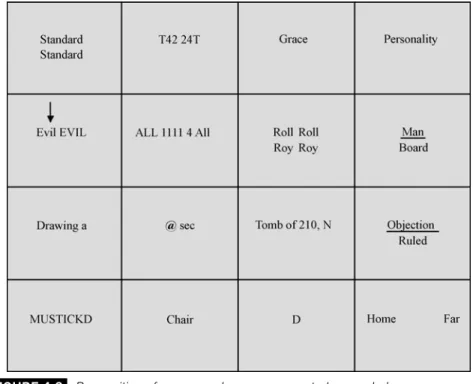
This applies to both individual firms and the sector as a whole. There are several self awareness tests available which help to determine one’s inherent creative ability. Their reliability and robustness do not form part of this chap- ter, however, one should always exercise caution when using such diagnostic instruments.Figure 4.2is an example of one such test.
FIGURE 4.2 Recognition of common phrases represented as symbols.
Adapted from: Zimmerer and Scarborough (2002, p. 40).
After reviewing the evidence, Robbins (2005) concludes that most people have the capacity for creativity so long as they are stimulated in the right way.
He proposes that creativity is a function of:
& Intrinsic motivation–the desire to apply oneself to a job because it is
inherently interesting and satisfying;
& Creative-thinking skills–personality characteristics associated with
creativity including intelligence, independence, self-confidence, risk- taking, locus of control and a tolerance for ambiguity; and
& Expertise–when the required technical ability, knowledge and other
proficiencies are present in the individual.
Adapted from Robbins (2005).
The following extract from an address by astrophysicist and Nobel Laureate Padma Vibhushan Subrahmanyan Chandrasekhar illustrates the role of ex- pertise in the creative process:
Shakespeare’s education was simple, as Elizabethan education was.
While it sufficed and stood him in good stead, Shakespeare was never persuaded by scholarship as such. Even so, when Shakespeare arrived in London in 1587, at the age of twenty-three, he had none of the advantages of a London background that Lodge and Kyd had, or the advantages of years at Oxford or Cambridge that Peele, Lyly, Greene, Marlowe, and Nashe had. There can be little doubt that Shakespeare was acutely aware of his shortcomings and his handicaps. He overcame them by reading and absorbing whatever came his way. The publication of the revised second edition of Holinshed’s Chronicles of England, Scotland, and Ireland, was particularly timely: it provided Shakespeare with the inspiration for his chronicle plays yet to come (Chandrasekhar, 2001).
It is of course extremely important for the hospitality entrepreneur to keep abreast of all related business news and economic and political trends. Before engaging in techniques designed to enhance personal and organizational cre- ativity, the entrepreneur needs to prepare. This is essential for anyone wishing to develop and enhance personal and organizational creativity. Kirby (2003) agrees noting that full benefits will only accrue if the entrepreneur indulges in:
& reading,
& attending associated conferences and trade events,
& networking,
& developing skills of listening,
& questioning, and
Idea Generation 77
& becoming self-aware, that is, what skills does the entrepreneur possess and what does she need to do to bridge knowledge gaps.
Fontelaet al.(2006) agree and the main characteristics of their‘Booster Sphere’inFigure 4.1are consistent with Kirby’s notion of preparation:
& Motivation;
& ambition;
& innovation;
& cooperation; and
& proactivity.
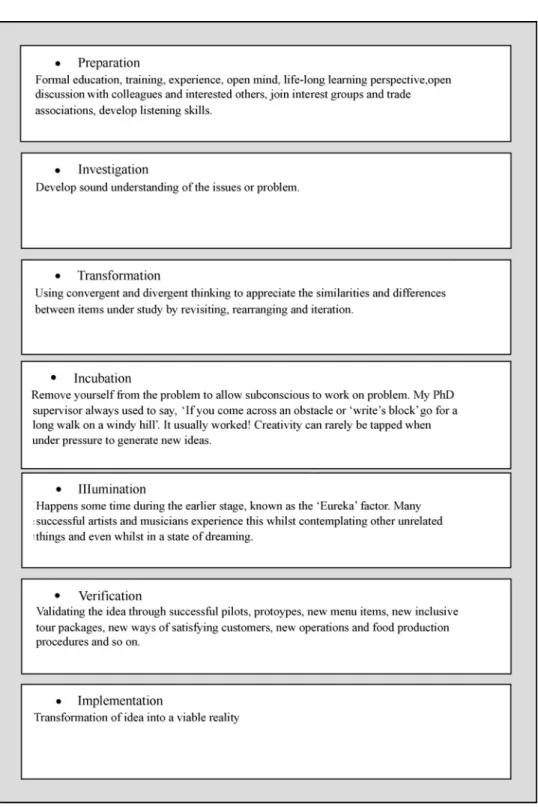
Essentially, the entrepreneur must be motivated to create an ideal internal knowledge base and develop linked attitudes and behaviours in order to cap- italize on their future creativity. Whilst subsequent‘good’ideas may appear to be spontaneous, the individual responsible with have engaged in a specific process; some stages of which are deliberate and others such as certain ele- ments of incubation and illumination are not. This process of creativity is shown inFigure 4.3.
Whilst the above appears to follow a logical and orderly sequence, the reality is somewhat different. The creative process tends to be less systema- tized and more recursive. There are no set time limits (save self-imposed ones) and the entrepreneur may not always engage in every stage. Much will depend on the context, competing work pressures and the degree of expertise the individual already possesses in the field of creativity. For example, one person may be inherently more creative than another or may be more practiced at the process.
Key point 4.3
There is no secret to creativity; it can be learned. However, there is no substitute for sound preparation such as background reading and acquisition of related knowledge from other areas. This will help increase the chances of generating creative yet practical ideas.
Many of the above stages are illustrated in the following case but there is an emphasis on‘preparation’.
Close Contest (Management of Entrepreneurs).
By Emma Allen
Successful entrepreneurs rely on more than just flair to build their businesses. Most do a lot of local research, while some even set up on their former employer’s doorstep.
Someone new to the area might have thought that the Lygon Arms (left) had the market sewn up in Broadway, but his local knowledge meant that Barry Hancox could see the gap in the market that allowed him to open his own venture, Russell’s.
As any successful entrepreneur will tell you, one of the tricks to setting up a thriving business is to do your research first. However, no amount of investigation can beat having strong local knowledge built up by first-hand experience working in the area where you intend to buy.
Knowing who your customers are, understanding trading patterns and, crucially, knowing whether there are any unfilled gaps in the local market will all give you a competitive edge.
For hotelier Barry Hancox, being able to take advantage of all of these helped to establish his new venture when he opened Russell’s, a restaurant with seven rooms in the quaint Worcestershire village of Broadway, nearly three years ago. The move was more a change of view than a relocation for Hancox. Before taking on Russell’s, he had been general manager at the four-star Lygon Arms hotel, just 200 yards up the road, where he had worked for 16 years.
While Hancox hadn’t planned it, having such a detailed understanding of the local market was, he says, invaluable. Not that the idea was to create a second Lygon Arms. He and his business partner, Andrew Riley–who previously owned the Broadway hotel, in the same village–had a clear vision of what they thought the market needed, and their focus was on a much more contemporary feel than the more traditional Lygon. Hancox explains:‘‘We knew the village needed a good restaurant, and that people were looking for decent food without the stuffiness - we got in just at the right time. And because we had this huge space up-stairs, we decided to add bedrooms. The concept just snowballed.’’
There have been clear advantages, however, such as being on the spot to secure the site–an old design workshop on the village high street. Hancox and Riley say that understanding seasonal fluctuations in a touristy area was enormously helpful in their early days, while having good corporate contacts has been useful for building midweek trade. They both also feel that raising finance would have been much more difficult without their combined local knowledge. We weren’t seen as such a risk.’’
Hancox also reckons that in some respects he and Riley have a bit of an edge over the Lygon Arms.‘‘The Lygon never got that involved with the local trade,’’he explains.‘‘It was probably seen as a bit intimidating, a bit stuffy, but we’ve always had strong support, which you need in a small place like this.’’Part of that has been down to well-pitched pricing, such as the restaurant’s early-evening fixed-price dinner menu, which has drawn in the area’s‘‘silver’’
clientele. The accommodation is also doing well, with all seven rooms fully booked at weekends throughout the summer.
Questions
1. List and comment upon the preparation undertaken by Barry Hancox.
2. How did this impact upon his ability to be‘creative’? Source: Caterer and Hotelkeeper, August 16, 2007.
COPYRIGHT 2007 Reed Business Information Ltd.
Idea Generation 79
FIGURE 4.3 The creative process.
Adapted from: Zimmerer and Scarborough (2002, pp. 52–55).
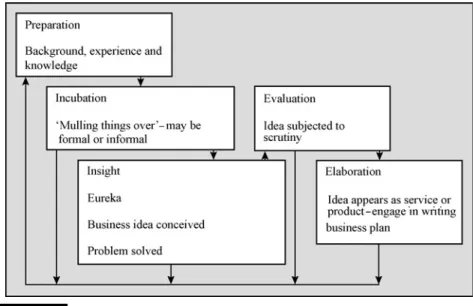
Similar to the above figure, Barringer and Ireland (2006) also consider creativity as a process noting that successful founders have the ability to recognize opportunities. They argue that creativity is the process of generating a novel or useful idea of which opportunity recognition is part and may therefore also be a creative process; this is shown inFigure 4.4.
Here the process is also viewed systematically moving from preparation to final elaboration with appropriate feedback loops. It also tacitly acknowledges that creativity is enhanced by the entrepreneur’s prior experience, cognition, ability to network and their knowledge of the area. This makes absolute sense, for example, how can a chef patron create new and exciting dishes without understanding current eating out trends, fashionable menu items, what her market will stand and how to cook?
It is one thing for the hospitality founder to be creative when their business is small but quite another to maintain and encourage creativity in others as the hotel grows. Several‘creative’strategies and ideas can be implemented to keep the hospitality founder and her employees motivated. Figure 4.5 shows a number of key individual and organizational enhancers and detractors.
In addition to the specifics of the creative process shown in Figures 4.3 and 4.4, the above are other behaviours in which the hospitality entrepreneur may engage. These are designed to optimise individual creativity and to establish an organizational culture that incubates and perpetuates similarly across the whole firm. Many of the enhancers and barriers to creativity are
FIGURE 4.4 Creative idea generation.
Adapted from: Barringer and Ireland (2006, p. 38).
Idea Generation 81
intuitive and therefore not problematic to identify. Therefore with careful planning, they could be applied in small hospitality organizations without too much difficulty. Moreover, creative behaviours are not difficult to master and a number of techniques and exercises are available in several formats ranging from self-help to consultancy workshop formats.
Key point 4.4
In order to enhance creativity in the workplace the entrepreneur must develop an appropriate culture through engagement with employees and modelling the desired behaviours.
APPROACHES AND TECHNIQUES
It is important to recognize that thousands of people come up with thousands more ideas every day, not all are successful, nor will they be pursued.
Entrepreneurs must therefore not only be creative but also innovative so that FIGURE 4.5 Barriers and enhancers: creativity.
Adapted from: Barringer and Ireland (2006) and Kirby (2003).
the idea may be applied and realize its full potential. In simple terms, creativity becomes the thinking part whereas innovation is the doing or undertaking of a creative idea. Innovation, its relationship with creativity and role within the creative process are discussed further in Chapter 5. Moreover, being creative is about more than coming up with one brilliant and insightful idea but rather about creative consistency of the founder and their employees. When hospi- tality entrepreneurs manage to gain competitive advantage over other organi- zations through implementing a creative idea it never lasts for long. The composite product (accommodation, food and beverage) is rather limited and there are only so many configurations available to the customer. It there- fore becomes increasingly difficult to think of creative ways to secure business.
However, the most successful entrepreneurs manage to spot opportunities and exploit them through creative thinking. Indeed, the hospitality industry typ- ically progresses in a uniform manner for given periods of time and then
‘spontaniously’, someone introduces a new concept which is then adapted and customized by other founders; the pattern repeats itself. For example, the impact of MacDonald’s on the restaurant industry was so profound that it gave birth to the fast food industry. Prior to this, diners had produced the same old fare in the same old manner since the turn of the last century. The MacDonald’s concept remains vital today and has been adopted and adapted on an almost ongoing basis.
Key point 4.5
In order to be creative, entrepreneurs must develop the ability to think laterally.
Accor’s concept and design of the Formula 1 accommodation some twenty years ago was an extension of the traditional Motel. However, the original hotels had an identifiable design with little in the way of luxury. This was entirely appropriate for an increasingly mobile and utilitarian customer base.
Since the 1980s the design has been changed regionally to appeal to an inter- national clientele in Belgium, Germany, Great Britain, The Netherlands, Spain, Sweden, Switzerland, South Africa, Australia, Brazil and Japan, but the core underlying principle of this brand remains.
Another example is the early success of ‘conveyor belt’ or Kaiten-zushi Japanese Sushi restaurants where food is delivered on a conveyor belt akin to a traditional automotive production line process. The original idea was born from a failure to recruit enough suitably qualified restaurant staff. The founder, Yoshiaki Shiraishi, was inspired by observing beer bottles moving around a Japanese brewery. The opening of the first restaurant in the late 1950s was
Approaches and Techniques 83
followed a decade after by others numbering over 200. Since then these restau- rants have enjoyed spells of popularity but all are based on Yoshiaki’s original idea. A more recent and highly successful adaptation is the YO!Shushi chain.
Ten years ago the founder British entrepreneur Simon Woodroffe established a number of modern hi-tech sushi restaurants in the UK; eleven more have opened internationally. Now he has diversified into the accommodation sector (YOTEL) and other retail areas. In true entrepreneurial fashion a portion of the YO! Company’s website reads:
‘‘YO! was always destined to be a retail brand and just happened to be a sushi bar in its first manifestation.’’(Mark Norton, designer of the original YO! Logo)http://www.yocompany.biz/retrievedMay 2008.
Interestingly, Woodroffe considers his business to be retail-based rather than hospitality oriented. In a sense this has allowed him to think unconven- tionally and creatively about his next venture which in turn has enhanced his ability to spot opportunities. Currently, his business interests range from restaurants to architecture and construction!
The following case also showcases creativity through opportunity spotting.
How we Got Started
Entrepreneur Margaret Dunford, 63, got her first taste of the licensed property market 27 years ago when she bought the lease to a run-down pub in Aldershot, Hampshire, with her then partner. For the first three months the business didn’t make any money.
However, having noticed that there were lots of bedsits in the area, Dunford decided to launch a take-out service providing cheap meals. Turnover quickly picked up after that.
When the customers brought the plates back they would often stop for a drink. For her next business Dunford bought a house and turned it into a seven-bedroom B&B–‘‘one of the easiest businesses to start’’–having persuaded the bank to give her 100%
financing.
An early guest at the B&B was a space shuttle engineer who was working on a simulator nearby. He liked it so much that he recommended it to his colleagues and she received a lot of trade from them after that, including the astronaut Bill Shepherd. Demand was such that she persuaded her bank to lend her the funds to open another B&B to cater for them. When the engineers’contract ended some six months later she promptly sold the second property for a profit. But the relationship didn’t end there. NASA invited her over to Florida to see a shuttle launch and she would later buy a home and a motel business there.
Three years later Dunford sold the motel for a profit. Other properties followed when she returned to the UK, including a pub in Andover, Hampshire, which she later sold for [pounds sterling] 400,000, making [pounds sterling] 190,000. Her latest venture is the Woodlands Cheese & Cider Barn & Tea Rooms, situated at the foot of Cheddar Gorge, Somerset, which she recently bought through business transfer agent Redwoods.‘‘Most people don’t
succeed in business because they don’t want to work at it. But I’m a workaholic,’’she laughs.
Source:‘‘how we got started.’’Caterer & Hotelkeeper, Sept 30, 2004), Institute of Hospitality eJournal Collection, Gale, Institute of Hospitality, 28 Apr. 2008
COPYRIGHT 2004 Reed Business Information Ltd.
RESEARCH AND EXERCISES
The ability to generate ideas is a key skill for the hospitality entrepreneur. This is not to say that all will develop into successful business opportunities but becoming practiced in creative techniques is essential. Some approaches are simply data collection procedures such as surveys where information is col- lected from a sample of individuals. Others focus on the individual through self-development exercises, some examples appear below.
& Research oriented approaches
T Surveys
When using research-oriented data collection approaches the normal protocols apply in order to ensure data is robust and reliable.
For example, survey instruments used must be simple and questions should be easy for participants to understand. More fundamentally the sample should be selected randomly and be large enough to permit useful analysis. On the other hand and in a more practical sense, some information is better than none for the small hospitality entrepreneur. Indeed, small operators will not necessarily have the resources available for a full blown scientific survey; in a sense, this is not always appropriate anyway. The hospitality entrepreneur may be considering the introduction of a new menu for their small provincial restaurant. Would a random survey of thousands within a radius of 200 kilometres be appropriate in this instance? Probably not but an existing list of regular patrons could be used to good effect.
T Focus groups
Another method of collecting large amounts of information efficiently is through the use of focus groups. It is normal to have no more than 12 group participants who have an interest in the matter being debated. This format allows open discussion and because it is a‘softer’way to elicit opinions and information, novel ideas will often emerge. The group usually has one or preferably two
moderators. One tends to lead the discussion around a few carefully chosen themes whilst the other records the information on a flip
Research and Exercises 85
chart or takes notes. There is little that cannot be debated in a focus group and the discussions contain much rich qualitative data.
Questionnaire surveys do not always deliver data of this quality unless there are hundreds of questions being posed. Forms containing too many questions are cumbersome and therefore of limited value. However, focus groups have some negative associated outcomes if the entrepreneur is inexperienced at coordinating such events. For example, it is easy to miss key items of information due to the richness of the group debate. It is also possible for one or two members to dominate the discussion. Coordinators must be able to identify this behaviour early on in the session and take the
appropriate remedial action.
T Other techniques
Approaches like the‘Delphi Technique’use the collective knowledge of industry experts to predict hospitality futures. These individuals would include senior members of allied international, national and regional associations like the World Tourism
Association, the UK-based Institute of Hospitality, the Queensland Hotels Association (Australia), advisory board members, family, friends, local Chambers of Commerce and so on.
T Brainstorming
This is a common form of training in creativity and its practice is widespread. These events have the capacity to generate many ideas in a short space of time. The set up is similar to that used in focus groups with a moderator/coordinator, flip chart and so on. The thing which differentiates brainstorming is that no logical evaluation of ideas is permitted. Obviously, there will be some differences depending on context, specific purpose and actors but all forms forbid criticism of anyone’s ideas. This is because first, criticism makes use of the non-creative left side of the brain; second, nothing is more effective in stifling ideas than criticism. The purpose during the early part of the session is quantity of ideas rather than quality.
The more outrageous or seemingly bizarre ideas sometimes prove to be the most effective stimulators of creativity; carefree expression should be encouraged by the moderator. Sessions should also move along a fast pace, this encourages people to react to ideas of others without having the time to engage logically or rationally.
& Self-development
These tests and exercises are not definitive but should be considered more as techniques and tools to help the process (making sure you
select the most appropriate for the job in hand). For example, the techniques may be divided in to several categories ranging from defining a problem and idea generation to selection and
implementation.
T Boundary examination
An example of a technique designed to help define problems is known as‘Boundary Examination’. Essentially the problem boundary is the container, which separates highly relevant items existing inside the boundary from less relevant ones existing outside the boundary. If the boundary has been provided for you because another person has defined the problem it will be inherently skewed towards their understanding as well as your own. Thus the boundary setting itself may become part of the problem. De Bono (1994) recommends a method designed to bring potentially relevant aspects back into awareness.
- Write down an initial statement of the problem.
- Underline key words.
- Examine each key word for hidden assumptions. A good way to do this is to see how the meaning of the statement changes if you replace a key word by a synonym or near synonym.
- Having explored how the particular choice of key words affects the meaning of the statement, see if you can redefine the problem in a better way.
- The aim is not necessarily to change the position of the boundary but rather to understand more clearly how the wording of the problem is affecting our assumptions about the boundary.
Retrieved from‘‘http://www.mycoted.com/Boundary_
Examination’’, May 2008 T Talking pictures
Another technique, this time for idea generation is called‘Talking Pictures’(Clegg and Birch, 2008) and is most effective when groups are failing to come up with new business ideas. Individuals should be divided into teams with each being given a digital camera and access to a printer. Allow the teams a short fixed time away from their immediate area and ask to take pictures of unusual objects and from unusual angles. Reconvene the session with all teams and invite to distribute their pictures to the other groups. Advise each team to use the pictures provided to create associations that occur to them and then use these associations for idea generation. At the end of the session you can either collect all of the ideas together by
Research and Exercises 87
writing them onto flipcharts or you can ask the groups to have listed their own and have these displayed for general perusal.
This technique uses random stimuli as an excursion with the advantage of a challenge/competition thrown in. The humour generated from the unusual objects/angles also raises the energy levels of the group, along with the fact that they have been up and moving about.
Retrieved from‘‘http://www.mycoted.com/Talking_Pictures’’, May 2008
T Other random stimuli examples
Several authors recommend the use of random stimuli of various kinds and a formal approach may look like this:
- Identify your criteria for ideas–e.g. ideas for solving a problem or tackling some aspect of it, an idea to be built on, a hypothesis to be investigated, etc. Spend some time on this stage for better-quality outcomes later.
- Pick a stimulus at random, by looking or listening to everything around you indoors and outdoors, something that catches your attention, opening a newspaper, dictionary, catalogue, book of pictures, throwing a dice at random or any other method that appeals to you.
- You should now relate this random stimulus back to your original problem; this could be done using simple free association.
- On the other hand you could go for a full excursion by describing the stimulus (how it works, what it does, what effects it has, how it is used, size, position, etc.). Followed by‘force-fit’pieces of this.
comprehensive description back to the problem to recommend relevant ideas.
- Should a random stimulus fail to work, pick another and keep trying.
& Combining fixed and random elements
T Choose a specific element of the problem and name it the‘fixed element’.
T Now select a random stimulus via any chosen method and free- associate the way in which these elements could be combined.
You can convey these directly to the problem, or use the 2- element combination itself to trigger additional ideas.
T Now select a new random stimulus, repeat the process with the same‘fixed element’and after several cycles of this choose a fresh fixed element and repeat.
& Select two to three grammatically random stimuli T Noun + verb;
T Adjective + noun;
T Verb + adverb;
T Noun + verb + noun.
T Try to create an unusual phrase, for example if you observed a school and a plane flying overhead, that might yield phrases such as‘flying school’or‘teaching flying’. You could free associate further phrase combinations from the one created so‘flying school’might generate‘elevated learning’, and so on.
Retrieved from‘‘http://www.mycoted.com/Random_Stimuli’’, May 2008 Examples of other creativity exercises may be found at the following URLs:
http://www.lifehack.org/articles/lifehack/essential-resources-for-creativity- 163-techniques-30-tips-books.html
http://www.brainstorming.co.uk/tutorials/creativethinkingcontents.html http://www.members.optusnet.com.au/charles57/Creative/Techniques/in- dex.html
http://www.virtualsalt.com/crebook2.htm
Reflective practice
1. Given the frenetic pace at which small hospitality firms operate, discuss how you would maintain personal and organizational creativity whilst engaged in managing the organization?
SUMMARY
Creativity or the ability to think creatively is an essential part of the small hospitality entrepreneur’s toolkit. It plays the key role in differentiating one small firm from another. Indeed, it also allows small independent hospitality firms to compete with their larger affiliated counterparts. As such, entrepre- neurs must have an innate or learned ability to think laterally and originally if they are to survive in the marketplace. Furthermore, being creative is not a temporary fix but rather a lifelong commitment to ensure the long term sustainable survival of the small hospitality business.
Few individuals are fortunate enough to possess significant amounts of innate creativity. However, evidence suggests that creativity can be learned provided the entrepreneur is motivated to do so and has the required
Summary 89
knowledge and field expertise. This may be achieved by careful planning, attention to detail and preparation. Stages typically involved in this process are:
& preparation,
& investigation,
& transformation,
& incubation,
& illumination,
& verification, and
& implementation.
The creative process is not necessarily linear or logical but rather recursive and organic. In fact, the very act of being creative requires the entrepreneur to first think in a lateral fashion. For some this is a challenge as traditionally western management theories promote rational and analytical thought pro- cesses using the left hemisphere of the brain.
As small firms grow the founder often becomes compelled to act more as a manager than creator. This inevitable pressure to ensure policies, procedures and controls are in place tends to stifle lateral thinking and all but eradicate creativity. There are a number of simple behaviours in which the entrepreneur can engage to ensure that:
& they remain creative,
& individual workers remain creative, and
& the organization develops and maintains a culture of creativity.
Examples of each include dealing with employees as equals, protecting those who make honest mistakes and embracing ambiguity. The founder should also model creativity, support champions and use diversity in the workforce. Furthermore, the creative entrepreneur should beware of cynicism or negativity, intolerance of high spirits and‘play’in the workplace and relying on former solutions to earlier problems.
Specific techniques designed to promote creative thinking and decision- making are wide ranging but some of the more common ones include collect- ing stakeholder data via surveys, focus groups and use of Delphi-type techni- ques from industry experts and associated agencies and other international, national and regional organizations. Each of these approaches must be care- fully planned and managed as each has inherent strengths and weaknesses.
For example, focus groups are good for collecting qualitative (rich) data but facilitators must be experienced enough to prevent certain participants from dominating others in the session as information will be skewed. Similarly, surveys using questionnaires have the advantage of collecting large amounts
of information but it may be of limited value particularly if the form is lengthy.
This is because participants tire easily and often fail to take sufficient notice of questions towards the end of the survey. Telephone surveys also suffer from this problem especially if category choices have too many response options.
Notwithstanding these challenges, the entrepreneur must ensure any research undertaken is appropriate for their business. Often a simple approach such as visits to competitors establishments may be sufficient for creative inspiration.
At a self-development level, many creativity training courses are available should the hospitality entrepreneur wish to take advantage of them.
Case author Nancy Chesworth
Department of Business and Tourism Mount St. Vincent University Canada
Summary 91