CREDIT PROGRAMS FOR THE POOR AND THE HEALTH STATUS OF CHILDREN IN RURAL BANGLADESH∗
BY MARKM. PITT, SHAHIDURR. KHANDKER, OMARHAIDERCHOWDHURY,ANDDANIELL. MILLIMET1
Brown University; World Bank; Bangladesh Institute of Development Studies;
Southern Methodist University
The impact of participation in group-based credit programs, by gender of participant, on the health status of children by gender in rural Bangladesh is investigated. These credit programs are well suited to studies of how gender- specific resources alter intra-household allocations because they induce differ- ential participation by gender. Women’s credit is found to have a large and statistically significant impact on two of three measures of the healthiness of both boy and girl children. Credit provided to men has no statistically significant impact and the null hypothesis of equal credit effects by gender of participant is rejected.
1. INTRODUCTION
This article examines the effect of additional resources supplied to and con- trolled by women, as compared to men, on child health outcomes, by gender of child. The source of these additional resources is group-based credit programs for the poor in rural Bangladesh. These credit programs are well suited to studying how gender-specific resources alter intra-household allocations because they in- duce differential participation by gender through the requirement that only one adult member per household can participate in any micro-credit program. This article thus contributes to the growing literature in which joint family decisions are derived from the possibly divergent interests of husbands and wives. The em- pirical literature has suggested that a mother’s relative control over resources importantly alters the human capital of her children; specifically that children seem to be better off when their mothers control relatively more of their family’s resources. Some of this literature has used the relative earnings of mothers and fathers to indicate control over resources. The endogeneity of earnings makes any
∗Manuscript received March 1999; revised March 2001–June 2001.
1This research was funded by the World Bank project “Impact of Targeted Credit Programs on Consumption Smoothing and Nutrition in Bangladesh” under research grant RPO 681-09. The authors acknowledge the comments of seminar participants at Cambridge University, the London School of Economics, Virginia Polytechnic Institute and State University, Georgetown University, the University of Copenhagen, the World Bank, and Brown University, as well as the comments of Ken Wolpin and two referees. Please address correspondence to: Mark M. Pitt, Department of Economics, Box B, Brown University, Providence, RI 02912, USA. E-mail:Mark [email protected]
87
inferences drawn using such measures suspect without some source of exogenous variation.2
The gender-specific additional resources in this analysis are the loans provided by the Grameen Bank, Bangladesh Rural Advancement Committee (BRAC), and Bangladesh Rural Development Board’s (BRDB) Rural Development RD-12 program. These are the major small-scale credit programs in Bangladesh, which provide production credit and other services to the poor. The largest group of program participants has been women, most of whom had no direct contact with the credit market prior to participating in these programs. The self-employment activities financed by these credit programs may affect the health status of children through the standard income and substitution effects, as well as by increasing the role and power of women in the household resource allocation process. Earlier work on the effect of these credit programs on other behaviors (Pitt and Khandker, 1998; Khandker et al., 1995; McKernan, 2001) has demonstrated that the magni- tude of the impact of borrowing on labor supply, expenditure, assets, schooling of children, fertility, contraceptive use, and self-employment profits depends on the gender of credit program participant. In this article we extend those results by not only asking if the size of the effect of program participation on child health depends upon the sex of the program participant, but also whether the effects differ by gender of the child.
All three of the Bangladesh programs examined below work exclusively with the rural poor. Although the sequence of delivery and the provision of inputs vary some from program to program, all three programs essentially offer produc- tion credit to the landless rural poor (defined as those who own less than half an acre of land) using peer monitoring as a substitute for collateral. For example, the Grameen Bank provides credit to members who form self-selected groups of five. Loans are given to individual group members, but the whole group becomes ineligible for further loans if any member defaults. The groups meet weekly to make repayments on their loans as well as mandatory contributions to savings and insurance funds. The Grameen Bank, BRAC, and BRDB also provide non- credit services in areas such as consciousness raising, skill development training, literacy, bank rules, investment strategies, health, schooling, civil responsibilities, and altering the attitudes of and toward women.
The research results presented below are based upon a 1991/92 survey of 1,798 households in 87 villages in rural Bangladesh. The earlier studies, cited above, which used these survey data confirm that program participation by households is self-selective. The estimation method used in these earlier studies corrects for the potential bias arising from unobserved individual- and village-level heterogeneity by taking advantage of a quasi-experimental survey design to provide statistical identification of the program effects. The survey design covers one group of house- holds which has the choice to enter a credit program and which may alter their
2Thomas (1990), among others, seeks to avoid this problem by using measures of unearned income.
Unearned income is not entirely exogenous with respect to past or present household behavior, and the quality of unearned income data is suspect in poor societies. Moreover, these data are contaminated by marriage market selection.
behavior in response to the program, and a “control” group that is not given the choice of entering the program but whose behavior is still measured. Similarly, the identification of these programs’ impact by the gender of the participant is accomplished based on the comparison between groups of each gender with and without the choice to participate. These programs, whose professed goal is to bet- ter the lives of the poor, may have chosen villages in a conscious manner based on their wealth, attitudes or other attributes. To deal with the possibility of endoge- nous program placement, these studies couple the quasi-experimental design with village-level fixed effects to sweep out village unobservables that might otherwise bias estimates of the impacts of these credit programs.
The 1991/92 survey included a special health status module that collected an- thropometric data on all children under the age of 15 years in 15 of the 87 villages surveyed. Unfortunately, only villages with a credit program and only households who were eligible to participate in the programs were included in this module, mak- ing identification via the quasi-experimental survey design impossible. Another identification strategy is required. As Pitt and Khandker (1998) have argued at length, an instrumental variable approach based upon exclusion restrictions is not applicable because there are unlikely to be valid identifying instruments; that is, exogenous variables affecting credit program participation (by sex) that do not also affect resource allocations to children conditional on participation. This is re- lated to the well known “more goods than prices” problem that naturally arises in the study of intra-household resource allocation. Pitt (1997) reviews some of the approaches to estimating the demand for goods within the household conditional on some individual- or household-specific endogenous choice, and suggests cross- person restrictions on demands within the household as one possible direction.3 For example, Pitt and Rosenzweig (1990) use cross-person restrictions on regres- sion parameters to estimate the effect of infant illness on the time allocation of the male and female teenage siblings and the mother of the infant. The estimated con- ditional demand equations in that article, the time allocation of male and female teenagers conditional on the health of an infant sibling, have the same structure as in this article—the health of male and female children conditional on the credit program participation of an adult household member. The idea is to estimate the differenced male–female equation conditional on the health of the infant sibling.
If the effects of some subset of exogenous regressors (prices) on time allocation conditional on infant health are restricted to be the same for male and female teenagers, these regressors became available as identifying instrumental variables for infant health in the differenced regression.
This method has two weaknesses if applied to our problem. First, it identifies thedifferentialeffects of credit program participation on the health status of boys and girls, not their level effects. That is, we could learn whether credit program participation augmented the health status of girls relative to boys, but not whether
3The problem with applying household fixed-effects estimation is that one cannot identify the level parameters of household-specific (as opposed to person-specific) regressors. Credit program partici- pation by either the father or mother of the children in a household is a household-specific variable from the perspective of the individual children in the household, who are the units of observation in the estimation.
the total effect for either gender was positive or negative, or the magnitude of the effect. We believe it is important to know if credit programs affect the health of children, not just if they differentially affect health, and thus we require another identification strategy. Second, as noted above, we need to apply a village fixed- effects estimation method in order to sweep out village unobservables that might otherwise bias estimates of the impacts of credit programs. The placement of these credit programs (by sex of participants) in villages has been shown to be correlated with unobserved village characteristics in Pitt and Khandker (1998).
Differencing across opposite-sex siblings within the family will not sweep out the effect of village unobservables unless they have exactly the same effect on each sex. This would be an unrealistic assumption to make. For example, one would have to argue that village-level attitudes on the treatment of girls relative to boys that affect their relative health status are not associated with the probability of having a woman’s or man’s credit group in the village. In other words, one would need to assume that village attitudes associated with the relatively equal treatment of girls are unrelated to attitudes on the participation of women in self-employment activities. We do not believe that parameter identification can rest on such a clearly unrealistic assumption. To sweep out all of these village unobserved factors associated with the availability of credit program by gender and with health status by gender requires actually sweeping out all gender-specific village fixed effects. Detailed price data, collected in each village market, are perfectly correlated with these village fixed effects and hence are unavailable as instruments as they are in Pitt and Rosenzweig (1990).
To estimate the level effects of credit programs by gender of the credit program participant on individual-specific indicators of well-being, we propose a set of restrictions on the error covariances of a set of gender-specific health behaviors and the decision to participate in a credit program. Chamberlain (1976, 1977a, 1977b) and Chamberlain and Griliches (1975) first demonstrated how to identify the parameters of a structural equation model from restrictions on error covariances.4 Extending their approach to our estimation problem permits identification of the level effects of credit program participation by gender of participant without requiring the imposition of difficult to justify zero restrictions that are inconsistent
4There was much subsequent work using covariance restrictions to estimate simultaneous equations models. Bound et al. (1986) extend Chamberlain and Griliches’ framework to opposite-sex siblings in studying the effect of ability on wages and schooling. Many applications of covariance restrictions make use of twins or impose a recursive structure arising out of the assumed sequential nature of the decision process, in which, for example, the schooling decision precedes the occupational decision which in turn precedes wage realizations. More recent applications make comparisons of children within the household along with their mother, as in Rosenzweig and Wolpin (1994, 1995), or comparisons of husbands and wives, as in Millimet (2000). In our application we do not assume a recursive decision- making process or make use of the peculiar restrictions that arise from comparing sets of twin. Our approach differs from most others in that it uses unbalanced cross-andown-sibling comparisons to formulate restrictions, makes use of a short panel to aid identification, permits interdependencies in health outcomes across siblings to arise from other sources, such as compensatory resource allocations, besides household-specific factors, and examines the effect of household-specific endogenous variables (female and male credit program participation), rather than individual-specific variables such as ability, on the outcomes of interest.
with a general household model, or relying exclusively on arbitrary assumptions about the distribution of errors. It does, however, require restrictions on the nature of the regression errors. The idea is to place a factor-analytic structure on the residuals of a set of equations for female and male credit program participation and a set of health measures, which in our study are arm circumference, body mass index, and height-for-age. In the estimation of the determinants of these health outcomes, the residual includes left-out household- and individual-specific variables such as relative bargaining power in the household, innate healthiness (health endowments), and preferences. These omitted variables may affect the health (and other) resources allocated to boy and girl children, but not necessarily in the same way.
The imposition of a factor-analytic structure can identify structural parame- ters with a single cross section of data providing that (i) we jointly estimate the determinants of a sufficiently large number of health outcomes that are likely to be influenced by a common latent factor, and (ii) we have a sufficient num- ber of households in the sample with more than one child and with children of more than one sex. As we demonstrate below, both conditions are satisfied by our data. In addition, we have data on health status at two points in time for each sampled household. Adding a time-period variance-components structure to the factor-analytic structure adds additional identifying restrictions to the residual covariance matrix (as in Hsiao, 1986).5Estimation is by maximum likelihood.
Our results are striking. After taking into account the endogeneity of individual participation in these credit programs and the placement of these credit programs across areas, we find that women’s credit has a large, positive, and statistically significant impact on two of three measures of the nutritional well-being of both boy and girl children. Credit provided to men has no statistically significant impact.
These patterns are not apparent when credit program participation is treated as exogenous in the determination of child health.
Section 2 of this article outlines an economic theory of household allocation to guide in the interpretation of the empirical results. Section 3 describes the estima- tion and identification of structural equations with covariance restrictions based upon regression errors with a factor-analytic structure. The precise form of the log- likelihood maximized is fairly messy and its derivation is relegated to an appendix.
Section 4 describes the 1991/92 Bangladesh micro-credit survey and the data used in the estimations. Section 5 presents and interprets the parameter estimates of our structural model and compares these estimates to those obtained from models that alternatively assume that household participation in these credit programs is exogenous and that credit programs are randomly placed across villages. Section 6 summarizes our results.
5The panel nature of the data suggests thatindividualfixed-effects estimation may be another approach to dealing with the heterogeneity bias. Unfortunately, the two survey rounds are quite closely spaced, only 6 months apart. It is well known that the signal-to-noise ratio can get dangerously low in this case leading to severe attenuation bias. Moreover, the endogenous regressor, participation in a group-based credit program, changed only slightly, if at all, for most households over this short period of time.
2. THEORY
Our objective is to estimate the effects of group-based credit program partici- pation (separately for husbands and wives) on the production of child health (distinguished by gender). To motivate the evaluation of such program participa- tion, consider a simple one-period collective model of household decision mak- ing. Since our goal is to illustrate in a simple manner the multiple avenues by which credit program participation may impact child quality, we treat the credit program as a fixed endowment of specific capital. This capital is acquired as a consequence of the endogenous choice to participate in a credit program, where participation entails some fixed cost of participation. The model allows for the preferences of men and women to differ within the household, for the possibility of gender-related productivity differences in the production of child health and other home-produced goods, and for their strength in household bargaining to depend on gender-specific program participation.
Assume that households consist of a boy and a girl child and two working-age adults—the male head and his wife. Each adult has preferences described by a person-specific utility function
us=us(hb,hg,Q,lm,lf), s=m, f (1)
wherehbandhgare the quality (health) of the boy and girl child, respectively,Q is a set of jointly consumed market goods, andlmandlfare the leisure of the male and female adult household members, respectively. The household’s social welfare is some function of the individual utility functionsU=U(uf,um). Browning and Chiappori (1998) have shown that if behavior in the household is Pareto efficient, the household’s objective function takes the form of a weighted sum of individual utilities,
U=τuf +(1−τ)um, τ ∈[0,1]
(2)
The parameterτ can be thought of as representing the bargaining power of the female household member relative to the male household member in determining the intra-household allocation of resources. Whenτ =0, female preferences are given no weight and the household’s social welfare function is identically that of the male. In accord with much of the literature, we presume thatτ is increasing in the relative value of female time and her money income.
To the extent that participation in a group-based credit program increases the value of female time and her control of money income, it also increases her pref- erence weight in (2). Without substantial loss of generality,τ is assumed to take one of two values given by
τ =
τ1 if female participates τ0 otherwise
(3)
whereτ1≥τ0.
The household produces the child quality goodhprovided to each child accord- ing to
hi=hi(Lf hi,Lmhi,Fi), i=b,g (4)
whereLf hiandLmhiis the time devoted to the production ofhfor children of sex iby females and males, respectively, andFiis a purchased input (food). In rural Bangladesh, as in much of the developing world, females supply substantially greater time to the production of child quality than do males.
Very few women in rural Bangladesh work in the wage labor market or in own- farm production that takes place outside of the home. It is a conservative Islamic society that encourages the seclusion of women. Lacking other opportunities, women are engaged in the production of household goods, to the exclusion of employment in market activities. These effects are magnified if τ is small and male preferences tend to favor production of certain kinds of household goods intensive in the time of women.
There are also economic activities that produce goods for market sale that are considered culturally acceptable. These activities, which produce what we refer to as Z-goods, do not require production away from the home and per- mit part-day labor for those who reside at the workplace. Although some of these production activities can be operated at low levels of capital intensity, for manyZ-goods a minimum level of capital,Kmin, is needed. This minimum is of- ten the result of the indivisibility of capital items. For example, dairy farming requires no less than one cow whereas hand-powered looms have a minimum size. For other activities where the indivisibility of physical capital is not an is- sue, such as paddy husking, transactions costs and the high costs of information place a floor on the minimal level of operations. In many societies these indi- visibilities may be inconsequential, but household income and wealth among the rural poor of many developing countries, including Bangladesh, is so low that the costs of initiating production at minimal economic levels are quite high.
At very low levels of income and consumption, reducing current consumption to accumulate assets for this purpose may not be optimal because it may seri- ously threaten health (and production efficiency) and life expectancy, as shown in Gersovitz (1983).
Formally, we represent the production function for theZ-goods as Z=Z(Lf z,Lmz,A,K)
(5)
whereLsz is the time by adults,s =m,f, devoted to the production of Z,K is capital used inZproduction, andAis a vector of variable inputs. If a female is the program participant (If =1), she is allocated capital Kf≥Kmin. This en- dowment from the credit program comes with the requirement that the borrower operate the self-employment activity, which is taken to mean that all labor is provided by the program participant (Lmz=0). This rules out the possibility of the male obtaining the loan, but the female supplying the labor involved in the production ofZ. Similarly, if a male participates in the program, he receives an
endowment of capital Km ≥ Kmin and must supply all of the labor (i.e., Lfz = 0). There are costs to participating in and borrowing from a group-based credit program. As our interest is not in modeling all the considerations that underlie the cost of borrowing from these programs, but rather in the implications of par- ticipation on intra-household resource allocation, we do not model these costs explicitly and simply denote them aspcf andpcm for females and males, respec- tively. An important part of these costs is the interest charged on loans, but they also include the disutility of participating in mandatory weekly group meetings, and the requirement that one monitor other group members and be monitored by them.
To complete the model, we note that the household is subject to several addi- tional constraints. First, the household’s budget constraint is
Q+pF(Fb+Fg)=v+Lmwm+(Im+If)(pzZ(Lf z,Lmz,A,K)−pAA) (6)
−Ifpc f −Impcm
where the jointly consumed market goodQis the numeraire;pA,pF, andpzare the exogenous prices ofA(inputs to theZ-good), the purchased inputFused to produce child quality, and theZ-good, respectively;vis nonearnings income, and wmis the male wage. Second, the credit programs restrict participation to at most only one adult member of the household (so thatIm+If must equal either zero or one). Finally, both adults are endowed with timeL. Men’s time is allocated to wage laborLmw, production of the child qualityLmh, and theZ-good,Lmz, and to leisure,lm:
L=Lmw+Lmhb+Lmhg+Lmz+lm
(7)
Women’s time is spent in the production of the h-good, Lfh, production of the Z-good,Lfz, and in leisure,lf:
L=Lf hb+Lf hg+Lf z+lf
(8)
The household’s problem is to decide which adult, if either, participates in the program and the allocation of household resources conditional on that participation decision. Since program participation by a married woman requires her husband’s assent, it is assumed that the male unilaterally makes the credit program participation decision for the household. He must choose among three different states: (i) no participation, (ii) he participates, or (iii) his wife partici- pates. Fully informed about the effect of participation on household income and the bargaining weight,τ, the male chooses the state that maximizes his own utility, um. It is clear that he will allow his wife to participate only if household full income increases by more than enough to offset his (potential) loss in utility due to her increased bargaining power. He will participate if his full income from producing the Z-good exceeds that determined by his market wage.
Given the solution to the participation decision, the conditional demand equa- tions for the inputs into the child health production function take the general form
L∗shi =Lshi
pA,pF,pz,pc f,pmf, v,Kf,Km
, s=m, f; i =b,g (9)
Fi∗ =Fi
pA,pF,pz,pc f,pmf, v,Kf,Km
, i =b,g
where Km or Kf (or both) must be zero. Combining (4) and (9), the effect of an exogenous increase in gender-specific capital on the health of boys and girls is
∂hi∗
∂Ks = ∂hi
∂L∗f hi
∂L∗f hi
∂Ks + ∂hi
∂L∗mhi
∂L∗mhi
∂Ks + ∂hi
∂Fi∗
∂Fi∗
∂Ks, i =b,g; s=m,f (10)
whereh∗i,i=b,g, is the optimal allocation of health to children.
There are three interesting questions that arise from examination of (10). First, does an influx of capital necessarily improve the health of children and, if so, by how much? That is, what is the sign and magnitude of (10)? Second, does the effect differ by gender of the participant? Third, does the effect differ by the gender of the child? Assuming the marginal products of the three inputs in (4) are positive, the sign of (10) depends on the effect of incremental productive capital on the demand for the three inputs, which are the partial derivatives of the conditional demand system in (9). Consequently, the sign of (10) is ambiguous since these partial derivatives reflect changes in the marital bargaining weight,τ, as well as the usual income and substitution effects, the net effect of which is not theoretically signed.
The second question asks what is the differential impact of an exogenous in- crease in male capital compared to female capital, which is given by
∂h∗i
∂Km− ∂h∗i
∂Kf = ∂hi
∂L∗f hi
∂L∗f hi
∂Km −∂L∗f hi
∂Kf
A
+ ∂hi
∂L∗mhi
∂L∗mhi
∂Km −∂L∗mhi
∂Kf
B
(11)
+ ∂hi
∂Fi∗
∂Fi∗
∂Km− ∂Fi∗
∂Kf
C
, i =b,g
The sign ofAandBare ambiguous and depend on the relative size of the own and cross effects of an exogenous increase in (gender-specific) capital on time spent in the production of child health (4).
Finally, the third question pertains to the differential effects of incremental capital on sons versus daughters (conditional on gender of the participant),
∂h∗b
∂Ks − ∂h∗g
∂Ks =
∂hb
∂L∗f hb
∂L∗f hb
∂Ks − ∂hg
∂L∗f hg
∂L∗f hg
∂Ks
A
(12)
+
∂hb
∂L∗mhb
∂L∗mhb
∂Ks − ∂hg
∂L∗mhg
∂L∗mhg
∂Ks
B
+
∂hb
∂Fb∗
∂Fb∗
∂Ks − ∂hg
∂Fg∗
∂Fg∗
∂Ks
C
, s=m, f
The termsAandBon the right-hand side of (12) may be nonzero if the productivity of adult time in the production of child health differs by the gender of the child, or if the time reallocated from the production of child health as a consequence of the incremental capital differs by the gender of the child. Similarly, the sign ofC depends both on the relative productivity ofF and any differential change in its demand by gender of child. Changes in time andFireflect changes inτ as well as income and substitution effects.
Since women do not have access to the wage labor market, the shadow price of women’s time depends on program participation, both through the increase in the productivity of women’s time associated with the self-employment that the capital endowmentKf enables, and through the change in the preference weight τ associated with women’s participation. In contrast, if men still provide time to the wage labor market, the shadow value of their time is unaffected by program participation. Moreover, since the preference weight is unaffected by male par- ticipation, such participation does not alter the shadow price of women’s time either. The only source of change in the demand for child health arises from the income effect associated with the rental value of the capital endowment provided by the credit program to the male participant. Note that although male participa- tion identifies the income effect (conditional onτ), this information does not help disentangle the substitution effect from the bargaining effect induced by women’s participation. The substitution effect of a change in the value of women’s time on child health may be positive if, for example, the increase in the value of their time induces men to devote more time to the production of child health, and this real- location produces a net increase in child health. Even if this substitution effect was assumed to be strictly negative, one could still not sign its effect on the bargaining
weight,τ, even if it were found that women’s program participation increased child health, that is, if the sign of (10) is positive. The income effect associated with women’s program participation differs from that of men’s because the increased shadow value of women’s time induces an income effect above and beyond that associated with the rental value of the capital endowment. Thus, a finding that the effect of women’s program participation on child health differs from the effect of men’s program participation does not necessarily imply that women have gained power in the household, even if women are assumed to prefer child quality more than their husbands. While it is not possible to separately identify the various av- enues by which participation maps into changes in child quality, empirical analysis will identify the signs of the comparative static results in (10), and thus (11) and (12) as well.
3. STRUCTURAL EQUATION ESTIMATION IDENTIFIED WITH COVARIANCE RESTRICTIONS
Our empirical objective is to estimate the demand equations for child health by gender conditional on the gender-specific resources provided by group-based credit programs for the landless poor. As noted in Section 2, there are not likely to be valid identifying instruments; that is, exogenous variables affecting credit program participation (by sex) that do not also affect resource allocations to children conditional on participation. This is related to the well-known “more goods than prices” problem that naturally arises in the study of intra-household resource allocation. When there are more goods than prices, even if price data were available for each good, the person-specific parameters of the un- conditional demand equations would still be unidentifiable. When prices are not person-specific, own- and cross-price effects cannot readily be disentangled (Pitt, 1997).
3.1. Structural Estimation with Sibling Data. We begin by specifying a simpli- fied version of the model we actually estimate in which a set of child-specific health behaviors depends, in part, on a common latent variable that also determines the value of a household-specific behavior, credit program participation. Consider a sample of households indexed byiconsisting of siblings indexed byjfor which we observe three related behaviors,hij,mij, andfij, in addition to the value of a household-specific endogenous variableyi. Unobserved heterogeneity, which affectsyi, is also believed likely to affect these child-specific health behaviors con- ditional onyi. As a result, estimating the determinants of these three behaviors conditional on the household-specific variable raises issues of heterogeneity bias.
However, if there is a common source or sources to this heterogeneity, it is possi- ble to estimate the parameters of the conditional demand equations by estimating the reduced forms imposing thisfactor structureon the residual covariance ma- trix. We write the conditional demand equations for the three behaviorshij,mij, andfij, conditional on a household choice variableyi(the amount borrowed from
group-based credit programs):
hij=Xi jβh+δhyi+λhµi+εi j
(13)
mij=Xijβm+δmyi+λmµi+ηij (14)
fij=Xijβf+δf yi+λf µi+υij
(15)
and the reduced form household demand foryi,
yi =Xijβy+λyµi+ξi, i =1, . . . ,n (16)
where Xij is a set of exogenous regressors not all of which necessarily vary across siblings in the same household, µi is the unobserved source of house- hold heterogeneity normalized to have unit variance, εij, ηij, vij, and ξij are error terms uncorrelated with µi, and β, δ, and the factor-loadings λ are pa- rameters to estimate. To keep the exposition simple, we have conditioned the three health behaviors hij,mij, and fij on only one endogenous variableyi, al- though in the estimation there are two gender-specific conditioned-upon en- dogenous variables (female and male credit). The appendix provides a com- plete characterization of the econometric model and the likelihood function maximized.
As a further expository simplification, we begin by assuming that the only source of correlation among these conditional demand equations is theµcom- ponent and that the errorsε,η,v, andξ are uncorrelated across behaviors and individuals.6 In the context of the theoretical model presented in Section 2, the factor µ can be thought of as preference heterogeneity. The probability that a woman will join a credit program (which precludes her husband from join- ing) quite likely depends on how her preferences in (1) differ from those of her husband, and the change in τ associated with her participation. In addi- tion, the maternal altruism hypothesis argues that women prefer investments in children more than men and are less likely to favor boys, so that nutritional outcomes by gender are also likely to be correlated with unobserved compo- nents ofτ.7
Estimation of Equations (13)–(15), which does not take into account the cor- relation between the right-hand-side regressor yi and the common source of error correlation, µi, will result in biased estimates of the δ parameters, the effects of yi on health outcomes. We can substitute Equation (16) into the
6This restriction is made only to simplify the demonstration of identification and is relaxed in the empirical implementation.
7In addition, the factorµimay reflect the family health endowment. Poor health may alter the ability of parents, women in particular, to engage in time-consuming self-employment activities, and also affect the nutritional status of children.
conditional demand Equations (13)–(15) to get the reduced form demand equa- tions forh,m, andf,
hij=Xijβ˜h+λ˜hµi+ε˜ij
(17)
mij=Xijβ˜m+λ˜mµi+η˜ij
(18)
fij=Xijβ˜f+λ˜fµi+υ˜ij
(19) where
β˜k=βk+δkβy, k=h, f,m λ˜k=λk+δkλy, k=h, f,m (20)
and
ε˜ij =εij+δhξi
η˜ij =ηij+δmξi ν˜ij =νij+δfξi
(21)
These reduced forms are correlated with each other through the common error components µi and ξi and have a variance–covariance matrix of the form,
=
h hm h f
hm m mf
h f mf f
(22)
with diagonal submatrices of the form m=
λ˜2m+ση2˜ λ˜2m
λ˜2m λ˜2m+ση˜2
≡
σm2v σmc
σmc σmv2 (23)
and off-diagonal submatrices of the form
hm=
λ˜hλ˜m λ˜hλ˜m
λ˜hλ˜m λ˜hλ˜m
≡
σhm σhm
σhm σhm
(24)
In households containing two children of the same gender (brothers), there are 13 unique variance–covariance terms that are functions of 11 free parameters (λh,λm,λf,λy, δh, δm,δf,σh,σm,σf,σy). Thus, there are two overidentifying
restrictions. Consider theuniquevariance–covariance terms σh2v =λ˜2h+σε2+δ2hσξ2
σmv2 =λ˜2m+ση2+δm2 σξ2 σ2fv =λ˜2f+σν2+δ2fσξ2 σhc =λ˜2h+δh2σξ2 σmc =λ˜2m+δ2mσξ2 σf c =λ˜2f+δ2f σξ2 σhm=λ˜hλ˜m+δhδmσξ2 σh f =λ˜hλ˜f +δhδfσξ2 σmf =λ˜mλ˜f+δmδfσξ2 σy2 =λ2y+σξ2
σhy =λ˜hλy+δhσξ2 σmy =λ˜mλy+δmσξ2 σf y =λ˜fλy+δf σξ2 (25)
whereσy2 is the variance of the composite regression error for the reduced form determinants ofyigiven by Equation (16). Recall thatσµ2=1 so that theλk,k=h, j,m, represents the standard deviations of the factorµin the conditional demand Equations (13)–(15).
A solution forδk,k =h,f,m, the effect of yi, credit program participation, can be obtained from this set of moment conditions. To demonstrate that this is so, consider an instrumental variables interpretation of parameter identification derived from this factor-analytic structure. Instrumental variable estimation of the system of Equations (13) through (16) can proceed as follows. First, eliminate the household effectµifrom Equation (13) by solving Equation (14) forµiand substituting this expression into (13), which yields
hij=Xij
βh−λh
βm
λm
+
δh−λh δm λm
yi+λh
λmmij+
εij−λh
ηij λm
(26)
In Equation (26), the variableyiis no longer correlated with the error since the sole source of its correlation with the residual of (13),µi, has been purged. On the other hand, the health behaviormijnow appears on the right-hand side of (26) and it is correlated with the residual through the error componentηij. However, valid instruments for mij exist. The values ofmik, hik andfik for all siblings of brotherj(k=j) are correlated withmijthrough the common componentµibut are uncorrelated with the error in Equation (26). Note that this model is identified by the purged instrumental variables even if the child-specific error components
of Equations (13) to (15) are correlated, that is,E(εij,ηij)=0,E(εij,vij)=0, and E(ηij,νij)=0, correlations that are permitted in the empirical application reported below, although it is far less transparent than the more restrictive model used in this example.
3.2. Interdependency of Health Outcomes across Siblings. It is clear that one can estimate the complete set of child-specific health outcome equations corre- sponding to Equations (13) through (15) by purging theµi component of each equation, as above, and identify the parameters of interest,δ. However, in its cur- rent form this model retains the unappealing assumption that health outcomes across siblings are correlated only through the household-specific componentµi. This assumption requires that child health be determined by the labor supply deci- sion of parents only, but not that of siblings. Empirical work on this topic suggests that the labor input of siblings, particularly older girls, has a significant impact on the health of younger children, as in Pitt and Rosenzweig (1990). In addition to this possible effect, interdependencies in child health may arise through the structure of household preferences. Households may compensate individual chil- dren endowed with poorer health than their siblings by transferring additional resources to them at the expense of those siblings. If we were analyzing a single outcome of children, as in Pitt and Rosenzweig (1990), allowing for interdependen- cies among children would make identification impossible. However, with three health outcomes in each of two periods for each child, interdependency can be per- mitted without destroying identification. In particular, we allow the child-specific components (the εij,ηij, andvij) of the conditional (on credit) health demand equations (13)–(15) to be correlated among siblings. We assume a common cor- relationρbof theεij,ηij, andvijamong boys, a common correlationρgof theεij, ηij, andvijamong girls, and a common correlationρbgof theεij,ηij, andvijacross boys and girls.8Test statistics reveal that in our data these interdependencies are statistically important.
3.3. Maximum Likelihood Estimation. The estimation problem described above is one of generalized least squares with an unknown error covariance ma- trix=σ2.9Ifcontains a sufficiently small number of parametersθsuch that =(θ), then this is feasible generalized least squares. The reduced form model described by Equations (17) through (19) can be estimated by maximum likeli- hood. If the disturbances are distributed as multivariate normal, the log-likelihood for a household is
lnL= −n
2ln (2π)−1
2ln|σ2(θ)| − 1
2ζ(σ2(θ) )−1ζ (27)
8Attempts to further generalize the correlations of these child-specific health errors resulted in our inability to numerically identify the model. Since the variances of the child-specific health errors are allowed to differ across health behaviors and gender, the pattern of cross-child effects (covariances) is reasonably general.
9The parameterσ2is not a new unknown parameter since the unknown matrixcan be scaled arbitrarily. Its introduction is in keeping with the common nomenclature of the least squares literature.
whereςrepresents the stacked vector of residuals of Equations (16) through (19).
In the two-brother example,n=7 because there are six child-specific behavioral equations: three health behaviors for each of two brothers plus the household- specific behavior (credit program participation). All of the estimates reported below were obtained by the method of maximum likelihood, which estimates the covariance parametersθsimultaneously with the regression parametersβ.10
Whereas the likelihood given by (27) illustrates the general principle and method used, the actual likelihoods maximized have been altered to take into ac- count six other features of the data. The first is that there are two (gender-specific) credit variables, not one as in the example above, and both are limited dependent variables. There is a substantial mass at zero for both men’s and women’s program credit. The likelihood (27) has been appropriately altered to treat the reduced form demands for credit as Tobits.
Second, the sample design is choice-based (see Section 4). In particular, program participants and target nonparticipating households are purposely oversampled.
The weighted exogenous sampling maximum likelihood (WESML) methods of Manski and Lerman (1977) were grafted onto the maximum likelihood method described above in the estimation of both parameters and the parameter covari- ance matrix. The weights used in the WESML estimation, in combination with area-level fixed effects, correct for all the endogenous stratification built into the sample design.
Third, the model estimated allows for the conditional demand equations (13)–
(15) to vary between boys and girls. Not only are the regression parameters allowed to vary freely, but the parameters that describe the residual variance–
covariance matrix are allowed to vary. In models of this sort, distinguishing among more member-types within the household, while adding many new parameters to be estimated, can in fact aid in identification as long as the same latent factor structure underlies the behavior of these member types.
Fourth, we use data from both survey rounds in the estimation. Doing so aids in identification but requires that we add a time-varying error component to the model to be estimated. Thus, the child-specific error associated with each health outcome is allowed to be imperfectly correlated across rounds.
Fifth, the number of boy and girl children in each household varies across house- holds, resulting in an “unbalanced” design. The likelihood is tailored to include all sampled children and not just a fixed number per household.
Finally, in line with our earlier work, we do not assume that the placement of these group-based credit programs across the villages of Bangladesh is exoge- nous. Program officials note that they often place programs in poorer and more flood prone areas, as well as in areas in which villagers have requested program services. Treating the timing and placement of programs as random can lead to serious mismeasurement of program effectiveness (Pitt et al., 1993). Consider the implications of a program allocation rule that is more likely to place credit programs in poorer villages than in richer ones. Comparison of the two sets of
10Estimation could also be accomplished with the generalized method of moments (GMM) using the methods described by Hansen (1982). The moment conditions, given by Equation (25), define (θ), the relationship between elements ofσ2and the parametersθ.
villages as in a treatment/control framework would lead to a downward bias in the estimated effect of the program on household income and wealth (and other outcomes associated with income and wealth) and could even erroneously suggest that credit programs reduce income and wealth if the positive effect of the credit program on the difference between “treatment” and “control” villages did not exceed the negative village effect that induced the nonrandom placement. Village fixed-effects estimation, which treats the village-specific component of the error as a parameter to be estimated, eliminates the endogeneity caused by unmeasured village attributes including nonrandom program placement.11
4. SURVEY DESIGN AND DESCRIPTION OF THE DATA
A multipurpose quasi-experimental household survey was conducted in 87 vil- lages of 29 thanas (subdistricts) in rural Bangladesh during the year of 1991–1992.
Eight thanas per program were randomly selected from the set of thanas served by that program, and five thanas were randomly selected from the list of nonprogram thanas. There are 391 thanas in Bangladesh.
Three villages in each program thana were randomly selected from a list of villages, supplied by the program’s local office, in which the program had been in operation at least three years. Three villages in each nonprogram thana were randomly drawn from the village census of the Government of Bangladesh. A household census was conducted in each village to classify households as tar- get (i.e., those that qualify to join a program) or nontarget households, as well as to identify program participating and nonparticipating households among the target households. A stratified random sampling technique was used to oversam- ple households participating in the credit programs and target nonparticipating households. Of the 1,798 households sampled, 1,538 were target households and 260 nontarget households. Among the target households, 905 households (59%) were credit program participants.12
Indicators of each individual’s anthropometric status—height, weight, and arm circumference—were collected from 15 of these villages. Collecting such infor- mation at the individual level is costly and time consuming; therefore, the study was limited to a subsample of the original 1,798 households. The anthropometric data were collected from three villages in five program thanas chosen at ran- dom. Two of the five thanas (Patuakhali and Shakhipur) contain a Grameen Bank, two (Rangpur Sadar and Habgianj Sadar) contain a BRAC program, and one (Matbaria) contains a BRDB program. Households were randomly se- lected to be anthropometrically measured within each of the 15 villages based
11One important drawback of estimating program impacts from this approach is the possible mis- interpretation of the village fixed effects. It is possible that credit programs can alter village attitudes and other village characteristics, perhaps through demonstration or spillover effects, and thus the at- titudes of those who do not participate in the credit programs as well as those who do. These spillover effects are captured by the fixed effects and not appropriately credited as a result of the program. It is generally not possible to estimate the village externality from a single cross section of data. This issue is discussed in more detail in Pitt and Khandker (1998).
12Note that endogenous stratification by thana does not require weighting in the estimation as long as the model is estimated with thana-level fixed effects. WESML estimation is still required to correct for endogenous sampling within thanas.
on a village census and the sample selection rules detailed in Khandker et al.
(1995), altered to increase the sample size to approximately 20 households per village instead of 17 in all other sampled villages. Although the original house- hold survey design called for anthropometric measures of individuals residing in nontarget households, the final survey included only those residing in tar- get households. This precluded the use of the quasi-experimental survey de- sign used to identify program effects in Pitt and Khandker (1998) and Pitt et al.
(2000).
The rural economy in Bangladesh revolves around agricultural activity. Both economic welfare and food consumption are highest after the major rice crop, aman, is harvested and are at their lowest just prior to the harvest. To avoid confounding seasonal effects with actual credit effects, anthropometric measures were collected twice; during the peak consumption period (January to April 1992) and during the lean period (September to November 1992).
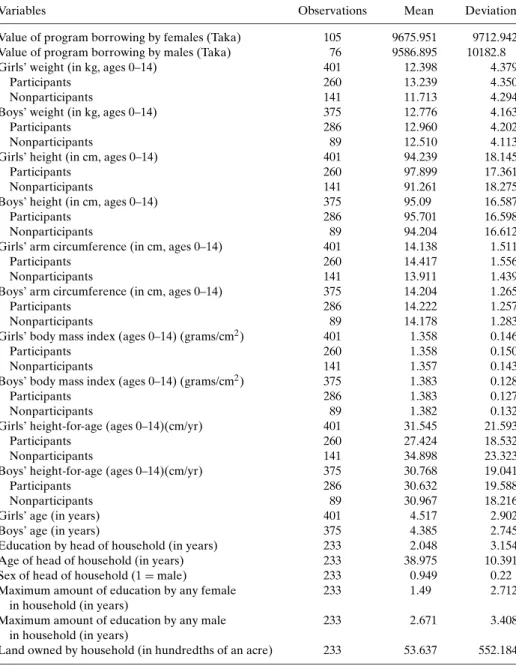
The measure of credit used below is the natural logarithm of the amount bor- rowed separately by male and female program participants from any of these three group-based credit programs (in constant taka) plus one. The measures of nutritional status for children under the age of 15 are the natural logarithms of arm circumference (in centimeters), body mass index (weight in kilograms divided by height in centimeters squared), and height (in centimeters) for age (in years).
All regression equations also include a number of exogenous characteristics of households—the age, gender, and sex of the head of the household, the amount of land owned, and the highest education level achieved by any male and any fe- male household resident—as well the age and age squared of individual children.
Table 1 presents the weighted means and standard deviations of all these variables.
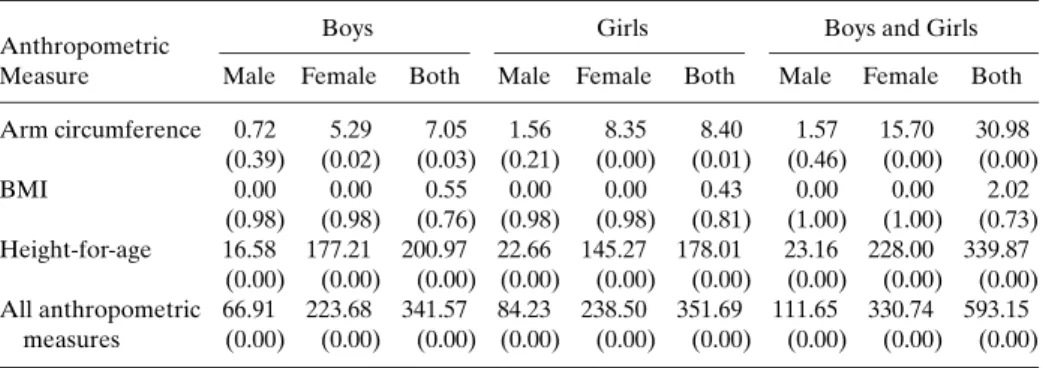
As noted above, eight equations are jointly estimated—six equations for the anthropometric status of boys and girls, and two credit equations for males and fe- males. There are 65 parameters associated with exogenous variables (see Table 1) to be estimated, in addition to 21 factor loadings, and 12 structural parameters (credit effects). Introducing thana fixed effects adds 40 additional parameters, whereas introducing village fixed effects adds an extra 120 parameters. Finally, as discussed in Section 3.2, the child-specific interdependencies that allow the idiosyncratic components of each error term to be correlated within and across children (in the same time period) adds three additional parameters. There are a total of 141 parameters jointly estimated in the thana fixed-effects model and 221 with village fixed effects.
How many covariance restrictions are required to estimate these models and how many are actually made? The answer depends crucially on the demographic characteristics of the sample. The best-identified case is for households with two or more boys and two or more girls surveyed in both rounds. Having more than two children of any gender does not add to identification since the error covari- ance between brother A and brother B is not different from the error covariance between brother A and brother C or between brother B and brother C. Our data represent an unbalanced random effects design since households have differing numbers of sons and daughters, and in some cases anthropometric measurements were not taken in both rounds.