Suharni Maulan is an assistant professor at the Department of Business Administration, Kuliyyah of Economics and Management Sciences, International Islamic University Malaysia. Dhika Amalia Kurniawan is a senior lecturer in the management department at the University of Darussalam Gontor (UNIDA) Indonesia. She has a Master's in Management at the Faculty of Economics and Business from the University of Sebelas Maret Surakarta, Indonesia.
Ely Windarti Hastuti er lektor i ledelsesafdelingen ved Darussalam Gontor University (UNIDA Gontor), Indonesien. Fajar Surya Ari Anggara er seniorlektor i ledelsesafdelingen ved Universitas Darussalam Gontor (UNIDA Gontor), Indonesien. Hartomi Maulana er seniorlektor i ledelsesafdelingen ved Darussalam Gontor University (UNIDA Gontor), Indonesien.
Rahma Yudi Astuti adalah Dosen Senior Departemen Manajemen Universitas Darussalam Gontor (UNIDA Gontor), Indonesia. Roghiebah Jadwa Faradisi adalah Dosen Muda di Jurusan Manajemen Universitas Darussalam Gontor (UNIDA Gontor), Indonesia.
BUSINESS SUCCESS FACTORS OF SMES IN MALAYSIA: An Empirical
Problem Statement
The most important questions that may arise after knowing the support programs mentioned above are: To what extent have the technical and financial support programs contributed to the business success of SMEs and what are the current problems or challenges that represent the main obstacles to the success of SMEs.
Research Objectives
Research Questions
What are the factors that determine the success of the company in the SME sector in Malaysia? What is the relationship between business dimensions success and SME performance in Malaysia.
Significance of the Chapter
Limitation of this chapter
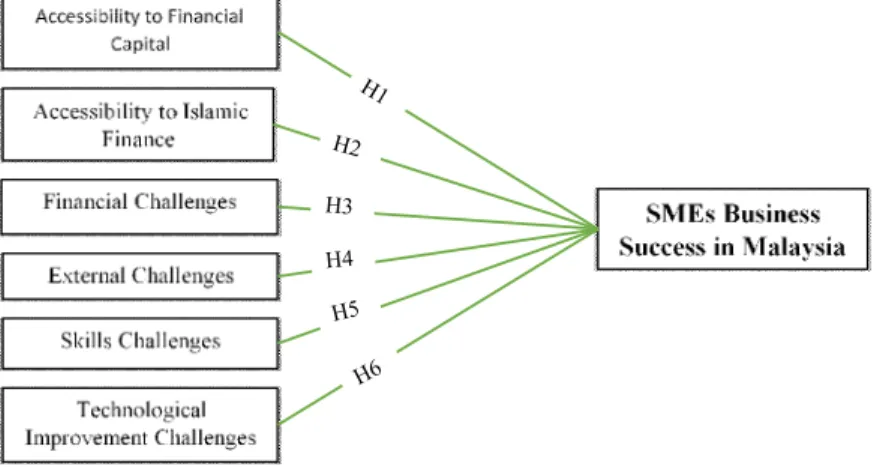
Conceptual Framework
H4: The fewer SMEs have external challenges, the more SME activities will succeed and grow. Generally speaking, the definition of small and medium enterprises (SMEs) varies from country to country (Omar, Arokiasamy, & Ismail, 2009; Jasra, Khan, Hunjra, Rehman, & Rauf-I-Azam, 2011). . Each researcher has tried to provide a definition that is often different from that of other academic researchers, and they have not proposed a standardized definition because they are used to looking at the issue from narrow angles, each according to its own specific focus.
In general, SMEs from an international business perspective were defined based on each country's economic and social development concept. In China, for example, small enterprises are defined as enterprises with fewer than 300 employees, and medium-sized enterprises as enterprises that have between 301 and 2,000 employees, while in Taiwan enterprises with 650 or fewer employees are defined as SMEs ( Xiangfeng, 2008 ). On the contrary, Mozambican SMEs are defined as small enterprises that have less than ten employees and medium enterprises with employees between 11 and 50 employees (Osano. & Languitone, 2016).
According to SME Corporation Malaysia (2018), the definition of SMEs is based on fixed quantitative criteria such as number of employees, sales turnover, total assets or total capital. For example, in the manufacturing sector, small enterprises are enterprises that have less than 200 employees or their sales turnover is less than 50 million ringgit, while small enterprises are described as companies with 5 to 75 employees or have a sales turnover of less than 50 million ringgit. Unlike the manufacturing sector, in the service sector and other sectors, any company with 30 to 75 employees or companies with a turnover of 3 to less than 20 million ringgit are categorized as medium enterprises.
On the contrary, the small companies in these sectors are companies with 5 to 30 employees or sales turnover of 300, 000 and 3 million ringgit (Council, 2005). Sales turnover from RM300000 to less than RM15 million OR Employees from 5 to less than 75. Sales turnover from RM15 million to not more than RM50 million OR Employees from 75 to 200 Services and.
Sales price set from RM300,000 to less as RM3 million OR Employees from 5 to less as 30.
Business Success Factors of SMEs
OR Employees aged less than 5. Sales turnover from RM300,000 to less than RM15 million OR Employees from 5 to less than 75. OR Employees aged less than 5. Sales turnover from RM300,000 to less than RM3 million OR Employees from 5 to less than 30. Recently, Lückmann & Feldmann (2017) conducted a descriptive study to identify the factors that influence the success of projects and pointed out that until there are studies on this topic, if there is a quantitative study, it will be a descriptive study confirmed, and research of the most important research.
The results showed that there are nine variables that influence the performance of SMEs, but eight of them belonged to one branch, that is, organizational culture, and the rest belonged to project management skills. They have high risk factors such as lack of guarantees and adequate credit history. However, according to a 2014 report by the World Bank's International Finance Corporation, there is a US$13.2 billion shortfall in Islamic finance in the MENA region.
The characteristics of access to finance can be illustrated by several elements, namely credit access, adequacy, affordability and duration of the credit. In the context of Malaysia, Abdullah et al., (2010) emphasized that the proportion of SMEs that had access to finance was very small and that most SMEs did not get financing opportunities despite the existence of several financing institutions in the country. . Similarly, capital market financing for the SMEs is one of the biggest corporate policy challenges, especially under the concept of diversified financing, which requires advanced institutional procedures and innovative reforms to respond to SMEs' needs.
Improving ITC has become one of the most effective tools in terms of cost and speed. 2011) assessed the role of the main factors that play a key role in the success of SMEs in Pakistan by investigating the relationship between the determinants and the success of SMEs. The results showed that financial resources are the main success factor of SMEs, followed by technological resources and entrepreneurial skills.
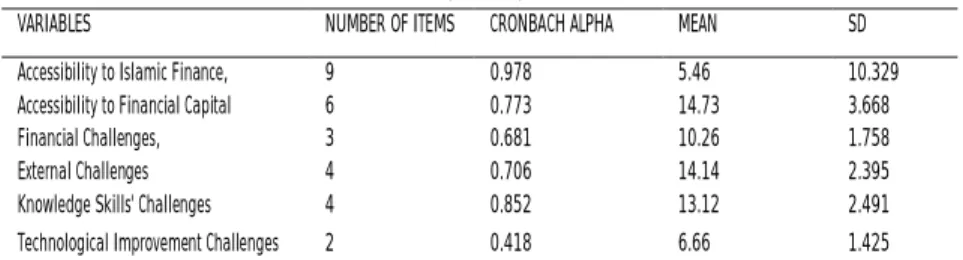
A reliability test was applied to identify multicollinearity issues and check the internal consistency of the data.
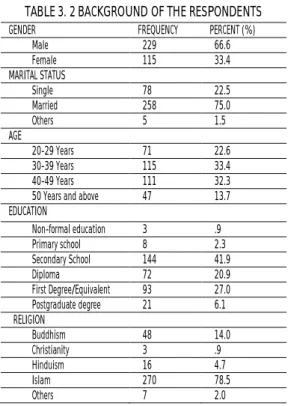
Respondents Background
The primary data was collected through questionnaires distributed to the formal SMEs' owners or business managers in Malaysia. Six enumerators were appointed to conduct the survey and the entire survey was monitored periodically to maintain the accuracy and validity of data collection. To realize this practically, a set of questionnaires was designed and the questionnaires were then administered to the respondents in Malaysia.
Therefore, the data collected was then analyzed using descriptive statistics as well as inferential statistics through SPSS software to see the level of significance between the variables.
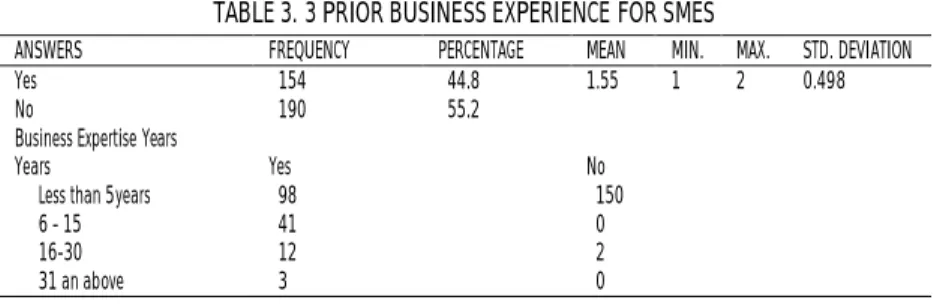
Business background
Total sales turnover and total asset turnover per year ranged from RM10,000 to RM23 million, and RM3,000 to RM50 million respectively.
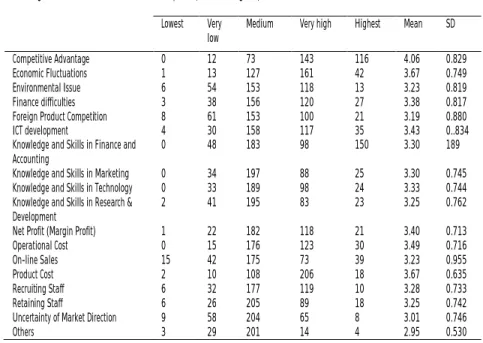
Level of Challenges
Reliability Test
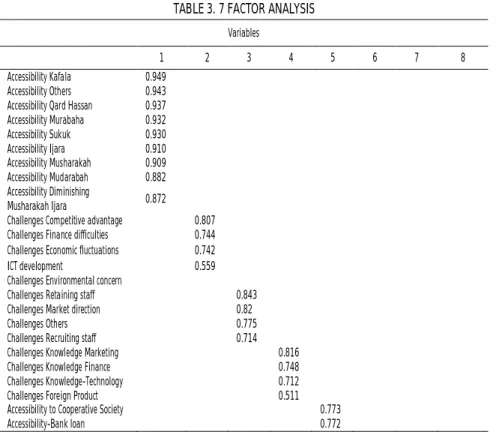
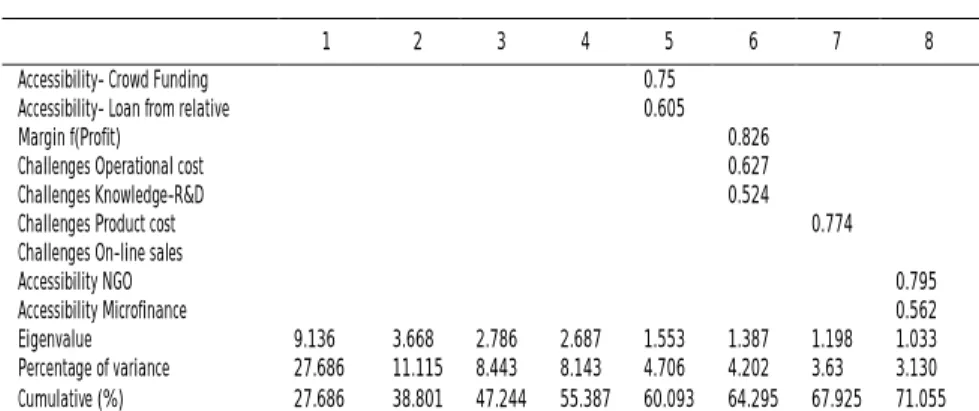
The results in Table 6 confirm that there is sufficient intercorrelation, as the KMO sampling adequacy measure is 0.814 (a value greater than 0.6 is a good measure). As a general rule, a KMO value of 0.6 is acceptable and a value closer to 1 is better. Bartlett's test of sphericity was also used to test the significance of the relationship between construct items and if there is no correlation between the construct items then it is not worth proceeding with factor analysis.
All Cronbach á reliability values are above 0.7, except for the variables "Technological Improvement Challenges (0.418)" and "Financial Challenges (0.681)". Nunnally (1978) suggested that a reliability value of .70 or higher is acceptable when used in basic social science research. Thus, the value of 0.418 for “Technology Improvement Challenges” is lower than the required value, so the variable should be neglected.
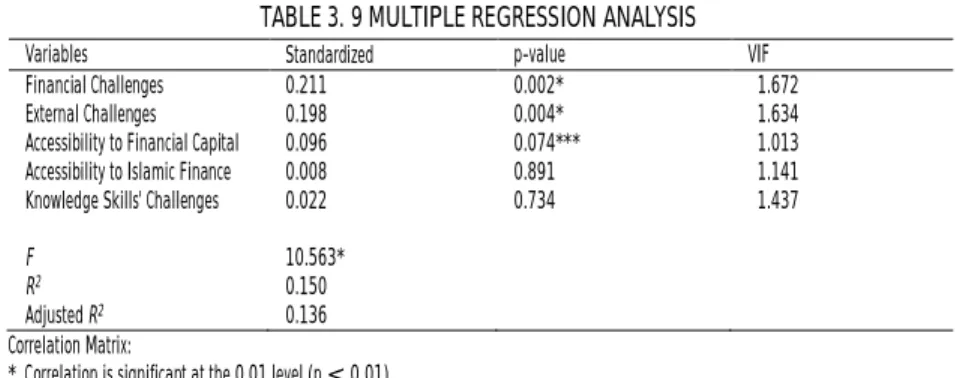
In addition, the results of the multiple regression analysis will later show that the variable is also significant.

Hypotheses Testing
The results of the hypothesis test indicate that the three factors - financial challenges, external challenges, availability of financial capital, influence the business success of SMEs in Malaysia. This means that financial challenges, external challenges, availability of financial capital are the key factors for the SME sector and therefore their influence on the success of the company is great. Thus, the owners or entrepreneurs of the SMEs in Malaysia also emphasize this importance through the findings of this chapter (H1: rejected).
However, all the previous factors have significant effects on SMEs' business success, and therefore the chapter found a positive relationship between the external challenges and SMEs' business success in Malaysia in terms of statistical significance. On the contrary, these results were somewhat contrary to the results obtained by Ali, Thabit Masheko; Mnzava, (2013) who indicated that some SMEs, especially in the rural area, have little access to financial capital, although it is available, because the SMEs' owners do not like to deal with the loans in their business and also because of the presence of internal sources of financing. Accessibility to Islamic finance showed a positive relationship with the SMEs' business success, but the relationship is not significant.
Overall, the results of the empirical study showed that there is a positive relationship between independent reliable variables (financial challenges, external challenges, access to financial capital) and business success of SMEs. In terms of statistical significance, only three variables were significant, namely financial challenges, external challenges and access to financial capital, which confirms the importance of these variables in SME owners in Malaysia. In addition, the other two variables (access to Islamic finance and knowledge and skills challenges) are important for business success, but to a lesser extent in the SME sector, which can be explained by the absence of some elements that might be important. - important but not included in this chapter.
The SMEs sector plays a crucial role in local and international economic development, and therefore their business success is absolutely vital. Therefore, this chapter aimed to examine the main factors that can impact the growth and success of SMEs' business in Malaysia. The chapter found that all the variables have a positive relationship with the success of the SMEs' business, but only three of them are significant (financial challenges, external challenges, accessibility to Financial capital).
In addition, researchers and academics can take advantage of the results of this chapter and conduct extensive research to clarify other variables that are not addressed in this chapter and appear to be important in SMEs' business success.