Helen Spencer-Oatey is a professor and director of the Center for English Language Teacher Education at the University of Warwick. I would also like to thank the reviewers of the new book chapters for their willingness to help in this way.
Face
Interactional goals refer to the specific task and/or relational goals that people may have when interacting with each other. The attributes that people are sensitive to face can apply to the person as an individual and also to the group or community to which the person belongs and/or identifies.
Sociality rights and obligations
Association: We have a fundamental belief that we have the right to social inclusion with others, in accordance with the type of relationship we have with them. These rights of association relate in part to interactional involvement-disengagement (the degree to which we associate with, or detach from, people), so that we feel, for example, that we are entitled to an appropriate amount of conversational interaction and contention. social. talk to others (eg not ignored on the one hand, but not overwhelmed on the other).
Interactional goals
Rapport-threatening behaviour
These procedural aspects must be addressed appropriately if harmonious relationships are to be created and/or maintained. These stylistic aspects must be handled properly if harmonious relationships are to be created and/or maintained.
Rapport management strategies
Illocutionary domain: speech act strategies
Upgraders have the opposite effect, and usually function to amplify the negative impact of the speech act. Embedded performatives: utterances in which the designation of the illocutionary force is modified by embedded expressions, e.g.
Other rapport management domains
The request in the example is large, so the main act contains four different types of reducers in an attempt to reduce the negative impact of the request on the other person. Moreover, there may be differences in the ways in which the three types of wording choices1 (selection of semantic components, direct/indirect degree, and use of enhancers/decreminators) interact with each other, and in the relationship-management value of these combined. elections.
Communication style and interactional ethos
By using downgraders/upgraders; for example: I'm sorry I can't come is less blunt than / can't come', and clean up, will you. By the number of elements used to convey a message; For example, I'm sorry I'm late is a blunter apology than I'm sorry I'm late.
Factors influencing strategy use
When people are focused on improving a relationship, they want to increase the harmony of the relationship. When people have a relationship-challenge orientation, they want to challenge or threaten the harmony of the relationship.
Factors influencing strategy use
- Participants and their relations
- Message content: cost-benefit considerations
- Social/interactional roles
- Activity type
- Overall assessments of context
A person can be said to have power over another to the extent that he is able to control the behavior of the other. People have a right to expect certain things from the other member and an obligation to perform certain other things.
Factors influencing strategy use: •tup Serf* *f
If the interaction is to be 'successful' in terms of rapport management, participants must be very sensitive to these complex processes.
3) Pragmatic principles and conventions
Sociopragmatic principles
For effective rapport management, the concerns of both self and others must therefore be taken into account by all parties. Moreover, people seem to hold lower-level principles regarding styles of interaction; for example, how warm, assertive or modest it is appropriate to be in a given context.
Pragmalinguistic conventions
Rapport management outcomes
Sociopragmatic principles: people from different cultural groups may have different principles for managing rapport in given contexts. Pragmalinguistic conventions: people from different cultural groups may have different conventions for selecting strategies and interpreting their use in given contexts.
Rapport management across cultures
Is the situation likely to be dangerous to the face of any of the participants, and if so, why. Chapters 5, 6, and 7 of this book provide excellent coverage of many of the issues discussed in this chapter.
Introduction
This makes the stone a prized possession, but I hope you'll agree that the stone isn't really a cultural thing. Now imagine that you put the pebble in your pocket, you take it home and spend some time thinking about what you can do with it.
Culture
If this sketchy account of what makes a thing part of culture is in the right direction, then the study of culture appears to be similar to the study of epidemics. In the same way, a culture cannot exist without some cultural representations being in the brains/thoughts of individuals, but it does not follow that the study of culture can be reduced to the study of individual psychology.
Communication
- Grice's Co-operative Principle
- Relevance Theory and the Communicative Principle of Relevance
- The role of contextual knowledge in communication
- Schema, frame and script
- Directness-indirectness in communication
It is more reliable because you have no reason to doubt the sincerity and competence of the passerby. An assumption is said to be directly communicated if it is part of the thought expressed by the meanings of the words used (technically called the 'explanation' of the expression).
Culture and communication
- Culture and contextual knowledge
- Culture and schemata
Example (6) shows that the availability of contextual assumptions required for the interpretation of a communicative act is largely culture specific. In light of the Indian participant's response, the French participant will most likely revise his schema about the 'Indian person'.
Conclusion
The smaller the common knowledge of the participants, the more difficulties they will have in communication. Task: Try to find several examples of euphemisms that can be explained in terms of the local culture in which they are used (Lambert 2001).
Introduction
- Apologies in Japanese and English: stereotypical conceptions
My Japanese friend was shocked and offended by their behavior, feeling that Japanese parents would have apologized in that situation, and that the Australian parents were rude and even insulting. However, when I discussed the incident with some Australian friends, I was told that the attitude of the Australian parents was acceptable because their daughter was an adult.
Cross-cultural Perspectives
- Linguistic studies of Japanese and English apologies
In addition to examples of women apologizing for the accidents of their husbands (. .), children (. .) and pets (. .), Japanese conduct manuals contain numerous examples of people apologizing for others' misbehavior such as: (a ) parents' excuse for offenses committed by their adult children, in situations such as a car accident. However, for the Americans the second most common overall choice was 'explain the situation' (21.5 per cent for the Americans, 12.2 per cent for the Japanese), while for the Japanese it was 'do something for the other person' ( 21, 1 percent for the Japanese, 15.3 percent for the Americans).
Research Procedure
- Design of the questionnaire
- The respondents
- Contextual assessments
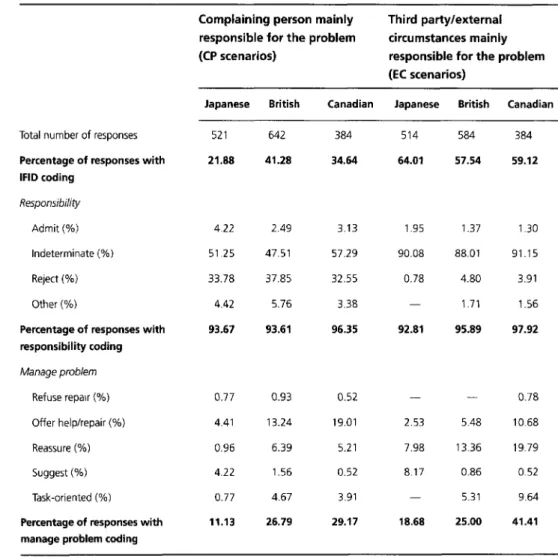
For half of the scenarios, the responsibility for the offense lay mainly with the person who filed the complaint (henceforth CP scenarios); for the other half, responsibility for the offense lay mainly with a third party or due to external circumstances (hereinafter EC scenarios). In the first two pairs, the complaint was against the respondent personally (the student and the friend, respectively); in the second two couples, the complaint was directed against a 'relevant party' for the defendant (the defendant's employer and the defendant's father, respectively).

Results
- Production responses
For the CP scenarios, British and Canadian respondents rated these as more important to "make the person less annoying" than Japanese respondents. They were also fairly similar for the ES scenarios in terms of 'meaning that the person is less disruptive'.
Discussion
- The effect of situation
- Representativeness of the respondents
- The research procedure
One possibility is that people's stereotypical conceptions of the forgiving behavior of Japanese compared to that of English speakers are incorrect. Another possible explanation for the findings is that people's conceptions of Japanese and English apology behavior are correct for certain types of situations but not for others.
Concluding comments
When conducting cross-cultural studies, it is essential to consider the representativeness of the sample and to be aware that there may be generational differences in people's normative behavior. However, only a very small percentage of responses contained such strategies, so the results of these additional codings are not reported here.
Appendix
Introduction
- Taxonomies of compliment response strategies
- Compliment responses in Chinese and English
This chapter reports a preliminary study of British, Mainland Chinese, and Hong Kong (henceforth HK) Chinese evaluative judgments of compliment responses. Thus, complimenters must find ways to resolve this conflict, and a wide range of compliment response strategies have been identified to address this conflict.
Compliment response strategies
- Evaluating compliment responses
- Design of the questionnaire
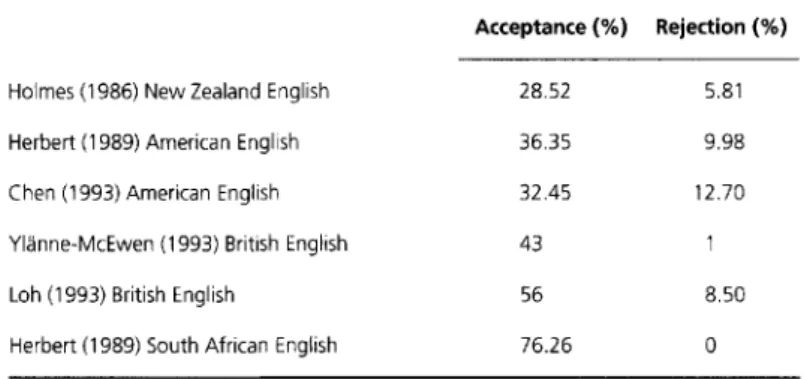
Indeed, studies that have examined responses to compliments in Chinese have almost all found that rejections are much more common than in English, but, as Table 5.3 shows, most studies have also found that acceptance responses are relatively common. This leads us to the question: how do people evaluate different types of responses to compliments.
Research Procedure
- The respondents
- Quantitative results
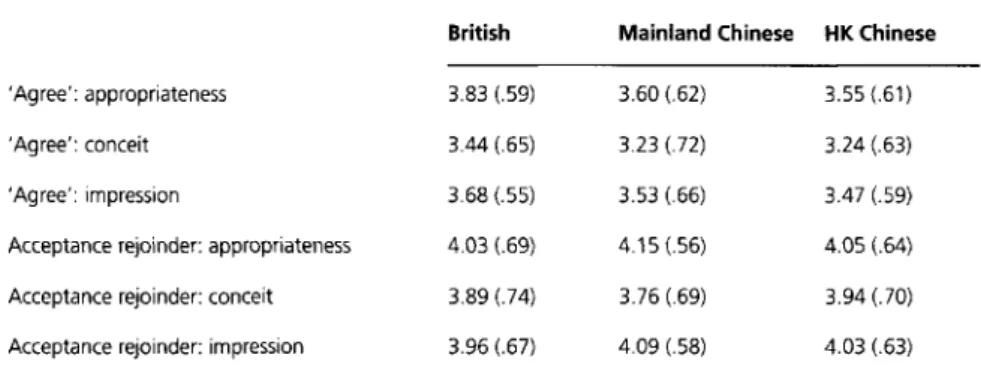
Respondents were asked to rate each of the responses in terms of appropriateness, conceit and impression (favorable/bad). As explained in Section 5.3.1, respondents rated each of the compliment responses for appropriateness, conceit and conveyed impression (favorable/bad).
Evaluations of acceptance responses
- Qualitative results
- Quantitative results
Analysis of variance results showing the effect of citizenship on acceptable response scores are given in Table 5.5. Analysis of variance results showing the effect of citizenship on acceptable response scores are given in Table 5.7.
Evaluations of rejection responses
- Qualitative results
- Modesty
For each of the three groups of respondents, 'disagree' responses attracted the most comments. Like British respondents, both Mainland Chinese and Hong Kong respondents commented on the inaccuracy or untruthfulness of the 'disagree' responses: there were 74 comments from Mainland China and 27 from Hong Kong.
Discussion
- Agreement and face
- Self-presentation
Perhaps surprisingly, neither group of respondents rated any of the acceptance responses as presumptuous. This appears to have been the interpretation given by a fair number of British respondents in this study.
Concluding comments
For example, many British and Chinese respondents evaluated 'disagreement' responses in terms of the impression they gave of the speaker. Similarly, many Chinese focused on the speaker and evaluated the "disagreement" responses negatively, claiming that they made the speaker sound conceited or insincere.
Introduction
- The data sample
- General structure of telephone openings
The bulk of the literature on telephone conversation (from the seminal studies of conversation analysts up to recent cross-cultural approaches) concerns the introductory part (see, for example, Hopper 1992; Luke and Pavlidou 2002a); It is in this sense that Laver speaks of the opening and closing phases of a conversation as 'the psychologically decisive margins of interaction'.
Telephone openings
- Greek openings - German openings
- Discussion
- The data sample
- General structure
- Greek closings - German closings
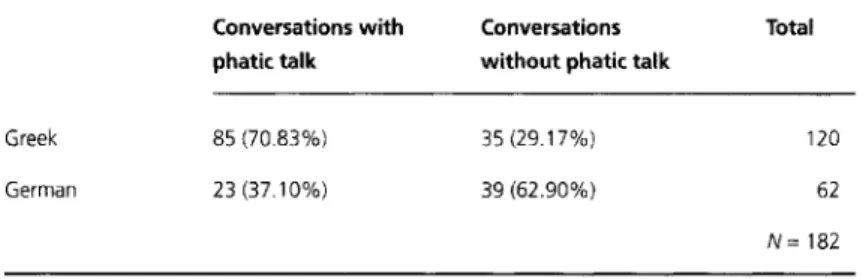
Using the dataset described above, I compared the use of phatic talk in Greek and German telephone conversations, focusing on the part that follows the initial response, the identification and the greeting, and that precedes stating the reason of calling. However, fifteen of the German calls belong to the corpus of Brons-Albert (1984), and another two come from the so-called Freiburger Korpus (TSG 1975).
Telephone closings
- Discussion
In the following, I would like to focus on some phenomena of repetition in Greek and German endings. In addition, Greek terminations show a greater degree of redundancy in the use of elements that are integral to the termination part of a telephone call.
Phatic communion and the
For example, as I have argued elsewhere using Laver's framework, German closures emphasize the 'consolidation of the relationship', while Greek closures are organized towards a 'cooperative separation' (Pavlidou 1997: 160 ). A cross-cultural comparison of the realization patterns of request speech acts in Persian and American English.
Introduction
Our main aim is to provide the reader with a good vantage point for further independent investigation of pragmatic transfer in the context of intercultural communication. It is by definition a cognitive phenomenon, because it concerns certain aspects of human knowledge, but it must also be studied descriptively from a social point of view, because the observation and analysis of communicative behavior (whether based on naturally occurring or experimentally elicited data) provides by far the most important source of evidence for pragmatic transfer.
What is pragmatic transfer?
Although it is customary to study pragmatic transfer in the context of second language acquisition, this is by no means necessary: as the example of offering coffee shows, pragmatic transfer is relatively independent of language, because pragmatic knowledge is distinct, though related to , language knowledge. There is no foolproof procedure for failing to prove that a communicative act has been influenced by pragmatic transfer.
How can pragmatic transfer
Let us further assume that, in the same type of situation, native speakers of another language Y (LY) typically accept compliments but downplay (and are culturally expected to downplay) their meaning. It seems reasonable to assume that native speakers of LY learning LX can respond to compliments in LX in the same way they would in LY.
How can pragmatic transfer
- A quantitative study of pragmatic transfer: Yoon (1991)
- A qualitative study of pragmatic transfer: Tyler (1995)
- Three questions for pragmatic analysis
At the beginning of the interaction, the student asks if the teacher knows how to keep score in bowling. In the context (i.e. the set of background assumptions) immediately available to the student, the hedge seems 'approximately' relevant as an indication that the teacher is less than fully competent as a bowler (a useful study of hedges or downgraders). , Itani 1996).
Explaining Pragmatic transfer
- Pragmatic competence and pragmatic transfer
The student's context includes several assumptions that indicate that many aspects of the relationship are negotiable. An important part of the speaker's task is to anticipate the set of contexts available to the addressee.
Are there different types of pragmatic
- Pragmatic transfer and second language acquisition
The primary purpose of the tutoring is to help the student with a computer programming assignment. The purpose of the tutoring is to get help with her computer programming assignment.
Pragmatic transfer, pragmatic theory and second language acquisition
- Is 'pragmatic transfer' a useful term?
The term 'pragmatic transfer' is probably best understood as referring to the projection of existing knowledge into new communication situations. Pragmatic transfer is best seen as a special case of general knowledge transfer (in the sense in which this term is used in psychology).
Conclusion
Pragmatic transfer can be identified by observing a person's communicative behavior in the host culture and comparing it to their communicative behavior in the home culture. Pragmatic transfer can lead to miscommunication (a) when the speaker's and hearer's background knowledge from which the context for interpreting the utterance is selected differ significantly, and (b) the speaker and hearer are unaware of these differences.
Culture and the perception of situations
If we observe that communicative behavior in the host culture is informed by the attitudes, values, norms and conventions of the home culture, then we have good reason to assume that communicative behavior in the host culture is partly due to pragmatic transfer. . Explaining pragmatic transfer has practical and theoretical implications: practical, because they can help us understand, solve, and predict problems in cross-cultural communication, and theoretical, because the possibility of explaining pragmatic transfer can provide evidence for or against theoretical frameworks.
Communication strategies and pragmatic transfer
Creating rules of thumb for intercultural communication
- Introduction Chapter Outline
- Central concepts of accommodation theory
- Accommodation research in
- Cultural difference: some dilemmas
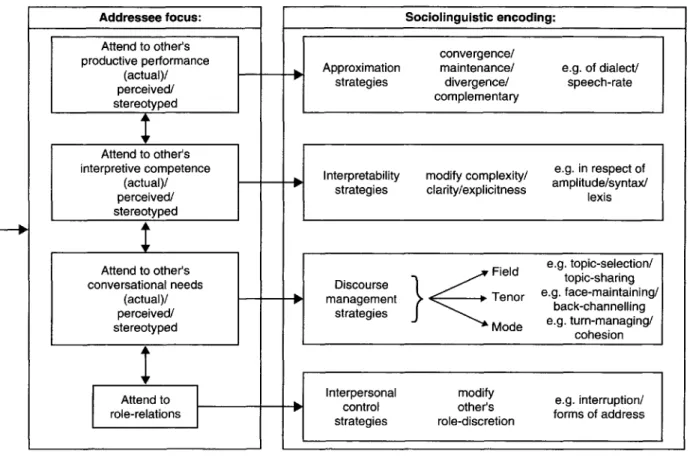
- Introduction: adaptation, identity
Thackerar et al. 1982), helps clarify communication processes. 2005) revise and synthesize the model in what they call 'Phase 3' of CAT history: they draw attention to the 'sociohistorical context' of interaction (highlighting intergroup history, interpersonal history and social/cultural norms and values), initial orientations or states (either intergroup or interpersonal directed) of individuals and the strategies (either accommodative or maladaptive) that individuals may adopt in an interaction situation. Furthermore, 'long-term issues are of concern to researchers studying intercultural contact and adaptation of immigrants or foreigners, language rivalry, or situations of long-term intergroup contact (eg, the impact of sexism or aging)' (Gallois and Giles 1998: 146).