All rights reserved. The Southern Baptist Theological Seminary has permission to reproduce and disseminate this document in any form by any means for purposes chosen by the Seminary, including, without limitation, preservation or instruction.
THE DEATH OF JESUS IN LIGHT OF EXODUS TYPOLOGY
__________________
A Thesis Presented to the Faculty of
The Southern Baptist Theological Seminary
__________________
In Partial Fulfillment
of the Requirements for the Degree Master of Theology
__________________
by
David Vincent Christensen December 2017
APPROVAL SHEET
ATONEMENT IN JOHN:
THE DEATH OF JESUS IN LIGHT OF EXODUS TYPOLOGY
David Vincent Christensen
Read and Approved by:
___________________________________________
William F. Cook (Faculty Supervisor)
Date _______________________________
For all who will believe, but especially for Kelly, my wife, and Elizabeth, our daughter:
May the Lord fill you with his joy and peace
by granting you to see and savor all that God is for us in Jesus.
TABLE OF CONTENTS
Page
LIST OF FIGURES ... vii
PREFACE ... viii
Chapter 1. INTRODUCTION ...1
Methodological Overview ...2
Theological Method ... 2
Biblical-Theological Exegesis ... 3
Typology ... 5
The Current Milieu: The Death of Jesus in the FG ...6
Concerning the Death of Jesus in the FG as Non-Sacrificial ... 7
Revelation (Bultmann and Forestell) ... 8
Exemplary love (Koester and Painter) ... 9
Departure (Käsemann and Nicholson) ... 11
Concerning the Death of Jesus in the FG as Sacrificial ... 12
Articles for sacrifice ... 12
Articles against non-sacrifice ... 13
Monographs for sacrifice ... 15
Publications connecting Passover and sacrifice ... 16
Concerning Exodus Typology in the FG ... 17
Coxon ... 18
Hoskins ... 19
Dennis ... 21
Chapter Page
Porter ... 21
A Summary and Way Forward ...22
2. A CONVERGENCE OF EXODUS IMAGERY IN THE BOOKENDS OF THE FG ...24
The Bookends to Jesus' Life ...24
Behold the Lamb (John 1:19–37) ...25
The Paschal Lamb ... 29
The Suffering Servant ... 30
The Significance of the Fusion ... 33
Unbroken Fulfillment (John 19:28–37) ...34
A Righteous Sufferer ... 35
A Perfect Paschal Lamb ... 37
Fused in Double Fulfillment ... 40
Summary of Bookend Analysis ...43
3. EVOCATIONS OF EXODUS TYPOLOGY IN THE FG ...45
Look to the Lifted-up One and Live ...45
Jesus Must be Lifted Up ... 46
Saved through Him ... 48
The Soul Satisfying Servant ...49
Come and Have Life ... 50
Ingesting the Paschal Lamb ... 53
Deliverance from Bondage ...55
Jesus the Exclusive Deliverer ... 56
Paternity and Eternity ... 59
The Ruler Cast Out by the Arm of the Lord ...60
The Arrival of Jesus' Hour ... 62
The Arm of the Lord and Unbelief ... 66
Chapter Page
Echoes in the Farewell Discourse ...69
Cleansed in the Presence of the Lord ... 70
The Ruler Stands Condemned ... 71
Promises of a New Exodus ... 72
Summary of Exegetical Study ...74
4. IMPLICATIONS, CONCLUSIONS, AND A WAY FORWARD ...75
The Nature of Atonement in the FG ...76
Cause of Death: Vindication ... 76
Manner of Death: Expiation and Propitiation ... 77
Means of Death: Substitution and Representation ... 78
Effects of Death: Reconciliation and Redemption ... 79
The Extent and Efficacy of the Atonement in the FG ...80
Extent ... 80
Efficacy ... 83
Conclusion and A Way Forward ...84
Appendix 1. AN ARGUMENT DIAGRAM OF JOHN 1:19–37 ...87
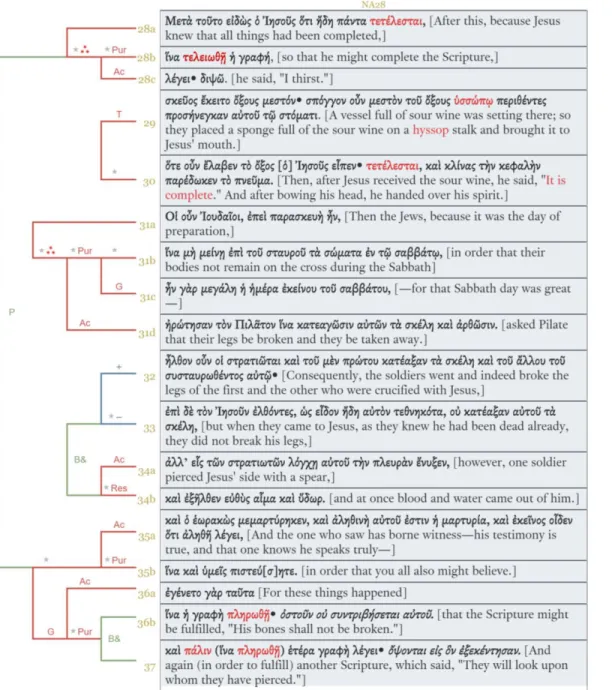
2. AN ARGUMENT DIAGRAM OF JOHN 19:28–37 ...89
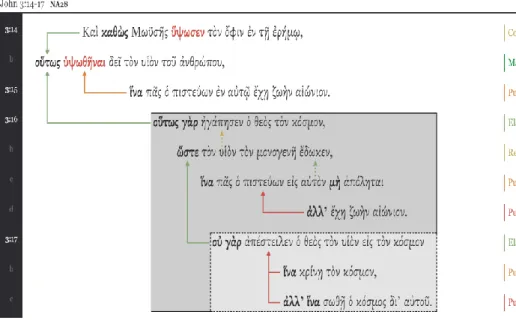
3. AN ARGUMENT DIAGRAM OF JOHN 3:14–17 ...90
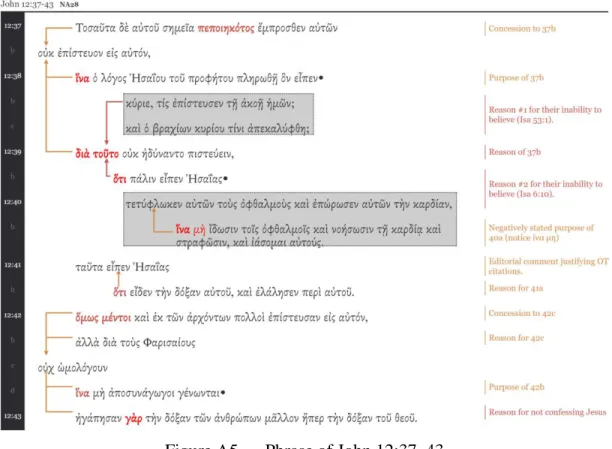
4. AN ARGUMENT DIAGRAM OF JOHN 12:37–43 ...91
BIBLIOGRAPHY ... 92
LIST OF FIGURES
Figure Page
1. Theological method ...3
2. The three horizons of context ...4
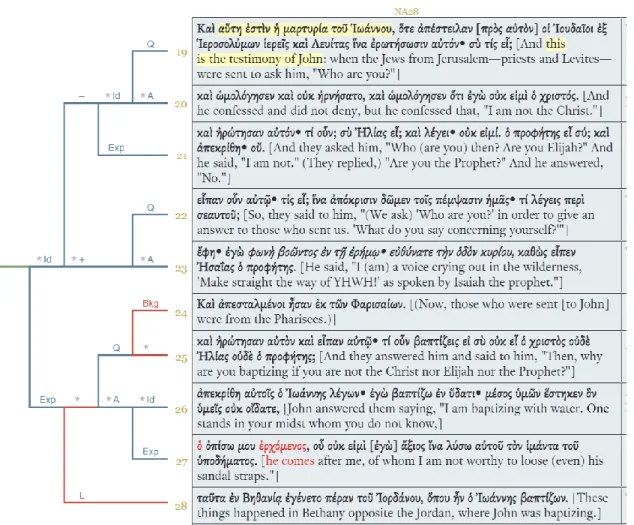
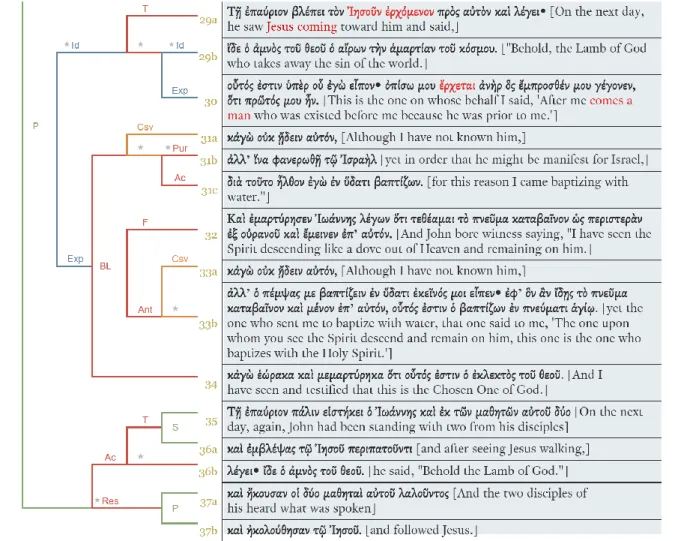
A1. Bracket of John 1:19–37 (part 1) ...85
A2. Bracket of John 1:19–37 (part 2) ...86
A3. Bracket of John 19:28–37 ...87
A4. Phrase of John 3:14–17 ...88
A5. Phrase of John 12:37–43 ...89
PREFACE
This thesis represents the beginning—the beginning of a journey in the gospels. When I originally applied to begin doctoral studies at The Southern Baptist Theological Seminary, I believed that I would become a Pauline scholar like many whom I admired, including John Piper and Tom Schreiner. However, as it turned out, the Lord had other plans for me.
During my first semester at Southern, I took a course with Dr. Bill Cook, my advisor for the current project. Dr. Cook's course was a semester's study through the Gospel according to John, and it was during that course that God awoke a desire to study the gospels within me. This desire only increased as I studied the Gospel according to Matthew with Dr. Pennington the following semester.
I am thankful for the way numerous individuals have invested in me over the years, including but not limited to Dr. Brent Aucoin of Faith Bible Seminary (FBS), Dr. Rob Green of FBS, and Dr. Andy Naselli of Bethlehem College and Seminary. Dr. Aucoin helped me to understand how to analyze and exegete biblical narrative. Dr. Green helped me learn and love Greek. Finally, Dr. Naselli was instrumental in forming my understanding of biblical theology, typology, and theological method. I praise God for these men, and I pray this project reflects the good deposit they made in my life and education.
David Christensen Louisville, Kentucky
December 2017
CHAPTER 1 INTRODUCTION
The Fourth Gospel (FG), as the final book of the tetrevangelium, is work that achieves magisterial depth through a simple vocabulary. One author described it as "a book in which a child can wade and an elephant can swim."1 John wrote with
"a mixture of clarity and profundity,"2 like a master artisan whose "narrative
technique is analogous to the visual artistry of Rembrandt's portraits . . . repay[ing]
sustained meditation."3 The FG is a figural tapestry which enraptures the readers through its evocative use of the OT which is often more visual than verbal.4 John's portrait of Jesus has captivated me; therefore, I am writing not only as one who has beheld it, but as one who is being held by it.5
Thus, if the FG repays sustained meditation and John has evocatively woven the OT throughout his portrait of Jesus, then what remains to be seen is what such imagery implies. The study at hand is intended to do just that, to unfurl
particular threads of John's tapestry and determine their implications. Specifically, it
1Paul F. Barackman, “Gospel According to John,” Interpretation 6, no. 1 (1952): 63.
2Leon Morris, The Cross in the New Testament, 2nd ed. (Grand Rapids: Eerdmans, 1972), 144.
3Richard B. Hays, Echoes of Scripture in the Gospels (Waco, TX: Baylor University Press, 2016), 284.
4Ibid., 336; Carson has noted that it is within the last century that scholarly investigations into John’s use of the OT have multiplied. D. A. Carson, “John and the Johannine Epistles,” in It Is Written: Scripture Citing Scripture: Essays in Honour of Barnabas Lindars, ed. D. A. Carson and H.
G. M. Williamson (Cambridge: Cambridge Univ. Press, 1988), 245–64.
5Similarly, Carson comments, “Readers should be approaching the text not as its master but as its servant; one should not so much seek to master Scripture as be mastered by it.” D. A.
Carson, “Theological Interpretation of Scripture: Yes, But . . .,” in Theological Commentary:
Evangelical Perspectives, ed. R. Michael Allen (London: T&T Clark International, 2011), 202.
is the goal of this paper to unpack the death of Jesus in light of exodus imagery.
Although there is a general consensus concerning the centrality of Jesus' death in the FG,6 there is far less consensus about why Jesus' death is central or its implications.
In order to accomplish this goal, I begin by overviewing my methodology and
surveying the current milieu of debate concerning the death of Jesus in the FG. After these introductory matters, I will provide a concise summary and the way forward.
Methodological Overview
This overview follows a theological progression. First, I will comment on the theological method which undergirds this paper. Second, I will discuss the specific approach to the text which will be employed. Finally, I will specifically discuss my understanding of typology.7
Theological Method
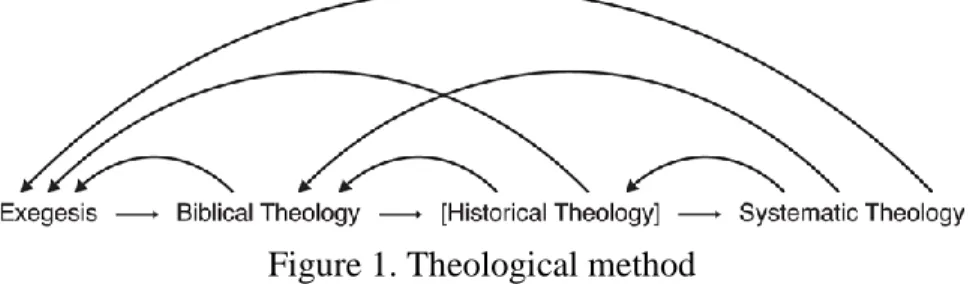
No person comes to Scripture as a tabula rasa; instead, one "necessarily interpret[s] out of a framework which itself must constantly be tested."8 In light of this, Carson's figure soberly depicts his theological method as a progression.9
6Belle states, “The majority of the speakers at the Colloquium agreed that . . . the death of Jesus is central to the fourth gospel.” Gilbert van Belle, “Introduction,” in The Death of Jesus in the Fourth Gospel, ed. Gilbert van Belle, Bibliotheca Ephemeridum theologicarum Lovaniensium 200 (Leuven, Belgium: Leuven University Press, 2007), xxx.
7Hoskins notes the confusing nature of typological discussions when authors do not define which conception of typology they are using. Paul M. Hoskins, Jesus as the Fulfillment of the Temple in the Gospel of John, Paternoster Biblical Monographs (Milton Keynes, England: Paternoster Press, 2006), 18.
8Carson, “Theological Interpretation of Scripture,” 197.
9D. A. Carson, “Unity and Diversity in the New Testament: The Possibility of Systematic Theology,” in Scripture and Truth, ed. D. A. Carson and John D. Woodbridge (Grand Rapids:
Zondervan, 1983), 91–92; this theological method is described in more detail by Naselli. Andrew David Naselli, “D.A. Carson’s Theological Method,” Scottish Bulletin of Evangelical Theology 29, no.
2 (2011): 245–274; it is more concisely summarized in a more recent publication. Andrew David Naselli, How to Understand and Apply the New Testament: Twelve Steps from Exegesis to Theology (Phillipsburg, NJ: P&R Publishing, 2017), 5–8.
Figure 1 demonstrates how awareness of systematic-theological arguments and biblical-theological motifs feed back into one's exegesis; however, Carson is quick to note that "nevertheless, the line of final control is the straight one from exegesis right through biblical and historical theology to systematic theology."10 This is the theological method which I will employ. The implication for this study is that my exegetical work will form the foundation for my biblical theological conclusions which in turn are the foundations for my systematic-theological conclusions. Indeed, the study itself will move from exegesis to theology for that very reason.
Biblical-Theological Exegesis
Biblical theology emerges from responsible exegesis.11 This exegesis,
"rather than try[ing] to go behind the text to get at what really happened, as though the text is mere propaganda, [tries] to understand what the biblical authors have written."12 The aim of such study is "to understand the meaning of any given text in its immediate historical and literary context, and then determine how that meaning
10Carson notes further, “The final authority is the Scriptures, the Scriptures alone. For this reason exegesis, though affected by systematic theology, is not to be shackled by it.” Carson,
“Unity and Diversity in the New Testament,” 92.
11D. A. Carson, “Systematic Theology and Biblical Theology,” in New Dictionary of Biblical Theology, ed. Brian S. Rosner and T. D. Alexander (Downers Grove, IL, IL: InterVarsity Press, 2000), 91; Aubrey Sequeira and Samuel Emadi, “Biblical-Theological Exegesis and the Nature of Typology,” Southern Baptist Journal of Theology 21, no. 1 (2017): 13.
12James M. Hamilton, With the Clouds of Heaven: The Book of Daniel in Biblical
Theology, New Studies in Biblical Theology 32 (Downers Grove, IL, IL: InterVarsity Press, 2014), 21.
Figure 1. Theological method
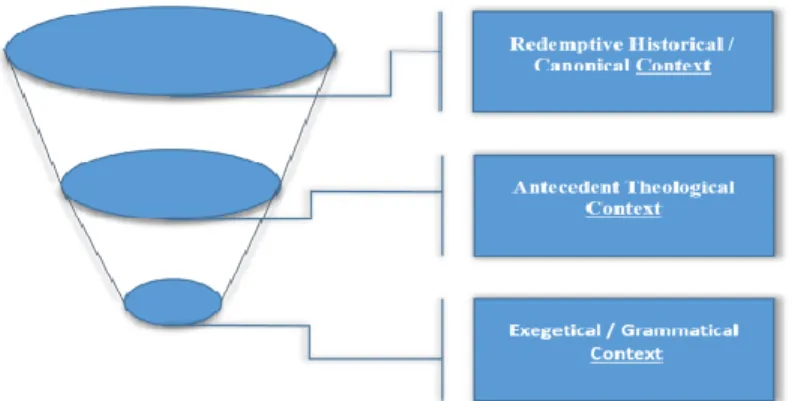
unfolds through the redemptive-historical narrative of Scripture, that is, in the literary context of the whole canon."13 Biblical-theological exegesis also recognizes the metanarrative of which each individual narrative or pericope is a part.14 Indeed, a given biblical text has three horizons or levels of meaning which unfold progressively throughout redemptive history: an immediate context, an antecedent context, and a canonical context (see figure 2).15
One will notice that the core meaning always contains the exegetical or immediate context, even as theological integration moves to the other levels. Bock helpfully illustrates this by saying, "[It] is much like a play in the second quarter of a football game that many come to realize in the fourth quarter was the turning point
13Sequeira and Emadi, “Biblical-Theological Exegesis,” 14.
14Hays recognizes that the various narratives of Scripture comprise a larger coherent story. Richard B. Hays, “Can Narrative Criticism Recover the Theological Unity of Scripture?,”
Journal of Theological Interpretation 2, no. 2 (2008): 202–3; yes to Hays’ observations, but I affirm them with Carson’s cautions. Carson, “Theological Interpretation of Scripture.”
15Vern S Poythress, “Divine Meaning of Scripture,” Westminster Theological Journal 48, no. 2 (September 1986): 267; Wellum and Gentry describe the three horizons as: textual, epochal, and canonical. Peter John Gentry and Stephen J. Wellum, Kingdom through Covenant: A Biblical-
Theological Understanding of the Covenants (Wheaton, IL: Crossway, 2015), 92–108.
Figure 2. The three horizons of context
of the game."16 This explains why OT texts appear to gain significance in light of redemptive history, and it brings us to the next issue—typology.
Typology
In the realm of the NT's use of the OT, there is no shortage of approaches to interpretive difficulties, and thus Silva concludes that "we should avoid quick solutions and simplistic answers."17 One of the best analyses in recent times of the problem of the NT's use of the OT was written by Moo and Naselli.18 In addition to their analysis, Hoskins makes clear that there are two major camps in the field of typology: those who see OT types as prospective (forward pointing, even if shadows) and those who see them as only retrospective (hindsight is twenty-twenty).19 Moo
16Darrell L Bock, “Evangelicals and the Use of the Old Testament in the New,” Bibliotheca Sacra 142, no. 568 (October 1985): 312; the significance of OT passages unfolds in light of
“developing revelation of the later parts of the OT and especially [in light of] the NT.” G. K. Beale, Handbook on the New Testament Use of the Old Testament: Exegesis and Interpretation (Grand Rapids: Baker Academic, 2012), 27; Gentry and Wellum, Kingdom through Covenant, 117n82.
17Moisés Silva, “The New Testament Use of the Old Testament: Text Form and Authority,” in Scripture and Truth, ed. D. A. Carson and John D. Woodbridge (Grand Rapids:
Zondervan, 1983), 155; Beale, obviously taking Silva’s point to heart, has teased out twelve categories of usage. Beale, Handbook on the New Testament Use of the Old Testament, 55–93; concerning Beale’s handbook, Naselli indicates it would be his textbook of choice if he could only pick one for the use of the OT in the NT. Naselli, How to Understand and Apply the New Testament, 260.
18Douglas J. Moo and Andrew David Naselli, “The Problem of the New Testament’s Use of the Old Testament,” in The Enduring Authority of the Christian Scriptures, ed. D. A. Carson (Grand Rapids: Eerdmans, 2016), 702–46.
19Hoskins, Jesus as the Fulfillment of the Temple, 18–32; for those who allow a
prospective understanding (in addition to Hoskins), see Richard M. Davidson, Typology in Scripture:
A Study of Hermeneutical Τύπος Structures, Andrews University Seminary Doctoral Dissertation Series 2 (Berrien Springs, MI: Andrews University Press, 1981); G. K. Beale, A New Testament Biblical Theology: The Unfolding of the Old Testament in the New (Grand Rapids: Baker Academic, 2011); Darrell L. Bock, “Single Meaning, Multiple Contexts and Referents: The New Testament’s Legitimate, Accurate, and Multifaceted Use of the Old,” in Three Views on the New Testament Use of the Old Testament, ed. Kenneth Berding and Jonathan Lunde (Grand Rapids: Zondervan, 2008), 103–
51; D. A. Carson, “Mystery and Fulfillment: Towards a More Comprehensive Paradigm of Paul’s Understanding of the Old and the New,” in Justification and Variegated Nomism: The Paradoxes of Paul, ed. D. A. Carson, Peter T. O’Brien, and Mark A. Seifrid, vol. 2 (Grand Rapids: Baker Academic, 2004), 393–436; Moo and Naselli, “The Problem of the New Testament’s Use of the Old Testament”;
Poythress, “Divine Meaning of Scripture”; Sequeira and Emadi, “Biblical-Theological Exegesis”; for those who only allow retrospective readings, see R. T. France, Jesus and the Old Testament: His Application of Old Testament Passages to Himself and His Mission (Downers Grove, IL: InterVarsity Press, 1971); David L. Baker, Two Testaments, One Bible: The Theological Relationship between the Old and New Testaments, 3rd ed. (Downers Grove, IL: IVP Academic, 2010); Hays, Echoes of Scripture in the Gospels.
and Naselli refer to these as senus occultus and sensus praegnans.20 The former refers to the concealing of the type from the OT human author, whereas the latter refers to the seed-like organic beginnings of the type. I hold to a sensus praegnans view of typology, which says, "An apple seed contains everything that will
organically grow from it. No examination by the naked eye can distinguish what will grow from the seed, but once the seed has grown into the full apple tree, the eye can then see how the seed has been 'fulfilled.'"21 Finally, the definition of type which is employed by this study is, "Types are historical, authorially-intended, textually rooted, tied to Scripture’s covenant structure, and undergo escalation from old covenant shadow to new covenant reality."22 Next, this section will develop a survey of significant literature for the study at hand.
The Current Milieu: The Death of Jesus in the FG
As noted above, the death of Jesus is largely regarded as central to the FG, but the consensus divides as to why.23 Von Wahlde perceptively comments on the prevailing views and notes, "The essential difference . . . [is whether] the death itself . . . has an intrinsic value to it in relation to the benefits flowing to the believer."24
20Moo and Naselli, “The Problem of the New Testament’s Use of the Old Testament,” 736;
Sequeira and Emadi, “Biblical-Theological Exegesis,” 17; Davidson writes, “The divine intent of the events clearly includes the τύπος-nature of the event. A providential design was operative, causing the events to happen τυπικως.” Davidson, Typology in Scripture, 268.
21G. K. Beale and D. A. Carson, eds., Commentary on the New Testament Use of the Old Testament (Grand Rapids: Baker Academic, 2007), xxvii.
22Sequeira and Emadi, “Biblical-Theological Exegesis,” 12. In addition, Sequeira and Emadi critique the TIS movement and concept of “figural reading” for amounting to sensus
occultus—meaning concealed from the author but extracted by the reader (see pp. 25–28). Here I will also note that any reference to evocation, figural, or cognates of these are merely attempts to express the visual or picturesque nature of an allusion or typological relationship. In using that language, I do not mean to invoke any sort of sensus occultus as the TIS movement might.
23Belle, “Introduction,” xxx.
24Von Wahlde categorizes the views under the categories “death as departure” and “death for others” in a soteriological and sacrificial sense. Urban C. Von Wahlde, “The Interpretation of the Death of Jesus in John against the Background of First-Century Jewish Eschatological Expectations,”
in The Death of Jesus in the Fourth Gospel, ed. Gilbert van Belle, Bibliotheca Ephemeridum
Those who see Jesus' death as sacrificial in the FG find it intrinsically valuable,25 whereas those in favor of departure or revelatory views would only attribute it value by association.26 In the survey of the significant literature on the death of Jesus in the FG, the literature is divided into two camps: death as non-sacrificial and death as sacrificial.27 Following the survey concerning the death of Jesus in the FG, this section will also survey significant literature concerning the existence of exodus typology in the FG.
Concerning the Death of Jesus in the FG as Non-Sacrificial
Recently, three publications have conducted surveys of research concerning the death of Jesus in the FG.28 There are varied emphases within the non-sacrificial camp. Within the category of Jesus' death as non-sacrificial, I will
theologicarum Lovaniensium 200 (Leuven, Belgium: Leuven University Press, 2007), 560.
25By sacrifice, I do not mean the existential or metaphorical sense as, for example, Koester does in arguing that sacrificial language in the FG is not substitutionary nor vicarious (see discussion of Koester below). When referring to sacrifice, I mean cultic substitutionary sacrifice unless otherwise indicated. Craig R. Koester, “The Death of Jesus and the Human Condition: Exploring the Theology of John’s Gospel,” in Life in Abundance: Studies of John’s Gospel in Tribute to Raymond E. Brown, S.S, ed. John R. Donahue (Collegeville, MN: Liturgical Press, 2005), 145–48, esp. 147.
26Intriguingly, Dennis observes a correlation between whether one treats the FG as a unity and considers all evidence as Johannine (not appealing to redaction, &c.), which when both are affirmed, results in a more traditional atonement view. In my survey, I concur with his assessment.
John A. Dennis, “Jesus’ Death in John’s Gospel: A Survey of Research from Bultmann to the Present with Special Reference to the Johannine Hyper-Texts,” Currents in Biblical Research 4, no. 3 (June 2006): 331.
27When referring to sacrifice, I mean cultic substitutionary sacrifice unless otherwise indicated.
28Rather than dealing with each literary contribution individually, I will discuss the literature in categories of their main emphasis. Dennis, “Jesus’ Death in John’s Gospel”; Belle,
“Introduction,” 43–64; John E. Morgan-Wynne, The Cross in the Johannine Writings (Eugene, OR:
Pickwick Publications, 2011), 3–39.
consider three sub-categories: revelation,29 exemplary love,30 and departure.31 Revelation (Bultmann and Forestell). The Johannine motif of revelation—
with Jesus as the Revealer—is presented, seminally, by Bultmann. He argues that
"John has subsumed the death of Jesus under his idea of the Revelation—in his death Jesus himself is acting as the Revealer."32 Infamously, Bultmann has asserted,
"Whatever the origin of these passages, the thought of Jesus' death as an atonement for sin has no place in John, and if it should turn out that he took it over from the tradition of the Church, it would still be a foreign element in his work."33 The context around the italicized quote above indicates two elements of Bultmann's treatment of John: speculative source-critical exegesis that allows him to avoid sacrificial texts and a presuppositional bias to regarding sacrificial material as basic to the Johannine understanding.34
Forestell follows Bultmann, but instead of identifying Jesus as Revealer (content unknown), Forestell discusses Jesus variously as the revelation of the word
29Rudolf Bultmann, Theology of the New Testament, trans. Kendrick Grobel, vol. 2 (New York: Scribner, 1955), esp. 49–69; J. Terence Forestell, The Word of the Cross: Salvation as
Revelation in the Fourth Gospel (Rome: Biblical Institute Press, 1974).
30Koester, “The Death of Jesus and the Human Condition,” 145–53; Craig R. Koester,
“Why Was the Messiah Crucified? A Study of God, Jesus, Satan, and Human Agency in Johannine Theology,” in The Death of Jesus in the Fourth Gospel, ed. Gilbert van Belle, Bibliotheca
Ephemeridum theologicarum Lovaniensium 200 (Leuven, Belgium: Leuven University Press, 2007), 172–80; John Painter, “The Death of Jesus in John: A Discussion of the Tradition, History, and Theology of John,” in The Death of Jesus in the Fourth Gospel, ed. Gilbert van Belle, Bibliotheca Ephemeridum theologicarum Lovaniensium 200 (Leuven, Belgium: Leuven University Press, 2007), esp. 351–61.
31Ernst Käsemann, The Testament of Jesus: A Study of the Gospel of John in the Light of Chapter 17, trans. Gerhard Krodel (Tübingen: Mohr Siebeck, 1968); Godfrey C. Nicholson, Death as Departure: The Johannine Descent-Ascent Schema, SBL Dissertation Series 63 (Chico, CA: Scholars Press, 1983).
32Bultmann, Theology of the New Testament, 2:53.
33Emphasis added. Ibid., 2:54.
34Thus, Bultmann can conclude, “Jesus’ death, therefore, is not a special work, but is conceived as of one piece with the whole life-work of Jesus.” Ibid., 2:55.
of God and the Father's love.35 Forestell says, "Jesus’ death is a revelation to men that God loves them with the self-devotion of the good shepherd."36 Carson's comical critique is as pointed as it is humorous. He says,
How does the cross of Jesus reveal the love of God, if it does not accomplish anything? It is like a man running down the Brighton pier at full tilt, crying out, 'World! World! I love you. And I'll prove it!'—whereupon he jumps into the sea and drowns. How does this, prove he loves the world? Most of us would
conclude that it proves he is insane. In other words, Forestell’s interpretation of the significance of the cross in John is not sufficiently content-ful, not
sufficiently robust, to be meaningful . . . it is an inherently unstable position.37 Carson's point is not that Forestell's study says too much, but that it says too little. Carson concludes, "Unfortunately, by setting up his thesis in an
antithetical way—the cross is revelation and nothing else—Forestell has, sadly, left too much of the text behind."38 In the end, John's theologia crucis is multi-faceted—
it identifies Jesus not only as the Revealer, but also as the Lamb of God who takes away the sin of the world.39 The following scholars depend in some manner on the work of Bultmann and Forestell.
Exemplary love (Koester and Painter). The emphasis of Koester and Painter falls largely on Jesus' death as a revelation of exemplary divine love.40 Both
35Forestell, The Word of the Cross, 76, 165, 192.
36Ibid., 76.
37D. A. Carson, “Adumbrations of Atonement Theology in the Fourth Gospel,” Journal of the Evangelical Theological Society 57, no. 3 (2014): 521; see also Max Turner, “Atonement and the Death of Jesus in John—Some Questions to Bultmann and Forestell,” The Evangelical Quarterly 62 (April 1990): 99–122.
38Carson, “Adumbrations of Atonement Theology,” 522.
39This point is stated in light of the conclusions of the present study.
40Koester says, “Put very simply, John understands that Jesus died to reveal God’s love to the world.” Craig R. Koester, Symbolism in the Fourth Gospel: Meaning, Mystery, Community, 2nd ed. (Minneapolis: Fortress Press, 2003), 244; in another publication Koester states, “Sacrificing one’s life for a sinful world is done to create a relationship of love where one does not exist.” Koester, “The Death of Jesus and the Human Condition,” 148; Painter writes, “God’s love for the world is revealed in God’s presence in the darkness.” In saying this, Painter is referring to Jesus' being lifted-up and vanquishing the ruler of the world. John Painter, “Sacrifice and Atonement in the Gospel of John,” in Israel Und Seine Heilstraditionen Im Johannessevangelium: Festgabe Für Johannes Beutler Zum 70.
Geburtstag, ed. Michael Labahn et al. (Paderborn, Germany: Schöningh, 2004), 309; elsewhere,
Koester and Painter eschew viewing Jesus' death in the FG as a substitutionary sacrifice.41 After asserting that "John does not think of Jesus' death as a sacrifice offered to God," it is no wonder that Painter finds it hard to explain why Jesus' death was necessary.42 Indeed, Carey's observation strikes home at this very point. He pushes against their positions by saying,
It is when we ask why it is that the public ministry in John is so directed towards Calvary, why the theme of his 'hour' is so strong, why the gift of his body and blood (6:53–56) is so important, why Jesus believes that 'love' drives him to the cross (15:12–13), why the power of Satan and evil is broken by the cross, that the views of those who deny the notion of a vicarious sacrifice in John appear so unsatisfactory.43
Although Painter uses terms like "inevitable," "essential," and "necessary"
to describe the death of Jesus, he does not provide an answer—which accounts for all that data—regarding why the death on the cross was the necessary climax of Jesus' revelation.44 Koester's resistance to substitutionary atonement is more sober and nuanced. His primary objection is that, "there is no suggestion that the good shepherd lays down his life to deliver the flock from divine judgment."45 Since Koester makes the disjunction between "the need for divine justice" and the "need
Painter says, “The self-communication of the love of God has the power to transform darkness to light, brokenness to wholeness, unbelief to belief.” Painter, “The Death of Jesus in John,” 354.
41In contrast to his own view of “atonement in the Johannine sense” (the reconciling of parties separated, undoing unbelief by bringing about faith), Koester responds to the idea of vicarious atonement by saying, “The Fourth Gospel, however, operates with a different theological framework.
The gospel does not relate Jesus’ death to the need for divine justice but the need for human faith.” A false dichotomy as my study will show. Koester, “The Death of Jesus and the Human Condition,”
147–48; Painter says, “The category of sacrifice, understood as the offering to God, in some sense, of the death of Jesus, is not helpful for the interpretation of John . . . (cont. in n. 9) There is nothing to suggest that John thinks of Jesus’ death as required by God to turn aside God’s wrath.” In Painter’s sections dealing with sacrifice in specific, I found the vast majority of his sentences to be assertions rather than arguments (esp. 289–94, 310–13). Painter, “Sacrifice and Atonement in the Gospel of John,” 290.
42Painter, “Sacrifice and Atonement in the Gospel of John,” 310.
43George Leonard Carey, “The Lamb of God and Atonement Theories,” Tyndale Bulletin 32 (1981): 118.
44Painter, “Sacrifice and Atonement in the Gospel of John,” 310–11.
45Koester, “The Death of Jesus and the Human Condition,” 147.
for human faith," he chooses to view references to God's wrath as emphasizing the unbelief and faithless condition of mankind—not about divine justice (sic).46 I will respond to Koester at this point with his own words, "Jesus' death may provide an example of love for people to follow, but a sinful world needs more than an example or it will not follow. The Lamb is sacrificed to create a relationship of faith."47
Departure (Käsemann and Nicholson). The final emphasis in our survey of those who do not ascribe to a substitutionary sacrifice view of Jesus' death is that of departure. While Bultmann would point to John 1:14a "the Word became flesh" as the center of Johannine theology, Käsemann would point to John 1:14b "we beheld his glory."48 For Käsemann, "the comprehensive and, for John, characteristic description of Jesus' death is given with the verb hypagein [ὑπάγειν, to depart]."49 Thus for Käsemann Jesus' hour and his being lifted up are both pointers to his glorious departure, return to the Father.50 Nicholson takes the coming and going motif described by Käsemann and seeks to cast his net wider—ascent and descent.51
46Koester, “The Death of Jesus and the Human Condition,” 147–48; Koester, Symbolism in the Fourth Gospel, 223; Morris’ discussion of the NT’s use of ὀργή is instructive here. Morris indicates that ὀργή denotes “a strong and settled opposition to all that is evil arising out of God’s very nature” (163). Leon Morris, The Apostolic Preaching of the Cross, 3rd ed. (Grand Rapids: Eerdmans, 1965), 162–63; see also Piper’s discussion on Rom 9:19–23, where he convincingly explains the demonstration of God’s wrath as essential to his nature because it serves the display of his glory, esp.
his mercy. John Piper, The Justification of God: An Exegetical and Theological Study of Romans 9:1–
23, 2nd ed. (Baker Academic, 1993), 183–216; Fuller, commenting on Rom 9:19 and the wrath of God, indicates that wrath vindicates God’s justice and is entirely consistent with his nature. Fuller says, “God acts consistently with His love for His glory only as He opposes all who disdain finding delight in His glory. If He did not act this way in the world He freely created, He would cease to be God.” Daniel P. Fuller, The Unity of the Bible: Unfolding God’s Plan for Humanity (Grand Rapids:
Zondervan, 1992), 445–48, esp. 448.
47Koester, “The Death of Jesus and the Human Condition,” 148.
48Käsemann, The Testament of Jesus, 9–10.
49Ibid., 17–18.
50Ibid., 19–20.
51Nicholson, Death as Departure, 8; Köstenberger subsumes “ascent and descent” under the banner of “coming and going” noting that the former merely supplements the latter. Thus, he indicates (527n4) that “Nicholson’s terminology . . . appears to be inadequate.” Andreas J.
Köstenberger, A Theology of John’s Gospel and Letters, Biblical Theology of the New Testament
Nicholson departs from Käsemann when he interprets Jesus' hour "not as the hour of his death but the hour of his return to the Father."52 Both scholars eschew sacrificial atonement as part of Jesus' death.53 Thus, although they are right to identify the motif of coming and going as indicative of Jesus' mission which is completed at the cross, they fail to see the significance of his sacrificial death—missing the forest for the trees.
Concerning the Death of Jesus in the FG as Sacrificial
As indicated earlier, there are three publications which have conducted rather comprehensive surveys of research concerning the death of Jesus in the FG.54 In this section, which is focused on those who view Jesus' death in the FG as a substitutionary sacrifice, I will consider a selection of those who have published articles for this view, articles against the opposing view, monographs for this view, and finally, arguments for this view with respect to the Passover.55
Articles for sacrifice. The main works surveyed in this category are the articles of Carey, Grigsby, and Skinner.56 Each of these individuals has written about
(Grand Rapids: Zondervan, 2009), 526–27.
52Nicholson, Death as Departure, 146–47.
53Ibid., 2; Käsemann, The Testament of Jesus, 19–20.
54Rather than dealing with each literary contribution individually, I will address them in the categories of their contribution. Dennis, “Jesus’ Death in John’s Gospel”; Belle, “Introduction,”
43–64; Morgan-Wynne, The Cross in the Johannine Writings, 3–39.
55Due to the scope of this paper, there is not space to interact with others who merit reading. In particular, see Dennis’ discussion of Frey, Knöppler, Metzner, and Zumstein. For example, Metzner argues that 1:29 “functions as the programmatische Leitthese, or the ‘leading thesis’, of the Christology of the FG and specifically of the evangelist’s view of Jesus’ death.” Dennis,
“Jesus’ Death in John’s Gospel,” 355.
56Carey, “The Lamb of God and Atonement Theories”; Bruce H Grigsby, “The Cross as an Expiatory Sacrifice in the Fourth Gospel,” Journal for the Study of the New Testament 15 (July 1982):
51–80; Christopher W Skinner, “Another Look at ‘the Lamb of God,’” Bibliotheca Sacra 161, no. 641 (January 2004): 89–104.
JtB's Christological confession in 1:29 "Behold the Lamb of God, who takes away the sin of the world,"—that at least part of the background for the lamb is Passover.57 Carey's poignant quote given above came shortly after his statement that "the heart of the gospel is that the Saviour has come to give life to men and this comes through his redemptive sacrifice upon the cross. The Baptist's statement thus establishes the purpose of the gospel itself."58 Grigsby, after considering the evidence for various views on 1:29, concludes that evidence for Passover is "impressive."59 Skinner concludes that "takes away the sin of the world" is connected with atonement and 1:29 is a reference to Jesus as the "ultimate Passover lamb."60 In light of these
articles, the way one interprets 1:29 is indicative of the prominence given to Passover in the FG and to some degree one's view of Jesus' death.61
Articles against non-sacrifice. The works of Carson and Turner are sober examples of how to interact with those whom you disagree.62 Turner interacts at length with the position of Forestell which he sees as a correction and improvement upon Bultmann. Turner draws out the point that Forestell eschews connecting Jesus'
57Carey, “The Lamb of God and Atonement Theories,” 118–19; Grigsby, “The Cross as an Expiatory Sacrifice in the Fourth Gospel,” 53–54; Skinner, “Another Look at ‘the Lamb of God,’” 103–
4.
58Carey, “The Lamb of God and Atonement Theories,” 117; Carey then argues against the minimization of sacrificial language in Dodd, Barrett, and Brown. Note the quote Carey provides from Brown occurs in a Festschrift for M. Black after Brown published his commentary (see ibid., 117n44).
C. H. Dodd, The Interpretation of the Fourth Gospel (Cambridge: Cambridge University Press, 1953), 233; C. K. Barrett, The Gospel According to St. John: An Introduction with Commentary and Notes on the Greek Text, 2nd ed. (Philadelphia: Westminster Press, 1978), 68.
59Grigsby, “The Cross as an Expiatory Sacrifice in the Fourth Gospel,” 59; Grigsby cites Howard for his conclusions. J. Keir Howard, “Passover and Eucharist in the Fourth Gospel,” Scottish Journal of Theology 20, no. 3 (September 1967): 337.
60Skinner, “Another Look at ‘the Lamb of God,’” 103–4.
61This observation is hinted at in the significance Porter ascribes to the Passover theme beginning with 1:29. Stanley E. Porter, John, His Gospel, and Jesus: In Pursuit of the Johannine Voice (Grand Rapids: Eerdmans, 2015), 206–207; see below for Turner’s statement to this point. Turner,
“Atonement and the Death of Jesus in John,” 121–22.
62Carson, “Adumbrations of Atonement Theology”; Turner, “Atonement and the Death of Jesus in John.”
death with the Passover lamb at the cross, preferring to see 19:36 as referring to Ps 34:21.63 Turner notes that Forestell eventually concedes Jesus is portrayed as Passover lamb, but Forestell dismisses this in the end by saying, "one isolated and disputed text is not sufficient to overthrow a point of view which otherwise pervades the entire gospel."64 Turner responds with three points against Forestell. First, Forestell did not sufficiently demonstrate the exclusivity of revelation to
atonement.65 Second, Turner argues the combination of the two provides a "more coherent explanation for the place of the cross in John."66 Finally, Turner argues that Forestell's treatment of 1:29 is unconvincing. Turner notes that most importantly,
"[John] 1:29–34 is the first witness to Jesus, and so, like the prologue, the one, above all, through which the rest of John is inevitably read."67 Therefore, Turner concludes,
"Far from being insignificant, its position would suggest 1:29 is a doorway to the Johannine understanding of the cross."68 Carson's article against Forestell proceeds by systematically addressing misinterpretations throughout gospel, ending with 1:29. There Carson sees a victorious sacrificial lamb and states, "We are forced to conclude that John the evangelist introduced, rather subtly, the theme of vicarious substitution as atonement for sin at the very beginning of his Gospel. That ought to have a shaping effect on the way we read the rest of the Gospel."69
63The study that follows will address the interpretation of John 19:36 in the study that follows. Turner, “Atonement and the Death of Jesus in John,” 106n17.
64Forestell, The Word of the Cross, 194.
65Turner, “Atonement and the Death of Jesus in John,” 113–15.
66Ibid., 115–19.
67Ibid., 121.
68Ibid., 121–22.
69Carson, “Adumbrations of Atonement Theology,” 519.
Monographs for sacrifice. Perhaps the most proliferate proponent of atonement in John is Leon Morris.70 Regarding 1:29, Morris concludes that the imagery of sacrifice is unavoidable.71 Morris traces themes which all point to the cross in John: sin, judgment, Jesus' hour, lifting-up, temple destruction, laying down one's life, ὑπέρ texts, and the sending of the Son.72 Morris did not, however, discuss the Passover typology nor connect it with the atonement.73 Morgan-Wynne is perhaps the only person to write an entire monograph on atonement in the
Johannine literature in the last two decades.74 Noticeably absent from the research of Morgan-Wynne is any interaction with the essays of Porter, Howard, or Hoskins.
This explains in part why he did not develop the Passover typology, although he did note that 1:29 demonstrated the importance of the death of Jesus which would have been even clearer on a second time through.75 Next, this survey will consider works which especially focused on the Passover elements.
70Morris, The Cross in the New Testament, 144–79; Leon Morris, “The Jesus of Saint John,” in Unity and Diversity in New Testament Theology: Essays in Honor of George E. Ladd, ed.
Robert A. Guelich (Grand Rapids: Eerdmans, 1978), 37–53; Leon Morris, The Atonement: Its Meaning and Significance (Downers Grove, IL: InterVarsity Press, 1983); Leon Morris, “The Atonement in John’s Gospel,” Criswell Theological Review 3, no. 1 (1988): 49–64; Leon Morris, The Gospel according to John, rev. ed., The New International Commentary on the New Testament (Grand Rapids: Eerdmans, 1995); in addition to discussing Morris’ contributions to the discussion, I will also comment on one other monograph which defends atonement in John. Morgan-Wynne, The Cross in the Johannine Writings.
71Leon Morris, “The Atonement in John’s Gospel,” Criswell Theological Review 3, no. 1 (1988): 60; Morris, The Gospel according to John, 126–32; Morris, The Cross in the New Testament, 173–75.
72Many, if not all, of these pointers to the cross are developed at length by Morgan- Wynne. Morgan-Wynne, The Cross in the Johannine Writings, 113–217.
73The first place Morris references Passover is in 1:29 where he sees sacrificial imagery regardless of which interpretation (himself undecided). Morris, The Gospel according to John, 126.
74Morgan-Wynne, The Cross in the Johannine Writings. Note that Morgan-Wynne’s work does include the Johannine epistles, but this statement is to his credit for thoroughness. I am hedging above because, although I am confident about English publications, I am uncertain about recent German or French publications. However, in my research, I have not seen others cite entire monographs by a single individual on this topic; D’Souza’s revised dissertation also deserves mentioning. Although his sole purpose in writing is to discuss John’s use of lamb-language in Revelation and the FG, D’Souza does give much of his space to the FG and regards that use as a substitutionary sacrifice, seeing a threefold fusion of Servant, Paschal lamb, and messianic king. John D’Souza, The Lamb of God in the Johannine Writings (Allahabad, India: St. Paul Publications, 1968).
75Morgan-Wynne, The Cross in the Johannine Writings, 88–92. In all fairness, Morgan-
Publications connecting Passover and sacrifice. In this category, the works of Dennis, Hoskins, Howard, and Porter stand out.76 In surveying these individuals, a striking correlation manifested itself. The vast majority, if not all, of the scholars who recognize the pervasiveness of the Passover typology also view Jesus' death in the FG as a substitutionary sacrifice.77 Köstenberger nails this connection in his Passover section by saying, "John's teaching on Jesus' substitutionary atonement builds on his earlier reference to Jesus' incarnation . . . . The atonement theme, far from being absent, is part of the warp and woof of John's gospel."78
Howard is typically seen as one of the first to trace the Passover theme in John.79 For instance, he observed, "[John] seems to be concerned with presenting
Wynne’s monograph was a very lengthy project (spanning decades) where he had numerous setbacks and difficulties. I applaud his work wholeheartedly, and I seek to complement it in light of the Exodus typology.
76John A. Dennis, Jesus’ Death and The Gathering of True Israel: The Johannine Appropriation of Restoration Theology in the Light of John 11:47–52, Wissenschaftliche
Untersuchungen zum Neuen Testament 217 (Tübingen: Mohr Siebeck, 2006); John A. Dennis, “Death of Jesus,” in Dictionary of Jesus and the Gospels, ed. Joel B. Green, Jeannine K. Brown, and Nicholas Perrin, 2nd ed. (Downers Grove, IL: IVP Academic, 2013), 172–93; John A. Dennis, “The ‘Lifting Up of the Son of Man’ and the Dethroning of the ‘Ruler of This World’: Jesus’ Death as the Defeat of the Devil in John 12,31–32,” in The Death of Jesus in the Fourth Gospel, ed. Gilbert van Belle, Bibliotheca Ephemeridum theologicarum Lovaniensium 200 (Leuven, Belgium: Leuven University Press, 2007), 677–91; Paul M. Hoskins, “Deliverance from Death by the True Passover Lamb: A Significant Aspect of the Fulfillment of the Passover in the Gospel of John,” Journal of the Evangelical Theological Society 52, no. 2 (June 2009): 285–99; Paul M. Hoskins, “Freedom from Slavery to Sin and The Devil:
John 8:31–47 and the Passover Theme of the Gospel of John,” Trinity Journal 31, no. 1 (2010): 47–63;
Stanley E. Porter, “Can Traditional Exegesis Enlighten Literary Analysis of the Fourth Gospel? An Examination of the Old Testament Fulfillment Motif and the Passover Theme,” in The Gospels and the Scriptures of Israel, ed. Craig A. Evans and William Richard Stegner, Journal for the Study of the New Testament Supplement Series 104 (Sheffield: Sheffield Academic Press, 1994), 396–428; Porter, John, His Gospel, and Jesus; Köstenberger, A Theology of John’s Gospel and Letters, 403–35.
77In this statement, I am hedging. I have not come across a single source which takes the Passover theme seriously, grounded in authorial intent, who does not also view Jesus' death as a substitutionary sacrifice. This is not to say that someone has not broken this correlation, but it is compelling evidence for the focus of this study.
78At the end of this quote, he cites the studies of Porter and Hoskins as grounds for such a claim. Köstenberger, A Theology of John’s Gospel and Letters, 415; Porter, “Can Traditional Exegesis Enlighten Literary Analysis of the Fourth Gospel?,” 407–11; Hoskins, “Deliverance from Death by the True Passover Lamb”; see also Matera, who argues that Jesus’ death is organically woven throughout John’s narrative; however, Matera misses the Passover and exodus connections (which leads him to doubt the atonement language). Frank J Matera, “On Behalf of Others, Cleansing, and Return:
Johannine Images for Jesus’ Death,” Louvain Studies 13, no. 2 (1988): 161–78.
79Howard, “Passover and Eucharist in the Fourth Gospel”; although Howard is primarily interested in the eucharistic connections, his treatment of the Passover theme and its significance for
Jesus as the perfect Paschal Victim, the complete Antitype of the old order."80 Regarding the significant place of the Passover, Howard states, "The Passover itself...forms the basis of the Heilsgeschichte which records the redemptive acts of God for His people Israel."81 Similarly, Dennis identified 1:29 as "one of the quintessential Johannine Christological and soteriological statements."82 I have treated Dennis, Hoskins, and Porter further in the following section which surveys those who have written about exodus typology in the FG.
Concerning Exodus Typology in the FG
Few have written monograph-length treatments of exodus typology in the FG, although some have written more briefly.83 Early scholarship (Sahlin, Enz, and Smith) tended towards fanciful or strained connections in large measure due to their attempts to see the exodus in some manner connected to John's literary
progression.84 After Sahlin, one is hard-pressed to find a lengthy treatment of NE in the FG until Brunson.85 One exception to that statement is the dissertation of
the atonement is quite helpful.
80Howard, “Passover and Eucharist in the Fourth Gospel,” 330; contra J. Ramsey Michaels, The Gospel of John, The New International Commentary on the New Testament (Grand Rapids: Eerdmans, 2010), 110.
81Howard, “Passover and Eucharist in the Fourth Gospel,” 329; Coxon helpfully proposes that John’s sitz im leben would at least include life post-AD70—the temple is destroyed. A Paschal NE especially fits if John wanted to address the place of sacrifice, temple, worship, and Jesus’ death in the FG. Paul S. Coxon, Exploring the New Exodus in John: A Biblical Theological Investigation of John Chapters 5–10 (Eugene, OR: Wipf & Stock, 2014), 47–55.
82Dennis, “Death of Jesus,” 188.
83Coxon has surveyed and correctly evaluated the significant scholarship. Coxon, Exploring the New Exodus in John, 73–82.
84Harald Sahlin, Zur Typologie des Johannesevangeliums (Uppsala: Lundequistska Bokhandeln, 1950); Jacob J. Enz, “The Book of Exodus as a Literary Type for the Gospel of John,”
Journal of Biblical Literature 76, no. 3 (1957): 208–15; Robert Houston Smith, “Exodus Typology in the Fourth Gospel,” Journal of Biblical Literature 81, no. 4 (1962): 329–42.
85Andrew C. Brunson, Psalm 118 in the Gospel of John: An Intertextual Study on the New Exodus Pattern in the Theology of John, Wissenschaftliche Untersuchungen zum Neuen Testament 158 (Tübingen: Mohr Siebeck, 2003).
George Balentine, who surveyed the concept of NE throughout the gospels.86
Balentine provides a sober treatment of exodus and NE themes in the OT and their evocations in the gospels—ground-breaking for its time. In particular, he observed that John portrayed Jesus as the "tabernacling presence of God and the Paschal lamb who lays down his life for the sins of the world."87 Brunson's monograph focused on the use of Psalm 118 in the FG, and thus his work was necessarily limited in that sense. In what follows, I will overview Coxon's work and other significant
scholarship with which he failed to interact.88
Coxon. Coxon's monograph is the first extended treatment of NE in the FG. He follows Hays' approach to intertextuality, proposing slightly modified
criterion for seeing allusions or echoes—an approach which says, "The main test . . . is the extent to which [an allusion or echo] makes its presence felt."89 It is no wonder that Coxon is a maximalist when it comes to seeing intertexts.90 If one only granted
86George L. Balentine, “The Concept of the New Exodus in the Gospels” (ThD diss., The Southern Baptist Theological Seminary, 1961); Coxon provides a helpful evaluation and is one of few I have encountered who noticed Balentine’s work. Coxon, Exploring the New Exodus in John, 78–80.
87Coxon, Exploring the New Exodus in John, 80; Balentine, “The Concept of the New Exodus in the Gospels,” 377–87.
88Coxon’s dissertation was presented in 2010, so it is understandable that he did not include the post-2010 publications listed here. Absent from his bibliography are Hoskins, Jesus as the Fulfillment of the Temple; Hoskins, “Deliverance from Death by the True Passover Lamb”; Paul M.
Hoskins, That Scripture Might Be Fulfilled: Typology and the Death of Christ (Longwood, FL: Xulon Press, 2009); Hoskins, “Freedom from Slavery to Sin and the Devil”; Dennis, “Jesus’ Death as the Defeat of the Devil”; John A. Dennis, “Lamb of God,” in Dictionary of Jesus and the Gospels, ed. Joel B. Green, Jeannine K. Brown, and Nicholas Perrin, 2nd ed. (Downers Grove, IL: IVP Academic, 2013), 482–83; Köstenberger, A Theology of John’s Gospel and Letters, esp. 403–35; Porter, “Can Traditional Exegesis Enlighten Literary Analysis of the Fourth Gospel?”; Porter, John, His Gospel, and Jesus, esp.
198–224; Adam Warner Day, “Lifted Up and Glorified: Isaiah’s Servant Language in the Gospel of John” (PhD diss., The Southern Baptist Theological Seminary, 2016), esp. 205–30.
89Emphasis mine. One should wonder about validity when the main test is how much an intertext is felt. Coxon, Exploring the New Exodus in John, 24–25; Richard B. Hays, Echoes of Scripture in the Letters of Paul (New Haven, CT: Yale University Press, 1989), 29–32; Moo and Naselli’s critique of Hays comes to mind where they find his approach “too clever by half,” and they state, “It does not go quite far enough in dealing with the problem of validity.” Moo and Naselli, “The Problem of the New Testament’s Use of the Old Testament,” 725–26.
90One simply has to consider his treatment of John 6:31 to see this. Coxon claims allusions to “Exod 16:4; Neh 9:15; Pss 78:24; 105:40, have all been combined or at least stand behind
half of Coxon's connections, his thesis would still stand, and that is perhaps the biggest takeaway from his work. His thesis was "to demonstrate that the Paschal NE paradigm is a major interpretive key to John's Gospel."91 Although I cannot concur with a number of his possible echoes or allusions, he has sufficiently proven his thesis.92 His work deserves more attention and interaction than it has received.93
Hoskins. The most glaring omission in Coxon is his failure to interact with Hoskins' monograph and article.94 A student of Carson, Hoskins' published
dissertation on the temple contains a helpful survey of the concept of typology, arguments for seeing Jesus as the fulfillment and replacement of the temple, and implications of this typological relationship.95 However, the recent articles of Hoskins are the focus here. He has argued convincingly that "Passover typology should be regarded as significant for interpretation of the Gospel of John, more significant than recent interpreters have seen."96 Hoskins argues, with Wilckens, that
the quotation.” Coxon, Exploring the New Exodus in John, 204–8.
91Coxon, Exploring the New Exodus in John, 342.
92Coxon is certainly right that the Paschal NE is a major interpretive key to the FG, but that does not mean he used it correctly in every instance.
93Coxon’s work, coupled with that of Brendsel and Day, signals a new beginning for NE studies in John. My own study at hand builds on their work by first bolstering it and then drawing implications from it. Daniel J. Brendsel, Isaiah Saw His Glory: The Use of Isaiah 52–53 in John 12, Beihefte zur Zeitschrift für die neutestamentliche Wissenschaft 208 (Berlin: De Gruyter, 2014); Day,
“Lifted Up and Glorified.”
94I have the following two sources primarily in mind, since they were published before Coxon’s work was presented. Hoskins, Jesus as the Fulfillment of the Temple; Hoskins, “Deliverance from Death by the True Passover Lamb”; additionally, post-Coxon, Hoskins published another article.
Hoskins, “Freedom from Slavery to Sin and the Devil.”
95Hoskins, Jesus as the Fulfillment of the Temple; Hamilton goes so far as to say, “This book is the perhaps the most important study of typology to have been produced in many years . . . [it is worthy of] careful reading and frequent citation.” James M. Hamilton Jr., “Jesus as the
Fulfillment of the Temple in the Gospel of John,” Southwestern Journal of Theology 51, no. 1 (2008):
110.
96Hoskins, “Deliverance from Death by the True Passover Lamb,” 299; Köstenberger, though he cites Hoskins on the theme, gives it only two pages. Köstenberger, A Theology of John’s Gospel and Letters, 414–15.