THE
ADULT
LEARNER
SIXTH EDITION
THE ADULT
LEARNER
The Definitive Classic in Adult Education and Human Resource Development
MALCOLM S. KNOWLES■ELWOOD F. HOLTON III RICHARD A. SWANSON
SIXTH EDITION
Amsterdam • Boston • Heidelberg • London • New York • Oxford • Paris
• San Diego • San Francisco • Singapore • Sydney • Tokyo
Elsevier
30 Corporate Drive, 4th Floor Burlington, MA 01803, USA
525 B Street, Suite 1900, San Diego, California 92101-4495, USA 84 Theobald’s Road, London WC1X 8RR, UK
This book is printed on acid-free paper.
Copyright © 2005, Elsevier Inc. All rights reserved. Previous editions Copyright © 1973, 1978, 1984, 1990, 1998 by Butterworth-Heinemann.
No part of this publication may be reproduced or transmitted in any form or by any means, electronic or mechanical, including photocopy, recording, or any information storage and retrieval system, without permission in writing from the publisher.
Permissions may be sought directly from Elsevier’s Science & Technology Rights Department in Oxford, UK: phone: (+44) 1865 843830, fax: (+44) 1865 853333, e-mail:
[email protected]. You may also complete your request on-line via the Elsevier homepage (http://elsevier.com), by selecting “Customer Support” and then “Obtaining Permissions.”
Library of Congress Cataloging-in-Publication Data Knowles, Malcolm Shepherd, 1913-
The adult learner : the definitive classic in adult education and human resource development / Malcolm S. Knowles, Elwood F. Holton III, and Richard A. Swanson.– 6th ed.
p. cm.
Includes bibliographical references and index.
ISBN 0-7506-7837-2 (alk. paper)
1. Adult learning. 2. Adult education. 3. Training. I. Holton, Ed, 1957- II. Swanson, Richard A., 1942- III. Title.
LC5225.L42K56 2005 374–dc22
2004024356 British Library Cataloguing in Publication Data
A catalogue record for this book is available from the British Library ISBN: 0-7506-7837-2
Printed in the United States of America
04 05 06 07 08 09 9 8 7 6 5 4 3 2 1
⬁
D
E D I C A T I O NMalcolm S. Knowles, the Father of Andragogy in the United States, died on November 27, 1997.
Malcolm was one of the world’s leading scholar–practitioners of adult learning. He was a member of a generation that experienced the fullest range of character-building phases the United States has known: a massive influx of immigrants, several wars, an economic depression, waves of technological advances, the civil rights move- ment, the dominance of the knowledge worker, and an optimism about the human spirit. While Malcolm participated in all this, he was one of the thinkers and doers rising above the milieu and point- ing the way for a dynamic democracy. Equivalent leaders of his gen- eration, in such areas as economics, quality improvement, religion, and psychology, have finished their work and their legacy lives on in the next generation. Malcolm’s early understanding of the impor- tance of adult learning has provided insight that will guide the pro- fessions dedicated to adult learning into the next millennium.
This revised sixth edition of Malcolm’s 1973 book is a testimony to his own learning journey and his personal confidence in the indi- vidual learner. In honor of Malcolm S. Knowles, the Academy of Human Resource Development has named its doctoral-dissertation- of-the-year award in his name. Those wishing to make a donation to this student-award endowment should contact the Academy.
v
Elwood F. Holton III, Ed.D, is the Jones S. Davis Distinguished Professor of Human Resource Development and Adult Education at Louisiana State University, where he coordinates the B.S., M.S., and Ph.D. degree programs in HRD/AE. He is the author and editor of numerous books and articles on learning and human resource devel- opment as well as the founding editor of Human Resource Develop- ment Review. Dr. Holton is also a Past-President of the Academy of Human Resource Development. He is an expert on adult learning applications in public and private settings and consults extensively with organizations in both sectors.
Richard A. Swanson, Ed.D., is Professor of Human Resource Development and Adult Education at the University of Minnesota.
He has wide-ranging teaching and consulting experience and has published extensively in the areas of learning and human resource development. He received the Distinguished Alumni Award from the University of Illinois College of Education and has been inducted into both the International Adult and Continuing Education Hall of Fame and the Human Resource Development Scholar Hall of Fame.
Dr. Swanson is a leading authority on how to develop and unleash human potential in organizations.
vi
Contents
Preface . . . .xi
c h a p t e r 1
Introduction . . . .1
Part 1: The Roots of Andragogy 6
C h a p t e r 2
Exploring the World of Learning Theory . . . .7
C h a p t e r 3
Theories of Learning . . . .18
C h a p t e r 4
A Theory of Adult Learning: Andragogy . . . .35
C h a p t e r 5
Theories of Teaching . . . .73
C h a p t e r 6
An Andragogical Process Model for Learning . . . .115 Part 2: Advancements in Adult Learning 139
C h a p t e r 7
Andragogy in Practice . . . .140
vii
C h a p t e r 8
Adult Learning within Human Resource
Development . . . .165
C h a p t e r 9
New Perspectives on Andragogy . . . .183
C h a p t e r 1 0
Beyond Andragogy . . . .204
C h a p t e r 1 1
The Future of Andragogy . . . .231 Part 3: Practice in Adult Learning 239
C h a p t e r 1 2
Whole-Part-Whole Learning Model . . . .240
C h a p t e r 1 3
From Teacher to Facilitator of Learning . . . .251
C h a p t e r 1 4
Making Things Happen by Releasing the
Energy of Others . . . .255
C h a p t e r 1 5
Some Guidelines for the Use of Learning Contracts . . .265
C h a p t e r 1 6
Core Competency Diagnostic and Planning Guide . . . .272
C h a p t e r 1 7
Personal Adult Learning Style Inventory . . . .282
C h a p t e r 1 8
Training Delivery Problems and Solutions . . . .296
C h a p t e r 1 9
A Model for Developing Employee Work
Effectiveness in New Roles and Environments . . . .308
viii
References . . . .321 Author Index . . . .361 Subject Index . . . .366
ix
Preface
Welcome to the newest edition of The Adult Learner. It is an honor for us to join with Malcolm Knowles in this updated and revised sixth edition. The Adult Learner has stood as a core work on adult learning for over thirty years. Our goal has been for it to remain a classic in the field of adult learning and human resource development.
We approached the task of continuing to update this classic book with care and thoughtfulness. In shaping this revision, we think it is still important to preserve Malcolm’s works and thoughts as close to their original form as possible. Thus, just as in the 5thedition, you will find that Part 1 of this edition (Chapters 2-6), entitled “The Roots of Andragogy,” are nearly identical to Chapters 1-5 of the 4th edition of The Adult Learner. We have done only minor copy edit- ing and formatting to preserve Malcolm’s original thinking. Chapter 1 and Part 2 (Chapters 7-11), entitled “Advancements in Adult Learning,” are our new contributions to the book. In addition, Part 3,
“Practice in Adult Learning” has been updated and expanded.
Highlights of the sixth edition include bringing back material from Knowles’ previous work covering his process model for program plan- ning; a completely new chapter on the Andragogy in Practice model first introduced in the 5th edition; a new chapter on the Future of Andragogy; the addition of the Personal Adult Learning Style Inventory developed by Malcolm and previously sold by HRD Press; and adding reflection questions to the end of each chapter. We hope you will agree that we have only improved upon the very successful 5thedition.
Each of the three parts of The Adult Learner have their own style. While the voices are varied, the messages are harmonious. The
xi
messages of lifelong learning, faith in the human spirit, and the role that adult learning professionals play in the adult learning process come through chapter by chapter.
Our hope is that this new edition of The Adult Learner, and its potential to advance adult learning wherever it is practiced, is real- ized and that Malcolm Knowles’ vision continues to thrive in this new century.
We would like to thank several colleagues for their help at various points in this effort. Sharon Naquin provided many hours of careful critique and research that were invaluable. We also appreciate the advice from our colleagues Reid A. Bates, Harold Stubblefield, Richard J. Torraco, and Albert K. Wiswell for critiquing the manu- script. Finally, thanks to our families who continue to believe that our work is important and worth the sacrifices.
Elwood F. Holton III Louisiana State University Richard A. Swanson University of Minnesota
xii
C H A P T E R 1
Introduction
In the early 1970s when andragogy and the concept that adults and children learn differently was first introduced in the United States by Malcolm Knowles, the idea was groundbreaking and sparked much subsequent research and controversy. Since the earli- est days, adult educators have debated what andragogy really is.
Spurred in large part by the need for a defining theory within the field of adult education, andragogy has been extensively analyzed and critiqued. It has been alternately described as a set of guidelines (Merriam, 1993), a philosophy (Pratt, 1993), a set of assumptions (Brookfield, 1986), and a theory (Knowles, 1989). The disparity of these positions is indicative of the perplexing nature of the field of adult learning; but regardless of what it is called, “it is an honest attempt to focus on the learner. In this sense, it does provide an alter- native to the methodology-centered instructional design perspective”
(Feur and Gerber, 1988). Merriam, in explaining the complexity and present condition of adult learning theory, offers the following:
It is doubtful that a phenomenon as complex as adult learning will ever be explained by a single theory, model or set of princi- ples. Instead, we have a case of the proverbial elephant being described differently depending on who is talking and on which part of the animal is examined. In the first half of this century, psychologists took the lead in explaining learning behavior; from the 1960s onward, adult educators began formulating their own ideas about adult learning and, in particular, about how it might differ from learning in childhood. Both of these approaches are still operative. Where we are headed, it seems, is toward a multi- faceted understanding of adult learning, reflecting the inherent richness and complexity of the phenomenon.
1
Despite years of critique, debate, and challenge, the core principles of adult learning advanced by andragogy have endured (Davenport and Davenport, 1985; Hartree, 1984; Pratt, 1988), and few adult learning scholars would disagree with the observation that Knowles’
ideas sparked a revolution in adult education and training (Feur and Gerber, 1988). Brookfield (1986), positing a similar view, asserts that andragogy is the “single most popular idea in the education and training of adults.” Adult educators, particularly beginning ones, find these core principles invaluable in shaping the learning process to be more conducive to adults.
It is beyond the scope of this introductory book to address the many dimensions of the theoretical debate raised in academic circles.
Our position is that andragogy presents core principles of adult learn- ing that in turn enable those designing and conducting adult learning to build more effective learning processes for adults. It is a transac- tional model in that it speaks to the characteristics of the learning transaction, not to the goals and aims of that transaction. As such, it is applicable to any adult learning transaction, from community education to human resource development in organizations.
Care must be taken to avoid confusing core principles of the adult learning transaction with the goals and purposes for which the learn- ing event is being conducted. They are conceptually distinct, though as a practical matter may overlap considerably. Critiques of andra- gogy point to missing elements that keep it from being a defining the- ory of the discipline of adult education (Davenport and Davenport, 1985; Grace, 1996; Hartree, 1984), not of adult learning. Grace, for example, criticizes andragogy for focusing solely on the individual and not operating from a critical social agenda or debating the rela- tionship of adult education to society. This criticism reflects the goals and purposes of adult education. Human resource developers in organizations will have a different set of goals and purposes, which andragogy does not embrace either. Community health educators may have yet another set of goals and purposes that are not embraced.
Therein lies the strength of andragogy: It is a set of core adult learning principles that apply to all adult learning situations. The goals and purposes for which the learning is offered are a separate issue. Adult education (AE) professionals should develop and debate models of adult learning separately from models of the goals and
purposes of their respective fields that use adult learning. Human resource development (HRD), for example, embraces organizational performance as one of its core goals, whereas adult education may focus more on individual growth.
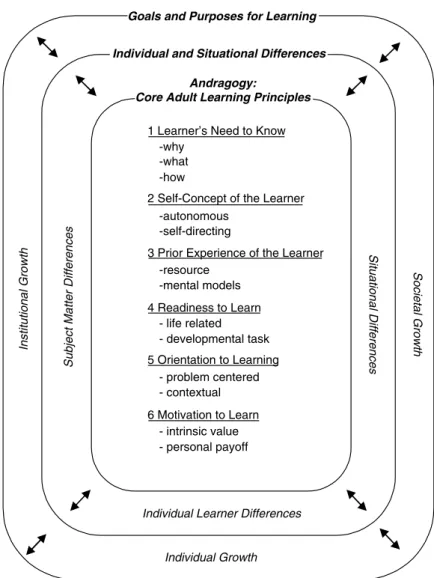
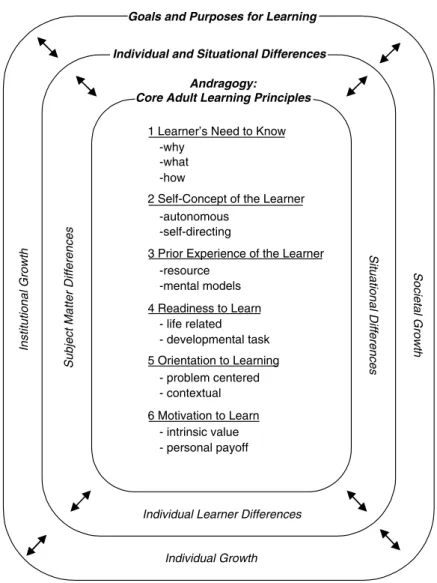
Having said that, these core principles are also incomplete in terms of learning decisions. Figure 1-1 graphically shows that andragogy is a core set of adult learning principles. The six principles of andra- gogy are (1) the learner’s need to know, (2) self-concept of the learner, (3) prior experience of the learner, (4) readiness to learn, (5) orientation to learning, and (6) motivation to learn. These principles are listed in the center of the model. As you shall see in this and sub- sequent chapters, there are a variety of other factors that affect adult learning in any particular situation and may cause adults to behave more or less closely to the core principles. These include individual learner and, situational differences, and goals and purposes of learning, shown in the two outer rings of the model. Andragogy works best in practice when it is adapted to fit the uniqueness of the learners and the learning situation. We see this not as a weakness of the principles, but as a strength. Their strength is that these core principles apply to all adult learning situations, as long they are considered in concert with other factors that are present in the situation.
This sixth edition of The Adult Learner provides a journey from theory to practice in adult learning. Figure 1-1 provides a snapshot summary of the journey in displaying the six core adult learning principles surrounded by the context of individual and situational differences, and the goals and purposes of learning. The following chapters will reveal the substance and subtleties of this holistic model of andragogy in practice.
P
L A N F O R T H EB
O O KThe first part of the book, “The Roots of Andragogy”
(Chapters 2–6), presents the core principles of adult learning: andra- gogy. It traces the development of the theory and focuses on the core unique characteristics of adults as learners.
Part 2, “Advances in Adult Learning,” (Chapters 7–11) addresses the two outer rings. Chapter 7 discusses in detail the Andragogy in Practice model introduced in this chapter and discusses how to apply
it in different settings. Chapter 8 discusses adult learning as practiced within human resource development. Chapter 9 focuses on new thinking about andragogy and elaborates on applying the core prin- ciples to different learners. Chapter 10 discusses new advancements in the understanding of adult learning that enable facilitators to further
ANDRAGOGY IN PRACTICE
(Knowles, Holton & Swanson, 1998)
Goals and Purposes for Learning
Individual and Situational Differences Andragogy:
Core Adult Learning Principles 1 Learner’s Need to Know
-why -what -how
2 Self-Concept of the Learner -autonomous
-self-directing
3 Prior Experience of the Learner -resource
-mental models 4 Readiness to Learn
- life related - developmental task 5 Orientation to Learning
- problem centered - contextual 6 Motivation to Learn
- intrinsic value - personal payoff
Individual Learner Differences
Individual Growth
Institutional Growth Subject Matter Differences Situational Differences Societal Growth
Figure 1-1. Andragogy in practice (Knowles, Holton, and Swanson, 1998).
adapt application of the core principles. Chapter 11 summarizes these two sections by looking at the future of andragogy in the areas of research and practice.
Part 3, “Practice in Adult Learning” (Chapters 12-19), presents selected readings that elaborate on specific aspects of andragogy in practice. These include strategies to implement the core assumptions, to tailor learning to individual differences, and to implement adult learning in organizations. Of special interest are two self-assessment instruments, the Core Competency Diagnostic and Planning Guide (Chapter 16) and the Personal Adult Learning Style Inventory (Chapter 17), that enable the reader to begin a personal development journey in adult learning.
R
E F L E C T I O NQ
U E S T I O N S1.1 What are your general thoughts on how humans learn?
1.2 Based on personal experience, what key factors are related to adult learning?
1.3 If you understood more about how adults learn, how would you use this information?
P A R T 1
The Roots of Andragogy
History and Principles of Classic
Andragogical Adult Learning Theory
C H A P T E R 2
Exploring the World of Learning Theory
W
H YE
X P L O R EL
E A R N I N GT
H E O R Y?
This is a good question. Perhaps you shouldn’t. If you have no questions about the quality of learning in your organization, if you are sure it’s the best it can be, we suggest that you cancel your order for this book and get a refund. However, if you’re a policy-level leader, a change agent, a learning specialist, or a consultant, you should seriously consider exploring learning theory. Doing so will increase your understanding of various theories and your chances for achieving your desired results.
Policy-level leader may have such questions as: Are our HRD interventions based on assumptions about human nature and organ- izational life that are congruent with the assumptions on which our management policies are based? Is our HRD program contributing to long-run gains in our human capital, or only short-run cost reduc- tion? Why do our HRD personnel make the decisions they do con- cerning priorities, activities, methods and techniques, materials, and the use of outside resources (consultants, package programs, hard- ware, software, and university courses)? Are these the best decisions?
How can I assess whether or not, or to what degree, the program is producing the results I want?
Managers may have all of these questions plus others, such as:
Which learning theory is most appropriate for which kind of learn- ing, or should our entire program be faithful to a single learning the- ory? How do I find out what learning theories are being followed by
7
the various consultants, package programs, and other outside resources available to us? What difference might their theoretical orientation make in our program? What are the implications of the various learning theories for our program development, selection and training of instructional personnel, administrative policies and practices, facilities, and program evaluation?
Learning specialists (instructors, curriculum builders, and meth- ods, materials, and media developers) may have some of those ques- tions in addition to the following: How can I increase my effectiveness as a learning specialist? Which techniques will be most effective for particular situations? Which learning theories are most congruent with my own view of human nature and the purpose of education?
What are the implications of the various learning theories for my own role and performance?
Consultants (change agents, experts, and advocates) may have some of these questions plus others, such as: Which learning theory should I advocate under what circumstances? How shall I explain the nature and consequences of the various learning theories to my clients? What are the implications of the various learning theories for total organizational development? Which learning theory is most consistent with my conception of the role of consultant?
A good theory should provide explanations of phenomena as well as guidelines for action. But theories about human behavior also carry with them assumptions about human nature, the purpose of education, and desirable values. Understandably, then, a better under- standing of the various learning theories will result in better decisions regarding learning experiences and more desirable outcomes.
W
H A TI
S AT
H E O R Y?
It seems that most writers in this field don’t expressly define the term theory, but expect their readers to derive its meaning from their use of the term. Torraco (1997) informs us that “a theory simply explains what a phenomenon is and how it works” (p. 115).
Webster’s Seventh New Intercollegiate Dictionary gives five defini- tions: (1) the analysis of a set of facts in their relation to one another;
(2) the general or abstract principles of a body of fact, a science, or an art; (3) a plausible or scientifically acceptable general principle
or body of principles offered to explain phenomena; (4) a hypothesis assumed for the sake of argument or investigation; (5) abstract thought. Learning theorists use all five of these definitions in one way or another, but with wide variations in their usage:
Here, for example, are some definitions by usage in context.
The research worker needs a set of assumptions as a starting point to guide what he/she does, to be tested by experiment, or to serve as a check on observations and insights. Without any theory, researcher activities may be as aimless and as wasteful as the early wanderings of the explorers in North America . . . knowledge of theory always aids practice. (Kidd, 1959, pp. 134–135)
A scientist, with the desire to satisfy his/her curiosity about the facts of nature, has a predilection for ordering his/her facts into systems of laws and theories. He/she is interested not only in ver- ified facts and relationships, but in neat and parsimonious ways of summarizing these facts. (Hilgard and Bower, 1966, pp. 1–2) Every managerial act rests on assumptions, generalizations, and hypotheses—that is to say, on theory. (McGregor, 1960, p. 6) Few people, other than theorists, ever get excited about theories.
Theories, like vegetables and televised golf tournaments, don’t trigger provocative reactions from people. Most theories, except those that are truly revolutionary, such as the contributions of Newton, Einstein, and Darwin, just do their jobs quietly behind the scenes. They may increase our understanding of a real-world event or behavior or they may help us predict what will happen in a given situation. But they do so without a lot of fanfare.
(Torraco, 1997, p. 114)
From these excerpts and perspectives we can see that a theory can be a guiding set of assumptions (Kidd), an ordering system that neatly summarizes the facts (Hilgard and Bower), and/or assump- tions, generalizations, and hypotheses (McGregor). And, as Torraco points out, theories can be tacit. Yet, we must examine another important perspective: the fact that there are some psychologists who don’t believe in theories at all. For example, Skinner objects to theories on the score that the hypothesis-formulation-and-testing
procedures they generate are wasteful and misleading. “They usually send the investigator down the wrong paths, and even if the scien- tific logic makes them self-correcting, the paths back are strewn with discarded theories” (Hilgard and Bower, 1966, p. 143). Skinner believes that the end result of scientific investigation is a “described functional relationship demonstrated in the data.” After reviewing the classical theories, he comes to the conclusion that “such theories are now of historical interest only, and unfortunately, much of the work which was done to support them is also of little current value.
We may turn instead to a more adequate analysis of the changes which take place as a student learns” (Skinner, 1968, p. 8).
Similarly, Gagne (1965) writes, “I do not think learning is a phe- nomenon which can be explained by simple theories, despite the admitted intellectual appeal that such theories have” (p. v). He goes on to explain, however, that a number of useful generalizations can be made about classes of performance change, which he describes as conditions of learning.
Where does all this leave us in answering the question, What is a theory? Perhaps the only realistic answer is that a theory is what a given author says it is. If you want to understand his or her thinking you have to go along with his or her definitions. So here is our defi- nition: A theory is a comprehensive, coherent, and internally consis- tent system of ideas about a set of phenomena.
W
H A TI
SL
E A R N I N G?
Any discussion of a definition of learning must be prefaced with an important and frequently made distinction—the one between education and learning.
Education is an activity undertaken or initiated by one or more agents that is designed to effect changes in the knowledge, skill, and attitudes of individuals, groups, or communities. The term emphasizes the educator, the agent of change who presents stim- uli and reinforcement for learning and designs activities to induce change.
The term learning, by contrast, emphasizes the person in whom the change occurs or is expected to occur. Learning is the act or process by which behavioral change, knowledge, skills, and attitudes are acquired (Boyd, Apps, et al., pp. 100–101).
Having made this distinction, we can proceed with our definition of learning. However, defining learning, like defining theory, can prove complicated. Some learning theorists assert that defining learning is difficult, while still others maintain that there is no basic disagreement about the definition of learning between the theories. Smith (1982) summarizes the difficulty of defining learning in these words:
It has been suggested that the term learning defies precise defini- tion because it is put to multiple uses. Learning is used to refer to (1) the acquisition and mastery of what is already known about something, (2) the extension and clarification of meaning of one’s experience, or (3) an organized, intentional process of testing ideas relevant to problems. In other words, it is used to describe a product, a process, or a function. (p. 34)
In contrast, Ernest Hilgard, one of our most distinguished con- temporary interpreters of learning theory, concludes that the debate centers on interpretation and not definition.
While it is extremely difficult to formulate a satisfactory defini- tion of learning so as to include all the activities and processes which we wish to include and eliminate all those which we wish to exclude, the difficulty does not prove to be embarrassing because it is not a source of controversy as between theories. The controversy is over fact and interpretation, not over definition.
(Hilgard and Bower, 1966, p. 6)
This generalization appears to hold with regard to those learning theorists who dominated the field until recently, although there are striking variations in the degree of precision among them. Let’s start with three definitions by different authors as presented in Readings in Human Learning.
Learning involves change. It is concerned with the acquisition of habits, knowledge, and attitudes. It enables the individual to make both personal and social adjustments. Since the concept of change is inherent in the concept of learning, any change in behavior implies that learning is taking place or has taken place.
Learning that occurs during the process of change can be referred to as the learning process. (Crow and Crow, 1963, p. 1)
Learning is a change in the individual, due to the interaction of that individual, and his environment, which fills a need and makes him more capable of dealing adequately with his environ- ment. (Burton, 1963, p. 7)
There is a remarkable agreement upon the definition of learning as being reflected in a change in behavior as the result of experi- ence. (Haggard, 1963, p. 20)
The last notion implies that we don’t directly know what learning is, but can only infer what it is. This idea is supported by Cronbach (1963), who stated, “Learning is shown by a change in behavior as a result of experience” (p. 71). Harris and Schwahn (1961) go back to, “Learning is essentially change due to experience,” but then go on to distinguish among learning as product, which emphasizes the end result or outcome of the learning experience, learning as process, which emphasizes what happens during the course of a learning experience in attaining a given learning product or outcome, and learning as function, which emphasizes certain critical aspects of learning, such as motivation, retention, and transfer, which presum- ably make behavioral changes in human learning possible (pp. 1–2).
Others take care to distinguish between planned learning and nat- ural growth.
Learning is a change in human disposition or capability, which can be retained, and which is not simply ascribable to the process of growth. (Gagne, 1965, p. 5)
Learning is the process by which an activity originates or is changed through reacting to an encountered situation, provided that the characteristics of the change in activity cannot be explained on the basis of native response tendencies, maturation, or temporary states of the organism (e.g., fatigue, drugs, etc.).
(Hilgard and Bower, 1966, p. 2)
The concepts of control and shaping lie at the heart of Skinner’s (1968) treatment of learning: (1) “Recent improvements in the conditions which control behavior in the field of learning are of two principal sorts. The Law of Effect has been taken seriously; we have made sure that effects do occur under conditions which are optimal
for producing changes called learning” [control] and (2) Once we have arranged the particular type of consequence called a reinforce- ment, our techniques permit us to shape the behavior of an organism almost at will (p. 10).
Clearly, these learning theorists (and most of their precursors and many of their contemporaries) see learning as a process by which behavior is changed, shaped, or controlled. Other theorists prefer to define learning in terms of growth, development of competencies, and fulfillment of potential. Jerome Bruner (1966), for example, observes, “It is easy enough to use one’s chosen theory for explain- ing modifications in behavior as an instrument for describing growth; there are so many aspects of growth that any theory can find something that it can explain well.” He then lists the following
“benchmarks about the nature of intellectual growth against which to measure one’s efforts at explanation”:
1. Growth is characterized by increasing independence of response from the immediate nature of the stimulus.
2. Growth depends upon internalizing events into a “storage sys- tem” that corresponds to the environment.
3. Intellectual growth involves an increasing capacity to say to oneself and others, by means of words or symbols, what one has done or what one will do.
4. Intellectual development depends upon a systematic and con- tingent interaction between a tutor and a learner.
5. Teaching is vastly facilitated by the medium of language, which ends by being not only the medium for exchange but the instru- ment that the learner can then use himself in bringing order into the environment.
6. Intellectual development is marked by increasing capacity to deal with several alternatives simultaneously, to tend to several sequences during the same period of time, and to allocate time and attention in a manner appropriate to these multiple demands. (pp. 4–6)
Still other theorists feel that even this emphasis on growth, with its focus on cognitive development, is too narrow to explain what learn- ing is really about. For instance, Jones (1968) objects to Bruner’s
underemphasis on emotional skills, his exclusive attention to extra- psychic stimuli, the equating of symbolism with verbalism, and his preoccupation with the processes of concept attainment to the seem- ing exclusion of the processes of concept formation or invention (pp. 97–104).
Nevertheless, Bruner is moving away from the perception of learn- ing as a process of controlling, changing, or shaping behavior and putting it more in the context of competency development. One of the most dynamic and prolific developments in the field of psycho- logy, humanistic psychology, has recently exploded on the scene (the Association of Humanistic Psychology was founded in 1963) and has carried this trend of thought much farther. Carl Rogers is one of its exponents. The elements of humanistic psychology, according to Rogers (1969), include:
1. Personal involvement. The whole person, including his or her feelings and cognitive aspects, are involved in the learning event.
2. Self-initiation. Even when the impetus or stimulus comes from the outside, the sense of discovery, of reaching out, of grasping and comprehending, comes from within.
3. Pervasiveness. Learning makes a difference in the behavior, attitudes, perhaps even the personality of the learner.
4. Evaluation by the learner. The learner knows whether the learning meets personal need, whether it leads toward what the individual wants to know, whether it illuminates the dark area of ignorance the individual is experiencing. The locus of evalu- ation, we might say, resides definitely in the learner.
5. Its essence is meaning. When such learning takes place, the ele- ment of meaning to the learner is built into the whole experi- ence. (p. 5)
Maslow (1970) sees the goal of learning to be self-actualization:
“the full use of talents, capacities, potentialities, etc.” (p. 150). He conceives of growth toward this goal as being determined by the relationship of two sets of forces operating within each individual.
“One set clings to safety and defensiveness out of fear, tending to regress backward, hanging on to the past. . . . The other set of forces impels him forward toward wholeness to Self and uniqueness of Self,
toward full functioning of all his capacities. . . . We grow forward when the delights of growth and anxieties of safety are greater than the anxieties of growth and the delights of safety” (1972, pp. 44–45).
Building on the notion that “insights from the behavioral sciences have expanded the perception of human potential, through a re-cast- ing of the image of man from a passive, reactive recipient, to an active, seeking, autonomous, and reflective being,” Sidney Jourard (1972) develops the concept of independent learning:
That independent learning is problematic is most peculiar, because man always and only learns by himself. . . . Learning is not a task or problem; it is a way to be in the world. Man learns as he pursues goals and projects that have meaning for him. He is always learning something. Perhaps the key to the problem of independent learning lies in the phrase “the learner has the need and the capacity to assume responsibility for his own continuing learning.” (p. 66)
Other educational psychologists question the proposition that learning can be defined as a single process. For example, Gagne (1972) identifies five domains of the learning process, each with its own praxis:
1. Motor skills, which are developed through practice.
2. Verbal information, the major requirement for learning being its presentation within an organized, meaningful context.
3. Intellectual skills, the learning of which appears to require prior learning of prerequisite skills.
4. Cognitive strategies, the learning of which requires repeated occasions in which challenges to thinking are presented.
5. Attitudes, which are learned most effectively through the use of human models and “vicarious reinforcement.” (pp. 3– 41) Tolman distinguished six types of “connections or relations” to be learned: (1) cathexes, (2) equivalence beliefs, (3) field expectancies, (4) field-cognition modes, (5) drive discriminations, and (6) motor patterns (Hilgard and Bower, 1966, pp. 211–213).
Bloom and his associates (1956, p. 7) identified three domains of educational objectives: (1) cognitive, “which deal with the recall or recognition of knowledge and the development of intellectual abili- ties and skills”; (2) affective, “which describe changes in interest, attitudes, and values, and the development of appreciations and adequate adjustment”; and (3) psychomotor. Later scholars expanded on the psychomotor domain to include all the human senses and their dimensions.
It is certainly clear by now that learning is an elusive phenomenon.
And, as we shall see next, the way people define it greatly influences how they theorize and go about effecting it. Until recently, educators of adults have been wallowing around in this same morass, and after wallowing around in it a bit more ourselves, we’ll see how adult edu- cators are beginning to extricate themselves.
S
U M M A R YExploring learning theory can be beneficial to policy-level leaders, managers, learning specialists, and consultants by providing infor- mation that will allow better decisions and ultimately more desirable learning experiences. However, doing so is not a simple task. In order to explore learning theory, one must understand several key concepts including the definition of theory, the distinction between learning and education, and the complexities involved in defining learning. We know that some learning theorists consider a theory to be a guiding set of assumptions, an ordering system that neatly sum- marizes the facts, and/or assumptions, generalizations, and hypothe- ses. Some psychologists, however, oppose the concept of learning theories. For instance, Gagne asserts that despite the “intellectual appeal,” learning cannot be readily explained by theories. Analyzing the changes that occur as a student learns, according to Skinner, pro- duces more valuable information than the “wasteful” and “mislead- ing” procedures generated by theories. Despite these objections, we conclude that a theory is a comprehensive, coherent, and internally consistent system of ideas about a set of phenomena. We also acknowledge the distinction between education and learning.
Education emphasizes the educator, whereas learning emphasizes the person in whom the change occurs or is expected to occur. Although this distinction is easily understood, developing a working definition
of learning is much more complex. Key components of learning the- orists’ definitions of learning serve as the foundation for our discus- sion of the definition of learning. These include change, filling a need, learning as product, learning as process, learning as function, natural growth, control, shaping, development of competencies, ful- fillment of potential, personal involvement, self-initiated, learner- evaluated, independent learning, and learning domains. We define learning as the process of gaining knowledge and/or expertise.
R
E F L E C T I O NQ
U E S T I O N S2.1 What is the connection between theory and practice?
2.2 Why should practitioners care about theory?
2.3 What is the essential difference between the concepts of edu- cation and learning?
2.4 What definition of learning or key points about learning pre- sented in this chapter have the most meaning to you? Why?
C H A P T E R 3
Theories of Learning
Traditionally, we have known more about how animals learn than about how children learn; and we know much more about how chil- dren learn than about how adults learn. Perhaps this is because the study of learning was taken over early by experimental psychologists whose canons require the control of variables. And it is obvious that the conditions under which animals learn are more controllable than those under which children learn; and the conditions under which children learn are much more controllable than those under which adults learn. The fact is, then, that many of the “scientific”
theories of learning have been derived from the study of learning by animals and children.
P
R O P O U N D E R S A N DI
N T E R P R E T E R SIn general, there are two types of literature about learning theory:
that produced by propounders of theories (who tend to be single- minded), and that produced by interpreters of theories (who tend to be reconciliatory). Admittedly, the distinction between propounders and interpreters is not absolute. For instance, some theorists, such as Pressey, Estes, Lorge, Gagne, Hilgard, and Huhlen, have made con- tributions of both sorts.
Table 3-1 presents a historic list of the major propounders and interpreters in the literature of learning theory. To keep the list rea- sonably short, we have defined “major” as those who have made the greatest impact on the thinking of others. Those making contribu- tions of both sorts have been placed in the column representing their major work. To provide a sense of historical development, the theo- rists are listed more or less in the order of appearance in the evolv- ing body of literature.
18
Table 3-1
Propounders and Interpreters of Learning Theory
Propounders Interpreters
Ebbinghaus (1885) Thorndike (1898) Angell (1896) Dewey (1896) Pavlov (1902) Woodworth (1906) Watson (1907) Judd (1908) Freud (1911) Kohler (1917) Tolman (1917) Wertheimer (1923)
Koffka (1924) Kilpatrick (1925)
Pressey (1926)
Guthrie (1930) Rugg (1928)
Skinner (1931) Hilgard (1931)
Hall (1932) McGeoch (1932) Lewin (1933) Piaget (1935) Miller (1935) Spence (1936) Mowrer (1938)
Katona (1940) Bode (1940)
Maslow (1941) Melton (1941)
Festinger (1942) Cronbach (1943)
Rogers (1942) Brunner (1943)
Estes (1944) Lorge (1944)
Krech (1948) McClelland (1948) Sheffield (1949) Underwood (1949)
Dollard (1950) Schaie (1953)
Tyler (1950) Garry (1953)
Koch (1954) McKeachie (1954) Birren (1954)
(table continued on next page)
T
Y P E S O FT
H E O R I E SThe proliferation of propounders has presented a major chal- lenge to the interpreters in their quest to bring some sort of order to learning theories. Researchers have exerted considerable effort in their attempts to structure the system. However, no single, uni- fied classification emerged from their early efforts. For instance,
Table 3-1. Continued
Propounders Interpreters
Bloom (1956) Getzels (1956)
Bruner (1956) Bugelski (1956)
Erikson (1959) Kuhlen (1957)
Crowder (1959) Kidd (1959)
Lumsdaine (1959) Botwinick (1960)
Combs and Snygg (1959) Miller (1960)
Ausubel (1960) Glaser (1962)
Glaser (1962) Flavell (1963)
Gagne (1963)
Hill (1963) Gage (1963) McDonald (1964)
Jourard (1964) Goldstein (1965)
Suchman (1964) Reese and Overton (1970) Crutchfield (1969) Goble (1971)
Friere (1970) Knowles (1970) Tough (1971) Houle (1972) Dave (1973) Loevinger (1976) Cross (1976)
Botwinick (1977) Howe (1977)
Gross (1977) Knox (1977)
Srinivasan (1977)
Cropley (1980) Chickering (1981)
Mezirow (1981) Darkenwald (1982)
Smith (1982) Merriam (1982)
Wlodkowski (1985) Brookfield (1986) Daloz (1986)
Hilgard and Bower identify 11 categories of theories, McDonald identifies 6, and Gage names 3. Hilgard and Bower’s (1996) 11 cat- egories are:
Thorndike’s Connectionism Pavlov’s Classical Conditioning Guthrie’s Contiguous Conditioning Skinner’s Operant Conditioning Hull’s Systematic Behavior Theory Tolman’s Purposive Behaviorism Gestalt Theory
Freud’s Psychodynamics Functionalism
Mathematical Learning Theory Information Processing Models
McDonald (1964, pp. 1–26) breaks the theories down into six cat- egories in his analysis:
Recapitulation (Hull) Connectionism (Thorndike) Pragmatism (Dewey)
Gestalt and Field Theory (Ogden, Hartman, Lewin) Dynamic Psychology (Freud)
Functionalism (Judd)
Gage (1972, p. 19) identifies three families of learning theories:
(1) conditioning, (2) modeling, and (3) cognitive. Kingsley and Garry (1957, p. 83) provide two sets: (1) association or stimulus-response (Thorndike, Guthrie, and Hull) and (2) field theories (Lewin, Tolman, and the gestalt psychologists). Taba (1962, p. 80) agrees with the two-family set, but uses different labels: (1) associationist or behaviorist theories and (2) organismic, gestalt, and field theories.
The work of Hilgard and Bower is perhaps the most comprehen- sively interpretive work to date. Their frustration in arranging the
disparate categories of theories into a pattern is clearly expressed in their work.
Learning theories fall into two major families: behaviorist/connec- tionist theories and cognitive/gestalt theories, but not all theories belong to these two families. The behaviorist theories include such diverse theories as those of Thorndike, Pavlov, Guthrie, Skinner, and Hull. The cognitive theories include at least those of Tolman and the classical gestalt psychologists. Not completely and clearly classifiable in these terms are the theories of functionalism, psychodynamics, and the probabilistic theories of the model builders. The distinctions between the two families of theories are not based only on differ- ences within learning theories; there are other specific issues upon which theories within one family may differ (Hilgard and Bower, 1966, p. 8).
Obviously, the interpreters had not succeeded up to this point in organizing the field of learning theories in a really fundamental way—
at least not in a way that satisfied most of them, and certainly not Knowles. Then, in 1970, two developmental psychologists, Hayne W. Reese and Willis F. Overton, presented a way to conceptualize the theories in terms of larger models: the mechanistic or elemental model and the organismic or holistic model. Then, the mist began to clear.
The Concept of Part and Whole Models of Development Reese and Overton (1970) propose that “any theory presupposes a more general model according to which the theoretical concepts are formulated” (p. 117). The most general models are the world views or metaphysical systems that constitute basic models of the essential characteristics of humankind and indeed of the nature of reality.
Two systems that have been pervasive in both the physical and the social sciences are the elemental world view, the basic metaphor of which is the machine, and the holistic world view, the basic metaphor of which is the organism—the living, organized system presented to experience in multiple forms. See Table 3-2.
The elemental model represents the universe as a system composed of discrete pieces operating in a spatio-temporal field. These pieces—
elementary particles in motion—and their relations form the basic
reality to which all other more complex phenomena are ultimately reducible. When forces are applied in the operation of the system, a chain-like sequence of events results; and, since these forces are the only efficient or immediate causes of the events, complete prediction is possible—in principle. As Reese and Overton (1970) point out,
“Consequently of the universe represented in this way, is that it is eminently susceptible to quantification” (p. 131).
The holistic model represents the universe as a unitary, interactive, developing organism. It perceives the essence of substance to be activity, rather than the static elementary particle. From such a point of view, one element can never be like another, and as a consequence, the logic of discovering reality according to the analytical ideal of reducing the many qualitative differences to the one is repudiated. In its place is substituted a search for unity among the many; that is, a pluralistic universe is substituted for a monistic one, and it is the diversity that constitutes the unity. Thus, unity is found in multiplic- ity, being is found in becoming, and constancy is found in change (Reese and Overton, 1970, p. 133).
The whole is therefore organic rather than mechanical in nature.
“The nature of the whole, rather than being the sum of its parts, is presupposed by the parts and the whole constitutes the condition of the meaning and existence of the parts” (Reese and Overton, 1970).
Accordingly, efficient cause is replaced by formal cause—cause by the essential nature of the form. Thus, the possibility of a predictive and quantifiable universe is precluded.
When applied to the sphere of epistemology and psychology, this world view results in an inherently and spontaneously active organ- ism model of humans. It sees people as an active organism rather than a reactive organism, as a source of acts rather than as a
Table 3-2
World Views or Metaphysical Systems
Elemental Model Holistic Model
Represents the universe as a machine Represents the world as a unitary, Composed of discrete pieces operating interactive, developing organism:
in a spatio-temporal field: reactive and active and adaptive model of man.
adaptive model of man.
collection of acts initiated by external forces. It also represents indi- viduals as an organized entity.
a configuration of parts which gain their meaning, their function, from the whole in which they are imbedded. From this point of view, the concepts of psychological structure and function, or means and ends, become central rather than derived. Inquiry is directed toward the discovery of principles of organization, toward the explanation of the nature and relation of parts and wholes, structures and functions, rather than toward the deriva- tion of these from elementary processes.
The individual who accepts this model will tend to emphasize the significance of processes over products, and qualitative change over quantitative change. . . . In addition, he/she will tend to emphasize the significance of the role of experience in facilitating or inhibiting the course of development, rather than the effect of training as the source of development. (Reese and Overton, 1970, pp. 133–134)
With this and the preceding set of concepts as a frame of reference, let us turn to a brief examination of the theories about learning derived from the study of learning in animals and children.
Theories Based on an Elemental Model
While John B. Watson (1878-1958) is considered the father of behaviorism, Edward L. Thorndike conducted the first systematic investigation in this country of the phenomenon we call learning. It was a study of learning in animals, first reported in his Animal Intelligence, published in 1898.
Thorndike perceived inexperienced learners to be empty organ- isms who more or less responded to stimuli randomly and automat- ically. A specific response is connected to a specific stimulus when it is rewarded. In this situation, the stimulus, S, is entirely under the control of the experimenter (or teacher), and in large measure so is the response, R, for all the experimenter has to do to connect the particular R to a particular S is to reward the R when the organism happens to make it. This association between sense impressions and impulses to action came to be known as a bond or a connection.
Thus, Thorndike’s system has sometimes been called bond psychol- ogy or connectionism, and was the original stimulus-response (or S-R) psychology of learning.
Thorndike developed three laws that he believed governed the learning of animals and human beings:
1. The law of readiness (the circumstances under which a learner tends to be satisfied or annoyed, to welcome or to reject);
2. The law of exercise (the strengthening of connections with practice); and
3. The law of effect (the strengthening or weakening of a connec- tion as a result of its consequences).
In the course of a long and productive life (he died in 1949), and with help from many collaborators, both friendly and critical, Thorndike’s system of thought became greatly refined and elabo- rated. It provided the subfoundation of the behaviorist theories of learning.
While Thorndike conducted his work on connections in this coun- try, the Russian physiologist Ivan Pavlov (1849-1936) conducted his experiments that resulted in the concept of conditioned reflexes.
Hilgard and Bower (1966) describe his classical experiment:
When meat powder is placed in a dog’s mouth, salivation takes place; the food is the unconditioned stimulus and salivation is the unconditioned reflex. Then some arbitrary stimulus, such as a light, is combined with the presentation of the food. Eventually, after rep- etition and if time relationships are right, the light will evoke sali- vation independent of the food; the light is the conditioned stimulus and the response to it is the conditioned reflex. (p. 48)
Pavlov’s work resulted in a system that has been termed classical conditioning to distinguish it from later developments in instrumen- tal conditioning and operant conditioning. In his system, he devel- oped several concepts and accompanying techniques that have since been incorporated into the behaviorist system. These concepts are reinforcement, extinction, generalization, and differentiation. In rein- forcement, a conditioned reflex becomes fixed by providing the con- ditioned stimulus and following it repeatedly with the unconditioned
stimulus and response at appropriate time intervals. Extinction occurs when reinforcement is discontinued and the conditioned stim- ulus is presented alone, unaccompanied by the unconditioned stimu- lus. The conditioned response gradually diminishes and disappears. It becomes “extinct.” In generalization, a conditioned reflex evoked to one stimulus can also be elicited by other stimuli, not necessarily sim- ilar to the first. A fourth basic concept Pavlov developed was differ- entiation. In differentiation, the initial generalization is overcome by the method of contrasts in which one of a pair of stimuli is regularly reinforced and the other is not; in the end, the conditioned reflex occurs only to the positive (reinforced) stimulus and not to the nega- tive (nonreinforced) stimulus.
The behaviorists, then and now, had and have in common the con- viction that a science of psychology must be based on a study of that which is overtly observable: physical stimuli, the muscular move- ments and glandular secretions which they arouse, and the environ- mental products that ensue. The behaviorists have differed among themselves as to what may be inferred in addition to what is meas- ured, but they all exclude self-observation (Hilgard and Bower, 1966, p. 75).
Watson placed emphasis on kinesthetic stimuli as the integrators of animal learning and, applying this concept to human beings, con- jectured that thought was merely implicit speech—that sensitive enough instruments would detect tongue movements or other move- ments accompanying thinking.
Edward R. Guthrie (1886–1959) built on the works of Thorndike, Pavlov, and Watson and added the principle of contiguity of cue and response. He stated his only law of learning, “from which all else about learning is made comprehensible,” as follows: “A combina- tion of stimuli which has accompanied a movement will on its recur- rence tend to be followed by that movement” (Hilgard and Bower, 1966, p. 77). In his later work, Guthrie placed increasing emphasis on the part played by the learner in selecting the physical stimuli to which it would respond; hence, the attention or scanning behavior that goes on before association takes place became important.
Guthrie’s system of thought was further clarified and formalized by his students, Voeks and Sheffield, but the next major advance in behaviorist psychology was the result of the work of B. F.. Skinner and his associates. It is from their work that the educational technology of
programmed instruction and teaching machines so popular in the 1960s were derived. Skinner’s ideas are summarized in Chapter 4.
Another development in behaviorist psychology occurring during the middle decades of the twentieth century was the construction of Clark L. Hull’s systematic behavior theory and its elaboration by Miller, Mowrer, Spence, and others. Hull’s theory is a conceptual descendant of Thorndike’s, inasmuch as he adopted reinforcement as an essential characteristic of learning. Hull constructed an elaborate mathematico-deductive theory revolving around the central notion that there are intervening variables in the organism that influence what response will occur following the onset of a stimulus. He developed 16 postulates regarding the nature and operation of these variables, and stated them in such precise terms that they were read- ily subjected to quantitative testing. Hilgard and Bower’s (1966) assessment of the effect of Hull’s work follows:
It must be acknowledged that Hull’s system, for its time, was the best there was—not necessarily the one nearest to psychological reality, not necessarily the one whose generalizations were the most likely to endure—but the one worked out in the greatest detail, with the most conscientious effort to be quantitative throughout and at all points closely in touch with empirical tests. . . . Its primary contribution may turn out to lie not in its substance at all, but rather in the ideal it set for a genuinely sys- tematic and quantitative psychological system far different from the schools which so long plagued psychology. (p. 187)
Undoubtedly, Hull’s work also stimulated the rash of mathemati- cal models of learning that were developed after 1950 by Estes, Burke, Bush, Mosteller, and others. It should be pointed out that these are not themselves learning theories, but mathematical repre- sentations of substantive theories.
Theories Based on an Holistic Model
John Dewey, in 1896, launched the first direct protest against the elemental model of the associationists. Although his work falls into the category of educational philosophy rather than learning theory, his emphasis on the role of interest and effort and on the child’s
motivation to solve his or her own problems became the starting point for a line of theorizing that has been given the label functionalism.
Translated into schoolroom practices, functionalism provided the con- ceptual basis for progressive education, which, as Hilgard and Bower (1966) state, “at its best was an embodiment of the ideal of growth toward independence and self-control through interaction with an environment suited to the child’s developmental level” (p. 299).
The spirit of experimentalism fostered by functionalism is reflected in the work of such learning theorists as Woodworth, Carr, McGeogh, Melton, Robinson, and Underwood. The essence of func- tionalism is summarized by Hilgard and Bower (1966, pp. 302–304):
1. The functionalist is tolerant but critical.
2. The functionalist prefers continuities over discontinuities or typologies.
3. The functionalist is an experimentalist.
4. The functionalist is biased toward associationism and environ- mentalism.
In a sense, Edward C. Tolman (1886–1959) represents a bridge between the elemental and the holistic models. His system was behavioristic in that he rejected introspection as a method for psy- chological science, but it was molar rather than molecular behavior- ism—an act of behavior has distinctive properties all its own, to be identified and described irrespective of the muscular, glandular, or neural processes that underlie it. But most important, he saw behav- ior as purposive—as being regulated in accordance with objectively determined ends. Purpose is, of course, an organismic concept.
Tolman rejected the idea that learning is the association of particu- lar responses to particular stimuli. In contrast to the associationists, who believed that it is the response or sequence of responses result- ing in reward that is learned, Tolman believed it is the route to the goal that is learned. He believed that organisms, at their respective levels of ability, are capable of recognizing and learning the relation- ships between signs and desired goals; in short, they perceive the sig- nificance of the signs (Kingsley and Garry, 1957, p. 115). Tolman called his theory purposive behaviorism.
The most complete break with behaviorism occurred at the end of the first quarter of the twentieth century with the importation of the
notion of insight learning in the gestalt theories of the Germans Wertheimer, Koffka, and Kohler. These theorists took issue with the proposition that all learning consisted of the simple connection of responses to stimuli, insisting that experience is always structured, that we react not to just a mass of separate details, but to a complex pattern of stimuli. And we need to perceive stimuli in organized wholes, not in disconnected parts. The learner tends to organize his or her perceptual field according to four laws:
1. The law of proximity. The parts of a stimulus pattern that are close together or near each other tend to be perceived in groups; therefore, the proximity of the parts in time and space affects the learner’s organization of the field.
2. The law of similarity and familiarity. Objects similar in form, shape, color, or size tend to be grouped in perception; familiar- ity with an object facilitates the establishing of a figure-ground pattern. (Related to this law is the gestaltists’ view of memory as the persistence of traces in the brain that allows a carryover from previous to present experiences. They view these traces not as static, but as modified by a continual process of integra- tion and organization.)
3. The law of closure. Learners try to achieve a satisfying endstate of equilibrium; incomplete shapes, missing parts, and gaps in information are filled in by the perceiver. (Kingsley and Garry [1957] observe that “closure is to Gestalt psychology what reward is to association theory”[p. 109].)
4. The law of continuation. Organization in perception tends to occur in such a manner that a straight line appears to continue as a straight line, a part circle as a circle, and a three-sided square as a complete square.
Gestalt psychology is classified by most interpreters as within the family of field theories—theories that propose that the total pattern or field of forces, stimuli, or events determine learning.
Kurt Lewin (1890-1947) developed what he referred to specifi- cally as a field theory. Using the topological concepts of geometry, Lewin conceptualized each individual as existing in a life space in which many forces are operating. The life space includes features of the environment to which the individual reacts, such as material
objects encountered and manipulated, people met, and private thoughts, tensions, goals, and fantasies. Behavior is the product of the interplay of these forces, the direction and relative strength of which can be portrayed by the geometry of vectors. Learning occurs as a result of a change in cognitive structures produced by changes in two types of forces: (1) change in the structure of the cognitive field itself or (2) change in the internal needs or motivation of the individual. Because of its emphasis on the immediate field of forces, field theory places more emphasis on motivation than on any of the preceding theories. Lewin felt that success was a more potent moti- vating force than reward and gave attention to the concepts of ego involvement and level of aspiration as forces affecting success. He saw change in the relative attractiveness of one goal over another, which he called valence, as another variable affecting motivation.
Since some of the strongest forces affecting an individual’s psycho- logical field are other people, Lewin became greatly interested in group and institutional dynamics; and, as you shall see later, it is in this dimension of education that his strongest influence has been felt.
Developments in the field-theoretical approach have more recently appeared under several labels: phenomenological psychology, per- ceptual psychology, humanistic psychology, and third-force psychol- ogy. Since the bulk of the work with this approach has been with adults, major attention to it will be reserved for a later section. Since phenomenologists are concerned with the study of the progressive development of the mind—or, as our contemporaries would insist, the person—they see humans as organisms forever seeking greater personal adequacy. The urge for self-actualization is the driving force motivating all human behavior.
Two phenomenologists, Arthur Combs and Donald Snygg, have focused on the learning of children and the role of their educators, and their findings have important implications for learning theories.
The flavor of Combs and Snygg’s system of thought can be caught from statements from Pittenger and Gooding (1971):
● A person behaves in terms of what is real to him or her and what is related to his or her self at the moment of action (p. 130).
● Learning is a process of discovering one’s personal relationship to and with people, things, and ideas. This process results in
and from a differentiation of the phenomenal field of the indi- vidual (p. 136).
● Further differentiation of the phenomenological field occurs as an individual recognizes some inadequacy of a present organi- zation. When a change is needed to maintain or enhance the phenomenal self, it is made by the individual as the right and proper thing to do. The role of the teacher is to facilitate the process (p. 144).
● Given a healthy organism, positive environmental influences, and a nonrestrictive set of percepts of self, there appears to be no forseeable end to the perceptions possible for the individual (pp. 150–151).
● Transfer is a matter of taking current differentiations and using them as first approximations in the relationship of self to new situations (p. 157).
● Learning is permanent to the extent that it generates problems that may be shared by others and to the degree that continued sharing itself is enhancing (p. 165).
Two other contemporary psychologists, Jean Piaget and Jerome Bruner, have had great impact on thinking about learning, although they are not literally learning theorists. Their focus is on cognition and the theory of instruction. Piaget has conceptualized the process of the development of cognition and thought in evolutionary stages.
According to Piaget, the behavior of the human organism starts with the organization of sensory-motor reactions and becomes more intel- ligent as coordination between the reactions to objects becomes pro- gressively more interrelated and complex. Thinking becomes possible after language develops, and with it a new mental organiza- tion. This development involves the following evolutionary periods (Piaget, 1970, pp. 30–33):
1. The formation of the symbolic or semiotic function (ages 2 to 7 or 8). The individual is able to represent objects or events that are not at the moment perceptible by evoking them through the agency of symbols or differentiated signs.
2. The formation of concrete mental operations (ages 7 or 8 to 11 or 12). Characteristic of this stage are the linking and dissociation
of classes; the sources of classification; the linking of relations;
correspondences, and so on.
3. The formation of conceptual thought or formal operations (ages 11 or 12 through adolescence). “This period is character- ized by the conquest of a new mode of reasoning, one that is no longer limited exclusively to dealing with objects or directly representable realities, but also employs ‘hypotheses’” (Piaget, 1970, pp. 30–33).
Some reservations have been expressed about the rigid age scale and minimization of individual differences in Piaget’s schema, but his conception of evolutionary stages adds a dimension that is not gen- erally given much att