
Democracy defines the general processes causing democratization and de-democratization at the national level around the world over the past few hundred years. He highlights the integration of trust networks into public policy, the isolation of public policy from categorical inequality, and the suppression of autonomous coercive power centers as key processes. His recent books with Cambridge University Press include Dynamics of Contention (with Doug McAdam and Sidney Tarrow, 2001), Silence and Voice in the Study of Contentious Politics (with Ronald Aminzade et al., 2001), The Politics of Collective Violence (2003), Contention and Democracy in Europe and Trust and Governance (2005).
Preface
In this book, the adapted material appears in different contexts that give it substantially new meaning. Contention and Democracy used comparative histories of European regimes to demonstrate the interdependence of democratization and popular struggle, while Trust and Rule analyzed the change and variation in connections between interpersonal trust networks and networks. political regimes. Both themes return in this book, now subordinate to a broader question: how do democratization and de-democratization take place in general. This book clarifies and revises some of the arguments from my previous publications, especially when it comes to autonomous centers of coercive power and public policy control over the state as factors in democratization and de-democratization.
What Is Democracy?
However, most of the time, we will summarize the average location on the four dimensions as a single variable: degree of democracy. However, many of the biggest and most powerful have resided in the high capacity non-democratic sector. Location in one or another of the four quadrants makes a powerful difference to the character of a regime's public policy (Tilly 2006).

Democracy in History
Russia
In the 2006 presidential elections, Lukashenka took no risk of a "color revolution" in the style of Serbia, Georgia and Ukraine. Moreover, when political rights and civil liberties change in a given regime, they tend to change together in the same direction—not exactly in parallel, but roughly in sync. That increase, as we have seen, often occurs at impressive speed in the aftermath of intense conflict.
Democratization and De-Democratization
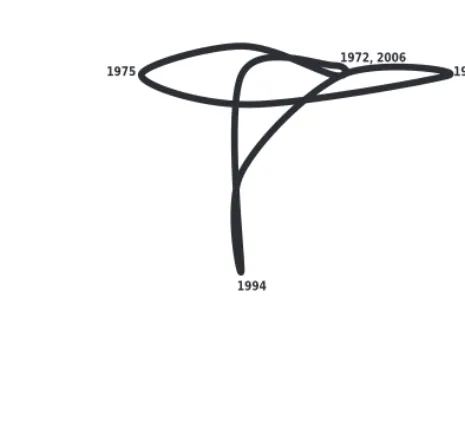
Can we translate the Indian chronology since 1972 in terms of democratization and de-democratization. Average those changes, assuming that changes in breadth, equality, protection and mutually binding consultation make equal contributions to democratization and de-democratization. They do not indicate a clear path to the direct measurement of democratization and de-democratization.
Protection: Reducing (increasing) the percentage of the population incarcerated without legal punishment or legal remedies. We approach Switzerland as a relatively unknown experimenter of both democratization and democratization. The Swiss federal diet ordered the dissolution of the mutual defense league (Sonderbund) formed by the Catholic cantons two years earlier; when the Catholic cantons refused, the Diet sent an army to Friburg and Zug (whose forces capitulated without serious fighting), then to Lucerne (where a brief battle took place).
Switzerland's complex history between 1790 and 1848 poses a serious challenge to the representation of democratization and democratization. The energetic mobilizations of the 1830s restored some democracy to the regime as a whole, without expanding the capacity of the central state. In Switzerland, as elsewhere, democratization and de-democratization appear to have been asymmetrical processes.
What explains the spread of democratization and de-democratization in the 19th and (especially) 20th century, from Western European principles to the rest of the world.
Trust and Distrust
But it dramatically illustrates how the 19th-century American electoral process integrated trust networks into public politics. But in the American political arena, networks of trust have often formed the basis of people's involvement in politics. They played their part in integrating trust networks into American public politics organized around trade and ethnicity.
How then were we to know that trust networks were becoming integrated into public policy. Instead, we should recognize that the forms of relationships between trust networks and public policy are of great importance. If my analysis of the 19th-century American experience is correct, however, it plays a crucial role in linking previously isolated networks of trust to public policy.
In terms of breadth, equity, mutually binding consultation and protection, the integration of trust networks in public policy more directly affects mutually binding consultation. However, the integration of trust networks in public policy is not a sufficient condition for democratization; After all, authoritarian regimes and theocracies also integrate trust networks. Although she uses different wording, Skocpol is describing the isolation of trust networks from national public policy.
The coincidental integration of trust networks into public politics does not exhaust the processes on which democracy depends.

Equality and Inequality
South African democrats who call for enlightenment, concludes Ashforth, risk being separated from the majority of people: The problem we face here is how South Africa's path to capacity and democracy has affected categorical inequality. in the long run, South Africans suffered greatly from the extreme intersections of inequality and the regime's public policy. As we shall see, before the democratic revolution of the late 1980s, South African whites repeatedly used their influence to undermine even the simulacra of democratic institutions they had established to divide and conquer the country's non-white population.
But on neither side of the divide do regimes build categorical distinctions produced by control over resources directly into their systems of rule. The power constellations of the two republics were uncertain, but they were still independent enough from the colonial authority in the Cape to practice a separate feudal system. By 1960, a full 63 percent of the African population lived at least temporarily outside African reserves (Fredrickson1981:244).
The state vigorously set about the very production of unequal categories, which it imposed on public life. This measure, however, encouraged mobilization among black Africans and other non-black challengers to the regime. Of all the votes, all racial categories combined, the ANC won 63 percent, the NP 20 percent and Inkatha 11 percent.).
The shake-up of the civil service saw the removal of a number of Asian and colored officials from lower-level bureaucratic positions (Johnson2004:214).

Power and Public Politics
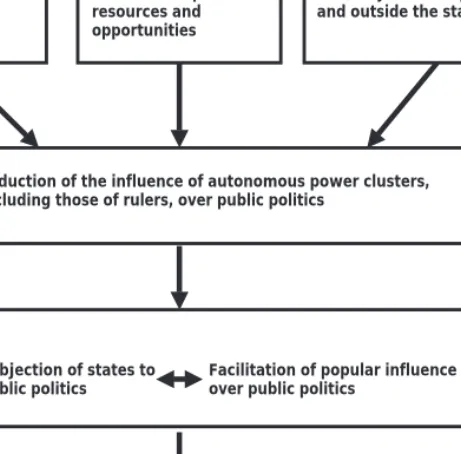
Reducing the influence of autonomous power clusters, including those of rulers, on public politics. In addition to the effects of changes in trust networks and categorical inequality, positive versions of the three processes just identified have a two-part effect: they subject the state to public policy control, and they facilitate popular influence over public policy. In both ways they subject states to public policy and facilitate the influence of the people on public policy.
Thus, like Putin in Russia, Bouteflika used his enormous energy revenues to move towards containing the autonomous power of the military, without at least directly exposing the state to public policy or increasing popular influence over public policy. Have our three crucial processes—expanding popular political participation, equalizing access to non-state political resources and opportunities, and curbing autonomous and/or arbitrary coercive power within and outside the state—actually caused the subordination of the state to public policy and the facilitation of popular influence over public policy. Subordination of the state to public policy and promotion of popular influence over public policy played indispensable roles in democratization.
Military support from Germany and Italy greatly facilitated Franco's invasion of the Spanish mainland from Morocco. Moreover, the overthrow of the authoritarian Portuguese regime in 1974 threatened Spain's conservatives and emboldened progressives. 1931–1933: Substantial integration of workers' and peasants' trust networks into national public politics through the mediation of trade unions and political organizations, combined with partial exclusion from the military.
1939–1960: A return to the overbearing patronage, particularistic ties, and evasive conformity of the 1920s, now coupled with the authoritarian integration of the military and the Catholic Church into Franco's system of government.
Alternative Paths
It results from the reversal of one or more of the three basic processes: withdrawal of large trust networks from public politics. Along that diagonal trajectory, de-democratization still results from the reversal of one or more of the basic processes: disconnection of trust networks, reinscription of categorical inequalities and/or formation of autonomous power centers that endanger popular influence over public politics and thus the state. Here we see the opposite of the strong state path: substantial democratization that precedes any substantial increase in state capacity.
As we will see later, they also host much of the world's many civil wars (Collier and Sambanis2005, Eriksson and Wallensteen 2004, Fearon and Laitin2003). Along weak state trajectories, dedemocratization occurs even more often than in strong and medium states; Incentives to draw on networks of trust, activate categorical inequalities, and create centers of power that escape the constraints of public policy increase as the state's capacity to sustain those processes declines. It shows us a regime that had long existed in the non-democratic, low-capacity (ie very violent) quadrant of the capacity-democracy space, but then switched to what might have been a strong state path to democracy.
In particular, invasion, colonization, revolution and internal confrontation sometimes accelerate the operation of the three basic processes. The peace settlement with Great Britain and the end of the civil war within Ireland fundamentally changed the regime. Both state capacity and democracy subsequently increased, with the necessary exception of the North.
But in all three, the basic processes remain the same: integrating trust networks into public policy, protecting public policy from categorical inequality, and controlling autonomous centers of power in ways that increase popular influence over public policy and public policy control over action. . of the state.

Democracy’s Pasts and Futures