DO SOCIO-DEMOGRAPHIC CHARACTERISTICS AND FINANCIAL LITERACY MATTER FOR SELECTING ISLAMIC
FINANCIAL PRODUCTS?
Salma Fadhilah Widityani1, Taufik Faturohman2, Raden Aswin Rahadi3 and Yulianti4
1 SBM Institut Teknologi Bandung, Indonesia, [email protected].
2 SBM Institut Teknologi Bandung, Indonesia, [email protected].
3 SBM Institut Teknologi Bandung, Indonesia, [email protected]
4 SBM Institut Teknologi Bandung, Indonesia, [email protected]
Keywords: Islamic financial literacy, College students, Determinant factors, Socio-demographic, Indonesia.
JEL Classification: J1; G2; G4.
Article history:
Received : October 22, 2018 Revised : November 17, 2019 Accepted : January 8, 2020 Available online : February 28, 2020 https://doi.org/10.21098/jimf.v6i1.1057
ABSTRACT
Indonesia is a promising market for the Islamic finance industry since most of the population is Muslim. However, the growth of Islamic finance in Indonesia is still low. Therefore, Islamic financial literacy needs to be improved in order to grow the Islamic finance industry significantly. The purpose of this study is to determine the factors that enhance Islamic financial literacy among college students in Indonesia. The development of validated constructs for Islamic financial literacy is important because conventional financial literacy might contain some elements that are not compatible with Islamic financial principles. This study also measures the level of Islamic financial literacy and its relationship with socio-demographic characteristics using multilinear regression. Furthermore, the relationship between Islamic financial literacy and the possession of Islamic financial products is observed by logistic regression. The determinant factors are perception, attitude and behaviour, and knowledge. The study found that type of educational institution, Islamic finance course experience, being educated to Master’s degree level, having one’s own income, and having an income above five million have a significant relationship with the Islamic financial literacy of college students. The factors that have a significant relationship with the possession of Islamic financial products are Islamic financial literacy, choice of major, Islamic finance course experience, and monthly income above five million . This research attempts to provide an Islamic financial literacy measurement through exploratory factor analysis.
The development of a validated instrument for an Islamic financial literacy index and its determinant factors is our scientific and practical contribution to the literature on Islamic financial literacy in Indonesia.
I. INTRODUCTION
Financial literacy has rapidly become an ability that must be developed by everyone in order to build individual well-being. It combines skills, awareness, knowledge, attitude, and behaviour towards financial matters that can be acted upon when making a financial decision. Every individual should be financially literate, because the individual’s needs will continue to increase, and financial institutions tend to provide increasingly more diverse yet complex financial products and services.
Financial literacy is a way to improve equality within the society since all citizens could make optimal use of financial products. Nidar and Sandi (2012) stated that a nation’s economy might be less affected by global financial issues if enough people understood the financial system and did not indulge in consumption and wasteful spending. The more financially literate people there are in a country, the more people could make use of financial products and services. Furthermore, financial literacy can contribute to equality in that country, since people will understand the value of and feel more capable of using financial instruments. A survey from S&P Global Finlit in 2015 about global variations in financial literacy showed that, from 140 countries, only 33% of adults were financially literate (Klapper, Lusardi,
& Oudheusden, 2015). According to the Financial Services Authority or Otoritas Jasa Keuangan (OJK), the index of financial literacy in Indonesia was 29.66% as of 2016. Meanwhile, financial inclusion was 67.82% (Otoritas Jasa Keuangan, 2016).
Banks are some of the financial institutions that play the most significant roles in financial literacy and inclusion in Indonesia compared with other financing institutions such as insurance companies, pension funds, pawnshops and capital markets.
Meanwhile, the index for public literacy on Islamic finance in 2016 was 8.11%, while the Islamic financial inclusion was 11.06% (Otoritas Jasa Keuangan, 2016). It is also apparent that Islamic banking is the financial institution that plays the most significant role in financial literacy and inclusion with regards to Islamic finance in Indonesia. From here we can see that the figures for Islamic financial literacy and inclusion in Indonesia are still deficient, indicating that Indonesian people are not yet literate enough in understanding Islamic finance as one of the financial systems in Indonesia.
The low level of Islamic financial literacy could be the cause of the insignificant growth of Islamic finance in Indonesia. It can be seen from the data of Otoritas Jasa Keuangan in 2017 that Islamic finance in Indonesia has not been well developed:
total financial assets controlled by Islamic financial institutions only account for 8.09% of the nation’s total financial assets, while the total assets of Islamic banking account for only 5.57% of total national bank assets (Otoritas Jasa Keuangan, 2017). If Islamic finance in Indonesia continues to experience insignificant growth, Islamic financial institutions may suffer from the issue of recognition; this can affect national economic growth, since the greatest contribution of financial services through financial institutions can influence the Gross Domestic Product (GDP) generated by a country.
Currently, Islamic finance is showing significant growth in the global financial market because of increasing demand for the products and services of Islamic financial instruments, not only for Muslims but also non-Muslims. Many people are beginning to see that Islamic finance, in some perspectives, is more
attractive and more beneficial for them than non-Islamic finance. A study from the International Monetary Fund (Hasan & Dridi, 2010) found that Islamic banks, as one of the Islamic financial institutions, contributed to financial and economic stability during the crisis, registering twice as high as non-Islamic ones. Thus, the crisis allowed Islamic banks to prove their resilience. Islamic finance also has potential in contributing to the real sector, including industry and tourism, that is the government is currently driving as the sector that contributes most significantly to economic growth in Indonesia. In addition to supporting financial and business activities, Islamic finance reduces speculative transactions, thus supporting the overall stability of the financial system, which contributes significantly to the achievement of price stability. Based on data from Dubai Islamic Bank, the size and growth (represent by total assets) of Islamic finance worldwide has continued to increase since 2007. The world’s Islamic finance assets have climbed significantly from $639 billion in 2007 to $2.3 trillion in 2016, and have the potential for growth in future years with the value of total assets estimated to reach $3 trillion in 2020.
Indonesia is a promising market for the Islamic finance industry since most of the population is Muslim. However, Indonesia cannot compete optimally amid Islamic finance growth in the global financial market since the growth of Islamic finance is still unsustainable and uncompetitive. Islamic finance in Indonesia lags behind other countries with a majority Muslim population, such as Malaysia and Saudi Arabia. In Malaysia, which has a population that is about 60% Muslim, total Islamic banking assets have reached 28.8% (Department of Statistics Malaysia, 2017). The low market size of Islamic finance in Indonesia compared to Malaysia might be a promising opportunity since there is still plenty of scope for the development of Islamic finance in Indonesia. Therefore, literacy in understanding Islamic finance needs to be improved to make Islamic finance, as one of the financial systems in Indonesia, grow significantly, and make its products more acceptable to the broader society. This can be achieved through more public awareness and understanding of the concept of Islamic finance. Therefore, people can build trust and confidently make a financial decision utilising Islamic financial products.
Otoritas Jasa Keuangan decided to involve college students in formulating strategic ideas to encourage and improve financial literacy and inclusion within young adult populations, as they are potential agents and bridges to increase public literacy. Hence, they are expected to be able to provide useful information related to financial products and services to the larger society. Therefore, college students, as well-educated young adults, are the right target for promoting Islamic financial literacy and contributing to its development within society.
1.1. Objective
This research aims to:
1. Define the determinant factors that construct Islamic financial literacy and measure the level of Islamic financial literacy among college students. The development of validated constructs for Islamic financial literacy is important because conventional financial literacy might contain some elements that are not compatible with Islamic finance principles. The Islamic financial literacy index proposed in this study is the novel contribution of the research. It is
measured based on factor analysis conducted by performing multivariate data analysis.
2. Compare the Islamic financial literacy index across socio-demographic characteristics.
3. Predict the relationship of socio-demographic characteristics, as the status of the college students, towards Islamic financial literacy.
4. Observe the relationship between socio-demographic characteristics and Islamic financial literacy towards the possession of Islamic financial products.
These findings could hopefully be used as a reference to increase the level of Islamic financial literacy, especially among college students. If Islamic finance is introduced to young adults from the beginning, Islamic finance will become more developed in Indonesia.
II. LITERATURE REVIEW
2.1. Background Theory of Islamic Financial Literacy
Financial literacy was defined by the Organisation for Economic Cooperation and Development (OECD) as the combination of awareness, knowledge, skill, attitude, and behaviour necessary to make a financial decision and ultimately achieve financial well-being (Atkinson & Messy, 2012). A survey from the OECD’s International Network on Financial Education (INFE) covers financial knowledge, behaviour, and attitude as the aspects that represent the level of someone’s financial literacy. According to the NAACP Financial Empowerment Guide (2003) , financial literacy provides the foundation to build wealth and fully participate in the economy. Hence, understanding financial principles and putting them to use can lead to the improvement of household and community lives.
Financial products have become more complex, and consequently consumers have become less able to understand those products; therefore, financial literacy education is a necessary corollary to the disclosure model. Becoming financially literate can turn consumers into responsible and empowered market players who are competent to handle their financial matters by confidently navigating their resources in the financial market and become knowledgeable investors in determining future investments that are suitable for them (Willis, 2008).
One of the financial systems in Indonesia is Islamic finance. Islamic finance has various types of financial instrument to choose from based on Shariah principles (Islamic law), called Fiqh Muamalah, which means that all transaction activities are based on Islamic rules drawn from the Quran and the Sunnah. Muslims have to emphasise Islamic financial literacy because Islam requires every Muslim to be knowledgeable in financial dealings, so the prosperity of every Muslim can be guaranteed but comply with Sharia principles. Based on the characteristics of Islamic finance principles, the balance between maximising profits and fulfilment of Sharia principles becomes fundamental to the operational activities in Islamic finance. The goals of Islamic financial literacy are to empower the individual to determine which profitable Islamic financial instruments meet their needs.
Furthermore, a literate individual can understand the benefits and risks correctly, know the characteristics of products and their differences from non-Islamic financial products and also understand the rights and obligations of the selected
financial instruments in order to improve their welfare and achieve their financial goals by adhering to Islamic law principles.
2.2. Previous Studies
Based on previous studies, the determinants of Islamic financial literacy were constructed from several factors and represented by a single measurement.
Atkinson and Messy (2012) measured financial literacy in Albania, Armenia, Czech Republic, Estonia, Germany, Hungary, Ireland, Malaysia, Norway, and Peru. They measured financial literacy based on the OECD survey. The survey covered financial knowledge, behaviour and attitudes relating to various aspects of financial literacy including budgeting and money management, short- and long-term financial plans, and financial product choice. They found low financial knowledge among a sizeable proportion in the sample. They also found that financial behaviour can still be improved, while attitudes are shown to vary widely.
Nidar and Sandi (2012) studied the personal financial literacy of Padjadjaran University students (Indonesia), and analysed the factors influencing this. They used basic personal finance, income and spending, credit and debt, saving and investment and insurance as the research indicators. Logistic regression was used in the study. They found that there were significant relationships between financial literacy and level of education, faculty, personal income, knowledge from parents, parents’ income, and ownership of insurance.
DEFINIT, SEADI, and OJK (2013) developed a financial literacy index in Indonesia. They measured both basic and advanced financial literacy. The study found that basic financial literacy was quite diverse across respondents according to the level of education, income and gender. Moreover, the advanced financial literacy of most respondents was very low. Gender, education level, and income are the factors that significantly correlated with financial literacy.
Abdullah and Anderson’s (2015) study considered the factors that influence the financial literacy of bankers around Kuala Lumpur (Malaysia) in terms of Islamic financial products. Factor analysis was used in this study. The variables were views on banking product, views on Islamic banking product, parents’ influence on Islamic financial product and services, factors determining investment in securities, views on conventional banking product, attitude on personal financial management, influence of personal financial management, knowledge on wealth planning and management, and attitude on Islamic financial product and services.
The findings revealed which factors determine bankers’ financial literacy on Islamic financial products and services.
Amiirah (2015) examined the Islamic financial literacy level of university students in Qatar. The Kruskal-Wallis and Mann-Whitney tests were conducted to assess any significant differences in the responses given across the different groups. The research found that knowledge of Islamic finance and Islamic financial literacy varies according to major. Moreover, knowledge of Islamic finance terms varies across religion, year of study and awareness of Islamic banking in Qatar.
Research by Antara, Musa, and Hassan (2015) analysed halal literacy and Islamic financial literacy on the attitudes of halal business producers towards Islamic financing adoption in Malaysia. The study implemented true/false test
questions with an option to choose ‘don’t know’. Furthermore, Confirmatory Factor Analysis (CFA) was used to analyse the scoring using the Weighted Least Squares method to test the construct validity. They proposed a measurement for halal literacy and Islamic financial literacy to help policymakers in understanding the level of literacy among consumers, especially from halal business producers’
perspective.
Rahim, Rashid, and Hamed (2016) analysed the constructs in order to test the validity and reliability of Islamic financial literacy and its determinants such as hopelessness, religiosity and financial satisfaction of college students in Malaysia.
The study implemented an exploratory factor analysis. They found that religiosity exhibited the highest variance, followed by hopelessness and financial satisfaction.
Setyawati and Suroso (2016) studied critical factors in the socio-economic variables that influence the Sharia financial literacy of lecturers in Indonesia. The research implemented a descriptive design that was intended to obtain a picture of the reality that already exists on the subject. They found that socio-economic characteristics influence financial knowledge, financial behaviours and financial attitudes. Furthermore, the level of financial knowledge, financial behaviours and financial attitude were determined by age, gender, level of education, domicile, expenditure per month and marital status.
Employing a quantitative method using questionnaires, Abdullah, Wahab, Sabar, and Abu (2017) studied factors determining Islamic financial literacy among undergraduate students in Malaysia. Their regression analysis results showed attitudes to personal financial management, gender, and education level, were statistically significant to determine the level of financial literacy.
Er and Mutlu (2017) observed the relationship between Islamic financial literacy and Islamic financial inclusion in Turkey. They measured the Islamic financial literacy level of individuals with religious sensitivity to increase their financial inclusion. Three separate sub-indexes (knowledge of the financial product, financial attitude of participants, and financial behaviour) were generated along with a general index of Islamic financial literacy. They found that the general index of Islamic financial literacy was calculated as 58%.
In conclusion, previous studies revealed that Islamic financial knowledge becomes the factor that most shapes the level of Islamic financial literacy. Islamic financial knowledge can be defined as the knowledge derived from understanding Islamic finance concepts acquired through education or experience (Abdullah &
Chong, 2014). The measurement of Islamic financial literacy based on knowledge factor consists of several items related to the concepts and products of Islamic finance (Antara, Musa, & Hassan, 2015). The other determinant factors that construct Islamic financial literacy also developed from several previous studies, such as religiosity, hopelessness, and financial satisfaction (Rahim, Rashid, &
Hamed, 2016).
Moreover, some studies construct Islamic financial literacy based on the views on the product, parental influence, investment decision, knowledge and attitude towards Islamic financial products (Abdullah & Anderson, 2015). Customer perception of the financial products and services also becomes a critical factor because it is linked to awareness, and awareness is one of the foundations of financial literacy (Akbar, Ali Shah, & Kalmadi, 2012)
Meanwhile, studies have investigated the relationship between Islamic financial literacy and socio-demographic variables of college students. The findings showed that personal finance, gender and education have a statistically significant relationship with Islamic financial literacy (Abdullah et al., 2017). Moreover, students’ education or experience in Islamic finance courses was found to have a significant relationship with Islamic financial literacy. The Islamic finance courses were considered as a religious matter rather than just an economic issue (Er et al., 2015). Meanwhile, socio-economic factors that have a significant effect on the Islamic financial literacy of lecturers are age, education level, expenditure and marital status (Setyawati & Suroso, 2016).
III. METHODOLOGY 3.1. Data and Data Collection
This research adopts a quantitative method. The primary data is collected by distributing questionnaires to college students who are currently taking a diploma, bachelor or Master’s degree in Indonesia. The students come from Institut Teknologi Bandung, Universitas Indonesia, Universitas Padjajaran, Universitas Pendidikan Indonesia, and other universities. The sampling method in this research is non-probability sampling, which is purposive sampling. The respondents in this study, college students in the young adults category, were selected by concentrating on respondents with specific characteristics who were considered to be a suitable match with the relevant topic. The targeted population of this study that represents the college students in Indonesia is college students in the Java area, since almost 60.3% of the college students in Indonesia are located in this area (Badan Pusat Statistik, 2015). The college students who are targeted for this study are those who are still pursuing their diploma, bachelor or Master’s degree and who are aged under 30 years old. The sample size is defined by following the study by Israel (1992). The size of the population in this study is 1,958,111 college students based on the data from Badan Pusat Statistik in 2015.
Therefore, employing the method suggested by Israel (1992), with 95% confidence and ±7% precision level, the questionnaire in this study needed to be distributed to at least 204 respondents. The unit analysis in this research is at the individual level since the entity that is being analysed is individual students
3.2. Questionnaire Development
In this study, the questionnaire covers the Islamic financial literacy of college students in Indonesia. The first section of the questionnaire gathers information about the personal background of the respondents. The socio-demographic characteristics are presented by gender, age, religion, monthly income, education level, choice of major, type of institution, Islamic finance course experience, and ownership of independent income. The question regarding the possession of Islamic financial products was also included in this section.
The second section of the questionnaire gathers information on knowledge, attitudes, behaviours, opinions, perceptions and other information related to Islamic financial literacy. The questionnaire was designed to identify the factors
that could determine the Islamic financial literacy of the college students by developing variables regarding Islamic financial literacy and also Islamic finance collected from several previous studies by Antara et al. (2015), Amiirah (2015), Abdullah and Anderson (2015), Bashir (2013), and Akbar, Ali Shah, and Kalmadi (2012), along with survey research conducted by (Atkinson & Messy, 2012) and the Directorate of Islamic Banking Indonesia (2008). Several variables were used to match with the topic raised and subject used in this research, which is Islamic financial literacy among college students. Specific modification of the questions was also done as an adjustment to the various conditions that occur. Table 1 shows the detailed variables that are used in this research.
Table 1.
Research Variables
No Variable Content and Scale
1-18 Islamic Financial Knowledge
Total score of true/false question with one correct answer regarding Islamic finance users, interest concept, objectives, profit maximisation, ownership risk, source of income, sharing principle, guarantee funds, mudharabah, murabahah, musyarakah, istishna, ijarah, wadih, waqf, riba/additional interest, maysir/speculation, and gharar/uncertainty
19 Easiness 6-point Likert scale to assess perception regarding the ease in understanding Islamic financial products
20 Competitive Return 6-point Likert scale to assess perception regarding the return from Islamic financial products
21 Safe Product 6-point Likert scale to assess perception regarding Islamic financial products as a safe investment
22 Religiosity 6-point Likert scale to assess the effect of religiosity from using Islamic financial products
23 Doubt on the Product 6- point Likert scale to assess doubt in using Islamic financial products
24 Purchasing Capability 6-point Likert scale to assess behaviour in purchasing capability
25 Financial Goals 6-point Likert scale to assess behaviour in setting financial goals
26 Making Use of Money 6-point Likert scale to assess attitude in using money 27 Risk Coverage 6-point Likert scale to assess behaviour in taking the risk of
using a product
28 Parental Warning 6-point Likert scale to assess the effect of parental warnings on the use of an illegitimate product
29 Parental Influence 6-point Likert scale to assess the influence of parents in using Islamic financial products
30 Facility and Network
Utilisation 6-point Likert scale to assess the utilisation of an Islamic bank despite having limited facilities and network
Source: Author’s analysis
3.3. Islamic Financial Literacy Measurement
3.3.1. The Determinant Factors of Islamic Financial Literacy
The determinants to measure the level of Islamic financial literacy are developed based on previous studies. Islamic financial literacy is constructed from several factors that consist of knowledge, attitude, behaviour, perception, and other information concerning Islamic finance. Based on the literature, we can construct the initial model for this research (Widityani, Faturohman, & Rahadi, 2018). Some improvements in this research were made and added to ensure the compatibility with the context of the study, which is Islamic financial literacy.
Factor analysis is used to reduce the variables and determine the factors that are appropriate to construct Islamic financial literacy. Factor analysis is also used for the validity tools of the questionnaire. Statistical consideration to perform factor analysis can be checked through the value of the KMO (Kaiser-Meyer- Olkin) Measure of Sampling Adequacy and the Bartlett Test of Sphericity. KMO quantifies the degree of inter-correlations among variables between 0 and 1. A value of 1 means that the others correctly predict each variable. It is better to have a KMO value closer to 1, while 0.6 is a suggested minimum value (Kaiser & Rice, 1974). For the Bartlett Test of Sphericity, the p-value must be lower than 0.05. It is required that each variable loading factor exceeds the point of 0.6, regardless of the sample size involved (Field, 2009).
Moreover, Cronbach’s alpha is used to indicate how well the questions in a set are positively correlated. The data is considered to be acceptably reliable if the Cronbach’s alpha score is above 0.6 (Sekaran, 2006).
This study mainly uses variables from previous studies, which are expected to be able to describe Islamic financial literacy more specifically. To calculate the level or index of Islamic financial literacy, we determine the variable weight of each factor and change those weights into single measurement items. In this study, we adopt the calculation method from DEFINIT et al. (2013). Based on this method, there are three categories of financial literacy level:
(i) 0 ≤ FLI ≤ 60 categorised as low financial literacy index (ii) 60 < FLI ≤ 80 categorised as moderate financial literacy index (iii) FLI > 80 categorised as high financial literacy index.
3.4. Comparative Analysis across Socio-demographic Characteristics
A comparative analysis is conducted to examine whether Islamic financial literacy differed based on two socio-demographic characteristics. The Mann-Whitney test with a significant value of 5% is applied since the data is mostly categorical, and it tends to show non-parametric distribution. It is a non-parametric test for two independent samples on a continuous dependent variable, which is the index of Islamic financial literacy.
1. Null hypothesis for gender (male and female)
H0: There is no statistically significant difference between the financial literacy of different genders
2. Null hypothesis for age level (less than 20 years old and 21-30 years old) H0: There is no statistically significant difference between the financial literacy of different age levels
3. Null hypothesis for religion (Islam and non-Islam)
H0: There is no statistically significant difference between the financial literacy of different religions
4. Null hypothesis for choice of major (business & management and non-business
& management)
H0: There is no statistically significant difference between the financial literacy of different choice of major
5. Null hypothesis for institution (public and private)
H0: There is no statistically significant difference between the financial literacy of different institutions
6. Null hypothesis for Islamic finance course experience (have experience and do not have experience)
H0: There is no statistically significant difference between the financial literacy of different Islamic finance course experience
7. Null hypothesis for own income (has own income and does not have own income)
H0: There is no statistically significant difference between the financial literacy of different own income categories
8. Null hypothesis for monthly income (IDR< 1,000,000 and IDR 1,000,000- 3,000,000)
H0: There is no statistically significant difference between the financial literacy of different monthly income levels
9. Null hypothesis for monthly income (IDR< 1,000,000 and IDR >3,000,000- 5,000,000)
H0: There is no statistically significant difference between the financial literacy of different monthly income levels
10. Null hypothesis for monthly income (IDR <1,000,000 and IDR >5,000,000) H0: There is no statistically significant difference between the financial literacy of different monthly income levels
11. Null hypothesis for monthly income (IDR 1,000,000-3,000,000 and IDR
>3,000,000-5,000,000)
H0: There is no statistically significant difference between the financial literacy of different monthly income levels
12. Null hypothesis for monthly income (IDR 1,000,000-3,000,000 and IDR
>5,000,000)
H0: There is no statistically significant difference between the financial literacy of different monthly income levels
13. Null hypothesis for monthly income (IDR >3,000,000-5,000,000 and IDR
>5,000,000)
H0: There is no statistically significant difference between the financial literacy of different monthly income levels
14. Null hypothesis for education level (diploma and bachelor’s degree)
H0: There is no statistically significant difference between the financial literacy of different education levels
15. Null hypothesis for education level (diploma and master’s degree)
H0: There is no statistically significant difference between the financial literacy of different education levels
16. Null hypothesis for education level (bachelor’s and master’s degree)
H0: There is no statistically significant difference between the financial literacy of different education levels
3.5. Socio-Demographics and Islamic Financial Literacy
Multilinear regression was used to determine the relationship between socio- demographic characteristics and Islamic financial literacy. After running classical assumption tests, multilinear regression can be run to examine the influence of socio-demographic characteristics on Islamic financial literacy. The model of regression is:
Where:
IFL = Islamic financial literacy
gender = Gender
age = Age
religion = Religion
major = Major
institution = Institution
institution2 = Private Institution
IF_course-experience = Islamic Finance Course experience own_income = Ownership of Independent Income edu_level1 = Education Level Diploma
edu_level2 = Education Level Master’s degree Education level bachelor’s degree is used as reference.
monthly_income1 = Monthly Income below 1 million monthly_income2 = Monthly Income 3-5 million monthly_income3 = Monthly Income above 5 million Monthly Income 1-3 million is used as reference.
Null hypothesis for F-test of multilinear regression:
H0: there is no simultaneous relationship between the independent variables and dependent variable.
The null hypothesis for T-test of multilinear regression:
H0: there is no statistically significant relationship between the independent and dependent variable.
Furthermore, logistic regression is used to analyse the relationship between socio-demographic characteristics and Islamic financial literacy towards the possession of Islamic financial products. Logistic regression is used because the dependent variable is a dichotomous variable or is divided into two groups, which are:
Y=0, for the respondents that do not possess an Islamic financial product Y=1, for the respondents that possess an Islamic financial product
IFL = β + β1 gender + β2 age + β3 religion + β4 major + β5 institution + β6 IF_course experience + β7 own_income + β8 edu_level1 + β9 edu_level2 + β10
monthly_income1 + β11 monthly_income2 + β12 monthly_income3 + e (1)
It predicts whether the respondent possesses an Islamic financial product or not based on their socio-demographic factors.
In logistic regression, we also examine the odds ratio, not only the coefficients.
The odds ratio, or , is the probability that an outcome will occur compared to the probability of that outcome not occurring. In this study, p indicates the probability of success (occurrence of events of Y=1) when the respondents possess an Islamic financial product. Meanwhile, 1-p indicates the probability of failure (occurrence of events of Y=0) when the respondents do not possess an Islamic financial product. The model is as follow:
β + β1 gender + β2 age + β3 religion + β4 major + β5 institution + β6 IF_course-experience + β7 own_income + β8 edu_level1 + β9 edu_level2 + β10 monthly_income1 + β11 monthly_income2 + β12 monthly_income3 + β13 IFL + e (2)
Where is the odds ratio for whether the respondents possess an Islamic financial product or not. The independent variables were explained in the previous equation.
IV. RESULTS AND ANALYSIS 4.1. Results
4.1.1. Respondents’ Profile
This study collected 303 valid questionnaires that were distributed to college students. Table 2 below summarises the analysis of the respondents’ socio- demographic characteristics, such as gender, age, religion, study programme (major), course experience, institution, education level, own income, and monthly income. Based on the detailed results of the research respondents, it is known that 64% of the respondents are female and the rest are male. The age of the majority of respondents is above 20 years old. Based on religious information, 91% of the respondents are Muslim. A total of 54% of the respondents take non-Business &
Management as their major. As for the institution, 84% of the respondents come from a public institution/university. 91% of the respondents have taken Islamic finance courses, and the rest have not taken Islamic finance courses. The education level of the majority of respondents is a bachelor’s degree, accounting for 68%. A total of 70% of the respondents already have an income and the amount of income per month for the majority of the respondents is between IDR1 million and IDR3 million. Additionally, the possession of Islamic financial products among the college students was determined by knowing how many college students had invested their money in Islamic financial products. The result is that only 17% of the respondents had already invested their money in Islamic financial products, while 83% of the respondents do not yet possess an Islamic financial product.
Table 2.
Respondents’ Profile Number of Respondents = 303
Gender Education Level
Male 109 36% Diploma Degree 18 6%
Female 194 64% Bachelor Degree 206 68%
Age Master’s Degree 79 26%
<=20 97 32% Own Income
>20 years 206 68% Yes 212 70%
Religion No 91 30%
Islam 276 91% Monthly Income
Non-Islam 28 9% < 1,000,000 76 25%
Major 1,000,000-3,000,000 188 62%
Business & Management 139 46% >3,000,000-5,000,000 27 9%
Non- Business &
Management 164 54% > 5,000,000 12 4%
Institution Islamic Finance Product Investment
Public 254 84% Yes 52 17%
Private 49 16% No 251 83%
Islamic Finance Course experience
Yes 276 91%
No 28 9%
(Source: Author’s analysis)
4.1.2. Islamic Financial Literacy Measurement
The Determinant Factors of Islamic Financial Literacy
For this data, the KMO value is obtained as 0.801 for the overall sample. This indicates that the sample was good enough for the analysis. Meanwhile, the Bartlett Test of Sphericity value is 0.00, showing that there is a statistically significant number of correlations among the variables. From this result, the data was able to perform factor analysis. Variables with an MSA score lower than 0.5 must be removed. In this dataset, no variable has an MSA score lower than 0.5. However, several variables (competitive return, risk coverage, parental influence, and parental warning) were removed since they had a low score of commonalities and may fail to load significantly on any factor. Moreover, low commonalities also lead to a low number of total variances explained by the factors, so it is better to remove any variables that have low commonalities (<0.5). Principal component analysis is used as the method to extract factors, while the number of factors to be retained is based on latent root criterion, screen test, and percentage of the variance explained by the factors. For the latent root criterion, according to the Kaiser criterion rule, the components are determined by an eigenvalue more significant than 1. Total variance explained by the factor is 65.46% for the overall sample. Therefore, a total of three factors are extracted. Table 3 below shows the eigenvalues of the correlation matrix of the three individual indicators that construct the Islamic financial literacy level of college students.
Table 3.
Total Variance Explained
Component Initial Eigenvalues Rotation Sums of Squared Loadings Total % of
Variance Cumulative % Total % of
Variance Cumulative %
1 3.277 36.412 36.412 2.820 31.333 31.333
2 1.553 17.256 53.668 1.977 21.963 53.296
3 1.061 11.788 65.456 1.094 12.160 65.456
4 0.674 7.490 72.946
5 0.571 6.342 79.288
6 0.564 6.267 85.555
7 0.505 5.608 91.163
8 0.448 4.979 96.142
9 0.347 3.858 100.000
(Source: Author’s analysis)
The results were obtained through the varimax rotation to minimise the number of individual variables that have high loading on the same factor in order to obtain a more straightforward structure of factor. All factor loadings greater than 0.6 (ignoring the sign) were retained, so all the variables are considered as valid. All the factors extracted have been given appropriate names according to variables that loaded on to each factor. The factor loadings (component matrix) and three factors found by using principal component analysis with varimax rotation are discussed in Table 4 below.
Table 4.
Names of Factors and their Factor Loadings
Factor Name of Factor Variable Statement Label Factor Loading
1 Perception Easiness IFL19 0.683
Safe Product IFL21 0.744
Religiosity IFL22 0.763
Doubt on the Product IFL23 0.746
Facilities and Network IFL30 0.755
2 Attitude and
Behaviour Purchase Capability IFL24 0.768
Financial Goals IFL25 0.835
Making Use of Money IFL26 0.774
3 Knowledge Knowledge IFL 1-18 0.952
(Source: Author’s analysis)
Factor 1: Perception.
This is the most crucial factor of the overall sample: it alone accounts for 31.33%
of the total variance and results in 5 variables that load significantly on this factor.
This factor indicates how their perception or awareness regarding Islamic finance shapes the Islamic financial literacy of college students. To show the reliability of the construct, the Cronbach’s alpha for this factor is 0.803.
Factor 2: Attitude and Behaviour.
This factor accounted for 21.96% of the total variance and comprised three variables. This factor indicates that attitude and behaviour can shape the Islamic financial literacy of the college students. To show the reliability of the construct, the Cronbach’s alpha for this factor is 0.720.
Factor 3: Knowledge.
This factor accounted for 12.16% of the total variance and is treated as the explanatory variable since this factor only constituted one variable. That one variable comes from 18 measurement items regarding the knowledge of Islamic finance concept. This factor points out how Islamic finance knowledge shapes the Islamic financial literacy of college students.
Overall, three factors were obtained to construct the financial literacy of college students on Islamic finance, namely Perception, Attitude and Behaviour, and Knowledge. This finding is different from the results of several previous studies that develop Islamic financial literacy only from the knowledge derived in understanding Islamic finance concepts and operationalisation, including that conducted by Antara et al. (2015). Other studies, by Er and Mutlu (2017) and Setyawati and Suroso (2016), also construct Islamic financial literacy similarly with non-Islamic financial literacy factors in general, which are financial knowledge, attitude, and behaviour, but by modifying the knowledge factor associated with Islamic finance. This result is also different from the determinant factors developed by Rahim et al. (2016) that construct Islamic financial literacy from hopelessness, religiosity, and financial satisfaction factors. Other than that, there is a study by Abdullah and Anderson (2015) that constructs Islamic financial literacy based on views on the product, parental influence, investment decision, knowledge and attitude towards Islamic financial products.
Islamic Financial Literacy Index According to the Determinant Factors
In this section, a single measurement item, which is the index of Islamic financial literacy, will be measured from the determinant factors that developed from the factor analysis in the previous section. To construct the index of Islamic financial literacy, the methods of index calculation conducted by DEFINIT et al. (2013) and OECD/INFE (2018) were used with some modifications in order to adjust the different types of question in this study. After several stages were performed, the index of Islamic financial literacy of the college students is shown in Table 5 below.
Table 5.
Islamic Financial Literacy Index Islamic Financial Literacy Index
Mean 74.69
Median 75.58
Std. Deviation 7.85
Minimum 51.05
Maximum 93.33
(Source: Author’s analysis)
The average score on the Islamic financial literacy index of the college students is 74.69 (using the scale from 0 to 100). Since the index of Islamic financial literacy is above 60 and below 80, this indicates that the Islamic financial literacy of college students is at a moderate level.
4.1.3. Comparative Analysis across Socio-demographic Characteristics
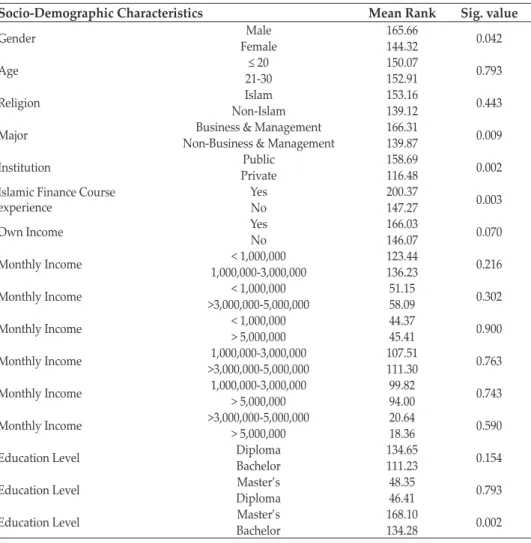
Comparative analysis by using the Mann-Whitney test (U-Test) with a p-value of 0.05 is conducted to examine whether Islamic financial literacy differed according to socio-demographic characteristics. In this data, since the two distributions do not generate a similar shape, the low ranks were compared and not the medians.
Table 6 shows the result of the Mann-Whitney test.
Table 6.
Mann-Whitney Test Results
Socio-Demographic Characteristics Mean Rank Sig. value
Gender FemaleMale 165.66144.32 0.042
Age 21-30≤ 20 150.07152.91 0.793
Religion Non-IslamIslam 153.16139.12 0.443
Major Non-Business & ManagementBusiness & Management 166.31139.87 0.009
Institution PrivatePublic 158.69116.48 0.002
Islamic Finance Course
experience YesNo 200.37147.27 0.003
Own Income YesNo 166.03146.07 0.070
Monthly Income 1,000,000-3,000,000< 1,000,000 123.44136.23 0.216 Monthly Income >3,000,000-5,000,000< 1,000,000 51.1558.09 0.302
Monthly Income < 1,000,000> 5,000,000 44.3745.41 0.900
Monthly Income >3,000,000-5,000,0001,000,000-3,000,000 107.51111.30 0.763 Monthly Income 1,000,000-3,000,000> 5,000,000 99.8294.00 0.743 Monthly Income >3,000,000-5,000,000> 5,000,000 20.6418.36 0.590
Education Level Diploma Bachelor 134.65111.23 0.154
Education Level DiplomaMaster’s 48.3546.41 0.793
Education Level BachelorMaster’s 168.10134.28 0.002
(Source: Author’s analysis)
From Table 6 above, we can see that gender, major, institution, Islamic finance course experience, and education level (Master’s and bachelor’s) are statistically significant in each category since the p-value is < 0.050. It can thus be concluded that:
• The Islamic financial literacy of males was significantly higher than females.
• The Islamic financial literacy of Business & Management students was significantly higher than non-Business & Management students.
• The Islamic financial literacy of public university students was significantly higher than private university students.
• The Islamic financial literacy of students that have already taken Islamic finance courses was significantly higher than the students who have not taken an Islamic finance course.
• The Islamic financial literacy of Master’s degree (S2) students was significantly higher than Bachelor’s degree (S1) students.
Meanwhile, the other socio-demographic characteristics do not significantly differ in each category since the p-value > 0.05, so it cannot be concluded that one category is higher than another category.
4.1.4. Relationship between Socio-Demographics and Islamic Financial Literacy Multilinear regression was used to see how significantly the socio-demographic variable might influence the Islamic financial literacy of college students. To ensure the suitability of data, classical assumptions were tested, such as normality, multicollinearity, and heteroscedasticity tests.
The F-test determines the relationship between the dependent variable and the independent variable simultaneously. From Table 7 below, the significant value for Islamic financial literacy is below 0.05 and the F score is 3.370. This indicates that simultaneously independent variables, which are socio-demographic characteristics, have a significant relationship on Islamic financial literacy as the dependent variable.
Table 7.
F- Test Results ANOVA
Model Sum of Squares df Mean Square F Sig.
1
Regression 2280.558 12 190.046 3.370 .000
Residual 16354.085 290 56.393
Total 18634.643 302
(Source: Author’s analysis)
From Table 8 below, it can be seen that the result of adjusted R-squared is 0.086 or 8.6%. This means that 8.6% of the change in Islamic financial literacy can be explained by independent variables. The remaining 91.4% is explained by other variables.
Table 9 shows the multilinear regression results. From the significant value (Sig), we can see which of the independent variables in socio-demographic factors influence Islamic financial literacy.
Table 8.
Model Summary Results Model Summary
Model R R Square Adjusted R
Square Std. Error of the
Estimate Durbin-Watson
1 .350 .122 .086 7.50955 1.945
(Source: Author’s analysis)
Table 9.
Multilinear Regression Result
Variable Regression Coefficient Std. Error t Sig.
(Constant) 69.249 2.223 31.149 0.000
Gender -1.129 0.981 -1.151 0.251
Age -0.206 1.014 -0.203 0.840
Religion 1.994 1.657 1.203 0.230
Major 0.655 1.224 0.535 0.593
Institution 2.971 1.267 2.345 0.020*
Islamic Finance Course experience 5.013 1.565 3.203 0.002*
Own Income 1.790 1.006 1.778 0.076**
Education Level_Diploma 2.606 1.895 1.375 0.170
Education Level_Master 2.870 1.427 2.011 0.045*
Monthly Income Below 1 Million 0.220 1.076 0.205 0.838
Monthly Income_3-5 Million -0.982 1.569 -0.626 0.532
Monthly Income Above 5 Million -4.120 2.311 -1.783 0.076**
(Source: Author’s analysis) Note:
* = Significant at 95% confidence level
** = Significant at 90% confidence level
Table 9 shows the socio-demographic factors that have a statistically significant influence on Islamic financial literacy at the 95% confidence level. They are institution, Islamic finance course experience, and education level (S2/Master’s degree). Furthermore, own income and monthly income above 5 million are significant at the 90% confidence level.
From the results in Table 9 above, the multilinear equation for the regression model is:
IFL = 69.249 – 1.129(gender) -0.206(age) + 1.994(religion) + 0.655(major) + 2.971(institution) +5.013(IF_course experience) + 1.790(own_income) + 2.606(edu_level1) + 2.870(edu_level2) + 0.220(monthly_income1) –
0.982(monthly_income2) – 4.122(monthly_income3) + e (3)
For the institution, there is a statistically significant positive relationship between Islamic financial literacy and the type of institution the students attended.
Since private institution becomes the reference category, a positive relationship means that students in public institutions are likely to be more financially literate than the students in private institutions. This might be because public institutions provide higher-quality education and this implicitly will affect financial education.
This can be supported by the fact that many people prefer to attend public institutions than private institutions because they consider that public institutions offer a better quality of education system.
As for Islamic finance course experience, this has a statistically significant positive relationship with Islamic financial literacy. Since students who have not taken an Islamic finance course become the reference category, a positive relationship means that the students who have already taken Islamic finance courses are likely to be more literate regarding Islamic finance than the students who have not taken Islamic finance courses. This might be because they gained more insight regarding Islamic finance from the course taken and that was enough to increase their literacy since they have already shaped their perception, display appropriate attitudes and behaviour, and also have knowledge regarding Islamic finance. This result supports the study conducted by Er et al. (2015), which found that college students who had previously attended a course or seminar about Islamic economy had higher Islamic financial literacy than the other students.
For education level, this has a statistically significant positive relationship with Islamic financial literacy. Since the education level of a bachelor’s degree (S1) becomes the reference category, a positive relationship means that Master’s degree (S2) students are likely more literate regarding Islamic finance than bachelor’s degree (S1) students. It might be because Master’s degree students have broader understanding related to Islamic finance, and their higher education means they have become more experienced and open enough in capturing the concept of the Islamic financial system. Several studies have investigated the relationship between education level and financial literacy, and the results show that people who have higher education levels tend to have a higher level of financial literacy, although those studies only cover financial literacy in general or non-Islamic financial literacy, such as those conducted by Otoritas Jasa Keuangan (2013) and Chen and Volpe (1998). On the other hand, regarding the relationship of education level and Islamic financial literacy, this study supports the result by Abdullah et al.
(2017) that found that the education level of students has a significant relationship with Islamic financial literacy. However, in this study, not all education levels are statistically significant in influencing Islamic financial literacy; only having a Master’s degree (S2) has a positive relationship with Islamic financial literacy as compared to a bachelor’s degree (S1).
4.1.5. Relationship between Socio-Demographics, Financial Literacy and Possession of Islamic Financial Products
Logistic regression is used to determine whether the possession of an Islamic financial product could be predicted from the socio-demographic characteristics and Islamic financial literacy of the college students. The results of the Omnibus test of model coefficients are presented in Table 10 below.
The Omnibus tests of model coefficients table gives us a Chi-Square of 29.455 on 13 df, significant beyond .05. Therefore, the model is statistically significant, and it should be further interpreted, since the model that includes the independent variables represents a significant improvement and fit over a null model that includes no independent variables. Table 11 shows a summary of the model. We can see from the table that Nagelkerke R square is 0.154. This means that 15.4%
of the change in the dependent variable can be explained by the independent variables. The remaining 84.6% is explained by other variables.
Table 10.
Omnibus Tests of Model Coefficients Omnibus Tests of Model Coefficients
Chi-square df Sig.
Step 1
Step 29.455 13 .006
Block 29.455 13 .006
Model 29.455 13 .006
(Source: Author’s analysis)
Table 11.
Model Summary Model Summary Step -2 Log likelihood Cox & Snell R
Square Nagelkerke R Square
1 248.361a .093 .154
a. Estimation terminated at iteration number 6 because the parameter estimates changed by less than .001.
(Source: Author’s analysis)
Table 12 shows the results of the Hosmer and Lemeshow test as the goodness of fit of the model. The significant value of the Hosmer and Lemeshow test is 0.186 (sig > 0.05). This means that the model is statistically significant and fits the data.
Table 12.
Hosmer and Lemeshow Test Hosmer and Lemeshow Test
Step Chi-square df Sig.
1 11.292 8 .186
(Source: Author’s analysis)
The results of the classification test are shown in Table 13 below.
The classification table shows the correspondence between values that are observed in the data and those that are predicted by the model. As we can see in the table, the cases that were observed not to possess Islamic financial products and predicted not to possess Islamic financial products number 248, meaning that 248 respondents were correctly predicted to fall into the not possessing Islamic financial products category with an accuracy rate of about 98.8%. Meanwhile, the cases that were observed to possess Islamic financial products were predicted to possess Islamic financial products by the corresponding value of 7; this means that seven respondents were correctly classified as possessing an Islamic financial product with an accuracy rate of 13.5%. Therefore, the total accuracy rate for the model was about 84.2%
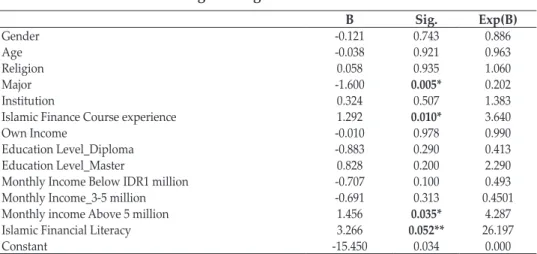
Table 14 predicts the probability of an event occurring based on a one-unit change in the independent variable when all other independent variables are constant.
Table 13.
Classification Table Classification Table
Observed Predicted
Islamic Finance Product Percentage Correct
No Yes
Step 1 Islamic Finance Product No 248 3 98.8
Yes 45 7 13.5
Overall Percentage 84.2
a. The cut value is .500 (Source: Author’s analysis)
Table 14.
Logistic Regression Result
B Sig. Exp(B)
Gender -0.121 0.743 0.886
Age -0.038 0.921 0.963
Religion 0.058 0.935 1.060
Major -1.600 0.005* 0.202
Institution 0.324 0.507 1.383
Islamic Finance Course experience 1.292 0.010* 3.640
Own Income -0.010 0.978 0.990
Education Level_Diploma -0.883 0.290 0.413
Education Level_Master 0.828 0.200 2.290
Monthly Income Below IDR1 million -0.707 0.100 0.493
Monthly Income_3-5 million -0.691 0.313 0.4501
Monthly income Above 5 million 1.456 0.035* 4.287
Islamic Financial Literacy 3.266 0.052** 26.197
Constant -15.450 0.034 0.000
(Source: Author’s Analysis) Note:
* = Significant at 95% confidence level
** = Significant at 90% confidence level
Based on the results, the independent variables that have a statistically significant relationship (at the 95% confidence level) with a dependent variable are choice of major, Islamic finance course experience, and monthly income above 5 million. The result shows a positive relationship between Islamic finance course experience and monthly income above 5 million with Islamic financial product possession. In contrast, choice of major has a negative relationship. Furthermore, Islamic financial literacy has a positively significant relationship with Islamic financial product possession at the 90% confidence level. This means that, if Islamic financial literacy increases, Islamic financial product possession also increases.
Meanwhile, the odds ratio shows the probability that the insignificant change factor would have occurred. The odds ratio for famous shows 0.202 indicates that Business Management students are 0.202 times more likely to possess an Islamic financial product than non-Business Management students. The explanation could be that Business Management students are exposed mostly to conventional financial instruments rather than Islamic ones. This type of financial instrument is discussed in several financial courses and is even used directly as a real learning tool in several courses. Therefore, it is necessary to introduce Islamic finance instruments to the students.
As for Islamic finance course experience, students who have already taken Islamic finance courses are 3.640 times more likely to possess an Islamic financial product than the students who have not taken an Islamic finance course. This could be because the students who have already taken an Islamic finance course have more understanding of the characteristics of the Islamic financial product and are aware that Islamic financial products will give them more benefits.
Also, it could be because the religiosity issues that are often explained in Islamic finance courses could shape the students’ beliefs that by utilising Islamic financial products, they could be considered as someone who religiously follows the Sharia principle (Islamic law) in their financial activities. This is similar to Bley and Kuehn (2003)’s statement that religiosity is the strongest predictor of preference for Islamic banking services. However, it does not necessarily mean that people who claim Islam as their religion will religiously follow Islamic law since religion has no significant relationship with the possession of Islamic financial products.
For monthly income, there is a significant relationship between students who have a monthly income above 5 million per month with Islamic financial product possession, but not with the other categories of monthly income. For the monthly income, the odds of possessing an Islamic financial product if the students have an income above 5 million per month is 4.287 times than that of the students who have an income of between 1 and 3 million per month. This might be because the students who have an income above five million per month already get enough money to have Islamic financial products and they have also become better at utilising their money by putting it in Islamic financial products.
Meanwhile, surprisingly, there is no significant relationship between Islamic financial literacy index and the possession of an Islamic financial product among the students. This might be because, as they are students, they do not need Islamic financial products for now. Also, the other socio-demographic factors such as gender, age, religion, institution, and independent income do not have a significant relationship with the possession of an Islamic financial product among college students.