Demystifying alexithymia:
An empirical approach and roadmap for remediation By
Rachel Aaron
Dissertation
Submitted to the Faculty of the Graduate School of Vanderbilt University
in partial fulfillment of the requirements for the degree of
DOCTOR OF PHILOSOPHY in
Psychology August, 2016 Nashville, TN
Approved:
Sohee Park, PhD Jo-Anne Bachorowski, PhD
Steven Hollon, PhD Craig Smith, PhD
ACKNOWLEDGEMENTS
First I would like to thank the many patients whom I was honored to work alongside through my clinical training. It was my utmost privilege to join you for a small part of your journey, to share the pain of your challenges and celebrate the joy of your victories. Your resilience, whether it came with ease or with immense struggle, motivated and inspired me every step of the way. I am immeasurably grateful for the opportunity to work with you;
the lessons you taught me will forever enrich my life.
This work would not be possible without the many people who supported me along the way; particularly my mentor, Sohee Park. Thank you for adopting me into your lab when I needed a research home, and mentoring me with boundless creativity and wisdom.
Thank you to the other members of my dissertation committee – Steve Hollon, Jo- Anne Bachorowski, and Craig Smith – for your support and encouragement, and for always challenging me to expand my perspective. Our many stimulating conversations about this work were invaluable to its development.
Thank you to the members of the Park lab, particularly to my fellow graduate students. To Joel Peterman, thank you for being the best sounding board for all things research and life, and for spearheading the occasional impromptu overnight road trip. To Taylor Benson, thank you for taking me under your wing four years ago when I joined the lab, and for introducing me to the alexithymia construct.
Immense thanks to undergraduate members of the lab, Matthew Snodgress and Scott Blain, for being amazing human beings, and for each of your many contributions to
Thank you to my supportive parents, Nick and Jan Aaron, for your unwavering confidence in my success. Thank you for teaching me that a good work ethic is best accompanied by the ability to stop and smell the roses, and flawlessly modeling both as long as I can remember.
As I strive to do most things, I present this work in loving memory of my best friend, Kate Crockett. Your unparalleled enthusiasm of my academic journey brought me needed courage when you were here, and remains a treasured memory that brings me daily strength and inspiration.
And to my dear husband, Alex Ferrer. From the bottom of my heart, thank you for the extraordinary support you have offered me throughout graduate school. Thank you for the many sacrifices you have made, big and small. Your unconditional patience and
steadfast faith in me has been an invaluable foundation through the ups and downs of this experience. I couldn’t have done it without you.
TABLE OF CONTENTS
Page
ACKNOWLEDGEMENTS ... ii
LIST OF TABLES ... vi
LIST OF FIGURES ... vii
Chapter I. Introduction ... 1
A Case for Studying Alexithymia ... 3
Measuring Alexithymia ... 8
Affective Experiences in Alexithymia ... 10
Interoceptive Awareness and Alexithymia ... 18
Current Study ... 19
II. Experiment 1: Delineating emotional processing abnormalities in alexithymia through a novel laboratory-based design ... 24
Aims ... 24
Method ... 24
Participants ... 24
Materials ... 25
Design and Procedure ... 26
Data Analyses ... 28
Results ... 30
Descriptive ... 30
Validating Findings ... 32
Relationship between performance variables ... 32
Relationship between TAS-20 and performance variables ... 33
TAS-20 and Emotional Complexity ... 36
Predictive Value of Overall Performance Variables. ... 39
Exploratory Analysis of Secondary Emotions Condition. ... 41
Emotional Complexity ... 45
Subscale Analysis ... 48
Secondary Emotion Words ... 49
Post-Experiment Measures ... 50
Limitations ... 51
Conclusions ... 52
III. Experiment 2: Investigating the Relationship Between Alexithymia and Interoceptive Accuracy and Examining the Benefits of a Brief Mindfulness Meditation ... 55
Aims ... 55
Methods ... 55
Participants ... 55
Materials ... 56
Design and Procedure ... 56
Data Analytic Approach ... 58
Results ... 58
Descriptive Statistics ... 58
Relationship Between Alexithymia and Interoception at Baseline ... 60
Relationship Between Alexithymia and Interoception at Follow-Up ... 62
Task Performance ... 64
TAS-20 Subscales and Task Performance ... 70
Discussion ... 73
Interoception ... 74
Differences in Experiment One and Experiment Two ... 77
Performance Variables in Control versus Meditation Group ... 79
Limitations ... 85
Conclusion ... 87
IV. General Discussion ... 89
Future Directions ... 92
Conclusions ... 93
APPENDIX ... 95
REFERENCES ... 100
LIST OF TABLES
Table Page
1. Descriptive performance data for videos based on emotion induction category ... 31
2. Descriptive response time data for videos based on emotion induction category. ... 31
3. Spearman correlations between major task variables. ... 33
4. Spearman correlations between TAS-20 total score and subscales. ... 34
5. Group differences in endorsing non-target primary emotions.. ... 36
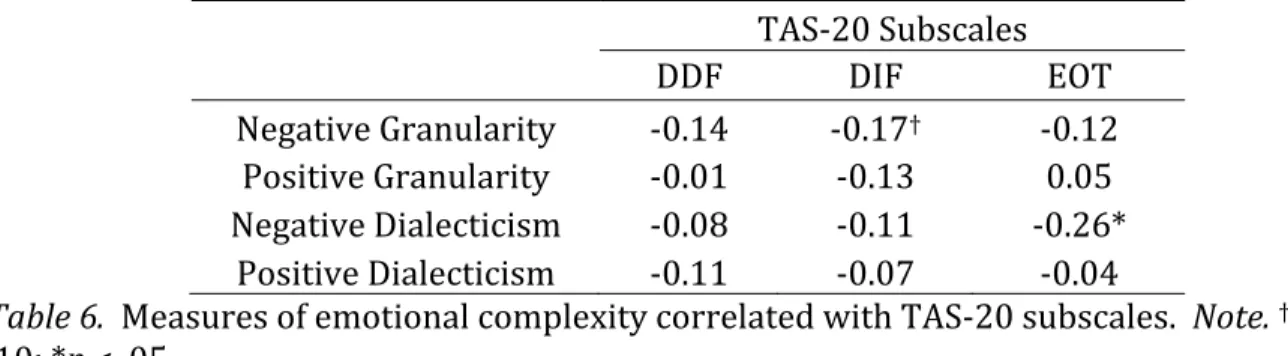
6. Measures of emotional complexity correlated with TAS-20 subscales. ... 39
7. Predicting TAS-20 subscales from performance variables using multiple regression ... 40
8. Parsimonious multiple regression models using performance variables and emotional complexity to predict alexithymia. ... 40
9. Identifying secondary words with predictive value based on elastic net procedure. ... 42
10. Descriptive information and tests of group differences for TAS-20 scores in meditation and control groups. ... 59
11. Means and standard deviations for interoceptive variables in control and meditation conditions. ... 59
12. Hierarchical multiple regression testing the quadratic relationship between TAS-20 and interocpetive accuracy ... 61
13. Spearman correlations between performance variables and TAS-20 subscales for control and meditation conditions ... 71
14. Spearman correlations between emotional complexity and TAS-20 subscales for control and meditation conditions ... 72
15. Post-experiment questions about task enjoyment and challenge. ... 73
LIST OF FIGURES
Figure Page
1. Summary of the role of the AI and ACC for integrating interoceptive
information to create an emotional state.. ... 11
2. Proposed pathway by which emotion granularity facilitates regulation of negative affect, pursuit of values and ultimately, wellbeing. . ... 16
3. A trial of the primary emotion portion of the experiment. ... 27
4. An abbreviated trial of the secondary emotion portion of the experiment.. ... 28
5. Example of variability in primary emotions selected in high alexithymia. ... 35
6. Quadratic relationship between TAS-20 and interoceptive awareness. ... 60
7. Group differences in interoceptive accuracy change based on high and low TAS-20 and high and low baseline IA. ... 64
8. Depicts significant interactions related to selecting target emotion; group by interoceptive accuracy and interoceptive accuracy by TAS-20. ... 67
9. Group by alexithymia interaction on primary RT variables.. ... 68
10. Group by alexithymia interaction on negative granularity.. ... 69
11. Three-way interaction of group by TAS-20 by interoceptive accuracy on positive granularity. ... 70
CHAPTER I Introduction
Alexithymia refers to the inability to label and describe one’s own emotional experience. The term was originally coined by Sifneos (1973), literally translated into a
“lack of words for emotions” (a – lack, lexis – words, thymos – emotions). The construct was initially used to describe patients with somatic symptom disorders who exhibited marked difficulty verbalizing their feelings and observed struggling to differentiate emotional and physiological cues (Sifneos, 1973) to the chagrin of their psychotherapists (e.g., Krystal, 1982; McDougal, 1982; Overbeck, 1977).
After nearly 45 years of research examining the construct, alexithymia is no longer considered a deficit in emotional vocabulary per se, but considered a general deficit in the cognitive processing of emotional experience (Lane, Ahern, Schwartz, & Kaszniak, 1997).
Alexithymia is thought to involve impoverished emotion concepts (Kashdan, Barrett &
McKnight, 2015; Lindquist & Barrett, 2008), or mental representations of experiences, situations and actions that accompany particular emotional states (for discussion of emotion concepts, see Barrett, 2006; Niedenthal, 2008). Such knowledge is critical for the formulation of an individual’s experience of the world and subsequent behaviors.
Conceptual knowledge is accessed when correlates of an emotional experience exceed a critical threshold (Niedenthal, Winkielman, Mondillon & Vermeulen, 2009).
Alexithymia may be associated with an abnormally high threshold by which emotionally
(Cameron, 2011), which is critical for the formulation of subjective feelings states (Craig, 2009; Critchley, Wiens, Rotshtein, Öhman & Dolan, 2004; Damasio, 1994; Damasio, 2003).
Niedenthal et al. (2009) describe emotion as embodied; that retrieving relevant conceptual information about emotion involves partial reenactment of emotional states in the
somatosensory systems. Some argue that alexithymia is, at it’s core, a deficit in
interoceptive awareness, and that this deficit interrupts normal range emotional processes such as the embodied experience of emotion (Herbert & Pollatos, 2012).
Alexithymia is dimensional (Taylor, Bagby, & Parker, 1999) and transdiagnostic.
Longitudinal studies show that though absolute levels of alexithymia can change over time, they remain relatively stable (see Cameron, Ogrodniczuk, & Hadjipavlou, 2014). Less is known about how alexithymia changes throughout development, largely due to a lack of validity of measures in youth (i.e., <18, Parker, Eastabrook, Keefer & Wood, 2010) and older adult (i.e., >60, Henry, Phillips, Maylor, Hosie, Milne & Meyer, 2006) populations.
Based on clinician observations, measurement cutoff scores were established to indicate a clinically problematic level of alexithymia (Taylor et al., 1999). In normative populations, 10% of individuals meet criteria (e.g., Salminen, Saarijärvi, Äärelä Toikka, & Kauhanen, 1999). A meta-analysis of gender effects concluded that though results across studies are inconsistent and the effect small, men do generally score higher on measures of alexithymia (Levant, Hall, Williams & Hasan, 2009).
Because knowledge of one’s emotional experience facilitates effective coping (Fukunishi & Rahe, 1995; Gohm & Clore, 2002; Moriguchi et al., 2007; Parker, Taylor, &
Bagby, 1998; Salavoy et al., 1995; Swart, Kortekaas, Aleman, 2009), which is closely related to health outcomes (Desteno, Gross, & Kubzansky, 2013 for review), it is not surprising that
clinical levels of alexithymia are much higher in myriad mental and physical health
disorders compared to normative samples (Leweke, Leichsenring, Kruse & Hermes, 2011;
Lumley, Beyer & Radcliffe, 2008). The construct is also associated with a range of problematic psychosocial features (Aaron, Benson & Park, 2015; Grynberg, Luminet, Corneille, Grèzes & Berthoz, 2010; Vanheule, Desmet, Meganck & Bogaerts, 2007).
A Case for Studying Alexithymia
Continuing to elucidate the alexithymia construct has important public health implications. Thousands of studies demonstrate the overlap between alexithymia and mental and physical health outcomes, yet still, little is known about their relationship and how alexithymia affects long-term outcomes, including success of psychotherapy.
Alexithymia is elevated in clinical populations. Alexithymia is related to
problematic health behaviors and outcomes in a many important domains. It is elevated in psychiatric populations including major depressive disorder (Honkalampi, Hintikka,
Laukkanen, & Viinamäki, 2001), schizophrenia (van’t Wout, Aleman, Bermond, & Kahn, 2007), and posttraumatic stress disorder (Yehuda et al., 1997). It is prevalent in
approximately 50% of individuals with autism spectrum disorders (Bird et al., 2010; Silani et al., 2008). It is ubiquitous in disorders involving utilization of problematic coping behaviors, including substance abuse (Coriale et al., 2011), eating disorders (Pinna, Sanna
& Carpiniello, 2015; Taylor, 2000) and aggression (Velotti et al., 2016).
In general populations, it is associated with decreased use of effective coping skills, such as reappraisal, emotional expression, and seeking social support (Fukunishi & Rahe,
emotional suppression and avoidance (Panayiotou et al., 2014; Parker et al., 1998; Swart et al., 2009). This pattern of coping is associated with risk of psychopathology and adverse health outcomes (see Aldao, Nolen-Hoeksema, & Schweizer, 2010 and Desteno, Gross, &
Kubzansky, 2013 for reviews).
Alexithymia is elevated in populations with medical complaints, particularly in somatic symptom disorder and related disorders, independently of other
psychopathological symptoms such as depression (Mattila et al., 2008). Baudic et al.
(2016) show that alexithymia prior to breast cancer surgery is the best predictor of developing chronic pain in women one-year post-surgery, more so than a variety of psychological factors including catastrophizing, repression and body image. This
longitudinal study adds empirical support to theories postulating alexithymia confers risk for the development of physical health conditions. Taylor & Bagby (2004) argue that alexithymia may lead to misperceiving the physiological correlates of emotion as signs of physical illness. In turn, heightened focus on aspects of physiological arousal can increase their perceived physical intensity. This increases risk of harmful appraisals and cognitive elaborations, particularly about health outcomes (Garland et al., 2011; Kano & Fukudo, 2013).
Alexithymia and empathy. Alexithymia is associated with reduced empathy.
Those with heightened alexithymia show reduced activation of regions involved in empathic processing in imaging studies (Bird et al., 2010; Moriguchi et al., 2007; Silani et al., 2008). Self report studies consistently show that alexithymia is associated with reduced forms of “mature empathy,” including perspective taking and empathic concern (e.g., Aaron et al., 2015; Grynberg et al., 2010; Silani et al., 2008; Sonnby-Borgstrom, 2009). This
association may help explain findings that alexithymia is associated with elevated interpersonal problems (e.g., Vanheule et al., 2007).
Compelling work in the field of autism spectrum disorders (ASD) demonstrates how consideration of alexithymia can shed light on long-held assumptions about clinical
populations. Despite the widespread assumption that ASD is associated with decreased empathy, landmark work by Bird et al. (2010) and Silani et al. (2008) shows that only ASD participants with elevated levels of alexithymia demonstrate empathic deficits. Bird and Cook (2013) propose “the alexithymia hypothesis,” arguing that emotional symptoms of ASD are due to the high co-occurrence of alexithymia in this population and not due to ASD per se. The same may be true for other disorders as well: Aaron et al. (2015) show that alexithymia accounts for the established correlation between empathic deficits and schizotypy, personality traits that indicate a predisposition towards schizophrenia (Claridge, 1990; Lenzenweger, 2006, 2011). Similarly, Brewer and colleagues (Brewer, Cook, Cardi, Treasure & Bird, 2015) show that facial emotion recognition deficits in eating disorders are attributable to alexithymia and not an eating disorder diagnosis. Continuing to investigate how alexithymia contributes to established deficits in various psychiatric diagnoses has the potential to illuminate inconsistencies in research and guide targeted remediation (Bird & Cook, 2013).
Alexithymia influences psychotherapy outcomes. Despite much conjecture, there is a dearth of evidence examining patterns of directionality between alexithymia and
physical and mental health outcomes; however, with thousands of cross-sectional studies,
particularly true given most modern psychotherapeutic orientations emphasize emotional processes (Grabe, Spitzer, & Freyberger, 2004). Though alexithymia first emerged to characterize individuals who demonstrated poor outcomes in traditional talk therapy and elicited frustration in therapists (e.g., Krystal, 1982; McDougal, 1982; Overbeck, 1977), it is still associated with poor psychotherapy outcomes (Ogrodniczuk, Piper, & Joyce, 2011 for review).
Fortunately, intervention generally improves relative levels of alexithymia. A recent review of 23 treatment studies concluded that general psychotherapeutic intervention results in reductions of alexithymia in many different clinical populations, including
depression, anxiety, eating disorders, and mixed psychiatric samples (Cameron et al., 2014) using a wide variety of clinical approaches. More work is needed to determine whether functional changes accompany alexithymia reductions; at least one study suggests they do;
Tulipani et al., 2010 show that pain levels and alexithymia decrease simultaneously
following a 6-month cognitive and emotion-focused intervention for individuals diagnosed with cancer.
A recent review (Pinna et al., 2015) examines alexithymia in the context of
interventions for eating disorders, spanning a wide variety of treatment approaches (e.g., weekly cognitive behavioral therapy, inpatient psychoanalysis, pharmacological
treatment). Consistent with Cameron et al. (2014), Pinna et al. (2015) show relatively stable levels of alexithymia with absolute reductions in some treatment groups; however, they observe those with high alexithymia at baseline show poorer therapy outcomes overall. Conversely, Morie et al. (2015) show that alexithymia is associated with increased likelihood of cocaine abstinence in an internet-delivered cognitive behavioral therapy
(CBT) treatment for individuals with cocaine use disorder. These findings highlight the likely moderating impact of alexithymia on treatment outcomes; depending on treatment parameters and clinical diagnosis, alexithymia may be associated with better or worse outcome.
Early intervention may have the potential to reduce alexithymia. Brackett et al.
(Brackett, Rivers, Reyes, & Salovey, 2012) show that a curriculum designed to promote awareness, expression and regulation of emotions improves social skills and academic performance among 5th and 6th graders. Kircanski, Lieberman & Craske (2012) train individuals to label their emotions when approaching a feared stimulus, a spider.
Compared to other emotion regulation strategies (reappraisal, distraction), those coached to employ emotion labeling showed reduced anxiety and increased willingness to approach the spider. Alexithymia generally improves in response to tasks that are not formal
interventions. Biekie (2008) shows that a 4-week expressive writing paradigm resulted in reduced doctor’s visits, reduced depression scores, and reduced sleep disturbances among those with elevated alexithymia. Constantinous et al. (2014) show that physiological and subjective aspects of emotional experience normalize in those with elevated alexithymia when participants are instructed to engage in deep emotional processing.
It is likely that alexithymia has moderating and mediating effects on interventions that vary by intervention design and clinical population. As evidence about how
intervention influences alexithymia emerges, so do theories and recommendations for improving psychotherapeutic outcomes in individuals with elevated alexithymia. Cameron
perspective, they highlight the potential utility of increased reflective listening and empathic resonance, as well as managing counter-transference when frustration arises.
Pinna et al. (2015) put forward a similar set of recommendations, and highlight the need of adapting interventions to better serve individuals with eating disorders, a
population in which rates of alexithymia are high (Taylor, 2000). Morie et al.’s (2015) intervention highlights the potential utility of internet-delivered interventions for those with elevated alexithymia, which are in line with the recommendation to offer a structured approach with reduced one-on-one participation demand.
Early accounts of alexithymia suggested the trait prevents meaningful change in response to psychotherapy; fortunately, intervention research demonstrates this is not the case. Those with heightened alexithymia across clinical diagnoses have the potential to benefit from psychotherapy, and it is essential the field determine how to best help these individuals improve. A critical next step in this field is to examine recommendations from experts empirically, and to investigate factors that promote seeking, adherence to, and benefit from psychotherapeutic interventions. Consideration of intervention approach, design, and clinical population is crucial in this line of work, as well as attention to the moderating and mediating effect of alexithymia on modern psychotherapeutic approaches.
Measuring Alexithymia
Alexithymia is typically assessed using self-report questionnaires or interviews.
The most common tool for assessing alexithymia is by far the 20-item Toronto Alexithymia Scale (TAS-20; Bagby, Parker, & Taylor, 1994) which is lauded for making wide-scale alexithymia research possible. It is comprised of three factors: difficulty identifying
feelings (DIF), difficulty describing feelings (DDF), and externally oriented thinking (EOT).
The first two scales assess one’s ability to reflect on their own emotional experience. The EOT scale reflects a cognitive style with preference for focusing on the details of everyday life, rather than internal processes such as thoughts, feelings, and fantasies. The TAS-20 measure has been translated in over 20 languages, and its three-factor structure has been cross-validated by confirmatory factor analysis in Western European, East Asian, and Middle Eastern countries (Taylor & Bagby, 2013).
Vorst & Bermond (2001) developed an additional questionnaire measure of
alexithymia, the Bermond-Vorst Alexithymia Questionnaire (BVAQ), to address the critique that the TAS-20 lacks a factor related to “experience of emotional feelings.” The BVAQ includes two additional scales measuring affective experience: reduced fantasizing and reduced experiencing of emotional feelings. The validity and reliability of this measure is less clear than that of the TAS-20, and the inclusion of the two additional factors is
questioned (see Taylor, Bagby, & Luminet, 2000; Lumley, Neely, & Burger, 2007; Morera, Culhand, Watson & Skewes, 2005). Factor analyses demonstrate that variance in
fantasizing is accounted for in the TAS-20, and some researchers suggest “reduced experiencing of emotional feelings” is more aptly characterized as a correlate of
alexithymia, rather than a core feature (Zech, Luminet, Rime, & Wagner, 1999). Thus, the TAS-20 remains the most common tool for assessing alexithymia.
Additional interview measures exist as well. The Beth Israel Hospital Psychosomatic Questionnaire (Sifneos, 1973) is a 17-item questionnaire completed by an interviewer or observer. Although this measure demonstrates concurrent validity with the previous
Structured Interview for Alexithymia (TSIA; Bagby, Taylor, Parker, & Dickens, 2006), which correlates modestly with self-reported alexithymia. The 33-item Observer Alexithymia Scale (OAS; Haviland, Warren, & Riggs, 2000) relies on collateral ratings from family members, friends, and therapists. The latter observer measures are relatively new and have not been widely tested (Lumley et al., 2007). As interview measures, administrations of these batteries can be cumbersome. Though they can be useful in clinical settings, they are generally not efficient for research purposes.
Early developments in interview-based assessments of alexithymia were essential for laying a foundation for this body of research. The advent of self-report measures, easily administered and interpreted, to assess alexithymia facilitated wide-scale alexithymia research. However, existing measurement tools have significant limitations. People with a high degree of alexithymia may not be reliable in assessing their own affective deficits on a self-report scale (Leising, Grande, & Faber, 2006). High negative affect associated with alexithymia may confer negative self-bias that could increase endorsement of alexithymic characteristics. In addition, reliance on these measures limits experimental manipulation, essential for determining causal pathways. An important next step in this field is
developing an objective laboratory-based assessment task to avoid the pitfalls of self- report and promote more experimental alexithymia research.
Affective Experiences in Alexithymia
Accumulating behavioral research points towards patterns of abnormal emotional experiences in alexithymia. In particular, utilization of imaging methodology in alexithymia research yields valuable information regarding its neural correlates, and recent reviews of the literature have helped pave the way for a more coherent framework. However, still
much is unknown about the how the construct relates to behavioral phenomena, and inconsistencies in the literature limit the generation of clear themes.
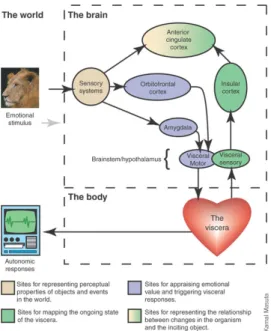
Neurological abnormalities in alexithymia. The anterior cingulate cortex (ACC) and anterior insular cortex (AIC) have entered the spotlight of alexithymia research. The ACC and AIC are involved in interpreting physiological cues of one’s emotional experience, and integrating this information into a subjective representation of one’s emotional state (Bechara & Naqvi, 2004), visually depicted in Figure 1. Gu et al. (2013) propose that the AIC serves to integrate bottom-up interoceptive information from top-down information from the ACC and prefrontal cortex. Together, the AIC and ACC are thought to comprise an
“interoceptive cortex” (Craig, 2002), facilitating and integrating awareness of interoceptive cues, and contributing to the sense of self.
Figure 1. Summary of the role of the AI and ACC in integrating interoceptive information to create an emotional state. From Bechara & Navqui (2004); image created by Kamul
Masuta.
mediates the association between alexithymia and impaired conscious awareness of one’s emotional state. This is consistent with the high prevalence of alexithymia in somatization disorders, as abnormal ACC activation may reflect amplification of physical sensations.
Abnormal ACC activity in alexithymia in well-established (Berthoz, et al., 2002; Kano, Hamaguchi, Itoh, Yanai, & Fukudo, 2007;. Karlsson, Näätänen, & Stenman, 2008; Moriguchi et al., 2007; for review, see van der Velde et al., 2013).
The ACC, along with the medial prefrontal and insular cortices, form a network characterized by the presence of Von Economo neurons (spindle cells) found only in highly complex and social species including humans, higher primates and elephants. This
network area is thought to contribute to the sense of self (Craig, 2009; Craig, 2009b). The AIC receives information from internal bodily states, and integrates these sensations into a subjective feeling (Craig, 2009; Damasio, 1994). Alexithymia is associated with reduced AIC activation in response to various emotional stimuli (Bird et al., 2010; Kano et al., 2003;
Reker et al., 2010; Silani et al., 2008). Theories endorsing the role of the AIC in alexithymia suggest alexithymic traits might be the result of a failure to engage the AIC under affective context or situation, and subsequently, a failure to represent important bodily states within the insula (Silani et al., 2008; Singer & Lamm, 2009).
Because the ACC and AIC commonly co-activate (see Gu et al., 2013), it has been difficult to parse their specific contributions to the alexithymia construct. Hogeveen and colleagues (2016) present compelling evidence bringing the AIC to the forefront. They measured alexithymia in Vietnam war veterans who sustained varying degrees of AIC damage following penetrating brain injuries and showed that severity of AIC damage
predicted alexithymia, or resulted in “acquired alexithymia.” This relation occurred independently of ACC activation.
Behavioral abnormalities in alexithymia. Since the advent of the TAS-20, the field has burgeoned with laboratory-based studies exploring behavioral abnormalities in alexithymia across myriad fields of psychology and neuroscience. These studies are critical for understanding exactly how alexithymia alters one’s emotional experiences, though still, there are many inconsistencies and much is still unknown.
Findings related to physiological arousal serve as a good example of inconsistencies in the field, as results are mixed. In response to emotional stimuli, a good deal of evidence suggests alexithymia is associated with physiological hypoarousal (e.g., Constantinou et al., 2014; Pollatos, Schubö, Herbert, Matthias & Schandry, 2008; Roedema & Simons, 1999), hyperarousal (Infrasca, 1997; Stone & Nielson 2001), while other studies demonstrate no differences in arousal levels (Bausch et al., 2001; Eastabrook, Lanteigne & Hollenstein, 2013; Friedlander, Lumley, Farchione, & Doval, 1997). Similar inconsistencies limit conclusions about how alexithymia alters subjective report of arousal (Peasley-Miklus et al., 2015, Roedema & Simons 1999). More consistent are findings comparing self-report and physiological arousal, which consistently demonstrate disparity in responses (e.g., Constantinou et al., 2014; Franz, Schaefer, Schneider, Sitte & Bachor, 2003; Pollatos et al., 2011; Stone and Nielson, 2001; Vanman, Dawson & Brennan, 1998).
Research addressing evaluation of valence in alexithymia is also inconsistent, with some demonstrating intact evaluation of valence (McDonald & Prkachin, 1990; Roedema &
to intensity ratings. Where some report no effect of alexithymia on intensity ratings (Koven, 2014; Fantini-Hauwel, Luminet, & Vermeulen, 2015 [in women]), others report decreased intensity ratings in response to sad stimuli (Mantani, Okamoto, Shirao Okada Yamawaki. 2005) and others report increased intensity ratings (Fantini-Hauwel et al., 2015 [in men]; Lee and Guajardo, 2011). Following emotion induction, some studies show that alexithymia is associated with reduced generation of emotion words to describe the experience (Luminet, Rimé, Bagby & Taylor, 2004; Páez, Velasco & González, 1999;
Roedema & Simons, 1999) while others suggest this ability may be intact (Constantinous et al. 2014).
Alexithymia is consistently associated with reduced facial emotion recognition (e.g., Brewer, Collins, Cook & Bird, 2015; Nook, Lindquist & Zaki, 2015; Prkachin, Casey &
Prkachin, 2009) and abnormal early processing of emotional body postures (Borhani, Borgomaneri, Làdavas, & Bertini, 2016). Interestingly, Nook et al. (2015) ameliorated deficits in facial emotion recognition in alexithymia by providing emotion word labels.
They conclude emotion labels facilitate access to conceptual knowledge about emotions and normalize behavior.
Response Time. Response time is a valuable measure of emotional processing (Fazio, 1990); as an indirect measure, it is generally unbiased by demand characteristics (Lischetzke, Cuccodoro, Gauger, Todeschini & Eid, 2005). Findings on response time in alexithymia are limited and mixed. Ihme et al. (2014) show that observer-rated (but not self-report) alexithymia was associated with slower response time for identifying negative affect in a facial recognition task. Other studies report no relationship between response
time and alexithymia during retrieval of emotional memories (Lundh, Johnsson, Sundqvist
& Olsson, 2002) or recall of emotional words (Luminet et al., 2006).
Lischetzke et al. (2005) show that faster response time may be adaptive; individuals respond faster to affective questions about which they are more certain. They use
response time as a measure of “emotional clarity,” or an individual’s meta-knowledge of his or her own affective state (Boden et al., 2013). Taylor (2004) argues emotional clarity is a core dimension of alexithymia. Faster response time to mood questions in the laboratory is associated with greater daily mood regulation, measured using experience sampling
method (Lischetzke, Angelova & Eid, 2011), though slower response time can reflect the presence of mixed affect (i.e., presence of both pleasant and unpleasant experiences;
Lischetzke et al., 2005).
Emotional complexity in alexithymia. Emotional complexity is a
multidimensional construct (see Grühn, Kotter-Grühn, & Röcke, 2010; Grühn, Lumley, Diehl, & Labouvie-Vief, 2013) that captures a wide range of emotional experiences,
including alexithymia. Constructs within include precision of one’s emotional experience, explicit knowledge of emotional experiences, and an individual’s perspective on their own degree of complexity (Lindquist and Barrett, 2008). Despite the relevance of emotional complexity to alexithymia, little research has examined their overlap.
Emotion granularity (also referred to as emotion differentiation), for example, refers to the ability to make fine-grained distinctions between emotional experiences.
Individuals with a high degree of granularity use precise vocabulary to capture the nuances
well-being and psychological health (Erbas, Ceulemans, Pe, Koval & Kuppens, 2014;
Kashdan, Barrett & McKnight, 2015). Better emotion granularity may promote cognitive distancing in response to distressing feelings and bodily sensations (Kashdan et al., 2015), facilitating effective emotion regulation and allocation of resources towards pursuit of values. A proposed pathway by which granularity interrupts adaptive emotion regulation is depicted in Figure 2.
Figure 2. Proposed pathway by which emotion granularity facilitates regulation of negative affect, pursuit of values and ultimately, wellbeing. From Kashdan et al., 2015.
Emotion granularity is quantified as an average inter-correlations between emotion words endorsed on Likert scales, either throughout the day in experiencing sampling methods (e.g., Barrett et al., 2001; Kashdan & Farmer, 2014), or in the laboratory(e.g., Boden, Thompson, Dizén, Berenbaum & Baker, 2013; Erbas et al., 2014). Smaller correlations indicate increased granularity. Like emotional awareness, granularity is associated with improved emotion regulation, especially negative granularity (Barrett et al., 2001; Demiralp et al., 2012; see Tugade & Fredrickson, 2007 for benefits of positive granularity). Similar to the alexithymia construct, low emotion granularity is associated
with major depressive disorder (Demiralp et al., 2012) and depressive symptoms in a non- clinical sample (Erbas et al., 2014). It is associated with disorders marked by difficulty regulating emotions, including eating disorders (Selby et al., 2013), borderline personality disorder (Suvak et al., 2011), aggression (Pond et al., 2012) and alcohol use (Kashdan, Ferssizidis, Collins & Muraven et al., 2010). It is also present in schizophrenia (Kimhy et al., 2014) and autism spectrum disorders (Erbas, Ceulemans, Boonen, Noens, & Kuppens, 2013).
Erbas et al. (2014) show that alexithymia, particularly the DIF and DDF subscales of TAS-20, are associated with reduced negative granularity. Based on their degree of
relatedness, they conclude that though the two overlap, they represent distinct emotional constructs. Kashdan et al. (2015) explain that following intense negative affect, a period of emotion differentiation emerges which launches subsequent emotion regulation. A lack of emotional awareness (i.e., alexithymia) may limit the process of differentiating an affective experience.
Another aspect of emotional complexity, dialecticism, refers to one’s tendency to simultaneously experience pleasant and unpleasant states (Bagozzi, Wong, & Yi, 1999).
Dialecticism is a core concept of dialectical behavioral therapy (DBT; Linehan, 1993), in which participants are encouraged to synthesize opposites (e.g., “acceptance” and
“change”). DBT has been successful in improving clinical outcomes in borderline
personality disorder (Panos, Jackson, Hasan & Panos, 2013), with growing evidence for its efficacy treating other disorders (Öst, 2008). Compared to emotional granularity, much
Zautra, & Smith, 2004; Ong & Bergeman 2004; Reich, Zautra, & Davis, 2003). Both granularity and dialecticism increase across the lifespan (Carstensen, Pasupathi, Mayr &
Nesselroade, 2000; Widen & Russell, 2008).
Interoceptive Awareness and Alexithymia
Deficits in interoception are thought to reflect a core component of alexithymia (Bird et al., 2010; Herbert & Pollatos, 2012; Herbert et al., 2011). Interoception refers to afferent information that arises from within the body that affects the cognition or behavior of an organism (Cameron, 2001; Craig, 2002); an individual’s metacognitive awareness of interoceptive signals in considered “interoceptive awareness.” An individual’s ability to accurately detect these signals is considered “interoceptive accuracy” (see Garfinkel &
Critchley, 2013; Garfinkel, Seth, Barrett, Suzuki & Critchely, 2015). Awareness of one’s bodily cues is critical for formulation of a sense of self (Craig, 2002; Damasio, 2003), for formulation of embodied emotional concepts (Herbert & Pollatos, 2012) and the
generation of subjective emotional states (Damasio, 2003).
Interoceptive awareness is measured using a variety of behavioral tasks, the most common of which are heartbeat detection tasks. In Schandry’s (1981) heartbeat tracking task, participants are asked to estimate how many times their heart beats in a given period of time. This estimation is compared to objective measures of heart rate. Similarly, in the heartbeat discrimination task, participants are presented with tapping noises and asked whether noises are synchronous or asynchronous with their own heartbeat (Whitehead, Dresher, Heiman, & Blackwell, 1977). Others rely on neuroimaging data from the
“interoceptive cortex” (Craig, 2009; Critchley et al., 2004) to quantify measures of interoceptive awareness. Others rely on response time to questions about physiological
state as an index of interoceptive accuracy (Silverstein, Brown, Roth & Britton, 2011), though little evidence supports this approach.
Alexithymia is associated with reduced interoceptive accuracy on the heartbeat tracking test (Herbert et al., 2011; Shah, Hall, Catmur, & Bird, in press) and shows
abnormal activation in and structure of the interoceptive cortex (Bird et al., 2010; Frewen et al. 2006; Ihme et al., 2013; Kano et al. 2003; Kano et al. 2007; Karlsson et al. 2008; Reker et al., 2010; Silani et al., 2008; Strigo et al., 2013). Because of the vast overlap between interoceptive awareness and alexithymia, and because interoceptive awareness is
considered critical in the generation of subjective emotional experiences (Damasio, 2003), some argue that interoceptive deficits are a precursor to the development of alexithymia (Herbert et al., 2011) or that alexithymia is best characterized as an interoceptive deficit (Bird et al., 2010; Herbert & Pollatos, 2012; Silani et al., 2008).
Like alexithymia, interoceptive awareness is responsive to intervention. A good deal of evidence shows that long-term mindfulness meditation training results in neural changes suggesting enhanced interoceptive awareness (Farb et al., 2010; Farb, Segal, &
Anderson, 2013; Hölzel et al., 2008; Hölzel et al. 2011; Lazar et al., 2005). Laboratory- based studies also show that feedback about one’s heart rate improves accuracy (Schandry
& Weitkunat, 1990), as does the presence of self-referential stimuli in the testing room (e.g., a mirror; Ainley, Maister, Brokfeld, & Tsakiris, 2013; Ainley, Tajadura-Jiménez, Fotopoulou, & Tsakiris, 2012).
Current Study
overlapping, emotion constructs are distinct, and collecting multiple measurements in the same study offers importance nuances (Grühn et al., 2013). In the paradigm, participants view video clips designed to elicit a particular emotional state, and asked a series of
questions about their emotional experiences. From these questions measures of subjective emotional experience (i.e., labeling primary emotional experience, subjective arousal, subjective intensity), implicit measures of emotional experience (i.e., response time) and aspects of emotional complexity (i.e., granularity and dialecticism) will be collected. Many of these measures have been minimally studied in alexithymia, and hold promise for further elucidating the construct.
This paradigm will address the hypothesis that alexithymia is associated with abnormal emotional concepts, or access to such concepts. Participants will be asked to identify their primary emotional experience, with the option of selecting “I experienced no emotion.” This question will provide insight into the use of conceptual emotional
information in alexithymia. If alexithymia is associated with impoverished conceptual knowledge about emotional states, it may be associated with selecting a greater variety of emotional experiences as primary, or endorsing incongruent emotion words. If
alexithymia is associated with an abnormally high threshold by which physiological and subjective cues about emotional experience enter consciousness, I hypothesize the construct will be associated with greater selection of “no emotion” as primary emotional experience.
Inconsistencies of past research suggest that experimental design and demand characteristics could confer heavy influence on measures of subjective experience including arousal or intensity ratings (see Helmes, McNeill, Holden & Jackson, 2008 for
discussion of social desirability in alexithymia). These inconsistencies preclude specific hypotheses, though in general, I expect alexithymia to be associated with abnormal patterns of responding on subjective measures and that different behavioral patterns will emerge for different alexithymia subscales.
I expect alexithymia will show more consistent deficits in measures of emotional complexity, which reflect mature developmental processes (Carstensen et al., 2000; Widen
& Russell, 2008) as well as implicit measures, which may be less vulnerable to experimental parameters and more difficult to manipulate. Specifically, I expect alexithymia will be associated with reduced granularity and dialecticism of emotional experience. I hypothesize alexithymia will be associated with either faster or slower response time; decreased response time would indicate reduced emotional clarity (Lischetzke et al., 2005), though increased response time may reflect reduced mixed- emotion or reduced time contemplating emotional states.
A second goal of this project was to examine how interoceptive awareness interacts with emotional correlates of alexithymia and to investigate the effects of mindfulness meditation on improving deficits in alexithymia. Participants will be randomly assigned to receive either a brief mindfulness meditation or control recording. Before and after, they will complete measures of interoceptive accuracy. Mindfulness practices encourage individuals to attend to present-focused internal experiences, such as bodily sensations, thoughts, and emotions (Kabat-Zinn, 1990). As a therapeutic tool, mindfulness involves cultivating a nonjudgmental awareness of the present moment.
2012). Mindfulness meditation enhances interoceptive awareness: Far, Segal & Anderson (2013) show that an 8-week mindfulness protocol (Mindfulness Based Stress Reduction;
Kabat-Zinn, 1990) increases activity in the interoceptive cortex compared to wait-list controls. Long-term meditators also show greater activation of the interoceptive cortex compared to non-meditating controls (Hölzel et al., 2008; Lazar et al., 2005). Mindfulness interventions may also have the potential to reduce alexithymia levels. Experiment two will examine how mindfulness meditation affects performance of major task variables, and whether alexithymia moderates or interacts with these effects.
I expect to replicate previous findings that alexithymia is associated with reduced interoceptive accuracy. Based on the theory that alexithymia is associated with intact ability to attend to internal stimuli but reduced tendency to do so (Panayiotou et al., 2015), I expect mindfulness meditation will improve interoceptive accuracy in alexithymia. I hypothesize mindfulness meditation will result in increases in measures of emotional complexity, particularly as mindfulness is used as a tool to promote dialectical thinking (Linehan, 1993). If mindfulness meditation is effective for normalizing this and other emotional experiences, I expect alexithymia will be associated with improvements in performance in the meditation condition. It may also be the case that mindfulness is not an efficacious intervention approach for those with elevated alexithymia, in which deficits in emotional processing may remain the same, or improve minimally in contrast to those with low alexithymia.
Through the development of a novel laboratory-based design to assess behavioral correlates of alexithymia, the current study will facilitate measurement of a range of subjective, implicit, and complex emotional experiences, further delineating the nature of
emotional processing deficits in alexithymia. Experiment two will examine how these measures relate to interoceptive accuracy, and whether they are responsive to a brief mindfulness meditation intervention. By collecting a range of emotional experiences, this paradigm will serve as a platform for future development of a laboratory-based assessment of alexithymia.
CHAPTER II
Experiment 1: Delineating emotional processing abnormalities in alexithymia through a novel laboratory-based design
Aims
1) To determine whether alexithymia influences normative selection of emotion labels following well-validated emotion induction film clips.
2) To assess how alexithymia relates to measures of subjective emotional processing.
3) To investigate the role of emotional granularity and dialecticism in alexithymia.
4) To measures response time as an implicit measure of emotional processing in alexithymia.
5) To develop a versatile laboratory-based task that can easily be used to measure behavioral correlates of alexithymia in the future.
Method Participants
113 undergraduates (68% women) were recruited and received course credit for their participation. Exclusion criteria were a past or current diagnosis of depression, anxiety, or substance use disorder. Data were excluded from two participants for not following instructions, and three participants due to equipment problems. Of the remaining participants, the average age was 19.31 (standard deviation = 0.89). 50%
identified as Caucasian, 24% Asian American or Asian, 14% African American or African, 2% Hispanic, 8% as “Multiracial,” and 2% as “other.” Written informed consent was
obtained from all participants, as approved by the Vanderbilt Institutional Review Board (IRB).
Materials
Apparatus and stimuli. Questionnaires and stimuli were presented via Eprime 2.0 using a 15” X 10” inch laptop with a black background in a darkened room. Participants wore Audio-Technica noise cancelling headphones through the video portion of the experiment. Stimuli included the 14 film clips identified as reliably eliciting one of 7 prototypical emotions (amusement, anger, contentment, disgust, fear, sadness, and surprise); there were two clips for each emotion category (Gross & Levenson, 1995; see Appendix A for details). Participants also viewed one video from the same battery
designed to induce a “neutral” state during inter trial intervals. Participants were given one practice trial during which they viewed a non-standardized film clip from the movie
Zoolander.
Questionnaires. Participants completed the Toronto Alexithymia Scale (TAS-20;
Bagby, et al., 1994). This scale consists of 20 items and measures three dimensions of the alexithymia construct: difficulty identifying feelings (DIF), difficulty describing feelings (DDF), and externally- oriented thinking (EOT). Participants rate to what extent they agree with statements using a five-point Likert scale. Cronbach’s alpha was 0.64 in the present study. Participants were also asked to report the intensity with with they experienced primary and secondary emotions on a 1-9 Likert scale, as well as subjective arousal using a 1-9 self-assessment manikin scale (SAM; Bradley & Lang, 1994).
Design and Procedure
After written informed consent was obtained, participants completed a
demographic form and questionnaire battery. They were randomly assigned to one of two counterbalanced run orders. In both, positive and negative emotion eliciting videos were evenly distributed. They received instructions for the task and were asked to read aloud a list of relevant emotion words to ensure familiarity (see Appendix B). While the
experimenter was present, they completed a full practice trial during and after which they were given opportunities to ask questions. Participants then completed 14 trials. After each video, participants responded to a series of questions about their primary and secondary emotional experiences.
Emotion induction task. Primary Emotion. After a 5s “neutral” film clip,
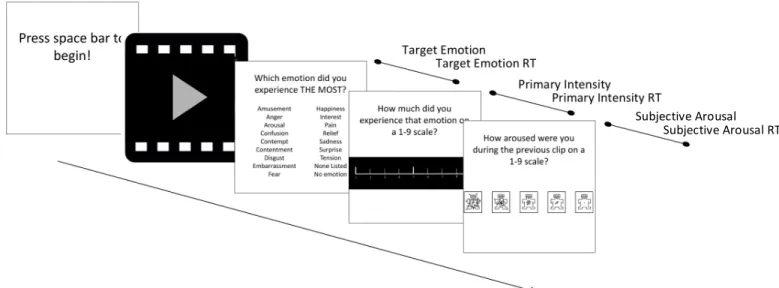
participants were presented with one of fourteen emotion inducing clips. Afterwards, they were asked which of 16 emotions they experienced the most (amusement, anger, arousal, confusion, contempt, contentment, disgust, embarrassment, fear, happiness, interest, pain, relief, sadness, surprise, and tension), replicating Gross and Levenson’s (1995) original design. In addition, they were given the option to select: “I did not experience any emotion,” and “the emotion I experienced is not listed here.” A “target emotion” variable was formed reflecting the percentage of times a normative emotional response was selected, based on intended induction as well as a few exceptions outlined in Gross and Levenson’s (1995) original paper (see Appendix A). Next, participants were asked to report the intensity of their primary emotion and subjective arousal. Response times were collected for all responses. Response time was defined as the duration between stimulus onset to participant response. This portion of the experiment is visually depicted in Figure
3 and a summary of these variables and all other task variables are summarized in Appendix C.
Figure 3. A trial of the primary emotion portion of the experiment and variable labels.
Note. Text here is abbreviated.
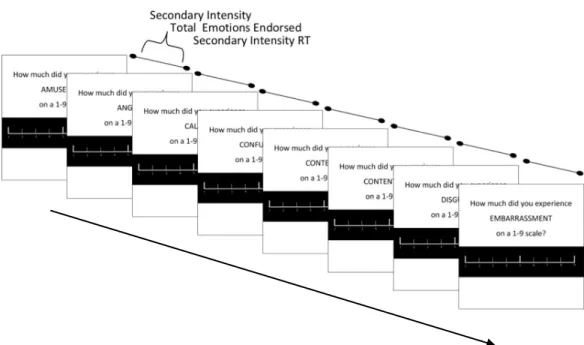
Secondary Emotions. Next, participants were presented with a serial list of 29 additional emotion words and asked how much they experienced each on a scale of 1-9, on which 1 indicated “I did not experience this emotion at all.” These included the 16 emotion words described above, non-overlapping words from the Positive and Negative Affect Scales (PANAS; Watson, Clark & Tellegen,1988) and two additional words added after piloting the experiment (calm, pity). Words are summarized in Appendix B. Emotions rated >1 were considered a positive endorsement of that emotion. From secondary emotion responses, variables were created for intensity of secondary emotions and total secondary emotions endorsed. At the end of each trial, participants were asked to indicate
Subjective Arousal Subjective Arousal RT
Figure 4. An abbreviated trial of the secondary emotion portion of the experiment and variable labels. Note: In actuality, 29 different words are presented to participants; Text here is abbreviated.
The secondary emotions portion of this experiment is used to calculate measures of emotional complexity, including granularity and dialecticism. Erbas et al. (2014) showed a negative relationship between alexithymia and negative granularity. The current study expands these findings by assessing positive granularity, and by using more complex and intense emotional stimuli (video clips versus static images and names of friends and family); this is an important step, as simple cues may be more likely to tap into rudimentary knowledge of emotional concepts, facilitating normative self-report (Lindquist & Barrett, 2008).
Data Analyses
Missing and outlying data. Because of technical errors that caused the task program to fail, .007% of performance data points were missing. Eight participants were
missing data from one of fourteen emotion induction trials; in this case, data from an induction congruent trial was used as a proxy to calculate overall aggregate variables. A ninth participant was missing data from both surprise induction trials; in this case, overall mean data from other trials was imputed for surprise trials. Response time variables were influenced by outliers. To address this, outliers were defined as data points 6 SDs greater than the mean, and were winsorized (Ghosh & Vogt, 2012). A total of .003% of these variables were adjusted. After adjustment, all task variables met assumptions of linear regression (Tabachnick & Fidell, 2007).
Elastic net regression models. To explore secondary emotional variables, elastic net regression was employed. This approach is a form of automatic variable selection, used to identify predictive variables within large data sets while utilizing shrinkage estimates to reduce predictive errors and avoid overfitting. An extension of ridge regression (Hoerl and Kennard, 1988) and least absolute shrinkage and selection operator (LASSO; Tibshirani, 1996), Zou and Hastie (2005) developed the elastic net approach to better accommodate data sets in which predictors outweigh number of participants. Elastic net combines the penalties applied in ridge and LASSO regression, facilitating variable selection by shrinking non-relevant regression coefficients to 0 and grouping similar variables, allowing collinear variables in the same model.
This approach is ideal for examining variables in the secondary emotion condition.
This condition yielded a large number of response variables (RTs and intensity ratings for 29 emotion words across 14 inductions). Though some permeations are collapsed and
Eventually, this information can be used to develop a more parsimonious version of the task presented, as well as guide interpretation of relevant themes present in alexithymia.
Results Descriptive
Mean TAS-20 was 45.75 (SD = 8.51). Mean DDF score was 12.42 (SD = 2.30); DIF was 14.71 (SD = 4.00); and EOT was 18.62 (SD = 3.70).
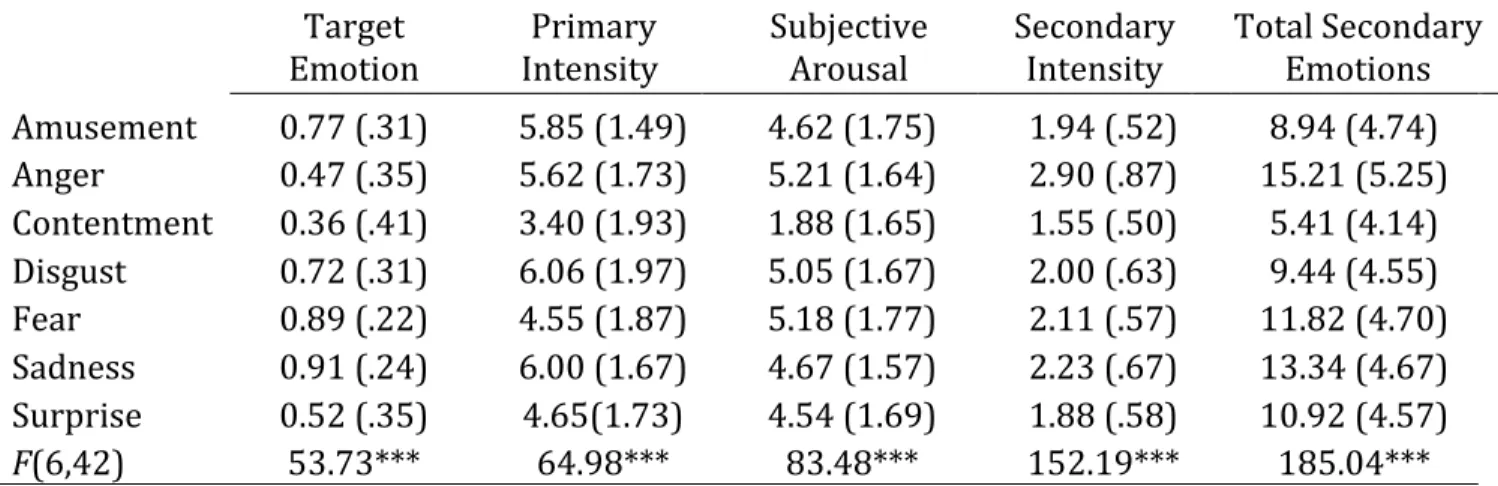
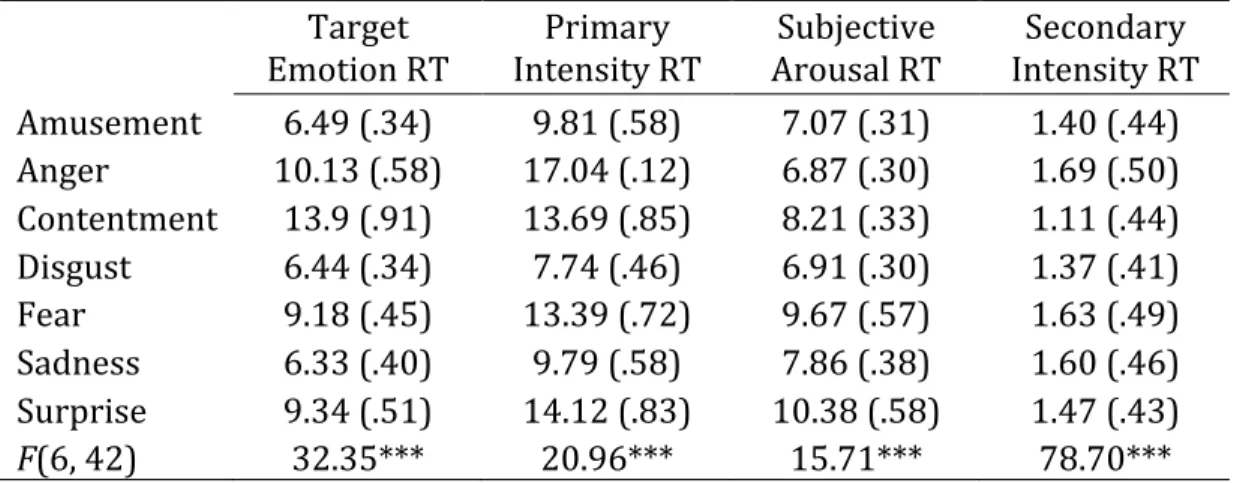
Task Performance. Means and standard deviations by emotion category for main performance variables are depicted in Table 1 and response time variables in Table 2.
Repeated-measures analysis of variance (ANOVA) was used to test the effect of emotion category (amusement, anger, contentment, disgust, fear, sadness, surprise). As expected based on Gross and Levenson’s (1995) findings, emotion category had a significant effect on all performance variables. There were no significant category by TAS-20 interactions on performance. Results presented in Table 1.
Target
Emotion Primary
Intensity Subjective
Arousal Secondary
Intensity Total Secondary Emotions Amusement 0.77 (.31) 5.85 (1.49) 4.62 (1.75) 1.94 (.52) 8.94 (4.74) Anger 0.47 (.35) 5.62 (1.73) 5.21 (1.64) 2.90 (.87) 15.21 (5.25) Contentment 0.36 (.41) 3.40 (1.93) 1.88 (1.65) 1.55 (.50) 5.41 (4.14) Disgust 0.72 (.31) 6.06 (1.97) 5.05 (1.67) 2.00 (.63) 9.44 (4.55) Fear 0.89 (.22) 4.55 (1.87) 5.18 (1.77) 2.11 (.57) 11.82 (4.70) Sadness 0.91 (.24) 6.00 (1.67) 4.67 (1.57) 2.23 (.67) 13.34 (4.67) Surprise 0.52 (.35) 4.65(1.73) 4.54 (1.69) 1.88 (.58) 10.92 (4.57)
F(6,42) 53.73*** 64.98*** 83.48*** 152.19*** 185.04***
Table 1. Descriptive performance data for videos based on emotion induction category. F values depict effect of emotion category on performance. Note. ***p < .001
ANOVA analyses also revealed significant main effect of emotion category on all response time variables as well. Means, standard deviations, and F statistics reported in Table 2. There were no significant group by alexithymia interactions on performance variables. Because of the lack of interactions between TAS-20 and emotion category for performance and RT variables, emotion categories were collapsed for all future analyses.
Target
Emotion RT Primary
Intensity RT Subjective
Arousal RT Secondary Intensity RT Amusement 6.49 (.34) 9.81 (.58) 7.07 (.31) 1.40 (.44) Anger 10.13 (.58) 17.04 (.12) 6.87 (.30) 1.69 (.50) Contentment 13.9 (.91) 13.69 (.85) 8.21 (.33) 1.11 (.44) Disgust 6.44 (.34) 7.74 (.46) 6.91 (.30) 1.37 (.41) Fear 9.18 (.45) 13.39 (.72) 9.67 (.57) 1.63 (.49) Sadness 6.33 (.40) 9.79 (.58) 7.86 (.38) 1.60 (.46) Surprise 9.34 (.51) 14.12 (.83) 10.38 (.58) 1.47 (.43)
F(6, 42) 32.35*** 20.96*** 15.71*** 78.70***
Table 2. Descriptive response time data for videos based on emotion induction category. F values depict effect of emotion category on performance. Note. ***p < .001; RT = response time.
Validating Findings
Patterns of responding are consistent with original findings of Gross and Levenson (1995). There is a deviation in target emotion for the disgust video depicting an arm amputation: in the original study, 80% of participants identified disgust as their primary emotion following this video, and only 57% chose so in the current study. A greater
proportion (24%) selected “interest” as primary, possibly reflecting high proportion of pre- medical students in Vanderbilt undergrad psychology courses. Also unlike original findings in other studies, there was no relationship between intensity and previous experience with videos (ps > .35).
Relationship between performance variables
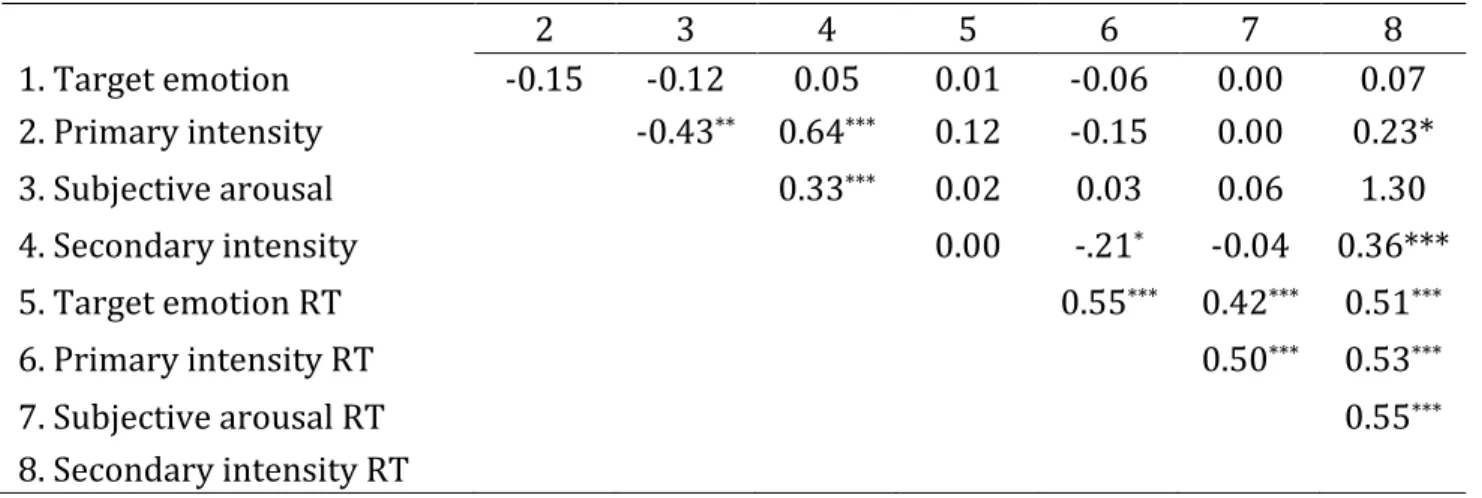
Spearman correlations between major task variables are presented in Table 3. All RT variables were strongly and positively inter-correlated. Secondary intensity was correlated with primary intensity RT. Primary and secondary intensity were positive correlated with secondary intensity RT. Finally, primary and secondary intensity were positively correlated with subjective arousal. There were no gender differences in performance with the exception of a statistical trend between males (mean= 9.33s, sd = 2.22) and females (mean = 8.44s, sd = 2.61 ) for target emotion RT; it took males longer to identify primary emotional experience (t(108)=1.73, p<.10).
2 3 4 5 6 7 8 1. Target emotion -0.15 -0.12 0.05 0.01 -0.06 0.00 0.07 2. Primary intensity -0.43** 0.64*** 0.12 -0.15 0.00 0.23*
3. Subjective arousal 0.33*** 0.02 0.03 0.06 1.30
4. Secondary intensity 0.00 -.21* -0.04 0.36***
5. Target emotion RT 0.55*** 0.42*** 0.51***
6. Primary intensity RT 0.50*** 0.53***
7. Subjective arousal RT 0.55***
8. Secondary intensity RT
Table 3. Spearman correlations between major task variables.; *p < .05; **p < .01.; ***p <
.001
Testing interaction of TAS-20. Where there were significant correlations between task variables, the effect of TAS-20 total score was assessed using Hayes’s (2013) PROCESS macro for moderation. No significant moderating effects of TAS-20 total emerged. Thus, alexithymia was associated with similar patterns of emotional processing.
Relationship between TAS-20 and performance variables
Overview of performance variables. Because of the ordinal nature of the target emotion variable and total secondary words endorsed, spearman correlations were employed to assess overall relationships between TAS-20 and performance variables.
Overall, TAS-20 total was correlated with reduced likelihood of selecting target emotion (ρ
= -0.21, p < .05) and reduced subjective arousal (ρ = -0.23, p < .05). It was also associated with faster RTs to questions about intensity of primary (ρ = -0.25, p < .01) and secondary (ρ
= -0.28, p < .01) emotions. Correlations between performance variables and TAS-20 subscales are reported in Table 4.
TAS-20 Subscales
DDF DIF EOT
Target Emotion -0.17† -0.14 -0.16†
Primary Intensity -0.09 -0.16 -0.04
Subjective Arousal -0.22* -0.12 -0.19*
Secondary Intensity -0.07 -0.05 -0.11
Total Secondary Words -0.04 0.03 -0.18†
Target Emotion RT -0.01 -0.22* -0.05
Primary Intensity RT -0.12 -0.26** -0.21*
Subjective Arousal RT -0.09 -0.10 -0.07 Secondary Intensity RT -0.13 -0.25* -0.26**
Table 4. Spearman correlations between TAS-20 total score and subscales. Note. †p < .10;
*p < .05; **p < .01.
DDF was associated with reduced arousal overall and reduced likelihood of
selecting target emotion at the trend level. DIF was negatively associated with RT variables including: identifying primary emotion RT, primary intensity and secondary intensity RTs.
EOT was associated with reduced arousal and faster response times for primary and secondary emotional intensity. EOT was associated with reduced likelihood of selecting the target emotion and endorsing fewer secondary emotion words overall at the trend level.
Because of the gender difference for selecting target emotion RT, the relationship between DIF and selecting target RT was re-run controlling for gender. The relationship remained significant. RT variables were also assessed with “no emotion” as a covariate, as selecting “no emotion” might have prompted participants to answer subsequent questions without contemplation, skewing RT. All relationships remained significant.
Group differences in selecting target emotion. Participants were divided into high (1 SD above the mean, 54, n = 21) and low (1 SD below the mean, 37, n = 19) TAS-20
scores in a post hoc analysis investigating qualitative differences in selecting target emotions, to better understand why TAS-20 was associated with reduced likelihood of selecting the target emotion (ρ = -.211, p < .05). Visual inspection suggested similar
response patterns, with the majority selecting the target emotion in both groups; however, it seemed visually that the high alexithymia group showed a greater range of responses.
Indeed, the low alexithymia group endorsed on average fewer non-target primary emotions (2.86) compared to the high alexithymia group (4.26; (t(40)=-2.68, p<.05).
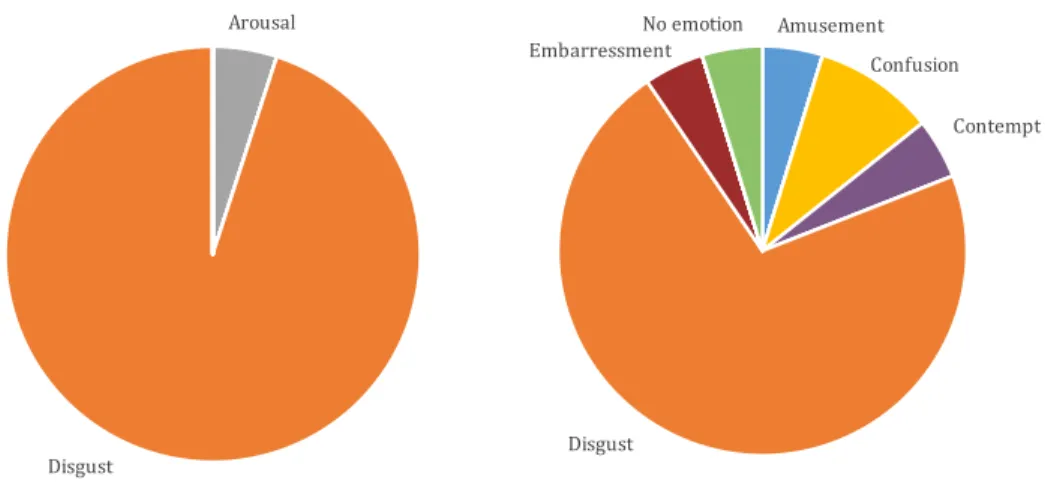
Figure 5 depicts an example.
Figure 5. Example of variability in primary emotions selected in high alexithymia. This figure depicts target emotion selected following a disgust induction, in which a woman eats her dog’s feces. The graph on the left represents those with low TAS-20 total (1 SD below the mean); the right represents those with high TAS-20 total (1 SD above the mean).
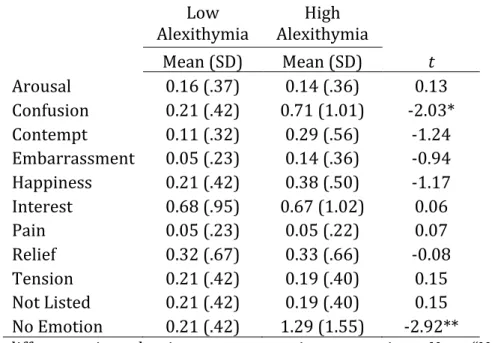
To assess patterns in selecting primary emotions, 11 t-tests were conducted
Arousal
Disgust
Amusement Confusion
Contempt
Disgust Embarressment
No emotion
< .05) as primary emotional state. To better understand how frequency of these emotion words contributed to the significant correlation between TAS-20 total score and target emotion (ρ = -.211, p < .05), a composite score of their combined frequencies was entered into a partial correlation analysis. With introduction of the composite term, the significant relationship between TAS-20 and accuracy became non-significant (ρ = -.07, p = .48).
Low Alexithymia
High
Alexithymia Mean (SD) Mean (SD) t Arousal 0.16 (.37) 0.14 (.36) 0.13 Confusion 0.21 (.42) 0.71 (1.01) -2.03*
Contempt 0.11 (.32) 0.29 (.56) -1.24 Embarrassment 0.05 (.23) 0.14 (.36) -0.94 Happiness 0.21 (.42) 0.38 (.50) -1.17 Interest 0.68 (.95) 0.67 (1.02) 0.06
Pain 0.05 (.23) 0.05 (.22) 0.07
Relief 0.32 (.67) 0.33 (.66) -0.08 Tension 0.21 (.42) 0.19 (.40) 0.15 Not Listed 0.21 (.42) 0.19 (.40) 0.15 No Emotion 0.21 (.42) 1.29 (1.55) -2.92**
Table 5. Group differences in endorsing non-target primary emotions. Note: “Not Listed”
refers to the item, “the emotion I selected is not listed here.” *p < .05; **p < .01.
For subsequent analyses, the frequency of selecting “no emotion” and “confusion” as primary emotional experience were combined into a “target composite” variable. TAS-20 total was positively correlated with target composite (ρ = -.30, p < .01), as well as EOT (ρ = - .31, p < .001). DDF and DIF were positively correlated at the trend level (for both, ρ = -.17, p < .10).
TAS-20 and Emotional Complexity
To assess the relationship between alexithymia and measures of emotional
complexity, variables for granularity and dialecticism were formed. Emotion granularity
variables were formed by calculating intraclass correlations with absolute agreement between intensity ratings of each word in the secondary emotion portion of the experiment, and calculating an average correlation (Barrett et al., 2001). Separate
measures were calculated for positive granularity (assessing correlations between positive words only) and negative granularity (assessing correlations between negative words only). The average correlation coefficient was then subject to Fisher’s z transformation, which for for ease of interpretation, was subtracted from one, such that a greater score indicates higher granularity (this reflects standard calculation of granularity indices;
Barrett et al., 2001; Boden et al., 2013; Tugade et al., 2004).
Negative granularity was associated with greater likelihood of selecting the target emotion (ρ = -0.24, p < .05), reduced target composite (ρ = -0.21, p < .05), fewer secondary words endorsed overall (ρ = -0.34, p < .05), reduced intensity of secondary emotion words (ρ = -0.34, p < .05) and slower response time for arousal (ρ = -0.21, p < .05). Negative
granularity was associated with positive granularity at the trend level (ρ = 0.17, p < .10); no other variables were related to positive granularity. For a complete correlation table of task variables in experiment 1, see Appendix D.
Dialecticism variables were formed by calculating a ratio of incongruent emotion endorsements to congruent emotion endorsements for positive inductions and negative inductions. Positive dialecticism was calculated as the ratio of positive endorsements in a negative emotion induction category to negative endorsements in a negative induction category. Negative dialecticism was calculated as the ratio of negative endorsements in a