http://doi.org/10.22342/jme.v14i4.pp757-780
Designing area of circle learning trajectory based on “what-if”
questions to support students’ higher-order thinking skills
I Putu Ade Andre Payadnya1,* , Rully Charitas Indra Prahmana2 , Jane-Jane Lo3 , Putu Ledyari Noviyanti1, I Made Dharma Atmaja1
1Mathematics Education Department, Universitas Mahasaraswati Denpasar, Bali, Indonesia
2Mathematics Education Department, Universitas Ahmad Dahlan, Yogyakarta, Indonesia
3Department of Mathematics, Western Michigan University, Kalamazoo, United States
*Correspondence: [email protected]
Received: 1 September 2023 | Revised: 4 October 2023 | Accepted: 9 October 2023 | Published Online: 5 November 2023
© The Author(s) 2023
Abstract
The study material on circle areas is contextually oriented and aids students in comprehending their surrounding environment. Higher-order thinking skills are imperative for the success of circular learning, as they help students grasp concepts holistically and solve concept problems. "What-if" questions can enhance students' higher-order thinking skills through problem-solving activities, fostering critical and creative thinking. However, applying "what- if" questions is limited to serving as problem-posing triggers, resulting in minimal variation in the material.
Therefore, this study aims to design a learning trajectory for the area of circles based on "what-if" questions to enhance students' higher-order thinking skills. This research also addresses the gap by utilizing "what-if"
questions to construct and evaluate circle area learning activities. We employed design research as the research method, conducted in three stages: preliminary design, experimental design, and retrospective analysis. The results demonstrated that the designed learning trajectory enhanced higher-order thinking skills in various aspects. Students exhibited critical thinking and profound analysis when working on worksheets and addressing the provided problems. Moreover, students showcased creative and divergent thinking abilities, enabling them to generate alternative problem solutions. Furthermore, optimizing technology usage and emphasizing reasoning in learning should be augmented to enhance student motivation and foster innovative learning.
Keywords: Area of Circle, Design Research, Higher-Order Thinking Skills, “What-If” Question
How to Cite: Payadnya, I. P. A. A., Prahmana, R. C. I., Lo, J-J., Noviyanti, P. L., & Atmaja, I. M. D. (2023).
Designing area of circle learning trajectory based on “what-if” questions to support students’ higher-order thinking skills. Journal on Mathematics Education, 14(4), 757-780. http://doi.org/10.22342/jme.v14i4.pp757-780
Cavanagh (2008) explored two primary reasons area measurement is important within the middle-school mathematics curriculum. The initial reason stems from the varied applications of area concepts in everyday tasks such as painting, gardening, tiling, and other activities necessitating coverage of a two- dimensional surface (Huang & Witz, 2013). The second reason lies in the essential role area concepts play in facilitating understanding various other mathematical notions (Outhred & Mitchelmore, 2000).
Circle area, as a measurement concept, remains pertinent to students' daily experiences (Laurens &
Laamena, 2020). Cox and Lo (2019) noted that beyond mere memorization and formula application for routine problems, the mathematics education community needs more insight into students' conceptions of the circle's area formula. Despite the intricacy of this information, relatively few studies have delved into it (Rejeki & Putri, 2018). Thus, circle area measurement stands as a highly significant subject,
constituting a valuable focal point within the realm of mathematics education.
Higher-order thinking skills (HOTS) represent a pivotal facet of mathematical cognition, wielding a decisive influence over the efficacy of mathematics education. According to Tanudjaya and Doorman (2020), higher-order thinking skills encompass students' capacities for analysis, synthesis, and evaluation within the learning process. Moreover, Hwang et al. (2017) delineated three distinct categories of HOTS:
problem-solving, critical thinking, and creativity. Problem-solving entails identifying issues, gathering, and scrutinizing pertinent information, and selecting and executing fitting solutions. Critical thinking involves an objective assessment of information, lucid and rational deliberation capacity, and the ability to reach reasoned conclusions. Creativity, conversely, pertains to generating novel products and cultivating distinctive ideas and methodologies through the expansion, refinement, analysis, and evaluation of existing ones. As students strive to cultivate analytical and creative thinking proficiencies requisite for twenty-first-century aptitudes—constituting the foundational competencies for their future readiness—
higher-order thinking skills assume paramount importance (Collins, 2014). Consequently, educators must imbue mathematics learning in the smart classroom with HOTS-oriented strategies (Lu et al., 2021).
Moreover, The Department of Education and Training (2022) ascertained that educators who endeavor to nurture and augment their students' higher-order thinking skills simultaneously foster advancements among their high-achieving pupils.
The Programme for International Student Assessment (PISA) maintains an ongoing evaluation of students' mathematical competencies globally, along with their proficiency in employing higher-order thinking skills (OECD, 2018). The most recent outcomes from the 2018 PISA survey positioned Indonesia at the 74th spot out of 80 participating countries, securing a mathematics skills score of 379 and a rank of 73rd (OECD, 2019b). Based on the PISA 2018 report, a mere 1% of Indonesian students display the capacity to model intricate scenarios (OECD, 2019a) mathematically. Lee and Lai (2017) supplemented this by highlighting that students struggle to resolve problems demanding elevated cognitive engagement.
In education, insufficient emphasis persists on applying mathematics in daily contexts, mathematical communication, and logical reasoning. An illustrative instance lies in students often encountering challenges when grappling with geometric concepts, such as the area of a circle (Praveen & Leong, 2013). Furthermore, Rosita et al. (2019) noted that students encounter difficulties when attempting to formulate conjectures and construct meaningful generalizations about circular concepts, as well as elucidating mathematical notions concerning circles through visual representations. In conclusion, the amalgamated findings of surveys and research underscore the need for higher-order thinking skills (HOTS) among Indonesian students, particularly in the domain of circle-related learning.
To address this challenge, an innovative solution is required to enhance students' learning experiences, particularly in the realms of area and area measurement of circles (Rejeki & Putri, 2018).
Hadi et al. (2018) investigated students' struggles with higher-order thinking skills (HOTS) problems. They identified a key hindrance in solving mathematical tasks: the difficulty of formulating a mathematical model and the absence of open-ended learning tools that could nurture student creativity. Moreover, several studies offer diverse perspectives essential for enhancing students' higher-order thinking skills (Meryansumayeka et al., 2022). Research conducted by Komarudin et al. (2020) revealed that learning must incorporate innovative educational media to elevate students' higher-order thinking skills.
In contrast, Ahmad et al. (2017) concluded that practical assessment can significantly enhance the efficiency of the learning process. Furthermore, Sofiyan et al. (2020) emphasized that educators should invest effort in constructing learning tasks encompassing instructive resources catering to cultivating higher-order thinking skills among students. Hence, developing a pedagogical design conducive to
fostering creative reasoning-based learning becomes imperative, especially for augmenting higher-order thinking skills within the domain of circle-related concepts.
Learning founded on "what-if" questions, which underscore critical and explorative thinking, emerges as a principal avenue for ameliorating students' higher-order thinking skills. "What-if" questions constitute a series of inquiries that stem from the What-if-Not strategy pioneered by Brown and Walter (1969). Brown and Walter (1990) categorize problem posing into two levels: "accepting the problem" and
"challenging the problem." At the "challenging the problem" stage, novel queries can emerge as byproducts of the initial problems. The inception of the "what-if" question was initially attributed to Payadnya et al. (2016), a concept offering a broader spectrum of possibilities for problem-solving.
Generating novel ideas through this technique enhances students' competence in tackling mathematical challenges.
Şengül and Katranci (2015) employed "what-if" questions to extract critical concepts from topics like ratios and propositions. They utilized questions as triggers to prompt problem analysis, suggesting a need for their greater integration into the learning curriculum. On the other hand, Cai et al. (2022) employed "what-if" questions to introduce variations in problem posing, although they were not extensively incorporated into the overall learning process. Numerous studies have primarily concentrated on crafting "what-if" questions yet have not fully harnessed their potential as innovative pedagogical tools.
Moreover, a comprehensive exploration and application of "what-if" questions within the context of circle materials remains largely unexplored. Payadnya et al. (2016) concluded that "what-if" questions can evolve into learning designs fostering enhanced thinking abilities among students. In another instance, Fitri and Prahmana (2020) successfully developed a learning trajectory centered on the Ferris wheel scenario in circular learning, significantly enhancing students' conceptual understanding skills. Guided by the findings of these prior studies, this research advocates for transforming "what-if" questions into a contextual learning design tailored to circle-related concepts, intending to enhance students' higher-order thinking skills.
We identified significant potential in structuring circle area learning activities utilizing "what-if"
questions based on analyzing various theoretical perspectives. These questions can be leveraged to create innovative learning designs that allow students to think critically and creatively across various concepts and problems. The inherent contextual nature of the circle area concept further supports the development of pertinent and efficient learning designs grounded in "what-if" questions. This paper presents a meticulously crafted circle area learning activity underpinned by "what-if" questions, intending to nurture students' higher-order thinking skills.
In the subsequent section, we delve into the methodology employed in this research, detailing the research design and outlining the three pivotal stages: preliminary design, design experiment, and retrospective analysis. These stages collectively establish the foundation for constructing a coherent learning trajectory. The third section encompasses the outcomes of implementing and analyzing the designed curriculum. It evaluates the enhancement of students' higher-order thinking skills, offering insights into progress, findings, and student responses throughout each activity. Finally, the conclusion outlines the research's limitations and recommends future studies.
METHODS
This study adopted design research as its research methodology. Plomp and Nieveen (2013) elucidate design research as an investigative approach to formulating and constructing an intervention—ranging
from educational programs and teaching-learning strategies to materials, products, and systems—to resolve intricate educational challenges. This research aligns with the validation study category, wherein the primary objective is the conception of a learning trajectory. This trajectory entails developing, elucidating, and validating a learning theory regarding the learning process, alongside the resultant intervention outcomes, for a given learning design (Prahmana, 2017). Within this framework, the study implemented the three key stages inherent to design research: preliminary design, design experiment, and retrospective analysis (Bakker, 2018).
Preliminary Design
In the preliminary design phase, a Hypothetical Learning Trajectory (HLT) is devised, which serves as a guiding framework for learning. The HLT comprises three integral components: learning objectives, steering the course of learning activities, learning activities themselves, and hypotheses concerning the learning process, containing forecasts of students' cognitive engagement when exposed to the designated learning activities (Simon, 1995). This stage encompasses several key activities, including consultations with supervisors, an exploration of available resources encompassing printed and digital materials such as books and scholarly journals, a review of classroom-based learning endeavors, interactions with mathematics educators, an analysis of the applicable mathematics curriculum, comprehensive research analysis, on-site investigations, the development of HLT design, and the creation of learning materials including Learning Implementation Plans, teacher guides, instructional media, and student worksheets. The initial HLT formulation was undertaken collaboratively by the researchers and their team, considering the diverse learning requirements inherent to the circle area subject, utilizing "what-if" questions. Subsequently, the HLT underwent refinement through collaboration with researchers at Western Michigan University, U.S.A., under the guidance of Prof. Jane-Jane Lo. She provided valuable insights to enhance the compiled HLT. Following this, the HLT was evaluated by an expert in design research in mathematics education, Prof. Rully Charitas Indra Prahmana, from Universitas Ahmad Dahlan, who examined, provided feedback and validated its content. Upon validation, the HLT was implemented in a classroom setting during the design experiment phase.
Design Experiment
The developed HLT is implemented within a classroom during the design experiment phase. This phase unfolded in grade 8 at Widiatmika Middle School, the designated research site for this study. The initial cycle of the study, referred to as cycle 1, was executed in small class settings, each comprising ten students. The learning intervention encompassed five distinct activities centered about the circle area.
Key tasks carried out during this stage encompassed overseeing the learning implementation, generating field notes, and recording comprehensive records of the multi-faceted learning endeavors. The data acquisition process comprised several approaches, including observing student interactions, analyzing student worksheets, documenting learning sessions via video recordings, and conducting interviews. The data collection methods employed encompass unstructured observations and open interviews. The amassed data is the foundation for subsequent analysis in the upcoming phase.
Retrospective Analysis
Following the completion of the design experiment, a retrospective analysis was conducted. The data accrued during the design experiment was subjected to qualitative analysis during the assessment phase, utilizing the constant comparison method (Bakker & Eerde, 2015). The sequential steps in data analysis encompass (1) scrutinizing students' responses, (2) sequentially reviewing all recorded learning
sessions, (3) compiling comprehensive transcripts, (4) flagging noteworthy segments that spotlight pivotal moments within the learning process, (5) expanding detailed transcripts for these segments, (6) corroborating or challenging interpretations of critical moments by cross-referencing them with other segments, (7) engaging in discussions with supervisors and colleagues to validate the researcher's interpretations and glean suggestions for enhancement. The analysis outcomes are subsequently re- evaluated with the teacher to ascertain the alignment of the research findings.
The selection of respondents in this study was based on the relationship between the material and student grades, as well as selection recommendations from teachers with representative student criteria based on mathematical ability. Due to these two factors, 10 individuals were chosen as research participants from four eighth-grade classes at Widiatmika Middle School. The researcher guarantees that the selection of participants is in accordance with research ethics, where there is agreement from the participants, accompanying teachers, and parents of the students which is obtained verbally through discussions or official statements. The data collection methods employed included interviews, observations, tests, and documentation. In the interviews conducted at the end of each cycle, we interviewed ten participating students to gather information on their obstacles, responses, and cognitive development during the research. Observations were carried out in an unstructured manner to record all important aspects related to student activities that could be relevant to the research findings. Meanwhile, documentation was conducted to record the results of student activities in the form of photos, videos, and student responses from the completed worksheets. Finally, tests were administered in each cycle in the form of Higher-Order Thinking Skills (HOTS) questions and "what-if" problems to assess improvements in students' abilities and as evaluation material for subsequent activities. Data analysis was performed through retrospective analysis following the steps outlined above. Additionally, the test in a form of one or two question results from each activity were quantitatively measured, focusing on average HOTS abilities, using indicators, and scoring rubrics from the Revised Bloom Taxonomy, which include analyzing, creating, and synthesizing with scale 100 maximums score (Anderson & Krathwohl, 2002).
The researchers did several things to ensure data saturation in this research by ensuring the validity and reliability of the data. To ensure the validity of the acquired data, several strategies are employed: (1) triangulating data from multiple sources, (2) verifying the alignment between the HLT and the actual learning occurrences, and (3) actively seeking counterexamples during the assessment phase to scrutinize formulated predictions (Frambach et al., 2013). Meanwhile, to establish reliability in the data analysis, the following methods are adopted: (1) meticulous documentation of all learning activities, (2) explicit delineation of the learning methodologies utilized, and (3) transparent explanation of the methods employed in drawing conclusions.
RESULTS AND DISCUSSION
In the preliminary phase, the researcher engaged in various pertinent activities, including thorough reference analysis, conducting interviews with mathematics teachers, and formulating the Hypothetical Learning Trajectory (HLT) with the guidance of a supervisor. The researcher conducted an extensive examination of relevant references encompassing learning designs related to circle area concepts and applying "what-if" questions. Subsequently, the researcher interviewed three mathematics teachers who teach grade 8 at Widiatmika Middle School. These interviews aimed to discern the challenges students encountered in their learning journey. The insights garnered during these interviews revealed that students predominantly approached learning by memorizing formulas and addressing procedural
problems within the context of circle area studies. Specifically, students would rapidly memorize the formula for calculating the area of a circle and subsequently apply it to problems presented by the teacher.
The teachers attested that those students frequently encountered difficulties when confronted with word problems and questions demanding higher-order analytical and critical thinking skills. Furthermore, observations revealed that students often needed help to grasp the fundamental concept of area, leaving them unable to define the term. This created a knowledge gap, particularly when transitioning to studying areas of two-dimensional shapes characterized by curves or irregularities.
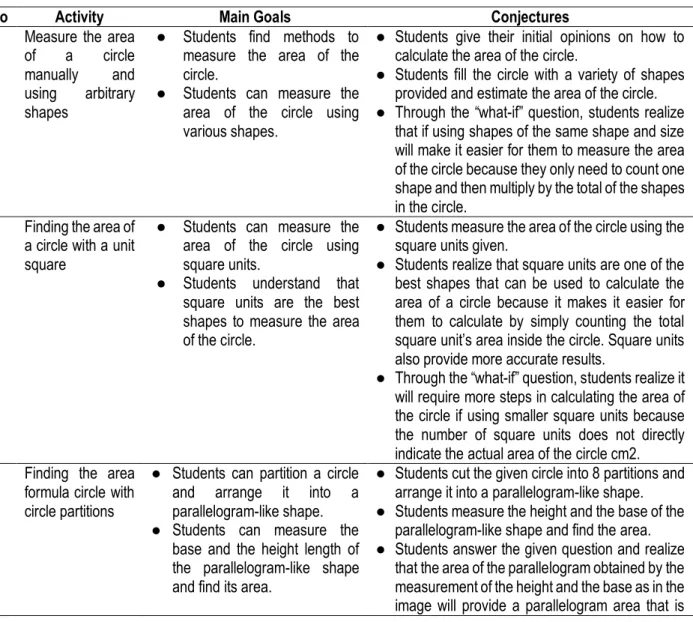
Armed with these identified challenges, the researcher undertook an intensive reference study and formulated the HLT during a tenure at Western Michigan University, U.S.A., facilitated by the Fulbright US-ASEAN Visiting Scholar Initiative Program. Over four months, the researcher had the opportunity to craft and refine the HLT under the tutelage of an esteemed mathematics education expert, particularly regarding circle-related concepts. The guidance from this supervisor led to the streamlining of activities and the incorporation of the GeoGebra application into the HLT activities. Following this, the HLT was again subjected to validation by an expert from Universitas Ahmad Dahlan. This expert provided valuable input regarding integrating contextual problems within the HLT material. The finalized HLT, consisting of six activities, was compiled by the researcher, and the details are presented in Table 1.
Table 1. Hypothetical Learning Trajectory (HLT)
No Activity Main Goals Conjectures
1 Measure the area of a circle manually and using arbitrary shapes
● Students find methods to measure the area of the circle.
● Students can measure the area of the circle using various shapes.
● Students give their initial opinions on how to calculate the area of the circle.
● Students fill the circle with a variety of shapes provided and estimate the area of the circle.
● Through the “what-if” question, students realize that if using shapes of the same shape and size will make it easier for them to measure the area of the circle because they only need to count one shape and then multiply by the total of the shapes in the circle.
2 Finding the area of a circle with a unit square
● Students can measure the area of the circle using square units.
● Students understand that square units are the best shapes to measure the area of the circle.
● Students measure the area of the circle using the square units given.
● Students realize that square units are one of the best shapes that can be used to calculate the area of a circle because it makes it easier for them to calculate by simply counting the total square unit’s area inside the circle. Square units also provide more accurate results.
● Through the “what-if” question, students realize it will require more steps in calculating the area of the circle if using smaller square units because the number of square units does not directly indicate the actual area of the circle cm2.
3 Finding the area formula circle with circle partitions
● Students can partition a circle and arrange it into a parallelogram-like shape.
● Students can measure the base and the height length of the parallelogram-like shape and find its area.
● Students cut the given circle into 8 partitions and arrange it into a parallelogram-like shape.
● Students measure the height and the base of the parallelogram-like shape and find the area.
● Students answer the given question and realize that the area of the parallelogram obtained by the measurement of the height and the base as in the image will provide a parallelogram area that is
● Students can compare the area of the parallelogram-like shape with the area of the circle.
smaller than the area of the circle. This is because there is an area of segments left on the outside of the parallelogram-like shape.
● Students think about the answers of what-if questions given. The expectation is for the students to realize that more and more partitions are created will affect the shape formed from the partition to become more rectangle-like and the accuracy of the area results obtained will increase.
4 Find the formula for the area of a circle with GeoGebra
● Students can find the formula of the area of the circle using GeoGebra.
● Students can understand the concept formula of the circle area properly.
● Students understand the relationship between the number of partitions and the accuracy of the area of the circle obtained.
● Students visit the GeoGebra media to discover the area of the circle through the given link.
● Students will find that the shape of the arranged circle partition is similar to a parallelogram.
● Students find if the circle partition is more or maximized the shape arranged will become a rectangle-like shape.
● Students find the area of the circle formula through the rectangle-like shape area formed from the partition of the circle.
● Students realize that the area gained from the rectangle-like shape is closer to the original circle area as the remaining segment-like shapes get less and less.
5 Solving problems related to the area of a circle.
● Students can solve critical thinking problems related to the area of the circle and give appropriate reasoning.
● Students can think of various other possibilities of a problems.
● Students solve the problems presented.
● Students develop their critical thinking abilities by answering what-if questions presented.
● Students solve the critical problems given with appropriate reasoning.
The researchers meticulously crafted each of these activities in collaboration with their supervisors, with the overarching objectives of reinforcing students' foundational grasp of circular area concepts and amplifying their higher-order thinking skills. The supervisors played a pivotal role by furnishing a wealth of suggestions and insights throughout the HLT preparation process. For instance, under the supervisors' guidance in the initial activity, students were engaged in an exercise involving the manual measurement of the outer circumference of circular areas. The introduction of technology, particularly the utilization of GeoGebra, was incorporated into the fifth activity. Furthermore, the last activity was enriched by integrating open-ended, interactive, and contextually relevant problems. Over the course of the four- month program, researchers worked diligently to compile the HLT, drawing from the comprehensive input provided by their supervisors. This culminated in the successful formulation of the HLT, which was subsequently implemented in an Indonesian context by the researchers.
The refined HLT, resulting from the collaboration with supervisors, was then administered to small groups comprising 10 grade 8 students. These students were divided into three distinct groups, enabling a focused and comprehensive exploration of the HLT's effectiveness.
Activity 1
Students receive worksheets meticulously aligned with the activities delineated within the HLT. In the first activity, students are presented with a scenario wherein they are tasked with calculating the area of circular
cardboard without resorting to the conventional formula for the circle's area. Notably, the specific dimensions of the cardboard are intentionally omitted, rendering the question abstract in nature. The objective here is to gauge students' capacity for creative problem-solving within their immediate environment. This activity yielded a multitude of distinctive and captivating perspectives from the students.
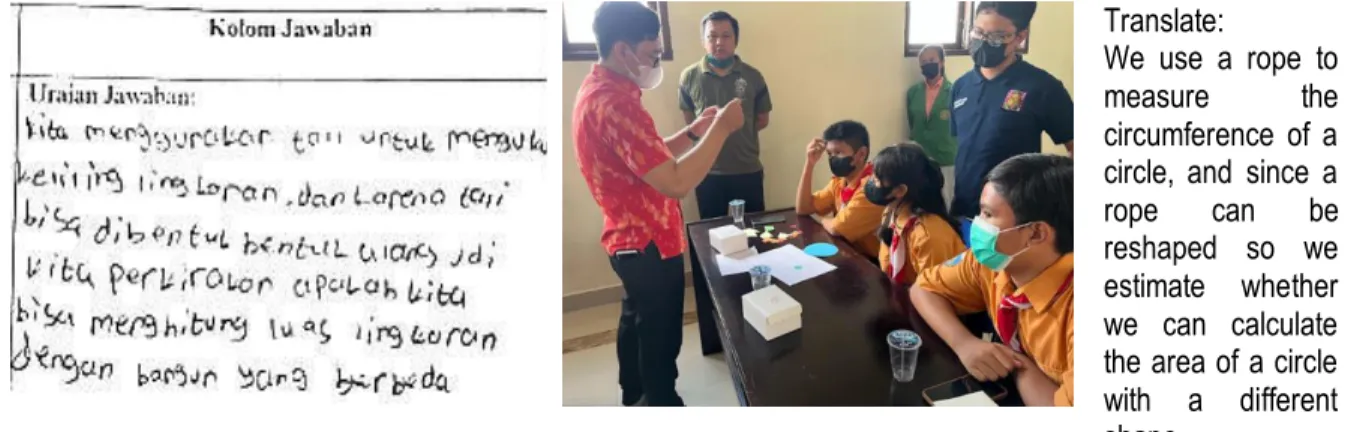
Several students approached the question by employing a length of rope, which they wound around the circular cardboard's circumference. After removing the rope, they fashioned it into a two- dimensional shape, like a rectangle. This approach was grounded in their familiarity with the formula for the area of a rectangle. Consequently, they concluded that the circle's area would mirror the resulting rectangle's area. Figure 1 presents an exemplar of a student's response.
Translate:
We use a rope to measure the circumference of a circle, and since a rope can be reshaped so we estimate whether we can calculate the area of a circle with a different shape
Figure 1. Student Answer and Activity on Problem 1
Figure 1 vividly illustrates the remarkable creativity exhibited by students, showcasing their ability to think outside the box by utilizing readily available objects, such as ropes, in imaginative ways. Lince (2016) emphasized that mathematics education should foster creative thinking, enabling students to explore innovative solutions autonomously. However, it's worth noting that students encountered challenges when it came to substantiating whether the area of the rectangle formed from the rope would indeed be identical to that of the circle. The area of the rectangle traced by the rope would not equate to the area of the circle, as different shapes sharing the same circumference do not necessarily share the same area.
On a different note, some students also employed a rope but adopted a distinct approach. They measured the area of the circular cardboard by systematically arranging the rope on the cardboard in a zigzag pattern, ensuring that it covered the entire surface. These students considered the total length of the rope used to envelop the cardboard as equivalent to the circle's area. The following is an example of one student's response:
Translate:
(if there is a rope)
The rope is measured first and then made in a zig-zag pattern then the length of the rope is added up to get the area of the circle
Figure 2. Student Answer on Problem 1
Figure 2 shows that the approaches adopted by other students are not only profoundly creative but also exhibit a greater alignment with accuracy than the method employed by the first group. These students also demonstrate the capability to validate the correctness of their answer, reasoning that if the rope can envelop the entire surface of the cardboard, then the entire area of the circle will be encompassed, ultimately equaling the circle's area. This substantiates the activities' efficacy in stimulating students' creative thinking faculties. Students who initially were accustomed to procedural learning encountered initial difficulties when faced with non-routine problems like those encountered in this activity. However, with a modest degree of guidance, students exhibited the capacity to generate novel ideas and devise alternative methodologies for gauging the area of a circular piece of cardboard, employing objects that are an integral part of their daily lives. As Tan et al. (2020) posited, the objective of nurturing creative thinking is to foster innovative perspectives, strategies, and modes of comprehension.
During this activity, students also communicated the challenge of visualizing without the actual object and the specific dimensions of the circular cardboard. This valuable feedback serves as a cornerstone for researchers, prompting the development of more contextually driven learning tasks that facilitate a more comprehensive activity completion. Furthermore, integrating comprehensive teaching aids can contribute to students' enhanced understanding of the concept more tangibly, aiding their problem-solving abilities.
The subsequent activity entails measuring the area of a circle using an arbitrary shape. Here, students are provided with a circle of predetermined dimensions and tasked with determining its area by filling the circle with an assortment of two-dimensional shapes selected from those provided.
During this activity, a diverse array of responses was garnered from students. Some students chose to employ two-dimensional shapes randomly, often favoring smaller options, as illustrated in Figure 3. Their rationale lies in the belief that smaller shapes can facilitate a more straightforward filling of the circle and yield more precise outcomes. Conversely, other students opted for larger two-dimensional shapes closely resembling the dimensions of the circle. Their line of thinking revolves around the notion that larger plane shapes can expedite the covering of the circle, leaving them to merely supplement the remaining portion with smaller plane shapes. This activity not only underscores students' capacity for reasoning but also exposes their inclination to face challenges when confronted with further inquiries, occasionally perplexing them.
Furthermore, it's noteworthy that most students encountered challenges in their final calculations.
Consequently, despite demonstrating adeptness in employing a sound method for calculating the area of a circle using cardboard, students grappled with yielding accurate results. This phenomenon underscores the gap between mathematical problem-solving within the school context and applying similar calculations in real-world scenarios. As Sari et al. (2018) highlighted, students may proficiently address mathematical queries in an educational environment yet still need help to execute analogous calculations in everyday life.
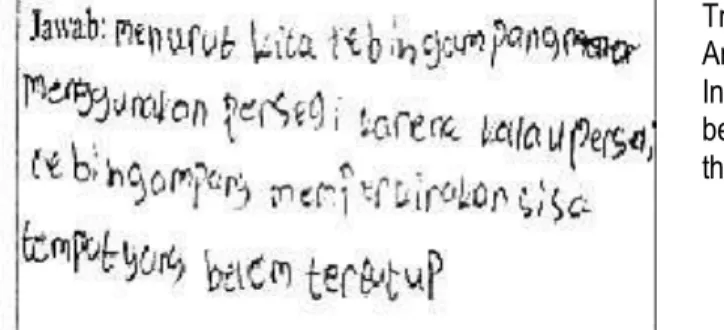
As the activity culminates, students are posed with a "what-if" question, specifically: "What if the area of a circle is computed using a two-dimensional shape of the same form and dimensions?" Most students responded by asserting that employing a two-dimensional shape of the same form and dimensions would simplify the process of computing the circle's area. However, students needed help determining which shape would be the most suitable for this purpose.
Translate:
Answer:
In our opinion it is easier to use a square because if a square is easier to predict where the area is not covered
Figure 3. Student’s Answer to “What-If” Question
Figure 3 provides compelling evidence of students adeptly demonstrating higher-order thinking skills. Notably, students can formulate predictions suggesting that utilizing a two-dimensional shape identical in form and dimensions to the circle would simplify the area calculation process. Furthermore, they confidently identify a square as the most suitable two-dimensional shape for this purpose. This robust response underscores the effectiveness of the "what-if" questions in fostering students' capacity for open and expansive thinking. This, in turn, prompts students to engage in a profound analysis of problem-solving strategies and encourages them to explore a wide spectrum of potential scenarios. As Nurhayati et al. (2023) emphasized, open-ended questions have indeed proven to be instrumental in enhancing students' proficiency in higher-order thinking skills.
Activity 2
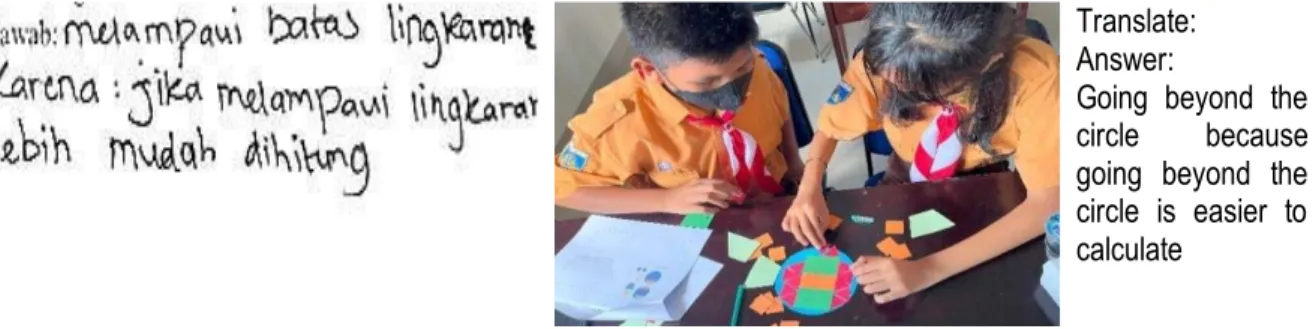
Moving on to the second activity, students were tasked with computing the area of a circle utilizing unit squares. Each student received several unit squares, which they were required to arrange into a configuration resembling a circle to perform the area calculation. This activity notably sparked a distinctive debate among the students. The crux of this discourse revolved around the "What-If" question, prompting a contemplation of whether it would be more advantageous to position the unit squares in a manner that not only covered the circle's area comprehensively but also exceeded it or if an alternative approach involving arranging the unit squares in proximity to the circle's area would be more effective.
Translate:
Answer:
Going beyond the circle because going beyond the circle is easier to calculate
Figure 4. Student’s Answer on Activity 2
As depicted in Figure 4, students who elected to fully envelop the circle's area while surpassing its boundaries rationalized their choice by contending that this approach simplifies the subsequent step.
Their reasoning centered around the straightforward process of subtracting the unit squares' total area from the estimated unit square area extending beyond the circle's circumference. Nonetheless, these students later recognized that completely enclosing the circle obscured its boundary line, posing visual
challenges. As a result, a unanimous consensus was reached among all students, favoring the approach of optimizing the placement of the unit squares without extending beyond the circle's circumference.
Evidently, students demonstrated an adept ability to engage in reasoning judiciously. They presented compelling arguments underpinning their selected answers and effectively substantiated their rationale. Notably, proficient mathematical reasoning constitutes a pivotal aspect of mathematical cognition. As Battista (2017) outlined, the capacity to engage in reasoning and construct meaning is pivotal for studying mathematics, empowering students to apply mathematical concepts in practical scenarios and problem-solving endeavors and fostering a robust foundation for future learning.
The core objective of this activity was to prompt students to recognize that employing unit squares offers the optimal approach for calculating the area of a circle. Students acknowledged that using unit squares streamlines calculations, obviating the necessity for individual area calculations of each two- dimensional figure. Additionally, this activity fostered students' comprehension of the concept of area and its correlation with a unit square. Specifically, when the area of the circle is denoted as "n" square meters, this signifies that the circle's area is congruent to the area of "n" square units.
Activity 3
Transitioning to the third activity, students were tasked with deriving the formula for the area of a circle utilizing circle partitions. The students were presented with a circle meticulously divided into eight sections. Their assignment involved reshaping these partitions into a configuration reminiscent of a parallelogram and subsequently calculating its area using the formula for the product of base and height.
An illustrative example of student responses from this activity is presented below (see Figure 5).
Translate:
Answer:
The shape formed is a parallelogram with a base length 𝜋𝑟, height 𝑟. So, the area is 𝜋𝑟2 Base length is obtained from a half of:
2𝜋𝑟 =1 2𝑥2𝜋𝑟
= 𝜋𝑟 Figure 5. Student’s Answer on Activity 3
Within the framework of the third activity, students adeptly unearthed the formula for the area of a circle with the valuable guidance of their teacher. The students seamlessly established a correlation between the determination of the circle's area and the computation of the parallelogram's area, as exemplified in Figure 5. This insightful discovery entailed recognizing that the base length of the parallelogram aligns with half of the circle's circumference, denoted as πr, while its height corresponds to the radius (r). Consequently, the area of the circle materialized as πr². This achievement signifies that in addition to displaying proficient mathematical thinking skills, students also wield commendable mathematical connection abilities. Their capacity to bridge more than one mathematical concept—
unveiling the area of a circle through an arrangement resembling a parallelogram—underscores this competence. García-García and Dolores-Flores (2018) expound that mathematical connection refers to
students' capability to establish links between mathematical concepts and real-world scenarios, other scientific domains, and various branches of knowledge. A student's prowess in mathematical connections manifests through their ability to identify and apply mathematical concepts in contexts extending beyond mathematics, uncover and employ interconnections among different mathematical ideas, fathom the interconnectedness of mathematical concepts as they coalesce into a cohesive whole, and discern how mathematical ideas synchronize and complement each other (NCTM, 2000; Son, 2022).
Nonetheless, challenges begin to surface when students are confronted with "what-if" questions inquiring about the implications of using additional circle partitions. The majority of students asserted that augmenting the circle partitions would yield no alteration, failing to recognize the consequential alteration in the configuration of the arranged planes and the consequent shifts in the calculated circle area values.
This observation reveals a nascent deficiency in students' capacity to engage in creative and divergent thinking. Ferrándiz et al. (2017) highlight that a hallmark of divergent thinking is the propensity to explore unorthodox (non-routine) possibilities, thereby engendering novel ideas. Consequently, students must be equipped to discern and fathom innovative potentialities stemming from the concepts and challenges they encounter.
Activity 4
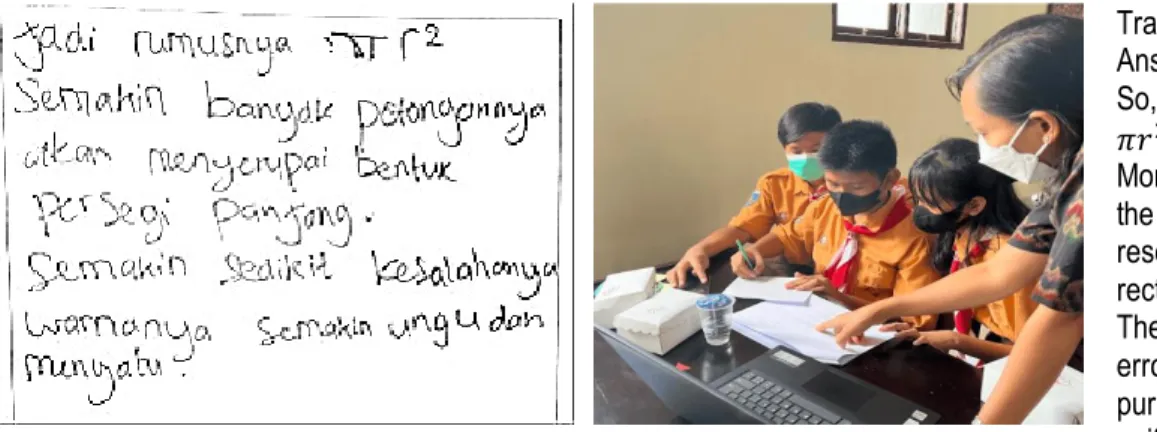
The subsequent activity closely mirrors the prior one, with students once again embarking on the journey to ascertain the formula for the circle's area through circle partitions, albeit adopting a novel two- dimensional arrangement. This instance, however, leverages the capabilities of GeoGebra. Here, students were directed to explore GeoGebra resources relevant to circle area. Paralleling the previous exercise, students adeptly discerned the area of a circle. Notably, students found this GeoGebra-enabled activity even more accessible than its analog counterpart. The appeal of GeoGebra lies in its interactive nature, coupled with its seamless manipulability by students. This enhancement is attributed to the interactive and adaptable nature of the GeoGebra resource provided. Below, the outcomes of the students' endeavors are laid out:
Translate:
Answer:
So, the formula is 𝜋𝑟2
More and more the pieces will resemble a rectangle shape.
The fewer the errors, the more purple and unified the color is.
Figure 6. Student’s Answer on Activity 4
Figure 6 shows that this medium empowers students to address the preceding "what-if" query, demonstrating that increasing circle partitions leads to a proportionally closer approximation of the actual circle area. Furthermore, students astutely recognized that these augmented partitions would progressively reshape the plane into a configuration more akin to a rectangle. The dynamic nature of this technology-enabled platform enabled students to directly visualize the evolution of the two-dimensional
circle partition's structure, transitioning from a parallelogram to a rectangle. This facilitated observation allowed students to discern how the remaining edge area of the circle partition diminished as more circular partitions were introduced.
The integration of technology-based learning media resonates seamlessly with contemporary pedagogical paradigms and aligns harmoniously with the inclinations of Generation Z students.
Interactive visuals and manipulable media serve as potent tools for enhancing students' grasp of the conveyed concepts. Students adeptness in navigating and harnessing these resources is unsurprising, given their status as digital natives, characterized by a preference for swift information consumption, proficiency in rapid data processing, a penchant for multitasking and non-linear information access, limited tolerance for prolonged lectures, a predilection for active over passive learning, and a pronounced reliance on communication technologies for information acquisition and engagement in both social and professional interactions (Prensky, 2011). Moreover, McClain & North (2021) stated that the integration of technology in middle school students significantly increases the development of students' mathematical skills, as well as leading to the mastery of specific skills in the digital era.
Activity 5
In the fifth activity, students are allowed to apply the concepts that have been given. Students are given two HOTS problems related to the area of a circle. Here are the problems given.
Problem 1
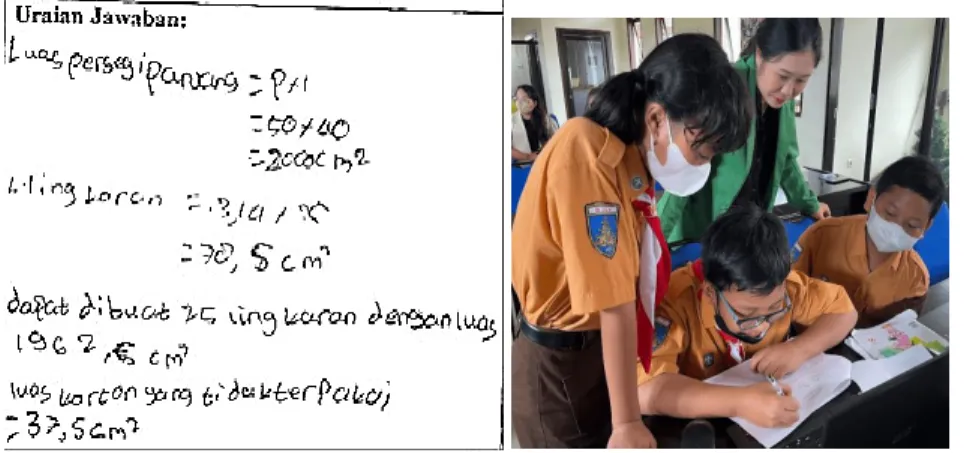
A rectangular piece of cardboard measuring 50 cm x 40 cm. From the cardboard, circles with a radius of 5 cm will be made. If you want to make as many circles as possible, what is the area of the unused cardboard?
What-If Questions:
What if the cardboard is in parallelogram shape? How will that affect your answer?
In the first problem, students are asked to estimate how much area of rectangular cardboard is left if they make as many circles of the given size as possible. On this problem, most students failed in answering perfectly. Students only rely on simple calculations by calculating the area of the carton and the area of the circle then subtracting them. Students finally answered incorrectly because they did not fully understand the context of the problem given.
Translate:
Answer:
Area of rectangle = 𝑝𝑥𝑙 = 50𝑥40 = 2000 𝑐𝑚2 Area of circle = 3,14𝑥25 = 78,5 𝑐𝑚2 Can be made 25 circles with area 1962,5 𝑐𝑚2 Unused carton area 37, 5 𝑐𝑚2
Figure 7. Student’s Answer and Activity on Problem 1
Figure 7 illustrates that students attempted to calculate the area of the cardboard and then subtract it from the area of the circle. However, their calculations resulted in an area larger than expected from the given cardboard size. Additionally, students faced challenges in answering the question about how many circles could be made from the cardboard. While some students estimated the number of circles, they needed help to explain why the maximum number of circles that could be made was 25.
In contrast, students performed better in answering the "what-if" question. They could logically deduce that using a rectangular shape for the cutout would decrease the number of circles that could be made due to the formation of acute angles at the corners of the parallelogram. Despite this, similar to previous instances, students needed help in articulating their reasoning effectively.
The study's findings align with prior research by Fujita and Jones (2014), highlighting challenges students face in reasoning and the need for students to improve their abilities to explain and provide supporting evidence for their solutions. This underscores the importance of nurturing comprehensive reasoning skills alongside problem-solving capabilities to enable students to effectively convey their thought processes and rationale in mathematical contexts (Septia et al., 2018).
Further emphasis on developing students' reasoning skills, logical thinking, and the ability to present evidence for their problem-solving choices could contribute to a more holistic mathematical proficiency among students.
Problem 2
Sprinkles spray the circular areas shown. Think about the area watered by the large sprinkler compared to the area watered by four small ones.
a. Without calculating, what is your intuition about how these two sprinkled areas compare?
b. Calculate the two sprinkled areas.
c. Compared your calculated answer with your initial intuition.
What-If Question
What if instead of four small sprinklers, you are using 9 even smaller ones like the picture below. Will the sprinkled area be larger, smaller or stay the same? Explain your answer.
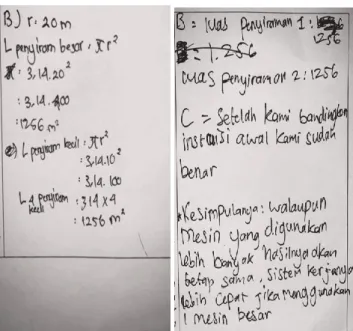
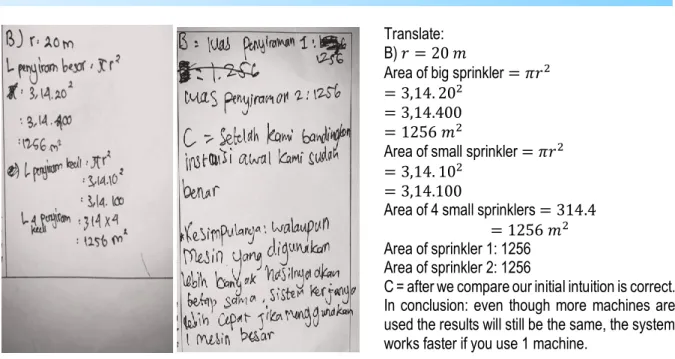
In this question, students were tasked with utilizing their intuition, followed by calculations to compare the area of a larger circle to that of several smaller circles created by sprinklers. The anticipated answer involves recognizing that the circular area of the two sprinklers is the same. Upon accurate calculation, the area of the small circle corresponds to a quarter of the area of the large circle, implying that the combined area of four small circles matches the area of one large circle. Below is an illustrative example of a student's response:
Translate:
B) 𝑟 = 20 𝑚
Area of big sprinkler = 𝜋𝑟2
= 3,14. 202
= 3,14.400
= 1256 𝑚2
Area of small sprinkler = 𝜋𝑟2
= 3,14. 102
= 3,14.100
Area of 4 small sprinklers = 314.4
= 1256 𝑚2 Area of sprinkler 1: 1256 Area of sprinkler 2: 1256
C = after we compare our initial intuition is correct.
In conclusion: even though more machines are used the results will still be the same, the system works faster if you use 1 machine.
Figure 8. Student’s Answer on Activity 5 Problem 2
Figure 8 demonstrates that most students could provide correct answers through calculations and intuition. Students arrived at the correct conclusion by observing that the area of four small circles resembles the area of the large circle when divided into four equal parts. This estimation was based on their visual comparison of the circle images in the two sprinklers' areas, leading them to accurately guess that the small circle's area is a quarter of the large circle's area.
In the context of the "what-if" questions, students began to explore the idea that even if the sprinklers were reduced in size and there were nine additional ones, the total area covered by the small circles would still be equivalent to the area covered by the large circle. This answer required students to apply the concept of congruence, recognizing that the large and small circles were essentially congruent two-dimensional shapes with the same proportional scale. This highlights that students could use their critical thinking skills in addition to intuition and calculations to resolve the problem. They exhibited the ability to analyze given problems using mathematical concepts and real-world understanding to arrive at suitable solutions. Hirza and Kusumah (2014) demonstrated that a realistic mathematics learning environment can enhance students' intuitive capabilities. Therefore, learning grounded in real-world contexts can foster the development of students' analytical and problem-solving skills. Moreover, effective mathematics education should empower students to cultivate their mathematical thinking skills, enabling them to tackle problems and grasp mathematical concepts (Çelik & Güzel, 2017).
However, while students demonstrated strong intuition and thinking skills, they still needed help in articulating proper reasoning. Students struggled to explain the rationale behind their answers and provide adequate justifications. The following is an example of a conversation between researchers and students:
Researchers : Putri, how do you expect the answer to this “what-if” question?
Putri : In my opinion, even though the sprinklers are divided by 9, the total area remains the same.
Researchers : Stay the same with which?
Putri : I mean it remains the same as the area of the large sprinkler sir.
Researchers : Why is that? If the previous one was only divided by 4, is divided by 9 also the same result?
Putri : I think so sir.
Researchers : Why?
Putri : I guess so sir, the problem is only divided.
The Impact of the HLT on The Students’ High-Order Thinking Skills in the Area of Circle Material
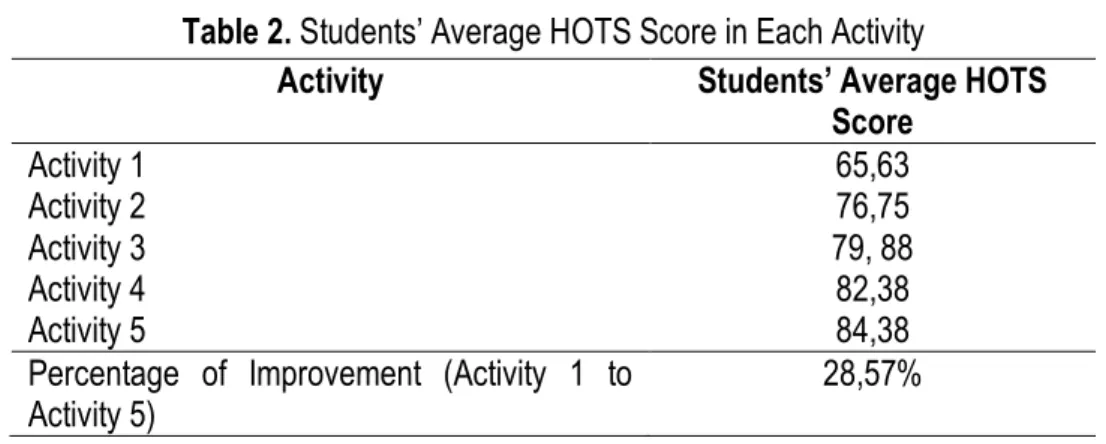
Throughout the five learning activities within the Hypothetical Learning Trajectory (HLT), students demonstrated notable progress in their higher-order thinking skills (HOTS). After each activity, the researchers consistently presented students with Higher-Order Thinking Skills (HOTS) problems, which were subsequently evaluated and used as material for reflective assessment. Table 2 presents the average development of students' higher-order thinking skills across each activity.
Table 2. Students’ Average HOTS Score in Each Activity
Activity Students’ Average HOTS
Score
Activity 1 65,63
Activity 2 76,75
Activity 3 79, 88
Activity 4 82,38
Activity 5 84,38
Percentage of Improvement (Activity 1 to
Activity 5) 28,57%
There is a significant increase in students' higher-order thinking skills from one activity to another, as shown in Table 2. These results also showcase the various perspectives on students' higher-order thinking skills. This research provides innovative "what-if" learning designs in broad circle materials that effectively improve students' higher-order thinking skills. From the results obtained in this study, "What- If" questions in learning can foster students' higher-order thinking skills by providing opportunities to challenge the problems they face. Payadnya et al. (2016) found that "What-If" questions can allow students to think divergently and creatively about various possibilities and solutions to their problems.
Activities challenging these problems will lead students to find new ideas and understand concepts more deeply (Song et al., 2007). The "what-if" questions presented in the lesson are quite effective.
Additionally, Şengül and Katranci (2015) found that "what-if" questions provoked students' desire to develop questions about problems and deepen their understanding of a material.
Researchers use real-world contexts in delivering material and problems in the learning carried out. Realistic learning that is designed can provoke students to associate mathematical problems with real-world contexts, thereby demonstrating excellent critical and creative thinking skills. For example, in the first activity, students were able to find a unique way to calculate the area of a circle by using ropes arranged in various ways. Learning using student worksheets that are based on real-world contexts and accompanied by activities to use visual aids is very suitable for improving students' mathematical thinking skills (Hirza & Kusumah, 2014). In line with this, Lestari et al. (2023) also found that realistic learning utilizing worksheets is practical and effective in improving students' critical thinking skills in mathematics lessons.
This research has yielded various unique and significant findings regarding students' thinking skills development and has highlighted several constraints and important notes for improving High-Level Thinking (HLT). These findings are presented in Table 3.
Table 3. Findings in Each Activity
Activity Findings
Activity 1 Students demonstrate a high level of creativity when solving problems within real-life contexts, but they still frequently make calculation errors.
Activity 2 Students are able to demonstrate reasoning abilities in problem-solving, but it may not be entirely precise and detailed
Activity 3 Students demonstrate a strong ability to establish connections between various mathematical concepts in problem-solving, but they encounter difficulties in thinking divergently when addressing 'what-if' questions Activity 4 Students show a strong interest in the use of technology in learning and
perceive technology as making learning more enjoyable and effective Activity 5 Students demonstrate good intuitive problem-solving skills, but they have
not yet displayed strong reasoning abilities
This research fills a gap in previous research regarding using "what-if" questions in learning. As in the study by Cai et al. (2022), "what-if" questions had a positive impact on increasing students' problem- solving skills, but in this study, the focus was on the variations of "what-if" questions given. Additionally, the most recent research by Mahmud and Mohd Drus (2023) uses "what-if" questions to encourage students' mathematical reasoning. Still, this study does not use "what-if" questions to construct students' knowledge in learning. In this study, the "what-if" questions became the "builders" and "evaluators" of learning activities. In this case, the builder initiates learning and determines the direction of students' learning activities.
Conversely, evaluation involves "what-if" questions in assessing learning achievement and improving higher-order thinking skills. Furthermore, this research employs circle area material, which must still be studied in geometry and measurement materials (Rejeki & Putri, 2018). Moreover, the learning trajectory in the circle material utilizes real contexts to enhance students' thinking skills, demonstrating high potential for learning success.
Some of the findings in this study will serve as reflections for researchers in improving future research. An interesting finding emerged from students' interest in technology-based learning. During the fifth session, students were taught to use GeoGebra media to find the formula for the area of a circle.
This underscores modern students, who are familiar with technology readily accept its application in learning. This highlights the high relevance of technology-based learning media for modern students and its potential to enhance thinking abilities. Bukhatwa et al. (2022) found that the technology-based interactive learning strategy is highly effective in mathematics learning. Utilizing technology to teach mathematics leads to better learning outcomes, improved performance, and quality (Homa-Agostinho &
Oliveira–Groenwald, 2020) while supporting student-centered learning (Kay & Ruttenberg-Rozen, 2020).
Therefore, future design improvements will focus on further enhancing the utilization of technology-based learning media.
Regarding reasoning, students have displayed some abilities in justifying the results obtained.
However, their reasoning abilities have yet to reach their maximum potential. Although students can
generally solve the problems given effectively, they need help articulating the logical reasons for the chosen solution methods. Furthermore, they need help properly explaining their answers, resulting in brief responses without a comprehensive explanation flow. Napitupulu et al. (2016) observed that secondary-level students cannot explain models, facts, properties, relationships, or patterns—collectively known as mathematical reasoning ability (MRA). NCTM (2000) asserts that learning mathematics must emphasize the use of inductive reasoning for pattern recognition and conjecture construction, the development of various mathematical arguments, spatial and comparison reasoning for problem-solving, deductive reasoning for argument validity, and situation analysis to ascertain properties and general structures. Students often struggle to explain connections between related concepts in problem-based learning. This reflection informs the focus of future designs on improving students' reasoning and justification abilities.
CONCLUSION
The designs developed in this study successfully elevated students' higher-order thinking skills in the area of circle materials. The learning trajectories crafted through the stages of preliminary design, experimental design, and retrospective analysis, anchored in "what-if" questions, have provided students with opportunities to engage in more critical and creative thinking during the learning process. This enables them to delve deeply into contextual problems and evolve their understanding of these problems.
This study addresses the gap by introducing a learning approach built upon "what-if" questions specifically tailored to the circle area material. The "what-if" questions assumed the roles of both scaffolding for learning and evaluating students' performance in learning activities. Educators can embrace the learning trajectory proposed herein as an innovative alternative to foster students' higher- order thinking skills.
However, this research isn't without its limitations as revealed by the outcomes of implementing the design in learning. The first limitation pertains to the utilization of technology, which was not maximized during the learning process. It has been observed that effective technology integration can enhance students' motivation and engagement, contributing to more enjoyable learning experiences. In this study, the incorporation of new technology was limited to only one activity, implying that the potential of technology, such as learning media and e-learning, has yet to be fully realized. Moreover, there were constraints in enhancing students' reasoning abilities. Drawing from the analysis of student responses, it is evident that students still face challenges in providing well-justified answers. This can be attributed to the limitations in the instructions and guidance presented in the provided worksheets. These aspects need to be carefully addressed to refine the design.
Considering the insights shared in the preceding paragraph, future research endeavors should strive to enhance the design by incorporating technology more extensively in the learning trajectory. This technology can be digital learning media, encompassing audio-visual elements that can be implemented through applications and instructional videos. The chosen technology should be innovative and interactive, fostering students' enthusiasm to enhance their higher-order thinking skills through various learning activities. Moreover, it is imperative to emphasize the aspect of reasoning within the student worksheets, guiding students to recognize the importance of substantiating all provided answers. This hallmark of justification characterizes students' ability to exhibit sound thinking and comprehension skills.
Acknowledgments
The researchers extend their heartfelt gratitude to the Institute of International Education (IIE) in the United States of America for their unwavering funding and support through the Fulbright US-ASEAN Visiting Scholar Initiative Program, which was pivotal in facilitating this research. The researchers also wish to acknowledge the invaluable collaboration that transpired among three distinguished universities during this study. Special appreciation is directed towards Western Michigan University in Kalamazoo, Michigan, U.S.A., and Universitas Ahmad Dahlan in Yogyakarta, Indonesia. These institutions generously provided the essential space, guidance, and facilities that were instrumental in the successful execution of this research.
Declarations
Author Contribution : IPAA: Conceptualization, Writing - Original Draft, Editing and Visualization.
RCIP: Writing - Review & Editing, Formal analysis, and Methodology.
JJL: Validation and Supervision.
PLP: Project administration, Resource.
IMDA: Project Software, Resource.
Funding Statement : This research was funded by Institute of International Education U.S.A.
through Fulbright US-ASEAN Visiting Scholar Initiative Program.
Conflict of Interest : The authors declare no conflict of interest.
Additional Information : Additional information is available for this paper.
REFERENCES
Ahmad, S., Prahmana, R. C. I., Kenedi, A. K., Helsa, Y., Arianil, Y., & Zainil, M. (2017). The instruments of higher order thinking skills. Journal of Physics: Conference Series, 943(1).
https://doi.org/10.1088/1742-6596/943/1/012053
Anderson & Krathwohl. (2002). Revisi Taksonomi Bloom (Revised of Bloom;s Taxonomy). Jakarta:
Rineka Cipta
Bakker, A. (2018). Design Research in Education: A Practical Guide for Early Career Researchers Bakker, A., & Eerde, V. (2015). An introduction to design-based research with an example from statistics
education. In A. Bikner-Ahsbahs, C. Knipping, & N. Presmeg (Eds.), Approaches to Qualitative Research in Mathematics Education (pp. 429-466). New York: Springer.
https://doi.org/10.1007/978-94-017-9181-6_16
Battista, M. T. (2017). Mathematical Reasoning and Sense Making. Reasoning and Sense Making in the Mathematics Classroom: Pre-K-Grade 2, 105(2), 1–19.
Brown, S., & Walter, M. (1969). What if not? Mathematics Teaching, 46, 38-45.
Brown, S. I., & Walter, M. I. (1990). The art of problem posing (2nd ed.). Hillsdale, NJ: Erlbaum.
Bukhatwa, B., Al Ruqeishi, E. N. A., & Al Khamisi, F. M. H. (2022). The Usefulness of Technology-based Interactive Methods in Teaching Mathematics and Statistics at the College Level. Shanlax International Journal of Education, 10(3), 30–40. https://doi.org/10.34293/education.v10i3.4627